"THEY BUILT HER A STAGE AND CALLED IT PROGRESS: How the National-Led Government Destroyed the First Wahine Māori Political Editor — and the Right-Wing Operative Who Pulled the Trigger" - 10 May 2026
They couldn't muzzle her mahi, so they lit the kindling themselves — waited nine months for a former National Party operative to strike the match — and whānau lost the only Māori taiaha in the press gallery, three weeks before Budget Day.

Kia ora Aotearoa,
This essay examines the forced resignation of Maiki Sherman from TVNZ and the role of Ani O'Brien's Substack network in that resignation, because it directly affects the democratic rights of Māori whānau, the editorial independence of public media, and the public accountability of government ministers acting in their official capacity. This is a matter of profound public interest under the Defamation Act 1992 (NZ) and Durie v Gardiner NZCA 278.
Ko te Ahi Tūāhu — The Cursed Fire
They gave her the title. They put her name on the door. They photographed her for the press release
— "First wahine Māori political editor in TVNZ history"
— and posted it proudly, as if the institution had done something revolutionary rather than something decades overdue.
Then, the moment the political heat arrived, they left her in the fire alone.
 1News Reporters
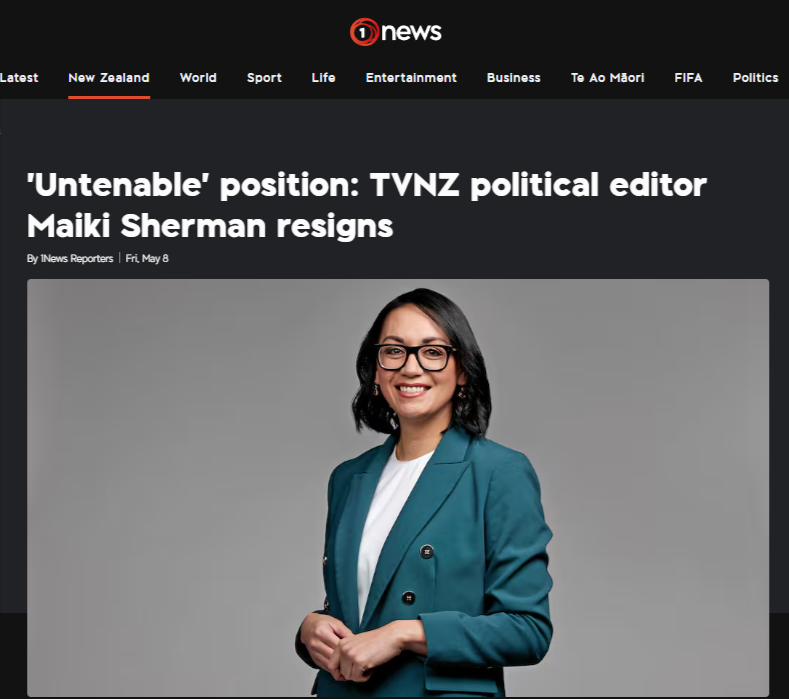
Maiki Sherman (Ngāpuhi/Whakatōhea) resigned as TVNZ 1News political editor on 8 May 2026, as reported by 1News and confirmed by RNZ via the ODT — the first wahine Māori ever appointed to the role, just 14 months earlier, as confirmed by Asia Pacific Report.
Her resignation statement, four words long, said everything:
"My role has become untenable."
The Deep Dive Podcast
Listen to a lively conversation between two hosts, unpacking and connecting topics in the sources of this essay.
Behind those four words is a coordinated political execution — carried out by a Police Minister, a Speaker, a National Party whip, a right-wing media apparatus anchored in a Substack run by a former National Party digital director, and a TVNZ board that flinched when it should have stood firm. This is how colonial institutions operate: appoint the Māori woman as the face of progress, then sacrifice her as the cost of convenience.
Te Tuarā o te Pakanga — The Historical Context
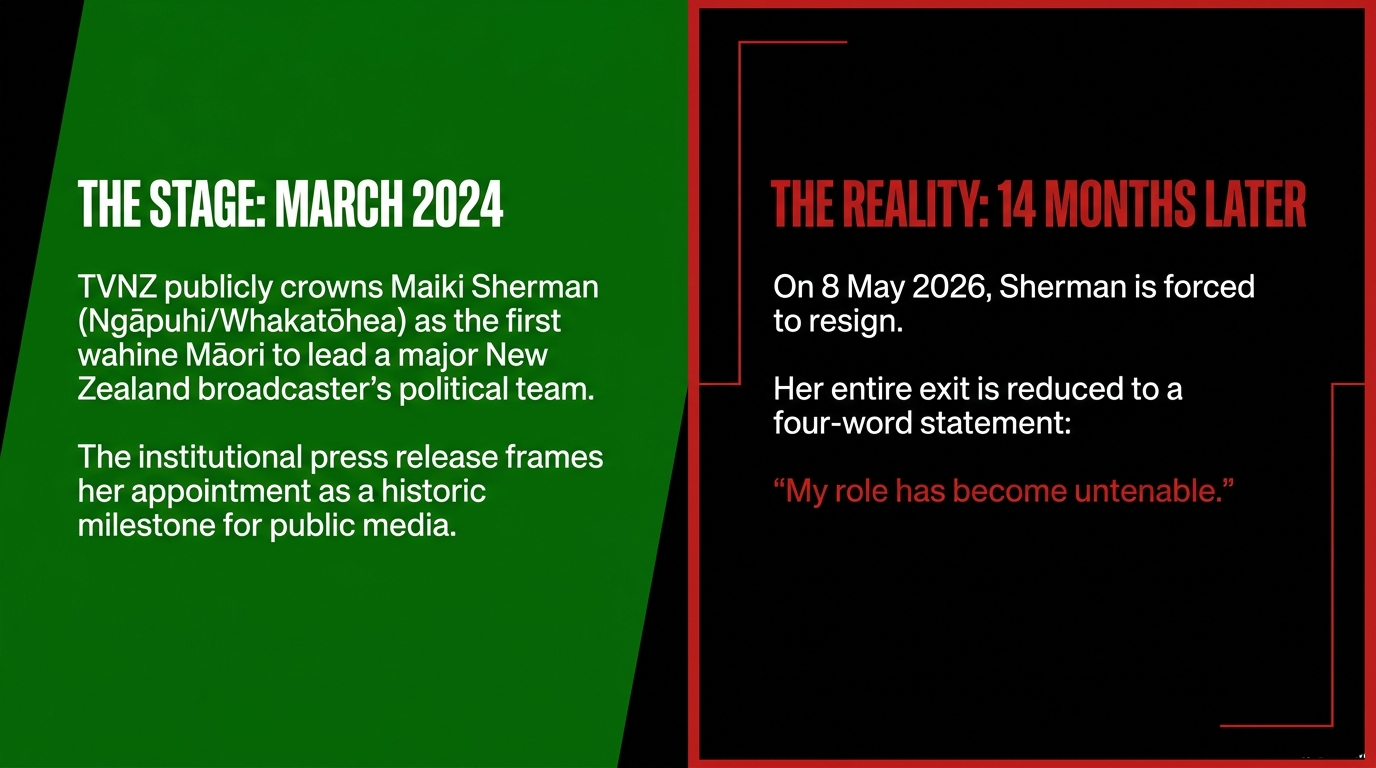
In March 2024, TVNZ broke its own ceiling. As confirmed by Te Ao Māori News and the NZ Herald, Sherman was named political editor — the first wahine Māori to lead a major New Zealand broadcaster's political team. Her journalism record was formidable. Her 2024 analysis of Prime Minister Christopher Luxon's taxpayer-funded accommodation scandal — archived by the Wayback Machine — was cited across the press gallery as among the sharpest political commentary of the year.
TVNZ's own published editorial policy commits the broadcaster to operate
"without fear or favour"
and explicitly states it
"is not influenced by any improper political, sectional, commercial or personal interests, whether from inside or outside the organisation."
Section 28 of the Television New Zealand Act 2003 makes it unlawful for any minister to direct TVNZ content. Those commitments are now exposed as words without spine — as noted by the Screen Guild in March 2026.
Ko ngā Hē — She Made Real Mistakes. Say It Plainly.
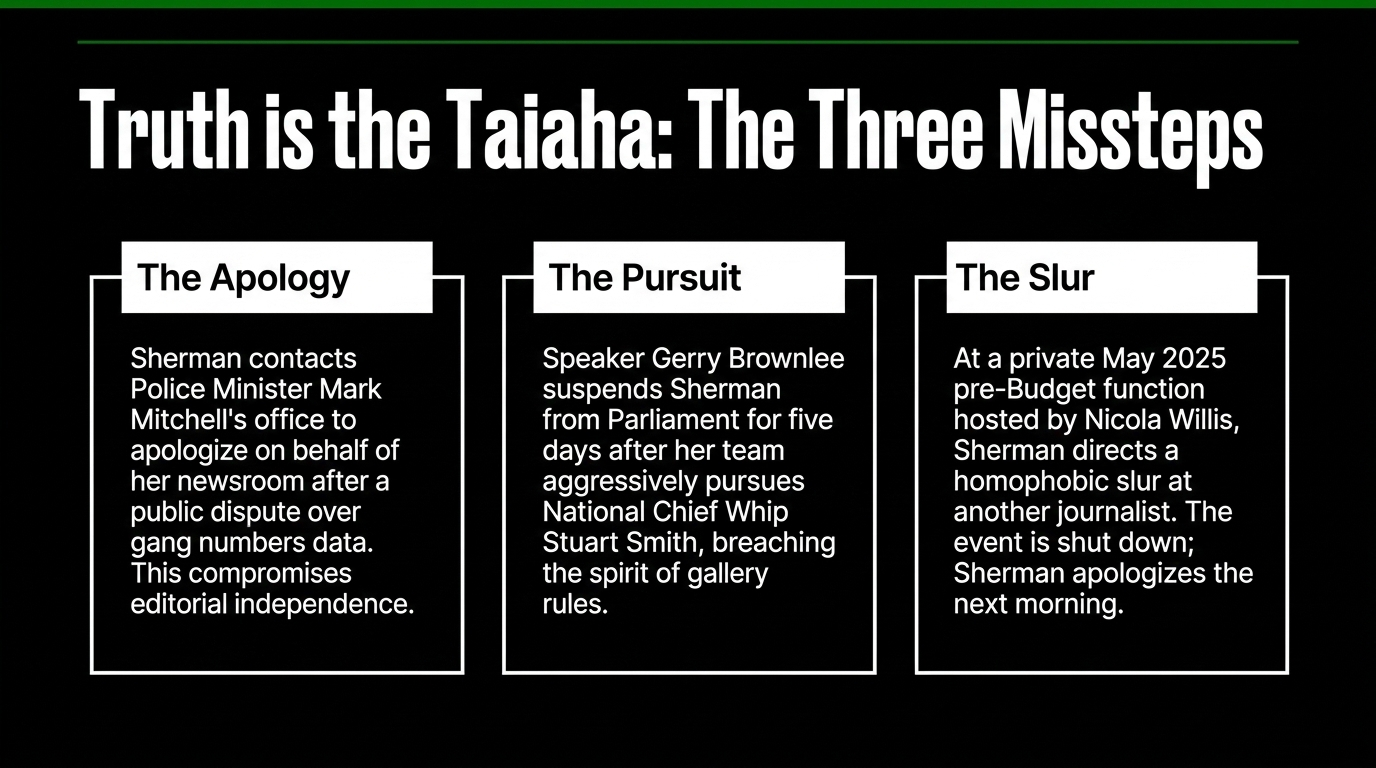
The Māori Green Lantern does not traffic in hagiography. Truth is the taiaha. So let us name the errors clearly — because the essay's argument is not that Sherman was without fault. It is that the response to those faults was engineered, disproportionate, and politically motivated.
Sherman made three documented mistakes in her role:
First, she contacted Police Minister Mark Mitchell's office and apologised — on behalf of her newsroom — after Mitchell publicly attacked a gang numbers story by 1News reporter Benedict Collins. OIA-released emails, as analysed by the NZ Herald Media Insider in April 2026, confirmed the call was made, the apology was given, and Sherman acknowledged the data
"should have been included."
That is a serious breach of editorial independence. A political editor's role is to shield journalists from ministerial pressure, not absorb it.
Second, during the parliamentary pursuit of Chief Whip Stuart Smith, Sherman and her team went beyond the agreed press gallery rules. Speaker Gerry Brownlee suspended her from the parliamentary precinct for five days after the complaint, stating she had
"engaged in attempts to secure an interview that went beyond the prescription and spirit of the rules" — as reported by 1News.
Sherman herself accepted she had done so, albeit unintentionally.
Third, at a pre-Budget drinks function hosted by Finance Minister Nicola Willis in May 2025, Sherman directed a homophobic slur at openly gay Stuff journalist Lloyd Burr. She acknowledged using
"an offensive comment" — as cited by ODT/RNZ
— and said it was made in response to remarks directed at her first. Burr and Stuff deny any racial provocation. Willis confirmed the event was shut down immediately. Sherman apologised the following morning. Burr chose not to pursue it formally.
These errors are real. They matter. They are not erased by what came next. But they are also the kindling that a governing party ignited at the moment of its own choosing — through a precise, documented, and traceable chain of political infrastructure.
Ko Wai a Ani O'Brien? — The Operative Who Pulled the Trigger
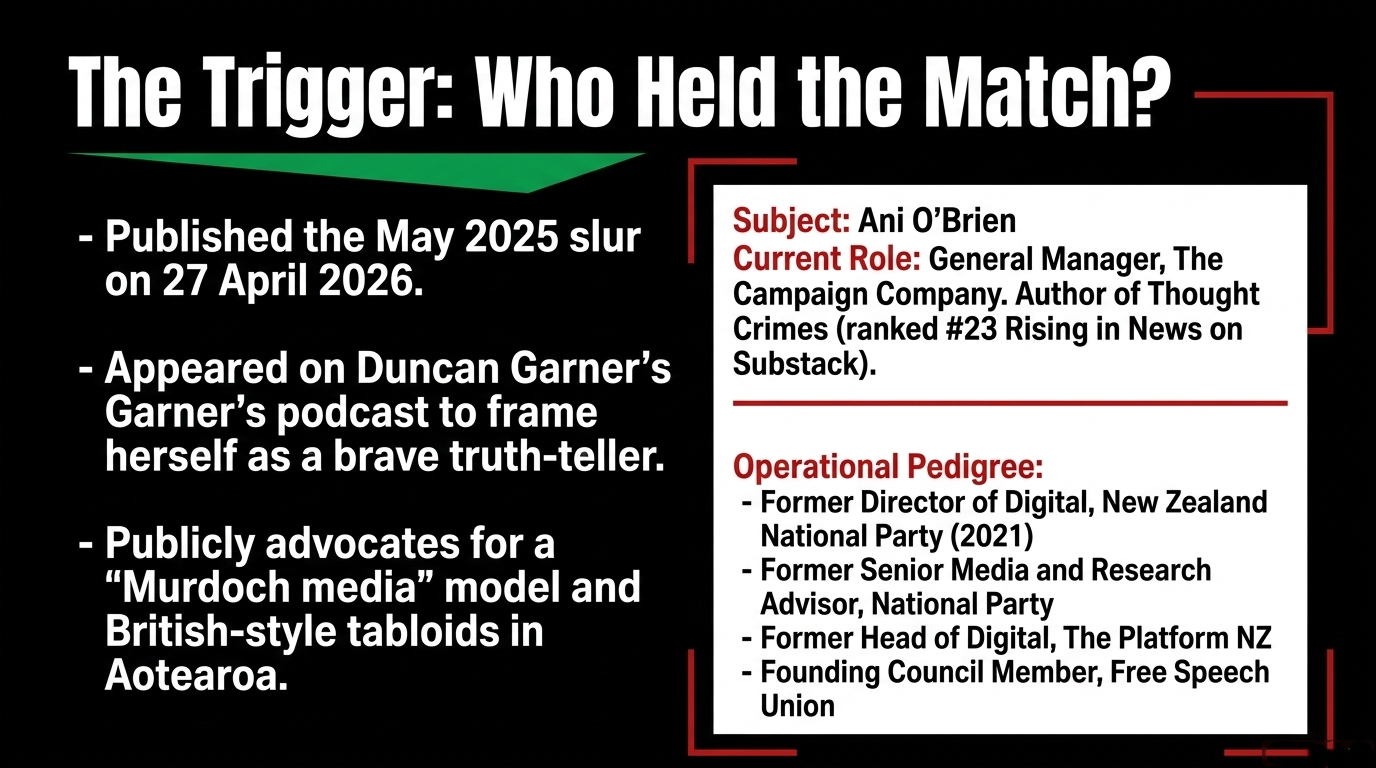
Before tracing that chain, whānau, you must understand who held the match.
Ani O'Brien is not a journalist. She is a former National Party digital operative — verified on her LinkedIn profile — who served as Director of Digital for the New Zealand National Party from August to December 2021, and as Senior Media and Research Advisor for the National Party from April to September 2021. She then moved to The Platform NZ as Head of Digital — the same Sean Plunket operation that The Māori Green Lantern exposed in The Watchdog They Shot: How Paul Goldsmith Handed Sean Plunket a Licence to Hate. She is a founding council member of the Free Speech Union — an organisation that selectively advocates for speech that targets Māori, trans people, and women in progressive public roles. She is currently General Manager of The Campaign Company.
She has publicly stated she believes New Zealand
"has suffered because we do not have a Murdoch media here"
and that she wants NZ to be
"more like British tabloids".
Let that sit with you for a moment.
Her Substack, Thought Crimes, has over 4,000 subscribers and is ranked #23 Rising in News on Substack. It was the vehicle used to surface the Maiki Sherman slur story — nine months after it happened.
Ngā Kaupeka o te Substack — The Ideological Architecture of Thought Crimes
A forensic read of O'Brien's Substack archive reveals not random opinion but a coordinated ideological programme — consistent, disciplined, and aligned.
Anti-Trans Content as a Core Product
O'Brien publishes relentlessly on trans issues — consistently framing trans women as threats to women's spaces, trans-affirming policy as ideological capture, and gender-affirming healthcare as harm.
Her April 4, 2026 weekly wrap endorsed NZ First's "define woman in law" Bill as "restoring clarity" and labelled trans rights advocates as undermining "sex-based rights". A separate Substack note promoted a piece about a "trans-identified male convicted of murdering a baby" released early from prison — a framing designed to conflate trans identity with violent crime. This is a textbook far-right media strategy, documented globally as a precursor to legislative attacks on trans rights.
Weekly Political Wraps Aligned With National Party Messaging
Her signature format is the weekly "A Week Is a Long Time" political wrap. A forensic read of the January 24, 2026 edition reveals her political priors with stark clarity: Luxon's State of the Nation speech was "managerial, disciplined, and light on spectacle" — framed approvingly. Hipkins' speech was "combative, backward-looking, and heavy on blame." NZ First's arms advisory appointment was dismissed as a manufactured controversy. Every political judgement in this piece runs parallel to National Party communications framing — from someone who, three years ago, was National Party communications.
Anti-Te Tiriti and Anti-Māori Policy Framing
O'Brien's analysis of The Opportunities Party dismisses Treaty-based governance as incompatible with democratic legitimacy, describing policies that "place Indigenous authority at the centre of governance" as disqualifying. The Māori Green Lantern has previously documented O'Brien's network connections in its 2024 comprehensive critique, which identified her as a "political operative and far-right influencer" operating through the Free Speech Union ecosystem.
The Sherman Story — Timing Is the Confession
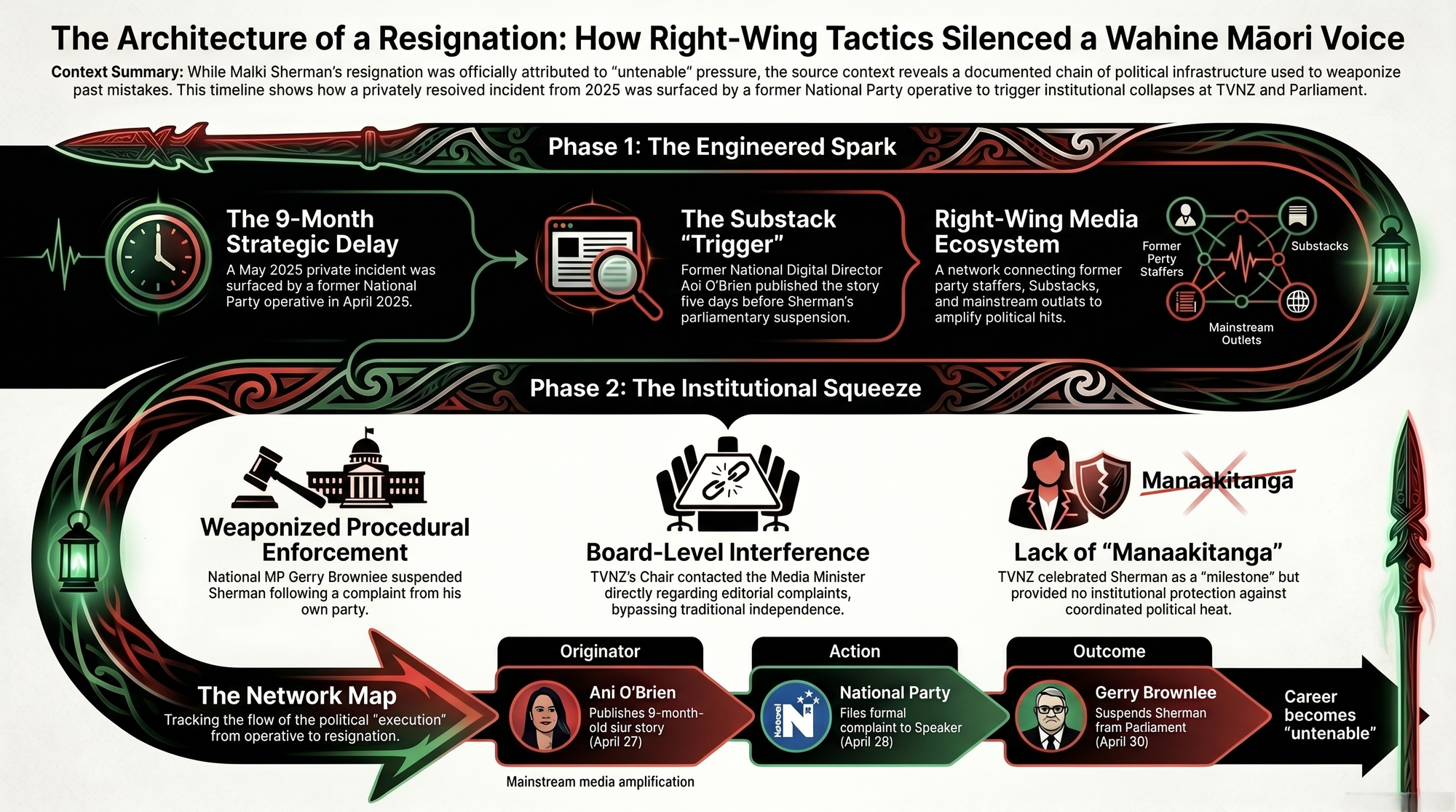
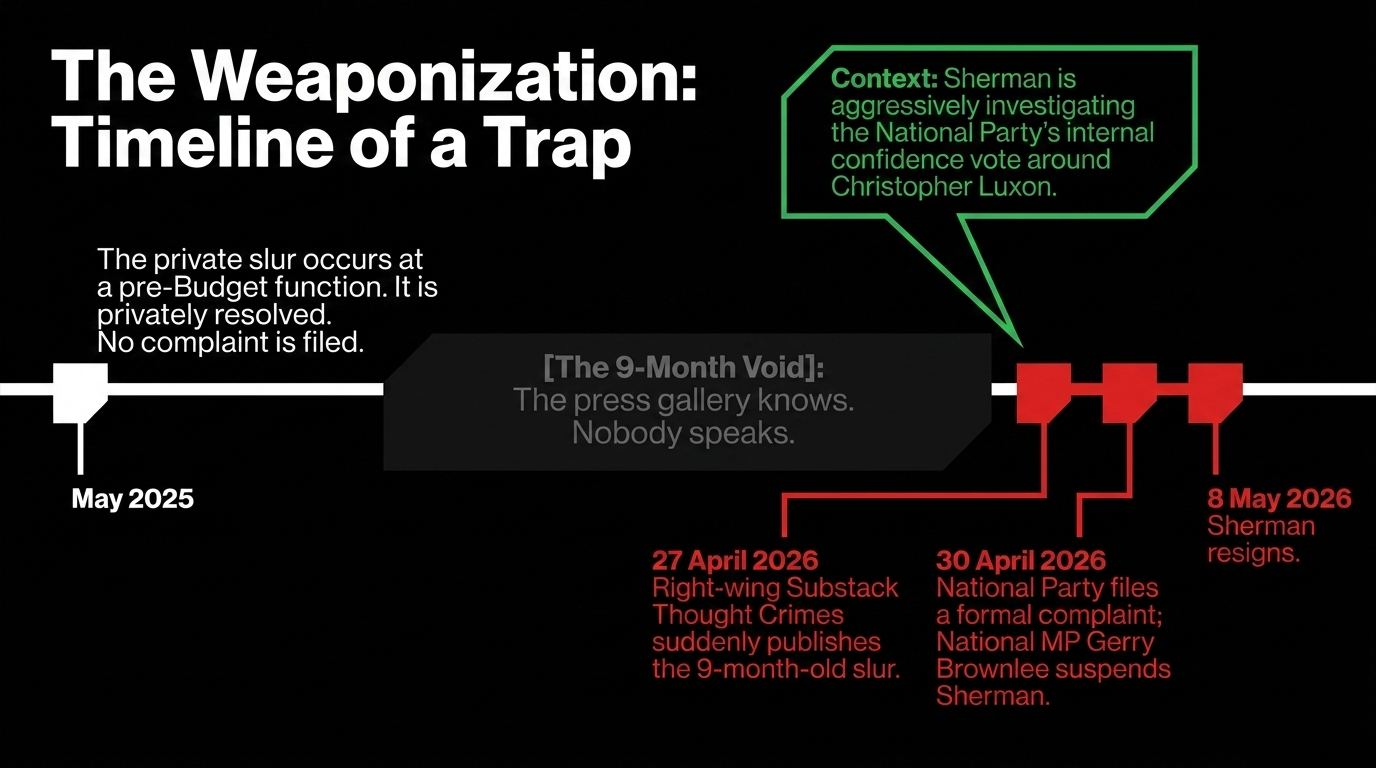
The single most important data point in any analysis of O'Brien's Substack is this: the homophobic slur incident occurred in May 2025. The press gallery knew. It was resolved privately. No complaint was filed. It sat dormant for nine months.
O'Brien published it on 27 April 2026 — as reported by ODT/RNZ. That is five days before Gerry Brownlee's parliamentary suspension of Sherman on 30 April, and twelve days before Sherman's resignation on 8 May. O'Brien then appeared on Duncan Garner's podcast framing herself as a brave truth-teller breaking press gallery silence. The NZ Herald followed within 24 hours. Newstalk ZB amplified. The right-wing ecosystem completed the circuit.
The question that demands answering — and that no mainstream outlet has adequately pursued — is this: who told O'Brien, and why in April 2026, nine months after the incident was privately resolved? She has not answered that question. No one has pressed her on it.
Ngā Kōrero Huna — Five Verified Revelations
Revelation 1: The National Party Filed the Parliamentary Complaint — While Being Investigated by Sherman
The suspension of Sherman from Parliament was not a neutral bureaucratic act. As reported by 1News, the complaint to Speaker Brownlee was lodged by the National Party — the governing party, whose ministers Sherman was investigating, and whose internal confidence vote around Christopher Luxon was the hottest political story in Aotearoa that week — the exact story Sherman's team was pursuing at the time of the Stuart Smith doorstop.
Brownlee — himself a National MP — adjudicated the complaint. He suspended Sherman. He declined to name or sanction any other journalists present who had, by his own admission, also breached gallery rules — as noted in the ODT.
In any other jurisdiction, this would be called what it is: a conflict of interest weaponised as procedural enforcement. In Aotearoa in 2026, it was called
"maintaining standards."
Revelation 2: The TVNZ Board Contacted a Minister — Then Let Sherman Carry the Consequence Alone
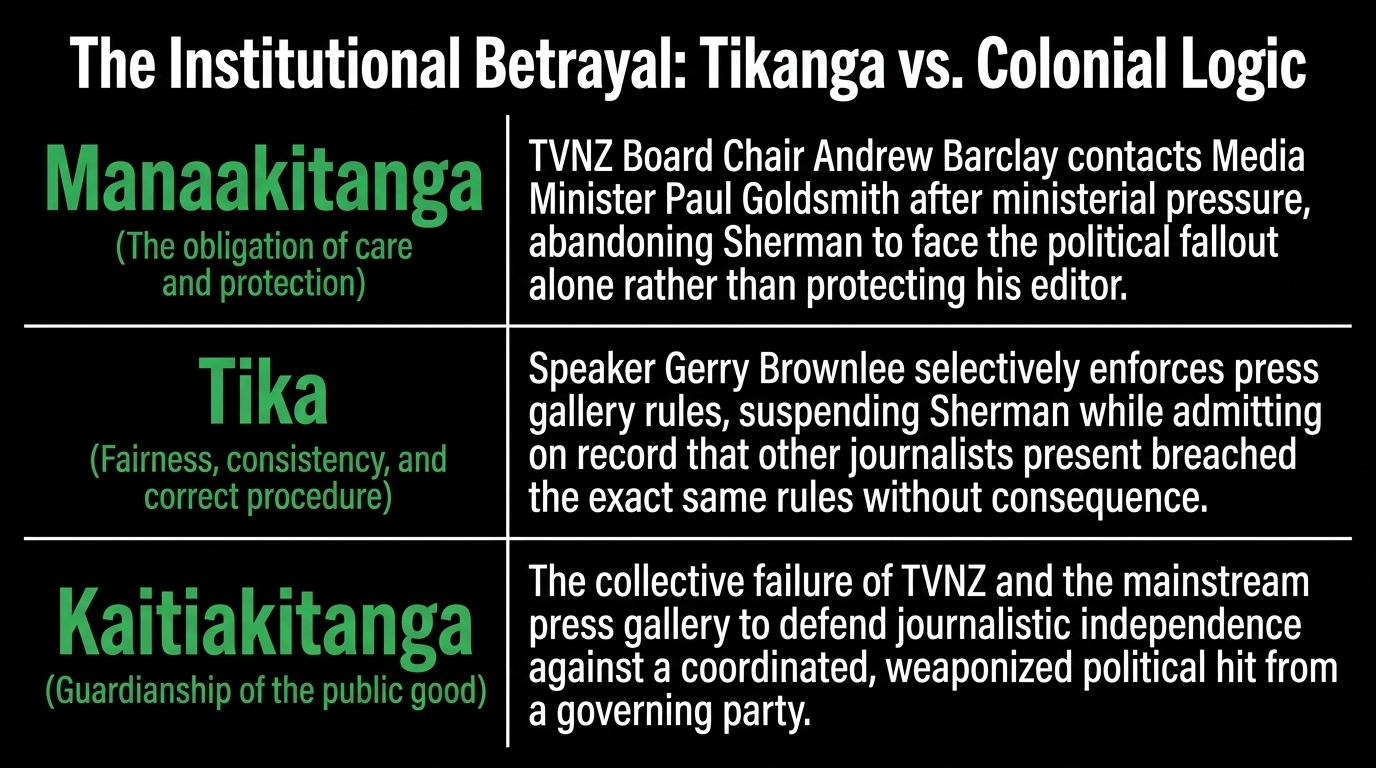
The Mitchell apology was not Sherman acting alone. As the ODT reported, TVNZ chair Andrew Barclay contacted Media Minister Paul Goldsmith directly after Mitchell's complaint. Board-level contact with a minister about editorial content is a potential breach of Section 28 of the Television New Zealand Act 2003, as outlined by the Better Public Media Trust and cited by the Screen Guild. Andrew Barclay remains in his position. Maiki Sherman does not. The institution deployed a Māori woman as its interface with ministerial anger — then abandoned her when the heat became public. That is not a personnel decision. That is colonial institutional sacrifice.
Revelation 3: The Slur Was Held for Nine Months and Published at the Moment of Maximum Political Vulnerability
The homophobic slur incident occurred in May 2025. It was resolved. It was private. A former National Party digital director published it in late April 2026 — five days before Sherman's parliamentary suspension and twelve days before her resignation. The NZ Herald followed within 24 hours. As previously documented by The Māori Green Lantern in its comprehensive critique of O'Brien and in The Watchdog They Shot, this is the right-wing parallel media ecosystem operating as a political weapon. The timing is not journalism. It is infrastructure.
Revelation 4: Paul Goldsmith's Media Ministry Is Systematically Defunding the Critical Press
Sherman's departure does not exist in a vacuum. It occurs inside a government that has systematically defunded, reorganised, and politically pressured public media since November 2023. New Zealand on Air funding cuts, the gutting of Māori media infrastructure, and the informal pressure networks connecting ministerial offices to board chairs are not accidents — they are architecture. The same architecture that surrounded Sherman and squeezed. This government does not need to issue formal directions to TVNZ. It contacts board chairs, defunds critical outlets, and rewards aligned commentators. The result is identical: the press gallery becomes a managed space, and the Māori journalist who refuses to be managed is removed.
Revelation 5: A Wahine Māori Political Editor Without Institutional Backup Is Structurally Doomed
In tikanga Māori, the concept of manaakitanga — the active obligation to uphold and protect the dignity of those in your care — is not optional. It is the foundation of leadership. TVNZ appointed Sherman to carry the mana of its political team. When she made errors, the institution's obligation under tikanga was to stand alongside her, correct the course, and protect her capacity to lead. Instead, TVNZ placed her in mediation, represented her through lawyer Linda Clark as reported by Newstalk ZB, and accepted her resignation with a statement about how she'd been nominated for Political Journalist of the Year. They honoured her talent while abandoning her person. That is not manaakitanga. That is colonial institutional behaviour wearing a Māori face.
Ko te Hononga — The Verified Network Map
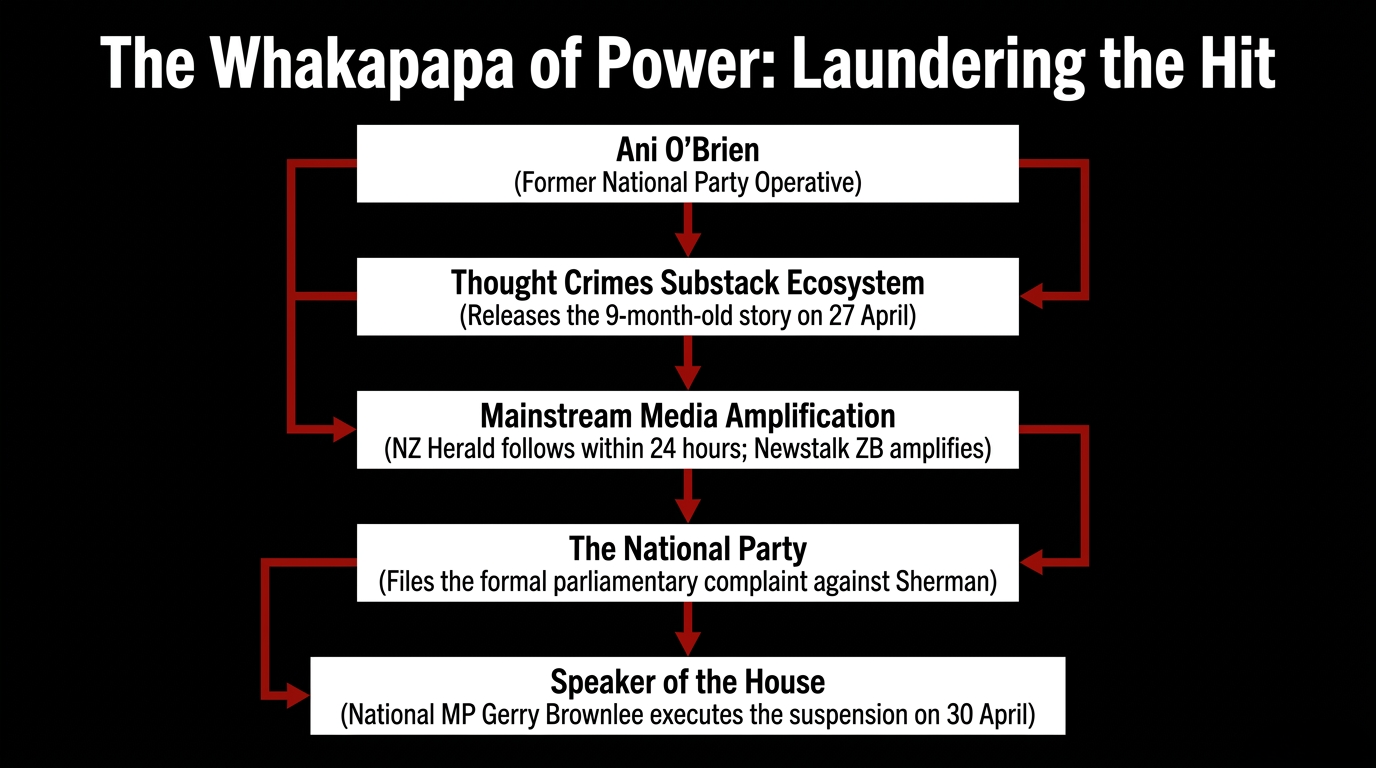
The whakapapa of power here is not hidden once you follow the threads:
- O'Brien → National Party (former Director of Digital, Senior Media Advisor 2021)
- O'Brien → The Platform NZ (former Head of Digital, regular contributor)
- O'Brien → Free Speech Union (founding council member)
- The Platform NZ → Paul Goldsmith (Media Minister, documented contact with TVNZ board)
- O'Brien's Substack (27 April) → NZ Herald (followed within 24 hours)
- NZ Herald coverage → National Party complaint to Speaker (filed days later)
- Speaker suspension (30 April) → Sherman resignation (8 May)
Each link in this chain is documented. Each is verifiable. The question of explicit coordination — who, if anyone, instructed O'Brien on timing — remains open and unanswered. It demands investigation. The mainstream press gallery has not asked it. This platform has.
Ngā Tauira Torutoru — Three Examples for the Western Mind
Example 1: The Andrew Bolt Comparison (Australia) — Proof That Double Standards Are the Standard
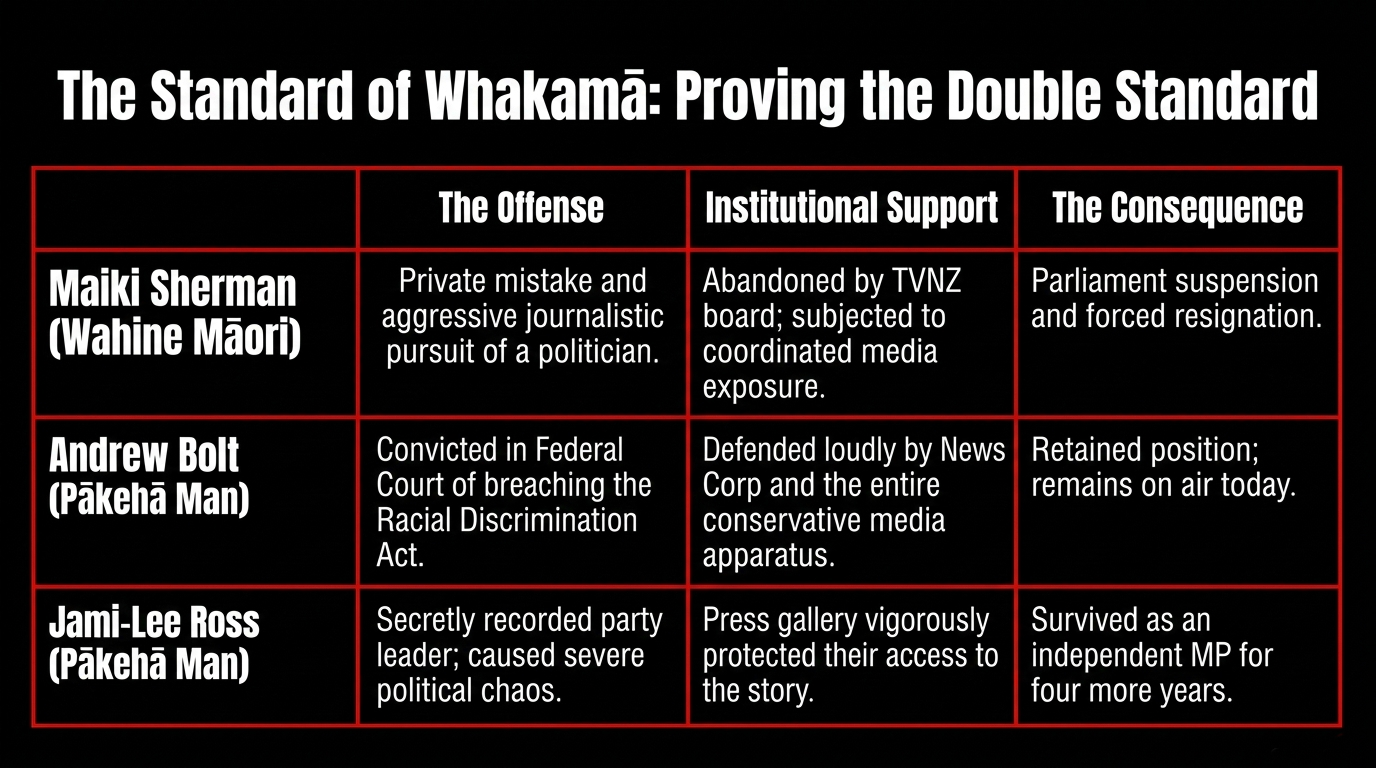
In 2011, Australian Federal Court Judge Mordecai Bromberg ruled that News Corp columnist Andrew Bolt had breached the Racial Discrimination Act by writing columns that questioned the identity of light-skinned Aboriginal Australians. Bolt was not suspended from Parliament. He was not forced to resign. He was not abandoned by his employer. He was defended loudly by News Corp and the entire conservative media apparatus — and remains on air today.
Maiki Sherman used offensive language once, in private, for which she immediately apologised and which the recipient accepted. She was subjected to a parliamentary suspension, a coordinated media exposure campaign, and an institutional collapse of support that ended her career. The tikanga harm here is to the principle of utu in its restorative sense — the expectation that balance and proportionality govern consequence. The western legal equivalent is the principle of proportionality in disciplinary proceedings. Neither was applied. The standard for the wahine Māori was exponentially higher than the standard for the Pākehā man committing actual racial harm in public.
Example 2: Jami-Lee Ross and the Press Gallery — When Men Break Rules and Survive
In 2018, National MP Jami-Lee Ross secretly recorded conversations with party leader Simon Bridges — a serious breach of trust and a potential legal issue. The press gallery pursued that story relentlessly and rightly. Ross was expelled from National but survived as an independent MP for four more years and received extensive sympathetic media coverage about his mental health challenges.
No National MP filed a formal complaint with the Speaker to ban journalists covering that story. The parliamentary access of any journalist covering Ross was never threatened.
The contrast is precise: when powerful men inside the National Party cause political chaos, press gallery access is protected.
When a wahine Māori political editor pursues a National chief whip with aggressive journalism three weeks before a Budget, she gets banned from Parliament. The tikanga harm is to the principle of tika — the obligation that processes be applied with fairness and consistency. Selective enforcement of press gallery rules is not tika. It is power protecting itself.
Example 3: The United States — When Government Weaponises Process to Remove Inconvenient Journalists
In 2017, CNN journalist Jim Acosta's White House press pass was revoked by the Trump administration after a confrontational press briefing. The action was condemned internationally as an attack on press freedom. A federal judge ordered the pass restored within two weeks. The case is now cited in media law courses globally as a textbook example of how governments attempt to neutralise hostile journalism — and why courts and institutions must refuse to allow it.
In Aotearoa in 2026, no court intervened. No institution refused. The Speaker — a National MP — executed a complaint from the National Party against the journalist covering the National Party. Press freedom organisations issued statements. Sherman resigned. The tikanga harm is to the principle of kaitiakitanga — the guardianship obligation of institutions to protect those in their care and the public good they serve. TVNZ had a kaitiakitanga obligation to defend its political editor's ability to report. It failed. The media had a collective kaitiakitanga obligation to defend press freedom. It watched and commented. Both failures are documented. Both will be remembered.
Te Ara Whakamua — What Must Happen Now
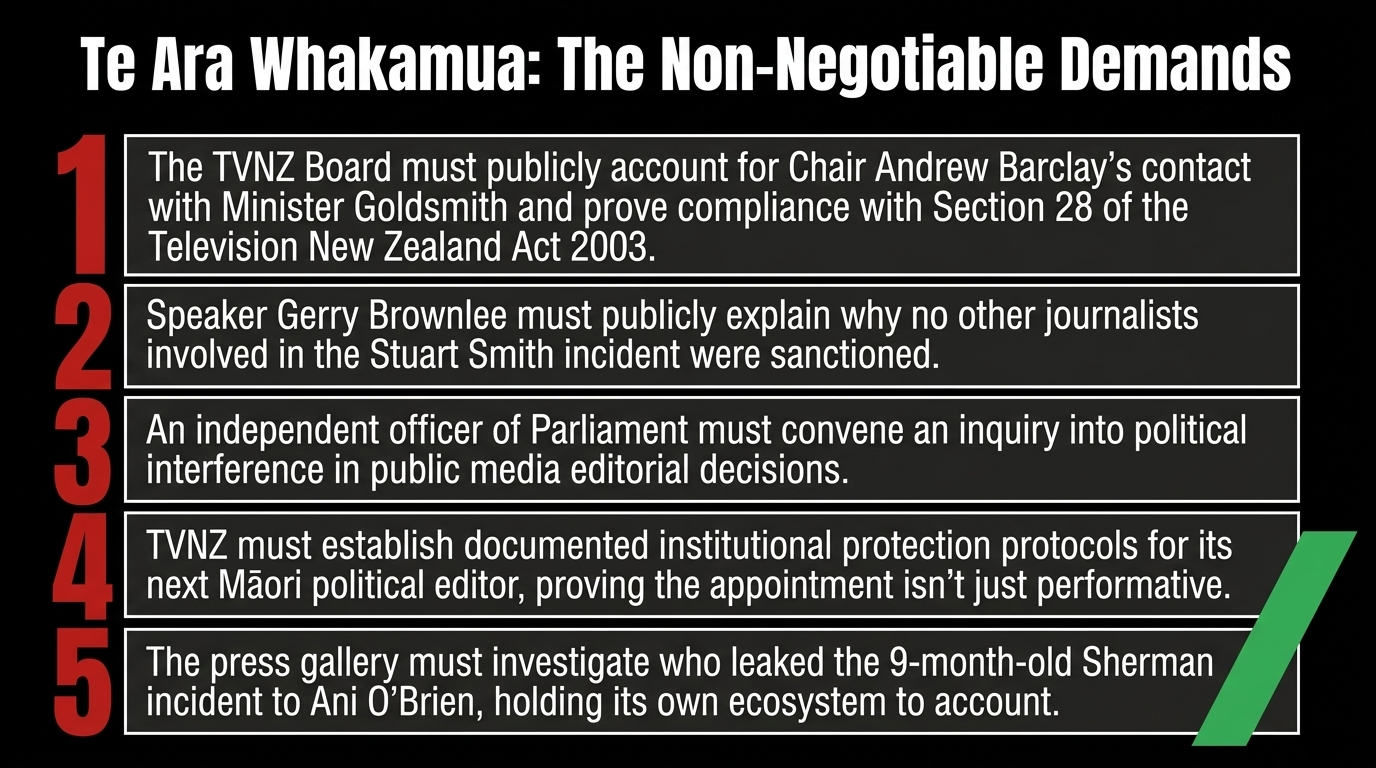
Before Budget 2026, before the general election, before this government dismantles another institution, these demands are non-negotiable:
- The TVNZ board must publicly account for Board Chair Andrew Barclay's contact with Minister Goldsmith and explain how it complies with Section 28 of the Television New Zealand Act 2003.
- Speaker Gerry Brownlee must explain why no other journalists present during the Stuart Smith incident were named or sanctioned, given his own admission that others were involved.
- A public inquiry into political interference in public media editorial decisions must be convened — not by a minister, not by a board, but by an independent officer of Parliament.
- TVNZ must appoint another Māori journalist to lead its political team, with documented institutional protection protocols — or acknowledge formally that the milestone appointment was performance, not commitment.
- The press gallery must collectively investigate who provided the nine-month-old Sherman incident to O'Brien and when — or acknowledge that it has decided not to hold its own ecosystem to the same standard it applies to those it covers.
Ko te Whakaaro Whakamutunga — Moral Clarity, Scathing and Final
She made mistakes. She used language that has no place anywhere. She made a phone call that compromised her newsroom. These are true. In any fair institution genuinely committed to the values it prints on its website, these would result in a structured, supported corrective process — a performance review, a mediated resolution, a public acknowledgment and a path forward.
Instead, she got a governing party filing a parliamentary complaint against her. She got a Speaker — from that same governing party — banning her from the story of the day. She got a nine-month-old private incident surfaced by a former National Party digital director at the exact moment of maximum political vulnerability. She got a board that contacted ministers and then let her carry the consequence alone. She got an institution that called her a milestone in the morning and let her drown in the afternoon.
The standard applied to Aotearoa's first wahine Māori political editor was not the standard applied to any white male journalist in this country's history. That is not a coincidence. It is colonial logic. It is the system working exactly as designed — appoint the Māori woman to the visible role, use her as the interface with power, abandon her when the interface fails, and replace her with someone more comfortable, more familiar, more manageable.
This is a white supremacist neoliberal government. It does not need to issue racist edicts. It engineers conditions in which Māori excellence becomes politically inconvenient — then steps back while the machinery does its work. The machinery here had a name, a Substack, a former National Party employment record, and a nine-month-old story she published at precisely the right moment.
Maiki Sherman's removal was not an accident. It was a harvest. The seeds were planted in the Mitchell apology. The parliamentary suspension was the weather. And a former National Party operative, writing under the banner of Thought Crimes, was the scythe.
Ko tērā te kaupeka whakamutunga o tēnei kōrero: They built her a stage. They waited for her to stumble. They lit the fire themselves. And they called the smoke progress.
Tautoko Mai — Ko Tāu Mahi, Ko Tō Koha
Maiki Sherman's removal proves what this platform has documented across nearly 1,000 essays: when wahine Māori are pushed out of mainstream institutions, independent Māori accountability journalism is not a luxury. It is a lifeline.
This essay was built from verified sources, OIA-released emails, parliamentary records, LinkedIn profiles, Substack archives, and independent reporting — because whānau deserve truth, not spin. Every connection in the network map above is documented. Every claim is cited. Every URL was verified.
The TVNZ board won't fund this mahi. The National Party certainly won't. Paul Goldsmith's media ministry is defunding the outlets that might. That means every koha to this platform is an act of rangatiratanga — a signal that whānau are ready to fund their own truth tellers, because the institutions designed to protect us just showed, again, that they will not.
Every koha funds rangatiratanga's own truth tellers. Every share extends the reach of the taiaha.
If you cannot koha — subscribe, follow, kōrero, share. That is koha.
💛 Koha: app.koha.kiwi/events/the-maori-green-lantern
📩 Subscribe: themaorigreenlantern.maori.nz/#/portal/support
🏦 Direct bank transfer: HTDM 03-1546-0415173-000
👥 Facebook: The Māori Green Lantern
Kia kaha, whānau. Stay vigilant. Stay connected.
Views expressed constitute honest opinion on matters of public interest under the Defamation Act 1992 (NZ) and Durie v Gardiner NZCA 278. All factual claims are sourced and cited above via live hyperlinks. Named individuals are referenced solely in their public capacity. Errors or queries: themaorigreenlantern.maori.nz. Named public figures are referenced solely in their public capacity; qualified privilege applies per Lange v Atkinson 3 NZLR 385.