"The Taniwha Who Wears the Crown's Feathers: Tania Tapsell and the Twelve Ways She Serves the Machine That Devours Her Own People" - 10 May 2026
A National Party operative sits in the mayor's chair of the most Māori city in Aotearoa — dismantling Māori structural power, one council vote at a time, and calling it leadership.

Kia ora koutou ano,
This essay examines Tania Tapsell's political affiliations and her record of decisions as Mayor of Rotorua because they directly affect Māori whānau in Rotorua, democratic rights, and the public accountability of an elected official exercising power over tangata whenua. Public interest framing per Durie v Gardiner NZCA 278.
The Metaphor: A River Dammed by Its Own Headwaters
Imagine the Kaituna River — pulsing with mauri, life-force of Te Arawa — but at its headwaters, someone has built a dam. Not a foreign dam. Not a Pākehā dam. A dam built by a woman who carries Te Arawa whakapapa in her veins, trained on the National Party's political machinery since she was 14 years old, shaped and mentored by the very figures who have spent decades ensuring that Māori political power flows away from Māori communities — and into Wellington boardrooms, corporate interests, and the quiet comfort of those who already hold the floodgates.
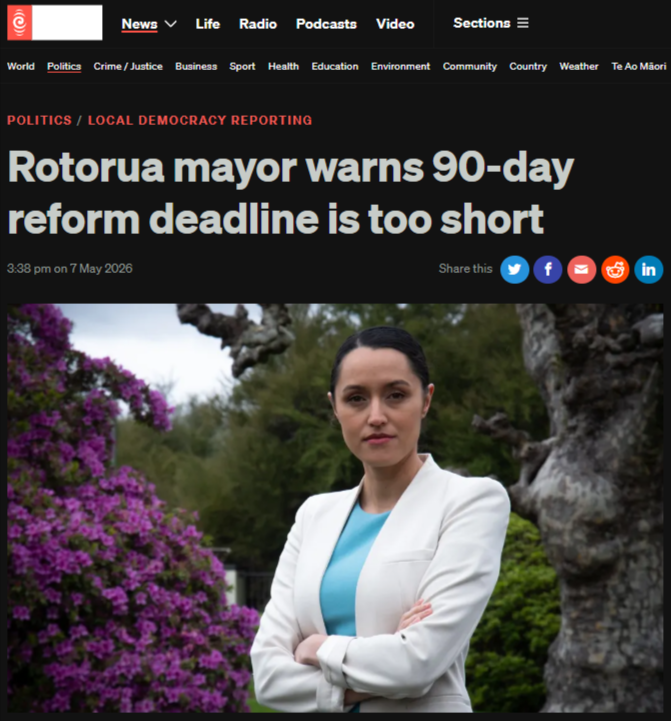
 RNZ News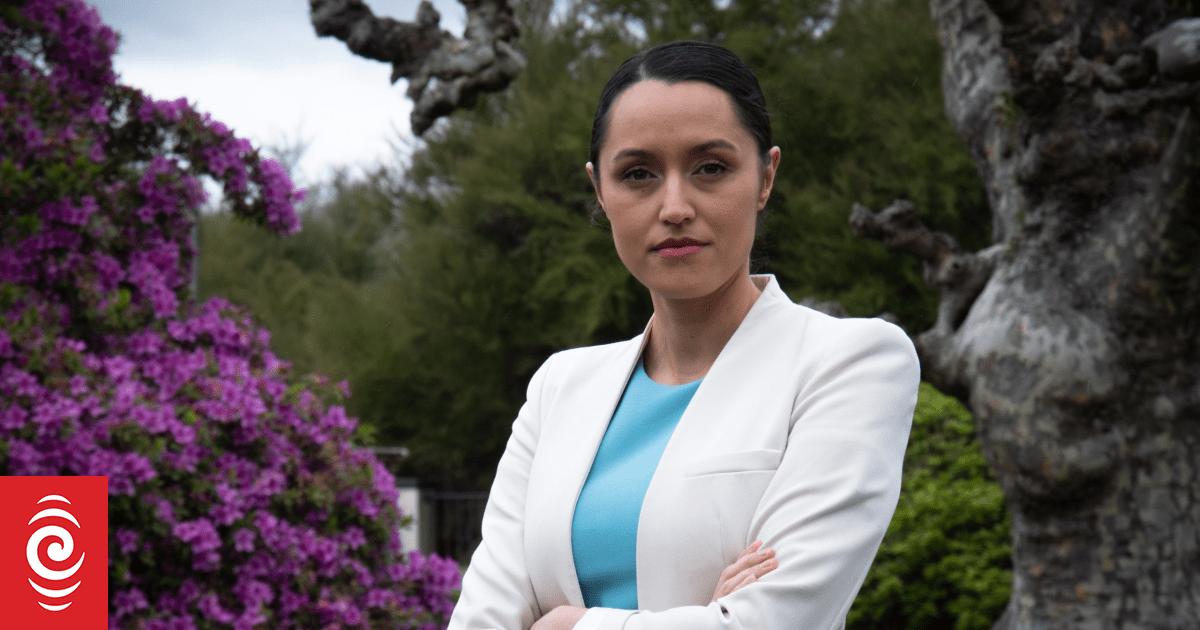
That woman is Tania Tapsell: Mayor of Rotorua, National Party candidate, political protégé of Todd McClay, corporate-funded incumbent, and the Crown's most useful face in the most Māori city in Aotearoa.
She is not the enemy. She is the instrument. And instruments do not choose who wields them — but we are entitled to ask who polished them, who sharpened them, and in whose name they cut.
The Deep Dive Podcast
Listen to a lively conversation between two hosts, unpacking and connecting topics in the sources of this essay.
This is a white supremacist neoliberal government. Say it. Prove it. Cite it. And name every enabler — including those who wear our own faces.
He Kōrero Tūāhuatanga — Background: The Making of a National Party Asset
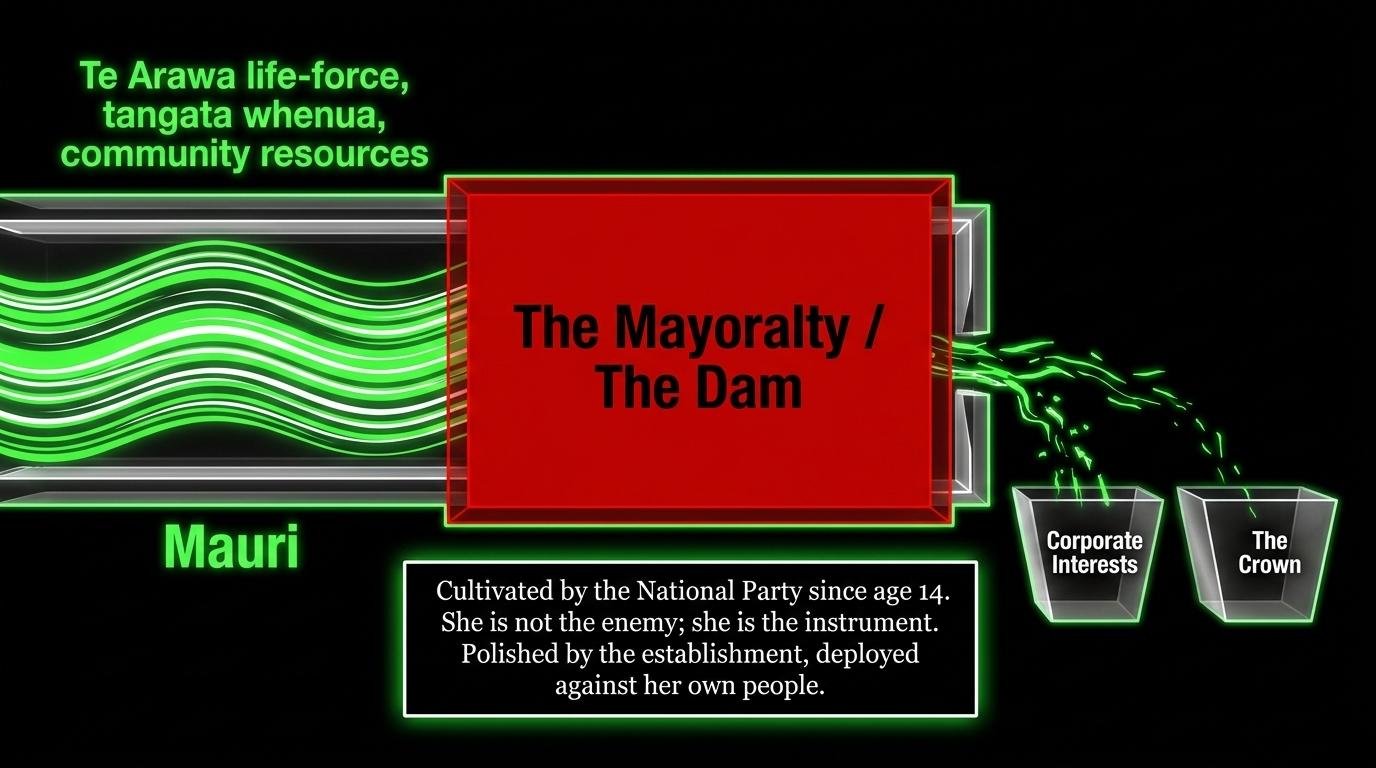
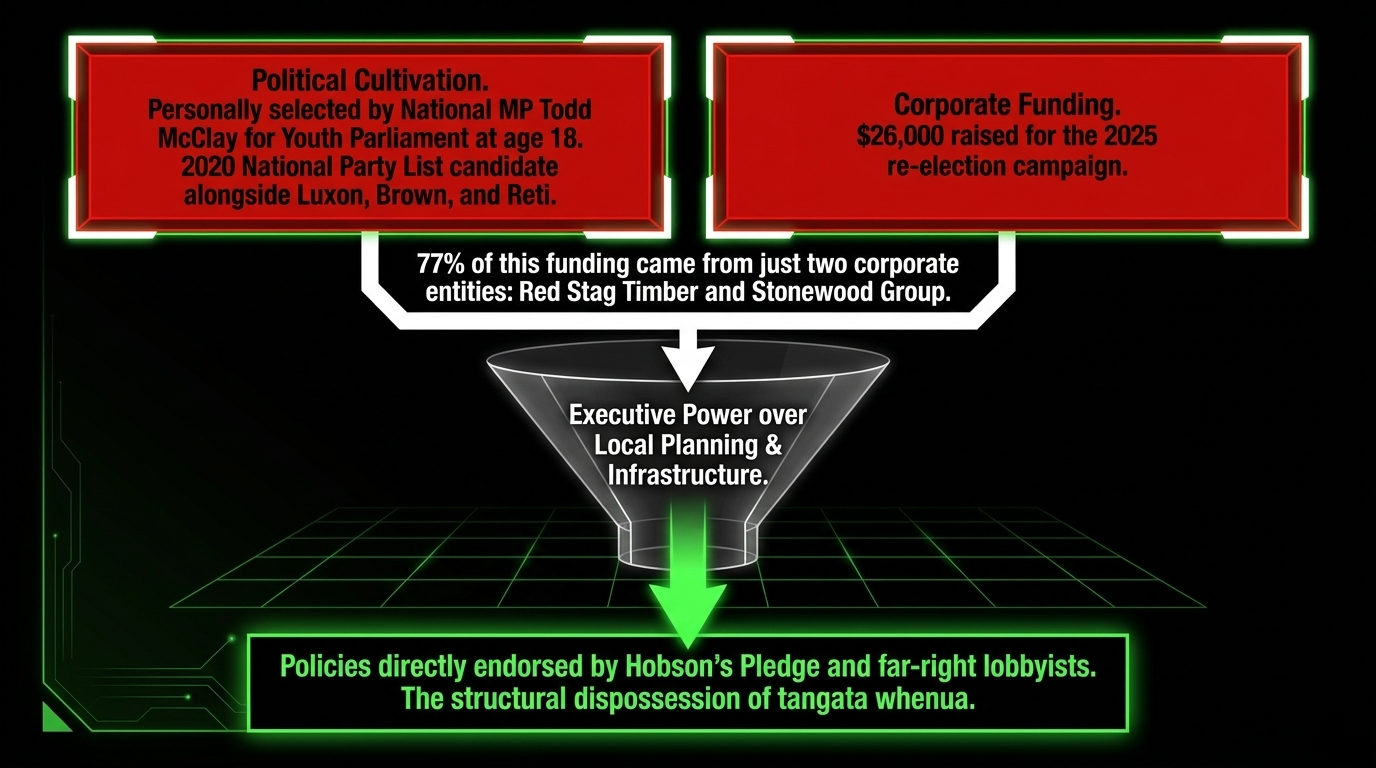
Tania Tapsell did not drift into the National Party. She was cultivated there. At age 14, she joined the Rotorua Youth Council. At age 18, she was personally selected by National MP Todd McClay — as confirmed by the Institute of Directors — to represent the Rotorua electorate at New Zealand Youth Parliament. Her political whakapapa was written in National Party ink before she could vote. McClay has held the Rotorua seat since 2008 and by 2023 returned to Parliament as a Cabinet minister. He did not merely mentor Tapsell — he was the gateway through which she entered the political establishment that now benefits from her mayoralty.
In 2020, Tapsell ran as National's candidate for the East Coast electorate and appeared on National's 2020 Party List — alongside Christopher Luxon (now Prime Minister), Simeon Brown (now Local Government Minister overseeing the very reform she is implementing), and Shane Reti (now Health Minister, architect of the Māori Health Authority's dismantling).
These are not strangers. These are colleagues. This is the company she chose.
Her great-uncle was Sir Peter Tapsell — five-term Labour MP for Eastern Māori. The political bloodline was there. She chose differently. As The Spinoff confirmed in 2020, for those who recognise the Tapsell name, her allegiance to the National Party might come as a surprise. It should not. It should be a reckoning.
She was first elected mayor in October 2022, and re-elected in a landslide in October 2025. Electoral popularity does not inoculate against political scrutiny — it intensifies the obligation of it.
He Whakamāramatanga — The Record: Twelve Verified Acts of Alignment
The mythology is that Tapsell is a pragmatic local leader who represents all of Rotorua. The record is something else entirely. What follows is not opinion. It is a documented pattern, verified source by source, decision by decision.
ACT ONE: The Māori Ward Vote — 2021
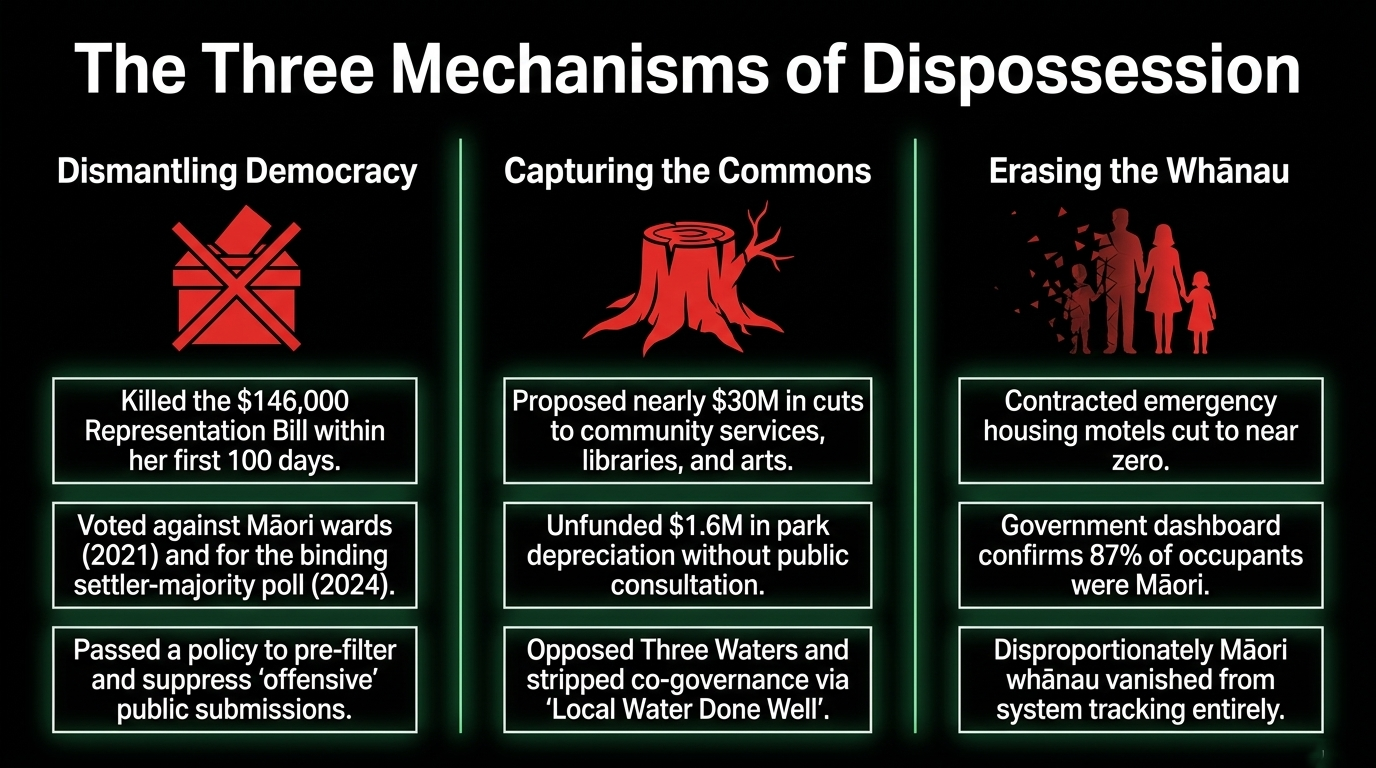
In 2021, Tapsell voted against establishing Māori wards for Rotorua Lakes Council. Her stated rationale — as recorded and later deployed by anti-Māori lobby group Hobson's Pledge — was that Rotorua was "unique" because Māori were already being elected successfully, as confirmed by 1News. The argument: structural constitutional protections should be abolished wherever minorities occasionally succeed by individual effort. When Hobson's Pledge later deployed those exact words in a social media post — confirmed by Te Ao News — she objected to the image usage. She did not dispute the accuracy of the quotes. When the colonial lobby group cites you accurately, the problem is the record — not the citation.
The tikanga breach: Māori wards are not a favour. They are a structural recognition of Treaty partnership — the kind of guaranteed voice at the table that tikanga requires when decisions affecting tangata whenua are being made. Voting against Māori wards is voting to keep that table structurally inaccessible to the people on whose whenua the city sits.
ACT TWO: The $146,000 Representation Bill — Killed in Her First 100 Days — 2023
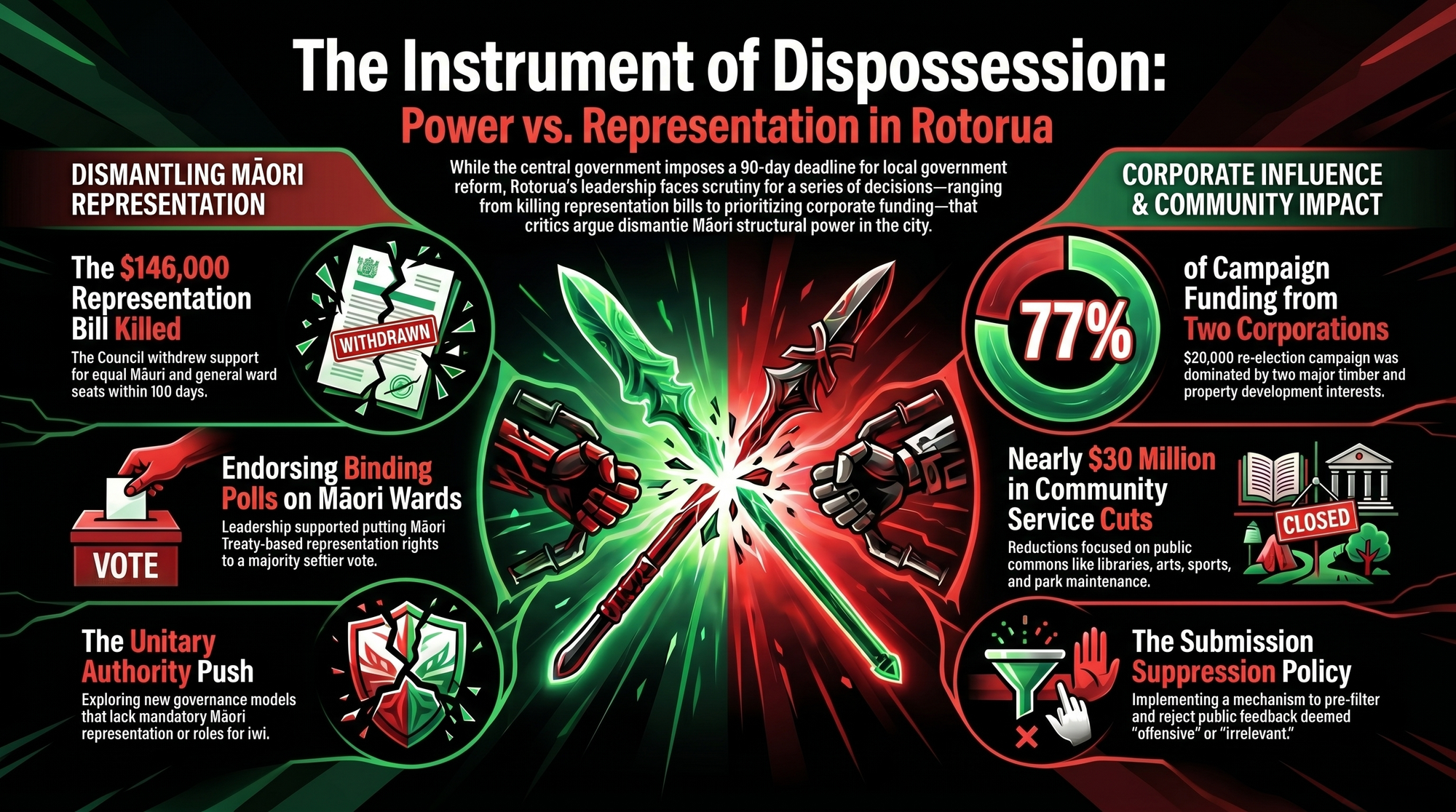
Tapsell had promised within days of her election to scrap the Rotorua District Council Representation Arrangements Bill — a bill that would have provided equal Māori and general ward seats on the council, and that had cost over $146,000 in ratepayer funds to develop. She delivered on that promise. In February 2023, as NZ Herald reported, all councillors voted to withdraw support for the bill — with the sole exception of Māori ward councillor Rawiri Waru, the one voice in the chamber that the bill was designed to multiply.
The harm quantified: $146,416 in ratepayer money — $143,905 in legal fees alone — evaporated. Proportionate Māori representation, structurally assured, was buried. A National Party mayor used her first 100 days to eliminate the one mechanism that would have most advanced Māori governance of their own city.
ACT THREE: The Submission Suppression Policy — February 2023
In the same month she killed the Representation Bill, Tapsell led the council to vote to advance a submissions policy — confirmed by the Rotorua Lakes Council's own news release — allowing the council to reject public submissions deemed offensive, discriminatory, or irrelevant. As NZ Herald confirmed, the Free Speech Union threatened legal action, warning this was a clear violation of the Bill of Rights Act. Tapsell defended the policy on Mike Hosking's Newstalk ZB programme — a deliberate choice of platform that signals exactly whose approval she sought.
The tikanga breach: Kōrero — the right to speak, to be heard, to participate in decisions affecting one's community — is foundational to tikanga Māori. A submissions policy that pre-filters speech deemed offensive or irrelevant by the council itself is a mechanism for suppressing dissent from whānau whose anger at the institution is entirely justified. Filtering the voice of the dispossessed is not civility — it is power protecting itself from accountability.
ACT FOUR: Three Waters Opposition — 2021–2023
Tapsell opposed Three Waters reform throughout its development and passage. The Three Waters model included a 50/50 co-governance structure in Regional Representative Groups — half councils, half mana whenua — a structural recognition of Treaty partnership over water management. As Te Arawa leaders have consistently argued, Māori own Te Arawa's lakes and waterways. Tapsell's opposition to Three Waters was opposition to Māori co-governance of Māori water.
After National repealed it in 2024, she claimed the repeal could give iwi more say on water — as reported by Te Kārearea Māori News — a position that has not materialised. Meanwhile, as Newsroom reported, the Three Waters repeal forced councils to hike rates by a third — over $1,000 extra per household in some districts — to fund water infrastructure that Three Waters would have collectively funded. Tapsell backed the policy that caused this. Her whānau will pay the rates.
ACT FIVE: The Māori Wards Binding Poll — August 2024
National's Local Government Electoral Legislation and Māori Wards Amendment Bill — as analysed by Te Ao News — forced councils to either disestablish their Māori wards or put them to a binding public poll. As 1News confirmed, Rotorua voted to hold the poll — and Tapsell voted with the majority. She framed this as local decision-making. What it actually was: endorsing a mechanism that puts Māori Treaty rights to a majority settler vote. The majority of councils nationwide expressed frustration at being put in this position. Tapsell complied without audible objection.
The tikanga breach (for the western mind): Imagine if gender equality in Parliament required a public vote every three years — men voting on whether women deserved their seats. That is what putting Māori wards to a public poll means. Tapsell endorsed this process in the self-declared heart of Māoridom.
ACT SIX: Emergency Housing — Up to 90% Māori, and Counting the Missing — 2024–2025
At the height of Rotorua's emergency housing crisis, as Whaatea News confirmed, up to 90 percent of those in emergency housing were Māori, and half of them were children. The government's Rotorua Temporary Housing Dashboard for March 2025 confirms 87% of contracted emergency housing occupants were Māori as of that date. When National wound down contracted motel emergency housing from 2024, Tapsell aligned publicly with the government's position. In November 2025, when Labour's Kieran McAnulty criticised the policy outcomes, she hit back, saying she was annoyed at Rotorua being used as a political football. She expressed no equivalent annoyance at the disproportionate Māori families whose trail went cold in the system's tracking.
The harm quantified: The government cut contracted emergency housing motels in Rotorua from a peak of 69 to near zero by end 2025. As the Māori Green Lantern documented in November 2025, this was a shell game of dispossession — and Rotorua's mayor played her part without flinching.
ACT SEVEN: Nearly $30 Million in Community Cuts — 2023
In April 2023, Te Ao News revealed that under Tapsell's direction, the council proposed nearly $30 million in cuts to services: closing the library on Sundays; cutting arts and cultural funding by $728,000; slashing sports and recreation by $3.25 million; gutting city beautification; stopping museum and waste education; reducing park maintenance; and eliminating $18.5 million from the Economic Recovery Fund. These were not cuts to bureaucracy. These were cuts to the public commons — the places and services that Māori whānau, disproportionately concentrated in lower income brackets, depend on most.
The tikanga impact: Whanaungatanga — the network of kinship relationships — requires physical and social infrastructure: places to gather, resources to share, institutions that sustain community cohesion. For a kaumātua without a car, the community arts programme is the connection. For a rangatahi without broadband, the Sunday library is the internet. Neoliberal cuts to public services are never neutral — they always land hardest on those with the fewest private resources to substitute.
ACT EIGHT: The Corporate Campaign — 77% From Red Stag and Stonewood — 2025
As confirmed by NZ Herald and first named by the Māori Green Lantern in "The Auction House Masquerading as Democracy", Tapsell's 2025 re-election campaign raised $26,000 — with 77% of that coming from Red Stag Timber and Stonewood Group, two large Rotorua-based commercial interests. Red Stag Timber's CEO alone donated $10,000. These are not small donors. These are corporations with active interests in resource consents, infrastructure decisions, and local planning — all matters over which the Mayor exercises direct authority.
The hidden connection: A mayor funded by timber and property development corporations, making planning and infrastructure decisions in a city where Māori land interests and resource rights remain live — this is not coincidence. This is the definition of structural conflict of interest. The Māori Green Lantern named it. The mainstream press did not.
ACT NINE: The Unitary Authority Push — "A Massive Moment" — May 2026
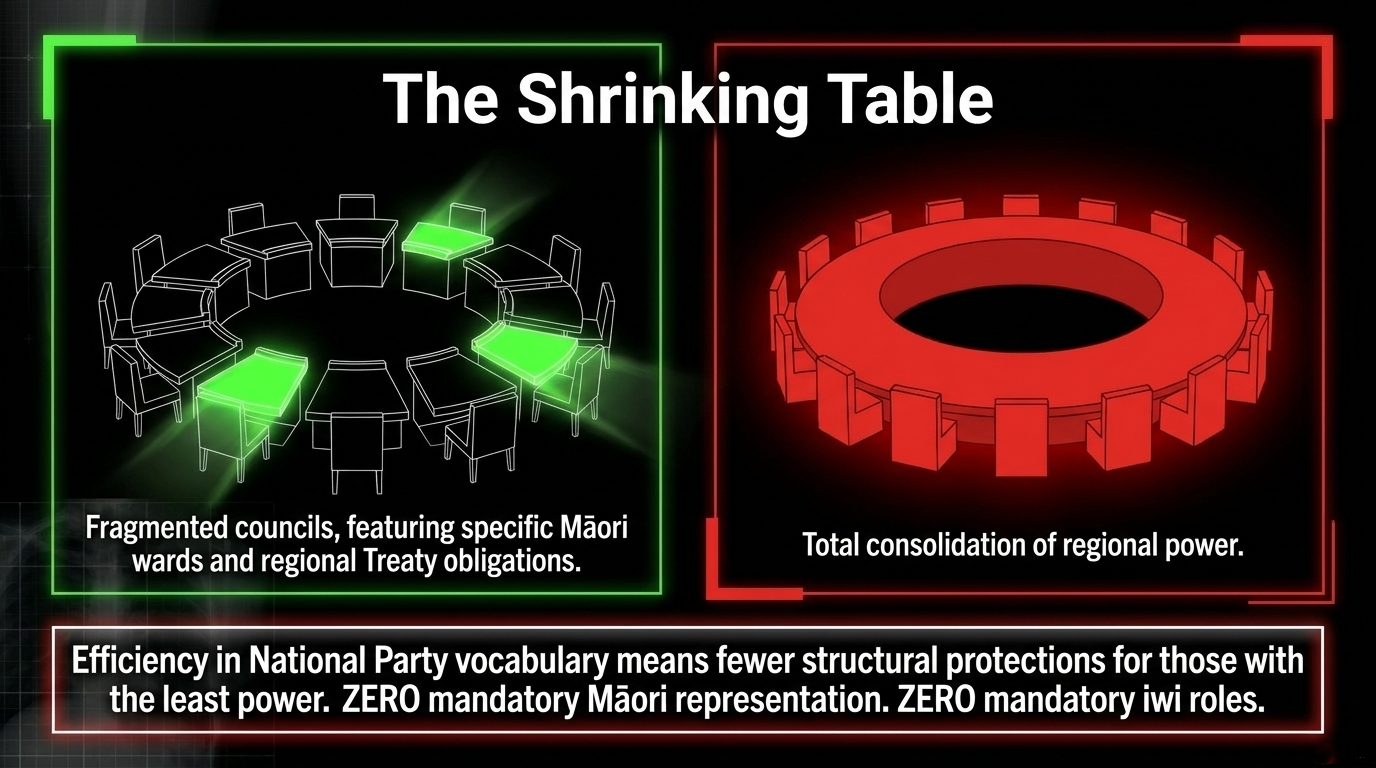
On 6 May 2026, the Rotorua Lakes Council website confirmed Tapsell had declared the government's local government reform "a massive moment for local decision making" and that Rotorua was already "a step ahead" in exploring becoming a unitary authority — absorbing the functions of regional councils. As Bay of Plenty regional councillors warned in February 2026, the proposed combined territory boards carry no mandatory Māori representation and no mandatory role for specific iwi. Māori ward councillor Iwi Te Whau stated the proposal did not give a voice to our people. Tapsell was already racing to implement it before the debate had been had.
The harm: A unitary authority consolidates all regional power in a single elected body — the mayor's team. Without mandatory Māori representation protections, this concentrates power precisely where Māori structural voice is already weakest. Tapsell is not just supporting this reform. She was already ahead of it.
ACT TEN: The $6 Million Cut Without Consultation — April 2026
In April 2026, Tapsell presided over an Annual Plan that found $6 million in cost savings — confirmed by the Rotorua Lakes Council — cutting a projected 10.8% rates increase to 6.8%. She declared this a fantastic result. The savings included $1.6 million by unfunding depreciation in parks and open spaces — the council stopped setting aside money to maintain and replace public green spaces. As NZ Herald confirmed, the plan was adopted without community consultation because the council determined there were no material or significant changes — a legal technicality deployed to avoid democratic process.
The tikanga impact: Parks and open spaces are the modern marae ātea for urban Māori communities without access to their own whenua. Unfunding their depreciation means the degradation of shared public space is now budgeted into the plan. The cost savings today become a debt paid in crumbling infrastructure by the most land-poor communities in the city.
ACT ELEVEN: The Submissions Gatekeeping — Legal Challenge Pressed Through — 2023
When the Free Speech Union threatened legal action over the submission suppression policy, as documented by the Free Speech Union itself, Tapsell pressed on. The council had conducted a prior legal review. She chose the platform of Mike Hosking's Newstalk ZB to defend the decision. The precedent set — that a council can pre-filter public submissions for content it considers offensive — is precisely the kind of administrative gate-keeping that silences the most angry, most marginalised voices. In Rotorua, those voices are disproportionately Māori. A mayor who filters the anger of the dispossessed is a mayor who has decided whose discomfort matters more.
ACT TWELVE: Local Water Done Well — Co-governance Stripped Out — 2026
In April 2026, the Rotorua Lakes Council website confirmed Tapsell was hosting meetings on Local Water Done Well — National's explicit replacement for Three Waters and its co-governance model. As Te Arawa leaders have consistently argued, Māori own the water — a position that will ultimately be tested in court. Meanwhile, as Democracy Action (Hobson's Pledge) confirmed on their own website, they have tracked Rotorua's council water governance specifically — and found nothing to object to under Tapsell. When Hobson's Pledge is satisfied with your water decisions, you should ask yourself: whose water governance are you actually protecting?
He Kōrero Mōna — The Steve Chadwick Dimension
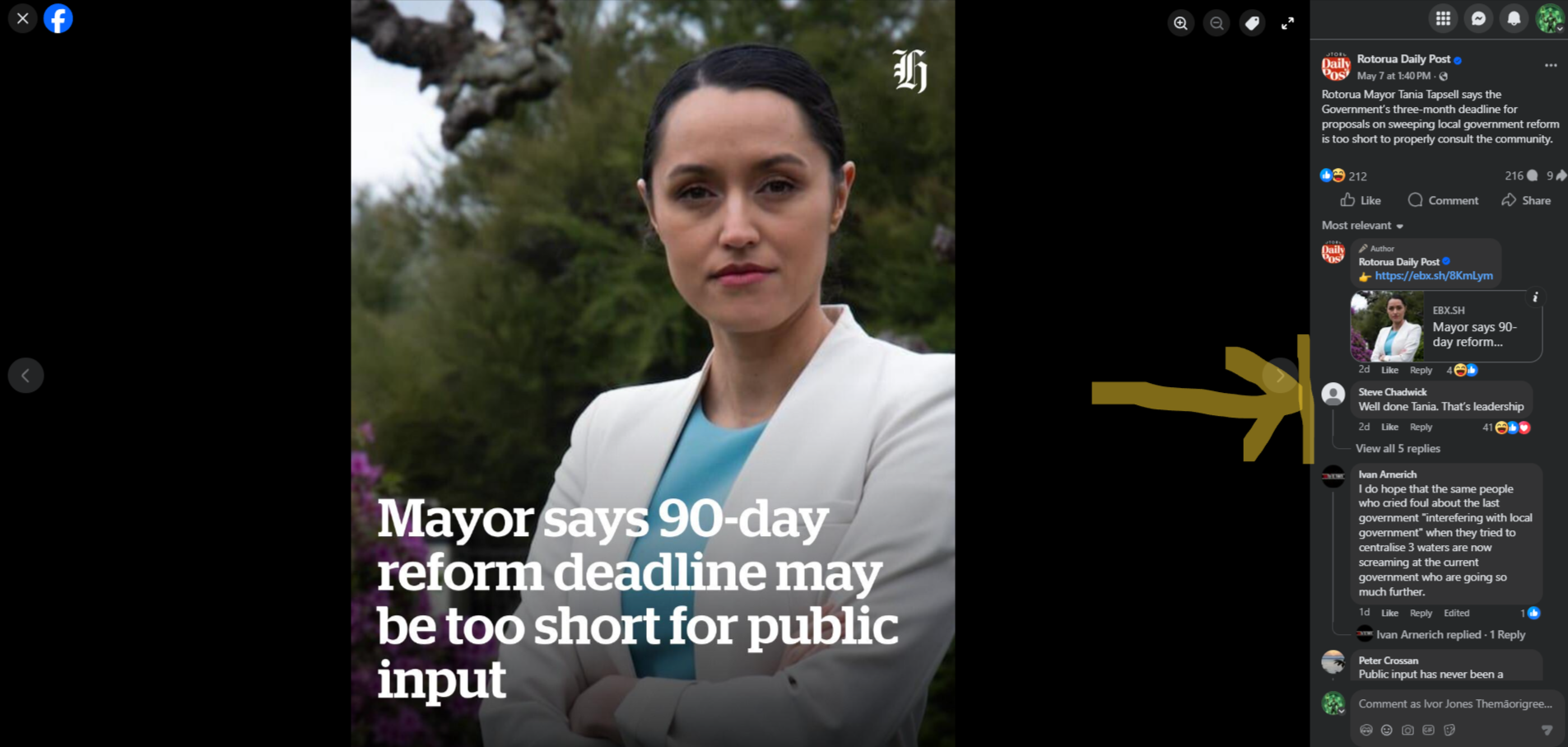
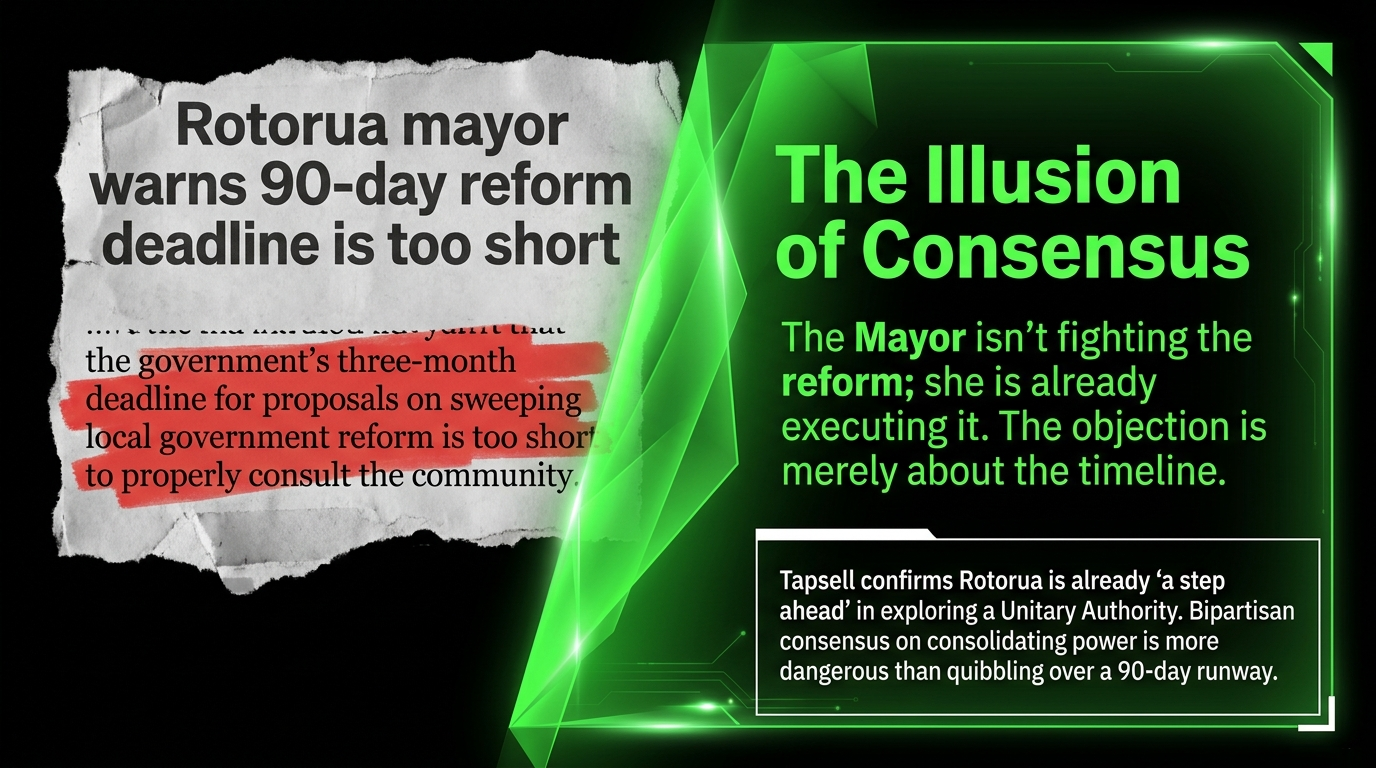
The Rotorua Daily Post article that prompted this investigation features former Labour MP and Rotorua Mayor Steve Chadwick appearing to support Tapsell's position on the 90-day reform deadline via socialmedia.
This matters because Chadwick — a Labour politician who served as Mayor from 2013 to 2022 — provides the veneer of cross-party consensus.
But note carefully what both Tapsell and Chadwick are agreeing on: not whether the reform should proceed, but only how quickly. Bipartisan consensus on the destination — restructured local government with consolidated power and no mandatory Māori voice — is more dangerous than quibbling over the timeline. Whānau should not mistake a request for a longer runway for opposition to the plane.
It is also worth noting: Chadwick's mayoralty was the one that used her casting vote — confirmed by Democracy Action's own judicial review coverage — to prevent withdrawal of the Representation Arrangements Bill that Tapsell later killed. The bill survived Chadwick. It did not survive Tapsell. That is the difference between the two mayors that actually matters.
Toru Tauira — Three Examples for the Western Mind
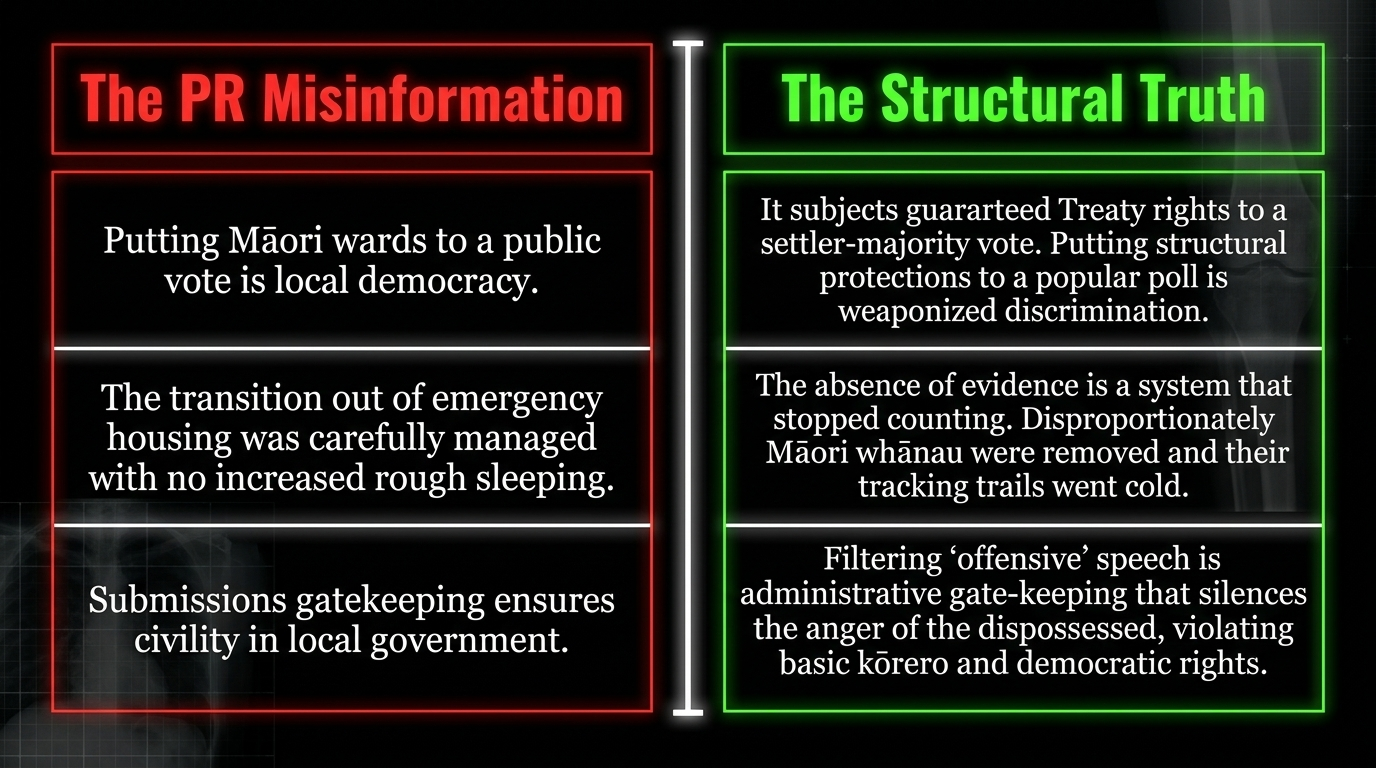
Example 1: The Māori Ward Poll — Democracy Used as a Weapon
The claim: Putting Māori wards to a public vote is democratic.
The reality: National's Māori Wards Amendment Bill — as analysed by Te Ao News — reversed Labour's 2021 protection that removed binding polls as a requirement. Tapsell voted in 2021 against establishing Māori wards. In 2024, she voted for a binding poll on whether to keep them. Both votes served the same outcome: structural barriers to guaranteed Māori representation.
Tikanga impact for the western mind: In te ao Māori, guaranteed representation at the table where decisions are made is not a preference — it is a constitutional obligation rooted in the Treaty relationship. Putting that guarantee to a majority vote is like asking the defendant whether they deserve a lawyer. It is structurally discriminatory regardless of the outcome.
Solution: Enshrine Māori ward seats as a non-negotiable Treaty right in local government legislation. Reinstate and strengthen the 2021 protections. As the Māori Green Lantern previously documented in "When Racism Wears a Council Badge", local government is the terrain on which rangatiratanga is either won or surrendered.
Example 2: Emergency Housing — The Māori Disappeared
The claim: The transition out of emergency housing was carefully managed.
The reality: As Whaatea News confirmed, up to 90 percent of those in Rotorua's emergency housing were Māori and half were children. As the Māori Green Lantern documented, a significant proportion of those removed from emergency housing vanished from tracking entirely. Tapsell stated she saw no evidence of increased rough sleeping. The absence of evidence is not evidence of absence — it is evidence of a system that stopped counting.
Tikanga impact for the western mind: Manaakitanga — the obligation to provide hospitality, care, and dignity to those in need — is not optional in Māori society. It is a leadership obligation. A mayor who closes emergency housing and declares victory while disproportionately Māori former residents are unaccounted for has not upheld manaakitanga. She has performed it.
Solution: Require independent monitoring and public reporting of housing outcomes for every whānau exiting emergency housing for a minimum of 12 months. Commission a full, public accounting of every family that disappeared from tracking. The Māori Green Lantern has documented this crisis — and its local administrators must be named.
Example 3: The Unitary Authority — Power Without Accountability
The claim: A Rotorua unitary authority would deliver better, more efficient local governance.
The reality: As the Rotorua Lakes Council confirmed on 6 May 2026, Tapsell had already committed Rotorua to exploring a unitary model ahead of the government's own timeline. The proposed boards carry no mandatory Māori representation — a point made explicitly by Māori ward councillor Iwi Te Whau, as reported by Te Ao News. Efficiency, in National Party vocabulary, always means fewer structural protections for people with the least power.
Tikanga impact for the western mind: In tikanga Māori, rangatira are accountable to their people, not above them. A governance structure that concentrates power in a single elected mayor's authority and strips guaranteed Māori representation is the structural opposite of rangatira accountability. It is the Crown's preferred model precisely because it is more controllable, less Māori.
Solution: Mandate Treaty partnership frameworks as founding constitutional requirements for any new combined territory or unitary authority structure. As the Māori Green Lantern documented in "Hidden Agendas and Conflicts of Interest: Ōpōtiki", local government structures are not neutral administrative tools — they are mechanisms of power.
Ngā Hononga Huna — Five Hidden Connections
- Todd McClay → Tania Tapsell (age 18): As confirmed by the Institute of Directors, McClay personally selected Tapsell for Youth Parliament. He has held Rotorua for National since 2008. The National Party machine in Rotorua is not coincidence — it is whakapapa.
- Red Stag Timber + Stonewood Group → 77% of Campaign Funding: As confirmed by NZ Herald, Tapsell raised $26,000 for her 2025 re-election — 77% from two commercial interests with direct financial stakes in her planning and infrastructure decisions. This is the definition of a captured mayor.
- National 2020 Party List → Direct Colleagues Now Dismantling Māori Rights: Tapsell stood alongside Luxon, Simeon Brown, and Shane Reti on National's 2020 Party List. They are colleagues — and they are now in government dismantling every structural Māori right they can reach.
- Hobson's Pledge → Deployed Her Own Accurate Words: As confirmed by Te Ao News, Hobson's Pledge used Tapsell's statements against Māori wards in a social media post. She objected to the image. She did not dispute the quotes. When the colonial lobby group cites you accurately, the problem is the record.
- Local Water Done Well + No Co-governance = Hobson's Pledge Has Nothing to Complain About: Hobson's Pledge tracked Tapsell's council specifically on co-governance in water management — and found nothing to object to. She has given them nothing to complain about. That is a pattern, not a coincidence.
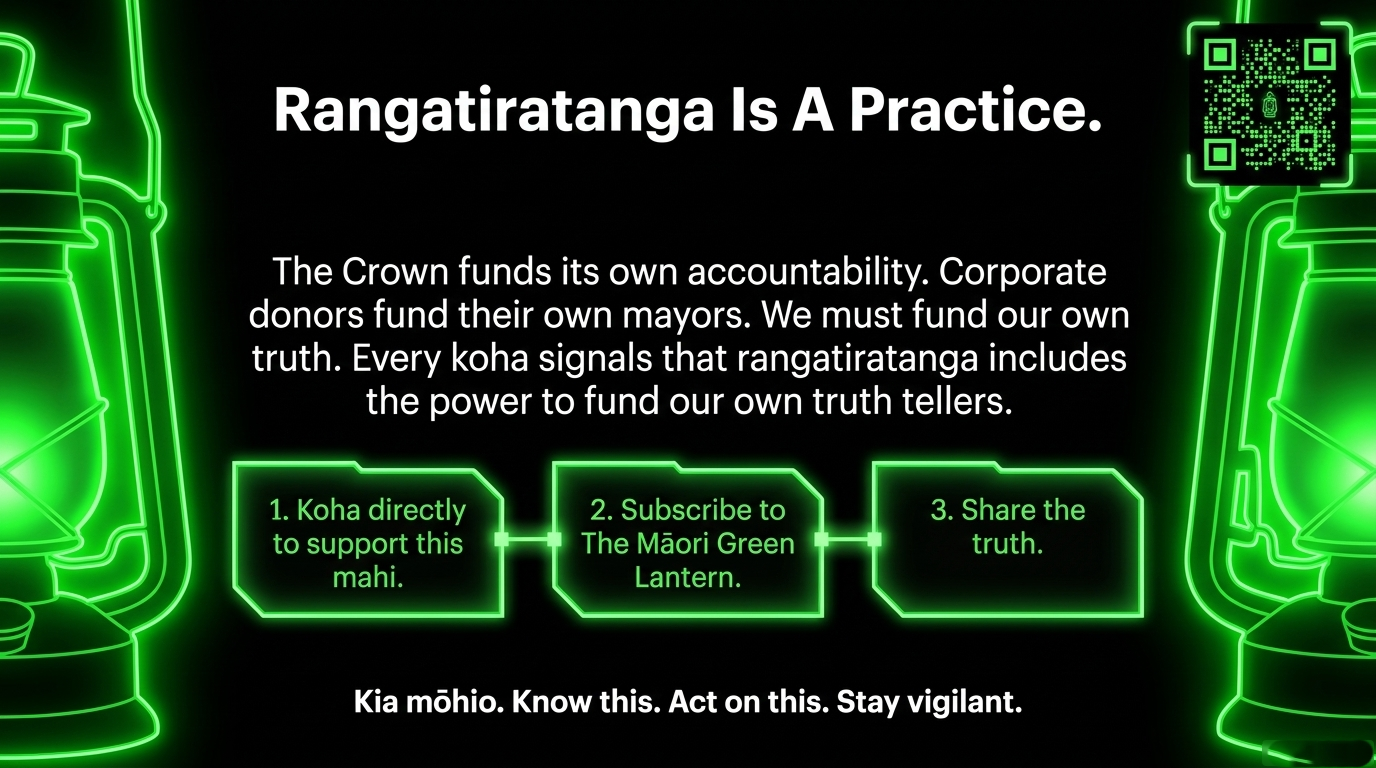
Rangatiratanga Is Not a Title. It Is a Practice.
The first Māori wāhine elected Mayor of Rotorua should be a cause for celebration. In another political universe, it would be.
In this one, it is a twelve-act case study in how a white supremacist neoliberal government deploys Māori identity as camouflage for Māori dispossession. Tania Tapsell did not create this government. But she feeds it, staffs it locally, legitimises it daily, and is funded by those who profit from it.
She killed the Representation Bill in her first 100 days. She opposed Three Waters co-governance. She backed the binding poll on Māori wards. She defended the disappearance of Māori from emergency housing. She cut nearly $30 million from community services. She took 77% of her campaign funds from two corporations. She endorsed unitary authority reform without Māori representation guarantees. She suppressed public submissions. And she has done it all while wearing the mana of Te Arawa wāhine as her most valuable political asset.
The taiaha does not lie. The record does not lie.
And this is what the record says: every time a National Party mayor in a majority-Māori city endorses the machinery that strips structural Māori power, she makes a choice.
Every choice documented here has a verified citation. Every whānau in Rotorua deserves to know that the woman in the mayor's chair has spent her entire political formation learning to administer
— not dismantle
— the structures of their dispossession.
Kia mōhio. Know this. Share this. Act on this.
Āwhina Mai — Koha Statement
Tania Tapsell raised $26,000 for her re-election — 77% from Red Stag Timber and Stonewood Group. The Crown funds its own accountability structures.
Corporate donors fund their own mayors.
That leaves exactly one source of funding for the accountability journalism that exposes both: you.
This essay exists because whānau fund truth-telling that the Crown will not fund and corporate media will not touch. Every koha signals that rangatiratanga includes the power to fund our own truth tellers — the ones who count the whānau who vanished from emergency housing, who trace the whakapapa from McClay to Tapsell to the 2026 reform agenda, who name the corporate donors and ask what they received in return.
Every koha is an act of rangatiratanga.
If you can koha directly: Support this mahi →
To receive essays directly and support through subscription: Subscribe to The Māori Green Lantern →
Direct bank transfer: HTDM, 03-1546-0415173-000
On Facebook: Follow and subscribe →
If you cannot koha — no worries. Subscribe, follow, kōrero, share with your whānau and friends. That is koha in itself. This truth needs legs. Give it yours.
Kia kaha, whānau. Stay vigilant. Stay connected.

*Views expressed constitute honest opinion on matters of public interest under the Defamation Act 1992 (NZ) and Durie v Gardiner