
"The Kennel and the Ballot Box: How ACT and NZ First Train the Public to Fear the Wrong People" - 6 July 2026
They sell cages as compassion and exclusion as common sense, while the same white supremacist neoliberal machine keeps its boot on Māori throats and its hand in migrant pockets.

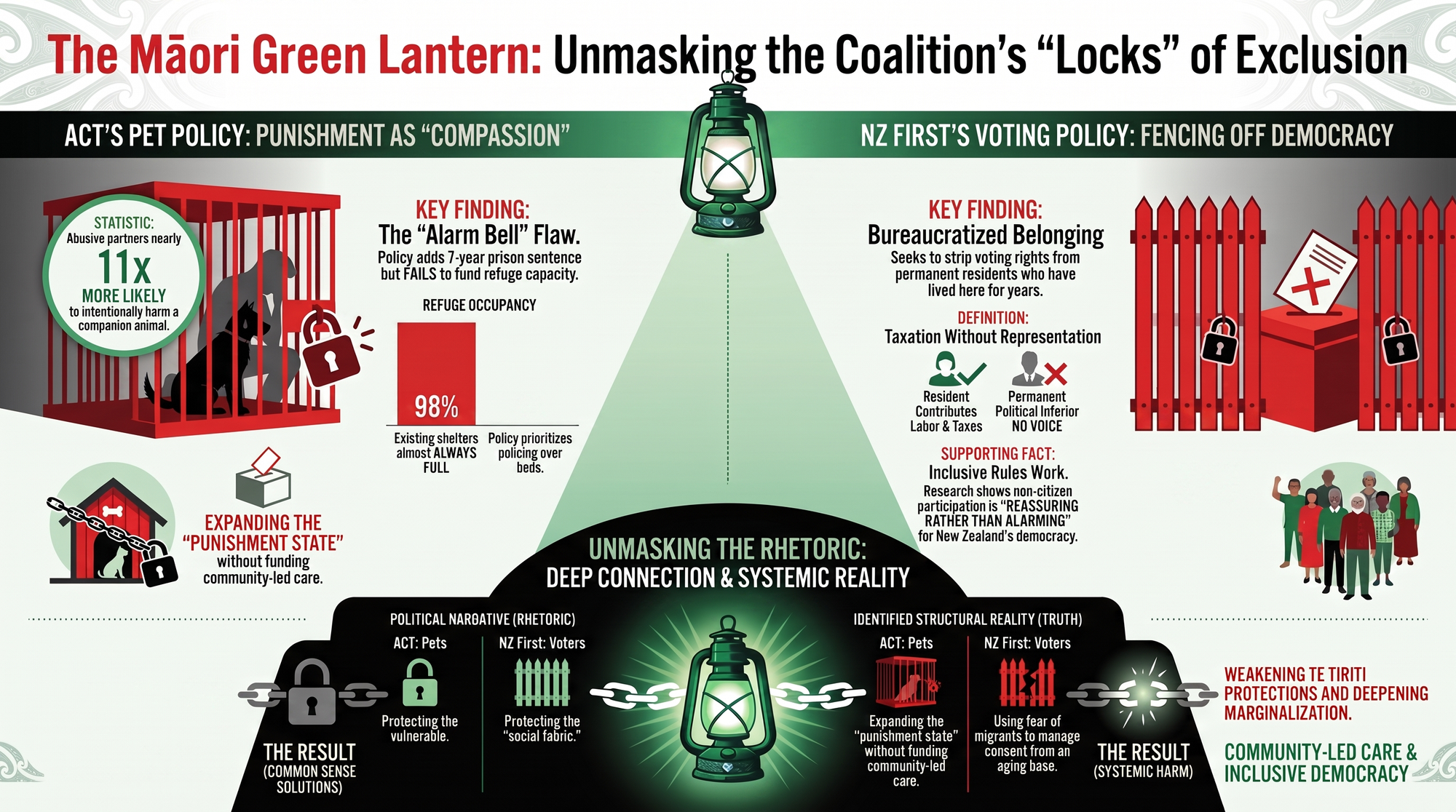
I am Ivor Jones, The Māori Green Lantern. I do not come to polish the chains. I come to name the locksmiths.
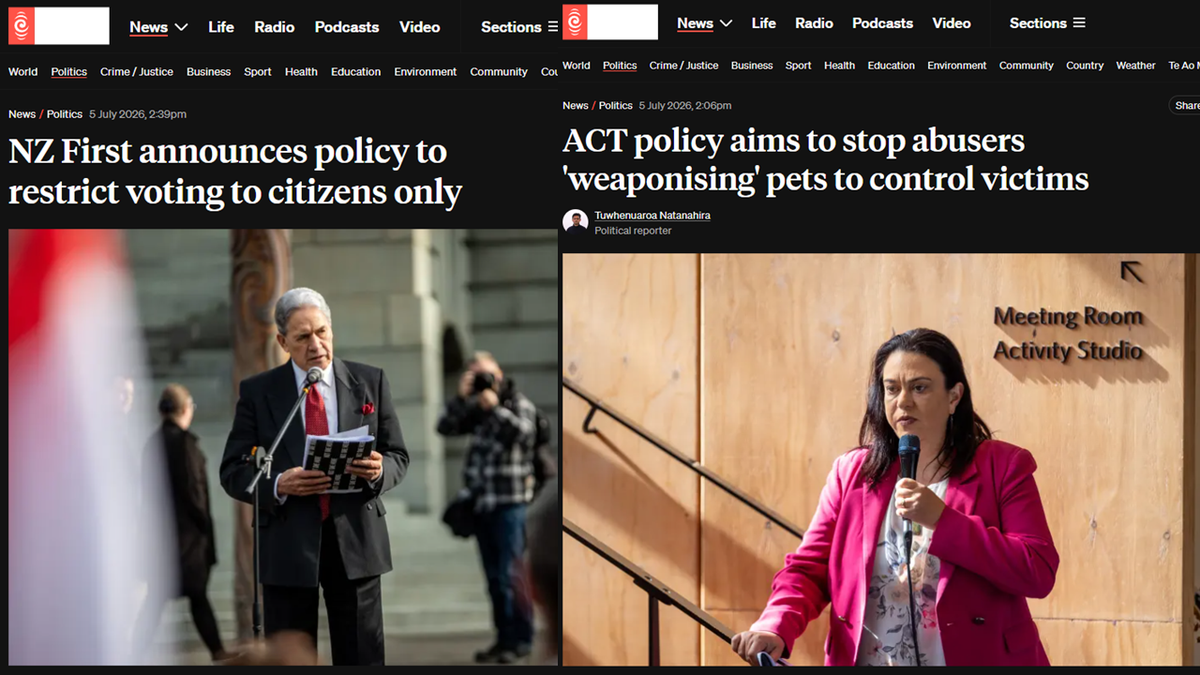
On 5 July 2026, two of the most cynical pieces of campaign-season theatre to emerge from this coalition government landed in the same news cycle. ACT announced a policy to stop abusers "weaponising" pets to coerce victims of family violence. NZ First announced a policy to restrict voting to citizens only. Both were dressed up as acts of principle. Both were weapons — wielded not against abusers and foreign influence, but against the communities already carrying this country's deepest historical wounds.
This is white supremacist neoliberal governance in its most smug provincial form. It does not always arrive with a swastika or a baton. Sometimes it arrives in a tidy press release about pets. Sometimes it arrives in a speech about allegiance. But the mauri it drains is the same.
The 🔋 Deep Dive Podcast
Listen to a lively kōrero between two hosts unpacking how ACT's pet policy, NZ First's citizens-only voting push, crimmigration, Te Tiriti and the wider politics of who gets protected and who gets erased all connect in real time.
The AI pronounces te reo Māori poorly — I apologise in advance. Please don't shoot me for it. 😄 The politics being dissected are considerably harsher on our people than the pronunciation.
🎬 YouTube Video
Like video? Here is a short video supporting this essay — boiling the argument down to its clearest public-interest points: who is targeted, who benefits, and why these two policies matter together rather than separately.
Again, don't shoot the messenger for AI pronunciation. Save that energy for the politicians selling punishment as compassion and exclusion as democracy. 😄
Koha — Support This Mahi

Every koha in support of this essay signals that whānau are ready to support the truth-telling that Crown and corporate structures will not provide. When this government strips migrants of their vote while expanding the punishment state into our homes, the answer is to resource the voices that name it plainly. That is rangatiratanga in action.
Kia kaha, whānau. Stay vigilant. Stay connected. And if you are able, consider a koha to support this mahi so the locks on the ballot box and the cages dressed up as policy keep getting named for what they are.
If you are unable to koha — no worries! Subscribe or follow The Māori Green Lantern at themaorigreenlantern.maori.nz, kōrero about the issues, and share with your whānau and friends. That is koha in itself.
Four pathways exist:
Koha directly: Support via Koha platform
Subscribe and receive essays: Subscribe to The Māori Green Lantern
Direct bank transfer: HTDM — 03-1546-0415173-000
Facebook: Follow and subscribe on Facebook
What These Policies Actually Say
ACT: Carceral Compassion Through The Pet Door
 RNZ | Te Reo Irirangi o Aotearoa
ACT's policy, launched at Pet Refuge, aims to stop abusers "weaponising" pets to coerce and control victims of family violence. It would:
- Amend the Crimes Act to make it a specific offence to use abuse of a companion animal as coercion or control in a family-violence relationship, with penalties of up to seven years' imprisonment
- Strengthen Protection Orders so offenders cannot withhold, sell, give away or otherwise dispose of a victim's pet
- Ensure pets are not left with a dangerous abuser when a Protection Order is made
- Require police to record pets on family harm reports
- Give police explicit statutory authority to remove animals to places of safety such as Pet Refuge or the SPCA
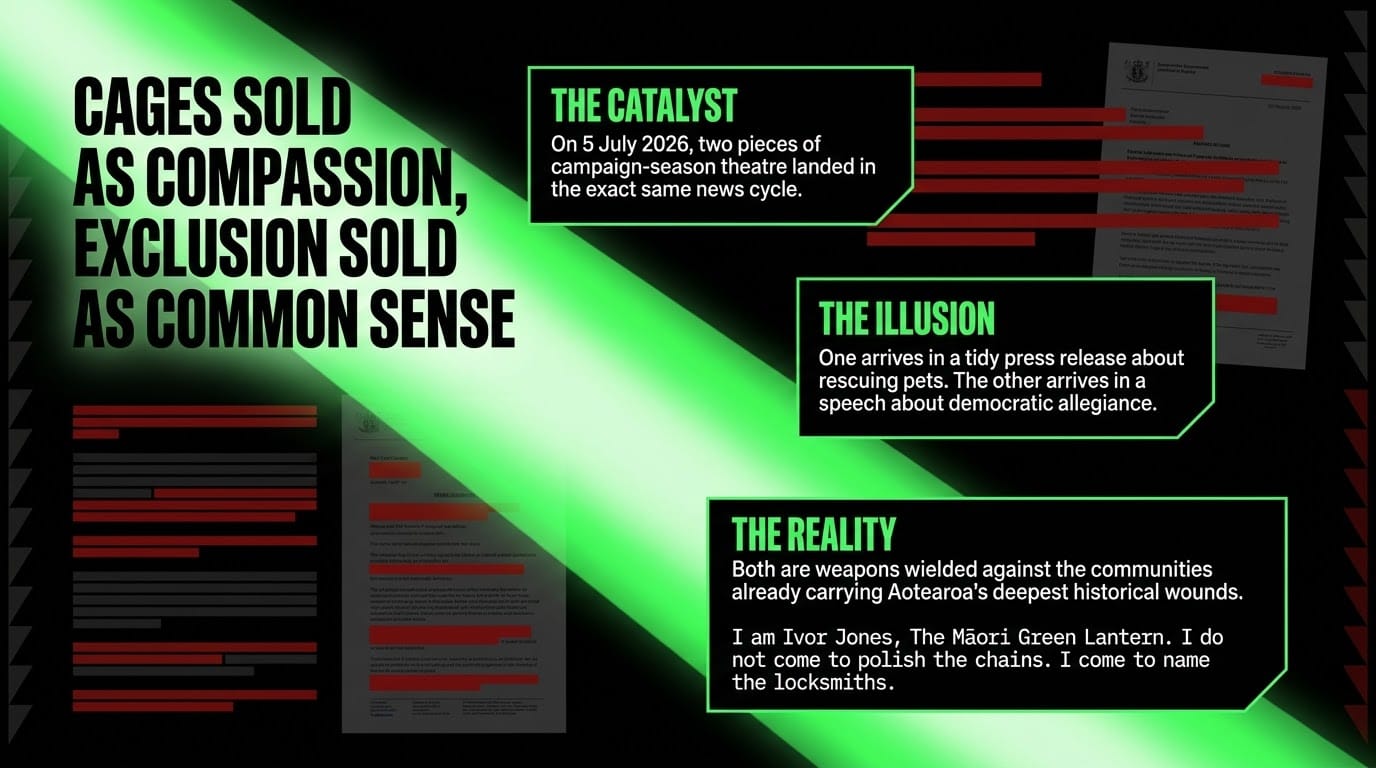
The abuse this policy describes is real. ACT's spokesperson Karen Chhour, speaking at the launch, cited evidence that abusive partners are almost 11 times more likely to intentionally harm an animal, and that more than half of victims delayed leaving because they feared for their pets. Pet Refuge founder Dame Julie Chapman confirmed the refuge sits at almost 98 percent capacity and is building a second shelter. The pain is documented. The harm is real.
But what ACT does with that pain is feed it back into the machinery of punishment. Animal cruelty is already illegal. Family violence is already illegal. Coercive control can already be prosecuted. ACT takes one devastating symptom and packages it as another imprisonable offence, more police powers, more courtroom process, more Crown reach into intimate life. That is not transformation. That is managerial cruelty dressed up as concern.
NZ First: Democracy Fenced Off For "Proper" Insiders
 RNZ | Te Reo Irirangi o Aotearoa
NZ First's new policy would strip voting rights from permanent residents and reserve the ballot for New Zealand citizens only. Under current law, people are eligible to enrol and vote if they are 18 or older, a New Zealand citizen or a permanent resident, and have lived in Aotearoa continuously for at least one year. This includes permanent residents and some long-term visa-holders.
Winston Peters announced the policy at a public meeting in Warkworth, declaring that voting "should be a privilege of those who have sworn allegiance to New Zealand". He called it a problem that permanent residents can vote "after just two years" and influence governments, local councils and even referendums that "fundamentally change the social fabric of our society." In the same week, Peters opposed the India free trade agreement on immigration grounds, completing the picture: migrants, trade and democratic rights bundled together as one fear narrative.
Academic research on New Zealand's voting rules shows Aotearoa is one of only four countries that allow non-citizens to vote in national elections and is the most inclusive of those four. That same research finds permanent residents vote at lower rates than citizens and that the experience has been "reassuring rather than alarming." NZ First is lighting a bonfire under a problem the evidence does not support.
Two Faces Of The Same Control Mentality
Put these two announcements together and the mask slips.
ACT offers carceral compassion: it recognises a terrible pattern of abuse, then answers it with a new offence, prison time and more police powers. NZ First offers exclusive democracy: it recognises that voting matters, then redraws the boundary so only formal citizens count as full political persons.
E-Tangata's analysis of "crimmigration" warns that proposed changes could allow non-citizens who have lived here for up to 20 years to be deported for legal infractions. That is the same logic as citizens-only voting: useful enough to work, not equal enough to decide. Both moves push state power further into the bodies and lives of already-marginalised people while leaving the structural arrangements that produce poverty, violence and precarity entirely untouched.
These are not anomalies. They are the latest snarl of the same wire.
Five Revelations About Who Benefits And Who Bleeds
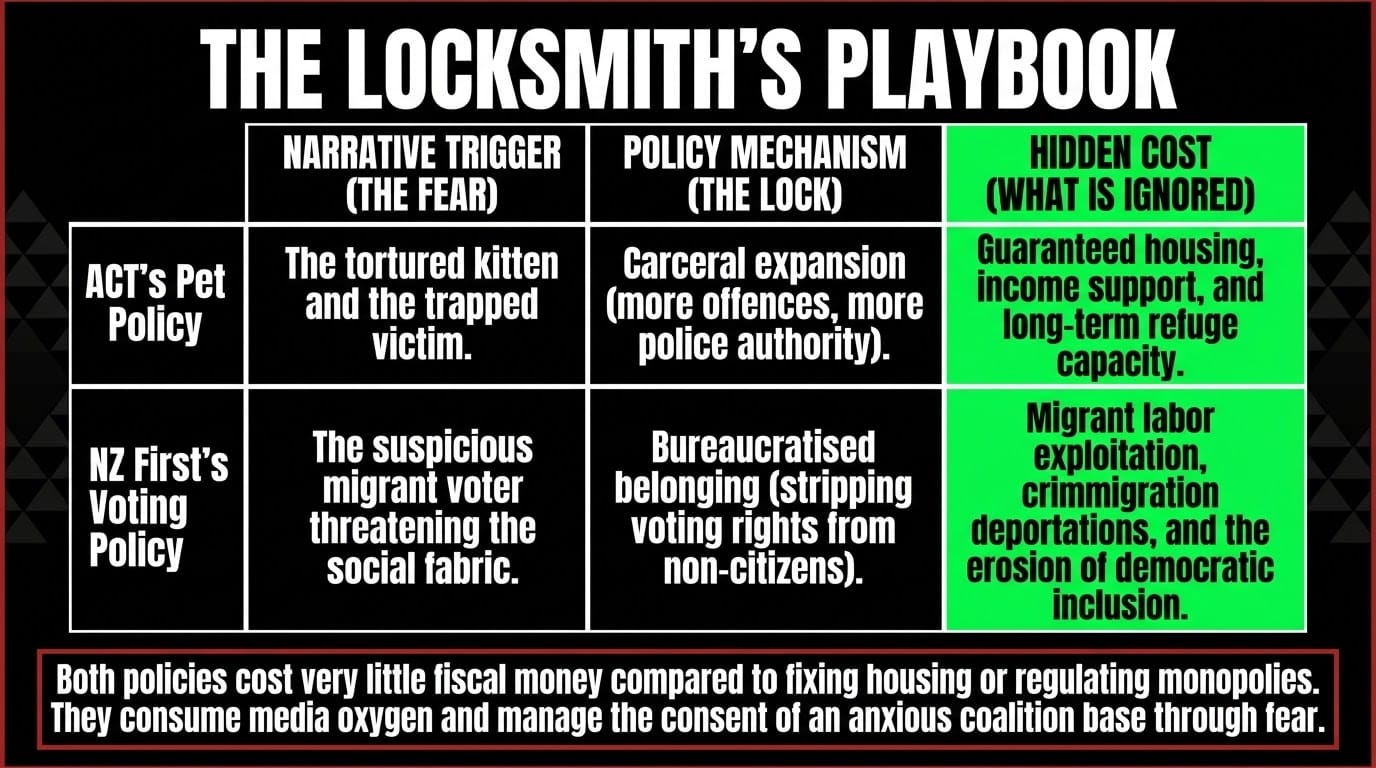
Revelation 1: The Punishment State Expands Through The Language Of Care
ACT's policy is sold as humane, but its core move is to add another pathway into the criminal justice system. It does not guarantee more housing, more income support, more Māori-led family violence prevention, or more long-term refuge capacity. It gives the state one more excuse to arrive in a siren, fill out another form, lay another charge, and call that safety.
E-Tangata's analysis of punishment politics identifies how governments use punitive framing to appear responsive while doing nothing structural. This is that in action. For Māori, Pacific and migrant whānau already over-represented in family-violence statistics and in the prison system, more offences and more police powers without guaranteed community resourcing means more contact with a system that has always harmed them more than it has helped them.
Revelation 2: Democracy Is Being Fenced Off For "Proper" Insiders
NZ First's policy says only citizens should vote, as though belonging begins when the state stamps a form. But many permanent residents have lived here for years, laboured here, paid tax here and raised tamariki here. The research is clear: their participation has not destabilised democracy. They participate less, not more, than citizens.
It is also reclassifying people who contribute to this country as permanent political inferiors — people who can be governed, taxed and policed but who, under NZ First's model, may never have equal say over the laws that govern them. That is not democratic principle. That is bureaucratised belonging.
Revelation 3: Both Policies Punch Down While Pretending To Protect
ACT says it will "put victims first." NZ First says it will "restore basic democratic principle." But in each case the real blow lands on people with less power. Victims still need stable housing and income even if police can charge pet-coercion. Permanent residents still contribute to communities even if NZ First tells them to stay quiet at election time.
E-Tangata's crimmigration essay notes that increasing deportations "will cause untold damage to our Pacific relationships." Citizens-only voting compounds that: one policy makes migrants more deportable; another makes them more voteless. Together, they construct a tiered society in which the state continues to extract value from migrants while offering them diminishing protection and voice.
Revelation 4: The Coalition Feeds Fear Instead Of Solutions
These are not policies designed around rent, wages, hospital wait times, food costs or constitutional justice. They are designed around narrative triggers: a tortured kitten, a suspicious migrant voter, a threatened "social fabric." They speak directly to a coalition base that is older, more Pākehā, more rural or small-town, and more attracted to symbols of control than to structural change. Winston Peters' own speech notes describe permanent-resident voting as a threat to the "social fabric" — a phrase that, in New Zealand political history, has consistently been used to mobilise fear of non-European migrants.
Meanwhile, E-Tangata's 2026 election survival guide warns that without constitutional protection for Te Tiriti, any progress can be laid to waste again within a few years. These two policies accelerate that risk.
Revelation 5: Te Tiriti And Whakapapa Are What These Policies Are Really Dodging
Through a Te Arawa, Ngāti Pikiao and Welsh whakapapa lens, these are settler-colonial scripts in modern clothes. ACT tells us the Crown's courts and police are the proper guardians of intimate harm, rather than hapū-based tikanga and community-led care. NZ First tells us the Crown's citizenship process is the proper gateway to voice, rather than whakapapa, residence and relational commitment.
E-Tangata's reflections on the Dawn Raids document how Pacific peoples were treated as useful labour but not fully equal members of the polity. Citizens-only voting and crimmigration reproduce that history exactly: you may labour here for decades, but your belonging is conditional, revocable and never quite equal.
Three Examples For The Western Mind
Example 1: The Flood Alarm Model Of Family Violence
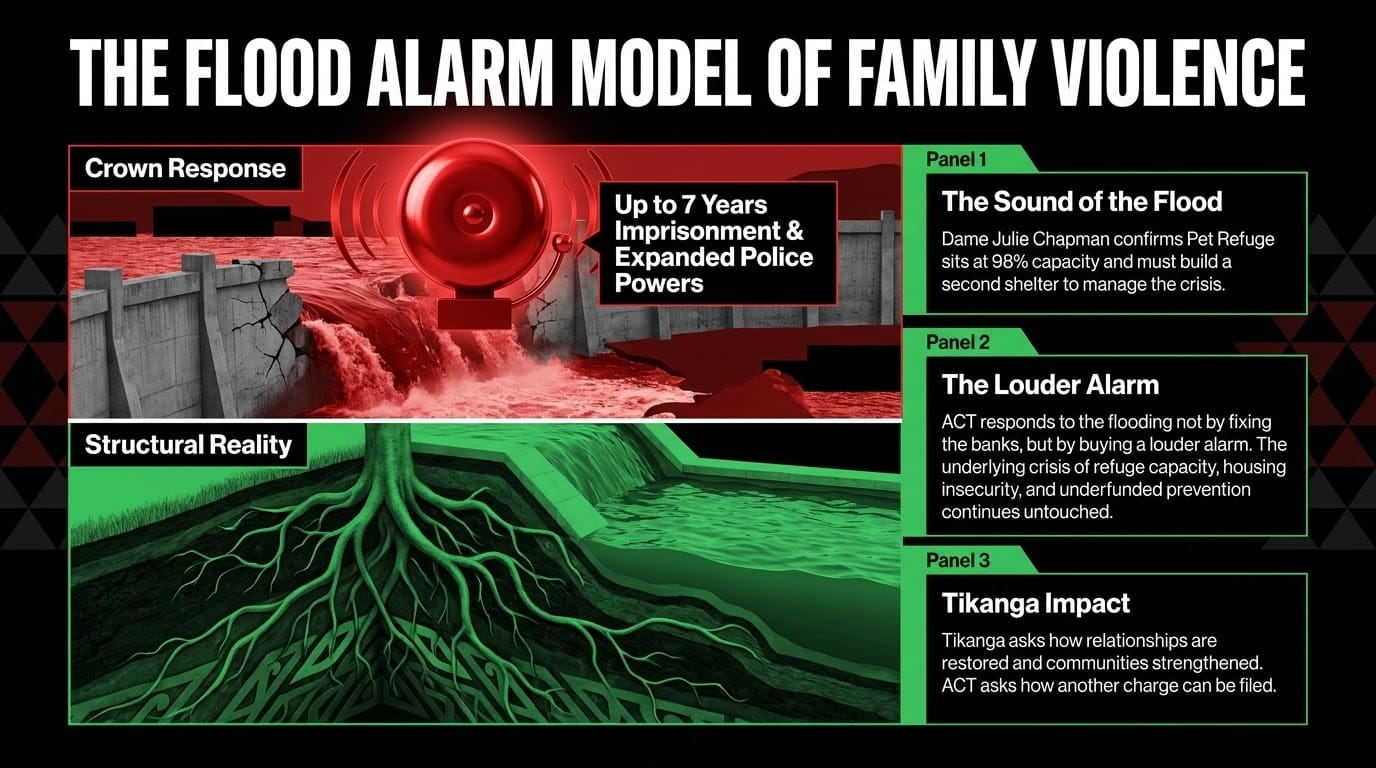
If your house is flooding because the riverbanks were never repaired, and the government responds by buying a louder alarm bell, you have not solved the flood. You have amplified the panic.
That is what ACT's pet policy does to the family-violence crisis. Pet Refuge sits at almost 98 percent capacity and is building a second shelter — that is the sound of the flood. ACT's flagship answer is a new offence carrying up to seven years' imprisonment — that is the louder alarm bell.
The harm: The underlying crisis of refuge capacity, housing insecurity and underfunded prevention continues untouched while the government generates headlines about criminal penalties.
The solution: Fund more refuge capacity, emergency housing, kaupapa Māori and Pacific-led support, and integrated family-violence responses before expanding the offence book.
Tikanga impact, plainly: Tikanga asks how relationships are restored and how the whole community is strengthened. ACT asks how another charge can be filed. These are not the same question.
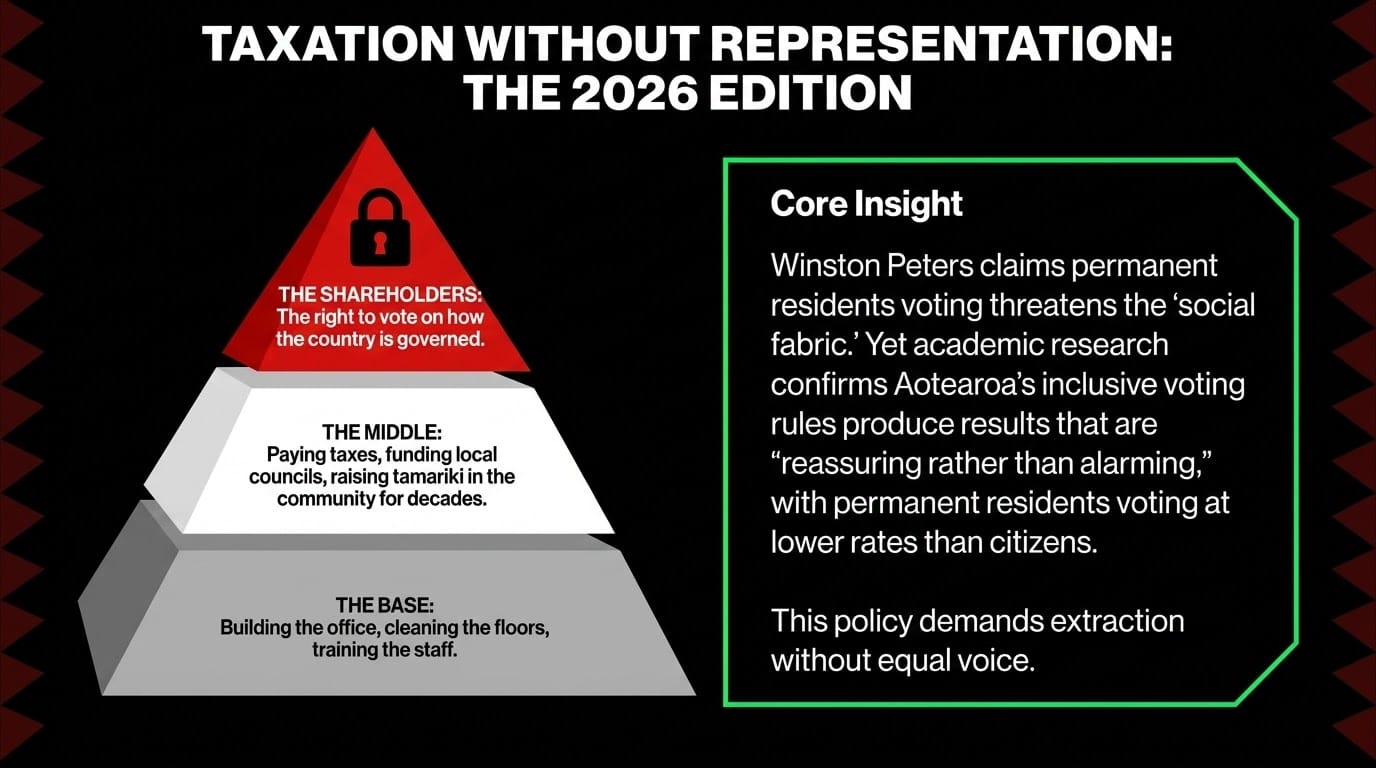
Example 2: Taxation Without Representation, 2026 Edition
Imagine a workplace where some employees build the office, clean the floors, train the staff and pay into the running costs, but management says only shareholders may vote on whether the roof is repaired. That is NZ First's democracy: extraction without equal voice.
Permanent residents can currently vote after one year of continuous residence, yet academic research finds they vote at lower rates than citizens and have caused none of the electoral disruption NZ First implies. Every person in the eligible non-citizen resident category would lose their democratic voice under this policy.
The harm: Thousands of tax-paying, community-contributing residents lose a core democratic right, disproportionately from Pacific and Asian communities.
The solution: Keep inclusive voting rules; strengthen Te Tiriti-based constitutional protections; expand democratic voice rather than contract it.
Tikanga impact, plainly: If you share the burdens of the whare, tikanga does not treat you as a ghost at the table. A people with mana do not build a society where neighbours can be used, taxed, watched and then politically erased.
Example 3: Conditional Belonging As State Doctrine
E-Tangata reports that proposed crimmigration changes could allow non-citizens who have lived here for up to 20 years to be deported for legal infractions. Pair that with citizens-only voting and the state message is brutally clear: you may labour here for decades, but your rights remain conditional on the Crown's continuing approval.
This is not a new story. E-Tangata's Dawn Raids analysis shows how New Zealand's immigration policy historically treated Pacific peoples as "unsuitable for permanent settlement but useful to meet short-term labour requirements." The same design reappears here, updated with new legal mechanisms but identical in moral logic.
The harm: Long-term resident communities face intensified precarity: more deportable, less able to vote, and subject to a government increasingly willing to use both levers at once.
The solution: Reject crimmigration, preserve democratic inclusion, and anchor belonging in relationship, residence and Te Tiriti obligations rather than in the Crown's citizenship paperwork.
Tikanga impact, plainly: Manaakitanga — the obligation to care for those who are present in our communities — is not contingent on a passport. When the state treats it as if it is, it is not defending democracy; it is defacing it.
What These Policies Are Really For
Neither policy is aimed at the majority of New Zealanders dealing with rent, mortgages, food costs, power bills, hospital wait times or the accelerating climate crisis. They are aimed at a specific slice of the electorate: older, more Pākehā, more rural or small-town, more attracted to strict borders and punishment narratives, who the ACT-NZ First coalition relies on for electoral survival.
ACT announced the pets policy without discussing it with other political parties, with David Seymour declaring he would be "amazed" if any MPs sided with abusers of women and pets. That is a deliberate provocation designed to generate coverage, not a genuine cross-party consultation. NZ First launched citizens-only voting alongside its opposition to the India free trade agreement, bundling migration, trade and democratic rights into a single fear package. That is a dog whistle and a ballot-box play combined.
These policies cost very little fiscal money compared to, say, fixing housing or regulating supermarket monopolies. They allow each party to signal that it is "tougher" and "more principled" than its coalition partners. They mobilise a noisy minority whose support is essential under MMP. And they consume media oxygen and legislative time that could have gone to structural reform.
E-Tangata's election 2026 survival guide frames the central question as whether Aotearoa will protect Te Tiriti constitutionally, or let any progress be rolled back again within a few years. ACT and NZ First are not answering that question. They are running interference on it.
The Deep Connection: Managing Democracy Through Fear
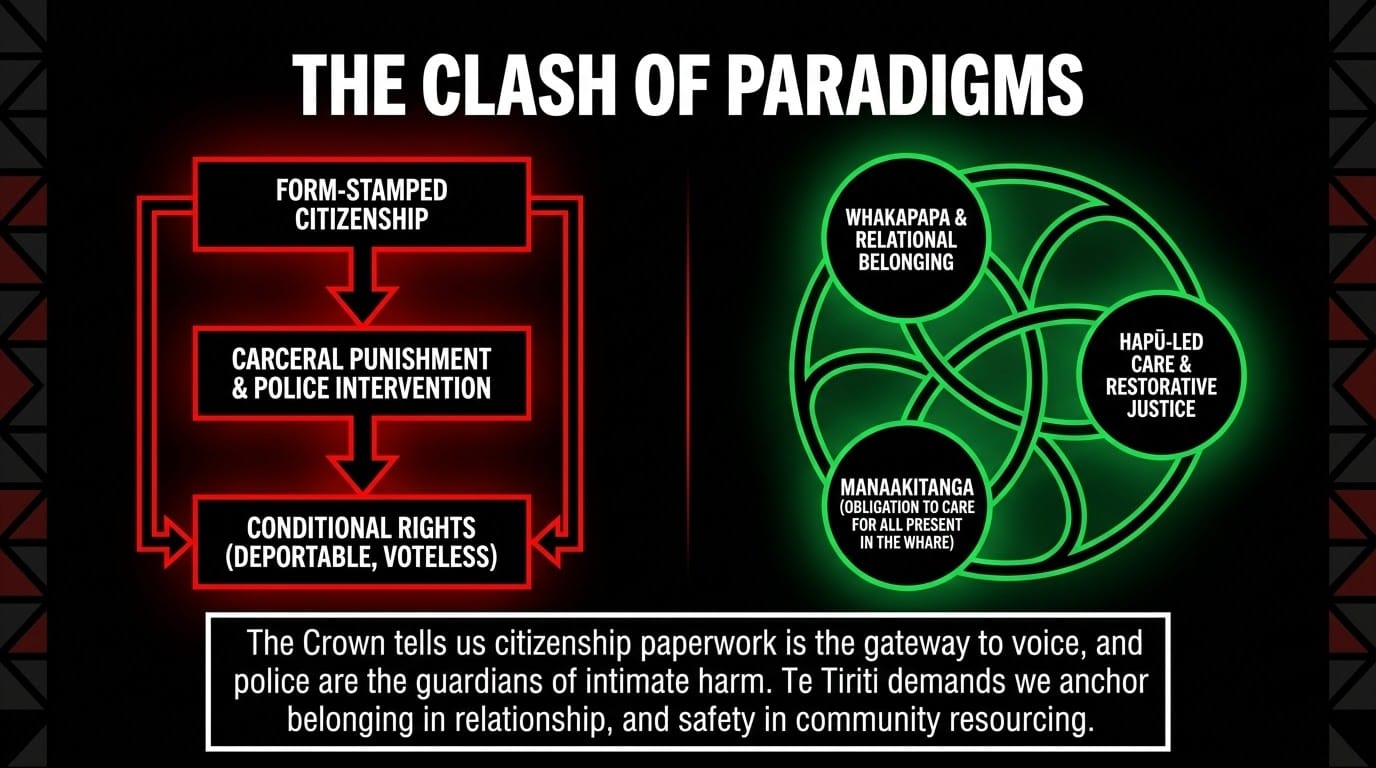
Both policies use striking, fear-laden symbols to justify increased exclusion and punishment: tortured pets; non-citizens deciding referendums; the "social fabric" under threat. Academic work on permanent-resident voting in New Zealand concludes the current inclusive rules have produced reassuring results. ACT's own policy material closes small legal loopholes around police tools and Protection Orders without transforming the support system underneath. Together, they create the appearance of decisive action while the underlying problems — violence, precarity, inequality — deepen.
What is being managed here is not danger. What is being managed is consent: keeping an anxious, ageing, culturally defensive coalition base in line while the government continues to do very little about the material conditions destroying most people's lives.
Naming The Arsonists, Guarding The Mauri

I do not call this government cruel because cruelty is a stylish adjective. I call it cruel because the pattern is visible: strip rights from those with less power, deepen punishment where communities need resourcing, and feed the settler appetite for control with one more headline at a time.
The taiaha response is to refuse their framing. Protect victims by funding refuges, housing and kaupapa Māori services. Protect democracy by defending non-citizen voting and demanding Te Tiriti constitutional protection. Name clearly that when they come for pets and permanent residents, they are not guarding the whare — they are rearranging the locks while the fire spreads.
The whare is on fire. ACT is pointing at the dog. NZ First is padlocking the gate. Neither of them is calling the waka.
Ivor Jones | Te Arawa, Ngāti Pikiao | themaorigreenlantern.maori.nz
Disclaimer: This essay represents the opinion and analysis of Ivor Jones, The Māori Green Lantern, based on publicly available sources cited throughout. All factual claims are sourced and attributed. This essay is published in the public interest. Opinions are clearly distinguished from verified facts. Right of reply is available to any individual or organisation named.