"The Locked Pātaka: How This Government Budgeted the Hunger of 169,300 Children" - 24 April 2026
They did not fail to feed the tamariki. They costed it, minuted it, and chose the landlords instead — 47,500 more children pushed into hardship while $2.9 billion went up the ladder. The moral failure is not hidden. It is filed, footnoted, and signed by ministers of the Crown.

He Kupu Whakataki — The Pātaka Stands Locked
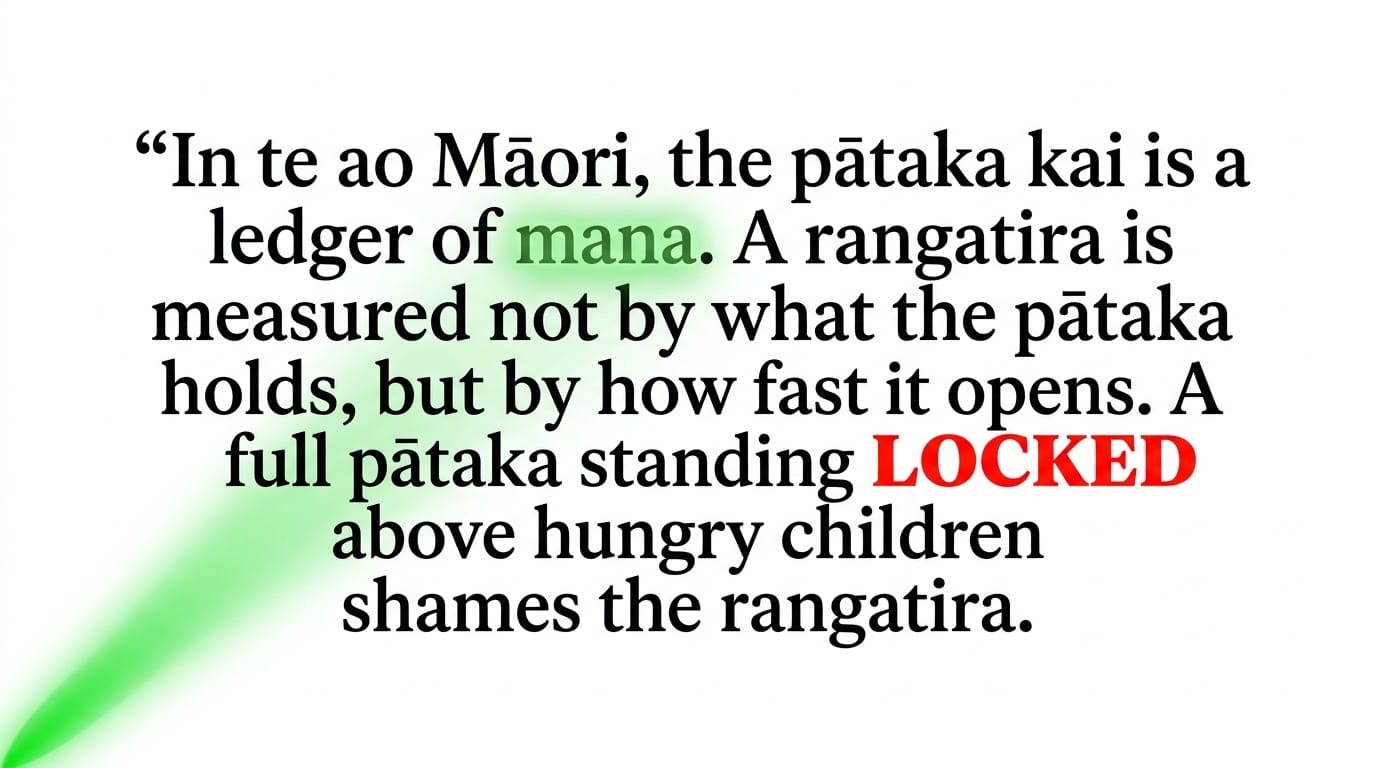
In te ao Māori, the pātaka kai — the carved storehouse raised on its legs above the pā — was never a pantry. It was a ledger of mana.
A rangatira was measured not by what the pātaka held but by how fast it opened: to the hungry child, to the manuhiri, to the whānau whose gardens had drowned.
An empty pātaka shamed the gardeners. A full pātaka standing locked above hungry children shamed the rangatira — and every hand that carved the padlock.
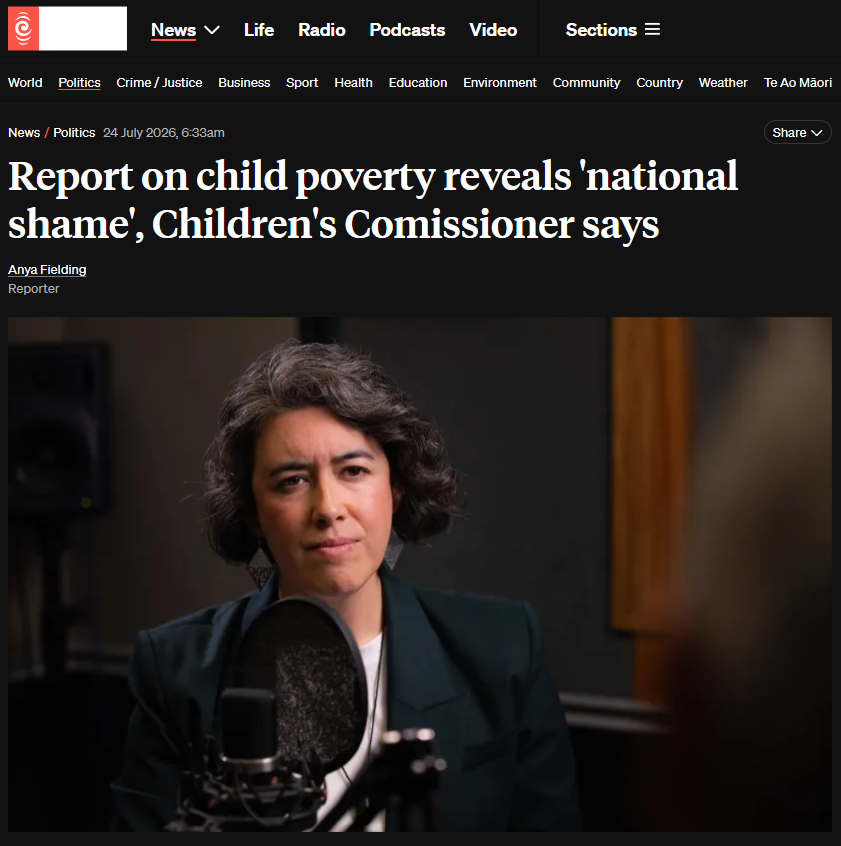
Aotearoa in 2026 is a full pātaka with a government-issue padlock. The Children's Commissioner said it herself this morning: we are "a small, relatively rich country," and it is "inexcusable" for our children to sit where they sit in the international rankings (RNZ, 24 July 2026).
The kai exists. The wealth exists. What does not exist is the will — because this coalition spent three years building the padlock in plain sight, component by component:
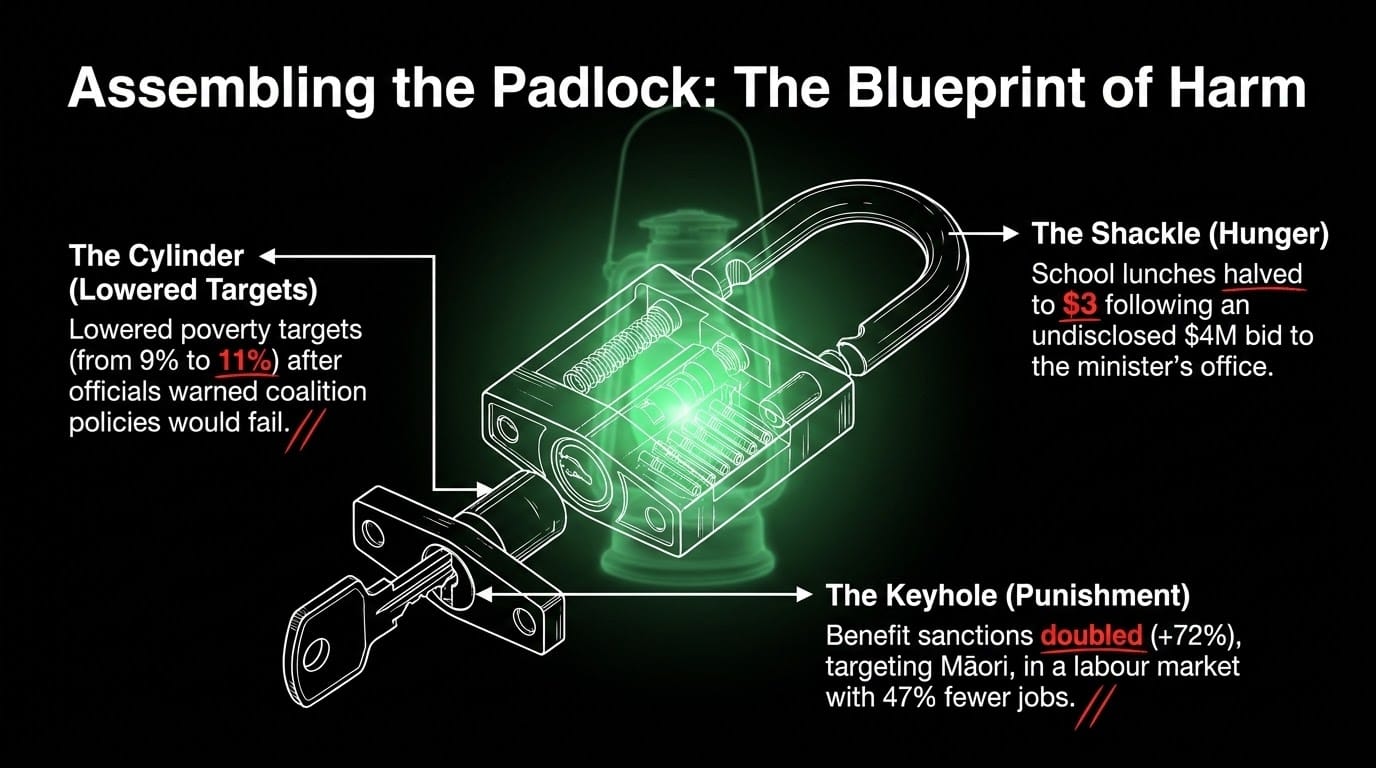
- a poverty target lowered after officials advised the government it would fail (RNZ; CPAG OIA release);
- a school lunch halved to $3 after an undisclosed approach to the minister's own office (The Spinoff);
- benefit sanctions doubled, falling hardest on tamariki Māori households, in a labour market with 47 percent fewer jobs to be sanctioned into (Infometrics);
- and a "fiscally neutral" Budget that pays the Accommodation Supplement of one poor family by raising the rent of a poorer one (Treasury, Budget 2026 Child Poverty Report).
While the padlock was assembled, the ladder to the pātaka was handed to residential landlords, gift-wrapped in $2.92 billion of restored interest deductibility (Inland Revenue RIS; 1News).
Dr Claire Achmad calls the result "a national shame" (RNZ). She is being generous. Shame implies a capacity for embarrassment. This government published every one of these choices in its own documents and stood at the podium to defend them.
Cui bono?
Landlords, richer by billions. A sole-bidder lunch conglomerate, its contract fattened by $18 million after its rivals withdrew (The Spinoff).
Ministers, who purchased the appearance of fiscal discipline with other people's children.
Cui malo?
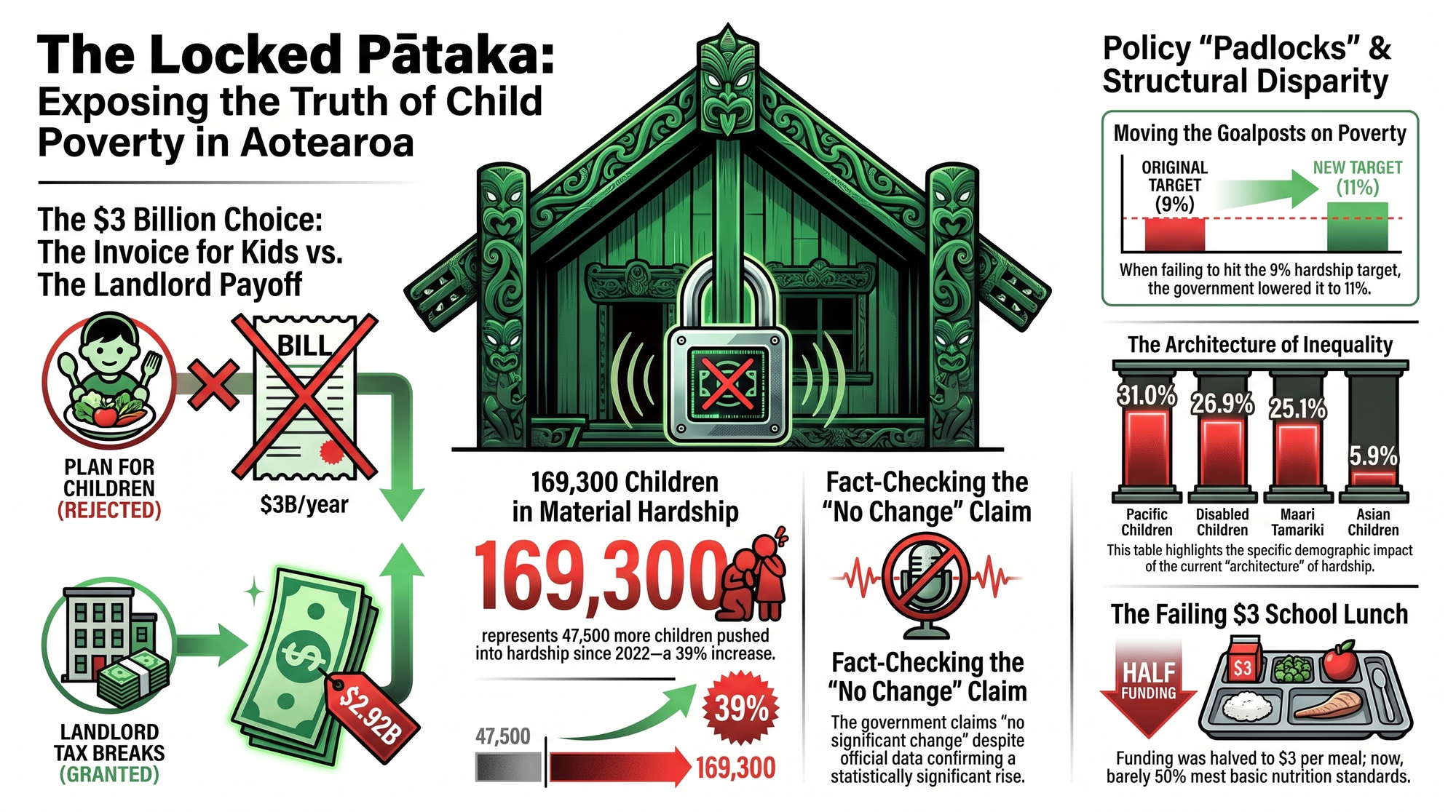
169,300 tamariki in material hardship — among them roughly 76,900 tamariki Māori and 54,400 Pacific children (Stats NZ; CPAG).
Te Horopaki — Background: The Law They Are Breaking Faith With
The Child Poverty Reduction Act 2018 exists precisely to prevent what you are about to read. It compels every government to set ten-year and three-year targets on material hardship and income poverty, and to account for them in every Budget (Treasury). The ten-year targets fall due in 2027/28: material hardship at 6 percent. Not aspiration — legislation.
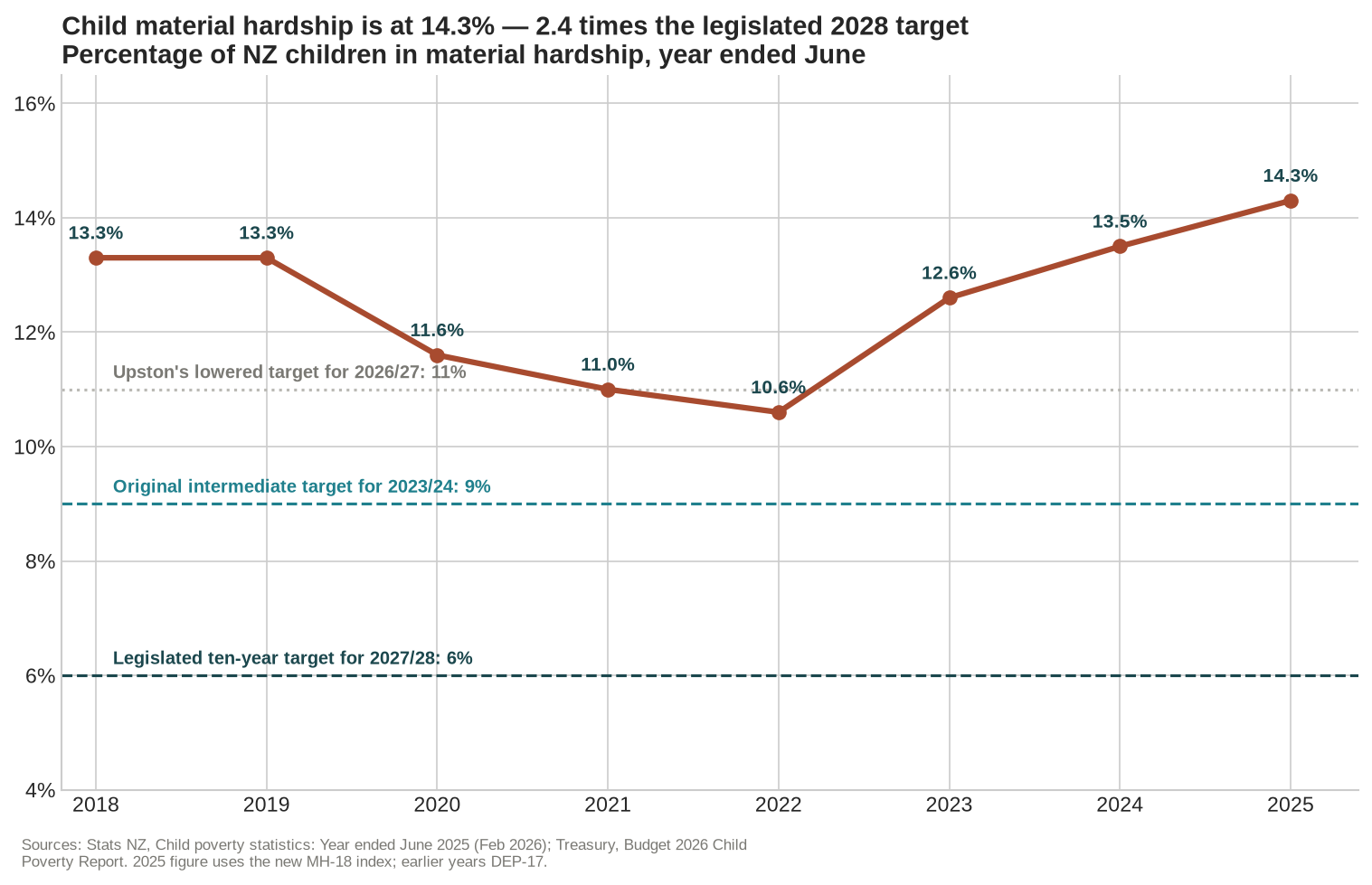
Here is where this government has taken us instead. Material hardship in the year ended June 2025: 14.3 percent — roughly 169,300 children — a ten-year high and the third consecutive annual rise (Stats NZ; CPAG).
That is 2.38 times the legislated target due in under two years (14.3 ÷ 6.0). Since 2022, when the rate stood at 10.6 percent, 47,500 more children have been pushed into hardship — a rise Stats NZ confirms is statistically significant (RNZ, February 2026).
And yesterday the Ministry of Social Development's own report — the one that triggered the Commissioner's "national shame" — showed New Zealand overtaken on international child hardship rankings by Lithuania, Latvia, Italy, Portugal and Cyprus: countries we outperformed only a few years ago (RNZ).
The Deep Dive Podcast
Listen to a lively conversation between two hosts, unpacking and connecting topics in the sources of this essay. I apologise in advance for the AI's very harsh pronounciation of reo. Please dont shoot me, :).
Youtube Video
Like video? Here is a short video suppporting the essay. Again, don't shoot the messenger please because of AI's pronounciation. :).
Koha Consideration:

This essay exists to document, beyond dispute and in the Crown's own paperwork, the harm done to 169,300 tamariki in material hardship
— the 76,900 tamariki Māori, the 54,400 Pacific children, the 200 whānau who vanished from the motel statistics with no one recording where they sleep tonight.
If this work serves your whānau, your marae, your kura, or your fight, consider a koha to keep this voice alive and independent:
Koha via app.koha.kiwi | Subscribe | Bank: HTDM 03-1546-0415173-000 | Facebook
Kia kaha, whānau. Stay vigilant. Stay connected.
Te Whakarāpopoto — What 14.3 Percent Means at 7am on a School Morning
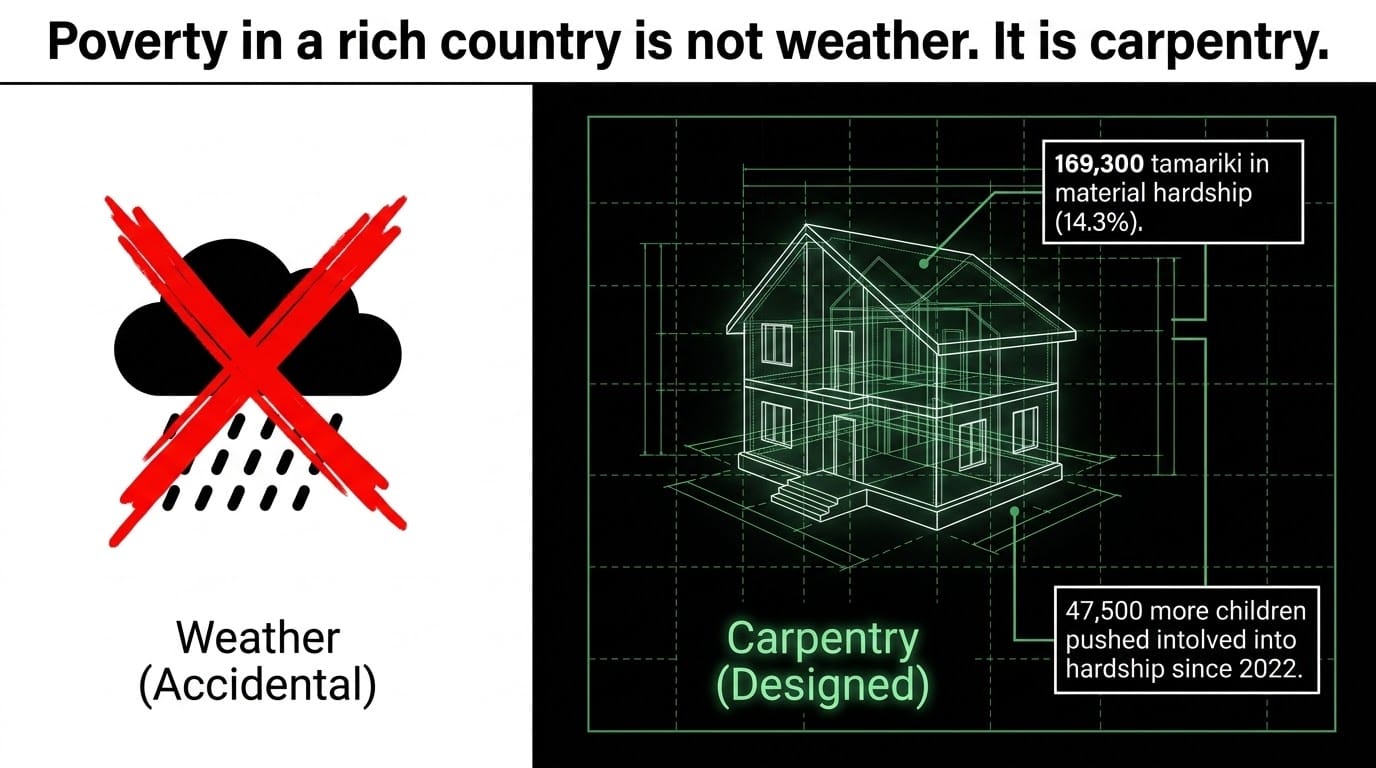
Material hardship is a technical term for a household that cannot afford seven or more of eighteen basics: a warm bed, dry shoes, a doctor's visit, heating, fresh fruit (Stats NZ methodology).
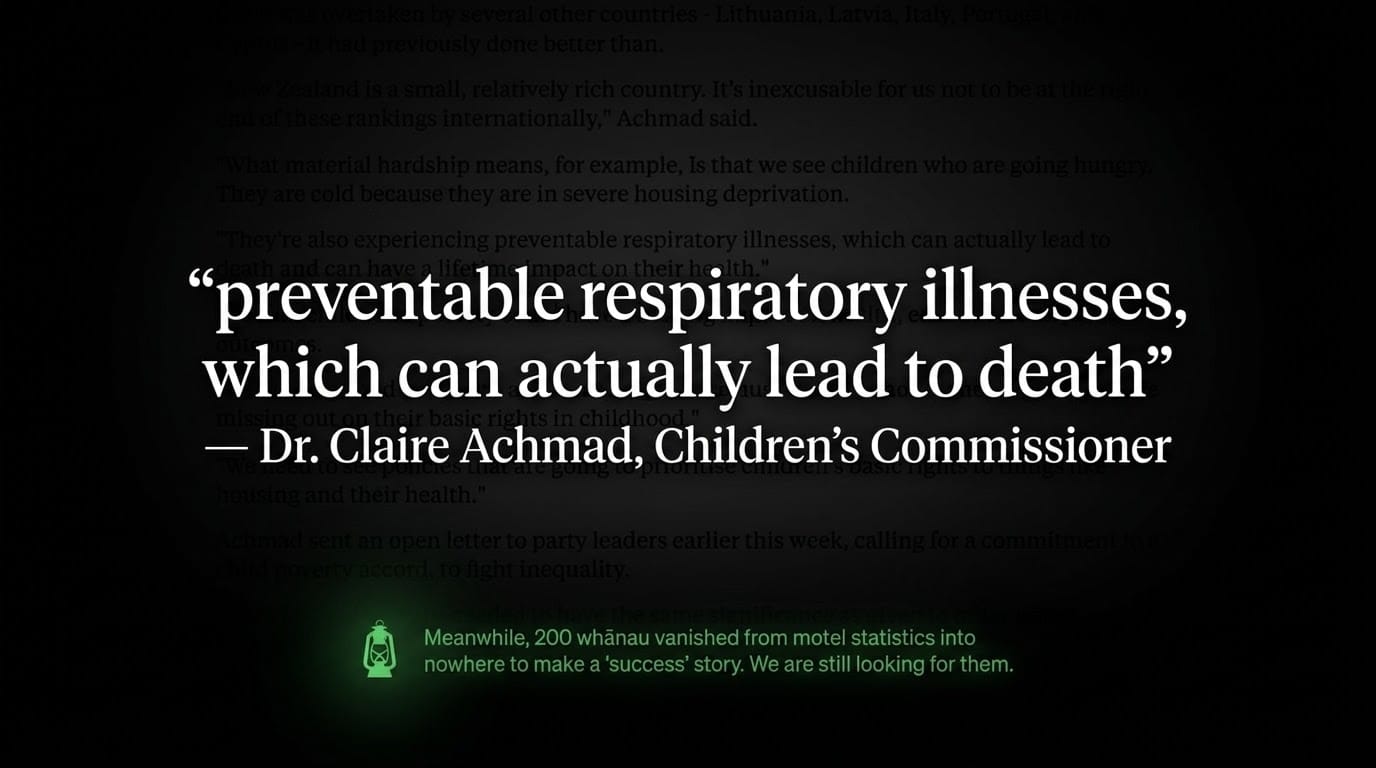
The Commissioner translated it into a child's actual morning: children "going hungry," children "cold because they are in severe housing deprivation," children carrying "preventable respiratory illnesses, which can actually lead to death" (RNZ).
Read that last phrase again. Preventable illness. Leading to death. In a rich country.
That is not an economic indicator — it is a breach of manaakitanga, the obligation that sits at the base of all mana. In te ao Māori a leader who hoards while tamariki sicken has not merely misgoverned; that leader has forfeited the moral authority to lead.
The Salvation Army, applying its Te Ora o Te Whānau framework, reached the same conclusion in secular language: these outcomes are produced by systems, not individual failings — low wages, insecure work, unaffordable housing, and welfare settings that do not meet basic needs (State of the Nation 2026).
And the burden lands exactly where colonisation aimed it:
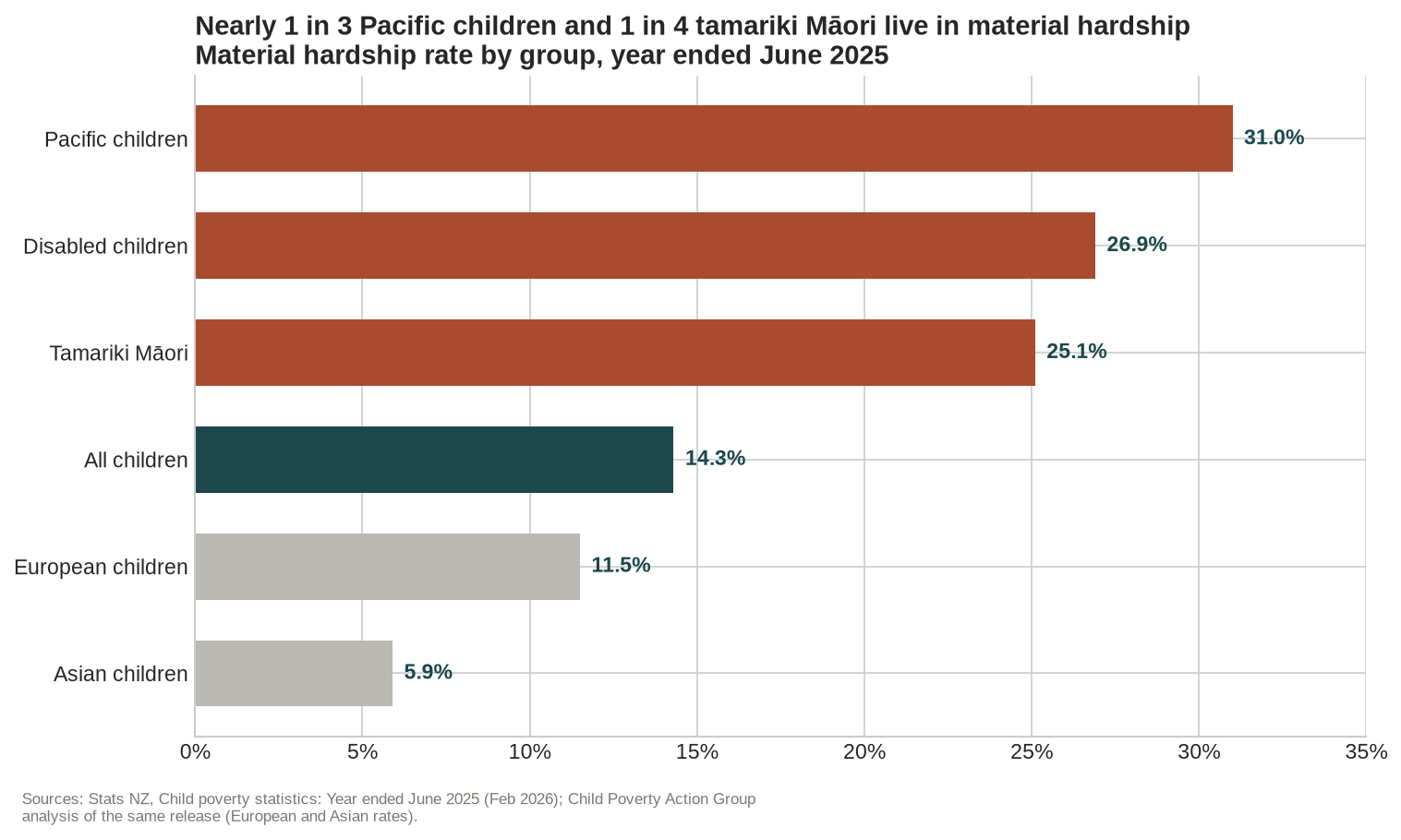
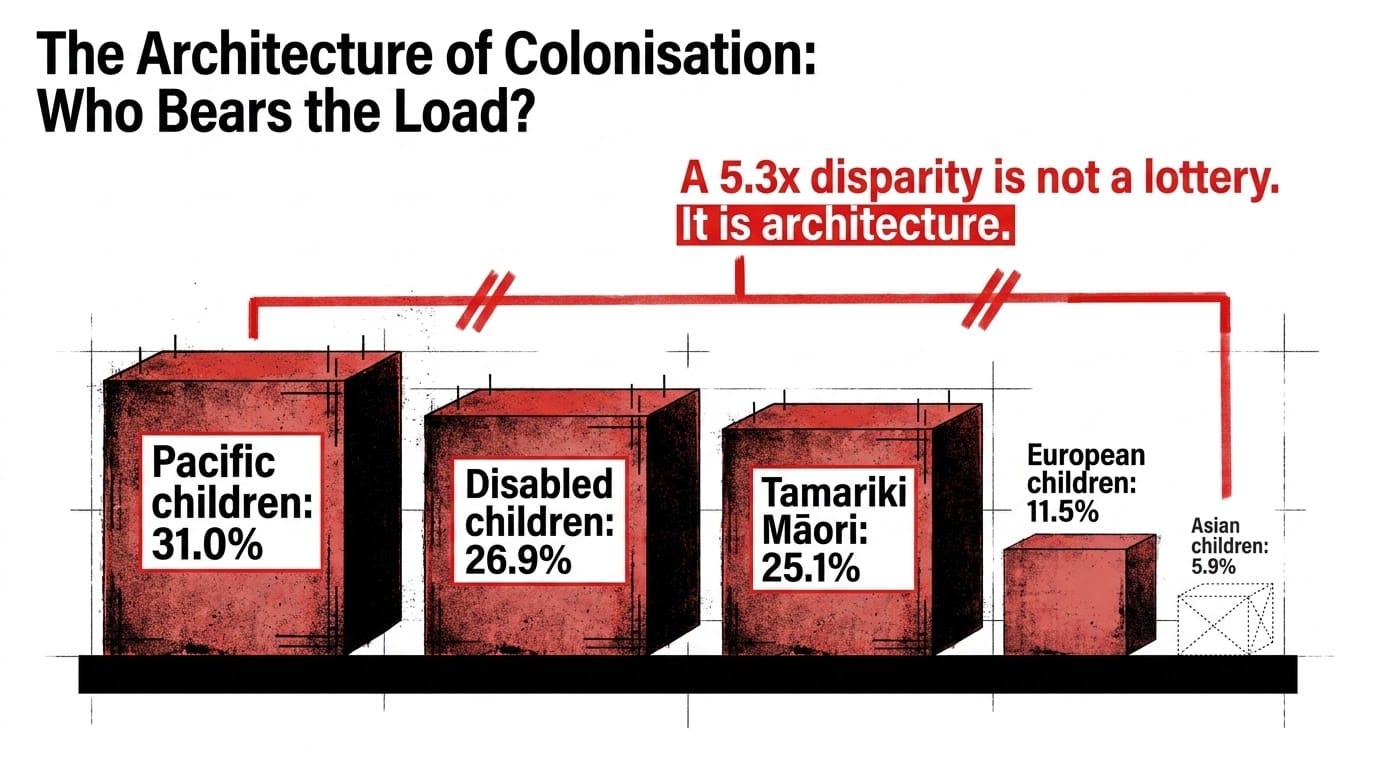
One in four tamariki Māori (25.1 percent). Nearly one in three Pacific children (31.0 percent). More than one in four disabled children (26.9 percent). European children: 11.5 percent. Asian children: 5.9 percent (Stats NZ; CPAG).
A 5.3-fold gap between Pacific and Asian children is not a lottery. It is architecture — and architecture has architects.
Te Tātaritanga — Analysis: Six Revelations From the Crown's Own Paper Trail
Revelation 1: They were handed the invoice for ending child poverty — and paid the landlords instead
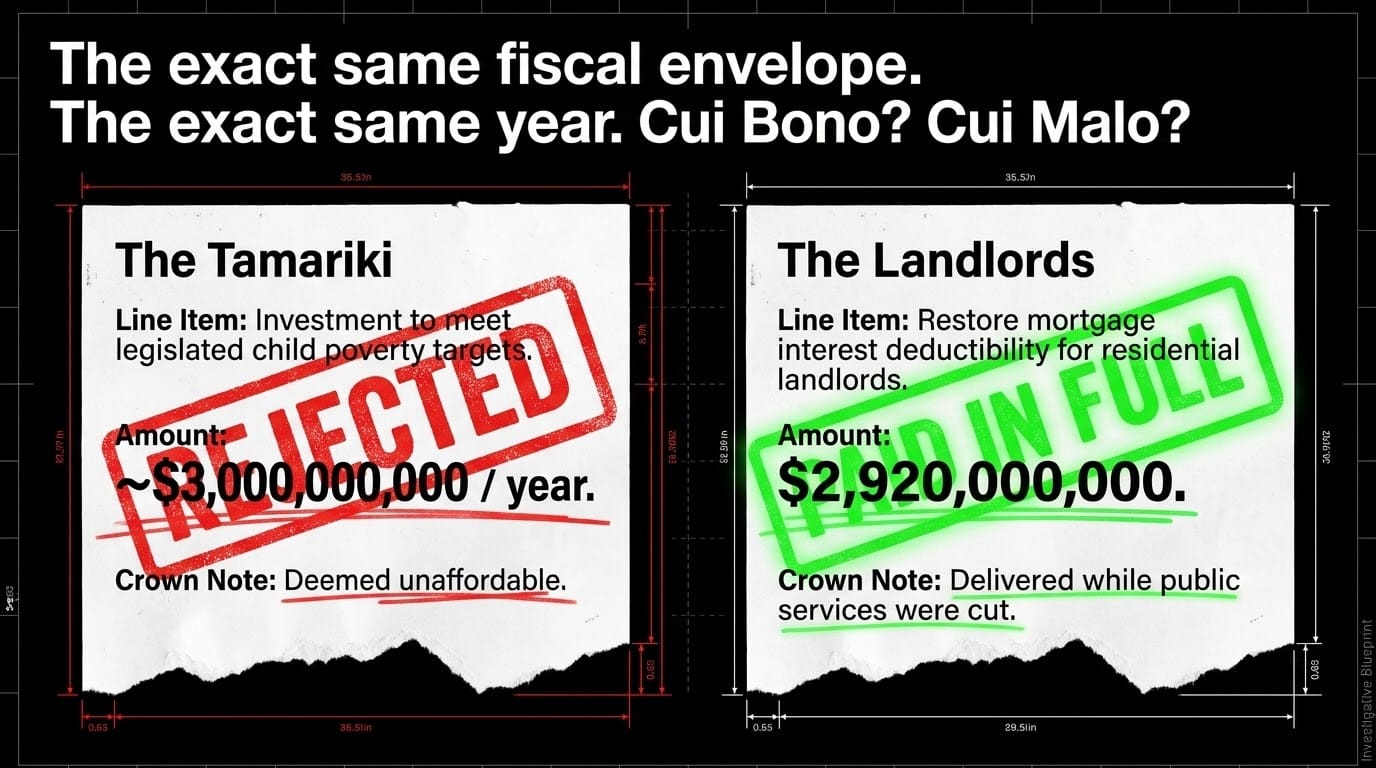
In September 2024, Child Poverty Reduction Minister Louise Upston rejected official advice that meeting the legislated targets "would require investment in the region of $3 billion per year" (RNZ).
Now place the second document beside the first. Restoring mortgage interest deductibility for residential landlords: $2.92 billion, costed by the government's own regulatory impact statement (Inland Revenue RIS), delivered while public services were being cut to fund it (1News).
The same government, the same fiscal envelope, the same year. One invoice was "unaffordable." The other was a coalition promise, honoured in full. Opinion, flagged as such and grounded entirely in the two documents above: no sentence this government ever utters about "tough choices" should be heard again without these two numbers read aloud beside it.
Revelation 2: When the target exposed them, they shot the target
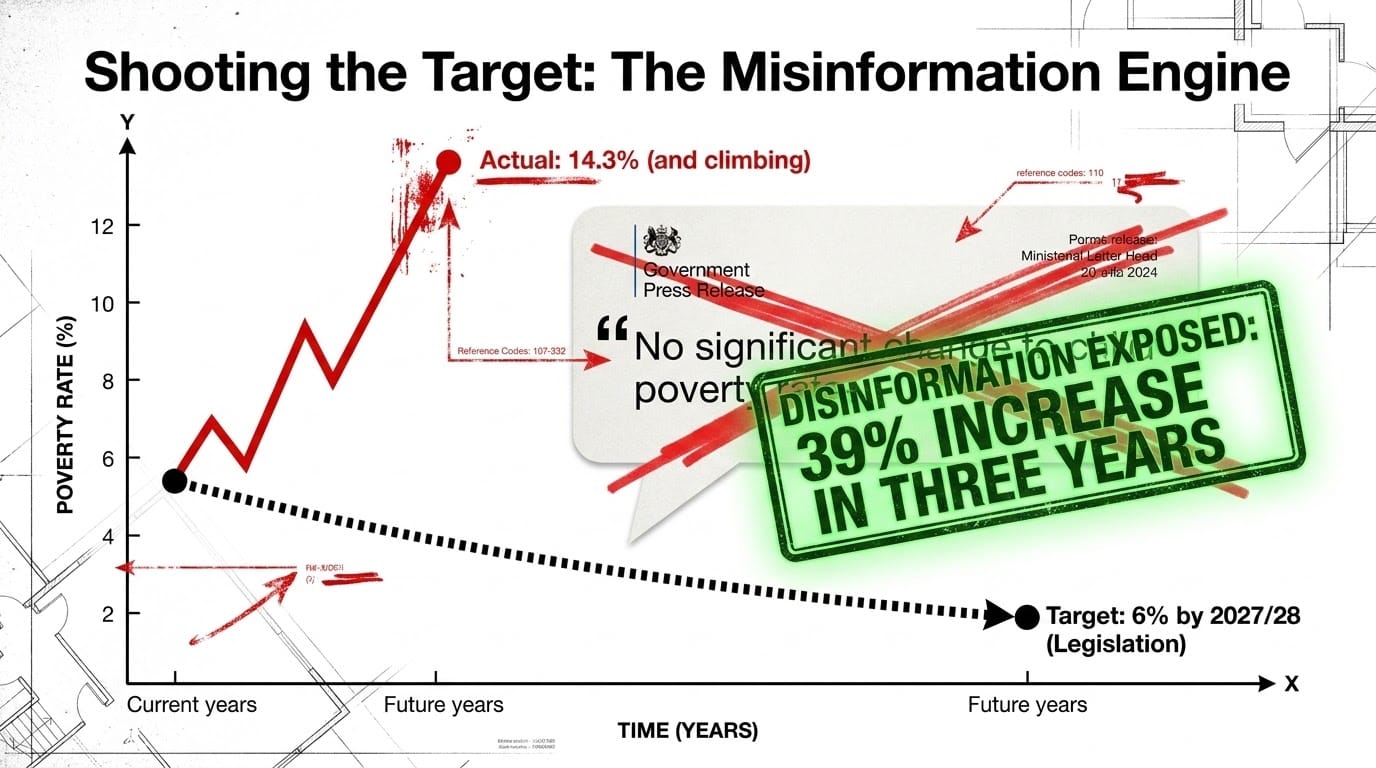
The intermediate target Upston inherited was material hardship of 9 percent by 2023/24, on the legislated road to 6 percent. Her replacement target: 11 percent by 2026/27 — weaker than the goal set five years earlier (RNZ; MSD).
The OIA record shows the sequence. April 2024: officials advise the Minister that coalition policies are "likely to fall well short of the reductions required to meet the current ten-year targets," and warn that the school lunch cuts and public transport changes "could potentially have a negative impact" on hardship (CPAG OIA release).
The government proceeds with the policies. Then it lowers the target. Then the rate sails past even the lowered target, to 14.3 percent — and Treasury's forecasting, per the NZCCSS, suggests the legislated ten-year targets will not be met (NZCCSS Issues Brief). [Verified]
The Beehive's official portfolio page then performs the boldest move of all: "No significant change to child poverty rates under successive governments" (Beehive) — published while Stats NZ confirms a statistically significant increase since 2022 (RNZ).
That is not spin. That is a government department contradicting the official statistician on the Crown's own letterhead.
Revelation 3: The $3 lunch — a price set in a meeting the minister's office kept quiet
David Seymour cut Ka Ora, Ka Ako per-meal funding from roughly $8 to $3, a change locked in by ACT's coalition agreement with National (The Spinoff).
The Auditor-General's inquiry, tabled 30 June 2026, catalogued the wreckage: barely half of assessed meals met nutrition standards; waste ran above target at roughly 20,000 uneaten meals a day; the main supplier, Libelle, collapsed into liquidation within three months of rollout — after the Ministry was warned of exactly that risk (The Spinoff).
Now the connection the press releases never mention. The $3 figure emerged after Seymour directed the Ministry of Education to meet with the charity KidsCan. The inquiry found his office failed to disclose that KidsCan had made a private $4 million funding bid directly to him — and KidsCan was subsequently awarded an $8 million early childhood contract. The Auditor-General found no direct evidence of predetermination, but identified factors that "could create a perception" of it (The Spinoff). Meanwhile the surviving sole supplier, the School Lunch Collective, had its contract expanded by $18 million (The Spinoff).
Seymour's answer to the country's chief public auditor: the inquiry was "largely driven by former employees of the Ministry of Education and those who lost their contracts" (The Spinoff).
He saved roughly $130 million in 2025 — against CPAG's costed $107–115 million a year to restore lunches children actually eat (CPAG Budget bid).
The "savings" and the hungry children are the same line item. One appears in a press release; the other appears at a school gate at lunchtime, empty-handed.
Revelation 4: Sanctions doubled — aimed at Māori and rangatahi, for jobs that do not exist
The traffic light sanctions regime, live from August 2024, drove quarterly sanctions from roughly 7,500 (March 2024) past 14,400 (September 2024); a year on they still ran at 12,900 — double the pre-system average (Infometrics, February 2026).
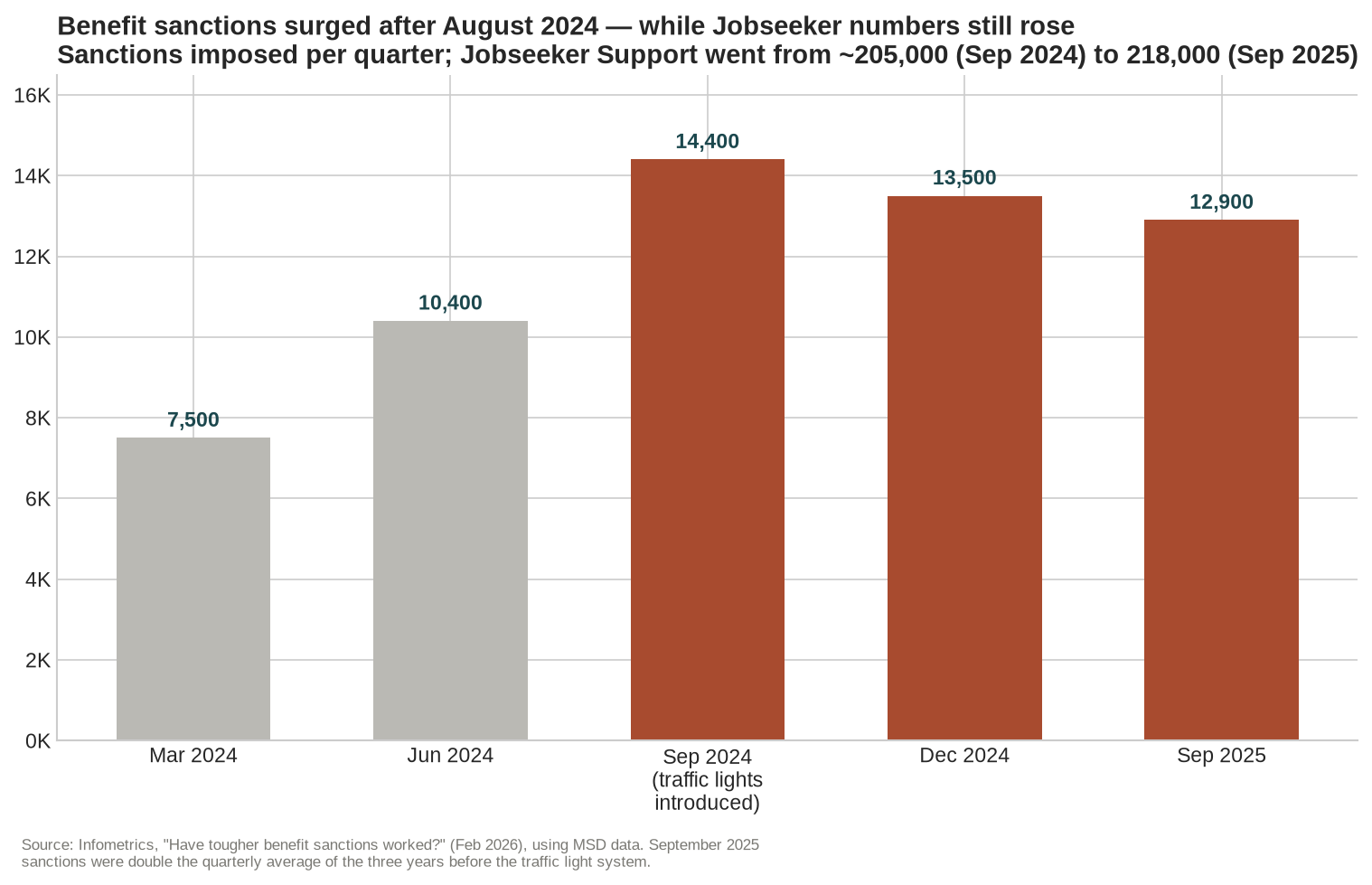
Aim of the weapon: Māori receive 49 percent of sanctions while making up 40 percent of beneficiaries. Rangatahi aged 15–24: 46 percent of sanctions, 19 percent of beneficiaries. Two-thirds of sanctions are for missed appointments — not refused work (Infometrics).
Result, on the government's own benchmark: Jobseeker numbers rose from about 205,000 to 218,000 in the system's first year — in a labour market with 47 percent fewer vacancies than 2022 and more than triple the applicants per vacancy of 2019 (Infometrics). You cannot sanction people into jobs that do not exist. You can only sanction their tamariki deeper into hardship — and the Salvation Army now counts 234,000 children in benefit-receiving households, the highest in a decade, with 21.4 percent of households with children going without food often or sometimes (State of the Nation 2026).
Revelation 5: Budget 2026 — temporary mercy, permanent extraction, unforecastable accountability
Treasury's Budget 2026 Child Poverty Report — the accountability document the Act forces them to publish — makes three admissions in a single paper. One: the headline relief, a $50-a-week in-work tax credit increase, is temporary; its impacts "in subsequent years are small and not statistically significant." Two: the "fiscally neutral" housing package raises social housing tenants' rent contribution from 25 to 30 percent of income and cuts Temporary Additional Support from 30 to 25 percent of the main benefit — the state paying one poor family's Accommodation Supplement with a poorer family's rent rise. Three: "The Treasury's model cannot estimate material hardship" (Treasury).
Hold the third admission to the light. The one measure this government selected as its portfolio target (MSD) is the one measure the Crown's own forecasters cannot model. Opinion, flagged, resting on the documents above: a target that cannot be forecast is a target you can never be shown to be missing — until the children have already gone hungry, at which point the Beehive calls it "an ongoing challenge under successive governments."
Revelation 6: The two hundred vanished families of the motel "success story"
August 2024: the government celebrates "more than 1,000 children no longer growing up in motels." Asked the obvious question — where are they? — MSD concedes it does not track where the children went. Of 1,008 households that left emergency accommodation, about half entered social housing, roughly 30 percent likely went to private rentals, and around 20 percent — some 200 families — vanished from the data entirely (RNZ, August 2024).
Two hundred whānau were counted out of a statistic and into nowhere: cars, garages, overcrowded lounges — no one in government can say. The press release, however, went out on time.
Ngā Whakaaweawe — Implications: The Harm, Quantified
- 47,500 more children in hardship than 2022 — a 39 percent increase in three years (47,500 ÷ 121,800 = 39.0 percent) (CPAG).
- 71,000 children in severe material hardship — up roughly 24,400 since 2022 (CPAG).
- Over 100,000 children (8.6 percent) in consistent poverty — low income and hardship at once (CPAG).
- 210,600 children (17.8 percent) below the primary after-housing-costs poverty line — a statistically significant rise from 2022 (Stats NZ; CPAG).
- 354,200 children (29.9 percent) below the 60 percent after-housing-costs line — a depth of deprivation CPAG describes as comparable to the aftermath of the Global Financial Crisis (CPAG).
- And behind every percentage: hospital wards filling each winter with preventable respiratory illness that "can actually lead to death" (RNZ).
What you can do this week. The Commissioner has written to every party leader demanding a cross-party child poverty accord:
"If we can agree a national infrastructure plan, then surely we can do the same… for our children" (RNZ).
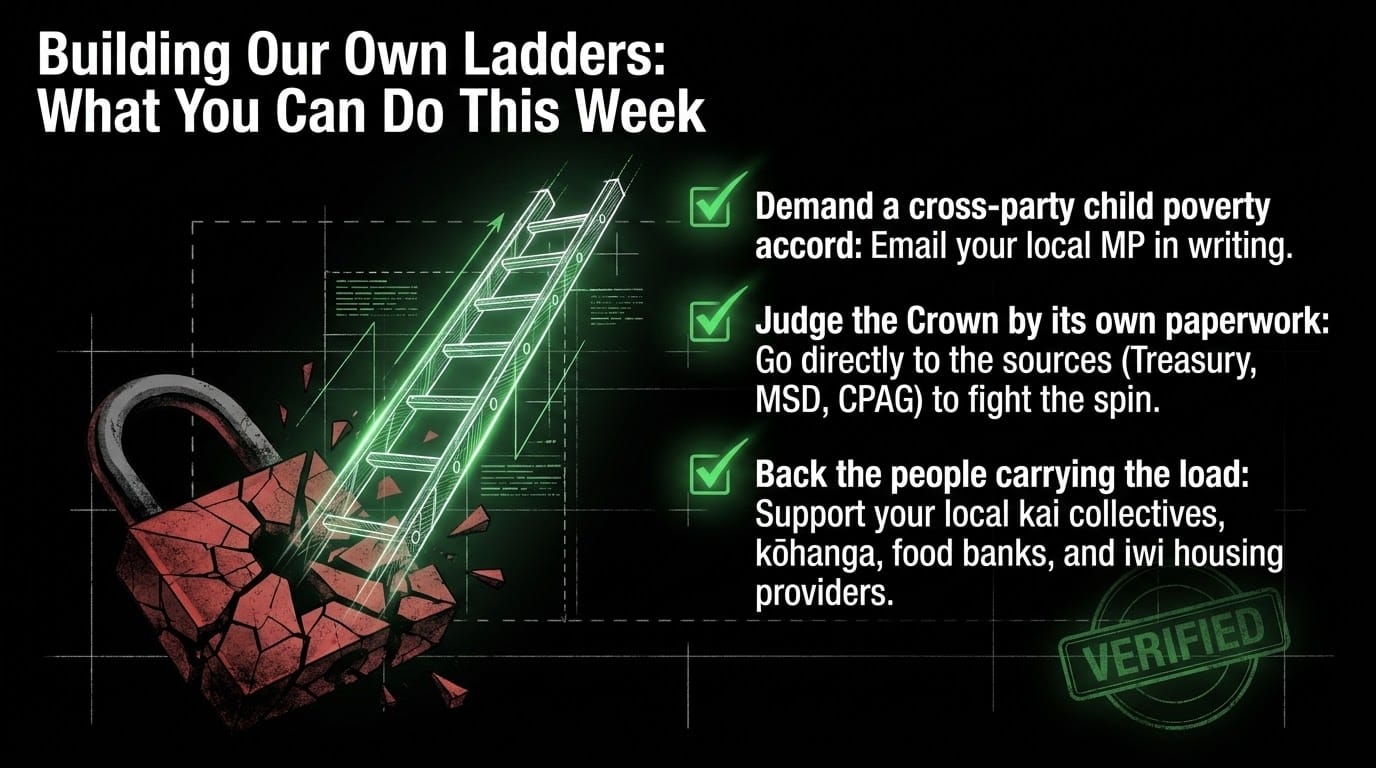
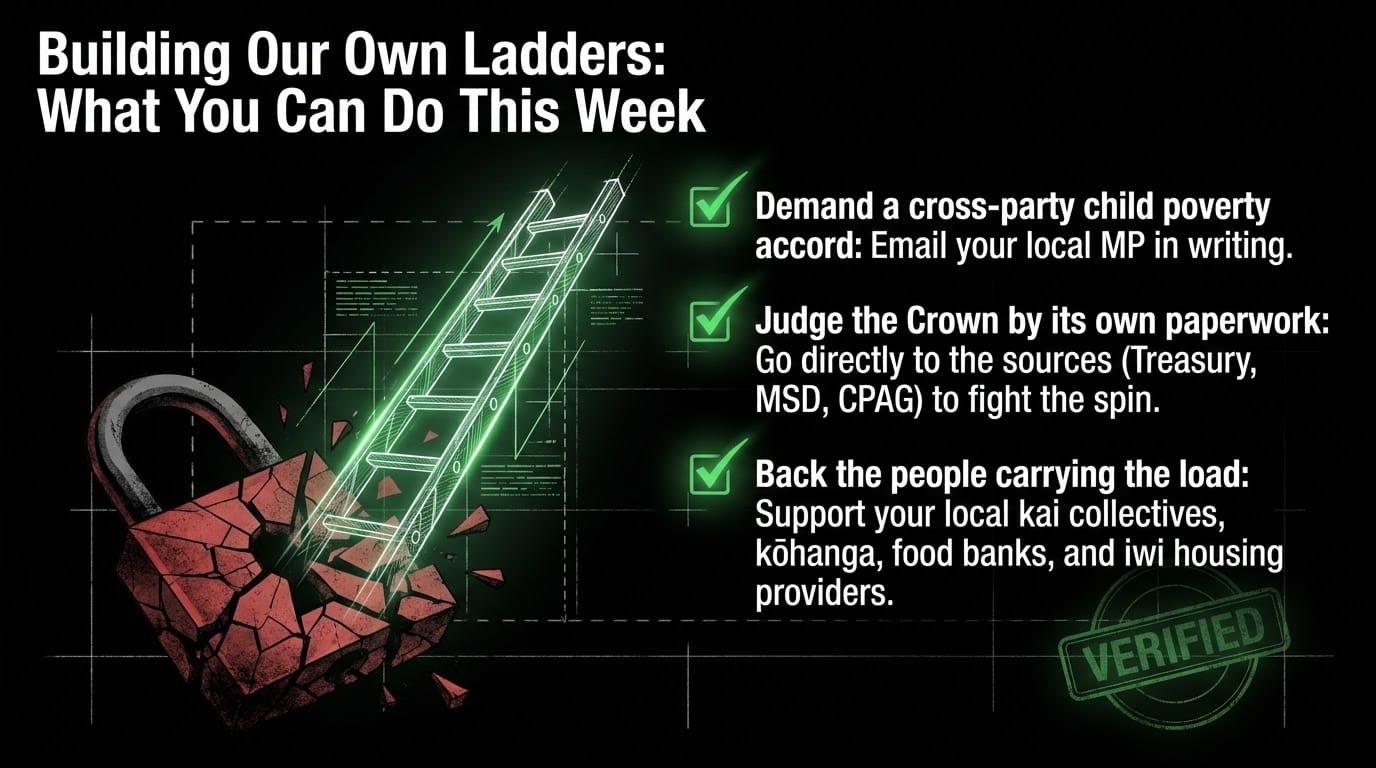
Email your local MP and ask, in writing, whether they will commit to it. Go to the sources yourself — the CPAG statistics hub, the Salvation Army State of the Nation, the Treasury report — and judge the Crown by its own paperwork.
Then back the people carrying the load the Crown set down: your local kai collective, food bank, kōhanga, and iwi housing provider.
Three Verified Examples for the Western Mind
The Accountant's Test
Core claim: officials priced ending child poverty at ~$3 billion a year and the Minister said no (RNZ); the same government paid landlords $2.92 billion (RIS).
Quantified harm: 47,500 more children in hardship since 2022. Solution: reverse the priority — the money demonstrably exists.
Tikanga impact: manaakitanga restored as fiscal policy, not charity.
The KPI Test
Core claim: the manager who misses the target and responds by lowering the target gets fired in any boardroom; Upston moved 9 percent to 11 percent (RNZ) and the actual rate hit 14.3 percent (Stats NZ).
Quantified harm: a legislated 6 percent target now missed by a factor of 2.38. Solution: restore the legislated trajectory and report against it honestly.
Tikanga impact: pono — truthfulness — returned to public accounting.
The Procurement Test
Core claim: a $3 price fixed after an undisclosed $4 million approach to the minister, a sole supplier's contract fattened by $18 million after rivals collapsed (The Spinoff; The Spinoff).
Quantified harm: only ~50 percent of meals met nutrition standards; ~20,000 meals wasted daily. Solution: restore ~$107–115m/year, locally supplied (CPAG).
Tikanga impact: kai as whakawhanaungatanga — feeding children as relationship, not logistics.
He Kupu Whakamutunga — Conclusion
Poverty in a rich country is not weather. It is carpentry. Someone drew the plans, someone priced the timber, someone signed the invoice
— and in this essay their names appear beside their own documents: Upston, who rejected the $3 billion invoice for children after her government paid $2.92 billion to landlords;
Seymour, who set a $3 lunch price after an undisclosed $4 million approach to his office and then blamed the auditors' witnesses;
a Cabinet that lowered the target rather than lift the children, then declared the wreckage "no significant change."
The pātaka is full. The padlock is government property. Rangatiratanga does not ask us to wait politely for the key — it asks us to name the locksmiths, publish the receipts, and build our own ladders: whānau-led, iwi-led, marae-led, until the measure of leadership in this country is once again how fast the storehouse opens.
Kia kaha, whānau. Stay vigilant. Stay connected.
Public interest: This essay concerns ministers exercising public power over legislated child poverty targets and billions in public money — squarely a matter of public concern (responsible communication on matters of public interest, Durie v Gardiner [2018] NZCA 278).
Right of reply: All individuals named — Hon Louise Upston, Hon David Seymour, Hon Tama Potaka, Hon Chris Bishop — are ministers named solely in their public capacity, in respect of statements and decisions covered by qualified privilege for political expression (Lange v Atkinson [2000] 3 NZLR 385). Their published responses and defences are quoted and linked above. No private individuals are named.
Disclaimer: This essay is political commentary and analysis in the public interest. All factual claims are cited to the linked sources, which readers are urged to consult directly; opinions are flagged as such and are honestly held, based on the facts cited. Reported statements are attributed to their sources ("[source] reported that…"). Any person or organisation named who believes a factual error appears here may contact The Māori Green Lantern for prompt review, correction, or retraction in line with our published protocol.