"The Lie Merchants: How National Weaponised Your KiwiSaver Against You" - 10 September 2026
One Regulator Ruling Confirms What Every Whānau Already Knew — This Government Lies To Keep Power, And Feels No Shame Doing It

Kia Ora, Whānau — I Am Furious, And I Want You To Be Too
My name is Ivor Jones. I am the Māori Green Lantern. I did not build a taiaha out of research and receipts to swing it gently, and I am not going to start now.
 RNZ | Te Reo Irirangi o Aotearoa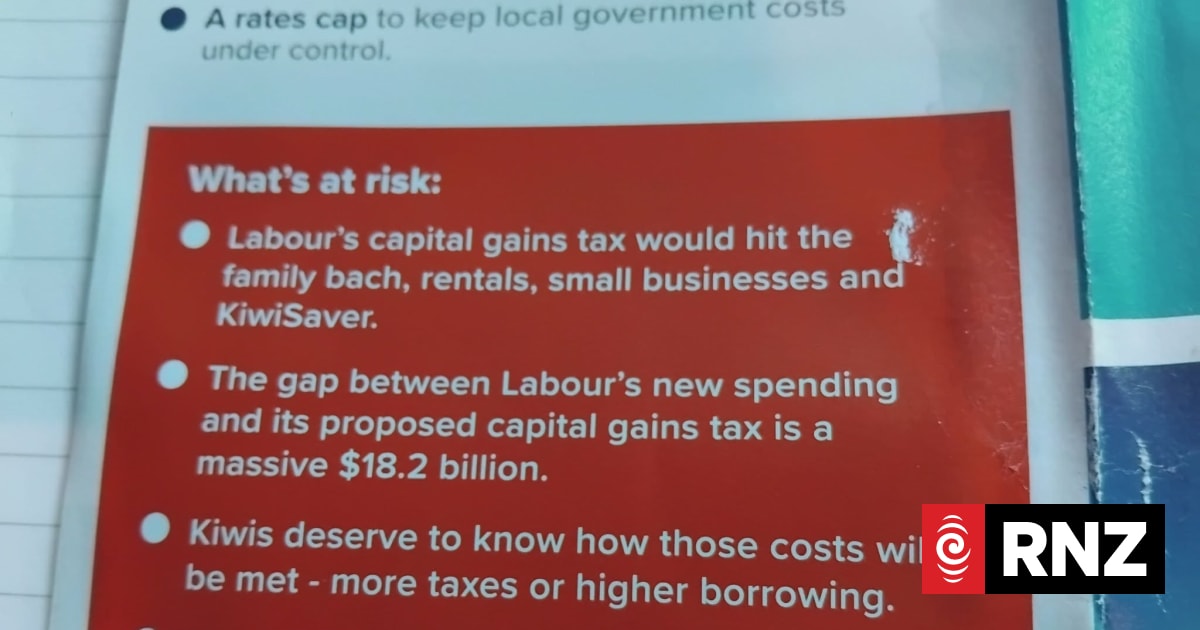
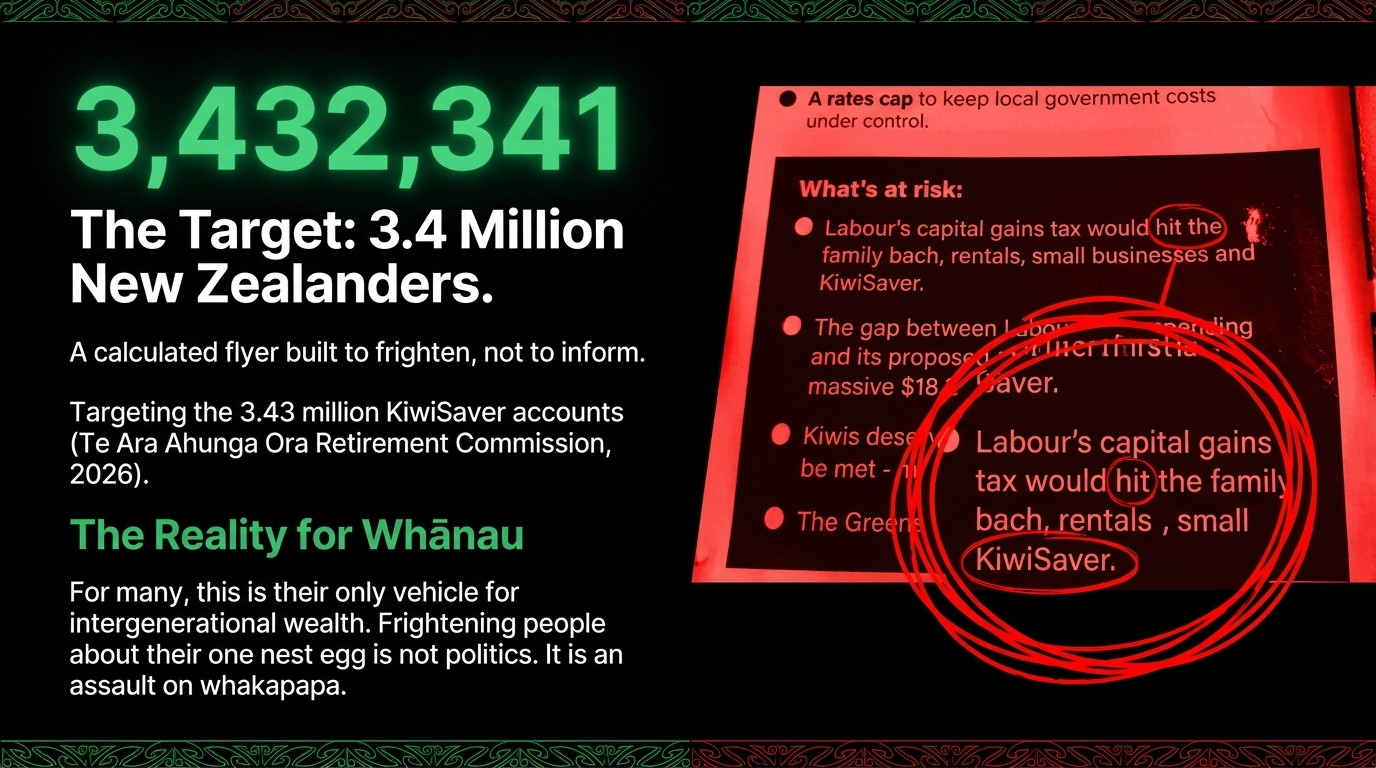
A white supremacist, neoliberal, National-led government has just been caught — formally, on the record, by its own regulator — lying to 3,432,341 New Zealanders about their retirement savings (Te Ara Ahunga Ora Retirement Commission, KiwiSaver Demographic Study 2026).
That is not a rhetorical flourish. That is the number of KiwiSaver members in this country as of December 2025, and every single one of them was a potential target of a flyer built to frighten, not to inform.
The Māori Green Lantern exists for exactly this moment. I am a kaitiaki — a guardian — and this platform is the digital manifestation of that responsibility: a watchdog that reads NZ Herald, RNZ, Stuff, Te Ao News and Waatea News alongside the social media firehose, specifically hunting for the sophisticated tactics far-right, white supremacist, and neoliberal networks use to spread disinformation into Aotearoa's political bloodstream.
I ground that analysis in kaitiakitanga — the Māori worldview that all life is connected, and that protecting our communities from harmful misinformation is not optional extra-curricular activism, it is a direct responsibility we carry.
I built this Lantern because the tactics never change, only the costume: anti-co-governance campaigns, historical revisionism, Treaty denialism, and welfare scapegoating on one side; market fundamentalism, "individual responsibility" rhetoric that erases structural racism, and deregulation dressed up as freedom on the other; replacement theory, reverse-racism grievance, and colonial apologia underneath both. A National-led government running a fear campaign against 3.4 million KiwiSaver accounts to protect its own tax narrative is not a one-off headline. It is exactly the pattern this Lantern was lit to expose — and I am not going to let it walk past without a name attached to it.
I am not going to pretend this is a debate about tax policy. It is a story about a governing party that will say anything, to anyone, and reach for a lawyer's technicality the second it gets caught. Let's go through it, line by line, receipt by receipt.
Te Papamuri — What The Regulator Actually Found
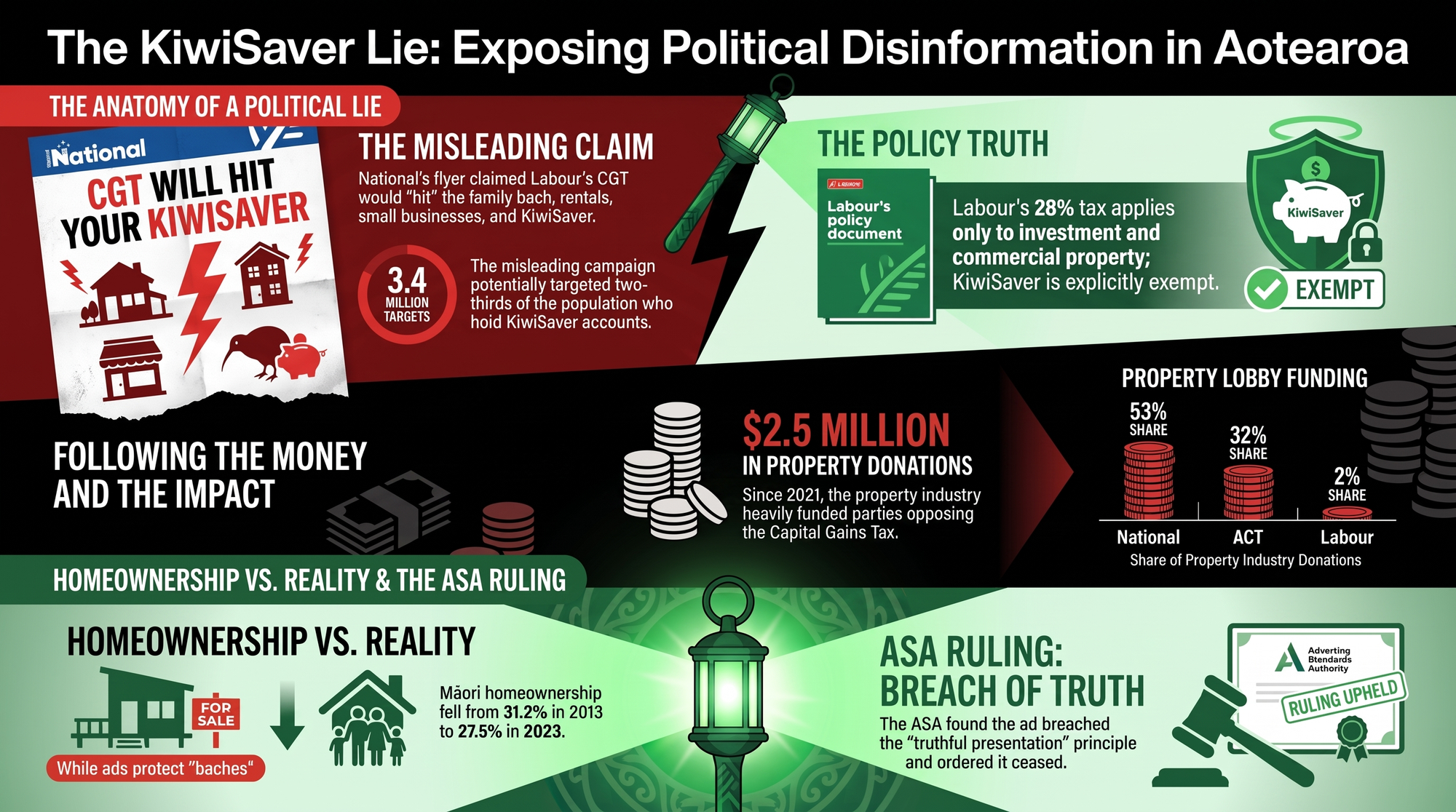
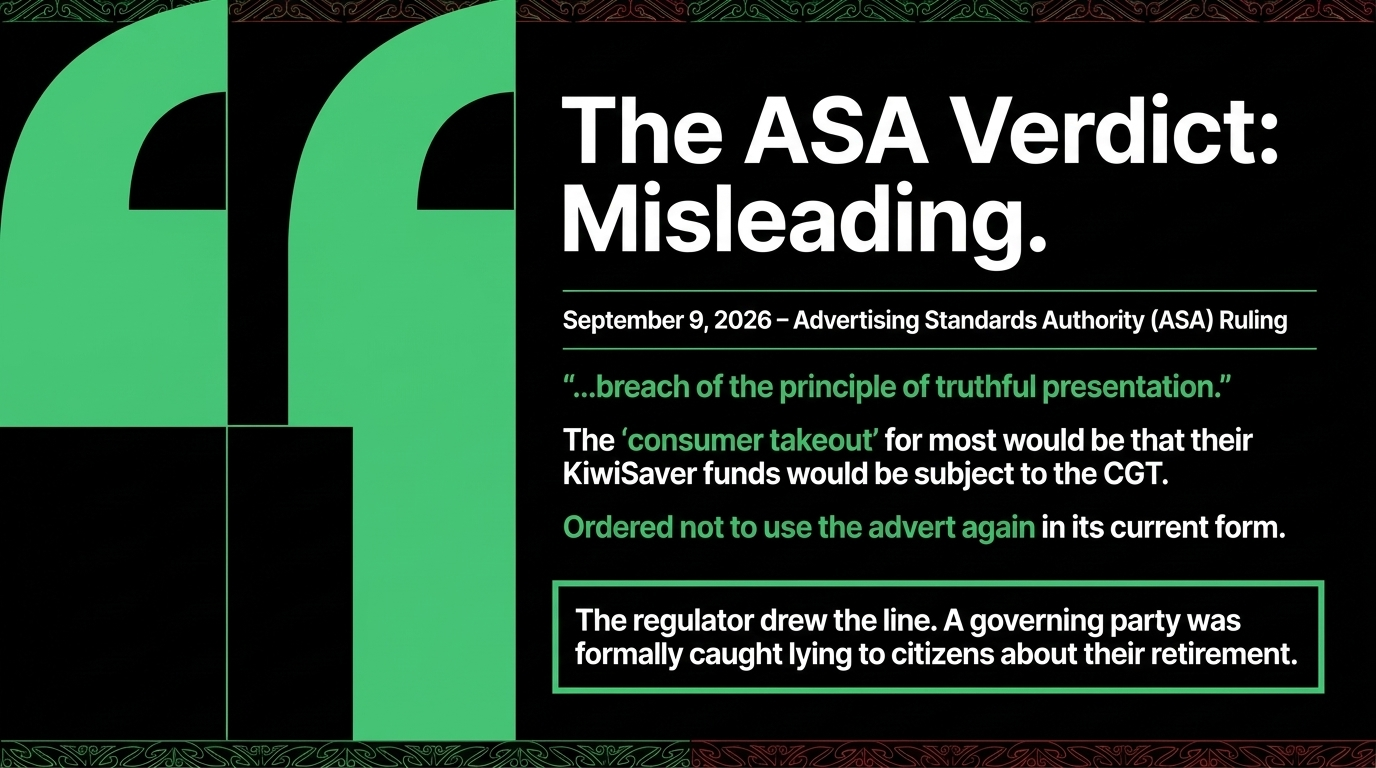
On 9 September 2026, the Advertising Standards Authority partly upheld a complaint against a National Party attack ad and ordered the party not to run it again in its current form (RNZ). The ad was a flyer promoting Chris Bishop as National's Hutt South candidate.
Its "Keeping Taxes Low" section stated: "Labour's capital gains tax would hit the family bach, rentals, small businesses and KiwiSaver" (RNZ).
Labour's actual policy — published, costed, on the party's own website — is a 28% tax on profit from selling investment and commercial property, taking effect from 1 July 2027, with KiwiSaver, the family home, farms, inheritances, shares and businesses all explicitly exempt (Labour Party official policy; Labour policy hub). The ASA's majority ruled that naming KiwiSaver in the same sentence as the bach and the rentals created a "consumer takeout" that ordinary savers would be directly taxed — untrue, and a breach of the truthful presentation principle (RNZ). This is not my opinion. This is what the regulator found, in writing, this week.
The Deep Dive Podcast
Listen to a lively conversation between two hosts, unpacking and connecting topics in the sources of this essay. I apologise in advance for the AI's very harsh pronounciation of reo. Please dont shoot me, :).
Youtube Video
Like video? Here is a short video suppporting the essay. Again, don't shoot the messenger please because of AI's pronounciation. :)
He Kupu Mō Te Koha
You might ask who is paying the Māori Green Lantern to trace 3.4 million exposed KiwiSaver accounts, audit an 80% fabrication rate, follow $2.5 million in property donations, and chase down a regulator's ruling until every number checked out.
The answer is you do.
This mahi is supported through koha and that is it. There is no corporate cheque behind this essay — no bank, no landlord lobby, no property developer funding the fact-check on their own donations. Every koha tells this government that whānau are willing to support the accountability that Crown and corporate structures refuse to provide, and that rangatiratanga includes the power to support our own truth-tellers, not wait for theirs.
Kia kaha, whānau. Stay vigilant. Stay connected. And if you are able, consider a koha to ensure this voice keeps following the money behind every lie they send to your letterbox.
If you are unable to koha, no worries! Subscribe or follow The Māori Green Lantern at themaorigreenlantern.maori.nz, kōrero and share this with your whānau and friends — that is koha in itself.
Four pathways exist:
Koha — Support: app.koha.kiwi/events/the-maori-green-lantern
Subscribe: themaorigreenlantern.maori.nz/#/portal/support
Bank transfer: Ivor Jones, account number 03-1395-0099387-000
Facebook: facebook.com/Themaorigreenlantern
Ngā Whakaaturanga E Toru — Three Examples For The Western Mind
Example One: The KiwiSaver Lie
Core claim: National told voters their KiwiSaver would be "hit" by a tax it is legally exempt from (RNZ).
Quantified harm: 3,432,341 New Zealanders hold a KiwiSaver account (Retirement Commission, 2026). That is not an abstraction — it is nearly two-thirds of the entire population, deliberately made to feel their retirement savings were under threat from a policy that, by its own written terms, cannot touch them.
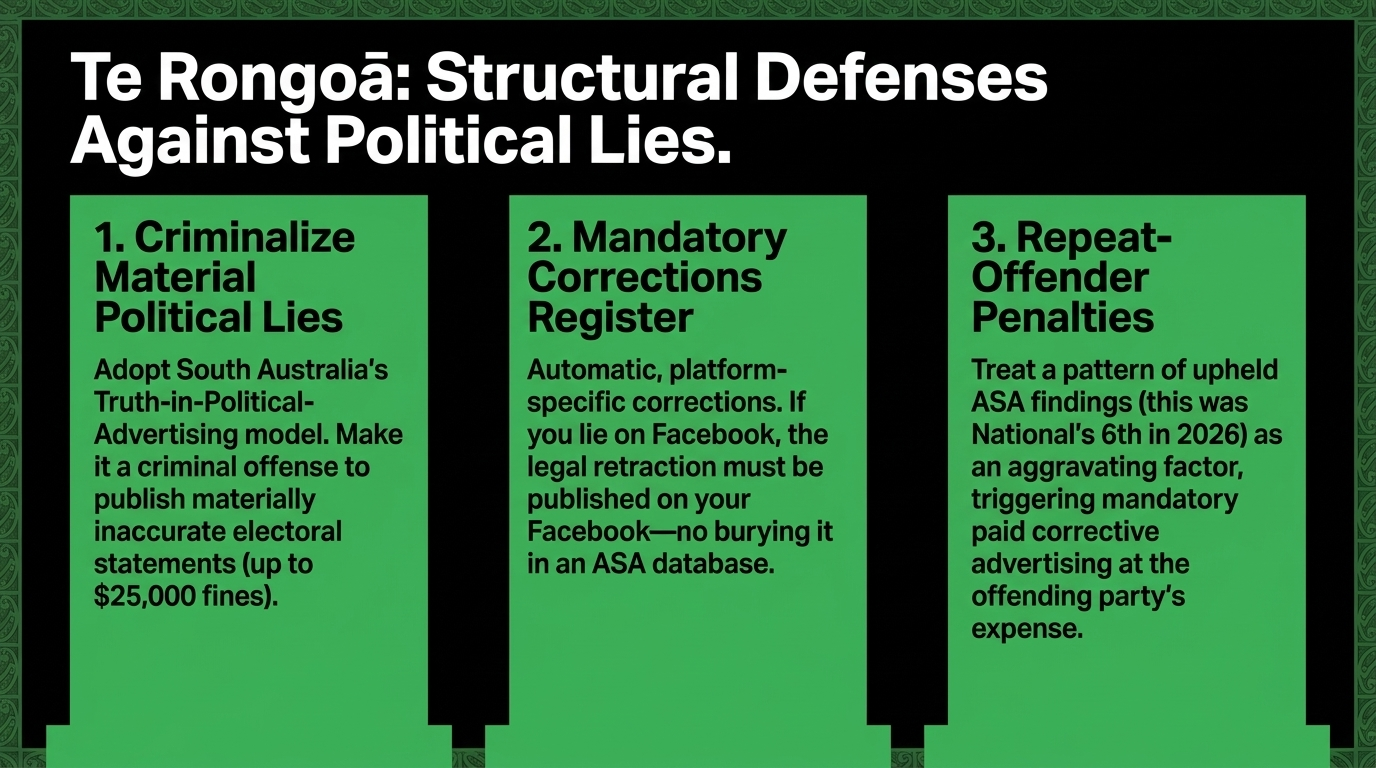
Solution: New Zealand has no equivalent of South Australia's truth-in-political-advertising law, which makes it a criminal offence to publish an electoral statement of fact that is "inaccurate and misleading to a material extent," with fines up to NZ-equivalent $25,000 for a body corporate and the power to compel a public retraction (The Australia Institute; The Conversation). New Zealand should adopt it, with an enforceable retraction requirement reaching the same audience the lie reached.
Impact on tikanga, explained for the Western mind: In te ao Māori, telling someone their whānau's future security is under attack, when it isn't, is not "robust debate" — it is a direct assault on whakapapa, because retirement savings are one of the only intergenerational wealth tools available to whānau who were never handed land, capital, or inheritance by a colonial system built to exclude them. Frightening people about the one nest egg they do have is not politics. It is cruelty dressed as a pamphlet.
Example Two: The Five-Tax Fabrication
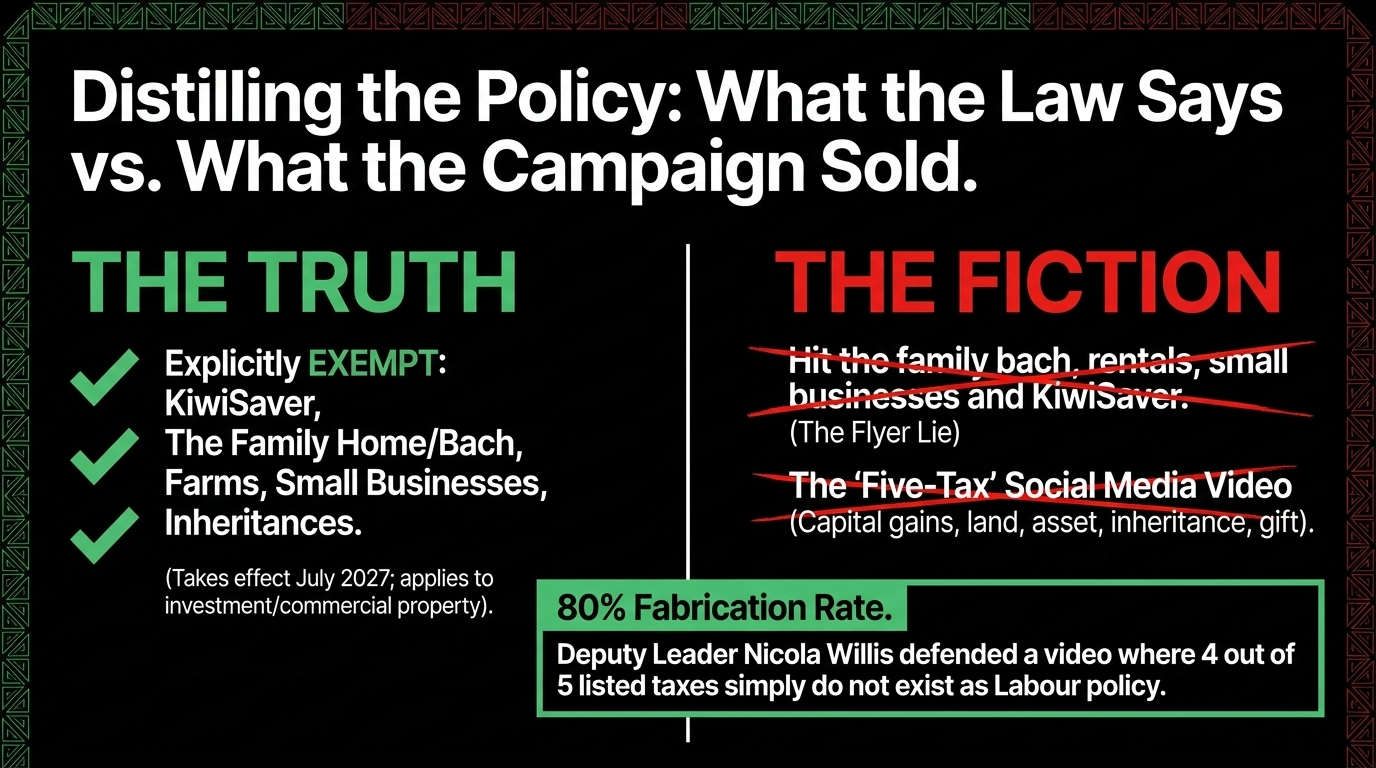
Core claim: Deputy Leader Nicola Willis refused to disown a National social media video from MP Grant McCallum listing five taxes — capital gains tax, land tax, asset tax, inheritance tax, and gift tax — as risks under a Labour government, when only the capital gains tax is real (The Post).
Quantified harm: Four of the five taxes listed do not exist as Labour policy. That is a fabrication rate of 4 ÷ 5 = 80% — four out of every five claims in that video were invented, and the Deputy Prime Minister called defending it her "duty to voters" (The Post).
Solution: A mandatory corrections register, published on the same platform as the original claim, triggered automatically whenever the ASA or Electoral Commission finds a material falsehood — no discretion, no delay, no burying it in a decision database nobody reads.
Impact on tikanga, explained for the Western mind: Whanaungatanga depends on the word of the person speaking to you matching the truth of what they know. A minister of the Crown who calls an 80%-fabricated claim her "duty" has broken that relationship deliberately, not accidentally — and she did it from a position of power over people who trusted the office, not just the person.
Example Three: The Doubling-Down Machine
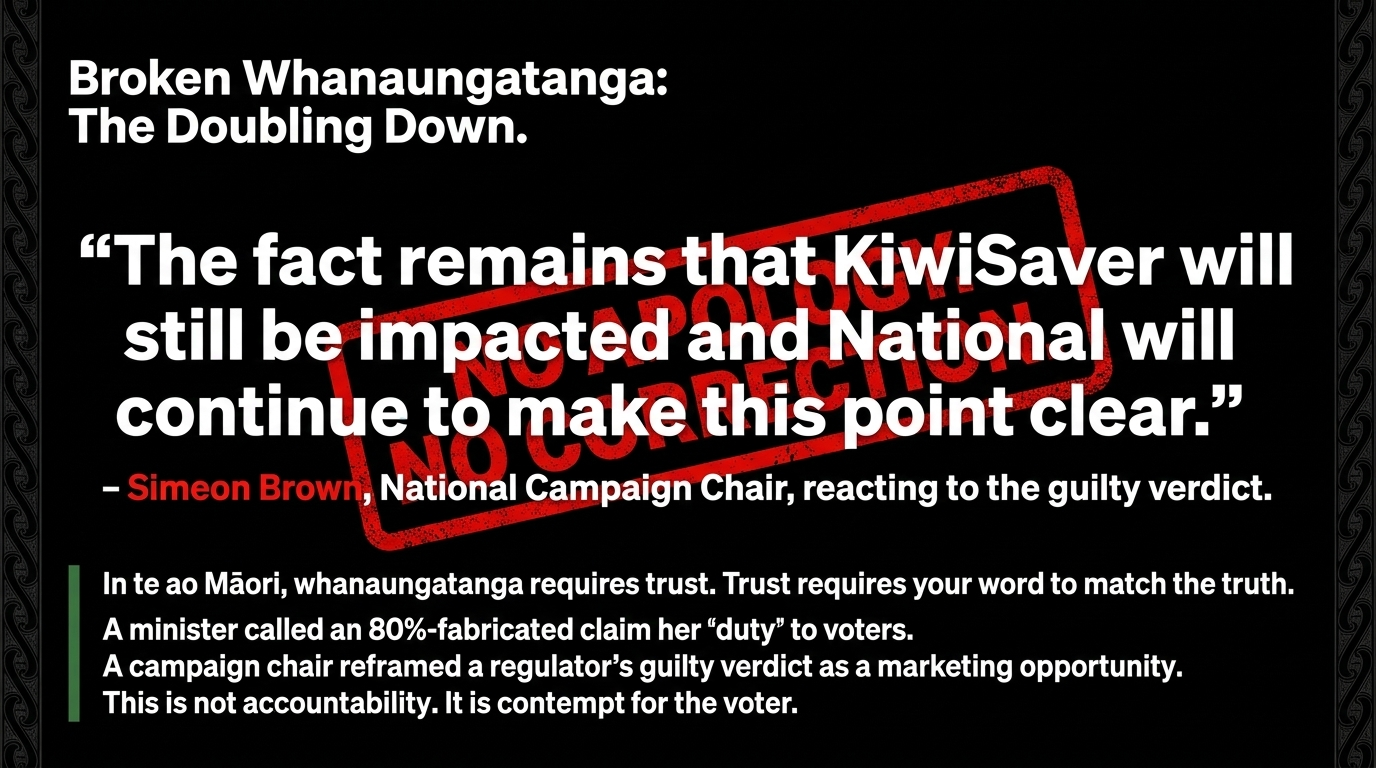
Core claim: Confronted with the ASA's finding against his own party, National's campaign chair Simeon Brown did not correct the record — he reframed it, insisting "the fact remains that KiwiSaver will still be impacted," while also claiming the ruling had "confirmed" a separate falsehood about Labour (RNZ).
Quantified harm: This is the sixth ASA decision in 2026 involving National political advertising. Working from RNZ's own reporting — five decisions by early August (four not upheld, one settled) (RNZ, 4 Aug 2026), plus this new partly-upheld ruling — National has spent 83.3% of 2026 being told by the regulator that its ads were acceptable or merely settled, and only now, on the sixth attempt, has anything actually stuck. Even then, the response was not an apology. It was a press release.
Solution: Electoral law should treat a repeated pattern of upheld or partly-upheld misleading advertising findings against the same party, within a single election cycle, as an aggravating factor — triggering mandatory paid corrective advertising at the offending party's own expense, not just a quiet instruction to stop.
Impact on tikanga, explained for the Western mind: Mana is not restored by winning a technical argument after being caught. In tikanga, accountability requires acknowledgement — you name the harm, you own it, you make it right. Brown did none of these things. He treated a regulator's finding as a debating point to be spun, which tells you everything about how this government actually regards the people it lied to.
Ka Whai Hua Wai — Cui Bono? Follow The Money
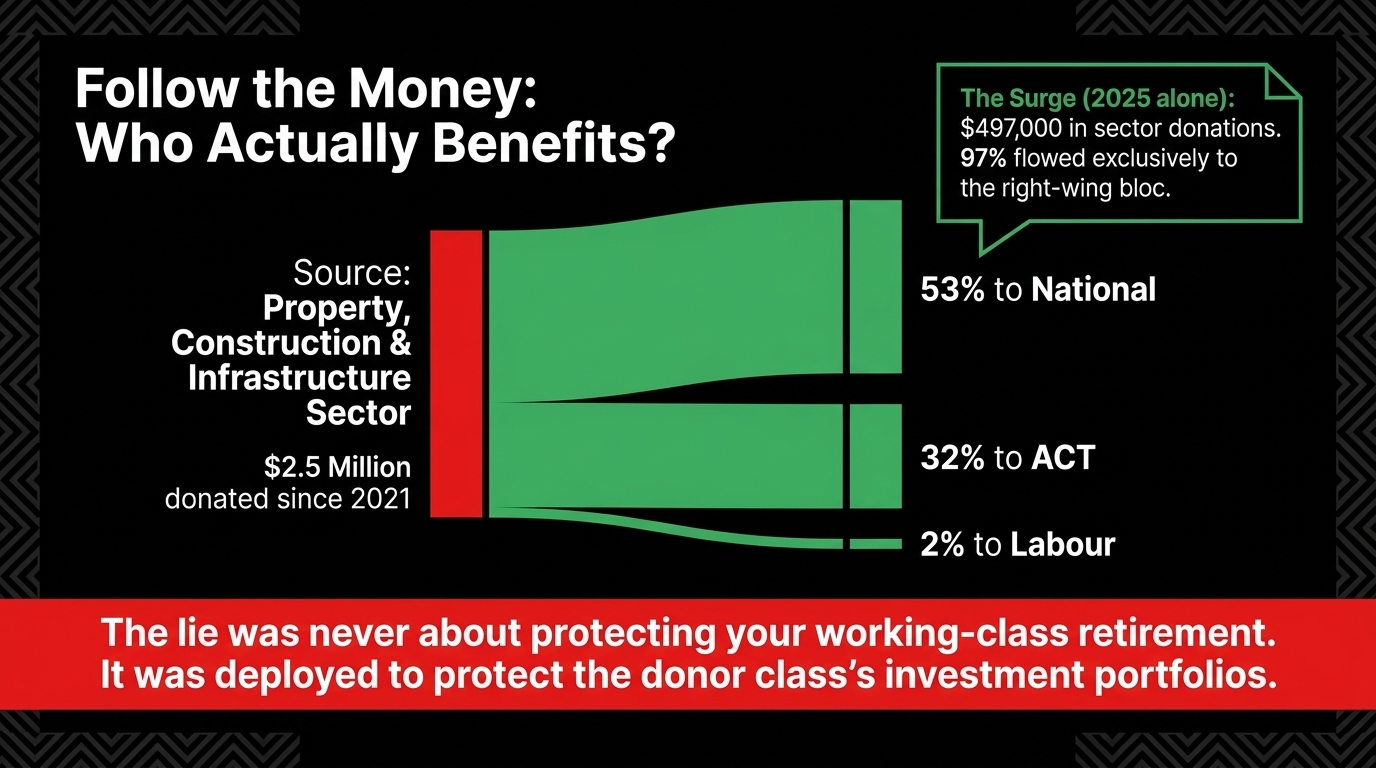
Ask the question every good investigation asks: who actually benefits from this lie? Not the KiwiSaver holder being frightened in the flyer. The property industry.
Since 2021, people and entities connected to the property industry have donated more than $2.5 million to New Zealand political parties — and an RNZ analysis of Electoral Commission returns found 53% went straight to National, another 32% to Act, and just 2% reached Labour (RNZ). In 2025 alone, the property, construction and infrastructure sector declared at least $497,000 in donations, with roughly 97% of that flowing to National, Act and NZ First combined — a rounding error reaching the opposition (Democracy Project, Bryce Edwards). Property-connected rich-listers have personally handed National six-figure sums in the run-up to this election (NZ Herald).
That is the actual constituency National is protecting when it screams about a capital gains tax that excludes the family home and KiwiSaver but does apply to investment property. The fear campaign isn't really about your bach. It's about the donor who owns six of them.
Te Kore Whare — Who Actually Owns Anything To Protect
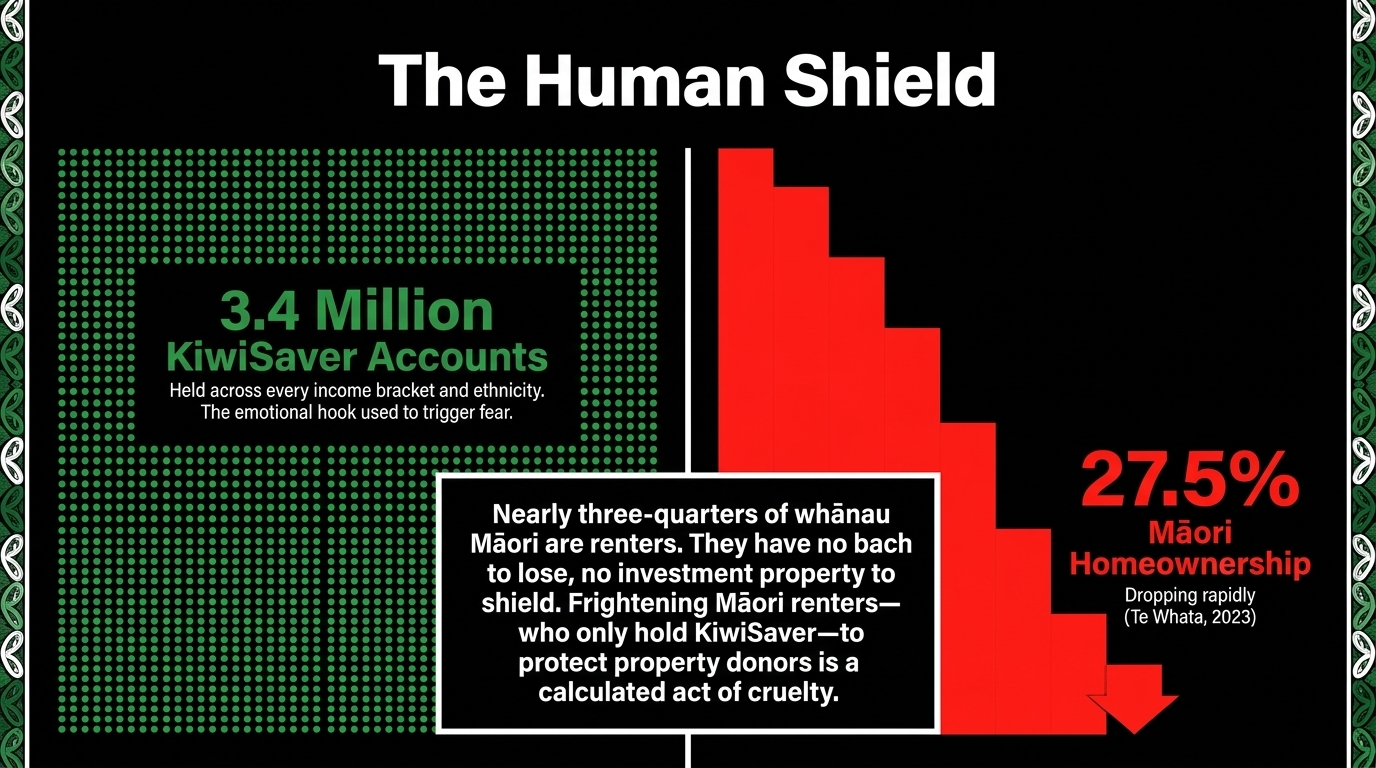
Here is the part that should make you angriest, whānau. Māori homeownership isn't rising under this "protect your assets" rhetoric — it's collapsing. Te Whata data reported by Waatea News shows Māori homeownership fell from 31.2% in 2013 to just 27.5% in 2023 (Waatea News).
That means nearly three-quarters of whānau Māori are renters, not owners. They have no bach to lose, no investment property to shield, no capital gain to be taxed on — the entire fear campaign in National's flyer is built around assets most whānau Māori simply don't hold. But they absolutely do hold KiwiSaver accounts, cutting across every income bracket and ethnicity in this country. So when National reaches for KiwiSaver as the emotional hook in its flyer, it isn't protecting Māori homeowners. It's frightening Māori renters and savers on behalf of a donor class that looks nothing like them, and has never needed to.
That is not an accident of copywriting. That is who this government works for, and who it doesn't.
Ngā Kōrero O Mua — This Is Not New, And I Have Been Saying So For Months

I have documented this exact pattern before, on this platform, long before this week's ruling gave it a regulator's stamp.
In "Ipsos vs Curia: Which NZ Political Poll Can You Actually Trust?", I traced how this same government uses selectively-presented data to manufacture a story it wants voters to believe, regardless of what the underlying numbers actually show.
In "The Hollow Men Run From Tova", I documented this exact government weaponising a procedural complaint to dodge scrutiny rather than answer for its record.
And in "The Green Party — The Great Rebalancing", I laid out the actual tax architecture debate this government keeps trying to bury under manufactured panic about "your bach" and "your KiwiSaver."
The KiwiSaver flyer isn't an outlier. It's the same operator, running the same play, for the sixth time this year — funded by the same donor class, and landing hardest on whānau who were never the ones with anything to protect in the first place.
Whakamutunga — Kia Mataara
A government that has to invent four fake taxes and misname a fifth to make its argument does not have an argument. It has a fear campaign, aimed at 3.4 million retirement accounts, run by a Deputy Prime Minister who calls the lying her duty, defended by a campaign chair who treats getting caught as a marketing opportunity, and bankrolled by a property industry that gave it 53 cents of every donor dollar since 2021.
That is not governance. That is contempt — for the truth, and for every whānau who has to decide who to trust with their vote based on what these people tell them, while the actual beneficiaries of the lie write the cheques from somewhere else entirely.
The regulator drew one line, on one flyer, this week. It took 72 complaints on one campaign and a formal finding on another before even that much happened.
I am not interested in giving this government credit for finally, partially, being told to stop. I am interested in making sure you never trust the next flyer that lands in your letterbox without checking it against what I've shown you here — and asking, every time, who actually owns the asset they say they're protecting you from taxing.
Tihei Māuri Ora!
Disclaimer: This essay contains verified factual reporting alongside clearly flagged opinion and analysis. Every numerical claim is shown with its source or formula. This is not a claim that any individual has committed a criminal offence; it is analysis of a regulator's published finding, public donation records, and public statements made in response to them.