"They Sold Our Whare And Called It A Reset" - 9 September 2026
The Golden Visa Is A Loyalty Card For The Rich, While Whānau Are Told Their Homes Are Too Expensive To Build


Kia ora e te whānau.
I am Ivor Jones, The Māori Green Lantern: kaitiaki against the lies told about who deserves a roof, who gets to own whenua, and who must keep waiting while somebody richer is welcomed through the side door.
I am not writing this calm. I am writing it with the arithmetic laid bare first, because anger without proof is noise
—but proof with anger is a taiaha.
This is not an allegation that Chris Bishop, Erica Stanford, Christopher Luxon, Kāinga Ora, or any other named person has acted unlawfully.
It is my evidence-based opinion about decisions made by Ministers and Crown agencies in their public capacity.
The public-interest question is simple: when a government stops, reworks, or abandons thousands of proposed public homes while creating new pathways for multi-million-dollar investor capital to flow into rental housing, who benefits—and who carries the cost?
The answer is not hidden. It is in the spreadsheets, the write-downs, the Ministerial announcements, and the Housing Register.
The Deep Dive Podcast
Listen to a lively conversation between two hosts, unpacking and connecting topics in the sources of this essay. I apologise in advance for the AI's very harsh pronounciation of reo. Please dont shoot me, :).
Youtube Video
Like video? Here is a short video suppporting the essay. Again, don't shoot the messenger please because of AI's pronounciation. :)
Support This Whānau Housing Watch

You might ask who supports The Māori Green Lantern to sit with OIA spreadsheets, Housing Register data, land-sale records, and Ministerial announcements long enough to trace where the whare went.
The answer is whānau do.
No corporate developer, no Kāinga Ora contractor, no Immigration New Zealand investor, and no Beehive office supports this mahi. Every koha says that whānau are ready to support the accountability that Crown and corporate structures will not provide.
It says rangatiratanga includes the power to support our own truth tellers—especially when public homes are called “assets,” public land is called “surplus,” and a $5 million investor is treated as more urgent than a whānau waiting for a key.
Kia kaha, whānau. Stay vigilant. Stay connected. If you are able, consider a koha to support this mahi and keep this housing watch alive.
If you cannot koha, kei te pai. Subscribe, follow The Māori Green Lantern, kōrero, and share this with your whānau and friends. That is koha too.
- Koha: Support this mahi through Koha — Support The Māori Green Lantern
- Subscribe: Receive essays directly through Subscribe To The Māori Green Lantern
- Bank Transfer: Ivor Jones — 03-1395-0099387-000
- Facebook: Follow and share The Māori Green Lantern On Facebook
The Working Numbers Before The Fire Starts
| Claim | Working | Result | Confidence |
|---|---|---|---|
| Bay Of Plenty Divestments | $2,332,000 ÷ 8 properties | $291,500 per property | Verified from supplied July 2026 OIA spreadsheet |
| Wellington Divestments | $1,295,000 ÷ 8 properties | $161,875 per property | Verified from supplied July 2026 OIA spreadsheet |
| Auckland Divestments | $12,244,300 ÷ 12 properties | $1,020,358 per property | Verified from supplied July 2026 OIA spreadsheet |
| National Divestments | $26,141,717 ÷ 48 properties | $544,619 per property | Verified from supplied July 2026 OIA spreadsheet |
| Northcote Development Ratio | $65 million projected development value ÷ $5.5 million land-sale price | 11.82 times | Verified calculation; limited meaning |
| Māori Main Applicants On Housing Register | 8,277 Māori main applicants ÷ 19,002 total applicants | 43.56 percent | Verified |
| Māori Share Of Applicants With Recorded Ethnicity | 8,277 Māori main applicants ÷ 17,751 applicants with recorded ethnicity | 46.63 percent | Verified; total-response ethnicity limitation applies |
| Projects Not Proceeding At This Stage | 212 projects | 3,479 proposed homes | Verified |
| Project Write-Down Range | $150 million to $180 million project costs + $40 million land-value decline | $190 million to $220 million total accounting write-down | Verified |
| Active Investor Plus Minimum Growth Investment | Statutory programme threshold | $5 million held for 36 months | Verified |
| Active Investor Plus Minimum Balanced Investment | Statutory programme threshold | $10 million held for 60 months | Verified |
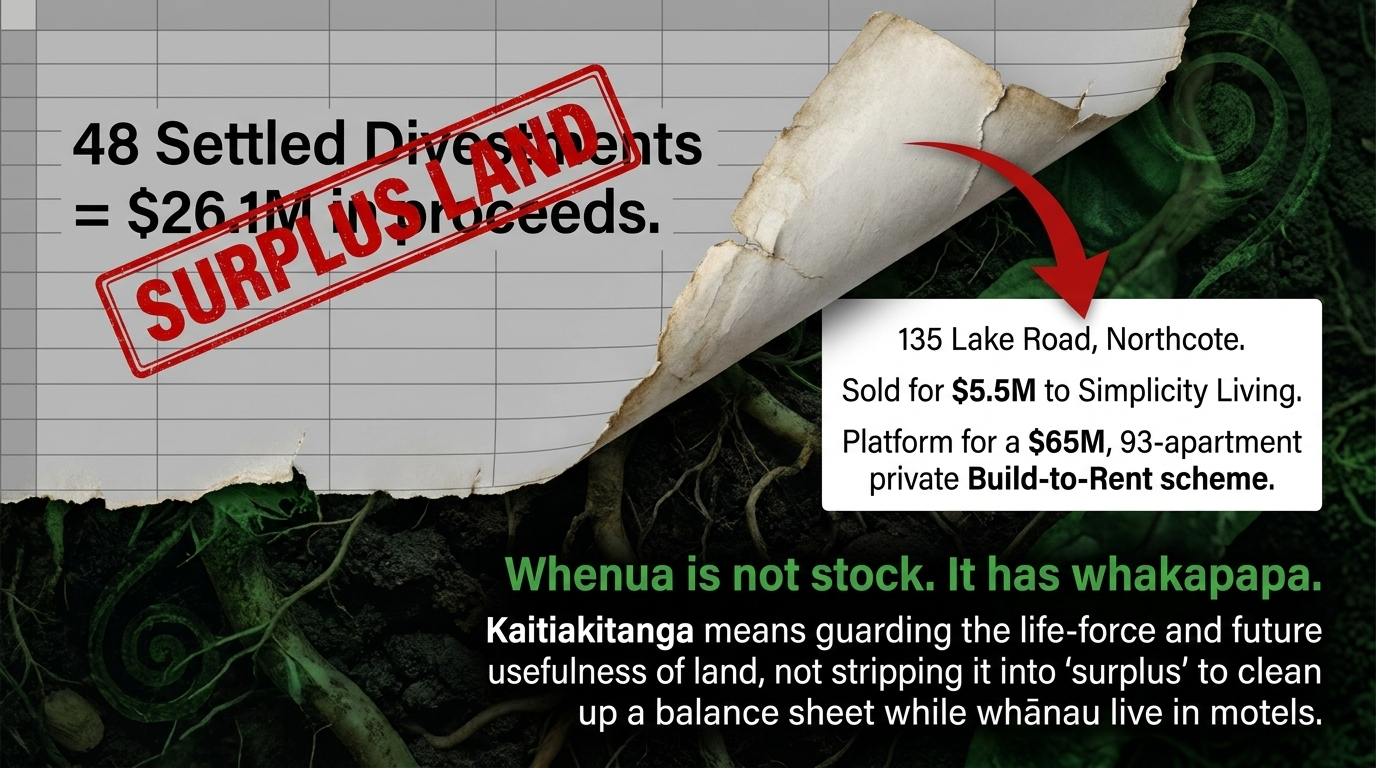
The July 2026 divestment spreadsheet records 48 settled public-housing divestments with approximately $26.142 million in proceeds: \$26,141,717 \div 48 = \$544,619 per property on average.
The regional differences matter. The spreadsheet records an Auckland average of approximately $1.020 million per divested property, a Bay of Plenty average of $291,500, and a Wellington average of $161,875. These are sale-proceeds averages, not valuations, and they do not prove any particular property was undervalued.
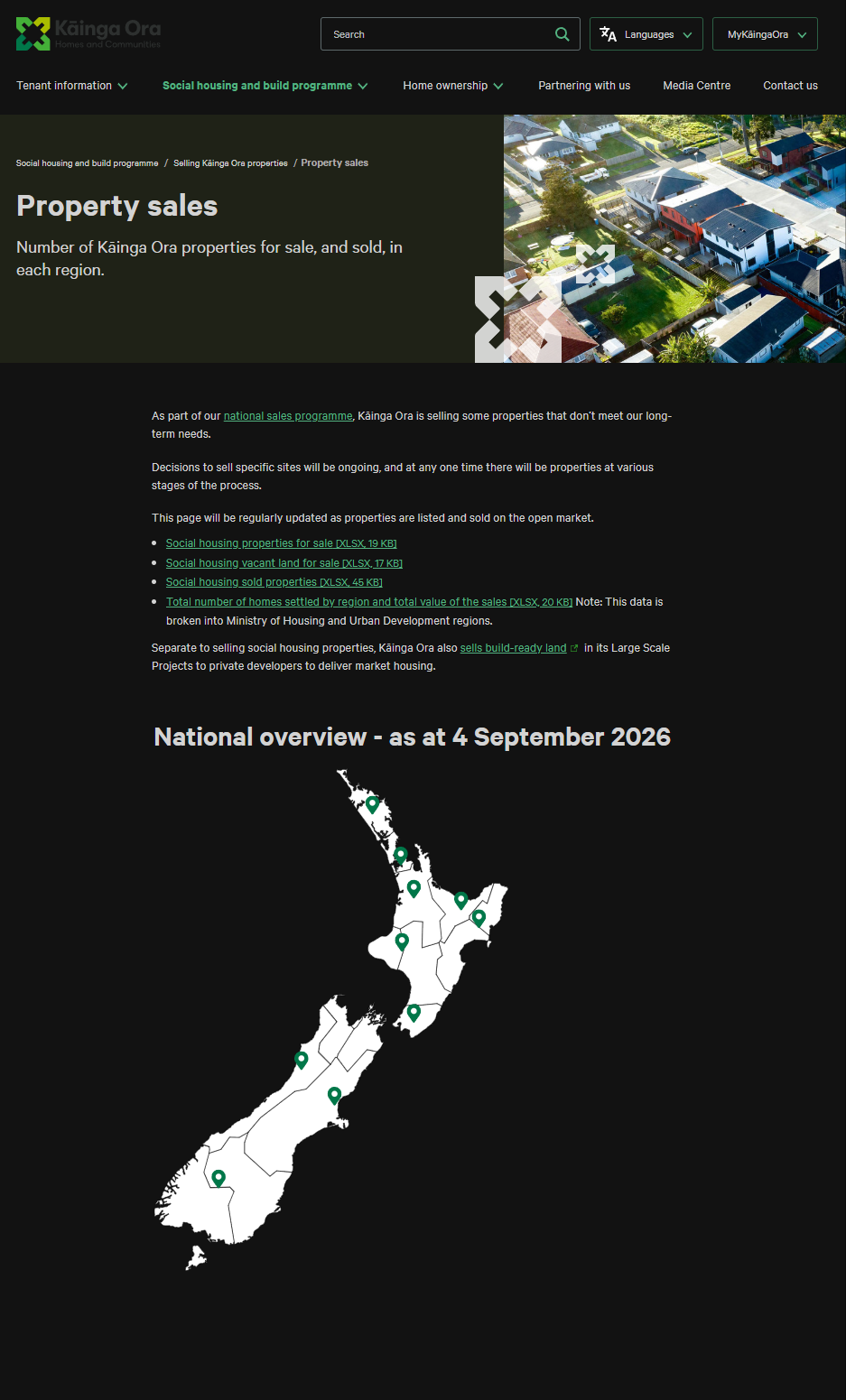
They prove something else: the Crown is converting public housing assets into cash in a market where whānau are still waiting for a secure home.
The public record says Kāinga Ora plans to sell roughly 900 homes annually for the next few years while stating that each sold home will be replaced elsewhere and that its portfolio will remain around 78,000 homes. (Kāinga Ora, Selling Kāinga Ora Properties).
That is the agency’s stated position. The question this essay asks is whether the replacement promise is transparent enough, fast enough, local enough, and accountable enough for the communities losing homes and land now.
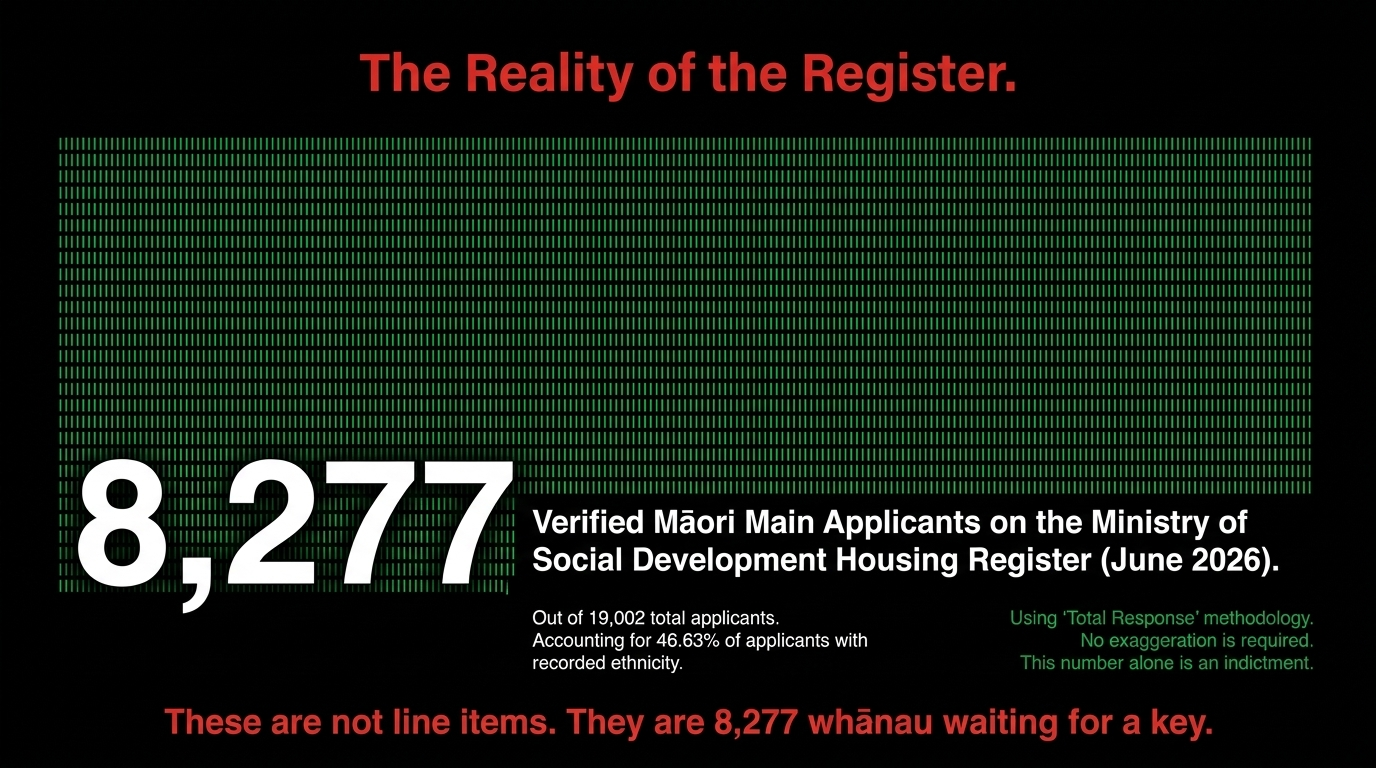
The Ministry of Social Development recorded 19,002 applicants on the Housing Register at 30 June 2026. (Ministry Of Social Development, Housing Register—June 2026) Its data records 8,277 Māori main applicants:8,277 \div 19,002 = 43.56\%. (Ministry Of Social Development, Housing Register—June 2026 Data Workbook) Among applicants with recorded ethnicity, the Māori figure is8,277 \div 17,751 = 46.63\%. (Ministry Of Social Development, Housing Register—June 2026 Data Workbook)
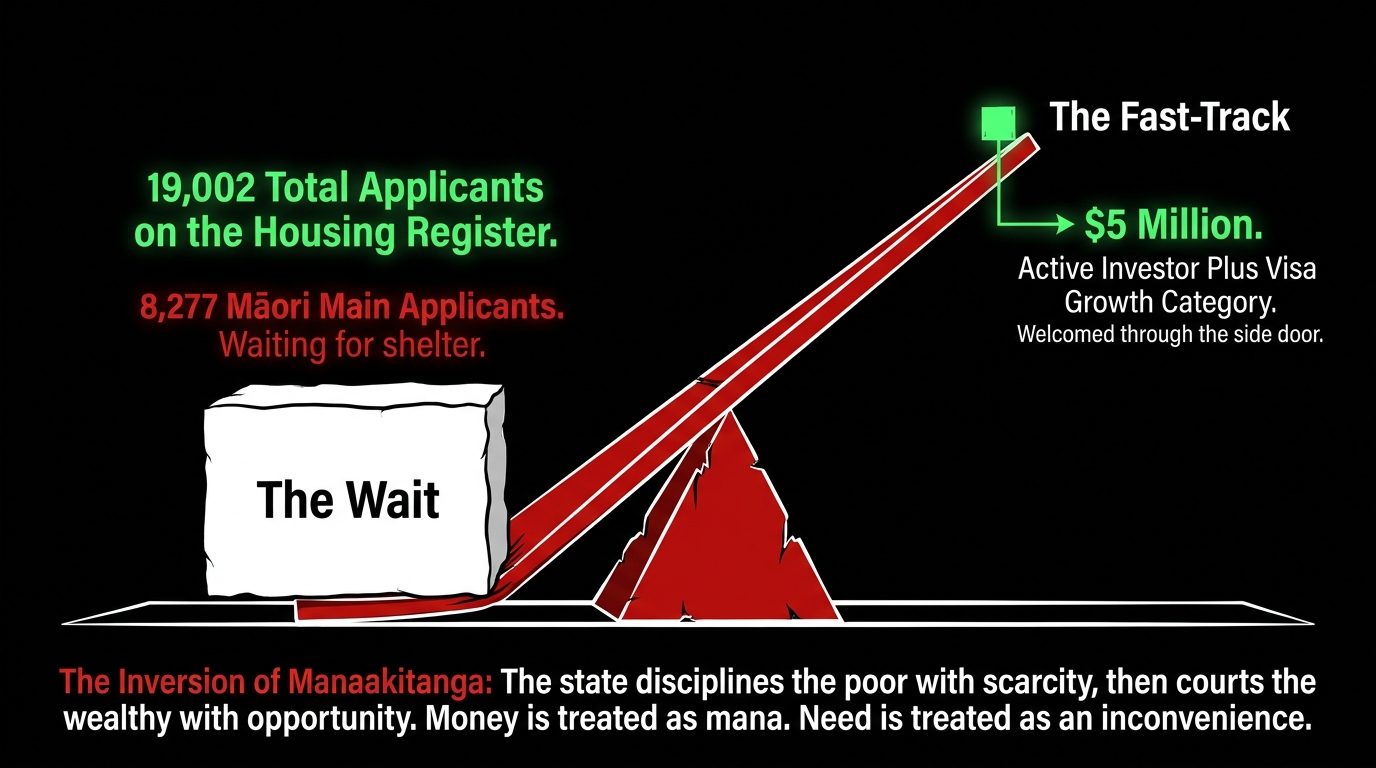
That distinction matters. MSD uses “total response” ethnicity: people can identify with more than one ethnicity, so ethnic-group totals can exceed 100 percent. (Ministry Of Social Development, Housing Register—June 2026 Data Workbook) Therefore, nobody gets to massage those figures into a false claim that 9,596 Māori households are waiting. The verified figure is 8,277 Māori main applicants. That number is already an indictment. It does not need exaggerating.
Cui Bono, Cui Malo: Who Eats And Who Waits?
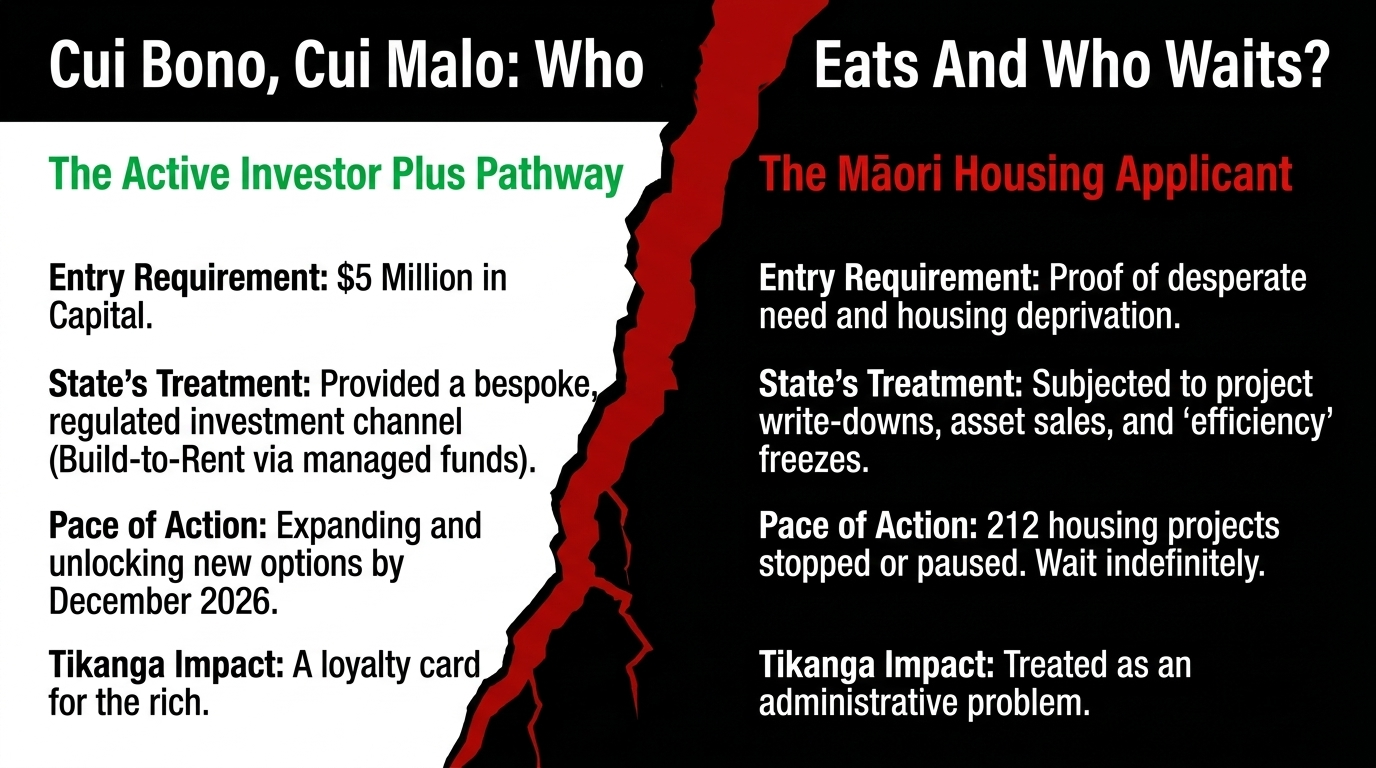
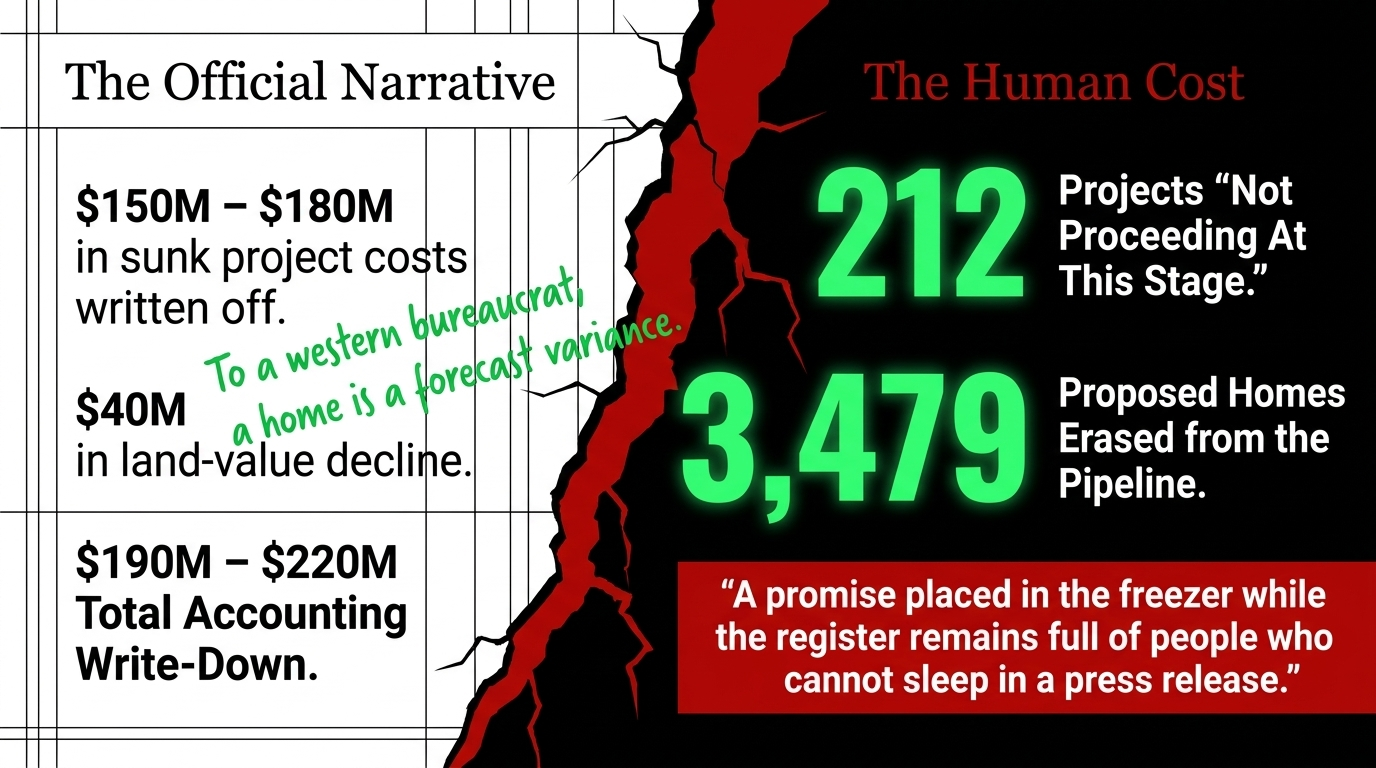
Here is the Crown’s own record. Kāinga Ora reviewed 466 social-housing projects, said 254 would proceed, and said 212 projects that “no longer stack up financially” or were not in the right locations would not proceed “at this stage.” (Kāinga Ora, Kāinga Ora Takes Next Step In Financial Reset, 19 June 2025)
Those 212 projects would have provided 3,479 homes. (Kāinga Ora, Information Sheet: Project Assessments And Write Downs)
Do not let anybody launder that language for you. “Will not proceed at this stage” is not the same as “every one of these homes is permanently cancelled.” Kāinga Ora says some sites may be reworked, sold, or held for future renewal decisions. (Kāinga Ora, Information Sheet: Project Assessments And Write Downs) But it is also not a home. It is not a key. It is not a warm bedroom for a mokopuna this winter. It is a promise placed in the freezer while the Housing Register remains full of people who cannot sleep in a press release.
The agency proposed one-off accounting write-downs of $190 million to $220 million. (Kāinga Ora, Kāinga Ora Takes Next Step In Financial Reset, 19 June 2025) Of that range, $150 million to $180 million relates to money spent on projects that will not go ahead as originally planned; a separate $40 million relates to land that had fallen in value. (Kāinga Ora, Kāinga Ora Takes Next Step In Financial Reset, 19 June 2025) Kāinga Ora says the project write-downs concern sunk costs in initial scoping and planning, mainly professional fees. (Kāinga Ora, Information Sheet: Project Assessments And Write Downs)
That is not just an accounting event. It is the Crown admitting that tens or hundreds of millions of public dollars were spent circling housing need without delivering 3,479 proposed homes. The whānau who need those homes do not get their years back. Their children do not get their bedrooms back. Their kaumātua do not get their stability back.
Then comes the other side of the gate.
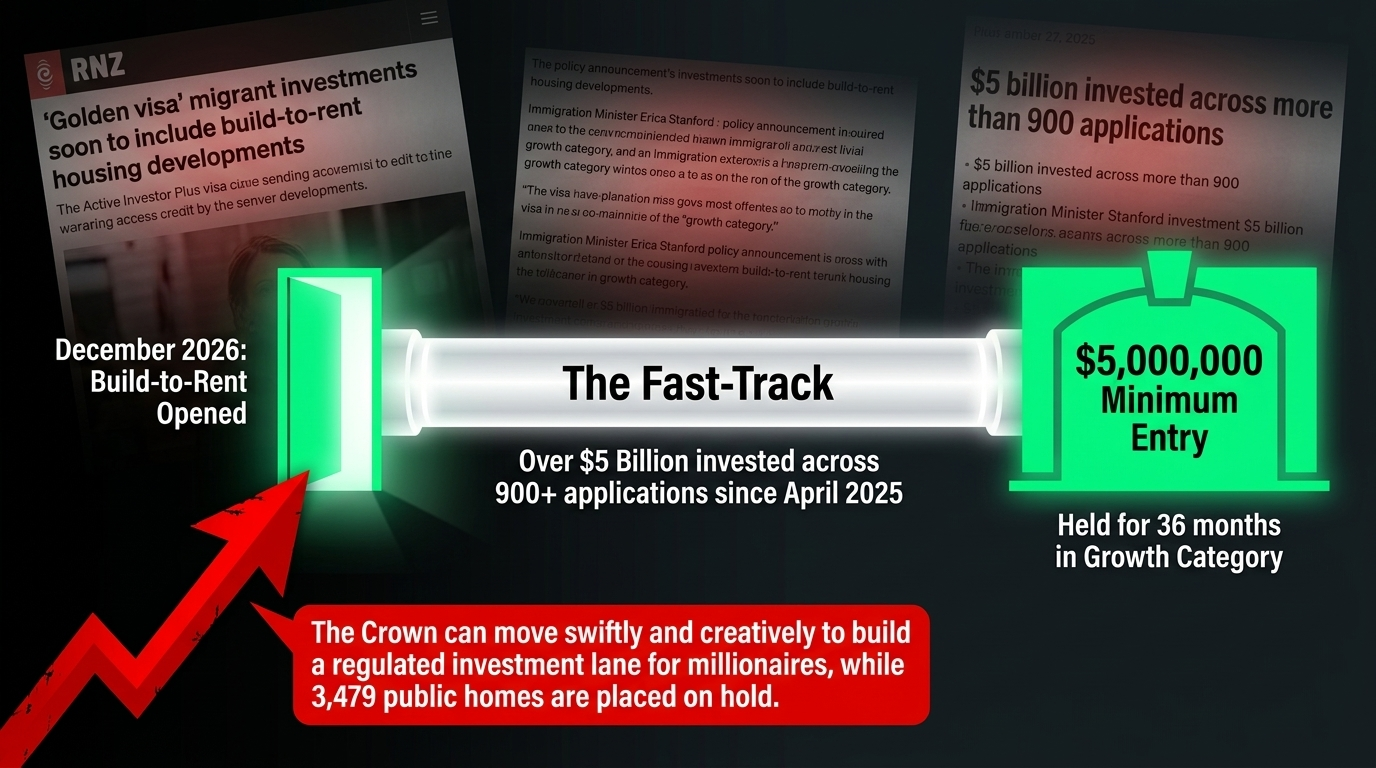
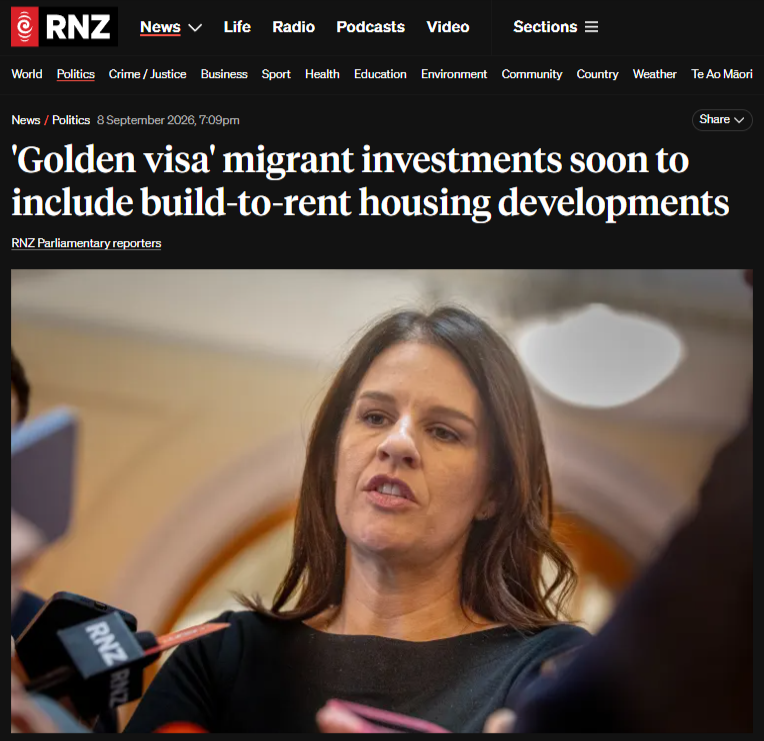
The Government has added Build to Rent developments to the Active Investor Plus visa’s Growth-category investment options from December 2026. (Immigration New Zealand, New Build To Rent Investment Option Added To Active Investor Plus, 8 September 2026)
The Growth category requires at least $5 million invested for at least 36 months; the Balanced category requires at least $10 million invested for at least 60 months. (Immigration New Zealand, Active Investor Plus Visa)
RNZ reported that the Government said more than $5 billion had been invested across more than 900 applications since the April 2025 settings change, with more than 80 percent of applications under the Growth category. (RNZ, Golden Visa Migrant Investments Soon To Include Build-To-Rent Housing Developments, 9 September 2026)
That is not evidence that $5 billion has entered Build to Rent; it has not. The Build to Rent option is due to begin in December 2026. (Immigration New Zealand, New Build To Rent Investment Option Added To Active Investor Plus, 8 September 2026)But it is evidence of priority.
When the state says it cannot carry forward thousands of proposed public homes, while designing a bespoke investment lane for people who can put $5 million into Aotearoa, that is not neutral administration.
In my assessment, it is neoliberal class politics made visible: the state disciplines the poor with scarcity, then courts the wealthy with opportunity.
A Debt The Crown Never Paid
Māori housing deprivation did not begin with this coalition. It sits inside a longer whakapapa of land loss, state policy, exclusion from finance, overcrowding, and a Crown housing system that repeatedly treated Māori as an administrative problem rather than Treaty partners.
The Waitangi Tribunal’s Housing Policy and Services Kaupapa Inquiry includes Housing On Māori Land, c. 1870s–2021, prepared by Dr Ella Arbury and Dr Fiona Cram. (Waitangi Tribunal, Housing Policy And Services—Wai 2750 Research) The Tribunal’s Māori homelessness report, Kāinga Kore, examines the Crown’s contemporary homelessness policy and its effects on Māori. (Waitangi Tribunal, Tribunal Releases Report On Crown Homelessness Policy)
That history matters because a housing cut never lands on a blank page. It lands on whenua already taken, on whānau already pushed into rentals, motels, garages, cars, overcrowding, debt, and the indignity of having to prove—again and again—that they are desperate enough to deserve shelter.
The Government’s claim is that it inherited a financially unsustainable agency. Chris Bishop said Kāinga Ora’s debt had risen from $2.3 billion in 2017/18 to $16.5 billion in 2023/24, and that the prior Board-approved budget forecast debt reaching $24.8 billion in 2026/27. (Chris Bishop, Turnaround Plan To Get Kāinga Ora Back On Track, Beehive, 3 February 2025) That case for intervention deserves to be reported fairly.
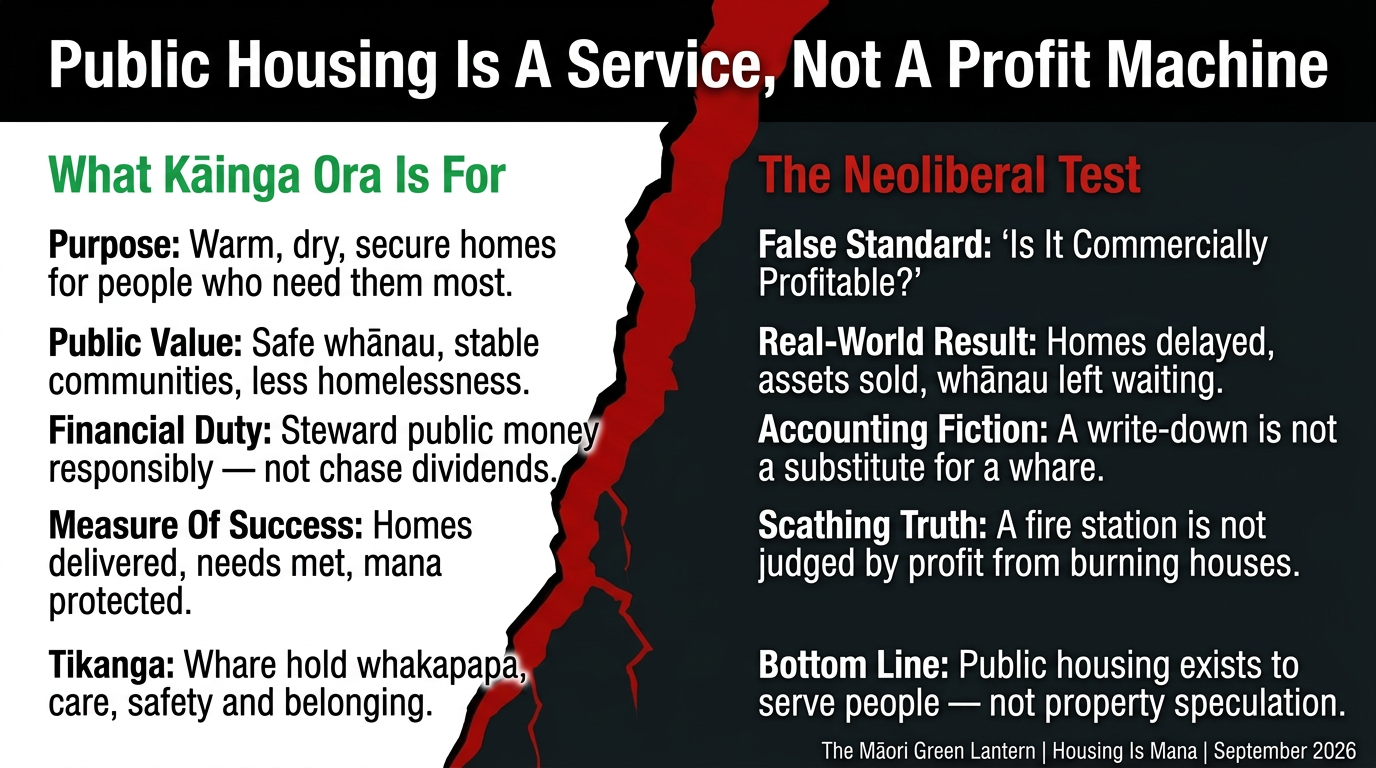
Kāinga Ora was never created to behave like a landlord chasing dividends for shareholders. It is a Crown agent, established to provide rental housing principally for people who need it most, contribute to good-quality and affordable housing choices, and sustain the social, cultural, environmental, and economic wellbeing of communities. (Kāinga Ora–Homes And Communities Act 2019, Section 12; Ministry Of Housing And Urban Development, Kāinga Ora–Homes And Communities Act 2019)
It has a duty to manage public money responsibly, absolutely—but financial sustainability is not the same thing as making a commercial profit, and “value for money” is not a licence to destroy or indefinitely defer homes for people in desperate need. Kāinga Ora itself says its core mission is providing and managing quality social housing for New Zealanders in need, and its operating principles include delivering warm, dry, healthy homes and ensuring those most in need are supported and housed. (Kāinga Ora, Statement Of Performance Expectations 2025/26; Kāinga Ora–Homes And Communities Act 2019, Operating Principles)
So when Ministers use balance-sheet language to justify halting public homes while whānau remain in need, my view is blunt: that argument is bullshit.
A fire station is not judged by the profit it makes from burning houses; a hospital is not judged by how much money it extracts from sick people; and public housing must not be judged by whether it performs like a property-speculation portfolio.
Its return is measured in warm children, stable whānau, safer communities, reduced homelessness, and the mana of people having a secure place to stand.
But the financial argument is not the end of the story.
The English review found Kāinga Ora was not financially viable under its existing settings, while Newsroom reported that savings proposed in the Government’s Budget were described in the review as unlikely to be achieved. (RNZ, Kāinga Ora Underperforming, Not Financially Viable—Sir Bill English, 19 May 2024; Newsroom, Govt’s Kāinga Ora Cuts “Unlikely” To Be Met—English Review, 4 June 2024)
Child Poverty Action Group and Public Housing Futures warned that the review could facilitate “privatisation by stealth” if the Crown reduced its role in building public housing while expanding other delivery channels. (Child Poverty Action Group, Kāinga Ora Review Must Not Usher In New Era Of Privatisation By Stealth, 19 May 2024)
That is their warning, not a finding of unlawful conduct. But it is a warning the public should take seriously whenever public homes, public land, public finance, and private development are being rearranged behind the language of “efficiency.”
Three Examples For The Western Mind
Example One: The Spreadsheet Says “Write-Down.” A Whānau Hears “Not This Year.”
The Claim: Kāinga Ora says the 212 projects not proceeding at this stage no longer stack up financially or are not in the right locations. (Kāinga Ora, Kāinga Ora Takes Next Step In Financial Reset, 19 June 2025)
The Harm: Those projects would have delivered 3,479 proposed homes. (Kāinga Ora, Information Sheet: Project Assessments And Write Downs) Kāinga Ora proposed writing down $150 million to $180 million spent on those projects’ early stages, with the separate $40 million land-value decline bringing the total accounting range to $190 million to $220 million. (Kāinga Ora, Kāinga Ora Takes Next Step In Financial Reset, 19 June 2025)
The Arithmetic: \$150\text{ million} \div 3,479 = \$43,116 per proposed home at the bottom of the project-cost range. \$180\text{ million} \div 3,479 = \$51,739 per proposed home at the top of the range. This does not mean every proposed home cost that amount; it shows the scale of early-stage money written off relative to the homes that were proposed.
The Solution: Create an independent public register for every stopped or reworked project: location, number of proposed homes, original cost, money spent, reason for the decision, land ownership status, iwi interests, tenant impacts, and the date on which an equivalent or better replacement is actually completed. No more “reset” language without a map, a timetable, and a ledger.
The Tikanga Impact: To a western bureaucrat, a home can become a forecast variance. To tikanga, a whare is not a line item. It is the shelter around whakapapa. It holds whānau relationships, grief, care, reo, kai, safety, and mana. Treating housing as a disposable spreadsheet cell is mauri-depleting because it transfers the risk of state planning failure onto people who already have the least room to absorb it.
I examined the same political machinery in The Housing Heist: How Chris Bishop’s Neoliberal Agenda Is Stealing Māori Futures, published on 29 October 2025. That earlier essay should be read as commentary alongside—not instead of—the official records linked here.
Example Two: “Asset Management” Is What They Call It When Whenua Stops Serving Whānau.
The Claim: Kāinga Ora says it sells homes and surplus land to reinvest in replacement homes, reduce debt, renew ageing stock, and release sites for other development. (Kāinga Ora, Selling Kāinga Ora Properties) It says properties are offered on the open market and independent current-market valuations inform listing expectations. (Kāinga Ora, Selling Kāinga Ora Properties)
The Harm: The supplied July 2026 divestment spreadsheet records 48 settled properties and approximately $26.142 million in proceeds. It records Wellington’s eight-property total at $1.295 million, or \$1,295,000 \div 8 = \$161,875 per property; Bay of Plenty’s eight-property total at $2.332 million, or \$2,332,000 \div 8 = \$291,500 per property; and Auckland’s 12-property total at $12.2443 million, or \$12,244,300 \div 12 = \$1,020,358 per property.
The Northcote comparison is a warning about the limits of rhetoric as well as the limits of Crown transparency. The New Zealand Herald reported that Simplicity Living paid $5.5 million for 135 Lake Road, Northcote, and proposed a $65 million, 93-apartment Build to Rent development there. (New Zealand Herald, Simplicity Living Announces $500m, 600-Unit Frankton Build-To-Rent Scheme, 12 August 2025) The raw ratio is \$65\text{ million} \div \$5.5\text{ million} = 11.82.
But listen carefully: that 11.82-times ratio compares a land-sale price with an estimated value of a completed multi-unit development. It is not a land-value-to-land-value comparison. It is not proof that Kāinga Ora unlawfully sold land too cheaply. What it proves is that public land can become the platform beneath a large private rental asset—and the public deserves to see the valuation, the rationale, the competing options, the iwi process, and the replacement-housing timetable before the deal is celebrated as clever management.
The Solution: Put every Kāinga Ora disposal above a defined threshold through a public pre-settlement process: independent valuation, summary of social-housing alternatives, iwi-right-of-first-refusal status, tenant implications, projected replacement-housing delivery, and final sale terms. Commercial sensitivity does not justify permanent public blindness.
The Tikanga Impact: Whenua is not simply stock. It has whakapapa. Kaitiakitanga means guarding the life-force and future usefulness of land, not stripping it into “surplus” whenever a balance sheet needs a cleaner line. In my assessment, the real issue is not that every sale is automatically wrong. The issue is that the Crown too often asks whānau to trust a process that reveals its reasoning after the whenua has already left public hands.
I traced a related land-to-developer pipeline in The Corporate Bulldozer Rolls Through Mt Eden, published on 29 August 2025. That earlier essay is an opinion piece; the primary evidence for this article remains the official Kāinga Ora material and the linked reporting.
Example Three: The State Makes A Door For Millionaires While Telling Whānau To Wait Outside.
The Claim: Immigration New Zealand says Active Investor Plus applicants will be able to invest through approved managed funds supporting eligible Build to Rent developments from December 2026. (Immigration New Zealand, New Build To Rent Investment Option Added To Active Investor Plus, 8 September 2026) Housing Minister Chris Bishop told RNZ that Build to Rent “can add to rental supply over time,” while the managed-funds model provides safeguards on who manages investment and how developments are delivered. (RNZ, Golden Visa Migrant Investments Soon To Include Build-To-Rent Housing Developments, 9 September 2026)
The Harm: The Growth category’s minimum qualifying investment is $5 million, held for 36 months. (Immigration New Zealand, Active Investor Plus Visa) RNZ reported the Government’s statement that more than $5 billion had been invested across more than 900 applications under the changed visa settings, and that more than 80 percent of applications were in the Growth category. (RNZ, Golden Visa Migrant Investments Soon To Include Build-To-Rent Housing Developments, 9 September 2026)
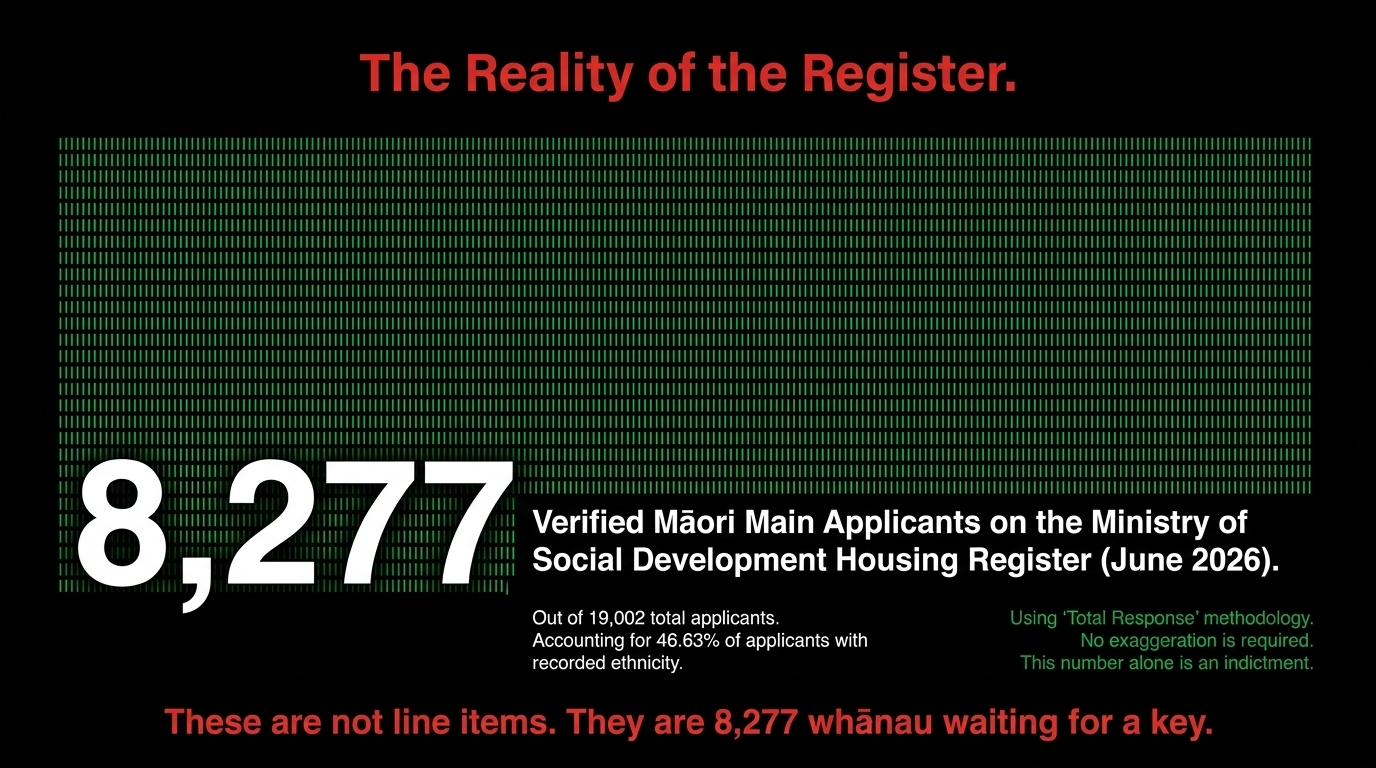
At the same time, 19,002 applicants were on the Housing Register at 30 June 2026, including 8,277 Māori main applicants. (Ministry Of Social Development, Housing Register—June 2026; Ministry Of Social Development, Housing Register—June 2026 Data Workbook)
Nobody should claim that every dollar of investor-visa capital steals a state home. The evidence does not establish that. The harm is political and structural: a government can move swiftly and creatively to build a regulated investment channel for people with at least $5 million, while thousands of proposed public homes are placed on hold, reworked, or stopped at the early stages.
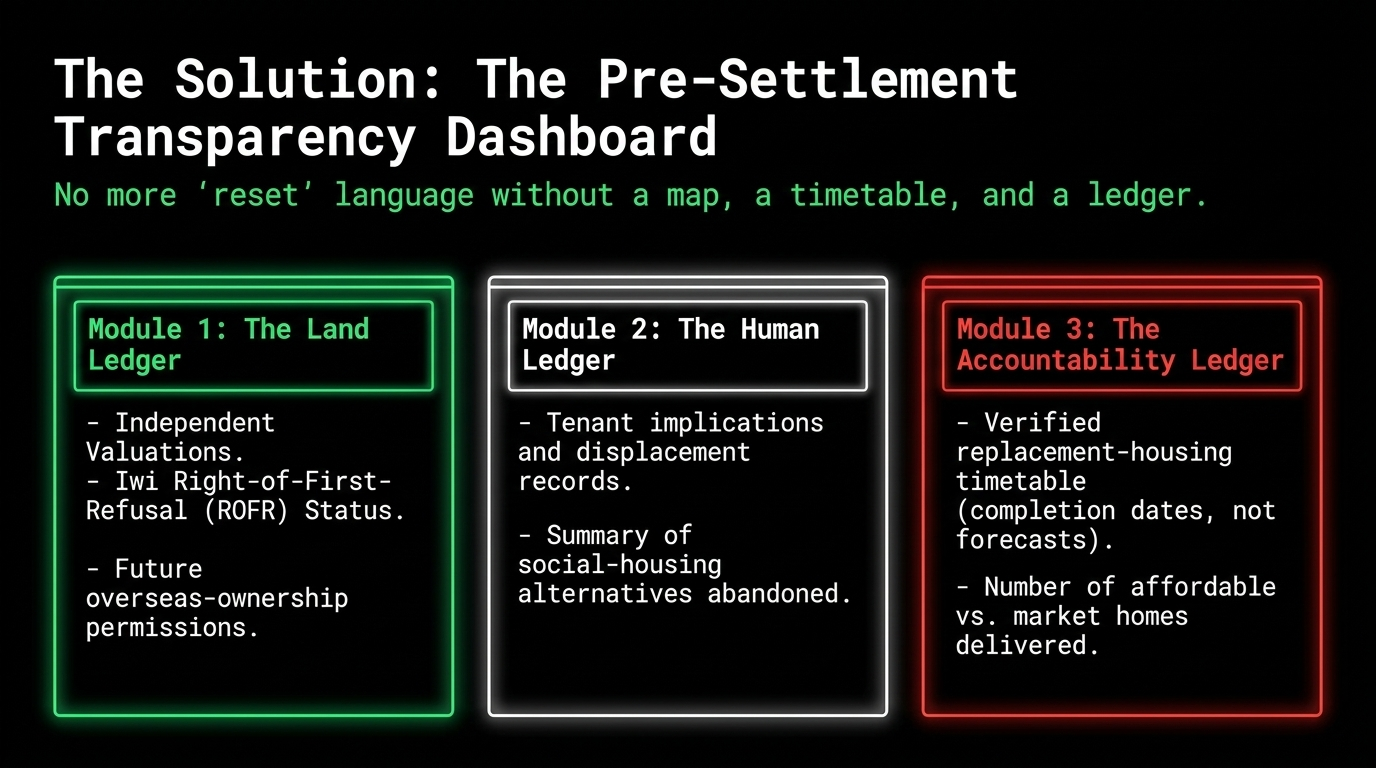
The Solution: Before the Build to Rent channel opens, Immigration New Zealand, Kāinga Ora, HUD, and the Overseas Investment Office should publish a quarterly public dashboard showing the number of approved Build to Rent managed funds, investment commitments, regions, homes proposed, homes completed, rents, affordability settings, overseas-ownership permissions, and any Crown land or former Kāinga Ora land involved. The data must be searchable by rohe and released in forms that iwi, hapū, tenants’ groups, and journalists can interrogate.
The Tikanga Impact: Manaakitanga is care directed toward people in need. It is not a concierge desk for people already carrying millions. When the Crown makes the pathway smooth for capital while leaving whānau in a queue for shelter, it reverses the moral order. It says money is mana and need is inconvenience. That is not manaakitanga. That is a loyalty card for the rich.
I named that same inversion in The Lotto Lie: How Nicola Willis Calls Survival A Jackpot While She Burns Whānau Homes To The Ground, published on 26 May 2026.
The Government’s Defence, And Why It Is Not Enough
The Government says it is not shrinking Kāinga Ora’s housing portfolio. It says it is renewing ageing stock, selling around 900 homes annually, reinvesting proceeds, and maintaining a portfolio of around 78,000 homes. (Kāinga Ora, Selling Kāinga Ora Properties) The Turnaround Plan says Kāinga Ora is funded to deliver around 2,650 additional homes through 2026, while Community Housing Providers are funded for a further 1,500 social homes from June 2025 onwards. (Chris Bishop, Turnaround Plan To Get Kāinga Ora Back On Track, Beehive, 3 February 2025)
Good. Put every part of that promise in public, region by region, rohe by rohe, project by project, and date by date.
Do not ask whānau to accept “replacement” as an article of faith. Show the replacement address. Show the number of bedrooms. Show whether it is public housing, affordable housing, market rental, or a developer’s future marketing image. Show when it will be finished. Show whether tenants were offered homes near their whakapapa, schools, workplaces, marae, doctors, and support networks. Show who owns the land after the transaction.
If the Turnaround Plan works, transparency will prove it. If it fails, transparency will stop the Crown from hiding behind another spreadsheet.
Rangatiratanga Does Not Come With A Price Tag
I do not accept the lie that this is just boring fiscal management. Housing is never just fiscal management when the people waiting are Māori, Pacific, disabled, elderly, escaping violence, raising children alone, or sleeping wherever they can.
In my assessment, this coalition’s housing and investor settings reproduce racialised and class-based harm. That is my political judgement, based on the documented pausing or stopping of 212 proposed projects, the 3,479 homes those projects would have delivered, the public-housing disposal programme, the $5 million investor threshold, and the imminent Build to Rent investment channel. (Kāinga Ora, Information Sheet: Project Assessments And Write Downs; Immigration New Zealand, Active Investor Plus Visa; Immigration New Zealand, New Build To Rent Investment Option Added To Active Investor Plus)
The Crown tells us it is being practical. I say practical for whom?
Practical for the investor who can place $5 million into a managed fund. Practical for the developer who can assemble rental assets. Practical for the Minister who can call a write-down “discipline.” Practical for the official who can replace a real address with a forecast delivery number.
Not practical for a whānau in a motel. Not practical for the mother trying to keep children in the same school. Not practical for a kaumātua moved away from their community. Not practical for the Māori main applicant number—8,277 people—sitting in the Housing Register data while the Crown congratulates itself for making investment easier. (Ministry Of Social Development, Housing Register—June 2026 Data Workbook)
The taiaha here is not empty rhetoric. It is the calculation.
It is 3,479 proposed homes not proceeding at this stage.
It is 8,277 Māori main applicants on the register.
It is a Growth-category threshold of $5 million for investor migrants.
It is an announced Build to Rent channel opening in December 2026.
It is a Crown that must now prove—publicly, not poetically—that the homes it sells, the land it releases, and the investor pathways it creates will improve life for the people who need housing most.

Ivor Jones The Māori Green Lantern Fighting Misinformation And Disinformation From The Far Right
Disclaimer: This article is published in the public interest concerning the official conduct and policy decisions of Ministers and Crown agencies. It expresses the author’s opinion on verified material. It does not allege unlawful conduct by any named individual or organisation.