"THE MACHINE THAT ATE OUR CHILDREN: How Erica Stanford Let an AI, an Undisclosed Australian, and a Libertarian Ideologue Rewrite the Minds of Tamariki Māori" - 25 May 2026
They hired a foreign consultant, fed the curriculum to a machine, erased Te Tiriti, and called it world-class. Your tamariki paid the price. Erica Stanford signed the cheques.
Kia ora, e hoa mā.
This essay examines Erica Stanford's curriculum rewrite because it directly affects the educational futures of tamariki Māori and Aotearoa's children, the democratic accountability of the Minister of Education, and the public's right to know how nationally significant secondary legislation is being developed, under the responsible communication defence established in Lange v Atkinson 3 NZLR 385.
He Kupu Whakataki — The Burning House
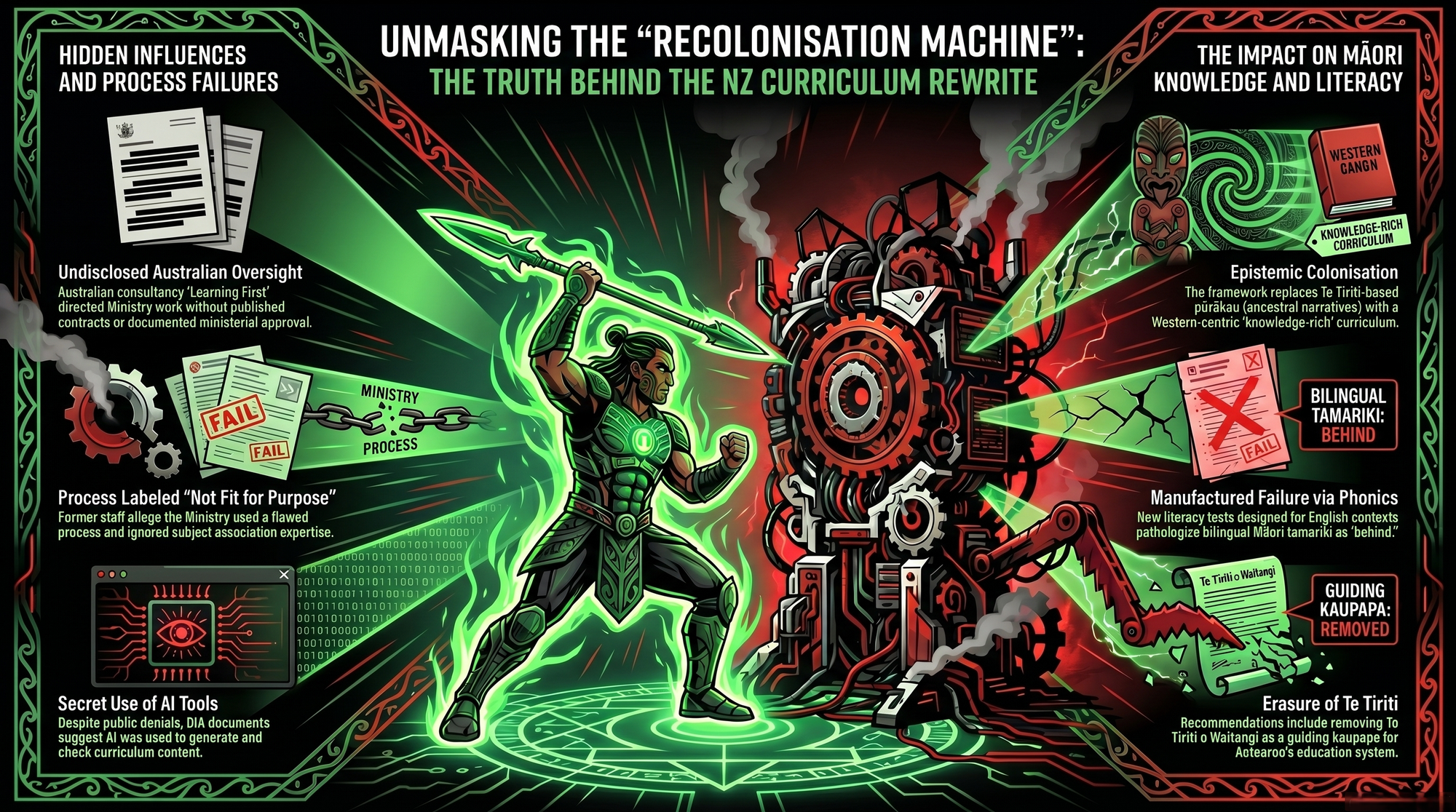
Ko au ko Ivor Jones, ko te Māori Green Lantern. Tēnā koutou katoa.
Picture this.
You arrive home to find strangers in your house — no contract, no mandate, no warrant. They've torn out the walls, replaced the whakairo with flatpack furniture from overseas, and are feeding your tamariki's stories into a machine. You ask who authorised this. They hand you a press release.
That is Erica Stanford's curriculum rewrite.
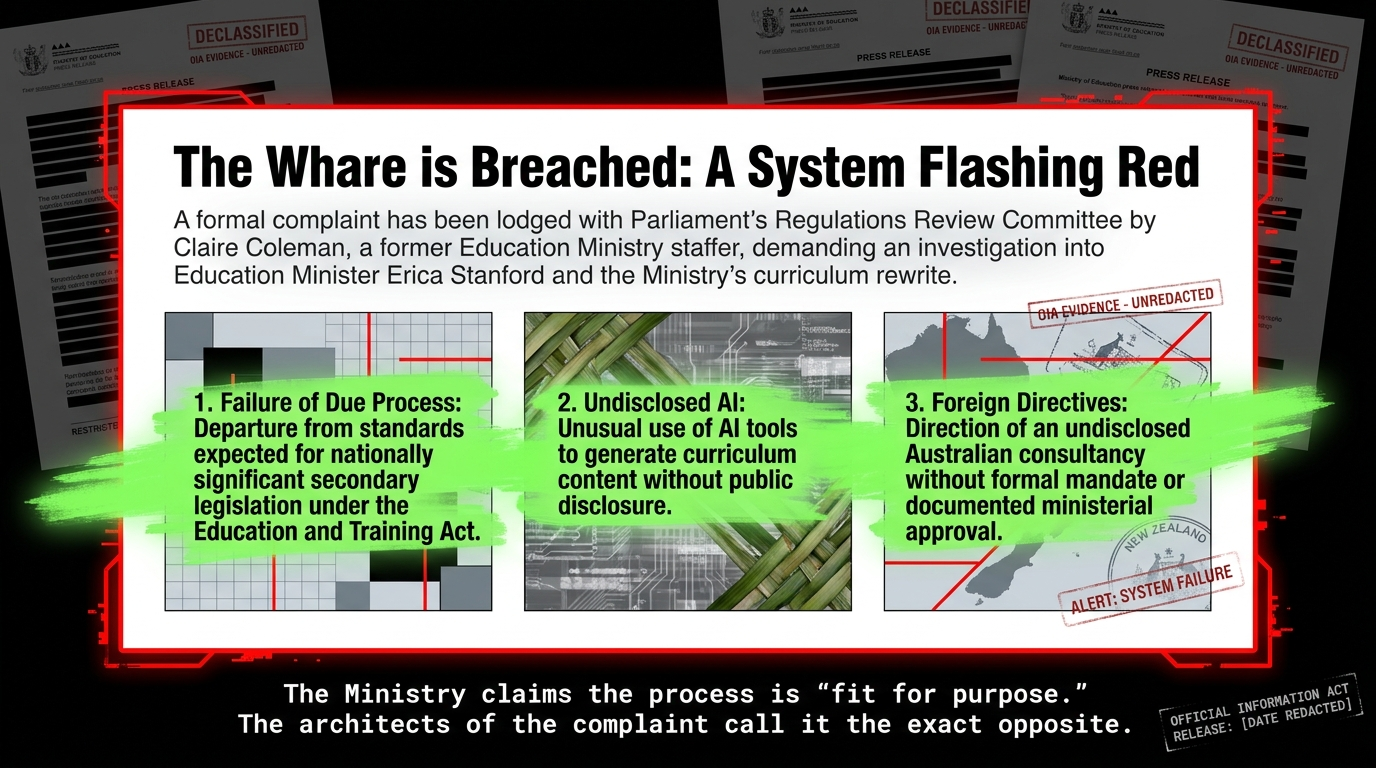
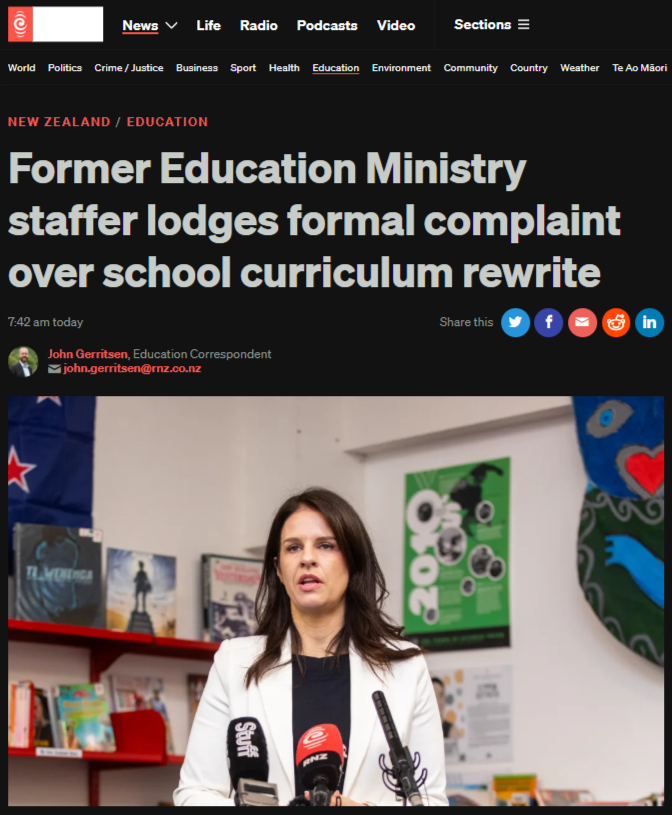
A former Ministry of Education staffer, Claire Coleman, has now lodged a formal complaint with Parliament's Regulations Review Committee, alleging — as reported by RNZ
— that Stanford and the Ministry did not follow due process in developing a nationally significant piece of secondary legislation.
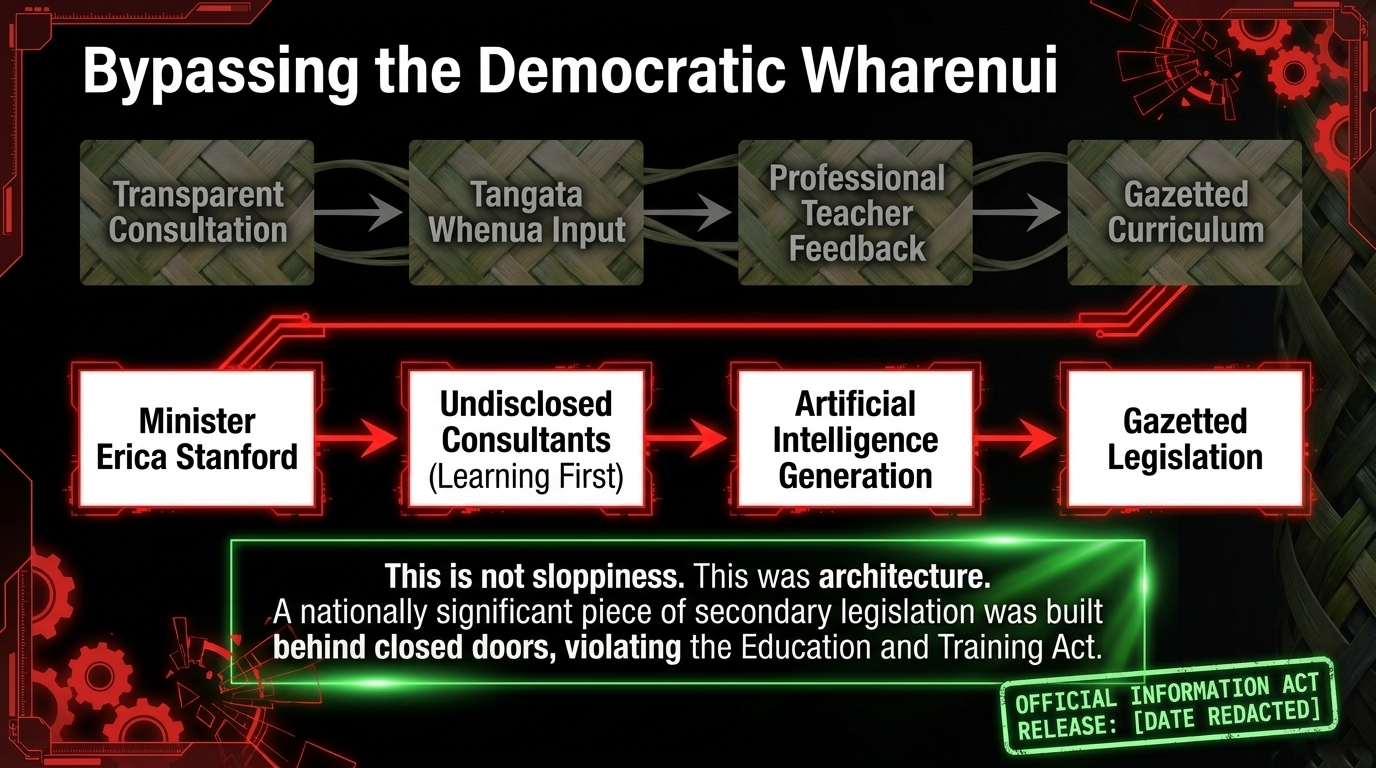
This wasn't sloppiness. This was architecture. And the architects had names, funders, and ideological purposes — none of which were disclosed to the New Zealand public.
I have been reporting on this recolonisation machine since 2024.
The essay Erica Stanford's Scorched Earth Attack on Teachers named the Atlas Network insiders.
The essay Recolonisation by Stealth traced how this mirrors the white supremacist Project 2025 playbook.
The essay Workbooks for Whose Children? exposed the $131 million Budget announcement as a colonial reset dressed in press-release clothing.
Today, with Coleman's complaint, the receipts are officially in Parliament's hands.
Ko Wai Rātou? — Five Verified Hidden Connections
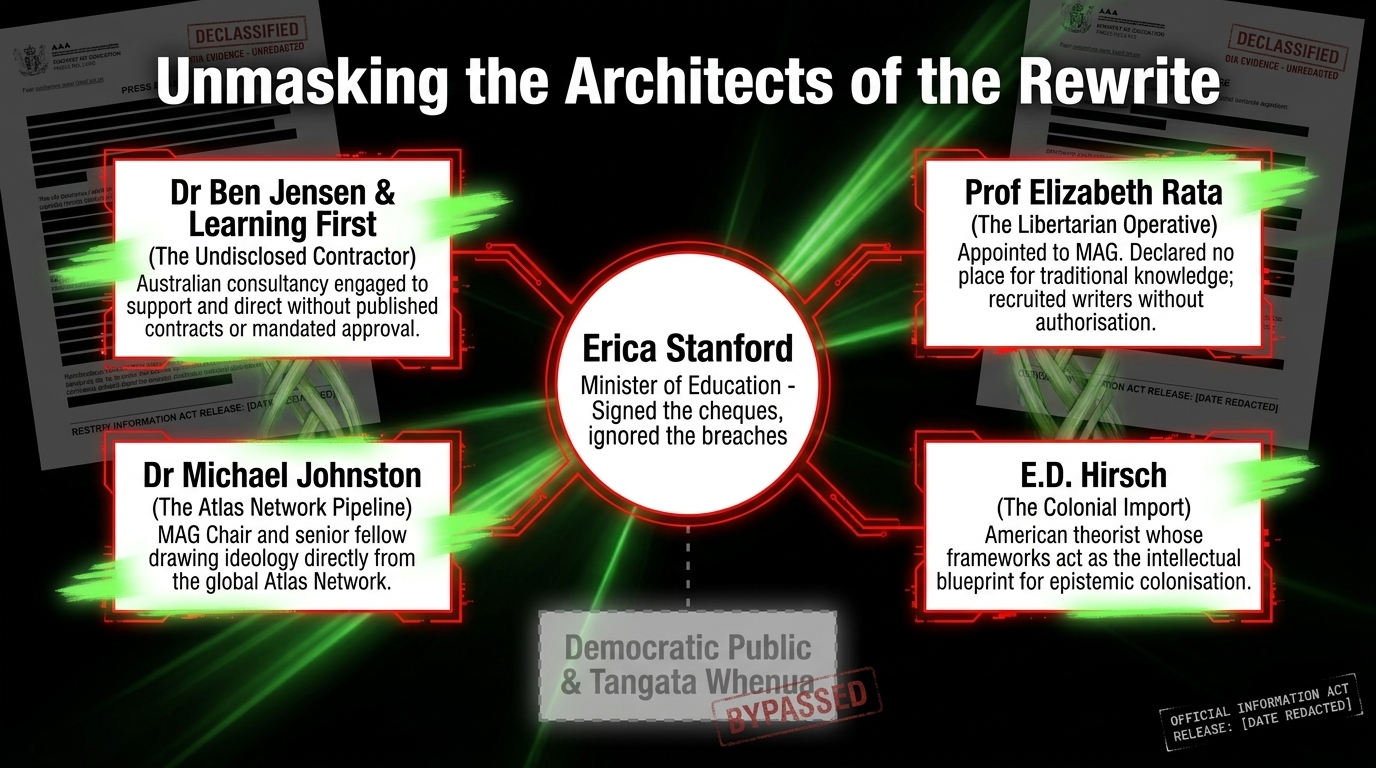
I name names because evidence names them. Not because I hate them. Because our tamariki cannot afford my politeness.
1. The Undisclosed Australian Contractor
Australian consultancy Learning First, led by CEO Dr Ben Jensen, was engaged to
"support and direct" Ministry of Education work on the curriculum
— without published contracts, terms of engagement, or documented ministerial approval, as reported by RNZ.
The Aotearoa Educators Collective reports that evidence from ministerial diaries and OIA documents confirms multiple engagements with Jensen.
No contract. No mandate. No public disclosure.
Stanford met with the man directing our children's future — and said nothing.
As Save Our Schools NZ has documented, available evidence suggests AI and Learning First have co-written multiple curriculum documents, a claim the Ministry denies without full transparency.
2. AI Generated Content — Then Denied
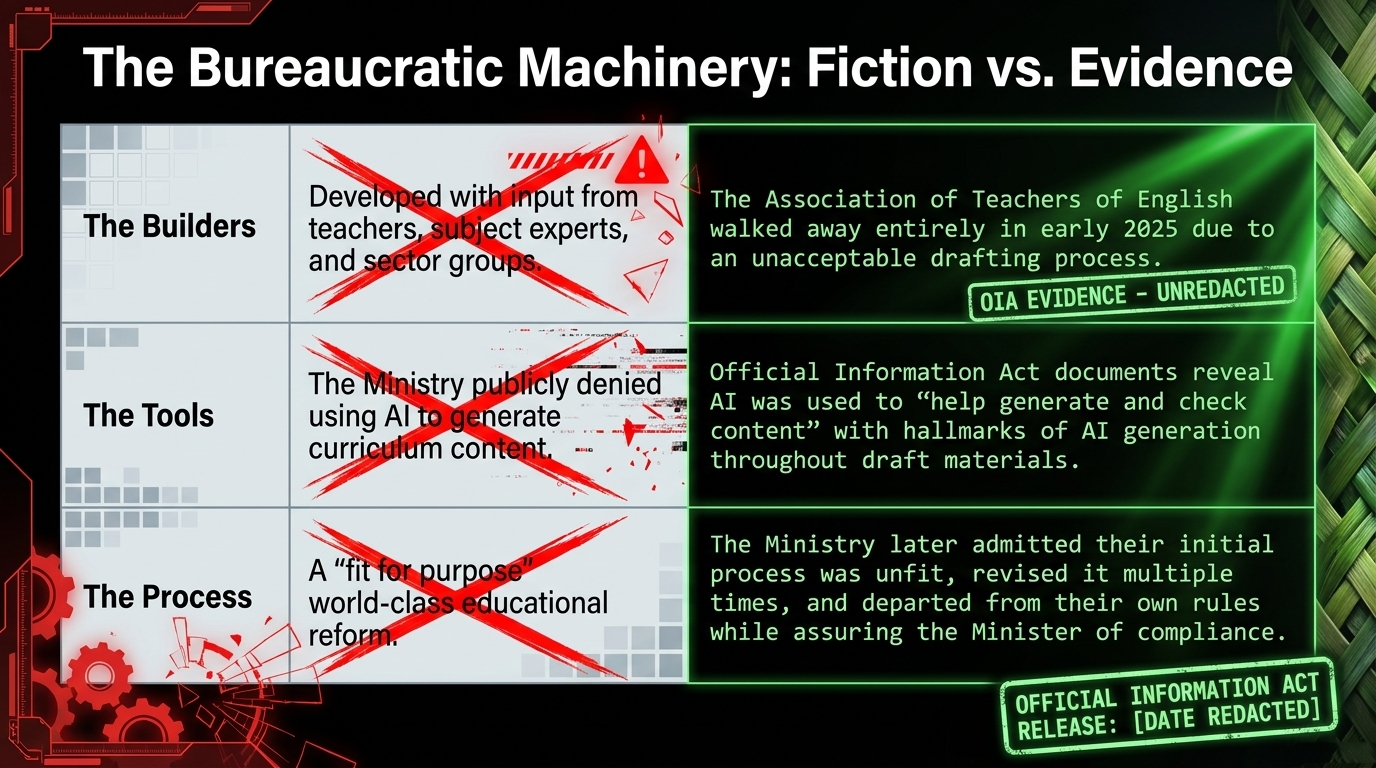
The Coleman complaint, reported by RNZ, states that OIA documents show AI was used to "help generate and check content" — while the Ministry publicly claimed no AI was used to generate curriculum content. Coleman says look at the draft material.
I say: I have. Teacher subject associations told RNZ the writing has the hallmarks of AI tools.
The Association of Teachers of English, in an unprecedented act of professional self-preservation, walked away from the process entirely in early 2025.
The Ministry calls the process "fit for purpose." The people who built the process called it the opposite.
3. The Libertarian Operative in the Writing Room
Professor Elizabeth Rata, an avowed libertarian who has publicly declared
"there is no place for traditional knowledge in a curriculum" and told a public forum that tamariki Māori identifying with their heritage group are being turned into "racialised identities"
— was appointed to Stanford's Ministerial Advisory Group and then, as E-Tangata meticulously documents, began recruiting curriculum writers without ministerial authorisation, including herself.
Ministry staff told her to stop.
She continued.
The Ministry accepted her choices. Stanford said nothing.
Available evidence, including OIA emails, confirms that Rata and MAG Chair Dr Michael Johnston were working on curriculum content without authorisation by April 2024.
4. The Atlas Network Pipeline
The MAG was chaired by Dr Michael Johnston, senior fellow of the New Zealand Initiative
— a right-wing think tank that draws ideology and funding from the global Atlas Network, the American libertarian infrastructure responsible for exporting Friedmanite economics to governments worldwide.
Johnston regularly appears on The Platform alongside Michael Laws to prosecute the case against te reo Māori in education, as confirmed by the NZ Initiative's own media page.
This is not a curriculum.
It is a policy delivery vehicle for Atlas Network ideology — dressed in the clothes of "back to basics" and signed off by a Minister who cannot claim she did not know.
5. The Hirschian Colonial Import
The intellectual framework — "knowledge-rich curriculum" — is lifted directly from American conservative theorist E.D. Hirsch, whose Core Knowledge Foundation has been rejected by Indigenous educators worldwide as a mechanism of epistemic colonisation. As the Aotearoa Educators Collective documents, Stanford's international advisers
— Ben Jensen (Australia), former UK schools minister Nick Gibb (who championed "dead white men" as literary canon), and Australia's Nathaniel Swain
— all build explicitly on Hirsch. Not one tangata whenua educator holds equivalent formal advisory influence over what our tamariki will learn. Not one.
Ngā Tauira Tokorua Tekau — Three Examples for the Western Mind
I am writing this section directly to Pākehā New Zealand, because some of you still think this is about "standards." It is not. It is about power. Let me show you.
Example One: The Literacy Test That Doesn't Test Māori Literacy
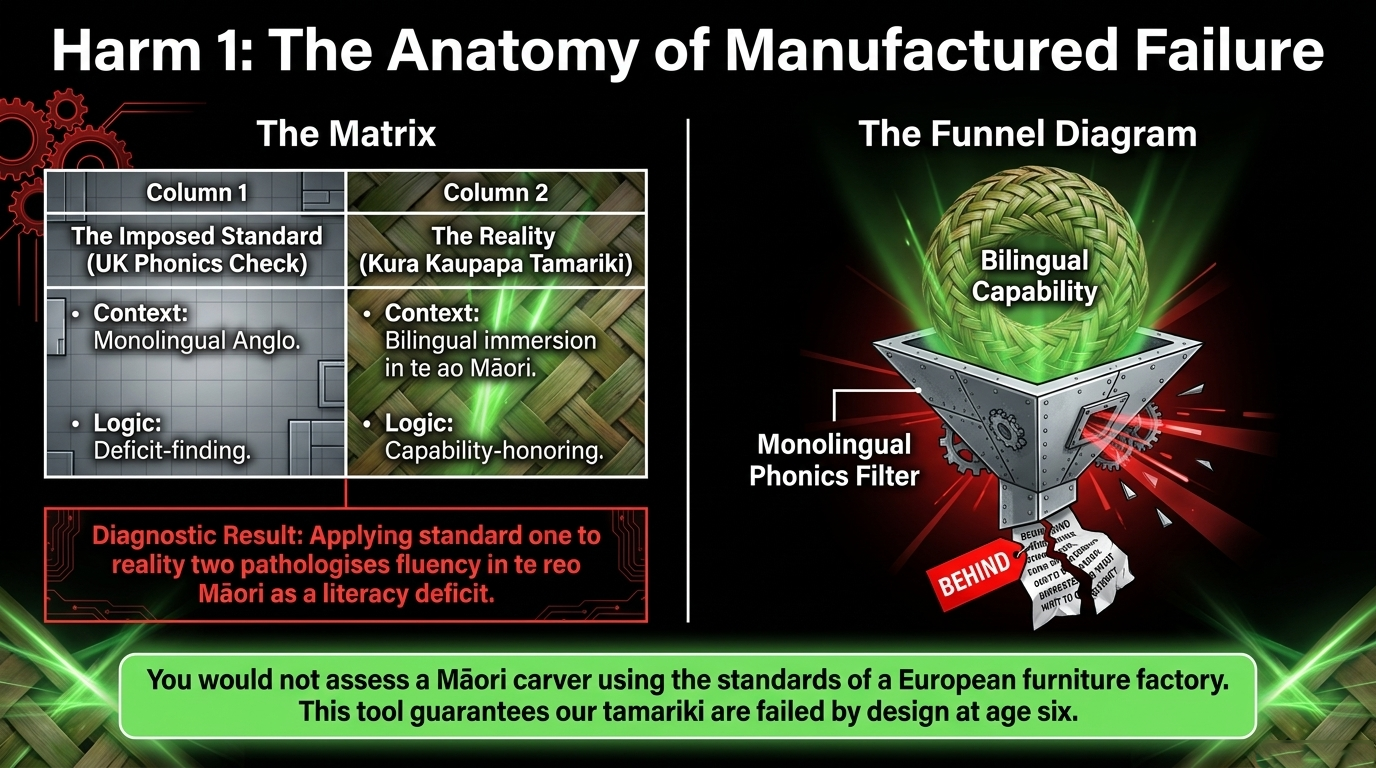
What happened: In 2024, Stanford announced a phonics screening check — a standardised literacy test imported from the UK and Australia — to be applied to all Year 1 and 2 children in Aotearoa. As I reported in Flawed Phonics Testing Plan in July 2024, this tool was designed for English-speaking children in Anglo contexts, not for tamariki in bilingual, kura kaupapa, or te reo Māori immersion settings.
Quantified harm: Tamariki in te reo Māori immersion education who are developing normal, age-appropriate bilingual literacy skills will be assessed against a monolingual English instrument and flagged as "behind." This is not measurement. It is manufactured failure — manufactured specifically for Māori children, using a tool designed by people who have never taught in a kura kaupapa Māori setting.
Tikanga impact for the western mind: In te ao Māori, the way you assess a child's capability must honour the context in which that capability is developed. You would not assess a Māori carver using the standards of a European furniture factory and declare him deficient. That is precisely what this phonics check does. It pathologises fluency in te reo Māori as a literacy deficit. It tells our tamariki, before they can read: you are behind. That is not education. That is colonial damage, delivered at age six, with government money.
Solution: Aotearoa needs a differentiated, bilingual-aware literacy assessment tool developed with Māori-medium educators — not imported from the UK and imposed by ministerial decree. NZEI Te Riu Roa has called for exactly this.
Example Two: Shakespeare In, Pūrākau Out
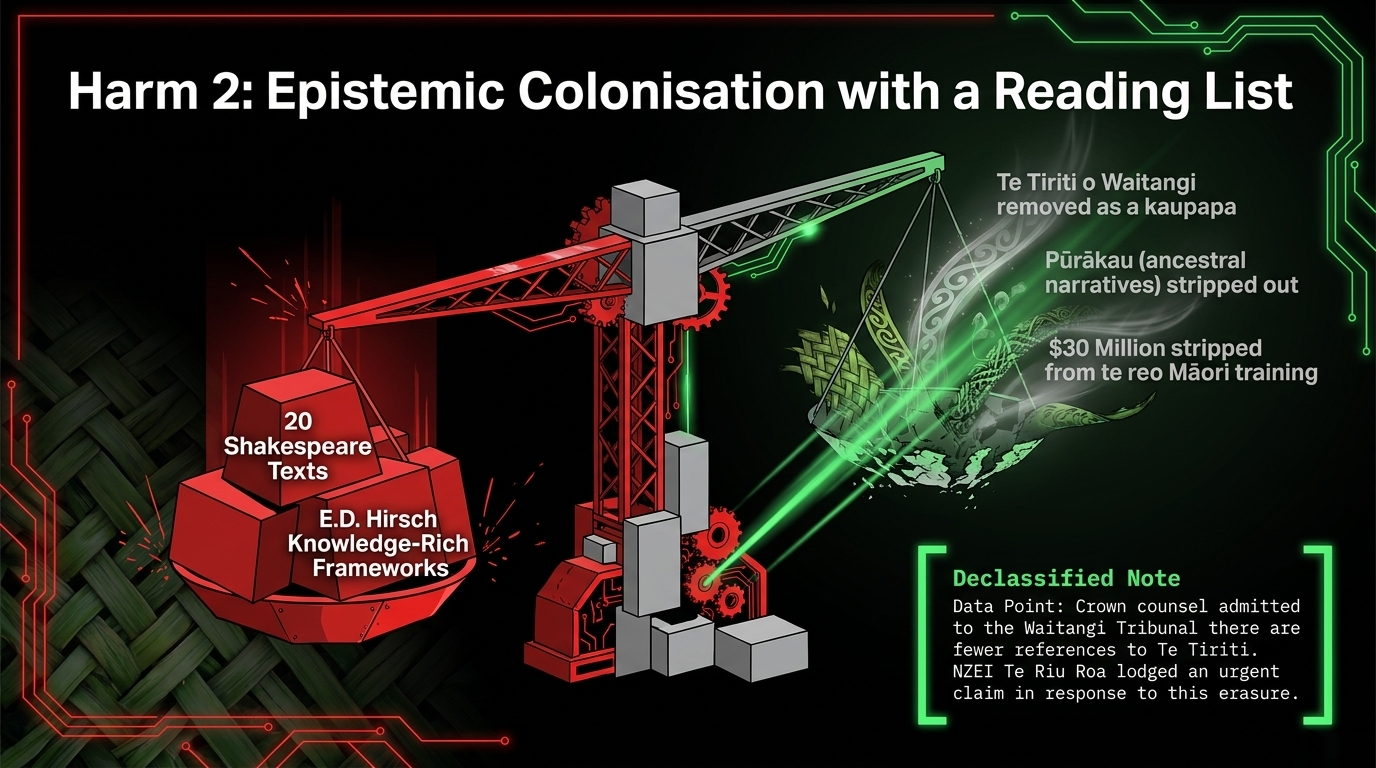
What happened: The Ministerial Advisory Group — chaired by an Atlas Network insider, including an unauthorised libertarian operative — formally recommended removing Te Tiriti o Waitangi as a guiding kaupapa from the curriculum, while sanctioning the inclusion of 20 Shakespeare texts as the anchor of the English curriculum, as documented by the Aotearoa Educators Collective. Stanford's own counsel admitted to the Waitangi Tribunal in late 2024 that "yes, there are fewer direct references to Te Tiriti and associated te reo Māori words and concepts" in the new curricula, as reported by E-Tangata.
Quantified harm: Fifty years of bicultural curriculum progress — built through Treaty settlements, Waitangi Tribunal findings, and the hard advocacy of Māori educators — has been dismantled in two years. Simultaneously, $30 million was stripped from te reo Māori teacher training to fund the curriculum refresh, as documented across multiple sources including E-Tangata. The Waitangi Tribunal's kaupapa inquiry on education received an urgent claim from NZEI Te Riu Roa in December 2024 specifically because of this erasure.
Tikanga impact for the western mind: In te ao Māori, pūrākau — our stories, our histories, our ancestral narratives — are not decorative. They are epistemological infrastructure. They teach children who they are, where they come from, and what obligations they carry into the future. When you replace them with Shakespeare, you are not simply choosing one author over another. You are telling a Māori child that their ancestors' stories do not constitute knowledge worthy of a curriculum. You are teaching them that the world they come from is pre-knowledge — that real knowledge began in England. That is not education. That is colonisation with a reading list.
Solution: Restore Te Tiriti as a constitutional curriculum kaupapa. Mandate Māori-medium educators on all advisory groups with equal weight to western academic representatives. Reinstate the $30 million in te reo Māori teacher training.
Example Three: The Process Designed to Fail — And Be Denied
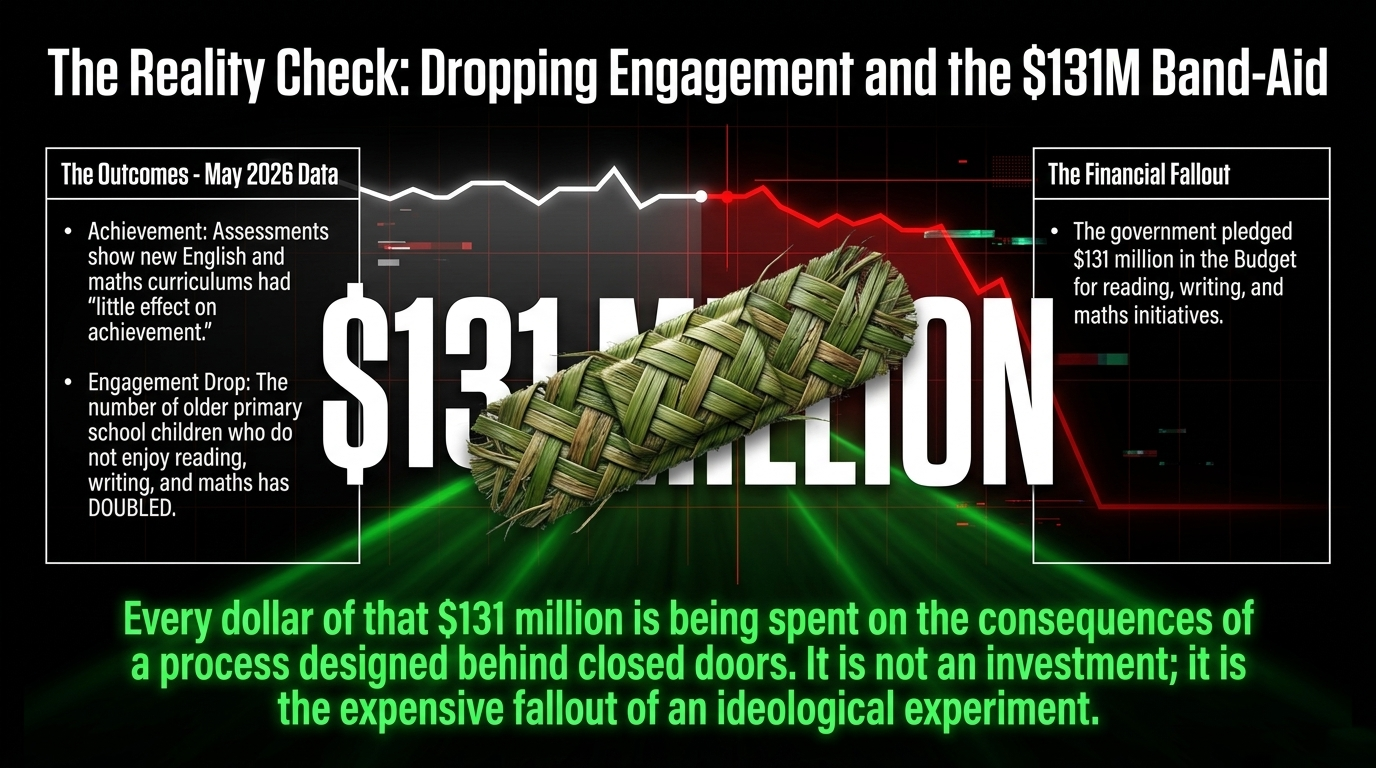
What happened: The Coleman complaint, as reported by RNZ, reveals a three-layer process failure: the Ministry used a process it later admitted was "not fit for purpose" to develop the English and maths curricula; it introduced a new process in late 2024, revised it in April 2025, and then departed from that too — all while the Minister was given assurances about process compliance on at least three separate occasions. The result of all this "world-class reform"? First results show the new primary English and maths curricula had "little effect on achievement," as reported by RNZ on 19 May 2026. And children's enjoyment of reading, writing, and maths has dropped — with the number of older primary children who do not enjoy these subjects doubling, as reported by RNZ on 20 May 2026.
Quantified harm: This is not a theory. The government spent hundreds of millions — including a $131 million Budget announcement on 18 May 2026, as reported by RNZ — to produce a curriculum that doesn't work, that children hate more than before, and that was developed using an undisclosed Australian company, AI tools, and a libertarian ideologue who was told to stop but wasn't stopped. Every dollar of that $131 million is being spent on the consequences of a process designed behind closed doors.
Tikanga impact for the western mind: In tikanga Māori, kaitiakitanga — guardianship — is an obligation, not a title. A kaitiaki who opens the gate to an undisclosed stranger, turns their back while that stranger rearranges the wharenui, then issues a press release about how beautiful the renovation looks — that kaitiaki has failed. Erica Stanford is the kaitiaki of Aotearoa's curriculum. She failed. The evidence is in Parliament. The receipts are in the OIA. The tamariki are sitting in classrooms enjoying reading less than they did before she started.
Te Whakakāhoretanga — The Full Indictment
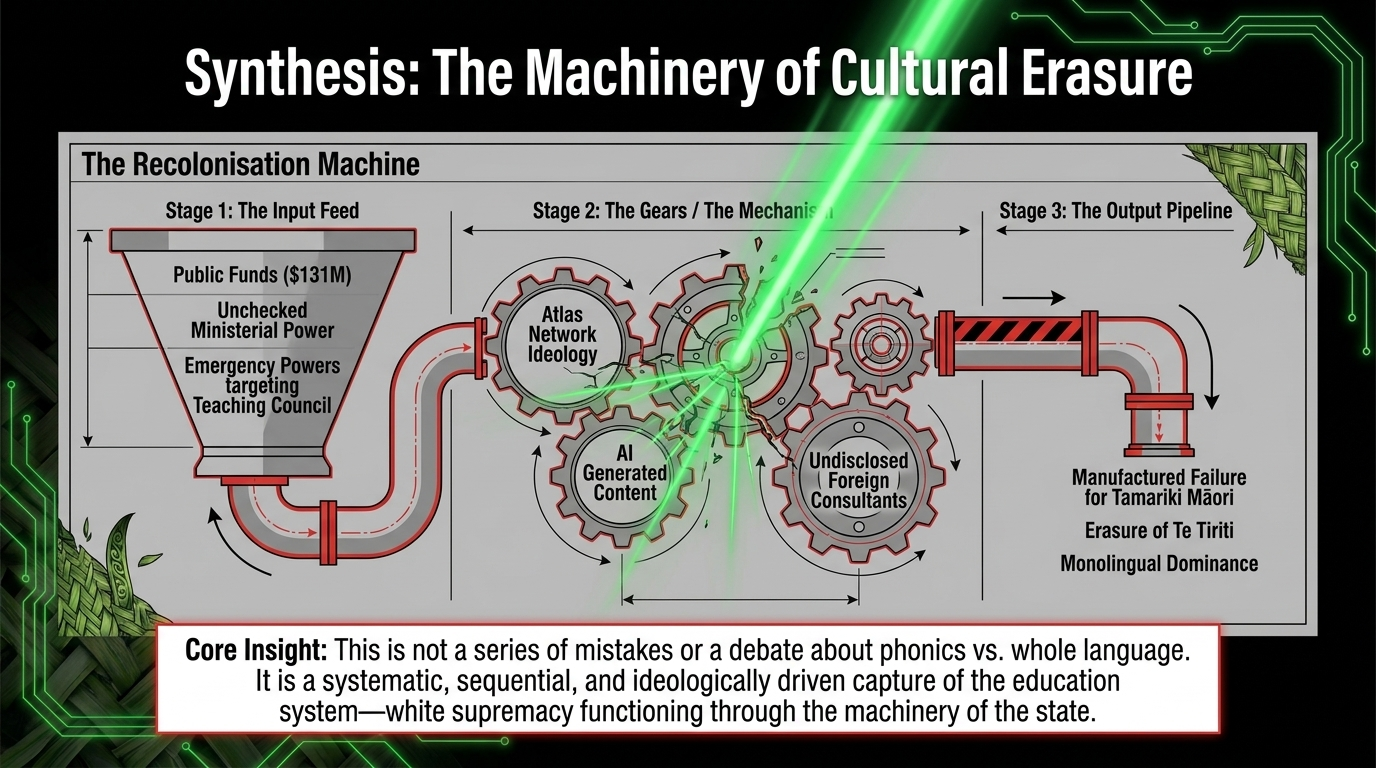
This government is white supremacist and neoliberal — not as an insult, but as a structural description backed by evidence.
I say so, I prove it, I cite it.
White supremacy is not only burning crosses. It is also the systematic dismantling of Indigenous knowledge systems through the machinery of the state.
When the Crown's own counsel stands before the Waitangi Tribunal and admits fewer references to Te Tiriti exist in the new curriculum
— that is the Crown confessing its own breach.
When an Atlas Network insider chairs the advisory group.
When an unauthorised libertarian who declared
"there is no place for traditional knowledge in a curriculum" writes the English curriculum.
When an undisclosed Australian company directs the work.
When AI generates content and the Minister denies it.
When the first results show it doesn't work and children enjoy learning less.
When $30 million is cut from te reo Māori teacher training.
When the NZATE walks out.
When a formal complaint reaches Parliament's Regulations Review Committee.
This is not a series of mistakes. This is a series of choices.
As I exposed in Privatising Education Is Cultural Genocide in March 2025, and as E-Tangata documents:
"Mainstream schools in Aotearoa New Zealand are controlled by those who have political, economic and cultural power, where western values, knowledge, culture and the English language are the central focus of the school."
Under Stanford, that concentration of power has accelerated
— funded by public money, insulated from scrutiny by OIA delays, and defended by a Ministry that says it is "confident" while its own former staffer is in Parliament saying otherwise.
Stanford is currently using the same Emergency Powers under the Education and Training (System Reform) Amendment Bill to bring the Teaching Council under near-total ministerial control, as reported by RNZ on 19 May 2026.
First the curriculum.
Then the teachers.
Then the body that registers and disciplines the teachers.
This is not reform.
It is capture — systematic, sequential, and ideologically driven.
He Kupu Whakakapi — Rangatiratanga and Moral Clarity
The Coleman complaint is at Parliament this Wednesday. I want every whānau member in Aotearoa to understand what is at stake.
This is not a debate about phonics versus whole language.
This is not a disagreement about curriculum philosophy.
This is about whether a Minister of the Crown can hand the intellectual future of your tamariki to an undisclosed Australian company, an AI, and an Atlas Network operative — without your knowledge, without transparency, without accountability — and then stand at a Budget press conference and announce $131 million to fix what they broke.
The answer is: not while this taiaha is still raised.
Kia kaha, whānau. Stay vigilant. Stay connected.
🪙 He Koha — Fund the Truth They Won't Tell You
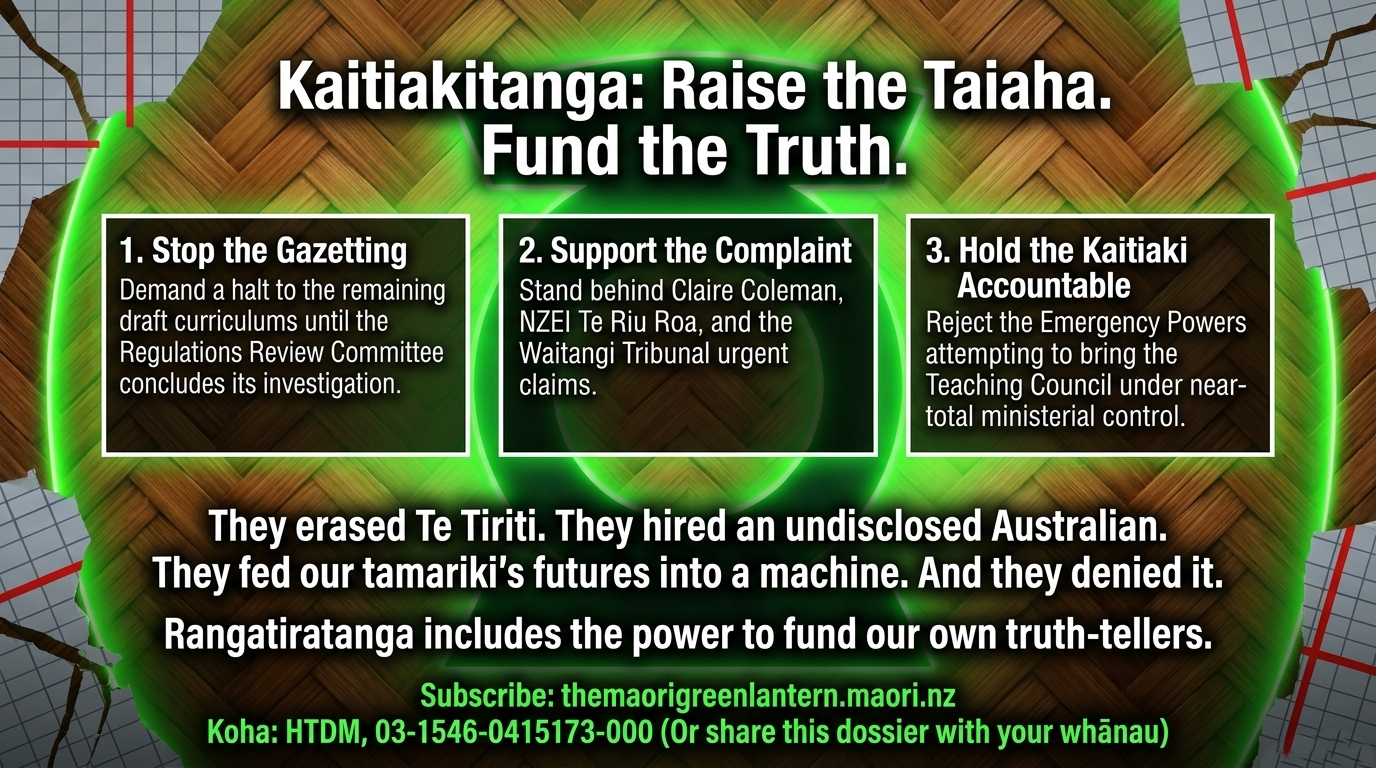
They erased Te Tiriti from the curriculum. They hired an undisclosed Australian. They fed our tamariki's futures into a machine. They denied it. And they announced $131 million to fix what they deliberately broke.
Every essay I write — naming names, citing evidence, refusing to soften — costs time, mahi, and resources that the Crown will never fund. Every koha you make signals that rangatiratanga includes the power to fund our own truth tellers. That we do not need the Crown's permission to hold the Crown accountable.
This essay exists because whānau like you funded it. The next one will too — if you can.
If you can koha: Koha here — Support the Māori Green Lantern | Bank direct: HTDM, 03-1546-0415173-000
If you cannot koha — no worries: Subscribe, follow, kōrero, share. That is koha.
Views expressed constitute honest opinion on matters of public interest under the Defamation Act 1992 (NZ) and Durie v Gardiner NZCA 278. All factual claims are sourced and cited. Named individuals are referenced solely in their public capacity as holders of public office or formal advisory roles. Errors or corrections: themaorigreenlantern.maori.nz.