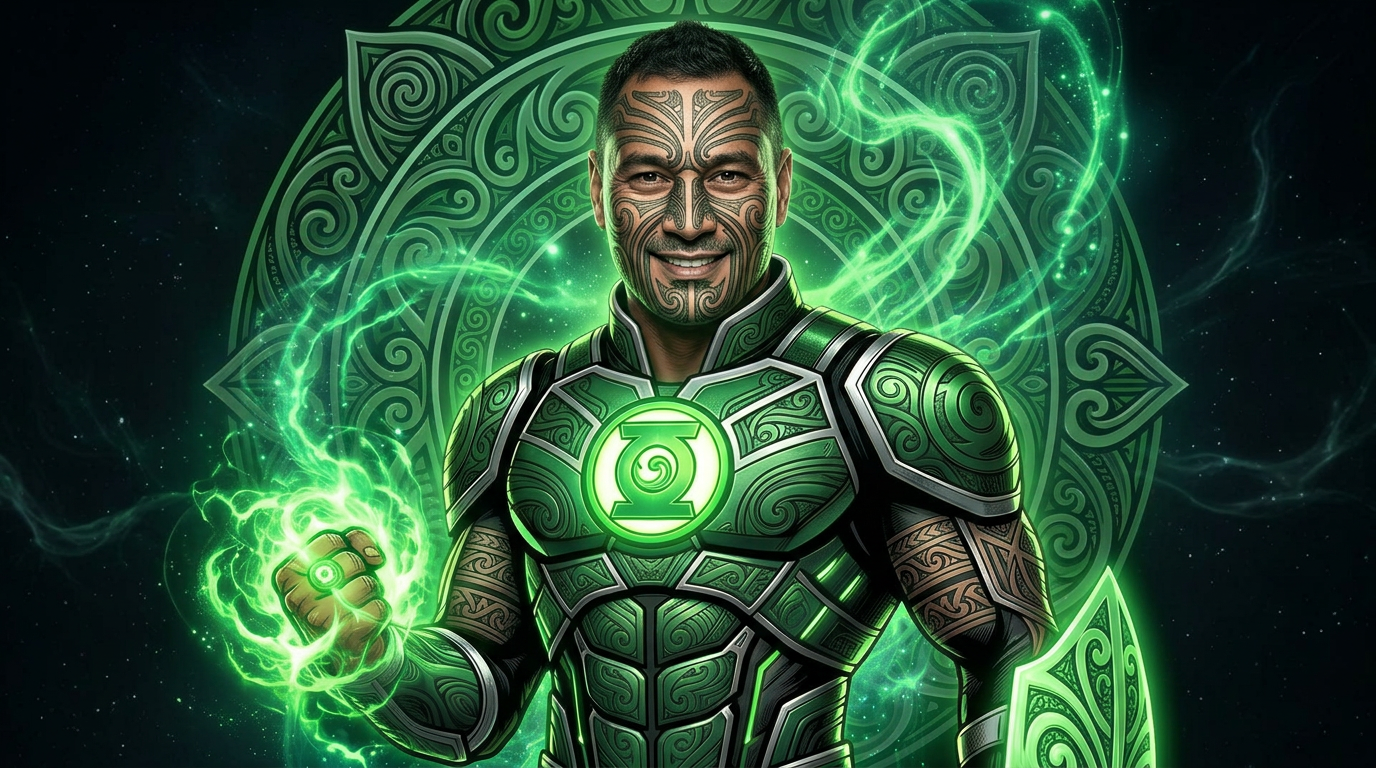
"THE RING CHOOSES THE WILLING — HIPKINS CHOSE THE WEALTHY" - 25 June 2026
How Labour's Red-Tie Neoliberal Project Manager Protected the 0.3% and Abandoned the 96% — Again

Mōrena Aotearoa,
"Are you afraid?"
That is the question the ring asks.
Chris Hipkins answered it on 23 June 2026.
He said: yes.
He just used different words.
The Ring and the Afraid Man
I am Ivor Jones. I am The Māori Green Lantern — tohunga mau rākau wairua, kaitiaki of whānau, enemy of the comfortable lie. Te Arawa, Ngāti Pikiao, Welsh whakapapa.
I wield the taiaha in both hands. I do not lower it for red ties.
The HBO series Lanterns opens with the most honest question ever asked of power:
"Are you afraid?"
The ring —
"the greatest weapon in the universe"
— does not choose the strong. It does not choose the comfortable. It does not choose the man who has polished his rhetoric for twenty years while protecting every structure that keeps our whānau poor.
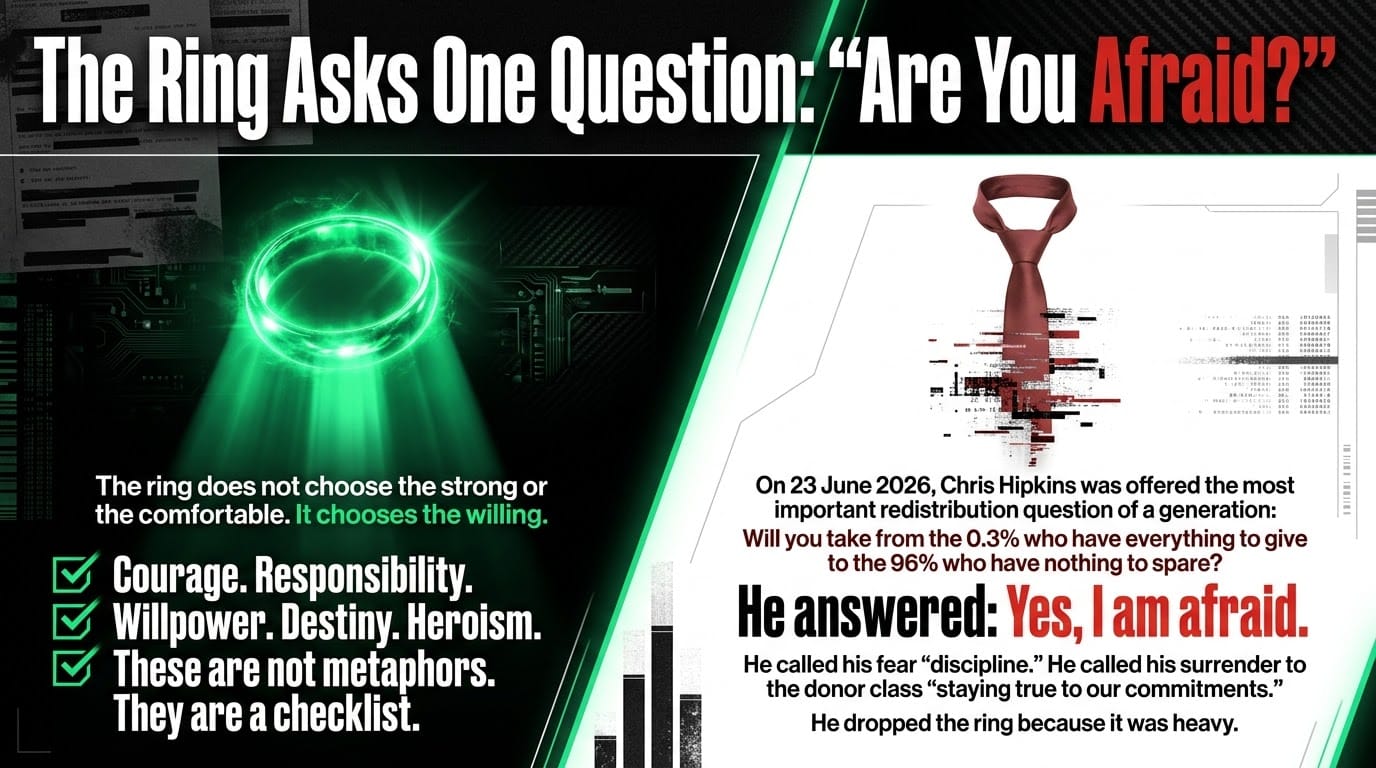
The ring chooses the willing. It chooses those who face their fear, name it, and act anyway. Its core themes — courage, responsibility, fear, willpower, destiny, heroism — are not metaphors. They are a checklist.
And Chris Hipkins fails every single item.
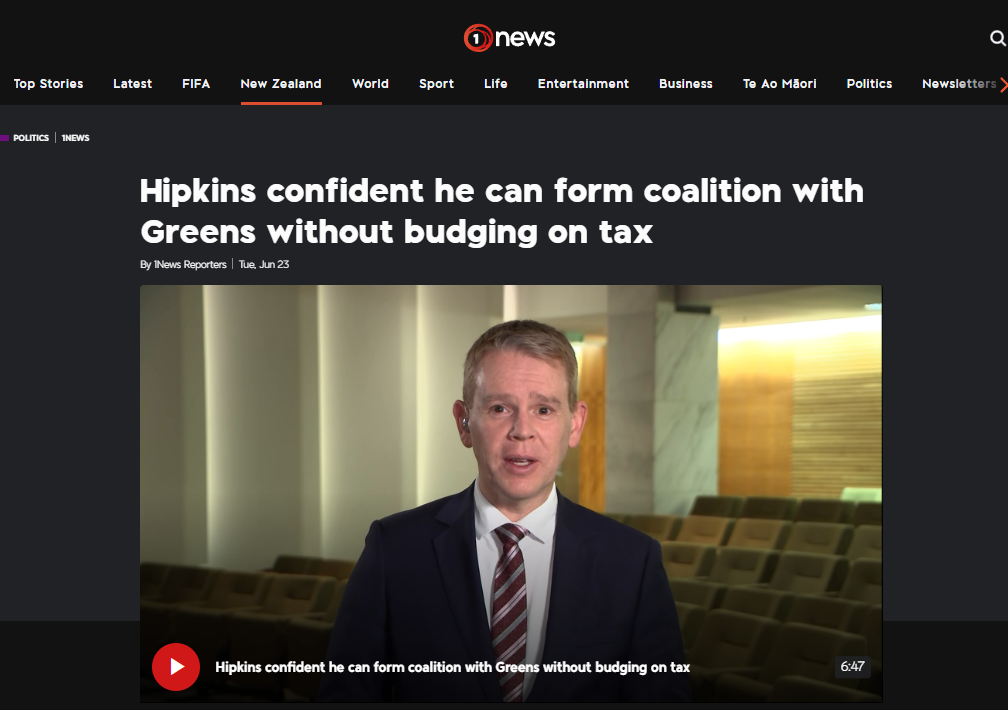
 1News Reporters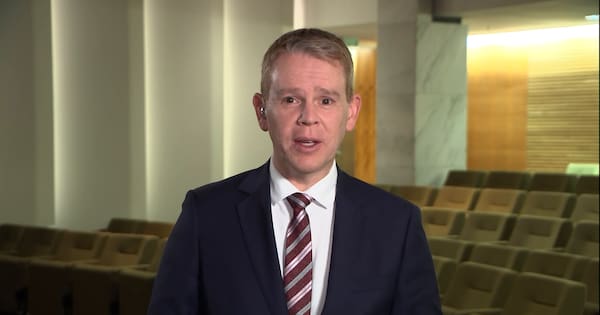
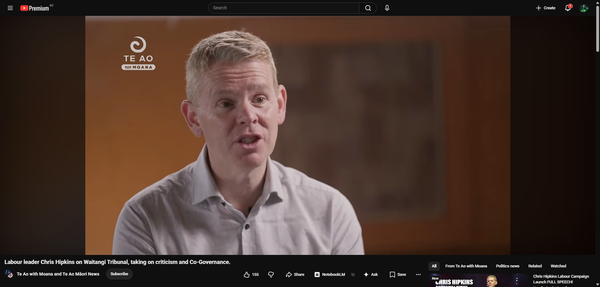
On 23 June 2026, Hipkins told 1News Breakfast he was "confident" he could form a coalition with the Greens without conceding a single policy to them.
He stood at the precipice of the most important redistribution question in a generation
— will you take from the 0.3% who have everything to give to the 96% who have nothing to spare? — and he flinched.
He dressed his cowardice in the language of principle. He called his fear "discipline." He called his surrender to the donor class "staying true to our commitments."
He dropped the ring because it was heavy.
I do not drop the ring. I am not afraid. Those are the elements required of a Lantern.
🎙️ The Deep Dive Podcast
Listen to a lively conversation between two hosts unpacking and connecting the key sources of this essay — Hipkins' 1News interview, 40 years of Rogernomics, the Greens' tax package, tikanga frameworks, and the HBO Lanterns connection.
I apologise in advance for the AI's very harsh pronunciation of te reo. Please don't shoot me 😊
📺 YouTube Video
Like video? Here is a short video supporting the essay — tracing the whakapapa from Roger Douglas to Chris Hipkins, and naming what the ring really asks of a leader.
Again, don't shoot the messenger because of the AI's pronunciation 😊
The Whakapapa of Rot — 40 Years of Labour Betrayal
Let me tell you who built this cage.
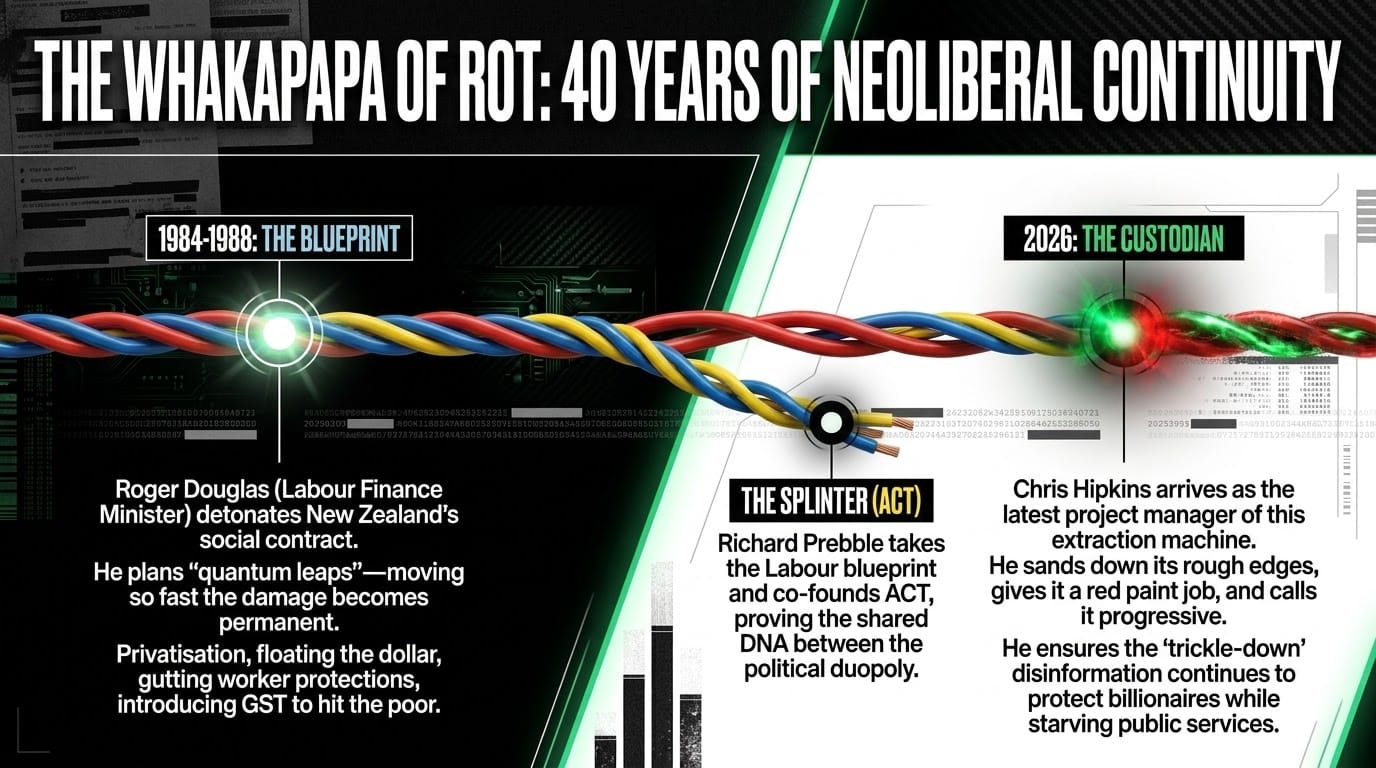
Roger Douglas — Labour's own Finance Minister from 1984 to 1988 — detonated New Zealand's social contract. He did not stumble into it. He planned it. He called it "quantum leaps" — the deliberate strategy of moving so fast, so hard, so comprehensively that no one could reverse it before the damage was permanent. Privatisation of state assets. Floating of the dollar. Gutting of subsidies and tariffs. GST — a tax designed to hit the poor hardest while the wealthy paid proportionally less. Douglas didn't leave Labour; he colonised it. And then Richard Prebble — another Labour minister, another architect of dispossession — followed him out to found ACT, confirming what we already knew: there was never a meaningful difference between the two projects.
As the New Zealand Public Service Association confirmed on Rogernomics' 40th anniversary:
"It weakened rules that regulate corporations, dismantled our welfare system and removed safeguards that protected workers' rights. Deliberate underfunding of our public services has made way for the privatisation of the public good, so that billionaires, property investors, corporations and banks can profit in their place."
The Spinoff confirmed what Māori already knew:
"Forty years later, trickle-down theory merely filled the cups of the wealthy."
This is the whakapapa that damns Labour. Not ancient history — living inheritance. Hipkins did not arrive in 2026 as a blank slate. He arrived as the latest custodian of a machine designed in 1984 to extract wealth from the many and protect the few.
And on 23 June 2026, he proved he has no intention of breaking that machine. He intends to maintain it, sand down its rough edges, give it a red paint job, and call it progressive.
The Receipt — What Hipkins Said, What It Costs
I do not trade in vibes. I trade in receipts.
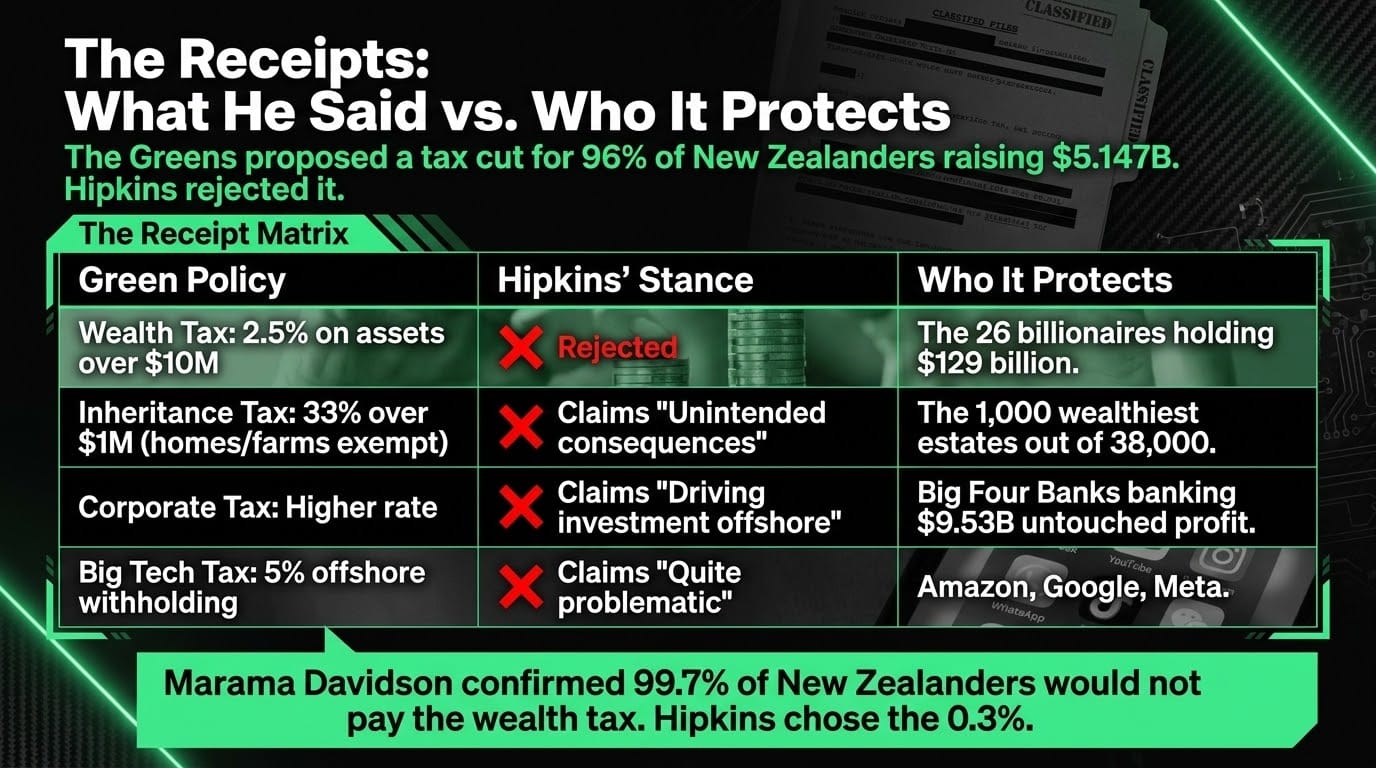
Here is what Hipkins told 1News on 23 June 2026, documented in his own words:
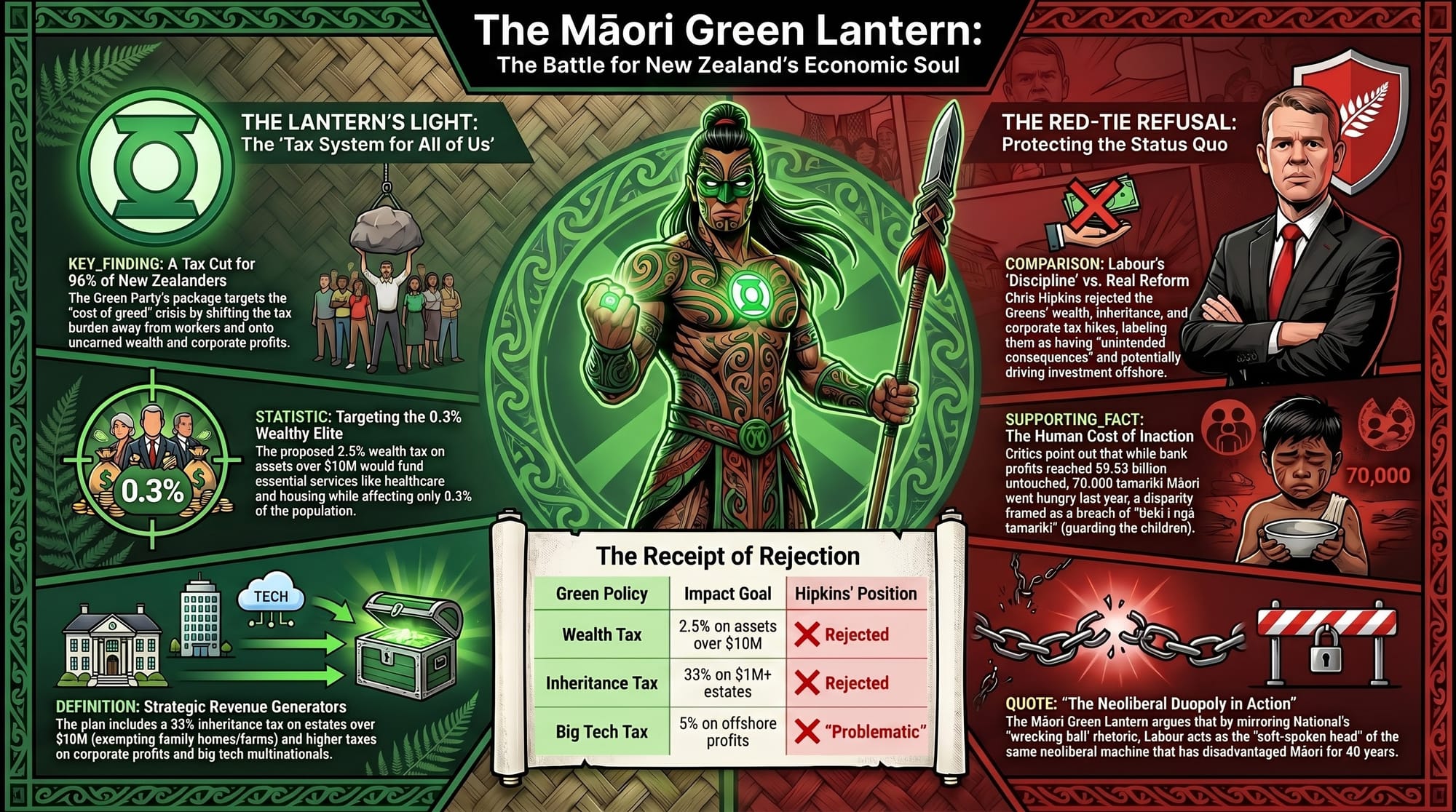
| Green Policy | What It Would Do | Hipkins' Position | Who It Protects |
|---|---|---|---|
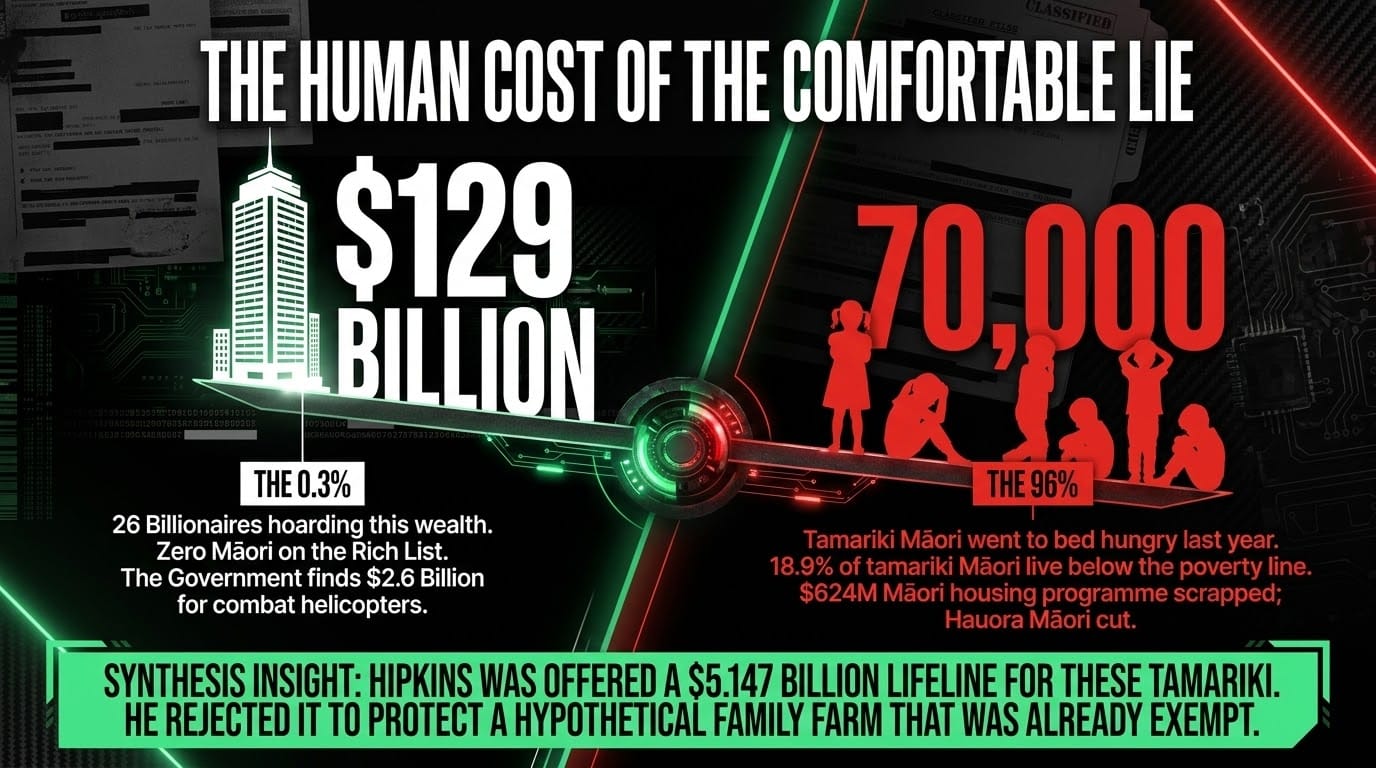
| Wealth tax | 2.5% on assets over $10M (family home exempt) | ❌ Rejected | The 26 billionaires with $129 billion |
| Inheritance tax | 33% on inheritances over $1M (homes and farms exempt) | ❌ "Unintended consequences" | The 1,000 people receiving the largest inheritances |
| Higher income tax | 45% on income over $160,000 | ❌ Rejected | Earners in the top bracket |
| Corporate tax increase | Higher rate for corporations | ❌ "Driving investment offshore" | $9.53 billion in Big Four bank profits — untouched |
| Big tech tax | 5% withholding on offshore big tech profits | ❌ "Quite problematic" | Amazon, Google, Meta |
| Landlord tax | Restoring interest deductibility | ⏳ Under consideration | — |
| Bank tax | Higher rate on bank profits | ⏳ "Want to scrutinise the advice" | — |
Greens co-leader Marama Davidson confirmed that 99.7% of New Zealanders would not pay the wealth tax. Chlöe Swarbrick confirmed that only 1,000 people out of 38,000 inheritances would be affected by the inheritance tax. The Greens' full package delivers a tax cut for 96% of New Zealanders and raises $5.147 billion net in year one after the Greens corrected their earlier typo the same day it was identified.
Hipkins rejected all of it to protect the 0.3%.
Meanwhile, as I documented in "The $2.6 Billion Helicopter Heist", this Government found NZ$2.6 billion for combat helicopters while the NZ$624M Māori housing programme was scrapped, Hauora Māori was cut, and 18.9% of tamariki Māori remained below the poverty line. And Labour — Hipkins' Labour — calls this the system worth maintaining.
Three Examples for the Western Mind
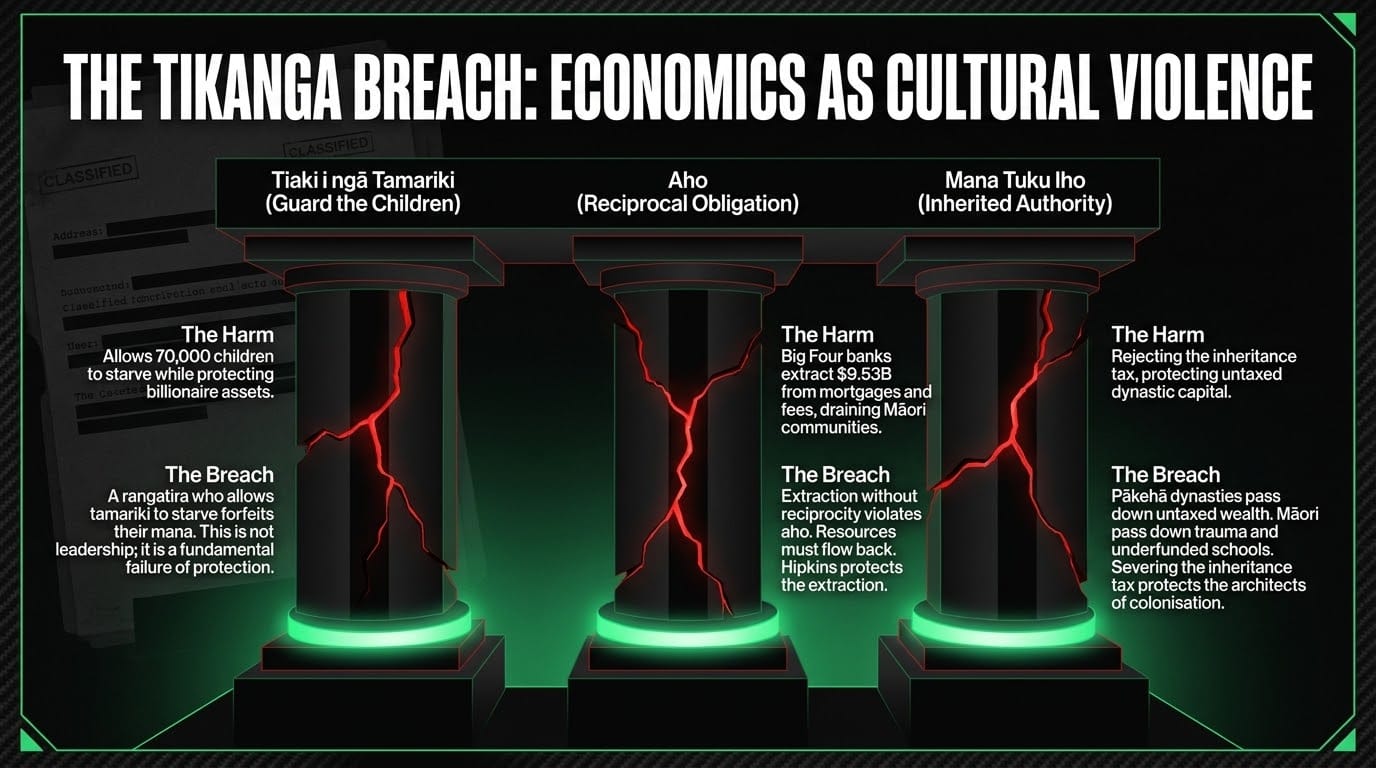
For those who have not yet felt this in their bodies. For those who still think this is abstract. Three receipts. Three whānau. Three proofs that Hipkins' cowardice has a human cost.
Example 1 — The Tamariki Māori Hunger Test
The harm: 18.9% of tamariki Māori live below the poverty line — Stats NZ, February 2026. 70,000 tamariki Māori went to bed hungry in this country last year. The Greens' tax package — rejected by Hipkins — would generate $5.147 billion in year one, specifically to fund income tax cuts for the 96%, healthcare, and housing. That is food on tables. That is heating in homes. That is tamariki who can concentrate in school because they are not starving.
The solution Hipkins rejected: A 2.5% levy on assets above $10 million — affecting 0.3% of New Zealanders — would directly fund the services that keep those 70,000 children alive and learning. Hipkins said no. He called it "unintended consequences."
The tikanga impact: In te ao Māori, the welfare of tamariki is the measure of a community's mana. A rangatira who allows tamariki to starve while protecting the wealthy does not hold mana — they forfeit it. What Hipkins is performing is not leadership. It is a breach of the most fundamental obligation a leader carries: tiaki i ngā tamariki. Guard the children. He chose the billionaires instead.
Example 2 — The Bank Profits That Nobody Taxed
The harm: Aotearoa's Big Four banks extracted $9.53 billion in profits — untouched. These are profits earned from the mortgages of working people, many of them Māori locked out of homeownership and forced to rent from landlords who benefit from tax deductibility. The Greens proposed a bank tax. Hipkins said he wanted to "scrutinise the advice" before deciding. That is the language of a man who will never decide.
The solution Hipkins rejected: Even Finance Minister Nicola Willis — National's own minister — tried to go further with a bank levy but was blocked by ACT. The Leader of the Opposition is to the right of a National Finance Minister on taxing bank profits. Let that land. Hipkins is so captured by capital that he cannot even match the ambition of the party he claims is destroying the country.
The tikanga impact: Whakaaro Māori holds that resources extracted from a community must flow back to that community — that is the principle of aho, of reciprocal obligation. Banks extract billions from Māori communities through mortgage interest, banking fees, and credit charges while zero Māori appear on the Rich List of 26 billionaires. That is extraction without reciprocity. It is the opposite of tikanga. Hipkins protects it.
Example 3 — The Inheritance that Never Reaches Māori Whānau
The harm: New Zealand has 26 billionaires holding $129 billion in wealth. Zero Māori appear on the Rich List — not one. The inheritance tax the Greens proposed — 33% on inheritances over $1 million, with family homes and farms explicitly exempt — would have affected only 1,000 people out of 38,000 inheritances per year. These are not family farms at risk. These are dynasties compounding. These are the second and third generation of Rogernomics' primary beneficiaries — those who got the assets when they were sold off for nothing, and whose children will never have to work.
The solution Hipkins rejected: Swarbrick stated plainly:
"We're talking about a few percentage points of a few people on the margins who are inheriting enormous amounts of currently untaxed and unearned wealth."
That revenue — redistributed — is what funds the schools, the hospitals, the mental health services. Hipkins called it "real unfairness" and cited a hypothetical family farm. The Greens had already exempted family farms. Hipkins' argument was a ghost.
The tikanga impact: There is a concept in tikanga called mana tuku iho — the authority and identity passed down through generations. For Māori, this was severed by colonisation: land confiscated, language suppressed, institutions dismantled. The wealthy Pākehā families of Aotearoa pass down mana tuku iho in the form of untaxed capital. Māori pass down trauma, overcrowded homes, and underfunded schools. An inheritance tax — designed with exemptions, affecting 1,000 people — was a small act of correction. Hipkins refused it. He chose dynasty over equity.
The Language of Fear — "I'm Not Going to Say Yes"
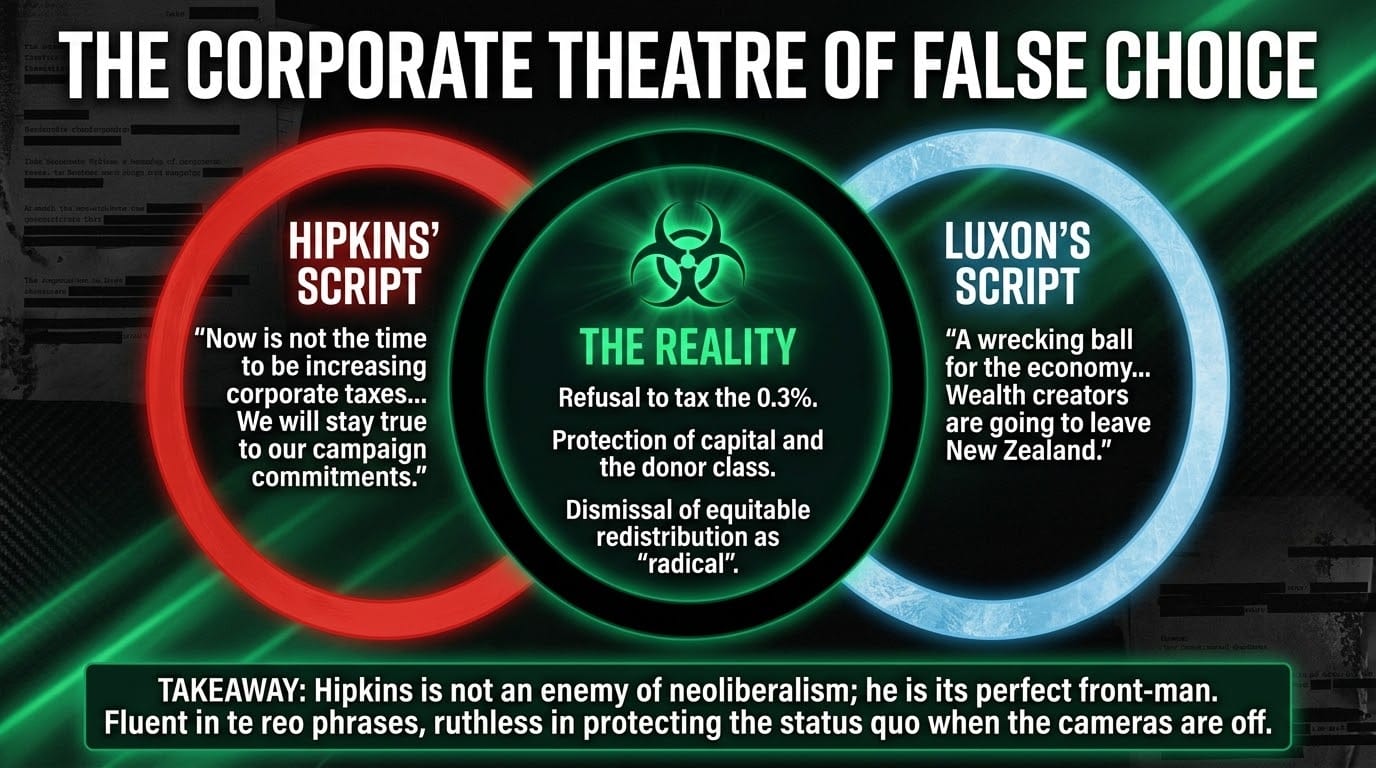
"I'm not going to say yes to things that we've specifically said before the election that we will not do."
That sounds like principle. It is cowardice with footnotes.
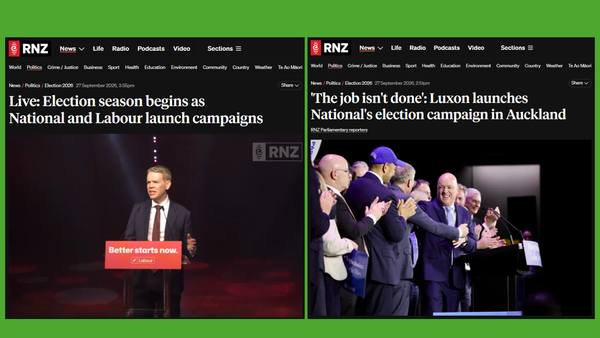
Hipkins himself pointed out that Christopher Luxon said no to many things before the last election and then said yes at the negotiating table. He cited this as evidence of Luxon's dishonesty. But governing requires adaptation. Coalition requires compromise. Hipkins cannot even bring himself to do what the man he calls a bad Prime Minister did: read the room, sit at the table, and actually lead.
When Luxon called the Greens' plans a "wrecking ball" for the economy, Hipkins did not correct him. He echoed him.
On the most consequential economic justice question of the decade, the Leader of the Opposition and the Prime Minister are reading from the same script. That is not coincidence.
That is the neoliberal duopoly in action — the corporate theatre of false choice that I have documented and named across multiple essays.
As I wrote in "He Waka Kōtahi, He Hinaki Hou: Labour's Neoliberal Mask":
"Labour is simply the soft-spoken head of the same neoliberal taniwha that ACT and National represent more openly."
And as I wrote in "Chris Hipkins' Labour Keeps the Neoliberal Knife at Māori Throats":
"Hipkins is not an enemy of neoliberalism; he is its perfect front-man: fluent in te reo phrases and compassion, ruthless in protecting the status quo when the cameras are off. ACT and National wield the axe; Labour forged the handle and insists on taking a photo with the stump."
In Lanterns, the ring measures willpower — the force that overrides fear, comfort, and self-interest.
Hipkins, confronted with the hardest question in Aotearoa politics, answered: No. Ask me again after the election. The ring does not wait. The whānau cannot wait. The 70,000 hungry tamariki cannot wait.
He dropped the ring. I pick it up.
Previous MGL Essays — The Whakapapa of This Argument
 Ivor Jones The Māori Green Lantern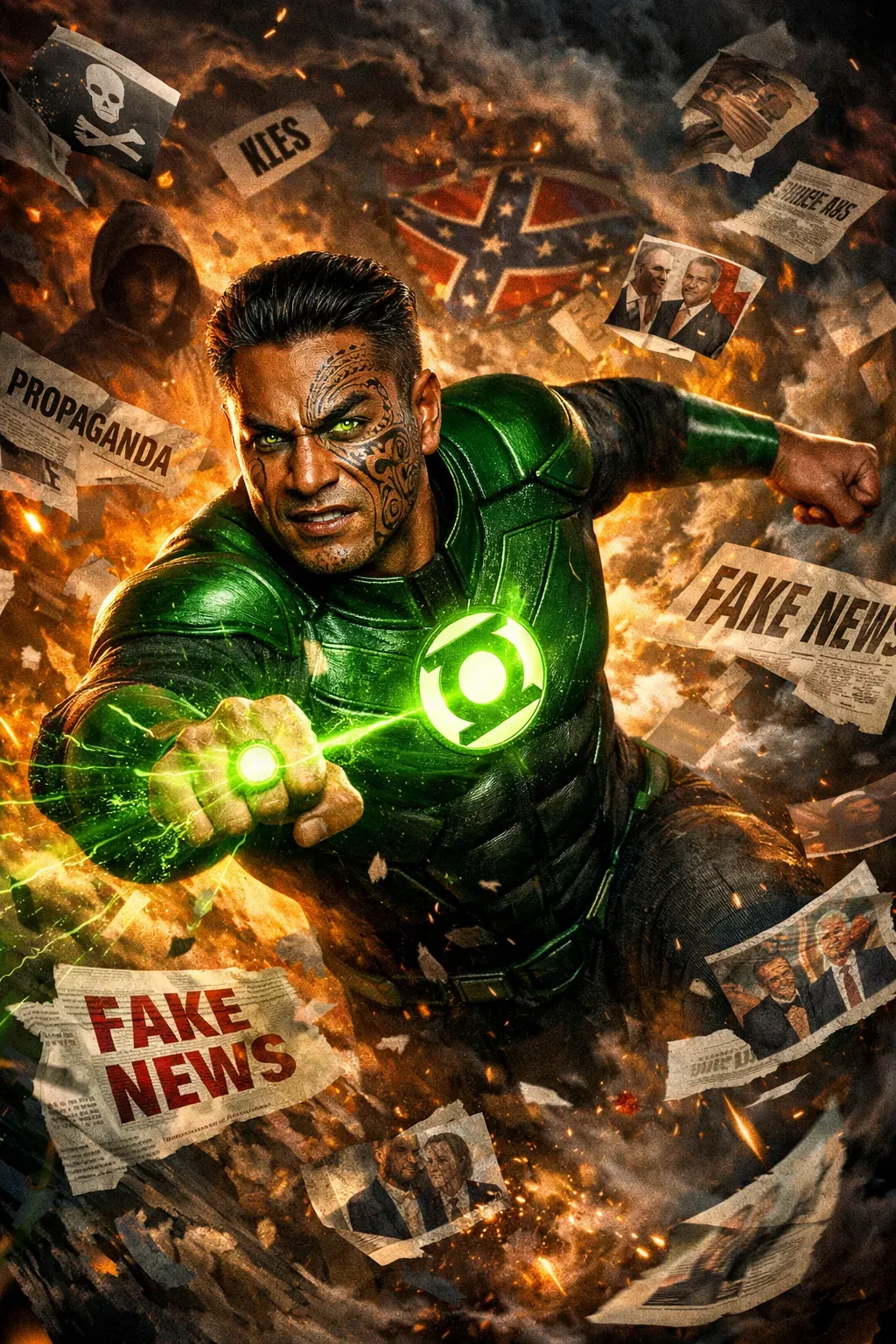
This is not my first time naming this machine. I have traced its wiring for years. Here are the receipts:
- "Chris Hipkins' Labour Keeps the Neoliberal Knife at Māori Throats" — documenting Labour's continuation of neoliberal economic settings during its last term in Government, and Hipkins' use of Māori language to mask structural betrayal.
- "He Waka Kōtahi, He Hinaki Hou: Labour's Neoliberal Mask and the Māori Votes They Are Hunting" — exposing Labour's performance of partnership alongside its refusal to entrench real Māori power.
- "The Corporate Theatre of False Choice: How Luxon and Hipkins Perpetuate Neoliberal Colonisation" — tracing how corporate donations flow to both parties to maintain neoliberal continuity regardless of who wins.
- "The Great Rebalancing — Corrected and Confirmed" — published 22 June 2026, the day before Hipkins' statement, confirming the Greens' corrected $5.147 billion net revenue figure and the government's three years of deliberate harm.
- "The Bach Feasters" — 9 June 2026. Hipkins defending a taxpayer-subsidised bach while 70,000 tamariki Māori went to bed hungry. "Red or blue. Same trough. Same hands. Labour is NOT the antidote."
- "Labour's Two-Faced Dance: Neoliberal Economics in Progressive Clothing" — January 2025: "Labour is essentially mirroring the same neoliberal approach that has historically disadvantaged Māori communities and working-class New Zealanders."
Tōku Whakaaro — My View
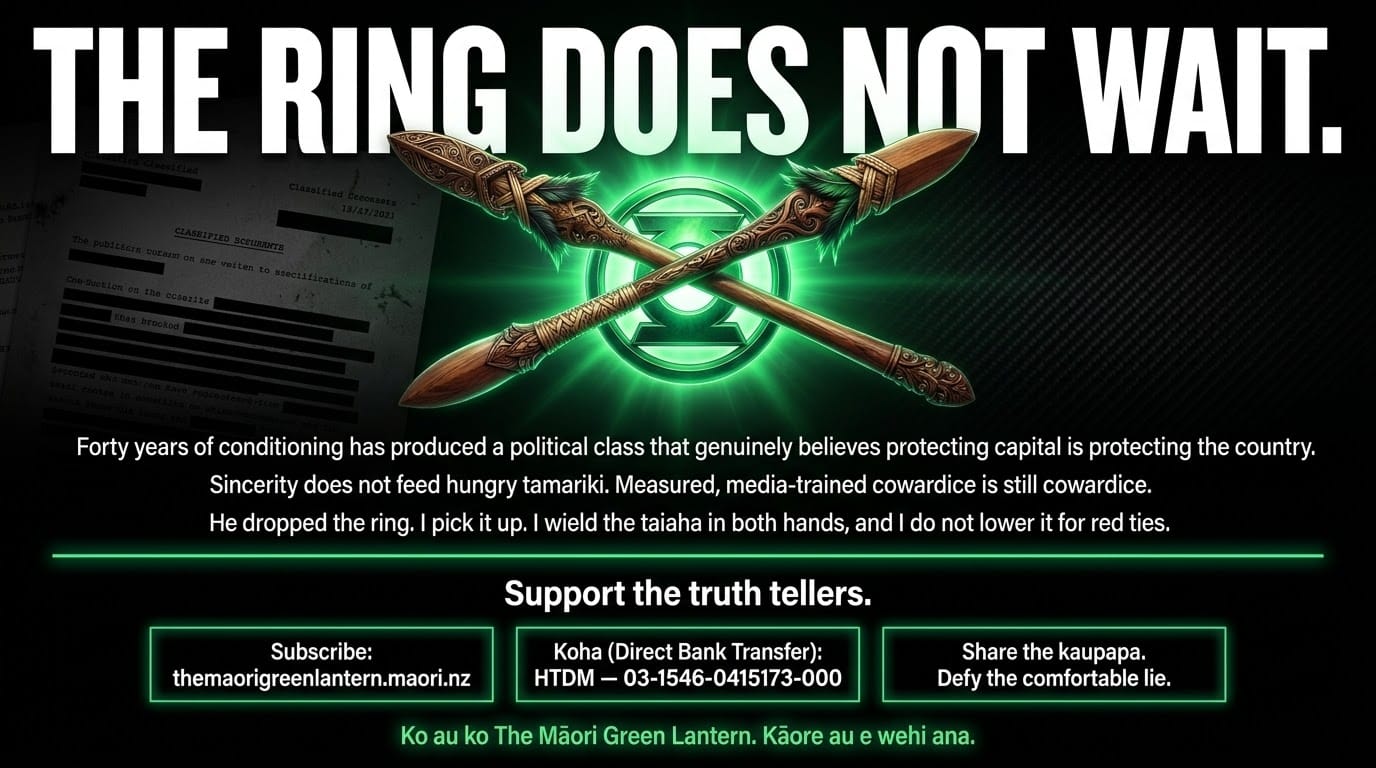
Hipkins is not a bad man. He is a captured man. Forty years of neoliberal conditioning inside the Labour Party machine has produced a leader who cannot imagine the boldness required to break the cycle. He has been trained — by Douglas, by Prebble's ghost, by the donor class, by three decades of Treasury orthodoxy — to believe that protecting capital is protecting the country. He genuinely believes the lie. That is the most dangerous kind of servant to the system: the true believer.
But belief does not excuse harm. Good intentions do not feed hungry tamariki. Sincerity does not pay the bills of the whānau choosing between rent and heating. And the measured, careful, media-trained cowardice of a man who will not tax the 0.3% is still cowardice — whatever he calls it.
The ring in Lanterns does not ask if you are good. It asks if you are willing. Willing to bear the weight of real power. Willing to make enemies of the powerful in order to protect the vulnerable. Willing to stand in the gap when no one else will.
I am Ivor Jones. I am The Māori Green Lantern. I am willing.
He is not.
Koha Consideration
Every koha to this kaupapa is a direct act of resistance against the forty-year neoliberal machine that Douglas built and Hipkins maintains.
When you support The Māori Green Lantern, you are not just supporting an essay. You are supporting the accountability that Labour, National, and ACT will never provide. You are signalling that the 70,000 hungry tamariki matter more than the 0.3% with offshore investment portfolios. You are saying: rangatiratanga includes the power to support our own truth tellers — the ones who name the receipts, trace the whakapapa, and refuse to lower the taiaha for red ties.
Kia kaha, whānau. Stay vigilant. Stay connected. And if you are able, consider a koha to ensure this voice continues.
If you are unable to koha, no worries! Subscribe or follow The Māori Green Lantern at themaorigreenlantern.maori.nz, kōrero and share with your whānau and friends — that is koha in itself.
Four pathways to support:
- 💚 Koha platform: Support directly here
- 📬 Subscribe for essays: themaorigreenlantern.maori.nz/#/portal/support
- 🏦 Direct bank transfer: HTDM — 03-1546-0415173-000
- 👍 Facebook: Subscribe on Facebook
Disclaimer
*This essay is published in the public interest under the principles of the New Zealand Bill of Rights Act 1990 (s.14, freedom of expression) and the qualified privilege established in Lange v Atkinson