
"Bloated, Slow And Overpaid?" – How Kiri Allan's Hit Job On The Public Service Feeds A White Supremacist Neoliberal Machine" - 15 August 2026
Walking Out Of The Fire And Blaming The Firefighters

I am Ivor Jones, The Māori Green Lantern.
A former Labour minister has just called the public service "bloated, slow and overpaid". In the middle of mass cuts and racist attacks on Māori public servants, that line is not brave truth-telling — it is a gift to a white-supremacist, neoliberal regime that wants our whānau defenceless.
 RNZ | Te Reo Irirangi o Aotearoa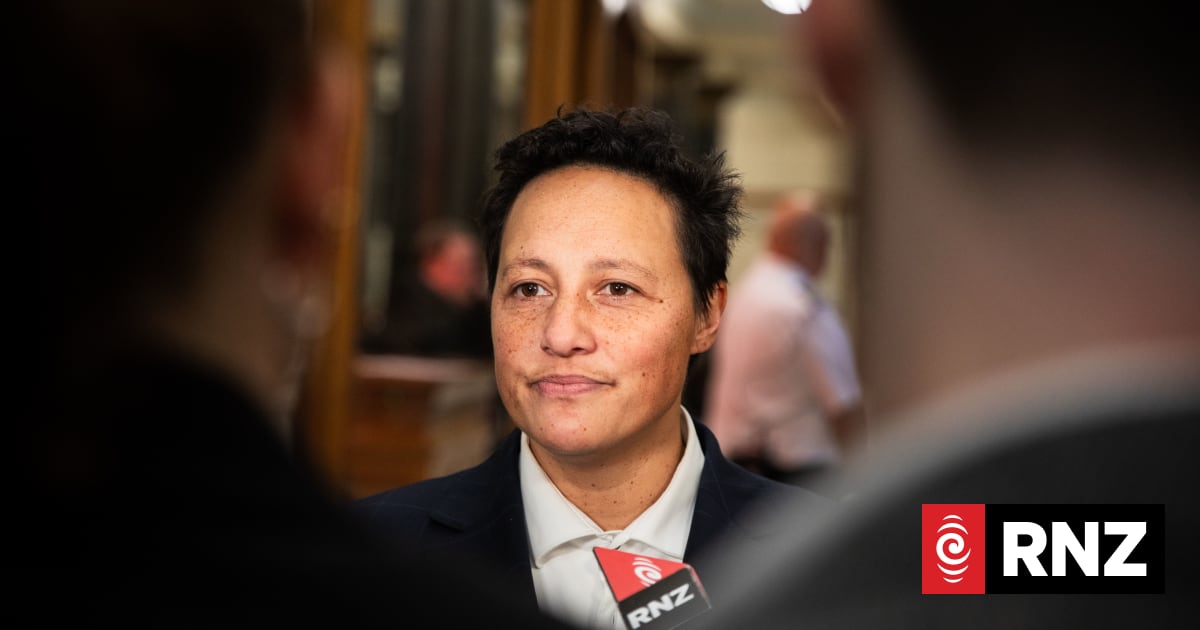
I'm going to talk to you in plain language, whānau, because the stakes here are not academic.
Kiri Allan has walked out of a burning building she helped design, turned to the cameras, and declared that the firefighters are too fat, too slow, and paid too much. In her memoir Go Hard or Go Home and in interviews, she describes the public service as "bloated, slow and overpaid".
She doubles down by saying senior bureaucrats are "more political than politicians", that they know they'll outlast ministers, and that gatekeeping in the centre stops money reaching communities.
That frustration is real. The way she frames it is dangerous.
The flames? Those are the mass cuts, racist policy attacks, climate disasters and pandemics tearing through our communities while this coalition strips out protections.
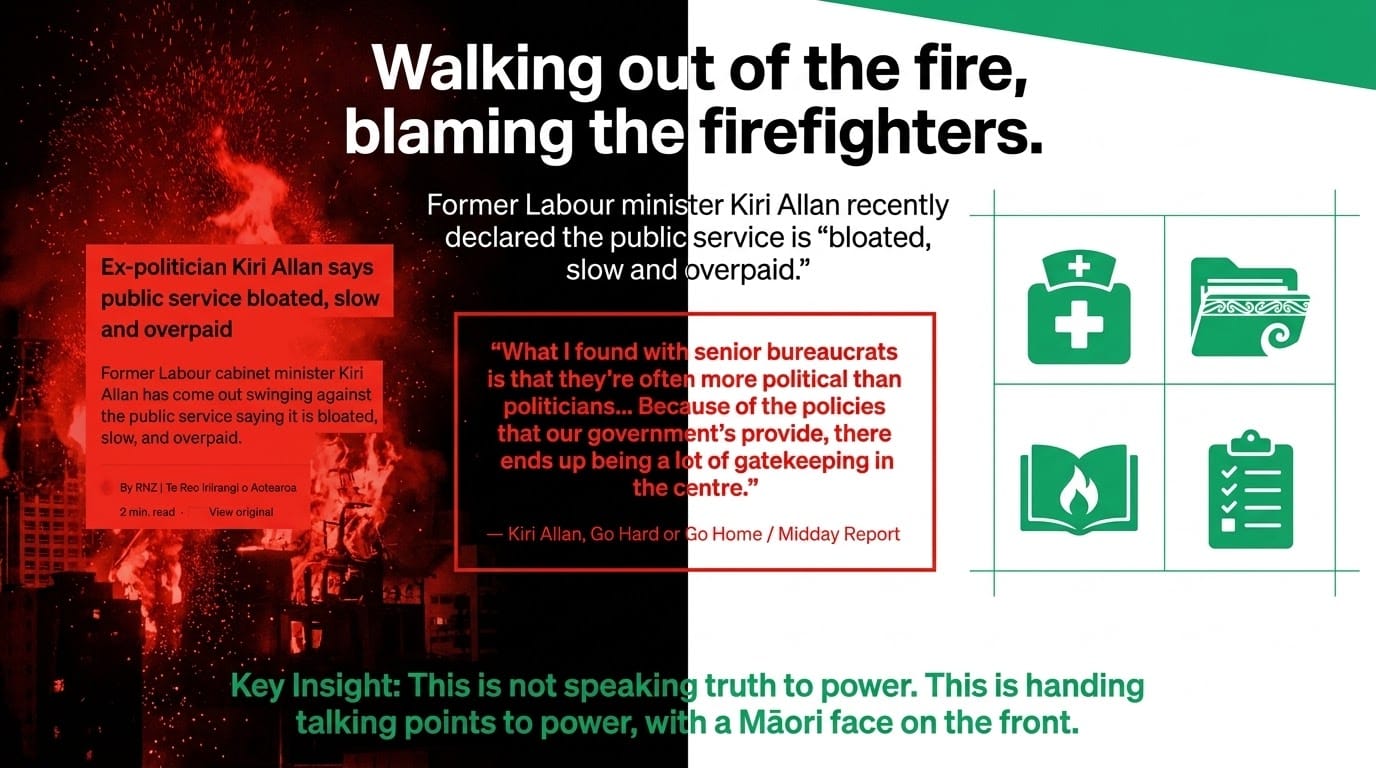
The firefighters? That is the public service: the nurses, inspectors, case workers, Māori policy advisers, teachers, prison staff, emergency planners and data analysts trying to hold the line with fewer resources every year, as shown in the Public Service Commission's own Workforce Data 2023 – Workforce Size and Workforce Size tables.
When Allan throws out "bloated, slow and overpaid" at that exact moment, she is not speaking truth to power. She is handing talking points to power, with a Māori face on the front.
The Racist Neoliberal Project Allan's Words Feed
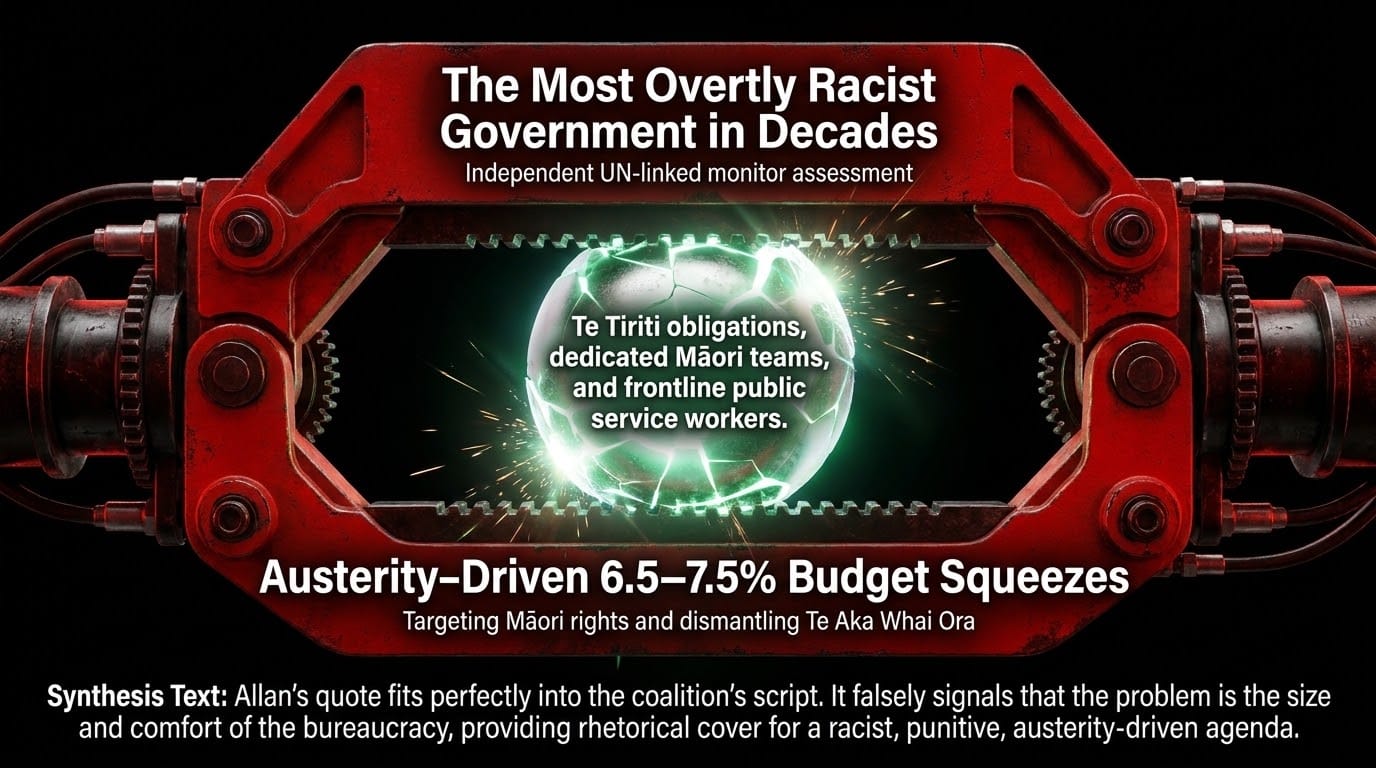
An annual monitoring report to the United Nations, summarised in E-Tangata's "The Most Overtly Racist Government In Decades", describes the current coalition government as "the most overtly racist and white supremacist government [Aotearoa] has had in decades", noting that its agenda specifically targets Māori and their rights.
That same coalition has ordered public-service agencies to make cuts of 6.5–7.5 percent to their budgets to fund tax cuts that primarily benefit the wealthy, leading to significant cuts to, or disestablishment of, dedicated Māori teams within agencies — again documented in that UN monitoring report and allied analysis.
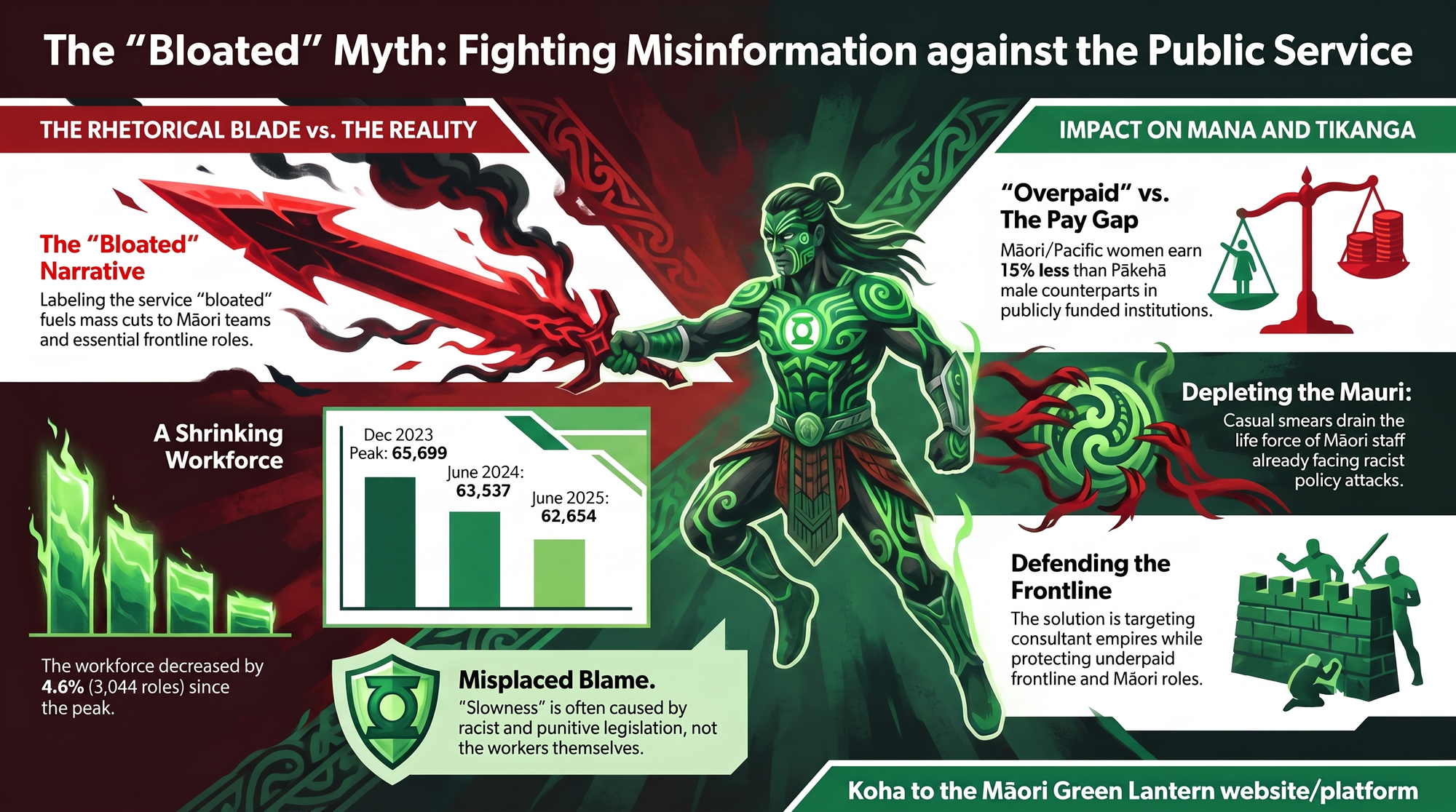
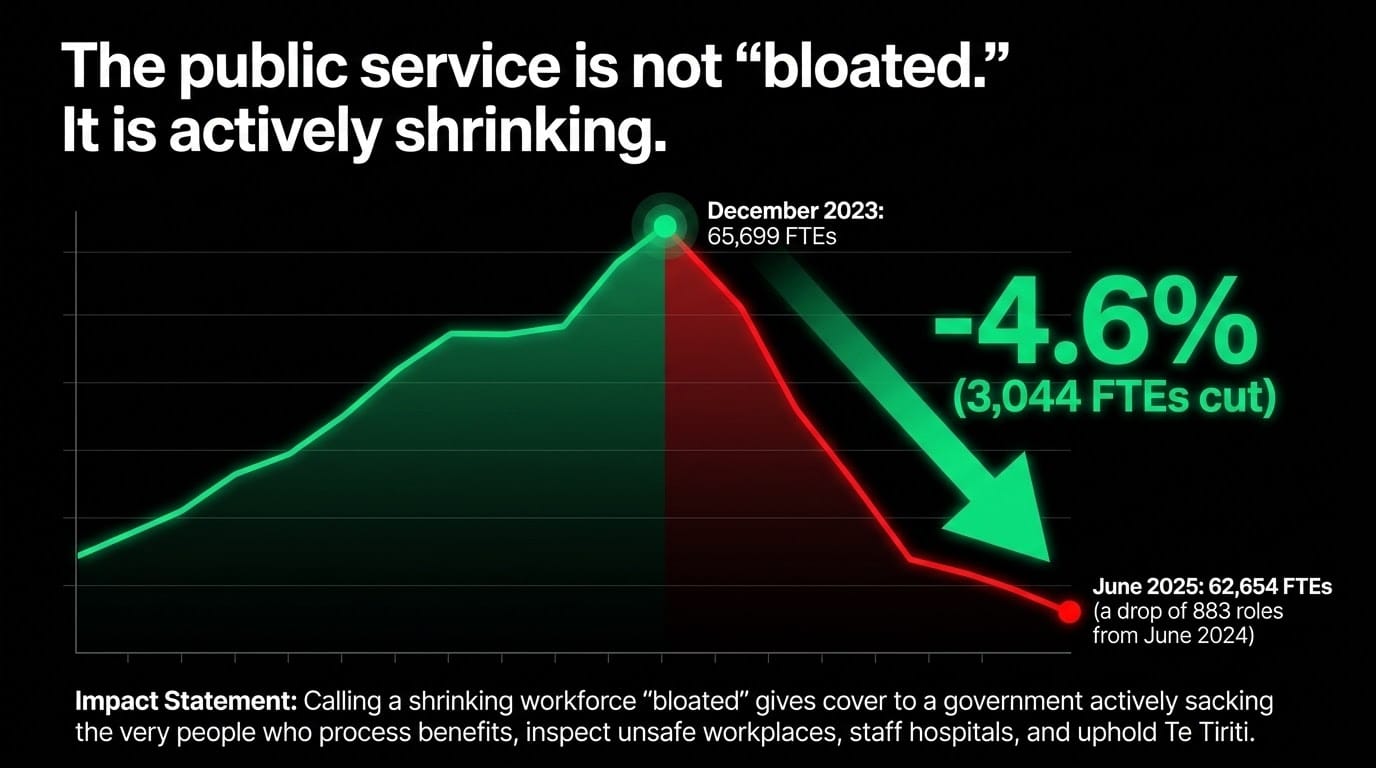
The Public Service Commission confirms that core public-service FTEs peaked at 65,699 in the December 2023 quarter and have decreased by 4.6% (3,044 FTEs) since then, in the Workforce Size series. Newswire's Budget 2026 And The Shrinking New Zealand Public Service notes that FTEs fell from 63,537 in June 2024 to 62,654 in June 2025, a drop of 883 roles or 1.4%, and that headcount fell from 65,113 to 64,163, a drop of 950 people or 1.46%.
The Deep Dive Podcast
Listen to a lively conversation between two hosts, unpacking and connecting topics in the sources of this essay. I apologise in advance for the AI's very harsh pronounciation of reo. Please dont shoot me, :).
Youtube Video
Like video? Here is a short video suppporting the essay. Again, don't shoot the messenger please because of AI's pronounciation. :)
Koha Consideration

Every koha signals that whānau are ready to support the accountability that this racist, neoliberal government will never give us. When a former minister helps them smear the public service, it is our own truth-tellers, researchers and Māori public servants who need backing to push back.
It signals that rangatiratanga includes the power to support our own truth-tellers, including those of us calling out how "bloated, slow and overpaid" rhetoric is being used to strip Māori and workers of protection. Kia kaha, whānau. Stay vigilant. Stay connected. And if you are able, consider a koha to ensure this voice continues.
If you are unable to koha, no worries! Subscribe or follow The Māori Green Lantern at themaorigreenlantern.maori.nz, kōrero and share with your whānau and friends — that is koha in itself.
Four pathways exist:
For those who wish to support this mahi directly with a koha (voluntary contribution), please visit the Koha platform: Koha — Support.
For those who wish to receive essays directly and support through subscription: Subscribe To The Māori Green Lantern.
For those who prefer direct bank transfer, account details are: Ivor Jones, account number 03-1395-0099387-000.
For those on Facebook: Facebook — Subscribe.
In other words: the public service is already shrinking. Allan's "bloated, slow and overpaid" line fits perfectly into the script the coalition needs. It tells the public that the problem is the size and comfort of "the bureaucracy", not the racist, punitive, austerity-driven agenda of the ministers giving orders.
Three Examples For The Western Mind – Quantified Harm Solutions And Impact On Tikanga
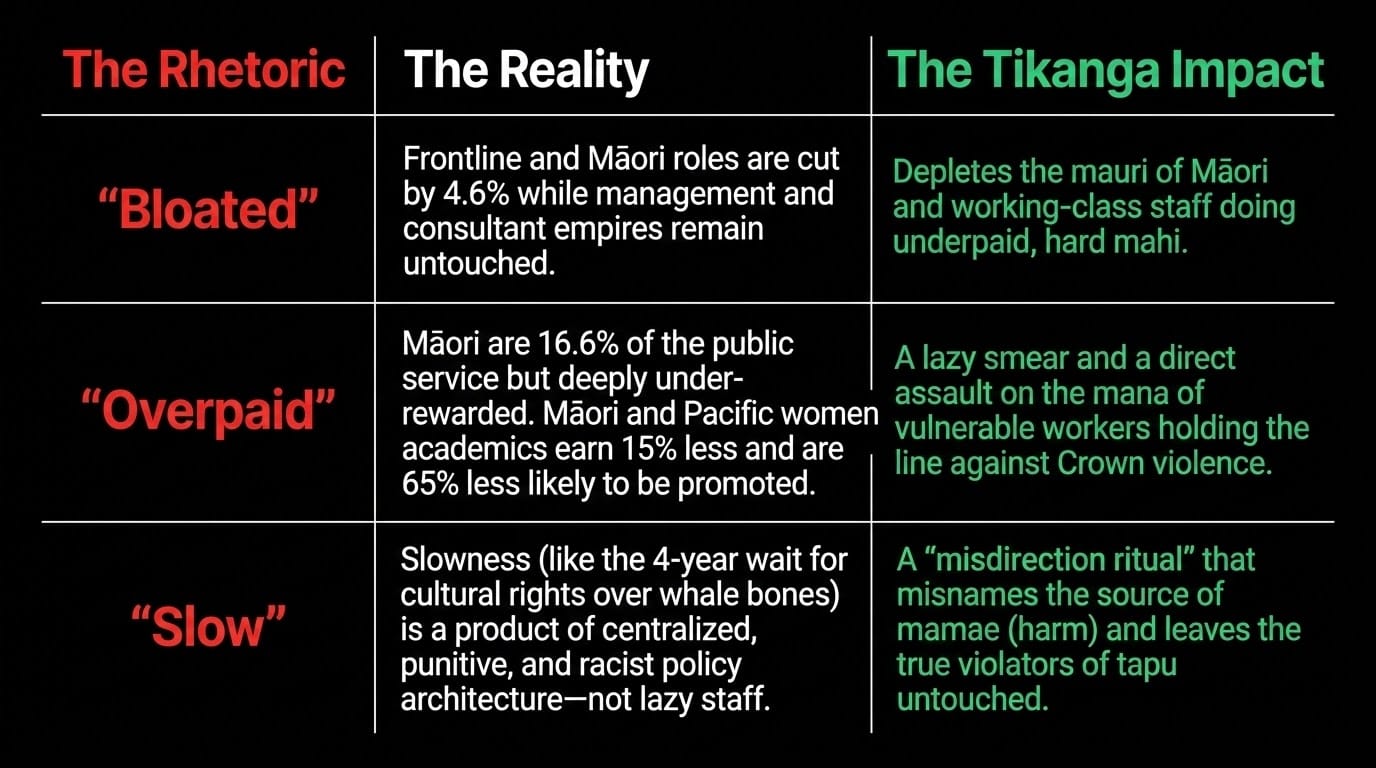
Plain language. Concrete harm. Real solutions. Tikanga at the centre.
Example One – Cutting Public Servants While Calling Them Bloated
The Harm
Public Service Commission data shows 63,117 FTE staff as at 30 June 2023, an increase of 4.5% (2,736 FTEs) from 60,381 FTEs in 2022, as agencies staffed up for pandemic response and long-delayed work — this is set out in Workforce Data 2023 – Workforce Size.
By June 2025, staffing measured in FTEs had fallen from 63,537 to 62,654, a decline of 883 roles or 1.4 percent, as reported in Budget 2026 And The Shrinking New Zealand Public Service and corroborated by the Commission's Workforce Size table. Over the same period, FTEs dropped a total of 3,044 from the 65,699 peak — a 4.6% fall.
When a former minister looks at that shrinking workforce and chooses the word "bloated", she gives cover to a government that is already cutting staff. The harm is brutally simple: fewer people to process benefits, inspect unsafe workplaces, staff hospitals, investigate pollution, and uphold Te Tiriti obligations, as described in Public Service Workforce Shrinks Amid Reduced Public Spending.
The Solution
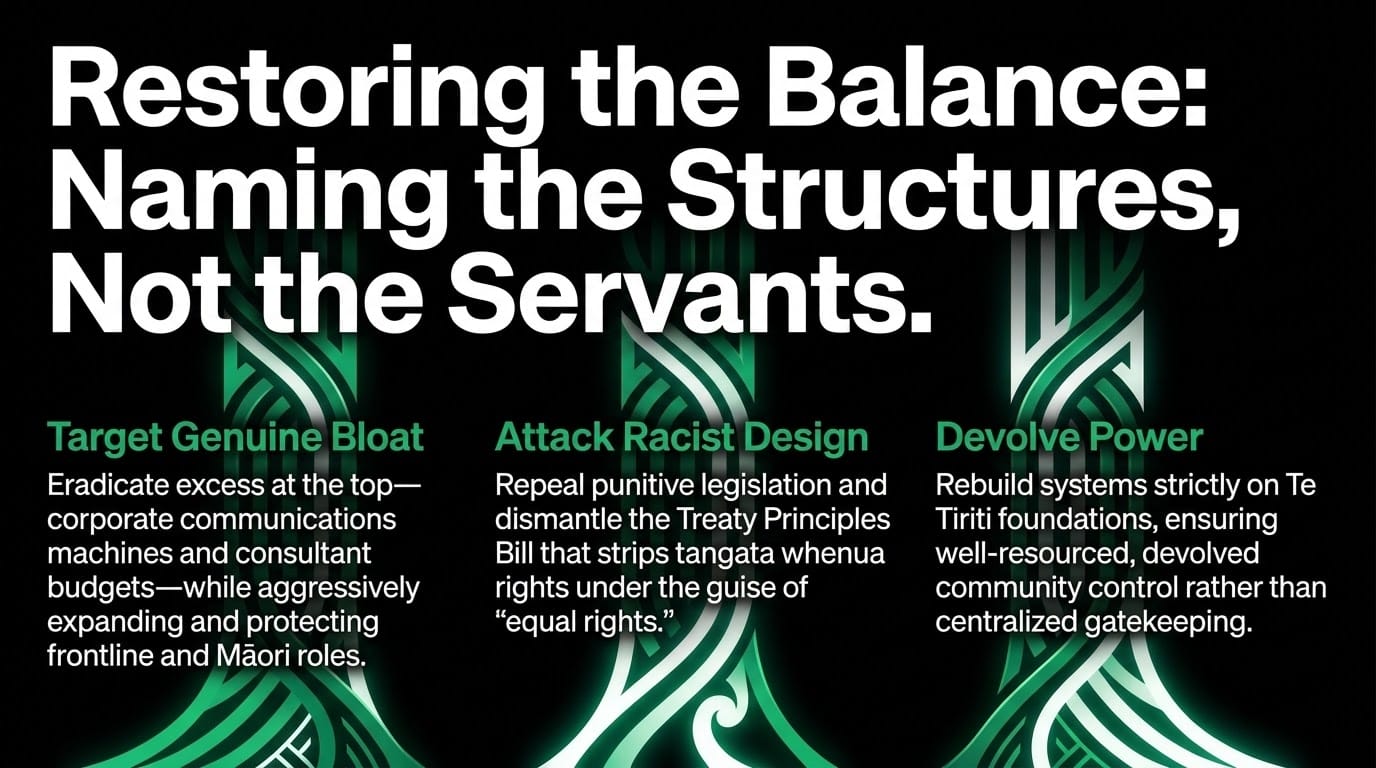
The solution is not to parrot "bloated". It is to demand targeted cuts to genuine bloat — the management layers, consultant empires and corporate communications machines — while protecting and expanding frontline and Māori roles.
In my essay, The Traffic Light Taiaha: How A White Supremacist Government Built A Punishment Machine, I walk through how this government built a traffic-light punishment system for Jobseeker recipients while dressing it up as "efficiency", and how their numbers unravel under basic scrutiny.
Tikanga Impact
From a tikanga lens, smearing the whole system as "bloated" without distinctions is mauri-depleting. It drains the life force of Māori and working-class staff who are doing hard, underpaid mahi inside those institutions, and it distracts from the real target: Crown structures that breach Te Tiriti and dispossess our people.
Michael Belgrave's Treaty history, summarised in E-Tangata's Built On The Back Of Betrayal, reminds us that the state was literally built on confiscation and dispossession, not on a culture of public-service greed. A Difficult Time To Be A Māori Public Servant describes how Māori staff now feel targeted and scared simply because they're Māori inside those systems.
Tikanga asks us to name the structures that betray mana, not to casually attack the people trying to hold some mana within them.
Example Two – Overpaid Spoken Over The Top Of Underpaid Māori Public Servants
The Harm
Allan contrasts public servants with private-sector workers "putting food on the table", implying public-sector workers are cushioned, overpaid, and lacking real incentive to work hard. RNZ's coverage of her comments captures that framing in Ex-Politician Kiri Allan Says Public Service Bloated, Slow And Overpaid.
But E-Tangata's Unstitching Equity In The Name Of So-Called Equality sets out how public servants in the justice system — prison staff and police in particular — face "poorly paid public-service treatment", with derisory pay that leaves them vulnerable to corruption.
Research on universities, summarised in New Zealand Universities Are Lucky To Have Us, shows Māori and Pacific women academics earn on average 15 percent less and are 65 percent less likely to be promoted than their male Pākehā counterparts, despite working in publicly funded institutions and carrying disproportionate cultural and pastoral load.
Public Service Commission figures in Māori In The Public Service show Māori public servants making up 16.6% of the Public Service workforce compared to 15.3% of the overall working-age population. Māori are over-represented in the public service and under-rewarded in pay and promotion relative to Pākehā.
Calling this workforce "overpaid" is not a brave truth. It is a lazy smear that erases pay gaps, ignores precarity, and collapses a diverse labour force into a caricature of cushy bureaucrats.
The Solution
The solution is to name where pay is genuinely excessive — at the top of agencies and in consultancy budgets — while fighting to lift pay, conditions and security for frontline and Māori staff.
My essay Destroying Every Reason This Government Gave For Urgency lays out how urgency is used to ram through punitive law and cuts without honest debate, and why we need more resourced scrutiny, not fewer public servants.
Tikanga Impact
Tikanga demands we uphold mana. Labelling Māori public servants as "overpaid" while they are under attack from racist policy and under-rewarded in pay is a direct assault on their mana.
The Crown Isn't Just Pākehā. It Is Also Māori explains that Māori are part of the Crown and its machinery, not just subjects of it. A Difficult Time To Be A Māori Public Servant shows how those Māori Crown servants are now asked to implement policies that minimise things of importance to Māori.
Tikanga does not allow us to casually degrade those workers as "overpaid", especially when their mahi is the only thing preventing Crown violence from being even worse.
Example Three – Slow And Gatekeeping While Racist Policy Does The Real Damage
The Harm
Allan describes "ridiculous" delays in getting Jobs for Nature funding to communities and a four-year process to resolve cultural rights over whale bones. Those experiences of centralised gatekeeping are real, as captured in RNZ's Ex-Politician Kiri Allan Says Public Service Bloated, Slow And Overpaid.
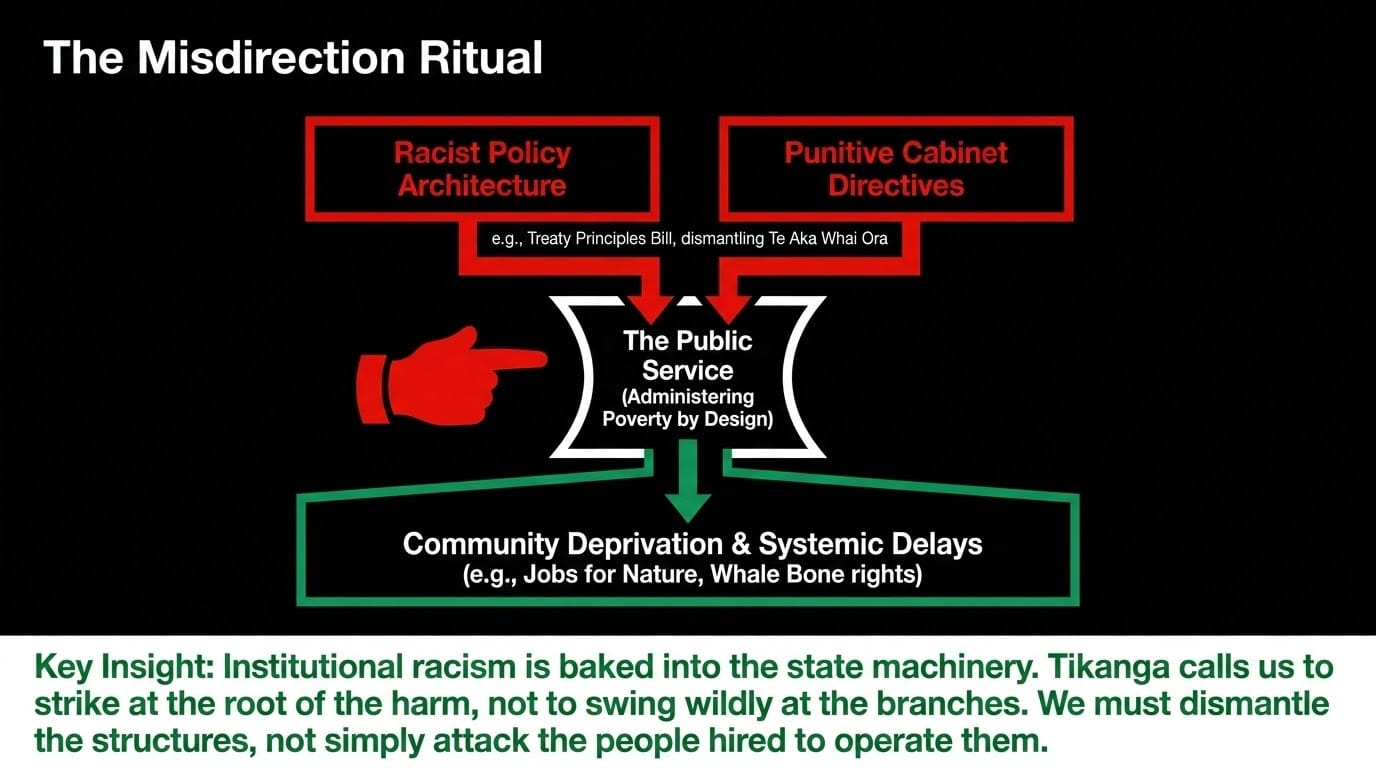
But when she pins "slow and gatekeeping" on "the public service" in general, she hides the role of ministers, Cabinet directions and racist policy settings that design the system to be punitive and controlling in the first place.
A Difficult Time To Be A Māori Public Servant explains that many Māori staff are now forced to implement policies that actively target and minimise Māori priorities, while trying to uphold the mana of their positions. Administering Poverty and Māori Media Revamp: Where's The Focus On Quality Journalism? show how systems are set up to punish beneficiaries and marginalise Māori stories by design.
It is not just "slow staff" causing harm. It is racist and punitive architecture.
The Solution
The solution is to attack centralised, racist design: repeal punitive legislation, dismantle Treaty-principles bills that strip rights, and rebuild systems on Te Tiriti foundations with devolved, well-resourced community control.
In my essay How Winston Peters Turned Go Back To Your Own Country Into A Government Policy, I trace how dog-whistle racism from Winston Peters was converted into actual policy and law through this coalition, including the Treaty Principles Bill and the dismantling of Te Aka Whai Ora, as condemned in The Māori Health Authority Must Stay.
Tikanga Impact
From tikanga, blaming "the public service" for slowness when the slowdown is designed by racist legislation is a misdirection ritual: it misplaces blame, misnames the source of mamae, and leaves the true violators of tapu untouched.
E-Tangata's The Racism That Too Few Of The Privileged Can See and Is Our Government Racist? explain how institutional racism works: the structures and values baked into state machinery are what need dismantling, not simply the people hired to operate them.
Tikanga calls us to strike at the root of the harm, not to swing wildly at the branches.
Naming The White Supremacist Neoliberal Government And Allan's Role
As I introduced in the essay How Winston Peters Turned Go Back To Your Own Country Into A Government Policy
— I'm not going to pretend this is neutral analysis.
This is a white-supremacist, neoliberal government, described by independent monitors as the most overtly racist and white supremacist in decades, actively stripping Māori of rights, dismantling Te Aka Whai Ora, and driving Treaty Principles legislation that seeks to erase tangata whenua rights under the banner of "equal rights for all", as documented in The Māori Health Authority Must Stay and Hīkoi Mō Te Tiriti: Walking Into The Future.
When Allan calls the public service "bloated, slow and overpaid", she is not tearing down that racist architecture. She is punching down at the workforce — including Māori — that she used to command, at the very moment those workers are being sacked, silenced and ordered to administer racist law.
I will not let that pass as "brave honesty". It is collateral damage to our whānau, and ammunition for the Crown and corporate structures that have always benefited from blaming the servants instead of the masters.
Ngā mihi,

Ivor Jones The Māori Green Lantern Fighting Misinformation And Disinformation From The Far Right
Disclaimer (Defamation Act 1992): This essay is political commentary and opinion based on cited public records, official data and published analysis. It critiques public statements, policies and systemic impacts, not private lives. Any person or organisation named is discussed in their public capacity. The content is offered in good faith, without malice, in the public interest, and is subject to correction if new verified information emerges.