"THE BACH FEASTERS" - 9 June 2026
They tell whānau the cupboard is bare while they eat from silver trays, bankroll their own comfort with public money, and call the feast "service". Red or blue — same trough, same hands, same contempt.

Mōrena Whānau,
I am Ivor Jones, The Māori Green Lantern. I do not write to soothe the powerful. I write to drag light through the cracks, lift the carpet corners, and show whānau exactly where the feeding happens.
Some scandals arrive with sirens. Others arrive with a polite press statement, a technical explanation, and a legal form tucked neatly under the arm.
Those are often the worst ones — because they reveal not just what the powerful do, but how comfortable they are doing it.
This week, the crack opened in Raumati.
 Thomas Coughlan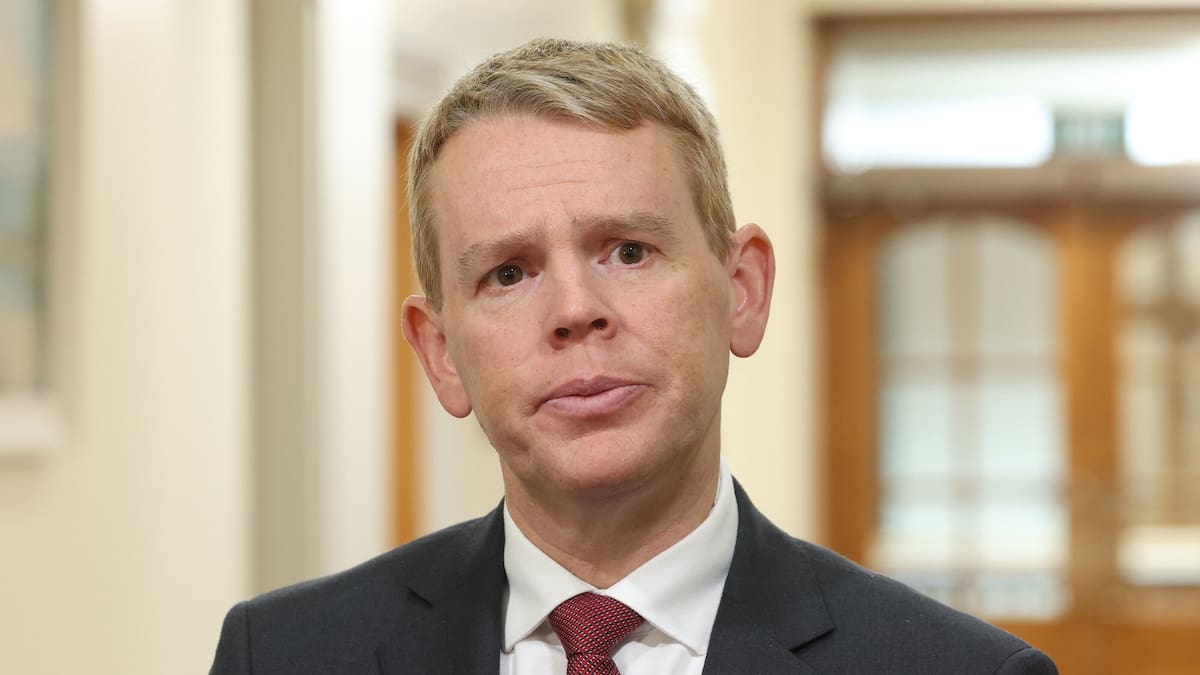
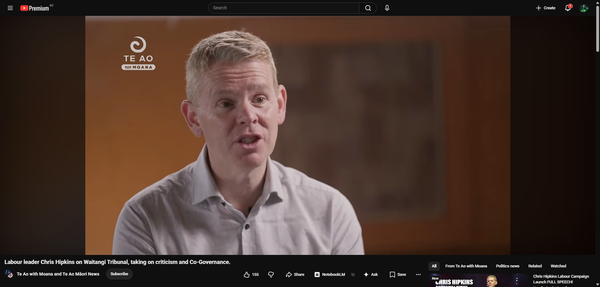
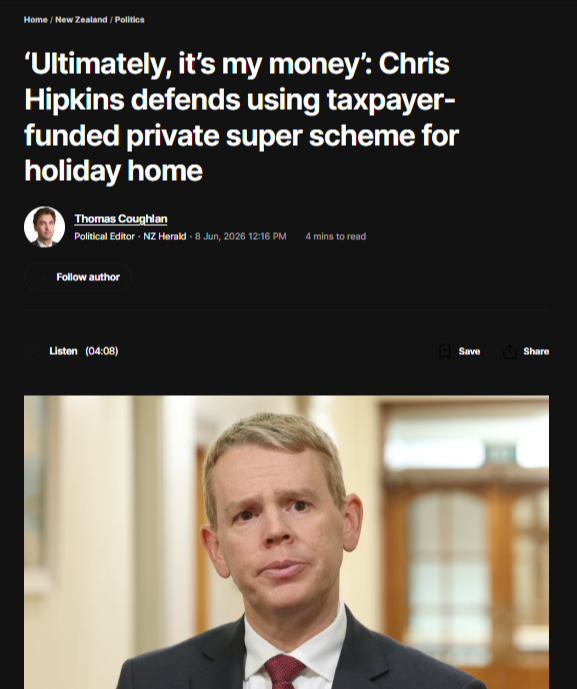
As reported by Thomas Coughlan in the New Zealand Herald, Labour leader Chris Hipkins confirmed he uses a taxpayer-funded private superannuation scheme linked to his family holiday home, and when pressed on whether this arrangement sits comfortably with his own public statements about housing, he said:
"Ultimately, it's my money, it's my retirement savings so I am investing for retirement savings."
That sentence is not just a quote. It is a doctrine. It is the creed of a political class that takes public money, passes it through a legal device blessed by Parliament, fattens a private asset, and then demands the public treat the result as personal virtue.
It is the old colonial trick dressed in modern bureaucratic linen: take from the commons, privatise the benefit, moralise the outcome.
And then, when challenged more directly
— when asked whether channelling publicly boosted retirement savings into a holiday home might contradict his own warnings about capital being locked in housing
— Hipkins did not pause or reflect.
He said: "I think that is a different conversation. I mean what are you saying, that people shouldn't be able to buy houses? I mean, I think that would be a very radical move." NZ Herald
Read that again.
He reframed scrutiny of a taxpayer-subsidised superannuation loophole as an attack on the right to buy houses. That is not a defence. That is the rhetorical judo of a politician who knows the argument is weak and hopes aggression will substitute for logic.
Nobody was suggesting people should not be able to buy houses, Chris. We were asking why taxpayers should fund your family bach via a private super trust while whānau sleep in motels.
The Remuneration Authority confirms that MPs elected after 1992 are entitled to a superannuation subsidy and that the scheme can be KiwiSaver or another registered retirement, savings, or superannuation scheme. The Authority also sets accommodation services in Wellington, travel services for family members, and a basic allowance for MPs.
This is the architecture of privilege — not rumour, not spin, but formal determination.
The Deep Dive Podcast
Listen to a lively conversation between two hosts unpacking the evidence, hypocrisy, and wider political pattern behind this essay. I apologise in advance for the AI's harsh pronunciation of reo. Please don't shoot the messenger.
Youtube Video
Prefer video? Here is a short video supporting the essay. And again, please don't shoot the messenger on the AI pronunciation.
The Bach, The scheme, And The Numbers
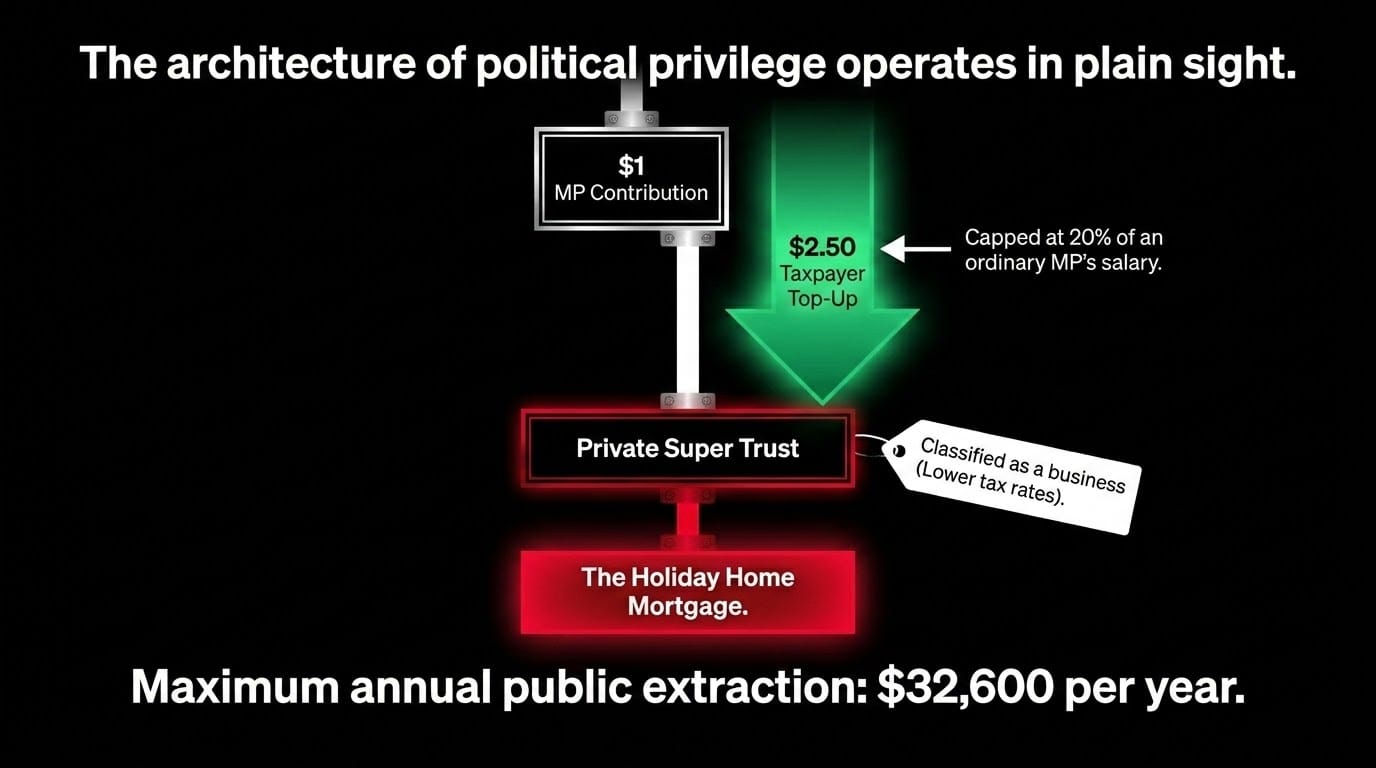
The Herald reports that for every dollar MPs contribute to their scheme, the taxpayer contributes $2.50, capped at 20 percent of an ordinary MP's salary, which the article says works out at $32,600 as of 1 July. Hipkins confirmed he pays the maximum contribution rate. He confirmed that contributions to the superannuation scheme can be used to pay the mortgage on his holiday home. NZ Herald
That means public money — your money, whānau — is flowing at a rate of $2.50 per personal dollar into a scheme named after the street where Hipkins' holiday home sits, and that scheme holds and services the mortgage on that property. The article further notes that in the past these private schemes were a source of tax-free capital gains, and that they pay lower rates because they are classified as businesses. NZ Herald
So the benefit is not merely the direct public top-up.
The benefit is the whole structure: public subsidy, tax treatment, and property ownership rolled into a scheme that ordinary workers cannot access, cannot replicate, and cannot even vote to change without going through a Parliament whose members are the primary beneficiaries.
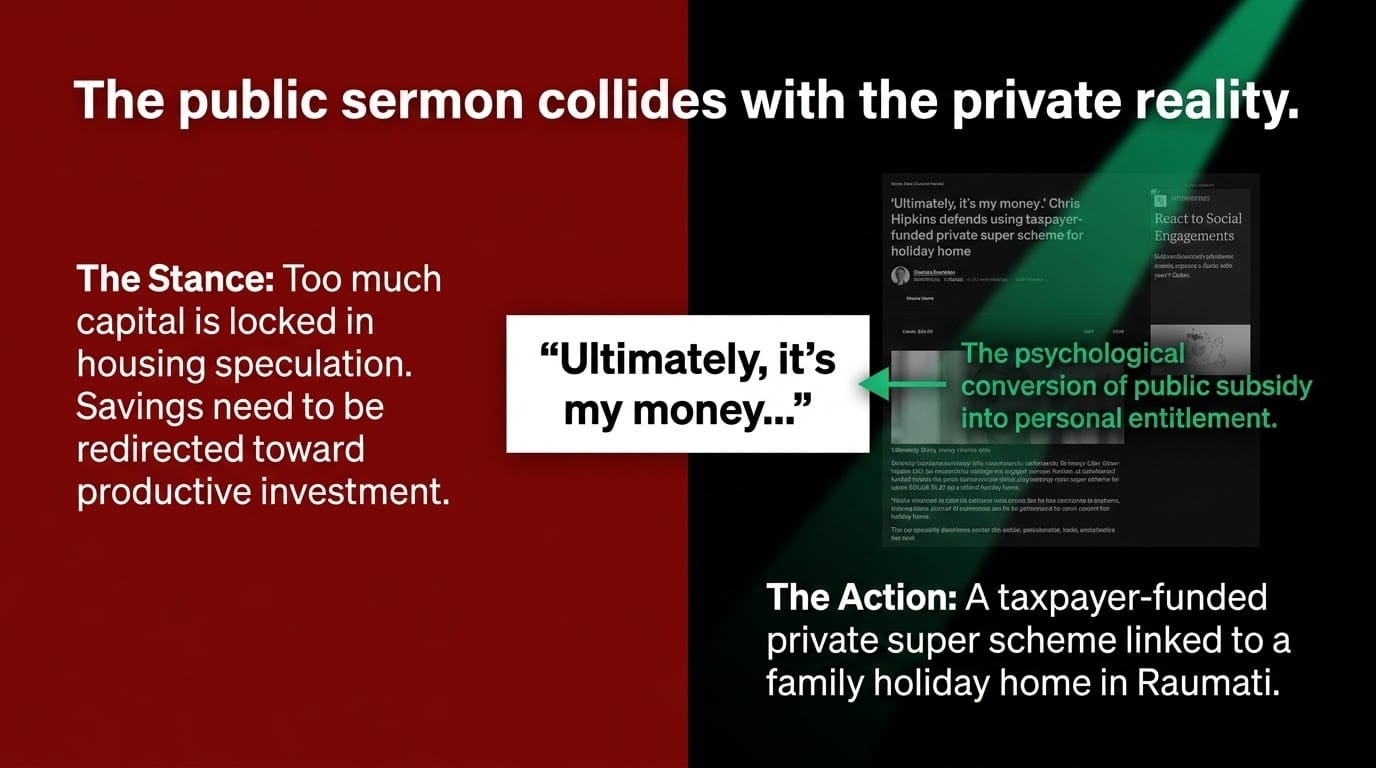
The sermon versus the bach comes into full view when the Herald article quotes Hipkins' own earlier position. He had argued publicly that too much capital was locked in housing speculation and that savings needed to be redirected toward more productive investment. Then we find that his own private retirement vehicle owns his family's coastal property.
He did not flinch.
He said the holiday home was different because the family had owned it for about 40 years and that he felt fortunate to be in this position. NZ Herald
A house does not become morally clean because it was purchased forty years ago. Publicly boosted equity is still publicly boosted equity.
Sentimentality about how long a family has held property is not a substitute for ethical accountability about how that property continues to be subsidised.
And when the Herald pushed further — when asked whether the MP super contribution rate was fair and whether ordinary workers should receive contributions at a comparable level — Hipkins would not commit.
He said: "In an ideal world, employer contribution rates would be higher. I am not making that case but I think it's ironic for us to take higher retirement savings rates. The salaries that Members of Parliament get are high by the standards of everyday New Zealanders." NZ Herald
He knows it is indefensible. He just refuses to act on that knowledge. He will not commit to reform. He will not surrender the perk. He will stand at the lectern of social concern and then go back to the scheme that bears the name of the street his bach is on.
Brownlee And The Culture Of Insulation
Now turn the lamp toward Gerry Brownlee, because Hipkins did not invent this culture. He inherited it, joined it, and now defends it. Brownlee has been tending this particular garden for much longer.
As reported by 1News, Speaker Gerry Brownlee considered sanctions against Stuff Digital over reporting tied to ministerial accommodation claims. The 1News report says he acknowledged no formal complaint had been made before he intervened — that he saw the photograph himself, thought it "was not too tidy", and decided to follow up.
That is not an administrator upholding process. That is a palace guard protecting the dining hall. The instinct is not transparency. The instinct is: when scrutiny comes near the comfort structures of Parliament, close the gate. Manage access. Frame the reporter as the problem.
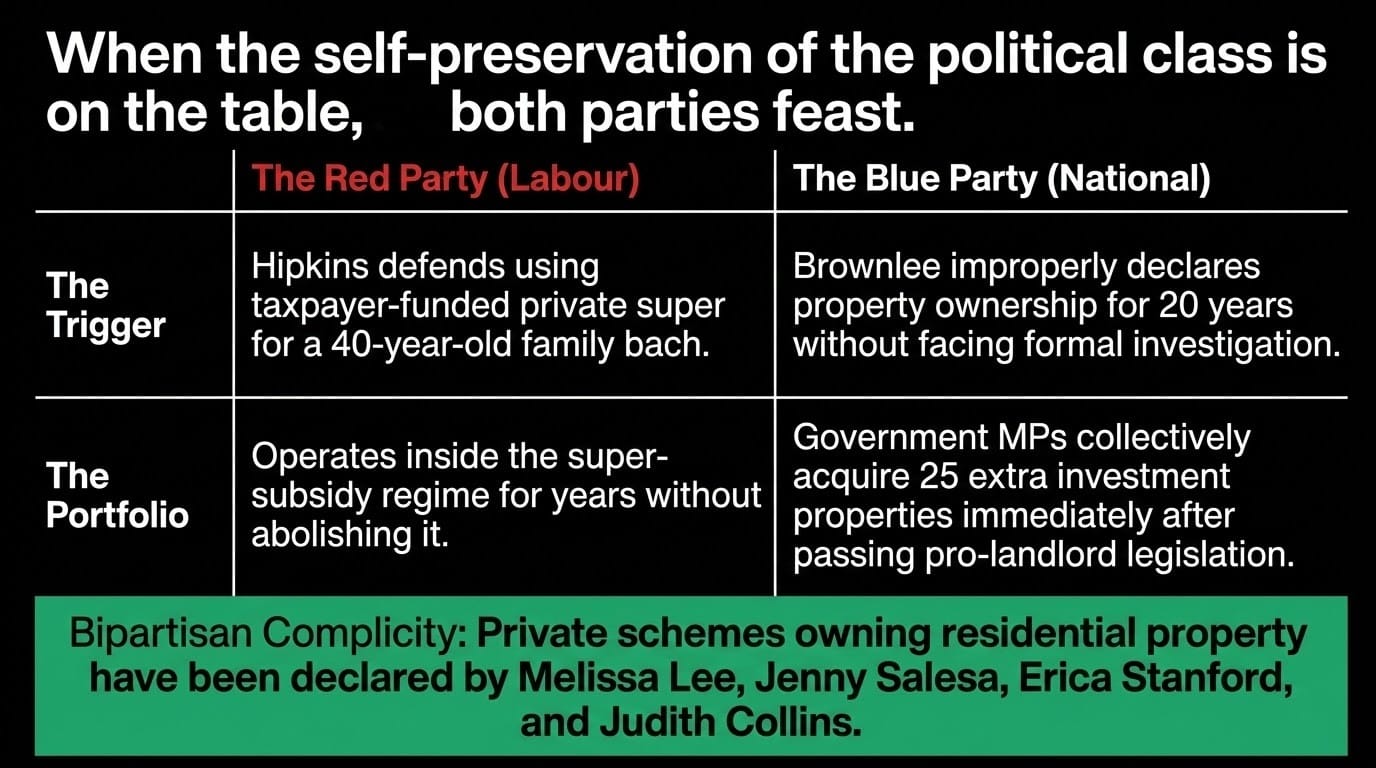
As reported by The Spinoff, Brownlee owns six properties, three of them rentals, with interests in two more through his grandfather's trust. The same article reported that the NZ Herald's Chris Knox had earlier revealed Brownlee had been incorrectly and incompletely declaring his property ownership to Parliament for 20 years.
Twenty years of incorrect property declarations.
Not a resignation. Not even a formal investigation. Just a correction, eventually, after a journalist found it.
That is the institutional protection of the parliamentary class in plain view. If you or I misreported our financial interests to an authority for two decades, we would not be called the Speaker of the House.
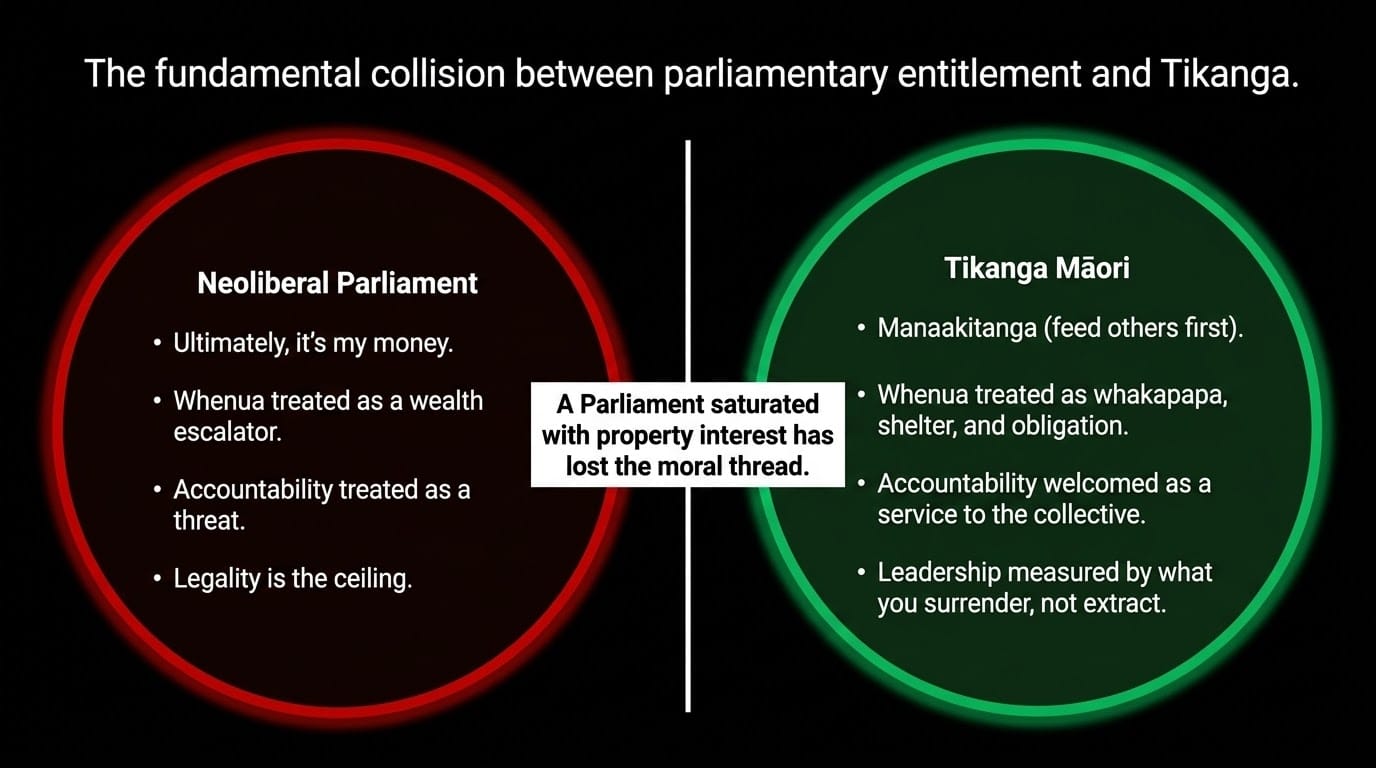
Brownlee's conduct is not identical to Hipkins'. I am not claiming it is. What I am claiming is that both men operate inside the same broad machinery of political insulation — where property is abundant, entitlement is normalised, and accountability is treated as a threat to manage rather than a service to welcome.
As reported by The Spinoff, government MPs collectively acquired 25 extra investment properties after passing pro-landlord legislation. That is not background noise. That is the sound of a political class voting itself richer while the people it governs are locked out of ownership entirely.
Labour Is Not The Antidote
This is where comfortable people want comfort. They want the old script: National bad, Labour better. National greedy, Labour imperfect. National governs for the rich, Labour merely fails the poor.
I am not offering that comfort today.
The Herald reports that similar private schemes owning residential property have been declared across party lines, including by Melissa Lee, Jenny Salesa, Erica Stanford, and Judith Collins. NZ Herald This is not one rogue arrangement. This is a system with bipartisan uptake, bipartisan protection, and bipartisan silence.
The Remuneration Authority confirms MPs receive formal packages of salaries, basic allowances, superannuation rights, accommodation services, and travel services under statute and determination. These are not rumoured perks. They are the official architecture.
Labour and National differ in rhetoric, emphasis, and the communities they flatter on the way through. But when the self-preservation of the political class is on the table, both parties have shown a remarkable talent for finding reasons to keep the arrangement exactly as it is.
That is why Labour being "no different from National" lands so hard here. It is not a claim that every manifesto is identical.
It is a claim that when privilege is available to Parliament, both parties reach for it with comparable enthusiasm.
When whānau ask for housing justice, the vocabulary narrows to "cost pressures", "constraints", and "gradualism". When MPs ask for property-linked super schemes, the vocabulary broadens to "entitlement", "determination", and "scheme design".
Labour attacks National for cuts to public services, Māori health, and pay equity — accurately. National under this government has been associated with sweeping public-sector cuts while approving salary increases for MPs, as reported by the PSA.
But Labour's own hand is visible in this structure too. Labour has operated for years inside the same super-subsidy regime and has never abolished it. Labour has never introduced a binding conflict of interest rule linking housing policy to MP property declarations. And now its own leader is using the most revealing possible opportunity — a moment of public scrutiny — to explain why his bach is different.
It is not different. And they both know it.
The White Tablecloth Over The Trough
The real obscenity of these arrangements is not simply that they exist. It is how they are draped in respectable language.
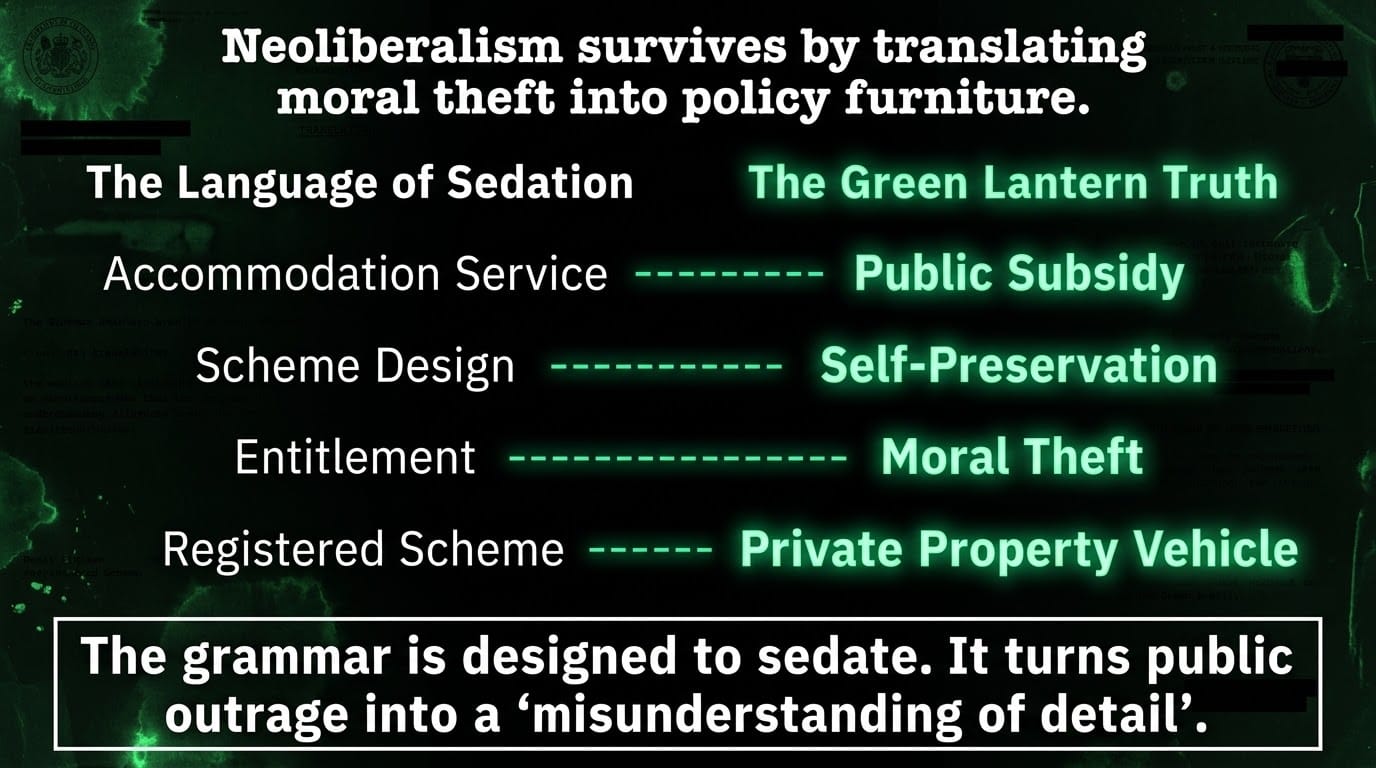
Everything comes upholstered in terms like "allowance", "subsidy", "entitlement", "registered scheme", "accommodation service", "retirement savings". The grammar is designed to sedate. It turns extraction into administration. It turns inequality into process. It turns public outrage into a misunderstanding of detail.
That is how neoliberalism survives — not mainly through open brutality, though it has plenty of that — but through translation. It turns moral theft into policy furniture.
The article further confirms the scheme is named after the street on which the holiday home is situated, suggesting a close association between the trust vehicle and the property. NZ Herald
That detail is not incidental. That is the structure making itself visible. A retirement scheme named after the street where the bach sits. Not a diversified fund. Not a productive enterprise. Not a Māori development finance vehicle.
A trust, named after a road in Raumati, servicing a family property. And the taxpayer puts in $2.50 for every dollar of that.
When Hipkins says "ultimately, it's my money", understand what that declaration actually means: the public subsidy has been psychologically converted into personal property. The laundering has already happened inside his own accounting of self. Any challenge now feels to him not like accountability but like theft from his own wallet.
That is the psychology of entitlement. That is the finish line of neoliberal political culture.
Three Examples For The Western Mind
The Trustee and The Beach House
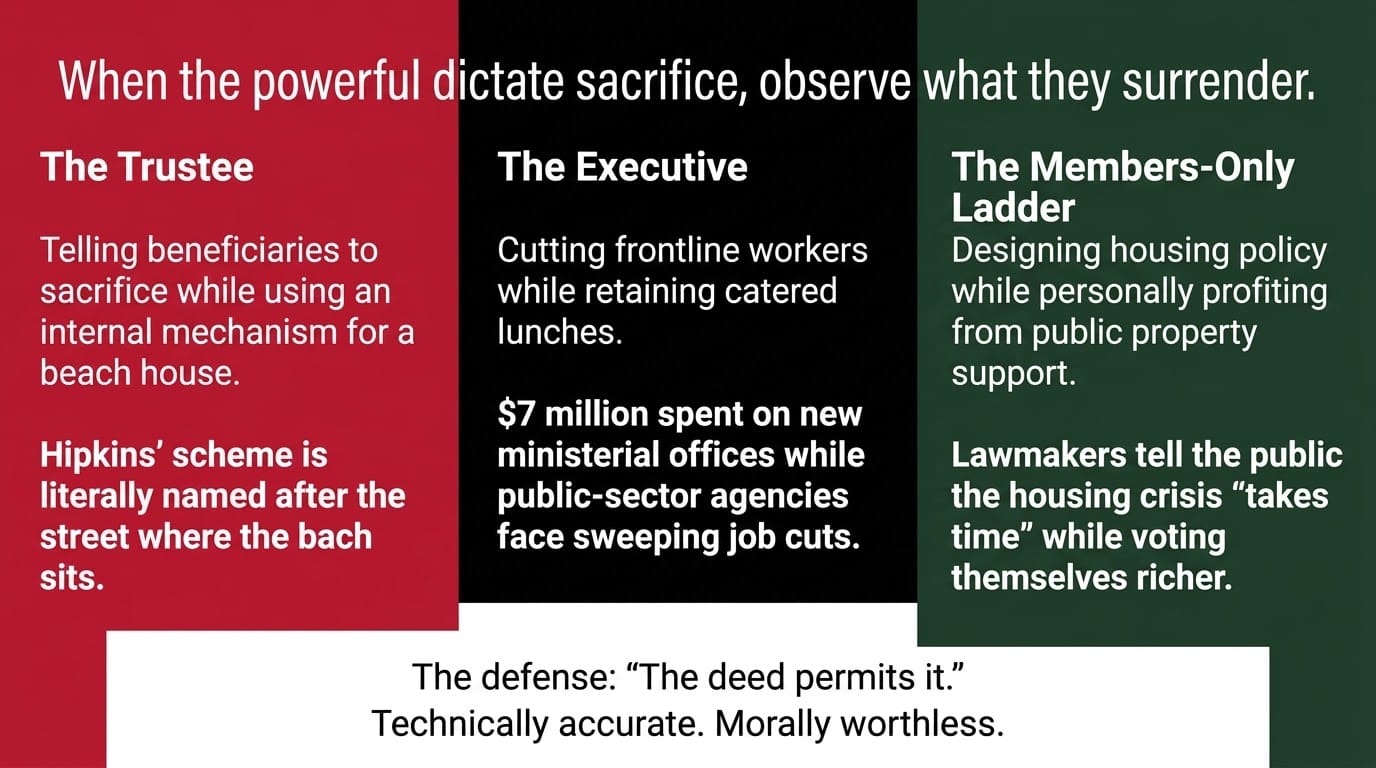
Imagine a trustee telling beneficiaries the trust is under pressure, sacrifices are necessary, and the future requires discipline. Then you discover the trustee has been using an approved internal mechanism to service the mortgage on their own family beach house.
The defence is: the deed permits it.
That is technically accurate and morally worthless.
The MP super contribution can reach $32,600 a year from the taxpayer. Hipkins confirmed the scheme is used to pay the mortgage on the holiday home. NZ Herald
Quantified harm: $32,600 per year in public top-up, flowing into a private property structure, for a politician who publicly argues that too much capital is locked in housing.
Solution: ban taxpayer-subsidised MP super schemes from owning or supporting residential property that MPs or their families use or enjoy. Full stop.
Tikanga impact: in tikanga, leadership is not measured by what you can extract without breaching a written rule. It is measured by what you are prepared to surrender so others can live with dignity. That is the test Hipkins has just failed.
The Executive Floor During The Layoffs
Imagine a company cutting frontline workers, freezing wages, and asking everyone to understand the difficult balance of modern management — while the executive floor retains catered lunches, private transport, housing support, and a pension structure ordinary workers will never approach.
The Remuneration Authority confirms the formal existence of salaries, allowances, accommodation services, family travel, and superannuation rights for MPs. 1News reported that the government planned to spend up to $7 million on new ministerial offices while agencies were being told to cut costs, drawing a "hypocritical" charge from Labour at the time. 1News
Quantified harm: the $7 million office spend sat alongside public-sector job cuts in the same fiscal period, a conjunction that Labour correctly identified as obscene — before Labour itself surfaced in the bach story.
Solution: automatic quarterly publication of all MP super subsidies, accommodation claims, and cross-linked property interests in a searchable public register, open without subscription or OIA request.
Tikanga impact: a kaitiaki does not explain procedure while eating with a full mouth beside people going hungry. They put the food on the table first. That is manaakitanga. That is what Parliament refuses.
The Members-Only Housing Ladder
Imagine lawmakers designing housing policy while many personally benefit from property-linked public support, rising valuations, and rent income — then telling the public the housing crisis is complicated and will take time.
As reported by The Spinoff, MPs can receive up to $36,240 per year in superannuation contributions and in some cases combine this with accommodation support.
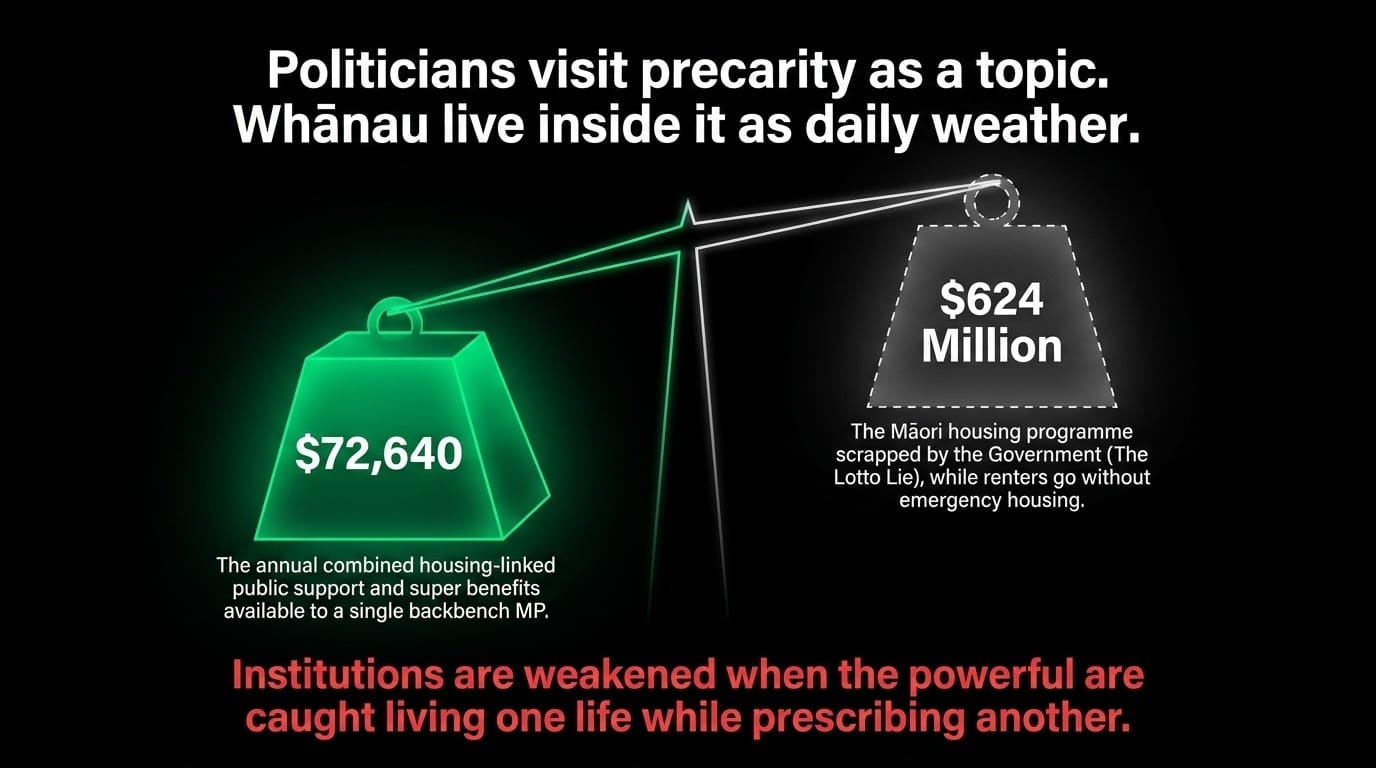
The same article says a backbench MP can receive as much as $72,640 per year on top of salary toward the cost of buying and living in their own Wellington home. Ministers can receive more.
Quantified harm: $72,640 per year in combined housing-linked public support for a backbench MP, while renters go without emergency housing and Māori housing programmes are stripped from the budget. The Māori Green Lantern has documented that in The Lotto Lie, the Government scrapped a $624 million Māori housing programme in the same period.
Solution: ban MPs from receiving public accommodation support or property-linked super benefits where they hold a direct or trust-based financial interest in the property concerned.
Tikanga impact: whenua is not a wealth escalator. It is whakapapa. It is shelter, continuity, and obligation. A Parliament that treats housing as a members-only benefit before treating it as a human right has already lost the moral thread.
What This Does To Trust
The defenders of this system will say that exposing these arrangements undermines faith in institutions and feeds anti-politics. They will say we must be responsible. They will say scrutiny of this kind is corrosive.
No. Institutions are not weakened by scrutiny. They are weakened by entitlement unchallenged. They are weakened when the powerful are caught living one life while prescribing another and respond with legal form rather than moral reflection. They are weakened when the public is asked to be endlessly patient while politicians are endlessly indulged.
Trust is not maintained by silence. Trust is maintained by proportion, transparency, and demonstrated sacrifice. If MPs lived even approximately like the people whose lives they regulate, the fury these stories provoke would not exist. The fury exists because the gap is real, wide, and apparently bottomless.
That gap is not merely economic. It is experiential. Politicians visit precarity as a topic. Whānau live inside it as daily weather.
The Māori Green Lantern record
None of this emerged from nothing. I have been tracing this culture across dozens of essays, because the pattern is consistent and the stakes are real.
Related essays already published on The Māori Green Lantern include The Comfortable Thief on ministerial accommodation obscenity, The Landlord Parliament on how MPs' property interests and pro-landlord law move together, He Waka Kotahi, He Hinaki Hou on Labour's neoliberal continuity beneath its progressive branding, and Ko te Taniwha Kei Roto i te Whare on the housing crisis as a structural betrayal of Māori.
This essay is one more window into the same building.
Yes, I call this what it is. A white supremacist neoliberal order that has spent decades training New Zealand to treat assets owned by the already comfortable as signs of personal merit while communities asking for enough to live are treated as a fiscal burden. The result is a Parliament fluent in property, governing a population drowning in housing stress, with a straight face.
What should happen
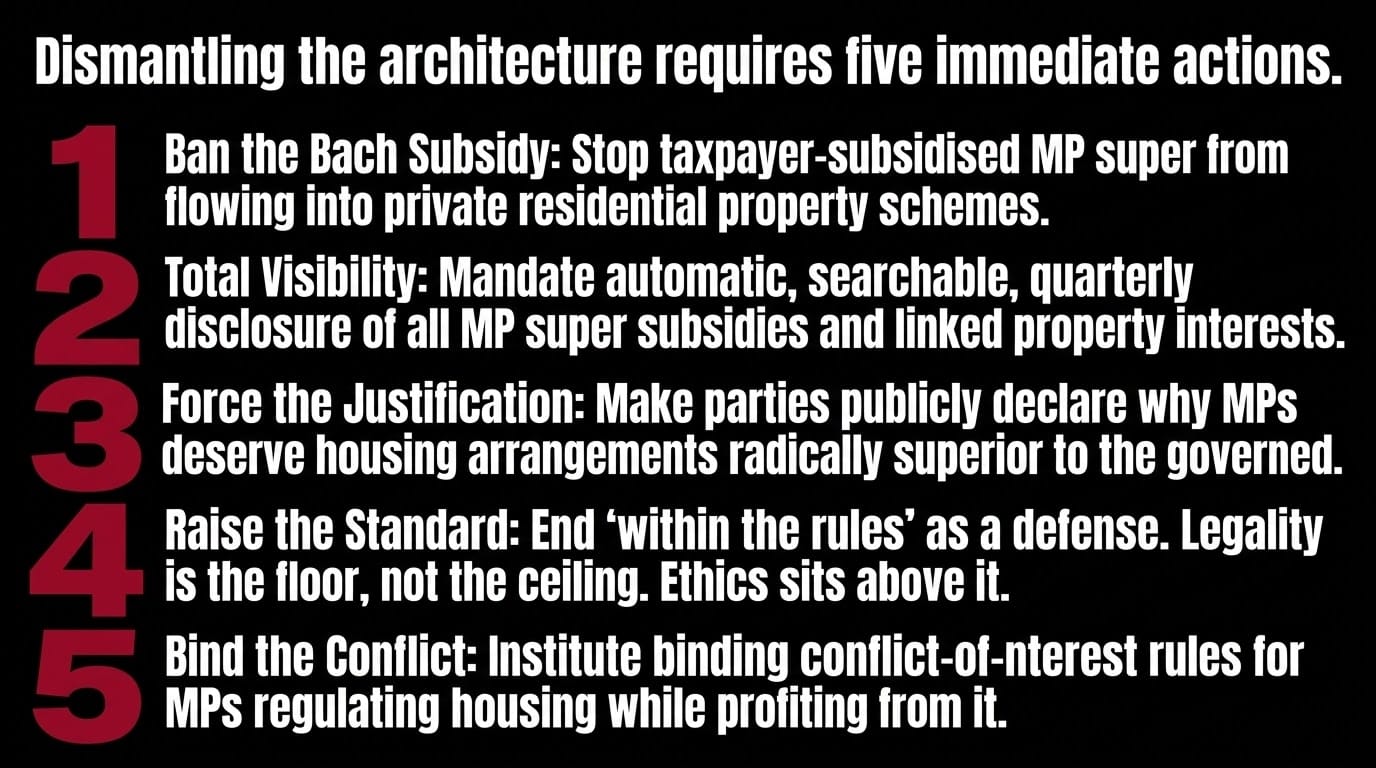
One: ban MPs from directing taxpayer-subsidised super into private residential property schemes they or their families benefit from.
Two: require automatic, searchable, integrated quarterly disclosure of all MP super subsidies, accommodation claims, and related property interests.
Three: force every party to publicly declare whether MPs deserve housing and retirement arrangements radically superior to those of the people they govern.
Four: end "within the rules" as an acceptable moral defence. Legality is the floor, not the ceiling. Ethics is what sits above it.
Five: strip housing policy debate of its hypocrisy. A Parliament saturated with property interest cannot be trusted to regulate housing fairly without binding conflict-of-interest rules that go far beyond what currently exists.
Koha Consideration
Every koha to this mahi is a direct challenge to the bach-feasters of Parliament.
It says: Whānau see you. We know how the trough works. And we will support our own truth-telling because you never will.
When Hipkins says "it's my money", every koha says: it's our accountability — and we are support this mahi ourselves, because neither the red party nor the blue one will.
If you are able, please consider a koha to keep this mahi going.
If you cannot koha, no worries at all — subscribe, follow, kōrero and share with your whānau and friends. That is koha in itself.
Koha directly: Support The Māori Green Lantern on Koha
Subscribe: The Māori Green Lantern support page
Bank transfer: HTDM, 03-1546-0415173-000
Facebook: The Māori Green Lantern on Facebook
Kia kaha, whānau. Stay vigilant. Stay connected.

Public interest statement: this essay concerns elected officials, parliamentary entitlements, housing-linked privilege, and the use of public money by public officeholders. It is written squarely in the public interest.
Disclaimer: This essay combines verified factual reporting drawn from the live sources linked throughout with clearly signalled opinion, criticism, and political analysis. Confidence labels are used throughout. Where parallels are drawn between political actors, those comparisons are analytical unless the specific conduct discussed is directly reported in the cited source. Opinions are flagged as such and grounded in the factual record cited immediately alongside them.