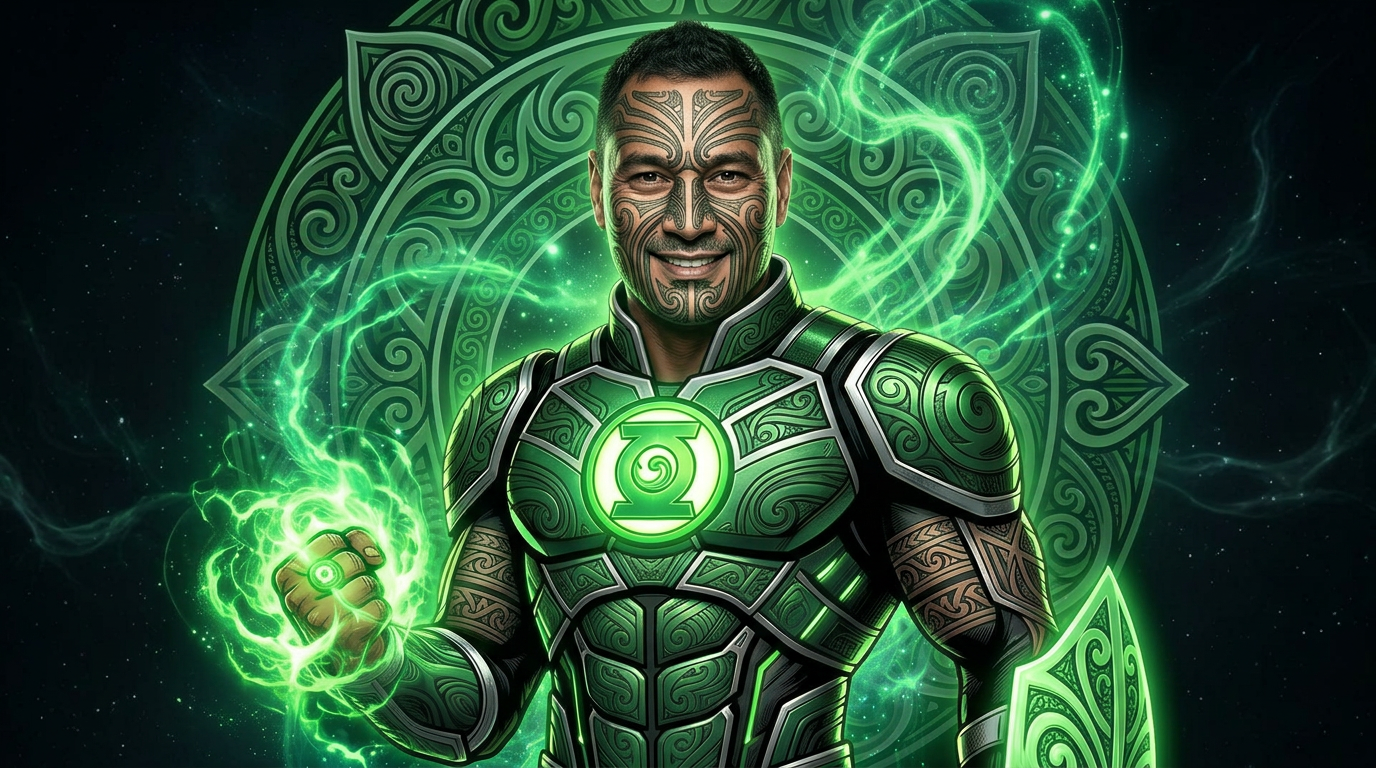
"The Ring Doesn't Lie: Why "Rise By Yourselves" Is the Same Trap in a Kākahu" - 7 September 2026
A taiaha to the Kīngitanga's kupu, a mirror to the Crown's ledger



Ka Tū, Ka Wero — The Ring Lights Up
E te iwi, kua tae mai anō a Ivor.
The Māori Green Lantern's ring doesn't run on hope, or on nostalgia, or on a beautiful kauhau delivered in the golden light of Tūrangawaewae
— it runs on willpower backed by verified fact.
 RNZ | Te Reo Irirangi o Aotearoa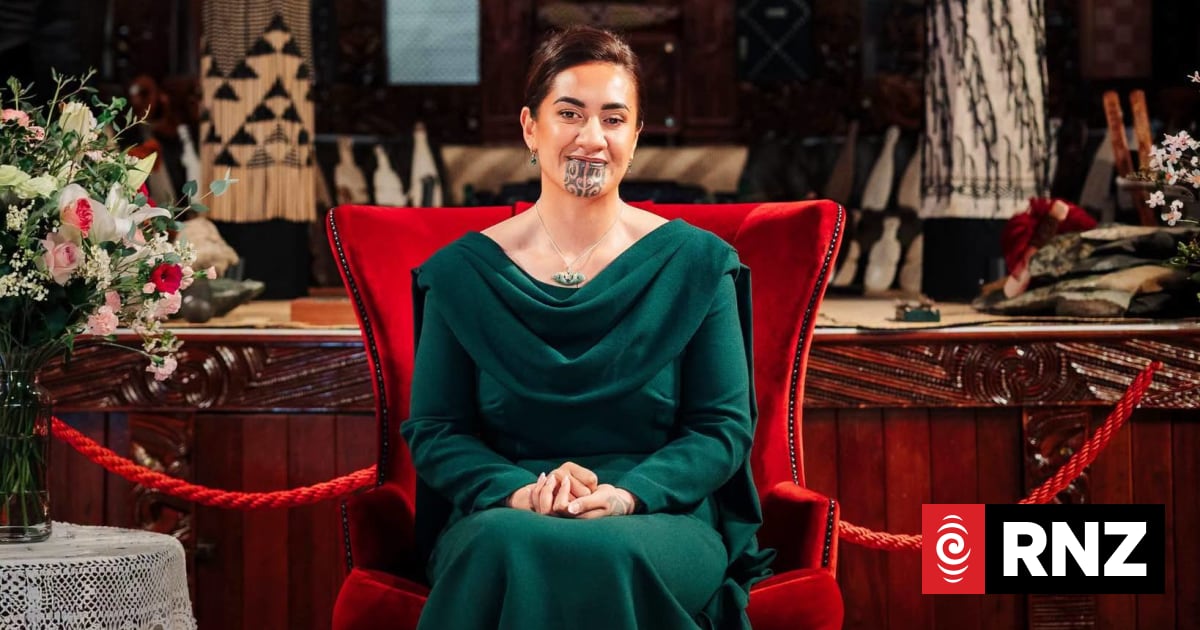
And when I pointed the ring at Te Arikinui's second Koroneihana address, it didn't glow green for triumph. It glowed amber — the colour of a warning half-true, half-weaponised.
Here is the wero, plain, before the taiaha even leaves my hands: on 5 September 2026, our young Kuīni stood at Tūrangawaewae Marae and told her people to rise
"from poverty, from dependency, from the belief that somebody else must determine our future."
Beautiful words. Kīngi Tāwhiao's whakataukī behind her, thousands in front of her.
But behind me, in the ledger nobody reads at Koroneihana, sits a $2.1 billion corporate machine that distributed less than 1% of its portfolio value to whānau last year, and in front of that ledger sits a coalition government that has ripped over $1 billion out of Māori-specific funding in the same eighteen months.
Cui bono. Cui malo. Who wins when the message from the top of the mountain is "climb it yourself"?
Kei te wero ahau — I'm not attacking the wahine toa who wears the korowai. I'm putting the ring's light on the whakapapa of the words she's been handed to say.
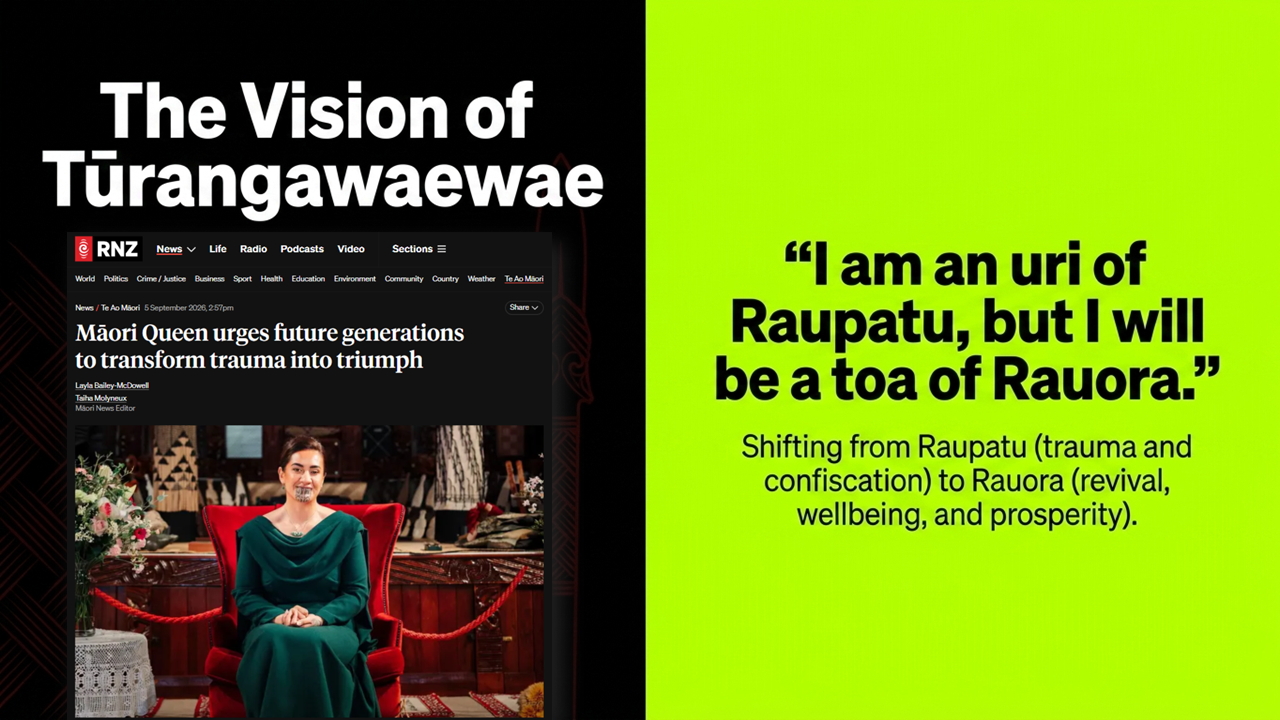
The Kauhau in Full: Reading Every Line Before I Swing
A tohunga doesn't strike before he's read the whole taonga. So here is the full kōrero, line by line, drawn straight from the complete RNZ report and cross-checked against the primary message. No cherry-picking. If you're going to accuse a queen, you read the whole speech first, koro.
She opens with Tāwhiao's own words -
"E kore teenei whakaoranga e huri ki tua o aaku mokopuna, ka puta, ka ora" —
and says
"the mauri of kotahitanga, carried and protected by her father, Kiingi Tuuheitia... now rests with everyone."
Watch that move, whānau — in one breath she hands the ring off.
The mauri, the responsibility, the mana to fix things, goes from the throne to every single whānau at once. That's the first amber flicker.
Raupatu, she says, is
"the impact of colonisation and intergenerational trauma."
Rauora is "wellbeing, health and prosperity."
Wound, then cure. But there's no third panel in this comic — no frame for
"and here is who pays for the healing."
The Crown that swung the confiscation axe simply isn't in this part of the frame.
When she paints what Rauora looks like —
"our tamariki growing up strong in their reo, their whakapapa,"
"our whānau healthy and secure,"
"our people owning homes, building wealth, creating businesses and institutions, growing leaders and determining our own future,"
"our whenua and wai flourishing,"
and Māori
"leading in technology, innovation, enterprise, science, energy"
— count them with me. Five of eight are money-and-enterprise words. Homes. Wealth. Businesses. Institutions. Enterprise. Three are cultural. I'm not saying that's wrong to want.
I'm saying it's a very specific dialect, and I've heard it before — in TGH's own annual brochure, word for word,
"Whakatupu Rawa, Whakatupu Taangata."
And now the line that stops me mid-swing, because it's honest, and I have to give her that:
"Is it enough for some Māori to prosper while too many whānau continue to struggle with the basics? Surely our tūpuna wanted more for us than survival."
E hika. She said it herself. She named the exact gap I'm about to prove with TGH's own numbers below. Full credit where it's due — the Green Lantern doesn't pretend a good line isn't good.
But then the pivot:
"The question for us is no longer only what happened to us; it is also: What will we do now?"
and the line every headline grabbed:
"I will not allow the circumstances into which I was born to determine the limits of my life. I will learn. I will work. I will lead. I will build."
Four "I will"s. Four.
That's not an accident of oratory — that's the emotional peak of the whole address, and it's built entirely from first-person individual effort.
Scholars overseas have a name for exactly this move when it's aimed at Indigenous peoples: manufactured resilient indigeneity — a discourse that
"insists the only recourse Indigenous peoples have is themselves,"
corroborated further in the literature on
"We the resilient": colonizing indigeneity.
Same ring, different wielder — this time it's pointed inward.
Then:
"E koro, Raupatu, rest here... let the burden fall from our shoulders."
Beautiful. Also — and I say this as a tohunga mau rākau, not a cynic — that's therapy language wrapped around what is still, legally, an unfinished claim.
The research on resilience-as-governance calls this exact move
"relocating the site of resolution" from the institution to the individual's insides.
Raupatu doesn't get to "rest" while the land is still 5% of what it was.

The line I keep coming back to, the one that gives this essay its name:
"Rise. Rise from poverty, from dependency, from the belief that somebody else must determine our future... the time has come to stop believing that our future sits entirely in the hands of government."
Kāore. I've heard this before. I'll show you exactly where, further down, and it isn't a flattering family to be quoting from.
Fair's fair though — straight after that, she says:
"Government has responsibilities. Those responsibilities must be honoured. But we also have responsibilities to ourselves."
That sentence exists. I will not pretend it doesn't, because a taiaha that only strikes with one blade isn't a taiaha, it's a club. She did not let the Crown off entirely.
Write that down before anyone quotes half this essay.
And she ends not on money, but on marae:
"We must build our own whare. Our reo, our taiao, our hauora and our pā harakeke are foundations for that future. Our Kotahitanga gives us the strength to build it together."
That's not TGH's dialect. That's tikanga. That's mana motuhake. The kauhau doesn't resolve cleanly into either camp — and I'm not going to force it to for the sake of a cleaner headline.
My read, ring at full charge: this speech is two taiaha strapped together. One blade is genuine, collective, tikanga-grounded aspiration. The other is individualised bootstrap language that — measured by repetition, by placement, by sheer emotional weight — dominates the address. She's not lying. She's not a puppet. But she is, whether she knows it or not, speaking in a dialect first taught to this country by people who wanted Māori to stop asking the Crown for anything at all.
The Deep Dive Podcast
Listen to a lively conversation between two hosts, unpacking and connecting topics in the sources of this essay. I apologise in advance for the AI's very harsh pronounciation of reo. Please dont shoot me, :).
Youtube Video
Like video? Here is a short video suppporting the essay. Again, don't shoot the messenger please because of AI's pronounciation. :)
Koha Consideration

Kia kaha, whānau.
This koha isn't for me — it's for the next essay that names the next machine, so the mokopuna reading this in twenty years inherit more truth than we did.
Consider a koha to keep this voice alive: Koha | Subscribe | Bank: HTDM 03-1546-0415173-000 | Facebook
Whakapapa: How Raupatu Built the Machine She's Standing On

You can't understand Rauora without walking the whakapapa of Raupatu first, and TGH's balance sheet doesn't exist in a vacuum — it exists because of a very specific 1863 crime.
Crown troops invaded Waikato and confiscated over 1.2 million acres, sending Kīngi Tāwhiao into exile. In 1995, Waikato-Tainui became the first iwi in the country to settle, for $170 million, confirmed independently by the Waikato River Authority.
That money didn't go into whānau's pockets. It went into a Post-Settlement Governance Entity, a Crown-designed corporate cage built to hold Treaty redress as capital, not reparation, as confirmed by AUT's own research.
By 2003, Tainui Group Holdings launched with a $166 million endowment. The cage was built before the Queen was even born. She inherited the corporate machine; she didn't design it.
Naming the Theory — and Whose Hands Built the Blade

I'm not the first to swing at "iwi as corporation." That analytical taiaha belongs to Auckland University's Elizabeth Rata, who's argued since the 1990s that Treaty settlements built a
"neotribal capitalist regime of accumulation,"
with a tribal-corporate elite acting as
the "chief executive officers of neotribal capitalism",
consistent across her writing since 2000.
Here's the connection nobody at the marae wants said out loud: Rata didn't build this theory to hand more mana to whānau. She carried it straight to the ACT Party's own annual conference in 2022, invited by David Seymour himself, warning of a
"neotribal capitalist version of the wealth-power merger"
as grounds to abolish what she calls
"tribal sovereignty".
So the same words I'm using today —
"neotribal capitalism," "corporate elite"
— are also the words a coalition partner uses to justify attacking the Treaty Principles Bill's critics as defenders of privilege, a bill that iwi leaders, a former Prime Minister, and legal experts called "unconscionable".
I'm picking up a weapon that's been fired at us before. I'm turning it around to point at the right target — the settlement architecture, not the people trapped inside it.
Four Waves That Manufactured the "Dependency" She's Now Naming

Wave One, The Land.
Sixty-six point four million acres in 1840. Roughly three million left by 1975 — over 95% gone. The Tribunal's own research puts Māori freehold land at just 5% of the country by 1980.
You cannot bootstrap wealth off a land base the Crown had already stolen down to almost nothing.
Wave Two, The Cities.
The government's own 1961 Hunn Report called urbanisation
"the quickest and surest way of integrating the two species of New Zealanders"
— read that phrase again, whānau, "two species" — confirmed in Te Ara's history of urban Māori.
Urban Māori went from 26% in 1945 to roughly 80% by 1986 . The Crown pulled whānau off the whenua by design, then decades later measured the disconnection as if it fell from the sky.
Wave Three, The Health System.
The Waitangi Tribunal's own WAI 2575 inquiry ruled social determinants — income, housing, education — are
"the most significant contributors"
to Māori health outcomes, and it's the Crown's fault under Te Tiriti.
Avoidable hospitalisation 60% higher, avoidable death roughly double. That's not a "dependency" whānau chose. That's a Crown Tribunal's ruling on the Crown's own record.
Wave Four, And Here's Where The Ring Goes Red.
In 1991, Ruth Richardson's "Mother of All Budgets" slashed benefits up to 25%, killed the universal family benefit, and ripped $1.275 billion out of welfare in a year.
Māori unemployment hit 25.4% by 1992 in the wreckage.
Minister
Jenny Shipley called it curing a "dependency" and a "poverty trap" through personal responsibility.
Whānau, that is the exact ancestor of
"stop believing our future sits entirely in the hands of government."
Same kōrero, same bones, thirty-five years apart, one delivered from the Beehive to cut a cheque, the other delivered from Tūrangawaewae to lift a wero. I make no claim she copied it on purpose. I make the claim that the bones match, and bones don't lie.
Three Verified Truths for Anyone Who Thinks This Is "Just Culture"
Truth One — The Money.

TGH's portfolio grew from $166 million to $2.1 billion between 2003 and 2024 — a 12.84% compound growth rate. Of a ten-year, $960 million shareholder return, only $180 million —
0.86% of the portfolio's current value, and just 18.8% of the total return
— reached iwi programmes directly.
Harm: whānau living beside a fortune that grows twelve times faster than it pays out.
Solution: publish annual per-whānau distribution ratios alongside portfolio growth, every AGM, no exceptions.
Tikanga impact: whakapapa demands the whole hapū eats before the storehouse is called full.
Truth Two — The Boardroom.

TGH's board carries directors from Meridian Energy, Auckland Airport, the Reserve Bank, the Financial Markets Authority, and Mint Asset Management — and a Chief Investment Officer straight from the NZ Superannuation Fund.
Harm: the same financial establishment managing Crown sovereign wealth now manages Raupatu redress, with no allegation of wrongdoing but every appearance of capture by the establishment's own playbook.
Solution: rotate genuine grassroots/hapū representation onto governance, not just professional directors.
Tikanga impact: rangatiratanga isn't rangatiratanga if the boardroom looks like Wall Street with a koru logo.
Truth Three — The Timing.

The kauhau landed eighteen months into a government cutting over $1 billion from Māori-specific funding, while Luxon calls iwi self-sufficiency "good alignment" with his own agenda.
Harm: 25.1% of tamariki Māori in material hardship, a 10.8-point gap on the national rate, unmoved year on year.
Solution: name the political convenience out loud, publicly, every time a self-reliance message coincides with a funding cut — sunlight is the only disinfectant the Beehive fears.
Tikanga impact: manaakitanga means the strong carry the weak, not that the weak are told to grow stronger arms.
Why Is She Saying This? Four Answers, All True at Once

She's continuing her father's kaupapa, not rupturing it — Ngā Wai hono i te Pō became monarch at 27, confirmed by NPR, after Tūheitia's Kotahitanga hui-ā-motu against the Treaty Principles Bill. This is that project, translated into money-talk.
She's speaking her tribe's own corporate dialect — the overlap with TGH's "Whakatupu Rawa, Whakatupu Taangata" is too close to be nothing, even though I can't prove the speechwriters sat in a TGH boardroom to draft it.
She's protecting the whare against a hostile Beehive — with the Iwi Chairs Forum boycotting Crown hui, self-reliance rhetoric keeps mana motuhake on Māori terms instead of ceding "dependency" language to ACT first.
She's speaking to the mokopuna generation, rangatahi who never lived Raupatu directly, in a register meant to make them investors, leaders, and inheritors of both the culture and the $2.1 billion balance sheet they'll one day govern.
The Numbers, Laid Bare, No Kōrero to Soften Them
| Measure | Figure | Confidence |
|---|---|---|
| Māori land loss, 1840–1975 | 66.4m acres → ~3m acres (over 95% loss) | Verified |
| Urban migration driven by Hunn Report policy | 26% urban (1945) → ~80% urban (1986) | Verified |
| Māori avoidable hospitalisation/mortality gap | 60% higher hospitalisation, ~2x avoidable mortality | Verified |
| 1991 "Mother of All Budgets" welfare cuts | Up to 25% benefit cuts; $1.275bn removed; Māori unemployment to 25.4% (1992) | Verified |
| TGH portfolio growth, 2003–2024 | $166m → $2.1bn (12.84% CAGR) | Verified |
| TGH ten-year distributions to iwi programmes | $180m (avg $18m/yr, 0.86% of portfolio) | Verified |
| Government cuts to Māori-specific funding, 2024–25 budgets | ~$300m (2024) + up to $750m–$1bn cumulative (2025, contested) | Verified / Corroborated |
| Tamariki Māori material hardship, year to June 2025 | 25.1% (vs 14.3% national) | Verified |
| Waikato Raupatu 1995 settlement value | $170m for 1.2m+ confiscated acres | Verified |
I'm not putting Te Arikinui or Tainui Group Holdings in the dock for corruption. Nobody's crimed here. What's on trial is a settlement machine the Crown built in 1995, an assimilation machine it built in 1961, and a "dependency" script it's been reading off since 1991
— now, unknowingly or not, echoed from the one seat in the country that's supposed to answer to nobody but the people.
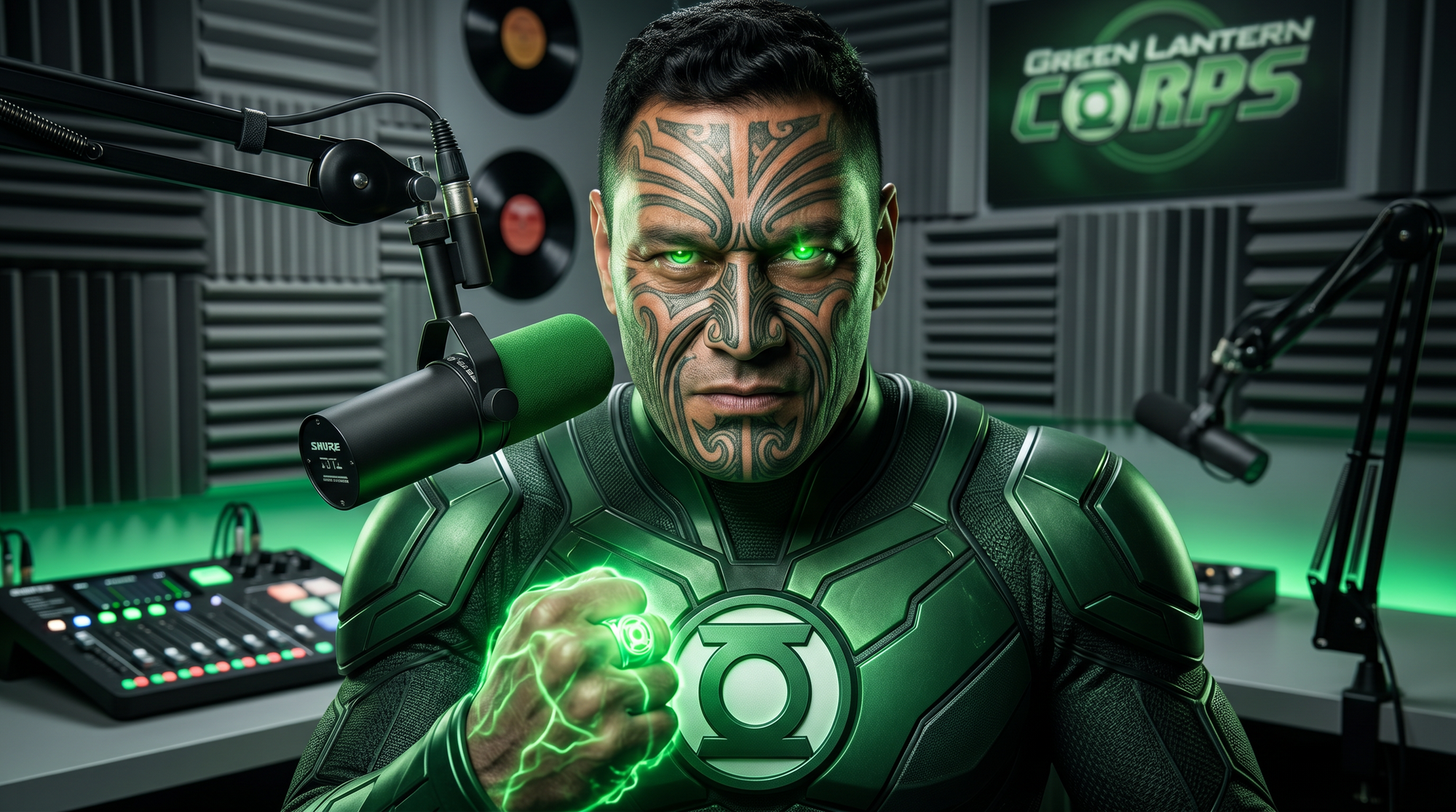
Ka Whawhai Tonu — The Fight Continues, Both Blades Up
Rangatiratanga is not choosing between loving Te Arikinui and telling the truth about the machine underneath her.
I hold both blades at once, same as any tohunga worth his taiaha.
Her kauhau is real aroha for her people — I believe that.
It is also, whether she named it or not, carrying rhetoric first tested on us by Ruth Richardson and now recycled by a coalition stripping a billion dollars from our whānau while calling it "alignment."
Willpower alone didn't stop the 1863 invasion. Willpower alone won't close a 10.8-point poverty gap while a $2.1 billion trust compounds at 12.8% and hands back less than one cent in every dollar.
Only truth, only redistribution, only a Crown that finally stops cutting — that's Rauora. Everything else is a beautiful word asked to do a government's job for free.
Kia kaha, whānau. Kei a koutou te mana. The ring only glows as bright as the truth we're willing to hold up to it.
Disclaimer: presented in the public interest (Durie v Gardiner [2018] NZCA 278), with verified fact, clearly flagged opinion, and no malice toward Te Arikinui, the Kīngitanga, or TGH — the taiaha here strikes a system, not a person. Retraction and correction will be actioned promptly on any substantiated complaint.