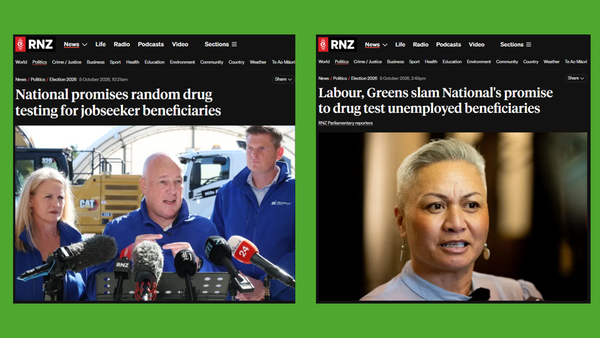
"The Wrecking Crew: How the New Zealand Initiative's Atlas Network Puppets Are Cheering the Destruction of 9,000 Whānau Livelihoods" - 20 May 2026
Corporate-funded ideologues celebrate mass unemployment while Māori workers and vulnerable communities bleed — and New Zealand's media calls it analysis.

Mōrena ano Aotearoa,
This essay examines the New Zealand Initiative's public celebration of 8,700 public sector job cuts because it directly and materially harms Māori whānau, tangata whenua workers, and the Treaty obligations this government has sworn to uphold.
The Arsonist with the Clipboard
Let me paint you a picture, whānau.
Your whare is on fire. Tamariki are inside. Kaumātua are on the upper floor. The smoke is thick and the stairs are burning. And standing on the footpath, clipboard in one hand, microphone in the other, is the arsonist — arms folded, measured tone, accented vowels — telling the journalist beside him that it is "precisely right" that the fire brigade is being defunded.
 RNZ News
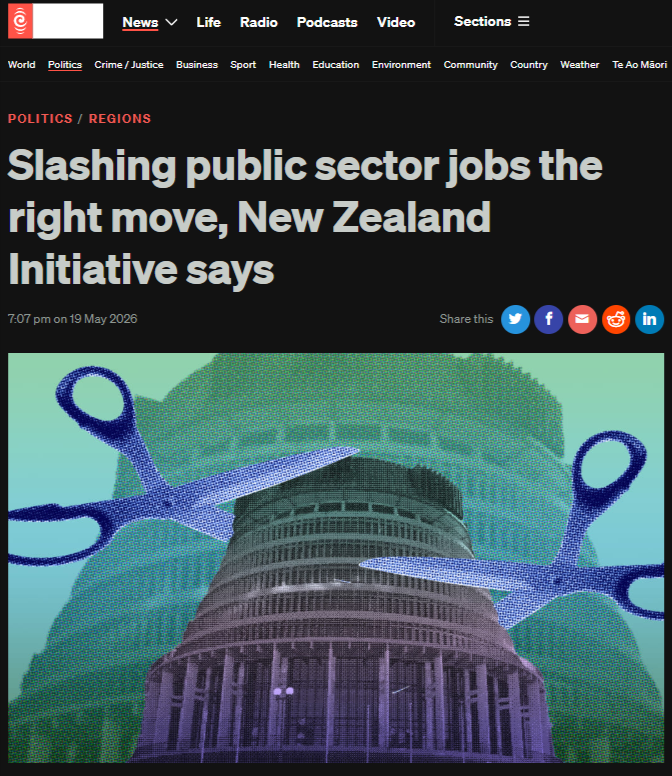
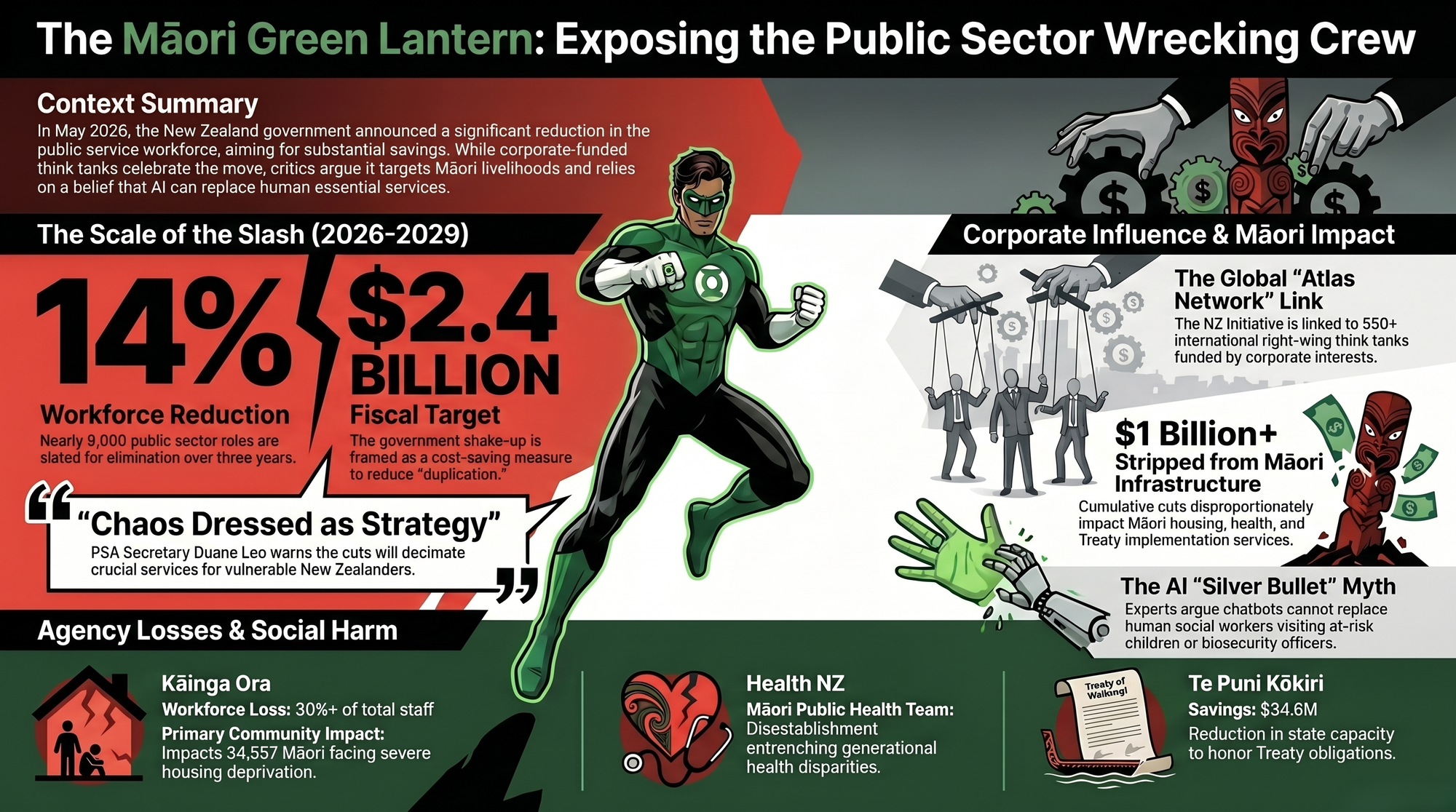
That arsonist is Oliver Hartwich, Executive Director of the New Zealand Initiative. And on 19 May 2026, as Finance Minister Nicola Willis announced the slashing of nearly 9,000 public sector jobs — a 14 percent reduction in the public service by 2029, sold as delivering $2.4 billion in "savings" — Hartwich was first out of the gate. No research. No harm assessment. No Treaty analysis. No consideration of the whānau who clean your government offices, case-manage your at-risk tamariki, check biosecurity at your ports, and process your ACC claims.
Just this, to RNZ: "The substance of the announcement is precisely right."
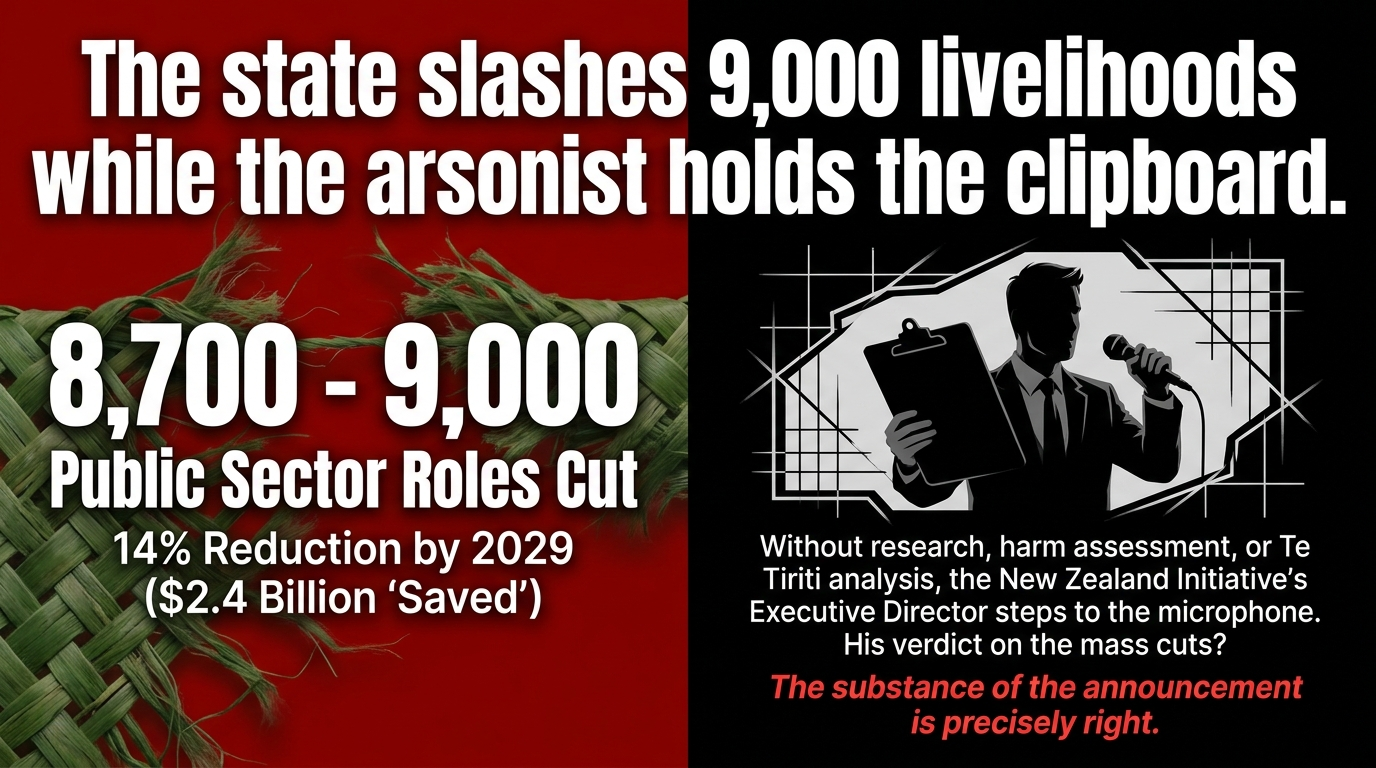
Precisely right. He said it with the confidence of a man who already knew the script. Because he did. He helped write it.
The Deep Dive Podcast
Listen to a lively conversation between two hosts, unpacking and connecting topics in the sources of this essay. I apologise in advance for the AI's very harsh pronounciation of reo. Please dont shoot me, :).
That is what I am going to show you today. Not just that the NZI cheered. But why. Who funds it. Who benefits. Who bleeds. And why the media's continuing failure to identify Hartwich as a paid mouthpiece for tobacco money and mining capital is not carelessness — it is complicity.
Who Is the New Zealand Initiative, Really?
Let us start with the basics, because the media will not.
The New Zealand Initiative is not a research institution. It is not independent. It is not non-partisan.
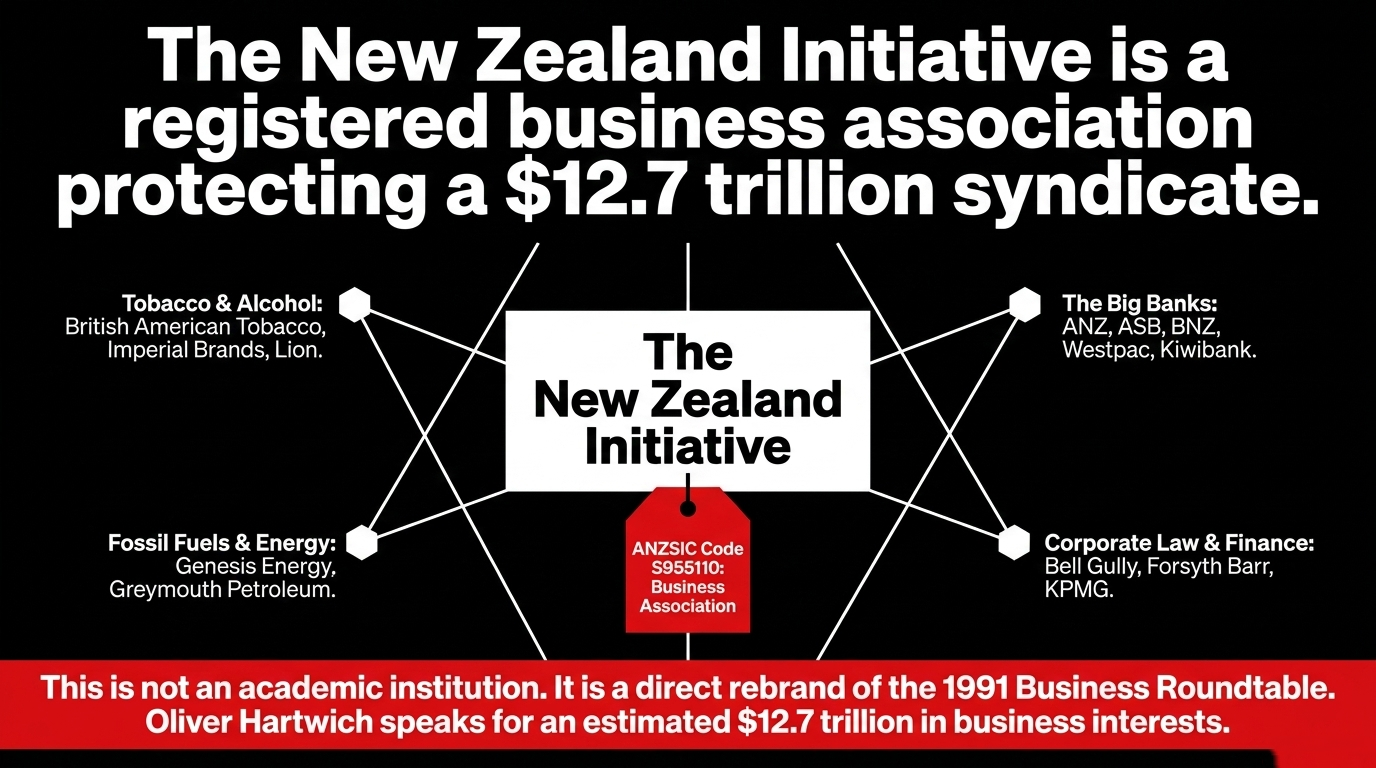
It is a corporate lobbying organisation wearing an academic disguise, classified by the New Zealand Companies Office under ANZSIC code S955110 — Business Association — as confirmed by Bryce Edwards at the Democracy Project.
It was incorporated in 1991 as the New Zealand Business Roundtable's legal vehicle, and reformed in 2012 by merger of the Business Roundtable and the New Zealand Institute — with German economist Oliver Hartwich installed as founding Executive Director, as reported by NBR. The Business Roundtable carries a particular whakapapa in Aotearoa. It was the organisation that pumped ideological oxygen into Roger Douglas's Rogernomics in the 1980s and Ruth Richardson's "Mother of All Budgets" in 1991 — benefit cuts of up to 25 percent that embedded intergenerational poverty into Māori and Pasifika communities for thirty years and counting.
That is not coincidence. That is continuity. The NZI is the Business Roundtable with a fresh coat of paint and a LinkedIn profile.
Now let me show you who sits on its board. According to the Democracy Project's full investigation, the NZI board includes:
- Neil Paviour-Smith — Managing Director of Forsyth Barr (one of NZ's largest investment brokerages)
- Roger Partridge — former Chairman of Bell Gully (one of NZ's most powerful corporate law firms) and a member of the Mont Pelerin Society, the elite international neoliberal scholars' network
- Scott Perkins — ex-Deutsche Bank, director of Woolworths and Origin Energy
- Barbara Chapman — former CEO of ASB Bank, Chair of Genesis Energy, director at NZME and Fletcher Building
- Christopher Quin — CEO of Foodstuffs North Island
- Sara Jane Tucker — External Relations Director of Lion NZ, the alcohol company
- Carrie Hurihanganui — CEO of Auckland Airport
These are not academics. These are not researchers. These are the chiefs of the corporate class. And they fund a think tank whose lead economist appears on your television telling you it is "precisely right" to sack 9,000 public servants — without ever disclosing that he serves at the pleasure of tobacco companies, oil interests, and the Big Four banks.
As the Democracy Project documents, the NZI's full member list includes British American Tobacco, Imperial Brands Tobacco, Lion (alcohol), Coca-Cola Amatil, Greymouth Petroleum, Fonterra, Fletcher Building, all five major banks (ANZ, ASB, BNZ, Westpac and Kiwibank), Microsoft, Uber, Mastercard, Southern Cross Health Society, KPMG, PwC, Deloitte, and Foodstuffs North Island. This is not a think tank. This is a syndicate — a consortium of corporations whose collective profits grow every time a public service is cut, every time a worker loses a collective agreement, every time the state retreats from regulating the market.
And as the investigative analysis at Free Market Moralism calculated, these members collectively represent over $12.7 trillion in business interests.
Oliver Hartwich speaks for them. The media calls him an economist.
The Atlas Strings
But Hartwich and the NZI do not operate alone. They are one node in a deliberate, structured, global ideological network.
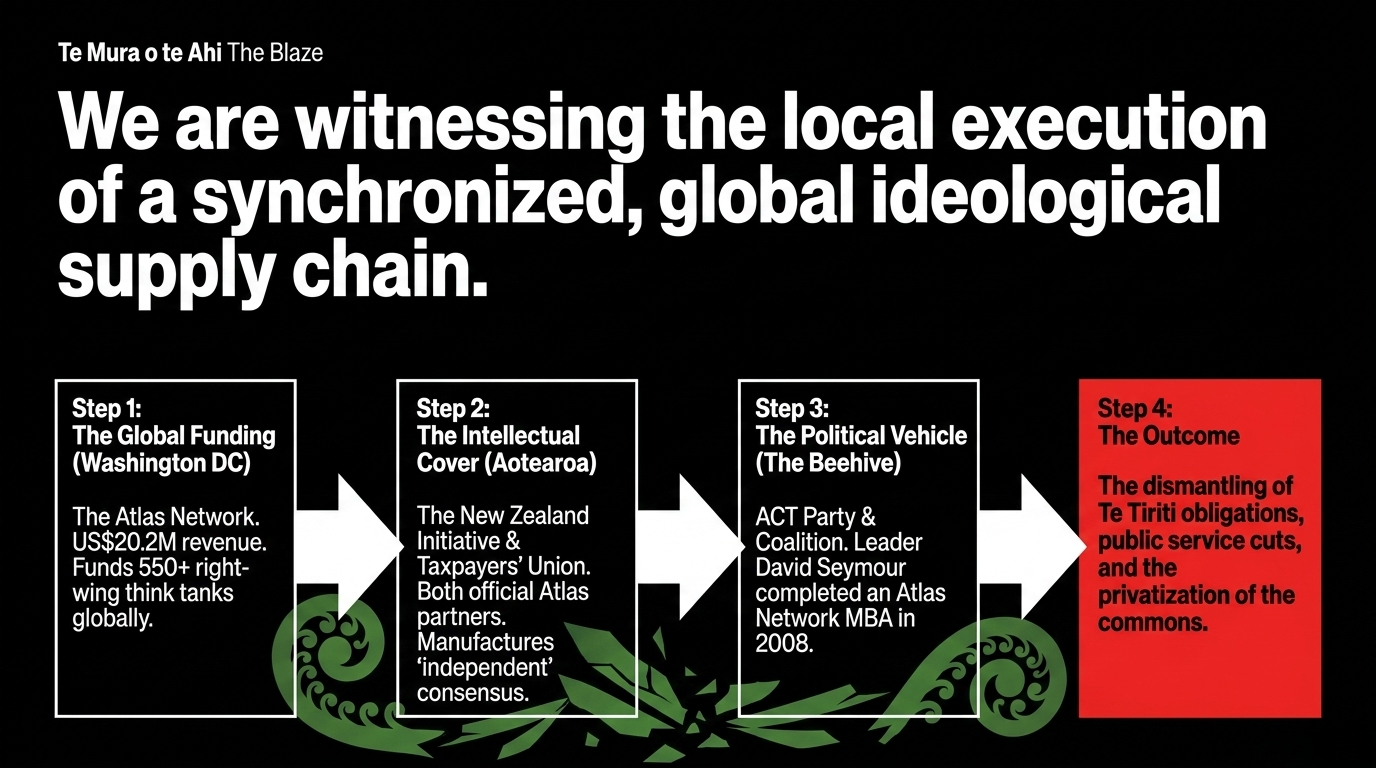
The NZI is a proud, self-declared member of the Atlas Network — a Washington DC-based organisation founded in 1981 that, as documented by the PSA, links over 550 right-wing think tanks across more than 100 countries.
In 2022, Atlas had revenues of US$20.2 million and distributed over US$75,800 in grants in Australia and New Zealand alone. Both the NZI and the Taxpayers' Union are official Atlas Network partners in Aotearoa, as confirmed by the PSA.
Atlas's stated vision — which you can read on their own website
— is "a free, prosperous, and peaceful world where the principles of individual liberty, property rights, limited government, and free markets are secured by the rule of law."
In plain English, in Aotearoa's context, that means: dismantle Treaty obligations, destroy Māori collective rights, privatise the commons, and eliminate the public institutions that tangata whenua depend on to survive.
Atlas promotes think tanks, in its own 1998 words co-authored by then-President Alejandro Chafuen, as "the most effective, yet subtle, vehicles for influencing the development of public policy" — by winning "the respect of journalists and government officials" and "shifting the climate of opinion in favour of market approaches." As the PSA documents, this network drives policy platforms pushing public service cuts, climate denial, deregulation, privatisation, attacks on workers' rights, and support for landlords over tenants — coordinated across countries from the United Kingdom to Argentina to the United States.
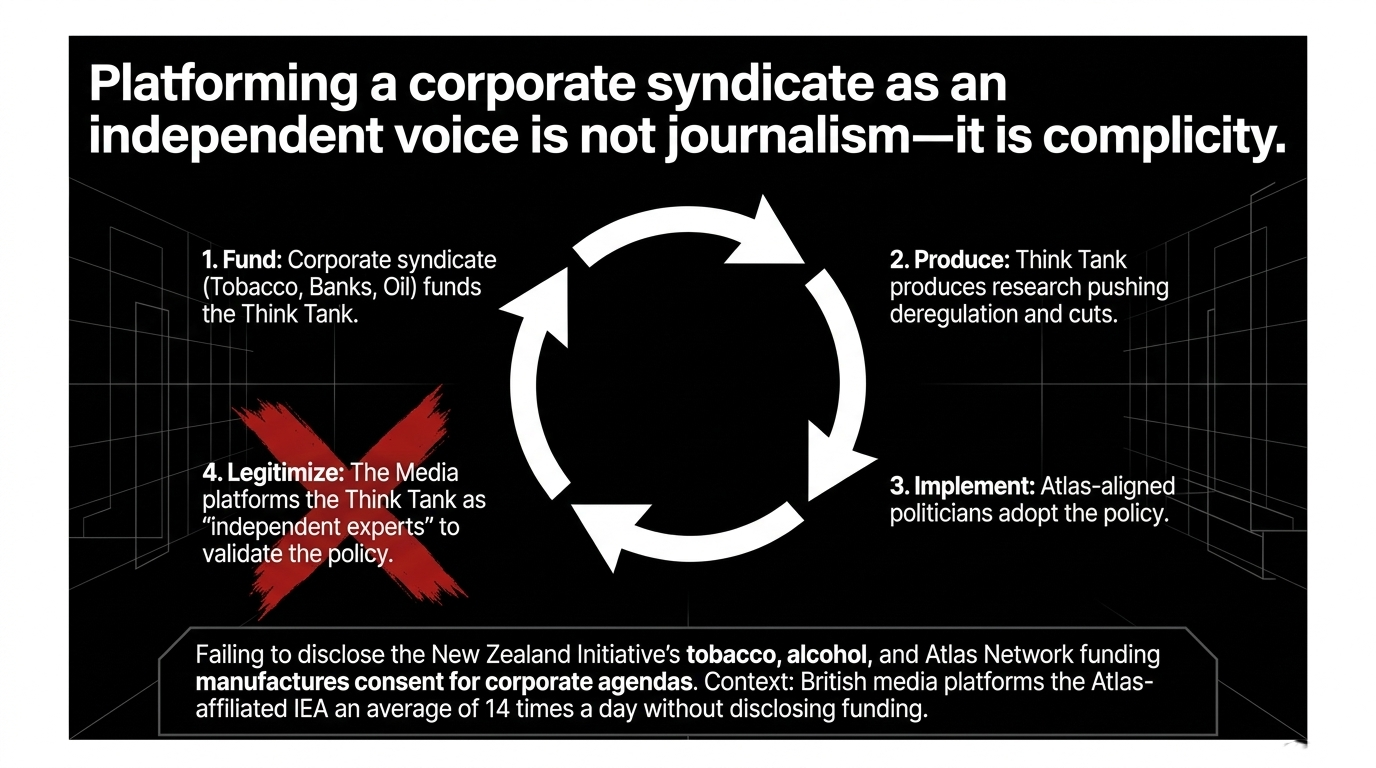
In the UK, Atlas member the Institute of Economic Affairs helped create former PM Liz Truss's disastrous mini-budget policies — and yet, as the PSA notes, British media still platforms the IEA an average of 14 times a day without disclosing its corporate funding. Sound familiar?
The connections in Aotearoa go deeper still.
As reported by Q+A on YouTube, Debbie Gibbs — daughter of major ACT Party donors Dame Jenny Gibbs and Alan Gibbs — served as Atlas's Global Chair. David Seymour, the ACT leader whose Treaty Principles Bill was designed to extinguish Māori constitutional rights, previously worked for the Frontier Centre for Public Policy in Canada — an Atlas-affiliated think tank — and completed an Atlas Network MBA for think tanks in 2008, as confirmed by analysis in my earlier essay on Seymour's imported ideology. The ACT coalition agreement is not New Zealand policy. It is the Atlas playbook, carried home in a briefcase from Winnipeg.
As the ABC's investigation into Atlas in Australia and New Zealand reports, political scientists in Aotearoa have described growing alarm at the sudden visibility of Atlas-aligned special interests in NZ politics. The dots are not hidden. They are written in ink.
The NZI's education research arm produced a manifesto before the 2023 election that, as E-Tangata documents, "now reads like the government's to-do list" — from downgrading Te Tiriti o Waitangi in the Education Act to gutting NCEA. Atlas-affiliated think tanks provide the intellectual cover. The politicians implement the policies. The media covers the politicians without mentioning the think tanks. This is not a conspiracy. This is a machine.
Five Hidden Connections the Media Won't Name

I want to be clear about method here, whānau. I do not speculate. I trace whakapapa. I follow money. I name the connections that exist in the documented record.
Connection One — The Roundtable Whakapapa. The NZI carries the direct genealogy of the New Zealand Business Roundtable, which drove the 1991 benefit cuts under Ruth Richardson, as documented by NBR. The same board families, the same corporate funders, the same ideology — just a rebrand. The 2025 job cuts are not a new policy. They are the Mother of All Budgets, Act Three.
Connection Two — The Mont Pelerin Thread. NZI Chairman Roger Partridge is a member of the Mont Pelerin Society, as documented by the Democracy Project. Mont Pelerin was founded by Friedrich Hayek in 1947 and is the intellectual parent of the entire global free-market movement — from Thatcherism to Rogernomics to the ACT Party. This is not coincidence. This is a deliberate ideological lineage connecting Aotearoa's policy-making to a seventy-year project of wealth concentration.
Connection Three — The ACT-Atlas-Gibbs Triangle. ACT's major funders, the Gibbs family, connect through Atlas's former Global Chair Q+A. ACT's leader trained at an Atlas-affiliated think tank as I have previously documented. The ACT coalition agreement is the vehicle for implementing NZI/Atlas policy priorities. Hartwich endorses the result. This is a closed loop of coordinated ideology, dressed in the language of democratic mandate.
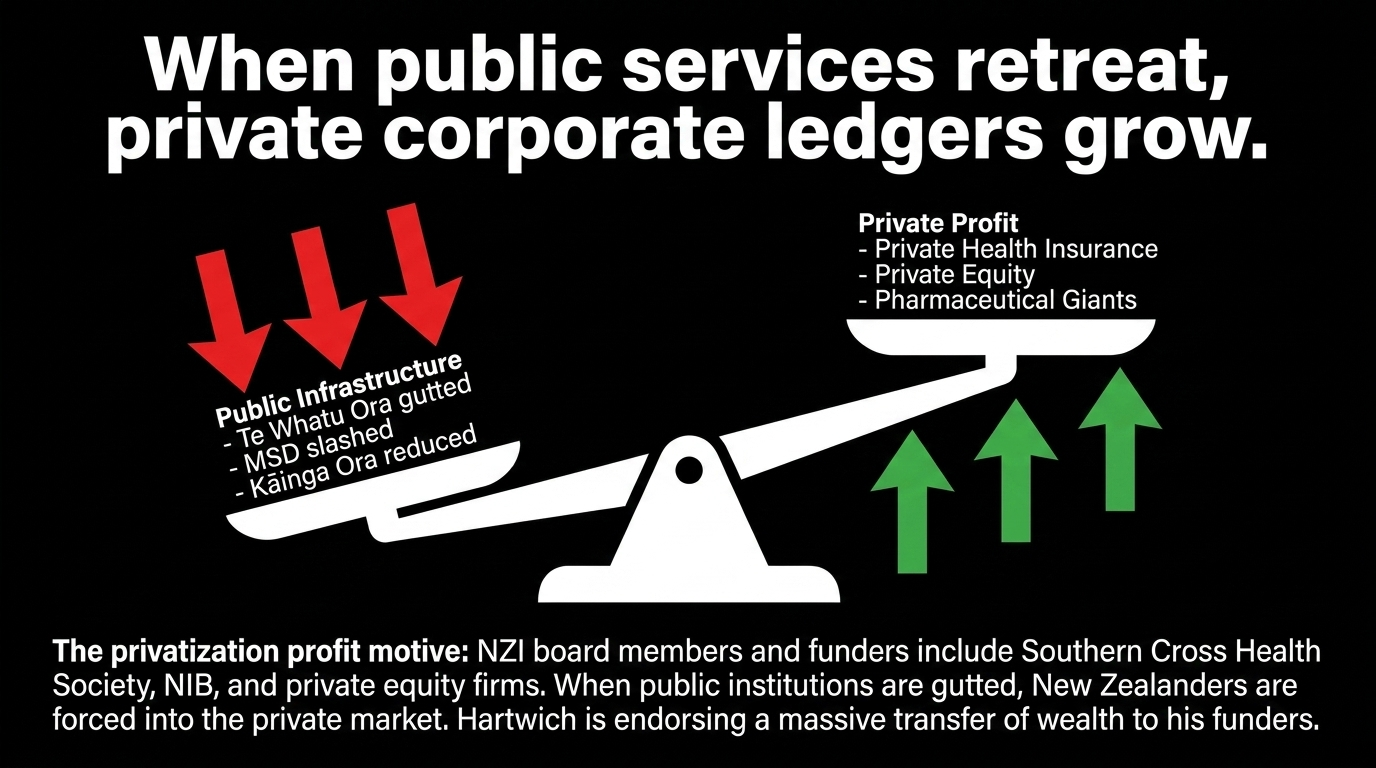
Connection Four — The Privatisation Profit Motive. NZI members include Southern Cross Health Society, NIB, pharmaceutical companies, and private equity — all of whom directly profit when public health services are cut and New Zealanders are forced into the private insurance market, as documented by the Democracy Project's membership list. When Hartwich endorses job cuts at Te Whatu Ora and the Ministry of Social Development, he is endorsing a transfer of business from the public sector to his funders' ledgers.
Connection Five — Policy Laundering in Real Time. Hartwich's instant, research-free endorsement of Willis's announcement — delivered with no Treaty analysis, no whānau harm modelling, no independent data — is not analysis. It is what the PSA identifies as Atlas's core function: providing "the most effective, yet subtle, vehicles for influencing public policy." The think tank manufactures the appearance of independent intellectual consensus for a policy already decided in boardrooms. Hartwich is not commenting on the policy. He is completing the policy.
Always the Same Whānau Who Bleed
I have been tracking this pattern for years. The hammer of neoliberal austerity falls hardest on Māori. Every. Single. Time.
Kāinga Ora — gutted. As reported by Te Wahanui, Kāinga Ora has already shed 620 jobs — meaning the agency has lost more than 30 percent of its entire workforce since December 2023. PSA Kaihautū Māori Janice Panoho stated directly: "These decisions are going to have a huge negative impact on Māori and Pacific people." Of the 112,496 people recorded as severely housing deprived at the 2023 Census, 34,557 were Māori and 28,779 were Pacific. The CEO insists services won't be affected. Remaining workers say they will carry double the load until they, too, burn out and leave. The CEO is wrong. The workers are right.
Health NZ — Māori public health team disestablished. Te Whatu Ora proposed to eliminate its entire Māori public health team within the National Public Health Service, as reported by Kaitiaki. The Kaitiaki report confirms that Māori and Pacific workers bear a disproportionate burden of these cuts — people who cannot simply pick up and move, because their communities, their marae, their whānau are here. When you eliminate the Māori public health workforce, you do not just lose jobs. You lose the culturally embedded knowledge, the whānau relationships, the tikanga-grounded practice that makes health interventions work for Māori populations. That knowledge cannot be rebuilt overnight. It takes generations.
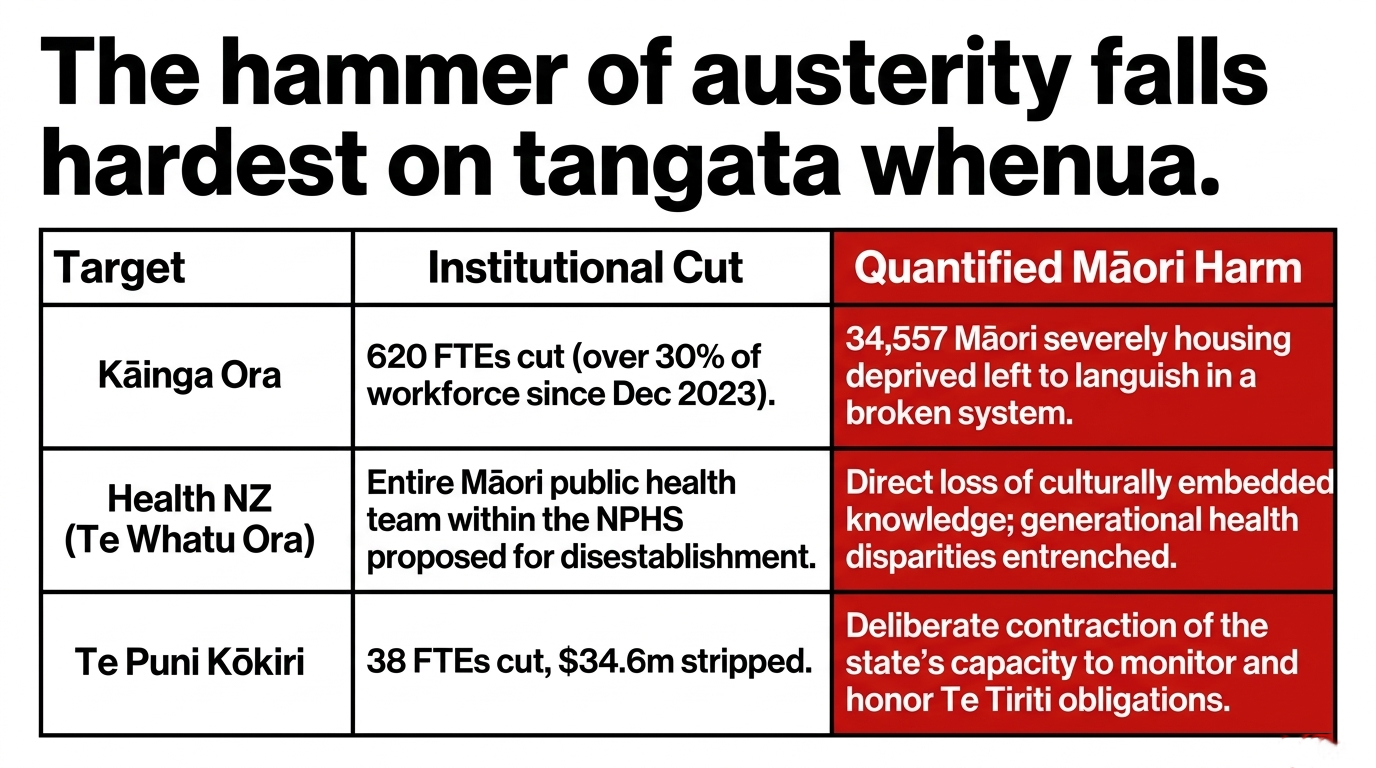
Te Puni Kōkiri — bled dry. The Ministry of Māori Development was ordered to find $34.6 million in savings, with 38 full-time roles cut, as reported by the NZ Herald. This is the ministry whose core function is to advance Māori wellbeing and Treaty implementation. Cutting it is not efficiency. It is a deliberate contraction of the state's capacity to honour its Treaty obligations.
The Billion-Dollar Theft. Take all of this together and look at the cumulative picture. Labour's own research, confirmed by the Labour Party, found that across Budgets 2024 and 2025, over $1 billion was stripped from Māori housing, education, trades training, and Treaty infrastructure. Te Arawhiti gutted. The Māori Health Authority dissolved. Whānau Ora constrained. Māori trades training defunded. And now, with 9,000 more public sector roles gone, the workers who were trying to hold these fraying systems together will also be gone.
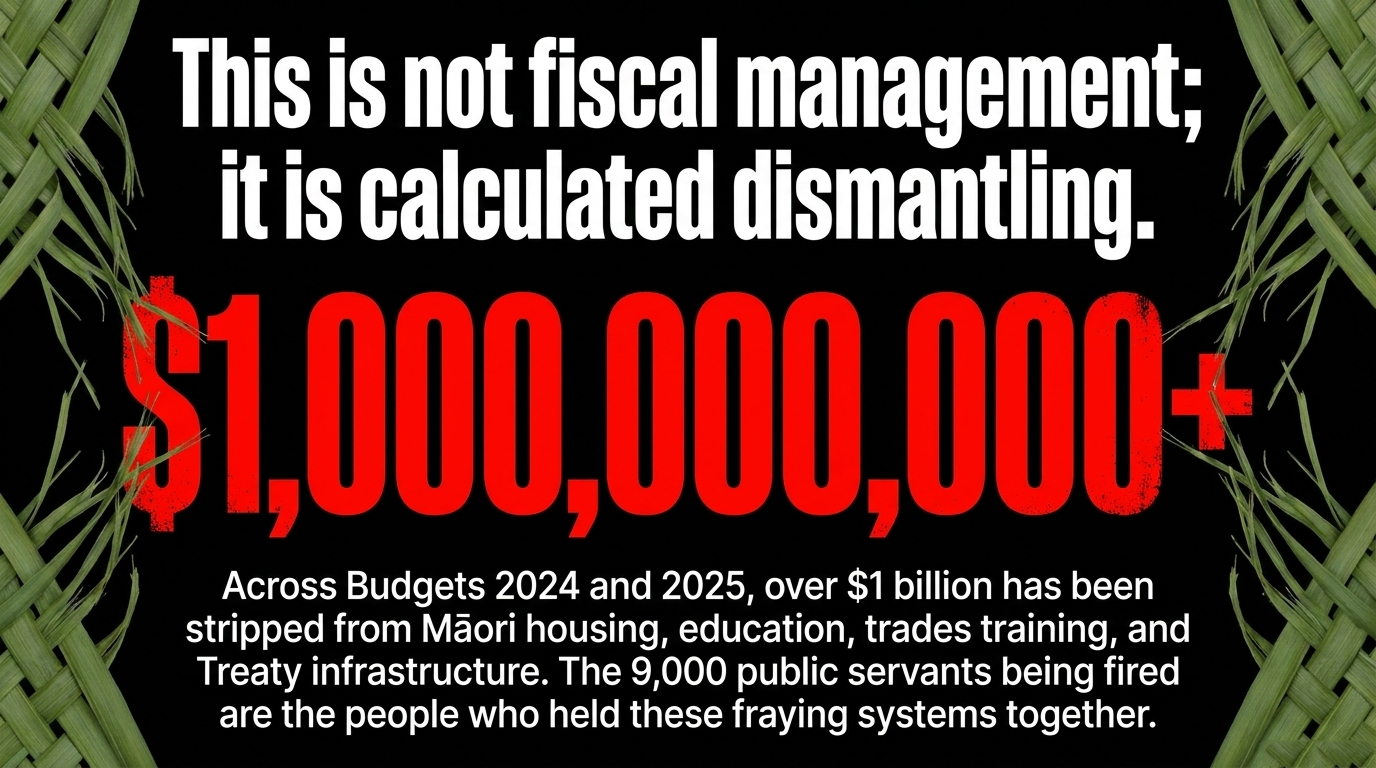
This is not fiscal management. This is a calculated dismantling of the infrastructure of Māori advancement. And the New Zealand Initiative is standing on the footpath, clipboard in hand, calling it "precisely right."
The AI Con — Name the Lie

I want to address the AI justification directly, because I find it personally insulting in its cynicism.
Willis told us in her announcement that AI would help replace the functions of thousands of workers. The technology would make us more efficient. New Zealand was "lagging behind" on AI adoption and needed to move faster.
Dr Andrew Lensen, senior AI researcher at Victoria University, told RNZ Checkpoint directly:
"In its current form there is no way AI could replace thousands of public servants. It is naive of the government to see it as a silver bullet."
He described Willis's claim that New Zealand was lagging on AI as false:
"I think we are a pragmatic country and we can see that a lot of the hype around AI has been driven by offshore interests and may not actually benefit us entirely in its current form."
PSA national secretary Duane Leo was, as always, unambiguous:
"You can't automate a social worker visiting a vulnerable child. You cannot replace a biosecurity officer inspecting cargo at the border with a chatbot."
He called the minister's AI justification dishonest:
"It's not genuine in terms of improving services." He called the whole plan "chaos dressed as strategy," as reported by RNZ.
He was right. And I want you to notice something. The AI companies — Microsoft, among them — are NZI members, as documented by the Democracy Project. The push to replace public servants with AI software will route government spending toward the NZI's own corporate funders. This is not coincidence. This is the machine completing its cycle.
The Media's Complicity
I need to say this clearly, because it matters as much as anything else in this essay.
Every time a journalist platforms Oliver Hartwich as a neutral "think tank expert" — without disclosing that the NZI is funded by British American Tobacco, Imperial Brands, Lion, and the five major banks; without disclosing that it is an Atlas Network affiliate whose stated purpose is to manufacture consent for corporate policy agendas; without disclosing that its board is packed with the CEOs of the very corporations that benefit from every public service cut — that journalist is not reporting. They are amplifying propaganda, and calling it balance.
As the PSA notes, the British media platforms the Atlas-affiliated Institute of Economic Affairs an average of 14 times a day without disclosing its funding sources. Our media is doing the same. It is not ignorance. The information is publicly available. It is a choice.
That choice harms Māori. It harms every working whānau who sees a man in a suit on television and assumes the suit means independence. The suit means the opposite.
What Needs to Happen — Tino Rangatiratanga in Practice
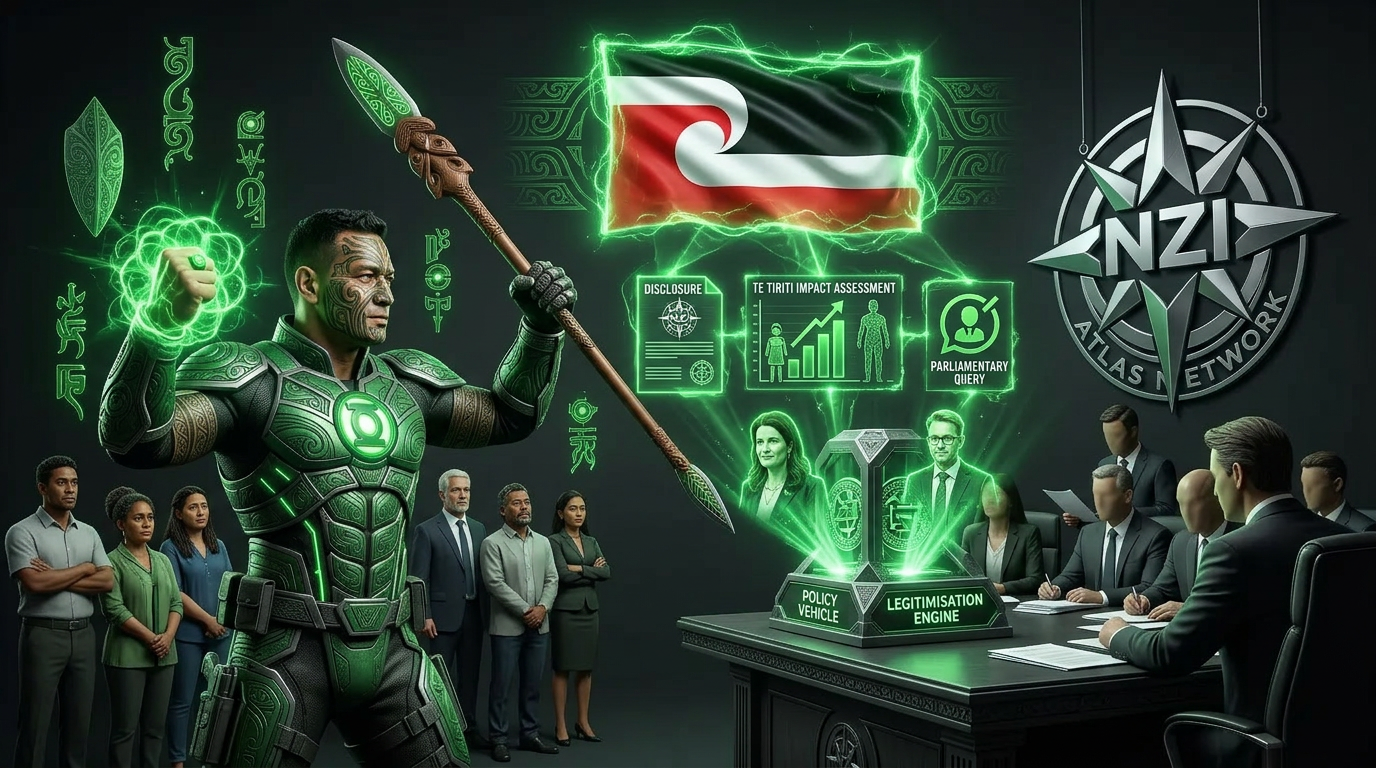
The taiaha is raised. The whakapapa is traced. The names are named. Now let me tell you what needs to happen.
One. Every media organisation that covers NZ policy must disclose, every time Oliver Hartwich or the NZI is cited, that the NZI is a corporate lobby group funded by tobacco, alcohol, petroleum, and banking interests, and is an official Atlas Network affiliate. This is not bias. This is basic journalistic context.
Two. The 9,000 job cuts must be subject to an immediate Te Tiriti impact assessment. The disproportionate harm to Māori workers and Māori communities is not a side effect. It is the logical result of an ideology that has always treated Māori as expendable. Waitangi Tribunal urgent hearing — now.
Three. The NZI's Atlas Network membership, its member list, and its board composition must be the subject of a parliamentary inquiry into foreign-funded ideological influence on New Zealand policy — as the ABC confirms is now being discussed across the Tasman.
Four. Whānau — you must understand that when Nicola Willis announces policy and Oliver Hartwich immediately endorses it, you are not watching independent confirmation. You are watching the same machine running two different outputs. Willis is the policy vehicle. Hartwich is the legitimisation engine. Neither speaks for you.
The public servants being cut — the social workers, the biosecurity officers, the Te Puni Kōkiri advisors, the Kāinga Ora housing managers — those people spoke for you. They were the state's relationship with your whānau. And the wrecking crew is cheering as they go.
Ka whawhai tonu mātou. We will not stop fighting.
| Sector | Cuts / Loss | Quantified Māori Harm |
|---|---|---|
| Overall public service | 8,700 FTE by 2029 — NZ Herald | Māori overrepresented in public sector workforce |
| Kāinga Ora | 620 FTE, 30%+ total workforce since Dec 2023 — Te Wahanui | 34,557 Māori severely housing deprived (2023 Census) |
| Health NZ / NPHS | Entire Māori public health team disestablished — Kaitiaki | Generational health disparity entrenched |
| Te Puni Kōkiri | 38 FTE, $34.6m savings demanded — NZ Herald | Direct hit to Treaty obligations infrastructure |
| Cumulative Māori funding | $1 billion+ stripped across 2024–25 — Labour | Housing, education, trades training, health gutted |
Tautoko This Mahi — He Koha, He Manaaki
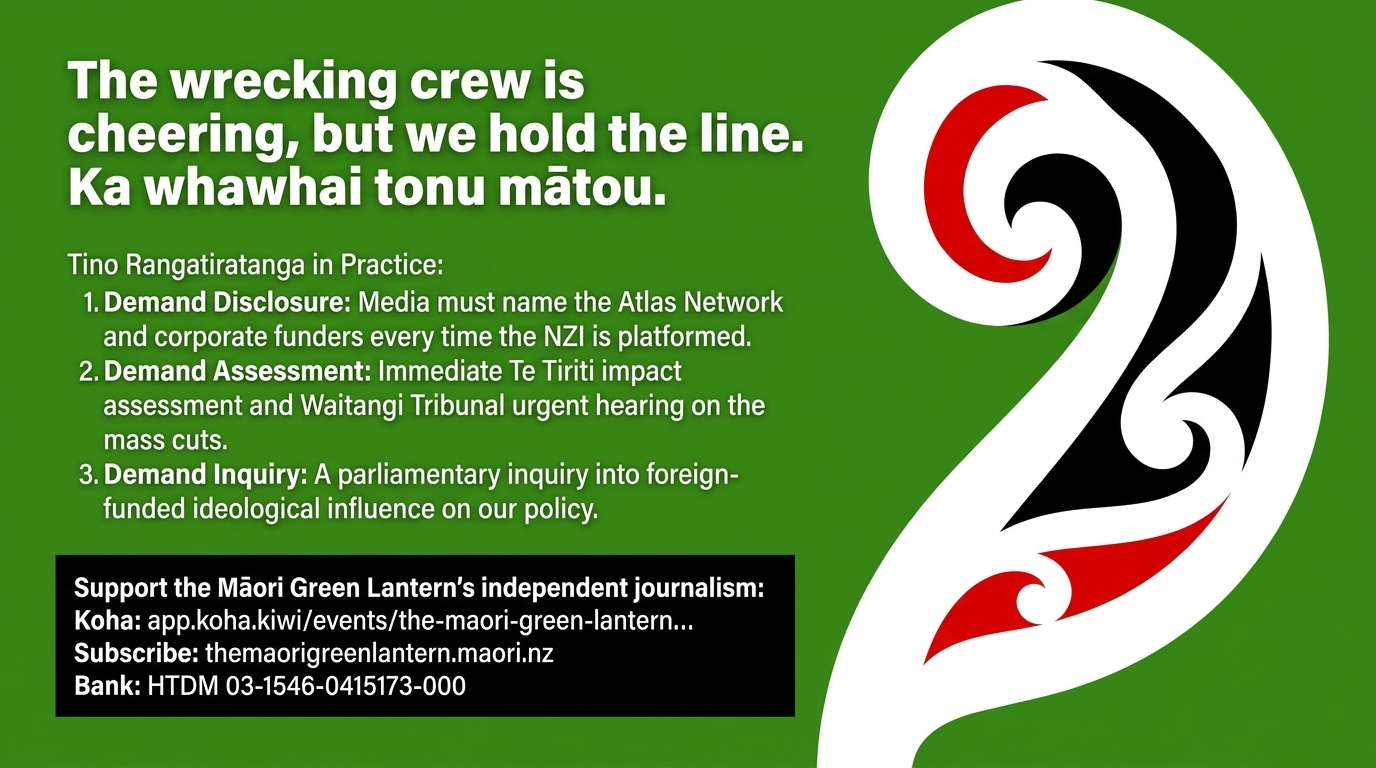
These words don't write themselves. Every essay is hours of research, source verification, URL testing, and aroha for whānau. This essay has exposed a $12.7 trillion corporate lobby network — funded by tobacco, alcohol, oil, and banking money — celebrating the mass unemployment of 9,000 real people, disproportionately Māori, who stand between vulnerable tamariki and the street.
Every koha funds rangatiratanga's own truth tellers. If we don't tell this story, who does?
If you cannot koha — subscribe, follow, kōrero, share. That is koha.
- 💰 Koha: app.koha.kiwi/events/the-maori-green-lantern-fighting-misinformation-and-disinformation-ivor-jones
- 📬 Subscribe: themaorigreenlantern.maori.nz/#/portal/support
- 🏦 Bank: HTDM 03-1546-0415173-000
- 👍 Facebook: facebook.com/Themaorigreenlantern
Kia kaha, whānau. He aha te mea nui o te ao — he tangata, he tangata, he tangata.

Views expressed constitute honest opinion on matters of public interest under the Defamation Act 1992 (NZ) and Durie v Gardiner NZCA 278. All factual claims are sourced and cited inline. Named individuals are referenced solely in their public capacity. Errors or corrections: themaorigreenlantern.maori.nz