Before We Fix MMP, Tell The Whole Story
RNZ reveals a real overhang problem. Before the rules change, its framing, expert claims and proposed repairs need the same scrutiny as the voters using them.

Introduction
Mōrena Aotearoa,
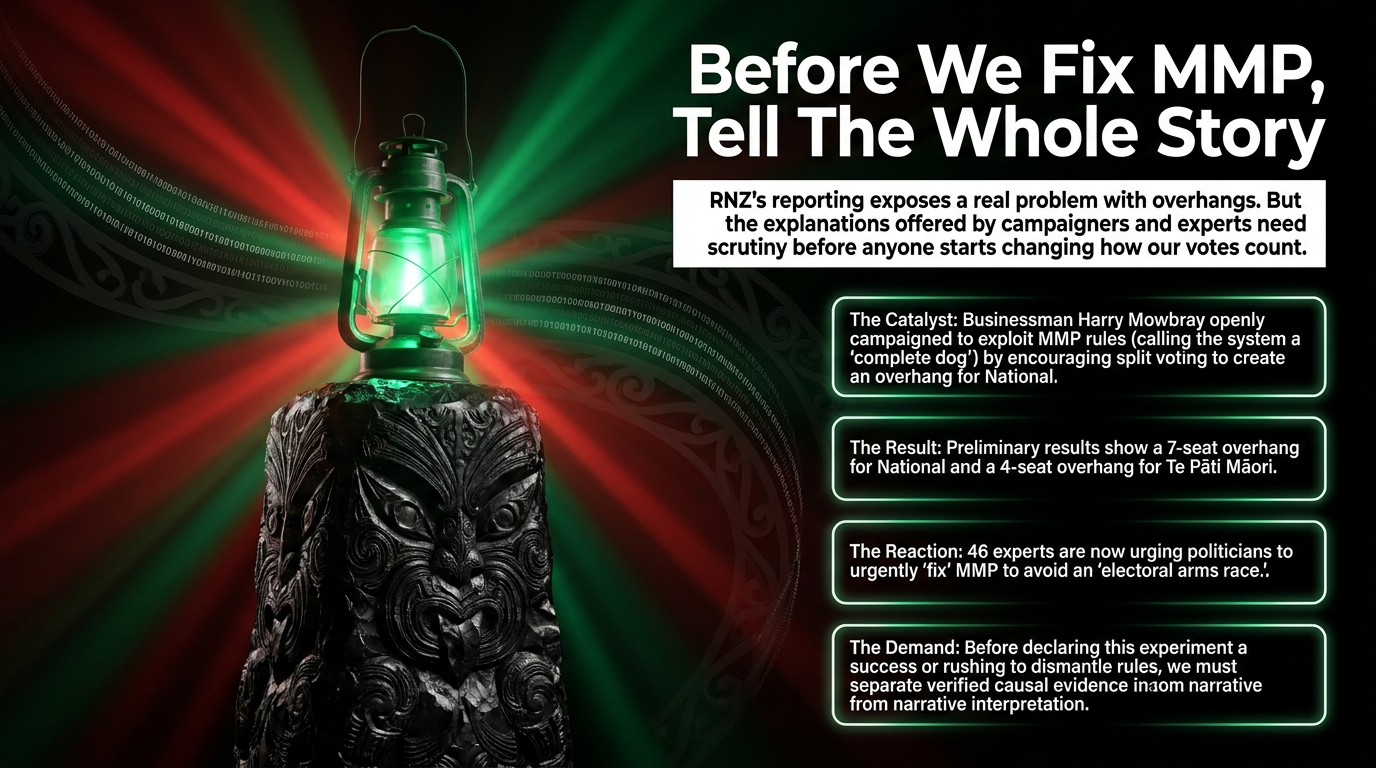
Harry Mowbray wanted to demonstrate that MMP was a “complete dog”, so he encouraged National supporters to give their electorate vote to National and their party vote to one of its coalition partners.
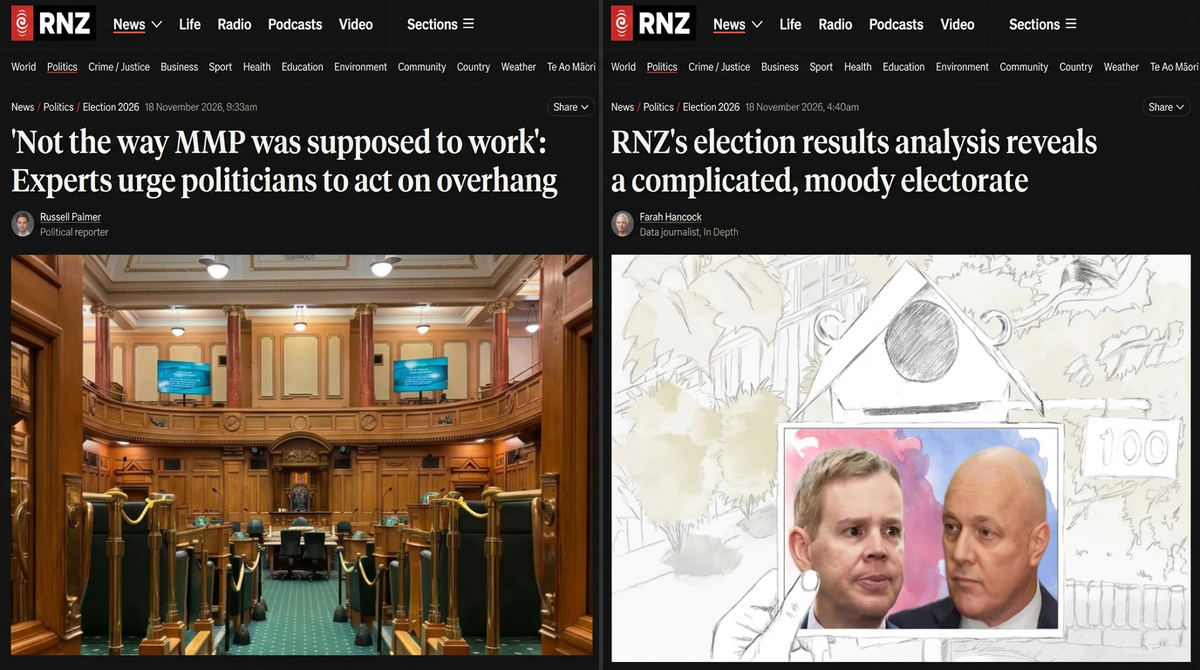
The aim, according to RNZ, was to help create extra National seats beyond its party-vote entitlement. Now RNZ reports a preliminary seven-seat overhang for National, alongside four for Te Pāti Māori, and the discussion has moved to urgently repairing the electoral system. That is the starting point established by RNZ’s election analysis.
It is an extraordinary place to find ourselves. Someone openly campaigns to exploit a weakness in the rules, a result consistent with that objective appears, and we are then asked to consider what the result tells us about the system. There is a genuine question there. But before anyone declares the experiment a success, we need to know whether the campaign actually produced the outcome.
 RNZ | Te Reo Irirangi o Aotearoa
RNZ is careful about that in its first article. It says the split voting might have followed Mowbray’s direction, or it might have happened anyway. That qualification matters. A campaigner’s intention is not proof of his influence, however neatly the result appears to fit the plan. The article leaves that causal question open.
 RNZ | Te Reo Irirangi o Aotearoa

In the companion report, however, the conversation becomes more urgent. A group of 46 experts wants politicians to address the overhang problem. Max Rashbrooke warns of an electoral “arms race”, while Andrew Geddis explains how an overhang could produce a parliamentary majority for parties that received fewer votes than the other parliamentary parties combined. Those are serious concerns, and RNZ is right to report them.
What we should not do is allow the urgency to carry every accompanying claim past scrutiny. We need to know what the figures establish, what remains an interpretation, what earlier recommendations actually said, and what each proposed repair would do to people’s representation. That obligation applies to experts defending MMP just as much as it applies to campaigners trying to discredit it.
The Explanation Needs To Match The Evidence
The first article is useful because it refuses to pretend that everyone voted for the same reason. RNZ grouped neighbourhoods using characteristics from the 2023 Census and compared the votes cast at voting places within them. What emerges is not one national verdict but several different patterns. The method and its limitations are explained in the article.
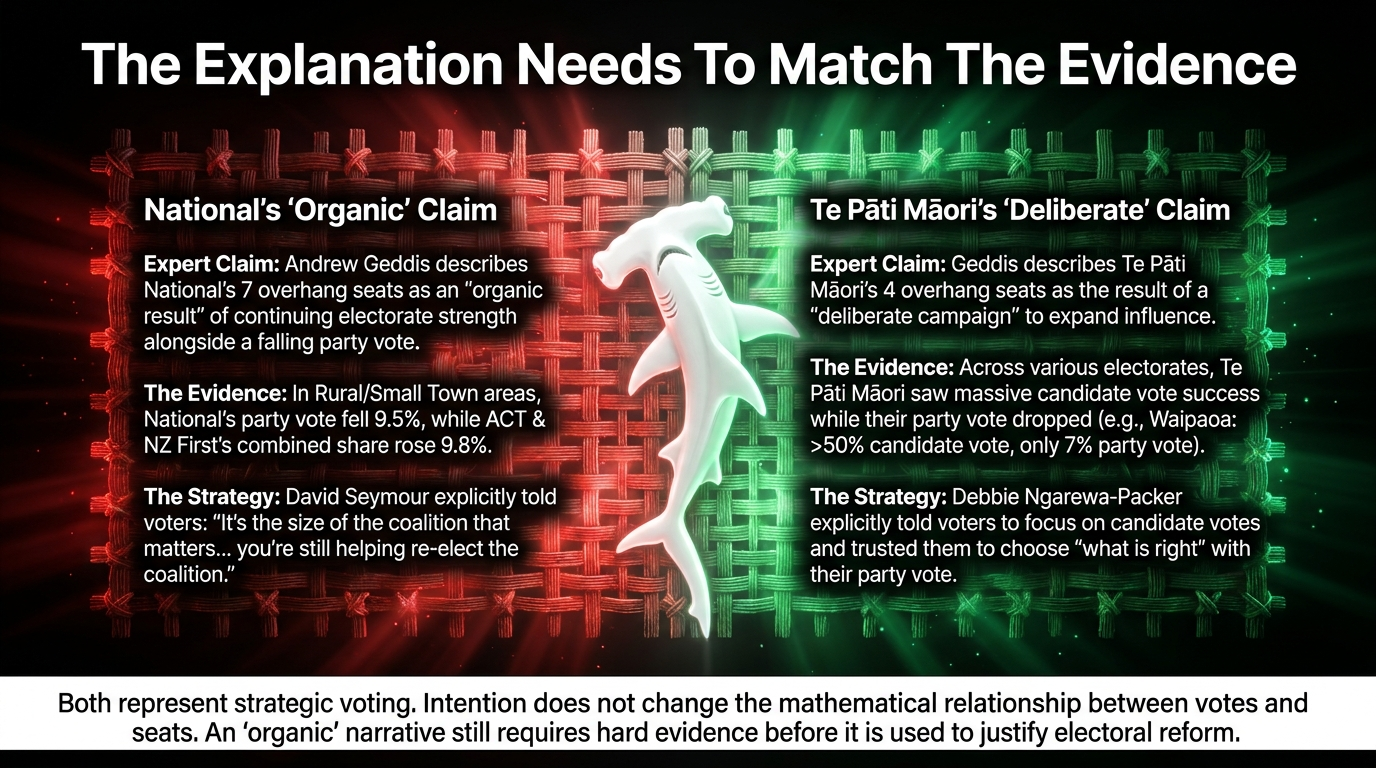
In Bankside, National’s party-vote share fell from 52.7 percent in 2023 to 43.3 percent in the preliminary result, while ACT’s rose by 5.1 percentage points to 18.1 percent. Across RNZ’s rural and small-town neighbourhood category, National’s party vote fell 9.5 points while ACT and NZ First’s combined share increased 9.8 points. Those changes are substantial.
They also fit the kind of electoral calculation David Seymour was encouraging when he told voters in West Melton that “it’s the size of the coalition that matters”. A party vote for ACT, he said, would still help re-elect the coalition. The same RNZ article quotes Debbie Ngarewa-Packer asking Te Pāti Māori supporters to focus on candidate votes while trusting them to make their own party-vote choice. Both appeals belong in this discussion.
Neither appeal becomes dishonest simply because it asks voters to think strategically. Nor does an external supporter’s campaign automatically become a campaign directed by National. But once those facts are on the table, nobody can reasonably present strategic voting as a uniquely Māori offence.
That is why one distinction in the second article needs a fuller explanation. Geddis describes Te Pāti Māori’s overhang as the result of a deliberate campaign, while National’s was “more like an organic result” of continuing electorate strength and a falling party vote, despite campaigns encouraging that outcome. That is Geddis’s assessment, not Rashbrooke’s.
There may be a good evidential basis for it. Te Pāti Māori’s own appeal is not the same thing as an outside campaign advocating a result that would benefit National. People can also like their electorate candidate while becoming dissatisfied with the candidate’s party. But readers are not shown enough of the reasoning to know how confidently the outcomes can be separated in this way, particularly when Geddis later says he is unsure whether the campaigns were successful.
“Organic” sounds explanatory. It still needs explaining.
The distinction also has limits. If the concern is proportionality, an unintended overhang can distort representation just as a deliberate one can. Intent helps us understand campaigning and possible future behaviour; it does not change the relationship between votes and seats. Geddis recognises the overall distortion, so it would be unfair to claim he excuses National. The question is why the origins are characterised differently and what evidence supports that judgement.
This is where a newsroom should press further. Accurately quoting an expert is part of the job. Giving readers enough information to understand and assess the expert’s conclusion is another part.
A Real Problem Does Not Make Every Claim Sound
There is a strong argument for reform, and it should not be lost in criticism of the reporting.
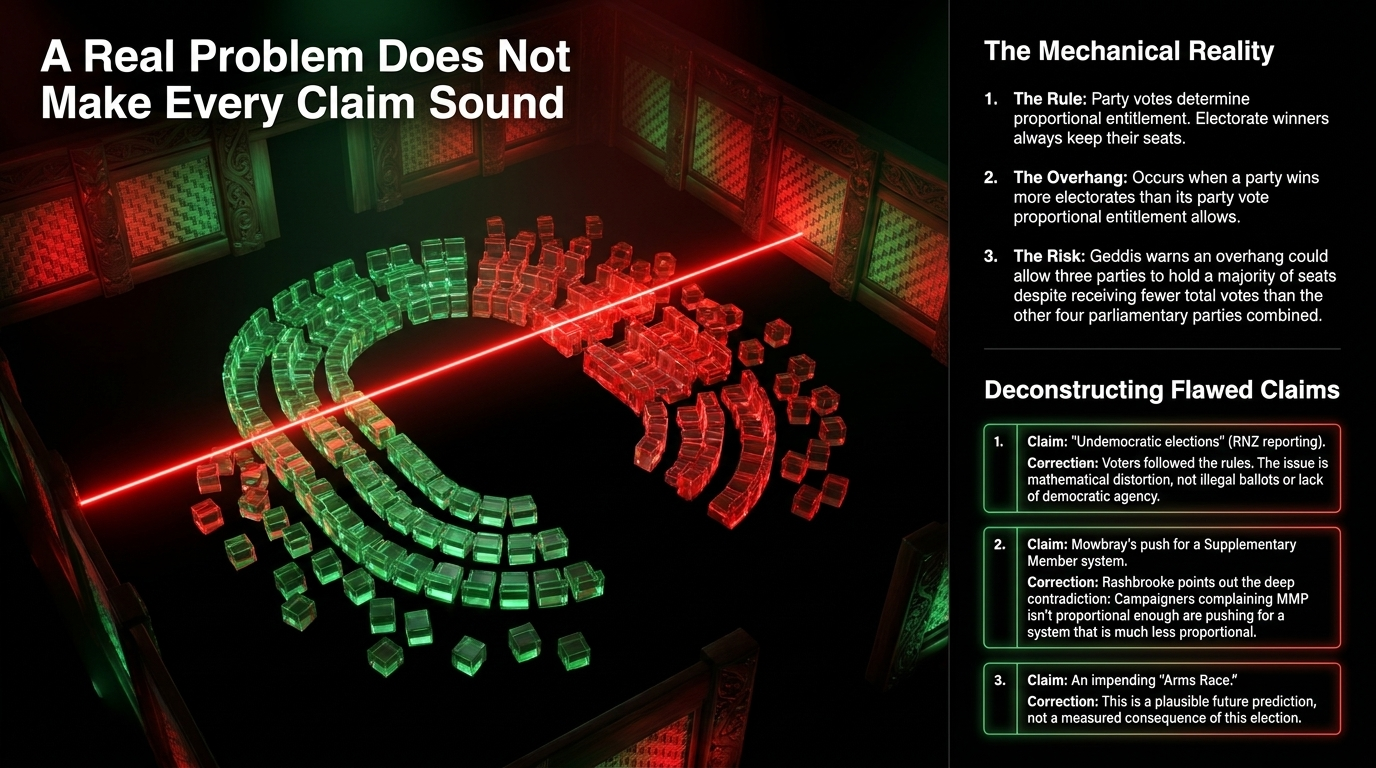
Under MMP, party votes determine proportional entitlement, subject to the eligibility rules, while electorate winners keep their seats. When a party wins more electorates than its proportional entitlement provides for, an overhang can result. The Electoral Commission examines that relationship in its 2012 review.
That means two legitimate choices can pull the system in different directions. People elect local representatives, and they choose parties. Keeping every electorate winner can weaken the connection between the party vote and Parliament’s composition.
Saying that voters followed the rules does not answer whether the rules are fair. It answers an accusation of wrongdoing. Those are different arguments, and anyone defending Māori political agency should be able to make that distinction without difficulty.
Geddis warns that the overhang could give three parties a majority of seats even though they received fewer votes than the other four parliamentary parties combined. He presents that as a possible outcome, not a completed final count. It is the most consequential warning in the article.
RNZ’s opening describes the experts as wanting to avoid “undemocratic elections in future”. That is broader than the specific problem explained underneath it. The concern is a possible distortion in translating votes into governing power. It is not evidence that ballots were illegally cast or counted. The report would be stronger if it kept the exact problem in front of readers rather than allowing the word “undemocratic” to carry several possible meanings.
Rashbrooke is on firmer ground when he challenges Mowbray’s preferred alternative. RNZ reports that Mowbray favoured something resembling supplementary member, which the article describes as less representative and giving electorates outsized influence. Rashbrooke points out the contradiction: people trying to make MMP less proportional are also advocating an alternative that would be less proportional. That criticism deserves an answer.
If the complaint is that votes are not being translated faithfully enough into seats, explain why a less proportional replacement would improve matters. If the actual preference is stronger electorate representation or less influence for smaller parties, say that instead. Those are political choices, but they are not the same objective.
Rashbrooke does not need to overstate the argument to make it forcefully. Yet he goes on to say that “any system other than MMP” would be less proportional. As printed, that is a universal claim without a corresponding comparison of electoral designs.
He may mean the alternatives familiar from New Zealand’s electoral debates. If so, readers should be told. The Electoral Commission itself described New Zealand’s MMP as a moderate form of proportional representation that balances competing objectives, and it recognised that thresholds affect proportionality. The detail of the design matters.
“Keep MMP and improve it” is a defensible position. It does not require an assertion about every possible alternative.
The same care belongs around the predicted “arms race”. It is a plausible risk, not an event already observed. The warning that trust could decline is also a prediction, not a measured consequence established by these articles. RNZ reports both as concerns about what could follow. Experts should warn before damage occurs, but a warning still needs to remain recognisable as a warning.
“I Didn’t See This Coming” Is Not The Whole History
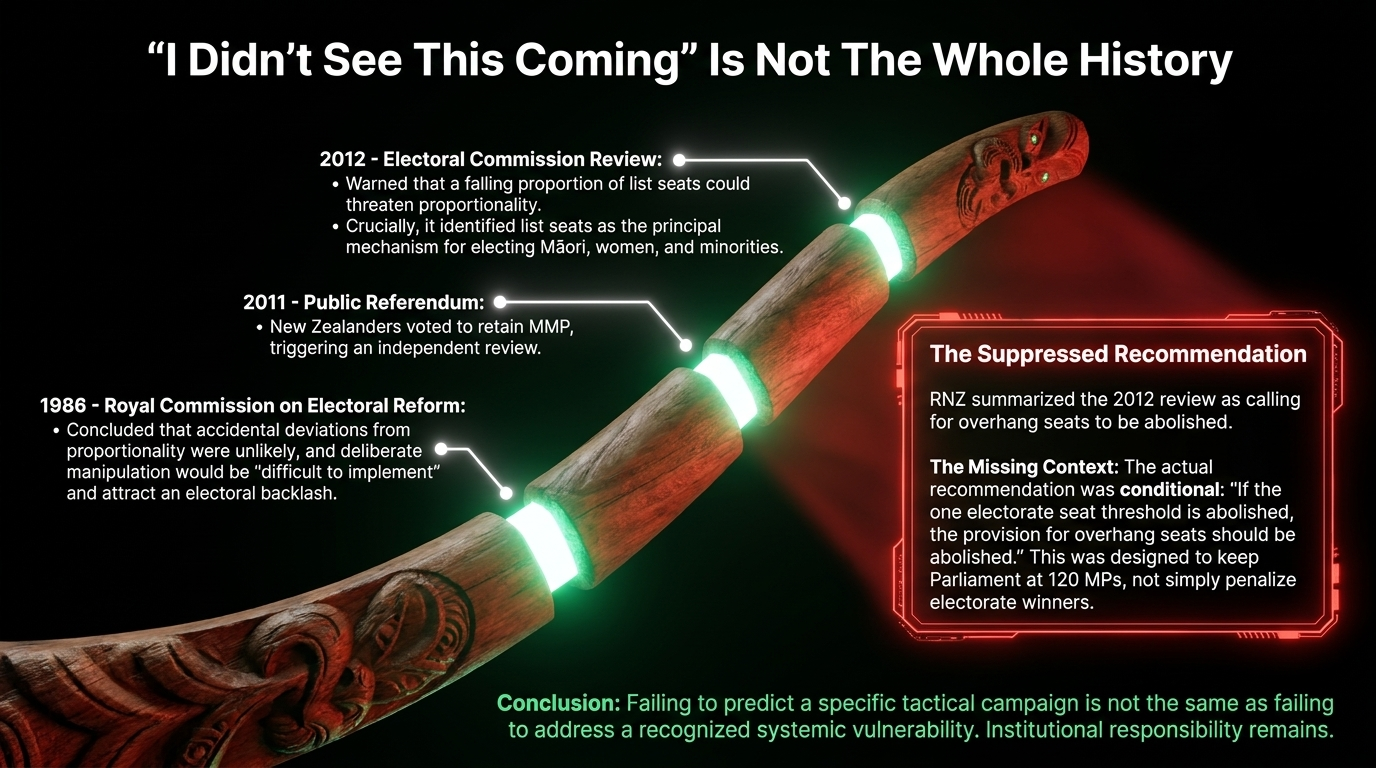
Rashbrooke says the problem “crept up upon us” and that he would not blame anyone very strongly for failing to anticipate it. Geddis argues that earlier proposals addressed a smaller, less pressing problem. Rashbrooke also points to the 1986 Royal Commission’s expectation that deliberate manipulation would be difficult and likely to attract an electoral backlash. Those explanations deserve a fair hearing.
But personal surprise cannot settle institutional responsibility.
The 2012 Electoral Commission review warned that a falling proportion of list seats could eventually threaten proportionality. It also identified a more immediate concern about diversity, describing list seats as the principal mechanism through which women, Māori and minority groups were elected. It proposed considering a fixed electorate-to-list-seat ratio. Those concerns were already in the official record.
That is not proof that the Commission predicted this particular pattern of tactical voting. It does show that preserving proportionality and representation was not an issue nobody had examined.
Failing to predict an event and failing to address a recognised vulnerability are different questions. Before excusing or condemning successive politicians, we need the proposals, the decisions and the reasons. Rashbrooke’s speculation about National’s “ego” may make for a lively quotation, but it does not provide that history. RNZ includes the remark without resolving the accountability question.
The article’s summary of the earlier remedy is also too compressed. It says the review following the 2011 referendum called for overhang seats to be abolished.
The recommendation actually said: “If the one electorate seat threshold is abolished, the provision for overhang seats should be abolished.” The condition is part of the recommendation, not a detail to discard.
It formed part of proposed changes to the treatment of parties winning electorates without crossing the party-vote threshold. Electorate winners would retain their seats, while Parliament would remain at 120 because additional list seats would not be allocated.
That is not a proposal simply to remove electorate winners whose seats exceed their party’s proportional entitlement. Nor can we assume from RNZ’s summary that implementing it would have prevented National’s reported overhang. Stopping Parliament from expanding and preventing disproportional representation are not interchangeable achievements.
Readers need that distinction before they can judge whether an earlier solution was neglected. Otherwise, the history becomes a reassuring reference to a review rather than an explanation of what the review would actually have changed.
Do Not Simplify Voters Out Of The Story
The first article also shows why commentary about Māori voting needs more care than a headline about a falling party vote.
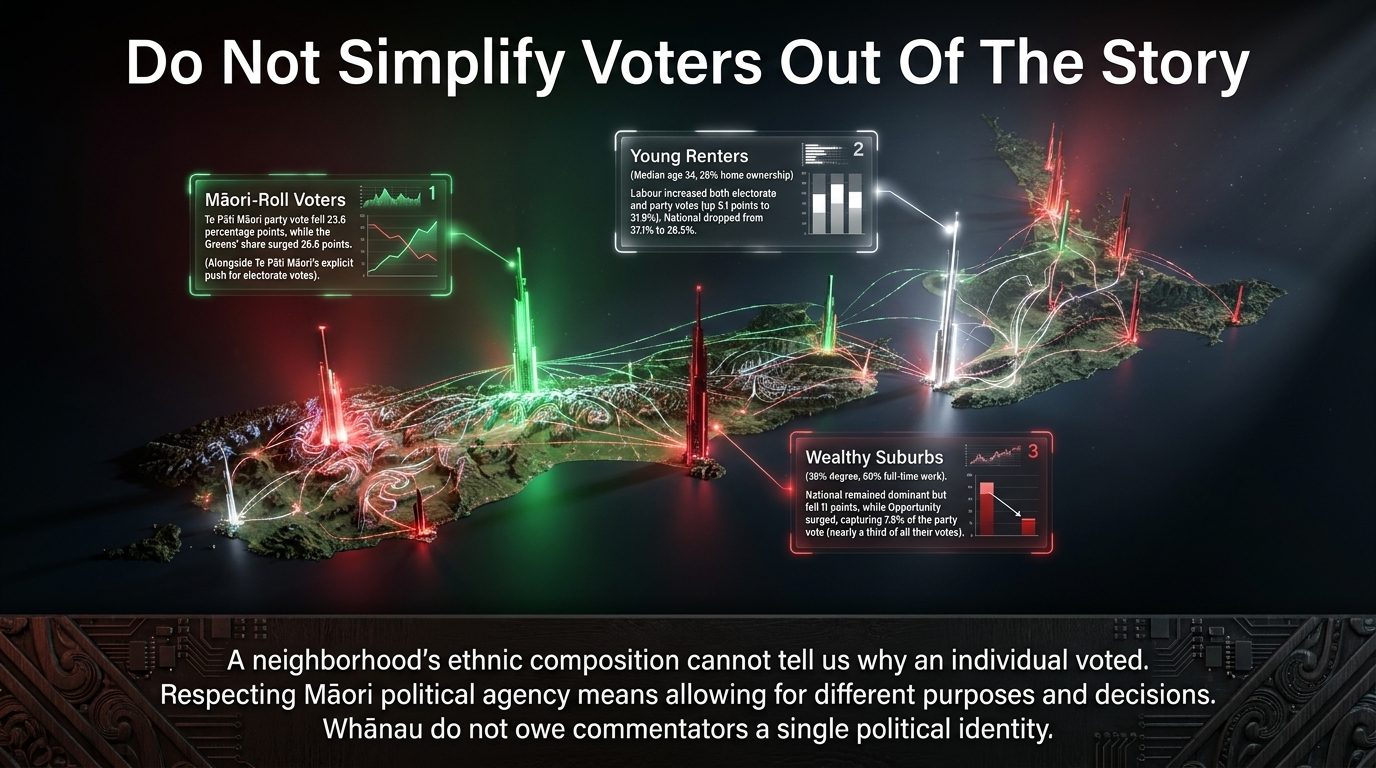
Among Māori-roll voters, RNZ reports that Te Pāti Māori’s party-vote share fell 23.6 percentage points compared with 2023, while the Greens’ share rose 26.6 points. Those movements sit alongside Te Pāti Māori’s explicit emphasis on electorate voting. Both choices are needed to interpret the result.
They do not prove everyone followed a plan. But a declaration of wholesale rejection based on the party vote alone would remove part of what voters did and then treat the remainder as the entire verdict.
Elsewhere, RNZ finds a different pattern. In neighbourhoods characterised by young renters with few children, Labour increased both its electorate and party votes. National’s party-vote share fell from 37.1 percent to 26.5 percent, while Labour’s rose 5.1 points to 31.9 percent. That is not the rural pattern of gains for National’s coalition partners.
These differences are the value of the analysis. Its limits matter just as much. RNZ links votes to the neighbourhood containing the voting place, not each voter’s verified residence. Its demographic profiles use the 2023 Census. Special and overseas votes are excluded from the comparisons, and the current results remain preliminary. The article discloses those qualifications.
A neighbourhood’s ethnic composition cannot tell us why an individual voted. A rise for one party alongside a fall for another cannot identify every voter’s journey. Respecting Māori political agency means allowing for different purposes and decisions, not replacing a hostile caricature with a flattering story in which everyone acted together.
Whānau do not owe commentators a single political identity.
Show Us What The Repair Would Do
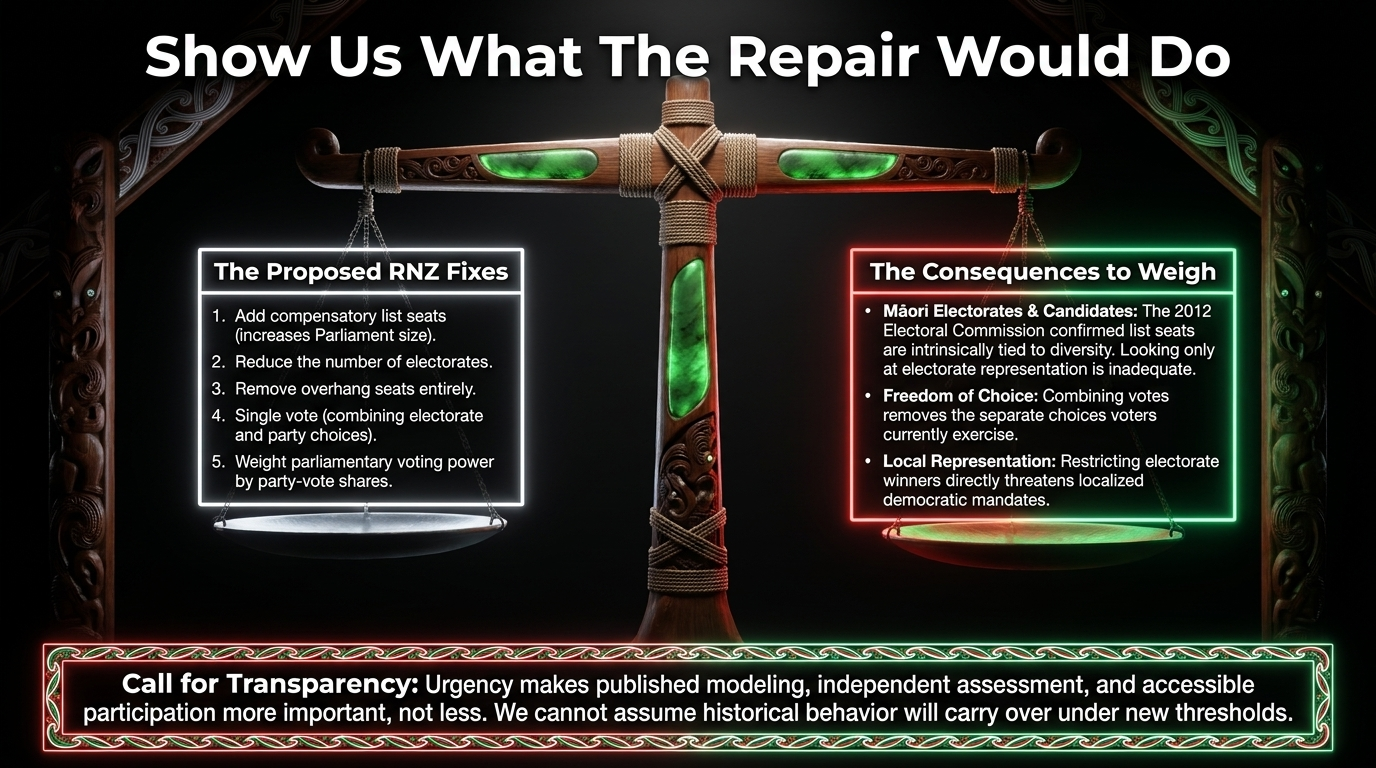
The proposed remedies deserve the same scrutiny as the diagnosis. RNZ lists additional compensatory list seats, fewer electorates, restrictions on electorate winners taking seats, a single vote serving electorate and party purposes, and parliamentary voting power weighted by party-vote shares. These are alternatives, not one agreed reform package.
They do different things to different people’s representation. Compensatory seats seek to restore proportionality while retaining electorate winners. Restricting those winners raises questions about local representation. Combining the votes removes the separate choices voters currently exercise. Weighting parliamentary votes changes the connection between the number of MPs and legislative power.
“Fix the overhang” does not tell the public enough to endorse any of them.
For Māori, the assessment must include effects on Māori electorates, Māori candidates, smaller parties and the freedom to choose different candidates and parties. That is not an accusation that every reform threatens Māori representation. It is a demand to examine the consequences before making the change. The Commission’s own discussion of list seats and diversity shows why looking only at electorate representation would be inadequate. Those forms of representation are connected.
Geddis acknowledges politicians’ interests in electoral design but argues that a parliamentary select committee offers a practical route to change before the next election. That is a genuine argument about time and implementation. Urgency, however, makes published modelling, independent assessment and accessible participation more important, not less.
The public should be shown how each option works, what assumptions sit behind the calculations and who gains or loses representation. A calculation using existing votes must also be distinguished from a prediction of how people would vote under new rules. The Commission cautioned against assuming historical behaviour would simply carry over under changed thresholds.
These articles do not establish that RNZ concealed National’s overhang or protected Mowbray from criticism. It reported both. Nor do they prove that commentators collectively deceived anyone. A critique that pretended otherwise would be guilty of the selective treatment it condemned.
What they do show is a discussion that needs to go further. The distinction between “organic” and engineered outcomes needs its evidence. Claims about every alternative system need boundaries. References to earlier recommendations need their conditions restored. Proposed repairs need their consequences explained.
There is enough substance here without inventing deception. A genuine proportionality problem can coexist with lawful voting choices. An expert can identify a real danger while overstating part of the case. Useful journalism can still leave essential questions unanswered.
The correction readers can carry into everyday kōrero is straightforward: both overhangs belong in the account, intention does not settle proportionality, and a repair must be judged by the representation it delivers.
Editors can put the material comparison beside the accusation. Experts can show the basis for their conclusions. Politicians can publish the consequences of their preferred changes and invite the people affected into the discussion before settling the design. That would leave whānau better equipped to judge the argument—and mokopuna a record of decisions tested before their consequences were handed on.
The Deep Dive Podcast
Listen to a lively conversation between two hosts, unpacking and connecting topics in the sources of this essay. I apologise in advance for the AI's very harsh pronounciation of reo. Please dont shoot me, :).
Youtube Video
Like video? Here is a short video suppporting the essay. Again, don't shoot the messenger please because of AI's pronounciation. :)
Koha Consideration
This investigation brings voting patterns, expert claims and earlier recommendations into the same account so whānau can assess the argument without accepting anyone’s authority on trust.
Independent scrutiny must include people whose wider concerns we share.
Your koha helps support and protect that standard and preserve a useful record for our mokopuna: what was known, what remained uncertain and what needed answering before the rules changed.
Those unable to contribute financially are welcome here. Sharing the essay, following and kōrero with whānau and friends are koha too. Helping someone recover missing context is a meaningful contribution to public understanding.

Voluntary koha: Give A Koha To Support And Protect This Mahi
Website subscription: Subscribe To The Māori Green Lantern
Direct bank transfer through your banking service:
Account name: Ivor Jones
Account number: 03-1395-0099387-000
Facebook subscription: Support Through Facebook

Disclaimer: This essay offers commentary on RNZ’s reporting and the electoral arguments discussed. Election figures cited are preliminary and may change. Criticism concerns public claims and decisions, not personal character; it does not allege unlawful conduct or deliberate deception. Corrections and substantive responses are welcome.