Wayne Brown, Democracy Is Not the Delay
After a business trip to China, Auckland’s mayor said democracy had had its day. His own record shows why the people who can question a decision need to be heard before it’s made.

Introduction
Wayne Brown was in China while New Zealand voted.
After the trip, Auckland’s mayor told Stuff what he made of the election:
“Democracy’s had its day. It’s time for something else, really.”
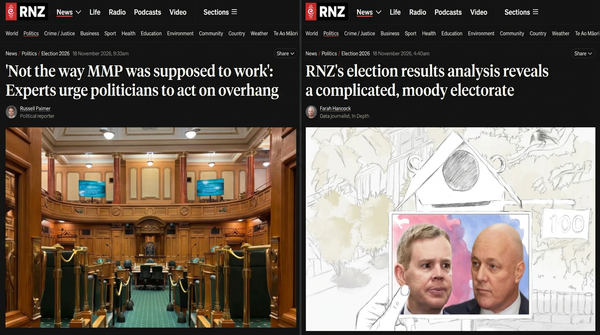
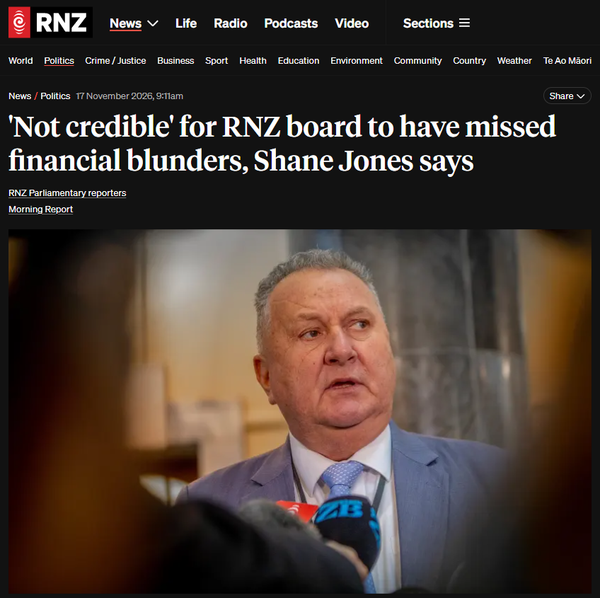
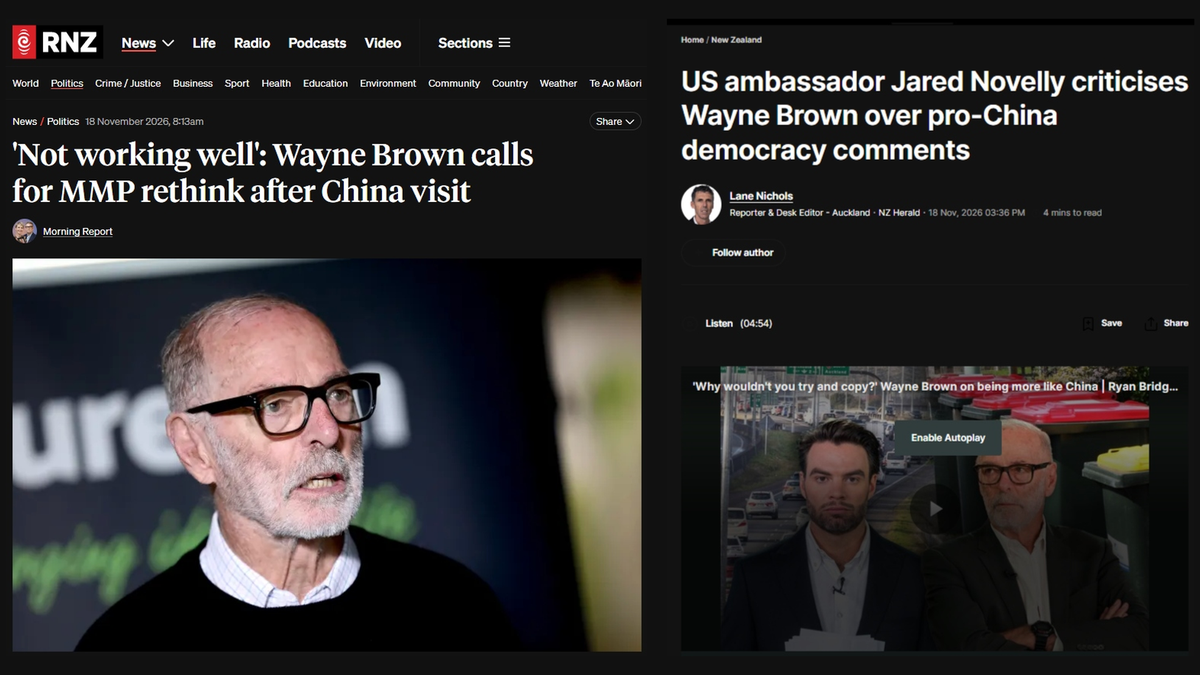
By the time he spoke to RNZ’s Morning Report, his position was narrower. He backed a referendum on MMP and said he wasn’t proposing that New Zealand adopt China’s Communist system. He’d just like to have China’s results.
 RNZ | Te Reo Irirangi o Aotearoa

Lane Nichols’ New Zealand Herald report led with US ambassador Jared Novelly, who called Brown a boomer, took a swipe at his intelligence and compared getting rid of democracy to getting rid of Auckland’s traffic lights.
 Lane Nichols
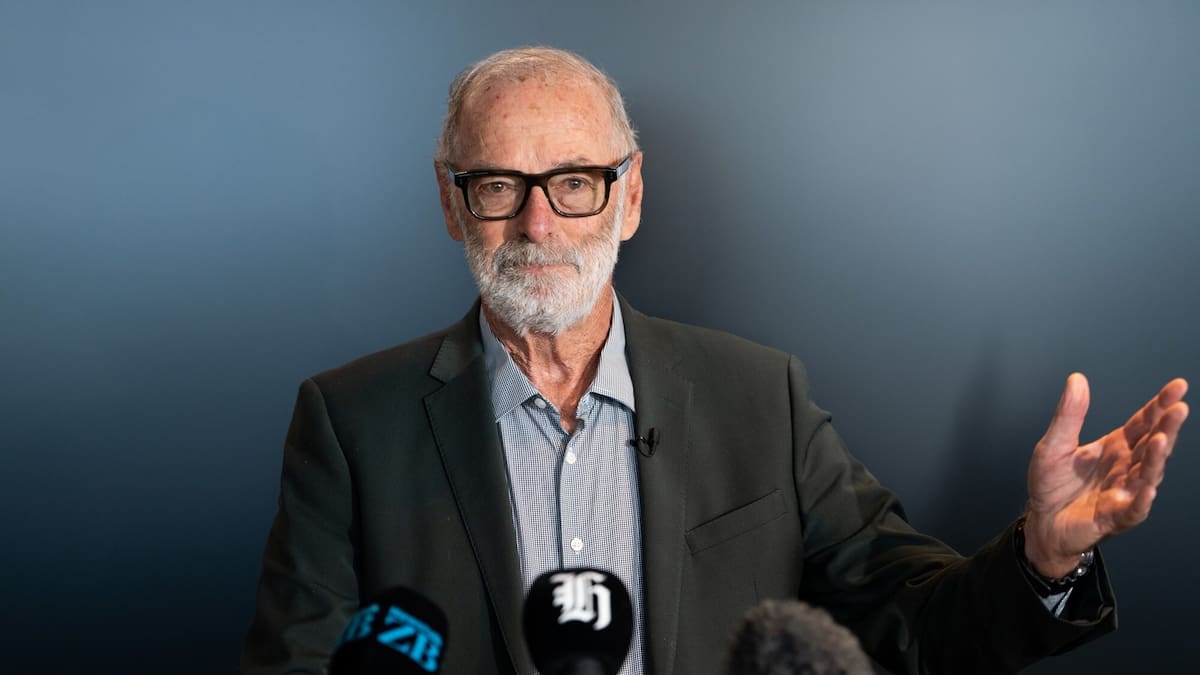
The more revealing exchange comes further down Nichols’ report, also published by Newstalk ZB. Broadcaster Ryan Bridge raised the example of building a motorway without the permissions a project would need here. Brown asked whether the motorway was needed and whether the rights of the majority outweighed those of the individual. He also said he wasn’t proposing a massive change to how we elect people and that “democracy’s fine by me”. He hasn’t put forward a plan for one-party rule.
What he has done is hold up China’s results while giving remarkably little weight to the people and procedures that can make a government explain itself before it acts.
There’s an argument worth having about how long it takes to build things in this country. Anyone who needs work, a bus that turns up or a reliable water supply has a stake in getting decisions made.
The Votes Brown Leaves Out
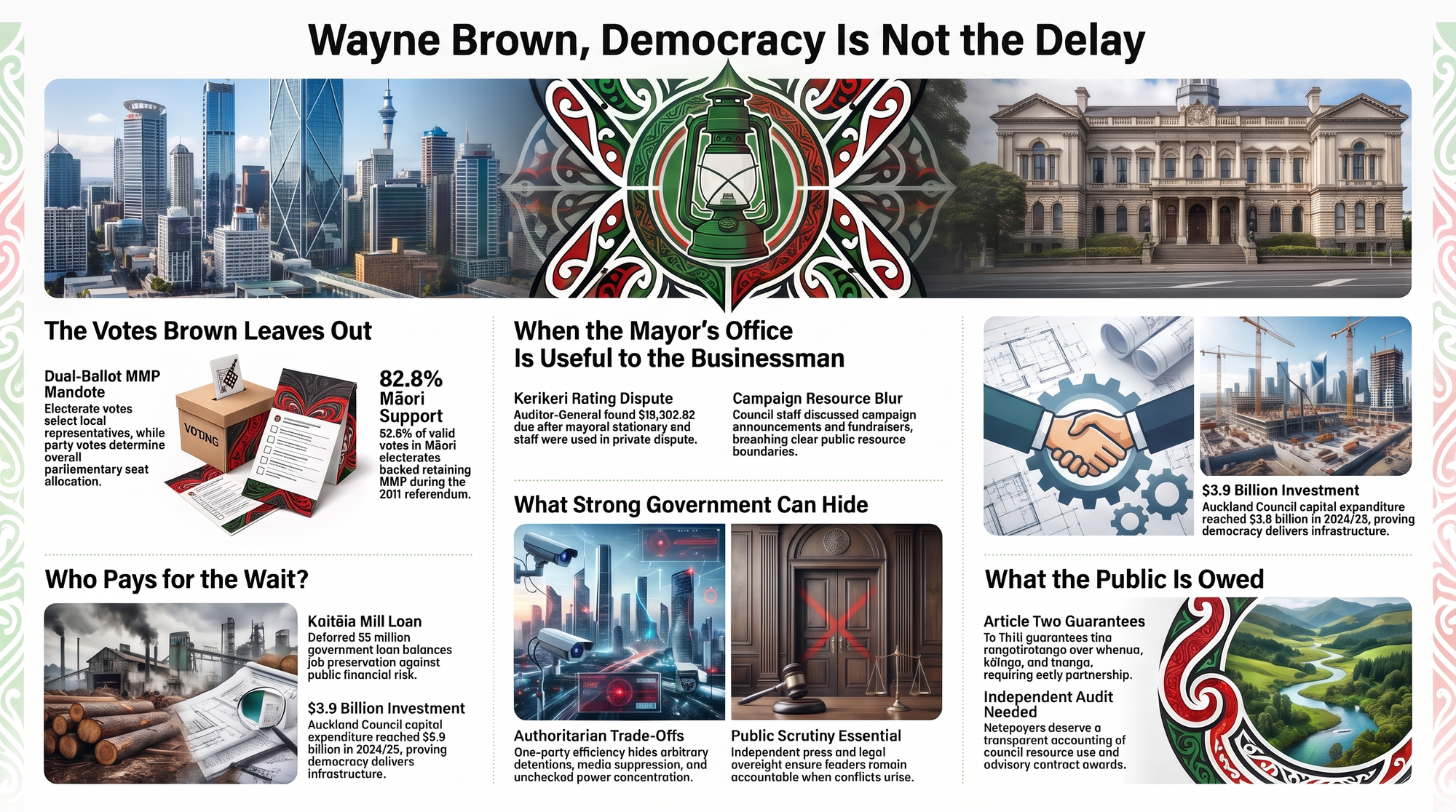
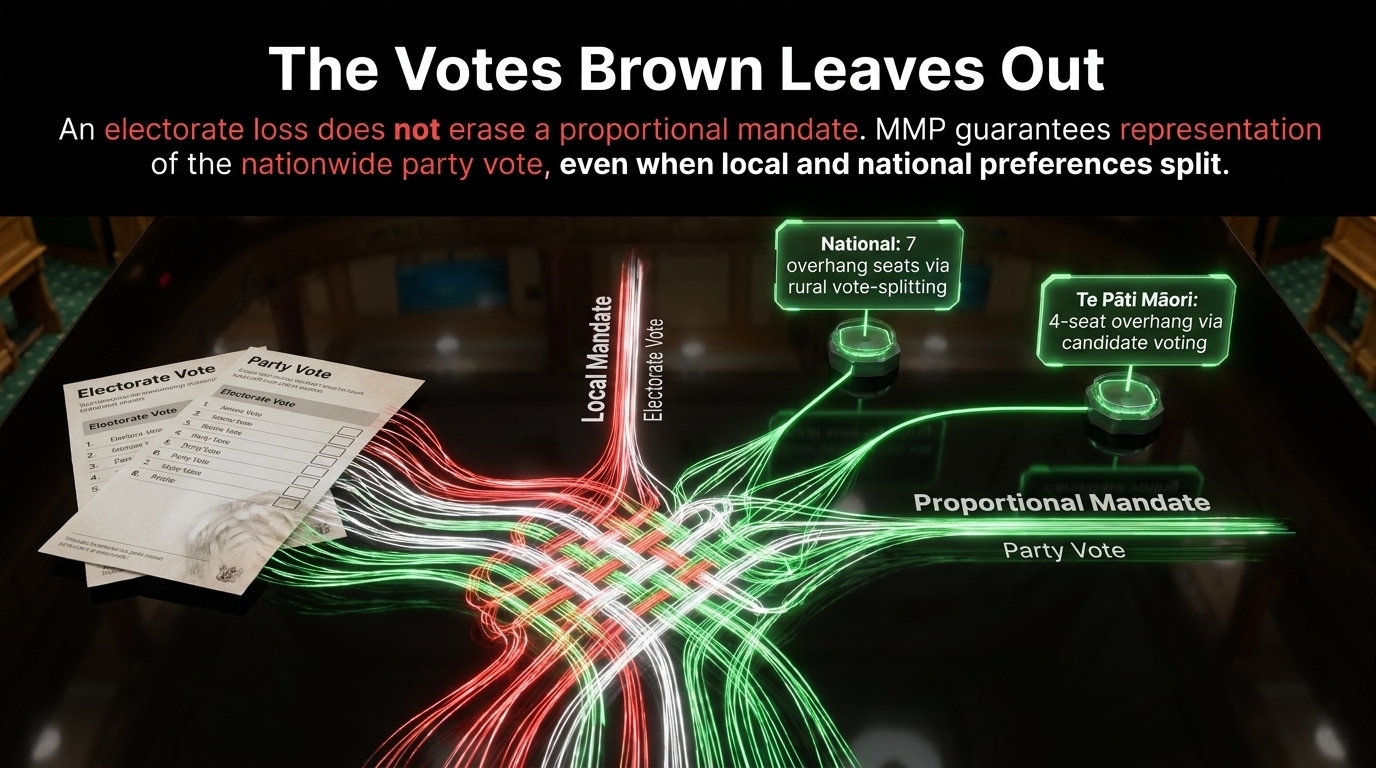
On Morning Report, Brown said Parliament was full of people who’d been “rejected by the locals”. He was talking about candidates who lost an electorate contest but entered Parliament on a party list. A candidate can indeed stand locally and lose.
What Brown leaves out is the other ballot.
Under mixed-member proportional representation, your electorate vote chooses your local MP; your party vote largely determines how many seats each qualifying party gets across Parliament. List MPs take those seats in their party’s list order. They don’t represent the electorate they lost, and they aren’t there without an electoral mandate. That’s how the two votes work, as the Electoral Commission’s review of MMP explains.
A close result can take time to settle. Voters are entitled to ask what should happen when a party wins more electorate seats than its party vote would ordinarily entitle it to.
When New Zealanders were asked in 2011 whether to keep MMP, 57.8% of valid votes said yes. In the Māori electorates, 82.8% of valid votes backed keeping it, as shown in the official referendum results by electorate. That’s a result for those electorates, not a survey of all Māori voters or a verdict that binds future generations. It does tell us whose votes can disappear from the story when opposition to proportional representation is treated as common sense.
Here’s the correction for everyday kōrero: The candidate lost the electorate contest. The party still earned seats through the party vote.
From there, we can have an honest argument about changing the rules. We can also ask whose preferences get the most airtime when those rules come up for debate.
As I argued in Your Fortune Is Not A Second Vote, wealthy people have every right to make their case. The rest of us have every right to follow the money and ask whose case gets heard.
When the Mayor’s Office Is Useful to the Businessman
Long before Brown went to China, there was a subdivision in Kerikeri.
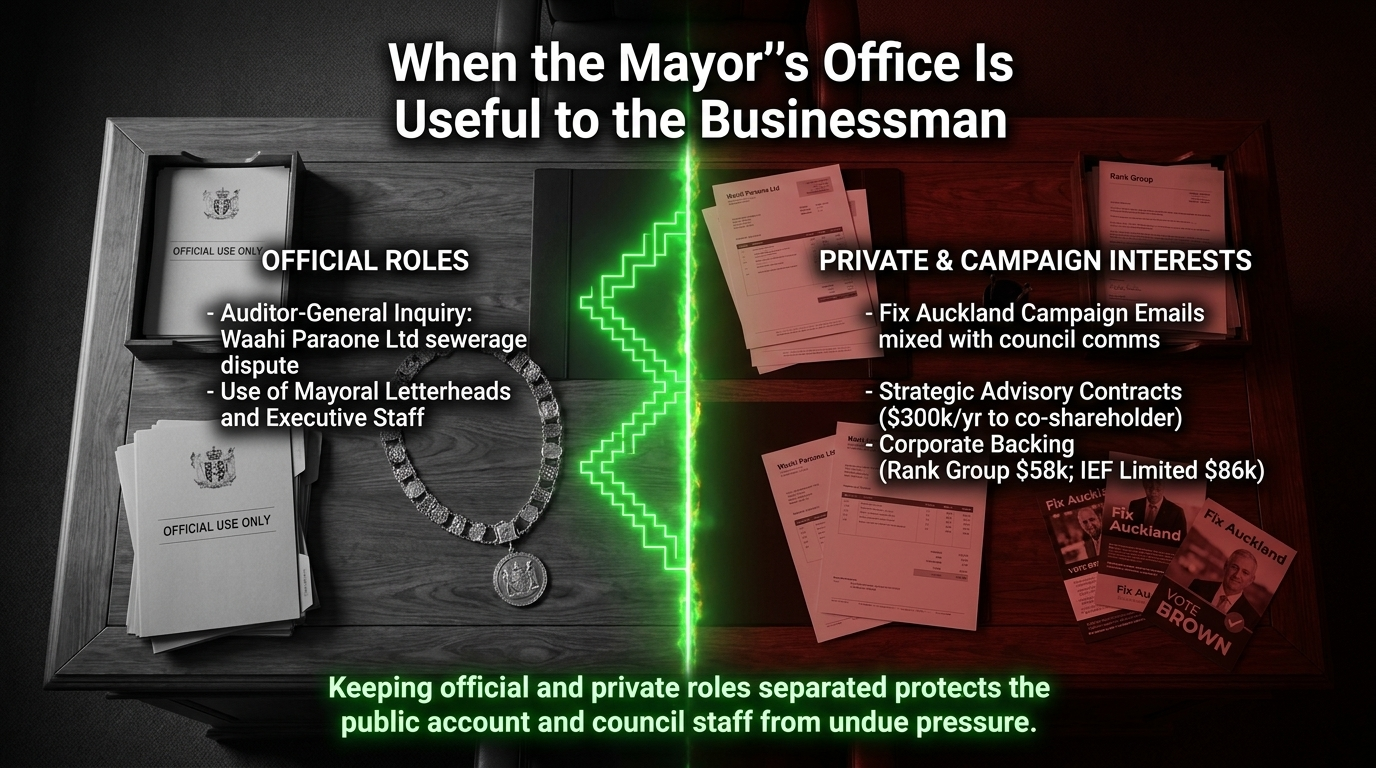
His company, Waahi Paraone Limited, had negotiated arrangements with the Far North District Council over sewerage connections and what it would pay. Some of those unusual arrangements predated his mayoralty.
Later, while Brown was mayor, the company withheld some rates and charges in a dispute with the council. Both sides asked the Auditor-General to step in. The inquiry found council errors and incomplete records on both sides. It concluded that $19,302.82 in rates and penalties was properly due; Brown paid after being advised of the draft finding.
Separately, it estimated the outstanding sewerage contribution at $76,487.09 as at 1 July 2012. That figure describes the balance at the time, as set out in the Auditor-General’s inquiry into the rates and charges owed by Brown’s company. It says nothing about what the company owes today.
Brown had every right to dispute a bill, and the council had made mistakes worth correcting. The problem was how he pursued it.
The conduct was unwise for a reason that doesn’t depend on proving pressure: a council employee shouldn’t have to work out whether a request from the mayor’s office is coming from a ratepayer disputing a bill or from the person who leads the council. Keeping those roles separate protects the employee as much as it protects the public account. The Auditor-General’s analysis of Brown’s conduct and the council’s handling of the dispute sets out that distinction.
Years later in Auckland, the boundary in question was between the mayoral office and Brown’s re-election campaign.
Emails obtained by Newsroom in its investigation into ratepayer-funded campaign activity show staff discussing how to announce that Deputy Mayor Desley Simpson was joining Brown’s Fix Auckland ticket. The deputy chief of staff advised keeping campaign references out of an official media release. The discussion then turned to putting Fix Auckland material into the speaking notes instead. Other correspondence involved mayoral-office staff in exchanges about a campaign fundraiser. The reporting also shows staff correctly directing some queries to the campaign.
Auckland Council said using council resources to assist electioneering was unacceptable. Brown’s office acknowledged that the separation had failed in some instances, called it inappropriate and said it took steps to address it.
The same investigation identifies Chris Mathews as a long-time friend, business associate and campaign figure who held a ratepayer-paid strategic advisory contract worth around $300,000 a year.
Newsroom’s separate reporting on the advisory contract and the shared company documents that Brown and Mathews were fellow shareholders in Asia Pacific Hotels Limited. Mathews told the Companies Office it had no assets and had never traded. The mayor’s office said his advisory contract ended to manage the perception of a conflict around the re-election campaign. Those facts don’t establish that the advice was worthless or that the contract was unlawful.
Brown’s 2022 electoral return, as reported by RNZ, showed $58,265 from Graeme Hart’s Rank Group, $86,825 across four contributions from IEF Limited, including support in kind, and $34,500 from Auckland Construction Group.
The figures show how much a handful of businesses could put behind one candidacy.
They don’t show who got a meeting, let alone that anyone bought a decision. If a donor later has business before the council, the useful questions are who met them, who made the decision and what reasons were recorded. The donor’s surname or where their company operates tells us none of that.
Who Pays for the Wait?
The strongest case for Brown’s impatience is in Kaitāia.
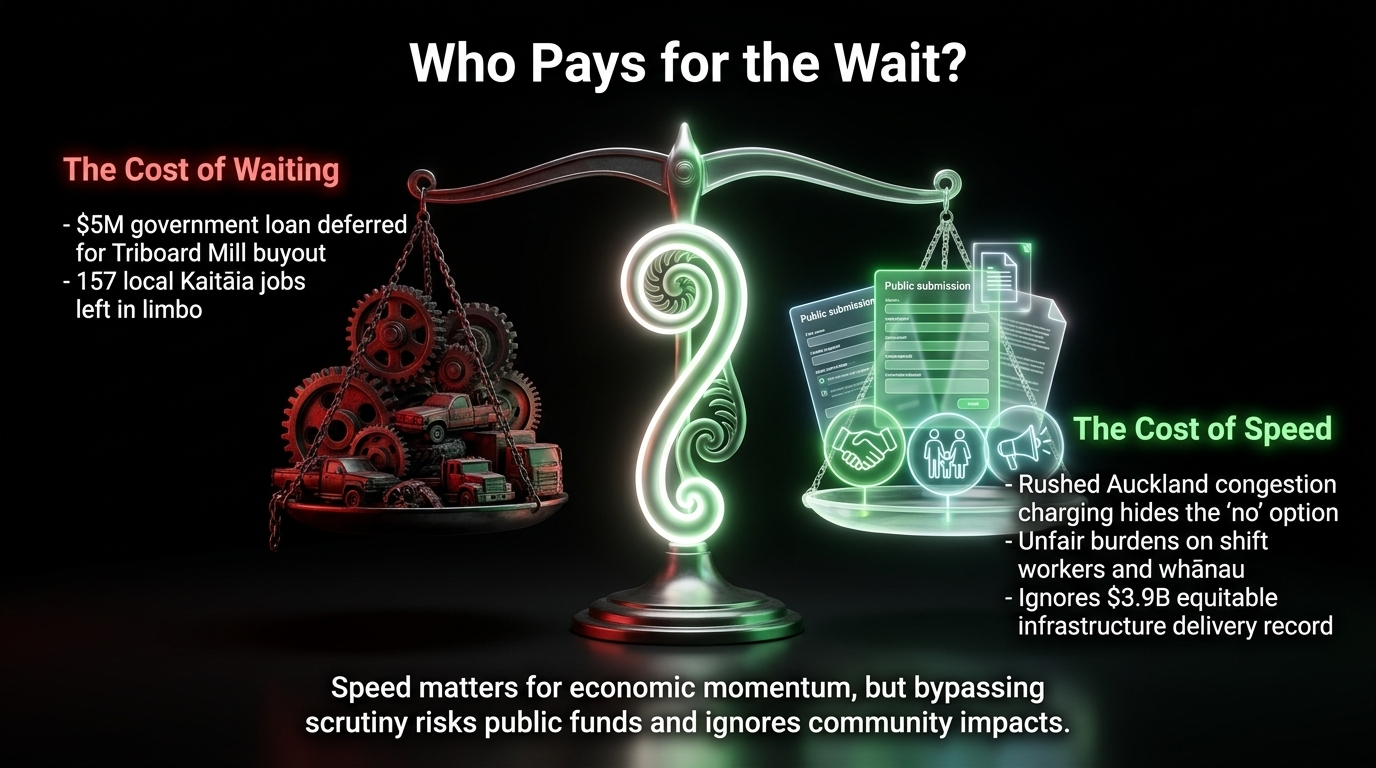
RNZ’s reporting on the stalled mill negotiations says ministers deferred decisions on proposed loans connected with two timber mills until after the election. Brown, acting as a Far North businessman rather than as Auckland mayor, led a consortium seeking a $5 million government loan to buy the Triboard Mill. Its existing owner said 157 jobs would go by March under either option it had announced. About 60 jobs had already gone at the neighbouring veneer mill.
Those are different groups of workers: one facing announced job losses, the other already living with them. The prospect of keeping industrial capacity in Kaitāia and retaining or restoring work deserves to be assessed on its merits.
The loan puts a commercial interest of Brown’s alongside the kind of post-election delay he’s complaining about. It doesn’t show that the loan drove his comments, or that anything he discussed in China stood to enrich him.
What it shows is why speed and scrutiny both matter. The delay has consequences for workers, while the proposed loan would put public money at risk. Ministers should explain what could be decided under caretaker arrangements and on what timetable. If a loan proceeds, the decision should say what the public is taking on and what the buyer is committing to deliver for workers. There’s no reason the people whose jobs are on the line should have to piece that together from competing accounts after the deal is done.
Back in Auckland, Brown told RNZ that congestion charging was going ahead:
“We’re gonna have it.”
As 1News reported on the council’s consultation, the form presented three designs and offered no dedicated option to oppose them all. Councillors John Gillon and John Watson pointed residents to the “other” field. Objections can be made; the council should say how it will count them and what they can change. For someone working a shift or taking a child to Starship, the concern is whether the price, route or available alternatives make an essential trip harder. The public should be able to see whether that evidence changed the design or the exemptions, and what the council decided to do with objections to charging itself.
A mayor can care about delivery and still get the process wrong.
Auckland Council’s annual results put capital investment at $3.9 billion in 2024/25, up from $3.2 billion the previous year, including work on transport, water and community facilities. Brown is entitled to point to that record. It also undercuts the suggestion that democratic contest makes substantial public investment impossible. His own council is a better place to look for ways to improve delivery than a claim that democracy has had its day.
What Strong Government Can Hide
Brown is right about one big thing: China’s economic transformation is real. The World Bank’s work on China’s poverty reduction documents the enormous fall in extreme poverty over four decades. Aotearoa can learn from what China built and how it built it. That the growth occurred under one-party rule doesn’t tell us how much of it came from market reforms, investment or other changes, let alone establish that suppressing political opposition produced it. And a demonstration of the camera-based traffic technology Brown told RNZ he wanted to learn about cannot tell Auckland who ought to hold its residents’ data, what it may be used for or when it must be deleted. Those decisions remain ours.
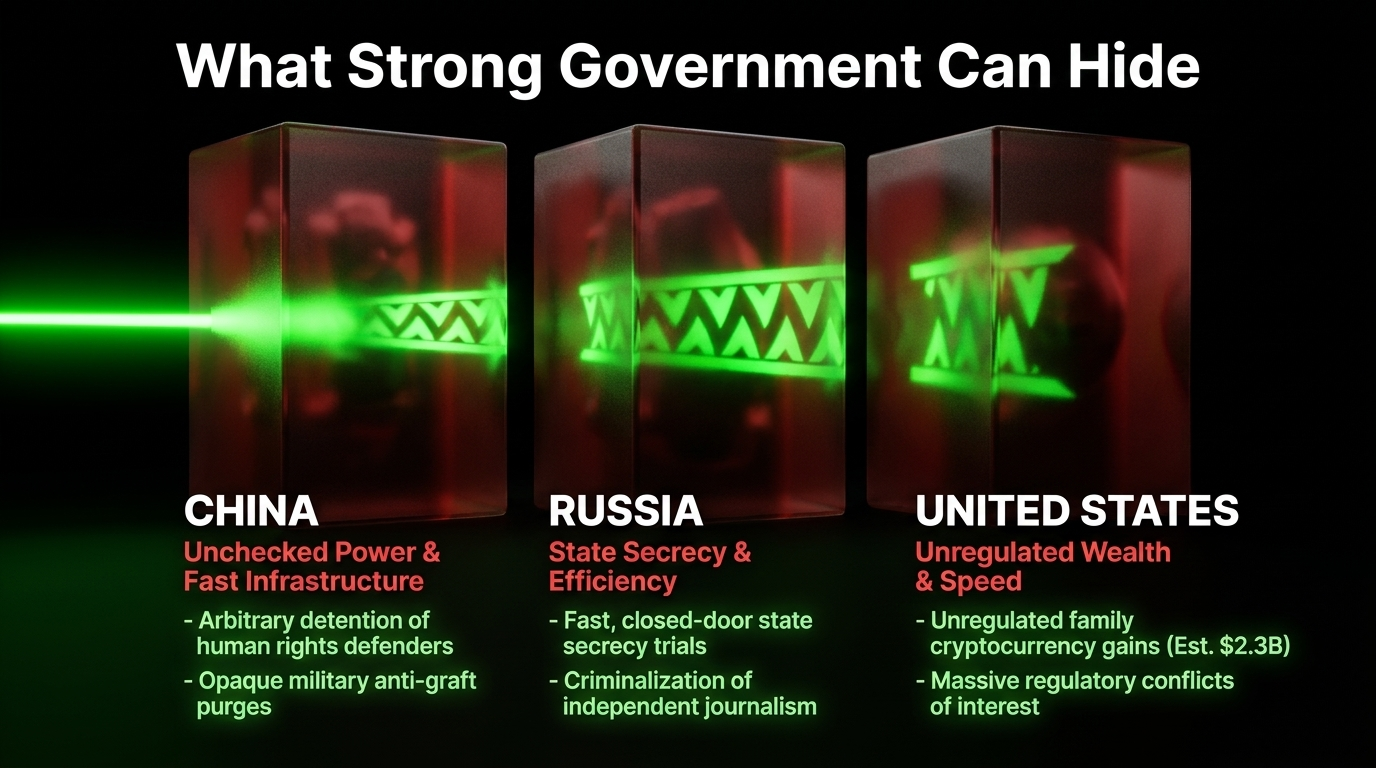
Human Rights Watch documents arbitrary detention of human rights defenders and restrictions on reporting and civil society under Xi Jinping. At the same time, Xi’s anti-graft drive has reached the top of the military. The 2026 investigation into General Zhang Youxia showed that even a longstanding ally was within reach. It also prompted analysts to warn that power was becoming more concentrated and the military command more opaque, as Reuters reported on the Zhang investigation. An investigation can uncover real wrongdoing without giving the public more ways to find out how power is used. The harder test is whether people outside the leader’s circle can bring evidence to light, including when it implicates the people in charge.
In Vladimir Putin’s Russia, former deputy defence minister Timur Ivanov was convicted of corruption in 2025 and sentenced to 13 years in a penal colony. He maintained his innocence, and the proceedings were closed on state-secrecy grounds, according to Reuters’ account of the trial and sentence. A year later, a Moscow court rejected Ivanov’s bid to sign a military contract and go to fight in Ukraine. The Moscow Times, which reported that ruling, has itself been designated “undesirable” by Russian authorities, making participation in its work in Russia punishable. The closed trial doesn’t establish that the conviction was unfounded. The treatment of the press shows another cost: the state can prosecute an official while making it dangerous for independent journalists to investigate the system he worked in.[reuters][themoscowtimes]
And then there’s the country Jared Novelly represents. Donald Trump remains the beneficiary of a trust that receives income from his family’s cryptocurrency ventures while his administration regulates and promotes the sector. Reuters’ analysis of the family’s main crypto projects estimated about US$2.3 billion in family gains and about US$2.3 billion in outside investors’ net losses, including paper losses, by the end of April 2026. The matching estimates don’t mean every dollar lost went to the family, and they’re not proof of stolen taxpayer money or a regulatory favour sold. The White House denies there is a conflict, as Reuters reported alongside Trump’s financial disclosure. The financial interest and the regulatory authority are visible regardless: the president’s family earns money in a market his administration oversees. Novelly’s defence of the public’s right to hold leaders to account applies in Washington as much as it does at Auckland Town Hall.
The comparison is about what the public can find out and do, not a claim that Auckland is governed like Beijing, Moscow or Washington. An election won’t answer whether an officeholder’s business interests influenced a decision. A prosecution won’t answer whether investigators can pursue the people who appointed them. And a motorway that opens on time won’t tell you whether the people who bore its costs had a fair hearing.
What the Public Is Owed
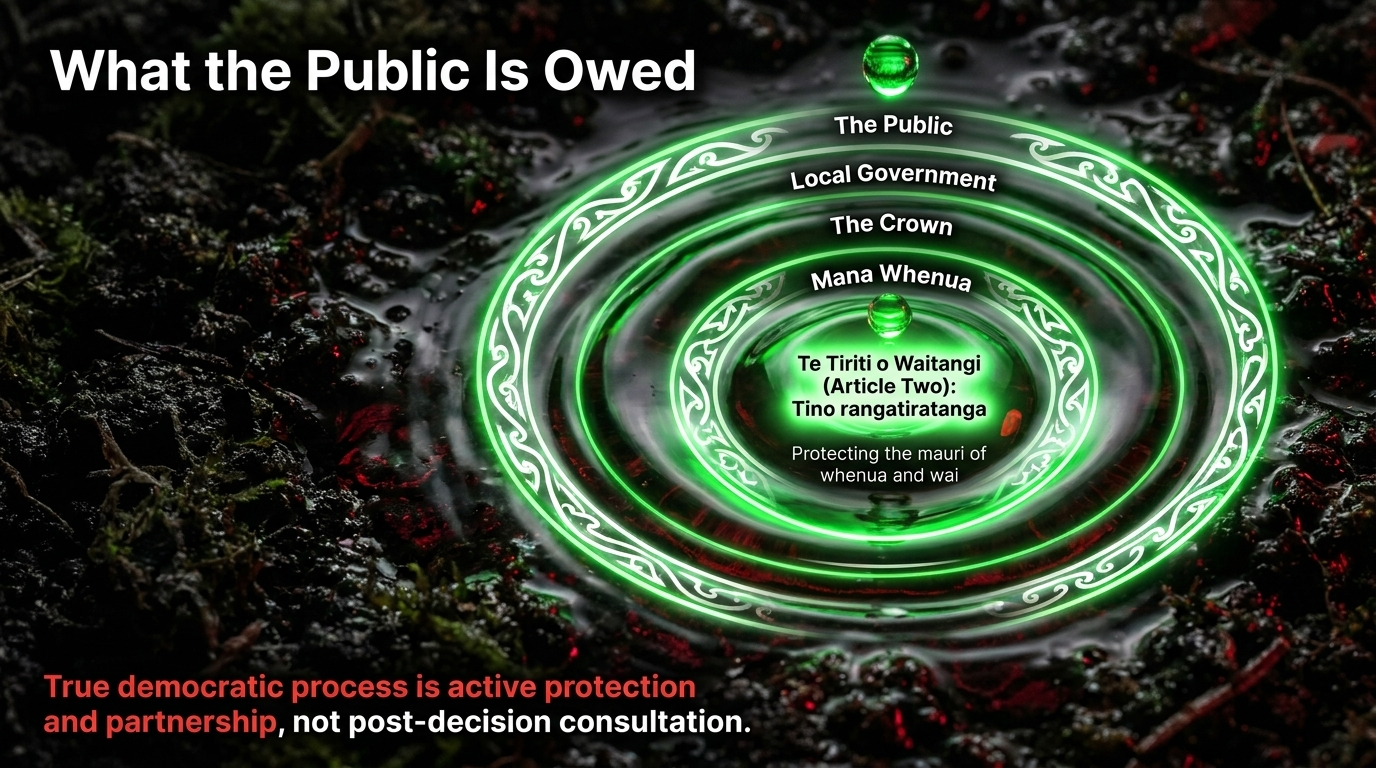
Brown’s motorway example weighs the needs of a majority against the rights of an individual.In Aotearoa, that leaves out an authority that doesn’t fit either box.
As Te Ara’s comparison of the Treaty texts explains, Article Two of the Māori text guarantees tino rangatiratanga over lands, kāinga and taonga. Where a decision affects whenua or wai, the hapū and iwi with relationships and responsibilities there aren’t simply another set of individual submitters.
In its Māori wards inquiry, the Waitangi Tribunal found that the Crown prioritised a coalition agreement without consulting its Treaty partner and failed to actively protect Māori interests in dedicated local representation, causing significant prejudice.
That finding concerns the Crown, not Brown. It shows why inviting people to respond after a commitment has been made is a poor substitute for involving them when decisions can still change.
In this essay, attending to mauri means asking whether a decision sustains the life of a place and the relationships through which people care for it. On a transport project, that might mean the council working with the relevant mana whenua early enough to change an alignment that threatens a waterway, or listening to whānau early enough to redesign a charge that would make essential trips harder. Those are examples of what a process could protect, not claims about harm already done or about what any particular hapū would decide. Completing a consultation tells us that a process took place. It doesn’t tell us whether people had the authority or opportunity to protect what they were responsible for.
The same care is needed with the word corruption.
Transparency International’s account of political corruption and state capture starts from the abuse of entrusted power for private gain. A bribe is one form. Diverting public resources to an incumbent’s campaign can confer an advantage without putting a dollar in the incumbent’s pocket. Awarding a contract to favour an associate at public expense, where that purpose is established, doesn’t require a kickback to count as abuse. At the systemic end, private interests can gain enough influence to shape the very rules meant to restrain them. The definition is worth widening beyond bribery because it lets us examine the abuse itself. It is not a licence to call every conflict corrupt, every donation a purchase or every bad decision a scheme.
It doesn’t establish that Brown praised China to enrich himself.
Auckland Council doesn’t need to settle his private motives to act on the conduct already documented. It should commission an independent review of the campaign-related work, establish what ratepayer time and resources were used, and publish what it can lawfully release about how the advisory contract was awarded, what it delivered and how conflicts were managed.
If the records can’t answer those questions, the review should say what’s missing, who was responsible for keeping it and what will change before the next campaign.
Aucklanders paid for the work. Auckland Council owes them an account of whose work got done.
The Deep Dive Podcast
Youtube Video
Koha Consideration

Voluntary koha: Give A Koha To Support And Protect This Mahi
Website subscription: Subscribe To The Māori Green Lantern
Direct bank transfer through your banking service:
Account name: Ivor Jones
Account number: 03-1395-0099387-000
Facebook subscription: Support Through Facebook
A remark about democracy can burn through the news in a day. The records that let whānau test it—the voting rules, the audit, the emails and the council’s own response—are worth keeping together.
That gives mokopuna something better than a memory of who got the last word: they can see what was said, what was established and what still needed answering.
If you’re able to contribute financially, the pathways below are ways to support and protect this mahi.
If you can’t, you’re welcome here just the same. Sharing the essay, following the mahi and taking it into kōrero with whānau and friends are koha too.

Disclaimer: This essay is political commentary. It distinguishes documented conduct from editorial judgement and does not allege that Wayne Brown took bribes or that personal financial gain motivated his comments about China. The accompanying screenshots are from RNZ and the NZ Herald.