"Don Brash, Your Own Sources Undermine Your Scare Story" - 17 November 2026
Brash warns that democracy is under attack, then asks for money. Restore the missing context and his case against three Māori-rights voices starts falling apart.

"Don Brash, Your Own Sources Undermine Your Scare Story" - 17 November 2026
Kia ora Aotearoa,
I signed up to Hobson's Pledge email list so I could keep an eye on them. This lot are so dumb, I tell ya.
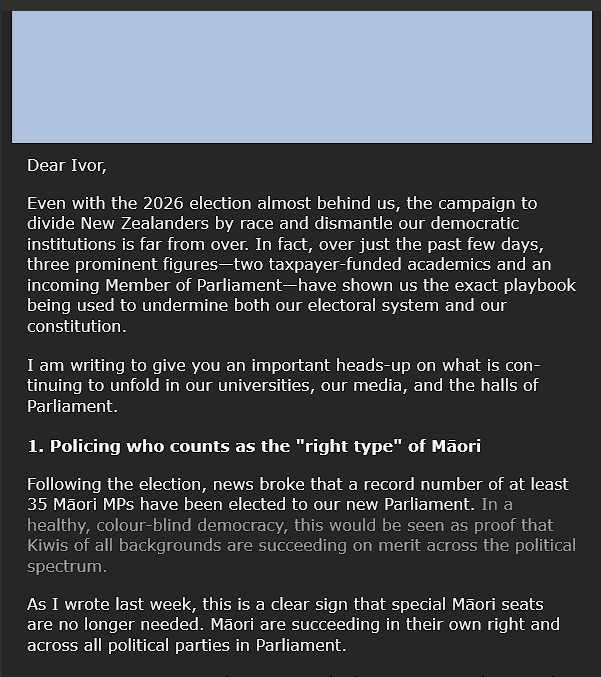
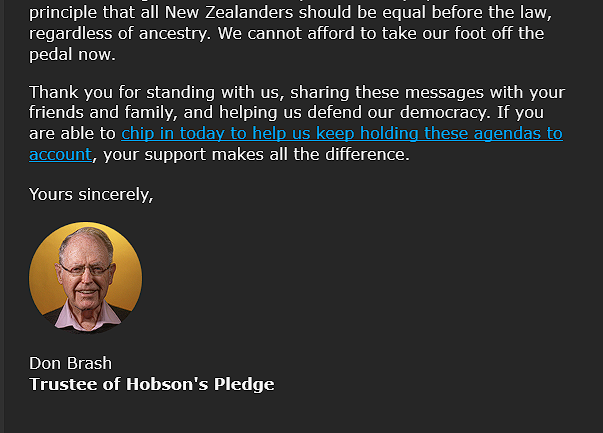
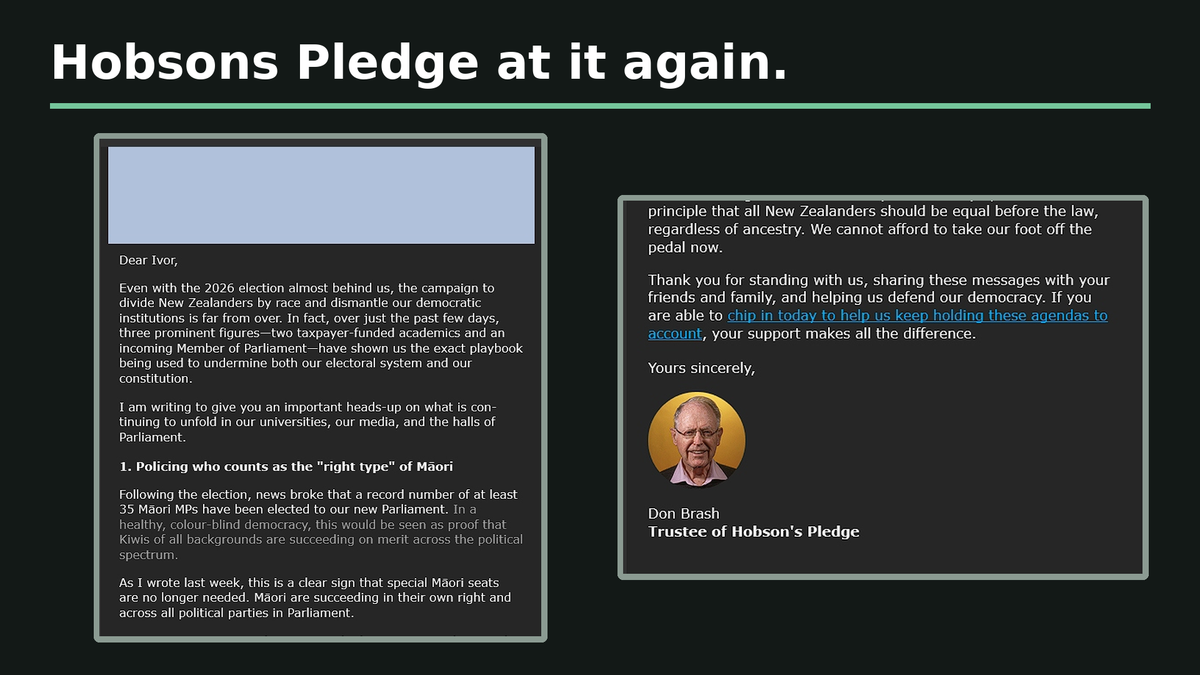
In his latest email blast, Don Brash warns that democracy is under attack. Then he asks for money. But the evidence between the alarm and the donation link does not establish the threat he describes.
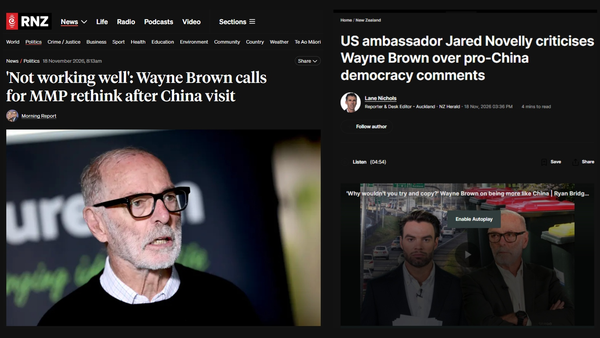
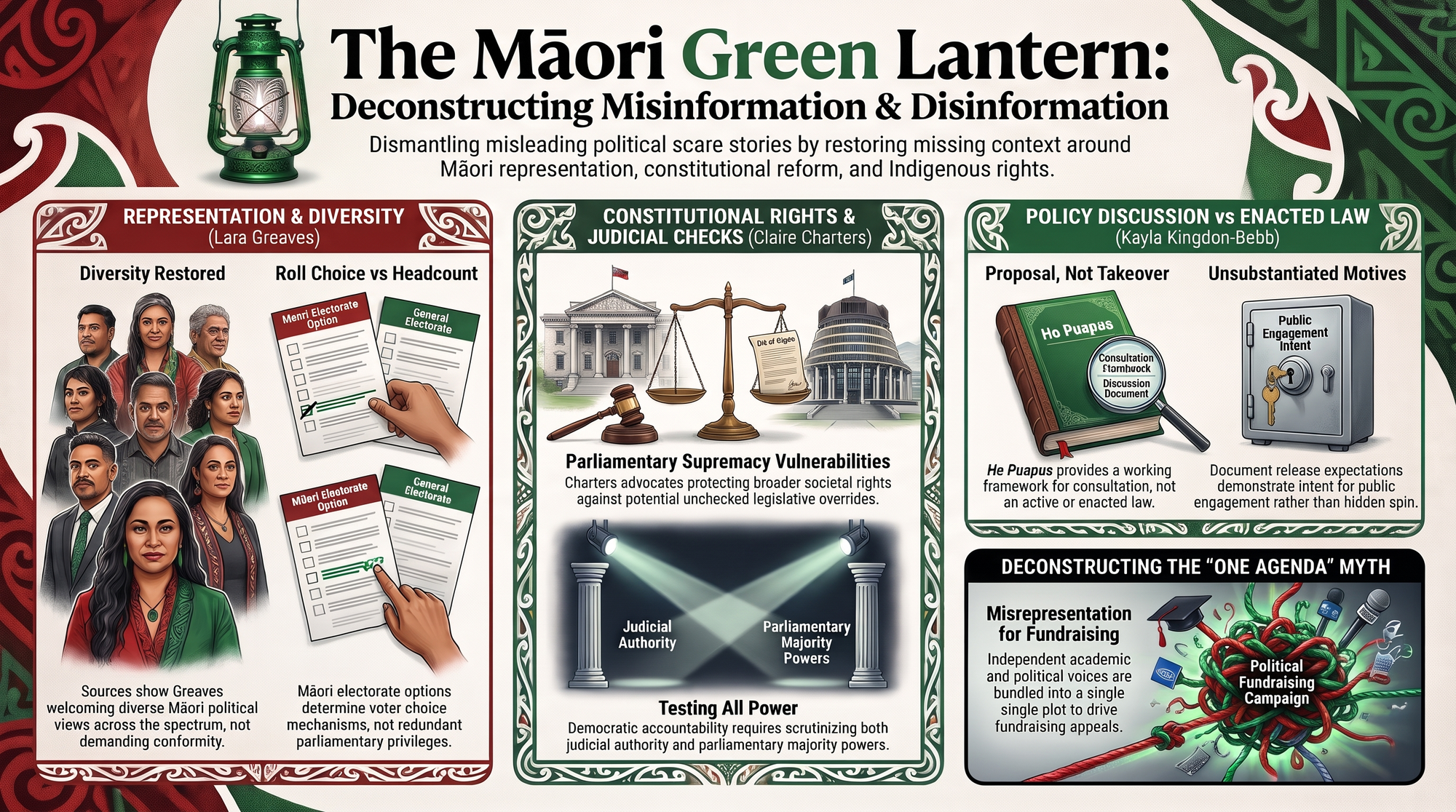
His Hobson’s Pledge email of 17 November 2026 accuses political scientist Lara Greaves of policing who counts as the “right type” of Māori. Yet the article he draws from reports her welcoming Māori politicians with different views—including conservatives. She describes people wanting to improve the country according to their own convictions, “whether that is more conservative or whether that is more mana motuhake”. That is in RNZ’s original report.
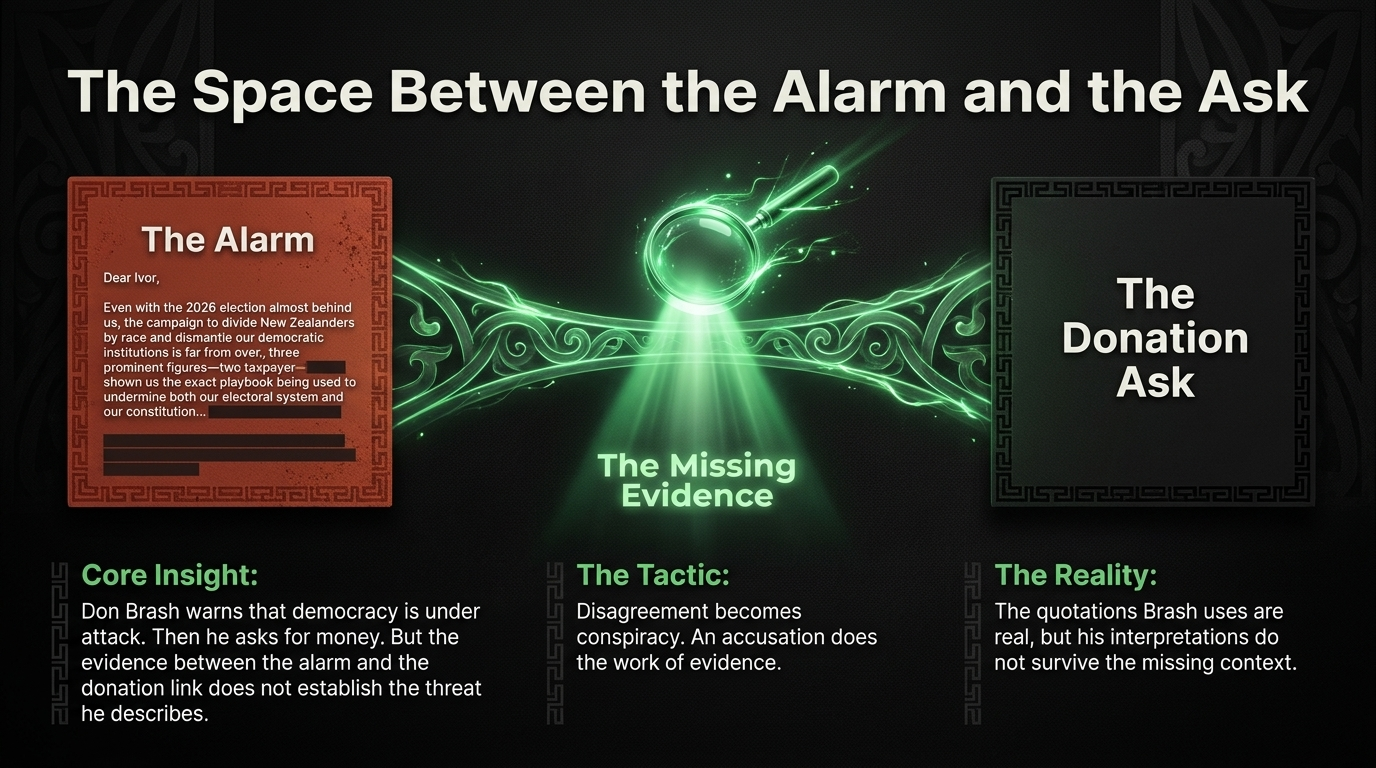
The quotation Brash uses is real. His interpretation does not survive the missing context.
That is the problem running through this appeal. Greaves discusses representation. Professor Claire Charters argues for constitutional change. Incoming Opportunity Party MP Kayla Kingdon-Bebb discusses He Puapua. Brash bundles them into “three voices, one agenda” against democracy.
I do not have to agree with everything these women say to insist that he represent their arguments honestly. Neither do you.
Māori rights, electoral representation and constitutional power deserve serious scrutiny. They do not deserve a fundraising story in which disagreement becomes conspiracy and an accusation does the work of evidence.
He Accuses Her Of Rejecting Diversity—Then Leaves Out The Diversity
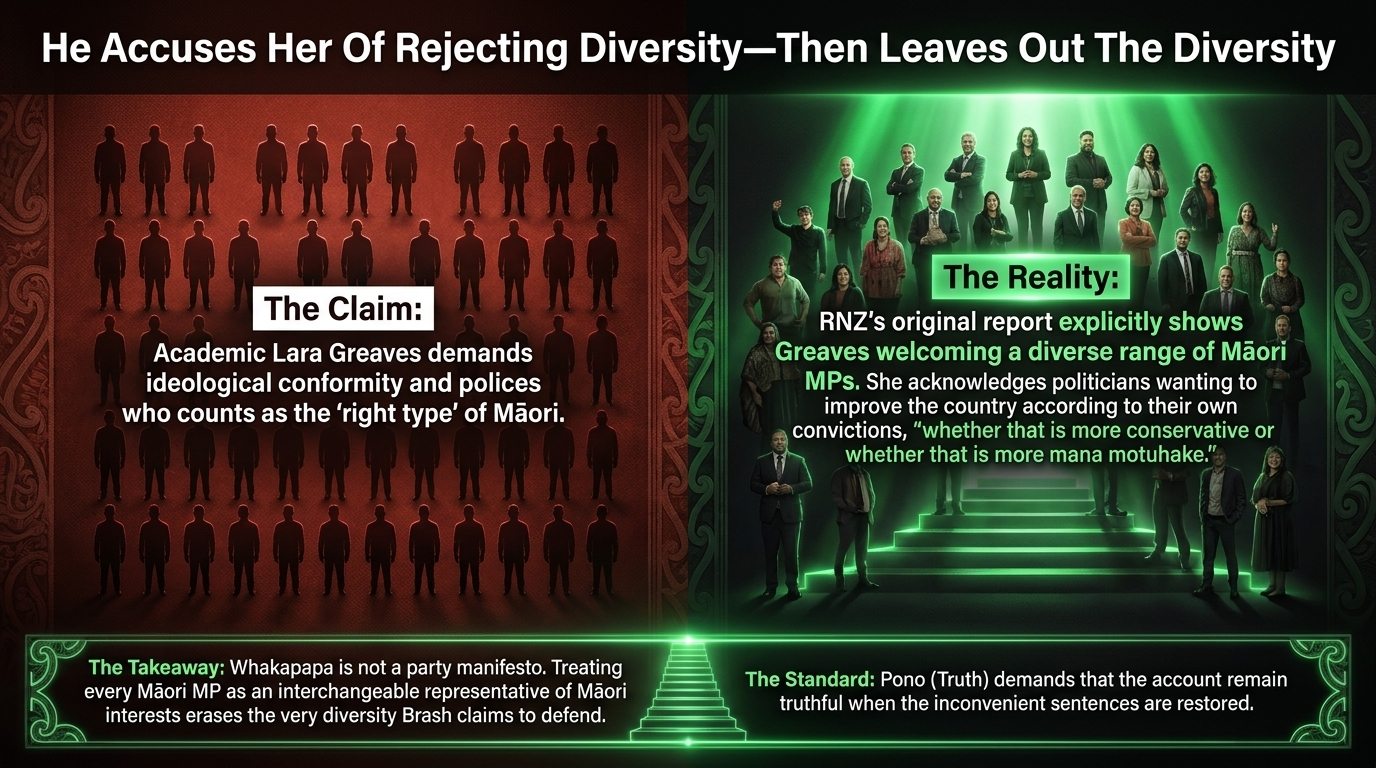
Greaves makes a straightforward distinction: having Māori MPs is not the same as having MPs whose political priorities include Indigenous rights.
Brash turns that into an allegation that she demands ideological conformity. But RNZ’s fuller account reports her welcoming a diverse range of Māori willing to stand for Parliament. It explicitly recognises different Māori politics across the political spectrum. Read what she actually said.
The distinction is not difficult. Who someone is does not tell us everything they stand for. Māori MPs can disagree about Te Tiriti, taxation, public services and the distribution of power without becoming less Māori.
Whakapapa is not a party manifesto.
Treating every Māori MP as an interchangeable representative of Māori interests would erase the diversity Brash claims to defend. Greaves recognises that diversity. His accusation obscures it.
That matters because his readers are not simply being offered a disagreement with her analysis. They are being invited to judge her conduct and character: here, supposedly, is an academic deciding which Māori count.
The source does not establish that claim.
Pono demands that the account remain truthful when the inconvenient sentences are restored. Put them back, Don. Then argue with what she said.
Brash’s next move is no stronger. He uses the number of Māori MPs to argue that Māori electorates are unnecessary.
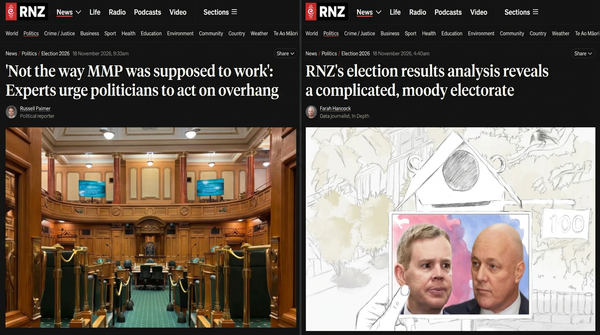
RNZ reported at least 35 provisionally elected, while noting that special votes could change Parliament’s composition. The same article examined Greaves’ concern that fewer list seats could restrict a route through which parties bring Māori candidates into Parliament. The number came with a warning about the electoral system, not a guarantee of permanent security.
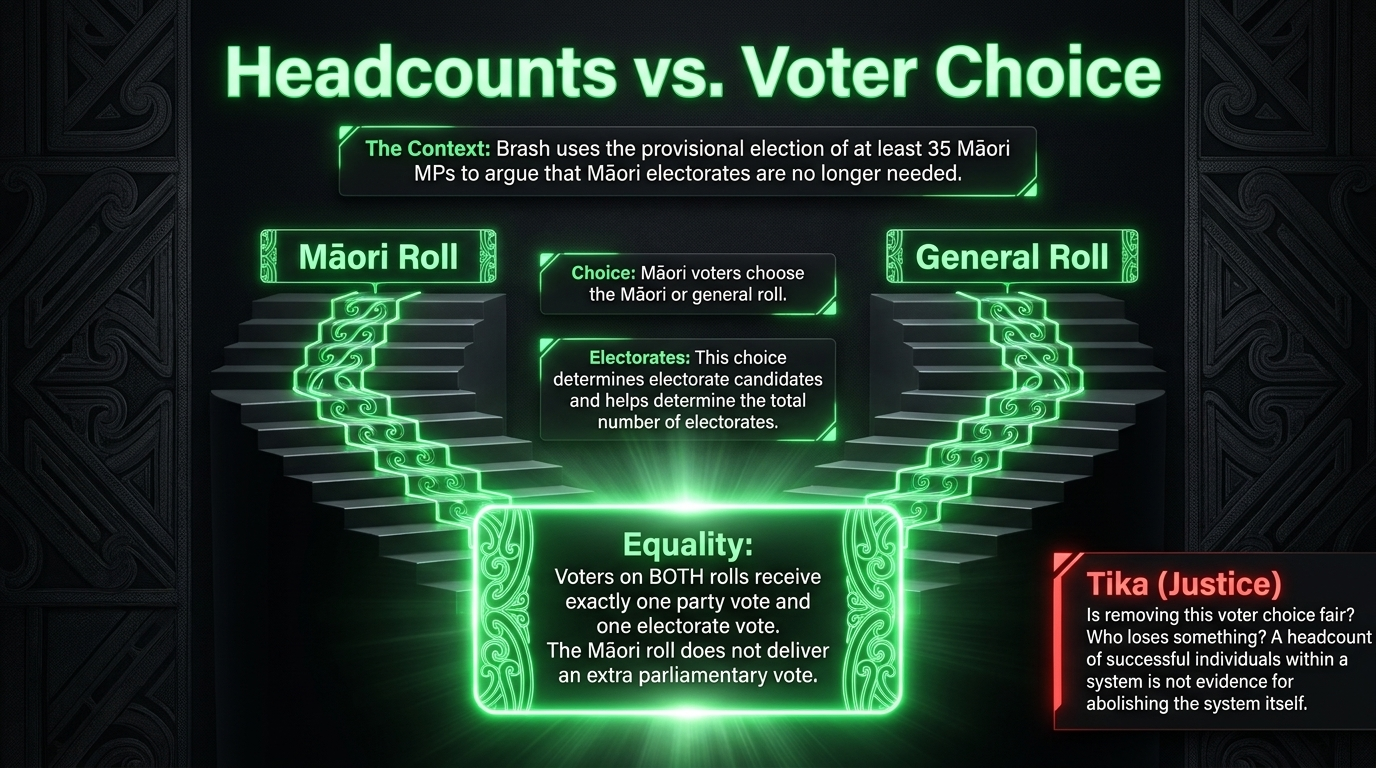
Even accepting the headcount, his conclusion does not follow.
The number of MPs with Māori whakapapa tells us who entered Parliament. Māori electorates concern how voters choose their representative. Those are different questions.
The Electoral Commission explains that Māori can choose the Māori or general roll. Their choice affects their electorate candidates and helps determine the number of Māori and general electorates. Their party-vote options remain the same. That is how the Māori Electoral Option works.
Nor does the Māori roll deliver an extra parliamentary vote. Voters on either roll receive a party vote and an electorate vote. They vote for an electorate candidate according to their roll. The official voting guide sets out the same two-vote entitlement.
Brash may argue for abolition. But counting Māori MPs does not show what representation would look like afterwards. It does not establish that Māori voters want their choice removed.
If he wants to take that choice away, he must justify the decision—not point to Māori succeeding within the existing system and declare part of that system redundant.
That is where tika bites: is the change fair, who loses something, and what evidence justifies the loss? A headcount is not an answer.
The Deep Dive Podcast
Listen to a lively conversation between two hosts, unpacking and connecting topics in the sources of this essay. I apologise in advance for the AI's very harsh pronounciation of reo. Please dont shoot me, :).
Youtube Video
Like video? Here is a short video suppporting the essay. Again, don't shoot the messenger please because of AI's pronounciation. :)
Scrutinise The Judges. Scrutinise Parliament Too.
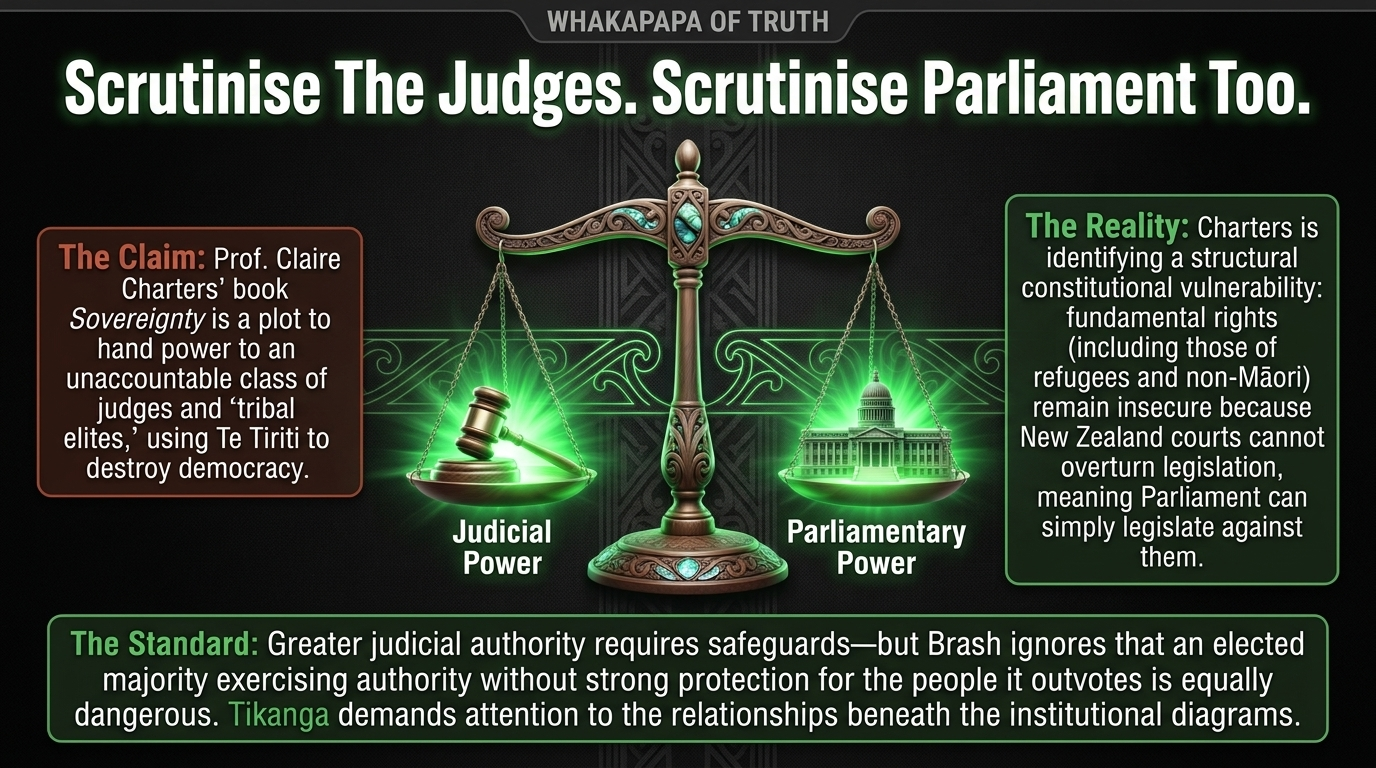
Claire Charters proposes substantial constitutional change, including stronger protection for rights and consideration of higher-law status for Te Tiriti. Her position is ambitious. There is no need to pretend otherwise. RNZ’s written account makes the argument clear.
Brash could confront it directly. Instead, his email warns of power passing to an unaccountable class of judges, academics and “tribal elites”.
There is a serious question beneath that language. Greater judicial authority requires safeguards. Who appoints the judges? What powers do they hold? How are constitutional rules interpreted? What happens when a court gets it wrong?
Charters and other reformers must answer those questions.
Brash must answer the corresponding questions about parliamentary power.
Charters identifies a specific vulnerability: New Zealand courts cannot overturn legislation merely because it conflicts with rights or fundamental constitutional values. Her argument is that rights remain insecure when Parliament can legislate against them. RNZ reports her extending that concern beyond Māori to refugees and other groups. Her argument concerns the protection of rights across society.
For someone whose rights are overridden, voting out a government later may do little to repair the damage already done.
Stronger constitutional protection is one possible response. The design matters: which rights are protected, who interprets them, how authority is divided and how people challenge its misuse. RNZ reports Charters discussing jurisdictional changes, a Māori senate and greater rights protection for everyone. These are proposals for constitutional change, not an enacted settlement.
I want judicial power tested. I want parliamentary power tested too. Neither deserves a blank cheque.
Brash warns about unelected people exercising too much authority. He does not adequately confront an elected majority exercising authority without strong enough protection for the people it outvotes.
Calling one danger “undemocratic” does not make the other disappear.
His reference to Te Tiriti as a brief document from 1840 is weaker still. A promise does not become insignificant because it is short. A state does not discharge its obligations by becoming complicated.
The questions concern what was agreed, what obligations follow and how power should be exercised. Word count settles none of them.
For me, tikanga requires attention to the relationships underneath the institutional diagrams. Whose authority is recognised? Whose whakapapa and relationships are respected? Can whānau shape decisions governing their lives, or must they accept arrangements designed elsewhere?
Respecting mana and wairua does not put a proposal beyond criticism. It demands that people’s standing, convictions and relationships receive serious engagement rather than dismissal through loaded labels.
Existing power must justify itself. Longevity is not innocence, and familiarity is not fairness.
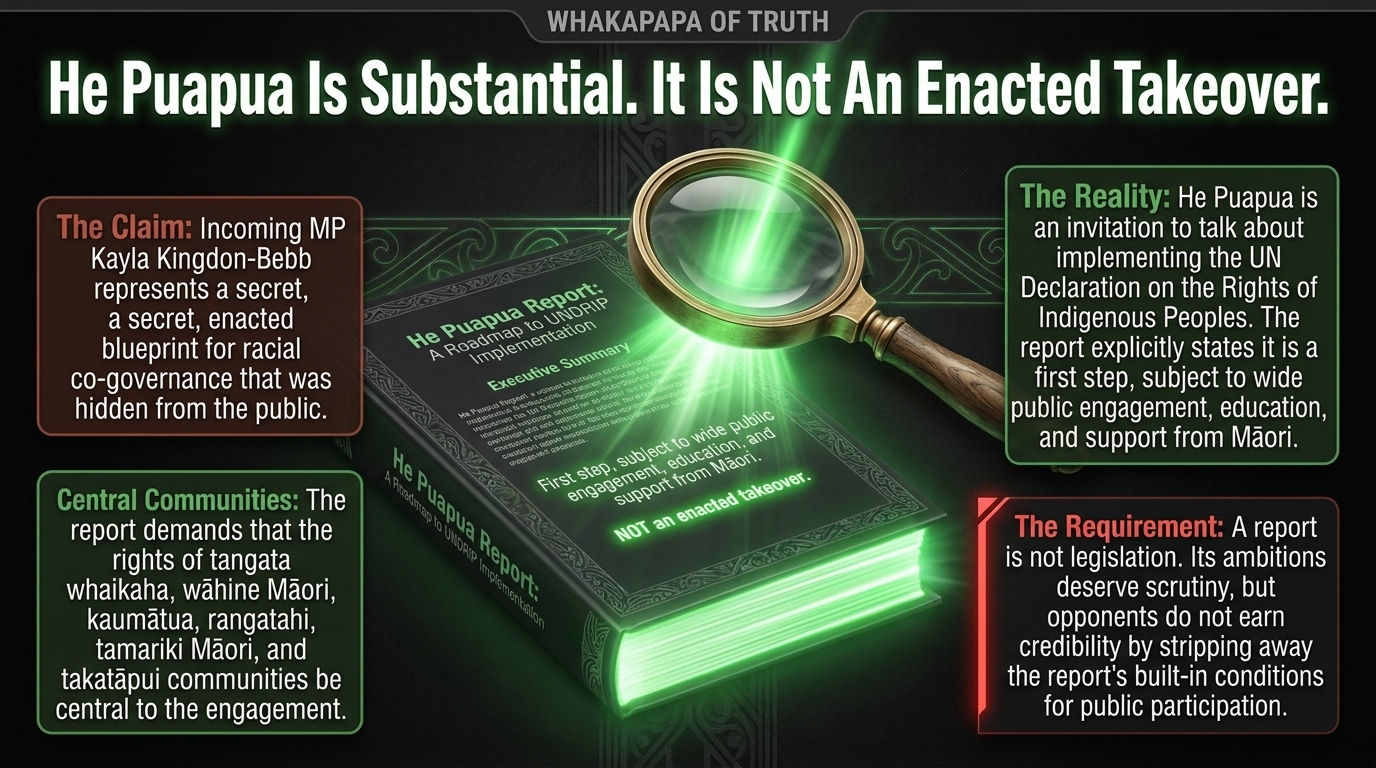
He Puapua Is Substantial. It Is Not An Enacted Takeover.
The same standard applies to Kingdon-Bebb.
According to 1News’ written account of her Q+A appearance, she described He Puapua’s overarching recommendation as an open-ended, inclusive conversation about implementing the United Nations Declaration on the Rights of Indigenous Peoples. She said neither she nor Opportunity had a fixed view on the right constitutional option. Those are her reported positions.
But He Puapua contains more than an invitation to talk.
It recommends a substantial shift towards rangatiratanga and changes in the distribution of authority. Its immediate recommendations include a high-level co-governance body with equal numbers of government ministers and Māori representatives, responsible for directing development of a Declaration plan, signing it off and overseeing accountability. Those responsibilities are in the original report.
Supporters should acknowledge that plainly. Nobody earns credibility by minimising the document.
But opponents do not earn it by stripping away the conditions either.
The report says it is the first step towards a plan. It makes proposals and examples subject to engagement with and support from Māori, acknowledges insufficient time for comprehensive work and wide engagement, and calls for public engagement and education. Those qualifications are part of the report—not excuses added afterwards.
Its ambitions deserve scrutiny. Its recommendations must not be presented as though they are already law.
A report is not legislation. Helping write it does not prove that every option discussed is now a party commitment. Anyone proposing significant change must explain who would exercise authority, how representatives would be chosen and what remedy people would have when power fails them.
The alternative to suspicion is not blind trust. It is clear information, meaningful participation and enforceable accountability.
He Puapua says the rights and interests of tangata whaikaha, wāhine Māori, kaumātua, rangatahi, tamariki Māori and takatāpui communities must be central to a Declaration plan and engagement. Its executive summary expressly names those communities.
Naming people is not the same as hearing them. Participation must be demonstrated.
Attention to mauri means asking whether an arrangement strengthens people’s agency, relationships and wellbeing—or diminishes them. Good intentions cannot answer that. Neither can a polished diagram. Whānau need a meaningful voice and a practical remedy when those exercising authority fail.
That standard applies to He Puapua. It applies to Brash’s preferred arrangements too.
Then comes his most revealing claim. The email says the “only reason” the authors objected to the circumstances of release was that they had lost their chance to manage the public-relations spin.
He supplies no evidence establishing that motive as the only explanation.
Kingdon-Bebb gave a different account. According to 1News, she objected to partial release and said the report should have been published openly, clearly identified as an independent working-group report rather than government policy. That explanation is on the public record.
The report itself also cuts against his certainty. Its covering letter expresses the authors’ hope that it would be published after Crown consideration. Its proposed early actions include publicly announcing receipt and outlining the next steps. The authors recorded an expectation of publication.
That does not prove the release was handled well. It does require Brash to produce evidence before claiming exclusive knowledge of other people’s motives.
“We know better” is not evidence. It is an instruction to stop asking for it.
Three Voices Do Not Prove One Plot
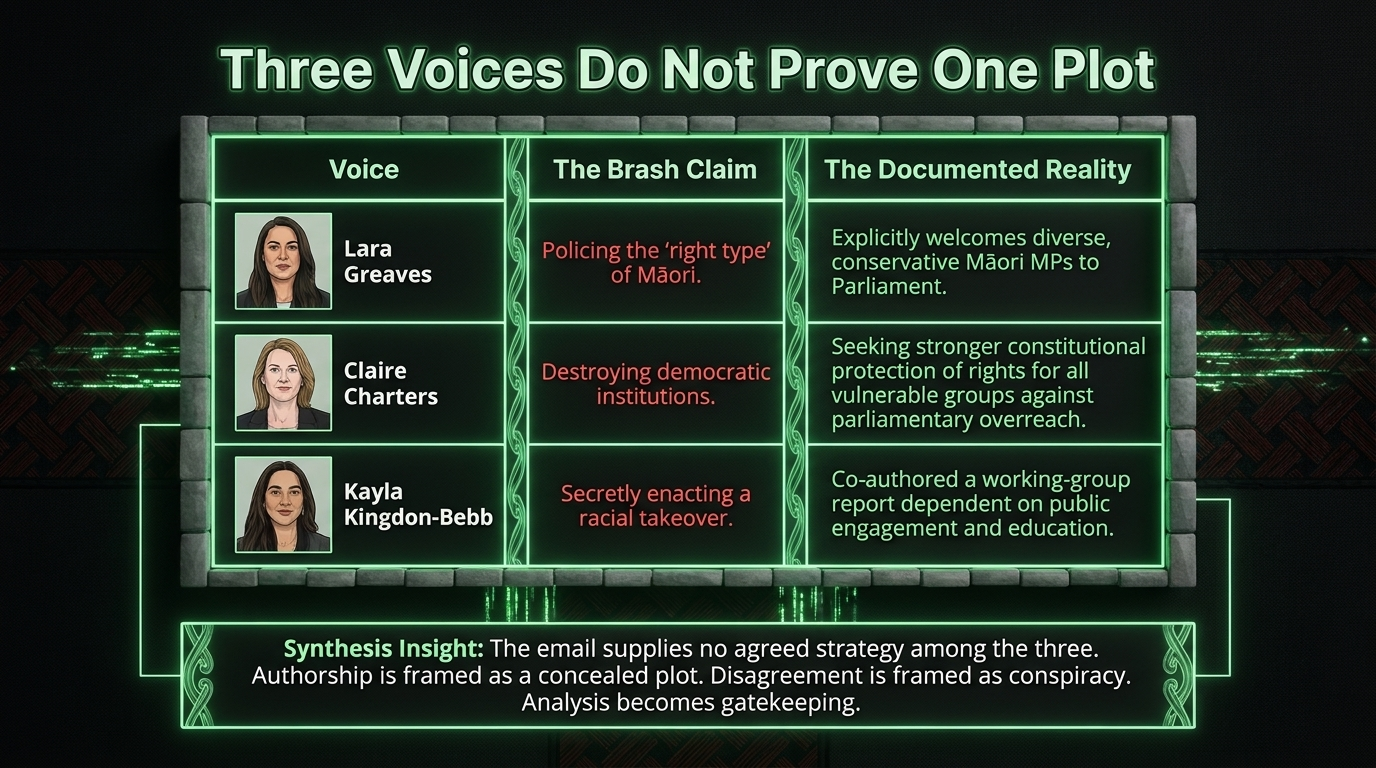
Charters and Kingdon-Bebb share a documented connection: both helped write He Puapua. Their names appear on the report’s title page.
That does not establish a coordinated campaign involving Greaves to dismantle democratic institutions.
The email supplies no agreed strategy among all three. It does not demonstrate how these interviews deliver the takeover it predicts. Instead, it collapses distinctions until the conclusion sounds inevitable.
Analysis becomes gatekeeping. Constitutional reform becomes democratic destruction. Authorship becomes evidence of a concealed party programme. Assertions about motives fill the gaps.
That is the mechanism of this appeal: make different activities look like one threat, then position Hobson’s Pledge as the organisation readers must fund to resist it.
Fundraising is not wrongdoing. Political advocacy is not wrongdoing. Neither excuses a weak case.
In “Your Voting Team Reached The Hospital. Did It Reach The Patient?”, I argued that democratic promises must be judged by the usable opportunities people receive, not an institution’s account of its own process. The same discipline belongs here. Democracy concerns people’s actual ability to participate, question power and influence decisions—not an organisation’s ownership of the word.
Māori do not have to endorse every constitutional proposal to demand an honest account of it. We do not have to defend every academic or politician before challenging an accusation the source itself undermines.
Brash may oppose Māori electorates, defend parliamentary supremacy and campaign against He Puapua. But he must make those arguments on their merits.
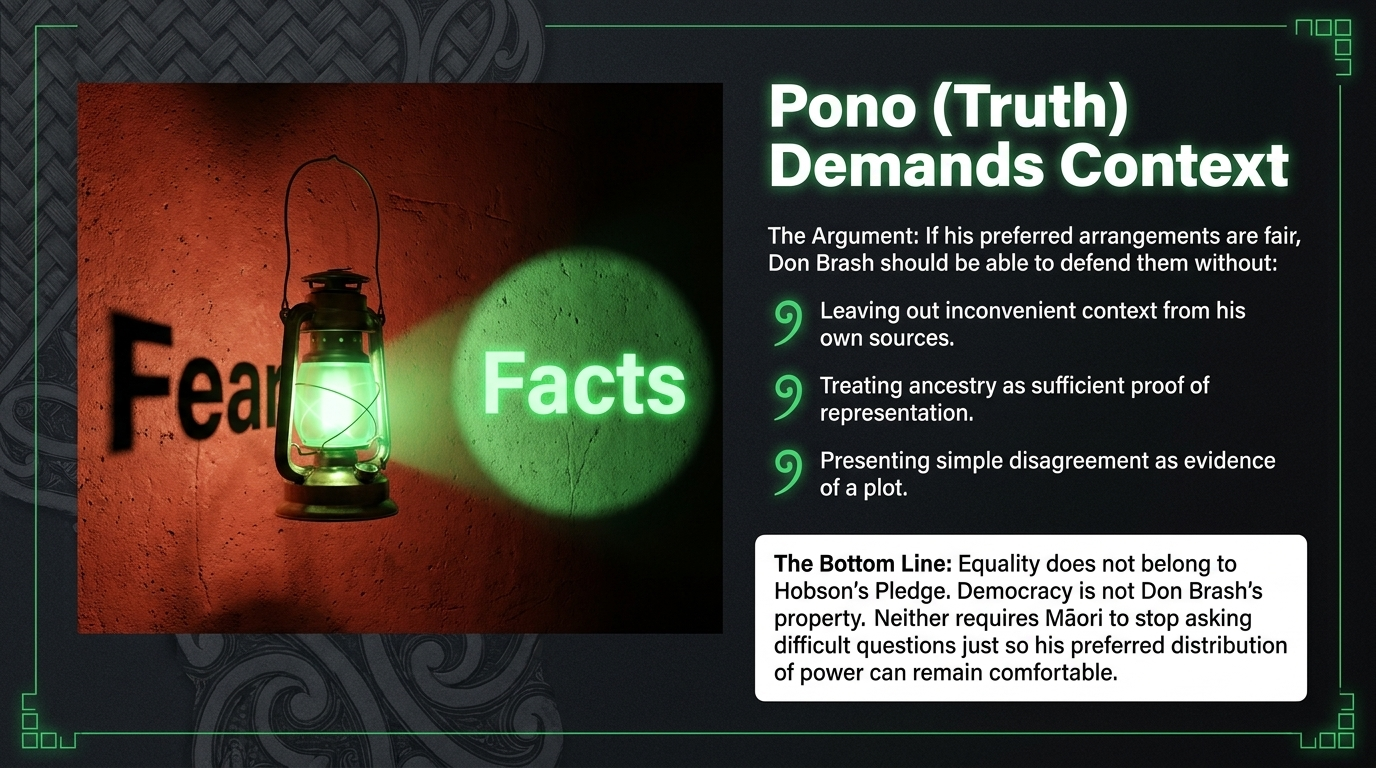
If his preferred arrangements are fair, he should be able to defend them without leaving out inconvenient context, treating ancestry as sufficient proof of representation or presenting disagreement as evidence of a plot.
He has not established that these three women are dismantling democracy. He has demonstrated that he opposes their arguments.
Those are not the same thing.
Equality does not belong to Hobson’s Pledge. Democracy is not Don Brash’s property. Neither requires Māori to stop asking difficult questions so his preferred distribution of power can remain comfortable.
His appeal asks the public for money. The public should ask him for a better argument.
Koha Consideration
Brash’s donation link is easy to find. The missing context takes more work.
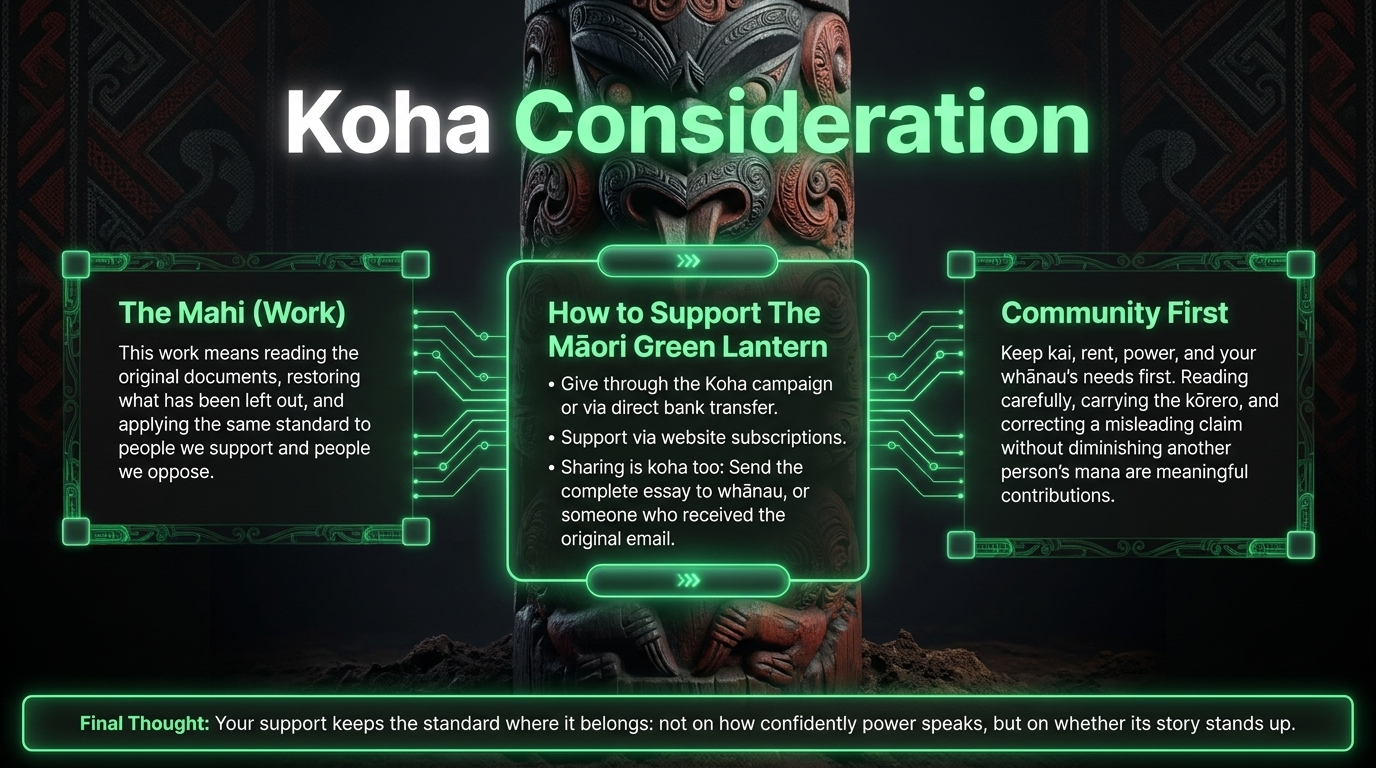
This mahi means reading the original documents, restoring what has been left out and applying the same standard to people I support and people I oppose. If this essay helped you test the claims rather than inherit the fear, please consider supporting The Māori Green Lantern:
Give through The Māori Green Lantern’s Koha campaign.
Support through the website’s subscription options.
For a direct bank transfer, use the current details published on the Koha campaign page.
Sharing is koha too. Send the complete essay to whānau, someone who received the email or a friend who wants to check the evidence.
Keep kai, rent, power and your whānau’s needs first. Reading carefully, carrying the kōrero and correcting a misleading claim without diminishing another person’s mana are meaningful contributions.
Your support keeps the standard where it belongs: not on how confidently power speaks, but on whether its story stands up.
Disclaimer: This essay offers evidence-based commentary on matters of public interest. Criticism concerns public statements, arguments and proposals—not personal identity. Interpretations are the author’s own. Corrections and substantive responses are welcome.