"Paul Goldsmith Knew The Risks. He Went Ahead Anyway" - 17 November 2027
Goldsmith’s own papers warned of risks to Māori. He went ahead without consultation. Chris Finlayson’s record shows why being a National minister is no excuse.

"Paul Goldsmith Knew The Risks. He Went Ahead Anyway" - 17 November 2027
Mōrena Aotearoa,
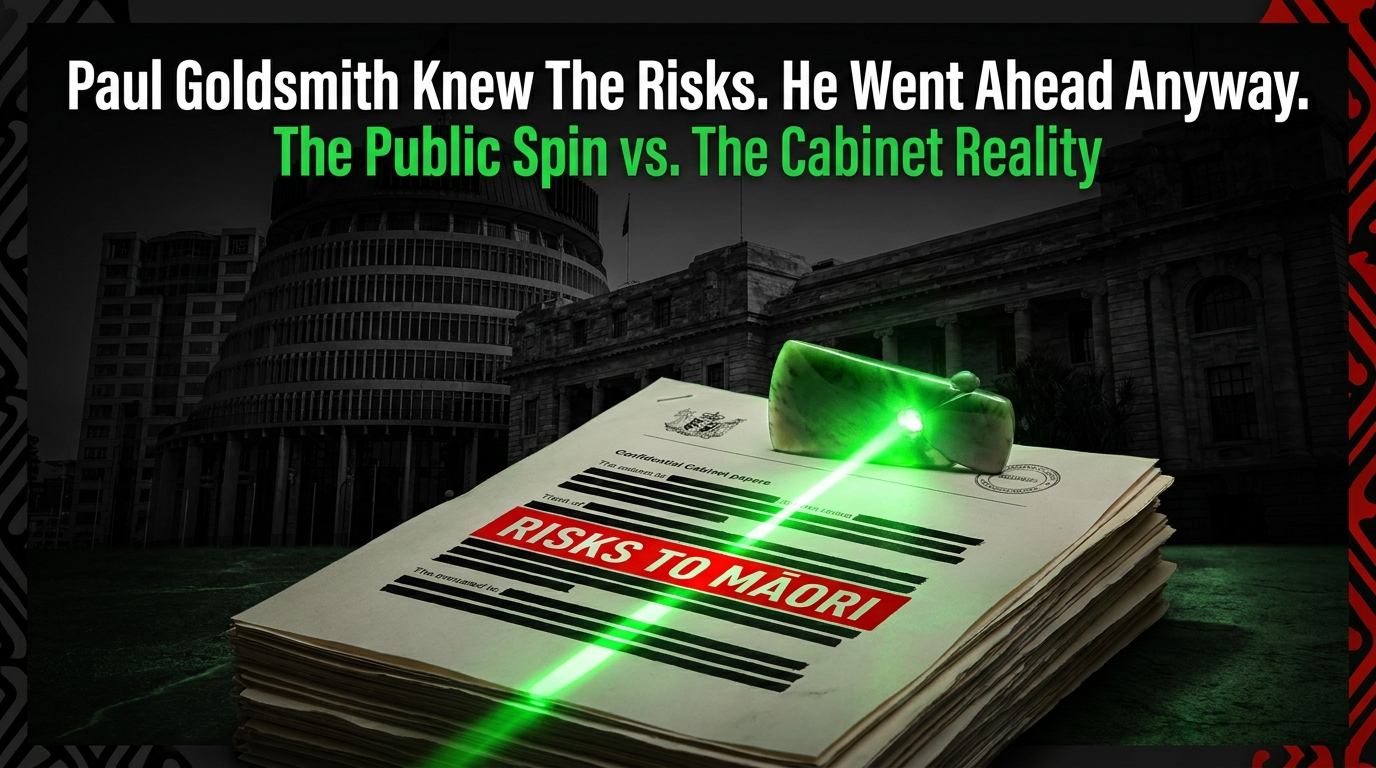
Paul Goldsmith knew his sentencing-report cuts could make an unequal justice system worse for Māori. His own Cabinet paper warned him. It also said there was a strong Treaty-based argument that Māori should “at the very least” be consulted.
He went ahead without that consultation.
The explanation was blunt:
“However, due to time constraints, no consultation with Māori has been undertaken.”
That is not an opponent’s accusation. It is written in the proposal Goldsmith authorised for Cabinet.[justice.govt]
The government had a deadline. Māori were expected to bear the risk.

 Derek Cheng

In his farewell interview, Goldsmith says:
“It’s when you stop talking that the problems arise.”
Yet his own proposal explained why Māori had not been consulted before he sought approval for a change likely to affect them disproportionately. Put his farewell comments beside that Cabinet paper. The contradiction is his to answer.
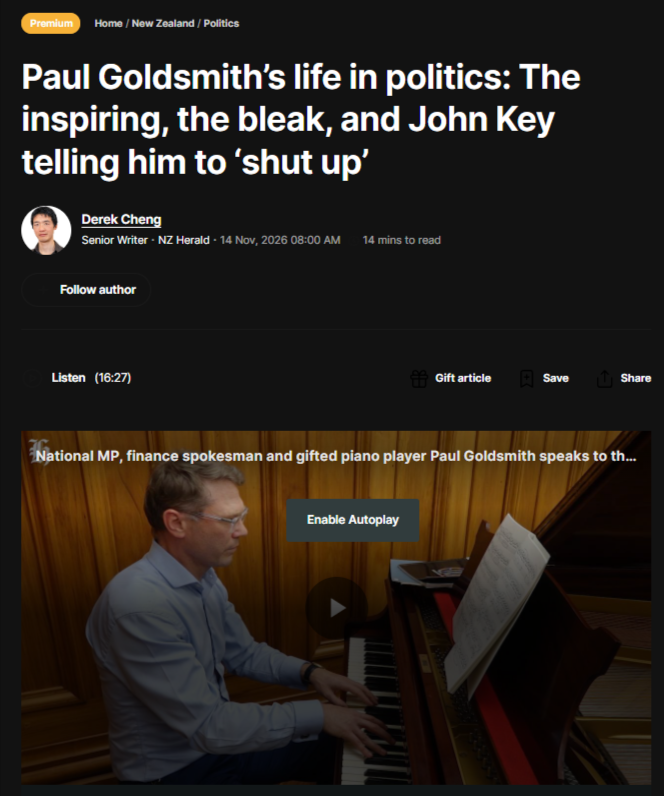
Forget the piano playing, running stories and jokes. After the 15 years in Parliament described in Derek Cheng’s profile, the question is whether Goldsmith used his power responsibly—not whether colleagues enjoyed his company.
Chris Finlayson makes that question harder for him. Another National minister used his position to help recognise Māori rights and later criticised his own side when he believed it was doing harm.
Goldsmith was not required to put the government’s programme first. He chose to.
What The Cut Actually Did
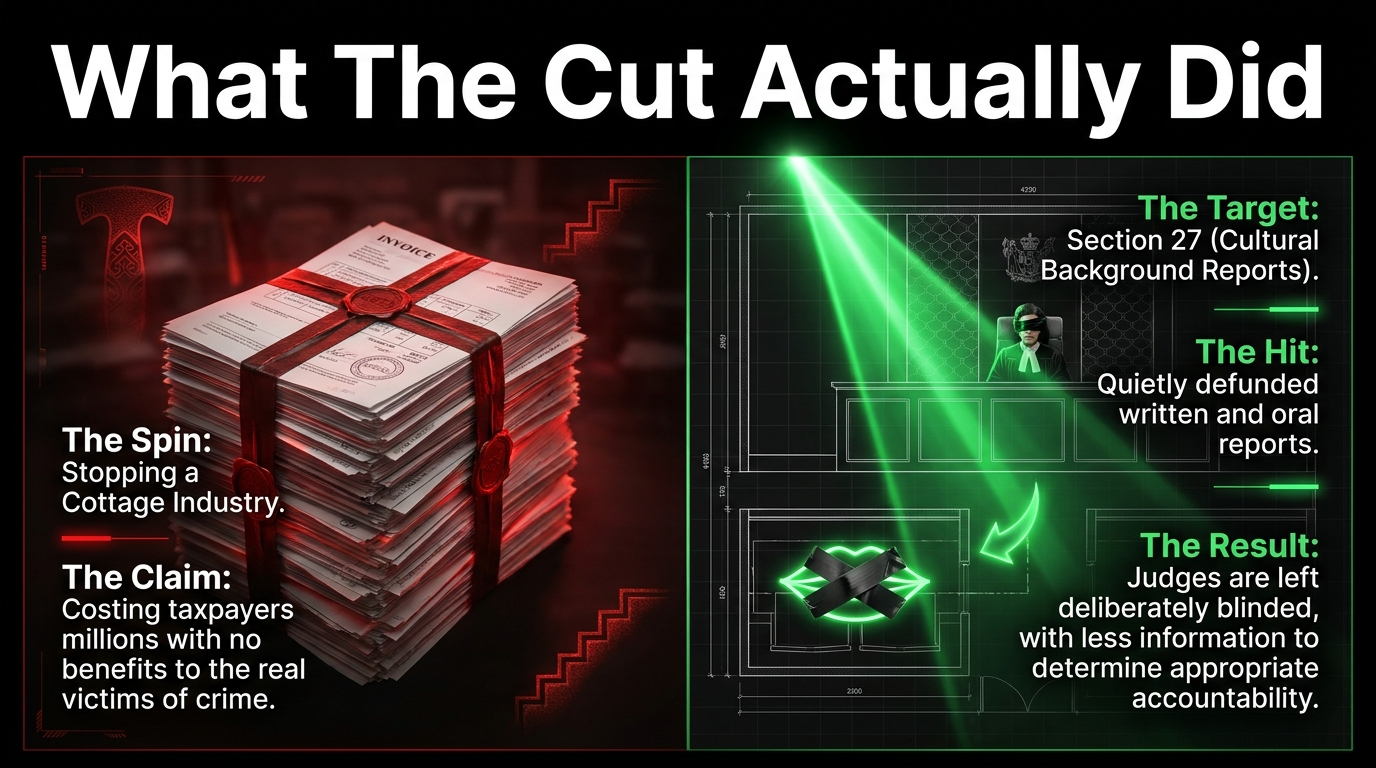
Section 27 allowed an offender to ask the court to hear information about their background, how it related to their offending, and what support from whānau or community might help prevent further offending.
Goldsmith’s Cabinet paper accepted that considering background and circumstances was a core part of sentencing. It also acknowledged that removing funding would probably leave judges with less information to determine an appropriate sentence. Those are the functions and risks recorded in his proposal.
Understanding an offender does not mean excusing them. A court still has to hold them accountable. But a sentence should reflect relevant evidence, including what might prevent another person being harmed.
Goldsmith promoted the change as stopping a “cottage industry”. When the bill passed its third reading on 6 March 2024, he said the reports cost taxpayers millions with “no benefits to the real victims of crime”. His official announcement presented the measure as fulfilling the government’s 100-day promise.
His own Cabinet paper was less reassuring.
It identified genuine problems: spending had increased, reports varied, and there were no uniform requirements covering their authors, content or cost. Those were reasonable grounds for reviewing the arrangements. They were not proof that withdrawing funding was the best answer.
The government could have tested pricing controls, quality standards and targeted funding. It could have worked with Māori and justice practitioners before deciding what to remove. Instead, the policy began with an instruction already settled: defund the reports.
Even the account of a report-writing industry growing at taxpayers’ expense needed context. Goldsmith’s paper noted that increased spending coincided with appeal court judgments recognising the relevance of an offender’s background at sentencing. That does not establish that every report was useful. It does establish that the growth occurred alongside legal developments supporting the use of that information.
The funding prohibition was also broader than the public argument about expensive written reports. It covered payments for written or oral reports or statements by a person called under section 27, while leaving other specialist-report funding available. That scope is set out in the Cabinet material.
Goldsmith said he wanted a return to people who knew the offender speaking in court. But his proposal also removed the relevant funding for oral statements. It did not prohibit someone speaking without payment. It did mean the funding withdrawal reached beyond the professional written reports he attacked.
That distinction matters when a minister claims to be removing an industry rather than support for participation.
The Deep Dive Podcast
Listen to a lively conversation between two hosts, unpacking and connecting topics in the sources of this essay. I apologise in advance for the AI's very harsh pronounciation of reo. Please dont shoot me, :).
Youtube Video
Like video? Here is a short video suppporting the essay. Again, don't shoot the messenger please because of AI's pronounciation. :)
A Possible Saving Was Sold As A Better System

The proposal estimated savings of up to $7 million a year within the Legal Aid appropriation, based on spending on written reports in 2022/23. But it warned that the actual savings depended on whether the information was obtained through other publicly funded channels. These were potential savings in one budget—not demonstrated net savings across the justice system.
Crown Law and the Public Defence Service warned of a real risk of more adjournments while information was obtained another way. The paper said this could have substantial consequences for efforts to clear the criminal court backlog, particularly in the District Court. Those were warnings from agencies within the system Goldsmith was responsible for improving.
Stopping one payment does not necessarily remove the work. Another agency may pay. A lawyer may need more preparation time. A hearing may be delayed.
Those possibilities were not invented by critics. They were described in the proposal.
The Māori impact was equally clear. Among sentences concluded in 2021 and 2022 that resulted in imprisonment, home detention, community detention or intensive supervision, 14% of Māori offenders received a legally aided section 27 report, compared with 7% in the New Zealand European/other category. Those are rates within that sentencing population, not the general population.
The paper warned that the funding change might worsen Māori overrepresentation. It identified possible consequences for whānau, particularly tamariki and rangatahi, if the change produced fewer sentencing discounts or required offenders to pay for reports themselves. A later approval paper acknowledged that some offenders would not be able to afford them. These were risks recorded before the legislation was introduced.
Someone with money could still buy a report. Someone without money would have to find another way to get relevant information before the judge.
Leaving an opportunity in law while withdrawing the means to use it does not establish fair access.
I will not invent a number of additional Māori imprisoned because of this change. The documents do not provide one. What they establish is Goldsmith’s knowledge of foreseeable risks and his decision to proceed.
The process made that decision worse. He proposed urgency instead of the normal select committee process, partly to free parliamentary time for other legislation. A regulatory impact statement was completed, but the usual quality-assurance requirement had been suspended for 100-day proposals, and it was not formally assessed. Those were the conditions under which the policy advanced.
He then recommended reducing the proposed transition from six weeks after Royal assent to two, citing the cost of continuing payments during the longer period. That was another deliberate choice to move faster.
Māori consultation did not happen. Normal select committee scrutiny was not the process he proposed. Formal quality assurance was absent. Yet consideration of equity and access rights was promised in further work.
The proper order was to understand the consequences and put protections in place before withdrawing support. Goldsmith’s approach reversed it.
For me, this is where tika and pono become practical standards: was the decision fair, and was its public explanation honest about the evidence and uncertainty?
Tikanga asks more than whether the minister followed enough rules to get a bill passed. In the approach I am applying here, it requires attention to people’s mana, whakapapa and relationships. Were whānau involved? Was their knowledge valued? Did the process respect their wairua, rather than treating them as administrative problems?
Attention to mauri means asking whether a decision supports people’s ability to recover and sustain their wellbeing, or makes that harder. These are not universal definitions offered on behalf of every iwi or hapū. They are the standards by which I judge this exercise of power.
They also apply to victims. Goldsmith’s later paper invoked Māori victimisation as a reason to use legal-aid resources effectively. That is a legitimate concern, but not evidence that this particular withdrawal would protect Māori victims.
Victims deserve effective decisions. Their suffering should not be used to excuse the failure to demonstrate effectiveness.
Finlayson Shows What A National Minister Could Do
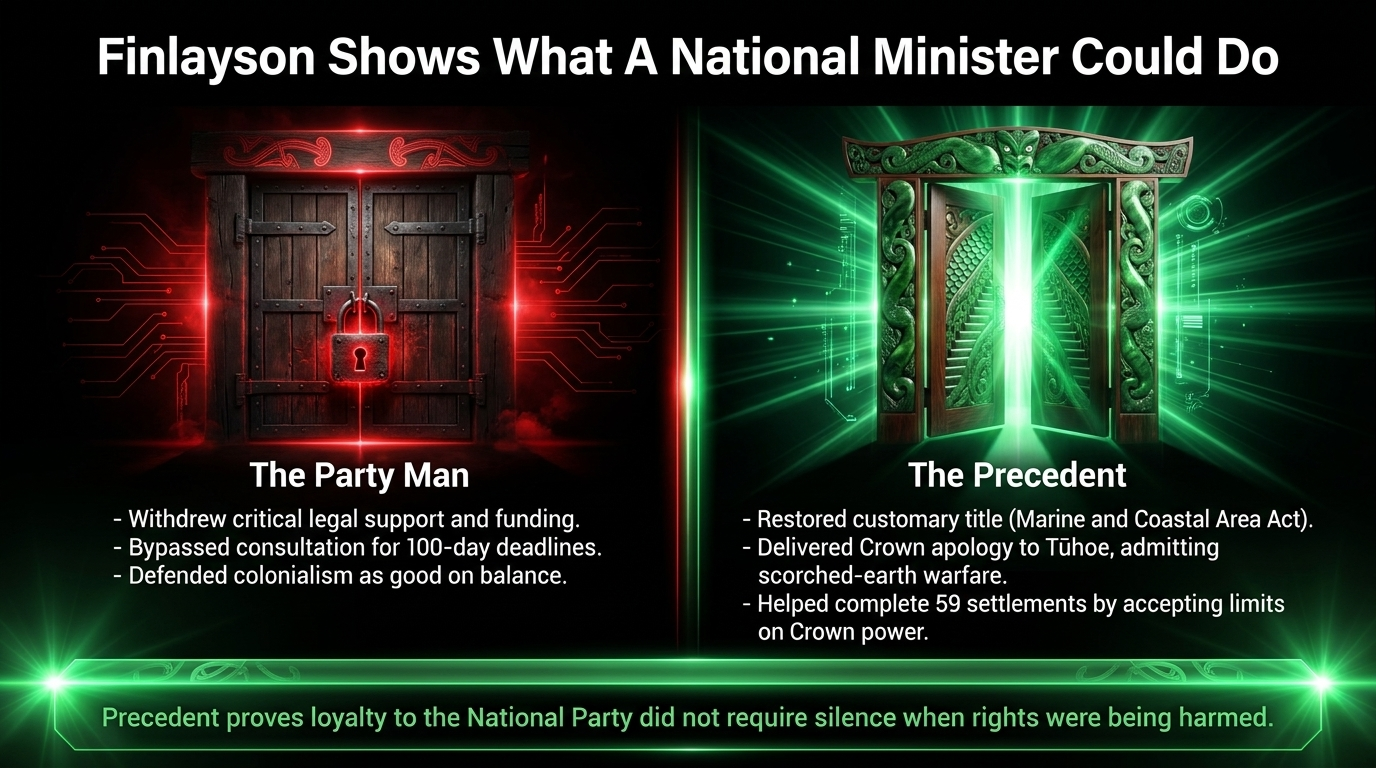
Finlayson’s record matters because it removes a convenient excuse. Being a National minister did not prevent someone recognising Māori rights or accepting limits on Crown power.
In his 2011 third-reading speech on the Marine and Coastal Area legislation, Finlayson defended restoring the right to seek recognition of customary title. He described the previous Foreshore and Seabed Act as discriminatory because Māori interests had received a different and lower level of recognition. That was the position stated by National’s Attorney-General.
He also defended public access. His argument was that customary rights could be recognised while access, navigation and specified activities remained protected. Māori rights and everyone else’s interests did not have to be presented as an unavoidable conflict. That was central to his explanation of the law.
The legislation was contested. His speech acknowledged disagreement, including Hone Harawira’s demand for delay. It also credited the Māori Party and Tariana Turia for their persistence. Finlayson did not describe the change as something National had generously decided to give Māori. His account recognised the political work that secured it.
The same seriousness appears in his address delivering the Crown apology to Tūhoe.
Finlayson acknowledged confiscation, wrongful killings, scorched-earth warfare, broken agreements and the undermining of promised self-government. He accepted that the Crown could not fully compensate for the losses and had to work to regain trust. Those are specific admissions in the published address.
The settlement also changed the legal arrangements. Te Urewera received a legal identity, with Tūhoe at the centre of its future governance and management. The address connects the apology to that change in authority.
This was not simply better language. It was a negotiated change in how power would be exercised.
Tūhoe deserve the credit for pursuing their claims and securing the agreement. Finlayson’s responsibility was to make the Crown capable of reaching and honouring it.
When he left the Treaty negotiations portfolio in 2017, 1News reported that he had helped complete 59 settlements. Tūhoe negotiator Tāmati Kruger said, “Easily we call him our friend.” The same report recorded criticism of his handling of cross-claims. Both belong in an honest assessment.
Finlayson does not have to be perfect for this comparison to be devastating.
He demonstrated that a National minister could help create legal recognition, accept Crown responsibility without excuses, and understand that a settlement was part of a continuing relationship.
He also demonstrated that loyalty to National did not require silence when he thought National was wrong.
In his 2026 assessment, Finlayson described the coalition’s actions as destructive and harmful to the Crown–Māori relationship. He argued for respect for Māori property rights and equal access to justice, and called the marine and coastal amendments “shameful and unjust”. Those are his published judgements.
Goldsmith disputes them. He says the amendments restored Parliament’s intended high threshold for customary marine title. He points to recognition around Ruapuke Island to challenge Finlayson’s assertion that the revised test was virtually impossible to meet. That is Goldsmith’s substantive defence.
That example means critics should not claim recognition became literally impossible. It does not answer whether making recognition harder was justified.
Goldsmith began his response by saying Finlayson had left Parliament but could not “let go of the chisel”. His opening complaint was that his predecessor would not stop intervening.
Finlayson did not owe the government silence. Challenging his own side when he believed rights were being harmed was a public service, not a failure to accept retirement.
Settlements Do Not Cancel Current Obligations
Goldsmith points to settlements he brought to conclusion. That work must remain part of his record. It defeats the sweeping claim that everything he did harmed Māori.
It does not excuse weakening protections elsewhere.
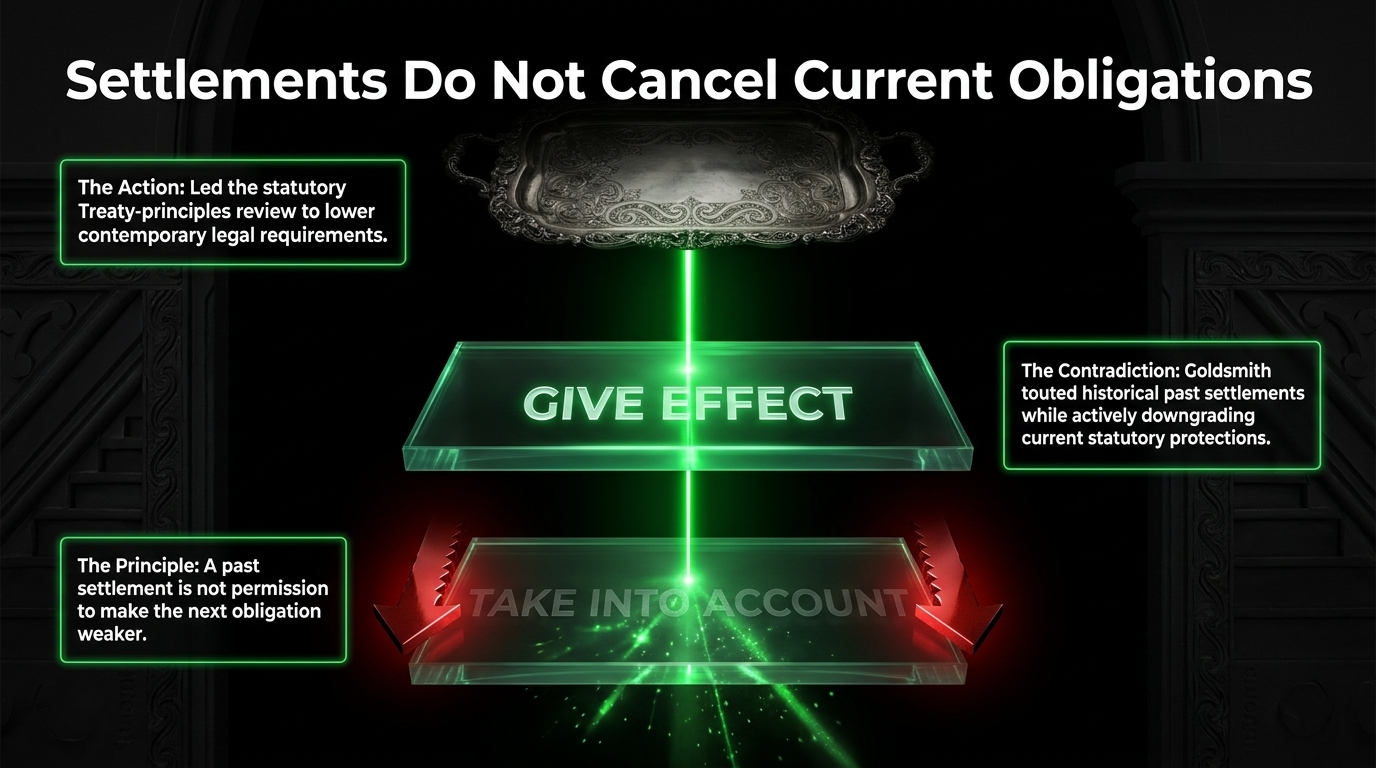
The Ministry of Justice identifies Goldsmith as the minister who led the statutory Treaty-principles review. This was separate from the Treaty Principles Bill. Cabinet decided that, within its final scope, no stronger Treaty standard than “take into account” should apply where a standard was required. Stronger wording such as “give effect” would therefore be reduced. These were substantive policy decisions, alongside proposed repeals.
Cabinet approved three bills for introduction in September 2026. One standardised drafting without substantively changing legal effect; another changed the strength of obligations; the third repealed references. That is the legislative stage and distinction recorded by the Ministry.
Those distinctions matter. Not every amendment was an attack, and approval for introduction was not enactment. Pono requires that accuracy from the critic too.
But it also exposes the weakness in Goldsmith’s claim that the programme provided clarity and consistency. His official announcement emphasised those objectives. If drafting can be clarified without weakening obligations, clarity alone cannot justify lowering the others.
The practical alternative was to improve wording where needed and justify substantive changes separately, with meaningful Māori involvement before decisions were settled.
Finlayson’s Tūhoe address acknowledged the Crown’s history of promising protection and then undermining it. Goldsmith’s programme included lowering contemporary legal requirements while he cited historical settlements as evidence of his achievements. The comparison rests on the apology and his review’s stated decisions.
A settlement is not permission to make the next obligation weaker.
Pride In New Zealand Does Not Excuse Dispossession
Goldsmith’s farewell interview makes the difference between the two men clearer still.
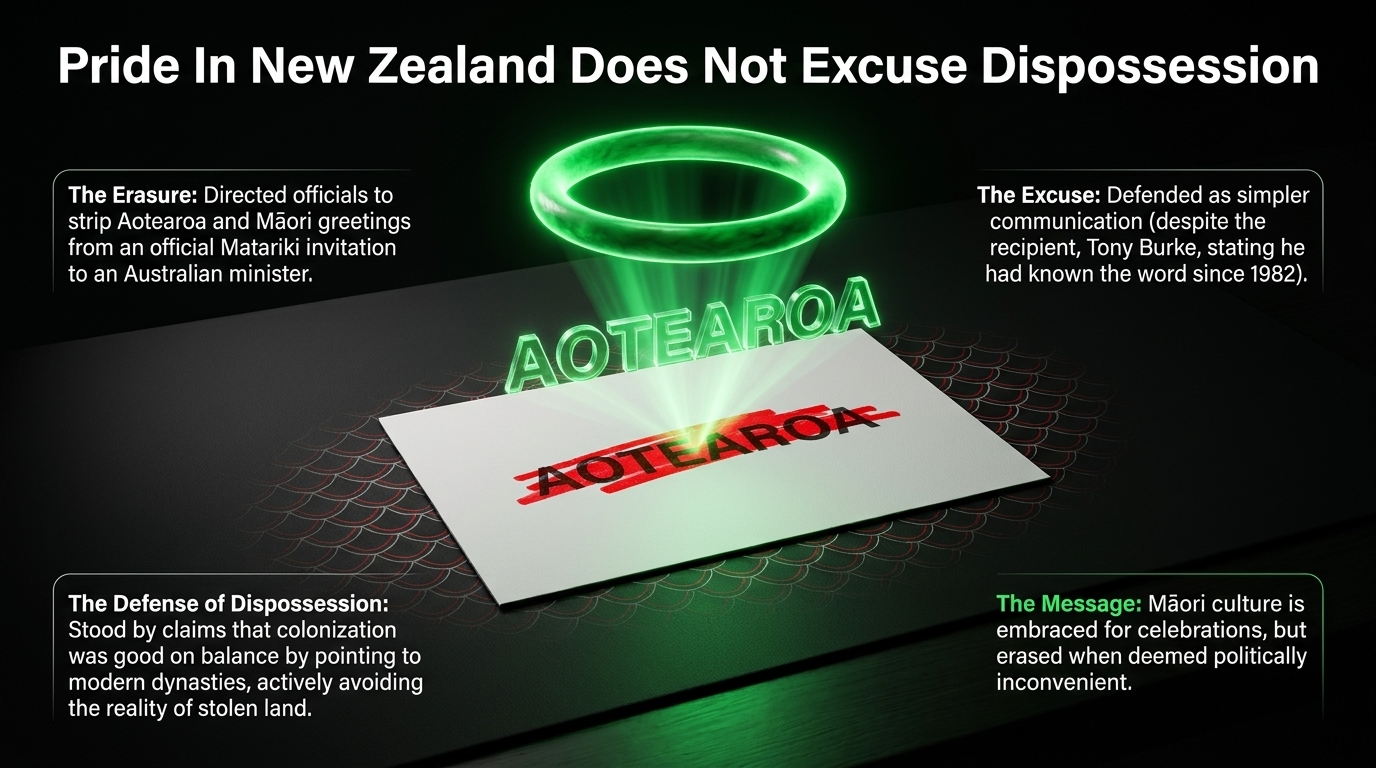
Asked about his earlier comments that colonisation had been good for Māori “on balance”, he stands by them. He then asks whether present-day New Zealand is something to be proud of. When stolen land is raised, he points to people falling in love and creating families and “new dynasties”. That is his explanation.
It does not answer the question.
People can value their country without defending dispossession. They can value their whakapapa without accepting that Crown wrongdoing was necessary for their families to exist.
Finlayson’s apology identified specific conduct and accepted responsibility. Goldsmith’s response changes the subject to pride in the country that exists now.
His treatment of a Matariki invitation showed the same unwillingness to make room for Māori on ordinary terms. Documents obtained by 1News showed that he directed officials to remove Māori greetings and “Aotearoa” from an invitation to Australian minister Tony Burke. He defended the changes as simpler communication. Other Māori words remained, and he separately requested a Māori sign-off for his booklet foreword, so this was selective removal, not a blanket ban.
Burke later said he had known “Aotearoa” since hearing Split Enz in 1982. The presumed problem was not a problem for the recipient.
The sensible alternative was to retain the greetings and explain them if necessary. Instead, the minister responsible for culture removed ordinary Māori language from an invitation to a Māori celebration.
This was not equivalent to withdrawing legal support or weakening a statutory obligation. It was a smaller decision with a clear message: Māori language could be removed when the minister considered it inconvenient.
Rotorua councillor and Māori-language advocate Rawiri Waru identified the absurdity. The karakia, songs and wairua were Māori, yet Māori language was being removed from the invitation. His response explains why this concerned respect and belonging, not merely wording.
The Legacy He Earned
In “Silver Trays Do Not Settle The Public Account”, I argued that affection between departing politicians cannot settle the question of what they did in office. Goldsmith deserves the same scrutiny.
The case against his decisions does not need invented motives, claims that he never helped anyone, or speculation about a future lobbying appointment. His stated possibility is a return to writing histories and biographies.
What he did with public power is enough.
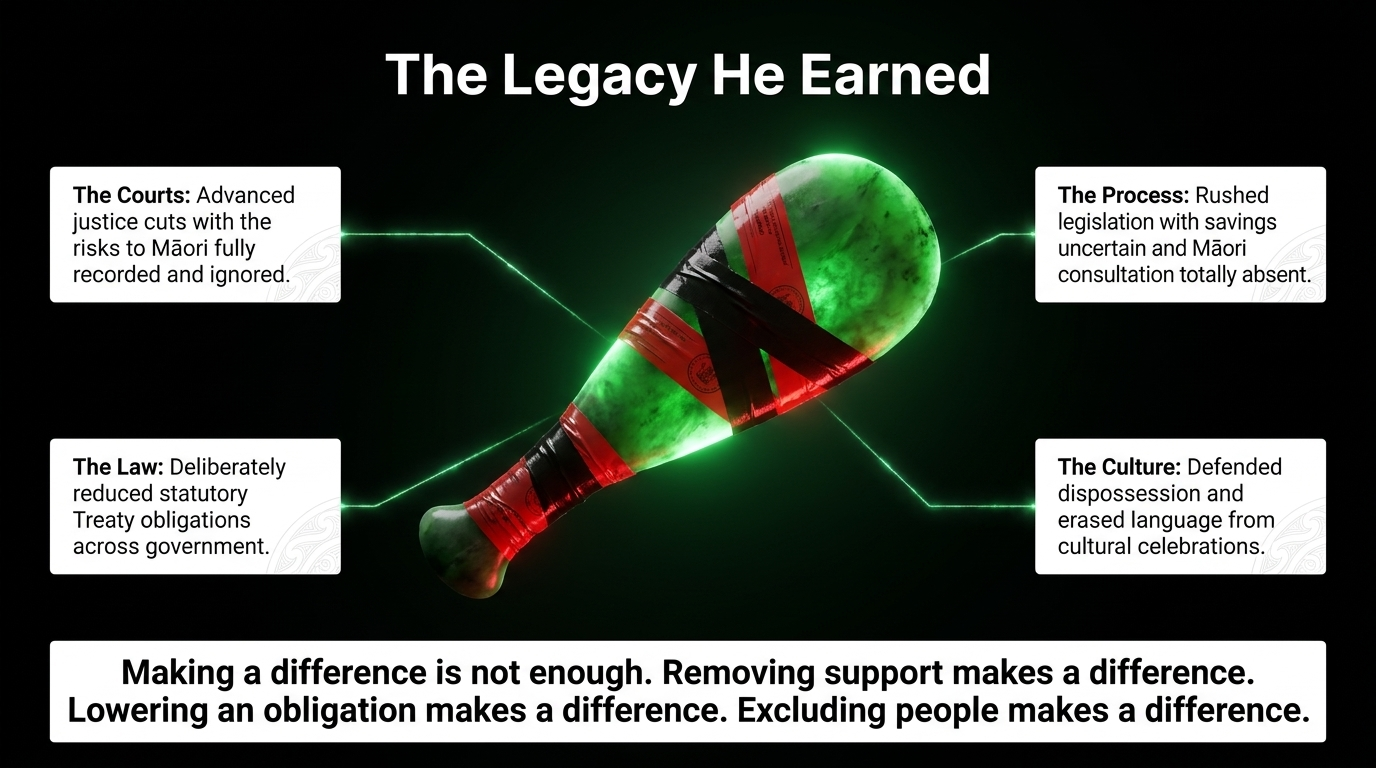
He advanced the sentencing-report withdrawal with the risks recorded, the savings uncertain and Māori consultation absent. He led a programme that included reducing statutory Treaty obligations. He defended colonisation with an argument that avoided a serious answer to dispossession.
My judgement is that, at these important moments, he acted as a party man first: the government’s commitment had to be delivered, and the people facing the consequences were expected to manage.
Finlayson makes that failure harder to excuse. Another National minister helped secure legal recognition, negotiated changes to Crown authority and later challenged his own side. He demonstrated that political loyalty could have limits.
Goldsmith had the information and the authority to insist on a better process. He could have required consultation before proceeding. He could have tested alternatives to wholesale withdrawal. He could have demanded a convincing account of the costs across the justice system.
He did not need hindsight. The warnings were already in front of him.
That is why this is not simply a disagreement over policy. It is a judgement about how a minister responds when his own proposal tells him that fairness, access and whānau wellbeing are at risk.
Goldsmith wanted to be remembered as a minister who made a difference. Making a difference is not enough. Removing support makes a difference. Lowering an obligation makes a difference. Excluding people from decisions about their own interests makes a difference.
Public service requires a better standard.
His farewell offers the entertaining colleague who enjoyed his work. His Cabinet paper records the minister who knew consultation was needed, knew Māori could be disproportionately affected, and sought approval anyway.
That is the record he leaves. He cannot reasonably ask whānau to forget it because he enjoyed being a minister.
Koha Consideration
This work puts a minister’s public explanation beside the documents he authorised, so whānau can judge his decisions for themselves.
If you value that work and can afford to support it, you can contribute through The Māori Green Lantern’s Koha page. For direct bank transfer, the details published there are Ivor Jones — 03-1395-0099387-000.
You can also subscribe through The Māori Green Lantern website.
If money is tight, keep it for your whānau. Sharing this essay is koha. Passing on the documents, discussing the evidence and helping someone check a political claim are koha too.
People should know what was done in their name—and have the evidence to demand better.
Disclaimer: This essay is political commentary based on the linked public record. It criticises Goldsmith’s statements, decisions and use of power—not his private beliefs. Identified risks are not presented as proven outcomes. Factual corrections supported by evidence are welcome.