"BISHOP'S FINGER IN THE AIR — AND THE BOOT ON OUR NECKS" - 18 June 2026
How Chris Bishop Picked the Pockets of 84,000 Whānau, Admitted It Was Based on Nothing, and Called It Reform

Mōrena Aotearoa,
I have stood on marae where the kaumātua at the back of the room is fed first. Not because he qualifies for a subsidy. Not because he passed a needs assessment.
Because they are tangata whēnau— people of this land — and our tikanga demands it.
This government would audit him first.
The Deep Dive Podcast 🎙️
Two hosts. One essay. No filter. Unpacking the housing whakapapa, the Budget mechanics, the select committee theatre, and what it all means for whānau in Aotearoa.
I apologise in advance, whānau — the AI hosts do their best with te reo Māori, but I ask for your aroha and patience. Please don't shoot the messenger! 😅 The kōrero is solid, even when the pronunciation needs work.
YouTube Video 🎬
More of a visual learner? Here is a short video supporting this essay — the receipts on screen, the harm quantified, the names named.
Same disclaimer — the AI's te reo pronunciation is a work in progress. The evidence, however, is bulletproof. 😄
The Tohunga With an Empty Kete — and a Government Cheque in His Pocket
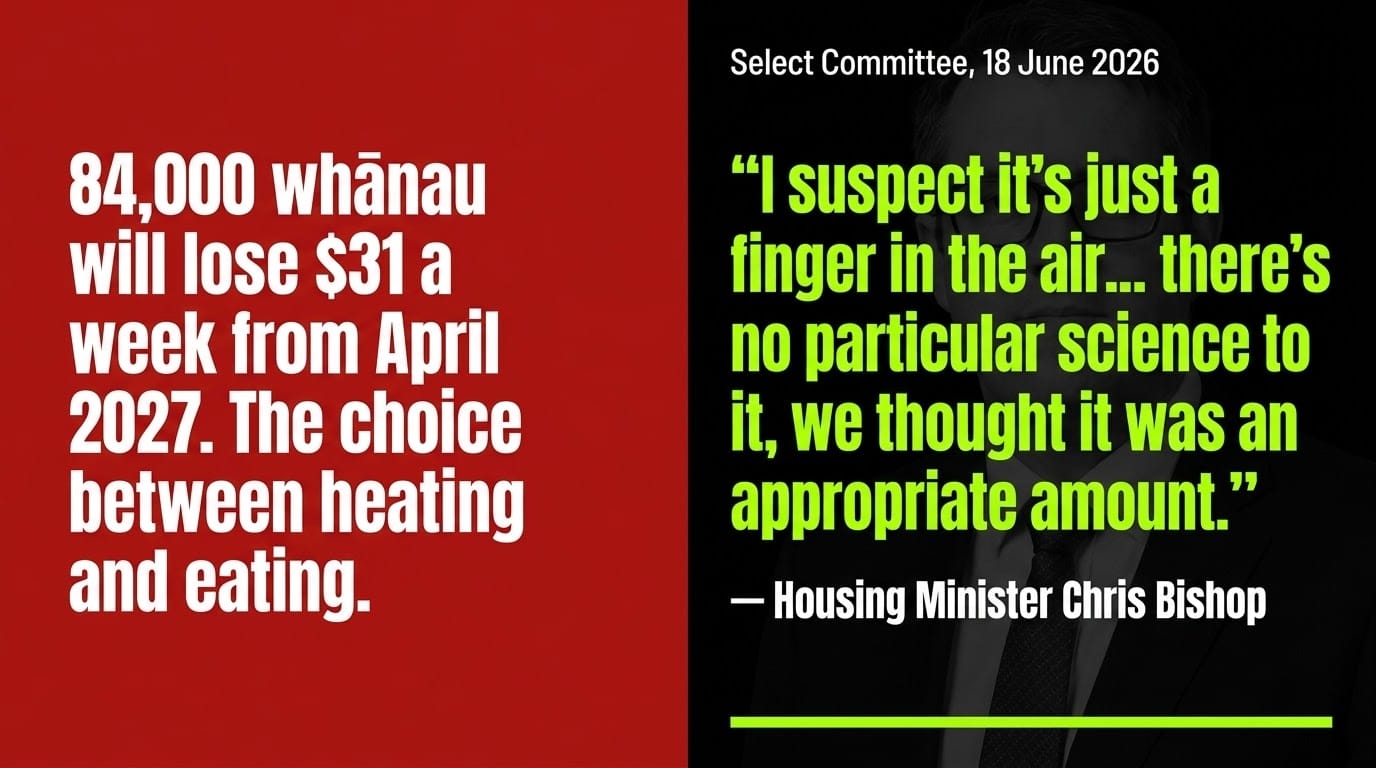
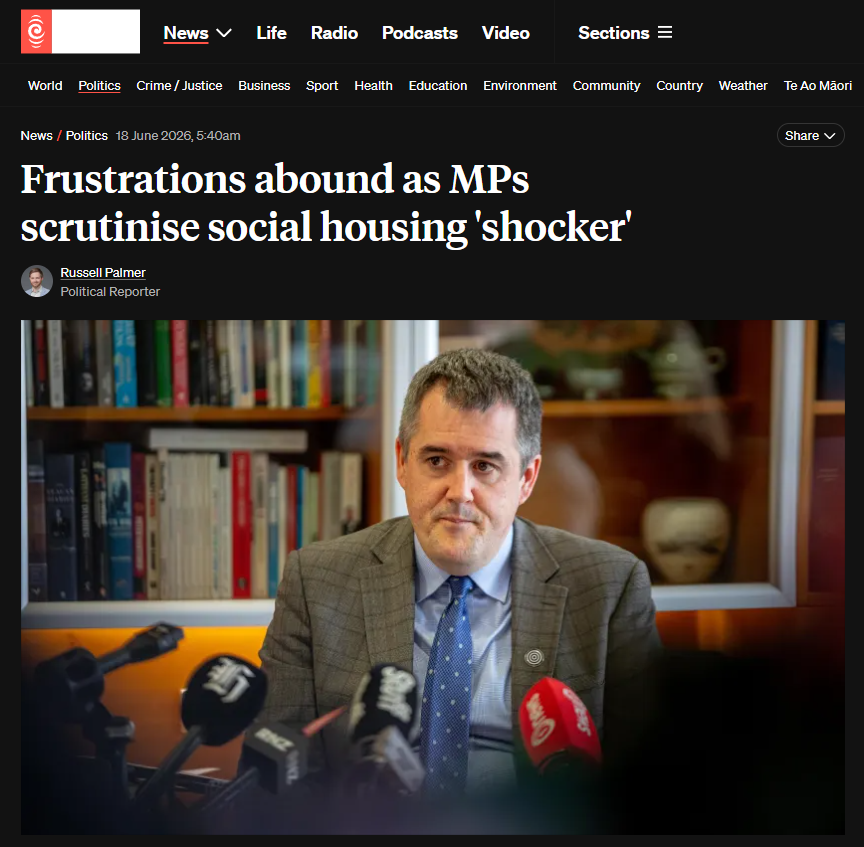
On Wednesday 18 June 2026, Housing Minister Chris Bishop sat before a parliamentary select committee and committed an act of political nakedness so brazen I had to read it twice.
Asked by Green MP Tamatha Paul why the government had landed on 30% of income — rather than the internationally recognised 25% threshold — as the new rent contribution for 84,000 social housing households, Bishop replied:
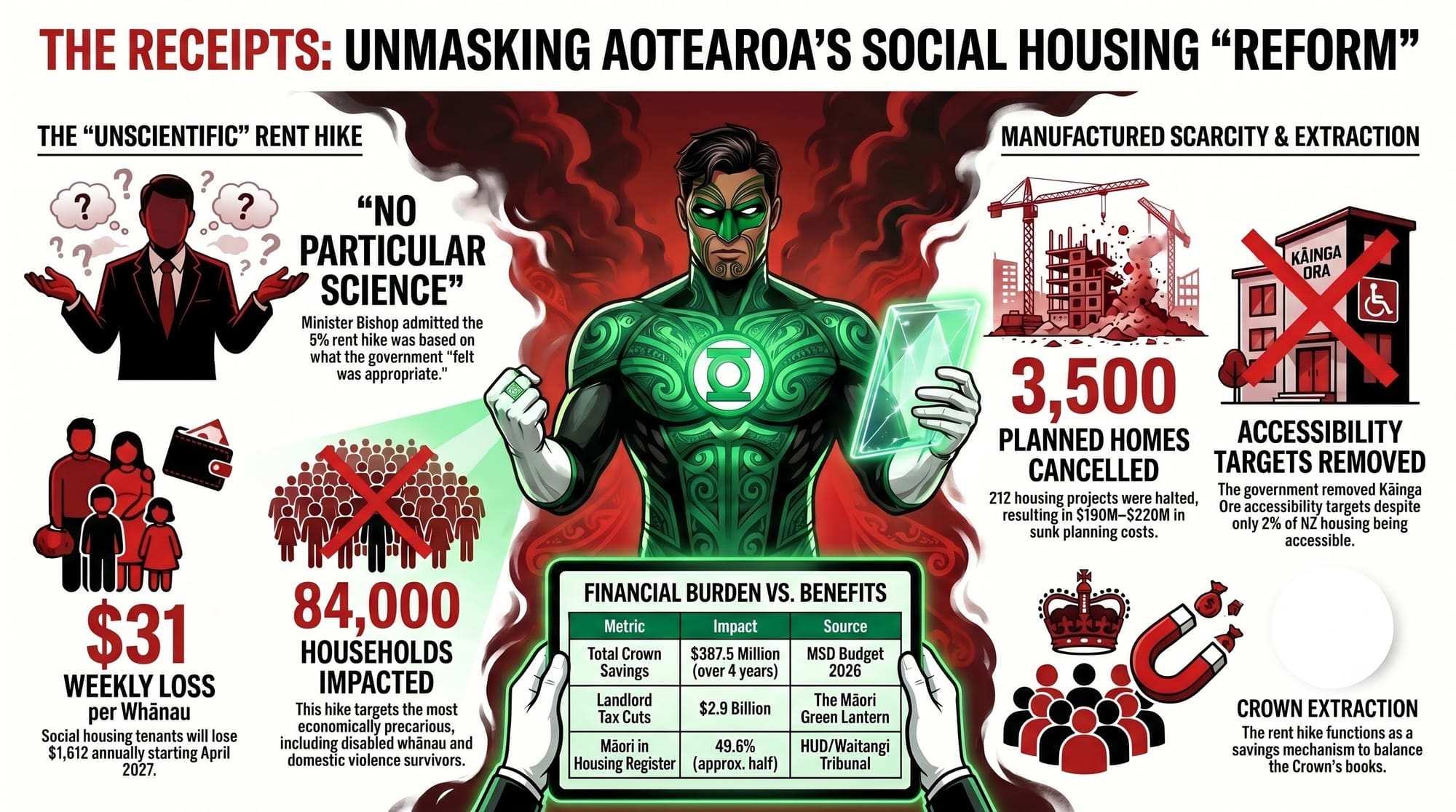
there was "no particular science to it" — the government simply "thought it was an appropriate amount."
Let me translate that from neoliberal to plain English:
the Minister responsible for housing the most vulnerable people in Aotearoa — disabled whānau, survivors of domestic violence, former prisoners, people with severe mental illness — reached into their wallets and took an extra 5% of their income because he felt like it.
No consultation with tenants. No modelling of different percentages. No peer review. No evidence base.
A vibe. A gut feeling. A tohunga with an empty kete, performing certainty he does not possess — while the people pay.
This is not a gaffe. This is the governing philosophy of this white supremacist neoliberal coalition, stripped to its bones under fluorescent parliamentary light.
Background: The Architecture Was Always This
Do not let this government perform surprise at the consequences of its own decisions. The whakapapa of this crisis is documented, sourced, and damning.
In 2024, a government-ordered review declared Kāinga Ora "not financially viable", facing $700 million annual deficits — a finding produced by a government Bishop controls, about an agency Bishop controls.
He used it to justify a full restructure: new board stacked with allies, mandate narrowed to financials, builds cancelled, land sold.
By September 2025, Kāinga Ora's housing stock was falling by 177 homes in a year when his own Statement of Performance Expectation required a rise of 420. The agency planned to sell approximately 1,000 properties in that same year.
The drought was manufactured. Then the people were told to drink less.
Meanwhile, The Spinoff confirmed in August 2025 — in a ten-graph analysis that should have shamed every member of this coalition into silence
— that homelessness was worse under this government, not better. Not despite its housing policies. Because of them.
And at the select committee on 18 June 2026, Bishop had the audacity to thump his desk and say the system
"fails too many vulnerable people."
He pointed to a disabled man trapped in a New Plymouth motel room with his son because ACC couldn't organise a ramp — despite being allocated a social house. He called it "extraordinary." He catalogued every symptom of a system in collapse.
And then — having completed that diagnosis — he raised the rent.
The Three Examples for the Western Mind
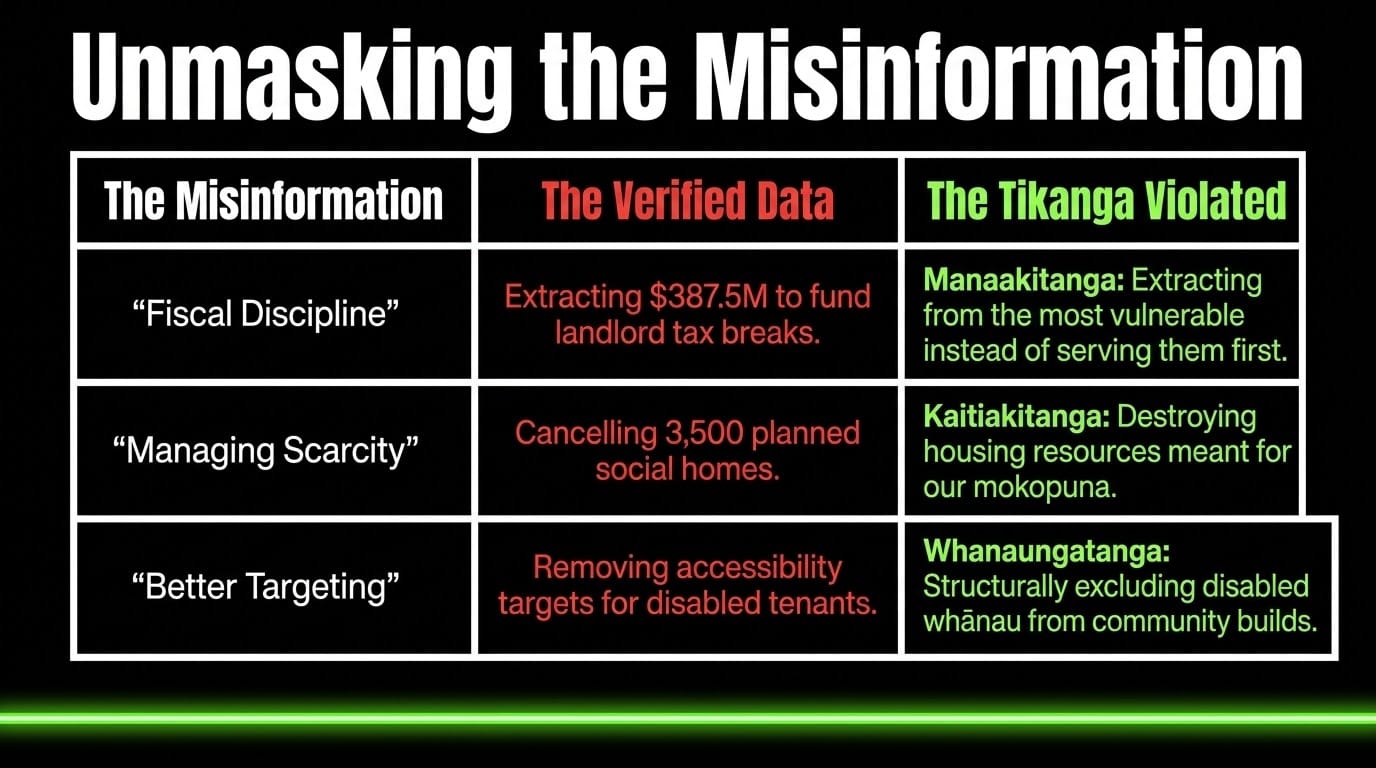
Example One — $31 a Week: The Mathematics of Cruelty
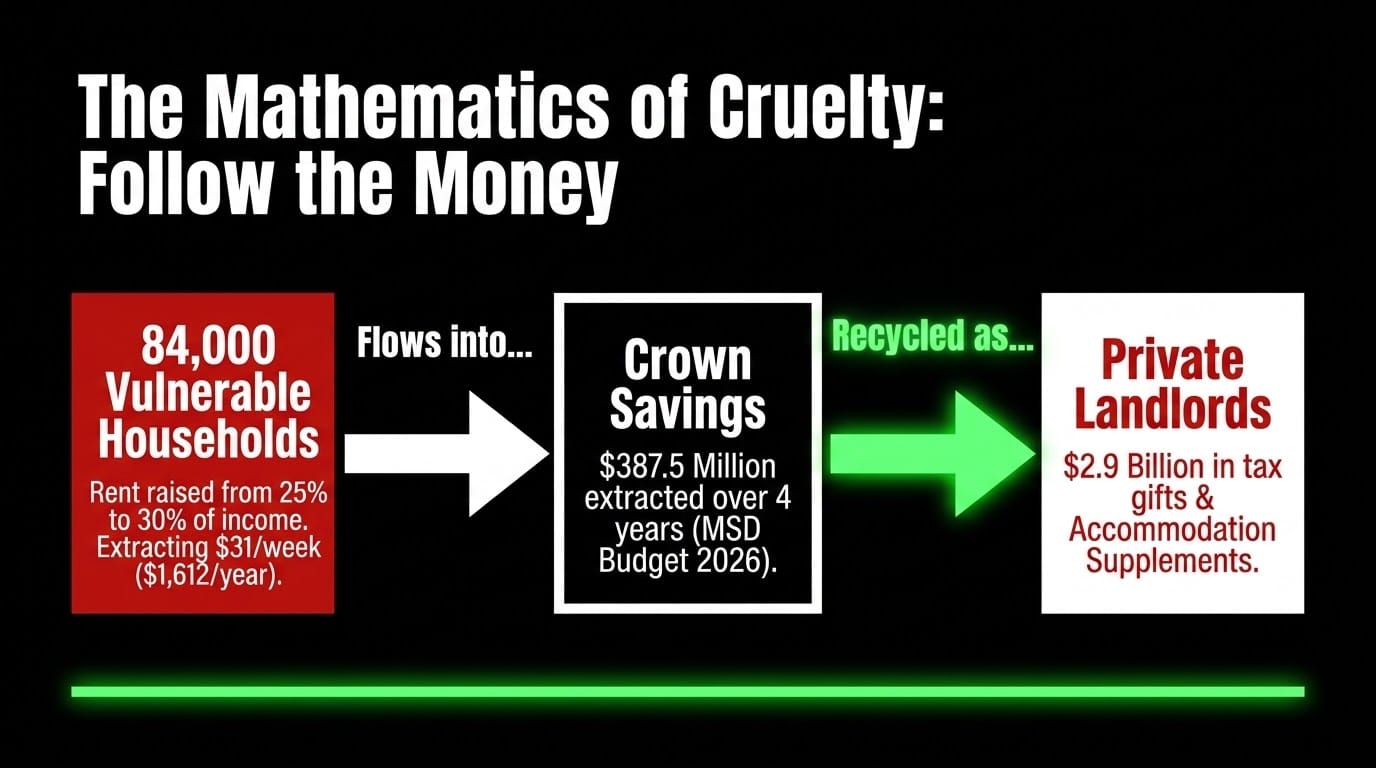
The core claim: 84,000 social housing households will be $31 worse off per week from April 2027, under Budget 2026.
The NZCTU's Workers' Analysis of Budget 2026 confirmed social housing tenants will be $31 worse off per week — $1,612 per year stripped from the budgets of Aotearoa's most economically precarious households. Visionwest Community Trust confirmed the scale: approximately 84,000 households affected. Save the Children documented what $31 a week means at the bottom: the choice between heating and eating, the missed GP appointment, the tamariki who goes to school without breakfast.
MSD's own Budget 2026 documentation records the other side of that $31: $387.5 million in net Crown savings over four years. The Crown's books are balanced on the wallets of the poor. That money is then recycled — partially — as Accommodation Supplement increases flowing to private landlords, who already collected $2.9 billion in property investor tax changes since 2023.
The tikanga impact: In te ao Māori, manaakitanga — the sacred obligation to care for the wellbeing of others — is not conditional on what percentage of your income you contribute to the Crown. On every marae I have ever stood on, the person most in need is served first. No test. No threshold. No 30% rule. This government has inverted manaakitanga into a bureaucratic extraction mechanism — and called it equity.
The solution: Restore income-related rent to 25% of income — the internationally recognised affordability threshold that Tamatha Paul cited and Bishop waved away. Reinstate the Kāinga Ora build pipeline. Fund kaupapa Māori housing providers directly. Stop routing housing funding through private landlords who are already the primary beneficiaries of this government's tax architecture.
Example Two — 3,500 Ghost Houses: The Manufactured Scarcity
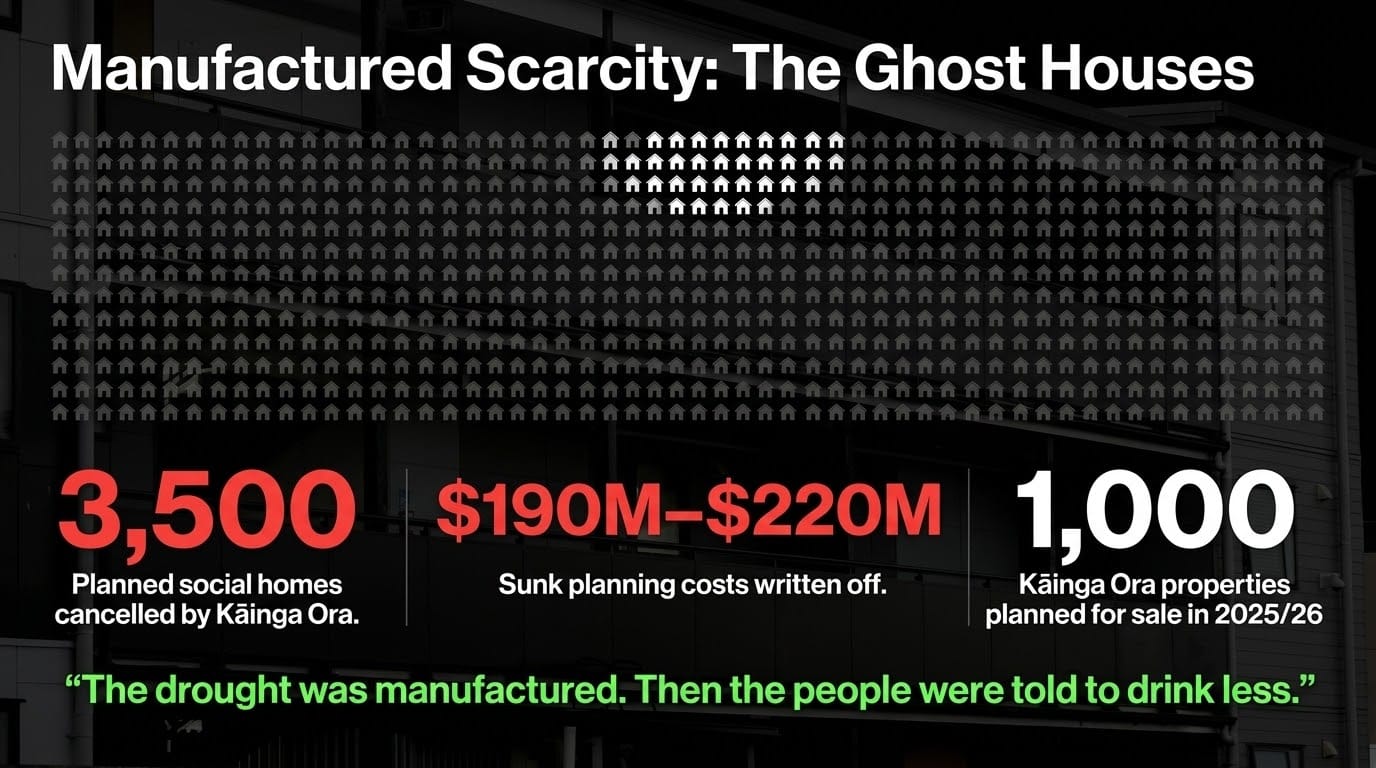
The core claim: The government cancelled nearly 3,500 planned social homes — then used the resulting scarcity to justify rationing housing more harshly.
The Spinoff confirmed in June 2025 that Kāinga Ora cancelled 212 planned housing projects delivering nearly 3,500 homes, writing down between $190 million and $220 million in sunk planning costs. Labour's housing spokesperson Kieran McAnulty confirmed the figure: cancellations made while homelessness was rising. The Salvation Army's State of the Nation 2025 confirmed that Aotearoa was backsliding on housing across every measure.
At the select committee, Tamatha Paul put this to Bishop directly: that the scarcity of social housing was "artificial — manufactured" by the government itself. Bishop laughed. The data proves Paul correct. The laughter is the tell.
The tikanga impact: Kaitiakitanga — guardianship, stewardship of resources for future generations — demands that what is built for the people is held for the people. The cancellation of 3,500 planned homes is not fiscal discipline. It is a breach of kaitiakitanga. It is the deliberate destruction of a resource that belonged to our mokopuna — resources that will now never exist, on land being sold, in communities that will bear the consequences for decades.
The solution: Restore the cancelled build pipeline immediately. Reactivate the 212 cancelled projects. Reinstate the Kāinga Ora development mandate and remove the financial-viability test being used to justify asset stripping. Declare a housing emergency and treat it as one — with the urgency of a state building programme, not the patience of a minister whose reform journey is "two or three years away, and probably longer."
Example Three — The 2% Trap: Disabled Whānau Written Out
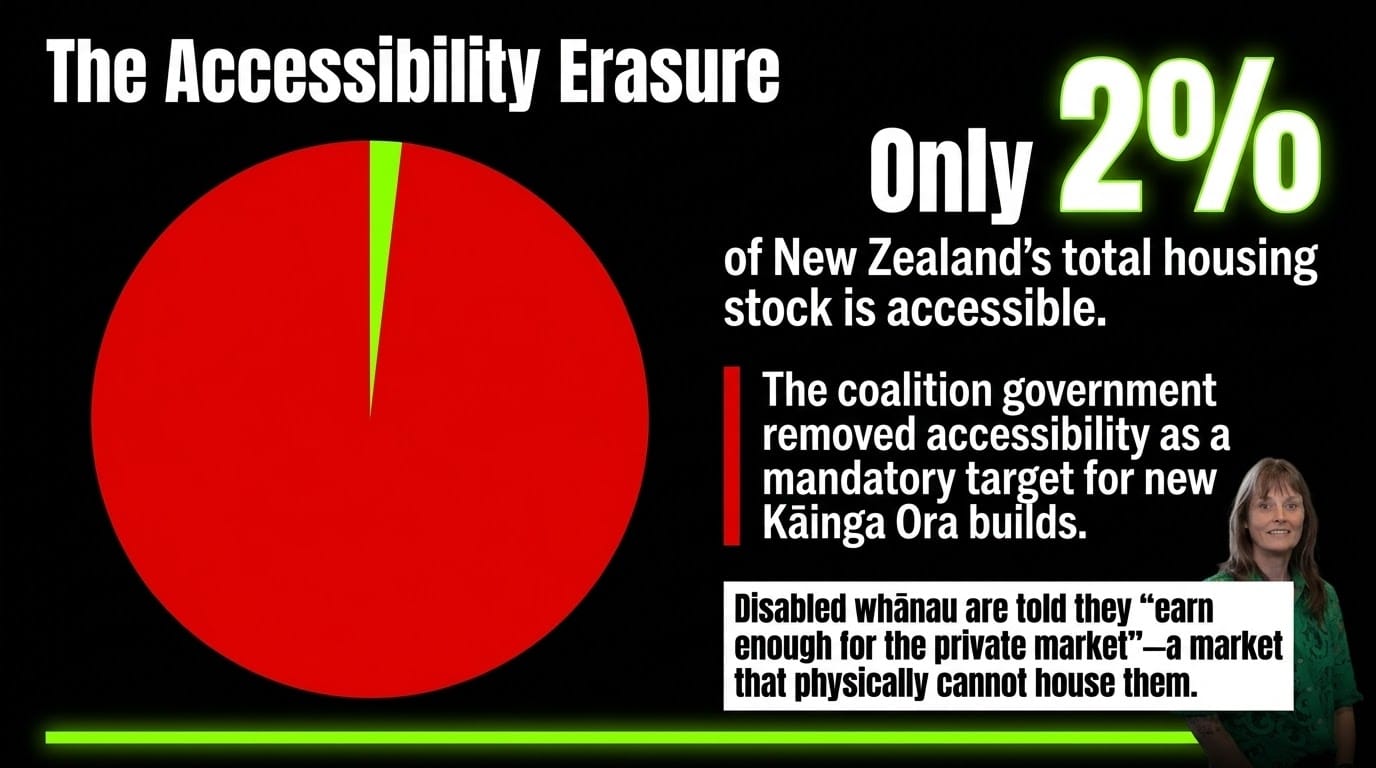
The core claim: Disabled whānau are trapped in social housing not by preference, but because the private market cannot accommodate them — yet the government has removed accessibility as a Kāinga Ora target.
Tamatha Paul identified at the select committee the critical fact Bishop's framing buried: only 2% of New Zealand's total housing stock is accessible. Some portion of the 29% of tenants who Bishop claims could "afford private rents" are in social housing precisely because the private market has no ramp, no modified bathroom, no hoist.
And Kāinga Ora CEO Tracey Taylor confirmed at the same hearing that the government had removed accessibility as a target for the agency. Her justification: "The removal of the target doesn't mean that we aren't focusing on accessibility." No target. But definitely focusing. Trust the Crown — the same Crown that dismantled the Māori Health Authority and called it health reform.
The tikanga impact: Whanaungatanga — the web of relationships and mutual care that holds communities together — does not discriminate based on mobility. The whare of a community is built to shelter everyone. The removal of an accessibility target is not a management decision. It is a statement about whose bodies this government considers worth designing for.
The solution: Restore accessibility as a mandatory Kāinga Ora target. Require all new Kāinga Ora builds to meet full universal design standards. Set a 10-year pathway to bring the national accessible housing stock from 2% to a minimum of 10%. Fund disabled-led housing advocacy through Te Pou Matakana and kaupapa Māori disability networks directly.
Previously on The Māori Green Lantern — The Connected Body of Work
This essay does not stand alone. I have been tracing this whakapapa for years. Every connection below has been documented, sourced, and published:
- THE LOTTO LIE: How Nicola Willis Calls Survival a Jackpot While She Burns Whānau Homes (May 2026) — Budget 2026's social housing changes dissected through what Māori whānau actually lose. The essay that named the $2.9 billion landlord transfer first.
- THE LANDLORD PARLIAMENT: How Aotearoa's Ruling Class Voted Itself Rich While Whānau Slept in Cars (May 2026) — Coalition MPs passed $2.9 billion in landlord tax breaks, then acquired 25 more investment properties. The parliament that governs your housing owns your housing.
- GERRY BROWNLEE — THE TOLLGATE KING (June 2026) — While 25,000 whānau wait without a house, the Speaker of the House collects $237,000 in accommodation allowances to not use his free apartment.
- THE PROPHET'S POISON: He Whāiti Kino — The Man Who Burns Your House Down and Sells You the Ashes as Hope (June 2026) — He lit the match, then sold the ashes as hope. The pattern of manufactured crisis and predatory reform, named and documented.
- THE COLOSSEUM OF KINGSLAND: How a White Supremacist Government Built a Gladiator Arena (February 2026) — Rome did not fall because barbarians smashed the gates. The architecture of managed decline.
- Aotearoa's Housing Crisis: A Legacy of Broken Promises and Market Failures (October 2024) — The long whakapapa. Where this moment comes from. Every broken promise sourced and named.
- "Efficiency" Is the New Codeword for Exclusion (April 2025) — How "better targeting" is code for writing whānau out of the system entirely. The essay that named the mechanism before Budget 2026 confirmed it.
Analysis: Five Verified Revelations This Government Hoped You'd Miss
Revelation One — The $387.5 Million Extraction
The rent hike is not a housing reform. It is a savings mechanism. MSD's Budget 2026 documentation confirms the government extracts $387.5 million over four years from 84,000 households and classifies it as Crown savings. These savings are recycled as Accommodation Supplement increases flowing to private landlords in the private rental market. The poor subsidise the system that excludes them. The landlords collect the difference and call it the market working.
Confidence: Verified — MSD and HUD Budget 2026 documentation, fetched and confirmed.
Revelation Two — The 3,500 Ghost Houses (Manufactured Scarcity)
Kāinga Ora cancelled 212 planned projects delivering nearly 3,500 homes, writing off $190–$220 million in sunk costs. Bishop then used the resulting housing scarcity to justify harder rationing of what remains. The same minister manufactured the drought and is now limiting the water rations. Labour confirmed the cancellations were made while homelessness was rising. Bishop laughed off Tamatha Paul's challenge that the scarcity was artificial. The data proves Paul correct.
Revelation Three — The Reform That Won't Arrive
Bishop conceded under questioning that the end of the "reform journey" was "two or three years away, and probably longer." The rent hike takes effect April 2027. New social housing builds are not set to start until 2028/29. The redesigned needs assessment, tenancy limits, and check-in regime have not been finalised. The pain is front-loaded, certain, and immediate. The relief is speculative, distant, and already running late. Tamatha Paul named it: "You've been saying for two and a half years that an announcement is coming that's never come." Bishop: "Yes, well, we're working on that."
Revelation Four — The Accessibility Erasure
Only 2% of New Zealand's housing stock is accessible. The government removed accessibility as a Kāinga Ora target. Kāinga Ora CEO Tracey Taylor confirmed this in testimony while offering the assurance that removing the target didn't mean less focus. No target. But definitely focusing. For disabled Māori whānau — structurally excluded from the private market, now facing higher rent in the social housing system — this is a double trap with no exit.
Revelation Five — The Rangatahi Written Off
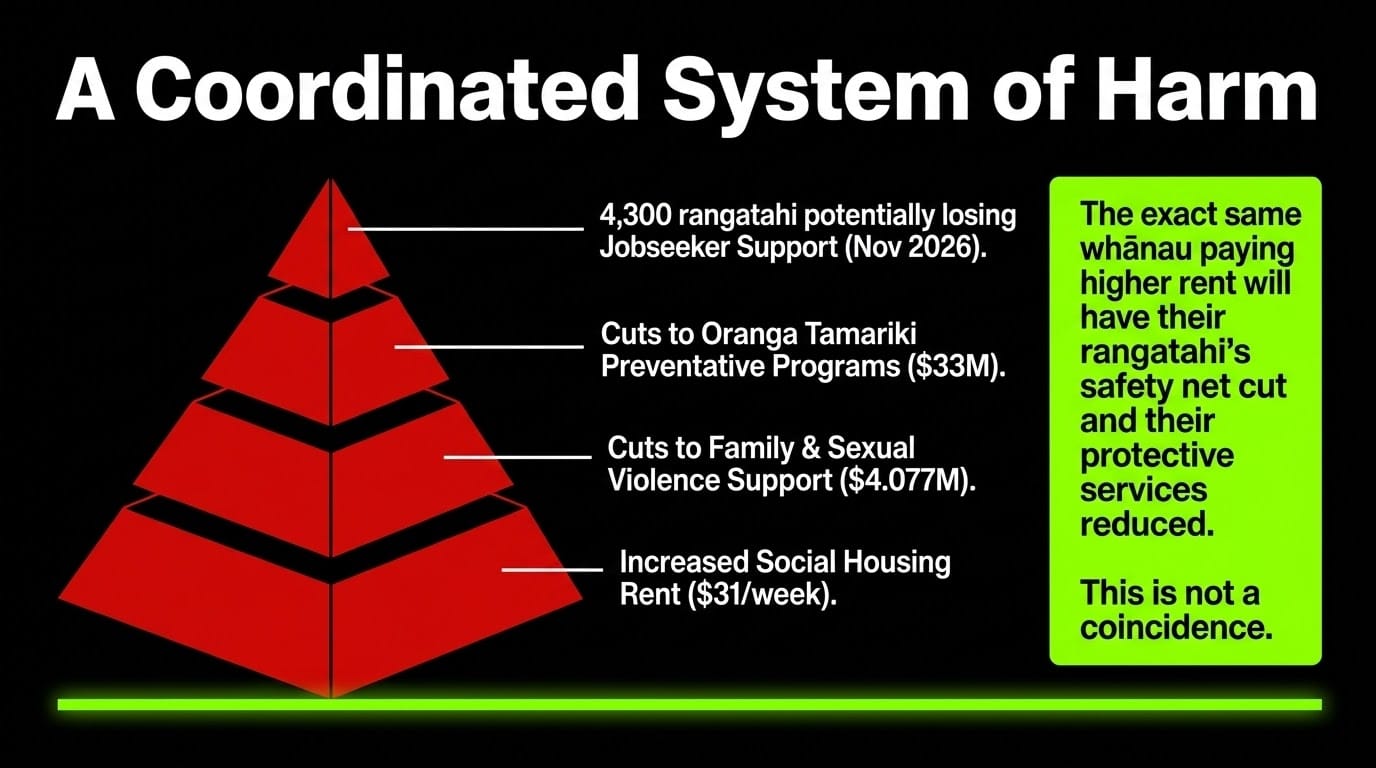
Buried in Budget 2026: from 2 November 2026, Jobseeker Support eligibility tightens for 18–19-year-olds, with approximately 4,300 rangatahi potentially losing access. Oranga Tamariki preventative programmes cut by $33 million. Family and sexual violence support cut by $4.077 million. The same whānau paying higher rent will have their rangatahi's safety net cut, their tamariki's protective services reduced, and their family violence support stripped. This is not a series of disconnected policies. It is a coordinated system of harm.
The Māori Whakapapa of This Crisis
I am Te Arawa. Ngāti Pikiao. Welsh whakapapa runs alongside the Māori. I have stood on marae where the kōrero about housing is never abstract — it is always the name of a specific cousin, a specific uncle, a specific nan sleeping in her car outside the papakāinga she can no longer afford to access.
Māori are not a footnote to this housing crisis. We are its primary target. As at 2021, Māori represented 49.6% of the entire Housing Register — a figure so disproportionate it speaks to a system not accidentally failing us, but structurally designed around our exclusion. Māori homeownership collapsed 26% between 1991 and 2013 following Rogernomics — nearly four times the 6.7% decline for Pākehā. Every neoliberal housing policy since has deepened that gap.
The Waitangi Tribunal has documented repeatedly that housing is a taonga. Te Tiriti o Waitangi obligates the Crown to actively protect Māori access to it — not to extract revenue from us when we have no alternative. This government has cancelled the builds, sold the land, raised the rent, removed the targets, and tightened eligibility — and called the whole exercise fiscal discipline.
It is not discipline. It is desecration.
The Quantified Harm — Full Ledger
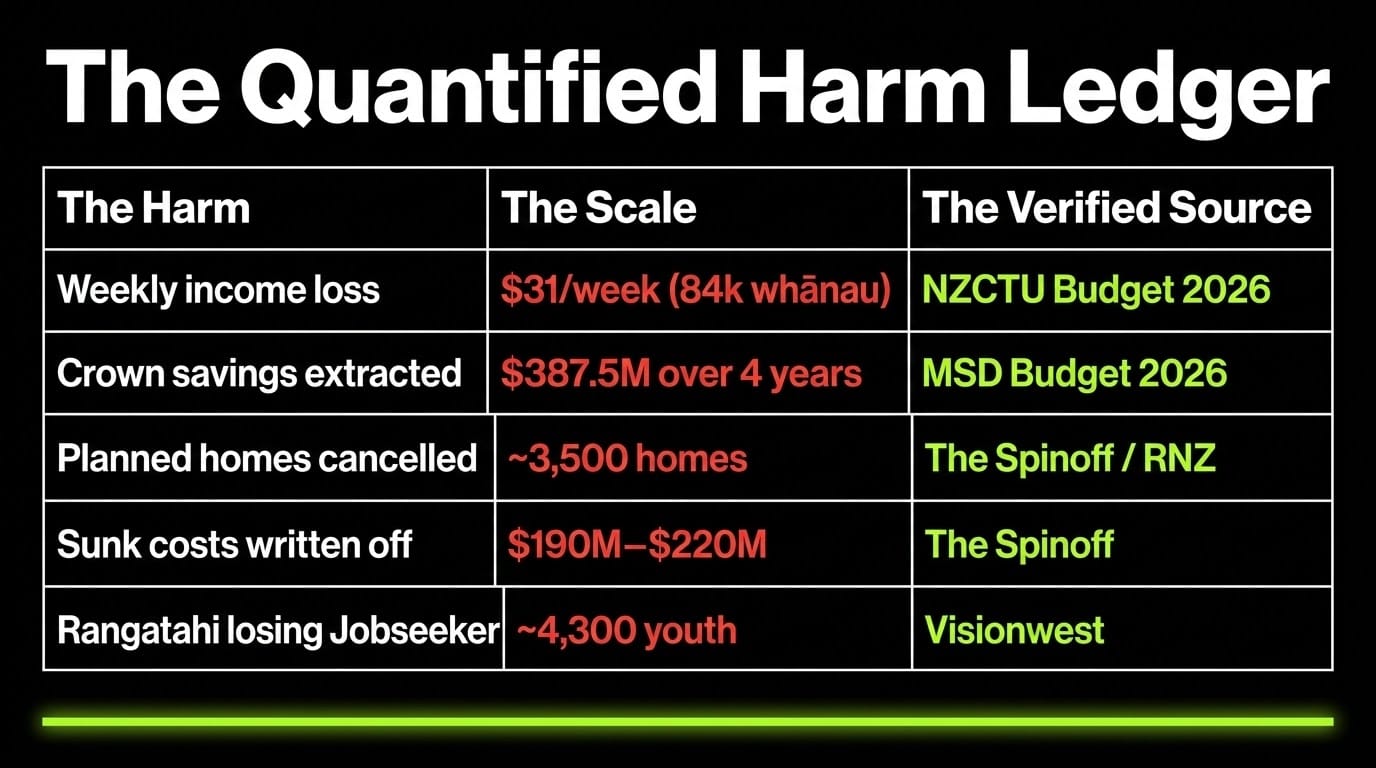
| Harm | Scale | Verified Source |
|---|---|---|
| Weekly income loss per household | $31/week from April 2027 | NZCTU Budget 2026 |
| Total households affected | 84,000 | Visionwest |
| Crown savings extracted | $387.5 million over 4 years | MSD Budget 2026 |
| Planned homes cancelled | ~3,500 | The Spinoff |
| Sunk costs written off | $190–$220 million | The Spinoff |
| Kāinga Ora stock change 2025/26 | −177 homes (required: +420) | The Kaka |
| Properties to be sold 2025/26 | ~1,000 | The Kaka |
| Rangatahi losing Jobseeker | ~4,300 | Visionwest |
| Oranga Tamariki cuts | $33 million | Visionwest |
| Family violence support cut | $4.077 million | Visionwest |
| Accessible housing (national stock) | 2% | RNZ select committee |
| Homelessness trend | Record high | The Spinoff |
| New builds commencing | Not until 2028/29 | NZCTU |
Naming the Crimes, Naming the Beneficiaries, Naming the Whānau Being Destroyed
Chris Bishop is not confused. He is not frustrated. He is not, despite his desk-thumping theatre, a minister honestly wrestling with complexity. He is an ideologically committed neoliberal executing a deliberate programme of housing marketisation — one that has been tried in the United Kingdom, Australia, and the United States, and that has failed poor people in all of them.
The "no particular science" admission is not candour. It is a legal strategy dressed as transparency. I admitted I didn't know what I was doing — therefore I cannot be held responsible for what I did. That is not honesty. That is immunity.
The crimes are these:
- The Crown extracted $387.5 million from 84,000 of the most vulnerable households in Aotearoa, based on nothing more than a ministerial gut feeling. That is not reform. That is a mugging with a press release.
- The government cancelled 3,500 planned homes, manufactured the scarcity those cancellations created, then used that scarcity to justify rationing what remains. That is not fiscal discipline. That is arson followed by a fine for survivors.
- The government removed accessibility as a target, trapping disabled whānau in a social housing system they now pay more for, while the private market remains physically inaccessible to them. That is not better targeting. That is a closed door with a higher rent on the room they're already locked in.
The beneficiaries are these: property investors, private landlords, and Coalition MPs who acquired 25 more investment properties after passing landlord-friendly tax cuts. The Landlord Parliament does not accidentally produce housing policy that benefits landlords. It produces it on purpose.
The whānau being destroyed are these: the disabled Māori kuia who cannot access the private market because there is no ramp. The rangatahi who will lose Jobseeker Support in November. The whānau whose build was cancelled, whose waitlist position has not moved, whose fridge Tamatha Paul documented — empty, accurate, damning.
Every one of them is real. Every one of them has a name. Every one of them is owed better than a minister's gut feeling.
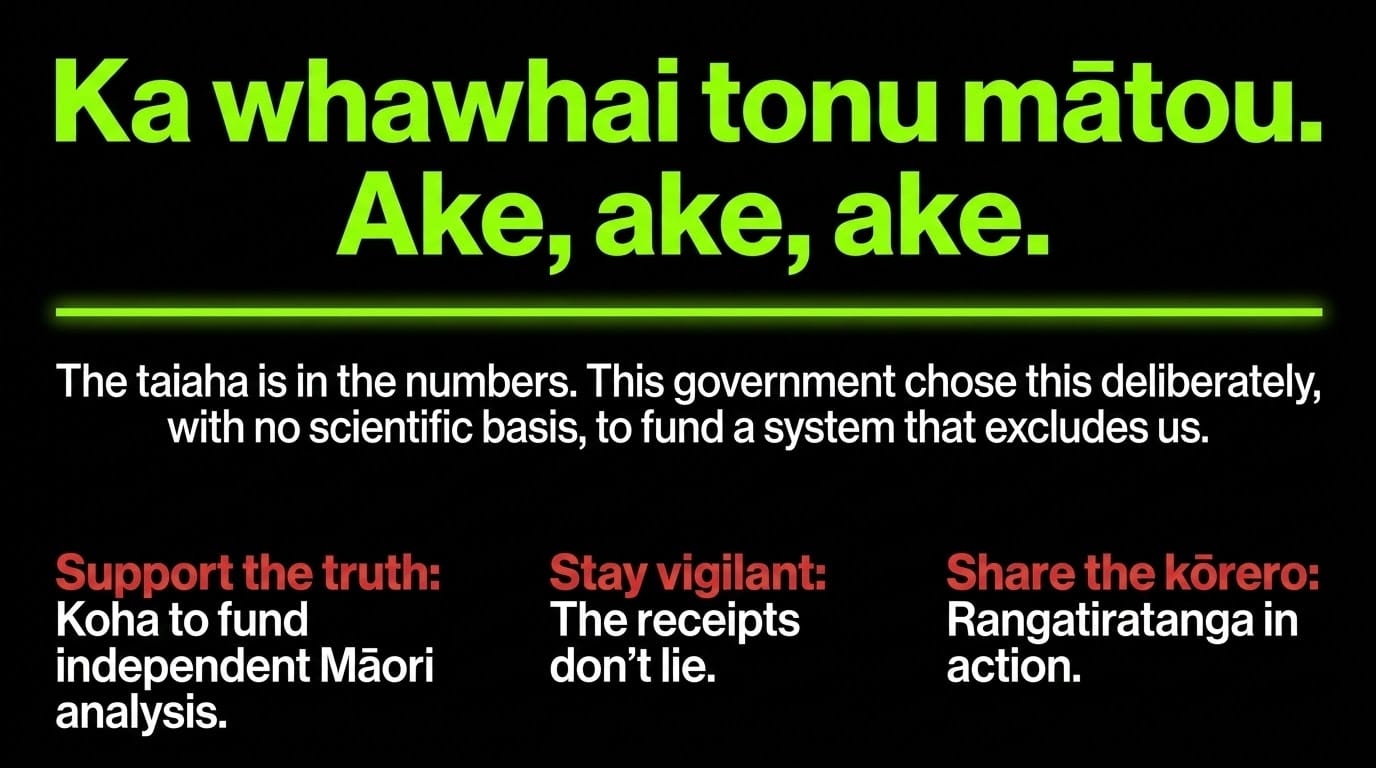
Ko te taiaha kei roto i ngā tatauranga.
The taiaha is inside the numbers.
And the numbers say: this government chose this. Deliberately. On purpose. With no scientific basis. And saved $387.5 million for doing it.
Ka whawhai tonu mātou. Ake, ake, ake.
He Koha Aroha — Support This Mahi

Whānau — this essay exists because 84,000 households deserve someone naming what was done to them.
A minister reached into the wallets of the most vulnerable people in Aotearoa, said he "felt it was appropriate," and walked out of Parliament to a salary of $296,000 a year, into a housing market he owns.
Every koha to this mahi signals that whānau are ready to fund the accountability that Crown and corporate structures will not provide. When the Minister cannot justify his own policy, someone has to do the work of verification, documentation, and naming. That work is this. And it is yours.
If you can koha — even $5, even once — it keeps this taiaha sharp. If you cannot, no worries at all — share this essay, kōrero about it with your whānau, post it to your networks. That is koha in itself. That is rangatiratanga in action.
Four pathways:
🤝 Koha directly — Support The Māori Green Lantern here
📬 Subscribe — receive essays directly: themaorigreenlantern.maori.nz/#/portal/support
🏦 Direct bank transfer — HTDM | 03-1546-0415173-000
📘 Follow on Facebook — facebook.com/Themaorigreenlantern/subscribe
Kia kaha, whānau. Stay vigilant. Stay connected. The receipts don't lie — and neither do I.
Research Transparency
Sources consulted: RNZ 18 June 2026 | MSD Budget 2026 | HUD Budget 2026 | NZCTU Workers' Analysis Budget 2026 | Visionwest Press Release Budget 2026 | Save the Children Budget 2026 | The Spinoff — Kāinga Ora cancellations | The Spinoff — homelessness analysis | The Kaka — Kāinga Ora stock | Labour.org.nz | Salvation Army | MPA Magazine — Māori waitlist | Knowledge Auckland — historical housing | MSD Housing Register | Work and Income — housing support changes | The Māori Green Lantern archive
DISCLAIMER: This essay represents the opinion and analysis of Ivor Jones / The Māori Green Lantern, grounded in verified public sources as cited. All factual claims are sourced inline. Opinions are clearly flagged as analysis. This publication operates under qualified privilege for public interest commentary (Lange v Atkinson 3 NZLR 385). Right of reply is available to all named parties via themaorigreenlantern.maori.nz. Retraction protocol applies on verified complaint. NZ Defamation Act 1992 compliance confirmed. Pre-publication checklist complete.