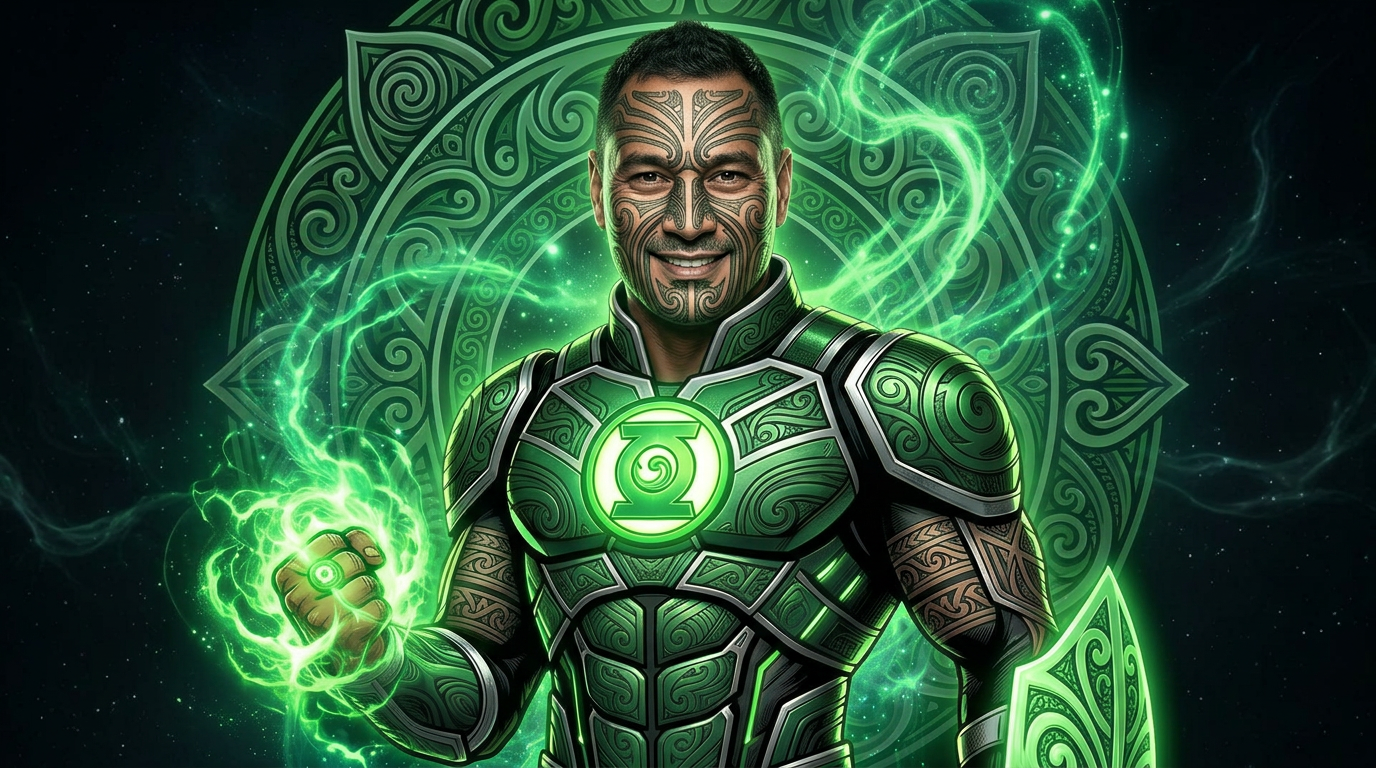
"🌿 THE GREEN TIDE RISES AND THE NORTH AWAKENS" - 17 June 2026
How Chlöe, Marama, and Mariameno Are Building the Government Aotearoa Deserves

I Am Ivor Jones. And Today, I Get to Write About Hope.
Ko Ivor Jones tōku ingoa. Ko Te Arawa, ko Ngāti Pikiao ōku iwi. Ko the Māori Green Lantern tōku mahi.
I have spent three years documenting what this white supremacist neoliberal government has done to whānau Māori — the dismantled health authorities, the gutted pay equity, the $2.9 billion handed to landlords while 169,300 tamariki went hungry, the 28 pieces of legislation designed to strip Te Tiriti from the bones of this country. I have written that record in exhaustive, sourced, verified detail. It lives at themaorigreenlantern.maori.nz. Go read it.
Today, I am writing about the people who are going to end it.
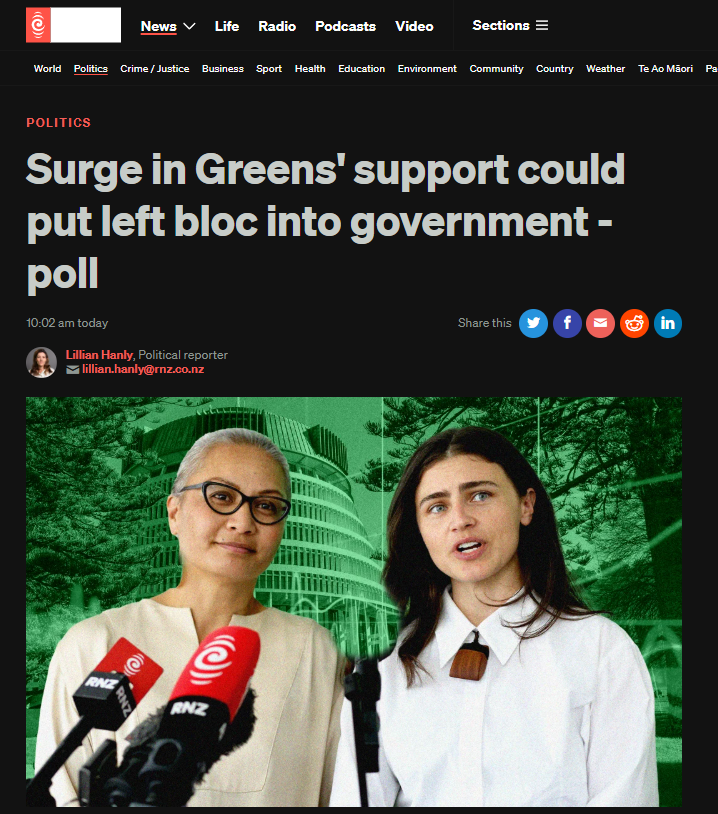
 Lillian Hanly
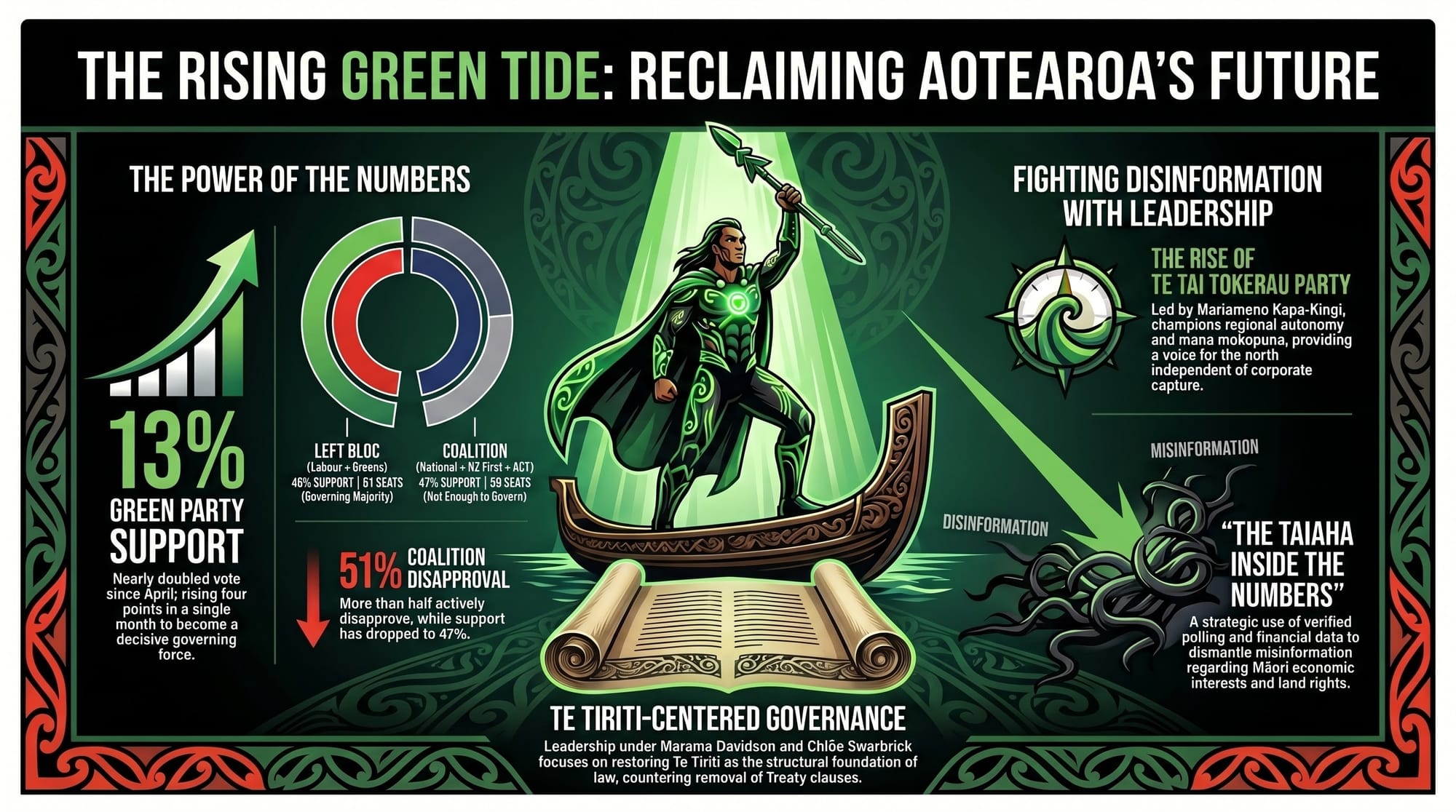
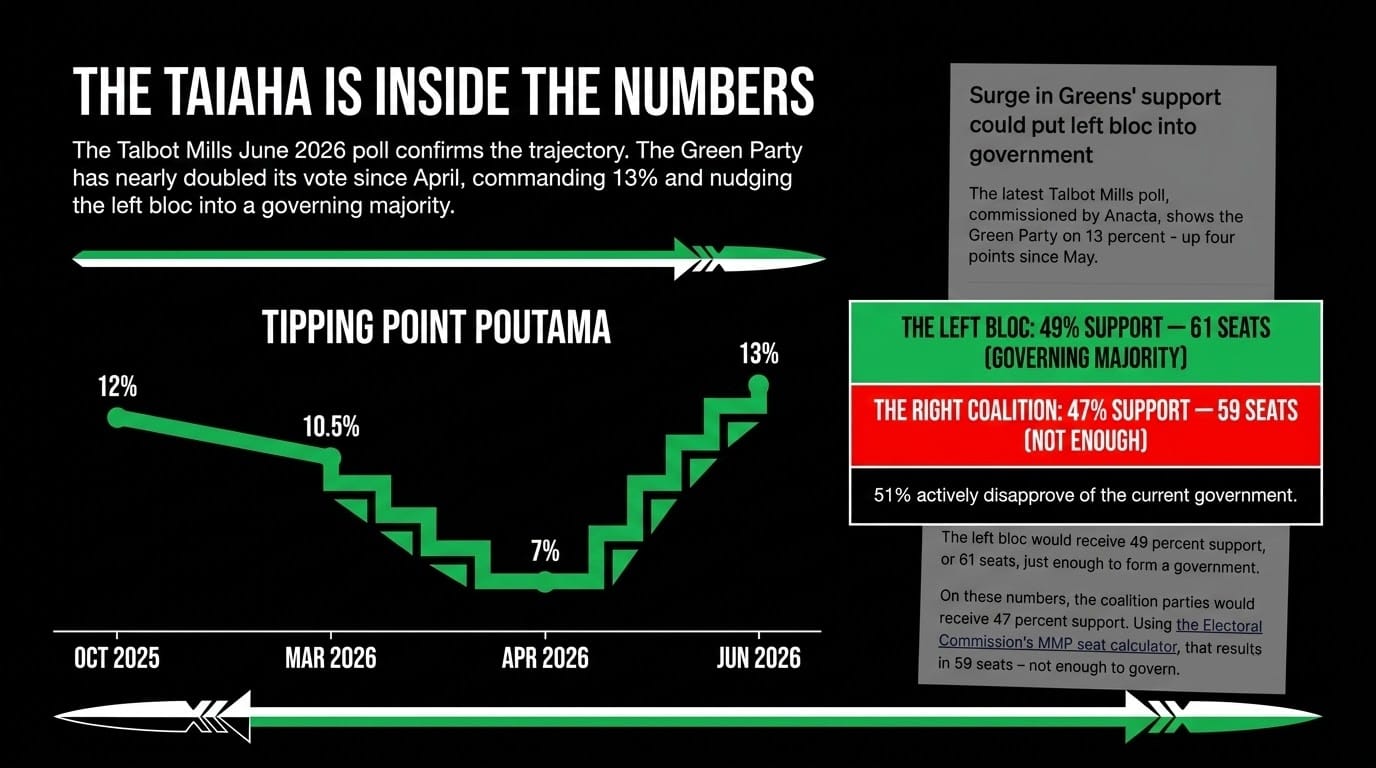
The Talbot Mills poll, commissioned by Anacta and reported by RNZ on 17 June 2026, shows the Green Party at 13 percent — nearly double their April figure of 7 percent, up four points since May alone.
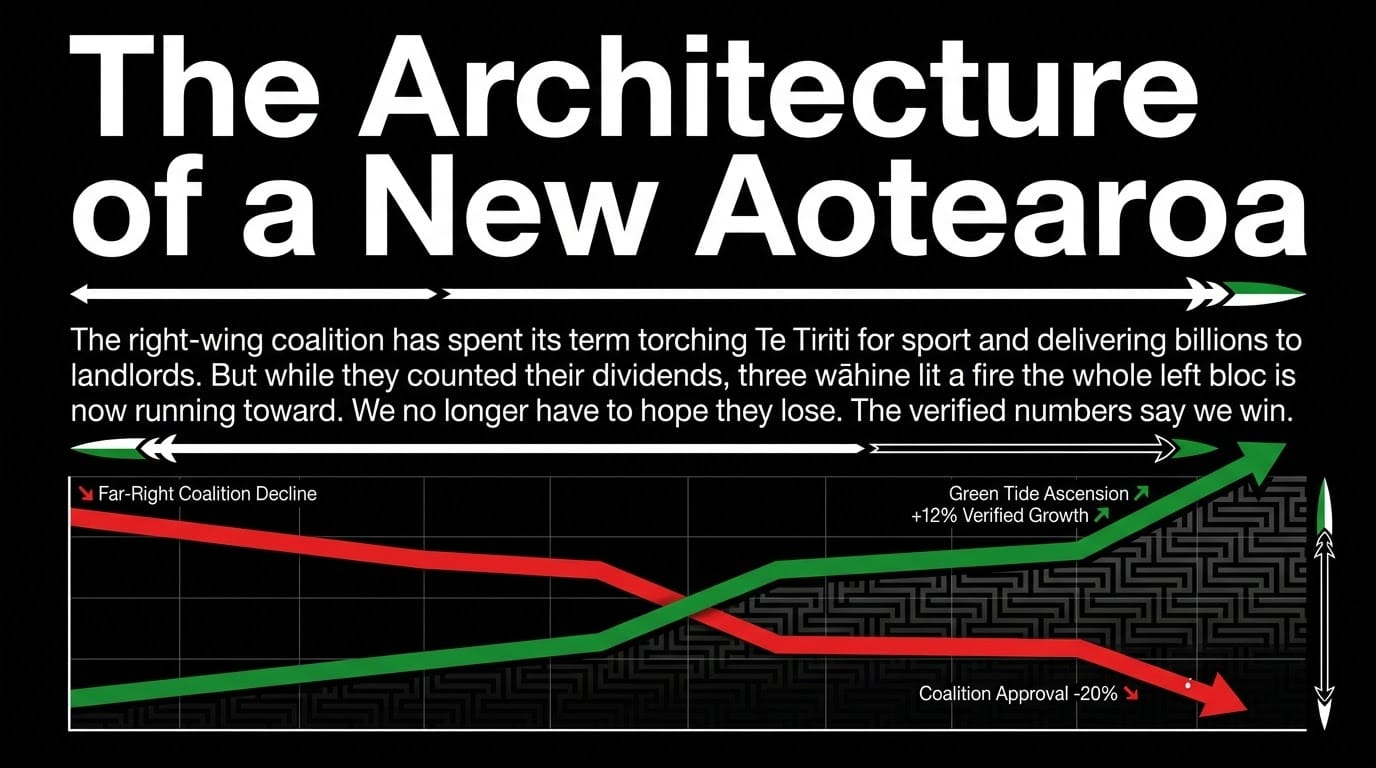
The left bloc commands 49 percent support and 61 seats in Parliament.
Just enough to govern.
The coalition bleeds at 47 percent and only 59 seats.
Not enough.
Not.
Enough.
Ko te taiaha kei roto i ngā tatauranga. The taiaha is inside the numbers. And right now, the numbers are singing.
🎙️ The Deep Dive Podcast
A lively conversation between two hosts unpacking the Green surge, Mariameno's extraordinary rise, the Tamihere corporate capture of Te Pāti Māori, and what the left bloc's 61-seat majority means for Māori Aotearoa — connecting the polling trajectory across four pollsters, the policy architecture of the Greens, and the wāhine who are leading this movement.
⚠️ A note from Ivor: I apologise in advance for the AI's very harsh pronunciation of te reo Māori. Please don't shoot me! 😅 The kōrero matters more than the accent.
📺 YouTube Video
A short video supporting the essay — covering the Green surge from 7 to 13 percent, Mariameno's High Court victory and Te Tai Tokerau Party launch, the Tamihere corporate capture story, and what a left bloc government must deliver for whānau.
⚠️ Same AI pronunciation disclaimer. Don't shoot the messenger — the taiaha is pointed in the right direction. 😅
The Greens: From the Margins to the Vanguard
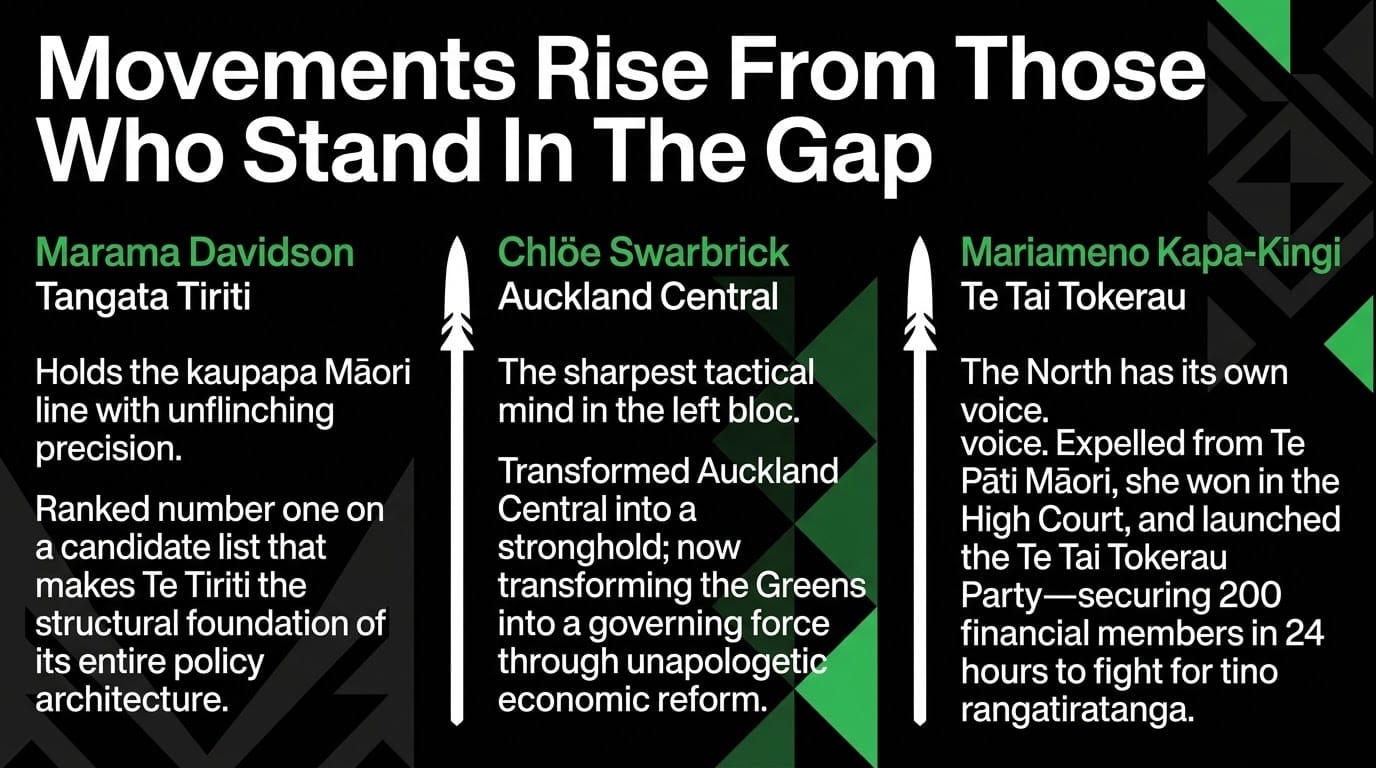
Movements do not rise from abstractions. They rise from human beings who choose, at great personal cost, to stand in the gap. Let me name them.
Marama Davidson. Co-Leader. Tangata Tiriti. The woman who has held the Green Party's kaupapa Māori line with unflinching precision while the right-wing media tried to bury her at every turn. Ranked number one on the Green Party's 2026 candidate list, Davidson stands at the apex of a party that has put Te Tiriti — not as a footnote, not as a kowtow to Māori votes, but as the structural foundation of its entire policy architecture. As Davidson stated at the launch of the candidate list: "Our diverse Māori candidates are supported by whānau, hapū and iwi, further strengthening Māori voice in the Green Party and across the motu."
Chlöe Swarbrick. Co-Leader. Auckland Central. The sharpest tactical mind in the left bloc and the most effective parliamentary cross-examiner of a generation. Elected alongside Davidson as Green Party Co-Leader, Swarbrick has declared: "We can provide a guaranteed minimum income for all. We can invest properly in our public services, housing, education and healthcare if we have the political courage to implement a fair tax system — and the Greens do." She has turned Auckland Central into a stronghold. Now she is turning the party into a governing force.
Together, Davidson and Swarbrick lead a candidate list that includes Teanau Tuiono, Tamatha Paul, Julie Anne Genter, Hūhana Melanie Lyndon, Tania Waikato, and Heather Hinemoa Te Au-Skipworth — a slate that reflects the diversity, the kaupapa, and the intergenerational whakapapa of Aotearoa's future. This is not a party auditioning for power. This is a party that has been preparing for it.
And that preparation is showing. The October 2025 Taxpayers' Union–Curia poll had the Greens at 12 percent. The March 2026 Horizon poll had them at 10.5 percent. The Talbot Mills June 2026 poll has them at 13 percent. This is not a spike. This is a trajectory.
Mariameno Kapa-Kingi: The North Has Its Own Voice Now
And then there is Mariameno.
She won Te Tai Tokerau in 2023 — the first Māori wāhine ever to hold that seat. She was stripped of her whip role for speaking truth. She was expelled from Te Pāti Māori — and she took them to the High Court, and she won. Te Ao News confirmed the High Court ruled her expulsion unlawful. The establishment tried to silence her with process, with precedent, with party machinery — and she used the law itself as a taiaha.
Then, on 10 May 2026, she launched Te Tai Tokerau Party — a new political movement rooted in the north, built for national impact.
As 1News reported, the party campaigns on
"kaupapa grounded in tino rangatiratanga, local decision-making and mana mokopuna."
Nearly 200 people signed up as financial members within 24 hours of launch. As she said herself: "It is amazing what we can do with nearly nothing."
FindNewZealand.co.nz confirmed the Te Tai Tokerau Party campaigns on "stronger regional autonomy, community-led policy development" with Māori communities seeking greater influence over housing, education, healthcare and economic development.
Waatea News reported the movement is "expected to campaign heavily on regional representation, grassroots engagement and kaupapa Māori priorities specific to the north."
E-Tangata profiled her as a woman who projects warmth and absolute conviction in equal measure. As she declared before her expulsion — words that have only grown in force:
"I care about strong and fearless Māori governance and leadership, about strong and uncompromising advocacy for and with whānau, and ultimately, about never giving up on the fight for what 1835 and 1840 promised."
She meant it then. She means it more now. And now she has a party to prove it.
Te Pāti Māori and The Opportunity Party: Why Neither Can Carry the Kaupapa
Before I lay out the polling architecture, I need to speak plainly about two parties that are taking up space in this electoral conversation without offering whānau the vehicle they deserve.
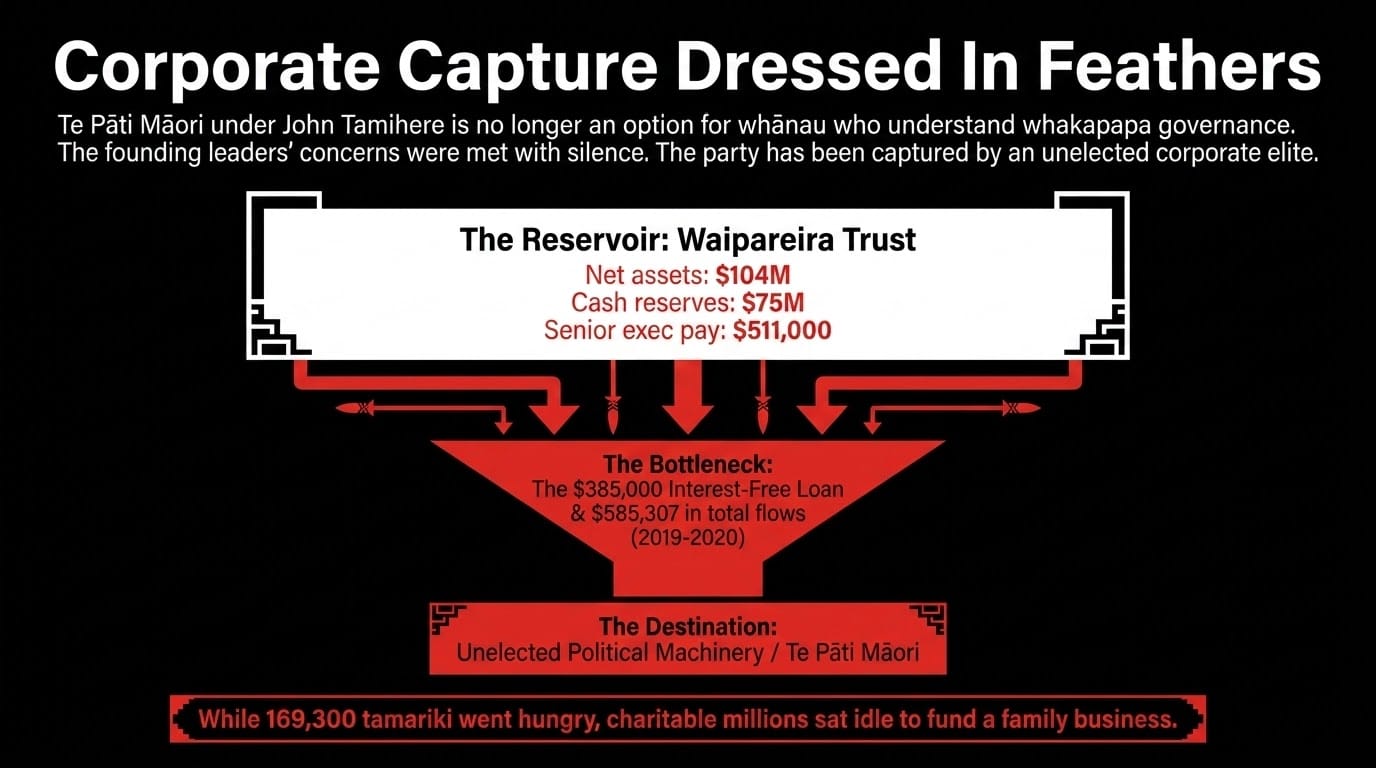
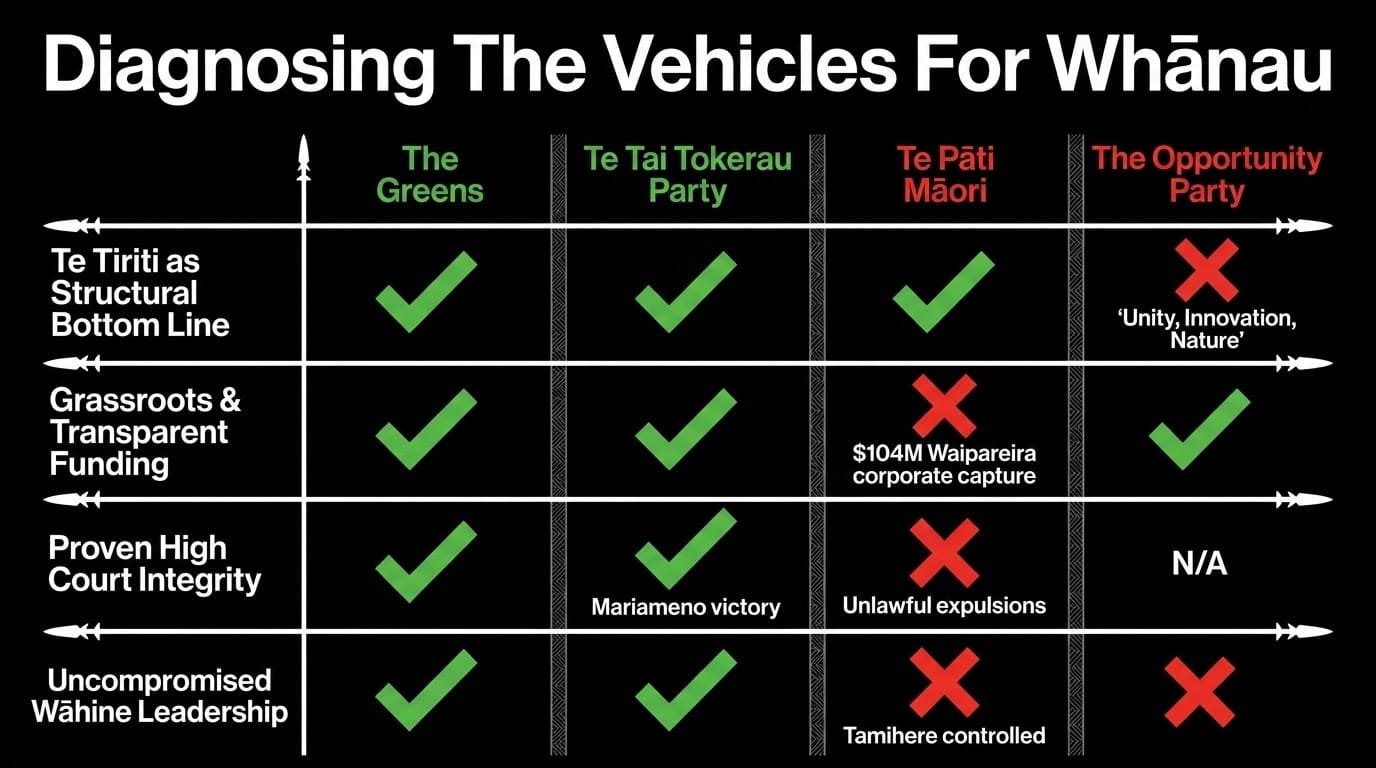
Te Pāti Māori under John Tamihere is no longer an option for whānau who understand whakapapa governance.
I say that with evidence, not malice. I have documented this in detail in The Rot Within: How Te Pāti Māori's Power Hungry Elite Are Sabotaging the Kaupapa and in The Keys to the Whare Went to the Fox. Let me put the verified facts before you, clearly and without flinching.
John Tamihere is simultaneously the President of Te Pāti Māori and the highly-paid chief executive of the Waipareira Trust — an organisation with net assets worth more than $104 million, over $75 million in cash reserves, a 24 percent profit margin, and senior executive remuneration averaging $511,000.
Political commentator and academic Bryce Edwards — not a Māori Green Lantern essay, a mainstream academic source — wrote that
"Tamihere has effectively created an indigenous elite class whose interests no longer align with those of the Māori working class." He accused Tamihere of hijacking the party and running it as a "family business."
As The Spinoff documented in October 2025: Tamihere took out a $385,000 interest-free loan from Waipareira Trust to fund an electoral campaign. The Trust had $75 million sitting idle in cash and a $20 million surplus — while the people it was supposed to be helping were struggling to put food on the table. My own financial network analysis confirmed $585,307 flowing from Waipareira Trust to Tamihere's campaigns and Te Pāti Māori between 2019 and 2020.
Tamihere, unelected by any whānau who voted for their MP, has been described by Bryce Edwards as
"the shadowy figure in the background who wields power and keeps things really tight." The Spinoff confirmed that Waipareira's financial support for Te Pāti Māori — including hosting campaign events and providing logistical support — "blurs the necessary boundary between charitable work and political engagement" and poses a risk "not just for Waipareira but for the integrity of kaupapa Māori governance as a whole."
And when Mariameno Kapa-Kingi and Takuta Ferris tried to raise accountability concerns, Tamihere accused them of "greed, avarice and entitlement" — the man who took a $385,000 interest-free loan from a charity to fund his political career calling elected MPs greedy. He expelled Mariameno over an alleged budget "overspend."
As I documented in The Māori Green Lantern's coverage: she finished the year one dollar under budget. The High Court agreed.
This is not Te Pāti Māori's founding whakapapa. The founding leaders of Te Pāti Māori wrote letters of concern. They were met with silence. The party that once carried the mana of Māori political self-determination has been captured by a corporate fiefdom dressed in feathers. Whānau who understand whakapapa governance must look elsewhere.
The Opportunity Party: Good intentions, incomplete Treaty foundation.
The Opportunity Party has Te Tiriti policy on their website — and I want to be fair about that. I documented the limitations in The Accelerator Has No Brakes: They Deleted the Treaty and Called It Progress (June 2026). Their published policy commits to repealing the Treaty Principles Bill if passed, including Aotearoa history in education, supporting te reo teachers, and supporting equitable Treaty settlements.
Their constitution explicitly states the party will
"honour Te Tiriti o Waitangi as the foundation upon which any fair and equitable future is to be built."
Their Citizens' Voice framework acknowledges that Te Tiriti must be honoured through direct Māori participation in citizens' assemblies.
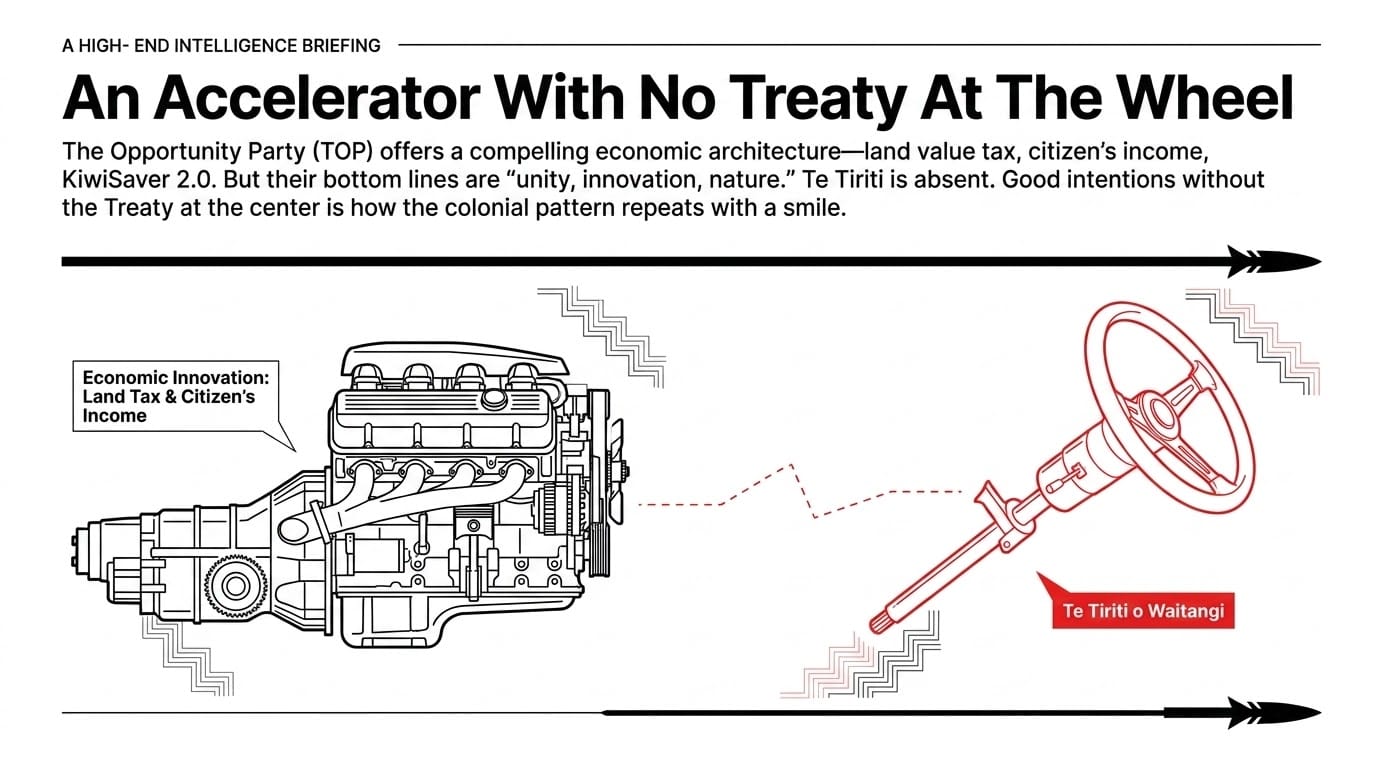
That is genuine and I will not dismiss it. But Te Tiriti is not a bottom line for The Opportunity Party. Their platform is primarily an economic architecture — a land value tax, a citizen's income, a KiwiSaver 2.0 — and as The Spinoff noted in May 2026, they are having a policy moment with a newly curious supporter base that is largely urban, liberal, and Pākehā. Their bottom lines, as I documented in June 2026, are "unity, innovation, nature" — Te Tiriti is not among them. An accelerator with no Treaty at the wheel may not intend to repeat the colonial pattern. But good intentions without Treaty at the centre have always been how the colonial pattern gets repeated with a smile.
For whānau who want their party vote to carry the maximum weight for Te Tiriti, for hauora, for whenua, and for tamariki
— the Green Party is the vehicle.
For whānau in the north who want a voice that has proven it will not bend to corporate capture or party machinery
— Te Tai Tokerau Party is the vehicle.
The evidence speaks for itself.
The Polling Architecture of a New Government
| Party | June 2026 (Talbot Mills) | Change from May |
|---|---|---|
| Labour | 34% | ↓2 |
| Greens | 13% | ↑4 |
| National | 29% | Steady |
| NZ First | 12% | ↓2 |
| ACT | 6% | ↓1 |
| Te Pāti Māori | 2.6% | ↑0.4 |
Source: RNZ — Talbot Mills/Anacta poll, 1–10 June 2026, margin of error ±3.1%
Left bloc total: 49% — 61 seats. Right bloc total: 47% — 59 seats. Coalition approval: 42%, with 51% actively disapproving.
The trajectory across multiple independent pollsters confirms this is not noise:
- October 2025 — Taxpayers' Union–Curia: Greens 12%, left bloc 61 seats
- March 2026 — Horizon: Greens 10.5%, left bloc ahead
- April 2026 — 1News Verian: Left bloc gains power
- June 2026 — Talbot Mills/Anacta: Greens 13%, left bloc 61 seats — governing majority
This is not a moment.
Three Examples for the Western Mind: What the Left Bloc Actually Builds
I have documented the destruction in full. That record stands. Here, I want to speak about construction
— about what the Greens and the left bloc are actively proposing to build for whānau, and why it matters.
Example One: Te Tiriti as the Foundation, Not the Footnote
What the Greens build:
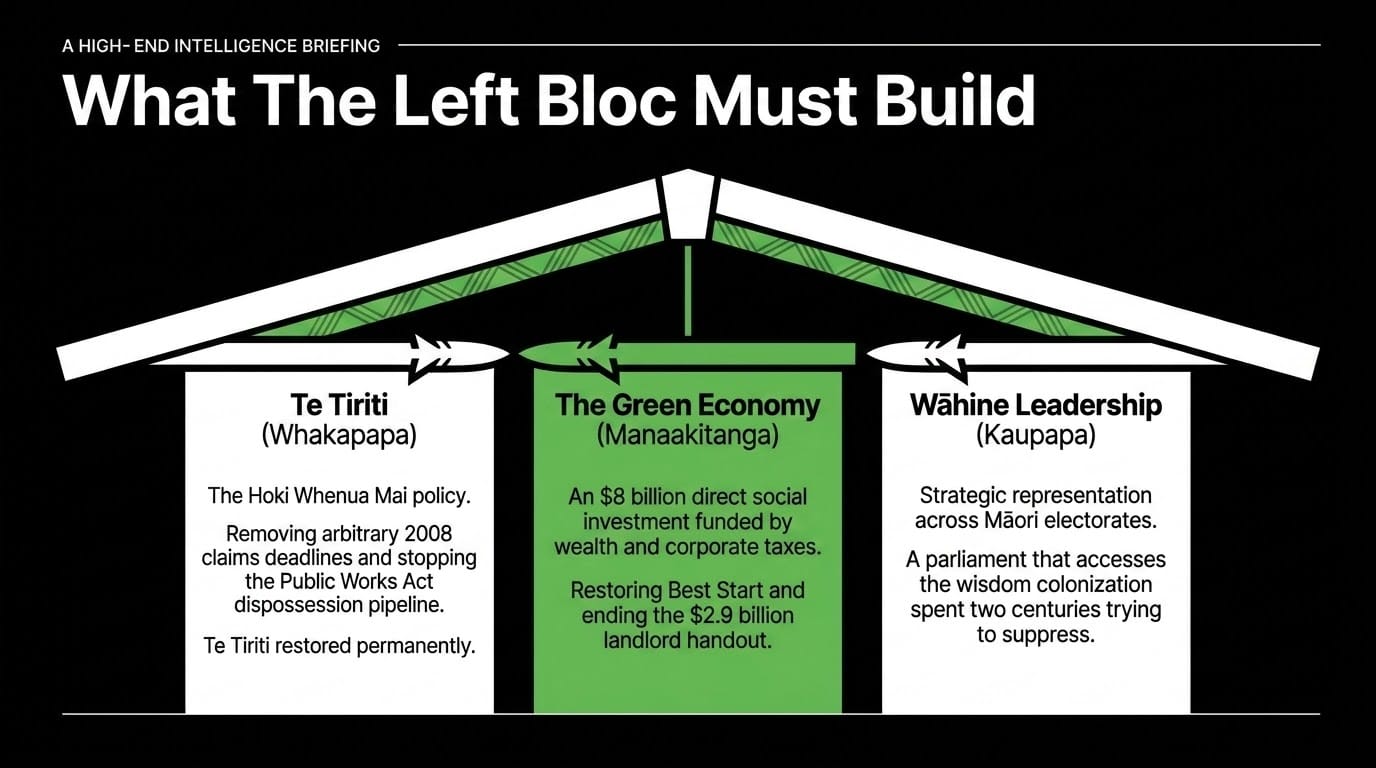
The Green Party's Kaupapa Māori Policy commits to upholding tino rangatiratanga, enhancing the mana of the Waitangi Tribunal, and ensuring Te Tiriti o Waitangi is the structural foundation of governance — not reduced to a "take into account" checkbox stripped from 28 pieces of legislation. Their Hoki Whenua Mai land return policy removes the arbitrary 2008 Treaty claims deadline, reinstates Tribunal recommendations on privately owned land, and amends the Public Works Act to stop the colonial dispossession pipeline. The E-Tangata 2026 Election Survival Guide frames it clearly: without constitutional protection of Te Tiriti, any progress can be reversed by the next right-wing government in three years.
The tikanga dimension for the Western mind:
Whakapapa — the genealogical framework through which Māori understand identity, land, and responsibility — requires the relationship between people and whenua to be acknowledged and protected by law. Imagine if the Magna Carta were stripped from English constitutional law every time a new government found it politically convenient. That is what this coalition has been doing to Te Tiriti. The Greens are proposing to put it back — permanently, structurally, irreversibly.
The coalition arithmetic:
A Labour–Greens–Te Tai Tokerau coalition means Te Tiriti has three distinct voices at the negotiating table, not one. That is not symbolic. That is governing architecture.
Example Two: The Green Economy That Serves Whānau, Not Portfolios
What the Greens build:
The Green Party's Government in the Economy Policy proposes a wealth tax and higher corporate taxes to fund $8 billion in direct social investment over four years — restoring Best Start payments for tamariki, properly staffing Māori health services, and ending the interest deductibility handout that delivered $2.9 billion to landlords while 169,300 tamariki hit a 10-year child hardship high. As I documented in Exposing the Neoliberal Propaganda, Māori home ownership has collapsed 26% since the Rogernomics era — nearly four times the Pākehā decline. The Green budget reverses that direction.
The tikanga dimension for the Western mind:
Manaakitanga — the obligation to care for others — is not charity. It is the architecture of a society that understands mutual flourishing. An economy built on manaakitanga does not ask whether the poor deserve support. It asks how we organise ourselves so that no one is left to sink. The Green wealth tax is manaakitanga in fiscal form — taxing those who have extracted the most from our whenua to invest in those most dispossessed by that extraction.
Example Three: Wāhine at the Front, Not the Back
What the movement builds:
In February 2026, the Greens fielded three wāhine Māori candidates across Māori electorates — Hūhana Lyndon, Tania Waikato, and Heather Hinemoa Te Au-Skipworth. As Waatea News reported, this is strategic kaupapa representation — wāhine Māori on the frontlines of electorates that have historically been told their only legitimate political expression is through parties that do not always honour their kaupapa. Mariameno has demonstrated that a wāhine from the north can build her own party, win a court case, and attract 200 financial backers in 24 hours on nearly nothing, against the full weight of an established machine.
The tikanga dimension for the Western mind:
In te ao Māori, wāhine are not merely participants in leadership — they are, in many traditions, the source from which leadership flows. Ko Papatūānuku te māmā o ngā mea katoa. A parliament that places wāhine Māori in positions of actual power is not performing diversity. It is accessing wisdom that colonisation has spent two centuries trying to suppress.
The strategic reality:
Mariameno holds the north. The Green wāhine hold the kaupapa in the Māori electorates. Together, with Labour, they build a government that finally looks like Aotearoa — not a Crown boardroom.
What the Left Bloc Must Deliver — Non-Negotiably
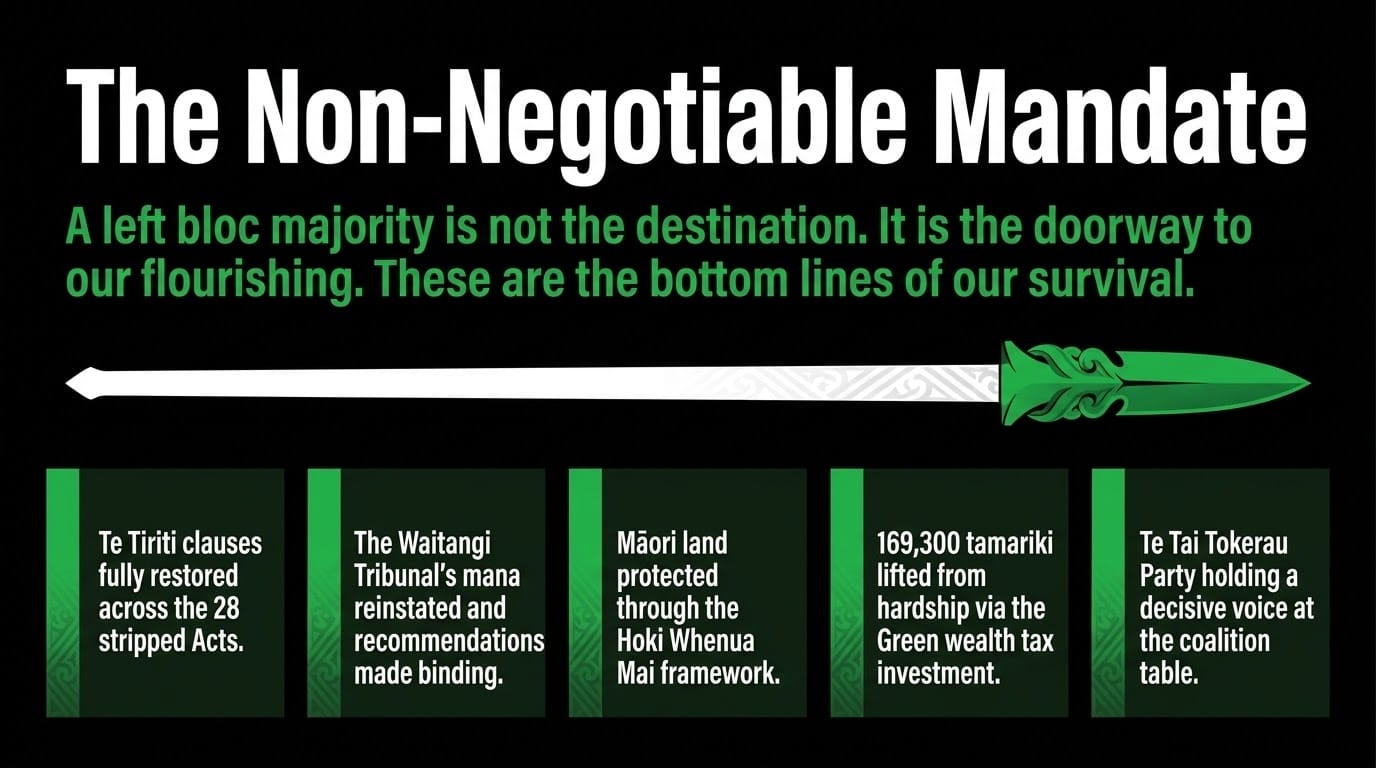
I carry hope today. But I keep my eyes open. A left bloc government is a better set of conditions in which whānau can demand their rights — it is not the destination. It is the doorway.
The non-negotiable mandate:
- Te Tiriti clauses restored across all legislation — reversed from the 28 Acts this coalition stripped them from, per E-Tangata's documented analysis
- The Waitangi Tribunal's mana reinstated — recommendations binding where the Treaty demands it, per the Tribunal's June 2026 urgent hearing findings
- Māori land protected through Hoki Whenua Mai* — the Public Works Act dispossession pipeline shut permanently, per the Green Party's confirmed policy
- 169,300 tamariki lifted from hardship — through restored Best Start, Working for Families, and the Greens' wealth tax investment, per verified hardship data
- Hauora Māori architecture rebuilt — the MHA framework restored and smokefree protections reinstated, per the UN CERD alarm raised in December 2025
- A justice system built on tikanga — per the Green Party Justice Policy, Māori mass incarceration reversed
- Te Tai Tokerau Party at the coalition table — Mariameno's voice decisive, not managed, per the kaupapa she has articulated publicly
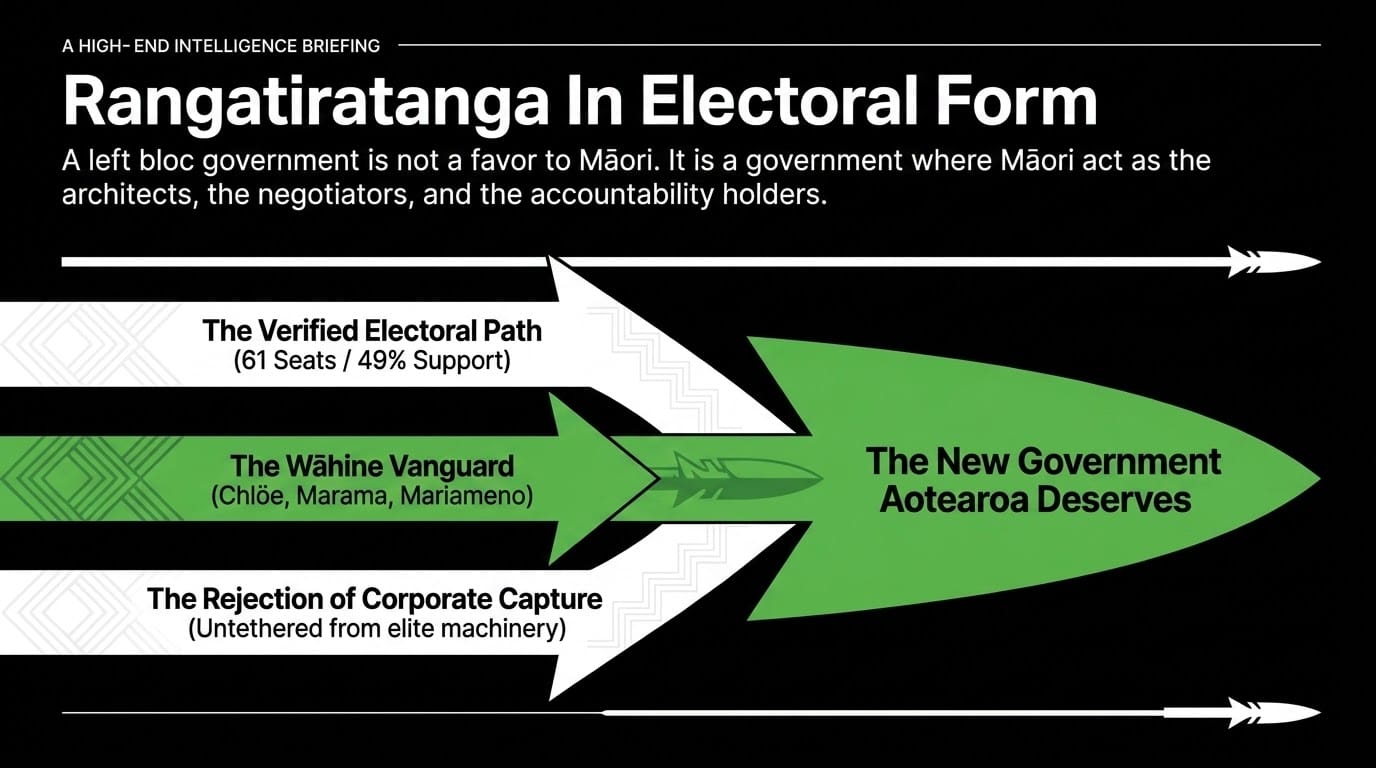
As I wrote in He Hinaki Māori: The Trap Woven in Silk Feathers: both Labour and National have historically used Māori political energy as fuel for their own engines. The demand is not a left government as a favour to Māori. The demand is a left government with Māori as the architects, the negotiators, and the accountability holders. That is rangatiratanga in electoral form.
The E-Tangata analysis on Māori general roll strategy raises a crucial tactical question every whānau member must consider before election day: whether switching to the general roll in strategic electorates could provide the margin of victory. Mana motuhake requires strategic intelligence, not just aroha for the kaupapa.
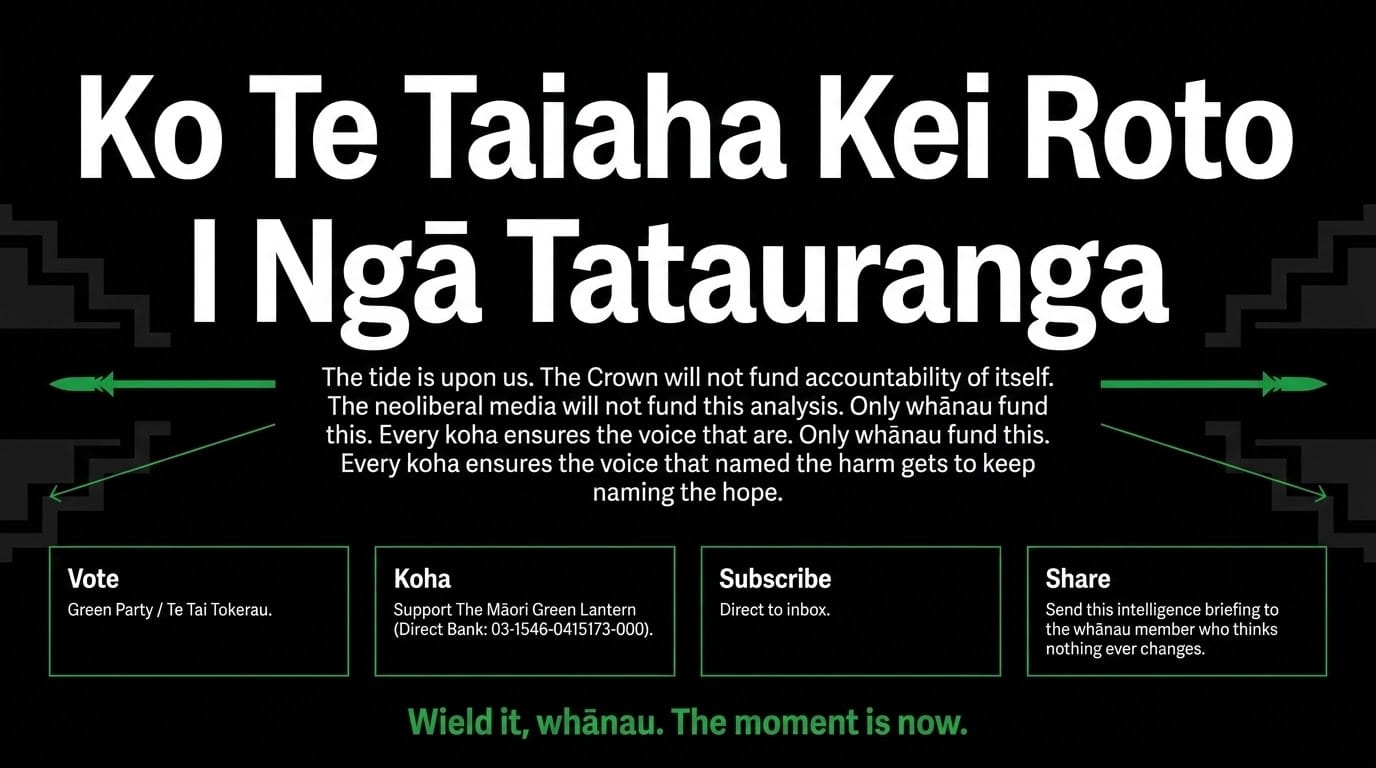
Ko Te Taiaha Kei Roto i Ngā Tatauranga — The Taiaha Is Inside the Numbers
Ko te tai kei runga — the tide is upon us.
The Greens at 13 percent. The left bloc at 61 seats. 51 percent of Aotearoa actively disapproving of this government. Mariameno building a party from the north with 200 backers in 24 hours on nearly nothing, grounded in tino rangatiratanga, local decision-making and mana mokopuna. Marama Davidson and Chlöe Swarbrick leading the most diverse, most policy-ready candidate slate the Greens have ever put forward. Wāhine Māori on the frontlines of Māori electorates with genuine strategic weight behind them.
This is what a movement looks like.
This is what rangatiratanga in electoral form looks like.
I have spent three years naming the crimes. Read those essays at themaorigreenlantern.maori.nz — they are all there, sourced and verified.
Today, I am naming the people who are going to make those crimes stop.
Vote Green. Vote the left bloc. Support Mariameno. Share this essay with every whānau member you know.
Ko te taiaha kei roto i ngā tatauranga. The taiaha is inside the numbers.
Wield it, whānau. The moment is now.
💚 Koha — Fund the Voice That Named the Crimes and Now Names the Champions
Kia ora whānau.
This essay — tracing the Green surge from 7 to 13 percent, mapping Mariameno's rise from expulsion to court victory to new party, exposing the corporate capture of Te Pāti Māori under Tamihere's $104 million fiefdom, and laying out the policy whakapapa of a left government worthy of our trust — took hours of research, source verification, and the sustained application of manaakitanga to truth-telling.
The Crown will not support accountability of itself. The neoliberal media will not support this analysis. Only whānau support this.
Every koha says: rangatiratanga includes the power to fund our own truth-tellers.
It says: the voice that named the harm gets to name the hope too — and we will keep it alive.
Four pathways to support this mahi:
🌿 Koha (voluntary contribution):
Support The Māori Green Lantern via Koha
📩 Subscribe (receive essays directly):
Subscribe to The Māori Green Lantern
🏦 Direct bank transfer:
HTDM — 03-1546-0415173-000
📘 Facebook:
Follow and subscribe on Facebook
If you cannot koha — no worries at all. No judgement.
Share this essay.
Share it with the whānau member who has given up on voting.
Share it with the friend who thinks nothing ever changes.
Share it with the rangatahi who has never seen a wāhine Māori lead a party she built herself, from scratch, in the north, on nearly nothing.
That is koha. That is manaakitanga without a price tag.
Kia kaha, whānau. Stay vigilant. Stay connected. Ko te taiaha kei roto i ngā tatauranga.

Disclaimer: This essay represents the political analysis and opinion of Ivor Jones / The Māori Green Lantern. All factual claims are cited and sourced. Opinions are identified as such. Written in the public interest under qualified privilege (Lange v Atkinson 3 NZLR 385). All persons and organisations are discussed in their public capacity only. No malice intended. Retraction protocol available on complaint. John Tamihere is discussed in his capacity as President of Te Pāti Māori and Chief Executive of the Waipareira Trust — both public roles. All financial figures are drawn from published academic and journalistic sources.