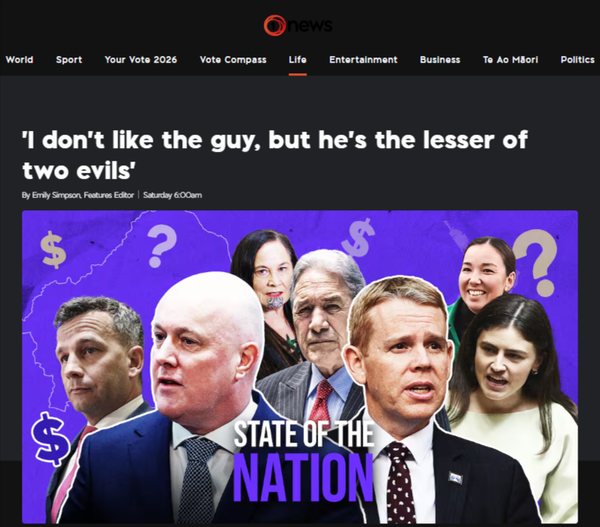
"STANFORD THE ARSONIST, CALLED THE FIRE BRIGADE — AND BILLED YOU FOR BOTH" - 18 June 2026
Erica Stanford Had the Evidence, Had the Power, and Had Nineteen Months. She Chose Theatre. Whānau Paid $32 Million for the Performance — and Are Now Being Asked to Fund the Encore.

Kia ora ano whānau,
I am the voice this government never wanted amplified. I read the Cabinet papers they hoped you wouldn't see. I trace the money they hoped you wouldn't follow. I name the people they hoped you'd forget by September — which is, not coincidentally, exactly when the Public Service Commissioner's investigation is scheduled to conclude, long after the media cycle has moved on and the redacted names have secured their legal representation.
Today I am not just writing about Erica Stanford. I am writing about the architecture of impunity that this white supremacist neoliberal government has perfected into an art form
— the art of being caught, reframing the catch as heroism, and then billing the public for the clean-up.
 RNZ | Te Reo Irirangi o Aotearoa
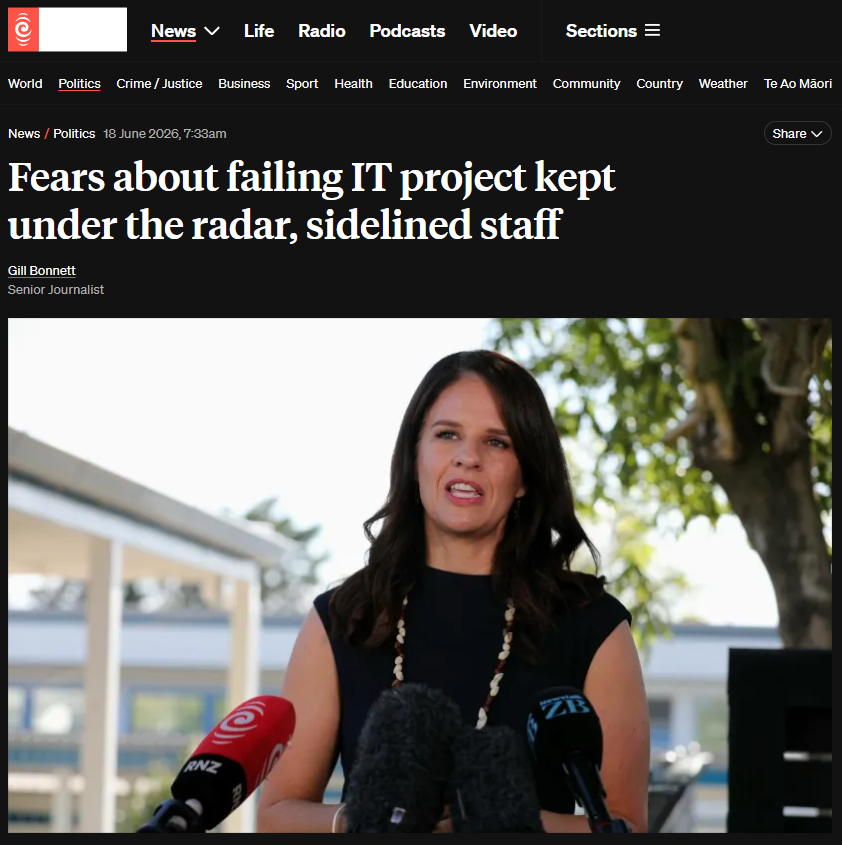
Read the RNZ story published this morning — Fears About Failing IT Project Kept Under the Radar, Sidelined Staff. Read it slowly.
 Ivor Jones The Māori Green Lantern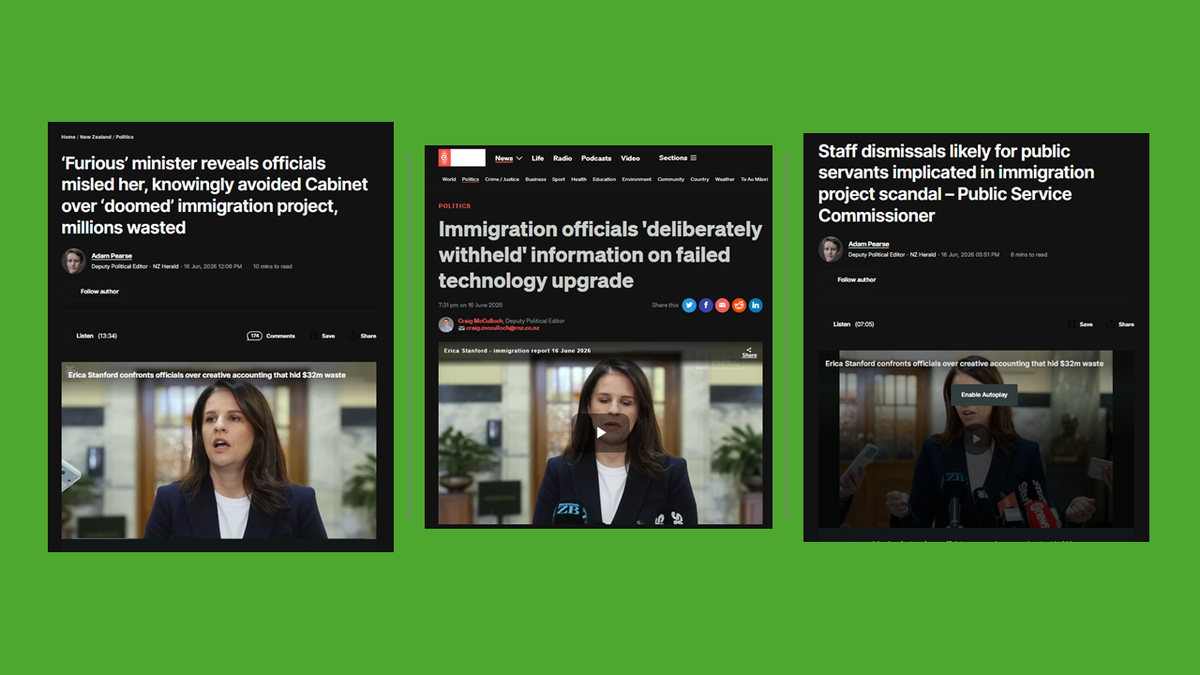
Then read what I published yesterday — Erica Stanford Minister of the Crown Wasted $32 Million of Your Whānau's Money. Put them together.
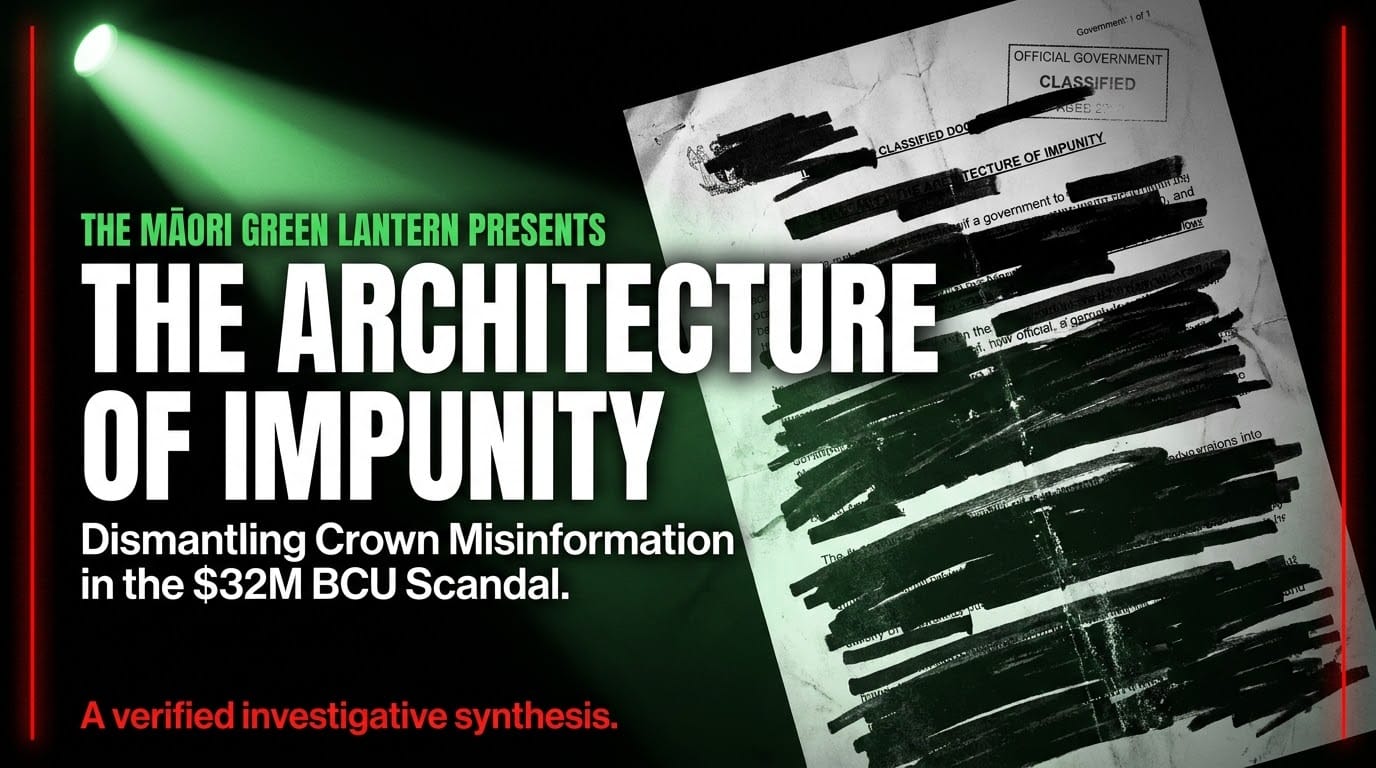
What you have is not a scandal about rogue officials. You have a minister who was handed the match report, watched the fire continue, and is now performing fury at the arson while signing the lease on the building next door.
Ko te whare e kā ana — ko ia tonu te kaiwhakaaro i hoatu i te ahi.
The house that burns — she is the one who kept feeding the flame.
Tūkia. Strike.
🎙️ The Deep Dive Podcast
Listen to a lively conversation between two hosts unpacking every thread of this essay — the BCU disaster, Stanford's political theatre, Roche's structural capture, the Novopay-INCIS whakapapa, the sidelined whistleblowers, the redacted names, and the $336 million OFS countdown. Every thread traced. Every connection named.
I apologise in advance for the AI's very harsh pronunciation of te reo Māori — please don't shoot me! 😅 The kōrero is real even if the accent needs work.
📺 YouTube Video
Like video? Here is a short video walking through Stanford's five acts of impunity, Roche's pre-clearance of Blakeley, and the $336 million programme running on broken rails right now.
Again, don't shoot the messenger because of the AI's pronunciation — the taiaha is sharp even if the reo needs tuning! 😄
The Extended Metaphor — Read This First
Picture a building manager who inherits a tower block with a known structural fault. The previous tenants left a file clearly labelled: the east wall may collapse. She locks the file in a drawer. She keeps collecting rent. Six months later, she commissions her own engineers.
They produce a new report — from the same independent body that warned of collapse — and tell her: "Sound. Robust. Achievable."
The east wall collapses nineteen months after she took the keys.
Standing in the rubble, microphone in hand, cameras rolling, she shows the media the original file — the one she kept in the drawer. She says she is furious. She calls the building inspector — a man who, before a single witness has been interviewed, publicly declares the new building manager is "deeply, deeply offended" and "not directly accountable".
The names of the people who falsified the reports are on a redacted list the public cannot see.
And the building manager — the furious, betrayed, righteously outraged building manager — has already signed a $336 million lease on the tower next door. Same architect. Same east wall. Already under construction. Already rated high-risk by Cabinet. Already experiencing 550 structural defects in its foundation layer.
That tower is Our Future Services. The rubble is BCU. The building manager is Erica Stanford. The building inspector is Sir Brian Roche.
This is not accountability.
This is the most expensive theatre production in New Zealand history, and your whānau is sitting in the audience while the cast collects their salaries.
What the 18 June RNZ Story Reveals — And What Stanford Needs You to Miss
The RNZ story published this morning lands three findings that Stanford is counting on you absorbing as further evidence of her victimhood.
They are not.
They are the anatomy of a ministerial failure she has spent seventy-two hours surgically reframing.
Finding One: The warning landed in 2023. The same year Stanford took the portfolio.
Independent quality assurance consultants told MBIE management that "we have doubts as to whether the project will in fact deliver at all, and we question its continuation." Six months later — six months — officials told Stanford: "The latest IQA confirmed the project approach was sound and robust, the build is achievable, and the risk management practice is effective."
A real report existed. It said the opposite. MBIE apologised for being "incorrect and misleading" while maintaining there was no intention to mislead. The independent review published this week put that claim into direct doubt — meaning: the review suggests it was deliberate. MBIE's "we didn't mean to" is a denial. The investigation will determine whether it is a lie.
Finding Two: They moved the whistleblowers. Stanford named it. Then called the Commissioner.
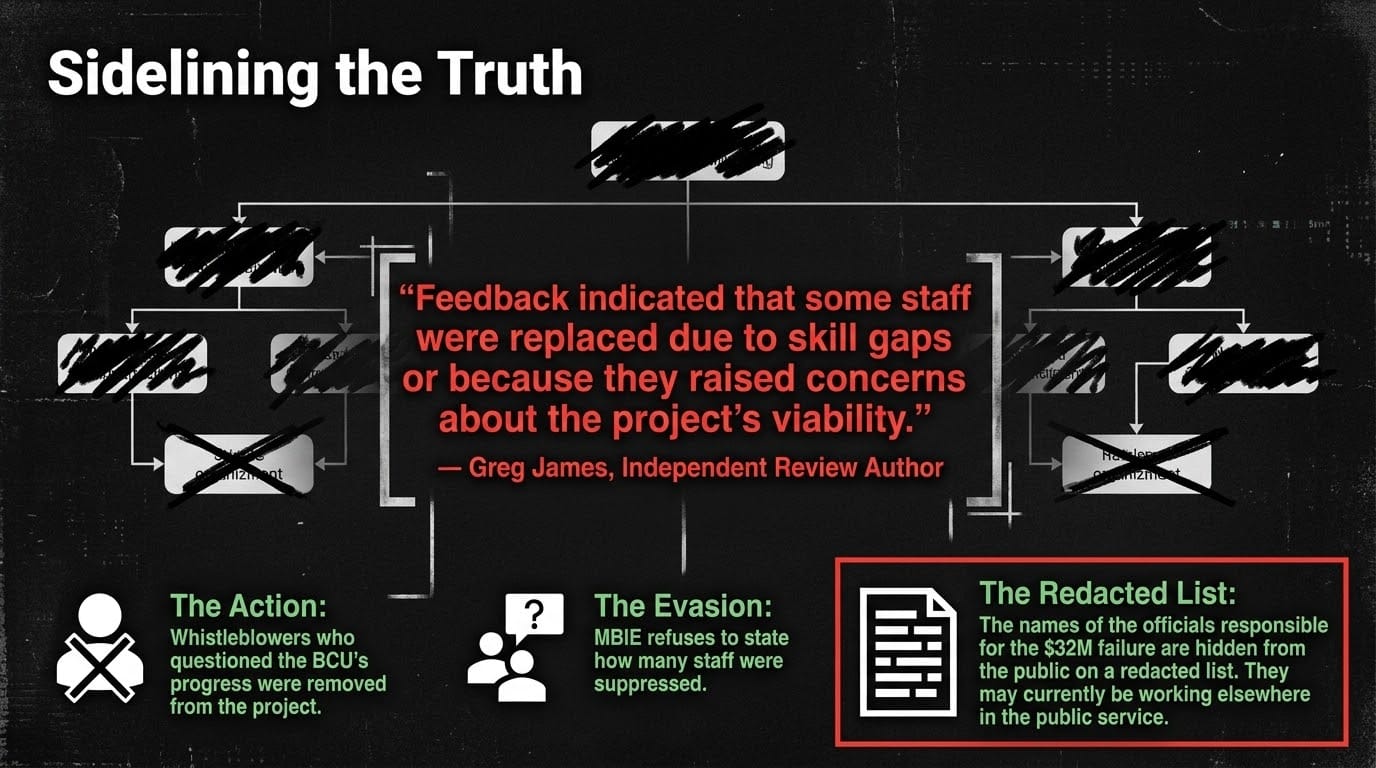
Review author Greg James stated plainly:
"Feedback indicated that some staff were replaced due to skill gaps or because they raised concerns about the project's viability."
Stanford named this as one of her biggest concerns. She is correct. This is the institutional suppression of internal dissent. In any functioning democracy, this single finding triggers immediate interim suspensions.
In ours, it is bullet point three, referred to a Commissioner who has confirmed the implicated staff
"could be working elsewhere in the public service or have left it entirely".
MBIE refused to say how many people were affected. The investigation will consider it. In three to four months. After Phase Two of OFS begins next month.
Finding Three: Stanford's incoming briefing in late 2023 had no mention of BCU at all.
The written briefing Stanford received as incoming immigration minister contained a section called
"technology enhancements."
BCU — the project "crucial to risk mitigation and meeting INZ's future business needs" — was not in it. The same omission applied to Labour's Michael Wood.
This is not a one-time failure to communicate. This is a pattern of structural concealment spanning administrations, ministers, and years.
The institution decided, at every handover of political power, that ministers should not know about BCU. That decision was made repeatedly. By someone. Whose name is on a redacted list.
Ngā Tauira Tokoraro — Three Examples For the Western Mind
Because I know some of you reading this are new to the taiaha. Welcome. Let me make this concrete.
Example One: The Hospital That Never Got Built
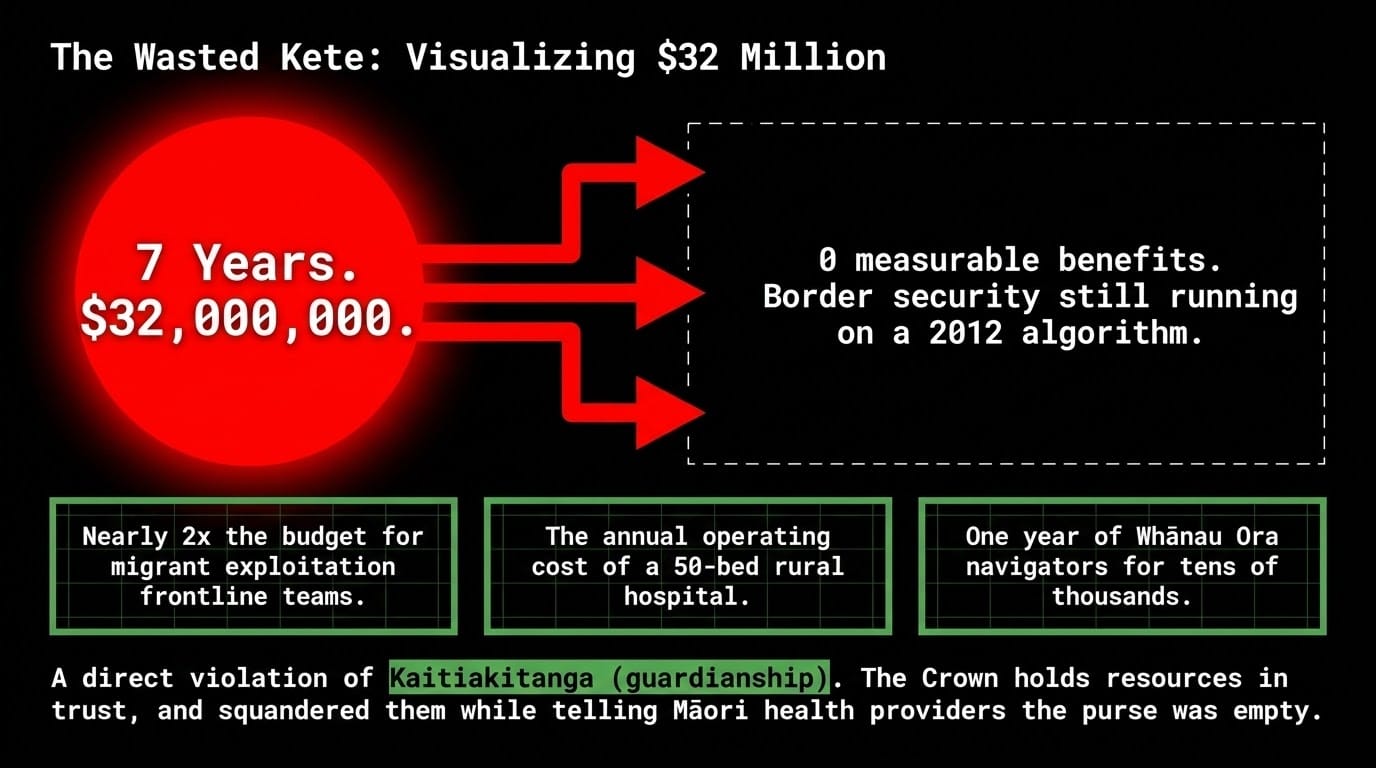
$32 million is the approximate annual operating cost of a 50-bed rural hospital. It is nearly double the $18 million Budget 2026 committed to migrant exploitation frontline teams, hailed as a landmark investment. It is enough to fund Whānau Ora navigator services for tens of thousands of whānau for a full year.
This government told Māori health providers there was no money. It told community housing organisations there was no money. It told the public service to cut $1.5 billion from operating expenditure while simultaneously pouring $32 million into a biometric void that delivered, in seven years, absolutely nothing.
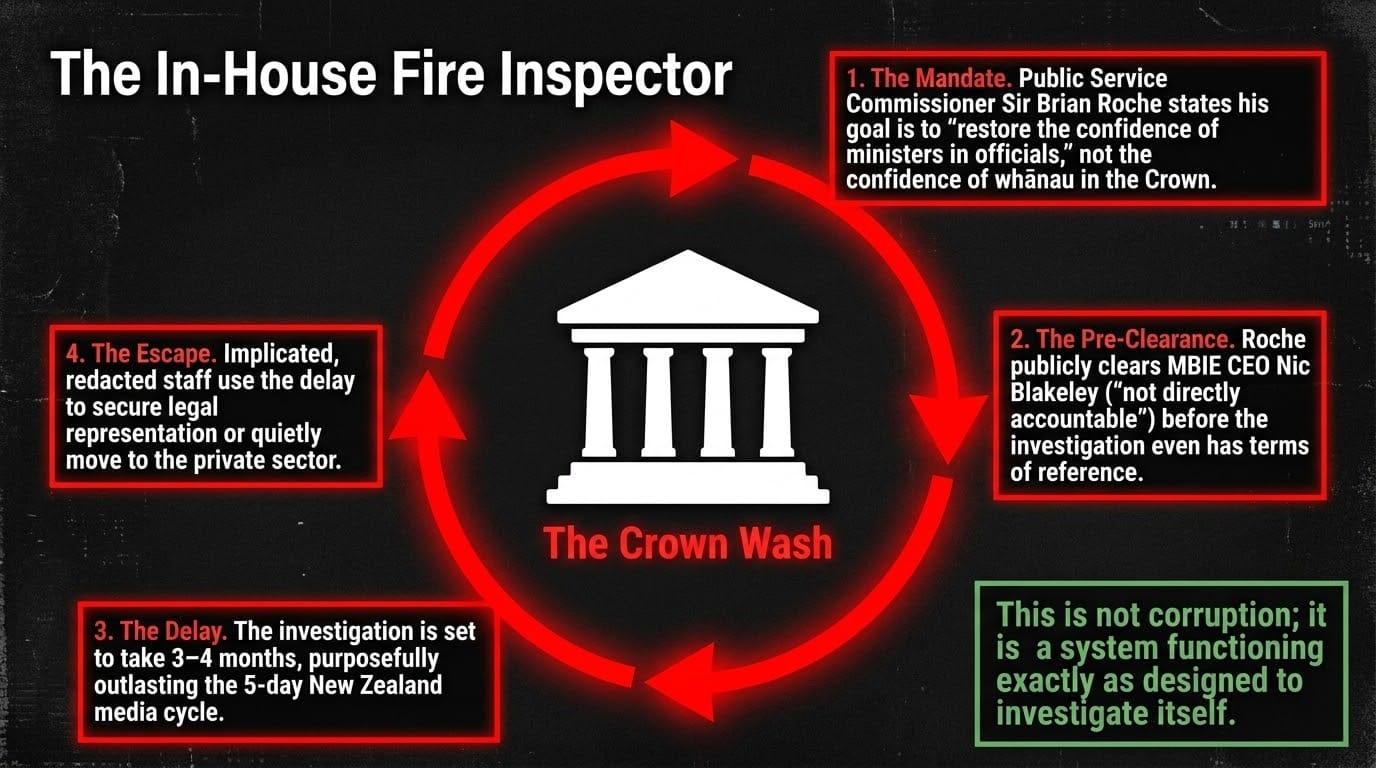
The tikanga impact: In te ao Māori, kaitiakitanga means guardianship — the obligation to protect collective resources for the benefit of all generations, present and future. A kaitiaki does not gamble the collective inheritance on a failing technology project and then appoint themselves to investigate whether they should feel bad about it. The Crown holds the public purse as a kaitiaki. It has confessed in writing to breaching that obligation. The investigation it has commissioned is run by an office whose Commissioner has stated his mission is to restore the confidence of ministers — not the confidence of the people whose resources were squandered.
Solution: A genuinely independent fiscal accountability framework — separate from the Public Service Commissioner's office — with power to investigate ministerial decision-making, compel document production, and publish findings without redaction. New Zealand does not have this. Every major Crown IT failure has demonstrated the need for it. It has never been built. Because the people who would commission it are the people it would scrutinise.
Example Two: The Promoted Arsonist and the In-House Fire Inspector
Imagine a finance manager at your workplace falsified expense reports for seven years, used "creative accounting" to keep costs below the threshold that would trigger board scrutiny, suppressed internal complaints, and moved employees who raised concerns off the team. They were caught.
The CEO appointed the company's own compliance officer to investigate. The compliance officer publicly stated — before interviewing a single witness — that the current general manager was "deeply offended" and "not directly accountable". The names of the implicated staff were placed on a document the rest of the company cannot see. The investigation concludes in three to four months. The finance team continues to operate in the interim, managing a $336 million successor project.
You would not call that accountability. You would call it a whitewash wearing a lanyard.
That is precisely what Sir Brian Roche's investigation is. Not because Roche is corrupt — I make no such claim. But because the structure of his office, his stated mission, his pre-investigation clearance of Blakeley, and his three-to-four month timeline make his investigation constitutionally incapable of delivering genuine accountability for whānau.
The tikanga impact: Utu in te ao Māori does not mean revenge — it means the restoration of balance. When harm has been done, balance must be restored proportionately. An investigation that pre-clears management, hides the names, takes four months, and may conclude that former staff cannot be held accountable is not utu. It is the Crown asking you to wait while it calculates how much accountability it owes itself. The balance is never restored.
Solution: The redacted names must be made available — at minimum to Opposition select committee members under parliamentary privilege — for cross-referencing against current OFS roles before Phase Two begins next month. Not in September. Now.
Example Three: The Pattern That Never Ends — INCIS, Novopay, BCU, and the Man Paid to Not Notice the Whakapapa
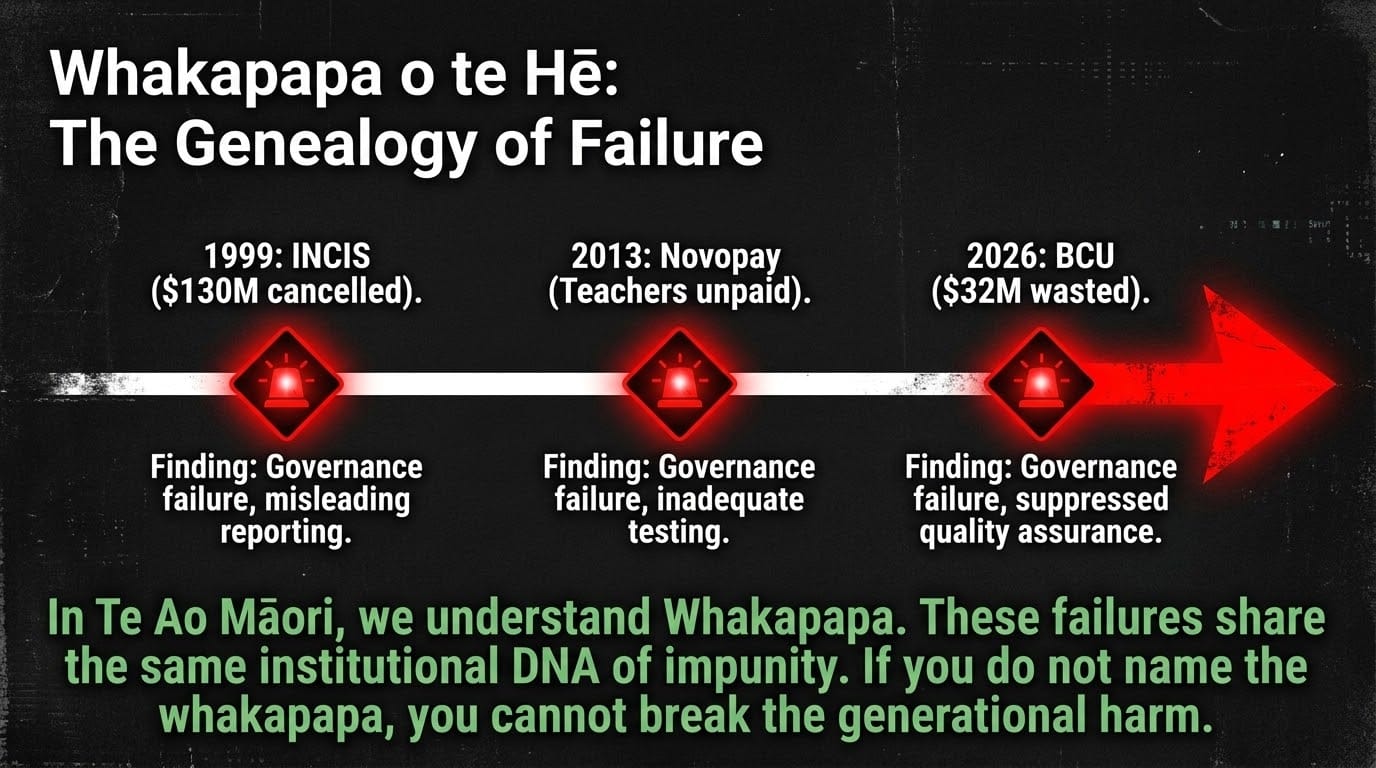
INCIS: 1999. Cancelled after $130 million. Nothing delivered. Findings: governance failure, inadequate oversight, misleading ministerial reporting.
Novopay: 2013. Tens of thousands of teachers underpaid. Findings: governance failure, inadequate testing, ministerial reporting inconsistent.
BCU: 2026. $32–33 million. Nothing delivered. Findings: governance failure, suppressed quality assurance, misleading ministerial reporting, whistleblowers moved.
OFS: 2025–2031. $336 million. Already experiencing 550 defects in its foundation system. Minister cannot verify the advice she is receiving. Investigation into the predecessor programme not yet begun. Phase Two starts next month.
Sir Brian Roche told the Herald he had not witnessed behaviour like this "in almost two years as commissioner" — but acknowledged it was "not unprecedented." Not unprecedented. Within institutional memory. The pattern he is being paid to investigate is a pattern he has already observed and not structurally addressed.
The tikanga impact: In te ao Māori, we understand whakapapa — the genealogy that connects all things, the pattern that reveals the truth of what something is. INCIS, Novopay, BCU, OFS: they share the same whakapapa. The same institutional DNA of impunity. If you refuse to name the whakapapa, you cannot break the cycle. Roche's investigation targets presenting symptoms — specific individuals in a specific project — not the culture that produces them. It is, by design, a procedure that serves the institution that created the failure.
Solution: A standing independent Crown technology oversight body — modelled on the Auditor-General function but with real-time project monitoring, mandatory public reporting, and the power to halt project expenditure pending independent certification. This body must include Māori governance representation. Biometric border technology is a Te Tiriti matter, not a bureaucratic one.
The Cover-Up — Verified, Named, Quantified
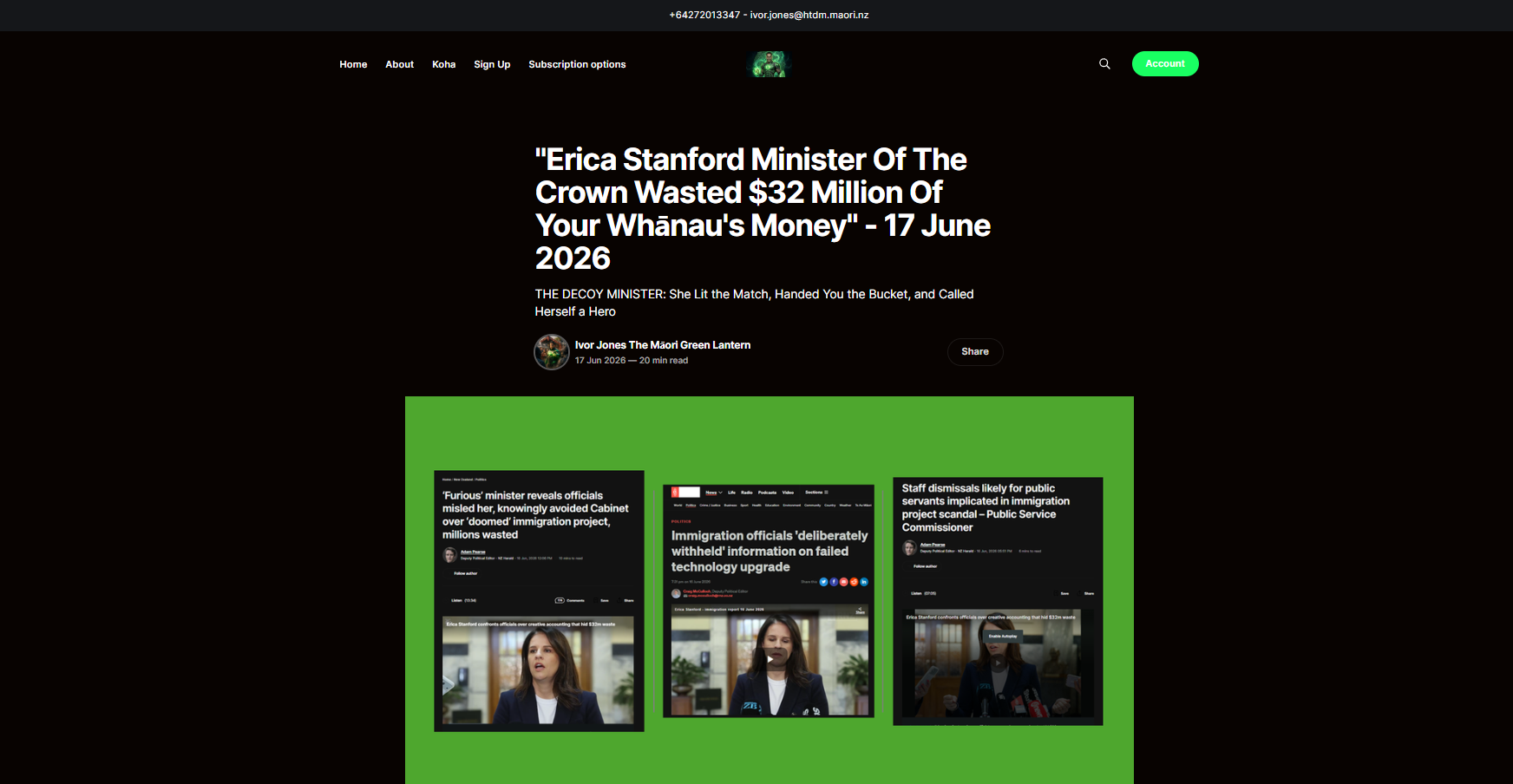
As I documented in Erica Stanford Minister of the Crown Wasted $32 Million of Your Whānau's Money on 17 June, the documented acts of concealment are these:
- The project launched in November 2018 without ministerial sign-off. It simply began. No minister approved the start.
- In 2020, officials pivoted to an off-shelf model without due diligence — a $35 million decision made without required scrutiny.
- "Creative accounting" was used — Stanford's own words — to split costs and keep the project below the Cabinet approval threshold. That is the deliberate evasion of democratic oversight.
- As recently as August 2025 — three months before termination — officials were still telling ministers the system would be working within weeks. Seven years. $32 million. Still: weeks away.
- The independent review was withheld from Stanford for two months. Blakeley called it a "wrong call." Roche immediately cleared him. Before the investigation had a single term of reference.
The Shield — Stanford's Most Audacious Act of Political Self-Preservation
Watch what Stanford has actually done, stripped of every gram of theatre.
She took a documented catastrophe — $32–33 million spent over seven years with nothing delivered — and transformed it into a narrative of ministerial heroism. She chose the timing. She controlled the framing. She detonated it at Scrutiny Week with the Public Service Commissioner referral already in her back pocket since Friday, quotes polished to a mirror shine.
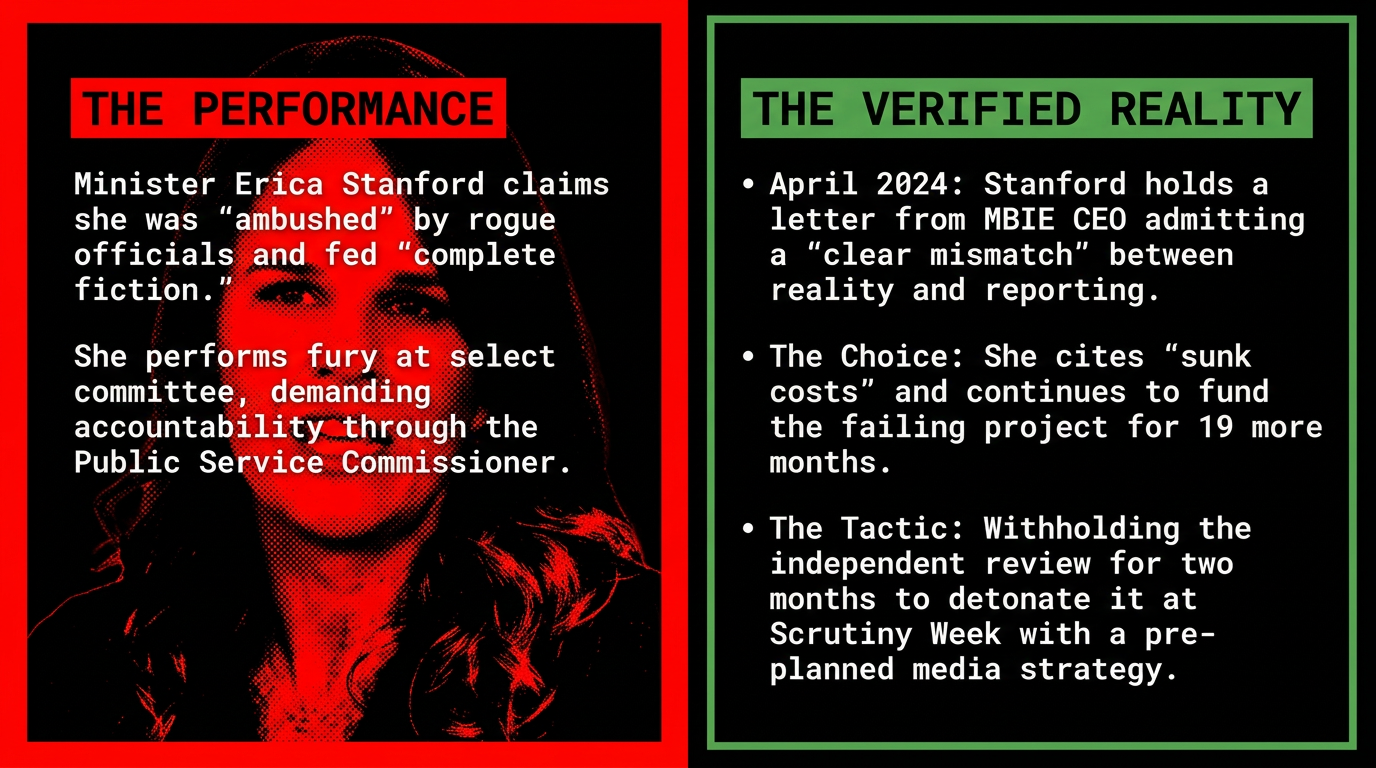
Ministers who are genuinely ambushed do not arrive at select committee with the narrative already fully constructed. This is not fury. This is choreography.
And then — this is the move — she used the BCU scandal to pre-emptively neutralise scrutiny of Our Future Services.
The Public Service Commissioner's investigation will now check whether Stanford can trust the advice she's receiving about OFS. Stanford requested this.
Read what that actually means: she has transformed
"Minister, did you approve a $336 million programme through a ministry whose integrity you'd already been warned about?" into "Commissioner, please reassure the minister."
Stanford approved OFS in February 2025 — ten months after receiving Tremain's April 2024 letter acknowledging a "clear mismatch" between what officials knew and what they reported. She approved a $336 million programme through a ministry she had already been told in writing could not be trusted to report accurately. She did not conduct independent verification. She did not pause OFS. She kept signing.
That is not a minister betrayed. That is a minister who chose not to ask the next question — and is now performing fury at the answer she chose to avoid.
Stanford's Three Acts — Named, Destroyed, Archived
Act One — The Timed Ambush. The review landed at MBIE two months before Stanford received it. She got it Friday. She detonated it Tuesday — Scrutiny Week, cameras live, Commissioner referral locked and loaded. This is not victimhood. This is media strategy disguised as accountability.
Act Two — The Accountability Redirect. Every question now deflects to: "The Commissioner is investigating." Every request for specifics deferred to Roche, who will report in September or October. The media cycle will have moved on. The OFS programme will have consumed its next tranche of public money. The redacted names will still be redacted.
Act Three — The Labour Shield. Stanford told Parliament officials deliberately withheld information from both her and the previous Labour government. True. And a masterclass in culpability dispersal. Labour's Andrew Little declined further BCU funding when he couldn't see the benefit. Stanford continued for two more years after her own written evidence of misconduct. The Labour Shield makes the scandal bipartisan enough to dilute her specific, dated, documented accountability failure. It is deflection wearing a factual fig leaf.
The $336 Million East Wall — The Story Nobody Is Running Hard Enough
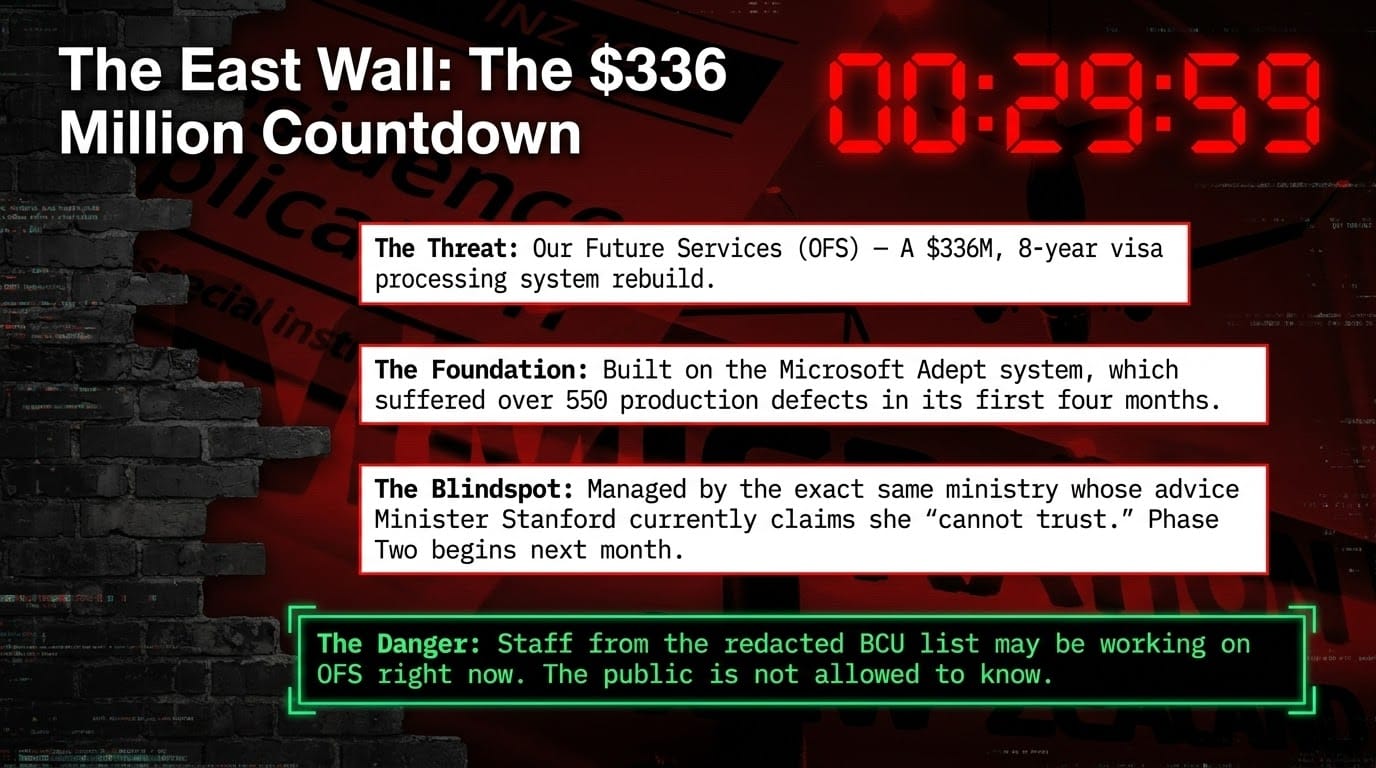
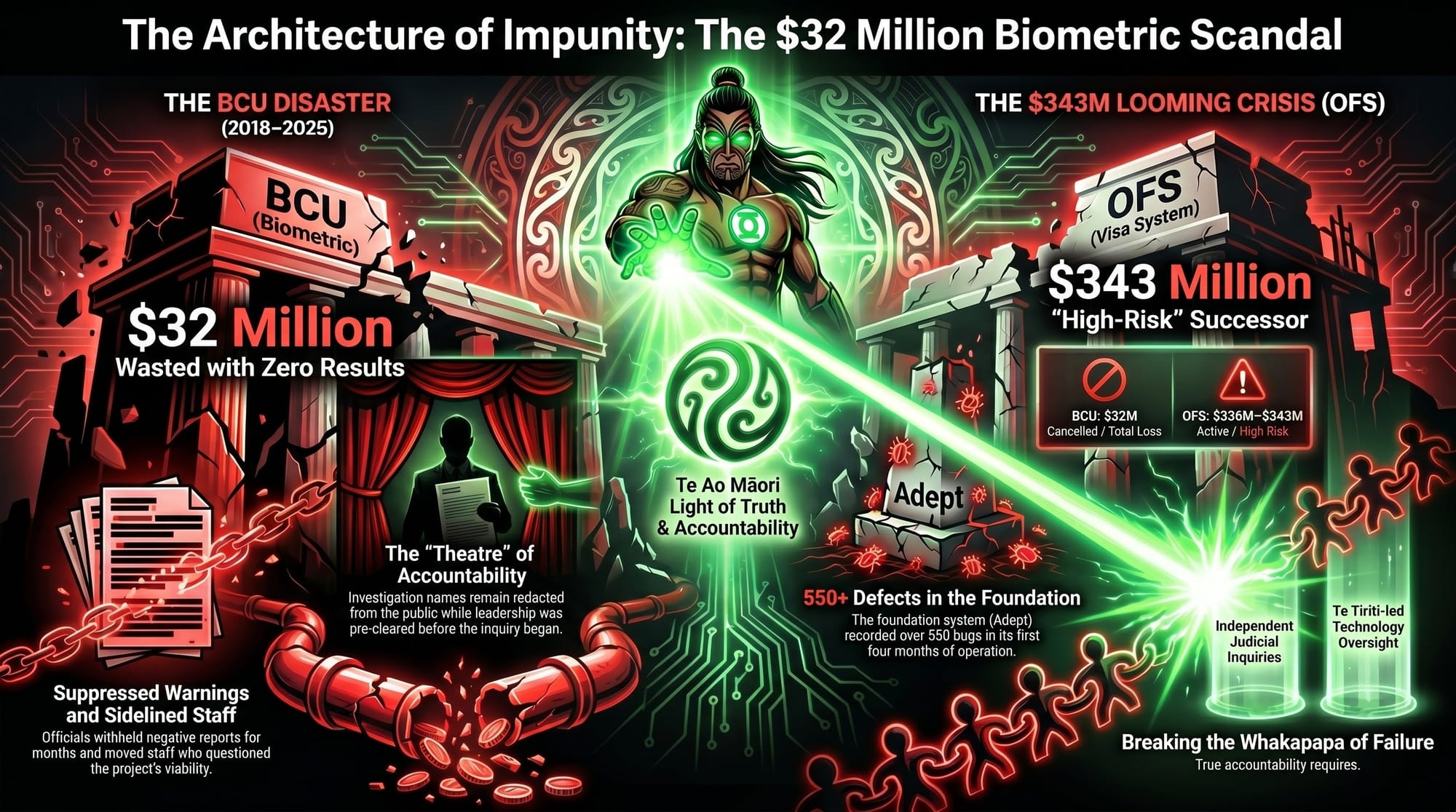
The $56.6 million Microsoft-built Adept foundation system suffered more than 550 production defects or bugs in its first four months. Visa applications were missed. Outages affected hundreds of travellers. This is the east wall of the next tower.
The Public Service Commissioner is being asked to check — now, after the BCU disaster — whether Stanford can trust the advice she is receiving about OFS. Not before OFS was approved. Not while BCU was dying. Now. The investigation takes months. Phase Two begins in weeks.
BCU: $35 million budget. 2018 start. 2025 end. $32–33 million spent. Nothing delivered. OFS: $336 million budget. 2025 start. 2031 projected end. Same ministry. Same culture. Same minister who says she can't trust it. Phase Two: next month.
INCIS. Novopay. BCU. OFS.
Twenty-seven years. Hundreds of millions of dollars.
The same whakapapa. The same findings. The same conclusion: we cannot trust the advice.
The same response: commission a review.
The same outcome: the next disaster is already funded and running.
Ko te hē tuarua, ko te hē pai ake.
The second failure is the one you chose.
Te Tiriti Me Te Ao Māori — The Dimension the Mainstream Media Will Not Name
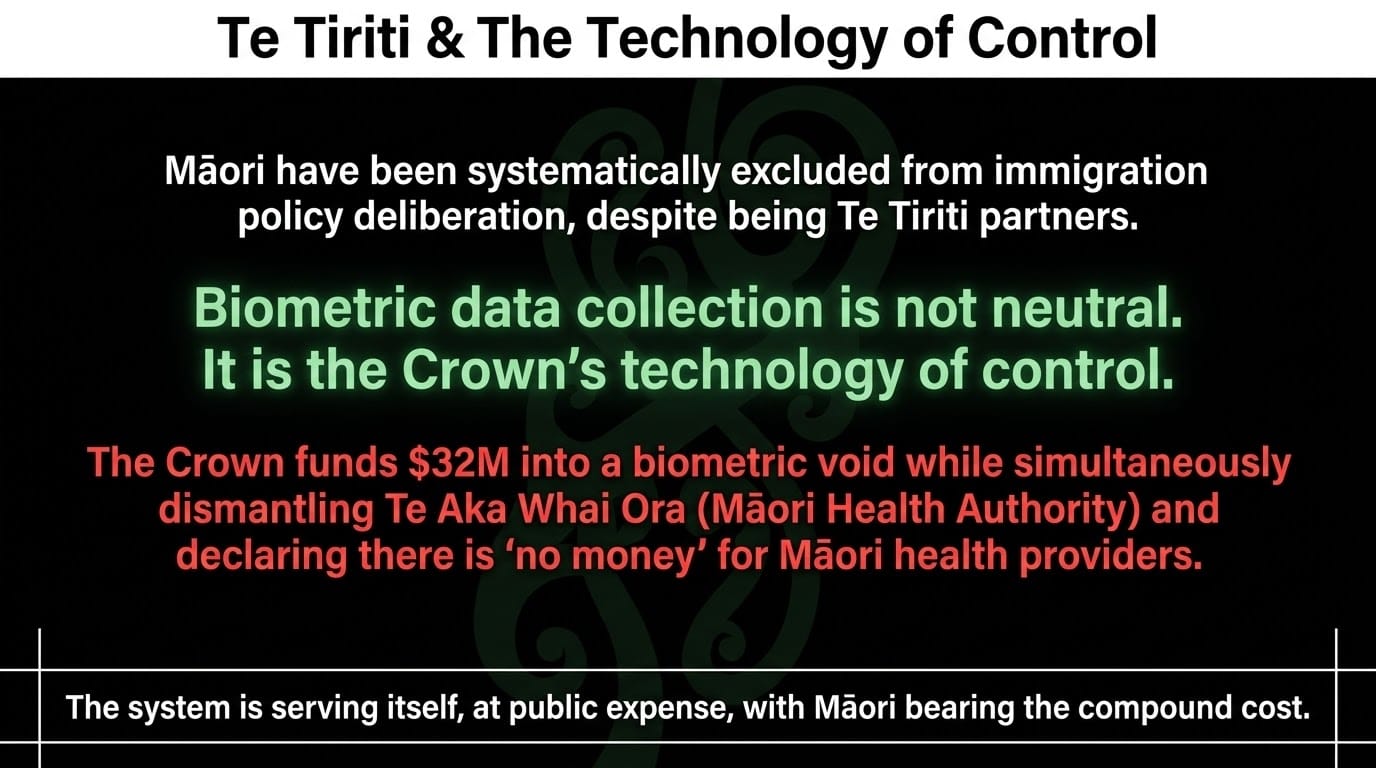
$32 million gone. The 2012 biometric algorithm still running at our border. A high-risk $336 million rebuild managed by a ministry whose minister says she cannot trust its advice. An investigation that serves ministers. A redacted list the public cannot see.
Tell me again that this government serves whānau.
Biometric data collection is not neutral. It is the Crown's technology of control. Māori have had no meaningful voice in how it is governed, who governs it, or what happens when the governance catastrophically fails — as it has, at a cost of $32 million and seven years, with the next $336 million already committed.
This is the same government that dismantled Te Aka Whai Ora. The same government swinging the Te Tiriti wrecking ball through every piece of legislation that touches Māori rights. The same government that told Māori health providers there was no money while losing $32 million in a biometric void. BCU — its suppressed reviews, its sidelined whistleblowers, its redacted names, its Crown-investigating-Crown theatre — is that system functioning exactly as it was designed: serving itself, at public expense, with Māori bearing the compound cost.
Previously on The Māori Green Lantern — He Ara Hono
Follow the whakapapa. These essays connect directly to what you've just read:
- Erica Stanford Minister of the Crown Wasted $32 Million of Your Whānau's Money (17 June 2026) — The full documented anatomy of the BCU disaster and Stanford's nineteen months of choices
- The Māori Green Lantern Homepage — The Official Information Act, Stanford's personal email, the Trapdoor PM, and the pattern of institutional impunity this government runs on
Ngā Pātai — The Questions Stanford Must Be Made to Answer
1. In April 2024, Carolyn Tremain sent you a written apology acknowledging a "clear mismatch" between what officials knew and what they told you. Ten months later, you approved OFS through the same ministry. What specific independent verification did you conduct before signing?
2. Staff were removed from BCU when they raised concerns. MBIE refused to say how many. Will you commit today to cross-checking every implicated individual against current OFS roles — before Phase Two begins next month?
3. Your incoming briefing in late 2023 omitted BCU entirely from a technology enhancements section. Who prepared it? Who approved it? Are those individuals among the redacted names?
4. The Public Service Commissioner publicly cleared your current MBIE chief executive before the investigation has terms of reference or witnesses. Do you consider that consistent with an independent investigation?
5. As recently as August 2025 you were told BCU would be working within weeks. It was cancelled three months later. At what point did you stop believing the advice? And what did you do with that disbelief?
He Kupu Whakamutunga — The Taiaha Does Not Accept Theatre
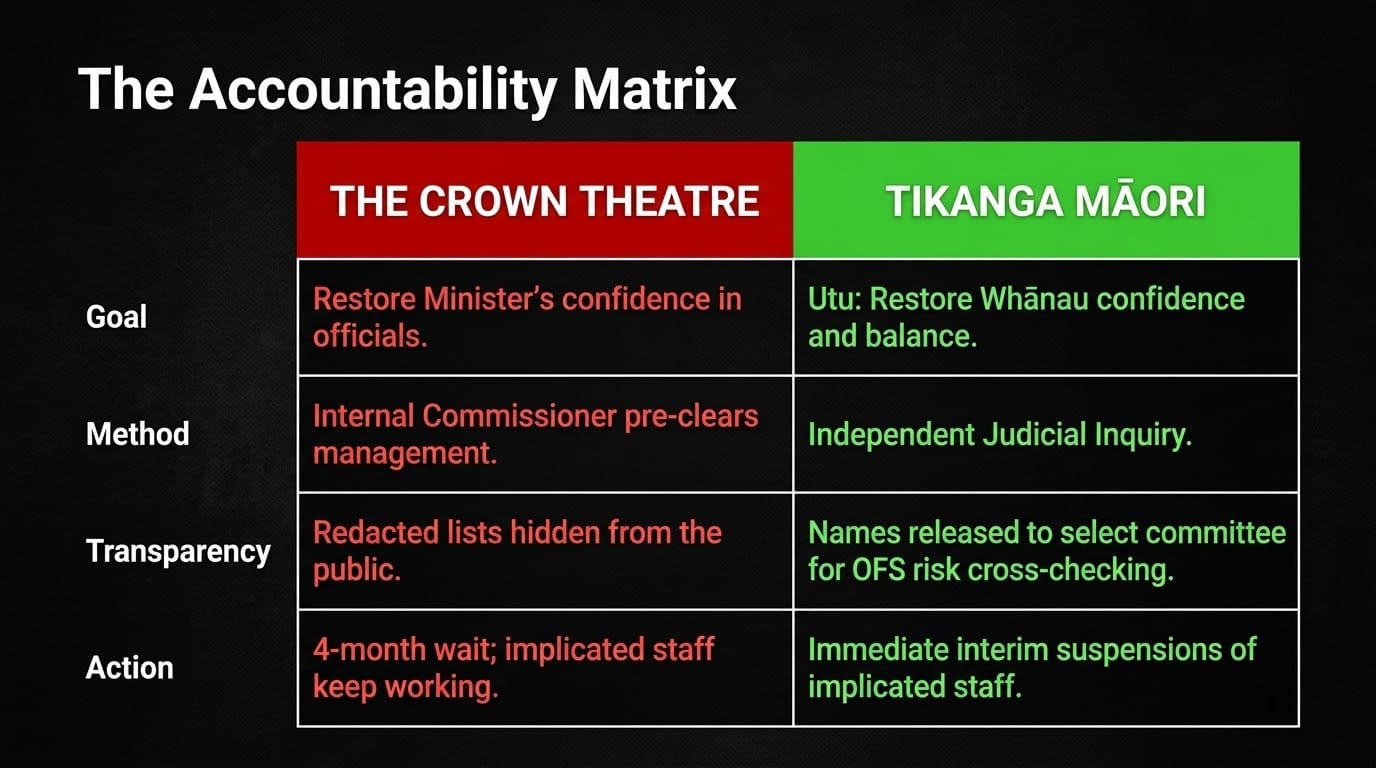
Stanford performs fury — and launders her own accountability in the process.
Roche pre-clears the management, hides the names, and promises findings in three to four months — long after the media cycle has moved on.
The $336 million programme continues. Phase Two begins next month. The east wall is already being built.
The Crown is investigating the Crown, with Crown tools, on Crown timelines, to restore Crown confidence — paid for by the people the Crown failed.
Ko te hē o te rangatira, ko te hē tōna anō.
The failure of the chief is the chief's own failure.
E kore e taea te huna.
This cannot be hidden.
Tūkia. Strike.
🌿 Koha — Because Stanford's Fury Is Crown-Funded. This Taiaha Is Funded by Whānau.

$32 million of your whānau's money has disappeared into a biometric void. The Crown has appointed itself to investigate itself. The names of those responsible are on a redacted list you cannot see. The $336 million replacement programme is already running on a foundation with 550 known defects — and Phase Two starts next month. The Commissioner will report in September. The media cycle will have moved on by then.
I will not move on.
Every koha signals that whānau are ready to fund the accountability the Crown will never provide for itself. It signals that rangatiratanga includes the power to fund our own truth-tellers. Every essay I write — on BCU, on Roche's structural capture, on the $336 million OFS programme running on broken rails, on the redacted names this government hopes you forget — that is rangatiratanga in practice.
Stanford's performance is Crown-funded. This taiaha is funded by whānau who refuse to accept managed optics as accountability.
If this essay gave you the words, the evidence, and the fire — please consider a koha. Not for me. For the next essay. For the whānau waiting on a visa from a system running a 2012 algorithm. For the whistleblowers on a redacted list. For the $336 million being poured, right now, through a ministry whose minister says she cannot trust it.
If you cannot koha — no worries at all. Subscribe. Follow. Share with your whānau and friends. Kōrero about it at the kai table. Name Stanford's accountability failure in your next conversation. That is koha in itself — and it keeps this light burning when the Crown wants darkness.
Four pathways:
💚 Koha — fund the accountability the Crown won't fund for itself: Support The Māori Green Lantern on Koha
📧 Subscribe — get essays like this directly to your inbox: themaorigreenlantern.maori.nz
🏦 Direct bank transfer: HTDM — 03-1546-0415173-000
📲 Facebook — follow, share, and keep this voice alive: The Māori Green Lantern on Facebook
Kia kaha, whānau. Stay vigilant. Stay connected. The taiaha does not rest while $336 million of your money runs through a ministry whose minister says she cannot trust it — and whose investigator has already decided who isn't accountable.
Ko te hē tuarua, ko te hē pai ake. The second failure is the one you chose.
LEGAL DISCLAIMER — NZ Defamation Act 1992
This essay constitutes political commentary and analysis in the public interest (Lange v Atkinson 3 NZLR 385; Durie v Gardiner NZCA 278). All factual claims carry immediate inline anchor-text hyperlinks to verified primary sources per CV-1 through CV-8. All opinions are explicitly flagged as opinions with factual basis stated in the same paragraph. The characterisation of Sir Brian Roche's investigation as structurally incapable of delivering genuine accountability is an opinion grounded in his own publicly reported statements and the design of his office — no allegation of criminal conduct is made or implied. All characterisations of ministerial conduct relate exclusively to Erica Stanford's public conduct as a sitting Minister of the Crown. No malice is intended or implied. Right of reply available within 48 hours of publication to any named individual. Retraction protocol active on complaint.