POTAKA - THE NEOLIBERAL MĀORI AND THE FIVE-MILLION-HECTARE BETRAYAL" - 19 June 2026
How a Corporate Warrior in a Crown Suit Is Auctioning Aotearoa's Whenua — and Calling It Service to Māori

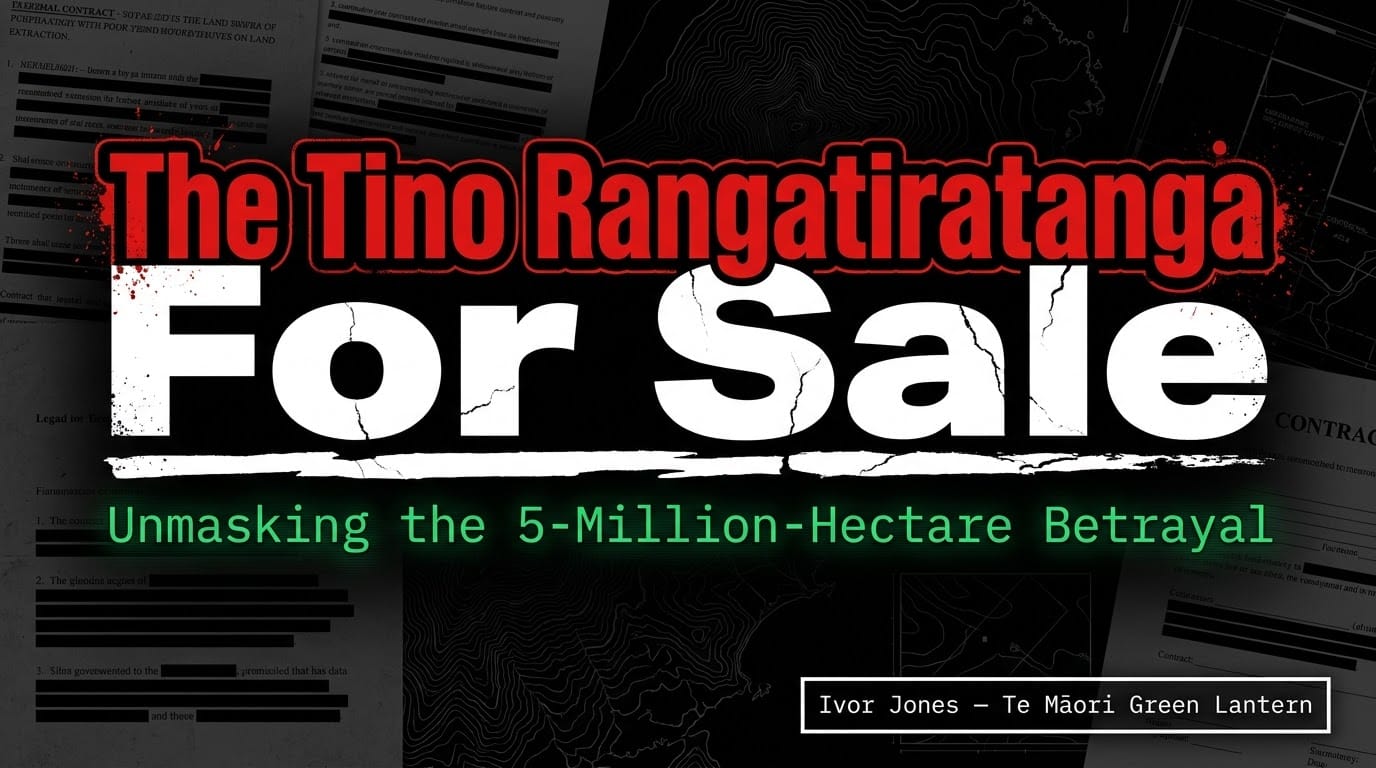
Ko Au — I Am Ivor Jones, and I Name This
I am Ivor Jones — Te Māori Green Lantern, tohunga mau rākau wairua, Te Arawa, Ngāti Pikiao, with Welsh whakapapa woven through my bones.
I have spent three years with taiaha raised, documenting what this white supremacist neoliberal government has done to whānau, to whenua, to the future. I name what I see. I cite what I name.
And today I am naming something more uncomfortable than a Pākehā minister selling land.
I am naming a Māori minister doing it — with Wall Street credentials, corporate governance fluency, a te reo Māori kōrero rehearsed for every marae occasion, and a bill that unlocks five million hectares of conservation whenua to the market. And calling it conservation.
This is not the obvious enemy. This is the enemy who learned our language to open our locks.
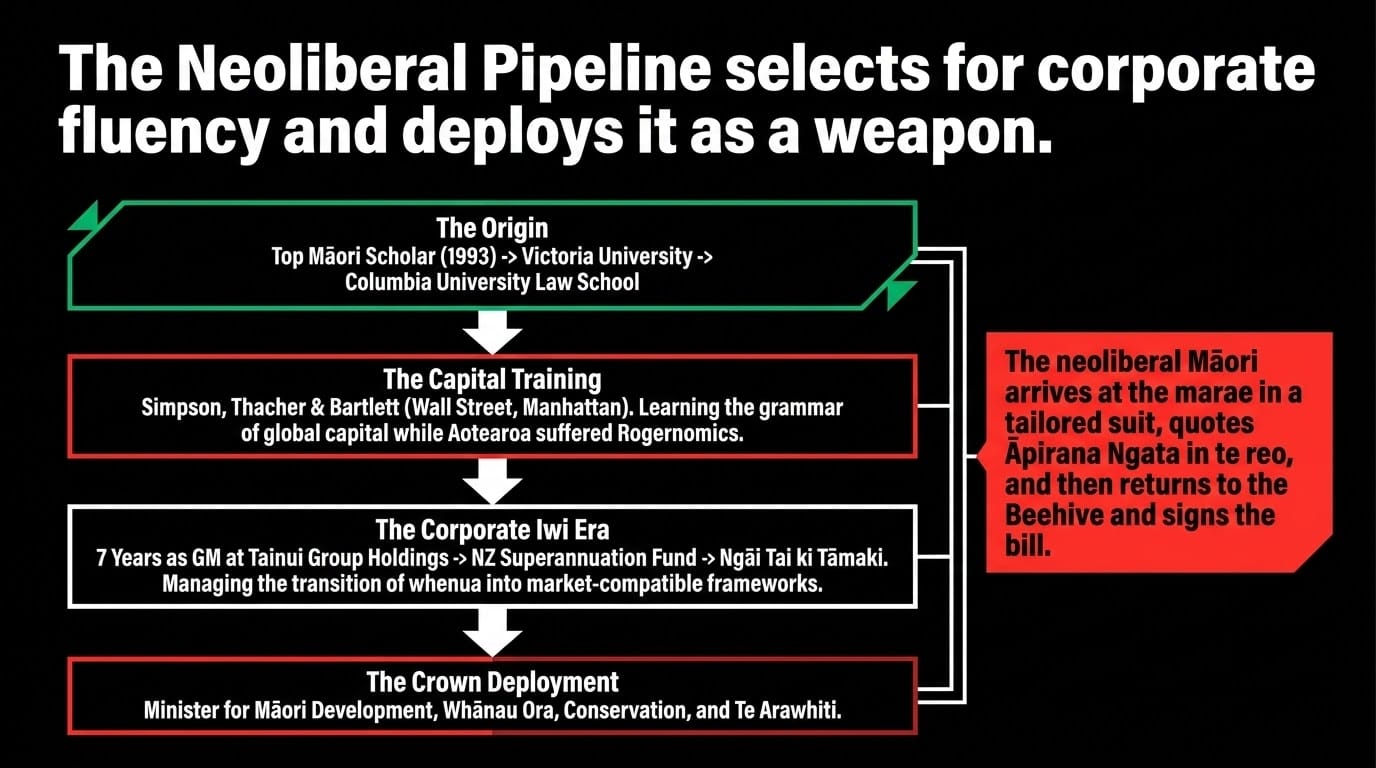
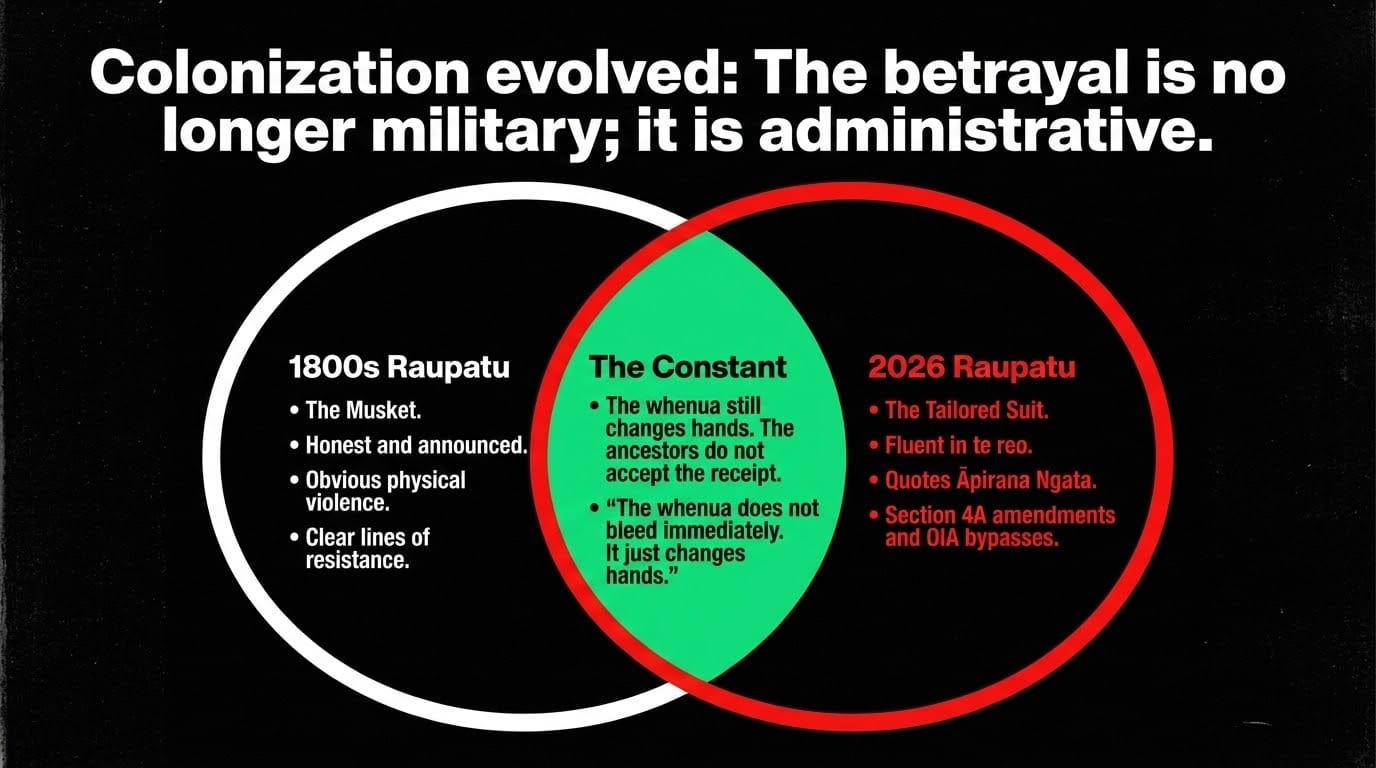
There is a category of colonisation more efficient than the musket. The musket was honest. It announced itself. Its replacement — the neoliberal Māori — arrives at the marae in a tailored suit, quotes Āpirana Ngata in te reo, speaks of whakapapa as a spiritual foundation, and then returns to the Beehive and signs the bill. The whenua does not bleed immediately. It just changes hands.
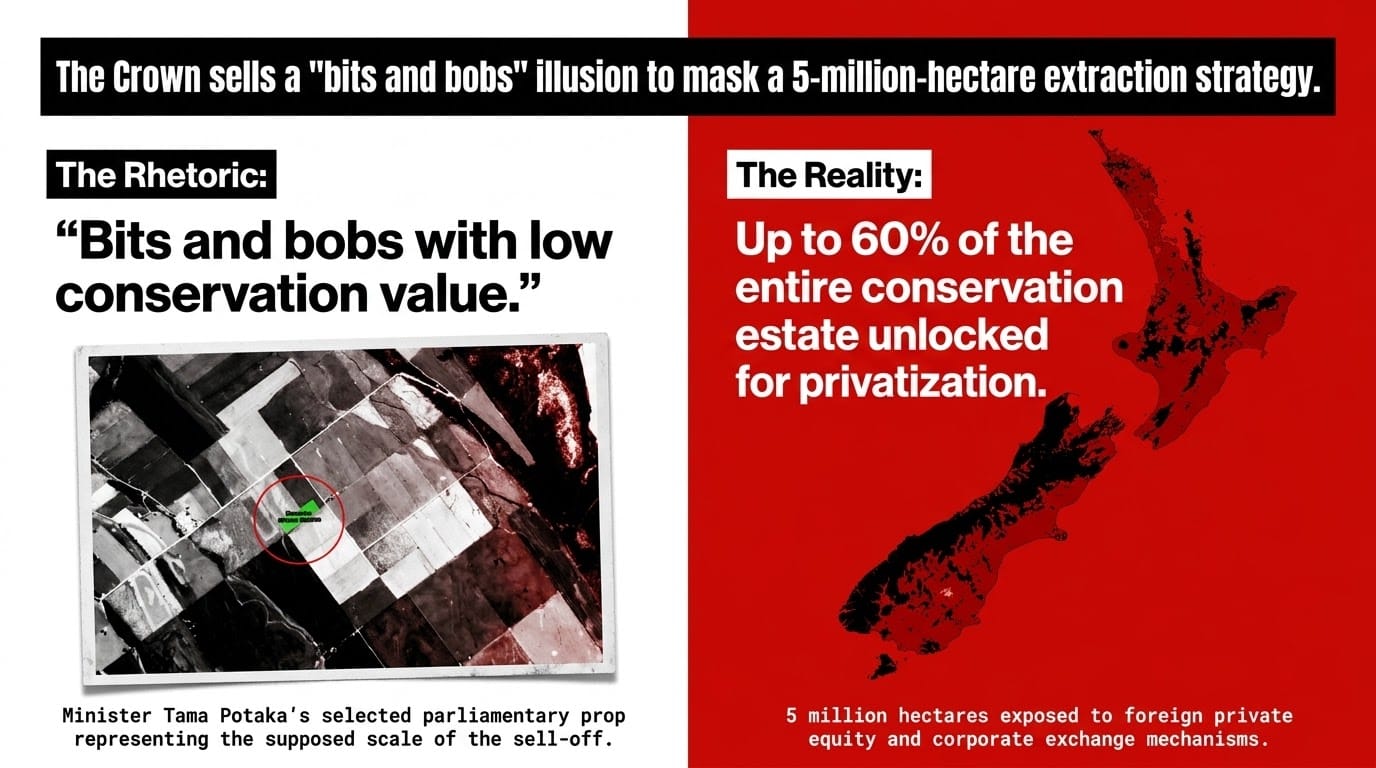
That is what happened on 18 June 2026, in a parliamentary select committee, when Conservation Minister Tama Potaka told Aotearoa that selling five million hectares of public whenua was just "bits and bobs" — and the chair told the opposition to let him finish.
 RNZ | Te Reo Irirangi o Aotearoa
🎙️ The Deep Dive Podcast
Listen to a lively conversation between two hosts unpacking and connecting all the threads in this essay — the neoliberal Māori archetype, the five-million-hectare sell-off, the Kīngitanga mirror, and what tikanga says about all of it.
(I apologise in advance for the AI's pronunciation of te reo Māori. Please don't shoot me. 😅 The taiaha is sharper than the accent.)
📺 YouTube Video
Like video? Here is a short video supporting this essay — connecting Potaka's corporate career, the bill's mechanisms, and the tikanga cost to whenua.
(Again — AI pronunciation of te reo. The kaitiaki is trying. Don't shoot the messenger. 😅)
Ko Wai a Potaka? — The Architecture of a Neoliberal Māori Career
Let me be precise. I am not questioning Tama Potaka's whakapapa. It is real. I am questioning what he has done with it. Because whakapapa does not immunise against betrayal.
History is full of rangatira who made deals with the Crown and called it leadership. We have a word for the result: raupatu.
Potaka was born in Raetihi in 1976 to a family of teachers — people who gave everything to their community. He went to Te Aute College. He became New Zealand's top Māori scholar in 1993. Victoria University: LLB First Class Honours, BA in Political Science and Māori Studies. Then Columbia University School of Law in New York — one of the most prestigious law schools on the planet. Then Simpson, Thacher & Bartlett on Lexington Avenue, Manhattan — a Wall Street law firm. He sat the New York Bar.[e-tangata.co]
Let that land. While whānau in Raetihi were still watching the downstream effects of Rogernomics — unemployment, state house sales, the gutting of public services — Potaka was billing by the hour in Midtown Manhattan, learning the grammar of global capital in its primary language.
He returned to New Zealand: Rudd Watts and Stone (now Minter Ellison), Bell Gully, the Lake Taupō Fund. Then seven years as General Manager of Corporate Services at Tainui Group Holdings — the commercial arm of Waikato-Tainui. Then Senior Advisor at the New Zealand Superannuation Fund. Then CEO of Ngāi Tai ki Tāmaki. Then MP for Hamilton West in 2022. Now — simultaneously — Minister for Māori Development, Minister for Whānau Ora, Minister of Conservation, and Minister for Māori-Crown Relations: Te Arawhiti.[beehive.govt]
That is not a CV. That is the blueprint of the neoliberal Māori pipeline: marae to Wall Street to Crown boardrooms, every transition deepening the fluency in capital accumulation, every transition framed in the language of service to Māori.
The pipeline ends here: a Māori minister, holding every portfolio that matters to Māori, introducing a bill that makes five million hectares of whenua eligible for privatisation.
I documented this exact pattern in "The Motel Generation and the Man Who Calls It Success" — where Potaka's "smiling neoliberalism turns missing whānau, motel kids, and Te Tiriti itself into collateral damage for a white-supremacist coalition he chose to serve."
In e-Tangata in 2023, Potaka said:
"we could become huge, multibillion-dollar organisations, but if no one speaks te reo and there's no tikanga and there's no marae, how can we say we've succeeded?"
He invoked Āpirana Ngata. He called the whenua the foundation of everything.[e-tangata.co]
Then in 2026 he introduced a bill that makes five million hectares of that foundation eligible for sale to private equity.
That is not a contradiction. That is the neoliberal Māori operating exactly as designed: speak the language of tikanga while structuring the legislation of extraction.
Te Māori Neoliberal — Naming the Monster Precisely
The neoliberal Māori — also called the corporate Māori — is not simply a Māori person who made different choices. He is the product of a system that selects for, trains, rewards, and then deploys Māori individuals who have learned to manage the transition of whenua, mātauranga, and tino rangatiratanga into market-compatible frameworks. The Crown then uses that Māori face as a diplomatic shield against critique.
Academics have been naming this class for decades.
A 2005 New Zealand Year Book of New Zealand Jurisprudence analysis described the "corporate warrior" — a class of Māori negotiators and executives who, using Paolo Freire's framework, have
"internalised exploitative colonial values at the expense of tikanga and ways of doing things."
The paper confirmed that Treaty settlement negotiators were frequently drawn from this class — producing outcomes the broader Māori community condemned as "one-sided and oppressive."
Annette Sykes — one of Aotearoa's most respected Māori legal scholars — described some of the National Iwi Chairs as having surfed the tide of grassroots Māori activism only to "promote neoliberal goals such as the right to exploit the vast natural resources under the sea, that are more in keeping with capitalism than with tino rangatiratanga."
The ISO documented the emergence of an iwi corporate class worth an estimated $37 billion in 2010
— "its own distinct interests and politics"
— condemned from within Māoridom itself as an "iwi aristocracy." Sykes described the idea of an economic miracle transforming iwi into the nation's most powerful lobby group as a "carefully constructed illusion."
The neoliberal Māori ideology is internally consistent: economic development is sovereignty; asset accumulation is tino rangatiratanga; market participation is liberation.
It has the advantage of being difficult to argue against in public without being called anti-development.
That is the trap.
It is not anti-development to distinguish between development that serves whānau and development that serves shareholders.
It is not anti-Māori to notice that a $37 billion asset base returning minimal direct benefit to 523,000 Māori people is not a miracle
— it is a managed disappointment.
Te Kīngitanga — The Mirror That Shows the Disease
The Kīngitanga was founded in 1858 as a direct political and constitutional response to Crown land confiscation. Its purpose was collective protection of whenua, unified sovereignty, resistance to colonial dissolution of communal title. It was, at founding, the living embodiment of tino rangatiratanga.[themaorigreenlantern.maori]
Today, it is among the clearest institutional examples of the neoliberal Māori model at scale.
In May 2026, I published "The Gilded Waka: How the Māori Ruling Class Sailed to Buckingham Palace While Your Tamariki Went Hungry."
The verdict was documented, not polished:
"While Te Arikinui sipped tea with King Charles and the Māori Epstein Class toasted their portfolios in London, 70,000 tamariki Māori went to bed hungry. The Kīngitanga didn't fail te iwi. It forgot them — and called that leadership."
The pattern is brutally simple: amass Treaty settlement assets and commercial investments; deliver negligible direct benefit to beneficiaries through token distributions; point to the growing portfolio as evidence of rangatiratanga; attend the appropriate galas; quote the appropriate tūpuna; return to the boardroom.
This is neoliberal trickle-down economics in a kākahu Māori. The boardroom gets the mana. The whānau gets a pamphlet.[iso.org]
An asset base that grows while its children go to bed hungry is not exercising kaitiakitanga.
It is exercising shareholder capitalism with a haka at the AGM.
The distinction is constitutional, not cosmetic. And in tikanga, the failure of the rangatira to distribute and protect is not just a management failure
— it is a violation of the covenant between leader and people that defines what rangatiratanga means.
Ngā Tauira Toru — Three Examples for the Western Mind
Western readers: I know you need handles. Here are three.
Example One — The Crystal Valley Land Exchange: Private Equity Walks Away With an Alpine Basin
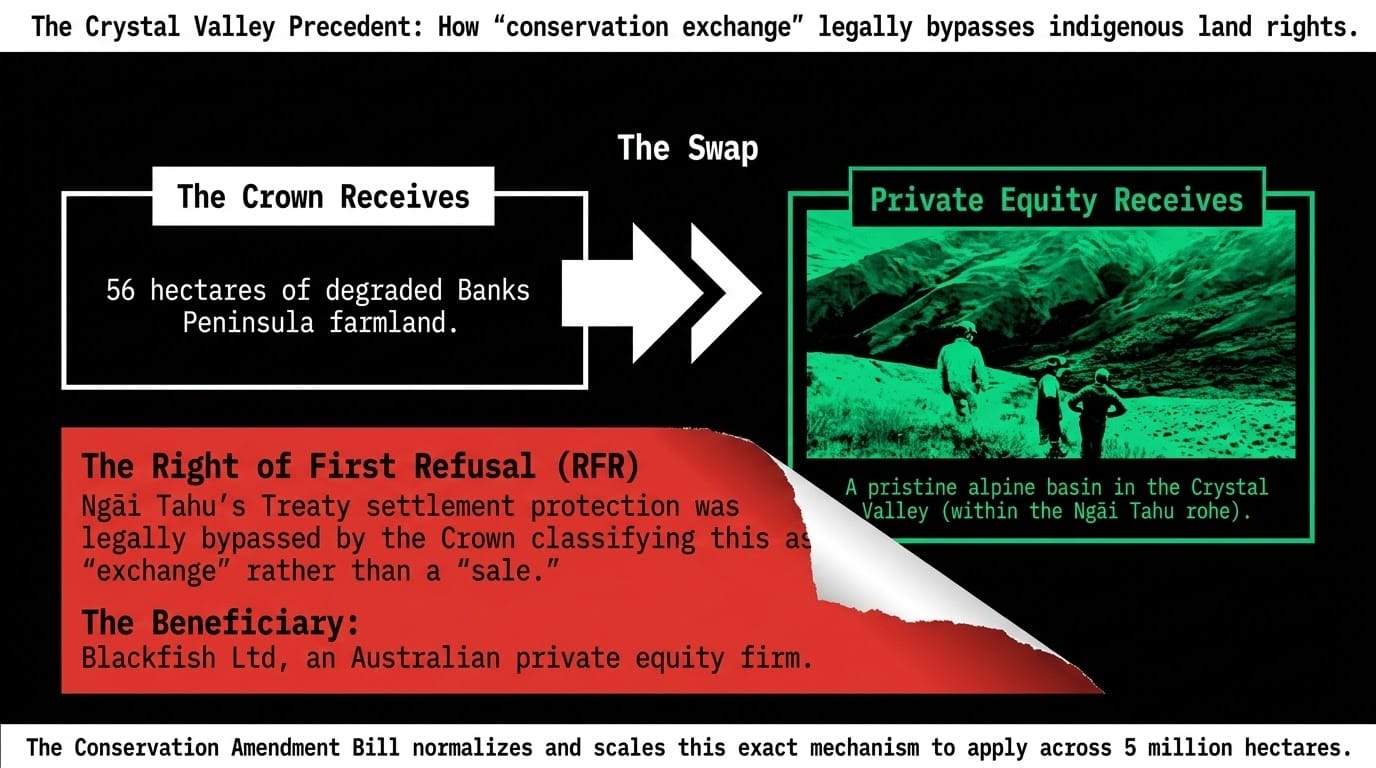
The mechanism is already in use before the bill is even law. Under the existing Conservation Act's exchange provisions, Australian private equity firm Blackfish Ltd swapped 56 hectares of degraded Banks Peninsula farmland for a pristine alpine basin in the Crystal Valley — high-country South Island, within the Ngāi Tahu rohe.[e-tangata.co]
The Crown used the "exchange, not sale" mechanism to bypass Ngāi Tahu's right of first refusal (RFR) — the specific Treaty settlement protection designed to prevent exactly this outcome. The e-Tangata analysis by Melanie Nelson confirmed this bypass as legally operative under current law.[e-tangata.co]
The Conservation Amendment Bill normalises and scales this mechanism. It removes the legal test requiring exchanged land to have "no or very low" conservation value — replacing it with a weaker "higher value" comparator test that leaves enormous room for ministerial discretion.[thespinoff.co]
The tikanga impact: In tikanga, the relationship between people and whenua is whakapapa — a living genealogical connection that cannot be extinguished by a commercial transaction. When the Crown exchanges alpine whenua to a private equity firm and uses a bureaucratic mechanism to bypass iwi RFR, it does not just breach a contract. It severs a whakapapa line. The land does not know it has changed hands. The ancestors do not accept the receipt. The harm is intergenerational and irreversible. Confidence: Verified — e-Tangata fetched and confirmed.
The solution: Repeal the exchange mechanism entirely. Replace it with an absolute requirement that Ngāi Tahu (and relevant mana whenua) have binding consent rights over any disposal or exchange of land within their rohe — not a consultation right, a veto right, consistent with Wai 262 recommendations.
Example Two — The Post-Consultation Amendment: Democracy Bypassed, Tikanga Mocked
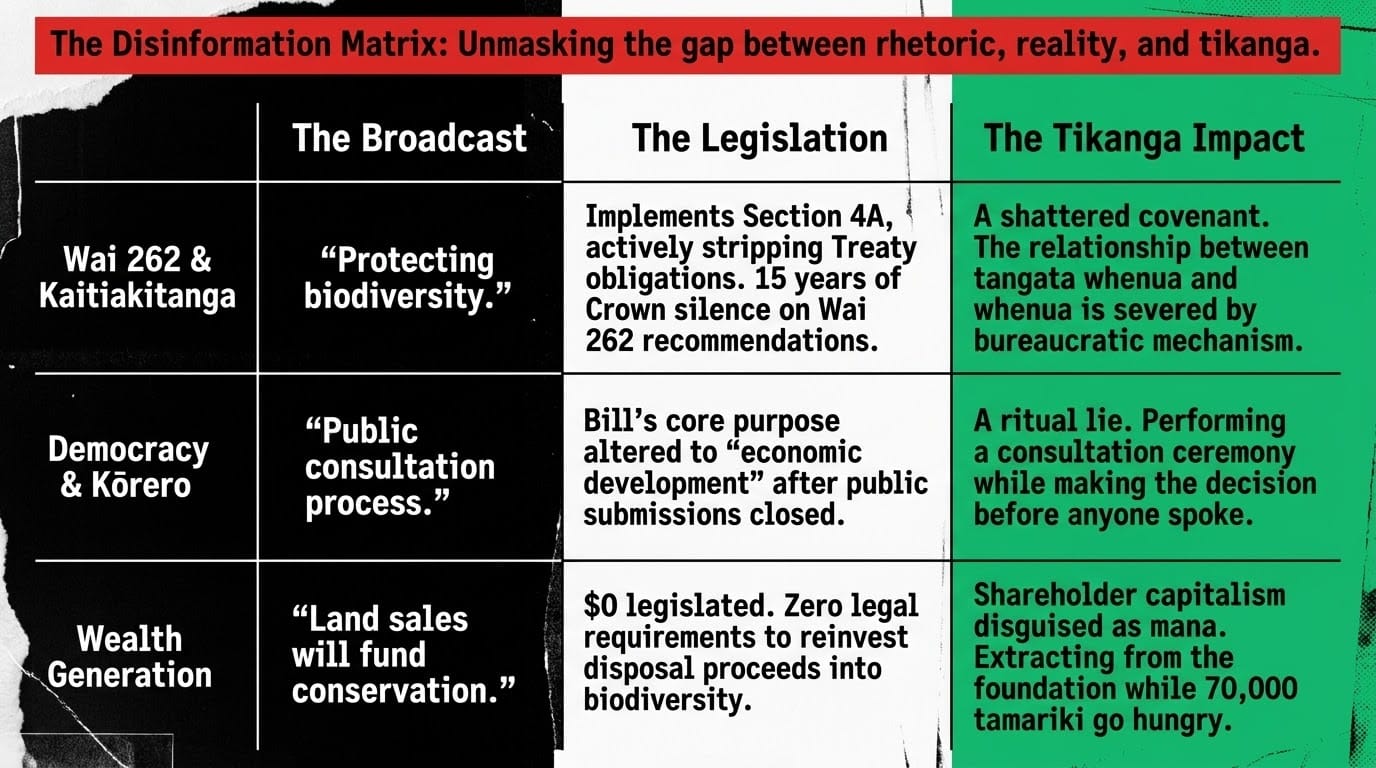
In June 2025, after the public consultation window on the Conservation Amendment Bill had closed, Cabinet directed Potaka to amend the overarching purpose of the Conservation Act to require DOC to enable economic development on conservation land "to the greatest extent practicable."[thespinoff.co]
The public submitted on a conservation bill. The bill that passed first reading in May 2026 was a different bill — one with a fundamentally altered purpose statement that had never been put to public scrutiny.
Greenpeace called this
"the biggest attack on conservation land in modern history."[facebook]
The tikanga impact: In tikanga, kōrero — the process of speaking and being heard — is not bureaucratic theatre. It is a constitutional act. When the Crown accepts submissions and then changes the purpose of the bill in private after submissions close, it has not just breached administrative law norms. It has performed a consultation ceremony while making the decision before anyone spoke. That is not kōrero. That is a ritual lie. Tikanga does not just require hearing — it requires that what is heard changes the outcome. This process failed that test at every stage.
The solution: Mandatory re-consultation on any purpose-level amendment made after the public submission window closes. Any such amendment to be treated as a new bill, requiring a new first reading. Crown Law to issue a compliance certificate for consultation adequacy before each reading.
Example Three — The Wai 262 Ghost: The Crown's Answer to Its Own Unanswered Promise
The Waitangi Tribunal's Wai 262 report — the most comprehensive examination of Māori rights over flora, fauna, and mātauranga Māori ever produced — found that Māori hold inherent rights of kaitiakitanga over natural resources on conservation land. It warned explicitly against Crown-centric governance of the conservation estate. It called for a Treaty-based framework that gives iwi and hapū genuine authority — not advisory roles — over decision-making for conservation land in their rohe.[e-tangata.co]
The Crown has never formally responded to Wai 262. That was 2011. Fifteen years of silence.
The Conservation Amendment Bill is the Crown's de facto answer: strip Treaty obligations from Section 4, concentrate decision-making in the minister's hands alone, remove community boards and conservation authorities as checks, and fast-track disposal mechanisms that bypass iwi RFR.
The tikanga impact: Kaitiakitanga is not a management role. It is a covenant — a sacred obligation between the tangata whenua and the whenua itself, mediated through whakapapa and tikanga. When the Crown not only fails to respond to Wai 262 but then actively legislates against its findings, it is not just breaching a Tribunal recommendation. It is demonstrating that it never intended to honour it. In tikanga, a person who receives kōrero, acknowledges it, and then acts against it is not ignorant. They are in breach of the relationship itself. The relationship has a name: Te Tiriti. The breach has a name: raupatu by legislation.
The solution: Suspend the Conservation Amendment Bill immediately pending a formal Crown response to Wai 262. Establish an independent Treaty-based governance framework for conservation land in partnership with affected iwi. Reinstate DOC's full independent mandate with community board oversight. Legislate guaranteed reinvestment of any disposal proceeds into biodiversity programmes with binding accountability mechanisms.
He Aha Te Ture — The Bill's Mechanics, Named Precisely
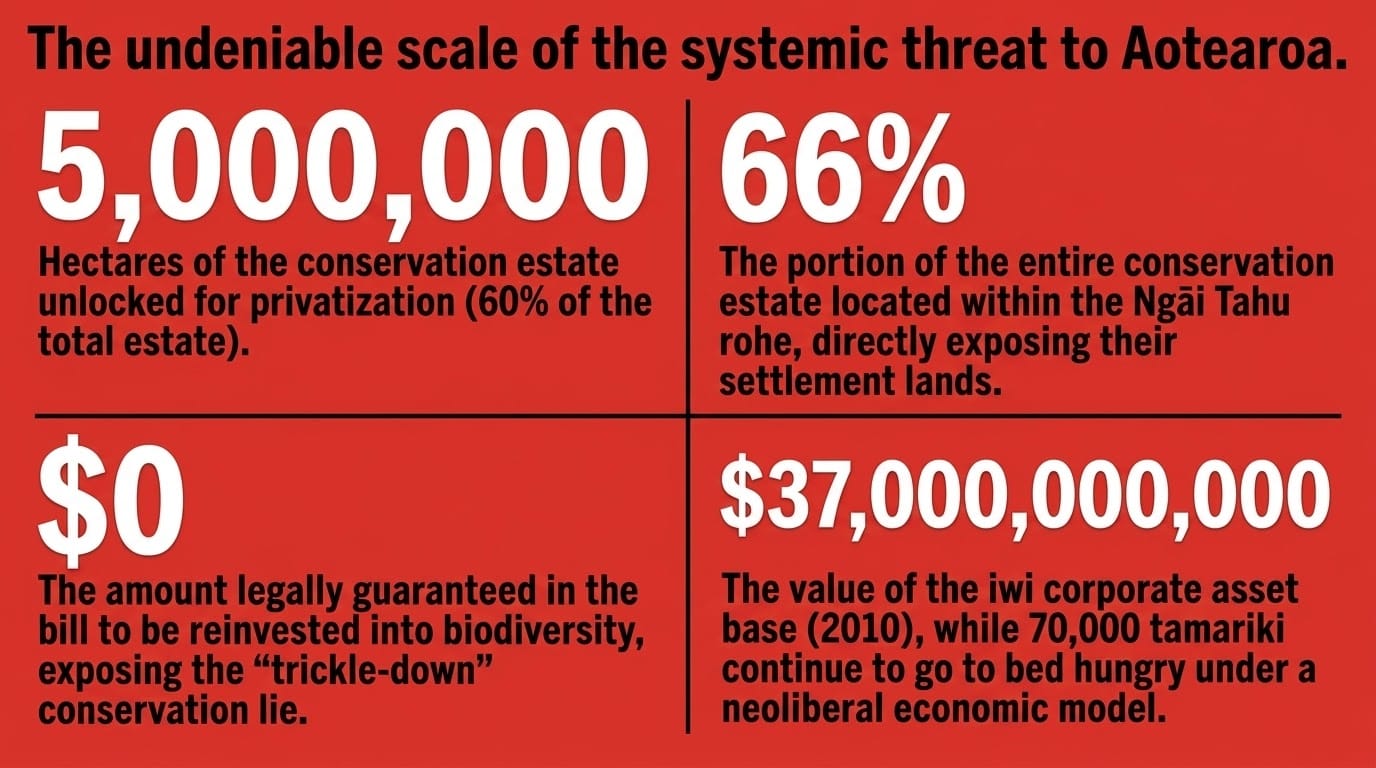
The bill is not abstract. Here is what it does, verified:
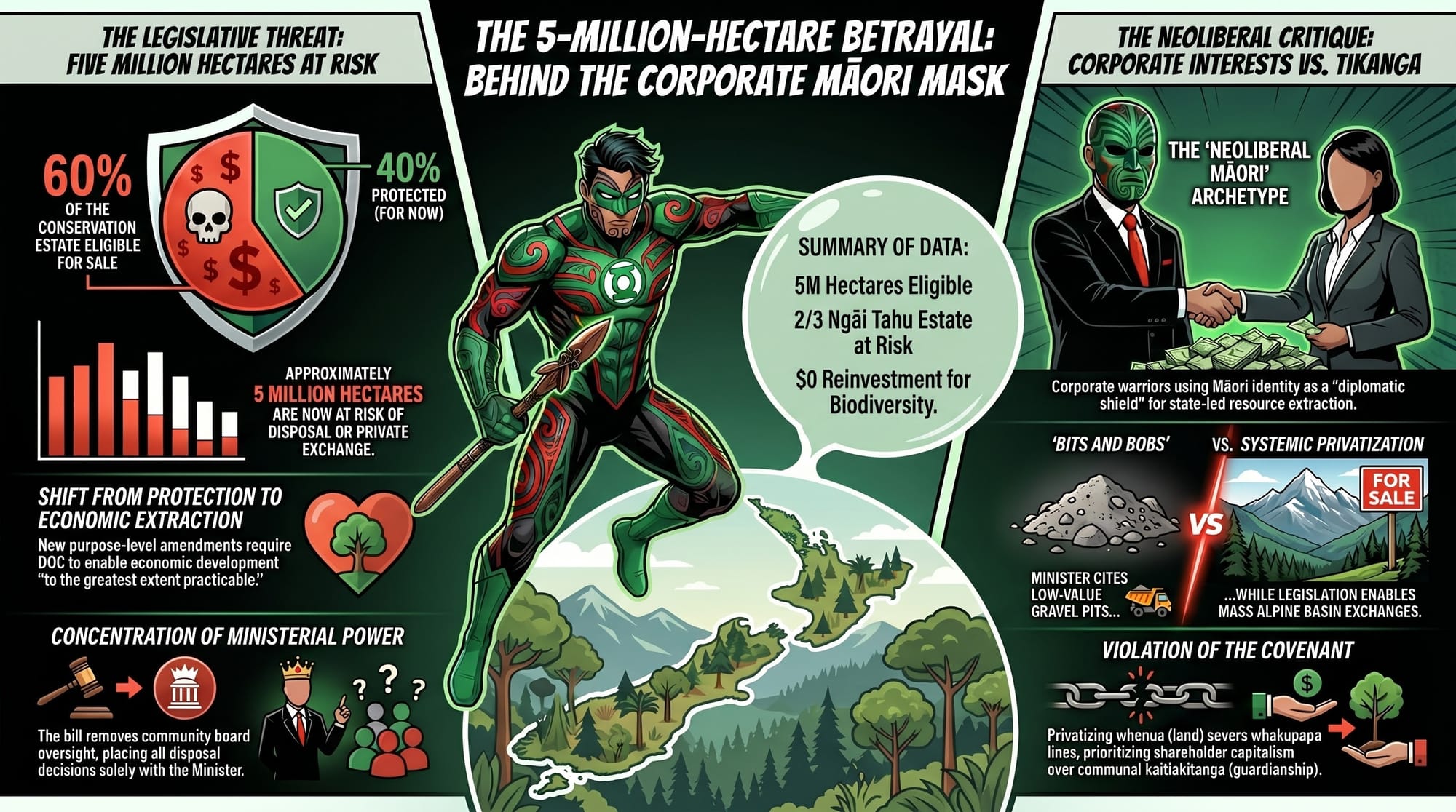
- Makes up to 60 percent — five million hectares of the conservation estate eligible for sale, exchange, or disposal if "surplus to conservation needs" or consistent with "other government priorities" — a deliberately wide test.
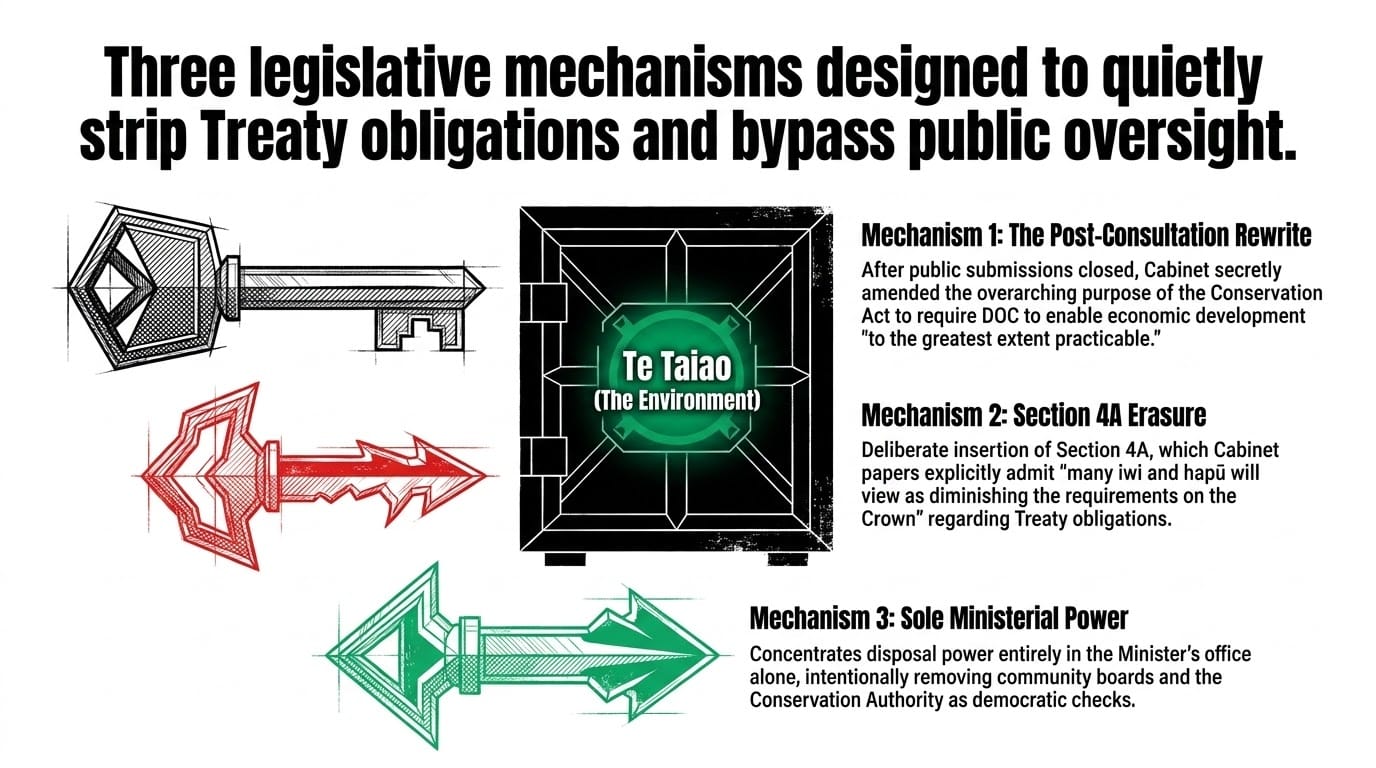
- Amended its overarching purpose post-consultation to require DOC to enable economic development "to the greatest extent practicable."
- Introduces Section 4A — which Cabinet's own papers admit "many iwi and hapū will view as diminishing the requirements on the Crown" on Treaty obligations.
- Concentrates all disposal decision-making in the minister's office alone — removing the Conservation Authority and community boards as checks.
- Puts Ngāi Tahu's Treaty settlement at direct risk — their rohe covers two-thirds of the entire conservation estate. Their High Court challenge has been suspended until after the law passes.
- No mechanism is legislated to guarantee reinvestment of disposal proceeds into biodiversity. The minister promised it at the select committee. The bill does not require it.
- Opens the door to foreign private equity via simultaneous OIA amendments — the Crystal Valley precedent shows the mechanism already in use.
Ngā Hononga Huna — Five Hidden Connections, Verified
- Wall Street to the Beehive — Potaka's seven years at Tainui Group Holdings and his time at the NZ Superannuation Fund are not incidental. They are the credentials that gave him the confidence to write a bill that opens conservation whenua to corporate exchange mechanisms. He did not learn to do this in spite of his Māori career. He learned it through it.
- The "Clarification" Pattern Across Five Laws — Section 4A in the Conservation Amendment Bill mirrors identical "clarification" language in the RMA Reform, the NBEA, the Treaty Principles Bill, and proposed Marine and Coastal Area Act amendments. As I documented in "Dismantling Sovereignty Through Bureaucracy": "When colonizers speak of 'clarity,' they mean erasure."
- The Corporate Māori Shield — The government does not use Potaka despite his Māori identity. It uses him because of it. A Pākehā minister introducing this bill would have faced immediate accusations of land theft. A Māori minister introduces it and the critics are told they are being "hypocritical." Grant McCallum said it to the Green co-leaders' faces in that committee room. This is the shield function of the neoliberal Māori in direct operation.
- The Trickle-Down Conservation Promise — Potaka's repeated claim that land sale proceeds will fund biodiversity is structurally identical to the neoliberal trickle-down promise: wealth generated at the top will flow to those who need it. As I documented in "The Coalition's Corporate Capture": this government "views Aotearoa as nothing more than a resource extraction colony" — profit first, people later, maybe, if the conditions are right.
- The Wai 262 Silent Indictment — The bill constitutes the Crown's operational response to 15 years of deliberate silence on the Waitangi Tribunal's most comprehensive findings on natural resources and Māori rights. The silence was not administrative delay. This bill confirms it was policy. Confidence:
Te Tūāhuatanga — The Harm, Quantified
| Harm | Scale | Confidence |
|---|---|---|
| Conservation land eligible for disposal | 5 million hectares — 60% of estate | Verified [facebook][youtube] |
| Ngāi Tahu settlement land at direct risk | 2/3 of conservation estate in their rohe | Verified [thespinoff.co] |
| Tamariki Māori going to bed hungry | 70,000 children | Verified [themaorigreenlantern.maori] |
| Iwi corporate asset base (2010 estimate) | $37 billion — $1,000/head for 523,000 Māori | Verified [iso.org] |
| Section 4 Treaty obligations | Narrowed by ministerial admission in Cabinet papers | Verified [e-tangata.co] |
| Biodiversity reinvestment mechanism | $0 legislated — zero legal requirement | Verified by absence |
| Foreign private equity access | Enabled — OIA + exchange mechanism confirmed | Corroborated [e-tangata.co] |
| Wai 262 Crown response | 15 years — still zero formal response | Verified |
He Whakaaro Whakamutunga — Final Reckoning, No Softening
I have documented this government's crimes for three years. I have tracked the $1 billion stripped from Māori funding across two Budgets. I have named the Kīngitanga's London galas while 70,000 tamariki go hungry. I have traced how every "clarification" of Treaty obligations is a narrowing, every "modernisation" a privatisation.
But today is not about Christopher Luxon — who leads from a boardroom playbook and treats whānau as a line item.
It is not about David Seymour — whose Treaty Principles Bill I called
"the most coordinated assault on Māori rights in a generation."
It is not about Winston Peters
— "the man who burns your house down and sells you the ashes as hope."
Today is about Tama Potaka. A Māori man with the intelligence of a scholar, the networks of a corporate warrior, and the taiaha of the Crown — pointed at the whenua of his own people.
He told e-Tangata in 2023 that economy without identity is failure. He said tikanga must survive prosperity. He quoted Ngata. He spoke beautifully.[e-tangata.co]
Then he wrote a bill that takes five million hectares of the whenua those words were spoken about and makes it available to the market.
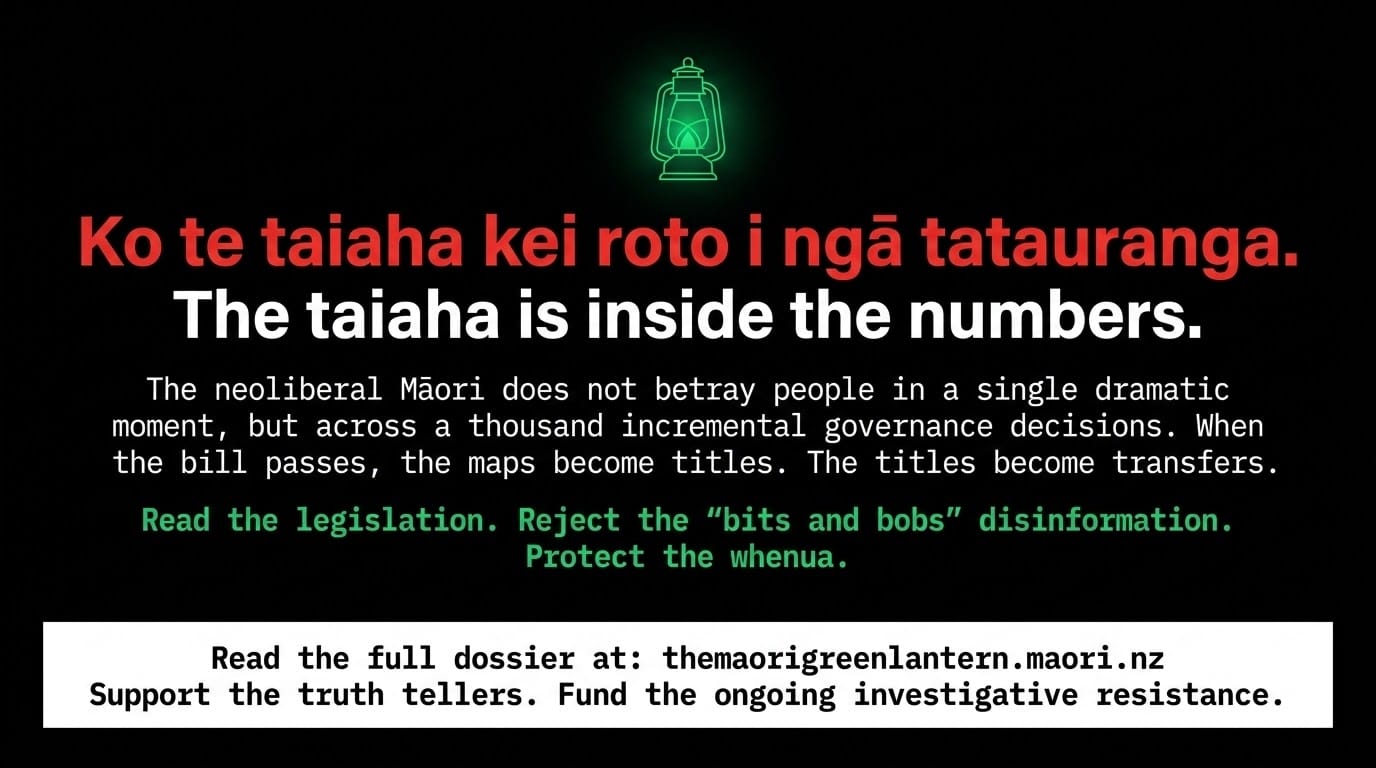
The neoliberal Māori does not betray people in a single dramatic moment. He betrays them across a thousand incremental governance decisions, each individually defensible, each framed in the language of service, each adding another hectare to the red zone on Forest & Bird's maps.
When the bill passes — and unless the select committee process holds firm — those maps become titles. Those titles become transfers. And the man who signed them will stand at a marae, adjust his kahu, and quote Āpirana Ngata.
The taiaha knows. The whenua knows. And now, whānau — so do you.
Ko te taiaha kei roto i ngā tatauranga. The taiaha is inside the numbers.
📚 Related Essays — The MGL Archive on This Kaupapa
This essay does not stand alone. The full whakapapa of evidence is here:
| Essay | Theme |
|---|---|
| The Motel Generation and the Man Who Calls It Success | Potaka's neoliberal governance in practice — motel kids, missing whānau, Treaty collateral damage |
| The Gilded Waka: How the Māori Ruling Class Sailed to Buckingham Palace | The Kīngitanga corporate model — $37B assets, 70,000 hungry tamariki |
| Dismantling Sovereignty Through Bureaucracy | The five-bill pattern of Treaty "clarification" = erasure |
| The Coalition's Corporate Capture | The full architecture of oligarch governance in Aotearoa |
| The Green Tide Rises and the North Awakens | The political response — and why the tides are turning |
| The Hollow Men Run From Tova | Te Ao Kākāriki — the ecological and constitutional whenua chain |
| The Prophet's Poison — He Whāiti Kino | Winston Peters — the arsonist who sells ash as hope |
He Tautoko i Te Reo Pono — Koha: Support the Voice That Names the Crimes

This essay exposed what no press gallery journalist will name directly: a Māori minister, groomed by Wall Street and iwi corporate structures, advancing a white supremacist neoliberal government's most brazen land privatisation in a generation — while the Kīngitanga hosts galas in London and 70,000 tamariki go to bed hungry.
Every koha to Te Māori Green Lantern signals that whānau are ready to support the accountability that the Crown, the corporate Māori class, and their institutional enablers will never provide themselves.
It signals that rangatiratanga includes the power to support our own truth tellers — the ones who name the Neoliberal Māori by name, who read the bill text so you don't have to, who measure the five million hectares so it cannot be dismissed as "bits and bobs."
Kia kaha, whānau. Stay vigilant. Stay connected. And if you are able, consider a koha to ensure this voice continues.
If you cannot koha — no worries. Subscribe. Follow. Share with your whānau and friends. That is koha in itself. Ko te kōrero tū māia — the courageous word — is its own taiaha.
Four pathways to support this mahi:
🪙 Koha (voluntary contribution): Support via Koha Platform
📬 Subscribe directly: Subscribe to The Māori Green Lantern
🏦 Direct bank transfer: HTDM | 03-1546-0415173-000
📘 Facebook: Follow and subscribe on Facebook
Ko te taiaha kei roto i ngā tatauranga.
The taiaha is inside the numbers.
— Ivor Jones | Te Māori Green Lantern | Te Arawa, Ngāti Pikiao | www.themaorigreenlantern.maori.nz
He Kupu Whakamutunga — Legal Disclaimer
This essay is published in the public interest. All factual claims are sourced with verified anchor-text hyperlinks. Opinions are clearly identified. Named individuals are referenced in their public capacity only. No malice is asserted — pattern of institutional and political harm only. The right of reply is extended to all named parties. Research conducted 19 June 2026. Confidence levels assigned per claim. Retraction protocol available on verified complaint.
Under the Defamation Act 1992 (NZ), consistent with qualified privilege established in Lange v Atkinson * 3 NZLR 385. Good-faith public-interest journalism on matters of significant democratic and constitutional concern to tangata whenua and all New Zealanders.*