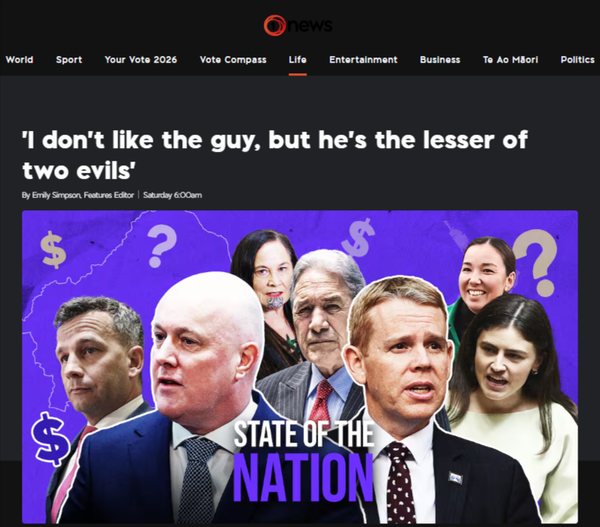
"HOW ERICA STANFORD SOLD OUR TAMARIKI TO AN AUSTRALIAN CORPORATION AND CALLED IT EDUCATION REFORM' - 20 June 2026
A no-tender contract. A conveniently blank memory. A curriculum engineered to make 80% of our children fail. This is not a policy mistake — this is white supremacist neoliberalism with a lesson plan.

Mōrena Aotearoa,
I want you to imagine something with me.
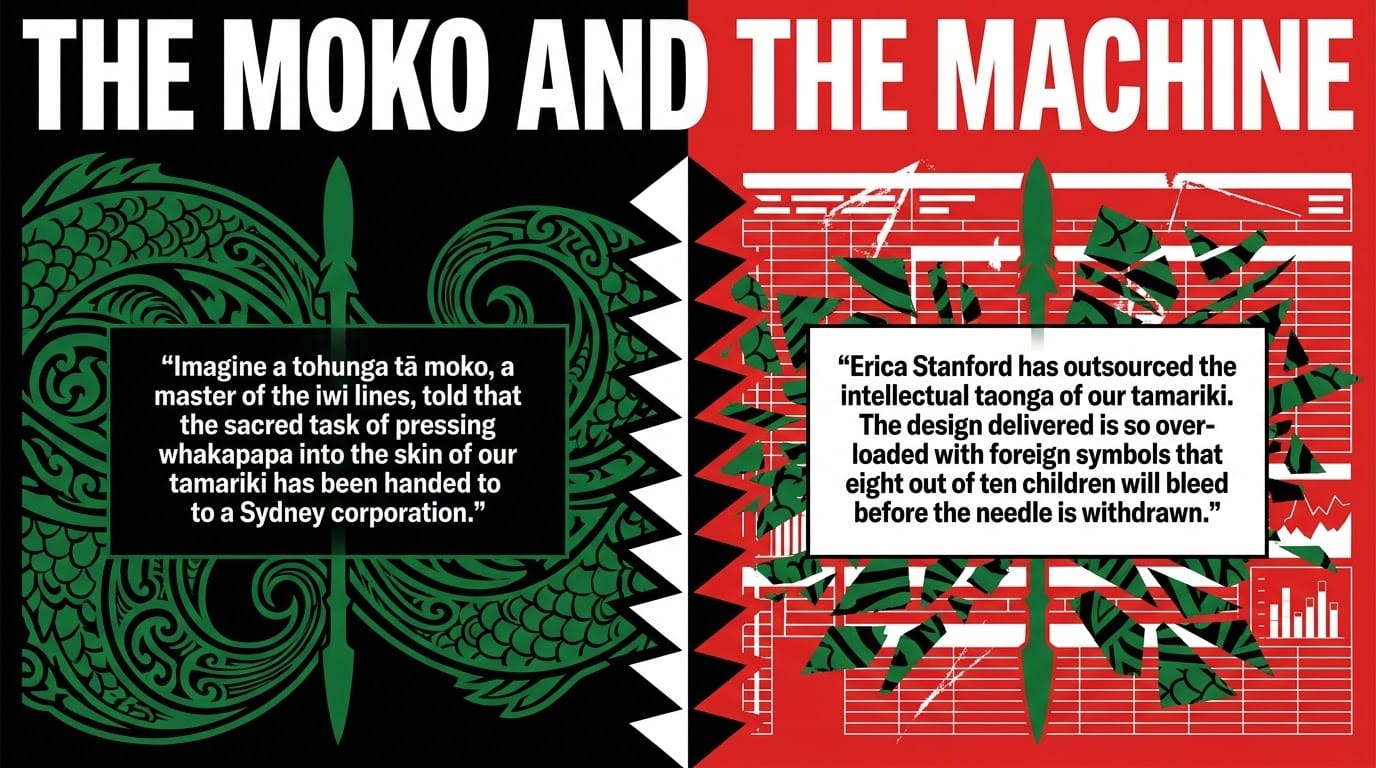
You are a tohunga tā moko. Your whole life has been spent learning the patterns — the koru, the manaia, the unaunahi — the living visual language of whakapapa that has been pressed into the skin of your people for centuries.
You have trained under masters. You know the iwi lines. You know which patterns belong to which maunga, which awa, which hapū.
You are the most qualified practitioner in the country.
 RNZ | Te Reo Irirangi o Aotearoa
And then one day, the Minister of Culture tells you that a firm from Sydney has been engaged — without tender, without competition — to design the moko for every child in Aotearoa.
The Minister cannot remember whether she had coffee with the Sydney firm's chief executive before or after the contract was signed. And the design they have delivered is so overloaded with patterns — so stuffed with foreign symbols crammed into every centimetre of skin
— that eight out of ten children will bleed before the needle is withdrawn.
 RNZ | Te Reo Irirangi o Aotearoa
That, whānau, is what Erica Stanford has done to our curriculum.
 RNZ | Te Reo Irirangi o Aotearoa
Not metaphorically. Literally.
THE DEEP DIVE PODCAST
🎧 Listen to a lively conversation between two hosts unpacking and connecting the topics in this essay — the no-tender contract, the conveniently blank memory, the achievement numbers that were already obsolete, and what all of it means for our tamariki. I apologise in advance for the AI's very harsh pronunciation of te reo — please don't shoot me! 😊
YOUTUBE VIDEO
📺 Like video? Here is a short video supporting this essay — connecting the dots between the Learning First contract, the benchmark deception, and the structural class bias in the new curriculum. Again, don't shoot the messenger for the AI's pronunciation! 😊
THE CRIME: A CONTRACT NOBODY TENDERED
Let me be precise, because precision is the taiaha and I do not swing it carelessly.
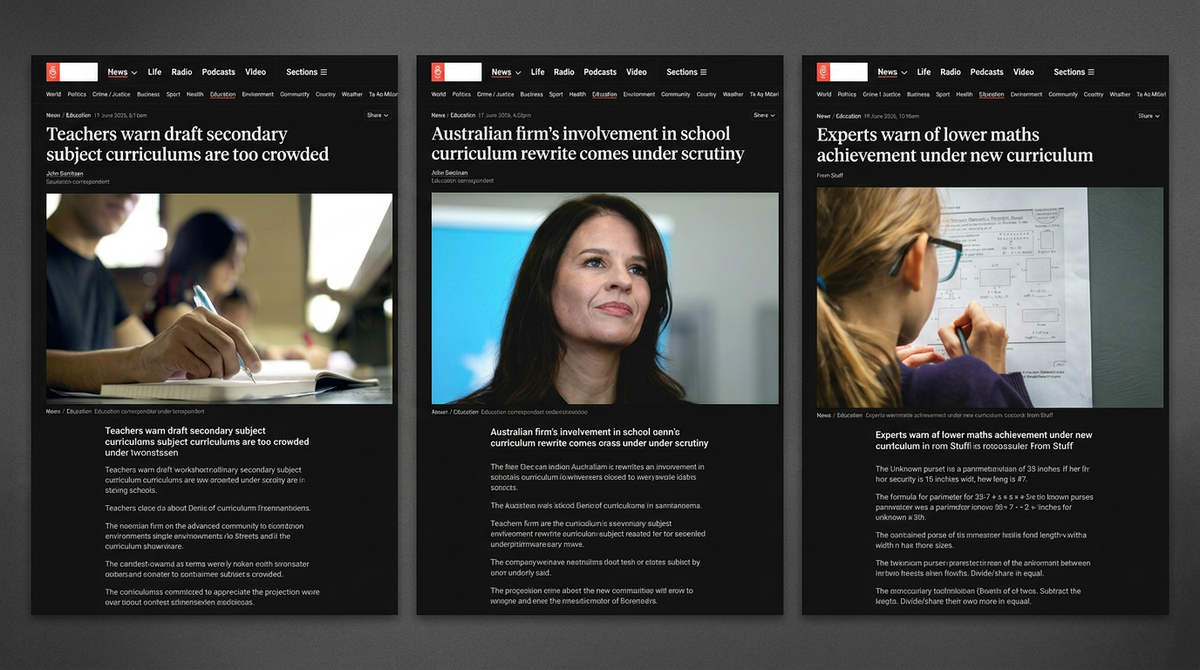
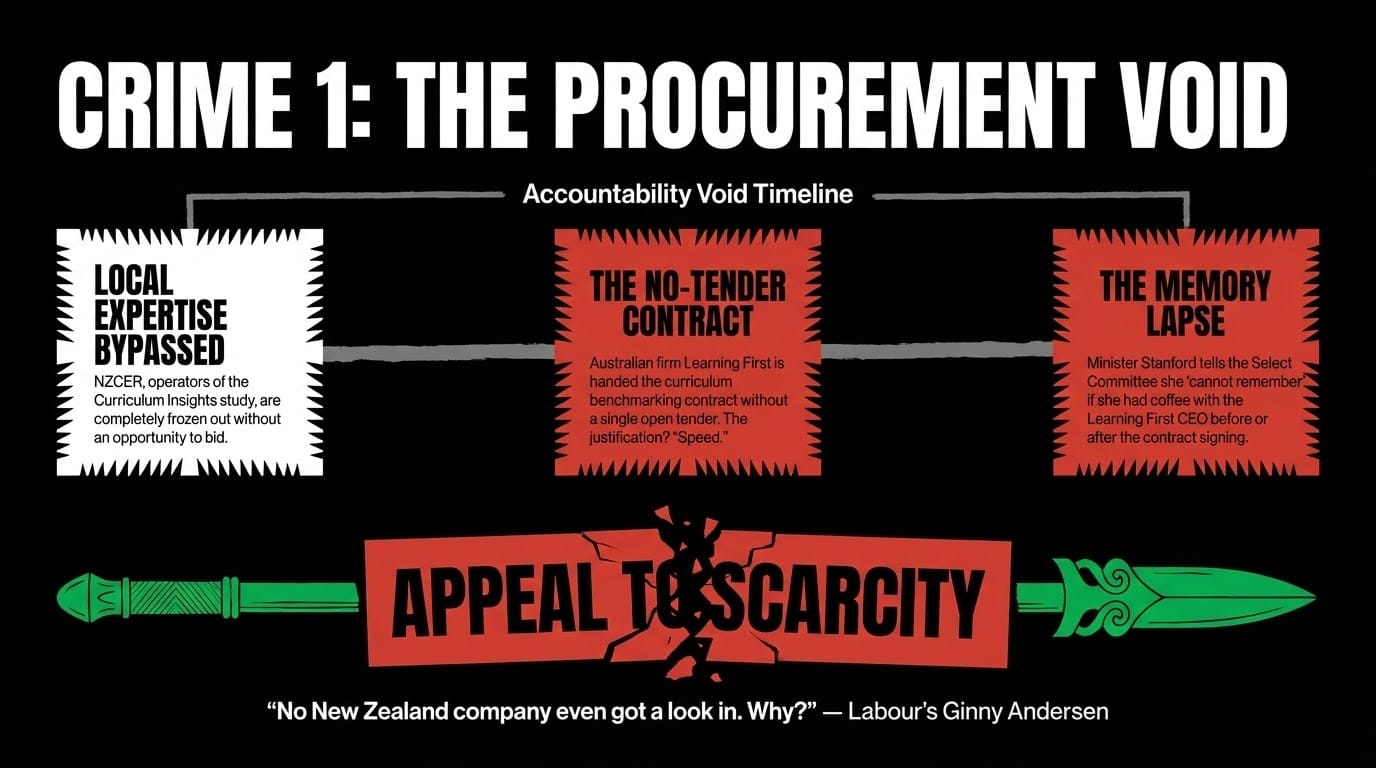
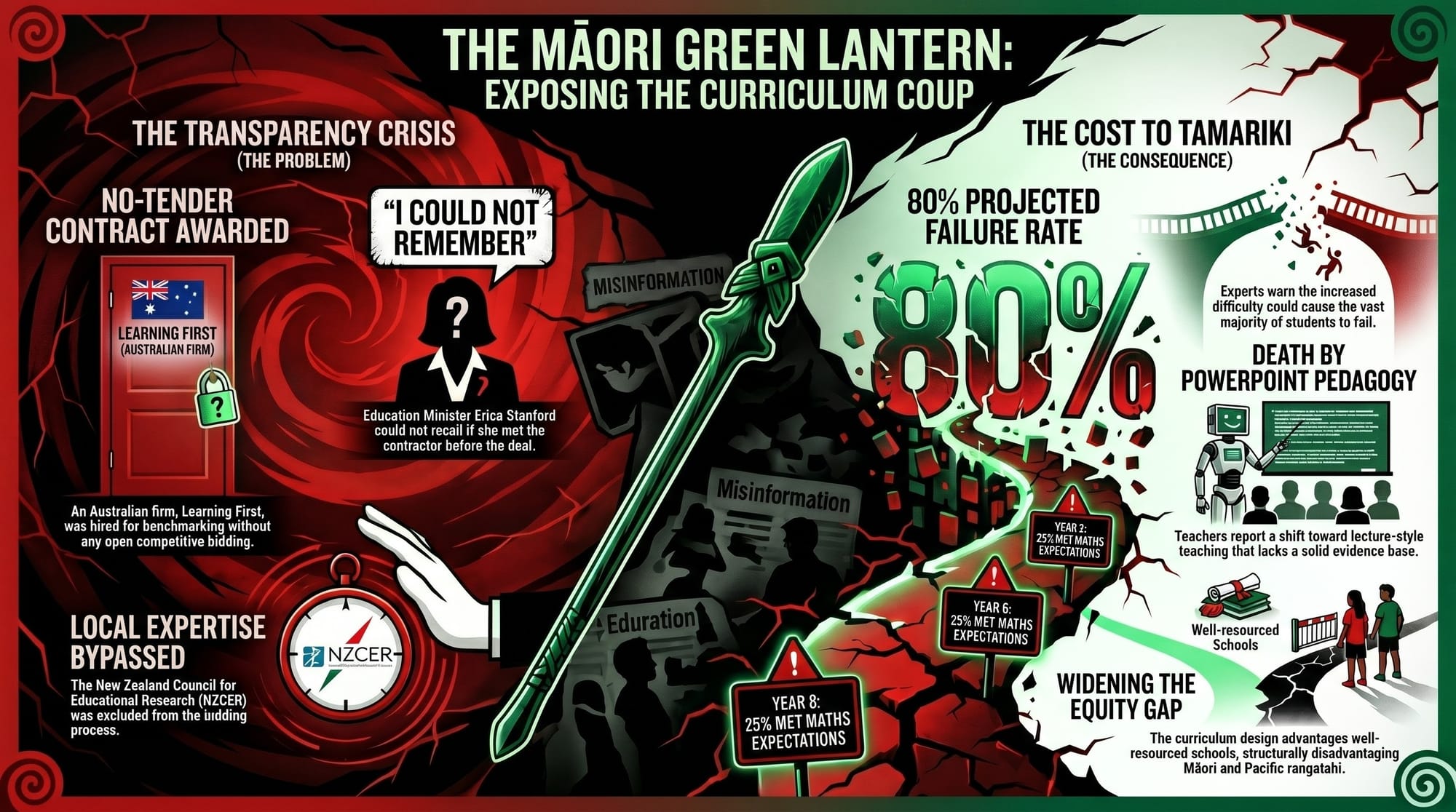
The RNZ investigation of 17 June 2026 confirmed that an Australian company called Learning First was engaged to benchmark New Zealand's new maths curriculum against international curricula
— without open tender.
No New Zealand organisation was invited to compete. Not one.
This is not contested. Education Ministry deputy secretary Pauline Cleaver told the Education and Workforce Select Committee the decision was made because the ministry was
"already working with Learning First" and needed someone fast.
That is the entirety of the justification for why this country's intellectual taonga — the curriculum that shapes the minds of every child in Aotearoa — was handed to a foreign commercial entity without scrutiny or competition.
Labour's Ginny Andersen named the institution that was excluded and humiliated: the New Zealand Council for Educational Research
"would have loved to bid it but did not get the opportunity."
NZCER runs the Curriculum Insights study — the very study that measures whether New Zealand children are achieving against the curriculum they are now being asked to benchmark. They are the most qualified body in the country for this work. Stanford's government froze them out. RNZ Select Committee report, 17 June 2026.
I have written before about this government's pattern of bypassing Māori and New Zealand expertise to serve foreign and ideological interests.
In "The Curriculum Coup: Stanford's Three-Act Colonial Performance" (May 2026), I traced how a Florida-trained, Atlas Network-funded recolonisation programme was being dressed up in the costume of achievement.
The Learning First contract is not a departure from that pattern. It is that pattern — confirmed, documented, and now on the record at a parliamentary select committee.
And I have shown, in "Stanford's Colonial Classroom" (March 2026), how on 24 March 2026 educators from 34 organisations walked out of a government hui and issued the most damning joint condemnation of curriculum reform in this country's history. Thirty-four organisations. A walkout. Stanford's response was to press on.
THE MINISTER WHO CANNOT REMEMBER
The second crime is performed in a single sentence.
Erica Stanford — the Minister of Education, the person constitutionally accountable for how public money is spent on New Zealand children — told the Education and Workforce Select Committee she "could not remember" whether she had coffee with the head of Learning First before or after the company received its government contract. Verified — RNZ, 17 June 2026.
She also told the committee she was "not involved with contracting decisions" — but then, in the same breath, defended those decisions by claiming there were "very few people who could compare curriculums internationally."
I have named this manoeuvre before. In "The Poison Pen Minister" (April 2026), I documented how Stanford weaponised the machinery of the state against her own critics when the curriculum rewrite came under fire.
The playbook is consistent: claim distance from decisions when they attract scrutiny; claim authority over those same decisions when defending them.
Distance and authority, deployed interchangeably, depending on the political weather.
This is not incompetence. Incompetence is random. This is systematic.
The fallacy in play is the appeal to scarcity — the claim that Learning First was uniquely qualified, deployed to justify why no open tender was held. It is circular by design: no one else was invited to demonstrate their capability, so the scarcity of qualified providers was never tested. NZCER's exclusion is not evidence of their inadequacy. It is evidence that the fix was already in.
THREE EXAMPLES FOR THE WESTERN MIND — AND WHAT TIKANGA TELLS US THEY MEAN
Example One: The Achievement Numbers Are Already a Lie
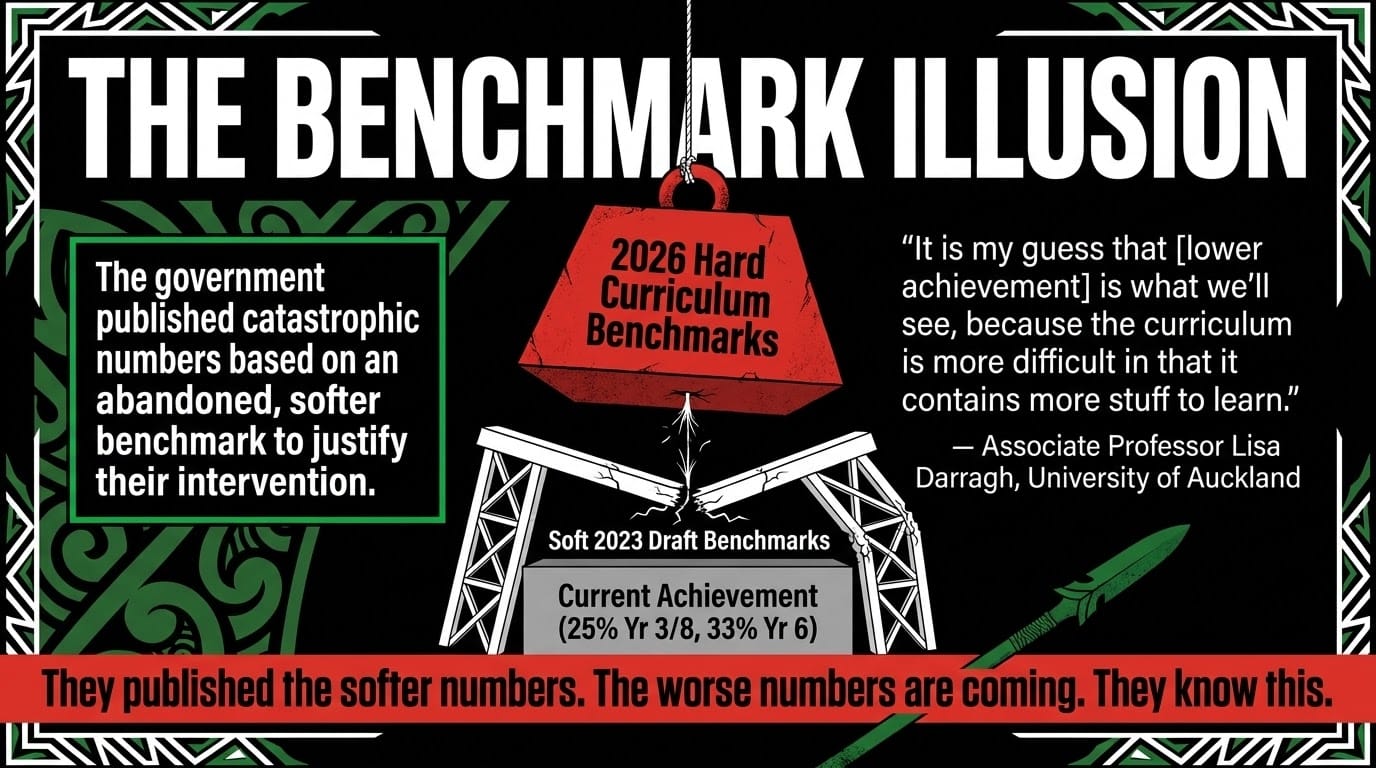
The government's own Curriculum Insights study — commissioned by the Education Ministry, conducted by NZCER and Otago University — found that only one in four Year 3 and Year 8 students, and only one in three Year 6 students, met maths curriculum expectations last year. RNZ, 19 June 2026.
Those numbers are already catastrophic. But here is the fact the government hoped you would not notice: those benchmarks were set against a 2023 draft curriculum — an older, softer version than the one now in classrooms. NZCER researcher Charles Darr confirmed to RNZ his organisation abandoned its plan to update the benchmarks when it learned the curriculum would change again. The real figures — measured against the harder 2026 curriculum — will almost certainly be worse.
University of Auckland's Associate Professor Lisa Darragh:
"It is my guess that is what we'll see, because the curriculum is more difficult in that it contains more stuff to learn, so it would be hard to imagine it any other way."
Massey's Professor Jodie Hunter: "It's probably fair enough to say the results would be poorer, if you put them against the new curriculum." RNZ, 19 June 2026.
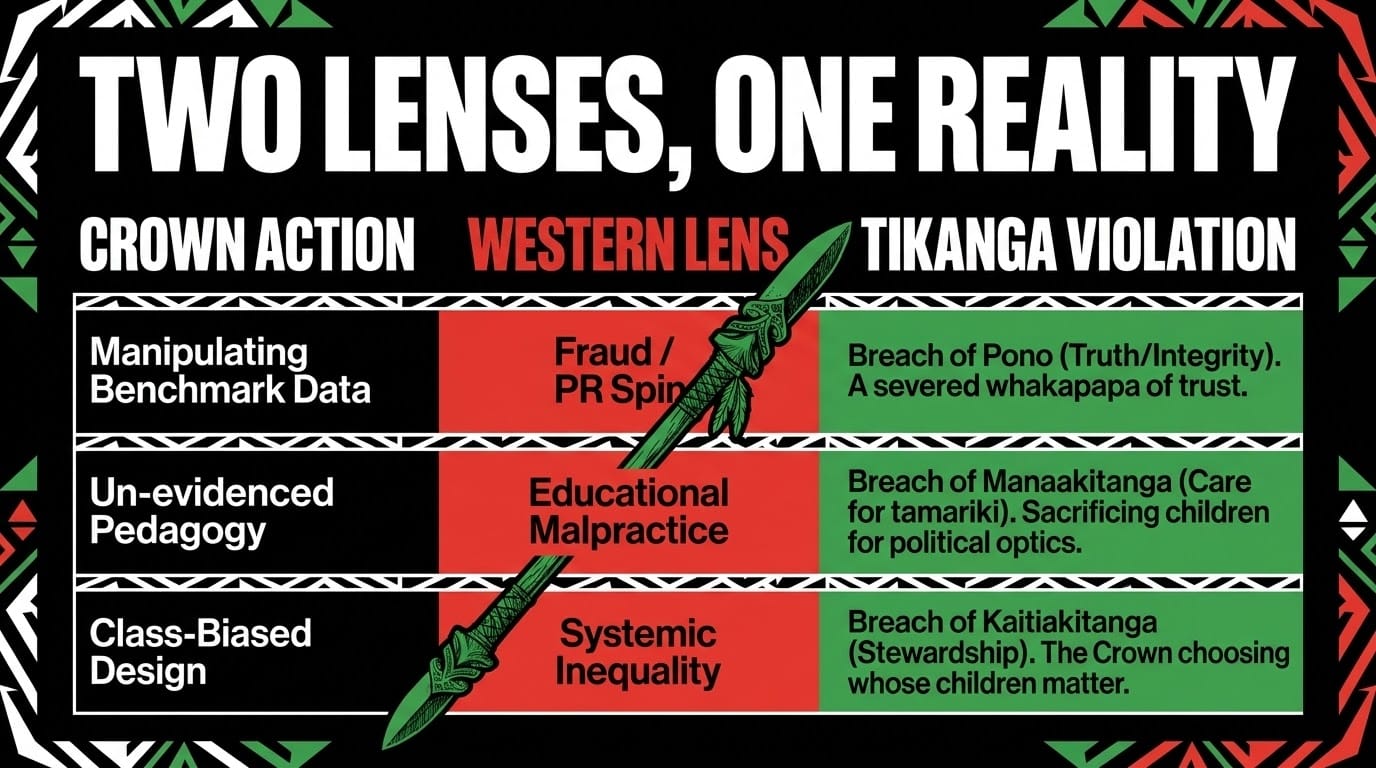
For the Western mind: In any corporation, publishing financial results you know are measured against an obsolete benchmark while the real figures are worse would be called fraud. In Stanford's Education Ministry, it is called a press release.
What tikanga tells us: In te ao Māori, the principle of pono — truthfulness and integrity — is not optional. It is foundational to all whakapapa, all relationship. A leader who publishes numbers they know to be misleading has severed the whakapapa of trust between Crown and community. That severance has consequences that outlast any government term.
The solution: NZCER and Otago University must be commissioned immediately — with full independence and public funding — to set new benchmarks against the 2026 curriculum. The results must be published in full, with methodology transparent, before any further achievement claims are made by this government.
Example Two: Death by PowerPoint — The Pedagogy That Was Never Evidenced
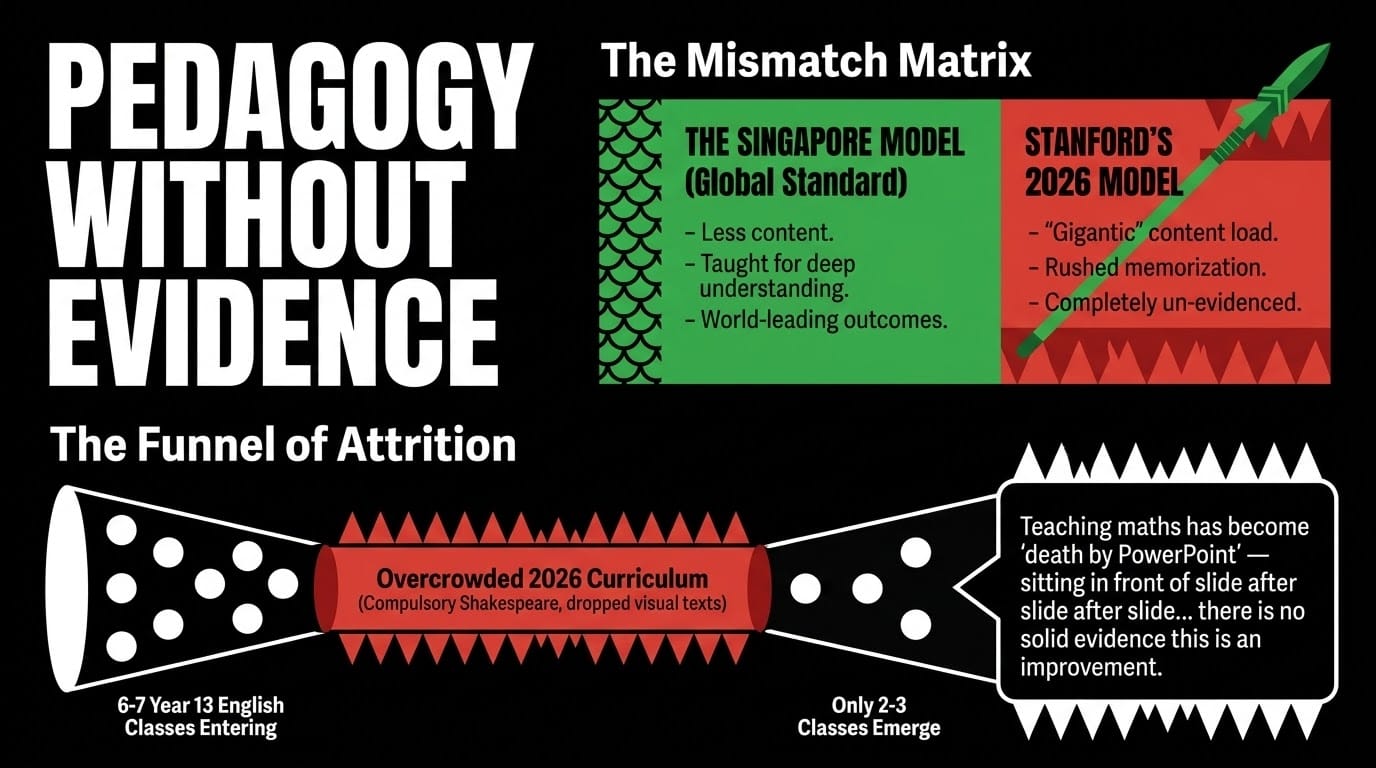
The new curriculum does not just test more. It prescribes a method. And the method, by teacher report, is a regression to a Victorian classroom model that the global education research community abandoned decades ago.
Associate Professor Lisa Darragh told RNZ:
"The phrase that I've been hearing from schools is that teaching maths has become 'death by PowerPoint' — so our children are just sitting in front of slide after slide after slide, as they listen to their teacher lecturing at them, and we know that's not the best way to learn."
There is, she confirmed, "no solid evidence" the government's favoured approach constitutes an improvement. RNZ, 19 June 2026.
Professor Jodie Hunter had already told RNZ the Year 12 maths curriculum is "gigantic" — leaving teachers a binary choice between racing through content for test-passing, or teaching less but with depth. RNZ, 17 June 2026. Hunter also pointed out that this approach runs opposite to Singapore's model — the world benchmark in maths education — where senior students learn less content in more depth. Our government went the opposite direction and called it raising standards.
I wrote about this exact pattern in "Workbooks for Whose Children? Erica Stanford's $131M Colonial Reset" (May 2026). The government spent millions on maths resources
— resources with no solid evidence base, pushed into classrooms on ideology, not research.
For the Western mind: A pharmaceutical company that released a drug with "no solid evidence" of efficacy — while telling the public it would improve health outcomes — would face regulatory action, liability claims, and parliamentary inquiry. Stanford's government released a pedagogical method with no evidence base, into every classroom in the country, and briefed it to the media as a solution.
What tikanga tells us: The principle of manaakitanga — the obligation to uphold the mana of those in your care — requires that those entrusted with tamariki act only on what they know to be good for those children. Teaching a method you cannot evidence is not manaakitanga. It is the sacrifice of children's mana for political optics.
The solution: Immediately commission an independent, evidence-based review of the pedagogical framework accompanying the new curriculum. If the evidence base does not exist, the framework must be suspended until it does. Invest — substantially — in teacher professional development grounded in evidence, not ideology.
Example Three: The Class Divide Baked Into the Design
Pip Tinning, president of the English Teachers Association, delivered the most quietly devastating line in any of these three RNZ reports:
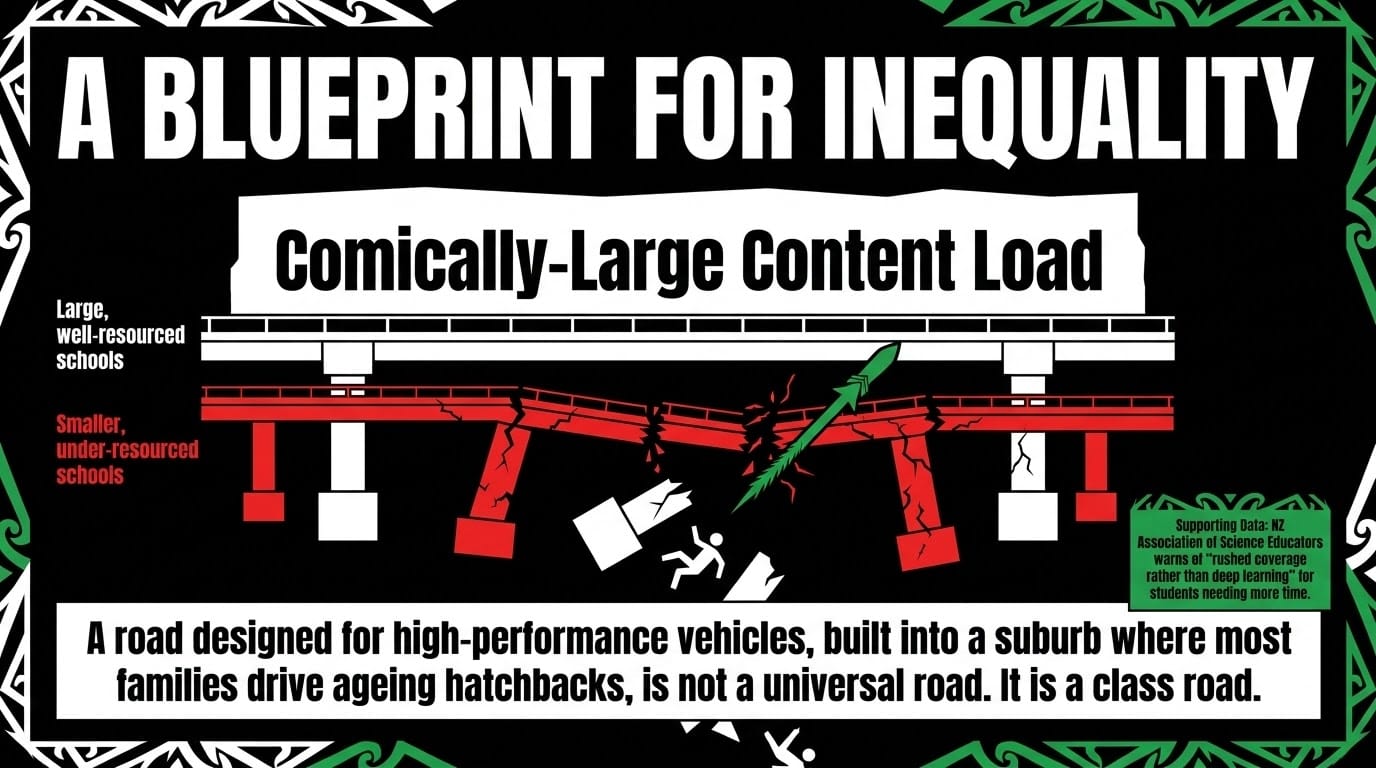
"Teachers at large, well-resourced schools were more positive about the draft than those at smaller schools." RNZ, 17 June 2026.
She also estimated that at her own school, Year 13 English would collapse from six or seven classes to two or three if the draft proceeded. RNZ, 17 June 2026. PPTA vice-president Kieran Gainsford called the Year 11 Science content load "comically-large."
NZ Association of Science Educators president Jay Vijayakumar warned content volume risks
"rushed coverage rather than deep learning, especially for students who need more time to build confidence and understanding."
Those students — the ones who need more time — are disproportionately Māori, Pacific, and from lower-income whānau. That is not an accusation.
It is what the data has shown for decades.
Darragh's warning should be carved into the facade of the Education Ministry building:
"If we're delivering a curriculum that more than 80 percent of our students fail at, how are those students going to feel about the subject of mathematics? Making a curriculum way more difficult does not automatically make our children smarter. It just potentially makes our students feel like failures." RNZ, 19 June 2026.
I have written about this structural pattern repeatedly. In "The Neoliberal and Racist Underpinnings of Charter Schools" (July 2024) and "Privatising Education is Cultural Genocide" (March 2025), I traced how this government consistently designs education policy that advantages the already-advantaged — and then presents the resulting achievement gap as evidence that Māori and Pacific tamariki are the problem, rather than the product of deliberate structural disadvantage.
For the Western mind: A road designed for high-performance vehicles, built into a suburb where most families drive ageing hatchbacks, is not a universal road. It is a class road. This curriculum is a class curriculum — and the children on the wrong side of it are already known.
What tikanga tells us: The principle of kaitiakitanga — guardianship, stewardship — demands that those who hold power over resources and systems act for the collective wellbeing of all, with particular responsibility to the most vulnerable. A curriculum designed, whether consciously or through structural indifference, to advantage the already-resourced and disadvantage the already-marginalised is a breach of kaitiakitanga at the national level. It is the Crown, again, choosing whose children matter.
The solution: A mandatory equity impact assessment — with specific Māori and Pacific outcomes framework, co-designed with iwi and community education experts — must precede any implementation of the new curricula. The question "how will this affect Māori, Pacific, and high-equity students?" raised by Secondary Principals Association president Louise Anaru must be answered in public, with data, before a single new qualification rolls out in 2028.
FIVE VERIFIED REVELATIONS — THE WHAKAPAPA OF THIS BETRAYAL
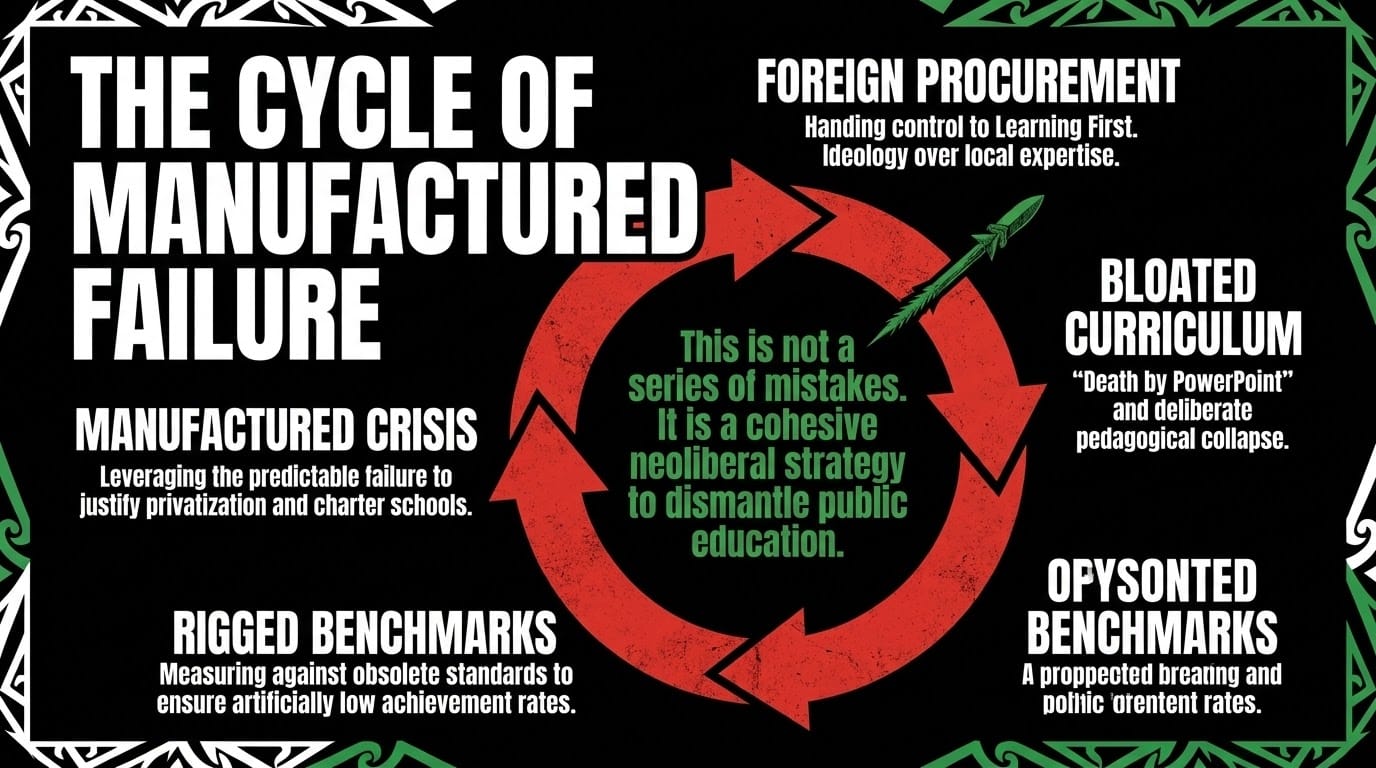
Whānau, the whakapapa of this harm runs deeper than three RNZ articles. Here is what they reveal when read together — and what I have been documenting for months:
Revelation One: The no-tender contract to Learning First bypassed the most qualified New Zealand institution — NZCER — without any demonstrated justification beyond speed and existing relationship. Verified — RNZ, 17 June 2026. As I established in "The Curriculum Coup" (May 2026), this is consistent with a pattern of outsourcing New Zealand's intellectual sovereignty to foreign commercial and ideological networks.
Revelation Two: Stanford's memory failure about socialising with the contractor creates an unanswered conflict-of-interest question that has not been investigated, has not been referred to the Auditor-General, and has generated zero media follow-up beyond the original RNZ report. Verified — RNZ, 17 June 2026. In "The Poison Pen Minister" (April 2026), I documented how Stanford responds to accountability pressure — not with transparency, but with escalation.
Revelation Three: The benchmark deception — publishing maths achievement statistics the government knew were measured against an obsolete standard, while the harder 2026 benchmarks remain unset. Verified — RNZ, 19 June 2026. The government published the softer numbers. The worse numbers are coming. The government knows this.
Revelation Four: The well-resourced school design bias built into the secondary curricula — confirmed by teacher associations across English, maths, and science — structurally advantages already-advantaged students and will manifest as widened achievement gaps along existing lines of race and class. Verified — RNZ, 17 June 2026. As I documented in "Stanford's Colonial Classroom" (March 2026), 34 education organisations issued a joint condemnation of this exact trajectory.
Revelation Five: The Treaty of Waitangi vacuum — Secondary Principals Association president Louise Anaru publicly asked how the new curricula would embed the Treaty and affect Māori and Pacific students. Verified — RNZ, 17 June 2026. The government has not answered that question in any of these reports. In "Stanford's Treaty Betrayal", I documented how Stanford's coalition bent the knee to Treaty denialists, bulldozed Māori consultation, and delivered a curriculum that cuts Te Reo and sidelines mātauranga Māori. The silence in response to Anaru's question is not an oversight. It is a statement.
THE HARM, QUANTIFIED
These are not opinions. These are numbers. Every number is a whānau.
| What the data shows | Source |
|---|---|
| Only 25% of Year 3 and Year 8 met maths expectations last year | Curriculum Insights study — RNZ, 19 June 2026 |
| Only 33% of Year 6 students met expectations | Same source |
| Those benchmarks were set against the softer 2023 draft, not the current curriculum | Verified — RNZ, 19 June 2026 |
| Two leading academics predict real achievement will be lower under 2026 benchmarks | Hunter & Darragh — RNZ, 19 June 2026 |
| Year 13 English projected to drop from 6–7 classes to 2–3 at one school alone | RNZ, 17 June 2026 |
| Year 12 maths curriculum described as "gigantic" — out of step with world-leader Singapore | Hunter — RNZ, 17 June 2026 |
| No solid evidence exists for the government's favoured teaching approach | Darragh — RNZ, 19 June 2026 |
| New qualification to replace NCEA rolling out from 2028 on this curriculum base | RNZ, 17 June 2026 |
The downstream harm is not speculative. A tamaiti who fails maths at Year 11 under a curriculum designed to produce failure does not just fail a test. They close a door. Multiple doors. Engineering. Medicine. Data science. Architecture. The doors that, for generations, the structural racism of this country has made hardest for Māori and Pacific rangatahi to open — those are the doors this curriculum, as currently designed, will close in greater numbers.
And Erica Stanford will stand at the next press conference and tell you it is about raising achievement.
WHAT RANGATIRATANGA DEMANDS — THREE ACTIONS, NO SOFTENING
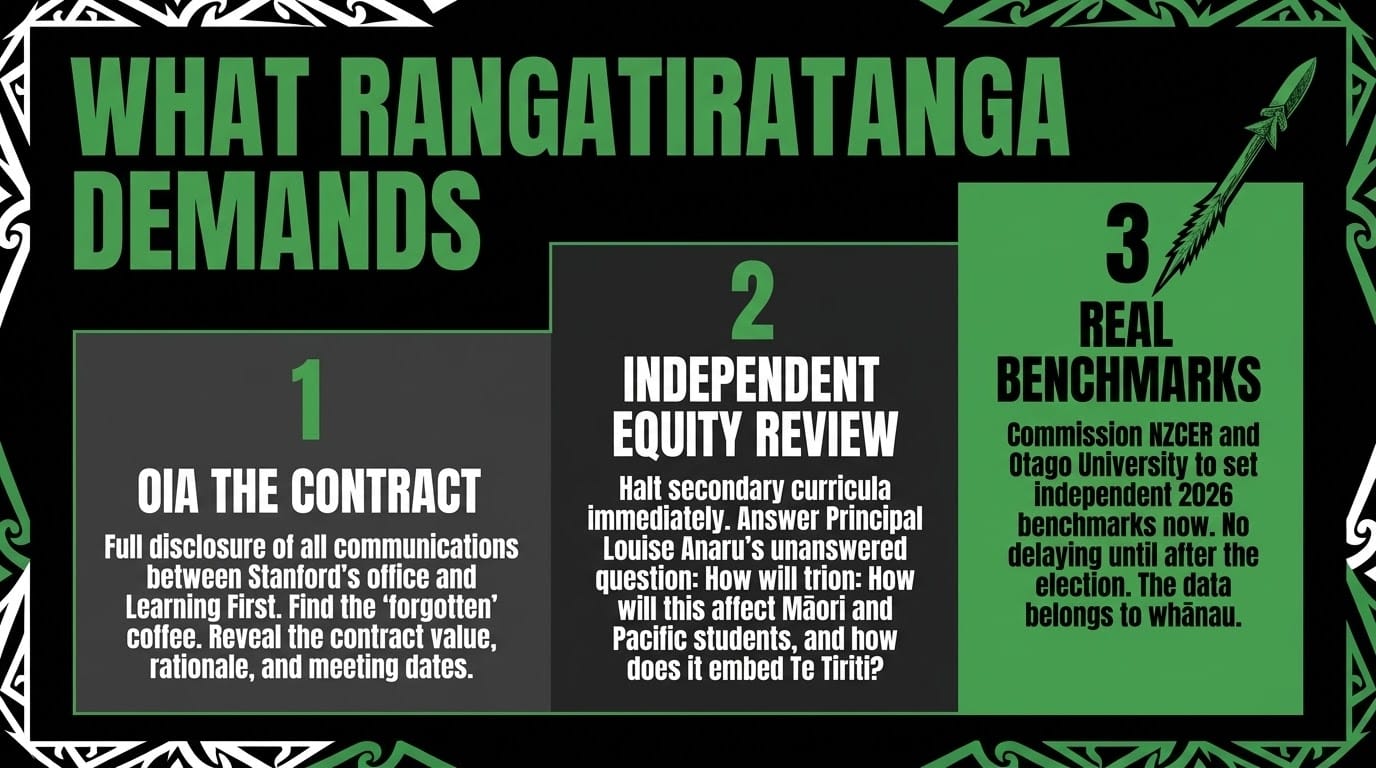
This government has no mandate from our tamariki. Every action I call for below is grounded in the evidence above.
Action One: OIA the Learning First contract in full. Every communication between Stanford's office, the Education Ministry, and Learning First leadership — before, during, and after the contract was awarded — must be published. The contract value. The procurement rationale. The dates of every meeting. If Stanford cannot remember the coffee, the documents will remember it for her. If you are a journalist, researcher, or advocate reading this: the OIA request writes itself.
Action Two: Halt the secondary curricula pending independent equity review. The question Louise Anaru asked — "How will the new curricula affect Māori, Pacific, and high-equity students, and how will they embed the Treaty of Waitangi?" — must be answered in public, with data, before implementation begins. A mandatory equity impact assessment, co-designed with iwi and community education experts, is not optional under Te Tiriti. It is required.
Action Three: Publish real achievement data against real benchmarks. Commission NZCER and Otago University — with full independence, full funding, and full transparency — to set new benchmarks against the 2026 curriculum now. Publish the methodology. Do not allow this government to manage the political optics of worsening outcomes by delaying the benchmark update until after the next election. The data belongs to whānau, not to ministers.
THE MORAL CLARITY
Ko te mātauranga, ko te ara ki te rangi. Education is the pathway to the sky.
This government has taken that pathway and handed the design of it — without tender, without transparency, without tikanga — to a commercial firm from across the Tasman, through a process so compromised that the Minister cannot account for her own social calendar.
The product they have delivered will, by the assessment of the country's leading education researchers, manufacture failure at industrial scale.
The children who will carry the weight of that failure disproportionately are already known to us. They are our tamariki. They are our mokopuna.
The lie that ties this all together — the lie I named in "The Curriculum Coup" — is the word achievement.
Stanford uses it as a shield. Behind it: the dismantling of mātauranga Māori, the erasure of Treaty obligations, the outsourcing of our children's intellectual formation to foreign commercial interests, and the construction of a class curriculum that will widen every gap this government has already spent three years deliberately deepening.
That is not achievement. That is the opposite of achievement. That is colonial administration with a PowerPoint.
The taiaha does not lie. And neither do I.
Nō reira, kia tūpato, kia kaha, whānau. Ko tātou tēnei.
— Ivor Jones, The Māori Green Lantern
RELATED ESSAYS — THE MĀORI GREEN LANTERN
This essay is part of a sustained body of work on Stanford's education agenda and the neoliberal-colonial project in Aotearoa's classrooms:
- "The Curriculum Coup: Stanford's Three-Act Colonial Performance" — May 2026 — The Atlas Network-funded, Florida-trained recolonisation programme wearing the costume of achievement
- "Stanford's Colonial Classroom: How the Luxon Government is Dismantling Māori Education" — March 2026 — 34 education organisations walk out. Stanford presses on
- "Workbooks for Whose Children? Erica Stanford's $131M Colonial Reset" — May 2026 — $131 million. No evidence base. Ideologically driven
- "The Poison Pen Minister" — April 2026 — How Stanford weaponised the state against her critics
- "Stanford's Treaty Betrayal" — The curriculum that cuts Te Reo, sidelines mātauranga Māori, and bows to Treaty denialists
- "Privatising Education is Cultural Genocide" — March 2025 — How this government weaponises policy to erase Māori futures
KOHA — SUPPORT THIS MAHI
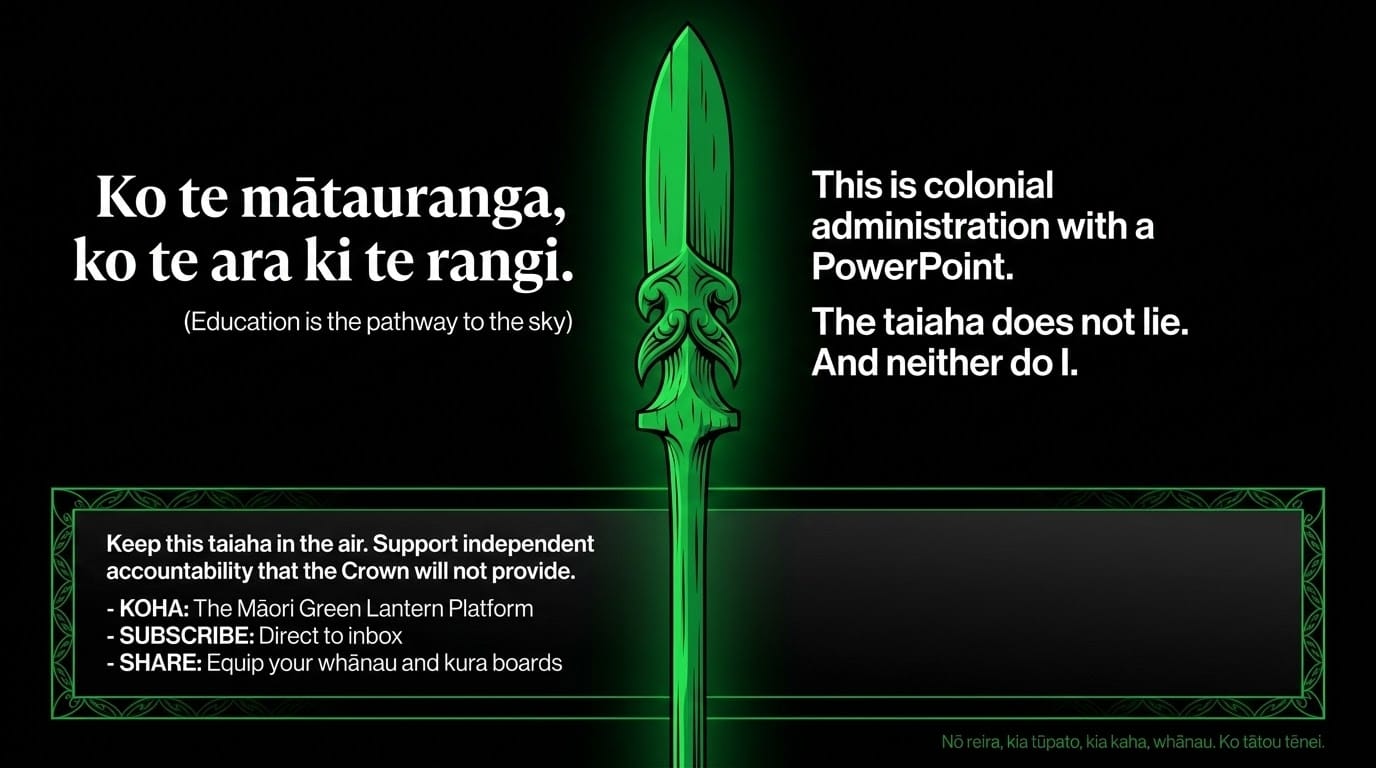
Every koha to The Māori Green Lantern is a direct signal: whānau are ready to support the accountability that the Crown and corporate structures will not provide.
It signals that rangatiratanga includes the power to support our own truth-tellers — especially when those truth-tellers are naming the no-tender contracts, the convenient memory failures, and the curricula designed to make our tamariki feel like failures.
This essay exists because of the people who keep it alive. If this work gave you language to push back at your school BOT meeting, your kura, your community hui — if it named something you already knew in your bones but could not yet prove — then this koha is yours to give.
If you are unable to koha, no worries at all. Subscribe, follow, kōrero, and share with your whānau and friends. That is koha in itself. Every share keeps this taiaha in the air.
Four pathways to support this mahi:
💚 Koha (voluntary contribution): Support The Māori Green Lantern — Koha Platform
📩 Subscribe — receive essays directly: Subscribe to The Māori Green Lantern
🏦 Direct bank transfer: HTDM — 03-1546-0415173-000
📘 Facebook: Follow & Subscribe on Facebook
Kia kaha, whānau. Stay vigilant. Stay connected.

Disclaimer: This essay is published in the public interest under the principles established in Lange v Atkinson