"NATIONAL'S KIWISAVER CON IS WAGE THEFT WITH A GLOSSY BROCHURE — AND SIMEON BROWN JUST TORCHED THE HOUSE ON THE WAY OUT" - 21 June 2026
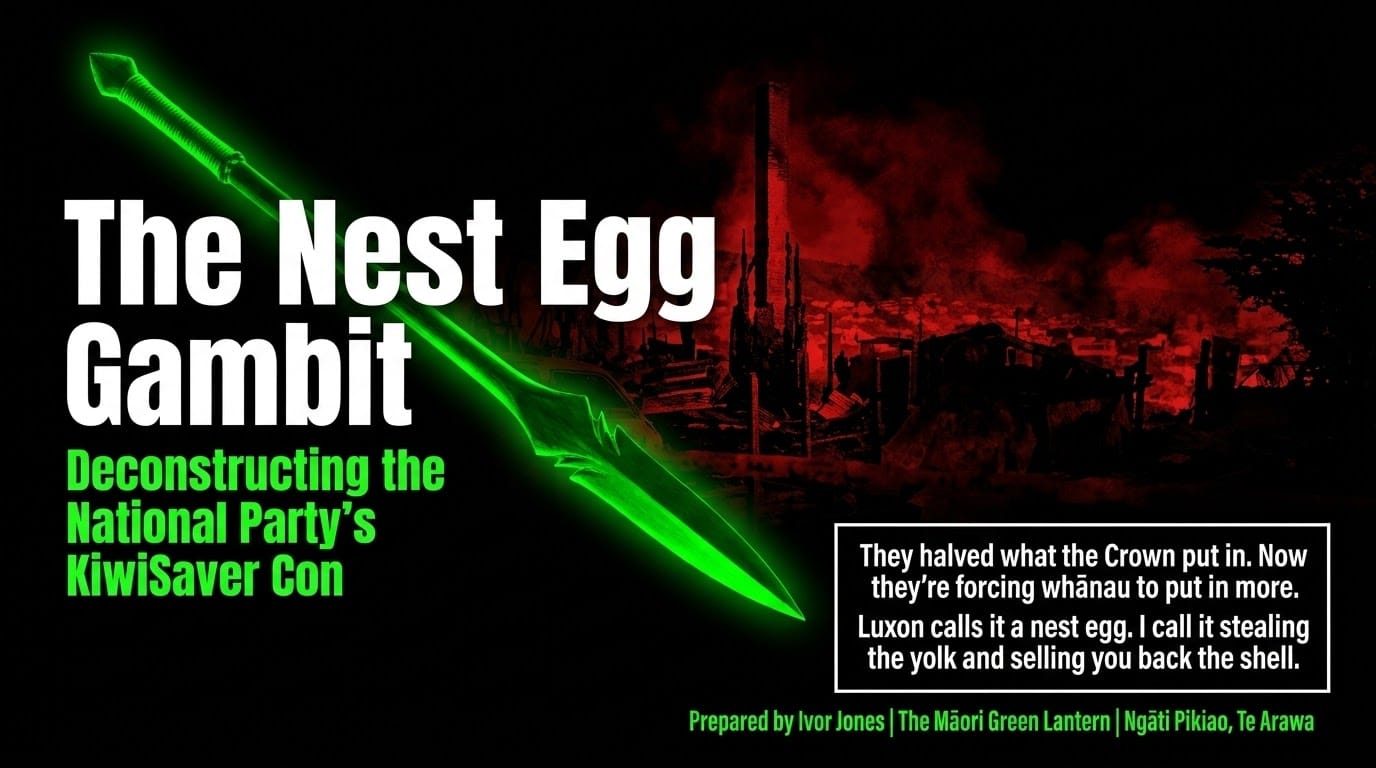
They halved what the Crown put in. Now they're forcing whānau to put in more. Luxon calls it a "nest egg." I call it stealing the yolk and selling you back the shell — while Simeon Brown stands at the door throwing the neighbours' keys in the gutter.

Ko Ivor Jones tēnei. Ko Te Arawa, ko Ngāti Pikiao ōku iwi. Ko The Māori Green Lantern tōku ingoa.
A Burning Wharenui and a Man Selling Buckets
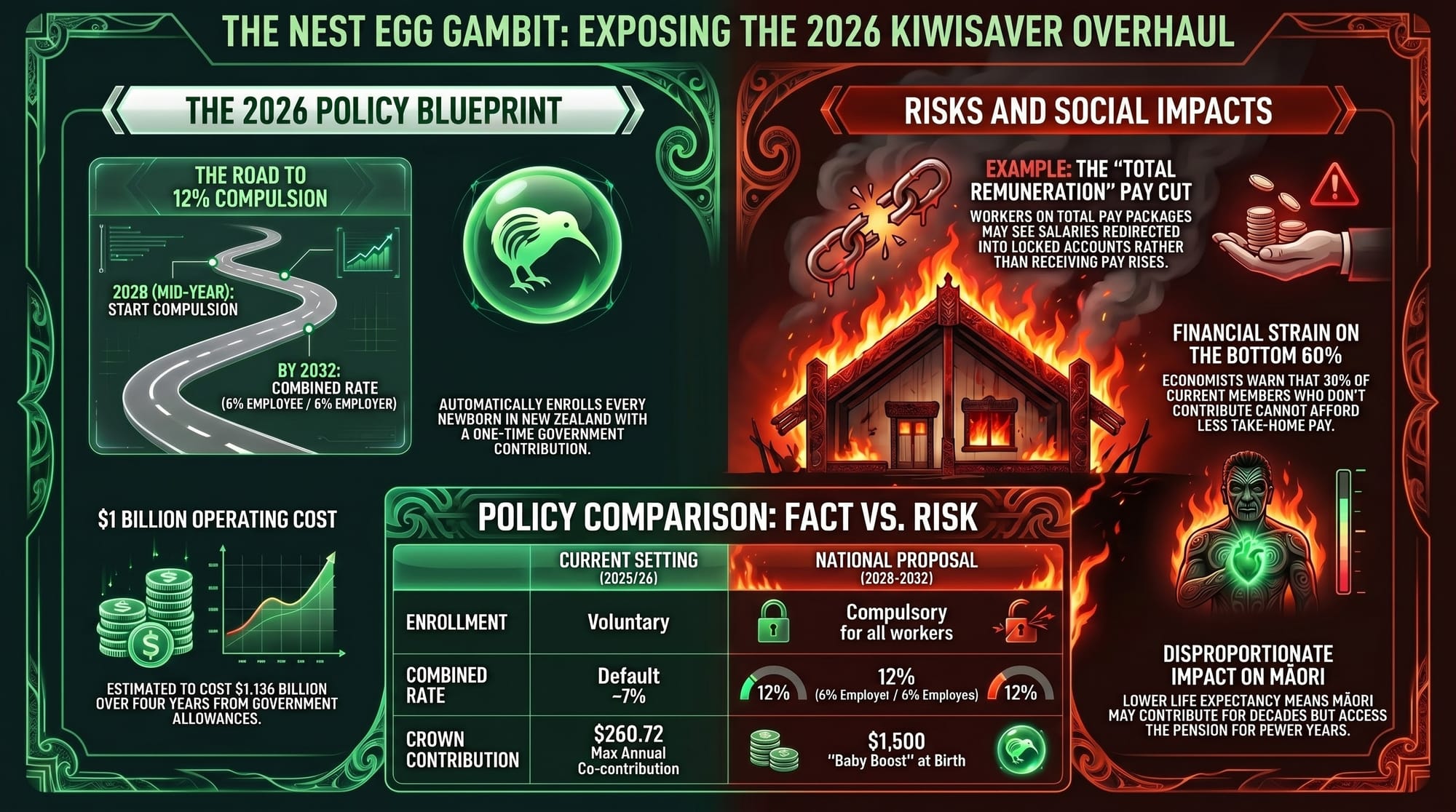
Picture a wharenui. It is on fire. The fire started because the landlord — a silver-haired CEO type who wears a suit to every tangihanga — cut the fire service budget, fired the caretaker, outsourced the sprinkler system to a mate from his Rotary Club, and told the whānau inside that "fiscal discipline" meant they would have to manage the embers themselves.
 RNZ | Te Reo Irirangi o Aotearoa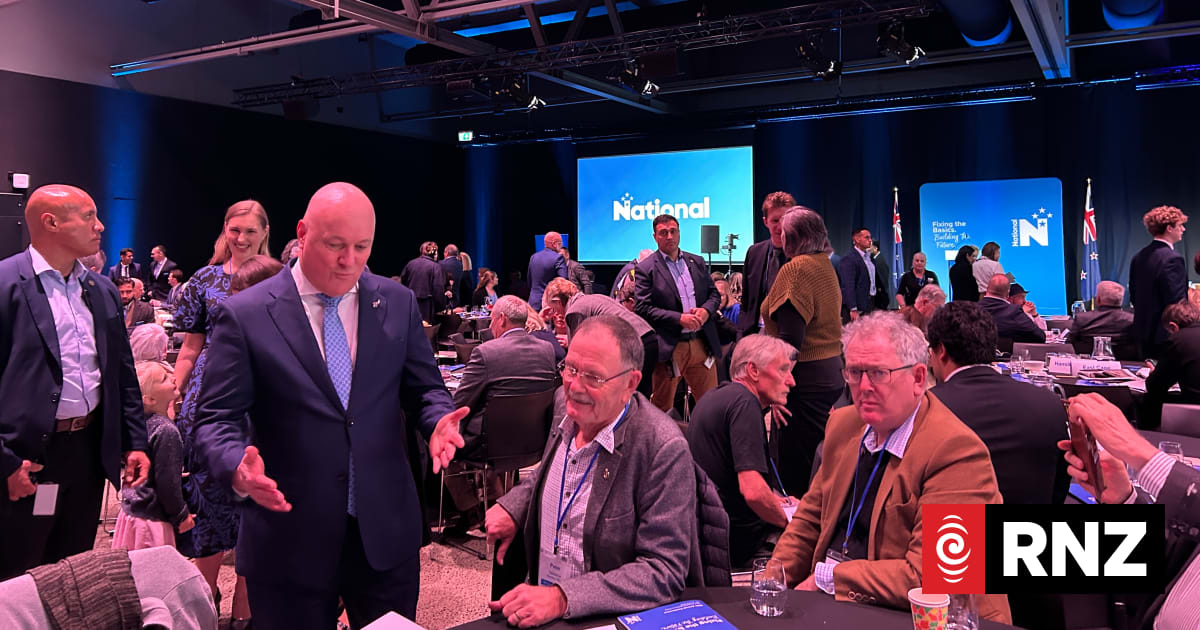
Now, standing at the entrance to the burning wharenui, that same man
— Christopher Luxon
— is holding a tin and a glossy pamphlet.
 RNZ | Te Reo Irirangi o Aotearoa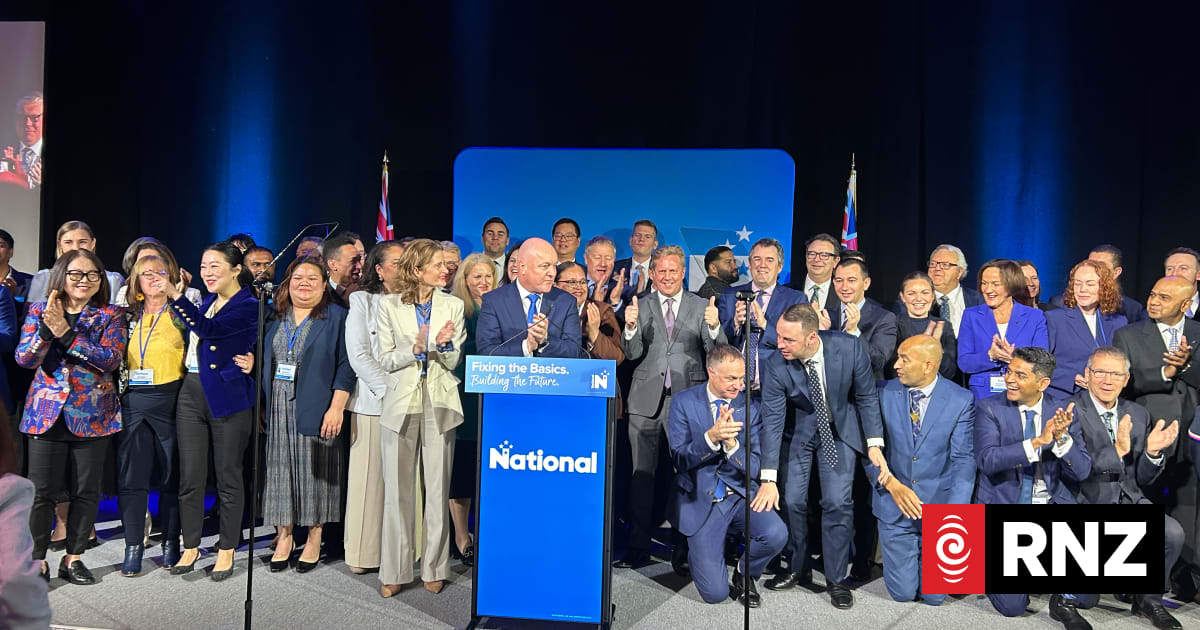
He smiles the smile of a man who has never had to choose between the power bill and the groceries.
"Save," he says. "Six percent from you. Six percent from your employer. Every pay cycle. From 2028. By 2032 you'll be at twelve percent combined. We call it a nest egg."
He does not mention that six months ago, his government
halved the amount it was contributing to that same nest egg.
He does not mention that the nest egg belongs to a system designed for someone else's retirement
— for people who own the land, not people whose land was confiscated to build it on.
 RNZ | Te Reo Irirangi o Aotearoa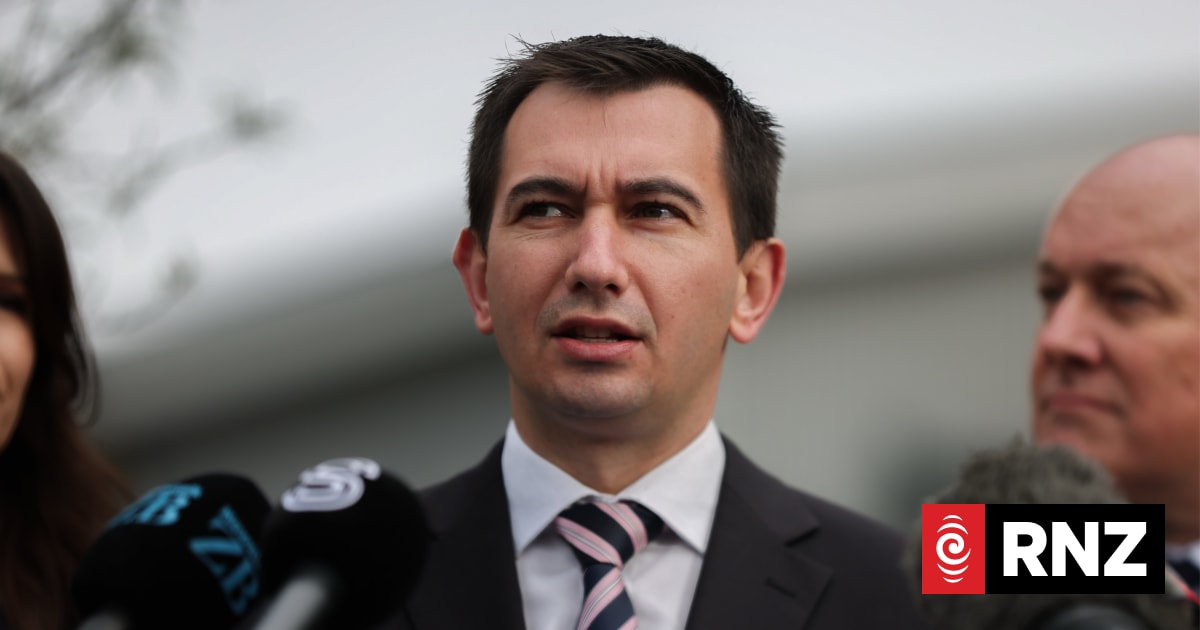
And behind him, Simeon Brown is giving a speech to 500 faithful in a conference hall in Lower Hutt, telling them not to vote for the people also standing at the burning entrance
— because that would "dilute the brand."
This is what I am here to tell you: the brand is already ash.
🎙️ The Deep Dive Podcast
Listen to a lively conversation between two hosts unpacking and connecting all the sources behind this essay — the KiwiSaver compulsion announcement, Simeon Brown's coalition tantrum, the affordability crisis, and what it all means for whānau. I apologise in advance for the AI's very rough pronunciation of te reo Māori — please don't shoot me. 😊 The kaupapa matters more than the accent.
🎬 YouTube Short
Like video? Here is a short video supporting this essay. And yes — same apology for the AI pronunciation of te reo. Don't shoot the messenger. The taiaha is pointed at the right people. 😊
The Indictment: What This Government Has Actually Done
Let me be precise, because the taiaha requires precision before it requires force.
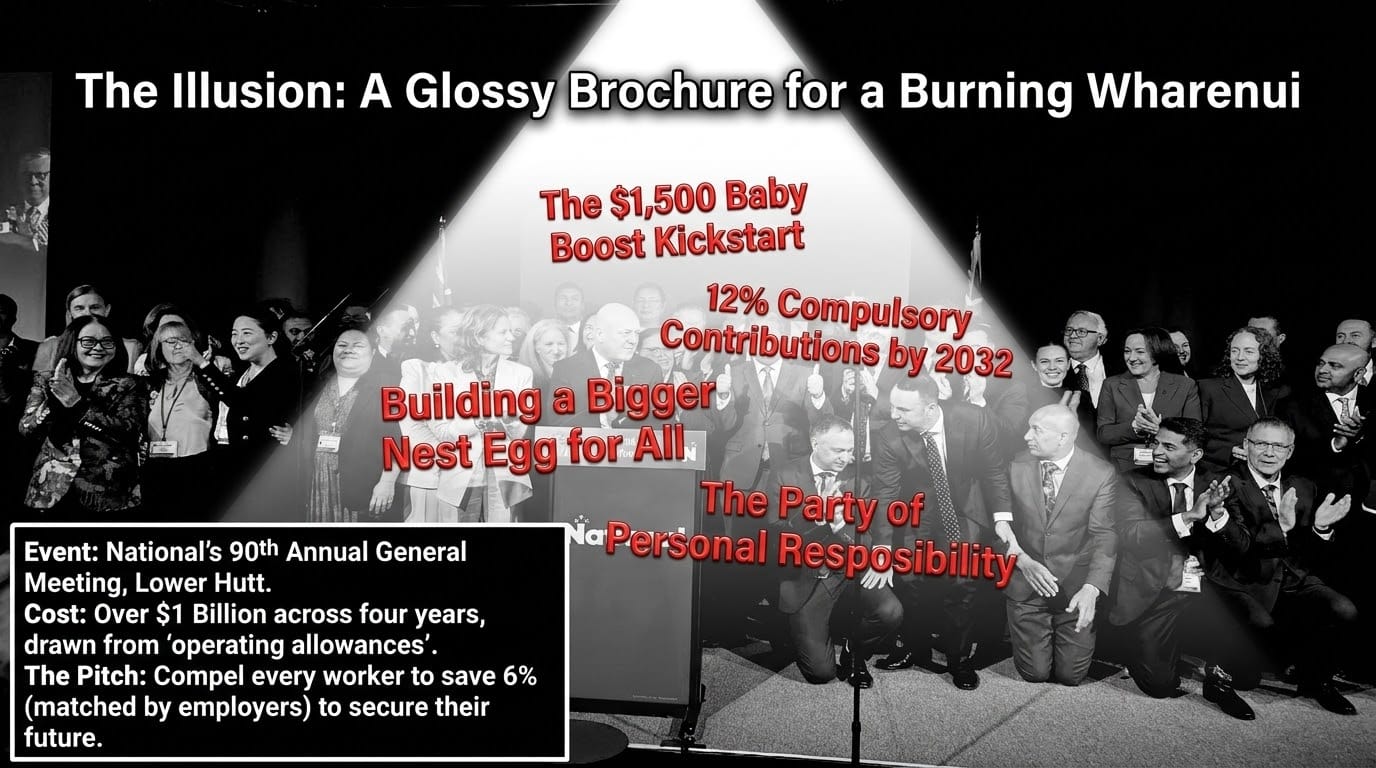
This is the same government that in Budget 2025 cut the KiwiSaver government co-contribution from 50 cents per dollar to 25 cents per dollar — halving the state contribution to low-income savers and reducing the maximum annual Crown contribution to $260.72.
That is the Crown's commitment to the retirement security of a solo mum in Flaxmere or a kaumātua in Ōpōtiki: two hundred and sixty dollars and seventy-two cents per year.
The CEO class gets tax structures. Whānau get a loyalty card with a broken stamp.
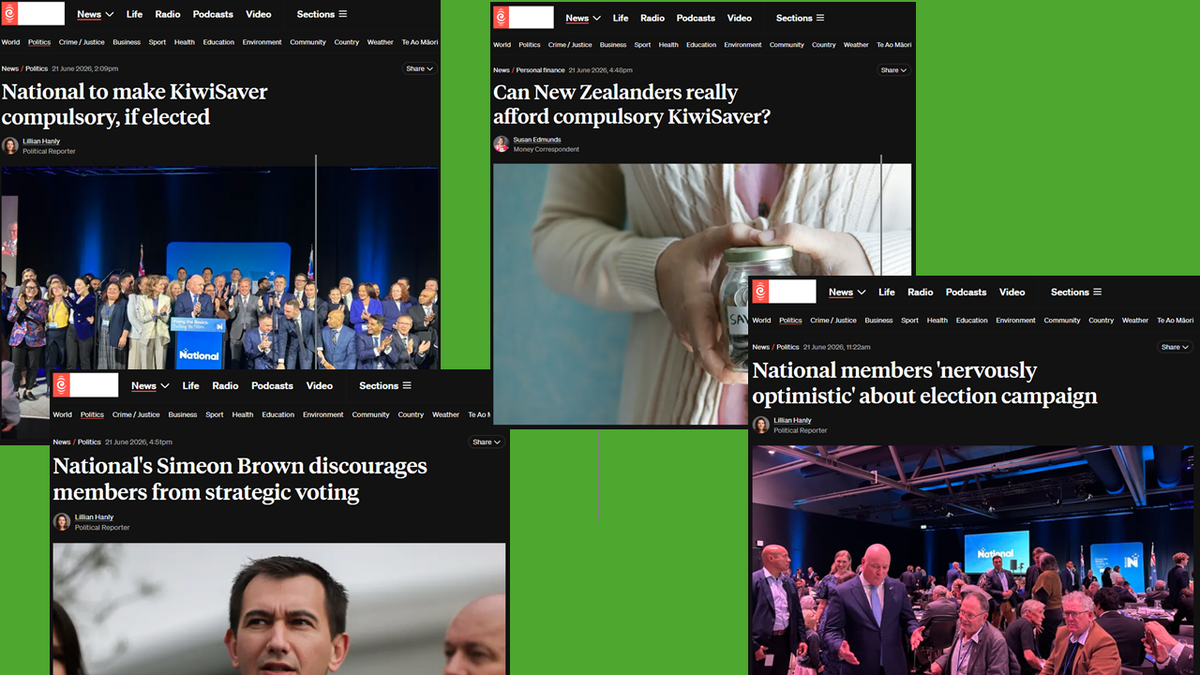
And now, six months after that cut, National announced at its 90th AGM in Lower Hutt on 21 June 2026 that it will make KiwiSaver compulsory for all workers — requiring a combined 12 percent contribution by 2032, a $1,500 Baby Boost kickstart, and automatic enrolment from birth — at a total cost of over one billion dollars over four years. Drawn from "operating allowances." The same allowances that somehow never stretch far enough to restore Māori health funding or rebuild the social infrastructure this coalition demolished.
The pattern is not accidental. The pattern is the policy.
A Party Stuck at 30 Percent and Bleeding Credibility
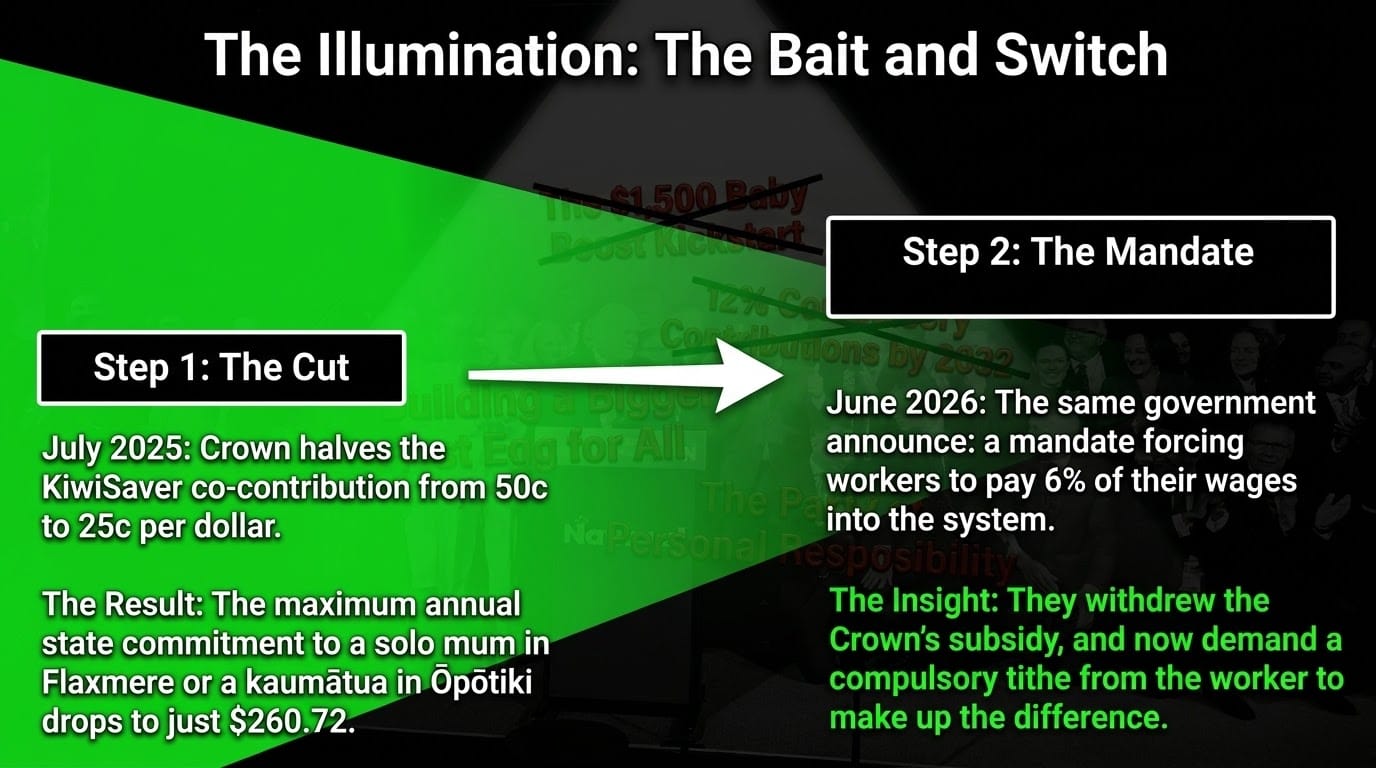
National's 90th Annual General Meeting took place in Lower Hutt, Wellington on 20–21 June 2026, with 500 members, MPs, and staff gathered to prepare for the November election. The mood, as reported by RNZ's Lillian Hanly, was described as "nervously optimistic".
National's own pollster David Farrar, owner of the Curia polling firm, told RNZ he was "nervously optimistic" about the election, and openly said 35 percent of the party vote would be "not too bad a result." This is a spectacular downgrade from the aspirational 45 percent goal the party set at the 2023 AGM — a goal it ultimately failed, landing at just 38 percent.
Labour is now ahead on cost of living — the defining kitchen table issue of the 2026 election — according to the latest Ipsos Issues Monitor survey. The conference was, in blunt terms, a damage-containment operation dressed as a rally.
Critically, National announced in May 2026 that it would target Māori electorates including Tāmaki Makaurau and Te Tai Hauāuru — seats the party had not seriously contested since 2002. Yet the conference booklet itself showed empty candidate slots for both those Māori electorates. They announce Māori engagement the way they announce everything: with a press release, a smile, and no follow-through.
Simeon Brown's Coalition Tantrum: A Campaign Chair in Freefall
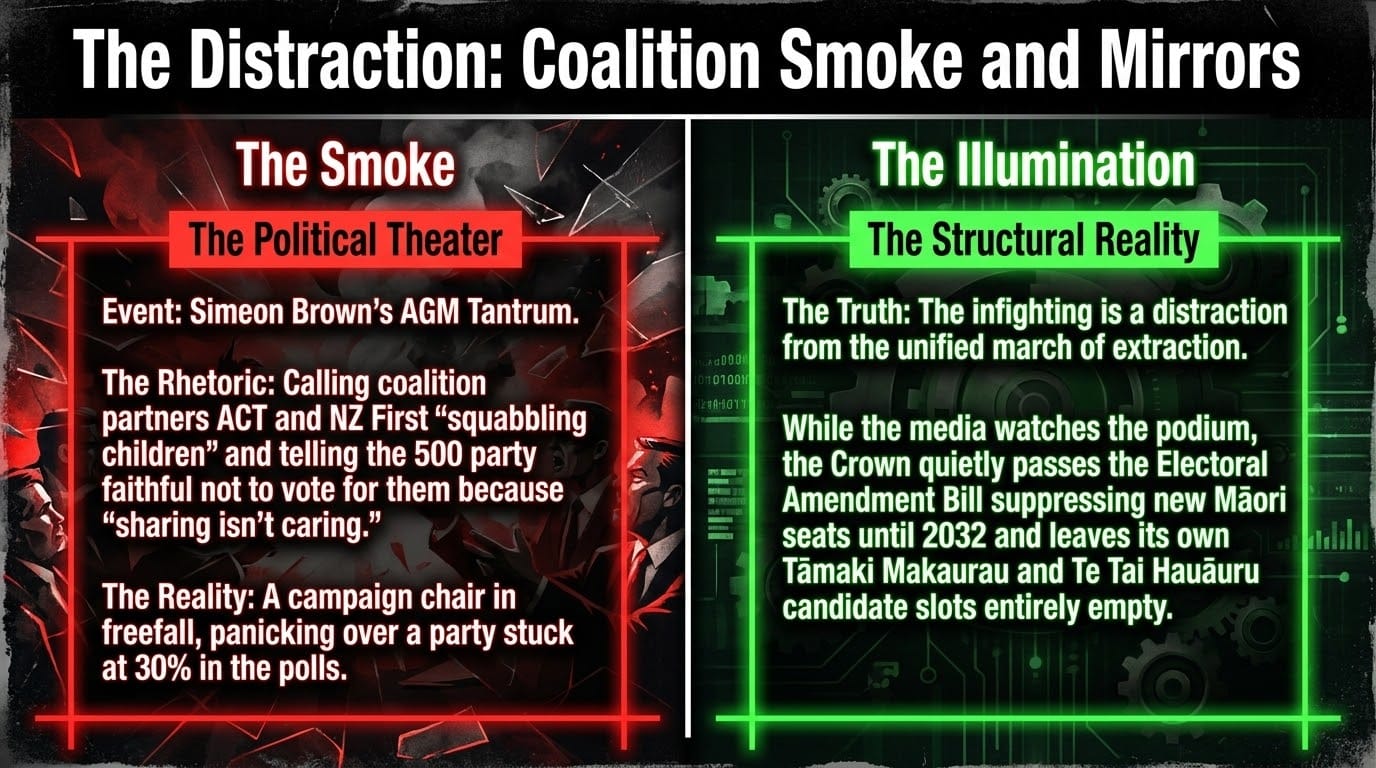
While Luxon announced the KiwiSaver compulsion policy on Sunday afternoon, his campaign chair was doing something remarkable on the same stage in the same building: publicly telling National's own coalition partners to go to hell.
In a speech to the party membership, Simeon Brown called ACT and New Zealand First "children" to National's "parents," described the minor parties as "a distraction," and told members directly: "Don't vote ACT or New Zealand First, thinking it helps National. It doesn't."
His exact formulation: "Sharing isn't caring, sharing is diluting your voice, your values, and your policies."
Let me translate this from the management-speak.
A campaign chair — the person responsible for building the electoral coalition that keeps his party in government — publicly told voters not to support the parties his government cannot survive without. In the middle of an election campaign. At a conference covered by every major media outlet in the country.
Winston Peters responded with the surgical precision of a man who has been doing this since before Brown was in primary school:
"National doesn't need to worry about NZ First. National needs to worry about National."
He listed the policies where National had voted with Labour — the Indian Free Trade Agreement, the social media ban, the gene technology bill — and said:
"There's not much difference between Pepsi and Coke."
ACT's David Seymour called for collaboration, not squabbling, saying he was "surprised" by Brown's comments.
Labour's Chris Hipkins described "a coalition of chaos that has spent three years squabbling."
He is being kind.
The logical fallacy Brown committed is called the false hierarchy fallacy: the assumption that the senior coalition partner has earned a natural authority that minor parties merely dilute.
This is the same logic that says Māori partnership under Te Tiriti is a distraction from good governance. It is the logic of the dominant culture dressing its domination as common sense.
The Policy Autopsy: Three Verified Revelations
Revelation 1: The Government Already Gutted the Scheme It Now Claims to Champion
Labour's Chris Hipkins identified this precisely: "Every time they've touched KiwiSaver, they've cut another part of it. The most recent cuts they made to KiwiSaver were only a year ago. Now they're trying to portray themselves as champions of KiwiSaver."
The receipts are clear. From 1 July 2025, the government co-contribution was halved from 50 cents per dollar to 25 cents per dollar, reducing the maximum annual Crown contribution to $260.72. From 1 April 2026, the minimum default contribution rate increased from 3% to 3.5% — meaning workers are already contributing more while the government contributes less. National now proposes to mandate contributions rising to 6% each (employee and employer) by 2032 on top of a halved Crown contribution. They withdrew the subsidy and now demand the tithe. (Confidence: Verified)
Revelation 2: The Hardship Exemption Is Administrative Theatre
Luxon said workers would be able to stop contributing if they met the criteria for a financial hardship withdrawal. Rupert Carlyon, founder of Koura Wealth, told RNZ plainly: "Administratively, that's too hard. That's going to be a nightmare if they're expecting providers and supervisors to do that."
The hardship withdrawal standard was designed for genuine crisis situations — not as a routine opt-out mechanism for workers whose incomes are simply too low to absorb a 12% combined contribution on top of a cost of living crisis this government has failed to address. Offering hardship exemptions as the safety valve for a compulsion policy is like building a bridge with no guardrails and pointing to the hospital in the valley below as evidence you care about safety. (Confidence: Verified)
Revelation 3: The Compulsion Mechanism Is a Retirement Age Trojan Horse
Luxon confirmed at the AGM that National has a "longstanding position about gradually lifting retirement ages" — while claiming this is "separate" from the KiwiSaver announcement. Rupert Carlyon of Koura Wealth named what the entire KiwiSaver industry is thinking: "Is this actually the first stage of means-testing? We all know that's the answer."
The sequence is clean and visible to anyone who follows the money: mandate private savings → build individual balances → use those balances as political cover to raise the retirement age → reduce Crown superannuation liability → transfer intergenerational risk from the state to the individual worker. This is privatisation of retirement security conducted in increment, announced as generosity. It is the oldest neoliberal trick in the book. (Confidence: Verified on policy facts; Corroborated on structural intent)
The Affordability Trap: Who Gets Hurt
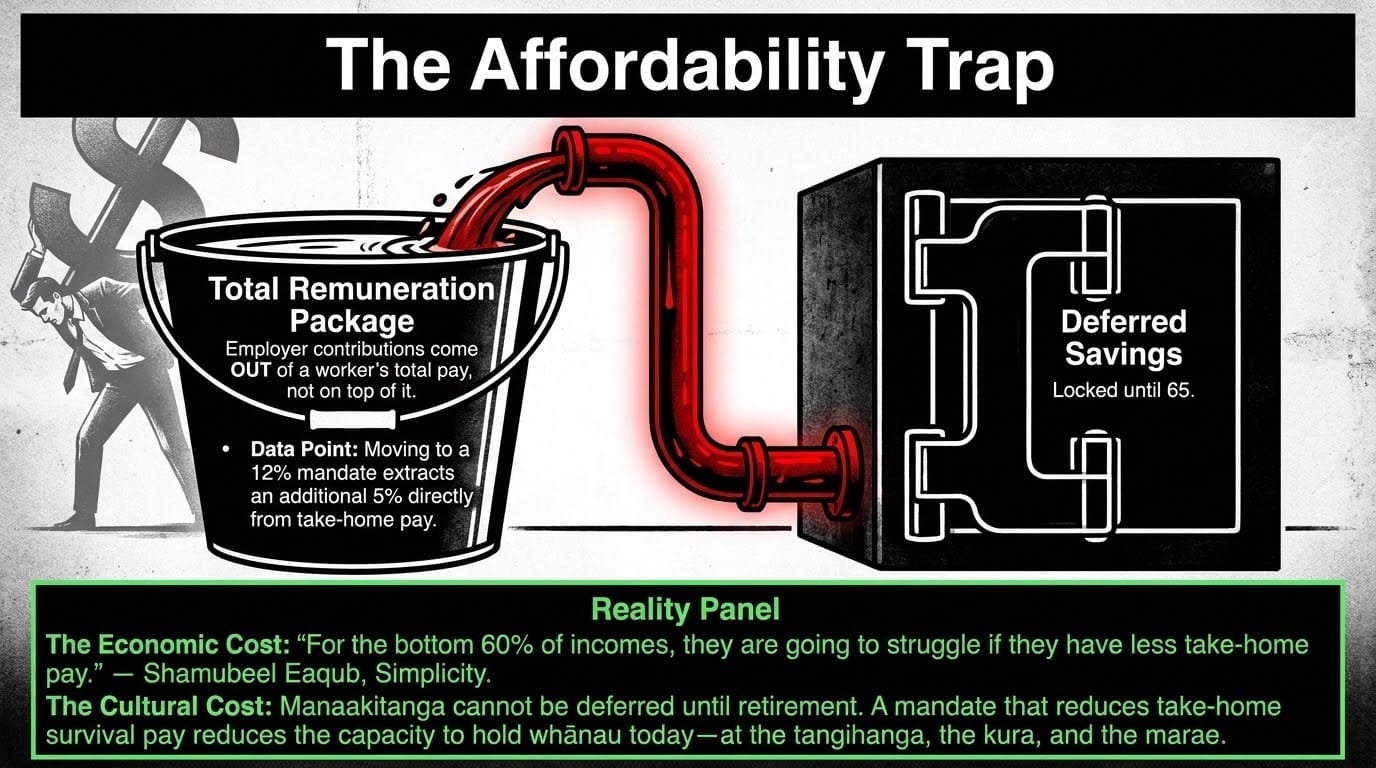
Simplicity chief economist Shamubeel Eaqub told RNZ: "For the bottom 60 percent of incomes, they are going to struggle if they have less take-home pay."
Of the nearly 3.5 million KiwiSaver members currently enrolled, 30 percent are not contributing. These are not lazy people. They are low-income workers, self-employed people with unstable incomes, people servicing high-interest debt, people choosing between contributions and food. Eaqub's own Simplicity research showed support for compulsory employer contributions — but not simultaneous employee compulsion: "My idea always was to make the employer contributions compulsory and the employee contribution voluntary. If you unlink those two things immediately this impact on people's incomes, on take-home pay, disappears."
National adopted the model that protects employers and burdens workers.
Dean Anderson, founder of Kernel, was direct: "If you're on a low income, dollars in hand matters most. Especially if they have any high interest personal debt. Losing 10–12 percent KiwiSaver is a nice-to-have, but not practical."
Matt Macpherson, general manager of funds at Sharesies, warned that the pace of proposed change "could cause a middle-aged New Zealander to have less spending capacity before retirement and put them at a financial disadvantage."
| Cohort | Specific Impact | Mechanism | Confidence |
|---|---|---|---|
| Bottom 60% of earners | Reduced take-home pay | Wage compression; no real opt-out | Verified |
| 30% non-contributing members of 3.5m | Forced enrolment without income support | No benefit if income too low to contribute | Verified |
| Māori workers (lower lifetime income) | Disproportionate take-home pay reduction | Structural income and savings gap | Corroborated |
| Parents on parental leave | Partial relief — government contribution extended | Partially positive; late and inadequate | Verified |
| Workers over 65 | Compulsory employer contributions | Partially beneficial; signals retirement age push | Verified |
| Coalition government stability | Fractured by Brown's public attack on ACT and NZ First | Undermines MMP governing relationships pre-campaign | Verified |
The Māori Dimensions: Five Verified Hidden Connections
Connection 1 — Empty Māori Seat Candidacies. The conference booklet confirmed empty candidate slots for Te Tai Hauāuru and Tāmaki Makaurau. National announced in May 2026 that it would contest those Māori electorates — then failed to populate its own ticket. (Confidence: Verified)
Connection 2 — KiwiSaver Compulsion Hits Māori Hardest. The government's own Whānau and Low-Income Household Savings Report documents that Māori have lower savings rates and lower homeownership rates than the general population. Eaqub's confirmation that the bottom 60 percent of incomes will "struggle" applies disproportionately to Māori workers. (Confidence: Corroborated)
Connection 3 — The Government Already Cut What It Now Demands More Of. From 1 July 2025, the KiwiSaver government co-contribution was halved from 50 cents per dollar to 25 cents per dollar. National mandates more worker contributions while withdrawing the Crown's share. For low-income whānau, this is net loss dressed as progress. (Confidence: Verified)
Connection 4 — Retirement Age Signal Embedded in Compulsion Policy. Luxon confirmed National's "longstanding position about gradually lifting retirement ages" at the same announcement. Māori men have a life expectancy approximately 7 years below that of non-Māori men — meaning any upward shift in the retirement age reduces the window during which Māori can access NZ Super they have been compelled to help fund. (Confidence: Corroborated — life expectancy gap well-documented across Stats NZ datasets)
Connection 5 — Electoral Boundaries Legislation Locks In Māori Seat Undercounts. Introduced in 2026, the Electoral (District Boundaries) Amendment Bill prevents any increase in Māori seats until at least 2032. National is simultaneously failing to stand candidates in Māori seats, legislating to prevent more Māori seats being created, and announcing KiwiSaver policies that proportionally extract more from Māori workers.
Three Examples for the Western Mind
Example 1 — The Employer Contribution Shell Game
Imagine you earn $60,000 a year on a "total remuneration" package — meaning your employer KiwiSaver contribution comes out of your total pay, not on top of it. Carlyon of Koura Wealth confirmed to RNZ: "Total remuneration packages would have to go." Under compulsion at 12 percent combined contributions, that same worker is not receiving a pay rise — they are having 5 additional percent of their salary redirected into a locked account they cannot access until retirement. That is a real-terms pay cut. For a Māori worker in the bottom 60 percent of incomes — already facing structural wage gaps, lower homeownership, and higher debt-to-income ratios — this is not wealth building. This is wealth extraction with new branding.
The tikanga impact: Manaakitanga — the obligation to provide for your whānau, to show generosity, to hold your people — is not a luxury that can be deferred until retirement. It is practised now: at the tangihanga, at the kura, at the marae. A policy that reduces take-home pay reduces the capacity to fulfil manaakitanga today. When the system says "save for yourself first," it is asking Māori to stop being Māori.
The solution: Eaqub's model — compulsory employer contributions, voluntary employee contributions — protects take-home pay while still building national savings. Pair it with a restored government co-contribution and a means-tested supplement for low-income workers. Fund it by reversing the tax cuts National delivered to those at the top of the income distribution.
Example 2 — The Baby Boost That Doesn't Reach the Babies Who Need It Most
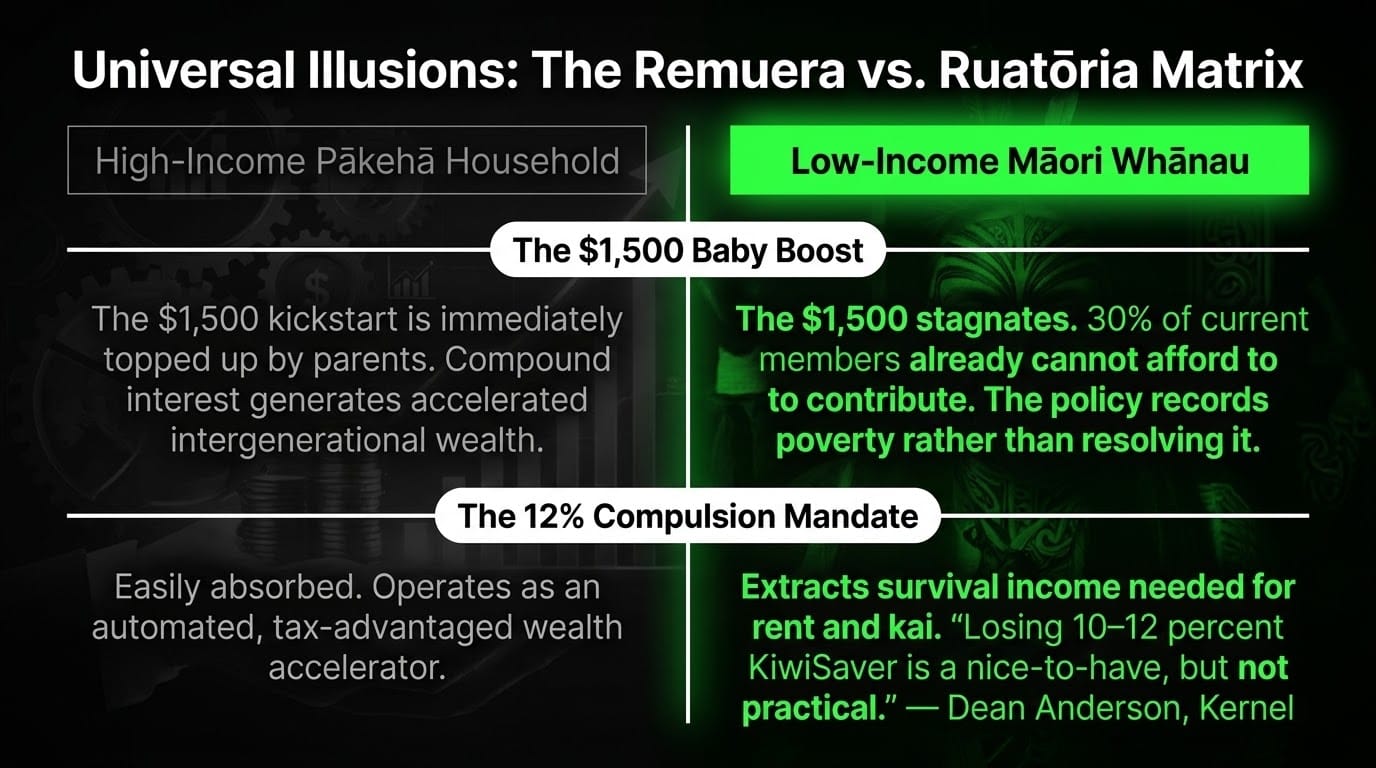
National's $1,500 Baby Boost automatically enrolls every newborn in KiwiSaver from birth. Let me show you where the money actually lands.
A baby born into a high-income Pākehā household in Remuera gets the $1,500 kickstart. Their parents contribute. Compound interest does the rest. A baby born into a whānau in Ruatōria — where the local economy was hollowed out by successive Crown confiscations and structural unemployment is the inherited condition — gets the same $1,500. Their parents may be among the 30 percent of KiwiSaver members not contributing because survival costs more than deferred saving. The $1,500 grows more slowly without supplement. And the compulsion arriving in 2028 will force those same parents to contribute from an income already too small.
The tikanga impact: Children are not investment vehicles. In tikanga Māori, a child enters the world as a living expression of whakapapa — of connection, continuity, land, and tīpuna. The state's obligation to that child is manaaki, not a financial product. A $1,500 kickstart for a baby born into poverty does not address the poverty. It records it.
The solution: Any Baby Boost must be supplemented by an income floor for families with newborns, targeted hardship support for low-income parents, and genuine housing affordability — not the unresolved supply-side crisis National has presided over for three years. The $1,500 means nothing if the whānau cannot pay the rent this week.
Example 3 — The Retirement Age Ratchet, Already Loaded
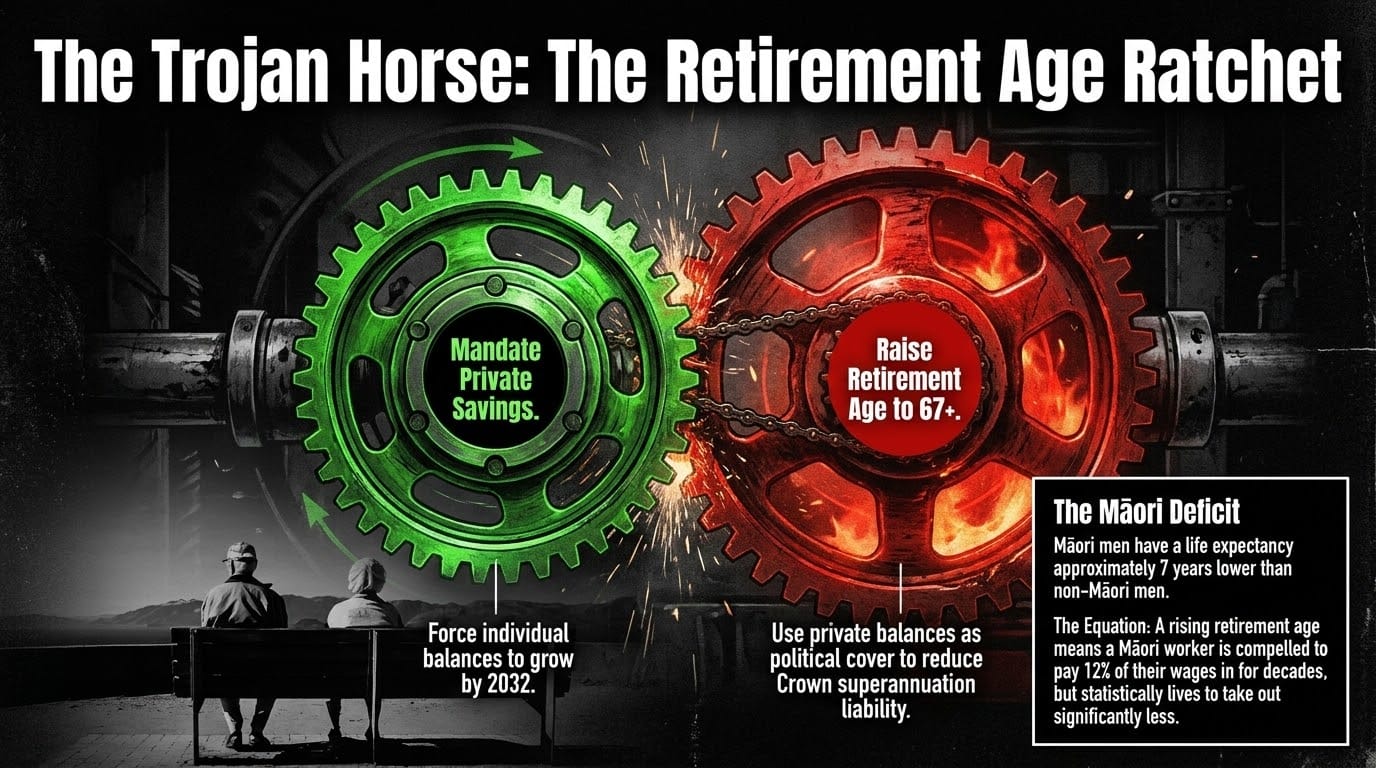
When Luxon says the retirement age conversation is "separate" from the KiwiSaver announcement, he is counting on you not following the logic. In Australia, compulsory superannuation was introduced in 1992 at 3 percent. It rose incrementally to 11.5 percent by 2024. Australia's retirement age is 67. When New Zealand reaches 12 percent combined contributions by 2032, the political argument for lifting the retirement age becomes structurally available — and Luxon's "longstanding position" on lifting the retirement age will be loaded, waiting for whoever is in power to pull the trigger.
Māori men have a life expectancy approximately 7 years lower than non-Māori men. If the retirement age rises to 67, a Māori man in the bottom income quintile — who has had 12 percent of every pay cheque redirected for decades — statistically has fewer years left to access the pension he was compelled to help fund. He paid in more. He gets out less. The system has always worked this way. National just wants to make it legally mandated.
The tikanga impact: In tikanga Māori, kaumātua are not retired. They are the weavers of knowledge, the carriers of whakapapa, the teachers of mokopuna. The state's retirement age is a Western construct imposed on a culture where contribution does not end at 65. Compulsory KiwiSaver embeds a colonial timeline onto Māori life — save on our schedule, retire on our schedule, access support on our terms. That is not rangatiratanga. That is managed dependence.
The solution: Any lift in the retirement age must be accompanied by a guaranteed exception framework for Māori and Pasifika workers, recognition of reduced life expectancy in benefit access calculations, and Treaty-compliant engagement with iwi on what a sovereign retirement framework looks like — not a press conference in Lower Hutt.
Previous MGL Essays on These Connected Threads
I have been here before. The architecture is the same. The players are the same. If this essay has lit a fire in your belly, these will fan it:
- The Pharmacy Con: Simeon Brown's Privatisation by Stealth — The same Brown now cannibalising his coalition built a privatisation architecture inside the public health system that Māori will pay for in lives, not dollars. Same pattern: reduce the public institution, dress the withdrawal as "reform," let the market fill the gap, call the result a "choice."
- The Waka Thieves: How Simeon Brown and Nicola Willis Stole Your Retirement — On the KiwiSaver co-contribution cut, the long game of means-testing, and the neoliberal theology that believes the market is more qualified to manage your old age than the Crown that took your land to build its own wealth.
- Elite Plunder Masquerading as Policy: How Luxon's Austerity Fuels Intergenerational Deprivation — The $555 million in targeted social support cancelled by ACT's veto, the tax cuts delivered to the top, the full arithmetic of whose future this government is actually protecting.
Name the Crime, Name the Beneficiaries, Name the Whānau Being Destroyed
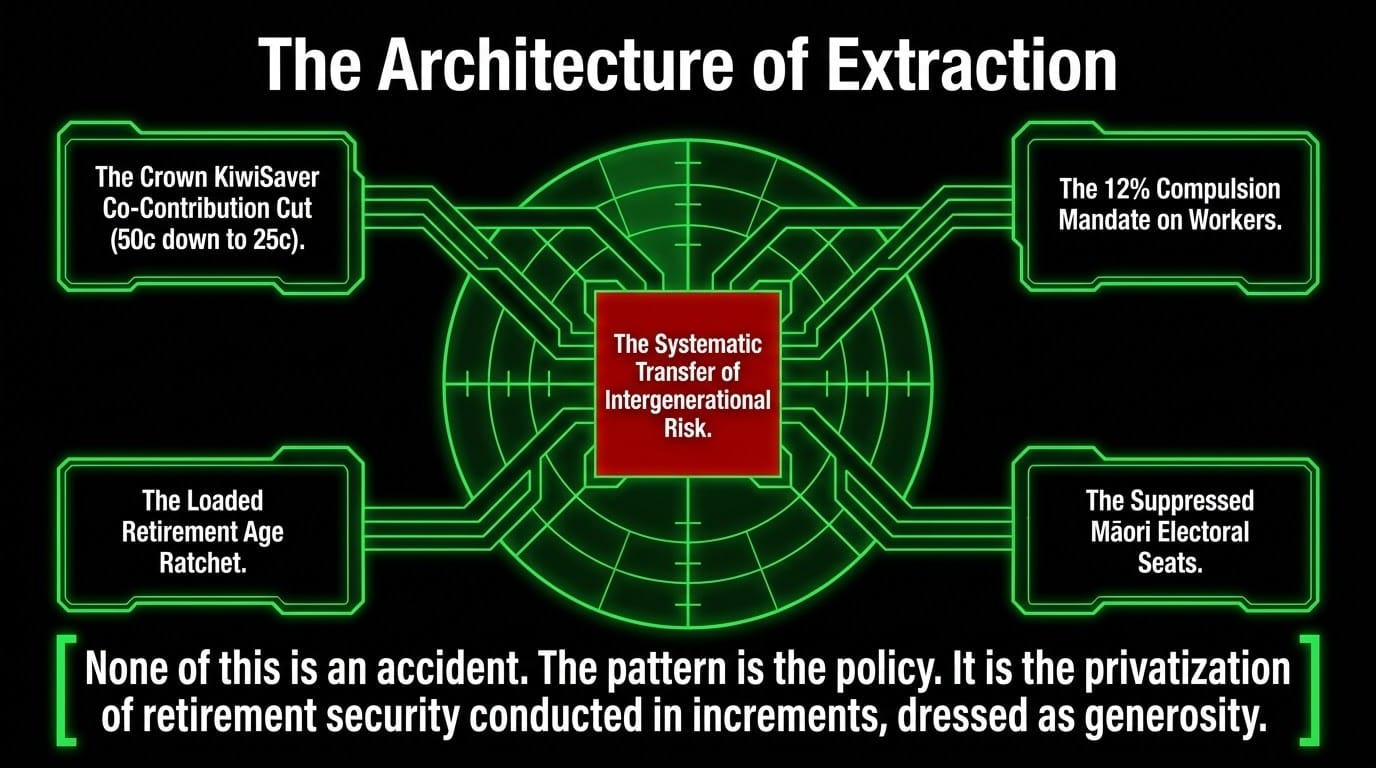
This is not a retirement savings policy. It is an election strategy with three goals: generate a headline that makes National look like it cares about ordinary New Zealanders' futures, signal the retirement age shift without announcing it, and out-flank Winston Peters on KiwiSaver — who correctly noted National was "just copying" New Zealand First policy and had raised the Baby Boost from $1,000 to $1,500 purely to claim originality.
The beneficiaries: KiwiSaver fund managers collecting fees on a compulsorily expanded capital pool. Employers on total remuneration packages who can reclassify existing salary as contributions without paying more. The National Party running on a "savings" narrative while quietly preparing a retirement age increase it will not yet name.
The whānau being destroyed: low-income Māori workers forced to contribute at rates their incomes cannot support. Solo parents — "overwhelmingly mums," in Luxon's own words — whose take-home pay is further reduced. Kaumātua whose reduced life expectancy makes every year of delayed pension access a net loss. Self-employed wāhine Māori with no employer contribution base and no hardship exemption that actually functions in practice.
Labour's Chris Hipkins asked the essential unanswered question:
"How are they going to support those on low incomes who aren't currently in KiwiSaver to become part of KiwiSaver? Because if they simply make it compulsory without any additional support, that's a real-terms pay cut for a lot of low-income New Zealanders at a time when they're already struggling with a cost of living crisis."
National did not answer. Finance Minister Nicola Willis said the billion-dollar cost would come from "operating allowances" — the same allowances that have produced three years of cuts to Māori health, housing, education, and social support.
Brown's "children and parents" language is not a gaffe. It is a theology — the same theology that told Māori they were children who needed the Crown to manage their affairs. The theology of the dominant culture: hierarchy is natural, management is care, power is wisdom.
The taiaha does not accept that theology.
Taiaha up, whānau. They are asking you to save your way out of the poverty they engineered. The taiaha is not for saving. The taiaha is for fighting.
Kia kaha. Kia māia. Kia manawanui.
Koha: Support This Mahi
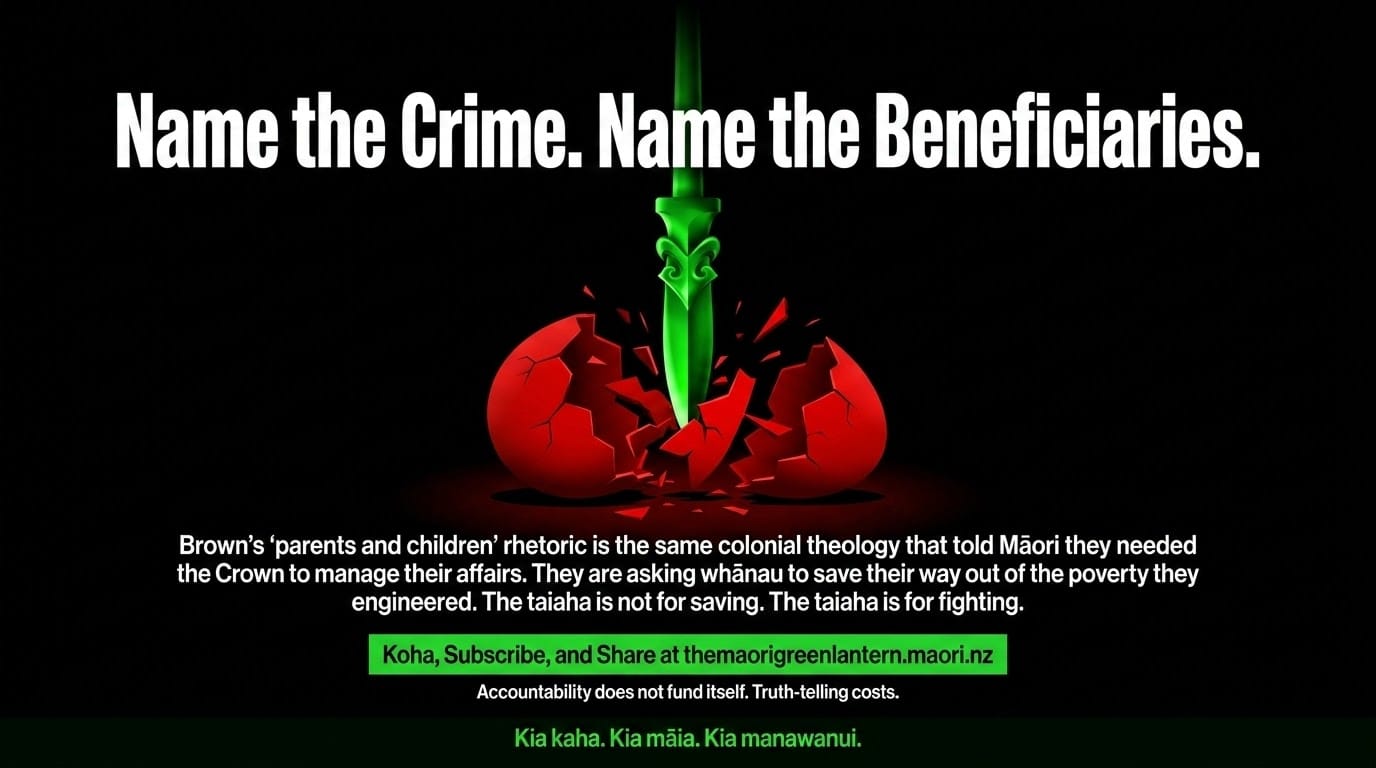
Every koha for this essay is a direct signal that whānau will not allow the Nest Egg Gambit to go unnamed. While Luxon redirects your wages into a locked account and calls it care — while Brown cannibalises the coalition and calls it strategy — this voice stays in the room, names the crime, and serves whānau.
Accountability does not fund itself. Truth-telling costs. This work is supported by whānau, for whānau — because Crown and corporate structures will never support the exposure of their own design.
If you cannot koha — no worries at all, e hoa. Subscribe. Follow. Kōrero. Share with your whānau and friends. That is koha in itself, and it may be the most powerful koha of all — because truth travels further than money.
Four pathways to support this mahi:
Koha (direct contribution): Support via Koha platform
Subscribe (receive essays directly): Subscribe to The Māori Green Lantern
Direct bank transfer: HTDM | 03-1546-0415173-000
Facebook: Follow and support on Facebook
Kia kaha, whānau. Stay vigilant. Stay connected.

⚖️ LEGAL DISCLAIMER — This essay is published in the public interest under the principles established in Lange v Atkinson 3 NZLR 385. All factual assertions are sourced and hyperlinked inline. Opinions are clearly flagged as the author's own analysis and are grounded in the same evidential record. Named individuals are public figures acting in their public capacity. No malice is intended or implied. The pattern of harm described is evidenced entirely by public record. The author invites right of reply at themaorigreenlantern.maori.nz.