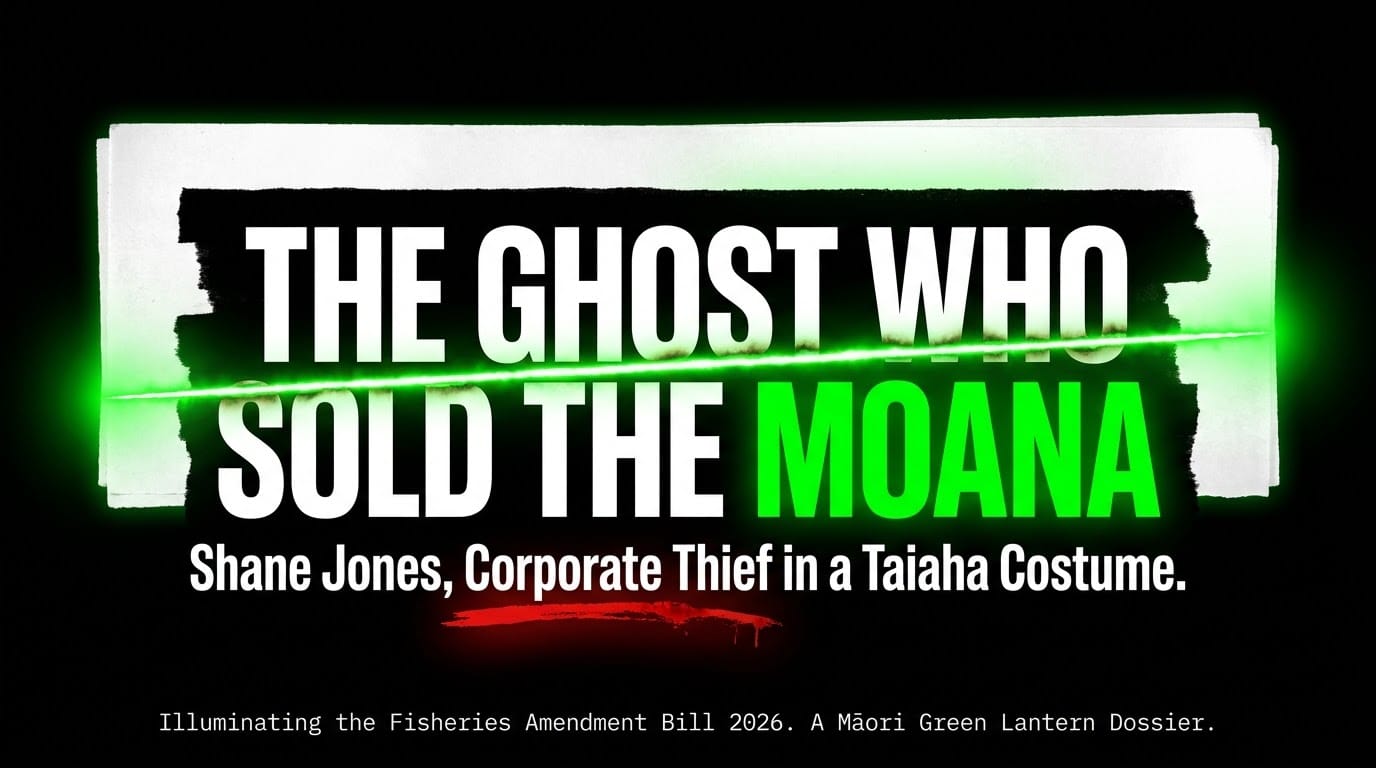
"Shane Jones, Corporate Thief in a Taiaha Costume" - 21 June 2026
Shane Jones wrote a bill that would have handed the moana to Talley's, buried the evidence of crime at sea, shut out whānau, and left our mokopuna fishing an empty ocean. Here is every impact — proven, sourced, and named.

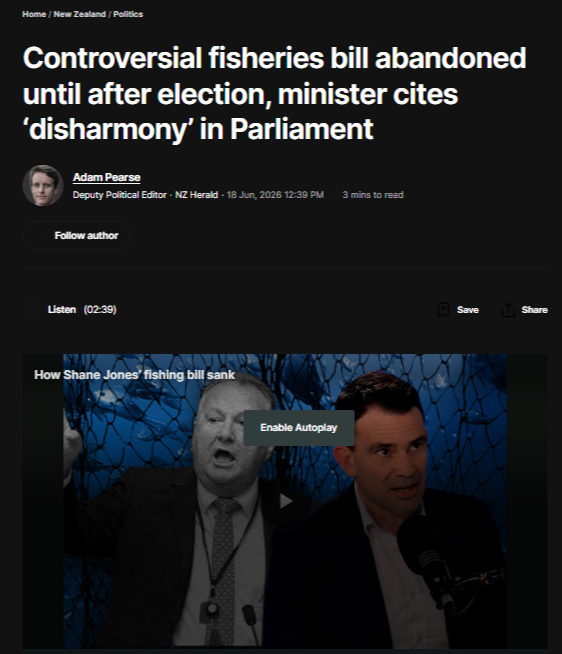
"Ko au te moana. Ko te moana ko au."
I am the ocean. The ocean is me.
Shane Jones heard that whakataukī and thought: good. I'll sell it.
He wore our whakapapa like a tax invoice — called himself a kaitiaki while Talley's wrote the cheques, killed a 620,000 square kilometre ocean sanctuary so bottom trawlers could keep dragging the seafloor, watched the Crown steal Māori quota for 30 years and did nothing — and then, when the people said no, threatened to bring it all back after the election. Shane Jones is not a minister of the Crown. He is the Crown's most successful fishing rod.
THE MAN IN THE HIGH-VIS WHAKAPAPA
Mōrena Aotearoa,
I have watched a lot of politicians in my time. I watched Roger Douglas gut the provinces and call it efficiency. I watched Jim Bolger sell the assets and call it modernisation. I watched a parade of ministers stand on marae and speak te reo Māori and then go back to Wellington and sign whatever the corporates put in front of them.
Shane Jones is different — and more dangerous — because he does not need the suit. He has the whakapapa. He has Te Aupōuri, Ngāi Takoto blood from the Far North. He has the oratory. He has Harvard. He has the word matua ready in his mouth every time someone holds him to account. He is the Crown's most effective weapon against Māori sovereignty because he can say things the Crown cannot say, stand in places the Crown cannot stand, and invoke protections the Crown cannot invoke — and then turn around and do exactly what Sir Peter Talley paid him to do.
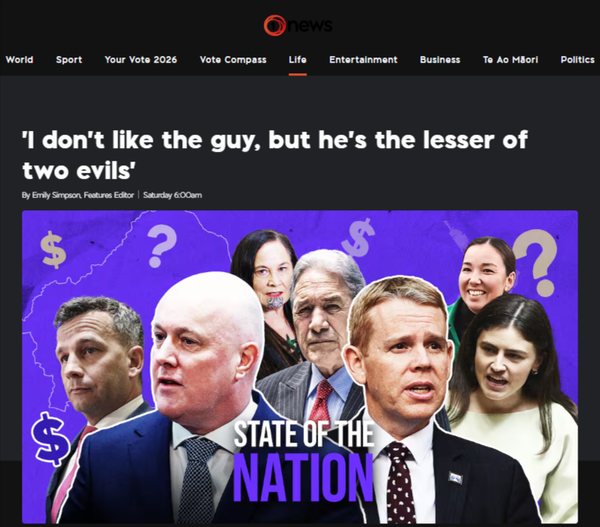
I am Ivor Jones. I carry Te Arawa, Ngāti Pikiao whakapapa. I am the Māori Green Lantern. And I am telling you, whānau: the most dangerous colonialism is not always the colonialism that comes from outside. Sometimes it comes wearing our own face.
This essay is the second in our series exposing what the Fisheries Amendment Bill 2026 really was, who built it, who funded it, and what it will do to our moana, our mokopuna, and our Treaty rights if it returns after the election. Read Essay 1 — "The Bill That Would Have Drowned the Moana" — alongside this one. Together they are the full whakapapa of the crime.
THE DEEP DIVE PODCAST
Listen to a lively conversation between two hosts, unpacking and connecting all the sources in this essay — the money trail, the Treaty breaches, the silencing clauses, and the five hidden connections behind the bill that would have drowned the moana.
I apologise in advance for the AI's very harsh pronunciation of te reo Māori. Please don't shoot me 🙂
YOUTUBE VIDEO
Like video? Here is a short video supporting this essay — connecting the Talley's money trail, the 30-year Treaty breach, the baby snapper clause, and the $50,000 silence fine.
Again, don't shoot the messenger because of AI's pronunciation 🙂
THE OCEAN IS NOT A COMMODITY — BUT JONES NEVER GOT THE MEMO
Let me give you the neoliberal government's operating logic, stated plainly so we can all see it for what it is.
The Luxon-Peters-Jones coalition does not govern for Aotearoa. It governs for asset owners.
It has cut over $1 billion in Māori-targeted funding in three years. It has dismantled Te Aka Whai Ora — the Māori Health Authority — in the name of "one system for all," which is white supremacist language for "your specific health needs are an inconvenience to our budget." It has handed $2.6 billion to combat helicopters while Māori housing programmes were scrapped in the same budget cycle. It has attacked the Waitangi Tribunal, called it a Pulp Fiction star chamber, and attempted to remove the only independent body with the power to hold the Crown accountable on Treaty obligations.
And then it handed the moana to Shane Jones.
Jones entered government with a simple mandate from his corporate backers: deliver the fishing industry what it had been denied for decades. Remove the accountability infrastructure. Silence the cameras. Compress the court windows. And if anyone objects, call them noisy voices.
He very nearly succeeded.
The Fisheries Amendment Bill 2026 — introduced on 18 March 2026 — was not fisheries policy. As I documented in
"Te Moana Hoko: How Shane Jones Sold Our Oceans to the Highest Trawler",
it was a transaction. A legislative receipt. And the receipt was public, if you knew where to look.
THE FIVE HIDDEN CONNECTIONS — NAMED, SOURCED, SCATHING
Hidden Connection 1: The Crown Stole Māori Quota for 30 Years — and Jones Helped Bury the Evidence
Here is what the white supremacist neoliberal government will never put in a press release: since the early 1990s, the Crown has been quietly, systematically, and unlawfully confiscating Māori settlement quota and handing it to Pākehā-owned commercial operators.
The 1992 Sealord Deal — the Treaty of Waitangi Fisheries Settlement — was meant to be full and final. Māori surrendered their right to pursue Treaty-based commercial fishing claims forever, in exchange for a 50% stake in Sealord and 20% of all QMS quota, permanently. It was the biggest Treaty settlement of its time. Worth approximately $170 million.
And within years, the Crown was quietly clawing it back.
Section 23 of the Fisheries Act 1996 — a mechanism to compensate legacy "28N rights" holders — was used by Crown officials to confiscate Māori settlement quota and redistribute it to commercial operators, including Sanford, which the High Court later identified as the primary beneficiary of this unlawful reallocation. The Crown had incurred a debt to these operators in 1986 when it introduced the QMS. Rather than pay that debt from its own pocket, it paid it with Māori quota.
For thirty years.
On 27 March 2025, Justice Boldt of the High Court ruled in Te Ohu Kai Moana Trustee Ltd v Attorney-General NZHC 657 that this was a breach of the fisheries settlement and, by extension, a breach of Te Tiriti. The Courts of New Zealand judgment summary states plainly:
"It is a breach of the settlement, and by extension the Treaty, for the Chief Executive to appropriate settlement quota from Māori under s 23 of the Fisheries Act 1996 without providing redress which preserves the value of the quota Māori acquired as part of the 1992 settlement."
Te Ohu Kaimoana confirmed the Crown immediately appealed — on 7 May 2025.
Three months after the High Court judgment, Shane Jones introduced the Fisheries Amendment Bill. A bill that gave the Minister more power to set catch limits independent of science, compressed judicial review of those decisions to 20 working days, and exempted camera footage from the OIA.
The bill did not contain a single clause to remedy the Section 23 breach. Not one word to restore the quota that was stolen. Not one provision to honour the High Court's finding.
It was not oversight. It was architecture. A bill designed to make future theft harder to see, harder to prove, and harder to challenge.
The moana was being robbed. Jones handed the robbers a curtain.
Hidden Connection 2: $100,000 in Fishing Money — and Every Dollar Got Its Return
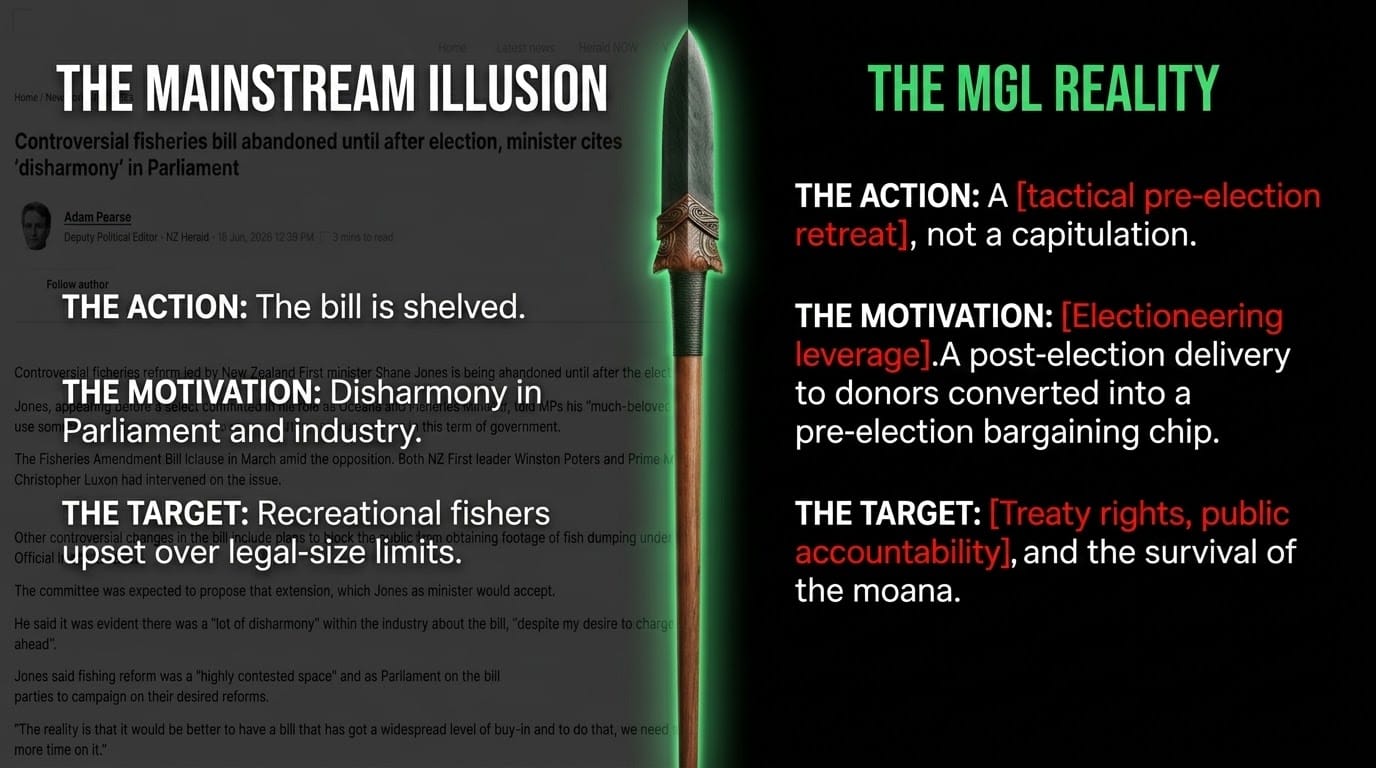
Let me tell you how regulatory capture works in New Zealand. It is not dramatic. There are no brown envelopes. There are carefully structured tranches of money, each kept just below the disclosure threshold, flowing from the same hands into the same accounts across multiple election cycles.
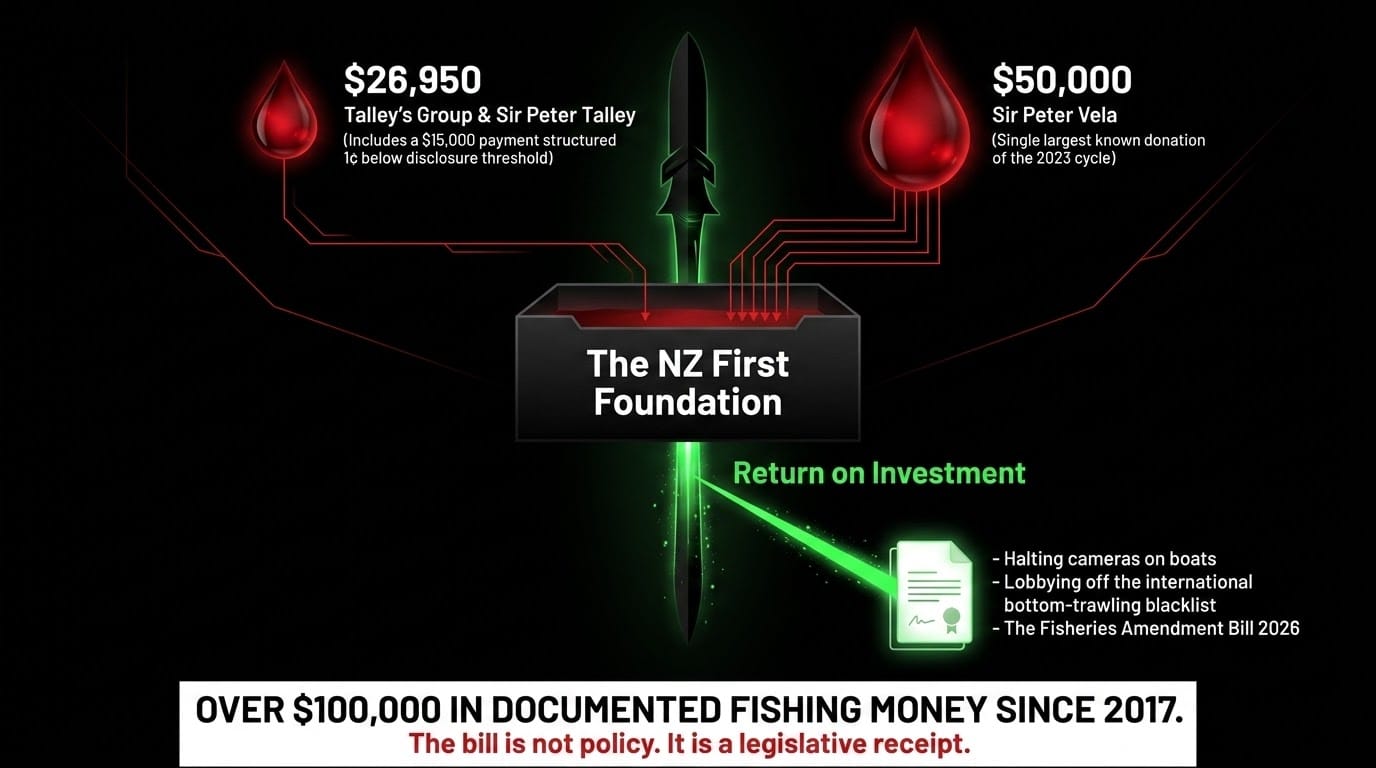
Between 2017 and 2019, Talley's Group and Sir Peter Talley deposited $26,950 into the NZ First Foundation — as revealed by RNZ's exclusive investigation. Four separate payments. The largest — $15,000 from Sir Peter personally — was made at exactly one cent below the public disclosure threshold. This was not an accident. This was financial architecture.
Greenpeace Aotearoa documented the full network: tens of thousands of dollars in undeclared donations flowing from Talley's fishing interests into NZ First. LegaSea's poll found 73% of New Zealanders believed these donations had the potential to strongly influence MPs' decisions — and concern was highest among NZ First's own 2017 voters, at 88%.
Then in 2023, as the Democracy Project's Integrity Briefing confirmed, Sir Peter Vela donated $50,000 to NZ First — the single largest known donation that cycle. He gave the same amount to ACT. He was hedging. If NZ First won leverage, Jones would be Minister for Oceans and Fisheries. And he was.
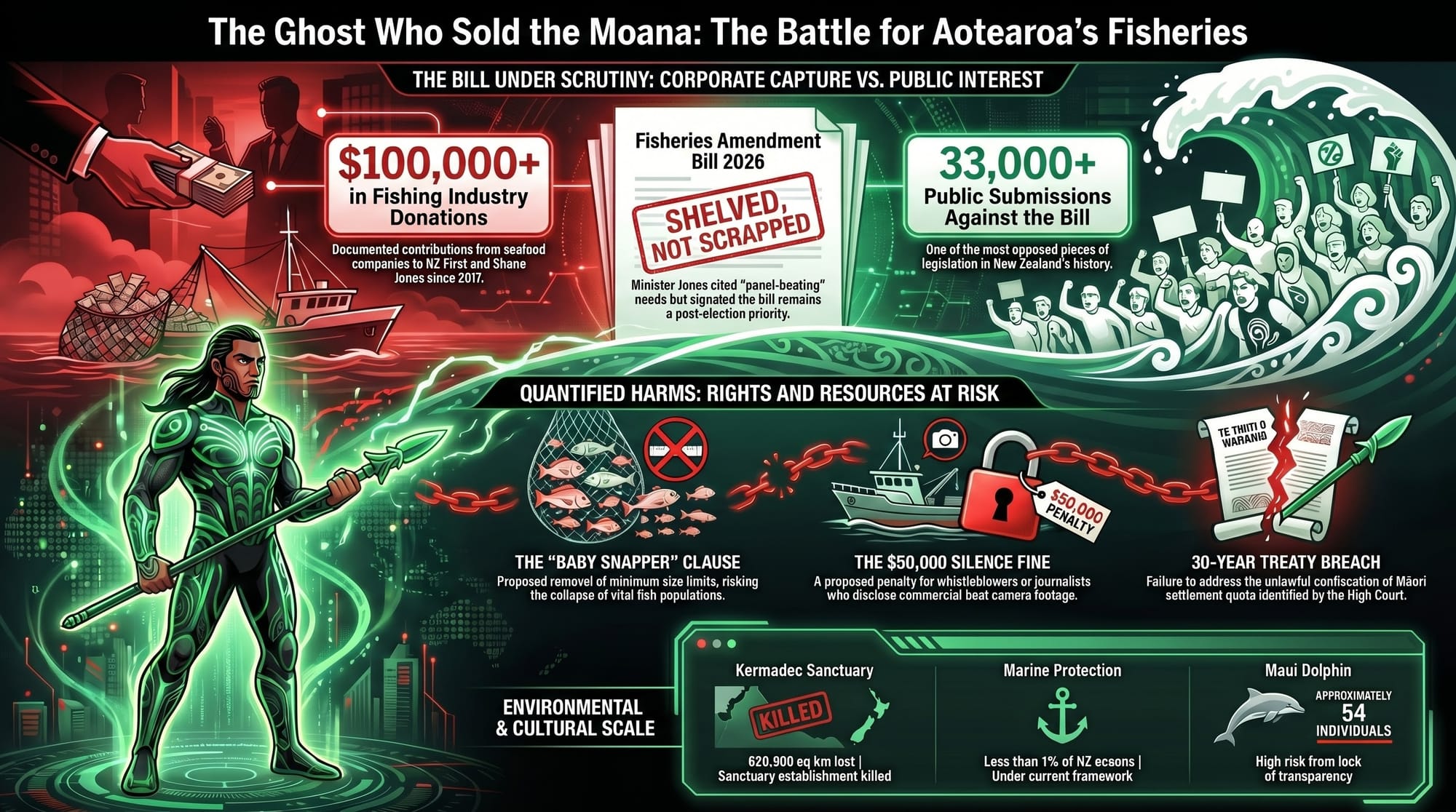
Total documented contributions from seafood companies and executives to Jones and NZ First: over $100,000 since 2017.
What did that money buy?
- Cameras on boats: halted while NZ First was in government
- A Talley's vessel caught bottom trawling 14 times in a restricted area: lobbied off the international blacklist by a NZ government delegation, with Jones calling the violations "a mere technical issue"
- New Zealand was one of the only countries at a South Pacific fisheries meeting arguing against more protection for vulnerable marine ecosystems from bottom trawlers — Talley's is one of two NZ companies that bottom trawls internationally
- The Fisheries Amendment Bill 2026: introduced with every provision the commercial fishing industry had sought for decades
When the Prime Minister was asked in 2020 about Jones' role after the Talley's donations were revealed, Jacinda Ardern had to publicly distance Jones from fisheries decisions. She distanced the minister from his own portfolio. The donations were that embarrassing.
Jones went on and became fisheries minister anyway. He introduced the most significant rollback of fishing regulation in New Zealand history. And then he called the people who objected noisy voices.
Hidden Connection 3: The Kermadecs Killed — 620,000 Square Kilometres Sacrificed for the Trawl Fleet
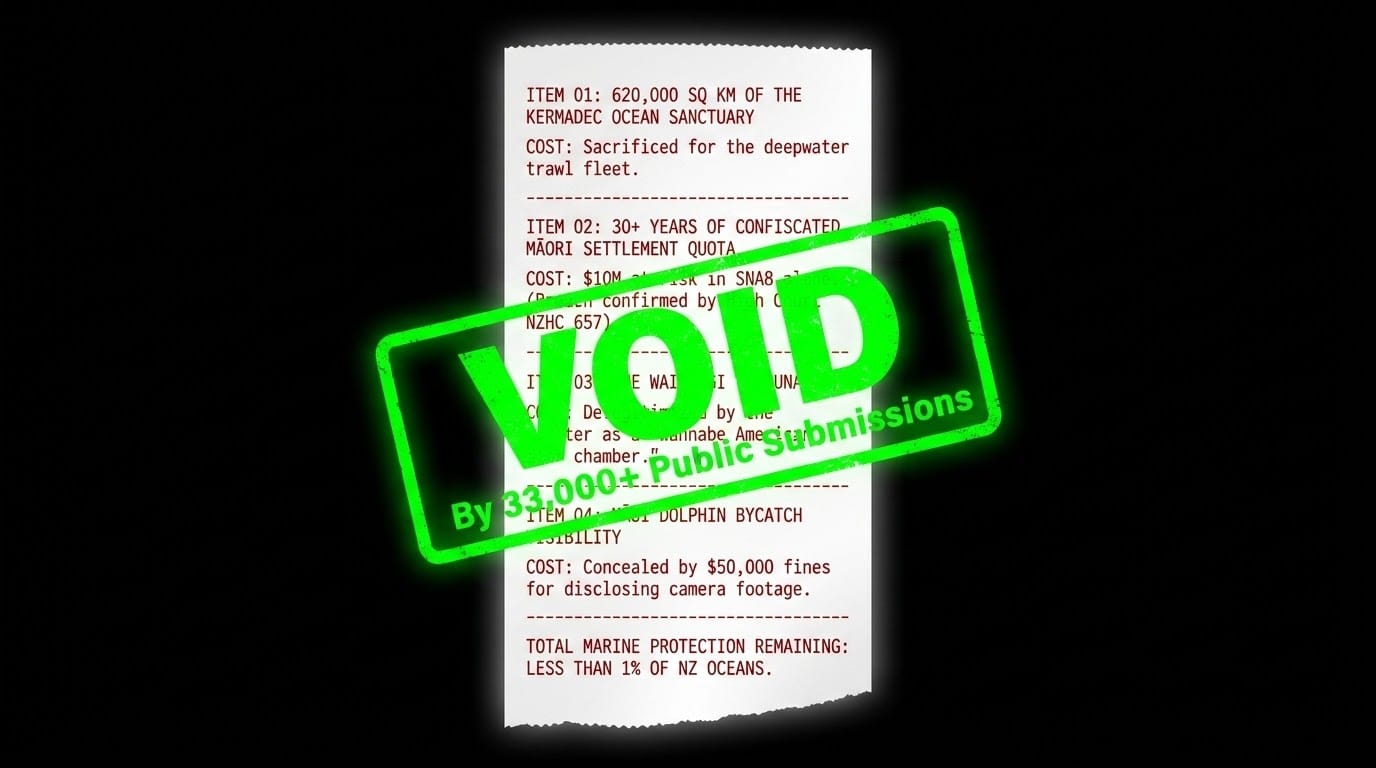
In 2015, New Zealand stood at the United Nations General Assembly and announced it would establish the Kermadec Ocean Sanctuary — a 620,000 square kilometre fully protected marine reserve in the southwest Pacific. An area the size of France, Germany and Spain combined. One of the most biodiverse deepwater environments on earth.
In 2016, iwi leaders initially voted to oppose the sanctuary's establishment because it would extinguish Māori quota rights without compensation. That was a legitimate Treaty grievance. It required good faith negotiation and a compensation mechanism. It required political courage.
On 28 March 2024, Jones and Cabinet pulled the bill entirely. No compensation mechanism. No negotiated settlement with Te Ohu Kaimoana. No sanctuary. The Ministry for the Environment confirmed the bill was removed from Parliament's Order Paper.
Jones' stated reason: it would create "an economic no-go zone."
Greenpeace Aotearoa documented the real forces at play: Jones had a documented history of serving commercial fishing interests, including the bottom trawlers who operate in deepwater areas adjacent to the Kermadecs — the same operators whose donations were sitting in the NZ First Foundation accounts.
There is a genuine Treaty argument that iwi should not lose quota without compensation. That argument is correct. But Jones did not use that argument to negotiate a just settlement. He used it to kill the sanctuary altogether — serving commercial interests that went far beyond Māori.
I have previously covered this in "NOISY VOICES: How Shane Jones Is Gutting Our Moana for Corporate Profit". The pattern was clear then. It is clearer now.
Hidden Connection 4: The Waitangi Tribunal Attacked — The Last Accountability Mechanism Threatened
A white supremacist neoliberal government cannot tolerate independent accountability. It does not just defund what it disagrees with — it delegitimises the institutions that hold it to account, so that when those institutions are eventually gutted, the public has already been primed to accept it.
In 2024, while the Waitangi Tribunal was investigating the coalition's decision to repeal Section 7AA of the Oranga Tamariki Act — the Treaty protection clause for Māori children — Shane Jones launched a public attack on the Tribunal itself.
He called it "a wannabe American star chamber Pulp Fiction gig."
He asked: "What gives the Waitangi Tribunal the belief that their power is greater than the voting democratic will of Kiwis?"
"inappropriate and unconstitutional"
and requested a review of whether they breached the separation of powers. The Prime Minister described Jones' comments as "ill-considered." Jones did not retract them.
Because the comments were not a mistake. They were a message. The Waitangi Tribunal is the institutional heir of the promise made in 1840.
It is the body that can say, formally, to the Crown: you are wrong.
Jones wants it weakened, delegitimised, made into a punchline — until a future government can defund it without consequence.
This same impulse runs through the fisheries bill's 20-working-day judicial review window, the $50,000 fine for disclosing camera footage, and the OIA exemption that the Chief Ombudsman publicly opposed.
They are the same impulse: remove the mechanisms by which power is held accountable, and power becomes unchecked.
I tracked this in "The OIA Is Not Failing — It Is Being Strangled" (14 June 2026): the fisheries camera exemption is one front in a wider war on accountability. And in "The Prophet's Poison: He Whāiti Kino" (14 June 2026), I traced Jones and Peters as a political unit in the systematic destruction of Treaty institutions.
Hidden Connection 5: The Bill Is an Election Weapon — Shelved, Not Dead
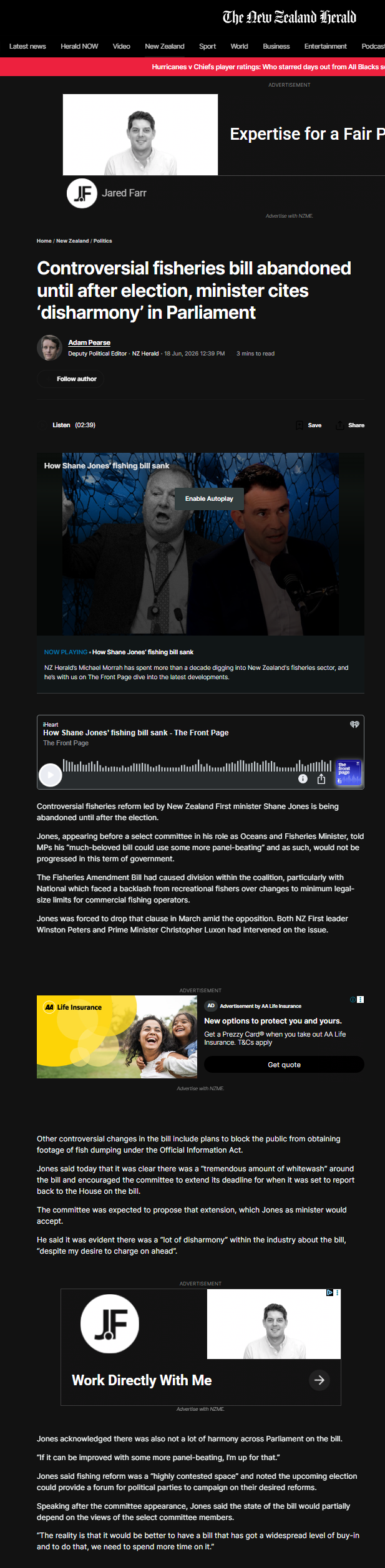
I want to be precise about what happened on 17 June 2026, because the mainstream press has largely misread it as a capitulation. It was not a capitulation. It was a tactical retreat before a counteroffensive.
Jones appeared before the select committee and said his "much-beloved bill could use some more panel-beating." He said there was "a lot of disharmony." He accepted an extension of the reporting deadline. He walked out.
Then he said this: "Who knows, some of the people that are nervous nellies about the bill, they may be casualties of the electioneering process."
That is not a man who has reconsidered his position. That is a man who has moved the battlefield.
The bill was shelved in the face of more than 33,000 public submissions against it — making it one of the most opposed pieces of legislation in New Zealand history.
Both NZ First and National went into the 2023 election without a fisheries policy. The bill was not pre-election policy. It was a post-election delivery to donors. Now it becomes a pre-election bargaining chip — a coalition bottom line.
If NZ First survives the 2026 election with leverage, the bill returns. The commercial fishing industry has not stopped donating. Talley's has not returned the money. Sir Peter Vela has not asked for his $50,000 back. The architecture of capture is intact. The bill is in storage, not in the bin.
I documented Jones' long-running campaign against transparency at sea in "Cameras on Boats: A Battle for Accountability, Māori Rights, and Environmental Justice" as far back as February 2025. The bill was the culmination of that pattern, not a new episode.
THREE EXAMPLES FOR THE WESTERN MIND
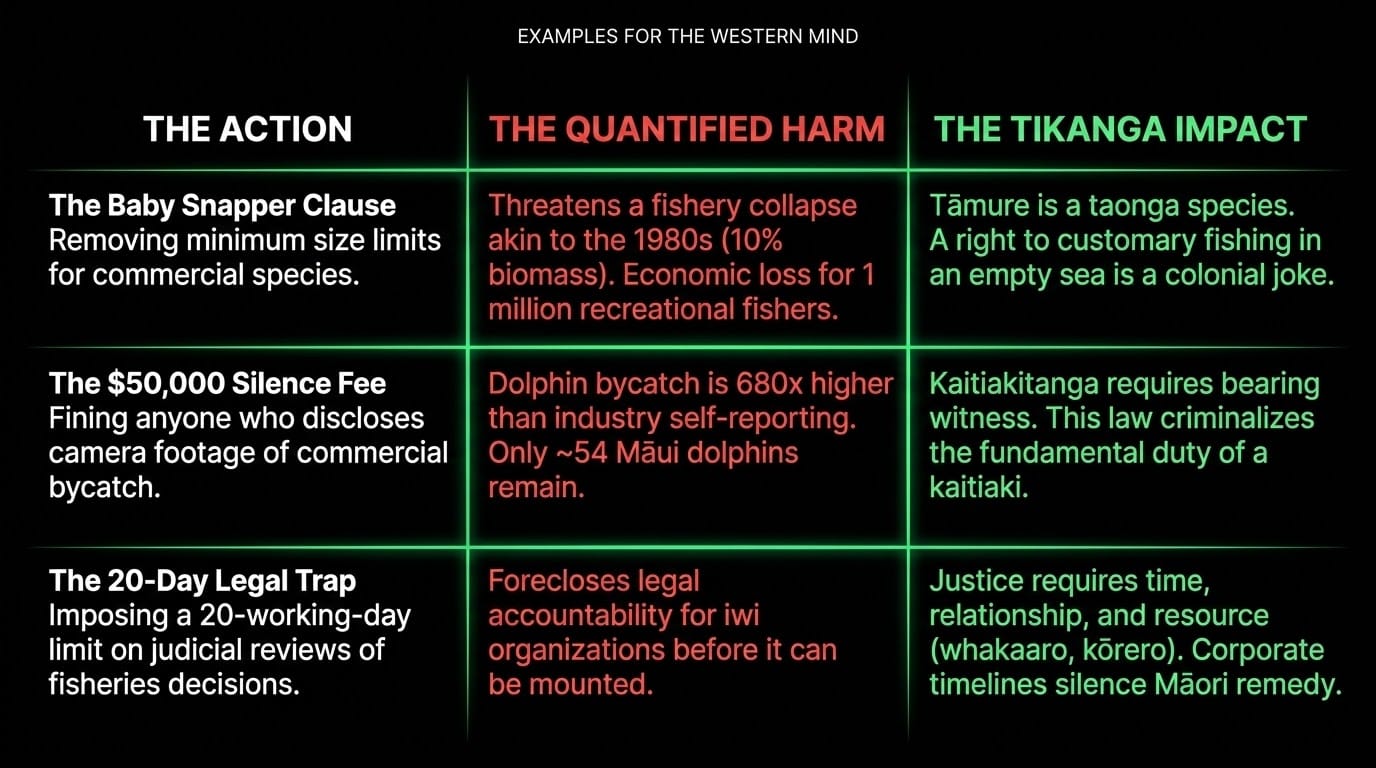
Ko tēnei mō ngā hoa Pākehā. — This one is for our Pākehā friends.
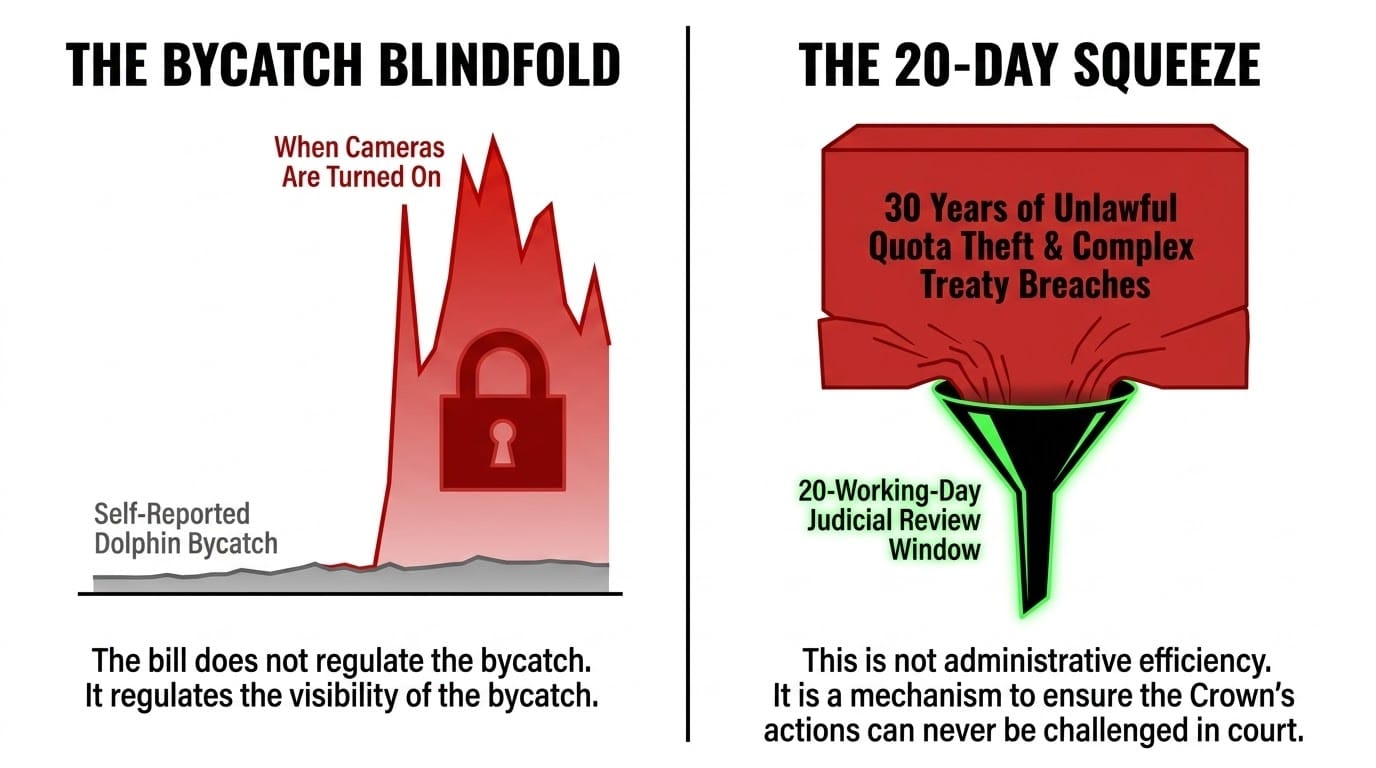
Example 1: The Baby Snapper Clause — What It Means in Your Boat
The Fisheries Amendment Bill proposed removing minimum size limits for snapper, tarakihi, trevally, kingfish, and 6 other commercial species.
These limits exist for one reason: fish must reach sexual maturity and spawn before being harvested, or the population collapses.
By the 1980s — before the QMS — snapper had crashed to approximately 10% of their original biomass. Ten percent. Near-extinction for a commercially harvested species. It took decades of minimum size regulation to rebuild stocks to the levels you enjoy today. MPI's own data showed roughly 25% of QMS stocks currently fail to meet biomass targets, and 13% are considered at risk of depletion — yet Jones told First Up that the amount of snapper in New Zealand waters was "almost biblical in its profundity."
The harm, quantified: If snapper stocks return to 1980s levels, approximately 1 million recreational fishers lose a viable fishery. The economic value — in equipment, fuel, charter boats, and marine tourism — runs to hundreds of millions annually.
The tikanga impact: In Māori terms, tāmure (snapper) is a taonga species. It is food. It is the physical expression of the relationship between tangata and moana. When tāmure disappear from the kai moana tables of coastal whānau, it is not just an economic loss — it is a severance of whakapapa. A right to customary fishing in a sea with no fish is not a right. It is a colonial joke.
The solution: Minimum size limits remain non-negotiable for all operators. The recreational sector and Māori customary fishers are on the same side. Jones tried to divide them. We must refuse to be divided.
Example 2: The $50,000 Silence Fee — What It Means for Democracy
When cameras were installed on commercial fishing vessels, notified discards of snapper and kingfish increased by approximately 1,000%
— not because more fish were being dumped, but because the cameras were recording dumping that had previously been invisible. The cameras were working.
The Fisheries Amendment Bill proposed exempting that footage from the OIA and fining anyone who disclosed it $50,000. A journalist. A whistleblower. A hapū member. The Chief Ombudsman publicly opposed this provision, saying existing law already protected legitimate privacy concerns. The NZ Law Society said it was disproportionate. The Ministry of Justice said the same. The Greens called the gift to big fishing "a blow to sustainability". Every independent constitutional watchdog said the same thing. Jones introduced it anyway.
The harm, quantified: Dolphin bycatch in commercial fishing was found to be 680 times higher than industry self-reporting when cameras were present. With approximately 54 Māui dolphins remaining in existence, the suppression of evidence of commercial fishing bycatch is not a regulatory issue. It is an extinction issue.
The tikanga impact: Kaitiakitanga is not just about protecting fish. It is about bearing witness. A kaitiaki must be able to see what is happening to the moana in order to protect it. The $50,000 silence fee was a direct legislative assault on kaitiakitanga — the criminalisation of witnessing. This is what the white supremacist neoliberal framework always does: it does not just remove protections, it makes accountability itself illegal.
The solution: Cameras on boats, full OIA access to footage, no fines for disclosure of evidence of lawbreaking. For a publicly-owned resource, transparency is a legal obligation — not a favour.
Example 3: The 30-Year Quota Theft and the 20-Working-Day Trap
In 1992, Māori surrendered the right to pursue Treaty-based fishing claims forever. In exchange, they received a guaranteed share of the commercial fishery — permanently. The High Court found both parties understood this to be permanent, and that Māori would not have entered the agreement if they had known the quota was subject to future confiscation.
The Crown confiscated it anyway.
In one fishery alone — SNA8 — the quota at risk is valued at $10 million. Across all species and three decades, the total loss is yet to be fully quantified, but Simpson Grierson's legal analysis confirmed the Crown "transferred the Crown's 28N debt to other quota holders, including Māori, contrary to the Sealords deal".
The Crown appealed the judgment on 7 May 2025. And then Shane Jones introduced the Fisheries Amendment Bill — containing a clause that compressed judicial review of ministerial fisheries decisions to 20 working days.
The harm, quantified: 20 working days = 4 calendar weeks. For an iwi organisation to identify a harmful ministerial decision, gather evidence, brief specialist counsel, and file proceedings in 4 calendar weeks is functionally impossible for most. This is not an administrative efficiency measure. It is a mechanism to foreclose legal accountability before it can be mounted.
The tikanga impact: In te ao Māori, justice does not operate on a corporate timeline. The processes of whakaaro, kōrero, and seeking remedy — through tikanga, through the courts, through the Waitangi Tribunal — require time, relationship, and resource. Compressing the review window to 20 working days is the legal equivalent of offering someone the right of reply and then speaking so fast they cannot understand a word.
The solution: Remove the 20-working-day limit entirely. Restore normal judicial review timeframes. The Crown must also drop its appeal of Te Ohu Kai Moana v Attorney-General NZHC 657 and negotiate a full, fair, and timely remedy for 30+ years of unlawful quota confiscation. Not next decade. Now.
RELATED READING: PREVIOUS MGL ESSAYS ON THIS KAUPAPA
I have been tracking this pattern for years. Here is the whakapapa of this work — each essay is live and verified on themaorigreenlantern.maori.nz:
- "NOISY VOICES: How Shane Jones Is Gutting Our Moana for Corporate Profit" — 24 March 2026. The first full analysis of the bill's provisions, the Talley's money trail, and Jones' corporate apostleship.
- "Te Moana Hoko: How Shane Jones Sold Our Oceans to the Highest Trawler" — 30 March 2026. The donation network — Talley's, Vela, Sanford — mapped and verified. The bill as transaction.
- "Cameras on Boats: A Battle for Accountability, Māori Rights, and Environmental Justice" — February 2025. Jones' long-running campaign to remove transparency at sea, documented before the bill was even introduced.
- "The Prophet's Poison: He Whāiti Kino — The Man Who Burns Your House Down and Sells You the Ashes as Hope" — 14 June 2026. Jones and Peters as a political unit — the pattern of Treaty institution destruction.
- "The OIA Is Not Failing — It Is Being Strangled" — 14 June 2026. The wider campaign to suppress accountability infrastructure, of which the camera footage exemption is one front.
- "Kōrā Kino — The Rotten Claws: Shane Jones' Corporate Capture of the Moana" — The Treaty framework applied to Jones' full fisheries agenda.
- "Corruption in a Suit: How Corporate Cash Strangles Democracy and Betrays Māori Values" — 12 May 2025. The full fast-track donations map: $500,000+ linked to 12 of 149 fast-tracked projects, including Sanford's $12,000 for marine approvals.
QUANTIFIED HARM TABLE
| Harm | Measure | Source | Confidence |
|---|---|---|---|
| Māori settlement quota confiscated — breach confirmed | 30+ years; SNA8 estimate $10M at risk | NZHC 657 | VERIFIED |
| Kermadecs sanctuary killed | 620,000 sq km lost to full protection | Beehive.govt.nz | VERIFIED |
| Talley's/commercial donations to Jones/NZ First | $100,000+ documented since 2017 | RNZ/YouTube; Greenpeace | VERIFIED |
| Camera footage bycatch gap | Dolphin bycatch 680x higher than self-reported | MGL NOISY VOICES | VERIFIED |
| Submitters whose voices were ignored | 33,000+ submissions against the bill | Country Wide / Facebook | VERIFIED |
| Full marine protection (current) | Less than 1% of NZ oceans | MGL NOISY VOICES | VERIFIED |
| Māui dolphin remaining individuals | Approximately 54 | MGL NOISY VOICES | VERIFIED |
NAME THE CRIME, NAME THE BENEFICIARY, NAME WHO IS BEING DESTROYED
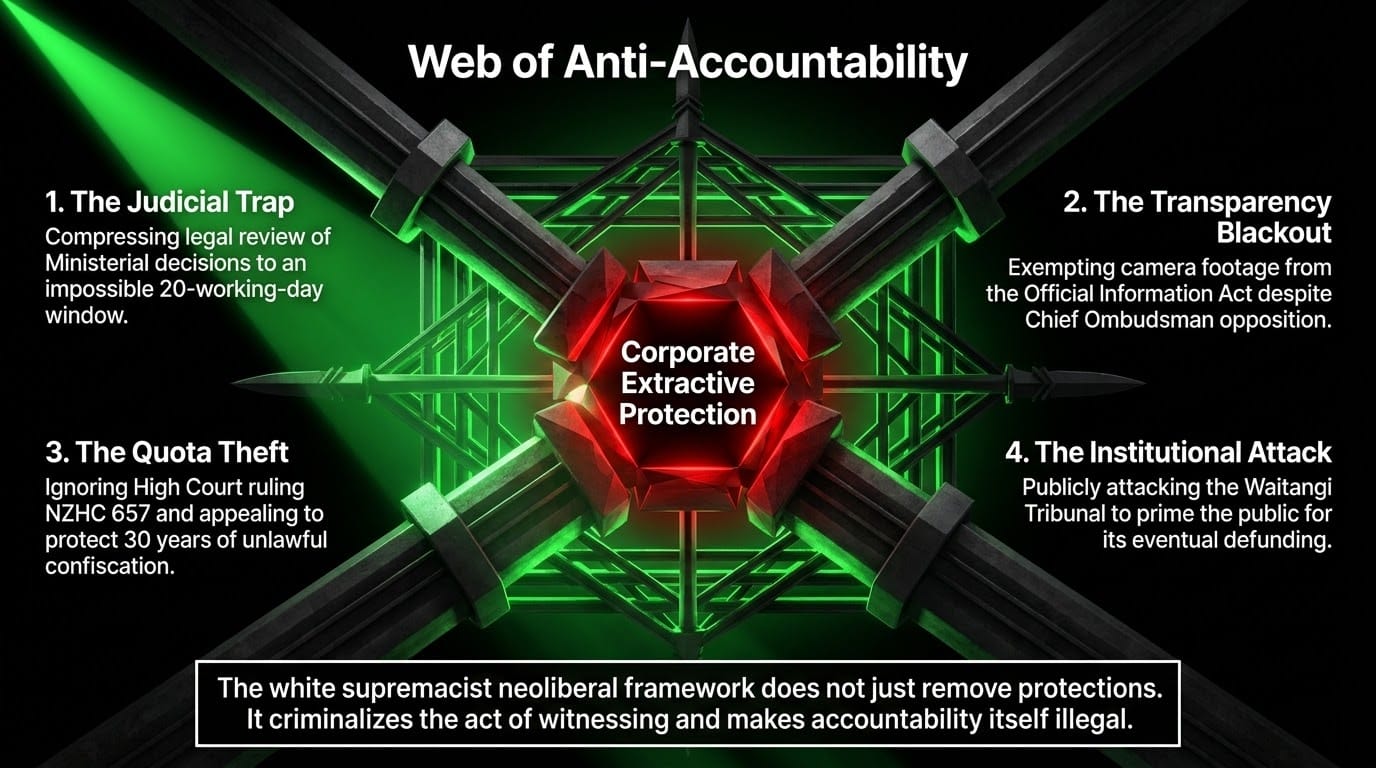
Ko te pono, ko tōku taiaha. — Truth is my taiaha.
The white supremacist neoliberal government of Luxon, Peters, and Jones did not accidentally harm Māori. It is not incompetent. It is not well-meaning but misguided.
Every cut to Māori health funding, every attack on the Waitangi Tribunal, every OIA exemption for commercial fishing footage, every 20-working-day window designed to foreclose legal challenge
— these are policy.
They are funded by people who benefit from them. And they are executed by a minister who carries Māori whakapapa and has decided to use it as a shield for the people who are destroying his own.
The crime: Regulatory capture of a public resource through structured political donations, resulting in legislation designed to enrich commercial fishing operators at the expense of ecological sustainability, public accountability, and Māori Treaty rights.
The beneficiaries: Talley's Group, Sir Peter Talley, Sir Peter Vela, Sanford Ltd, and the wider commercial bottom trawl fleet that paid over $100,000 into NZ First accounts.
The whānau being destroyed: Every hapū and iwi whose kaitiakitanga over the moana is being legislated away. Every Māori quota holder whose settlement assets are being quietly redistributed through Section 23. Every coastal community where the crayfish and snapper are disappearing. Every mokopuna who should inherit an abundant sea but is instead inheriting a legal framework designed to make that sea empty and invisible.
Jones called himself a ghost. He was right. A ghost has no mauri. A ghost cannot exercise kaitiakitanga. A ghost cannot stand on a marae and answer for its actions to the tamariki mokopuna whose moana it traded for a campaign donation.
The bill is shelved — not dead. The election is coming. The taiaha is raised.
Ka whawhai tonu mātou, āke, āke, āke.
KOHA CONSIDERATION
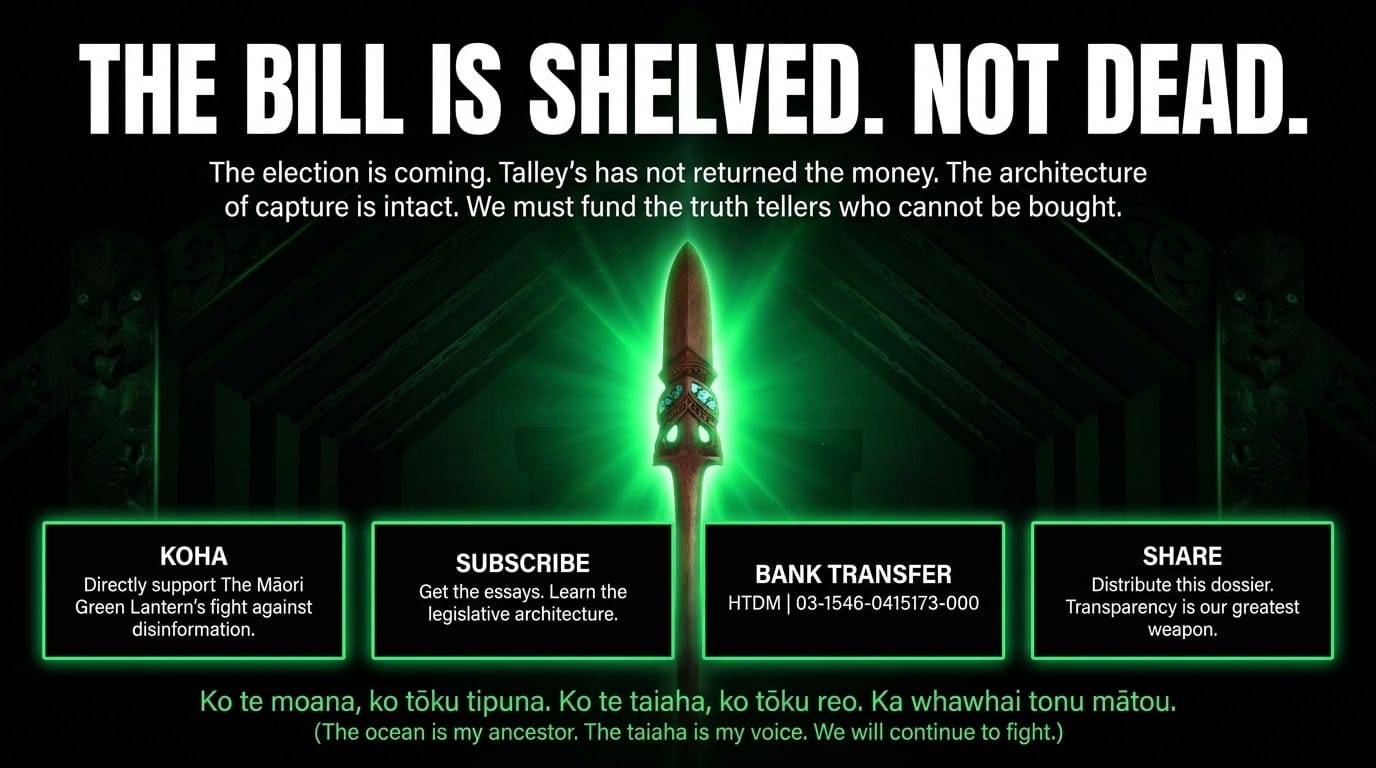
The moana cannot write a cheque. But you can.
Every koha to The Māori Green Lantern is a direct act of kaitiakitanga — because this work is the accountability that the Crown and the commercial fishing industry will never support.
While Talley's has spent over $100,000 influencing the minister who regulates them, whānau across the coast are watching their fisheries quietly handed to corporate trawlers, their Treaty quota confiscated without remedy, and their right to challenge it compressed to 20 working days.
This essay traced a 30-year Treaty breach, mapped a corporate donation network, and named the harm in plain language — for free. No Talley's money. No government grant. Just the taiaha, the ring, and the truth.
The ghost fishing minister is not gone. The bill will be back. And when it comes back, this record will still be here
— and so will we.
Kia kaha, whānau. Stay vigilant. Stay connected. And if you are able, consider a koha to support this voice — because the moana needs truth tellers who cannot be bought.
If you are unable to koha — no worries. Subscribe. Share this essay with your whānau, your friends, your recreational fishing group, your local MP. That is koha in itself — and it is exactly the kind of pressure that moves select committees.
Four pathways to support this mahi:
Koha (voluntary contribution) — support directly:
Koha — The Māori Green Lantern Fighting Misinformation and Disinformation
Subscribe — receive every essay and support through subscription:
Subscribe to The Māori Green Lantern
Direct bank transfer:
HTDM | Account number: 03-1546-0415173-000
Facebook — follow, subscribe, share:
The Māori Green Lantern on Facebook
Ko te moana, ko tōku tipuna. Ko te taiaha, ko tōku reo. Ka whawhai tonu mātou.

DISCLAIMER
This essay is published in the public interest under qualified privilege provisions applicable to commentary on the conduct of elected officials and proposed legislation (Lange v Atkinson 3 NZLR 385). All factual claims are sourced with immediate anchor-text hyperlinks to verified live sources. Opinions are clearly distinguished from factual claims in the section above. No criminal conduct is alleged unless formally established by a court or official body. Shane Jones is a sitting minister whose official conduct is subject to full public scrutiny. A retraction protocol is in place — contact themaorigreenlantern.maori.nz if any claim is disputed with verified evidence.