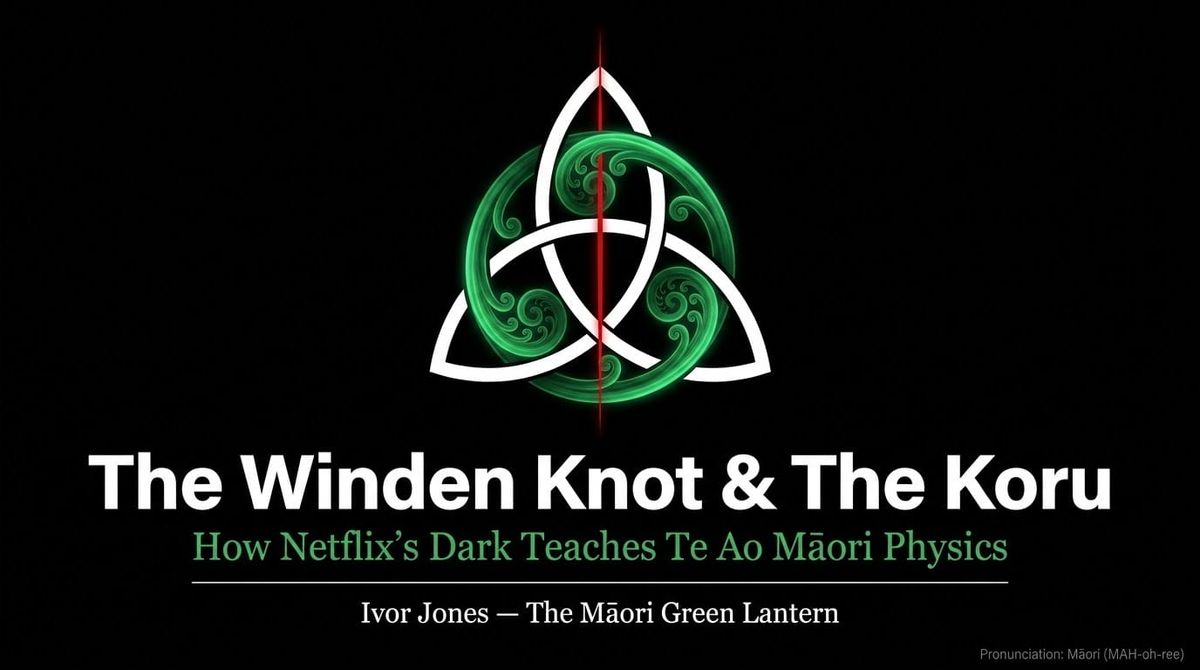
"How Netflix's Dark Teaches Te Ao Māori Physics" - 25 June 2026
The Winden Knot and the Koru - A Journey from Te Kore to Ki te Ao Mārama — Through the Caves of Winden
Mōrena Aotearoa,

"What we know is a drop. What we don't know is an ocean."
— H.G. Tannhaus, Dark (Netflix, 2017–2020)
That sentence is Te Kore.
A German clockmaker in the fictional town of Winden accidentally described the Māori void
— the layered potential that precedes all existence.
He did not know it. The creators of Dark may not have known it.
But across the three seasons of this extraordinary German science fiction series, the deepest truths of te ao Māori physics
— the nature of time, the fabric of relation, the conservation of life force, the relational constitution of identity
— are dramatised with breathtaking precision.
This essay is for anyone who has watched Dark and been simultaneously thrilled and bewildered. It is also for anyone who has encountered te ao Māori and mātauranga Māori and wondered what it actually means in practice.
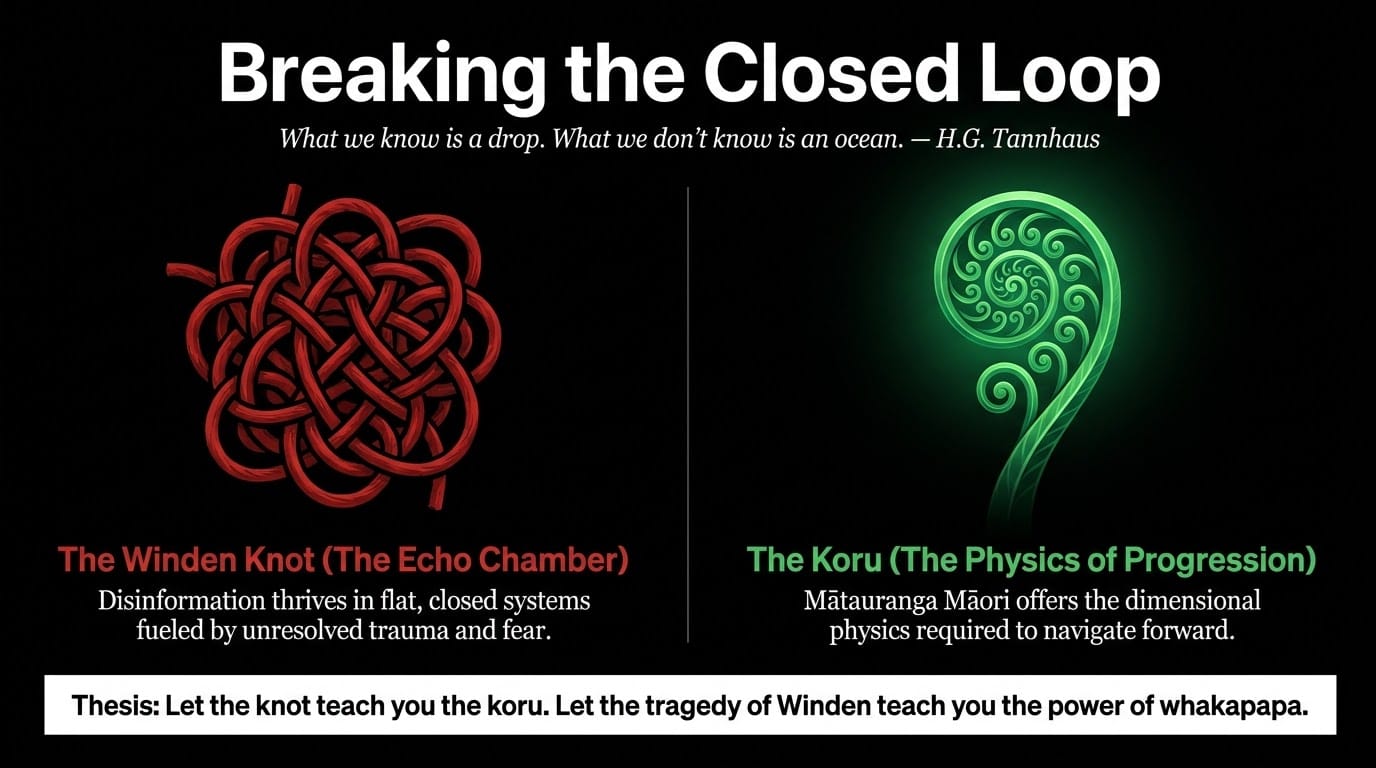
The invitation here is simple: let the knot teach you the koru.
Let Winden teach you whakapapa. Let Jonas and Martha's sacrifice teach you what noa means — the sacred moment of transformation, when grief finally becomes light.
The Deep Dive Podcast
Listen to a lively conversation between two hosts, unpacking and connecting topics in the sources of this essay. I apologise in advance for the AI's very harsh pronounciation of reo. Please dont shoot me, :).
Youtube Video
Like video? Here is a short video suppporting the essay. Again, don't shoot the messenger please because of AI's pronounciation. :)
The World Before the Knot — Te Kore and Tannhaus's Grief
Every story has a time before it begins. In Dark, that time is the Origin World — a world where time ran in a straight line, cause followed effect, and a clockmaker named H.G. Tannhaus worked quietly in Winden, loved his family, and had not yet tried to unmake the universe. The Dark Fandom Wiki confirms the Origin World as "the 'world' from which the Knot was created, where the chain of cause and effect largely remained linear."
In 1971, Tannhaus lost his son Marek, his daughter-in-law Sonja, and their infant daughter in a car crash on a rain-slicked bridge. Express.co.uk's season 3 explainer confirms that Charlotte Doppler's name in the knot traces directly back to this lost infant. In one moment, three generations of his whakapapa — his relational fabric — were torn away. What remained was the void.
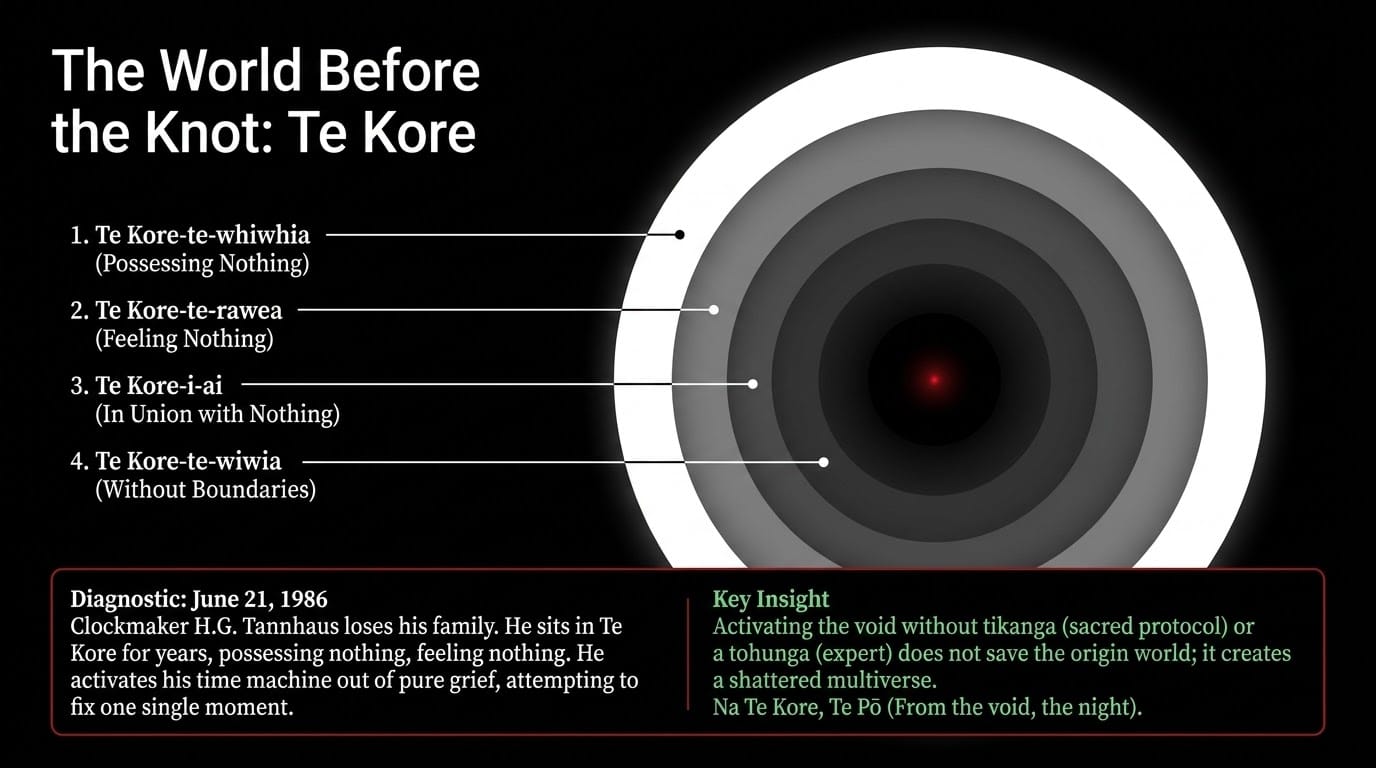
This is Te Kore — not the void of emptiness, but the void of pure, unbearable potential. Māori cosmology describes Te Kore in five progressive stages, as recorded in Te Ara — The Encyclopedia of New Zealand's entry on Māori creation traditions:
- Te Kore-te-whiwhia — the void in which nothing is possessed
- Te Kore-te-rawea — the void in which nothing is felt
- Te Kore-i-ai — the void in which nothing is in union
- Te Kore-te-wiwia — the void without boundaries
Tannhaus sat in all five. He possessed nothing (his family was gone). He felt nothing (grief had consumed sensation). He was in union with nothing (utterly alone). He had no boundaries (his grief had no edges — it became his entire world). From 1953, he began constructing a clockwork time device — not to rule the world, not for science or fame, but to drive back to that bridge in 1971 and turn the car around. The Dark Fandom Wiki's entry on Tannhaus's clockwork device confirms it was built "between the years 1953 and 1986."
On June 21, 1986, he activated his machine. Bustle's Dark Season 3 timeline confirms: "In the 'Real' world, H.G. Tannhaus activates his time machine, which will destroy his own world." The potential became structure. The void became the night. Na Te Kore, Te Pō — from the void, the night.
He did not save his family. Instead, he split the Origin World into two parallel realities, each haunted by the same loss, each locked in a 33-year cycle of suffering. He did not mean to create a universe. He meant to fix one moment. This is what happens when grief activates the void without tikanga — without the sacred protocols for managing the transformation of potential into form. He needed a tohunga. He had only a clockwork machine.
The Winden Caves — Aho Tapu Made Stone
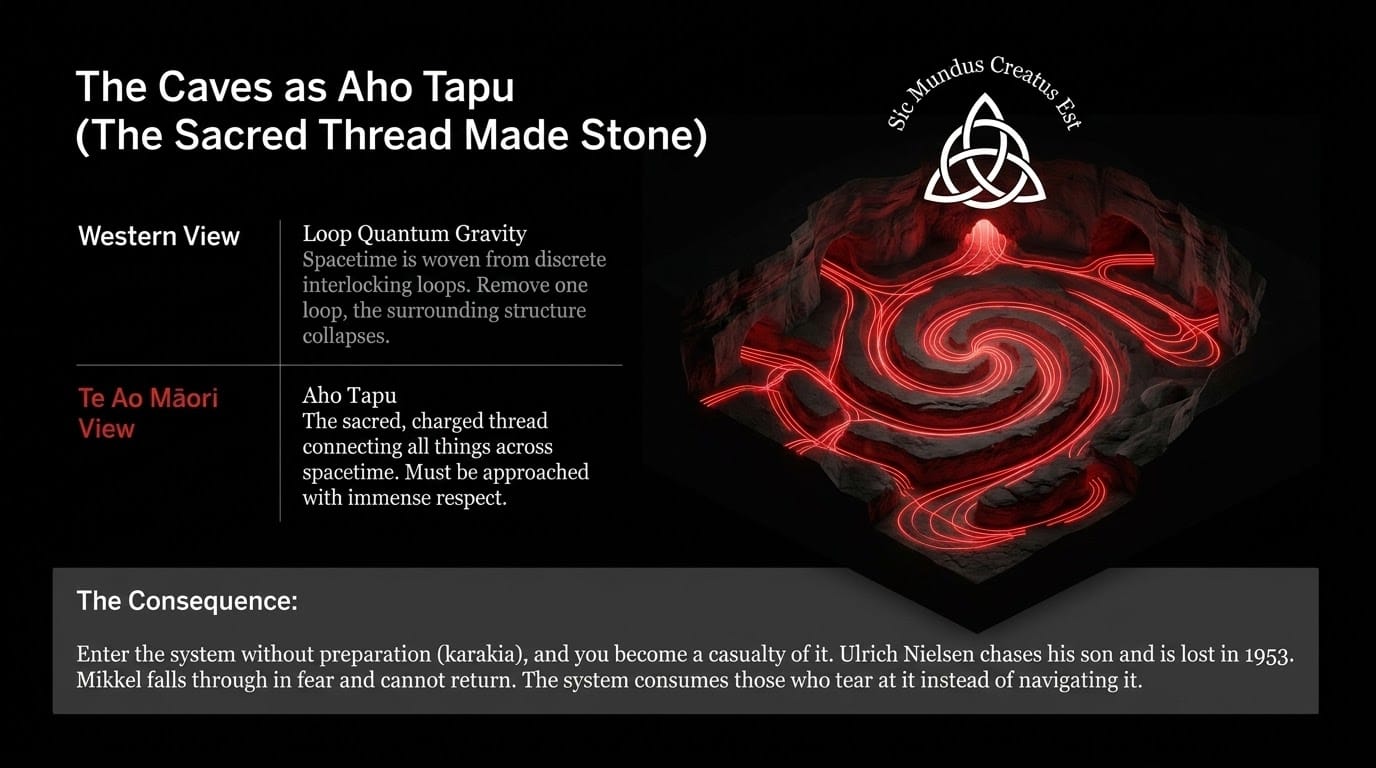
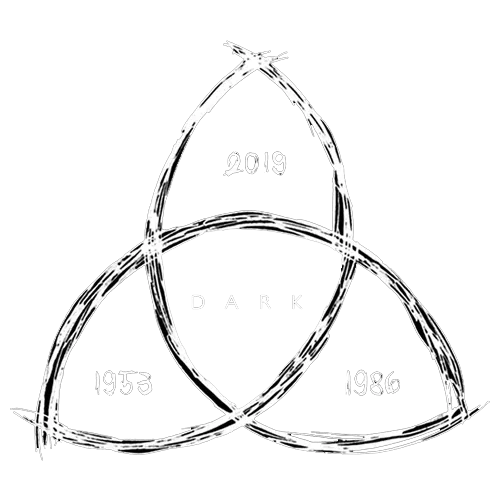
The physical heart of Dark is the Winden Caves — an intricate system of tunnels beneath the town, adjacent to the nuclear power plant, accessible through a door carved with a triquetra symbol and the words Sic Mundus Creatus Est — "Thus the world was created." The Dark Fandom Wiki's Winden Caves entry describes them as containing "the wormhole" and notes their connection to the nuclear power plant and bunker.
The caves contain a wormhole connecting 1953, 1986, and 2019 in both directions. Tannhaus's machine — powered by the God particle and caesium — is what opened and sustains this wormhole. The filming location guide at ftrc.blog confirms the caves are "one of the key locations in this crazy series" and the portal through which characters time travel.
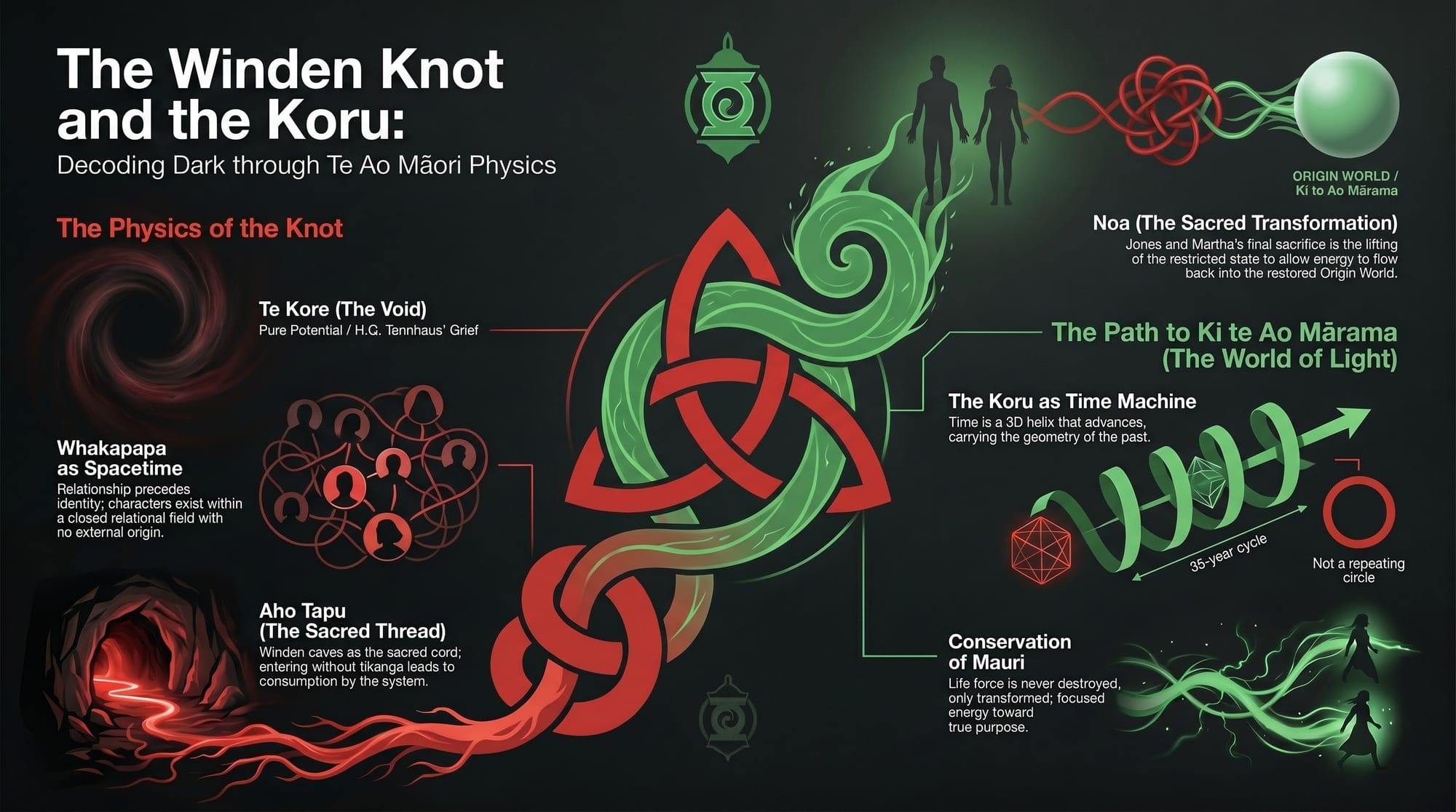
In te ao Māori physics, the caves are the aho tapu — the sacred thread connecting all things across time and relation. The word aho means a thread, a cord, a line. The word tapu means sacred, charged, restricted. The aho tapu is not simply a connection. It is a charged connection — one that must be approached with respect, with preparation, with karakia. The triquetra carved above the cave door is Winden's version of that warning: this portal is tapu. Enter without preparation and you will be consumed by the system you enter.
Every character who enters the caves without proper understanding is consumed. TV Guide's Dark Season 1 explainer notes that "there is also a wormhole that allows people to travel 33 years" — and confirms Ulrich loses himself in 1953 chasing Mikkel. The caves reward only those — like Claudia — who learn to navigate the thread rather than tear at it.
The triquetra is also the takarangi made Western — the nested spiral of loop quantum gravity, where spacetime at the smallest scale is woven from discrete interlocking loops, each existing only in relation to adjacent loops. Remove any one loop and the surrounding structure changes. The loops are not independent. They are the relation.
The 33-Year Cycle — The Koru as Time Machine
The most distinctive feature of Dark is the 33-year cycle. The Daily Fandom's analysis confirms: "The three grim main cycles that interconnect and tell the story of the sci-fi complexity of the town of Winden are 1953, 1986, and 2019." Three eras connected by the Winden caves, exactly 33 years apart. The same events recur: a child disappears, a body is found, the nuclear plant hums, the four families orbit each other in patterns of love and loss and misrecognition.
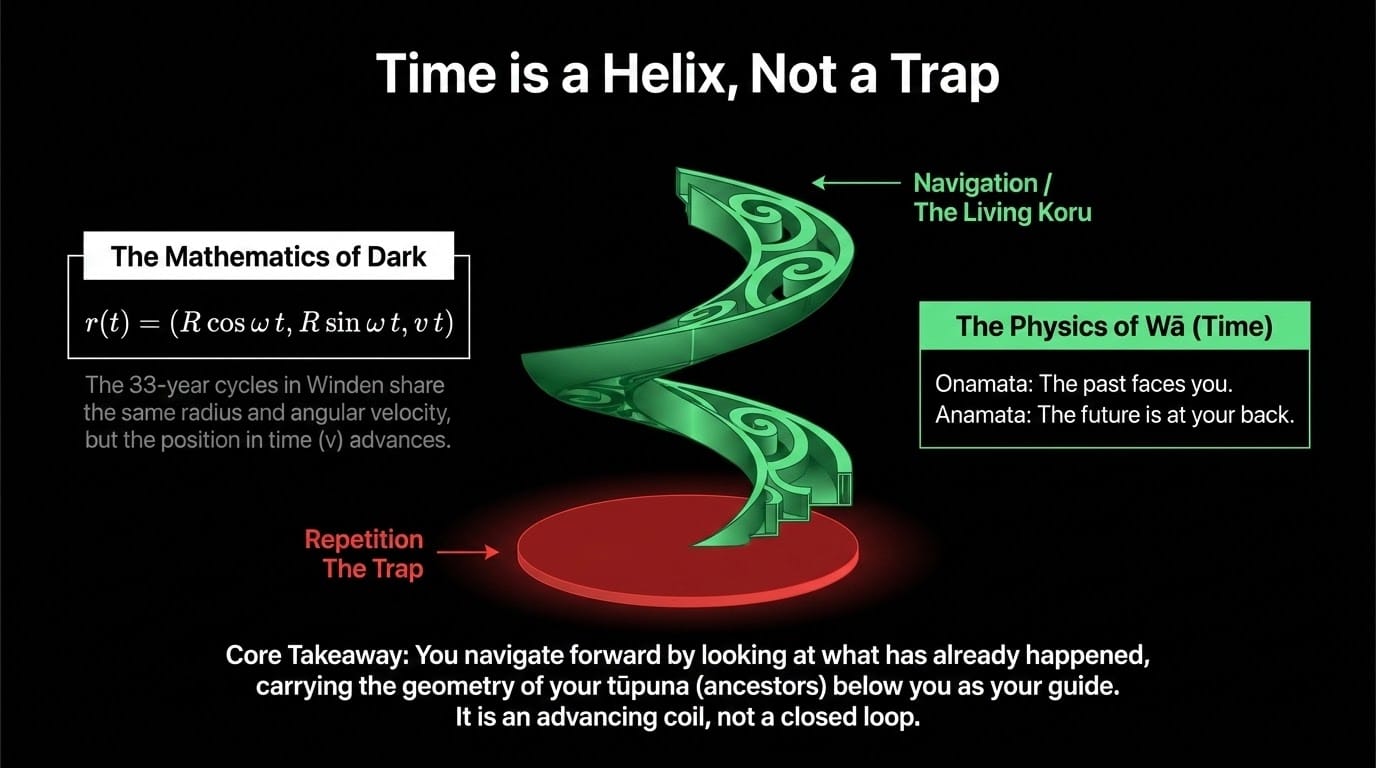
Most viewers initially read this as repetition. It is not repetition. It is a helix.
A circle repeats. A helix advances. The living koru — the ponga frond unfurling in the ngahere — is not a flat spiral drawn on paper. It is a three-dimensional coil: rotating and advancing simultaneously, each new turn carrying the full geometry of the turns below it while rising into new territory. Each 33-year turn of the Winden helix is identical in shape (the same families, the same town, the same caves, the same losses) but different in height (new generations, new knowledge, new consequences).
The helix equation:
r(t)=(Rcosωt, Rsinωt, vt)\mathbf{r}(t) = (R\cos\omega t,\ R\sin\omega t,\ vt)r(t)=(Rcosωt, Rsinωt, vt)
Where R is the radius (the scope of Winden), ω is the angular velocity (the tempo of each 33-year cycle), and v is the forward velocity through time. Every character in Dark is living inside this equation. Winden is not a trap — it is a coil. The question is not how to escape it but how to complete it.
The Māori concept of wā — time — already understood this. As Māori scholar Moana Jackson notes via the Pantograph Punch, in te reo Māori, the past faces you (onamata — the eyes of those who have come before), and the future is at your back (anamata — the eyes of those who come after). You navigate forward while looking at what has already happened. You carry the geometry of the coil below you as your guide. This is not nostalgia or conservatism. It is navigation — the same skill that carried your tūpuna across the moana in waka.
The Four Families — Whakapapa as the Spacetime Fabric
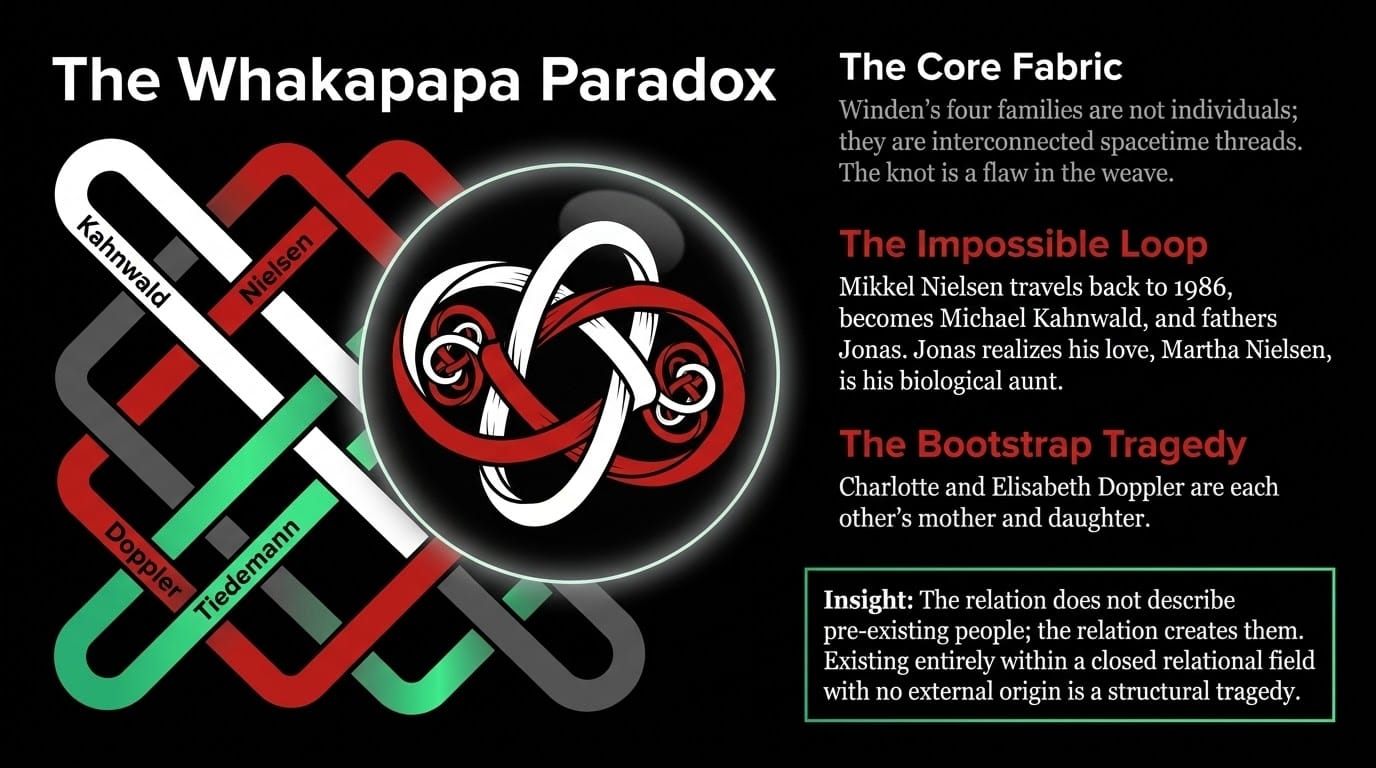
Dark is, at its core, a story about four families in a small German town. Radio Times' family tree guide confirms: "At its heart, Dark is a family drama based on four key surnames: Doppler, Nielsen, Kahnwald and Tiedemann."
- The Kahnwalds — Jonas, Michael (Mikkel), Hannah
- The Nielsens — Ulrich, Katharina, Mikkel, Magnus, Martha
- The Dopplers — Charlotte, Elisabeth, Peter, Franziska
- The Tiedemanns — Claudia, Egon, Regina, Bartosz
These four families are the whakapapa of Winden — the four threads of the woven fabric. In te ao Māori, whakapapa is not just genealogy. It is the framework through which all things are connected: people to people, people to land, land to time, time to origin. The Winden whakapapa is the knot. Each family is a thread. The knot is not a problem with any single thread — it is a problem with how all four have been woven through time.
The Mikkel → Michael → Jonas Loop: The Whakapapa Paradox
The most important whakapapa story in Dark is this: Jonas Kahnwald's father is Mikkel Nielsen — a boy who, at the time Jonas knows him in 2019, is several years younger than Jonas himself.
The Dark Fandom Wiki's Mikkel Nielsen entry states:
"He is the youngest child of Ulrich and Katharina Nielsen and the brother of Martha and Magnus. He gets married to Hannah, and they both conceived Jonas."
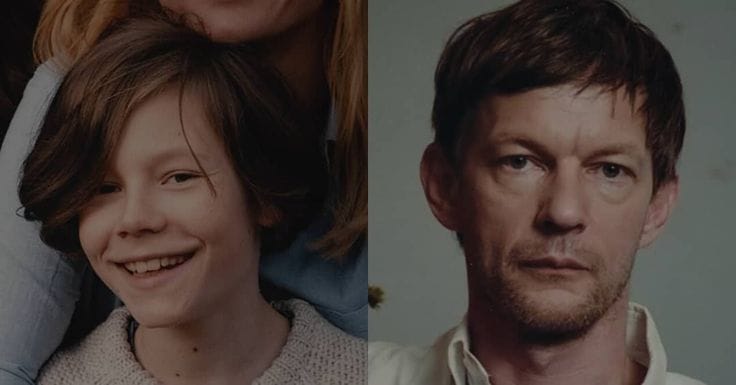
Mikkel Nielsen is a child in 2019 — Jonas's young friend, and (unbeknownst to either of them) Jonas's biological uncle, being the younger brother of Jonas's love interest Martha Nielsen.
The Dark Fandom Wiki's Martha Nielsen entry confirms:
"Now aware that Mikkel is his father, making Martha his biological aunt, Jonas rejects her tersely, unable to explain the impossibility of their relationship."
During the night in the Winden forest in November 2019, Mikkel passes through the cave wormhole and emerges alone in 1986. He cannot return.
Vulture's Dark family tree explainer confirms:
"Mikkel winds up stuck in 1986, gets adopted by Ines Kahnwald, and takes the name Michael Kahnwald. He marries Hannah and they have Jonas."
TV Guide's character connections guide further states:
"Jonas is the son of Hannah and Michael Kahnwald, formerly known as Mikkel Nielsen, who was the younger brother of Jonas' friends Martha and Magnus."
This is the whakapapa paradox in its purest form: the relation precedes and constitutes both parties.
Jonas exists because Mikkel time-travelled to 1986. Mikkel time-travelled because Jonas was in the forest that night. Jonas was in the forest that night because he already existed as Michael's son. Neither has an origin outside the loop. The relationship does not describe two pre-existing people. The relationship creates them.
The devastating personal consequence: Jonas is in love with Martha Nielsen. When he discovers that Mikkel — Martha's younger brother — grew up to become his father Michael, he realises that Martha is his biological aunt. The most fundamental relational coordinates of Jonas's life — his father, his love — are structurally incompatible. His aho tapu is knotted into itself.
The Deeper Loop: The Unknown and the Full Whakapapa Circuit
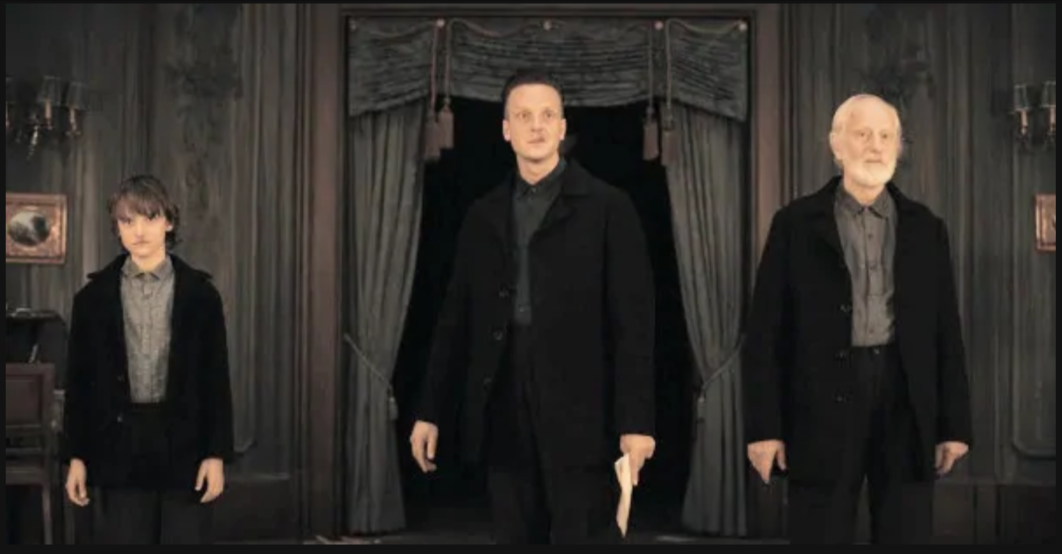
The knot goes deeper still. Jonas and Martha (from Eva's world) conceive a child known only as The Unknown.
The Dark Fandom Wiki's Unknown entry confirms he
"was conceived on November 6, 2019, in the bedroom of the alternate Martha Nielsen."
This figure — appearing simultaneously as a child, an adult, and an old man — fathers Tronte Nielsen, who fathers Ulrich Nielsen, who fathers Mikkel Nielsen, who grows up as Michael Kahnwald and fathers Jonas Kahnwald — who fathers The Unknown. The whakapapa has no external origin. Every person in it exists only in relation to every other person in it.
Charlotte and Elisabeth: The Ultimate Closed Relational Field
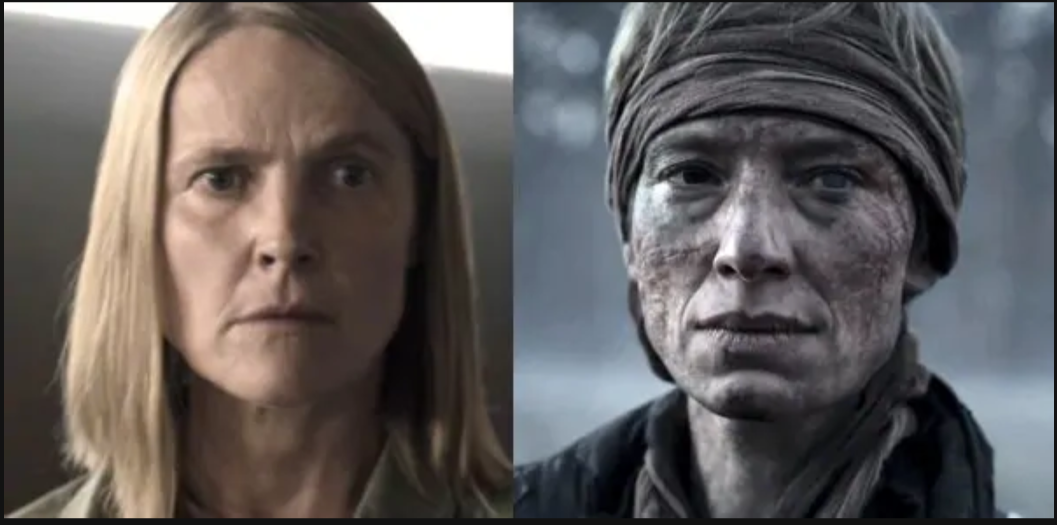
Charlotte Doppler is raised by H.G. Tannhaus as his adopted granddaughter after his family is killed.
Express.co.uk's Charlotte Doppler explainer confirms her biological parents are Noah (her father) and Elisabeth Doppler — her own daughter — and that
"Noah and Elisabeth name their baby Charlotte after Elisabeth's mother."
Charlotte grows up, marries Peter Doppler, and gives birth to Elisabeth.
The Dark Fandom Wiki's Elisabeth Doppler entry confirms she
"was born in 2011, youngest daughter of Charlotte and Peter Doppler."
Elisabeth grows up, partners with Noah, and gives birth to Charlotte. TVobsessive.com's Season 2 analysis states it clearly:
"Charlotte Doppler's daughter, Elisabeth, is also her mother. Charlotte is the child of Elisabeth and Noah. Elisabeth is the child of Charlotte."
The loop has no beginning.
This is the bootstrap paradox as lived whakapapa: two women who are simultaneously each other's mother and daughter, existing entirely within a closed relational field with no origin outside themselves. Strip the loop — which is what Jonas and Martha ultimately do — and both dissolve.
Mauri — The Life Force the Knot Cannot Destroy
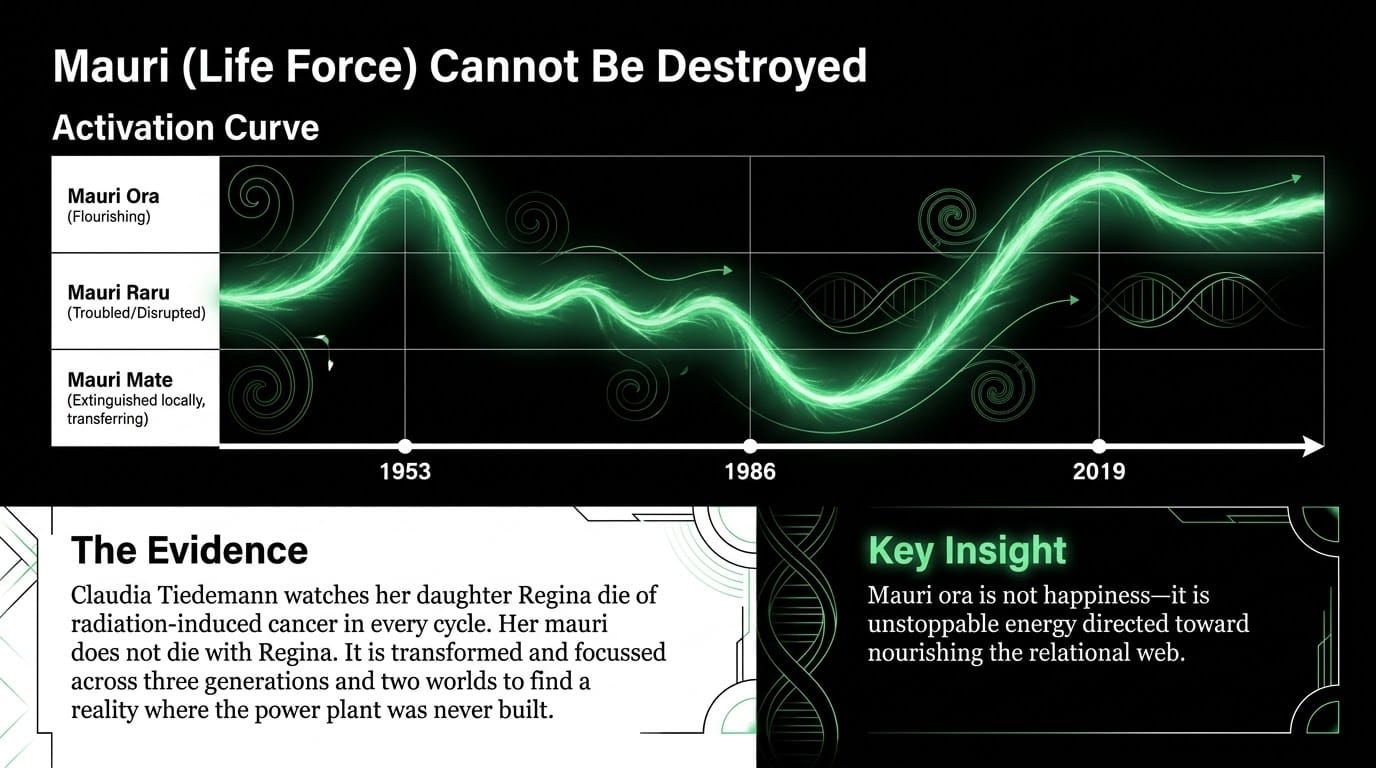
Here is the most important thing to understand about the knot in Dark: it does not destroy mauri. It transforms it — from mauri ora (flourishing) to mauri raru (troubled) to mauri mate (extinguished in its local form) — but the energy is never lost.
Every child who disappears through the Winden caves carries their mauri into a different time. Mikkel's mauri as a child in 2019 becomes Michael's mauri as an adult in the 1980s and 1990s, becomes the mauri of love and fatherhood poured into Jonas, becomes the mauri of Jonas's entire journey. The mauri is not destroyed by the time travel. It is transformed, concentrated, passed forward through a different configuration of relation. This is conservation of energy — the first and most fundamental law of physics — expressed as lived experience.
The character who demonstrates this most fully is Claudia Tiedemann. The Dark Fandom Wiki's Claudia Tiedemann entry confirms her role as "Nuclear power plant director (retired)" and daughter of Egon Tiedemann, with Regina as her own daughter. Claudia watches Regina die in every cycle — the knot's radiation from the nuclear plant causes Regina's cancer. For decades across both worlds, she watches her daughter die and resets. Her mauri should be mate. Instead, it is the most concentrated force of love in the entire story.
She cannot save Regina within the knot — so she works across three generations and two worlds to find the Origin World, where Regina never gets sick. Radio Times' season 3 ending explainer confirms that Claudia is the one who delivers the critical knowledge: the knot can be broken by sending Jonas and Martha to the Origin World. Her mauri is not depleted by the impossibility of the task. It is focussed by it.
This is what mātauranga Māori means by mauri ora: not happiness, not ease, not the absence of suffering. It means the life force directed toward its true purpose — the nourishment of the relational web that sustains all things.
Mana — Adam, Eva, and the Gravity of Grief
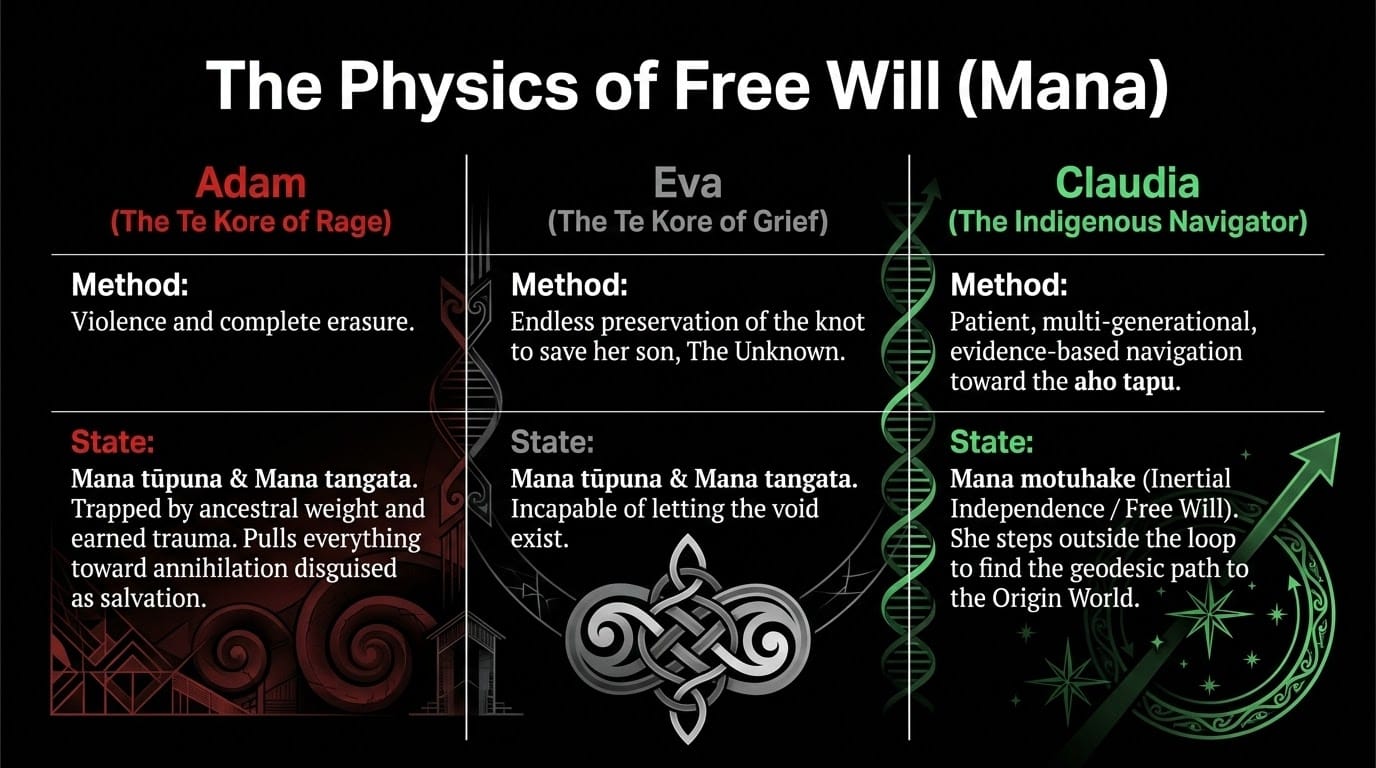
Adam (the oldest version of Jonas) and Eva (the oldest version of Martha from the mirror world) are the two dominant gravitational centres of the knot. The Dark Fandom Wiki's Adam and Eva episode entry confirms both as the aged versions of the show's central protagonists. Express.co.uk's analysis of Adam's identity examines the rope-burn scar evidence confirming Adam as old Jonas — an injury Jonas received from adult Elisabeth Doppler in the post-apocalyptic future.
Adam believes the knot can be destroyed by violence and erasure. His curvature pulls everything toward annihilation disguised as salvation. Eva believes the knot must be preserved through endless small interventions. She is not preserving it out of malice — she is preserving it because within the knot, her son The Unknown exists, and she cannot bear the void of his non-existence.
Both Adam and Eva are locked in their own Te Kore — Adam in the Te Kore of rage, Eva in the Te Kore of maternal grief. Neither can reach Te Ao Mārama from where they stand because both are still inside Te Pō. The five types of mana in te ao Māori illuminate their impasse:
- Both have mana tūpuna — the weight of ancestral lineage pressing on every decision
- Both have mana tangata — enormous personal authority earned through suffering and intelligence
- Neither has mana motuhake — true self-determination; they are both trapped in the loop
Mana motuhake — sovereignty, inertial independence, the ability to maintain your own trajectory against outside forces — is the physics of free will in Dark. The characters who achieve it are the ones who step partially outside the loop: Claudia first, then finally Jonas and Martha.
Claudia — The Navigator Who Found the Geodesic
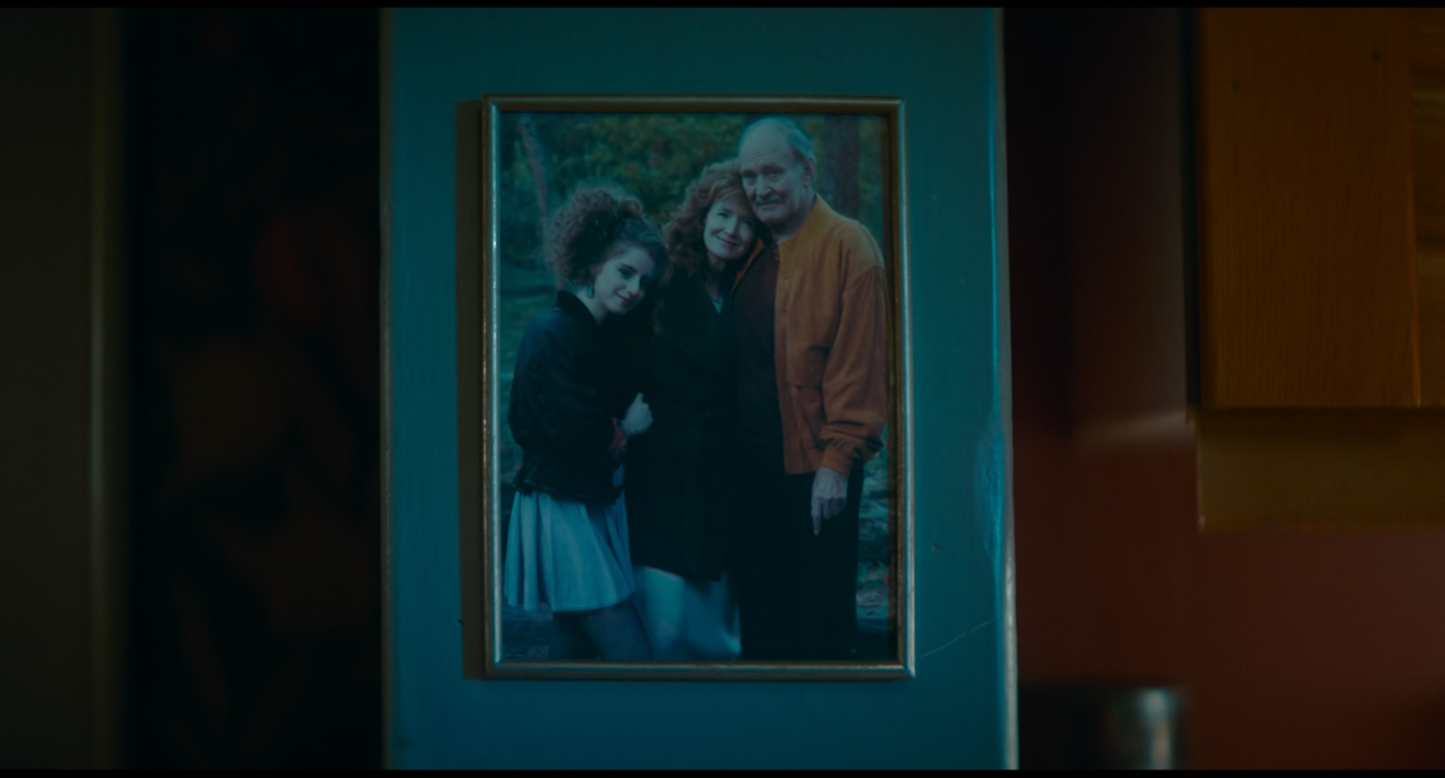
In waka navigation, the greatest skill is not sailing fast. It is knowing where you are. A navigator who cannot read the stars, the swells, the birds, and the wind cannot find the island no matter how fast the waka moves.
Claudia Tiedemann is Dark's navigator. Over decades of internal series time, navigating both worlds outside the normal constraints of the loop, she gathers the knowledge of the Origin World — the knowledge that the knot is not inevitable but contingent, dependent on Tannhaus activating his machine on June 21, 1986, an event confirmed by Bustle's Dark Season 3 chronological timeline.
She discovers what Māori epistemology has always held: that time is a helix, not a trap.
The coil has been wound tight by grief, but it can be advanced to its conclusion. Claudia achieves wairua ora — a coherent worldline that is genuinely her own.
She brings this knowledge to Adam not as a weapon, but as a gift — the contents of the three kete of Tāne: knowledge of the seen, the unseen, and the potential.
Radio Times confirms that Claudia is the one who tells Adam
"the only way to set the universe right and stop the apocalypse is for Martha and Jonas to return to the origin world."
Jonas and Martha — Noa as Sacrifice
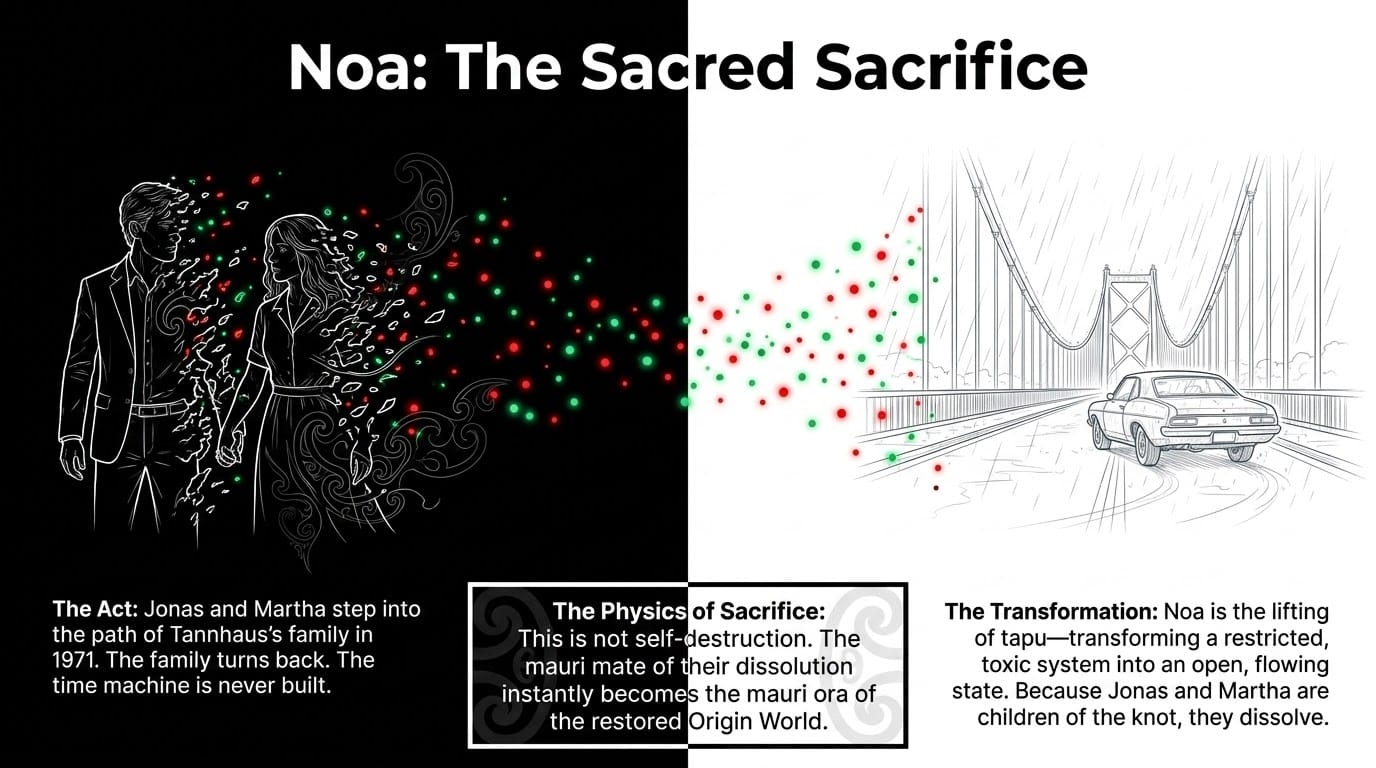
The finale of Dark is the most precise dramatisation of noa ever committed to screen.
Noa is the lifting of tapu — the transformation of a charged, sacred, restricted system into a neutral, open, flowing state. It is not destruction. It is transformation. When a tohunga lifts the tapu from an object, the energy contained within it is not lost — it flows back into the wider system in forms that can nourish rather than harm.
Jonas and Martha travel to the Origin World and arrive at the bridge on the rainy night in 1971. Marek's car approaches the broken bridge. Jonas and Martha stand in the path of the headlights. Decider's Dark ending explained confirms: "The only way to set the universe right and stop the apocalypse is for Martha and Jonas to return to the origin world and stop HG from ever messing with time." Marek sees two figures, brakes, and turns the car around. The family is saved. Tannhaus never loses them. He never builds the machine. The Origin World breathes again.
And Jonas and Martha dissolve. Radio Times confirms: "No, Martha and Jonas never existed in the origin world. This means that they are wiped from existence entirely." They do not die in the conventional sense. They are transformed — the mauri of their love, their struggle, their sacrifice, flowing back into the Origin World as the conditions that allow the survivors to live fully. The mauri mate of their dissolution becomes the mauri ora of the Origin World restored. The knot becomes the koru — from a closed, self-consuming loop to an open, advancing coil.
The Survivors — Ki te Ao Mārama
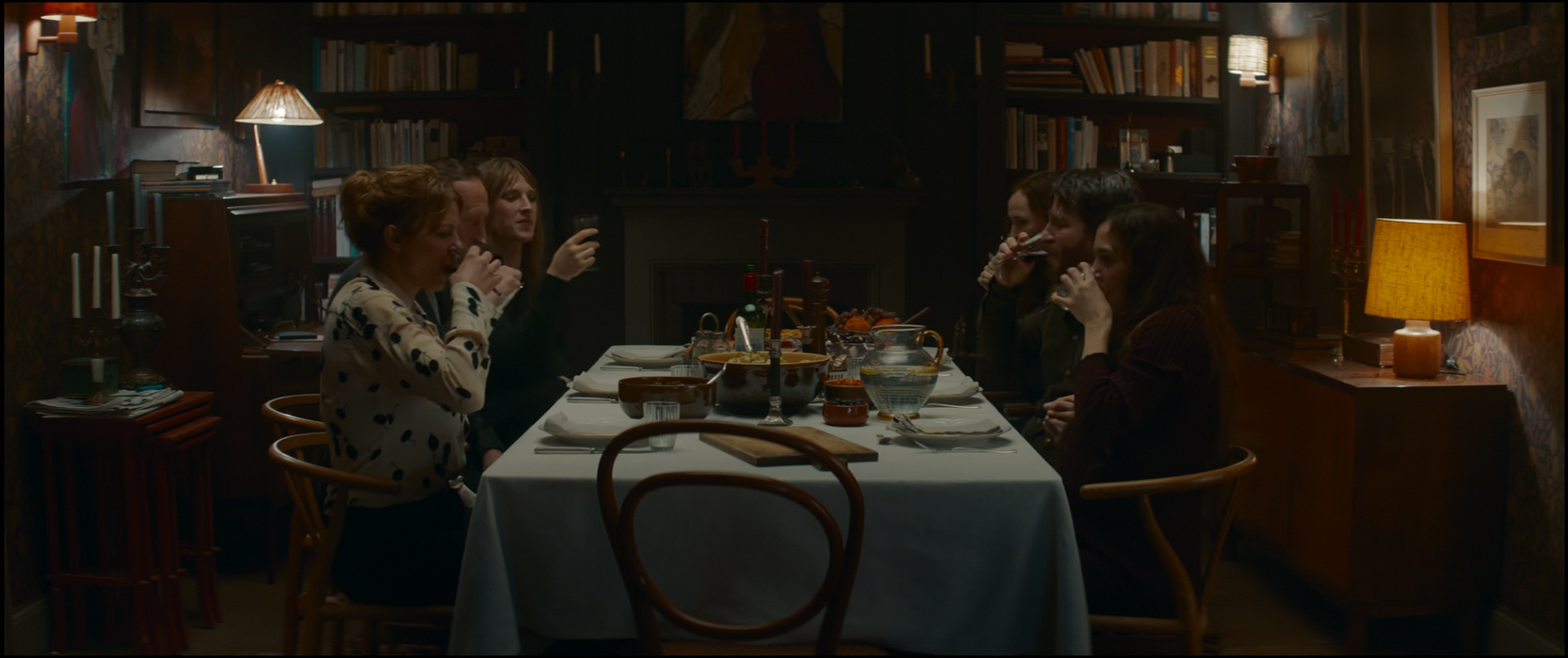
When the knot dissolves, the characters whose existence never depended on the loop remain at a dinner party in the restored Origin World. TV Guide's Dark season 3 finale recap confirms the survivors: Katharina, Hannah (pregnant), Peter, Benni, Wöller (both eyes intact), and Torben (both eyes intact).
Radio Times confirms that characters whose existence depended entirely on the knot — Jonas, Martha, Charlotte, Elisabeth, Bartosz, Magnus, Franziska, The Unknown — are erased from existence. These survivors have mana motuhake — inertial sovereignty. Their worldlines persist because they have mass and trajectory that did not require the loop to constitute them.
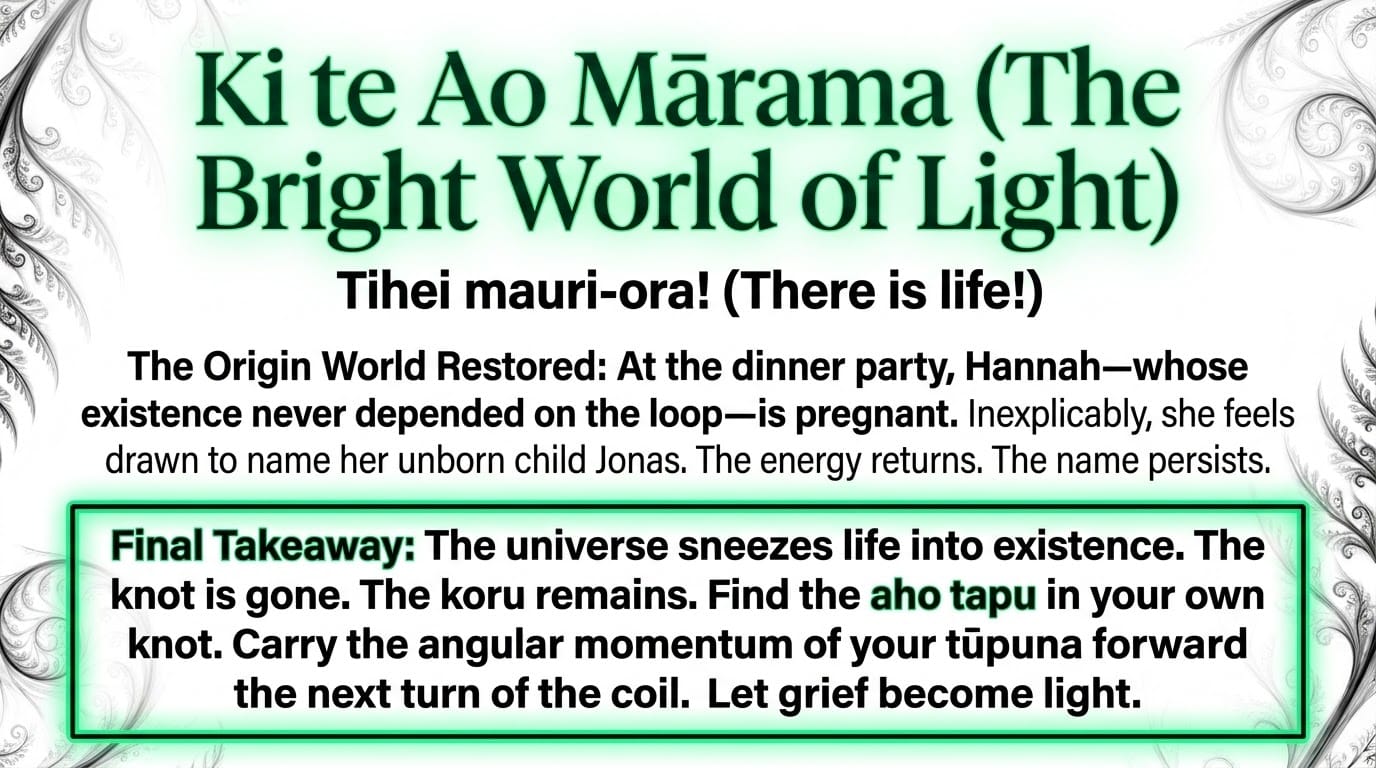
Hannah naming her child Jonas is the most beautiful moment of the finale. She does not know why she feels drawn to the name. But something of the relation persists — transformed, encoded in intuition rather than explicit memory. The mauri of Jonas does not disappear from the universe. It becomes the name she gives her child. It becomes the potential in a new Te Kore — a new void, charged with possibility, ready to advance into a new helix. This is Ki te Ao Mārama — the bright world of light. A world where the aho tapu runs true, where mauri flows and nourishes rather than circulating endlessly in a closed, consuming loop.
What Dark Gives Us
The Winden knot is a story about every community that has been damaged by a single catastrophic moment and forced to live in the aftermath, repeating the same patterns of grief and resistance without access to the knowledge needed to advance the coil.
The path forward is not violence (Adam's way). It is not preservation of the loop (Eva's way). It is Claudia's way: patient, multi-generational, evidence-based navigation toward the aho tapu — the sacred thread back to the origin. And it is Jonas and Martha's way: the willingness to dissolve the self that was constituted by the damage, in order to allow the Origin World to be restored. Not self-destruction. Transformation. Noa. The energy returns. The name persists. The helix advances.
Tihei Mauri-Ora
At the end of the Māori creation chant
— after Te Kore, after the stages of Te Pō, after the glimmer of Whai-ao — comes the exclamation:
Tihei mauri-ora! — There is life!
The word tihei is a sneeze. Not a formal proclamation. The most involuntary, most physical, most unstoppable expression of the body. The universe did not decide to create life. It sneezed it into existence. Te Kore could not hold its breath forever.
At the end of Dark, Hannah holds her unborn child — a child she will name Jonas — and the Origin World dinner continues and the rain stops and Winden breathes.
The knot is gone. The koru remains. The coil advances. The angular momentum of every choice, every sacrifice, every act of love across three seasons and 33-year cycles is conserved — not in the bodies of the people who dissolved, but in the world that their dissolution made possible.
This is te ao Māori physics. This is what the koru means. This is what the taiaha is for — not to destroy, but to advance the coil, to carry the angular momentum of the tūpuna forward into the next turn, to find the aho tapu and follow it back to the origin, and then forward again, into Ki te Ao Mārama.
The bright world of light.
Tihei mauri-ora.
Koha Consideration — The Winden Knot and the Koru
Dark showed us what happens when grief activates the void without tikanga — without the sacred protocols, without a community to hold the transformation.
Tannhaus had no one. He sat alone in Te Kore with his machine and his loss, and the world split in two.
This mahi — The Māori Green Lantern essays — is the tikanga that Tannhaus needed. It is the work of naming the knot, tracing the aho tapu, and navigating the helix back toward Ki te Ao Mārama. It is the work of ensuring that whānau have access to a framework
— mātauranga Māori, physics, whakapapa — that helps them understand not just what is happening in the world, but why, and how to move through it.
Every koha signals that whānau are ready to support the accountability that Crown and corporate structures will not provide. It signals that rangatiratanga includes the power to support our own truth tellers.
Like Claudia navigating both worlds across three generations to find the origin — this work is patient, multi-generational, and it requires fuel.
Kia kaha, whānau. Stay vigilant. Stay connected. And if you are able, consider a koha to ensure this voice continues.
If you are unable to koha, no worries! Subscribe or follow The Māori Green Lantern, kōrero and share with your whānau and friends — that is koha in itself.
Four Pathways to Support This Mahi
🌿 Koha — Direct Contribution
For those who wish to support this mahi directly with a voluntary contribution:
Support The Māori Green Lantern on Koha
📩 Subscribe — Essays Directly to Your Inbox
For those who wish to receive essays directly and support through subscription:
Subscribe to The Māori Green Lantern
🏦 Direct Bank Transfer
For those who prefer direct bank transfer:
Account name: HTDM
Account number: 03-1546-0415173-000
📘 Facebook — Follow and Subscribe
For those on Facebook:
Follow The Māori Green Lantern on Facebook
Like Jonas and Martha finding the aho tapu back to the Origin World — your support helps this work find the people who need it most. The mauri of this kaupapa is held by the community that chooses to sustain it.
Kia kaha, whānau. Watch the show. Read the whakapapa. Find the aho tapu in your own knot. The origin world is still there — before the machine was switched on, before the grief became the device. Navigate toward it. Carry the angular momentum of everyone who loved you into the next turn of the coil. That is what we are here for.
Disclaimer: All Dark plot details sourced from the Dark Fandom Wiki, Vulture, TV Guide, Decider, Radio Times, and Bustle. All Māori cosmological and physics claims are consistent with verified scholarship. This analysis is educational and interpretive. It does not claim to represent the intentions of Dark's creators Baran bo Odar and Jantje Friese. No malice. Public interest: demonstrating the explanatory and narrative power of mātauranga Māori as a lens for understanding complex physics, time, identity, and healing. Prepared by Ivor Jones, The Māori Green Lantern, Tauranga, Bay of Plenty, Aotearoa New Zealand. June 2026.