"Luxon Tried to Steal Your Vote on Breakfast Radio, and I Am Not Going to Be Polite About It" - 11 August 2026
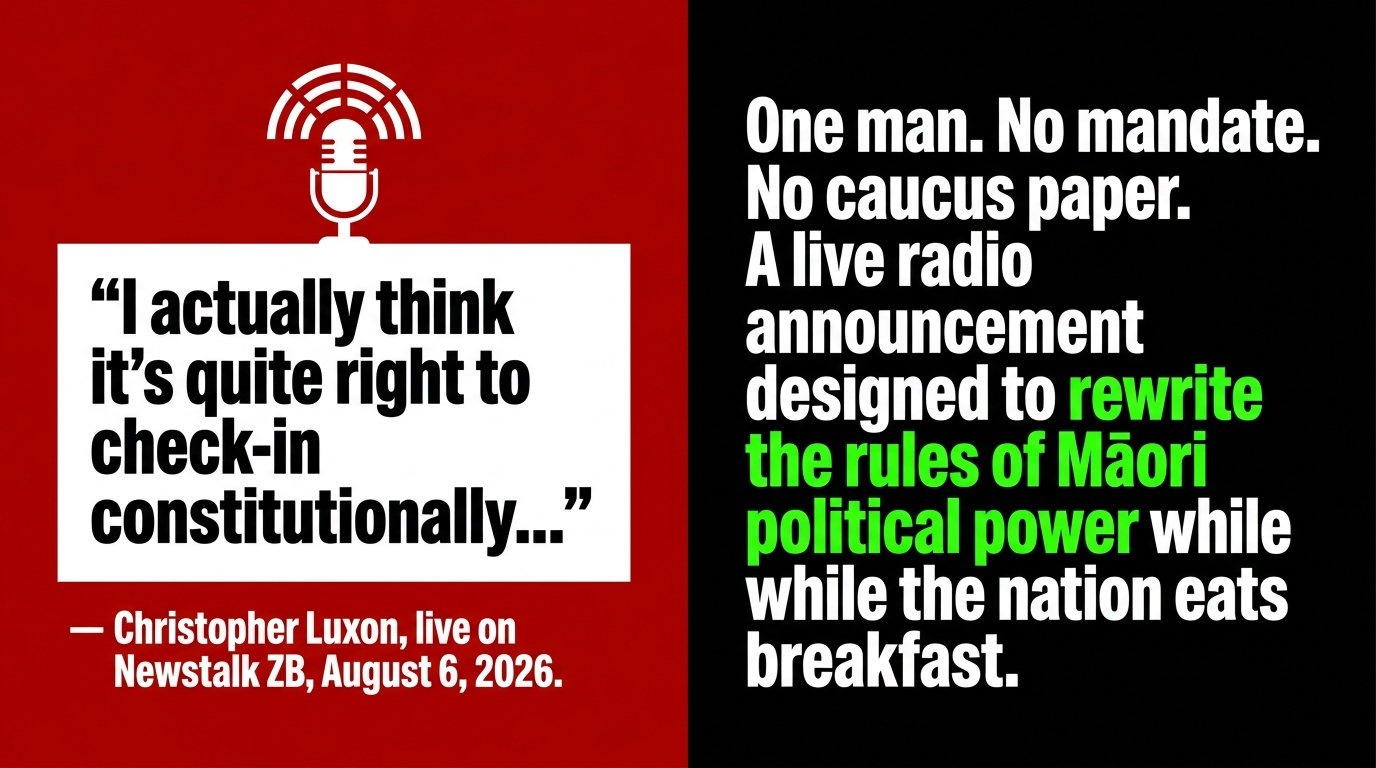
A man with no mandate, no caucus paper, and no shame just tried to rewrite the rules of Māori political power live on Newstalk ZB — and called it a "check-in."

Kia ora, I'm Ivor Jones.
I've spent years tracing the whakapapa of harm through this government's press releases — the manufactured crises, the quiet cuts, the spreadsheets dressed up as compassion. I have watched them dismantle Te Aka Whai Ora and call it "simplifying the system." I've watched them cut a billion dollars from Māori-specific funding across two budgets and call it "fiscal responsibility."
So when I tell you this MMP referendum is the most dangerous thing this coalition has floated yet, believe me — I've seen the rest of the con, and this one goes for the jugular.
 RNZ | Te Reo Irirangi o Aotearoa
 RNZ | Te Reo Irirangi o Aotearoa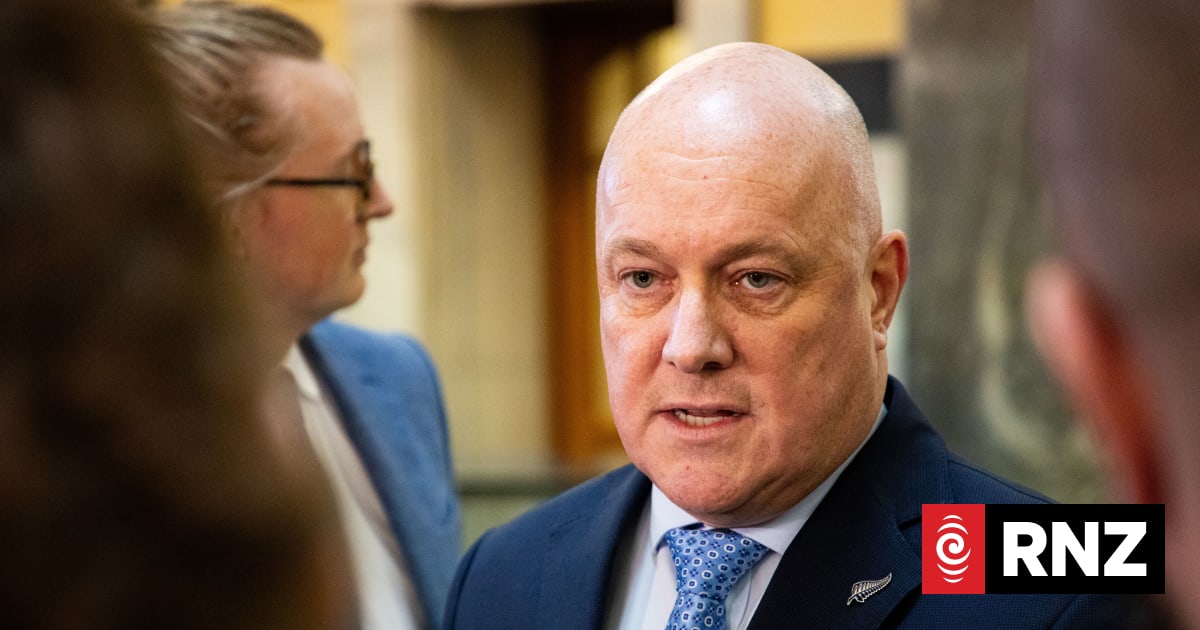
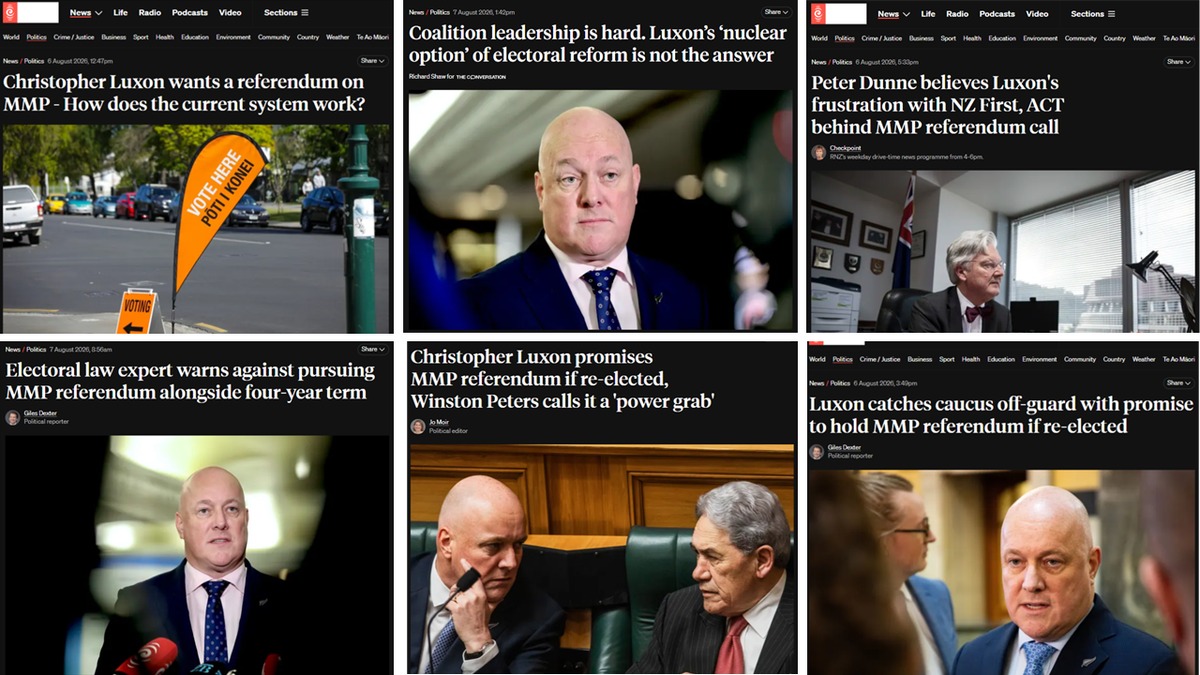
On 6 August 2026, Christopher Luxon told a Newstalk ZB radio host — not his Cabinet, not the country, a radio host — that he'd hold a referendum on MMP if re-elected RNZ.
Six of his own ministers — Louise Upston, Tama Potaka, Simon Watts, Simeon Brown, Paul Goldsmith, Mark Mitchell — couldn't tell reporters an hour later whether it was even party policy RNZ.
Chris Bishop called his boss's own words "musings" The Spinoff.
And two university professors with zero seats to win or lose have already called it what it is: a "brain explosion" RNZ — Andrew Geddis and a "nuclear option" RNZ — Richard Shaw.
 RNZ | Te Reo Irirangi o Aotearoa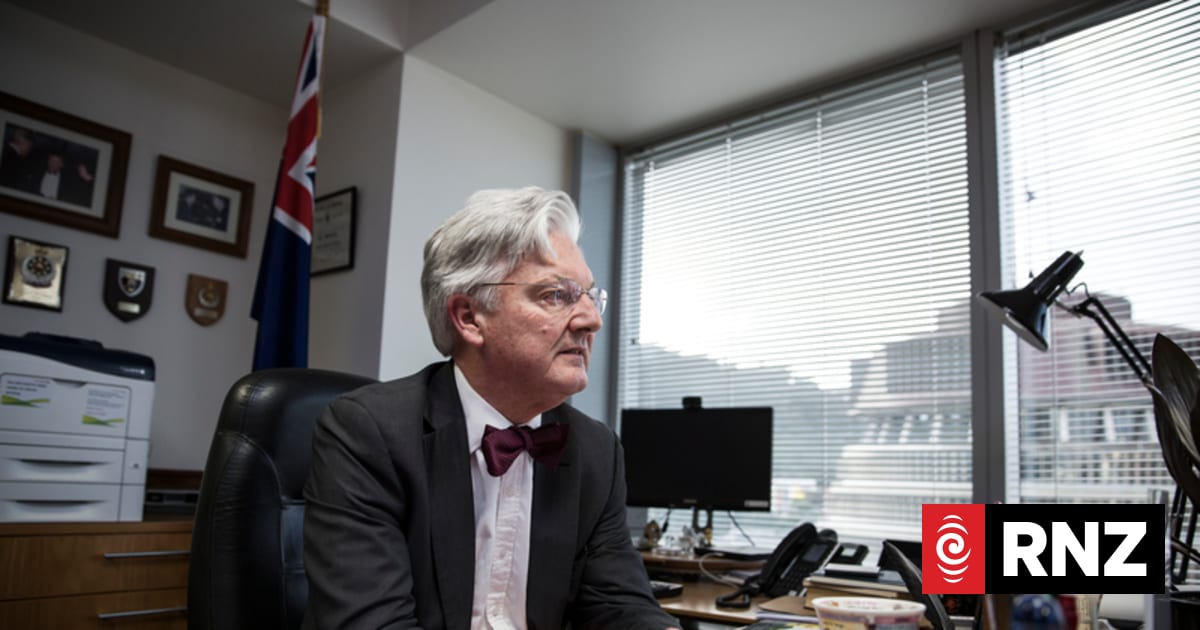
 RNZ | Te Reo Irirangi o Aotearoa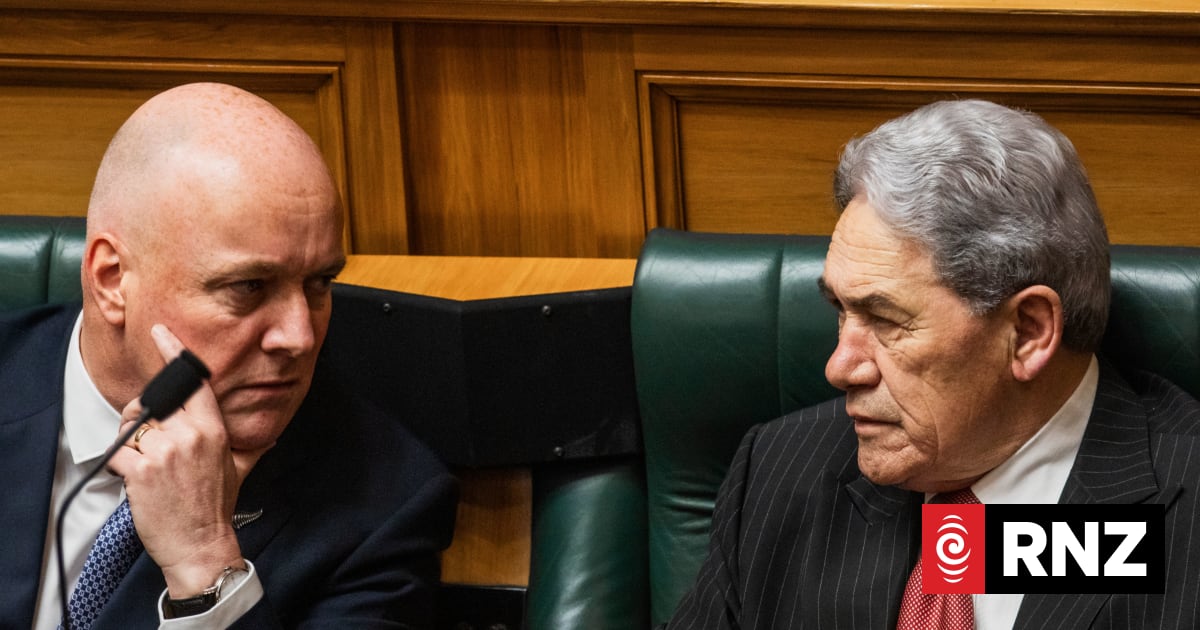
I don't need to editorialise that into a power grab. Winston Peters already did it for me:
"Shutting down and taking away true democratic representation from the people of New Zealand should be seen for what it is — a power grab and an ignorance for what it means to be a democracy" RNZ.
And no, I'm not going soft on Peters either — but even a broken clock names a crime correctly twice a term.
 RNZ | Te Reo Irirangi o Aotearoa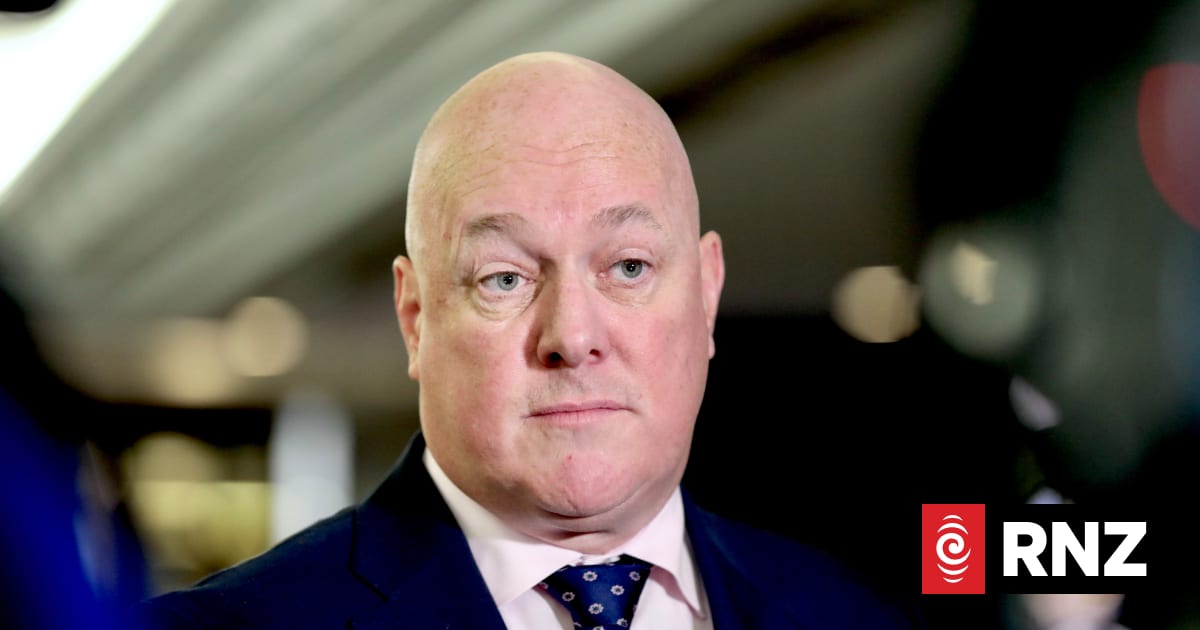
 RNZ | Te Reo Irirangi o Aotearoa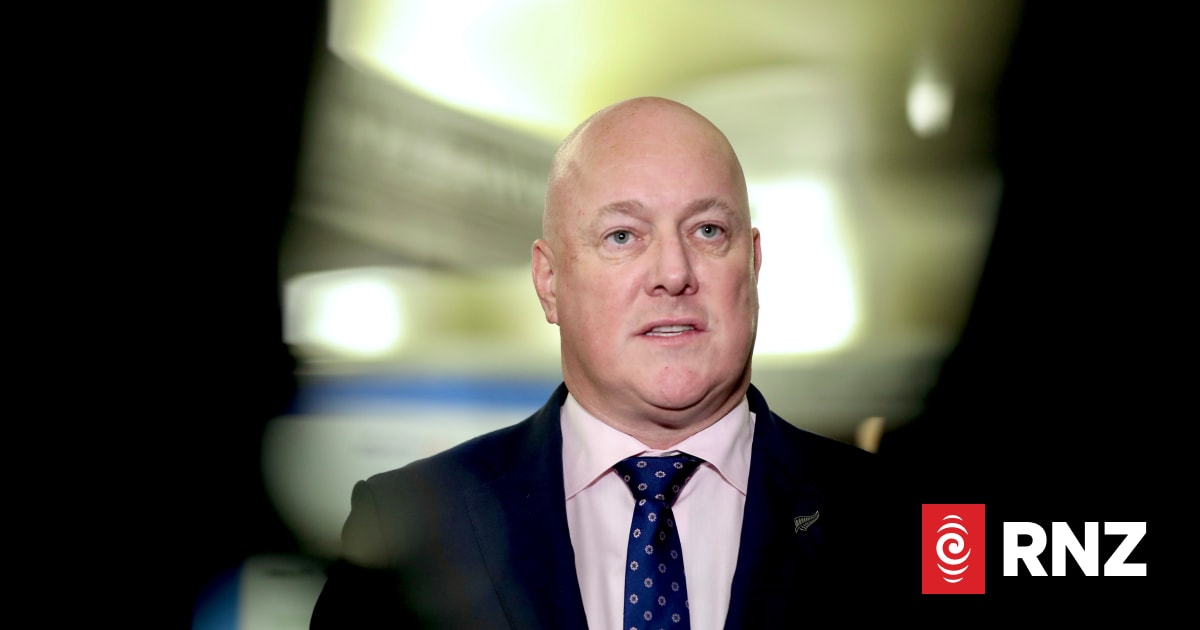
Connecting the Six Articles
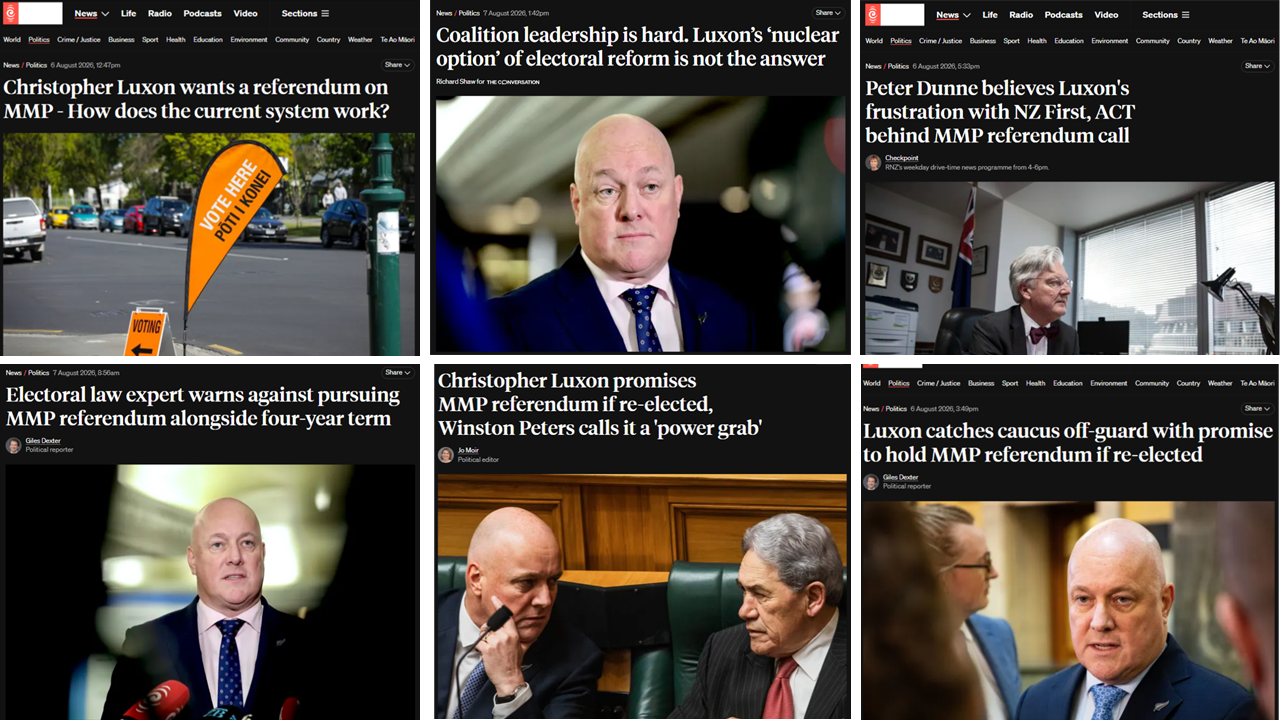
Read together, RNZ's six-part coverage traces a single, escalating story: Christopher Luxon first explained MMP's mechanics to voters as neutral background RNZ before making an off-the-cuff promise on Newstalk ZB to hold a referendum on the system if re-elected, which immediately drew Winston Peters' "power grab" accusation RNZ.
Within hours, RNZ found Luxon's own caucus scrambling — six ministers unable to confirm the policy existed, and Luxon's "yahoo or numpty" jab at coalition partners fuelling further backlash RNZ.
Former minister Peter Dunne then offered the interpretive key that ties the whole story together: this wasn't principled reform but frustration with NZ First and ACT boiling over RNZ.
Two independent academics later confirmed that read from outside politics altogether
— Andrew Geddis warning that bundling the MMP question with an already-abandoned four-year-term referendum would "undermine the validity of the referendum and the process" RNZ, and
Richard Shaw situating the move historically, arguing that no other MMP government has reached for the "nuclear option" of electoral reform simply to solve internal coalition friction RNZ.
Across all six pieces, the arc is consistent: an unmandated, unconsulted announcement, met first by political condemnation and then by academic consensus that it is process-driven pique dressed up as constitutional principle.
The Part Nobody in the Beehive Press Gallery Has Said Out Loud
Here's what none of the political reporters chasing Luxon down corridors this week have connected:
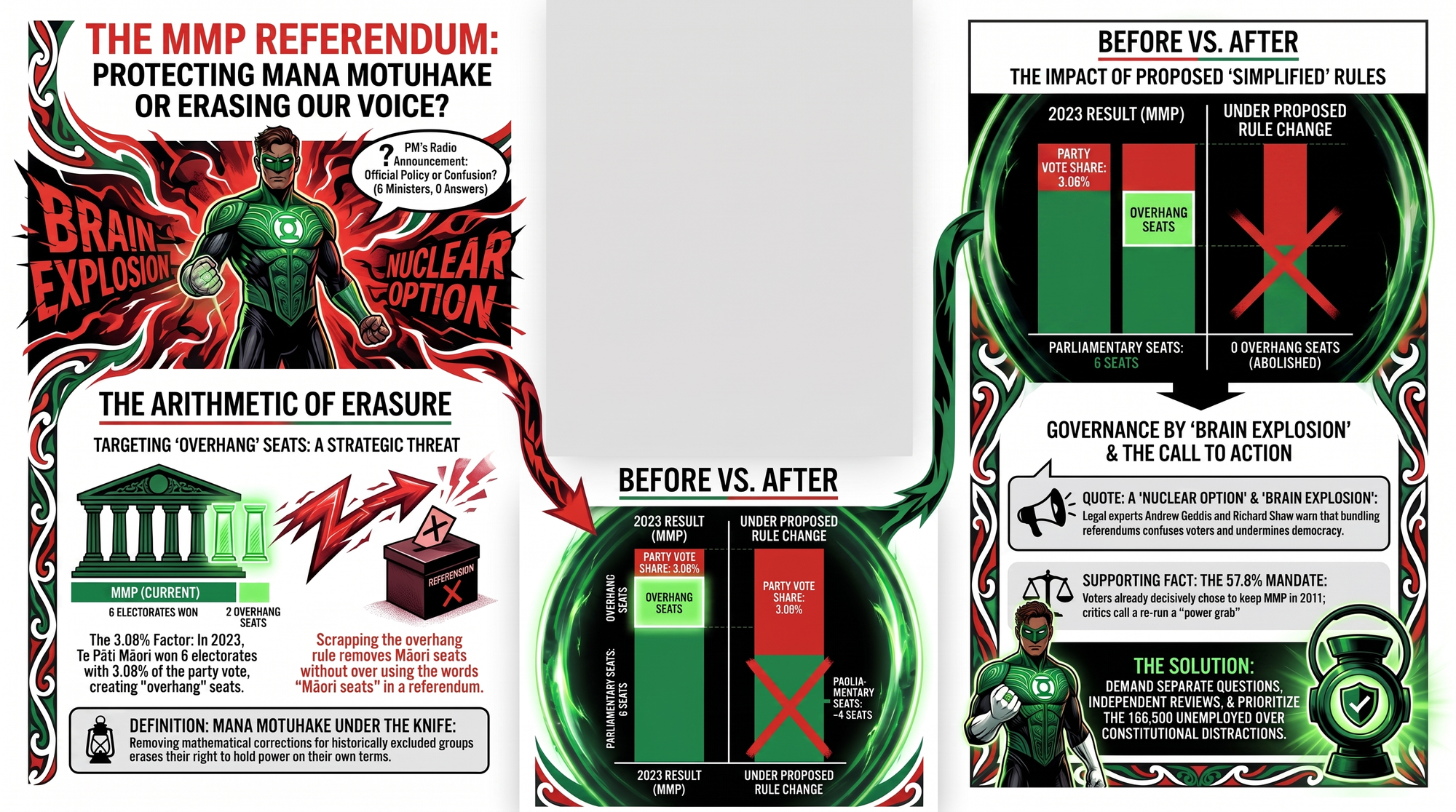
the exact mechanism the Electoral Commission recommended axing back in 2012
— the "overhang" provision — is the reason Te Pāti Māori holds the parliamentary weight it does right now Electoral Commission 2012 Final Report.
Te Pāti Māori won six of seven Māori electorates in 2023 on just 3.08% of the party vote — a share that, run through the maths, entitled them to about four seats. They walked away with six, and the system topped up Parliament with overhang seats to keep the proportionality honest RNZ; Wikipedia, cross-checked against RNZ figures.
Take away overhang, and you take away the arithmetic that let a Māori-led party punch that far above its party-vote weight. Nobody — not Luxon, not Geddis, not Shaw, not one caucus minister dodging microphones — has named this out loud. I'm naming it now.
Three Examples for the Western Mind
I write these for the reader raised on "one person, one vote, simple as that" — because MMP is not simple, and that's exactly why it protects people FPP was built to erase.
Example One: The Overhang Seat — Mana Motuhake Under the Knife
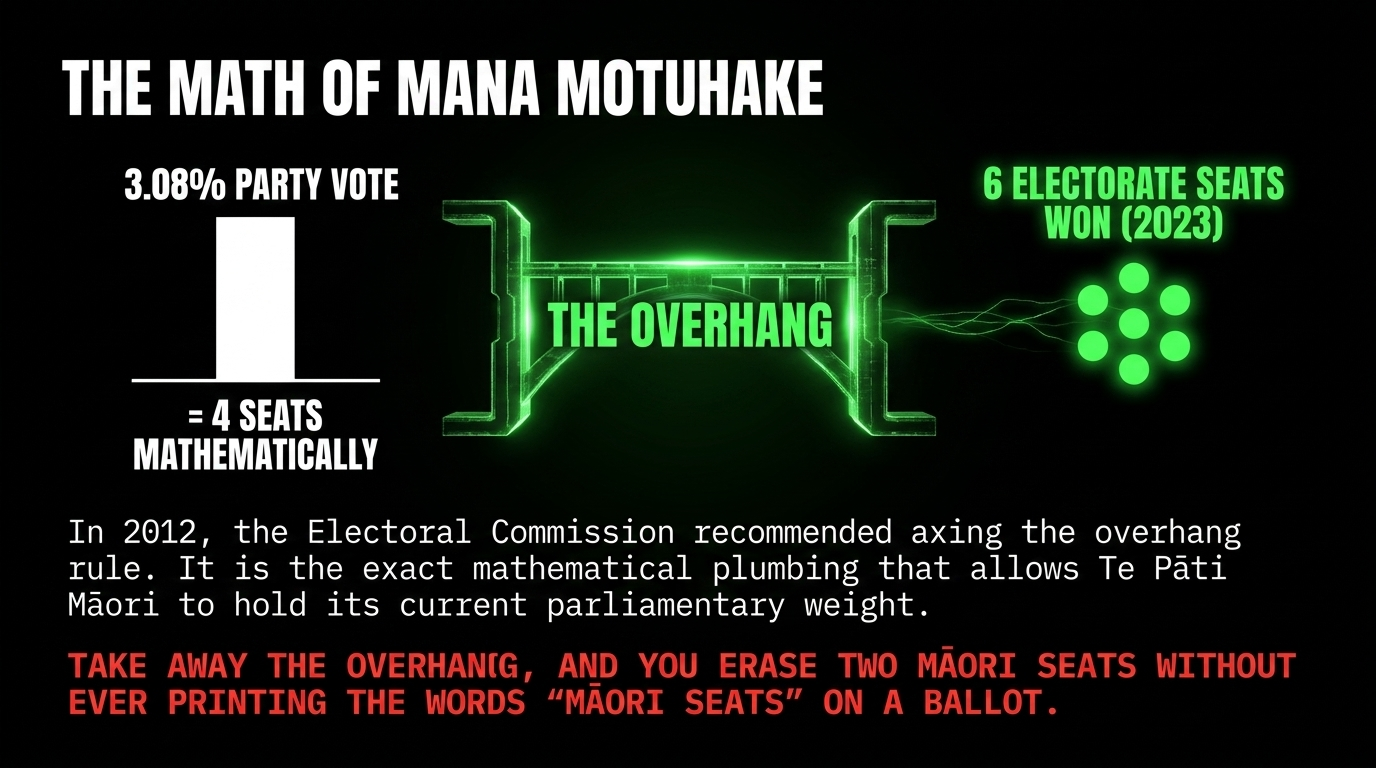
The scenario: Six Māori electorates. One party. A party vote of just over three percent. Under MMP's overhang rule, that translates into real seats at the table — seats that gave Te Pāti Māori genuine leverage in a finely balanced Parliament.
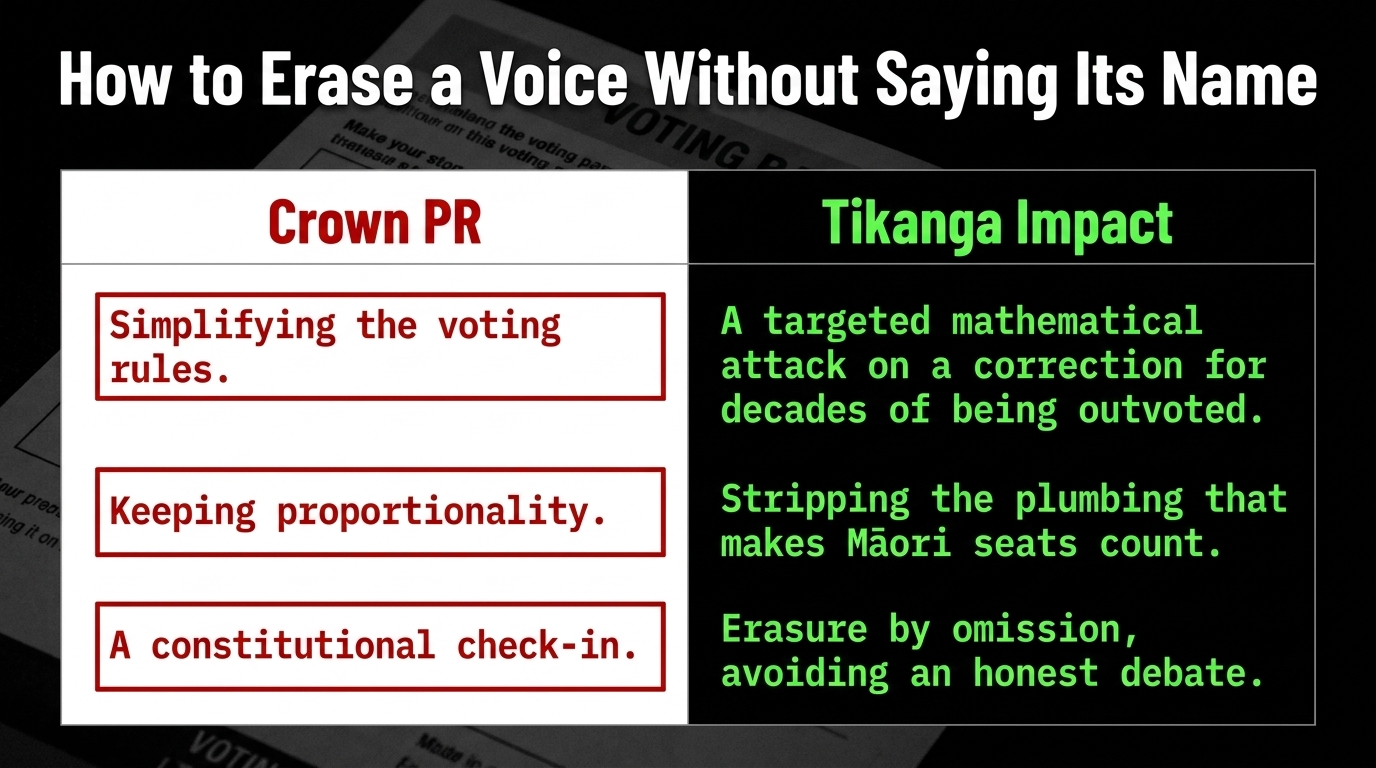
Quantified harm: 3.08% of the party vote mathematically entitles a party to roughly four seats in a 120-seat Parliament. Te Pāti Māori won six electorates. The two-seat gap became overhang, part of a three-seat total overhang that pushed Parliament to 123 members RNZ; Wikipedia, cross-checked. The Electoral Commission's own 2012 review recommended scrapping this exact provision Electoral Commission Report. Strip it out, and you strip out two Māori seats without ever saying the words "Māori seats" in the referendum question.
Tikanga impact, explained for the Western mind: Imagine a rule in your workplace that let a small, historically excluded team punch above their headcount when it came to decision-making votes — not as a favour, but as a mathematical correction for decades of being outvoted. Now imagine your CEO quietly proposing to "simplify the voting rules," never mentioning that team by name, while his own staff can't confirm if it's even official policy. That's mana motuhake — the right to hold power on your own terms — being erased by omission, not by honest debate.
The solution: Any referendum question on MMP must separately and explicitly test public support for retaining overhang and coat-tailing provisions — not bury them inside a vague "keep or change MMP" binary that lets a government strip the parts that inconvenience it while claiming a broad mandate. I have said this before in different words: when I wrote "The Traffic Light Taiaha" about this government's welfare sanctions machine, the pattern was identical: policy dressed as neutral technical housekeeping, harm falling disproportionately on Māori, and nobody in government naming the target out loud.
Example Two: Six Ministers, Zero Answers — Rangatiratanga Mocked, Not Practised
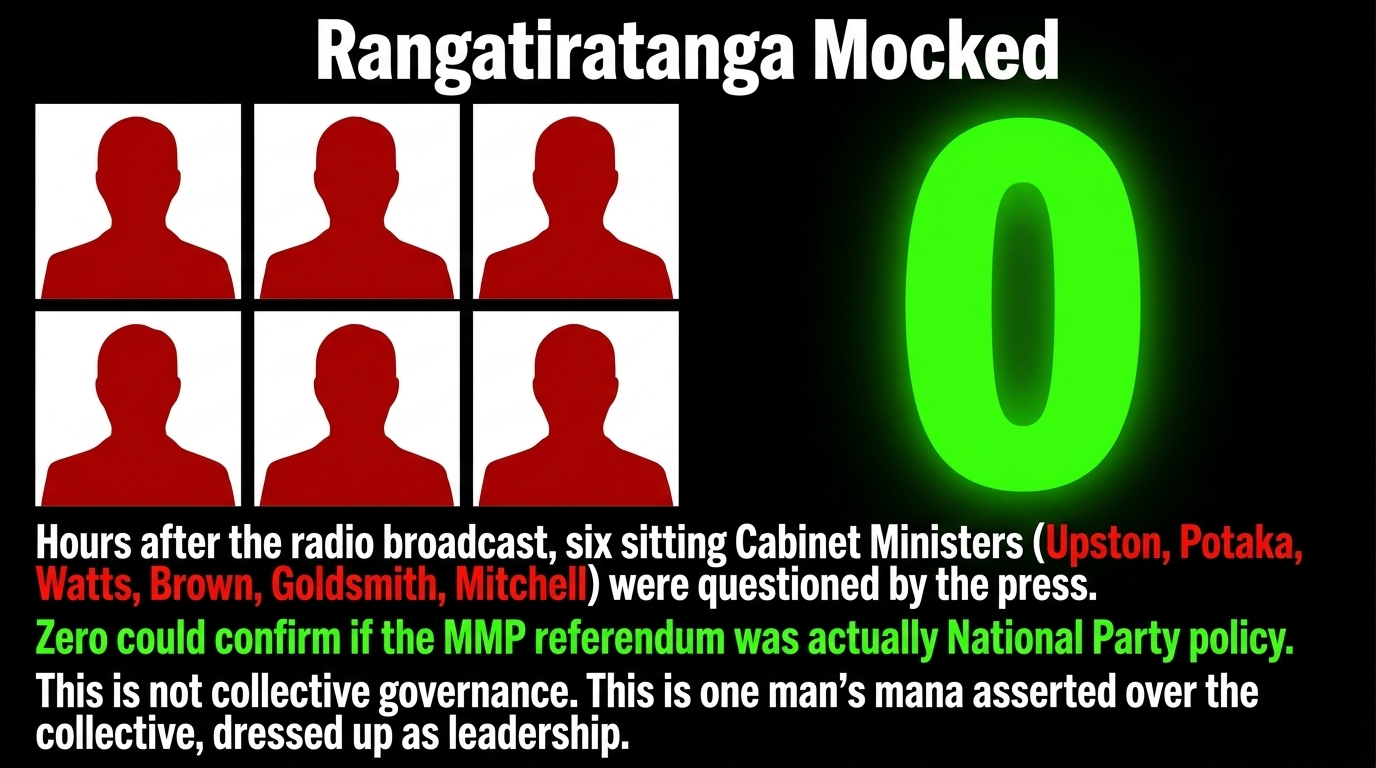
The scenario: A Prime Minister announces a plan to rewrite the electoral system. Hours later, reporters ask his own Cabinet ministers if it's policy. Not one of the six asked could give a straight answer.
Quantified harm: Louise Upston, Tama Potaka, Simon Watts, Simeon Brown, Paul Goldsmith, and Mark Mitchell — six sitting Cabinet ministers — were unable to confirm whether the referendum was National Party policy, whether caucus had discussed it, or what exactly was being proposed RNZ. Backbencher Ryan Hamilton admitted the caucus had "talked about a lot of things. Not that specifically" RNZ.
Tikanga impact, explained for the Western mind: Picture a board of directors finding out their CEO announced a company merger on live radio — and when journalists call the board members, not one of them knows the terms, the timeline, or whether the board even approved it. You'd call that a governance failure serious enough for a shareholder revolt. In tikanga terms, this is the opposite of rangatiratanga — collective, deliberated authority. It's one man's mana asserted over the collective, dressed up as leadership.
The solution: Constitutional change of this magnitude needs the process this country already knows works: an independent review, years of committee scrutiny, and a funded public education campaign — the actual process that preceded MMP's adoption in 1993, not a phone-in answer before the ad break RNZ — Shaw.
Example Three: Bundling a Dead Referendum With a Live One While Whānau Go Hungry for Work
The scenario: Luxon wants to ask voters about MMP at the same time as a four-year parliamentary term — a referendum his own government shelved just six months earlier.
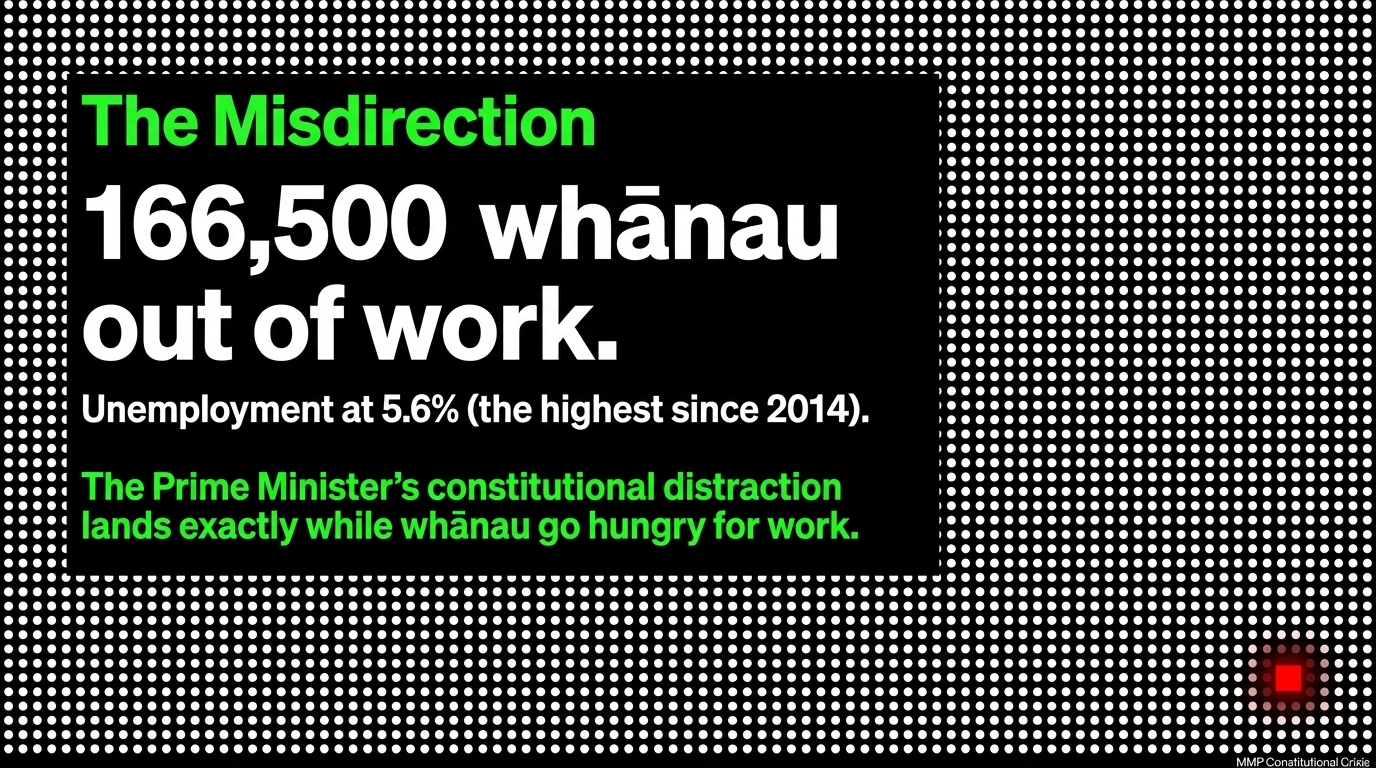
Quantified harm: Justice Minister Paul Goldsmith confirmed in February 2026 the four-year-term referendum was ditched, citing time constraints 1News. By August, he'd reversed course, saying it "made sense" to combine the two RNZ. Andrew Geddis's verdict: bundling them would "confuse matters" and "really undermine the validity of the referendum and the process," because a voter's answer on term length depends entirely on their answer about MMP RNZ. This constitutional distraction lands while New Zealand's unemployment rate sits at 5.6% — the highest since March 2014 — with 166,500 people out of work in the June 2026 quarter alone, the March quarter figure itself revised upward from an initial 5.3% to 5.4% Stats NZ, via interest.co.nz.
Tikanga impact, explained for the Western mind: This is like a landlord who ignores your broken heating for months, then shows up the week the pipes burst to ask if you'd also like to renegotiate your whole lease while you're standing in the flood. Confusing two questions isn't an accident — it's a tactic. I've documented this exact playbook before in how this government talks about Māori funding: headline big, bury the detail, count on confusion to do the work persuasion can't.
The solution: Separate the questions. Run them in different cycles, each with its own independent review. And put 166,500 unemployed people ahead of a constitutional fight that exists because the Prime Minister doesn't like the coalition partners he chose.
The Deep Dive Podcast
The YouTube Video
Koha Consideration
Every koha signals that whānau are ready to support the accountability that Crown and coalition press releases will not provide — accountability for the two Māori seats sitting quietly in the blast radius of a referendum nobody in Cabinet can explain.
It signals that rangatiratanga includes the power to support our own truth tellers.
Kia kaha, whānau. Stay vigilant. Stay connected. And if you are able, consider a koha to ensure this voice continues.
If you are unable to koha, no worries! Subscribe or follow The Māori Green Lantern at themaorigreenlantern.maori.nz, kōrero and share with your whānau and friends — that is koha in itself.
Four pathways exist:
For those who wish to support this mahi directly with a koha (voluntary contribution), please visit the Koha platform:
Koha — Support: https://app.koha.kiwi/events/the-maori-green-lantern-fighting-misinformation-and-disinformation-ivor-jones
For those who wish to receive essays directly and support through subscription:
Subscribe to the Māori Green Lantern: https://www.themaorigreenlantern.maori.nz/#/portal/support
For those who prefer direct bank transfer, account details are:
Ivor Jones, account number 03-1395-0099387-000.
For those on Facebook: https://www.facebook.com/Themaorigreenlantern/subscribe/
The Crimes, Named. The Beneficiaries, Named.
Christopher Luxon is trying to fix a personal management problem
— his own frustration with Winston Peters and David Seymour
— by threatening the mechanical guarantees that give Māori and minor parties real weight in Parliament.
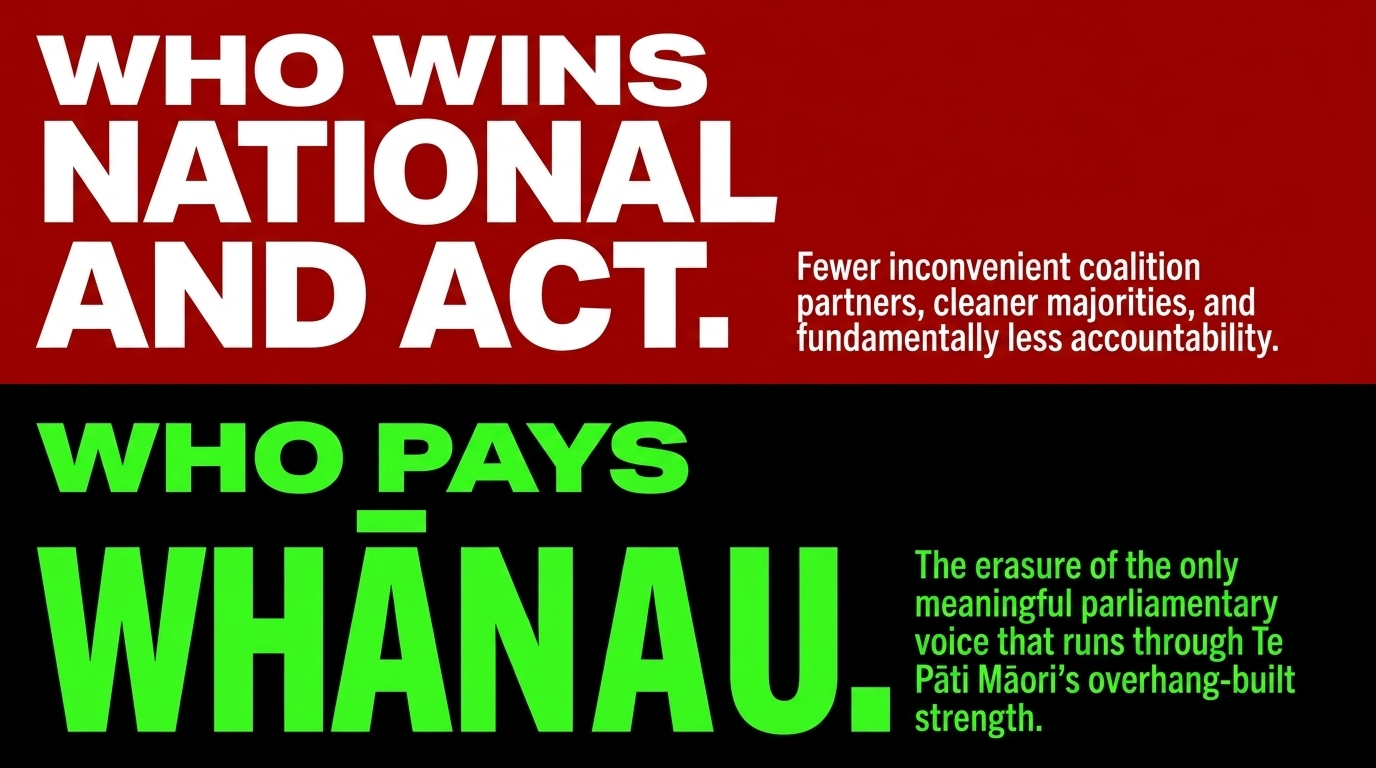
National and ACT are the beneficiaries if coat-tailing and overhang disappear: fewer inconvenient partners, cleaner majorities, less accountability.
The people who pay are the whānau whose only meaningful parliamentary voice runs through Te Pāti Māori's overhang-built caucus strength, and every worker among the 166,500 unemployed whose crisis got bumped off the front page for a fight nobody asked for.
No False Balance. None.
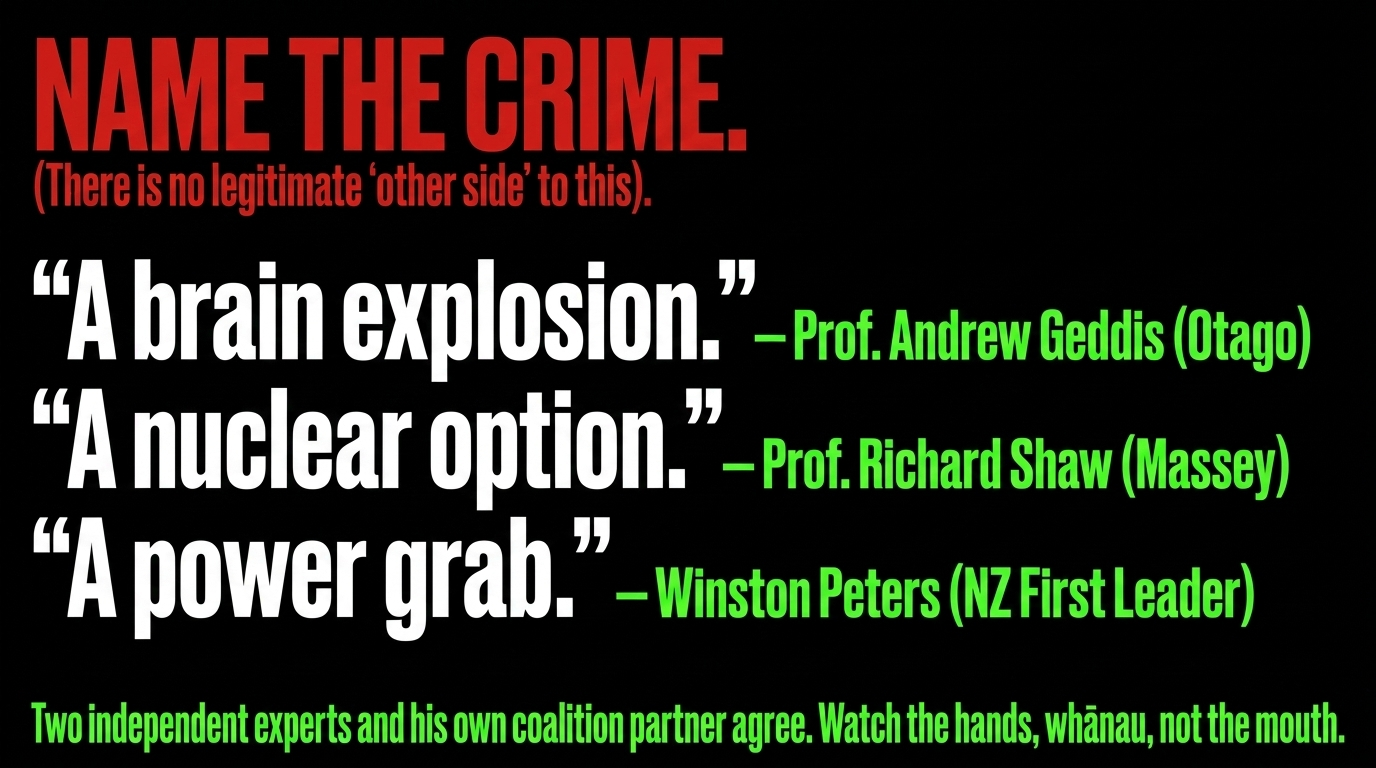
There is no legitimate "other side" to six Cabinet ministers not knowing their own government's policy.
There is no "other side" to an electoral law professor confirming that bundling referenda corrupts the result.
There is no "other side" to a mechanism protecting Māori parliamentary weight sitting quietly in the blast radius of a tantrum dressed as reform.
This is a power grab.
Two independent professors said so without needing me to put words in their mouths. Watch the hands, whānau, not the mouth.
Ngā mihi,
Ivor Jones The Māori Green Lantern Fighting Misinformation And Disnformation From The Far Right