"The Autopsy of a Prime Minister Who Won't Admit He's Already Dead" - 12 August 2026
Goneburger: The Death of a Prime Ministership by a Thousand Self-Inflicted Cuts


Mōrena Aotearoa.
I'm Ivor Jones, The Māori Green Lantern, and what these five RNZ articles line show, when laid side by side, is not a "leadership speculation story."
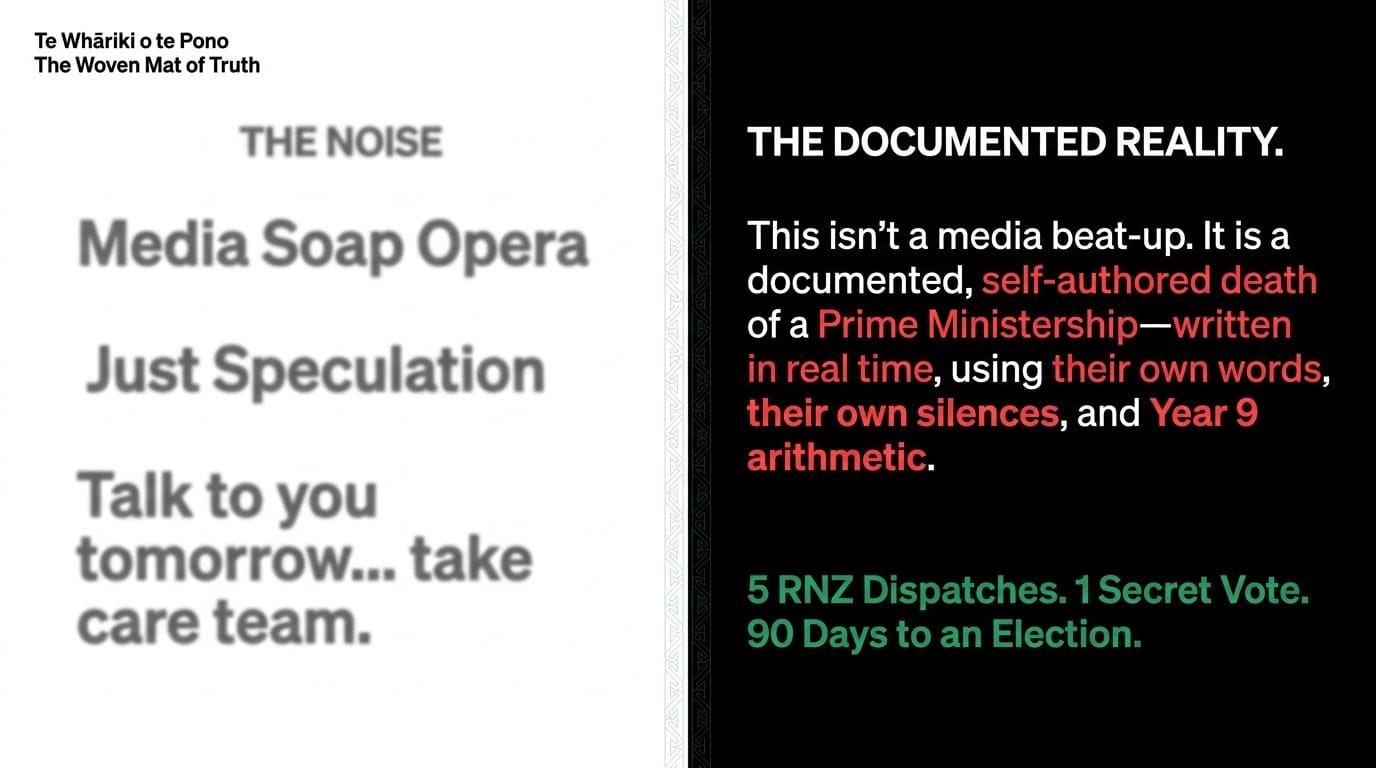
It is the documented, self-authored death of a Prime Ministership — written in real time by RNZ's own political desk, using Luxon's own words, his own colleagues' silences, and arithmetic simple enough for a Year 9 maths class.
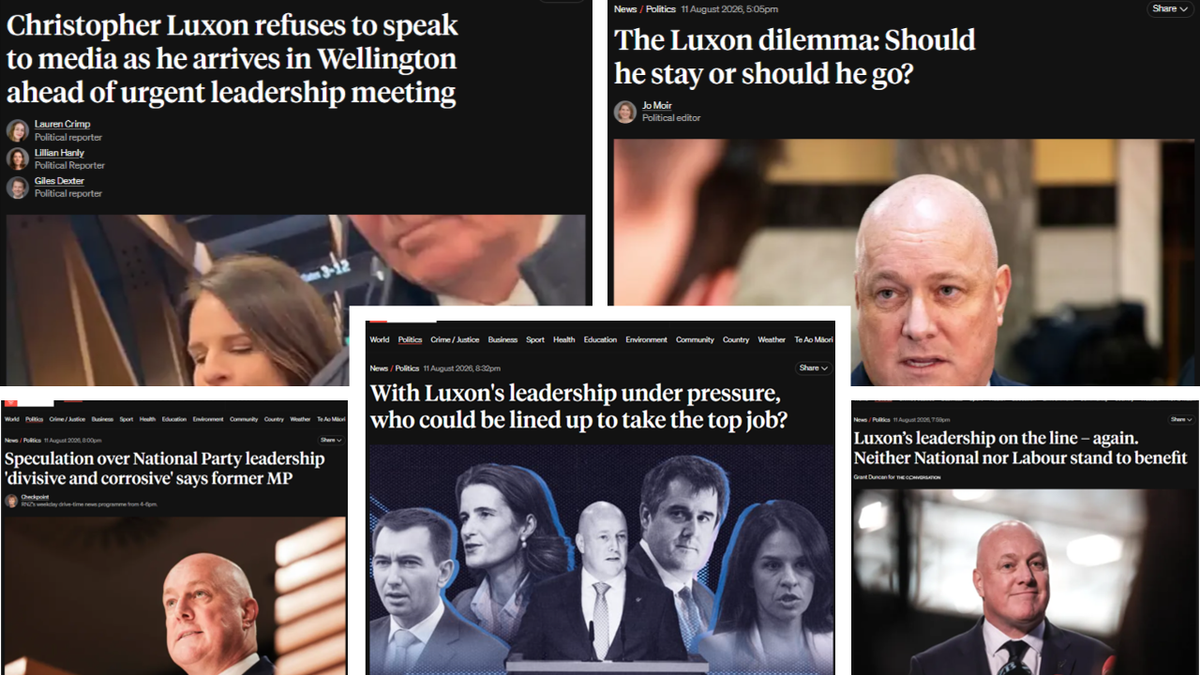
Let's go through each one and then I'll tell you what it all adds up to.
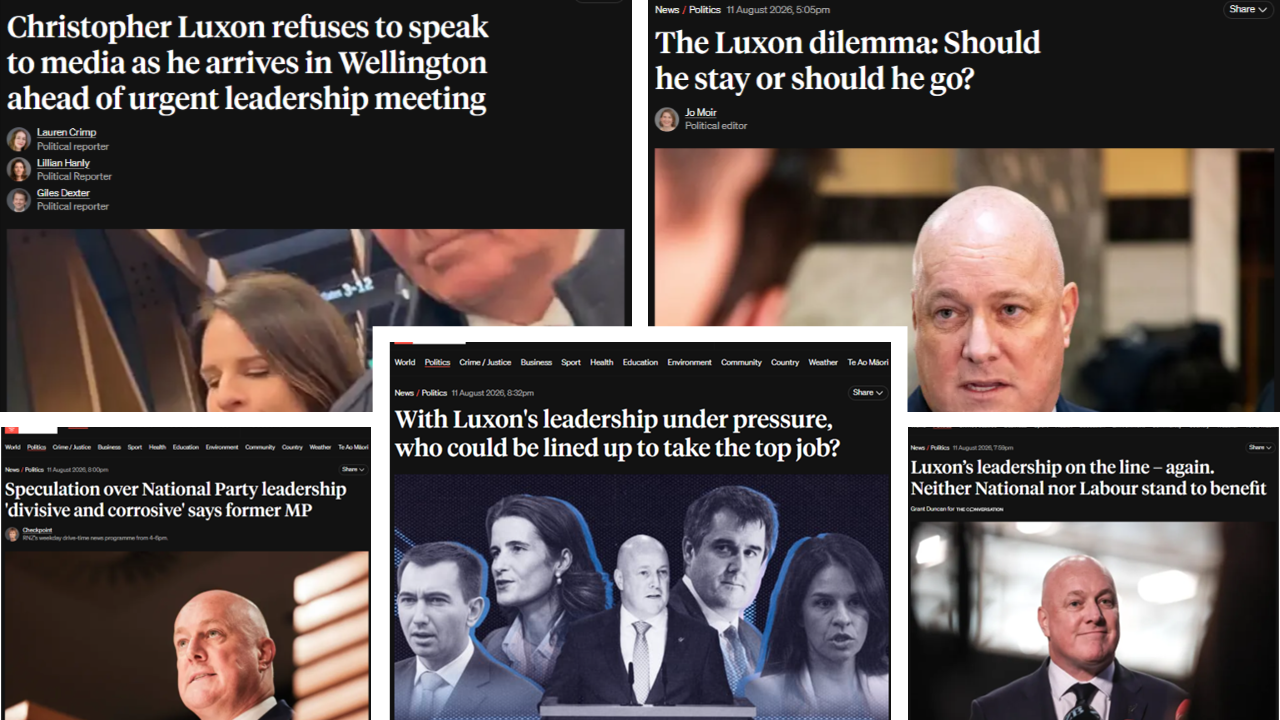
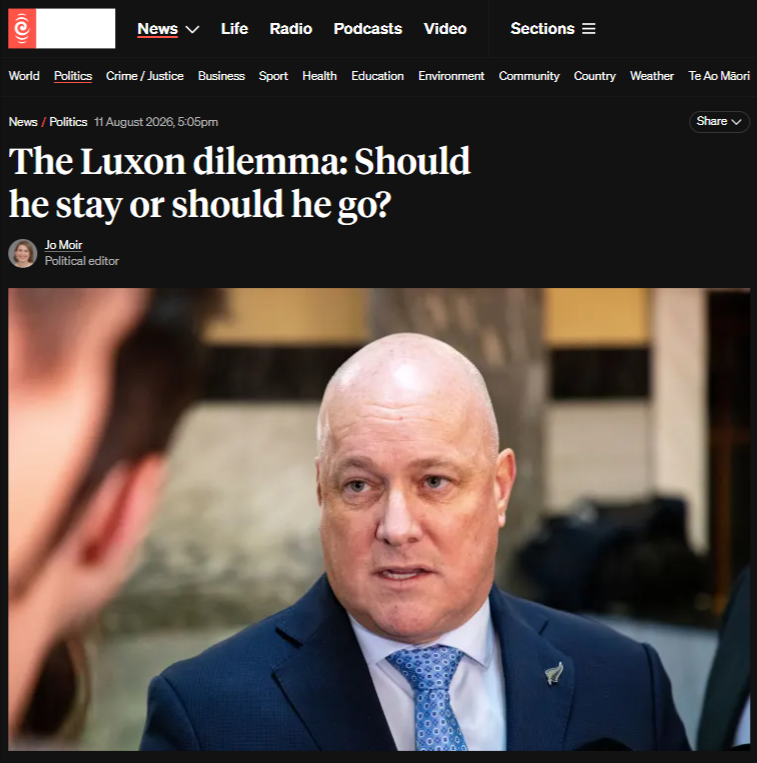
Article One: The Luxon dilemma: Should he stay or should he go? — the arithmetic of his own funeral
 RNZ | Te Reo Irirangi o Aotearoa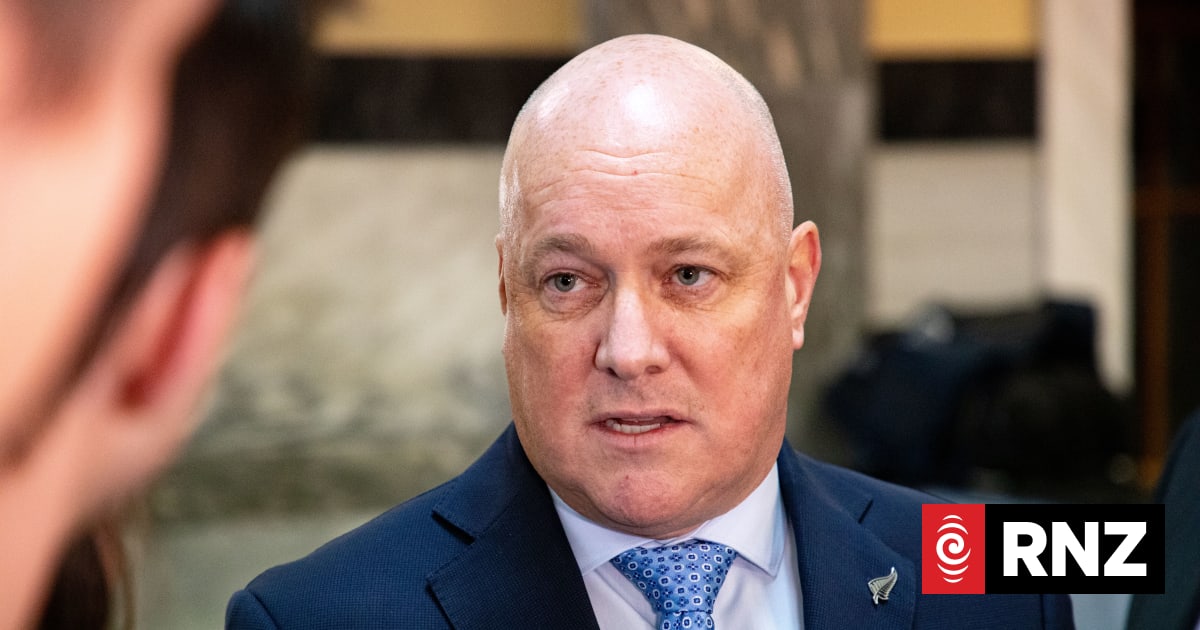
Jo Moir's piece is the coldest one, because she doesn't need adjectives — she just does the sums.
He failed both.
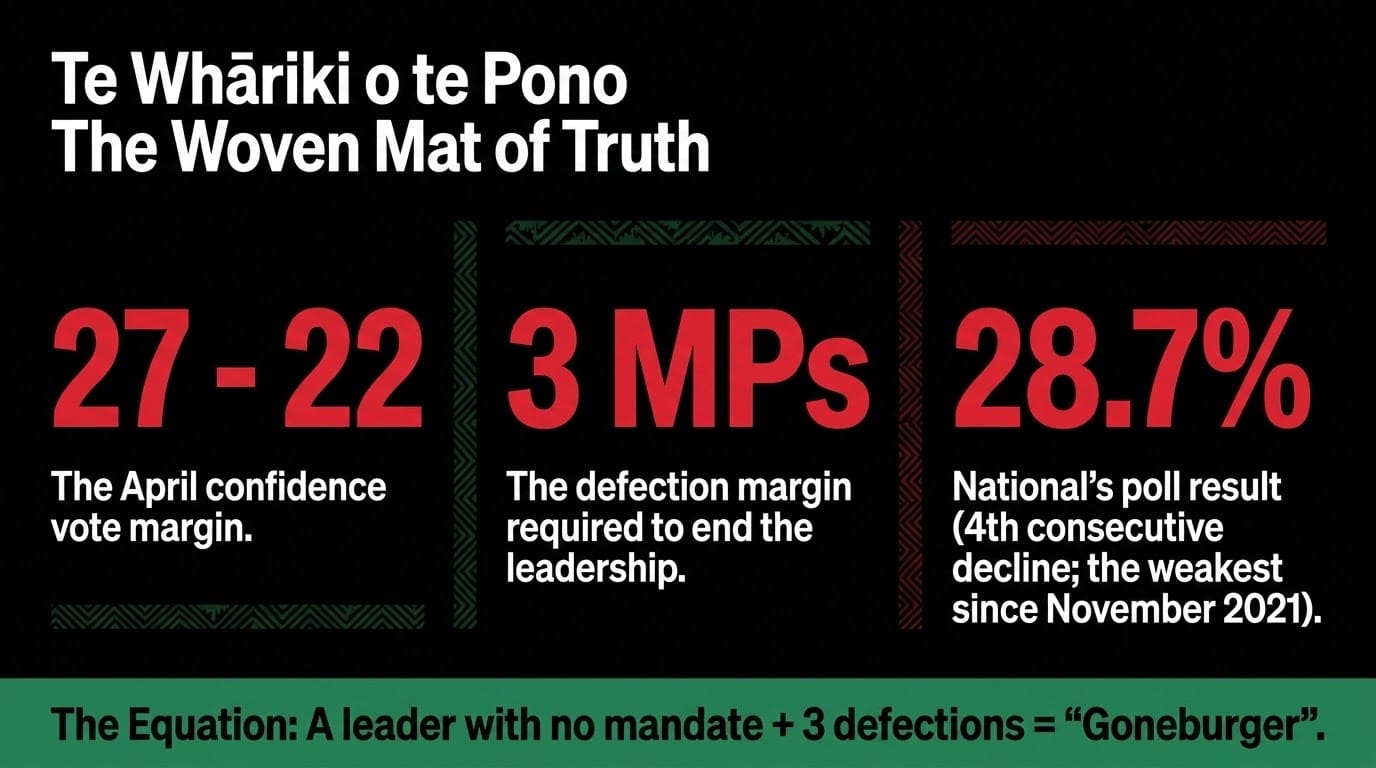
National sits at 28.7 percent, its fourth straight decline, its worst result since he took the job. Then the number that should have ended this Prime Ministership on the spot: a 27-22 vote, and when asked directly, Luxon "didn't deny it". Three defections and he's finished — Moir's word for it is "goneburger".
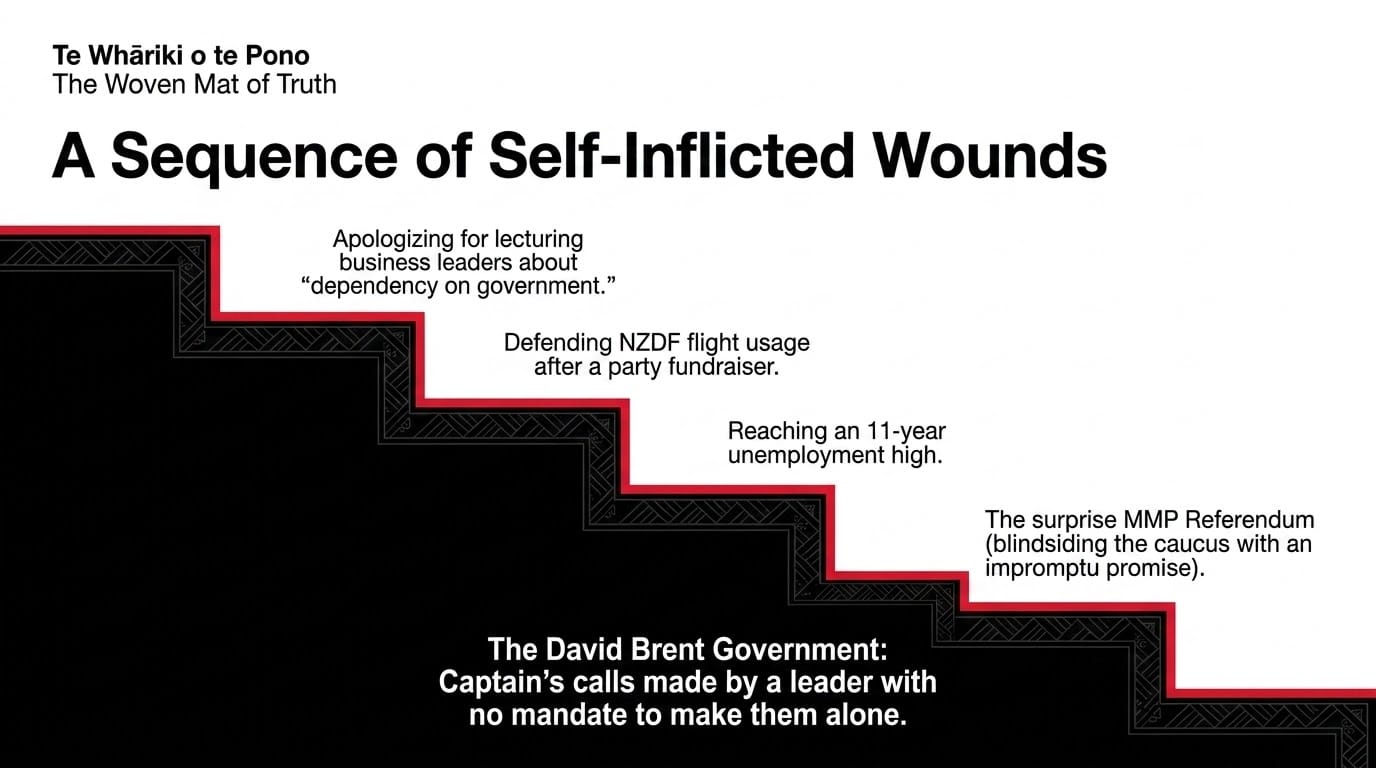
What damns him further is the pattern of behaviour in the same fortnight: two unilateral "captain's calls" — ruling out a coalition arrangement and then blindsiding his own caucus with a surprise MMP referendum — made by a leader with no mandate to make them alone.
Moir's verdict, delivered without a single raised eyebrow needed: "Luxon is not Key or Ardern".
That's RNZ's most senior political journalist telling New Zealand, on the record, that the Prime Minister has confused the confidence of a room with the confidence of a country, and he doesn't have either anymore.
The Deep Dive Podcast
Listen to a lively conversation between two hosts, unpacking and connecting topics in the sources of this essay. I apologise in advance for the AI's very harsh pronounciation of reo. Please dont shoot me, :).
Youtube Video
Like video? Here is a short video suppporting the essay. Again, don't shoot the messenger please because of AI's pronounciation. :)
Koha consideration

Every koha signals that whānau are ready to support the accountability that Crown and corporate structures will not provide. It signals that rangatiratanga includes the power to support our own truth tellers.
Kia kaha, whānau. Stay vigilant. Stay connected. And if you are able, consider a koha to ensure this voice continues.
If you are unable to koha, no worries — subscribe or follow The Māori Green Lantern at themaorigreenlantern.maori.nz, kōrero and share with your whānau and friends. That is koha in itself.
Koha — support directly: app.koha.kiwi
Subscribe: themaorigreenlantern.maori.nz support portal
Bank transfer: Ivor Jones, account number 03-1395-0099387-000
Facebook: facebook.com/Themaorigreenlantern
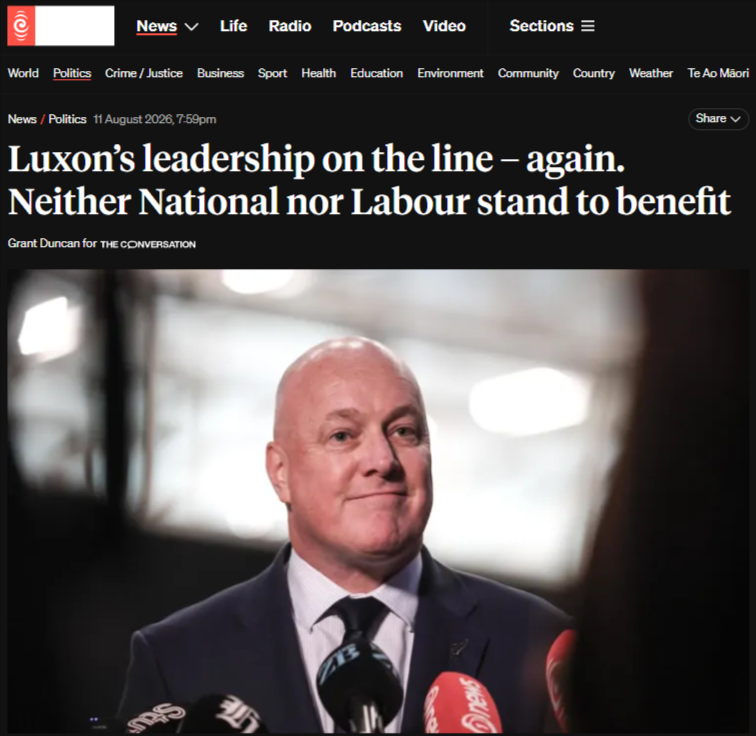
Article Two: Luxon's leadership on the line — again — the David Brent government, exposed by an academic
 RNZ | Te Reo Irirangi o Aotearoa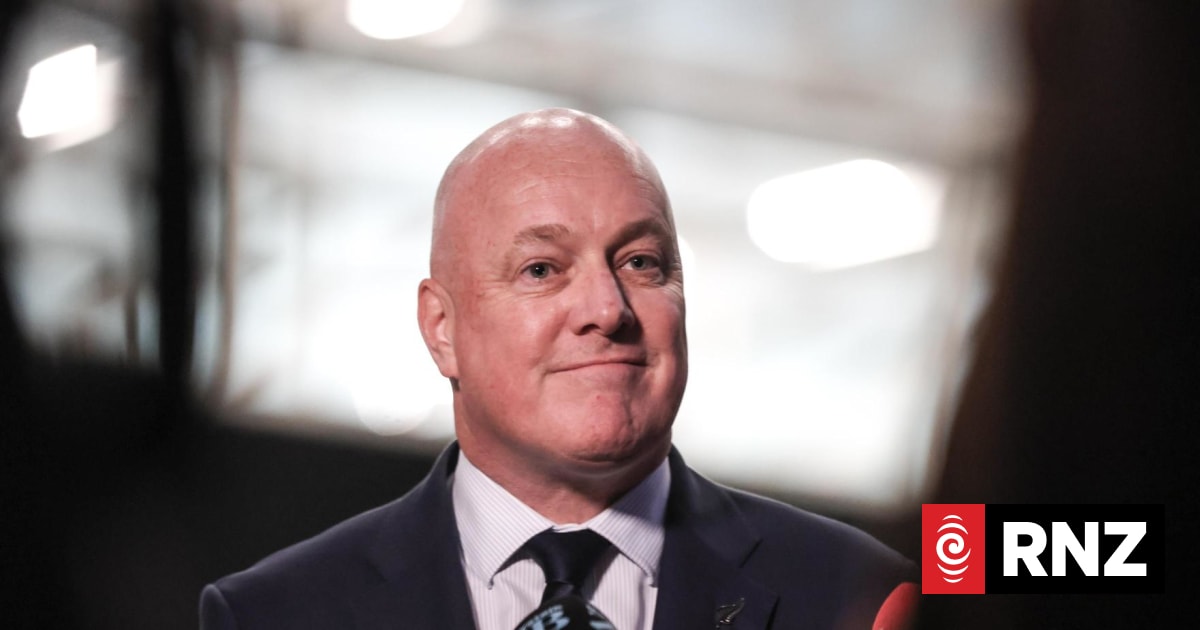
Grant Duncan doesn't waste time on sympathy. He documents Luxon apologising for lecturing business leaders about "dependency on government," then blindsiding caucus with the referendum stunt, and states plainly that the pile-up "earned comparisons with the fictional David Brent of The Office".
This is published by RNZ. Not a meme account. The national broadcaster ran the comparison of its sitting Prime Minister to a fictional buffoon manager, because the facts supported it.
Duncan's structural point is the one that should terrify National strategists: unlike Labour's seven-week pivot to Ardern in 2017, National has "no stellar alternative leader waiting in the wings".
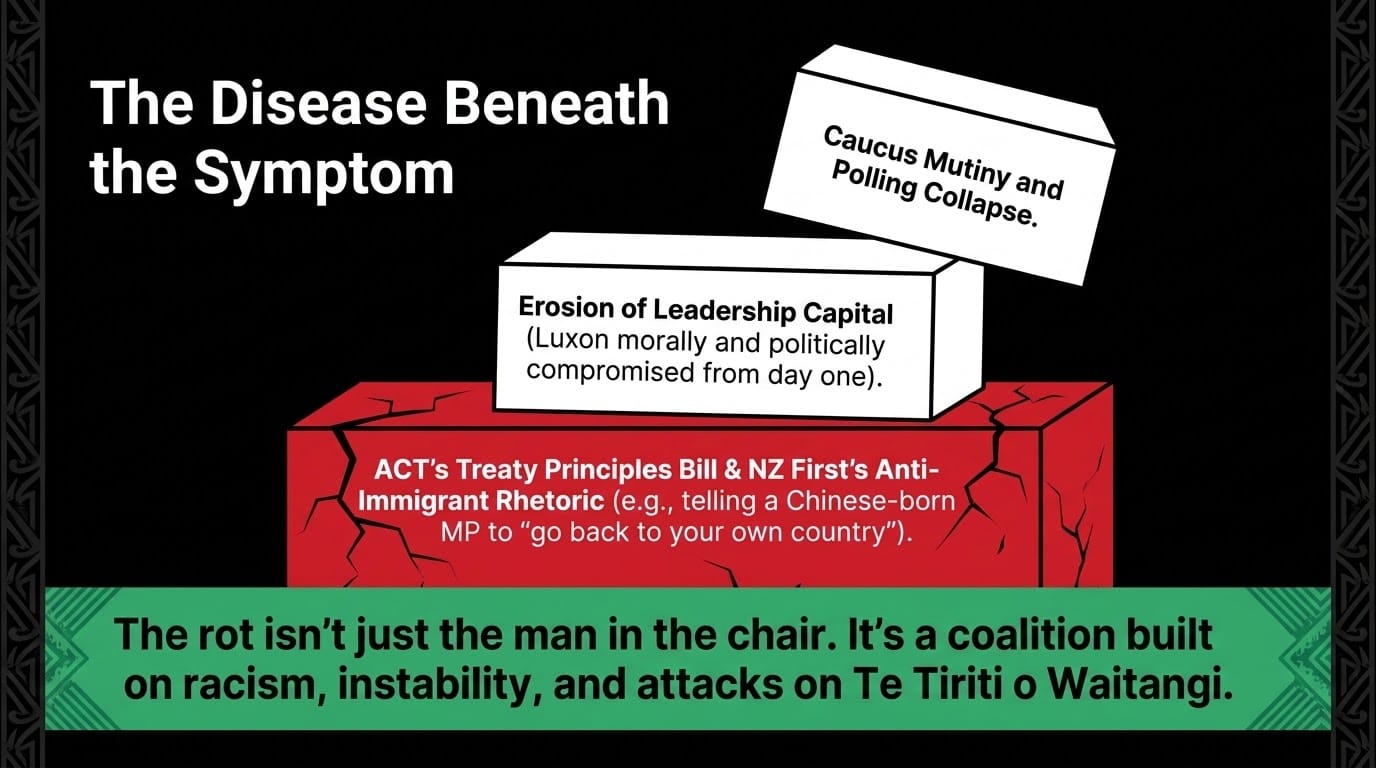
And he names the rot underneath the personality drama: the ACT Party's Treaty Principles Bill already "compromised" Luxon's leadership before any of this week's chaos began, alongside Winston Peters telling a Chinese-born Green MP to "go back to your own country".
This coalition was built on racism and instability from the outset — the leadership crisis is just the wound finally becoming visible to people who weren't paying attention to Te Tiriti.
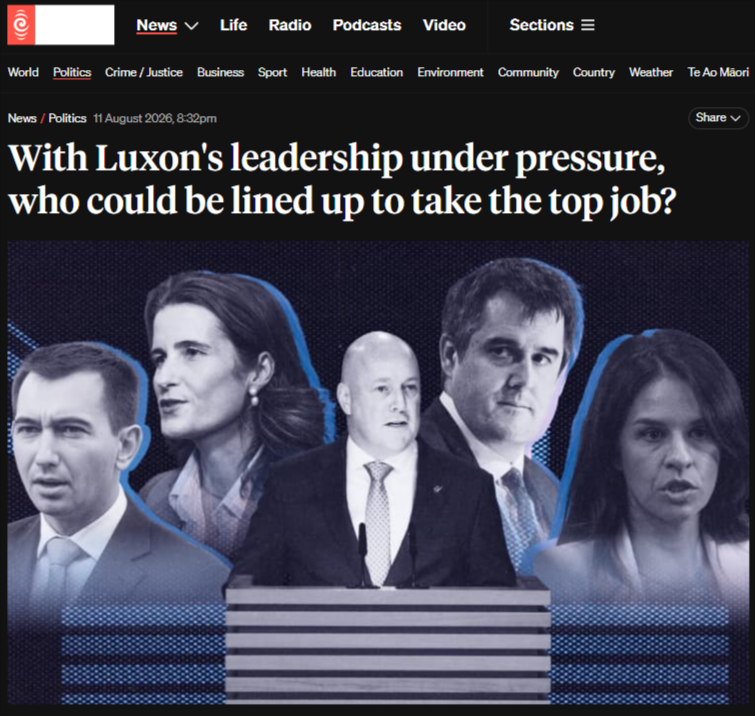
Article Three: Who could be lined up to take the top job? — a succession bench of broken promises
 RNZ | Te Reo Irirangi o Aotearoa
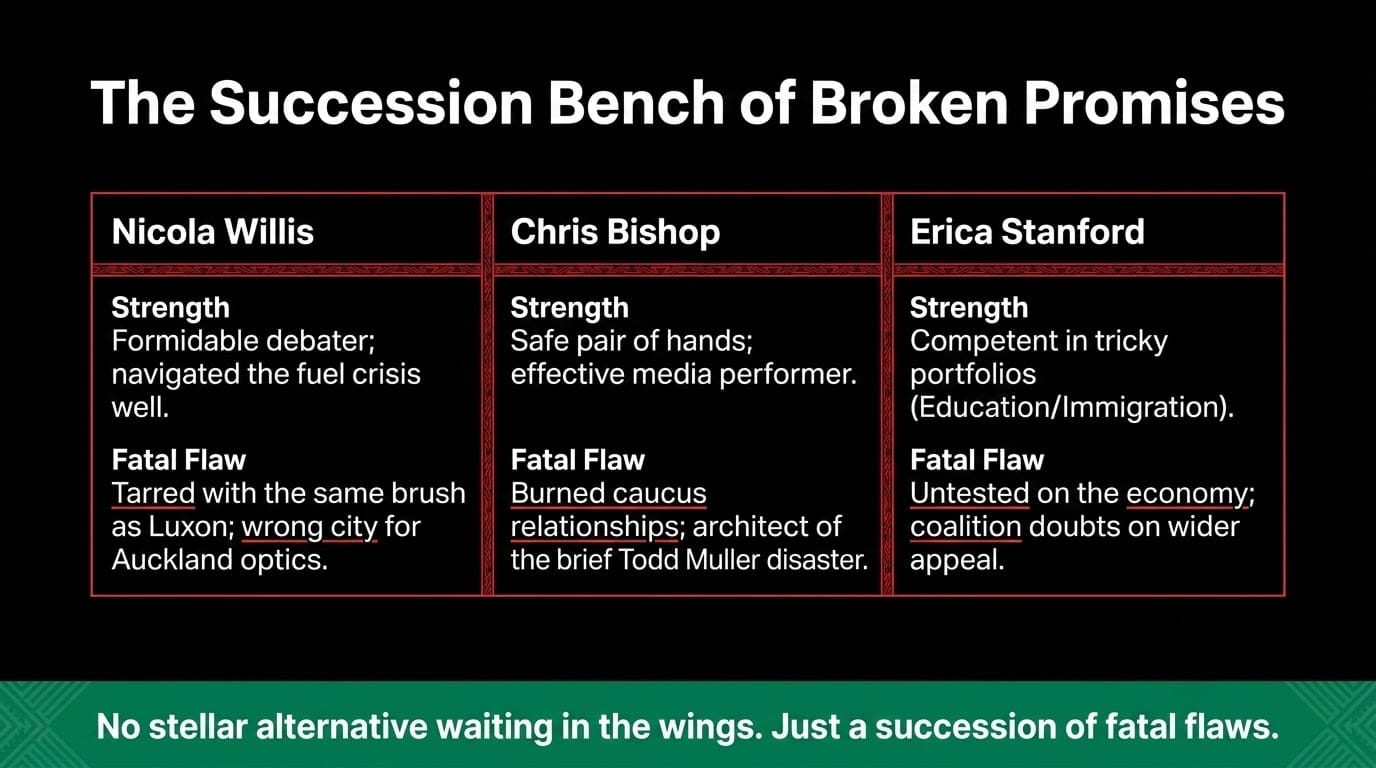
Every single named contender comes pre-loaded with a disqualifying flaw, according to RNZ's own reporting.
Nicola Willis is "tarred with the same brush" as Luxon and lives in the wrong city for a party obsessed with Auckland optics.
Chris Bishop is "deeply ambitious" but has "burn[ed] relationships with the caucus," with RNZ specifically dragging up his role in "Todd Muller's ill-fated and brief rise to the top" — a direct, sourced reminder that the last time National panicked into a leadership change, it collapsed in weeks.
Erica Stanford is "not as tested" on the economy.
The most revealing line is the uncertainty itself: RNZ reports it was "unclear whether he'll call another confidence vote in himself, just four months after the last one".
A governing party, ninety days from an election, doesn't even know if its own Prime Minister is about to repeat the exact desperate manoeuvre that failed to fix anything the first time.
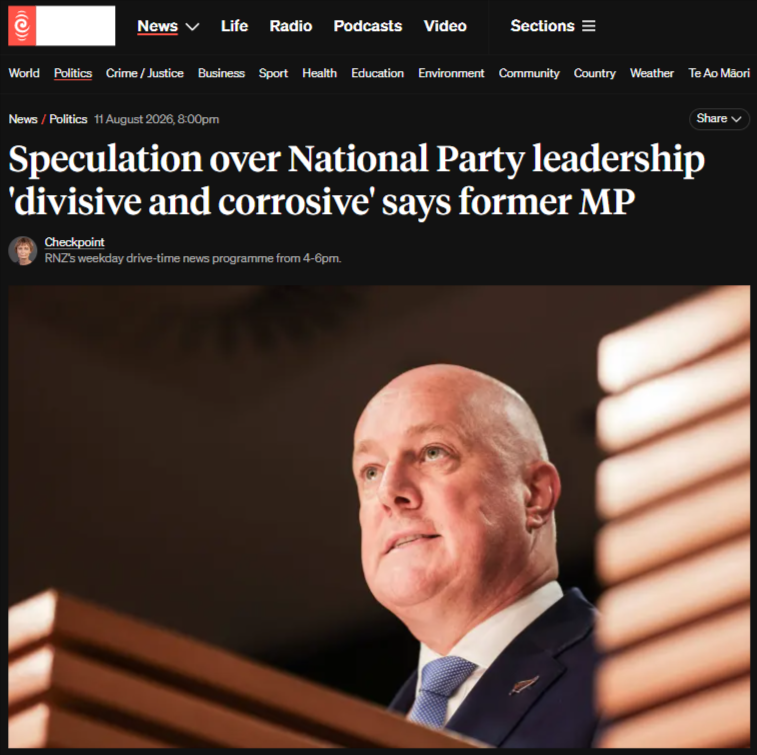
Article Four: "Divisive and corrosive" — a 30-year insider names the rot, and the greed underneath it
 RNZ | Te Reo Irirangi o Aotearoa
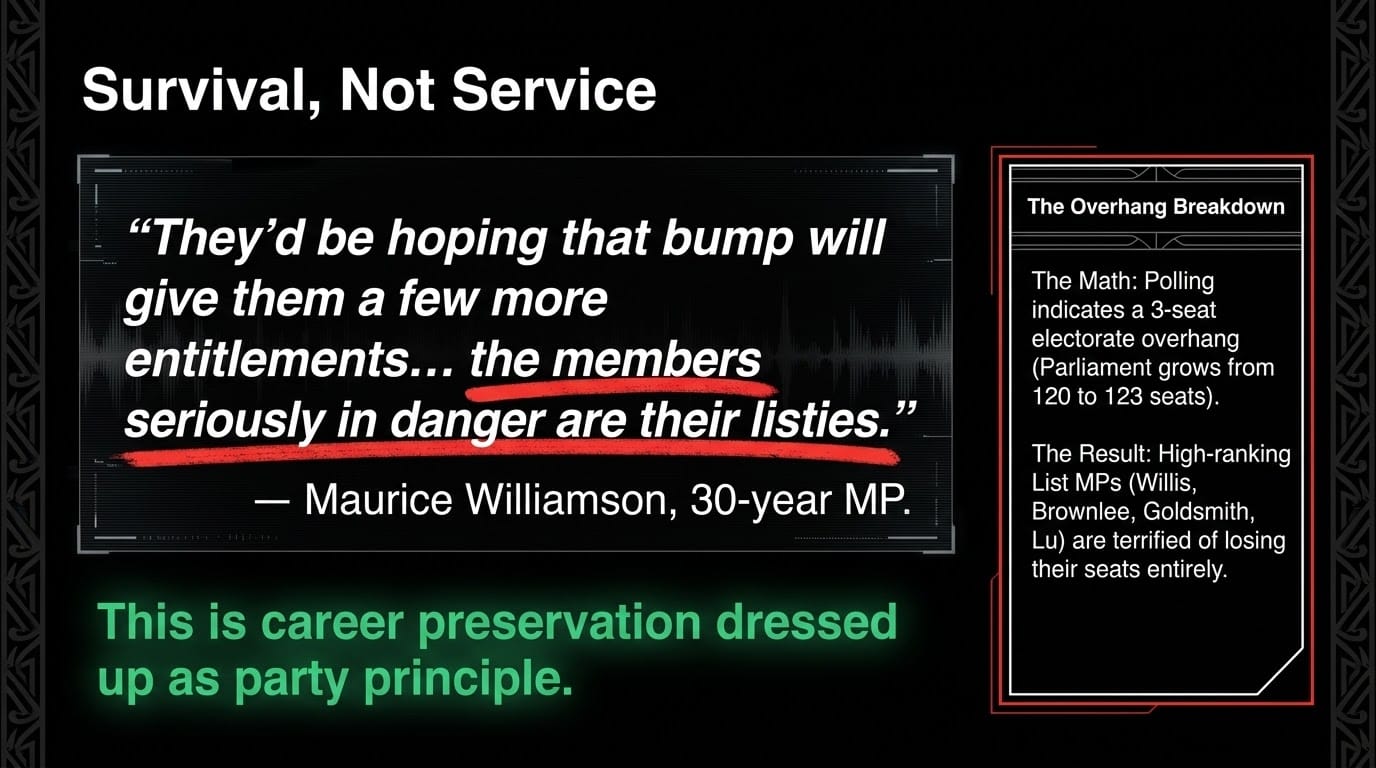
Maurice Williamson, thirty years in Parliament, calls it exactly what it is: "divisive and corrosive". But his most damning contribution isn't the soundbite — it's the confession of motive.
This isn't concern for the country. This is career preservation dressed up as principle.
Williamson's parting shot deserves to be carved into the wall of the Beehive:
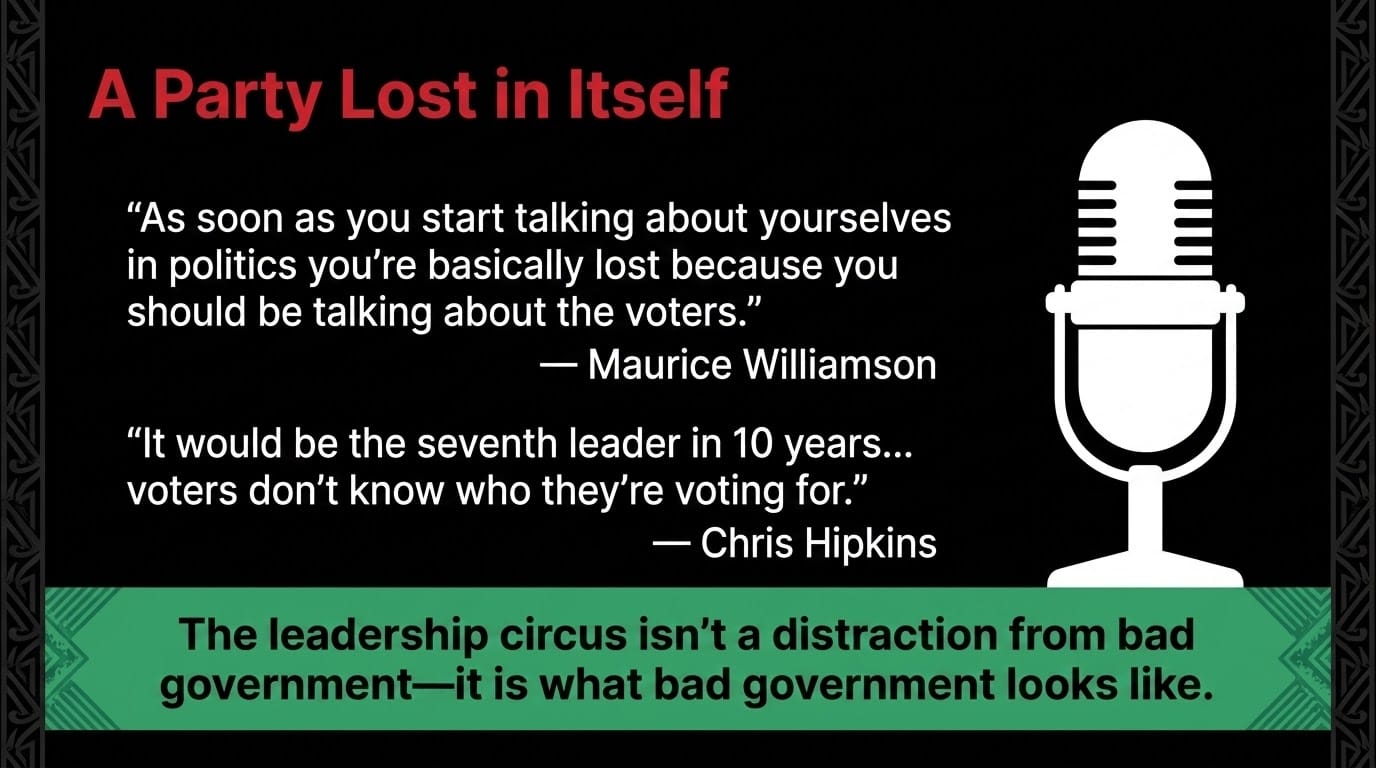
"As soon as you start talking about yourselves in politics you're basically lost because you should be talking about the voters and what you're going to do for them".
A former National MP just confirmed his old party has become exactly what he's describing — and did so on RNZ's own airwaves.
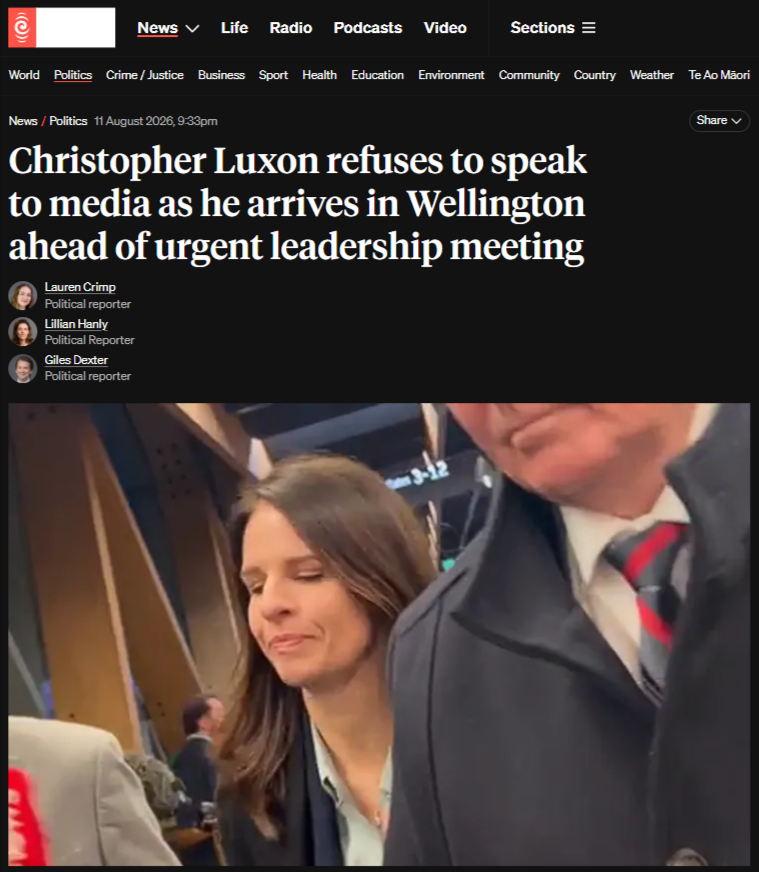
Article Five: Christopher Luxon refuses to speak to media — cowardice, choreographed
 RNZ | Te Reo Irirangi o Aotearoa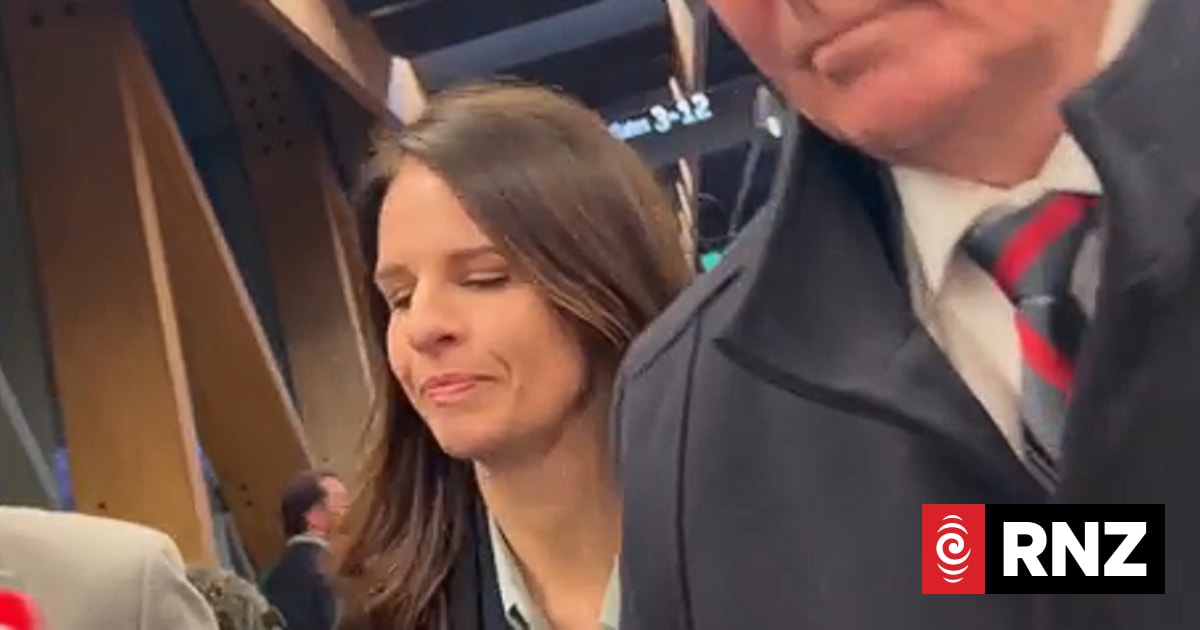
This is the article where the mask fully comes off.
Luxon himself offered reporters nothing but
"talk to you tomorrow ... take care team".
Erica Stanford, a tipped successor,
"did not say a word"
and refused to confirm confidence in her own leader.
Willis and Bishop both cancelled scheduled RNZ interviews that same morning.
And when Bishop was cornered, he responded not with an answer but with a farcical minute-by-minute account of getting a coffee and calling his wife — a non-answer so absurd it became its own confession.
Auckland Mayor Wayne Brown, standing beside Bishop, laughed off being asked whether he wanted him as Prime Minister, then admitted what he'd really prefer is for voters to choose the Prime Minister
"instead of Winston Peters doing it"
— a National-aligned mayor openly conceding the real power in this coalition sits with an ACT-adjacent kingmaker, not the electorate.
Chief whip Stuart Smith repeated
"I have nothing to say on that matter"
like a hostage reading a ransom note.
And Chris Hipkins delivered the coldest line of the entire saga: a change now would make the new leader
"the seventh leader in 10 years," meaning voters "don't know who they're voting for".
This was never a leadership story
Read separately, these are five stories about a wobbly Prime Minister.
Read together, they are the documented autopsy of a Prime Ministership that died from self-inflicted wounds months before this week
— a 27-22 vote margin thin enough to collapse with three defections,
a pattern of unilateral decisions made by a man with no mandate to make them,
a succession bench where every name carries a public disqualifier,
a 30-year insider confirming the rot is really about MPs protecting their own list seats, and
a Cabinet room full of ministers so committed to performing loyalty they couldn't answer a straight question about confidence in their own leader.
None of this happened in a vacuum, and none of it is separate from the government's actual record.
This coalition was already compromised before this week by ACT's Treaty Principles Bill and Winston Peters' racism toward a sitting MP.
The leadership circus isn't a distraction from bad government — it is what bad government looks like when it finally turns its dysfunction on itself instead of on the people it was elected to serve.
Whether Luxon survives Wednesday's meeting or not, the pattern documented across these five articles will outlast him: a party with no mandate for its policies, no consensus on its direction, and no candidate capable of fixing what's actually broken, because what's broken isn't the man in the chair. It's the coalition itself.
Ngā mihi,
Ivor Jones The Māori Green Lantern Fighting Misinformation And Disinformation From The Far Right

Disclaimer
This is opinion and analysis grounded in the five named RNZ articles, current as of 12 August 2026, cited inline as anchor-text hyperlinks per claim throughout, with all quotes drawn verbatim from the source articles. Scathing conclusions about political competence and institutional dysfunction are my own assessment as Ivor Jones, clearly flagged as opinion, grounded in the factual record cited above — no malice, pattern of harm only. This concerns public figures acting in their public capacity and is published in the public interest under Durie v Gardiner and Lange v Atkinson principles. Right of reply stands for any named party within 48 hours. Note: at time of writing (2:38am NZST, 12 August 2026), the outcome of Wednesday's caucus meeting was not yet known; this essay analyses events up to and including the lead-up to that meeting only.