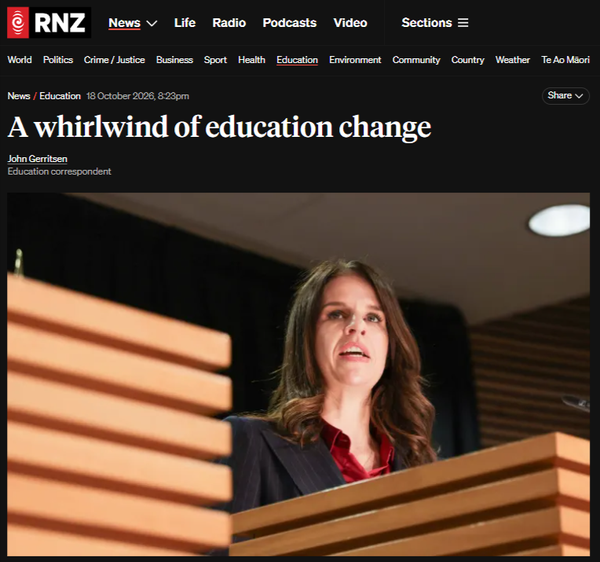
"Luxon’s Democracy Comes With A Locked Gate" - 19 October 2026
They Narrowed The Franchise, Singled Out Māori Representation, And Told The Public To Look At A Bus Advertisement

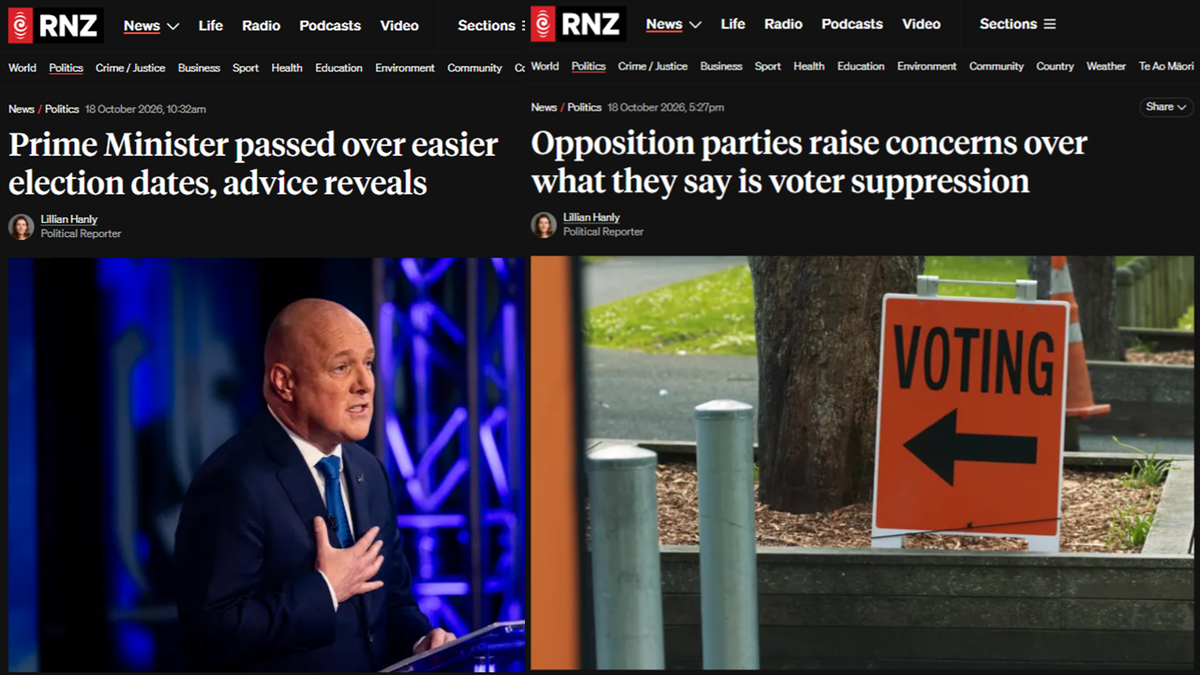
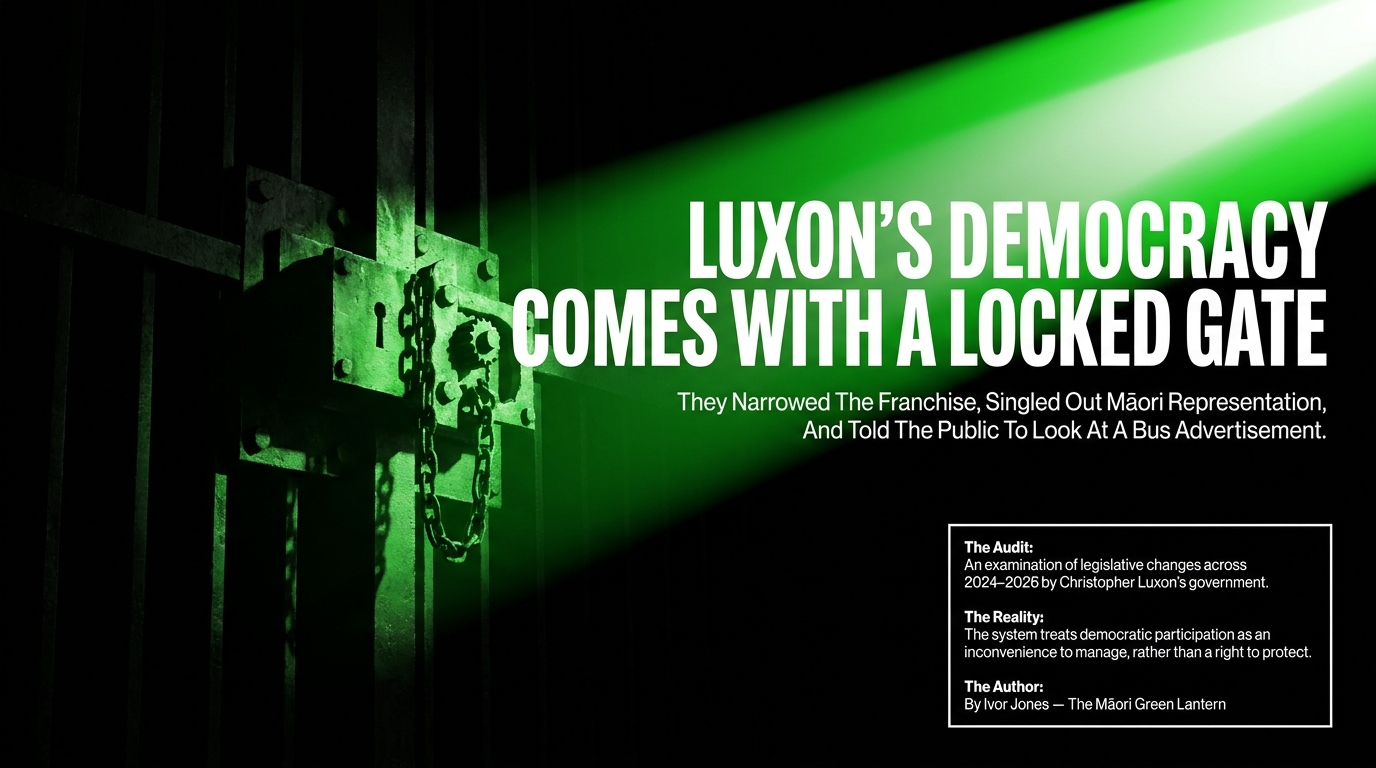
I do not need to invent a brown envelope to condemn Christopher Luxon’s treatment of democracy. The public record is damning enough: he selected an election date after receiving advice that easier alternatives existed and that holiday clashes could reduce turnout, while his Government legislated an earlier enrolment deadline despite its own Attorney-General’s warning about unjustified restrictions on voting rights. RNZ’s account of the election-date advice and the Attorney-General’s rights analysis establish those decisions.
 RNZ | Te Reo Irirangi o Aotearoa
My charge is political and moral: this Government has treated democratic participation as something to manage around, rather than something to protect.
Here I examine the legislative changes made across 2024–2026: enrolment restrictions, prisoner disenfranchisement, Māori-ward referendums and reduced donation transparency. I connect those changes to Luxon’s election-date decision, explain the strongest defence of the Government, and give three everyday examples showing the harm and the repair.
 RNZ | Te Reo Irirangi o Aotearoa

I apply Tika, Pono and Tikanga as an accountability framework. Not decorative Māori words sprinkled over a Western argument. A test of whether power serves life.
Read Beyond The Slogan
I want you to click through, follow the evidence and use this mahi in daily life—in whānau kōrero, community meetings and conversations with representatives.
This essay belongs alongside my examination of Luxon’s claims about voting and my election-policy assessment using Tika, Pono and Tikanga.
For listeners and viewers, that existing policy assessment also contains podcast and video sections; for long-form readers, the cited archive is there to examine rather than merely applaud. The published article provides those formats.
I am building this repository for our mokopuna. I want them to look back and say: at least The Māori Green Lantern, among others, was warning us—and left evidence they could check
Tika, Pono, Tikanga And Mauri
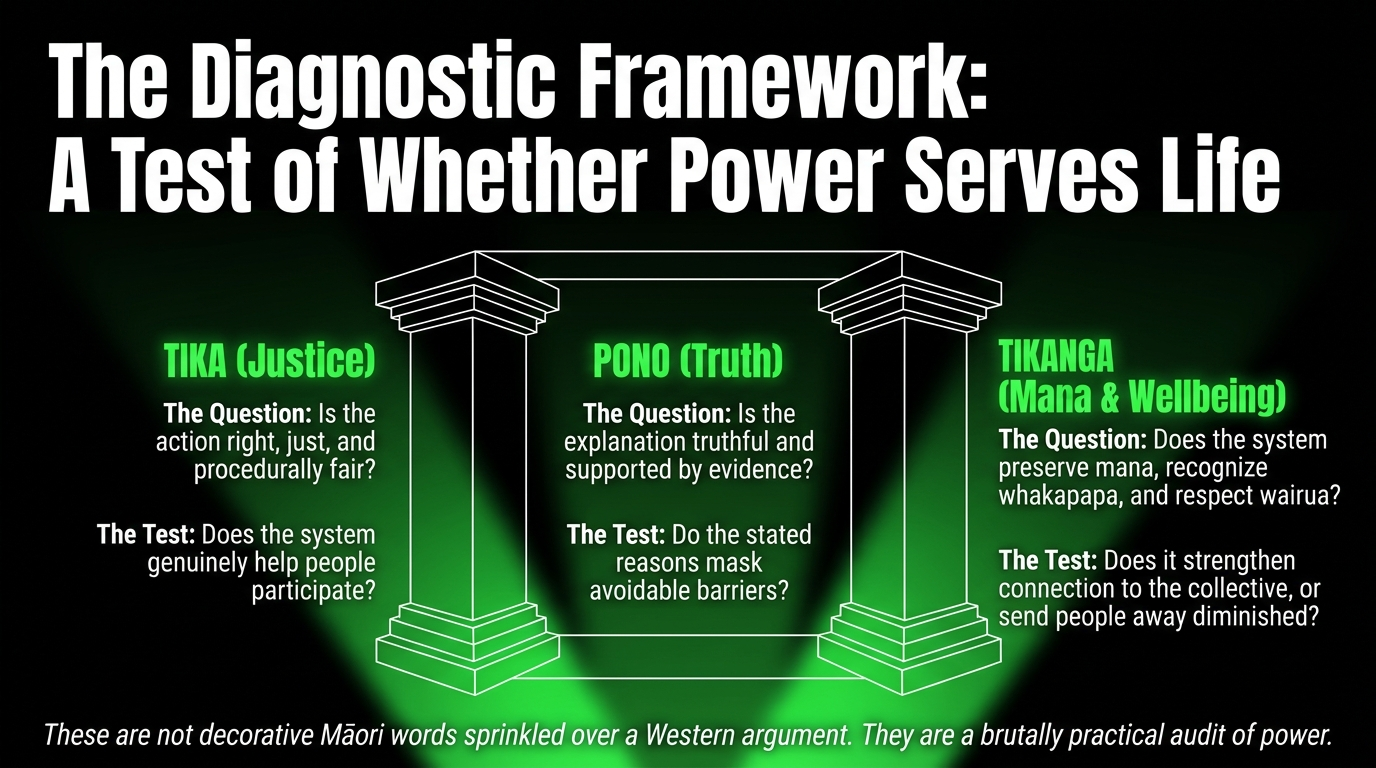
Tika asks whether the action is right and just.
Pono asks whether the explanation is truthful and supported by evidence.
Tikanga asks whether the system preserved people’s mana, recognised their whakapapa, respected their wairua, involved their whānau and helped restore wellbeing.
That is the framework I use here, not a claim to speak for every iwi or hapū.
Applied to an election, these questions become brutally practical. Did the system help people participate? Did it recognise their circumstances? Did it protect their independent political choices? Did it strengthen their connection to the collective, or send them away diminished?
For readers more familiar with Western institutions: think of procedural fairness, dignity, belonging and effective access to rights. Those are useful bridges, but they do not exhaust tikanga. My question reaches beyond whether an official followed the rulebook to whether the relationship between people and power remained right.
A system that humiliates an eligible voter can comply with its own paperwork and still fail that test.
The Date Was Not Inevitable
The Electoral Commission described 7 November as “challenging, but manageable” and considered 17 October and 21 November more administratively feasible; its August 2025 advice warned that holiday clashes could leave voters away from home and potentially reduce turnout. RNZ’s report describes the Commission’s advice and letter.
Luxon chose the more difficult option.
His explanation invoked sporting fixtures, other events and the observation that eight of the previous 12 elections occurred in October or November. RNZ records those stated reasons.
That does not answer why this particular date was preferable to the easier alternatives. “Other elections happened in spring” is not a serious response to a specific warning about avoidable barriers.
National’s response was to call Labour desperate and emphasise how long the date had been public. RNZ reports that defence.
Knowing about an obstacle for months does not turn it into good administration.
I cannot prove Luxon privately selected the date to damage his opponents. I can say he accepted a warned-of participation risk. That distinction matters. Pono does not permit me to manufacture intent simply because the documented decision deserves contempt.
Labour Day And Closed Doors
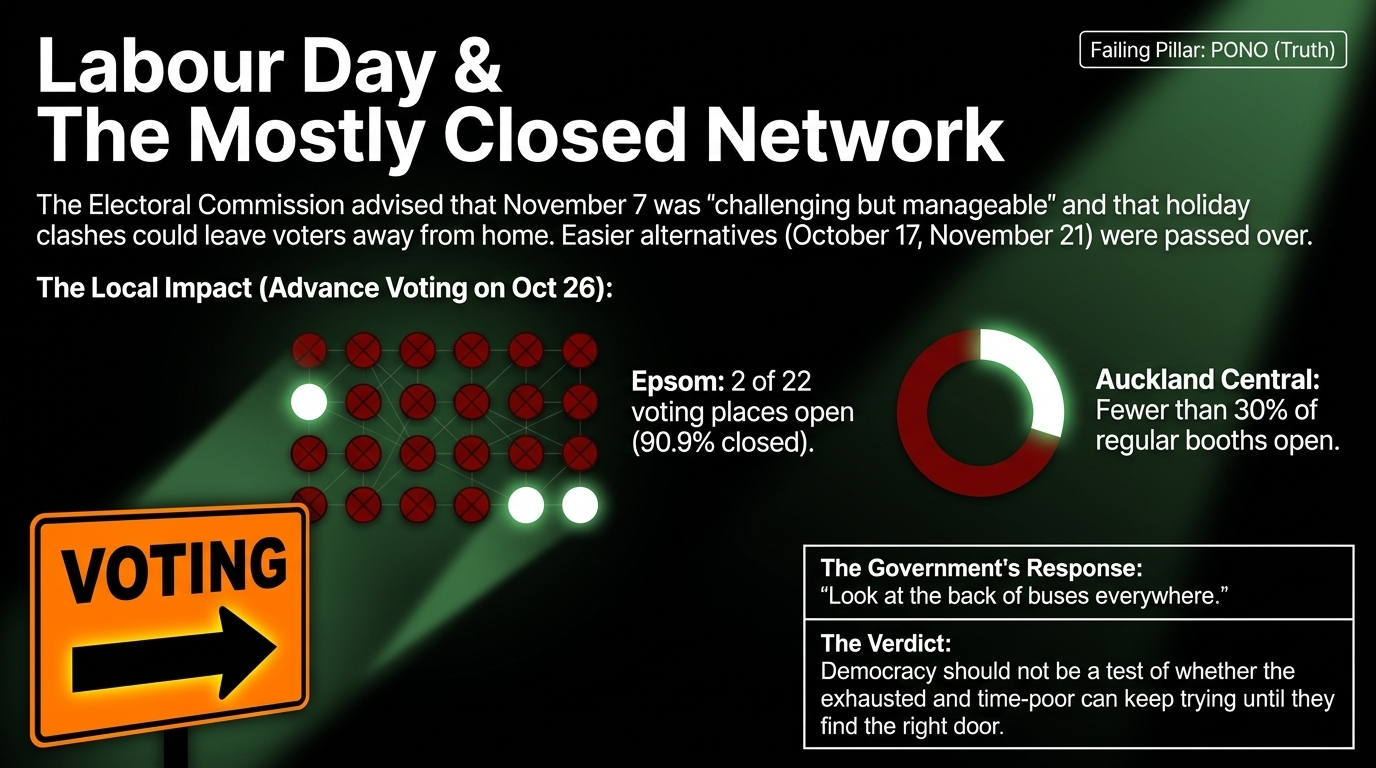
Advance voting begins on Labour Day, 26 October, and Belich said only two of Epsom’s 22 voting places would open that day. RNZ reports the date and her figures.
Swarbrick separately said fewer than 30% of Auckland Central’s regular voting places would be open. RNZ attributes that figure to her.
The strongest counterargument is straightforward: Labour Day is only one day within the voting period, and Belich acknowledged the overall effect might be limited. RNZ includes that qualification.
Fine. Let us take it seriously.
The date does not make the election illegitimate. Reduced holiday opening does not mean every affected person loses their vote. But neither observation excuses choosing unnecessary friction when easier alternatives were available.
Democracy should not be a test of whether the exhausted, the time-poor and the less mobile can keep trying until they find the right door.
The Law Shut Earlier
The Electoral Amendment Act passed its third reading on 16 December 2025; most provisions commenced on 20 December, with specified provisions following on 1 January 2026. The Ministry of Justice sets out that chronology.
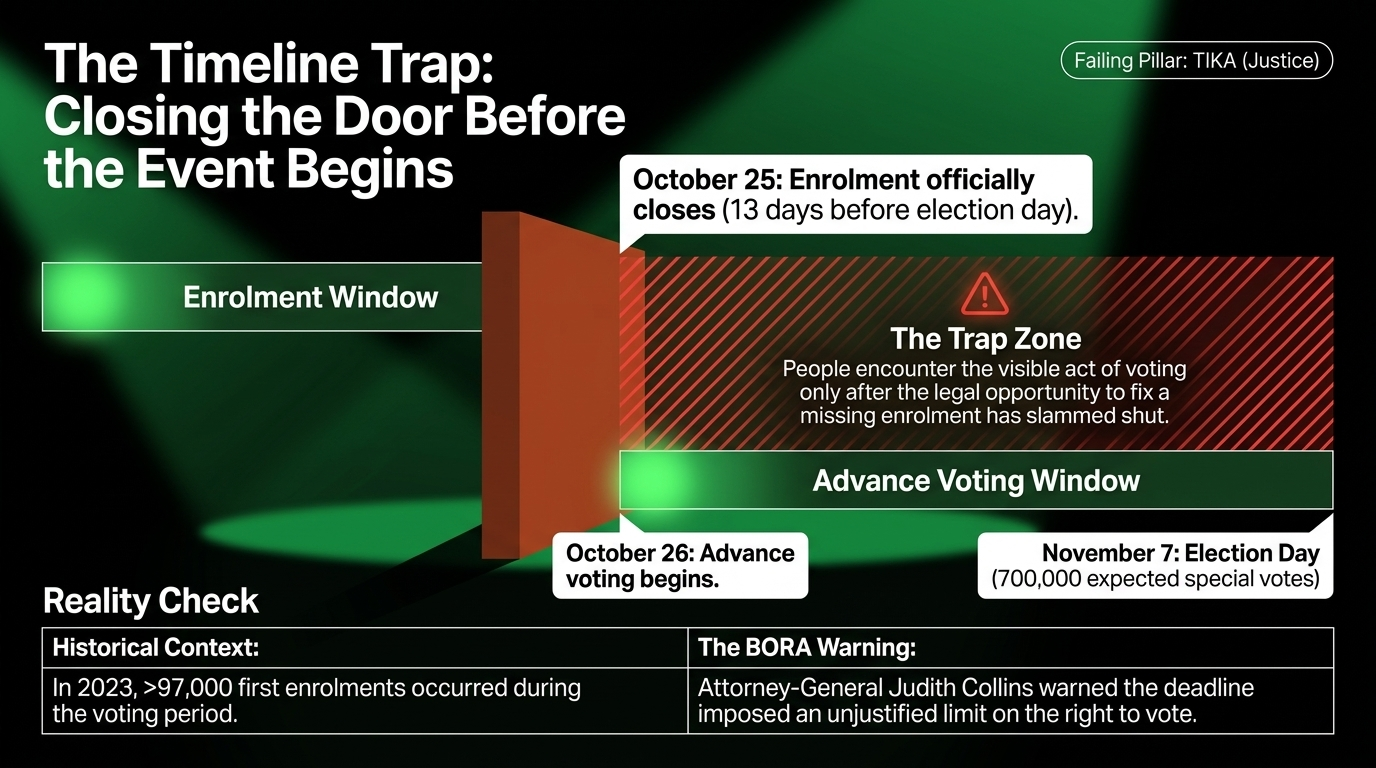
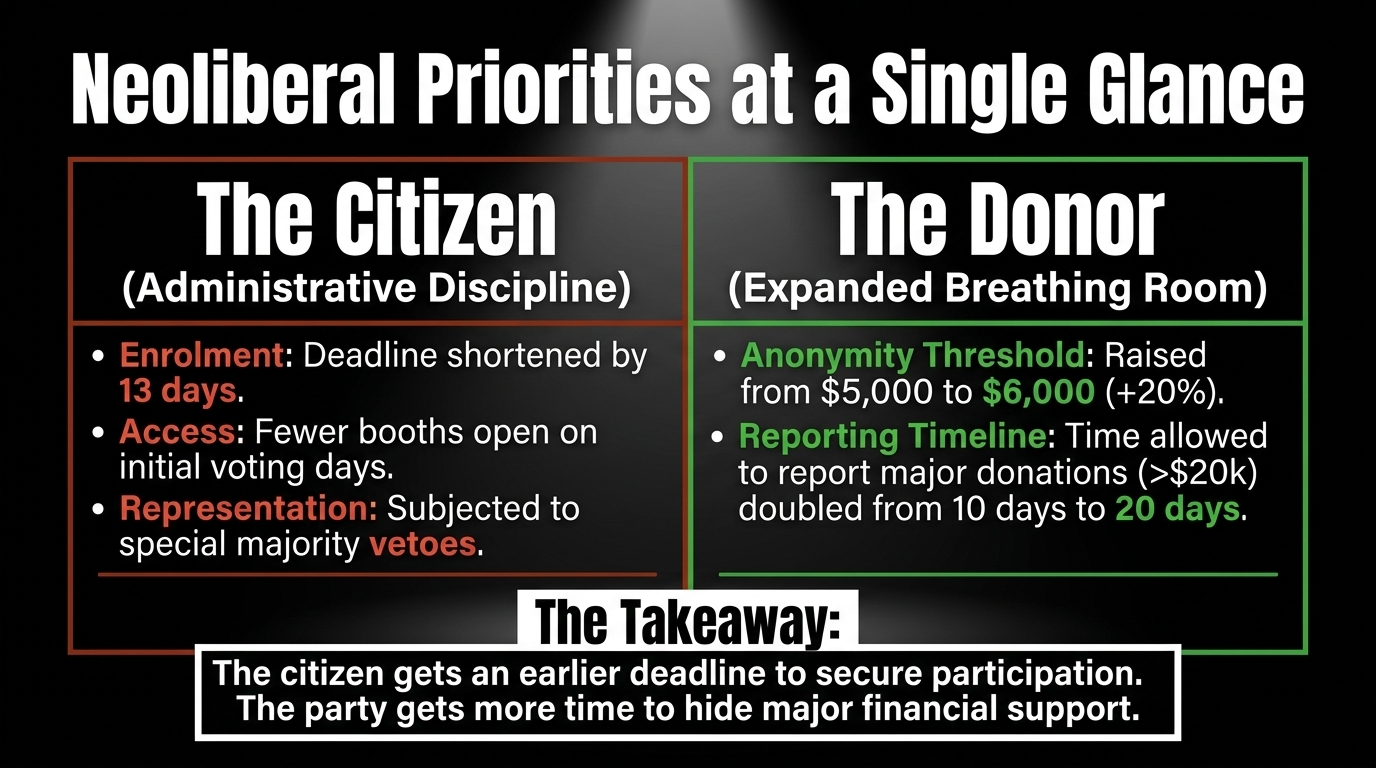
The Act moved the enrolment deadline to 13 days before election day and fixed advance voting at 12 calendar days. The Ministry explains both enacted changes.
For this election, enrolment closes on 25 October—before advance voting opens. The Electoral Commission’s enrolment guidance identifies the deadline.
That is the trap: people can encounter the visible act of voting only after the opportunity to fix a missing enrolment has closed.
Attorney-General Judith Collins concluded that the proposed deadline appeared to impose an unjustified limit on the right to vote under section 12 of the Bill of Rights Act. Her report states that conclusion.
This was not merely an Opposition complaint. It was the Government’s own formal human-rights warning.
The Workload Was Real
I will not pretend electoral administration is effortless.
The Commission recorded about 450,000 enrolments or updates during the 2023 voting period, including 110,000 on election day; more than 600,000 special votes represented 21% of votes cast. Its election report documents the workload.
Those figures describe transactions and votes, not an interchangeable headcount of people. They must not be piled together to manufacture a frightening total.
The Attorney-General accepted that faster counting was an important objective and that an earlier deadline had a rational connection to that objective. Her analysis explicitly recognises the Government’s legitimate purpose.
But that was not enough. She found the benefits uncertain, the restrictions disproportionate and less restrictive alternatives available, including automatic address updates and shorter deadlines. Her proportionality analysis explains why the proposal failed.
The honest verdict is not that every administrative concern was fabricated. It is that the Government chose a rights-restricting answer without demonstrating that the restriction was necessary.
Efficiency Does Not Excuse Everything
The Commission reportedly expects around 700,000 special votes in 2026, with checking and counting potentially extending to about 20 days. RNZ reports the Commission’s forecast and counting requirements.
That forecast does not prove the deadline produces no benefit whatsoever. We cannot observe the alternative election under the old rules.
What we can say is that the Government cannot honestly sell disenfranchisement as a demonstrated shortcut to rapid results. The Attorney-General warned that activity might simply move earlier and that the scale of any counting improvement was uncertain. Her report records those limitations.
My answer is simple: improve the machinery before cutting people out of it.
A democracy does not become more efficient by treating its citizens as excess processing.
The Young Were Still Missing
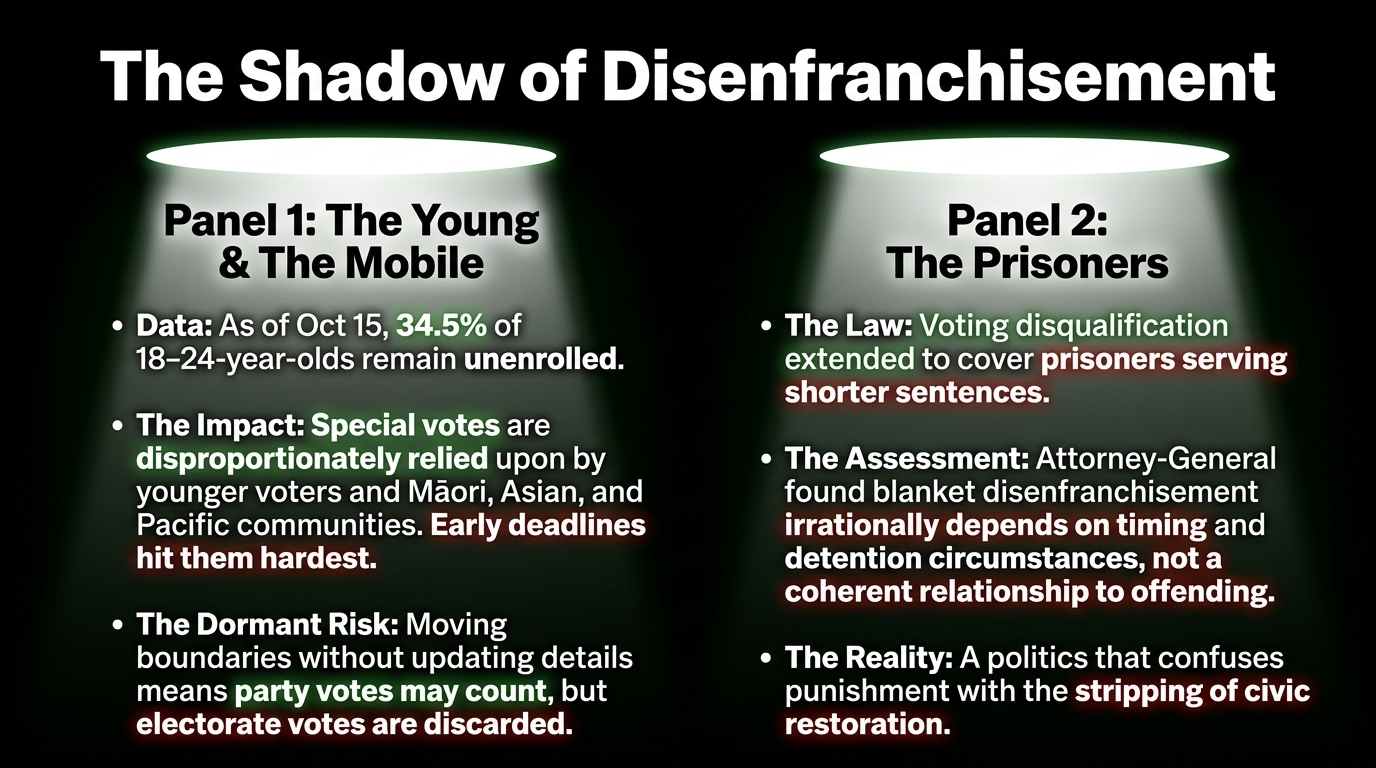
As at 15 October, 65.5% of 18–24-year-olds were enrolled, according to Commission figures reported by RNZ. The report identifies the age group and date.
That leaves 34.5% unenrolled at that snapshot—not 34.5% permanently excluded, and not a verified headcount.
The Attorney-General also recorded that special votes were more common in areas with larger Māori, Asian and Pacific communities and among younger voters, indicating those communities could be more affected by an earlier deadline. Her report sets out that evidence and its qualification.
Luxon said enrolment was straightforward and advertising extensive; Goldsmith pointed people towards advertisements on buses. RNZ records their response.
Look at the back of a bus. That was the answer to a warning about democratic exclusion.
Advertising can help people navigate a restriction. It cannot establish that the restriction should exist.
Dormant Does Not Mean Disqualified
We must not frighten people away from voting through sloppy language.
Being on the dormant roll does not automatically mean being ineligible: the Commission says dormant electors can still cast special votes. Its enrolment guidance explains that distinction.
A different problem arises when someone has moved across electorate boundaries without updating their details: their party vote may count while their electorate vote is disallowed, a consequence examined in the Attorney-General’s analysis. Her report explains the circumstances.
My practical message is therefore not despair. Check your enrolment and address before the deadline. Help whānau check theirs—with consent, without pressure over how they vote.
The political answer is to remove unnecessary traps, not make families permanently responsible for compensating for them.
Prisoners Were Stripped Again
The enacted change extends voting disqualification to prisoners serving shorter sentences for offending committed after commencement. The Ministry explains the extension and its timing.
The previous framework disqualified prisoners serving life, preventive detention or sentences of three years or more. The Attorney-General describes that former position.
Her report concluded that blanket sentenced-prisoner disenfranchisement appeared inconsistent with voting rights because its effects depended irrationally on timing and detention circumstances rather than a coherent relationship to offending. The report explains that conclusion.
For accuracy, remand prisoners, people on bail and people released on parole are not all swept into that same sentenced-prisoner category. The Attorney-General makes those distinctions.
My tikanga question is not whether offending should have consequences. It should. My question is whether stripping civic belonging helps repair harm and return someone to responsible participation.
I reject a politics that confuses punishment with restoration.
Māori Representation Faced A Veto
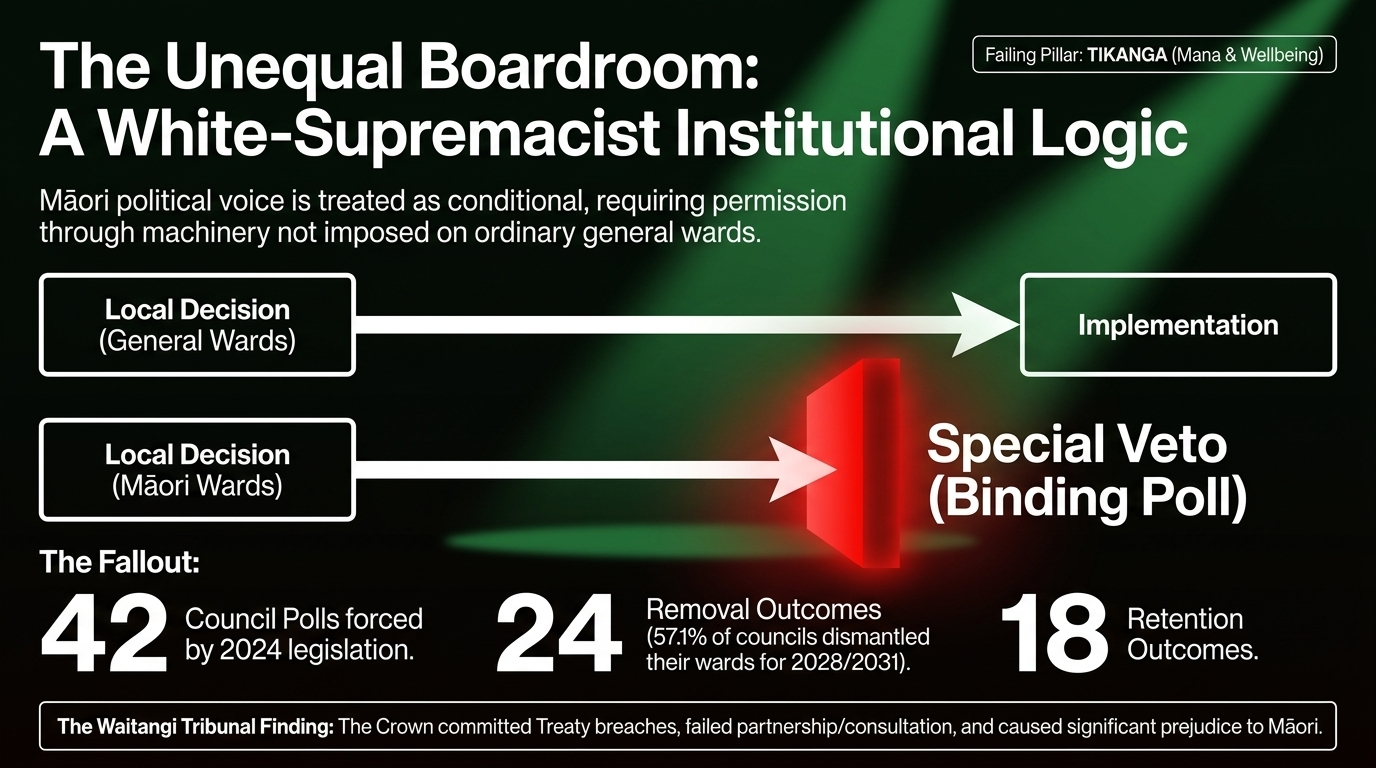
The 2024 Māori-ward legislation required affected councils to reverse their decisions or hold binding polls on dedicated Māori representation. The Department of Internal Affairs explains the legislative requirements.
The Waitangi Tribunal found Treaty breaches, including failures of partnership and consultation, and identified significant prejudice to Māori. Its urgent inquiry findings explain the Crown’s failures.
The Government proceeded.
Across the 42 council polls, 24 outcomes favoured removal and 18 retention; the consequences apply from the 2028 elections and bind the following electoral cycle as well. RNZ reports the final outcomes and timing.
That is not the same mechanism as stopping an individual enrolling. It is the weakening of a representative structure.
My judgement is that singling out Māori representation for a special majority veto reproduces white-supremacist institutional logic: Māori political voice is treated as conditional on permission through machinery not imposed on ordinary general wards. That is an argument about the structure and its consequences, grounded in the Tribunal’s findings, not an allegation about every supporter’s private beliefs.
Donors Got More Breathing Space
The Act raised the donor-identity disclosure threshold from $5,000 to $6,000 and doubled the election-year reporting period for donations exceeding $20,000 from 10 days to 20. The Ministry confirms both changes.
That does not abolish disclosure. It does make the threshold higher and the reporting slower.
The contrast is obscene.
The citizen gets an earlier deadline to secure participation. The party gets more time to disclose major financial support.
I see neoliberal politics in that ordering of priorities: administrative discipline for ordinary people, greater room around political money.
Three Examples For Western Readers
Example One: The Locked Office
Imagine an organisation announcing that everyone can participate in its decision, then closing registration before participation begins.
That is the practical problem with enrolment closing on 25 October and advance voting opening the next day. The Commission explains the enrolment deadline, while the Ministry sets out the advance-voting period.
The scale of exposure is not imaginary: more than 97,000 people first enrolled during the previous election’s voting period. That is historical evidence, not a prediction that all would now be excluded. The Attorney-General records the figure.
Tikanga impact: the institution puts its timetable ahead of people’s effective belonging.
Repair: restore election-day enrolment, resource processing properly and use automatic address updates. The latter is already enabled by the legislation. The Ministry identifies that constructive provision.
Example Two: The Mostly Closed Network
Imagine being told a service is available on a public holiday, then finding almost every familiar branch closed.
Using Belich’s reported Epsom figures, two open places out of 22 means about 9.1% open and 90.9% closed. This measures locations—not travel distance, queue capacity or votes lost. RNZ supplies the underlying figures.
Tikanga impact: formal availability substitutes for meaningful access; a person’s circumstances become their problem alone.
Repair: publish clear place-by-place opening information, provide accessible transport and choose future dates that avoid known access difficulties.
Example Three: The Unequal Boardroom
Imagine a board allowing most members to establish their representative arrangements normally, while one group’s representation must survive a special organisation-wide veto.
That is the structural objection to the Māori-ward poll regime identified by the Tribunal. Its findings explain the unequal treatment and Treaty prejudice.
The removal outcomes occurred in 24 of 42 council polls—about 57.1% of councils holding polls, not 57.1% of all voters. RNZ reports the underlying results.
Tikanga impact: Māori collective voice is made conditional, weakening the recognition of whakapapa and rangatiratanga in public decision-making.
Repair: remove the special veto, rebuild representation through meaningful engagement and stop treating Treaty partnership as an inconvenience to majority power.
The Deep Dive Podcast
Listen to a lively conversation between two hosts, unpacking and connecting topics in the sources of this essay. I apologise in advance for the AI's very harsh pronounciation of reo. Please dont shoot me, :).
Youtube Video
Like video? Here is a short video suppporting the essay. Again, don't shoot the messenger please because of AI's pronounciation. :)
Koha Keeps The Scrutiny Alive
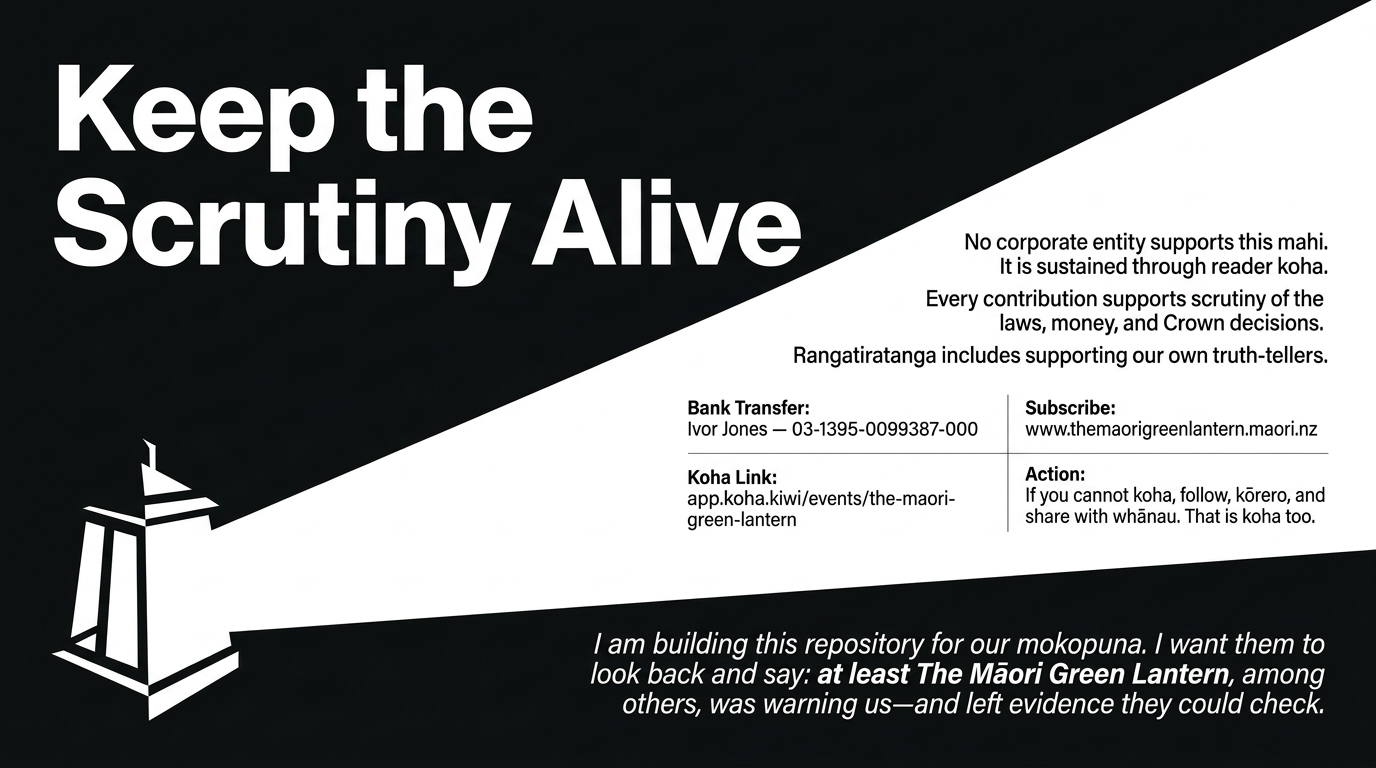
No corporate entity supports this mahi. It is sustained through reader koha, as I explain in my published support statement.
Every koha supports scrutiny of the laws, money and Crown decisions examined here. Rangatiratanga includes supporting our own truth-tellers.
- Koha — Support This Mahi
- Subscribe To The Māori Green Lantern
- Direct transfer: Ivor Jones — 03-1395-0099387-000
- Subscribe On Facebook
If you cannot koha, follow, kōrero and share with whānau and friends. That is koha too.
Do Not Reward This Record
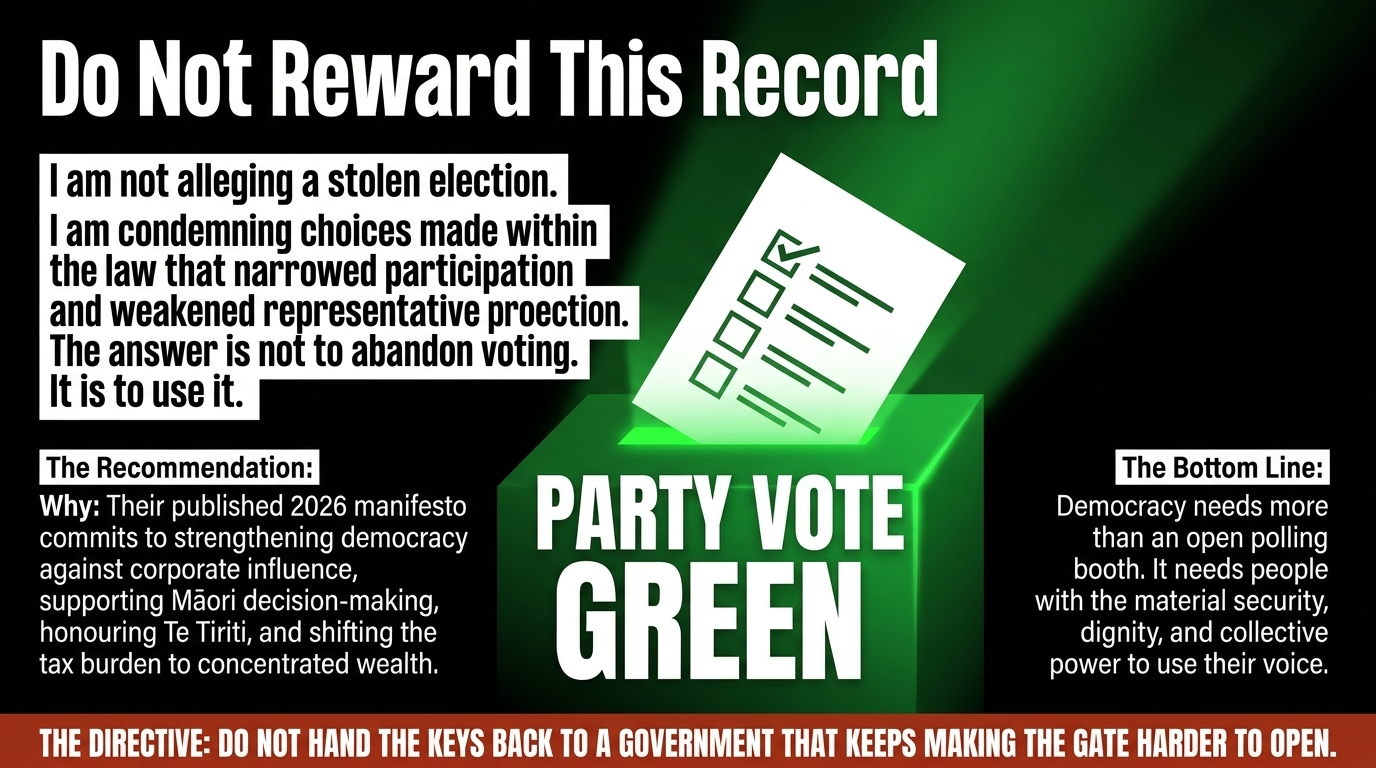
I am not alleging a stolen election. I am condemning choices made within the law that narrowed participation and weakened representative protection.
The answer is not to abandon voting. It is to use it—and insist on restoring election-day enrolment, ending blanket prisoner disenfranchisement, removing the special Māori-ward veto, strengthening donation transparency and publishing election-date advice before decisions are locked in.
My recommendation is party vote Green.
The Greens’ published manifesto commits to strengthening democracy against corporate influence, supporting Māori decision-making, honouring Te Tiriti, investing in public services and shifting the tax burden towards concentrated wealth. Those are promises to test, not achievements I pretend have already happened. Their 2026 manifesto sets out that programme.
I recommend that direction because democracy needs more than an open polling booth. It needs people with the material security, dignity and collective power to use their voice.
Do not vote this coalition back into power in November. Its documented record of electoral restrictions and Māori-representation changes is reason enough to deny it another mandate. The enacted electoral changes and the Tribunal’s Māori-ward findings are there to read.
Tika demands better rules. Pono demands honest reasons. Tikanga demands that people leave the system with their mana intact.
Do not hand the keys back to a Government that keeps making the gate harder to open.
Disclaimer
This essay is political commentary by Ivor Jones, The Māori Green Lantern. It draws on the reporting and documents linked throughout; its interpretations, criticisms and voting recommendation are the author’s own.
References to “corruption”, “white supremacy” or “neoliberalism” express political and structural criticism, not findings of criminal wrongdoing or claims about any individual’s private beliefs. The essay does not allege that the election is rigged or illegitimate. Hypothetical examples illustrate policy effects; they do not describe identified individuals.
I speak for myself, not for all Māori, iwi or hapū. Readers are encouraged to examine the linked evidence and reach their own conclusions. Factual corrections supported by evidence are welcome.