"Seven Parties Walked Into The Light. This Is Why Six Of Them Should Not Come Back" - 3 October 2026
Tika, Pono, Tikanga, And One Ballot Paper — The Arithmetic Of Who Gets To Live Well In Aotearoa.


Mōrena ano Aotearoa,
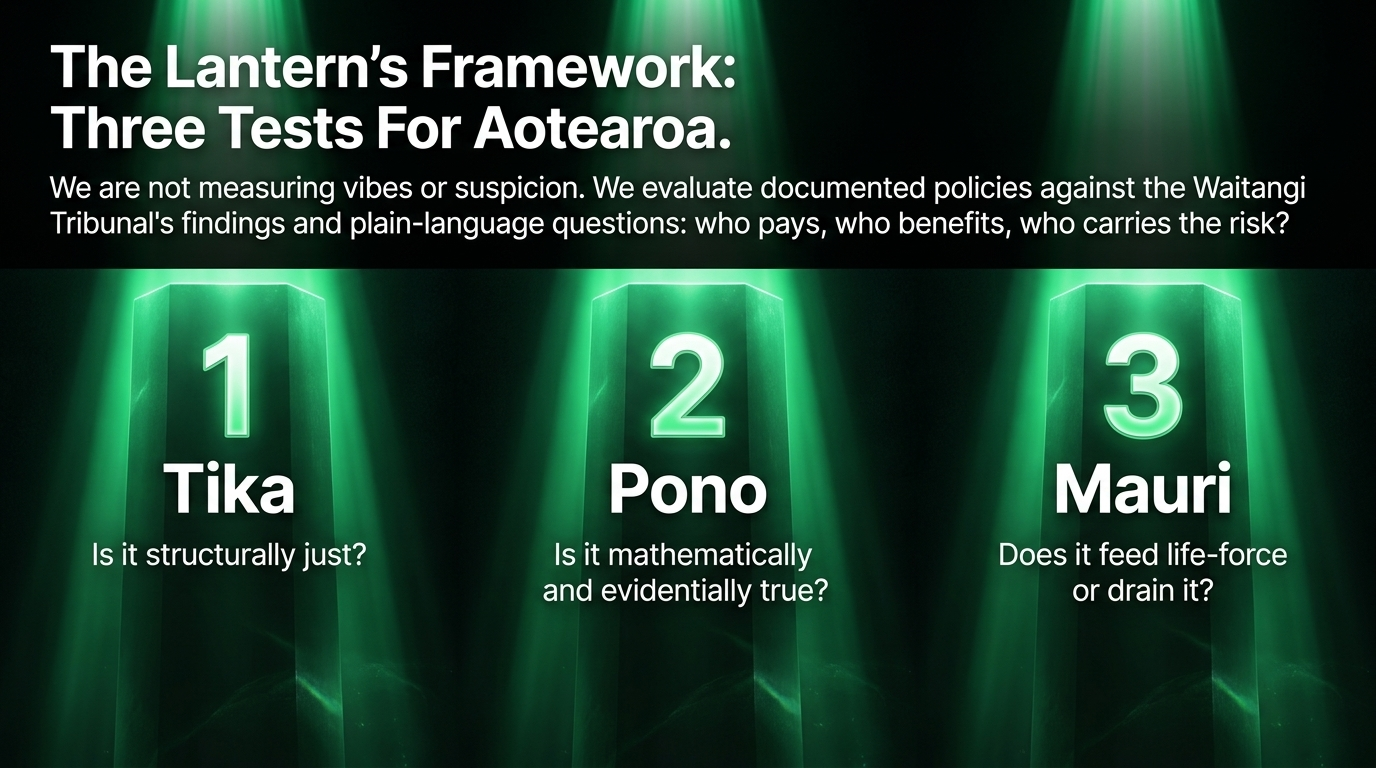
I read all seven parties' published 2026 policies so you don't have to decode the campaign grid yourself.
I ran each one through three Māori tests — Tika (is it just?), Pono (is it true?), Mauri (does it feed life or drain it?) — and asked the question: who pays, who benefits, who carries the risk?
 Thomas Coughlan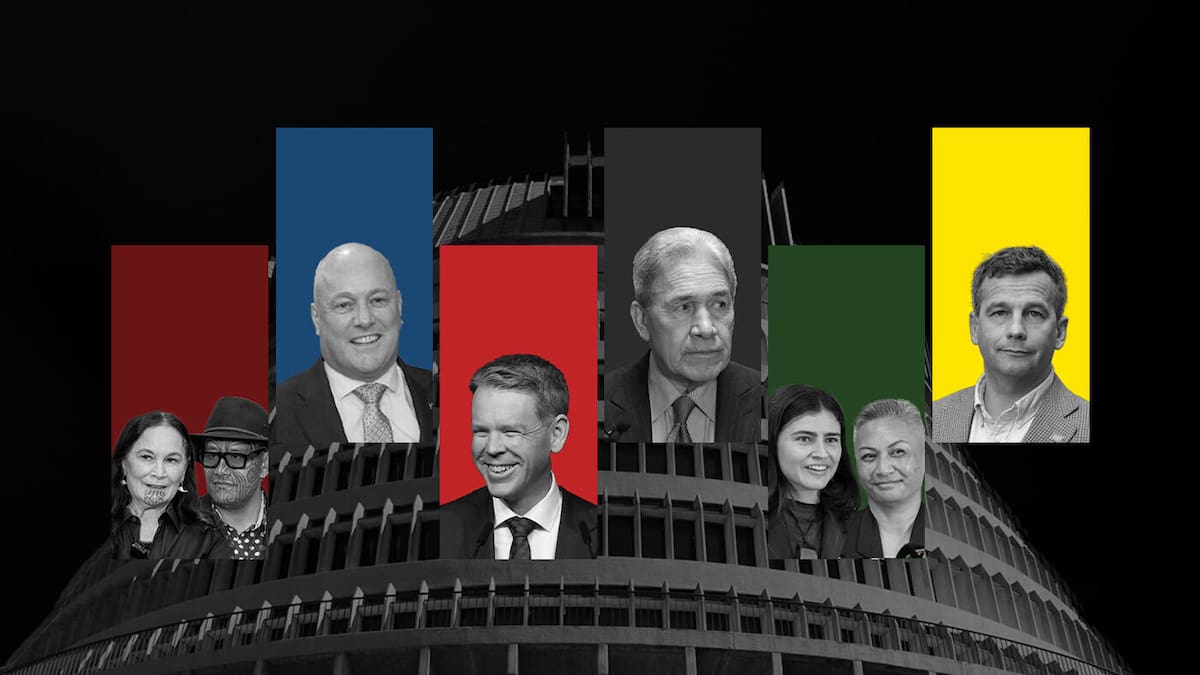
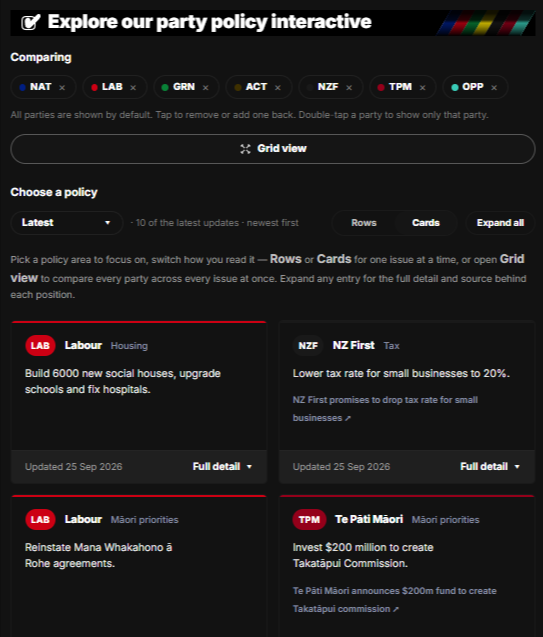
Then, party by party, I give you the documented reason to keep your vote away from six of them — not vibes, not suspicion: their own words, the Tribunal's findings, the survey data.
Three everyday examples translate it for the Western mind.
And at the end: the one vote that keeps mauri in the machine.
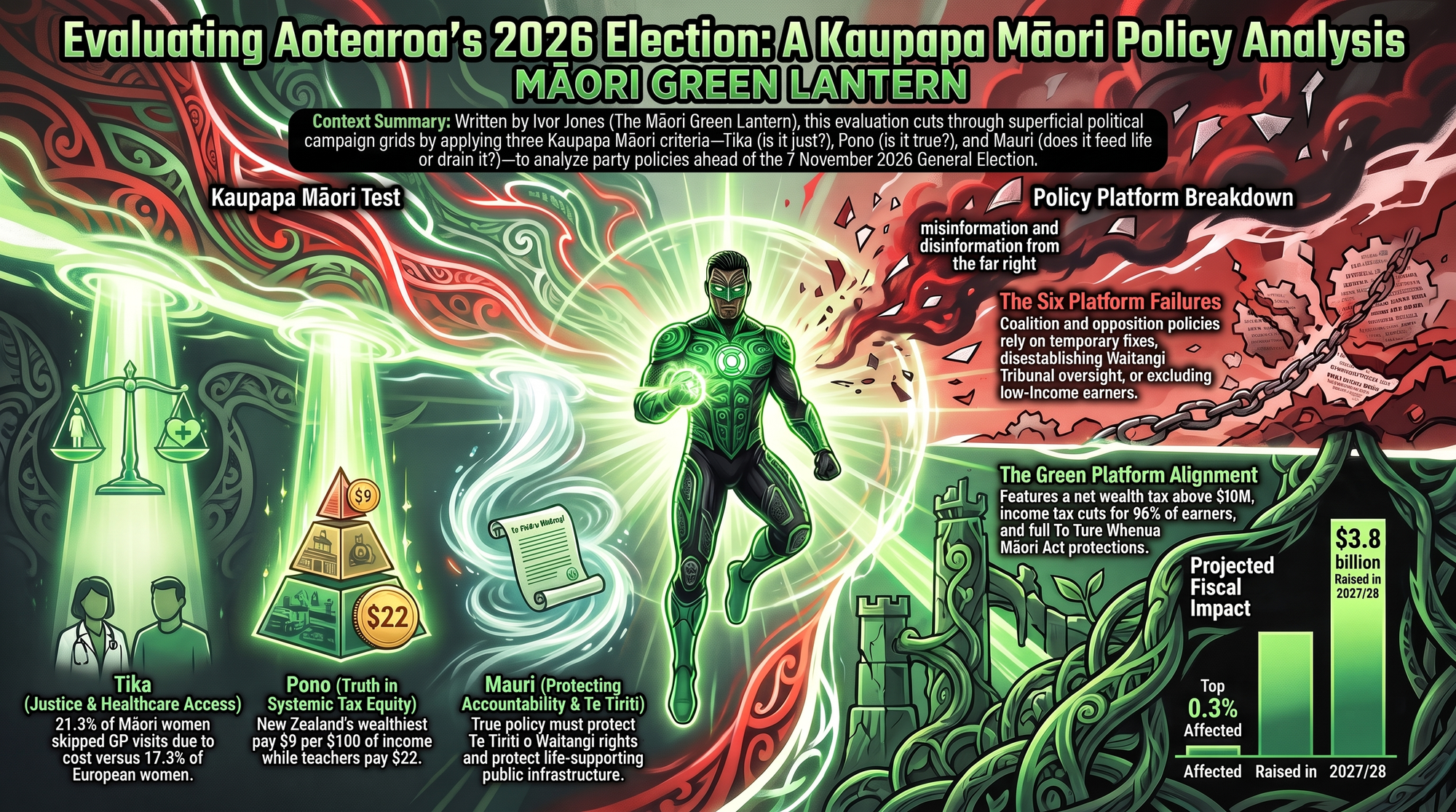
Click through with aroha — this is not decoration, it's a working toolkit for whānau hui, staffroom kōrero, and the polling booth. This essay stands alongside the ones already in the archive, like "Labour's Red-Coloured Cage".
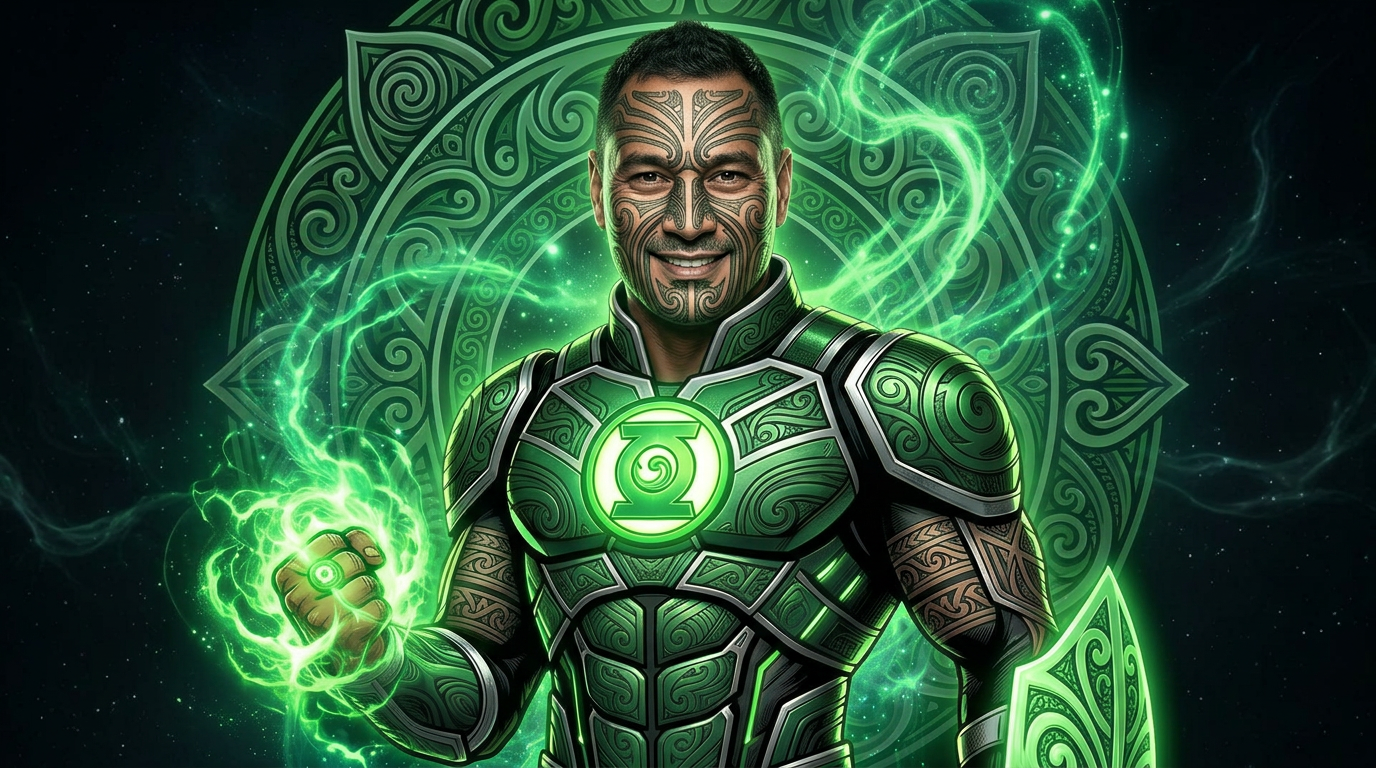
This repository is for our mokopuna — so they can look back and say: at least we knew. At least The Māori Green Lantern, amongst a few, was warning us.
The Grid Is A Brochure Rack, Not Journalism
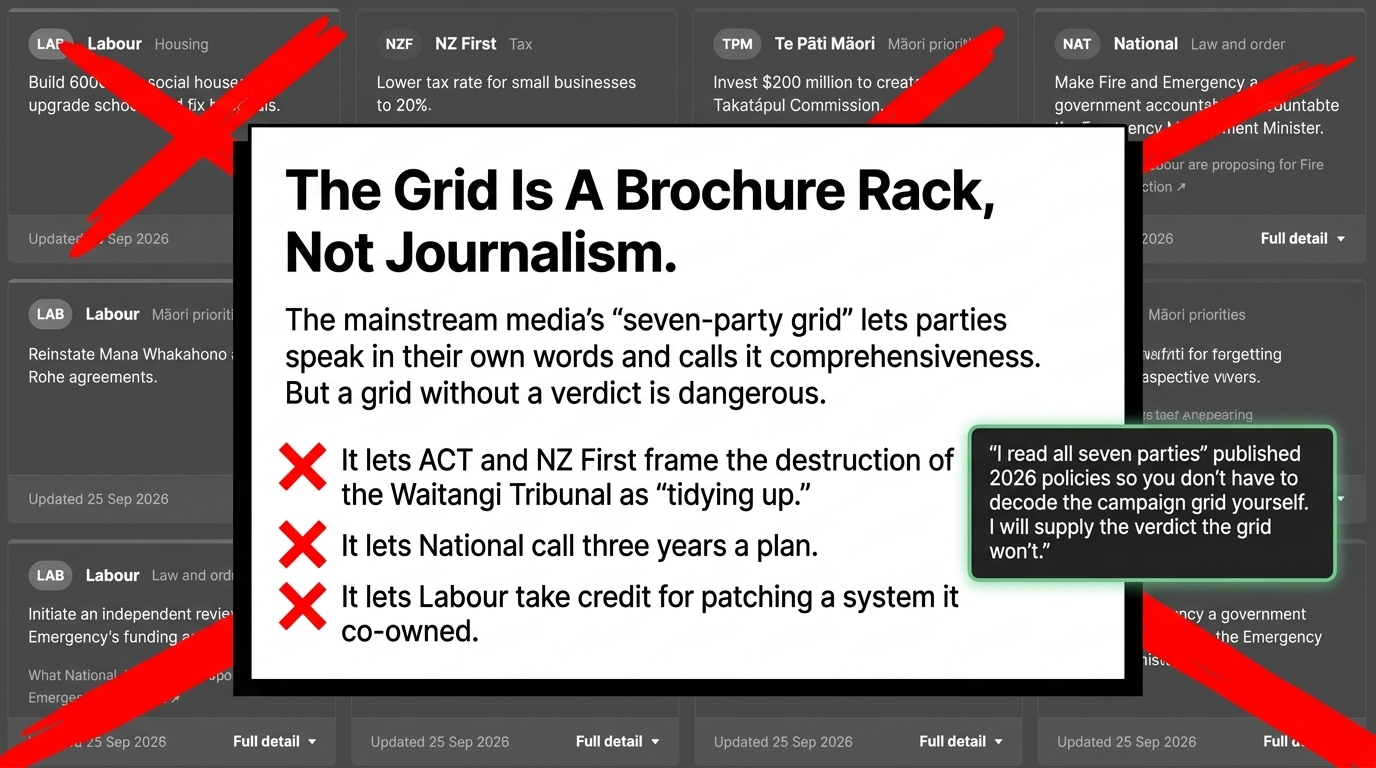
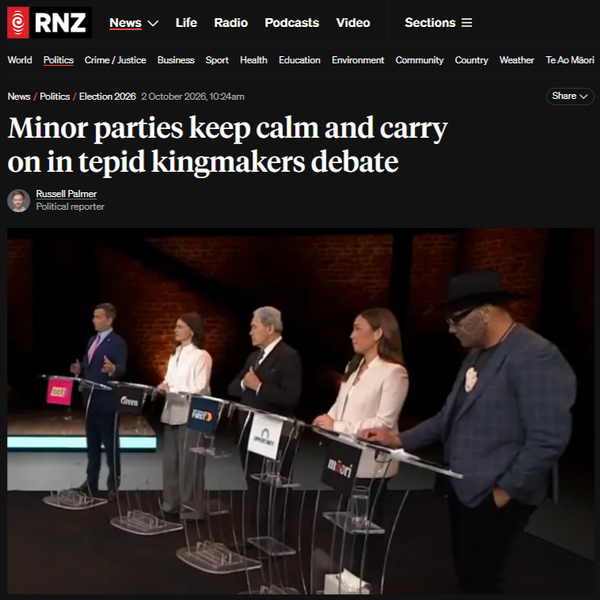
The Herald's seven-party grid lets parties speak "in their own words" and calls it comprehensiveness.
But a grid without a verdict lets ACT and NZ First frame the Waitangi Tribunal's destruction as tidying up, lets National call three years a plan, lets Labour take credit for patching a system it co-owned.
So I'll supply the verdict the grid won't.
Why Not National: No New Taxes Means No New Anything
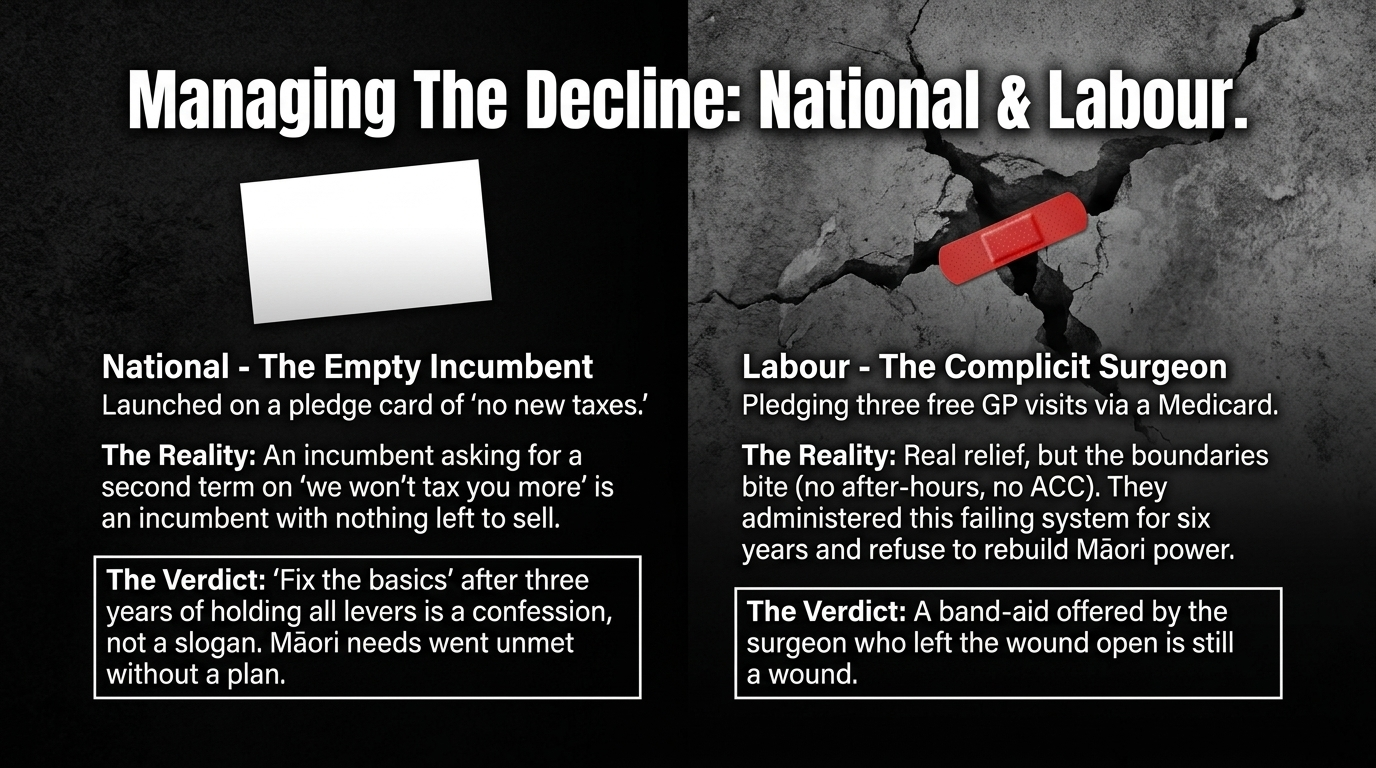
Christopher Luxon's National launched on a pledge card — "no new taxes," compulsory KiwiSaver, marginally wider first-home deposit access. RNZ described the launch as "another pledge card rather than any new policy," with conspicuously empty seats.
Reason not to vote for them: an incumbent asking for a second term on "we won't tax you more" is an incumbent with nothing left to sell. No new taxes solves one anxiety for the already-comfortable and answers none of it for whānau whose barrier is not the tax rate but the clinic gate (see Example 1, below).
"Fix the basics" after three years of holding all the levers is a confession, not a slogan.
Why Not Labour: Three Free Visits To A System They Helped Build
Chris Hipkins offers three free GP visits a year via a Medicard, funded by a targeted investment-property capital gains tax. Real relief — and I said so in the first essay. But the boundaries bite: no after-hours, no ACC, no rollover.
Reason not to vote for them: Labour is campaigning against a health system it administered for six years, and its answer to Crown control of Māori health — which I documented in "Labour's Red-Coloured Cage" — is to promise repeal without rebuilding Māori power.
A band-aid offered by the surgeon who left the wound open is still a wound.
Why Not ACT: Because They Publish The Demolition Order Themselves
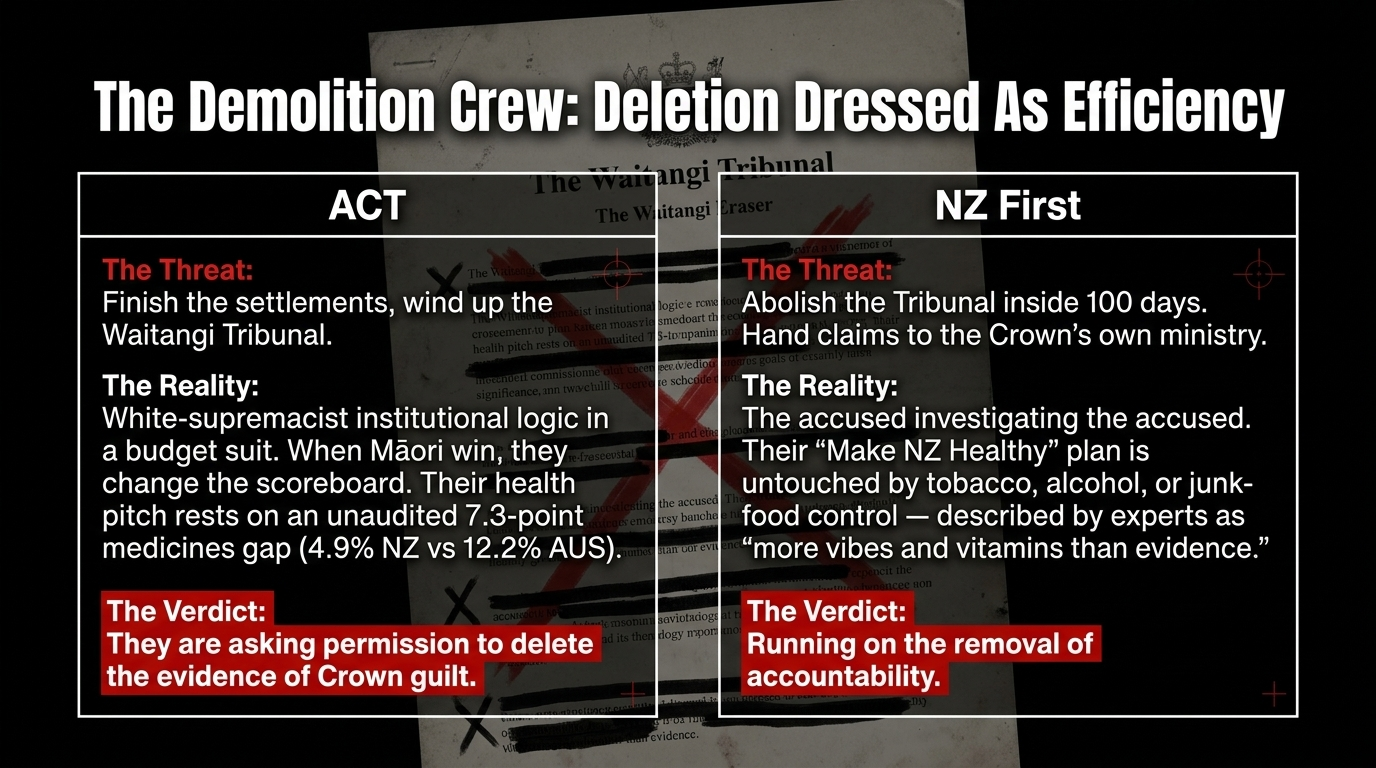
David Seymour's ACT put it in a policy title: "Finish the settlements, wind up the Waitangi Tribunal." End contemporary jurisdiction. Close the Tribunal once historic claims are done. Their health pitch rests on figures they supply themselves — NZ spending 4.9% of the health budget on medicines against Australia's 12.2%, a 7.3-point gap (12.2 − 4.9; working shown), unaudited elsewhere.
Reason not to vote for them: my opinion, openly flagged, is that this is white-supremacist institutional logic in a budget suit — when Māori win, change the scoreboard.
A party whose flagship Treaty policy is to silence the standing commission that keeps finding the Crown guilty is not offering you policy. It is asking your permission to delete the evidence.
Why Not NZ First: The Accused Investigating The Accused
Winston Peters pledges to "immediately abolish the Waitangi Tribunal" within the first 100 days and hand contemporary claims to the Crown's own Māori ministry. In plain English: the accused investigates itself. Boyd Swinburn at the University of Auckland found their fifteen-point "Make NZ Healthy" plan full of vitamin trials and dietary education, untouched by tobacco, alcohol, or junk-food control. RNZ reported the Tribunal found no clear plan for Māori health after Te Aka Whai Ora was scrapped — the arc I traced in "The Crown Ripped Māori Hands From The Health System."
Reason not to vote for them: a party that campaigns on abolishing the body's means of testing Crown conduct, while simultaneously lacking a population-health plan, is running on the removal of accountability.
That is not a health policy and it is not immigration reform. It is the getaway car.
Why Not Te Pāti Māori: The Platform Deserves A Vehicle That Can Drive It
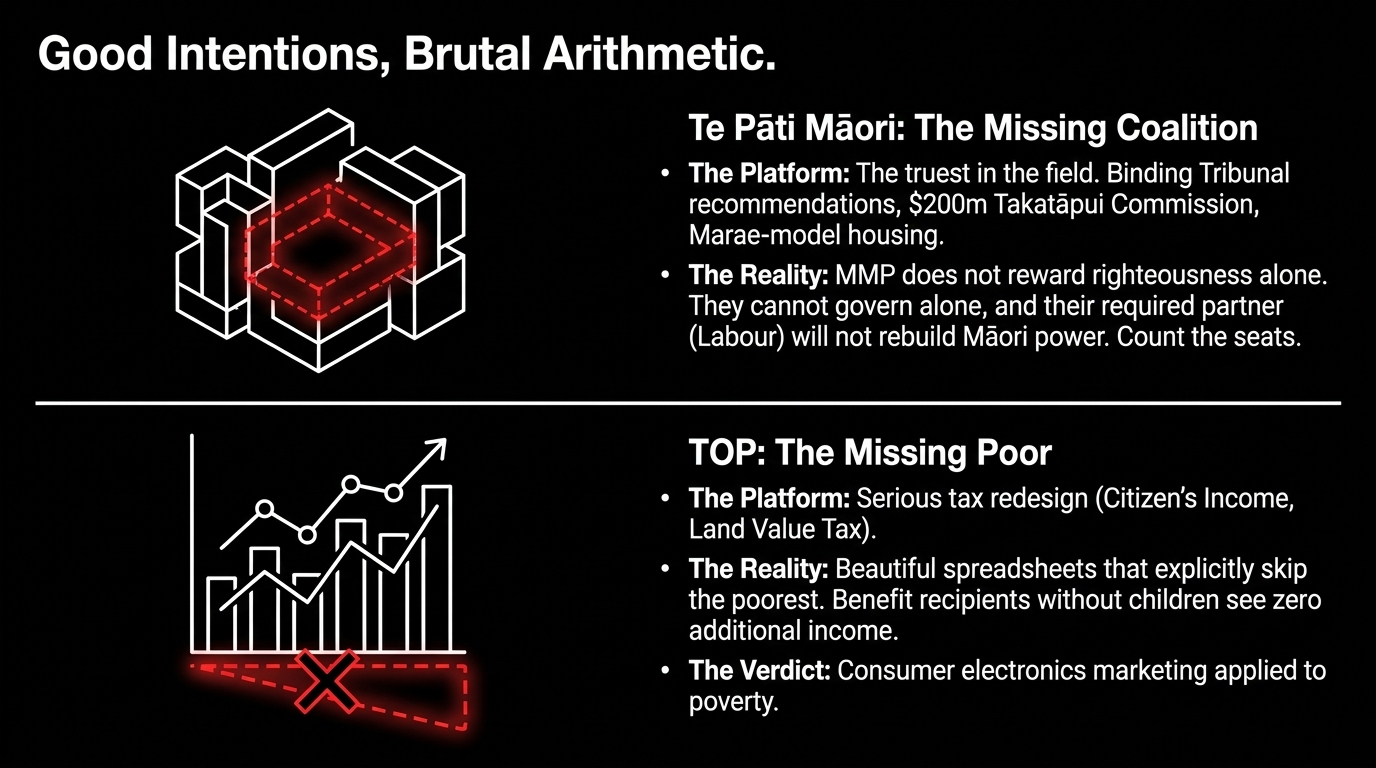
Let me be precise, because misinformation is the enemy even when it flatters us. Rawiri Waititi and Debbie Ngarewa-Packer's platform is the truest one in the field: Māori-led health authority restored, binding Tribunal recommendations, the $200 million Takatāpui Commission, Marae-model housing.
Reason to hesitate before voting them — and this is arithmetic, not disloyalty: MMP does not reward righteousness alone. Te Pāti Māori cannot form a government by itself, and the partner it needs is the Labour that will not rebuild Māori power.
An electorate vote for our people in the Māori seats is mana's own weapon; the party vote must land where a government that honours Te Tiriti can actually be assembled. Read the platform. Treasure it. Then count the seats.
Why Not Opportunity: Beautiful Spreadsheets That Skip The Poorest
Qiulae Wong's TOP has the most intellectually serious tax redesign in the campaign — Citizen's Income, Land Value Tax, KiwiSaver 2.0. But Michael Fletcher's analysis, via 1News/The Conversation, concluded it "could benefit many, but not poorest" — benefit recipients without children see no additional income, per TOP's own caveats.
Reason not to vote for them: a "tax reset" that leaves the floor exactly where it was is consumer electronics marketing applied to poverty.
When your model's headline winners exclude those on core benefits, you have priced whānau out of the product description.
Why Green: The Only Package That Survives Tika, Pono, And Tikanga
Marama Davidson and Chlöe Swarbrick's Manifesto 2026, verified from their own pages:
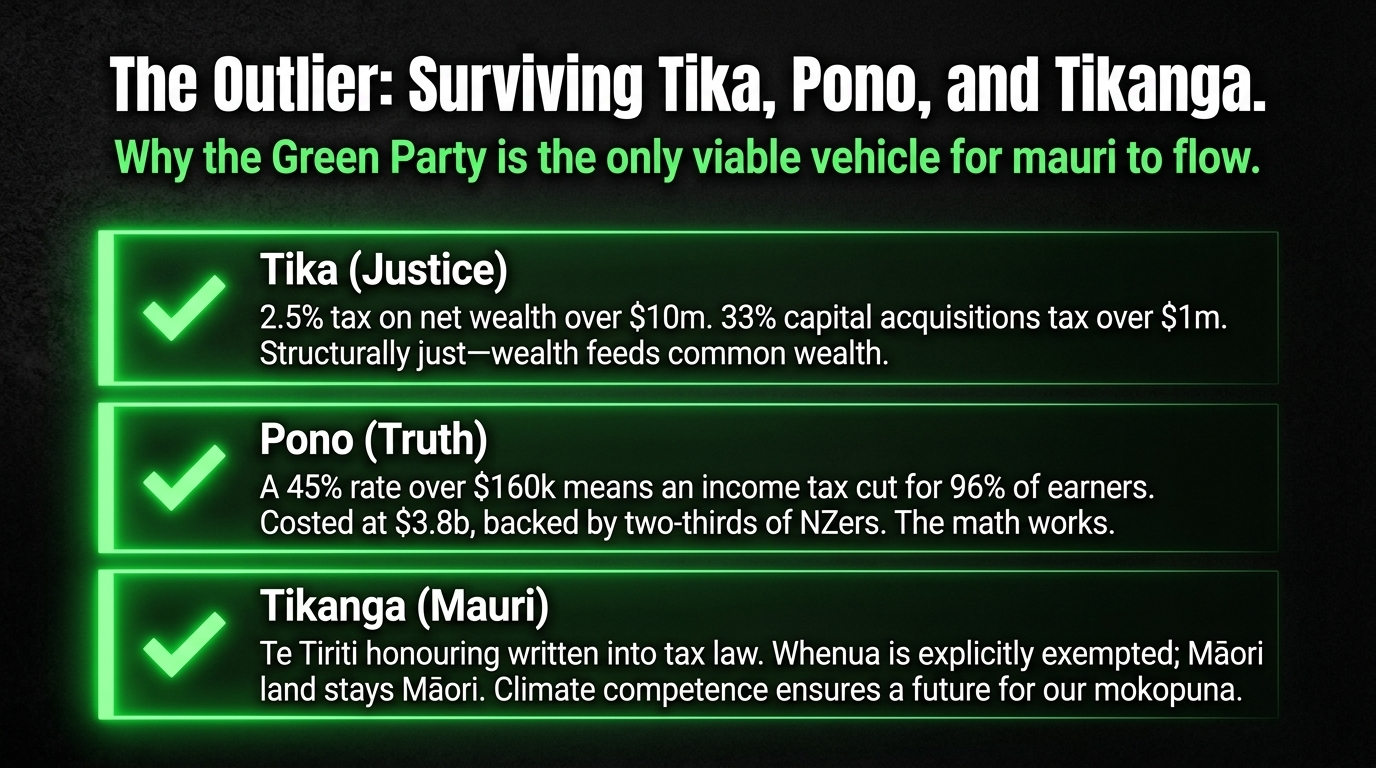
- A 2.5% annual tax on net wealth above $10m per person ($20m per couple), family home exempt
- A 33% Capital Acquisitions Tax on gifts and inheritance over $1m, with Māori land protected under Te Ture Whenua Māori Act
- A 33% corporate rate on only the largest 0.7% of companies; first $10,000 of income tax-free; a 45% rate over $160,000 — an income tax cut for 96% of earners — and pay equity reinstated within 100 days
- Newswire reports the wealth tax touches ≈ the richest 0.3% and is costed at ≈ $3.8b in 2027/28 (party costing, labelled); the Greens' Ipsos read-out reports almost two-thirds of New Zealanders back it
Tika: it is structurally just — wealth feeds common wealth. Pono: the numbers and the correction notes are published.
Tikanga: whenua is explicitly exempted; Māori land stays Māori. Mauri flows.
Three Examples For The Western Mind
The Clinic Gate
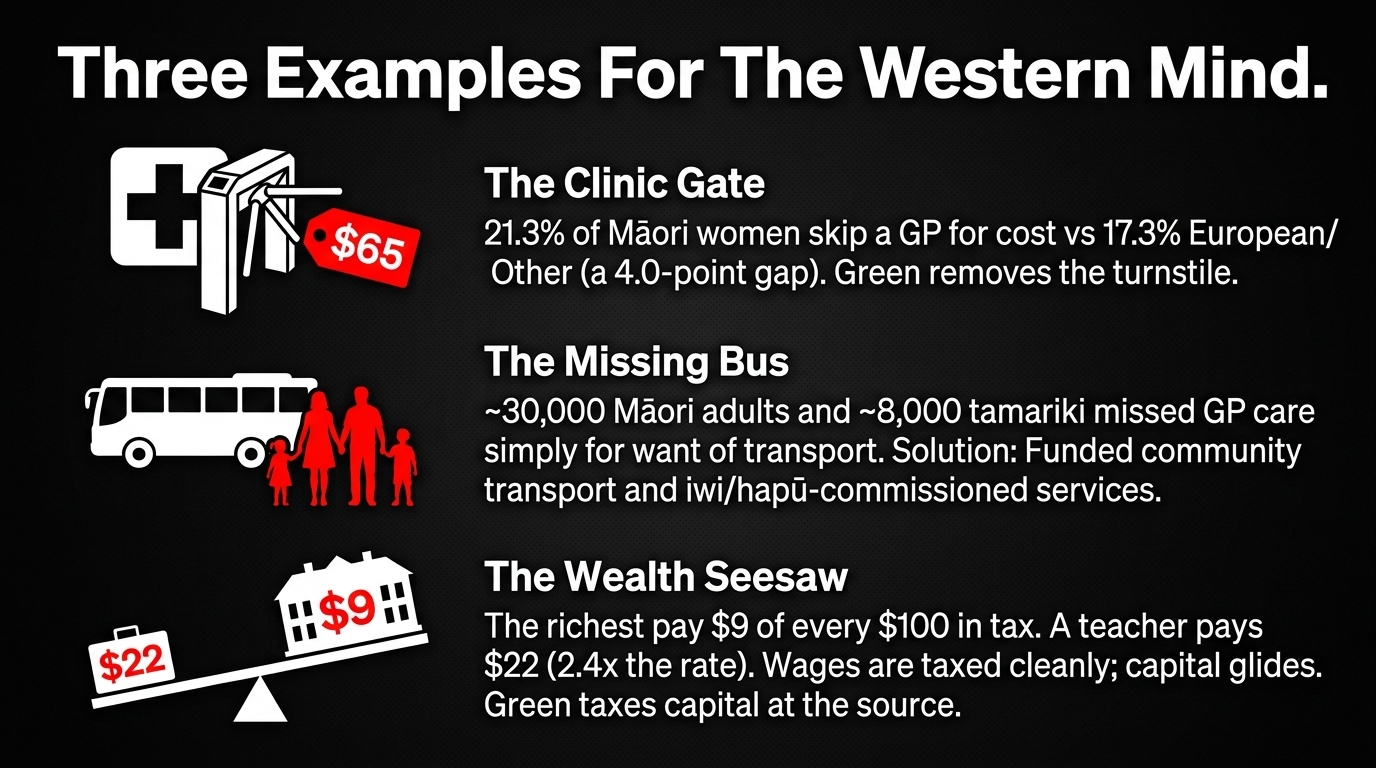
A GP waiting room with a $65 turnstile. Ministry of Health data shows 21.3% of Māori women skipped a GP for cost in the year to June 2025, versus 17.3% of European/Other women — a 4.0-point gap (21.3 − 17.3).
National holds the gate. Labour oils it twice a year. Green removes the turnstile. Tikanga fails wherever money decides who speaks first.
The Missing Bus
EHINZ's 2026 surveillance report: ≈30,000 Māori adults (4.6%, 95%CI 3.5–5.9) and ≈8,000 tamariki missed GP care for want of transport; disabled adults 6.2× the non-disabled rate (11.2%, ≈44,000 people).
That's not a rural excuse; it's a national leak.
Solution: funded community transport, mobile clinics, iwi- and hapū-commissioned services — money where the deficit is.
The $9 Versus $22 Rule
Wages are taxed cleanly; capital glides. The Green design taxes it at source. That "wait, that's legal?" moment is the unlock.
The Coalition Must Not Return, And Here Is Why In One Line Each
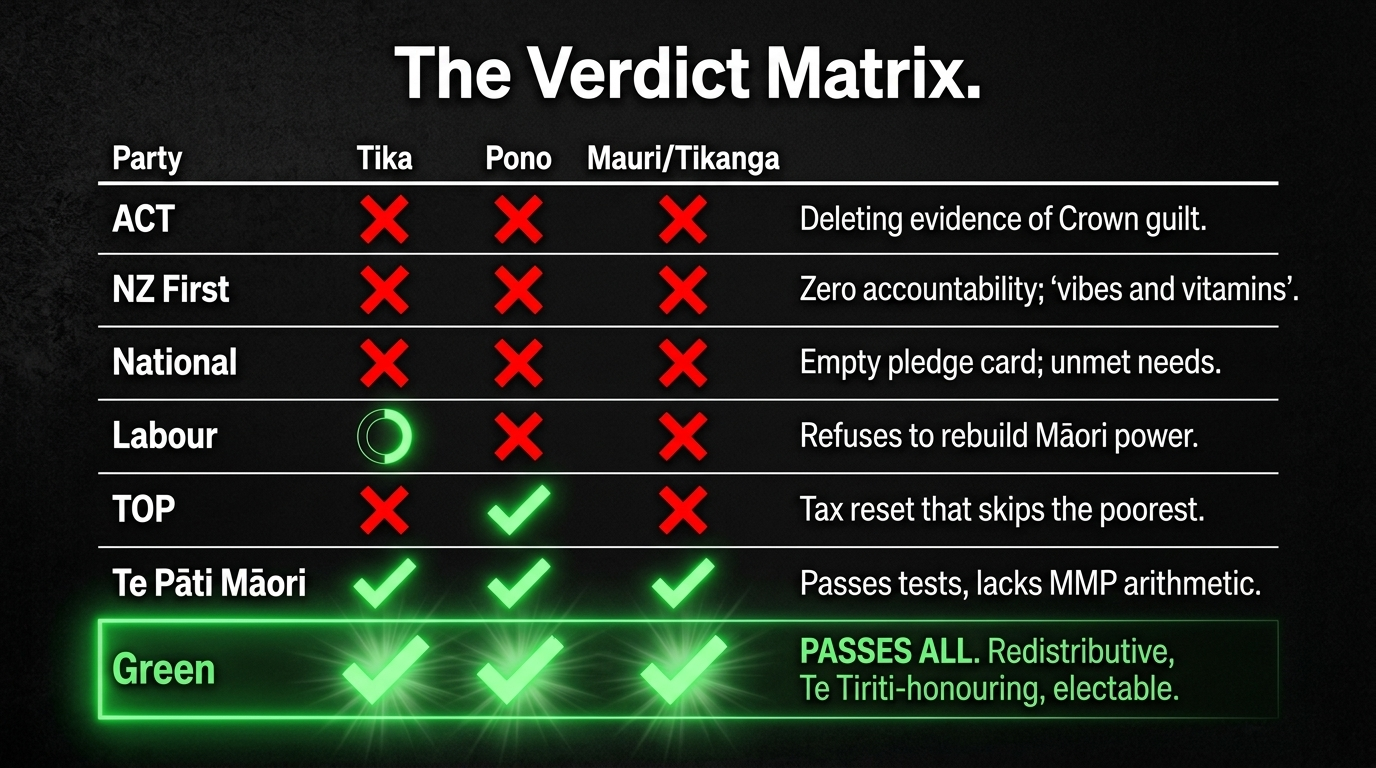
- National: a government asking for a renewal with an empty pledge card while the Tribunal documents that Māori needs went unmet without a plan.
- ACT: a party whose Treaty policy is to wind up the Tribunal — deletion dressed as efficiency.
- NZ First: a party pledged to abolish that same Tribunal inside 100 days, with a health platform an Auckland public-health professor called "more vibes and vitamins than evidence."
Election day is Saturday, 7 November 2026. Vote with your mokopuna's eyes. Party vote Green — because among the seven, only the Greens carry redistribution, Te Tiriti honouring written into tax law, climate competence, and an electable path to actually doing it.
The Deep Dive Podcast
Listen to a lively conversation between two hosts, unpacking and connecting topics in the sources of this essay. I apologise in advance for the AI's very harsh pronounciation of reo. Please dont shoot me, :).
Youtube Video
Like video? Here is a short video suppporting the essay. Again, don't shoot the messenger please because of AI's pronounciation. :)
Koha — Support The Receipts
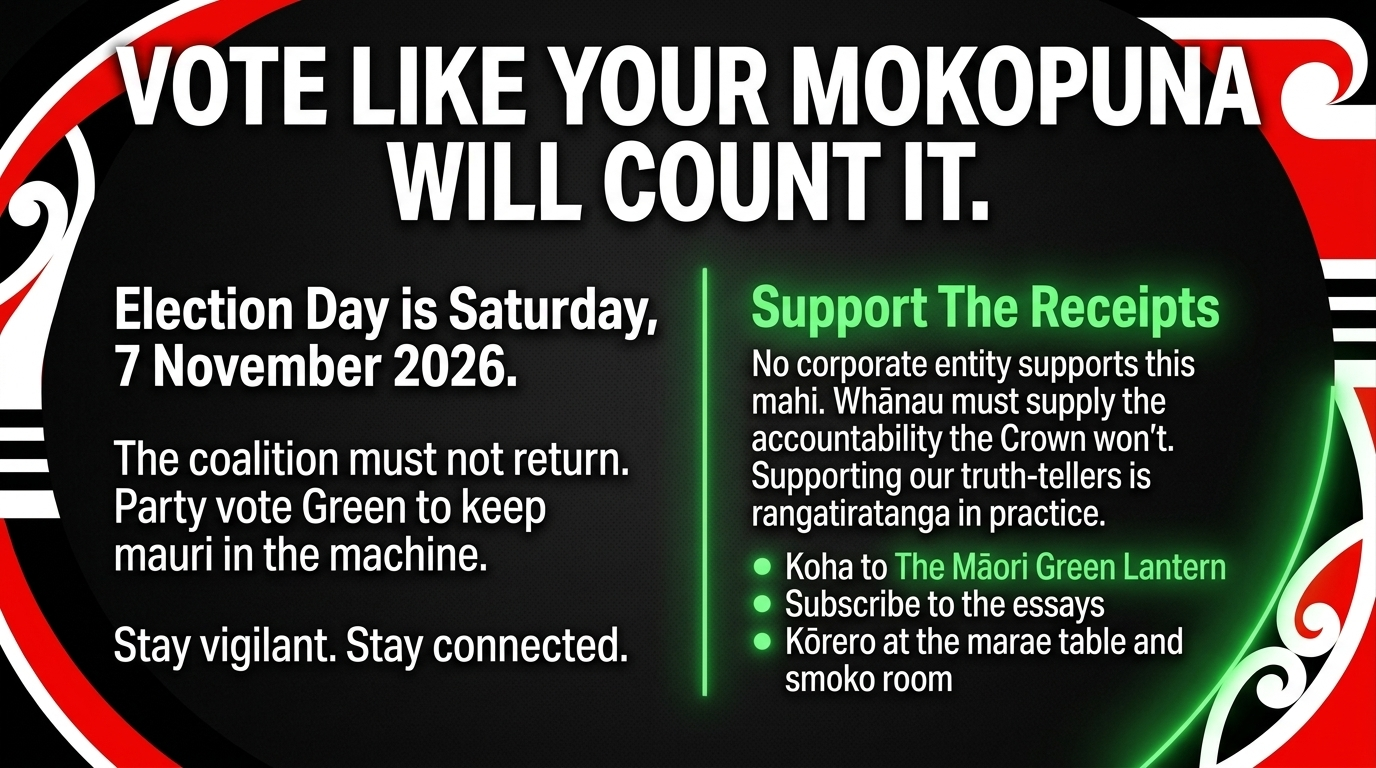
Who supports reading seven manifestos, checking each statistic against the source it came from, and writing this so our babies can find it later?
You do. No corporate entity supports this mahi — not one. Every koha says whānau will supply the accountability Crown and corporate structures won't. Supporting our own truth-tellers is rangatiratanga in practice. Can't koha? Share the links, kōrero them at the marae table and the smoko room. That is koha in itself.
- Koha — Support The Māori Green Lantern
- Subscribe — Get These Essays First
- Bank: Ivor Jones · 03-1395-0099387-000
- Subscribe On Facebook
Kia kaha, whānau. Stay vigilant. Stay connected. Vote like your mokopuna will count it.
Disclaimer: All figures trace to cited sources; party costings (ACT's medicines gap, Green revenue projections, TOP modelling critiques) are source-published estimates labelled as such. Characterisations of coalition conduct as "white-supremacist institutional logic" are this author's opinion grounded in the cited Waitangi Tribunal record — opinion, not allegation of individual criminal conduct.