
"NZ First Wants Whānau to Buy a Fossil-Fuel Lottery Ticket — From the Government That Set the Pātaka Alight" - 20 July 2026
They are holding a match over the pātaka, charging the public for the petrol, dressing up discarded politicians as "the next generation" — and now asking to be paid again to put out the fire they lit themselves.


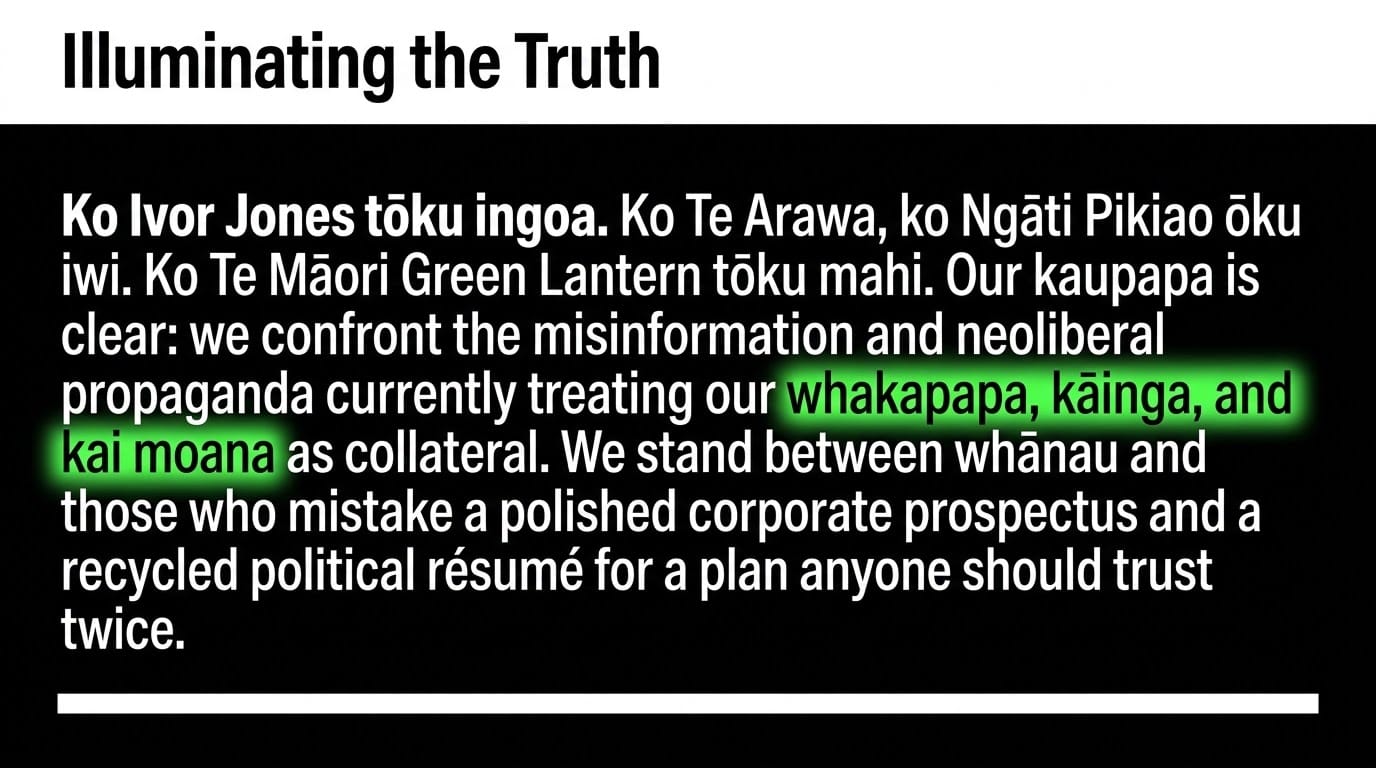
Ko Ivor Jones tōku ingoa. Ko Te Arawa, ko Ngāti Pikiao ōku iwi. Ko Te Māori Green Lantern tōku mahi.
My kaupapa is confronting misinformation, white supremacy, racism, and neoliberal propaganda affecting whānau across Aotearoa.
I stand with those whose whakapapa, kāinga, kai moana, and futures are treated as collateral by people who mistake a corporate prospectus, a recycled political résumé, and their own record of government, for a plan anyone should trust twice.
The Pātaka Is On Fire
NZ First is not offering energy security. In my assessment, it is offering a $1 billion drill-shaped mirage and asking whānau to applaud while it drifts across the horizon.
 RNZ | Te Reo Irirangi o Aotearoa
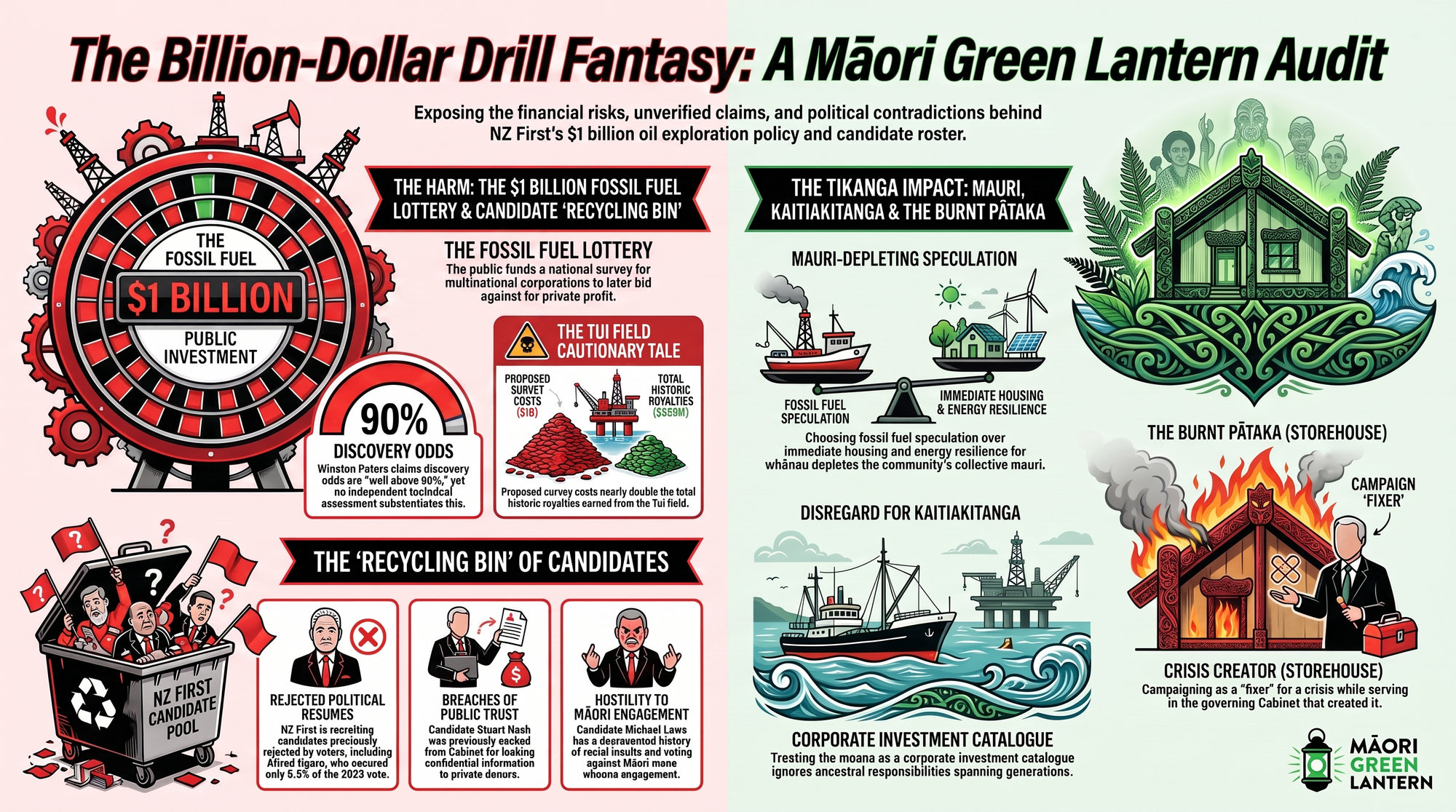
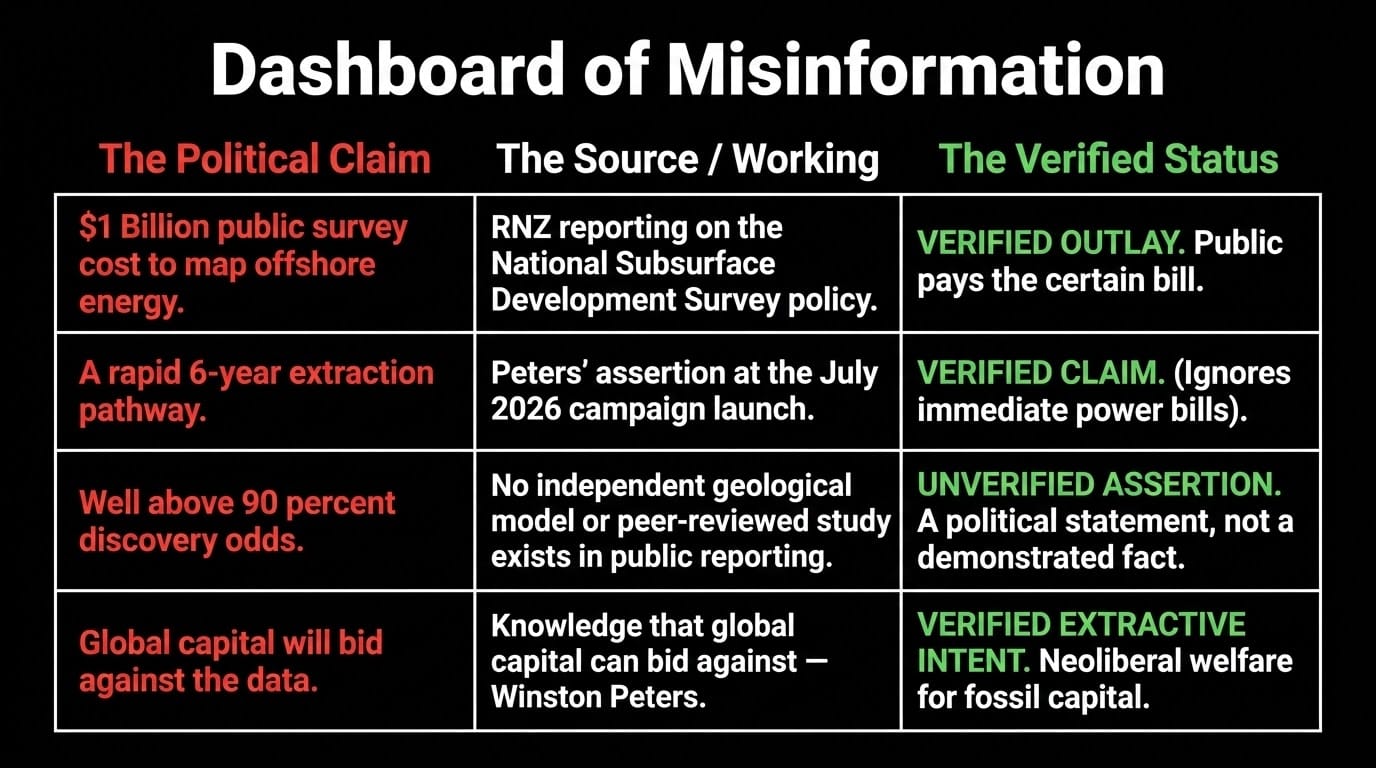
RNZ reports Winston Peters' promise of an initial $1 billion National Subsurface Development Survey, covering energy, geothermal, and carbon-dioxide storage sites, with offshore petroleum reserves at the centre of the pitch.
That timeline does not answer today's power bills, fuel insecurity, or regional hardship.
— meaning the public funds the map, and a multinational extractor later decides whether the find is worth exploiting.
I call that neoliberal welfare for fossil capital: the public carries the certain bill, corporations are invited to consider the uncertain reward.
No independently published geological model, resource assessment, or peer-reviewed study supporting that figure appears in the reviewed reporting — this remains an unverified political assertion, not a demonstrated fact.
The Public Pays Twice
RNZ reports NZ First's proposal for a production royalty above 50 percent as the mechanism for public return.
But a royalty is not money in hand
— it depends on discovery, commercial viability, financing, consenting, construction, and profitable production all succeeding in sequence.
The Tui field is the reminder NZ First does not want on the campaign stage. MBIE confirms the Crown assumed responsibility for decommissioning the Tui oil field after its operator entered liquidation, and that the decommissioning project has now been completed. MBIE's earlier Cabinet material records approximately $539 million in historic Tui royalties.
Set against NZ First's proposed $1 billion survey outlay, the arithmetic is 1,000−539=4611{,}000 - 539 = 4611,000−539=461: the proposed survey cost alone exceeds that historic royalty figure by $461 million. This does not predict what any future field would return
— it shows only that the promised billion-dollar cheque is not a trivial sum, and that any fossil-wealth claim must include the full public ledger, not just the headline.
The promised "Norway model" is a political costume. Aotearoa does not become Norway because a minister says the word loudly near a microphone.
Deep Dive Podcast
AI reo pronunciation warning: this is advocacy commentary, not a substitute for fluent reo speakers — please forgive the robot's tongue and take the evidence seriously.
YouTube Video
AI reo pronunciation warning: don't shoot the messenger — correct pronunciation belongs with speakers, whānau, and teachers who carry it properly.
Koha Consideration
Every koha says whānau will support the accountability that fossil-fuel lobby politics, recycled political failure, and a governing party's rewritten history will not provide on their own.
It signals that rangatiratanga includes the power to support our own truth-tellers when they stand between wai, moana, whenua, mokopuna, and a billion-dollar political fantasy fronted by discarded politicians and dressed up as a rescue from a fire the rescuers helped light.
If you are able, consider a koha to support The Māori Green Lantern. If koha is not possible, subscribe or follow The Māori Green Lantern, kōrero about this with your whānau, and share it — that too is koha.
Koha — support this mahi
Subscribe to The Māori Green Lantern
Direct bank transfer: HTDM, 03-1546-0415173-000
Follow on Facebook
The Climate Ledger
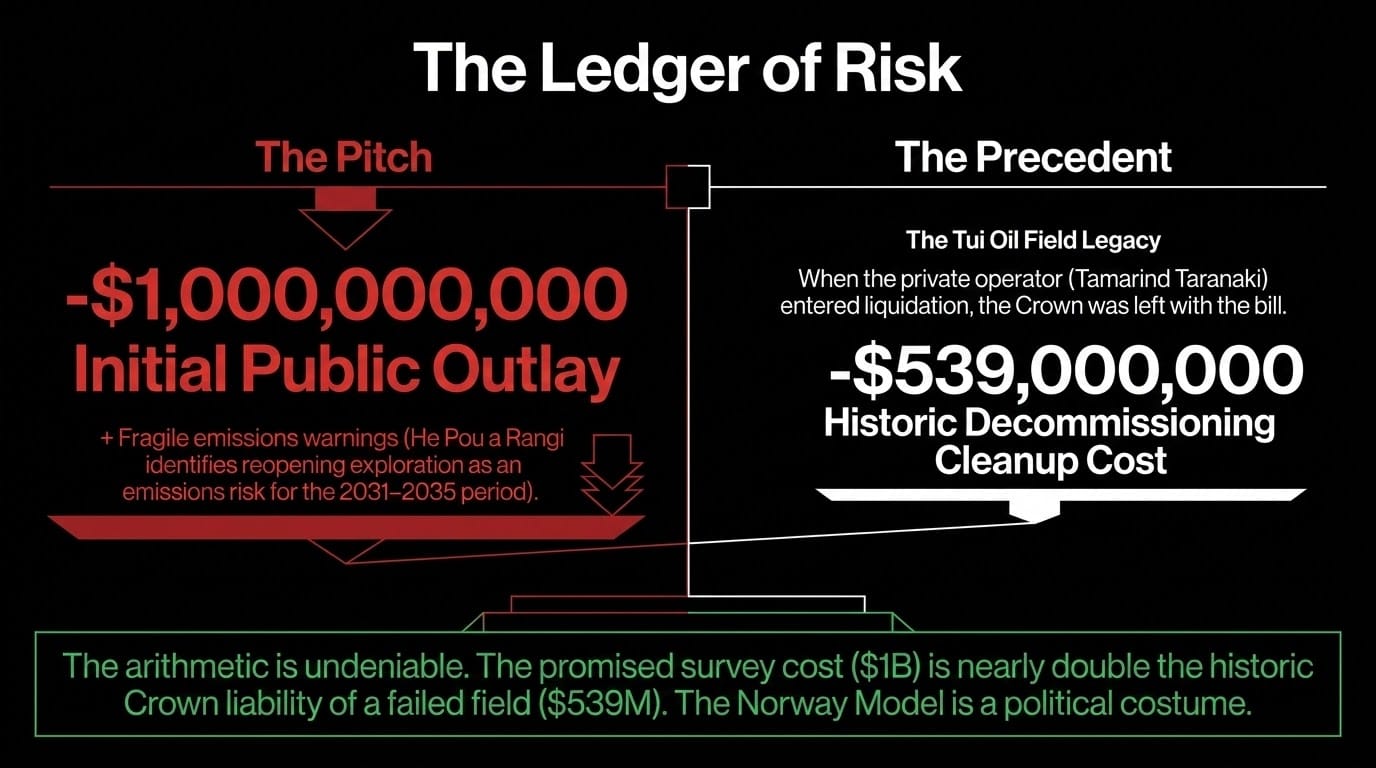
In my assessment, that is the obscene timing of this policy: Aotearoa is warned its emissions pathway is fragile, and NZ First answers by spending public money to make a fossil-fuel future easier to sell.
I have documented this same pattern before. My essay "The Pātaka Beside the Strait" examined Peters' rhetoric during the fuel-security crisis, and my essay "The Pātaka Is Ash" documented the gap between fuel-security messaging and the country's physical reserve vulnerability.
Three Examples For The Western Mind
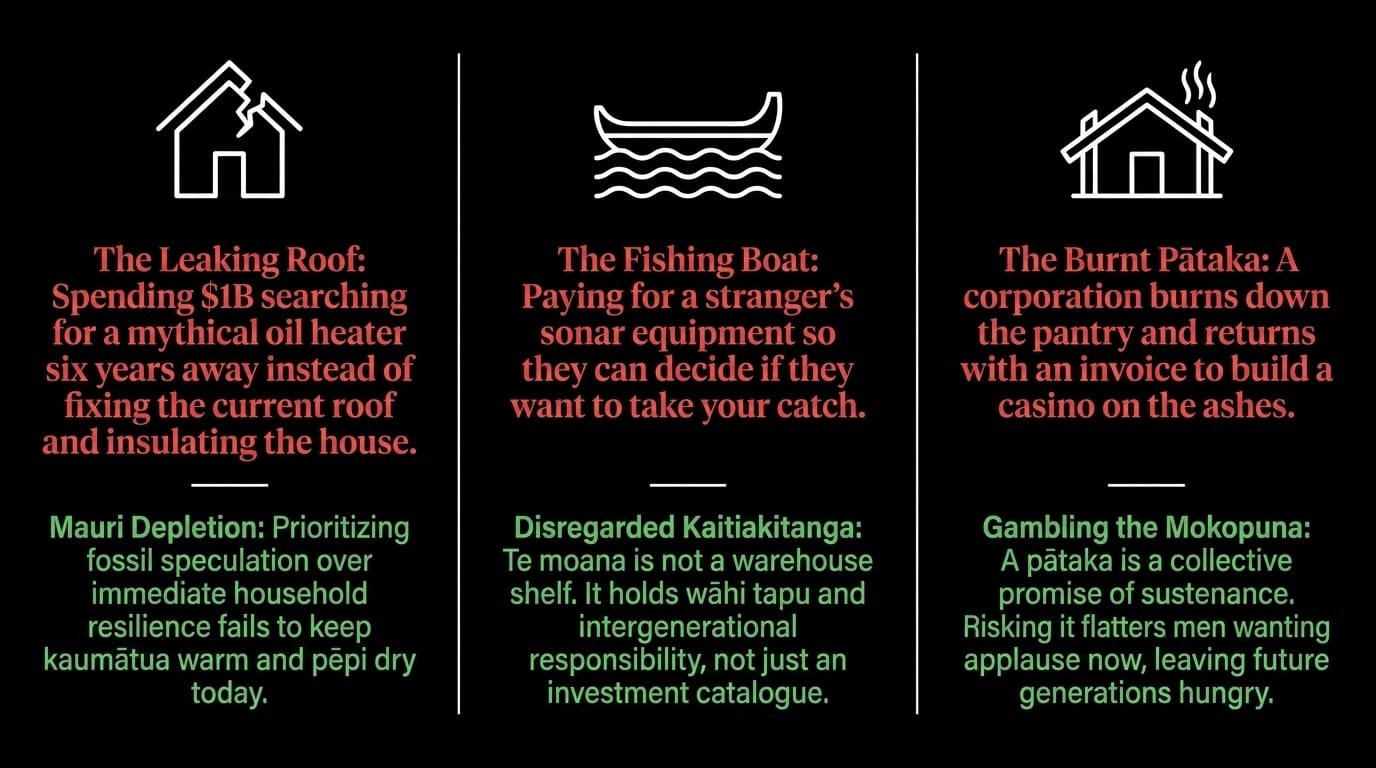
1. The Leaking Roof
Western-mind version: A family has a leaking roof. Instead of repairing it, insulating the house, and installing solar panels, the landlord spends $1 billion searching for a mythical oil heater six years away.
The solution: Direct public investment into electricity affordability, energy efficiency, distributed generation, storage, and locally owned resilience ahead of a speculative offshore resource play.
Tikanga impact: The roof is not only a roof. It is the whare that keeps kaumātua warm, pēpi dry, and mana intact. In my view, choosing fossil speculation over immediate household resilience is mauri-depleting because it places corporate possibility above the lived safety of whānau today.
2. The Fishing Boat
Western-mind version: You own the boat, the sea, and the fishing ground. Somebody else asks you to pay for their sonar equipment, then says they may let you keep a share of the catch if their expedition succeeds.
The harm: RNZ records that the survey model is designed to produce data "global capital can bid against".
The solution: Require transparent public costings, independent geological review, binding environmental liability, and genuine decision-making authority for mana whenua before any public money is committed.
Tikanga impact: Te moana is not a warehouse shelf. It holds whakapapa, kai moana, wāhi tapu, and responsibilities spanning generations. In my assessment, extractive policy that treats it as an investment catalogue disregards kaitiakitanga before a single drill touches the seabed.
3. The Burnt Pātaka
Western-mind version: A corporation burns down the community pantry, leaves everyone hungry, then returns with an invoice to build a casino on the ashes.
The harm: MBIE confirms the Crown had to assume decommissioning responsibility when the Tui field's operator entered liquidation, showing that petroleum development can leave public institutions holding costs after private failure.
The solution: Any extraction proposal must publish full life-cycle costs — survey, drilling, infrastructure, monitoring, spill response, abandonment, remediation, financial securities, and Crown exposure in the event of insolvency.
Tikanga impact: A pātaka is a collective promise that there will be sustenance for those who come after us. In my view, gambling it on a fossil boom is not prudent management — it is the politics of taking from mokopuna to flatter men who want applause now.
The Recycling Bin of Political Rejects
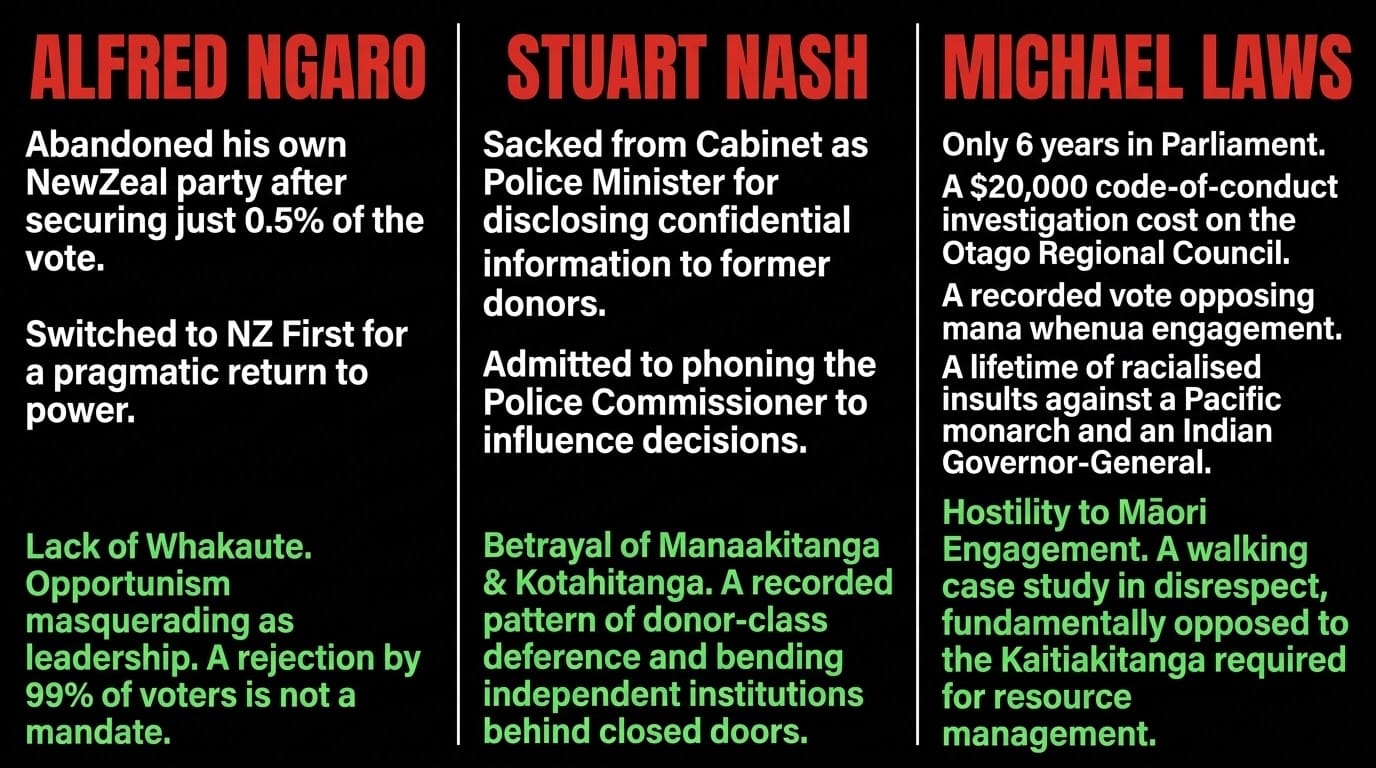
If the oil survey is a fantasy dressed as sovereignty, NZ First's candidate list is a landfill dressed as renewal. This deserves equal scrutiny, because a policy is only as credible as the people asking us to trust them with it.
 RNZ | Te Reo Irirangi o Aotearoa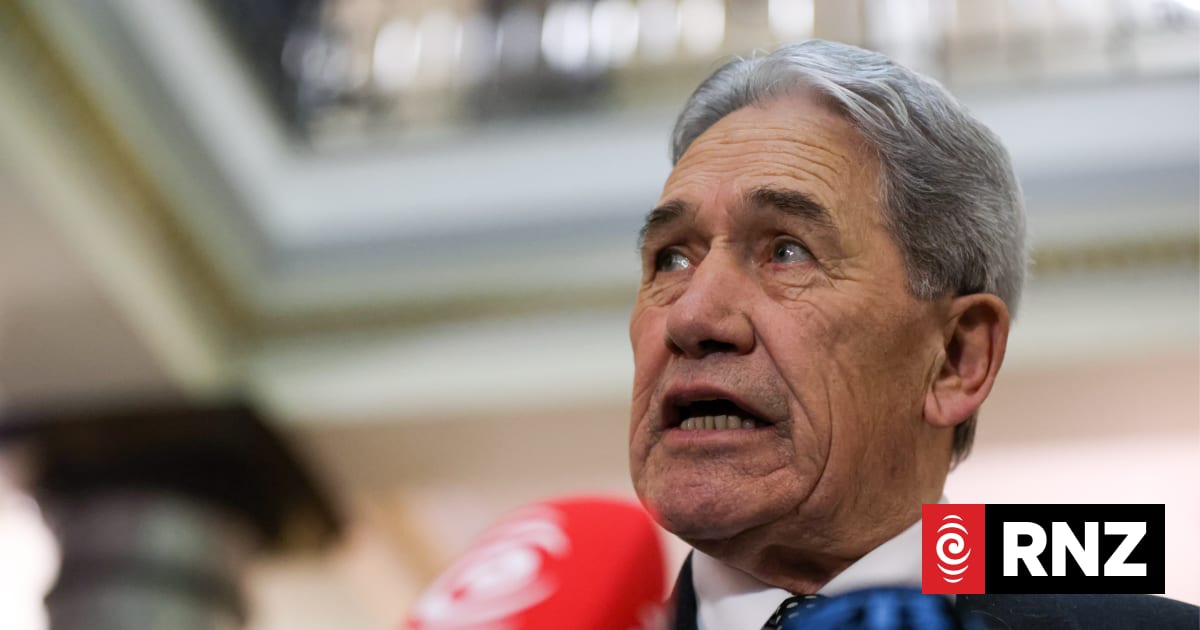
 Adam Pearse
Alfred Ngaro: the leader whose own party couldn't clear five percent
Alfred Ngaro left the National Party to found his own party, NewZeal, built on Christian conservative values. 1News reports that Ngaro himself acknowledged NewZeal secured only around 16,109 votes at the 2023 election — approximately 0.5 percent, nowhere near the five percent threshold required to enter Parliament.
That is not a near miss. It is a rejection by more than 99 percent of voters who considered his standalone offer and declined it.
In my assessment, that moment says more about Ngaro's political relevance than any press release could. Ngaro himself described the switch as "pragmatic," according to 1News — not a conversion of principle, but a calculated hitch onto a vehicle with a functioning engine, after building and crashing his own.
Tikanga impact: Whakaute — respect and integrity in leadership — requires consistency between what a person asks voters to believe and what they do when belief fails to deliver power. A leader who abandons his own founding vision the moment it proves electorally unviable, and rebrands loyalty to a party he previously left, is not modelling rangatiratanga. He is modelling opportunism.
Stuart Nash: the minister who leaked Cabinet secrets to donors
Stuart Nash was sacked from Cabinet as Police Minister. The New Zealand Herald reported that Chris Hipkins revealed Nash was sacked after disclosing confidential information from a Cabinet meeting to two businessmen, both former donors. This was not a difference of policy opinion. It was a breach of the confidentiality that underpins collective Cabinet government, allegedly for the benefit of people who had funded him.
Stuff also reported that Nash had separately resigned as Police Minister after admitting on radio that he personally telephoned Police Commissioner Andrew Coster to press him to appeal a court decision — a minister attempting to direct operational police decisions behind closed doors. Two separate breaches of ministerial conduct, involving both donor influence and interference in policing, sit in Nash's record before he ever reaches an NZ First stage.
Tikanga impact: Manaakitanga and kotahitanga depend on trust that those who hold power will not trade it quietly for donor favour or use it to bend independent institutions. A politician with this record does not arrive at NZ First's podium clean; he arrives carrying the exact pattern of donor-class deference that whānau have paid for in housing, health, and justice outcomes for decades.
Michael Laws: six years in Parliament, a lifetime of racial insult
Michael Laws served just six years in Parliament, from 1990 to 1996, before resigning from both Parliament and Napier council over what became known as the "Antoinette Beck affair" — Wikipedia's account, drawing on contemporaneous reporting, describes Laws awarding a council communications contract to a company part-owned by his wife, then submitting a fabricated signature under a fictitious person's name to conceal it. He resigned once the deception was exposed.
That is only the beginning of his record. As Mayor of Whanganui, Wikipedia records Laws describing the deceased Tongan king as "a bloated, brown slug" on air — conduct New Zealand Herald readers voted the "worst insult of 2006." He also called then-Governor-General Anand Satyanand a "fat Indian", only apologising after a broadcasting colleague lost his job for comparable remarks about an Indian politician.
More recently, on the Otago Regional Council, Wikipedia records that Laws accused two council staff members of being "activists" because of Green Party membership and questioned "whether the Green Party has installed an activist cadre" — remarks a former staff member characterised as "McCarthyism". The subsequent code-of-conduct process, which cleared him, still cost ratepayers approximately $20,000 in external legal fees, according to a fellow councillor cited in the same source. Wikipedia also records that Laws and a fellow councillor unsuccessfully opposed a motion for the council to engage with local Māori mana whenua — a documented vote against the very engagement this essay argues is a minimum requirement for extractive and resource decisions.
Tikanga impact: Kaitiakitanga and manaakitanga both require that people in public office treat those different from themselves — by ethnicity, by role, by political affiliation — with dignity rather than contempt weaponised for ratings or leverage. A candidate with a public record of racialised insults against a Pacific monarch and an Indian Governor-General, and a recorded vote against mana whenua engagement, is not a neutral recruit. He is a walking case study in the disrespect this platform exists to name.
The Pattern, Not The Individuals
I want to be precise about what I am arguing and what I am not. I am not claiming that every person who joins NZ First personally holds identical views, nor am I alleging any criminal conduct beyond what is documented above.
What I am arguing, based on the pattern across Ngaro's failed party, Nash's donor-leak and policing-interference record, and Laws' decades of racialised public commentary and hostility to Māori engagement, is that NZ First is not "rebuilding hope" with fresh talent. It is running a salvage operation on political careers that voters, colleagues, or institutions have already rejected once — and asking the public to underwrite the second attempt, just as it asks the public to underwrite a speculative oil survey.
The Arsonist Selling Fire Insurance
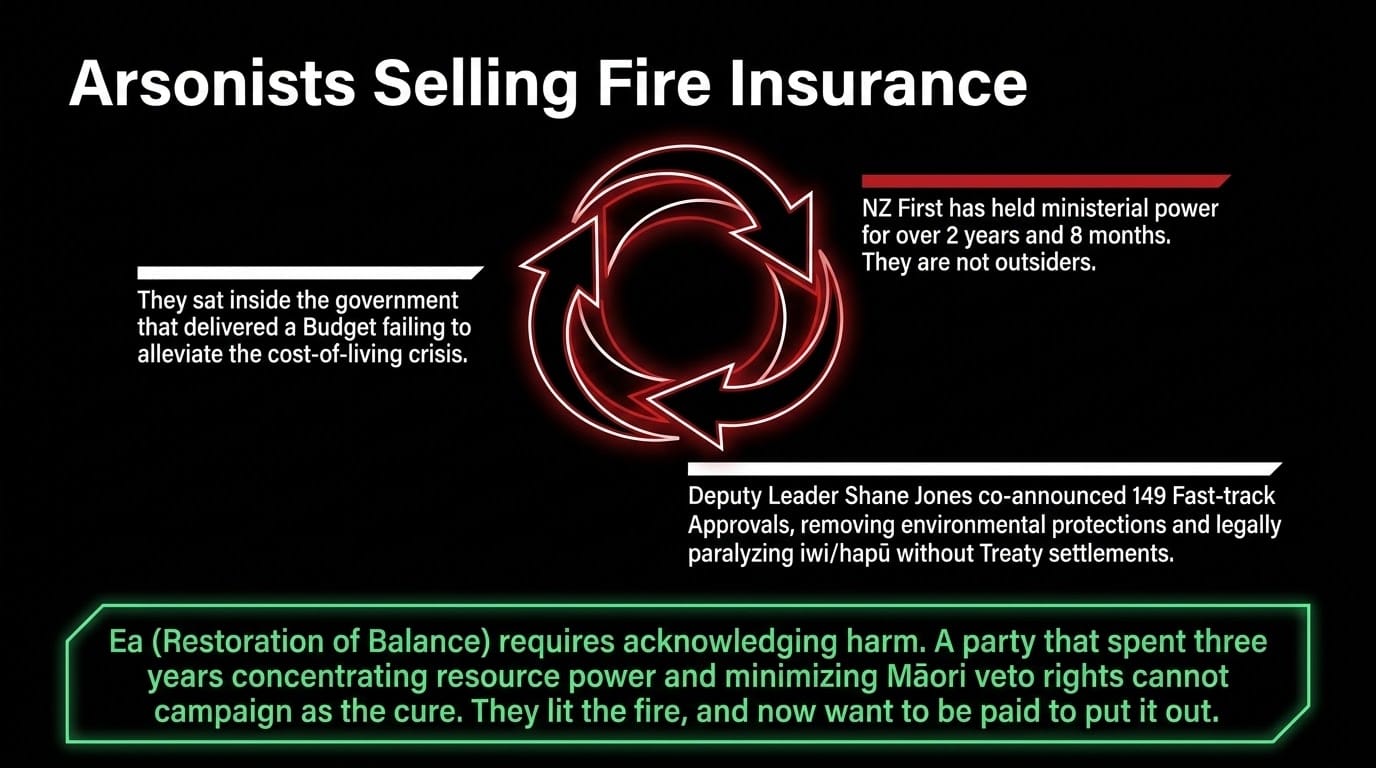
Here is the hypocrisy that ties every thread of this essay together, and it deserves the same weight as the drilling fantasy and the recycled candidates: NZ First has been sitting inside the Cabinet room that made the very conditions it now campaigns against.
Dentons reports that the coalition Cabinet, including NZ First, was announced on 24 November 2023. By the time of the July 2026 conference, NZ First had held ministerial power for approximately two years and eight months
— not as a bystander criticising from the opposition benches, but as a governing partner with its deputy leader running two of the most consequential ministries in the country.
NZ First's own website confirms that Shane Jones holds the Minister for Regional Development, Minister of Resources, and Minister of Oceans and Fisheries portfolios inside this government.
He is not an outsider pointing at problems. He is one of the people who built the current energy, resource, and regional-development framework that NZ First's own conference now describes as failing.
Consider the Fast-track Approvals Act, championed by Jones alongside National ministers. E-Tangata reported that opponents said the bill removes environmental protections and puts unprecedented power in the hands of three ministers, including Jones, to override resource management decisions previously made by courts.
The same report states plainly that iwi and hapū without a completed Treaty settlement are left legally powerless to challenge fast-tracked proposals — including seabed mining — on their ancestral whenua. E-Tangata further reported that final approval decisions under the Act rest with three government ministers, one of whom is Shane Jones.
Wikipedia's entry on the Fast-track Approvals Act 2024 records Jones stating the legislation would prioritise economic growth through accelerated project consenting — the same minister who now, as NZ First's deputy leader, stands on a conference stage promising a new billion-dollar resource programme as if his party had spent the last three years advocating for the public interest rather than authoring the mechanism critics say weakens it.
The Beehive itself confirms 149 projects were listed under the Fast-track Approvals Act, co-announced by Jones — a scale of ministerial approval power that critics, including iwi and hapū cited by E-Tangata, say bypasses the very Treaty-consistent scrutiny this essay has already argued is missing from the oil survey proposal.
This is not two separate failures. It is one governing pattern: concentrate resource decisions in ministerial hands, minimise Māori veto rights, and call the result "growth."
Meanwhile, the cost-of-living crisis NZ First now campaigns against was not inflicted by a foreign power while the party watched helplessly from the sidelines.
Scoop's analysis of Budget 2026 states the governing coalition won the previous election by claiming it alone possessed the managerial competence to fix the nation's cost-of-living crisis. Labour's own release on Budget 2026 states the Government's finance spokesperson Barbara Edmonds concluded the Budget delivered "more cuts, more pain and higher costs" rather than the promised relief. NZ First did not oppose this Budget from the crossbenches. It sat inside the government that delivered it.
This is the hypocrisy that must be named alongside the drilling fantasy and the recycled candidates, given equal weight because it is the frame that makes sense of both: a party that has spent nearly three years as part of a government reducing environmental scrutiny, concentrating ministerial power over resources, and presiding over a cost-of-living crisis its own coalition partner's Budget failed to fix, now stands at its own conference asking to be trusted as the saviour of the very conditions it helped create.
Tikanga impact: Ea — the restoration of balance after harm — requires that those responsible for harm first acknowledge their role in causing it. A party campaigning as the cure for a crisis it helped engineer while in government is not offering ea. It is offering a second harm dressed as healing, and asking whānau to applaud the costume.
The Returnees Must Answer
RNZ reports that former National MPs Harete Hipango-Brownlie, Alfred Ngaro and Michael Laws, and former Labour MP Stuart Nash, are seeking a return to Parliament as NZ First candidates. Joining a party does not establish an individual's view on every policy. It does mean each candidate must publicly answer whether they support the platform they seek votes under.
They should be asked directly:
- Do you support the $1 billion survey without a published independent basis for the claimed greater-than-90 percent discovery odds?
- Do you support using taxpayer-funded geological data to make prospects available to global capital?
- Do you endorse Peters' "one country, one people, one law" language at the campaign launch?
- Mr Ngaro: what changed in your economic or ideological position between founding NewZeal and joining the party whose platform you previously stood outside of?
- Mr Nash: what safeguards will you support to ensure ministers cannot repeat the donor-disclosure breach that ended your Cabinet career?
- Mr Laws: do you still hold the view, evident in your recorded opposition to mana whenua engagement on the Otago Regional Council, that Māori engagement processes are unnecessary?
- What binding authority — not consultation theatre — will mana whenua have to refuse or reshape offshore development in their rohe?
- Mr Jones: given your role passing the Fast-track Approvals Act that E-Tangata reports concentrates resource-approval power in three ministers, why should voters trust NZ First's next resource programme to include the Treaty-consistent scrutiny critics say the last one lacked?
- Why should voters trust NZ First to fix a cost-of-living crisis that occurred, in part, during its own time in government?
No smears are required here. The reported record is enough. A candidate — or a governing party — who seeks public power under this banner must account for the banner.
Name The Ideology
In my assessment, this is white-supremacist neoliberal politics in its familiar Aotearoa form: proclaim one neutral national interest, downgrade tino rangatiratanga into a procedural inconvenience, present private extraction — of seabed resources, of political credibility, and now of public trust in a party's own governing record — as the natural destiny of those with enough audacity to demand it twice.
This is my political analysis, not a claim about the personal beliefs of every candidate or supporter.
That assessment builds on wider Crown patterns I have documented previously. My essay "How a White Supremacist Neoliberal Regime Turned Our Wai and Moana into Profit-Streams" examines the conversion of water and coastal resources into commercial opportunity under the language of "reform", and my essay "The Empty Seam" examines fast-track extraction processes that reduce public and Māori scrutiny.

The Demand
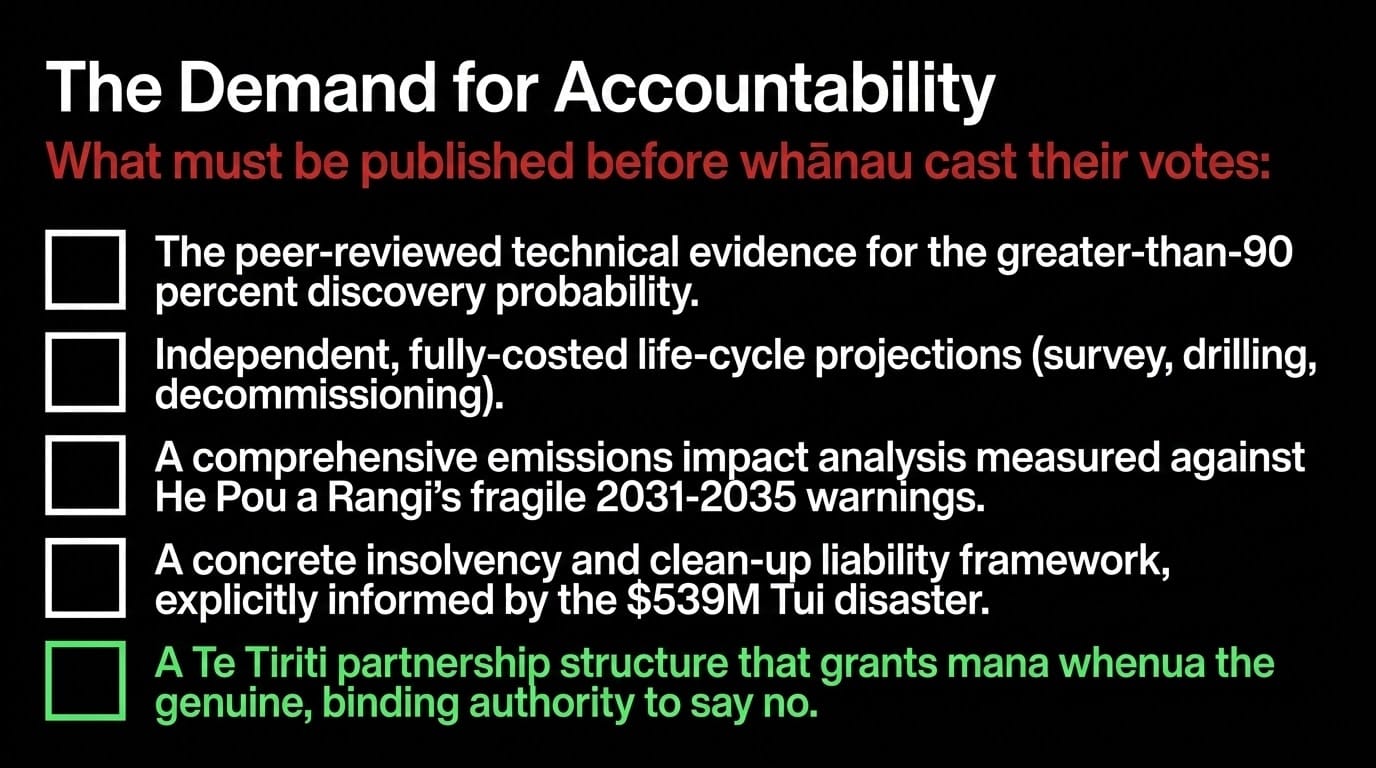
NZ First should publish, before it asks whānau for their votes:
- The technical evidence for the claimed greater-than-90 percent discovery probability
- Independent survey, drilling, development, and decommissioning costings
- A full emissions impact analysis, measured against He Pou a Rangi's identified emissions-budget risks
- The proposed ownership and royalty architecture
- The insolvency and clean-up liability framework, informed by the Tui decommissioning precedent
- A Te Tiriti partnership structure that gives mana whenua genuine authority to say no
- A public accounting from each recycled candidate explaining the conduct documented in their own record, before asking for the public's trust a second time
- An honest accounting of NZ First's own record in government, including its ministerial role in the Fast-track Approvals Act and its part in a Budget its own coalition partner's opponents say failed to fix the cost-of-living crisis, before campaigning as the solution to conditions it helped create
Until then, in my assessment, NZ First's $1 billion drill promise, its candidate roster, and its "rebuilding hope" slogan are three expressions of the same con: ask the public to fund the risk, keep the credibility question for after the votes are counted, and hope nobody remembers who was sitting in Cabinet when the pātaka caught fire.
Māuri Ora!
Ivor Jones The Māori Green Lantern Fighting Misinformation And Disinformation From The Far Right
Publication Record
Public-interest basis: This essay concerns a declared proposal for $1 billion in public expenditure, offshore petroleum activity, climate policy, energy security, Te Tiriti-consistent decision-making, the fitness for public office of candidates seeking election under a specific party platform, and the governing record of a party seeking re-election. The critique addresses policies, public statements, and matters already established in public record.
Right of reply: NZ First, Winston Peters, Shane Jones, Harete Hipango-Brownlie, Alfred Ngaro, Michael Laws, and Stuart Nash should be offered 48 hours to answer the questions set out above. Any substantive reply should be published in full or accurately summarised with a link.
Disclaimer: This is evidence-led political commentary and opinion based on public reporting and referenced official and secondary sources. It does not allege criminality beyond what is documented and attributed above. Any correction supported by primary evidence will be reviewed and appended promptly.