"Opportunity, Choose The Partners Who Can Help You Deliver" - 11 November 2026
Do Not Campaign To Change The System And Then Become Its Latest Excuse.



Kia ora e te whānau.
Here is my argument.
If Opportunity wants to deliver the kind of country described in its own policies, it should seek a governing agreement with Labour, the Greens and Te Pāti Māori.
Not because those parties agree on everything. They do not. Not because Labour deserves our unquestioning trust. It does not. And not because putting different people around the Cabinet table automatically changes what happens outside it.
My argument is simpler than that: compare the policies, identify the conflicts, and choose the arrangement with the stronger chance of turning your stated principles into something people can actually live with.
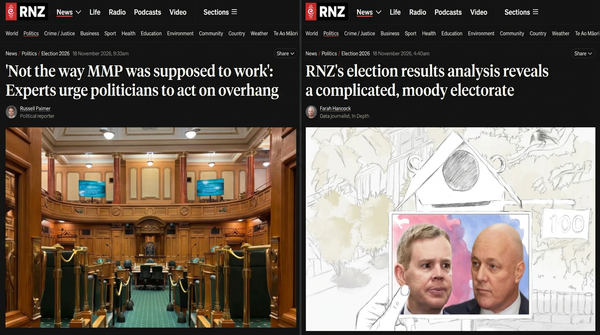
Before we go further, there is a parliamentary reality we must respect. The election count remains preliminary. Reuters reports that special votes could change whether the existing coalition has a majority. I am arguing for a left agreement if sufficient parliamentary support exists—not pretending the numbers are already settled.[reuters]

 RNZ | Te Reo Irirangi o Aotearoa

This morning, I want to compare Opportunity directly with National, ACT, New Zealand First, Labour, the Greens and Te Pāti Māori.
Not their colours. Not their campaign personalities. Their policies. Their differences. And what those differences mean for whānau.
First, What Is Opportunity Actually Offering?
Opportunity is not simply proposing a friendlier style of politics.
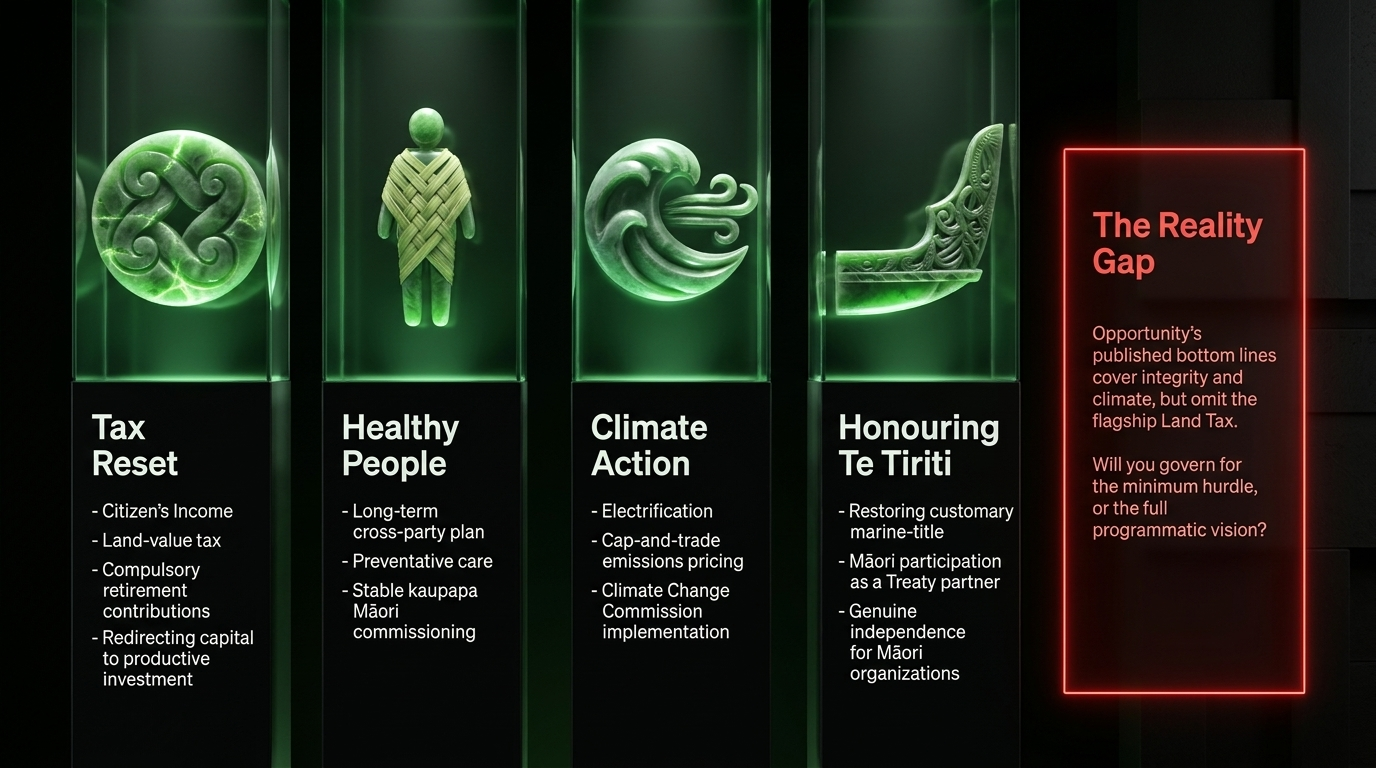
Its Tax Reset combines a Citizen’s Income, a land-value tax and compulsory retirement contributions. Its stated intention is to shift incentives away from property speculation and towards people and productive investment. That is Opportunity’s published proposal.
Its health programme seeks a long-term cross-party plan, stronger primary and preventative care, stable commissioning and greater protection from vested interests. Those commitments appear in Healthy People.
Its climate policy supports electrification, emissions pricing, adaptation and implementation of Climate Change Commission advice. That is its stated climate direction.
And its Te Tiriti policy is more substantial than a vague promise to get along.
It proposes restoring customary marine-title settings that applied before the changes, strengthening Treaty analysis in lawmaking, involving Māori as a Treaty partner in constitutional discussions, and giving Māori organisations genuine independence—not responsibility without power. Read Honouring Te Tiriti.
Those are meaningful commitments.
But Opportunity also needs to be honest about the distance between its full programme and its minimum negotiating demands.
Its published bottom lines concern prices, political integrity, health, oceans and climate. Its flagship land tax and Citizen’s Income are not included among those minimum requirements. That distinction is recorded in Reuters’ account of its negotiating position.
So here is my question to Opportunity.
When you decide who to govern with, are you looking for the agreement that merely clears your minimum hurdle—or the one that gives your wider programme the best chance of advancing?
Because those are not necessarily the same agreement.
Opportunity And National: Some Shared Tools, A Serious Tax Conflict
Let us give National an honest hearing.
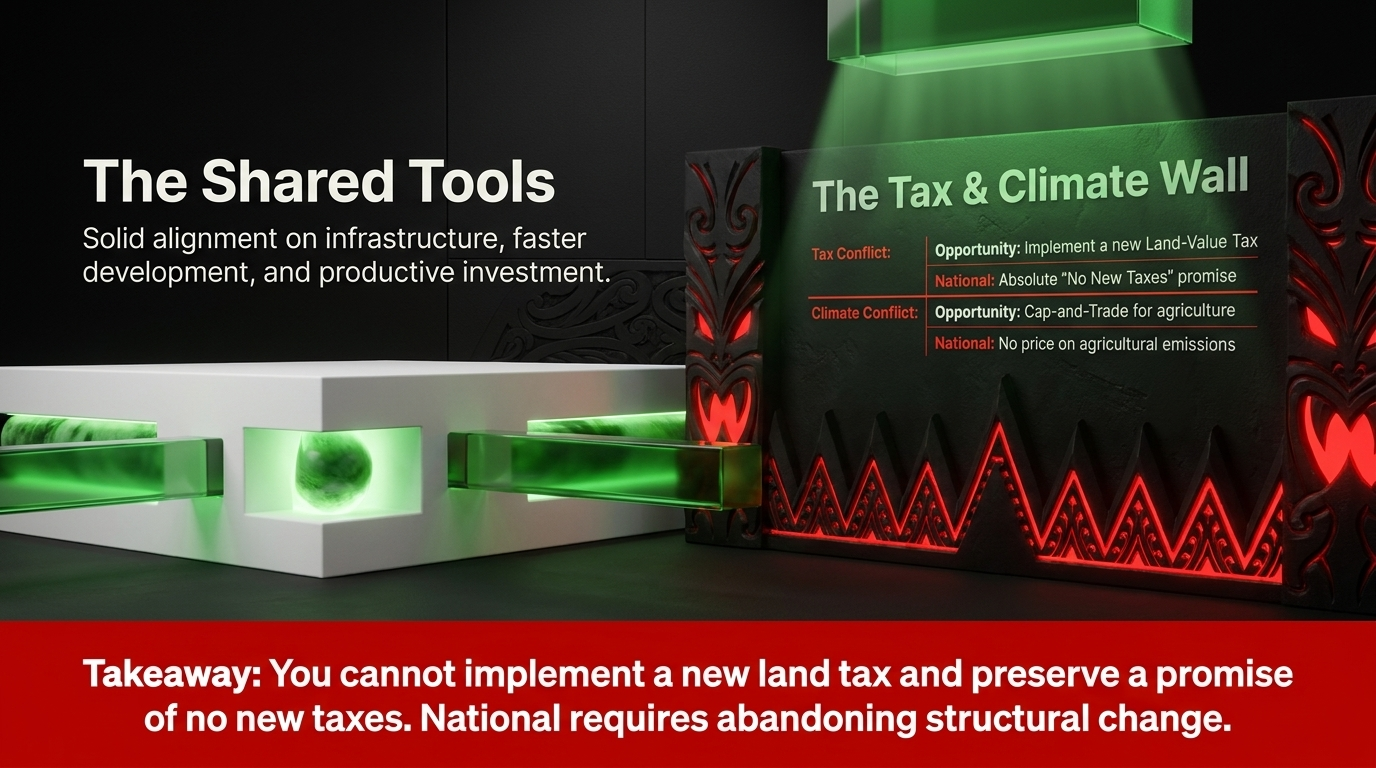
National proposes infrastructure, faster development, investment, energy projects and stronger frontline services. It says those can be delivered through economic growth, spending control and no new taxes. That is National’s own programme.
Opportunity also wants productive investment, enterprise and a more capable economy. Its Tax Reset explicitly argues for redirecting capital towards business rather than property. That is its economic rationale.
There is room for agreement over investment and getting useful things built. I will not deny it. But then we reach the tax system.
Opportunity proposes a new land-value tax as an essential part of its income-and-tax package. National promises no new taxes. Put Opportunity’s Tax Reset beside National’s commitment, and the conflict is obvious.
You cannot implement a new land tax and preserve a promise of no new taxes at the same time. Somebody has to move. There is another difference in climate policy.
Opportunity proposes cap-and-trade approaches to agricultural methane and nitrous oxide. National explicitly campaigns on no price on agricultural emissions. Those positions are in Opportunity’s climate policy and National’s rural programme.
Again, a real policy conflict—not a misunderstanding that disappears over coffee.
National’s strongest case is that investment, fiscal restraint and regulatory changes can improve services without a broader tax settlement. That deserves examination.
But Opportunity should not pretend National’s approach and its own are simply different routes to an identical destination.
My judgment is that National offers selected areas of cooperation while resisting important parts of the structural change Opportunity says it wants.
That does not make talking illegitimate.
It makes signing something that abandons those changes a decision requiring a serious explanation.
The Deep Dive Podcast
Listen to a lively conversation between two hosts, unpacking and connecting topics in the sources of this essay. I apologise in advance for the AI's very harsh pronounciation of reo. Please dont shoot me, :).
Youtube Video
Like video? Here is a short video suppporting the essay. Again, don't shoot the messenger please because of AI's pronounciation. :)
Opportunity And ACT: Markets Are Common Ground, Not A Complete Programme
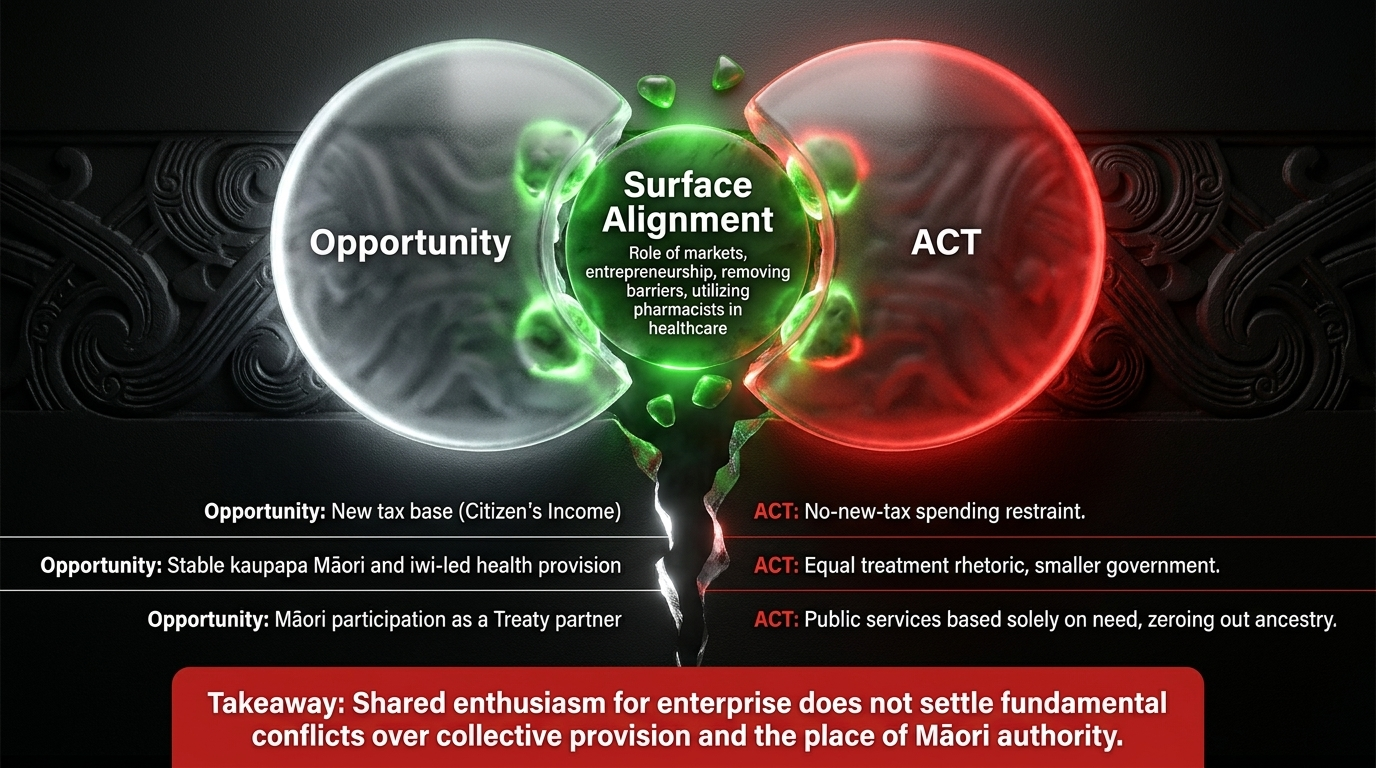
Opportunity and ACT can both see a role for markets, entrepreneurship and removing unnecessary barriers.
Opportunity’s own programme is not anti-business. Its Tax Reset is explicitly intended to encourage productive enterprise. Read its explanation.
ACT emphasises smaller government, less regulation, spending restraint and no new taxes. Those priorities appear in its manifesto announcement.
There could be useful cooperation.
But being able to agree about a business facing an unnecessary obstacle does not mean agreeing about the whole relationship between government, wealth and public wellbeing.
Opportunity proposes a new tax base to support a Citizen’s Income. ACT presents no-new-tax spending restraint as a central part of its programme. That is a substantive difference between Opportunity’s package and ACT’s stated direction.
Health provides a useful qualification.
ACT proposes additional general-practice spending and greater use of pharmacists. So no, I will not describe ACT as opposing every public service. That would contradict its own announcement.
But Opportunity’s health policy seeks a durable funding and workforce settlement, stronger prevention and stable support for kaupapa Māori and iwi-led providers. That is a broader institutional commitment in Healthy People.
Then there is Te Tiriti.
Opportunity explicitly recognises Māori participation as a Treaty partner and supports genuine independence for Māori organisations. ACT frames its programme around public services based on need rather than ancestry. Compare Opportunity’s Treaty policy with ACT’s stated position.
That does not prove no agreement is possible.
It means the agreement must explain how Māori authority and Treaty obligations survive—not bury the question beneath the comforting phrase “equal treatment”.
My conclusion is that ACT offers some shared economic tools, but substantial conflicts over revenue, the scale of collective provision and the place of Māori authority.
Shared enthusiasm for enterprise does not settle those differences.
Opportunity And New Zealand First: Useful Economic Overlap, Sharp Constitutional Conflict
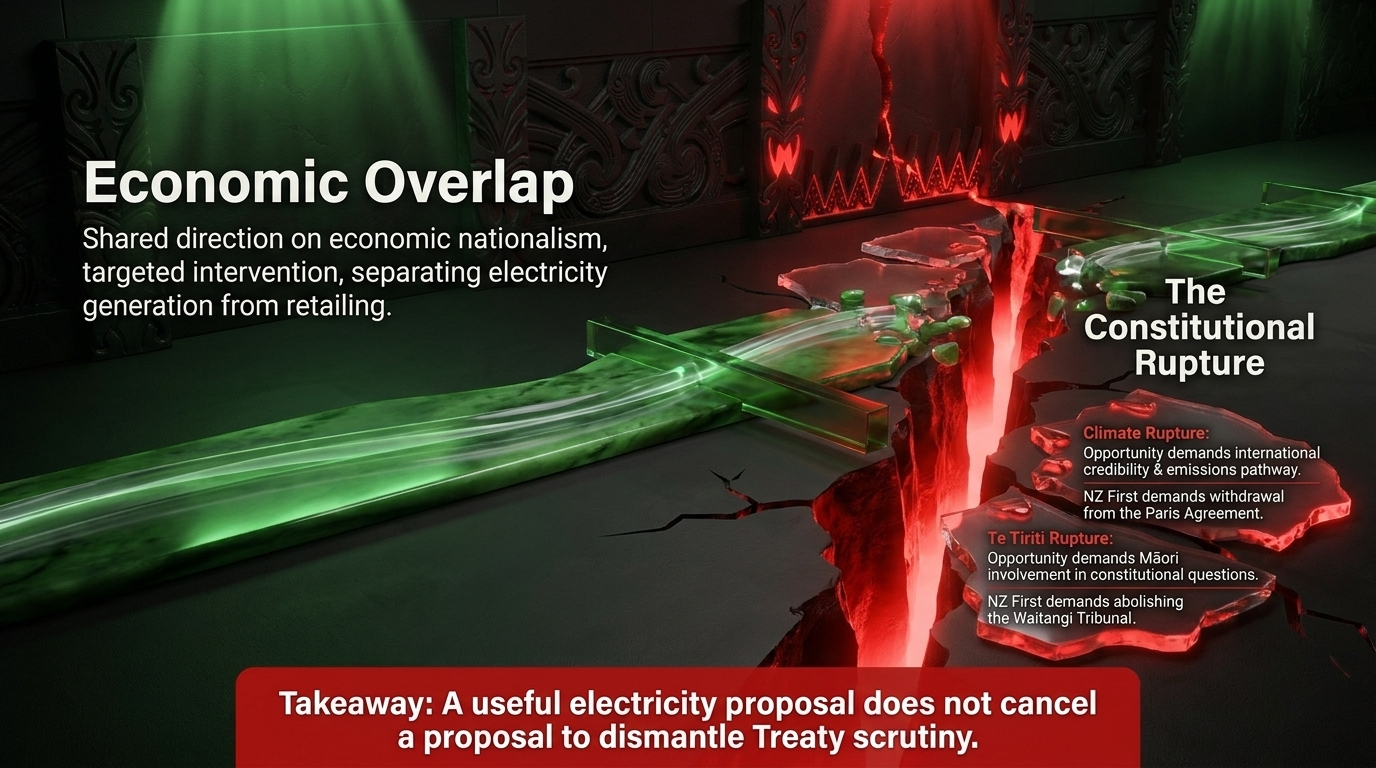
Peters is not simply Seymour with a different tie.
New Zealand First supports economic nationalism, targeted government intervention and public ownership interests. It also proposes separating electricity generation from retailing. Those commitments appear in Peters’ economic programme.
That creates genuine potential overlap with Opportunity’s concern about concentrated power and productive investment.
Recognise it.
But now compare climate.
Opportunity wants a credible emissions pathway, stronger climate institutions and international credibility. Peters calls for withdrawal from the Paris Agreement. Read Opportunity’s climate programme and Peters’ own statement.
That is not a small disagreement about implementation.
It concerns the framework within which implementation takes place.
Now compare Te Tiriti.
Opportunity says Treaty obligations must receive proper effect and constitutional questions should involve Māori as a Treaty partner. New Zealand First proposes abolishing the Waitangi Tribunal and replacing it with a completion commission. Those positions appear in Opportunity’s policy and New Zealand First’s announcement.
Whānau, I cannot look at that and call the partnership straightforward.
A useful electricity proposal does not cancel a proposal to dismantle Treaty scrutiny.
My conclusion is that New Zealand First offers meaningful overlap on intervention and market structure, but sharp conflicts with Opportunity on climate and Treaty institutions.
Those conflicts go to the purpose of government—not merely the price of a concession.
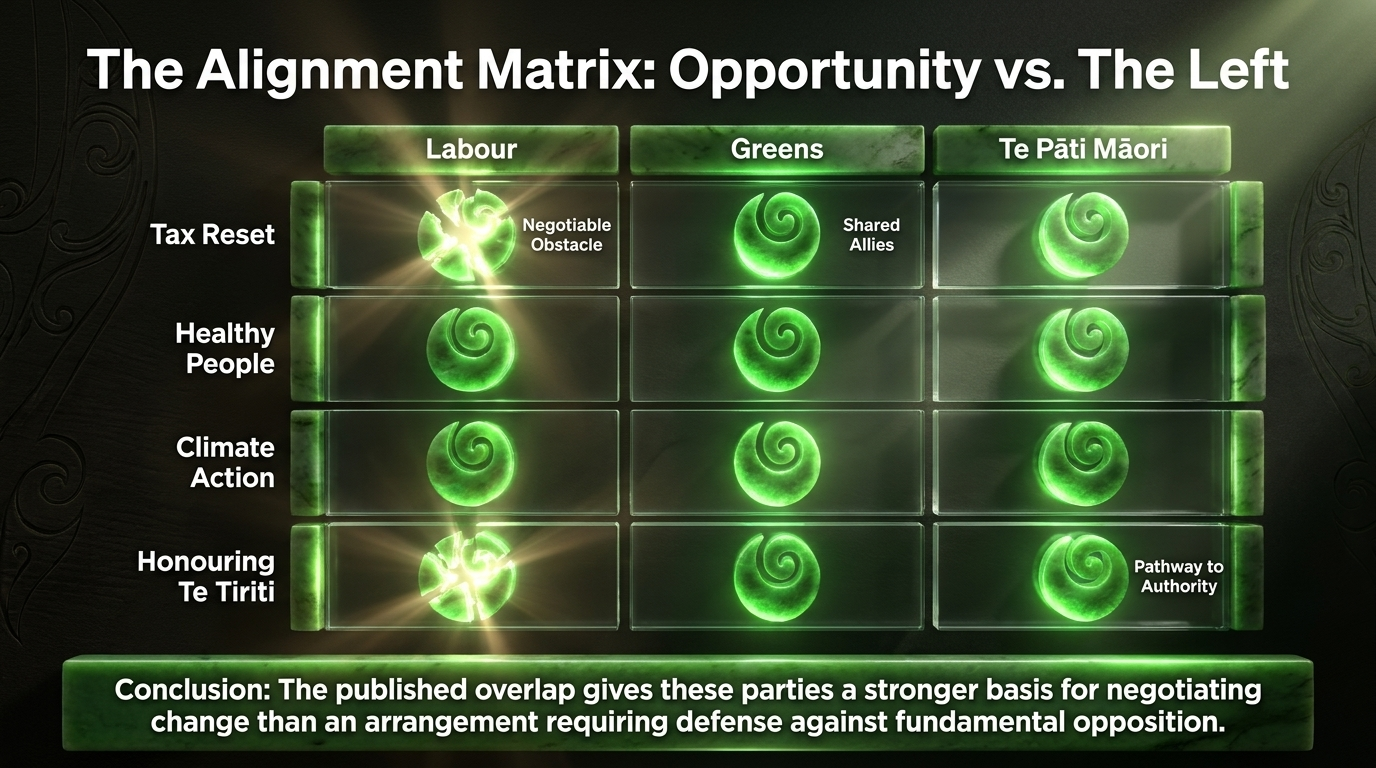
Opportunity And Labour: A Stronger Starting Point, With A Conflict We Must Not Hide
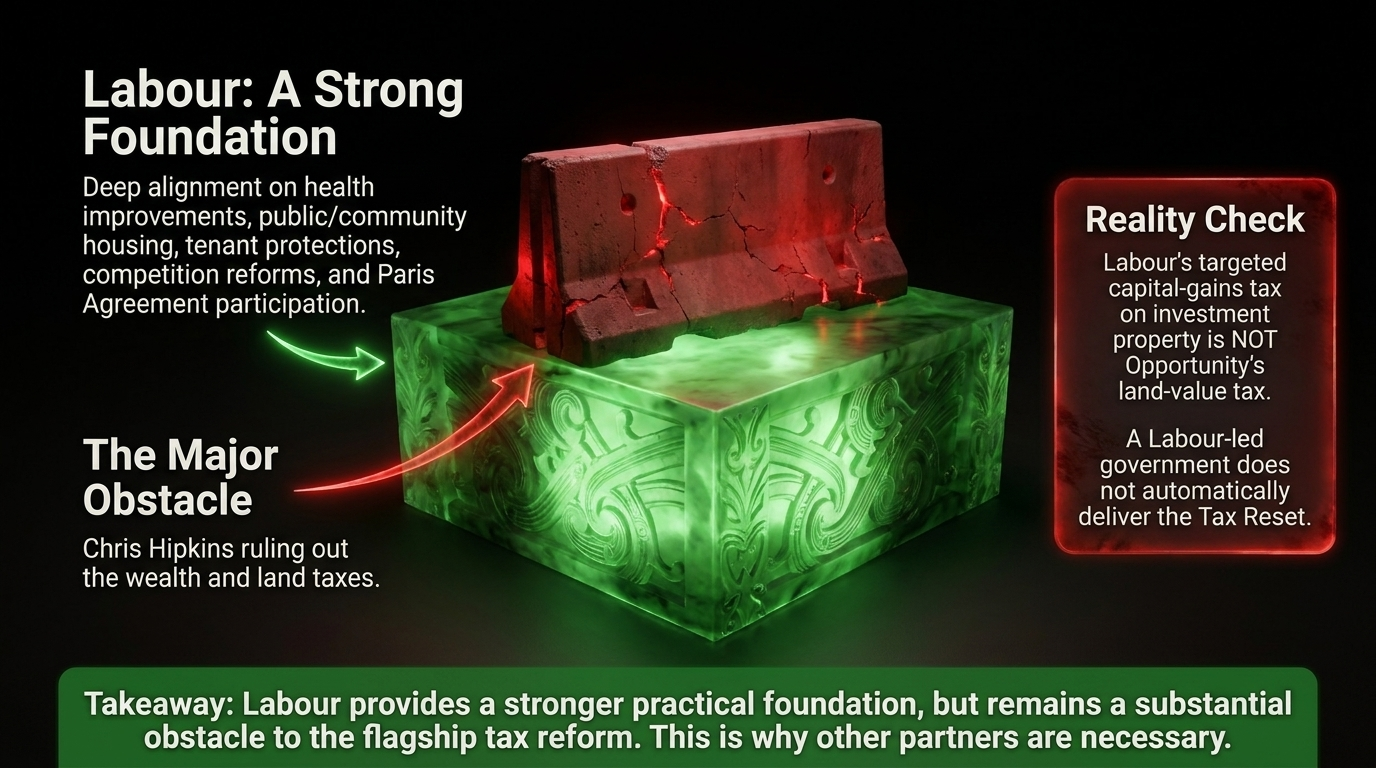
Now Labour.
Labour proposes a targeted capital-gains tax on investment property, health improvements, public and community housing measures, stronger tenant protections, competition reforms and continued participation in the Paris Agreement. Those are in Labour’s published programme.
There is a stronger starting point here for Opportunity.
Both want to change incentives around property, improve access to healthcare, challenge aspects of concentrated market power and support a more durable climate response. Compare Labour’s programme with Opportunity’s Tax Reset, health policy and climate policy.
But I am not going to hide the awkward part.
Labour’s capital-gains tax is not Opportunity’s land-value tax.
A tax on specified gains when an asset is sold is not the same mechanism as an annual tax on unimproved land value.
More importantly, Hipkins has ruled out the wealth and land taxes proposed by potential partners. That opposition is recorded in BusinessDesk’s examination of the competing tax programmes.
So a Labour-led government does not automatically deliver Opportunity’s Tax Reset.
Anybody telling you otherwise is selling certainty they do not possess.
Labour also promotes Māori-led training, Māori procurement and community delivery. Opportunity supports stronger Māori agency and independence. Those commitments appear in Labour’s programme and Opportunity’s Treaty policy.
But more contracts and better delivery do not, by themselves, settle who governs.
That must be negotiated explicitly.
My conclusion is that Labour provides a stronger practical foundation than National for several of Opportunity’s objectives, but remains a substantial obstacle to its flagship tax reform.
That is why the Greens and Te Pāti Māori matter.
Not as decorations around Labour.
As negotiating parties able to insist that “change” means more than Labour’s preferred limit.
Opportunity And The Greens: Different Tax Designs, A Stronger Shared Direction
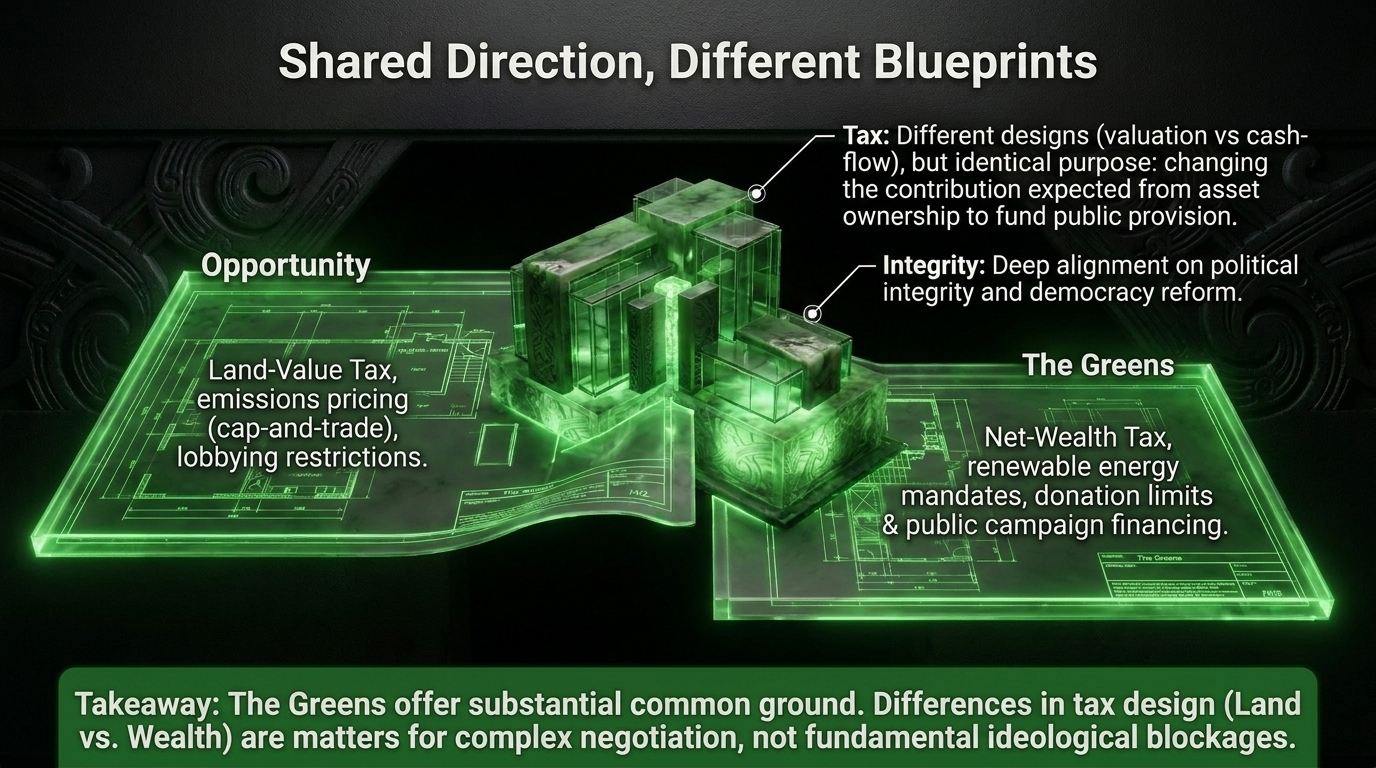
The Greens offer the clearest broad overlap with Opportunity across redistribution, public investment, climate and political integrity.
Opportunity wants to change the tax-and-income settlement. The Greens propose taxing exceptional wealth and large corporations to support services and more secure incomes. Compare Opportunity’s package with the Green manifesto.
Those tax designs are not interchangeable.
A land tax and a net-wealth tax raise different valuation, cash-flow and implementation questions. They must be examined together rather than stacked up as if every proposed revenue stream can be collected without interaction.
But both programmes accept something National and ACT resist: that changing the contribution expected from asset ownership can be part of improving security and public provision.
On climate, Opportunity emphasises emissions pricing, electrification and resilience. The Greens emphasise stronger emissions reduction, renewable energy and environmental protection. Their approaches differ, but the direction has substantial overlap in Opportunity’s climate programme and the Green manifesto.
On political integrity, Opportunity’s negotiating demands include lobbying restrictions and donation caps. The Greens explicitly propose donation limits, lobbying transparency and greater public campaign financing. Those commitments are documented by Reuters and in the Green democracy programme.
On Te Tiriti, Opportunity seeks a constitutional conversation with Māori participating as a Treaty partner. The Greens support constitutional transformation grounded in Te Tiriti and Matike Mai. Compare Opportunity’s position with the Greens’ programme.
The Greens go further. That is a difference to negotiate, not evidence of identical policy.
My conclusion is that this is a relationship with substantial common ground across the objectives Opportunity itself identifies.
There is more here than a shared willingness to talk.
There is a plausible programme to build.
Opportunity And Te Pāti Māori: Independence Must Mean More Than Delivery
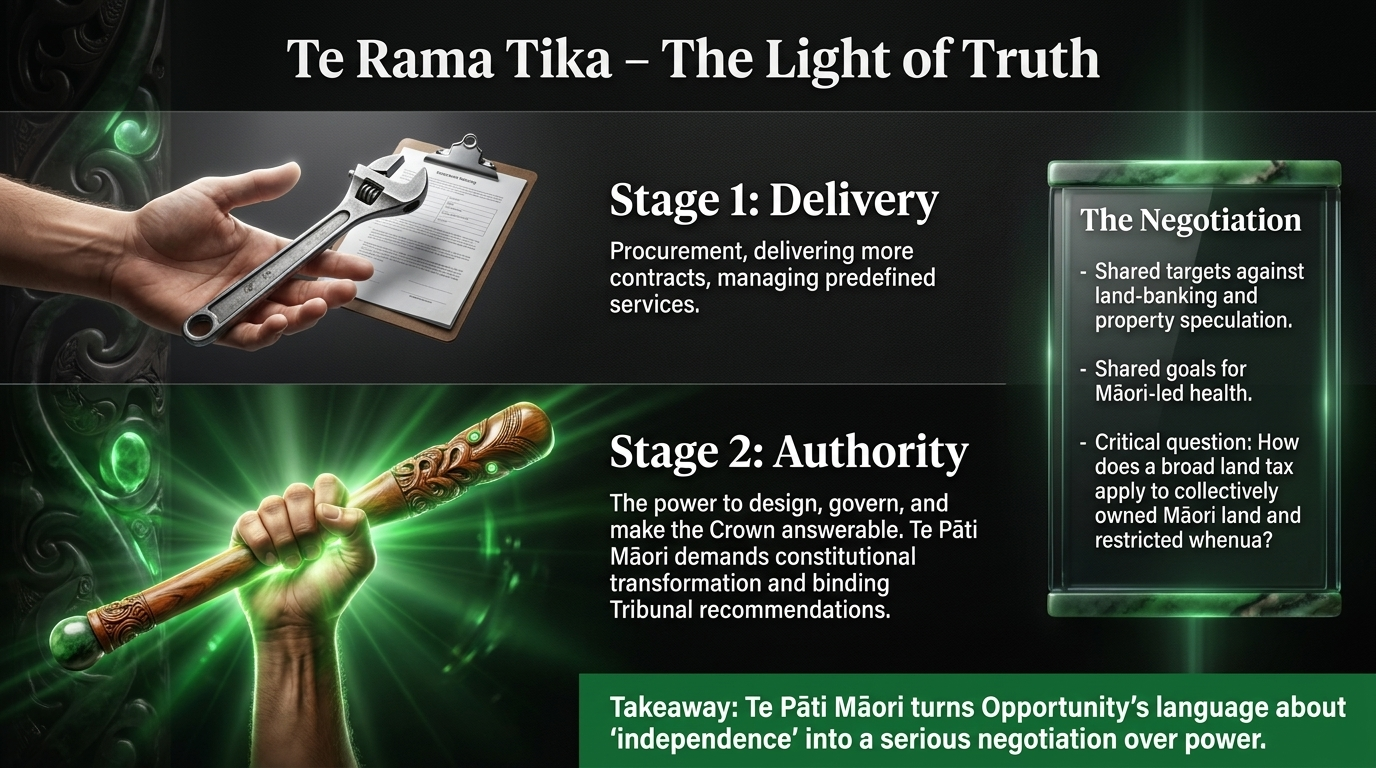
Te Pāti Māori gives this discussion something that must not disappear into economic management: the question of authority.
Opportunity promises genuine independence for Māori organisations, stronger Treaty analysis, support for Māori enterprise and Māori participation as a Treaty partner. Those are its own commitments.
Te Pāti Māori proposes stronger Māori-led health and education authority, constitutional transformation, binding Tribunal recommendations and greater control over economic development. That is its published programme.
There is an overlap.
There is also a difference.
Opportunity’s approach is more conditional on outcomes and negotiated institutional arrangements. Te Pāti Māori’s programme places a more explicit demand on returning authority and making the Crown answerable.
That difference deserves serious negotiation.
On housing, Te Pāti Māori proposes more public and affordable homes, easier development on ancestral land and action against speculation and land-banking. Opportunity’s Tax Reset also targets incentives to hold land and property for speculative gain. Compare Te Pāti Māori’s programme with Opportunity’s proposal.
On health, Opportunity supports stable kaupapa Māori commissioning and meaningful Māori participation. Te Pāti Māori proposes rebuilding stronger Māori-led health authority and prevention. Those commitments appear in Healthy People and Te Pāti Māori’s programme.
But I will not pretend every question has been answered.
How would a broad land tax apply to collectively owned Māori land, land subject to legal restrictions, or whenua held for intergenerational responsibilities rather than ordinary sale?
I would require those questions to be resolved with the people affected—not explained away after the agreement is signed.
And binding Tribunal recommendations are a larger commitment than Opportunity’s published Treaty position expressly makes. That gap must be acknowledged.
My conclusion is that Te Pāti Māori can help turn Opportunity’s language about independence into a serious negotiation over power.
Not just Māori carrying more responsibility.
Māori having the authority to act.
This Is Where Tika, Pono And Tikanga Matter
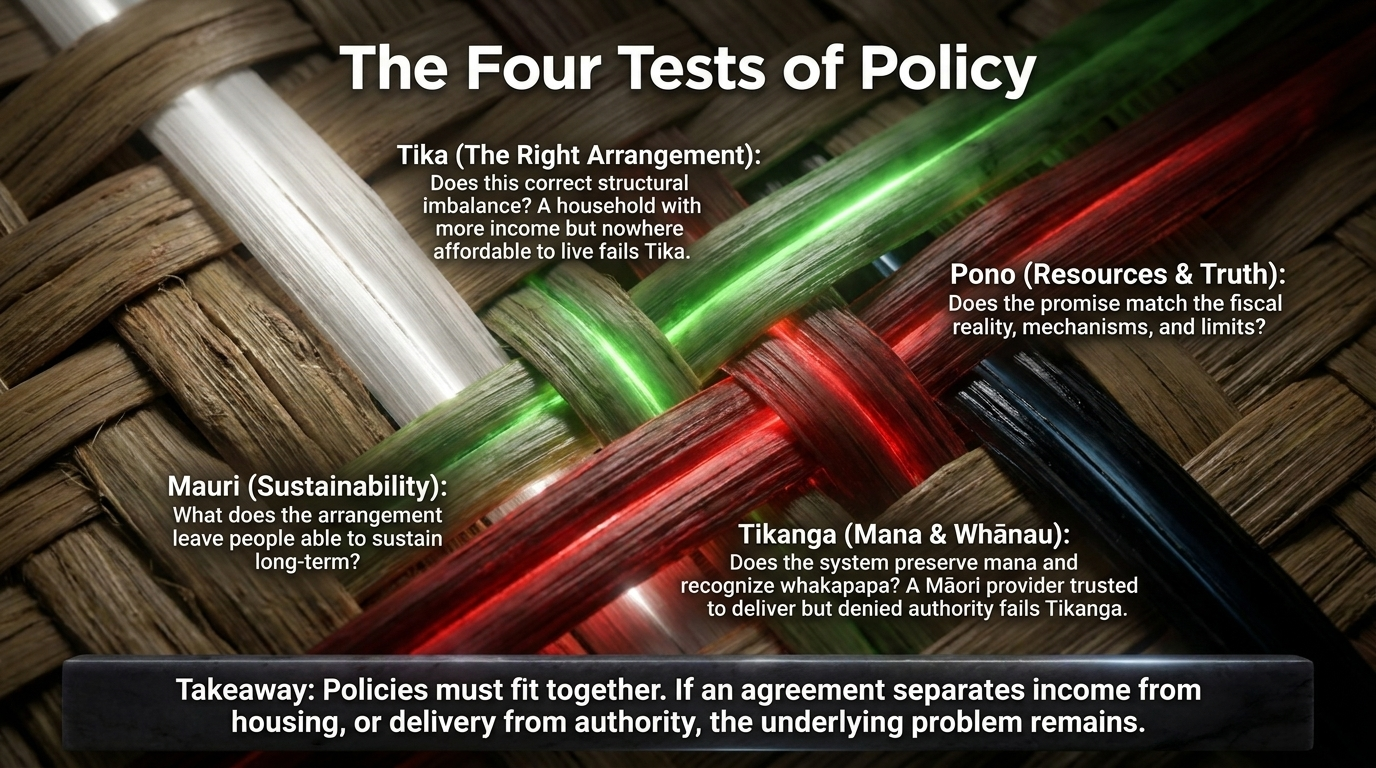
Whānau, imagine the household with a little more income but nowhere affordable to live.
Imagine a cheaper appointment that cannot actually be booked.
Imagine a Māori provider trusted to deliver the service but denied authority over its design.
Those are illustrative tests—not claims that a particular unsigned agreement has already produced those outcomes.
Tika asks whether the arrangement is right.
Pono asks whether the promise matches the resources, mechanisms and limits.
Tikanga asks whether the system preserves mana, recognises whakapapa, respects wairua, involves whānau and returns people towards wellbeing.
I use those questions as my editorial framework, not as a claim to define tikanga for every iwi or hapū.
And mauri asks what the arrangement leaves people able to sustain.
That is why the policies must fit together.
Income security alongside housing.
Health entitlements alongside workforce capacity.
Economic development alongside environmental durability.
Māori delivery alongside Māori authority.
If the agreement separates those things, the public can receive an impressive collection of announcements while the underlying problem remains.
The Left Must Earn The Agreement
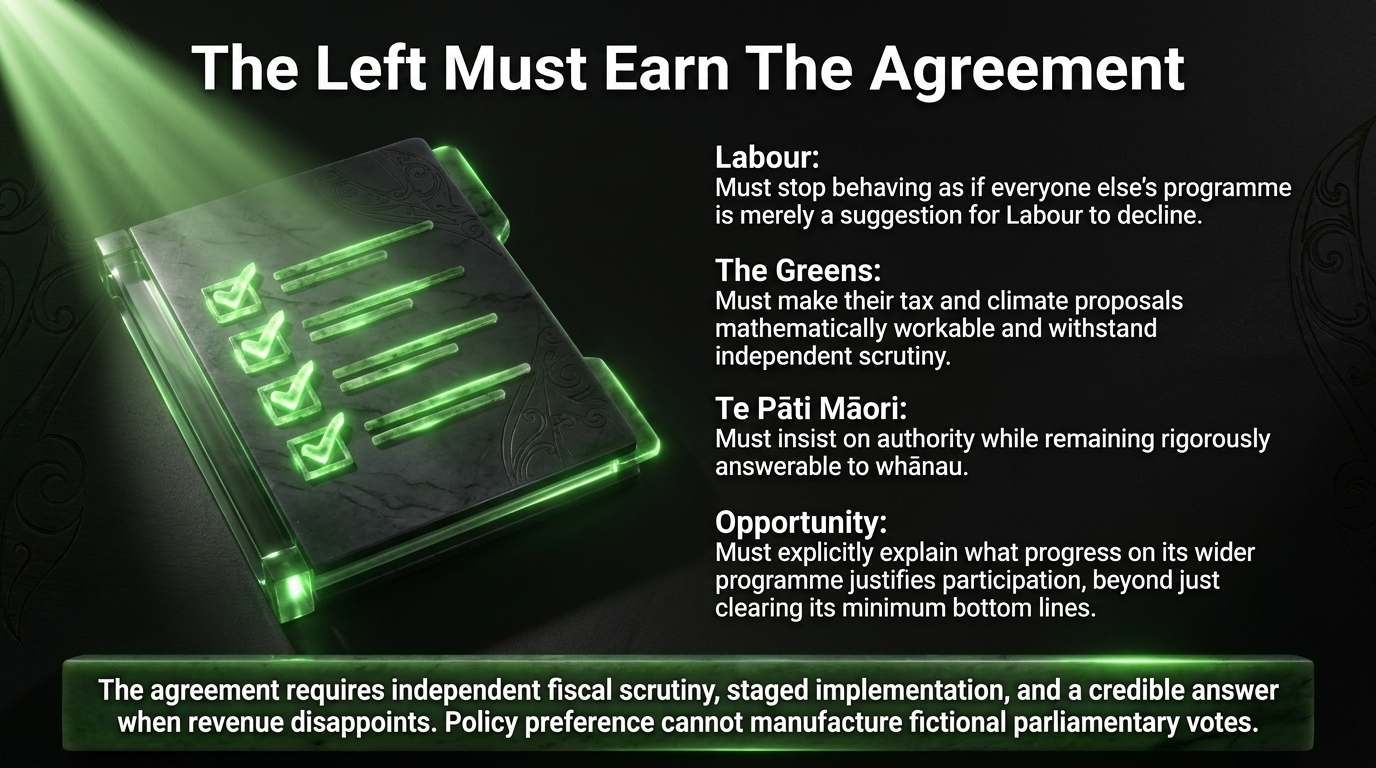
The strongest counterargument is obvious.
Labour resists Opportunity’s land tax. The Greens have a different tax programme. Te Pāti Māori seeks constitutional commitments that the others have not all accepted.
How is that easy?
It is not.
I am not arguing for easy.
I am arguing that the published overlap gives these parties a stronger basis for negotiating change than an arrangement requiring Opportunity to repeatedly defend its priorities against fundamental opposition.
But the left must earn that conclusion.
Labour must stop behaving as if everyone else’s programme is merely a suggestion for Labour to decline.
The Greens must make their proposals workable and withstand scrutiny.
Te Pāti Māori must insist on authority while remaining answerable to whānau.
And Opportunity must explain what progress on its wider programme would justify participation—not simply announce that its minimum conditions have been cleared.
The agreement needs independent fiscal scrutiny, staged implementation, clear responsibilities and public reporting.
It needs a credible answer when revenue disappoints or delivery falls behind.
And if the final count does not permit the proposed arrangement, policy preference cannot manufacture parliamentary votes.
I will not turn a stronger policy case into a fictional majority.
Opportunity, Choose A Direction You Can Defend
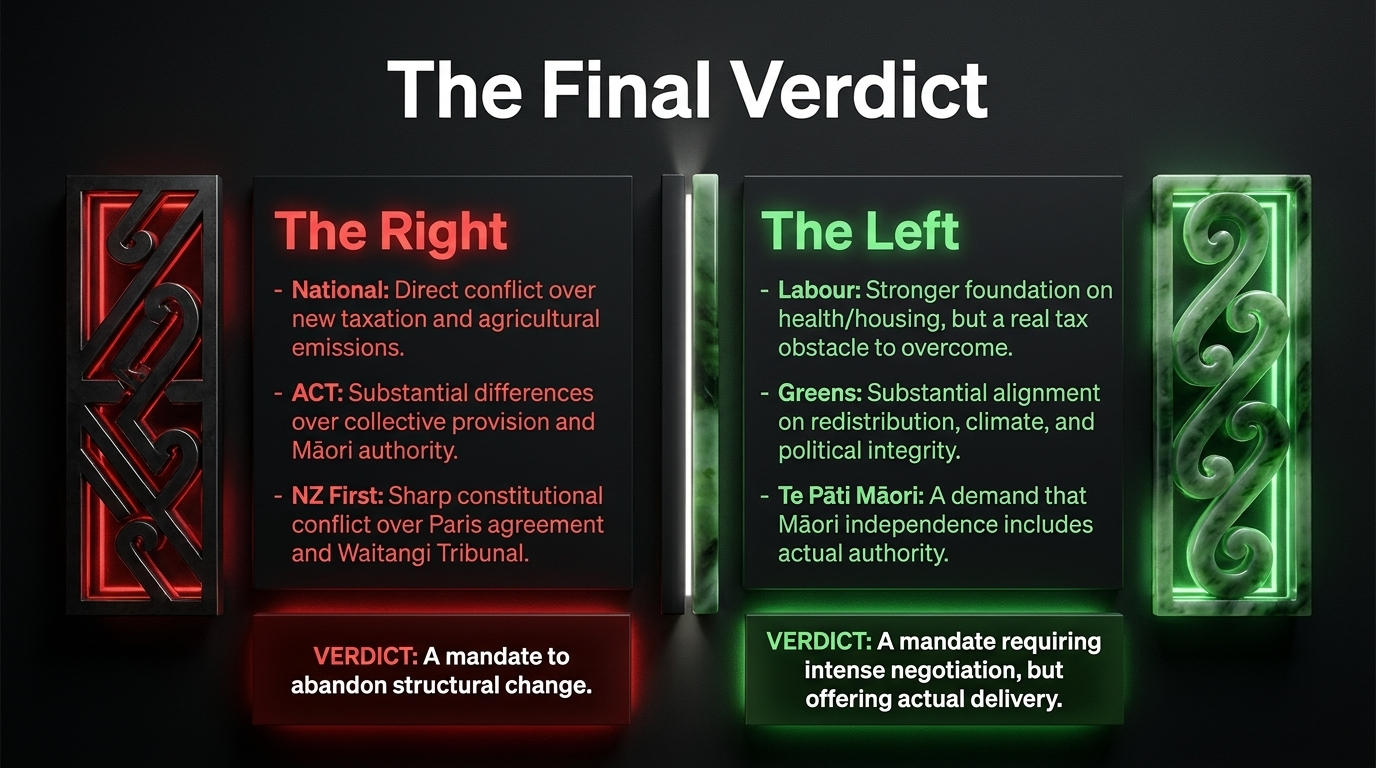
So here is my case.
National offers selected economic overlap, but a direct conflict with Opportunity over new taxation and important differences on agricultural emissions.
ACT offers shared interest in enterprise, but substantial differences over taxation, collective provision and Māori authority.
New Zealand First offers useful interventionist proposals, but sharp conflict over Paris participation and the future of the Waitangi Tribunal.
Labour offers a stronger foundation on health, housing, competition and climate—but a real tax obstacle.
The Greens offer substantial alignment across redistribution, climate, public investment and political integrity.
Te Pāti Māori offers a stronger insistence that Māori independence must include authority, not merely delivery.
That is my comparative judgment from the published Opportunity programme, National’s plan, ACT’s announcement, New Zealand First’s programme, Labour’s policies, the Green manifesto and Te Pāti Māori’s commitments.
Opportunity, you do not have to become a left-wing party to recognise that your policies may have a stronger home in a left-led agreement.
You do have to decide whether your purpose is to be available—or to deliver.
I want you to negotiate with Labour, the Greens and Te Pāti Māori for a government capable of changing the conditions people live under.
A funded agreement.
An accountable agreement.
An agreement that protects the environment, strengthens public capability and gives Māori authority something firmer to stand on than ministerial goodwill.
And if you cannot secure that, say so honestly.
But do not campaign to change the system, help preserve its central arrangements, and then ask whānau to celebrate your influence.
Influence is not the achievement.
What you do with it is.
Kia kaha, whānau.
Koha To Support And Protect Scrutiny That Does Not Change Sides

Whānau, who supports the time it takes to compare the policies, read the promises and ask what a coalition agreement would actually deliver?
You do.
There is no queue of corporates behind this mahi. The Māori Green Lantern is supported through koha—not payments to soften the questions or applaud whichever party gets into government.
This essay asks Opportunity to choose partners who can help deliver its programme. Your koha helps support and protect the scrutiny that must follow: checking whether the promises become obligations, whether Māori gain authority, and whether whānau receive more than another explanation for why change must wait.
I will not mistake Opportunity’s influence for achievement. Nor will I give Labour, the Greens or Te Pāti Māori an exemption from accountability.
Every koha helps preserve that independence and a record our mokopuna can use. Rangatiratanga includes supporting our own truth tellers—and expecting them to remain answerable to evidence.
Four Ways To Support And Protect This Mahi
Give A Voluntary Koha.
Subscribe To The Māori Green Lantern.
Direct bank transfer: Ivor Jones — 03-1395-0099387-000.
Support Through Facebook Subscription.
If money is tight, no worries. Follow The Māori Green Lantern, kōrero and share with whānau and friends. That is koha too.
Kia kaha, whānau. Stay vigilant. Stay connected. Whoever enters government, our questions must go in after them.
Disclaimer
This essay expresses my political analysis and preference for a Labour–Green–Te Pāti Māori–Opportunity agreement, conditional on sufficient parliamentary support and a credible negotiated programme. Published policies are promises, not guaranteed outcomes; the election position discussed remains provisional pending the final count. My use of Tika, Pono, Tikanga and mauri is an editorial framework, not a claim to speak for all Māori, iwi or hapū. Criticism concerns public policies and conduct—not unproven private motives. Sourced corrections are welcome.[reuters]