"PIKETTY'S MAP, OUR TERRITORY: The Economists Finally Arrived. They Were 200 Years Late and Our Tamariki Are Still Hungry." - 24 June 2026
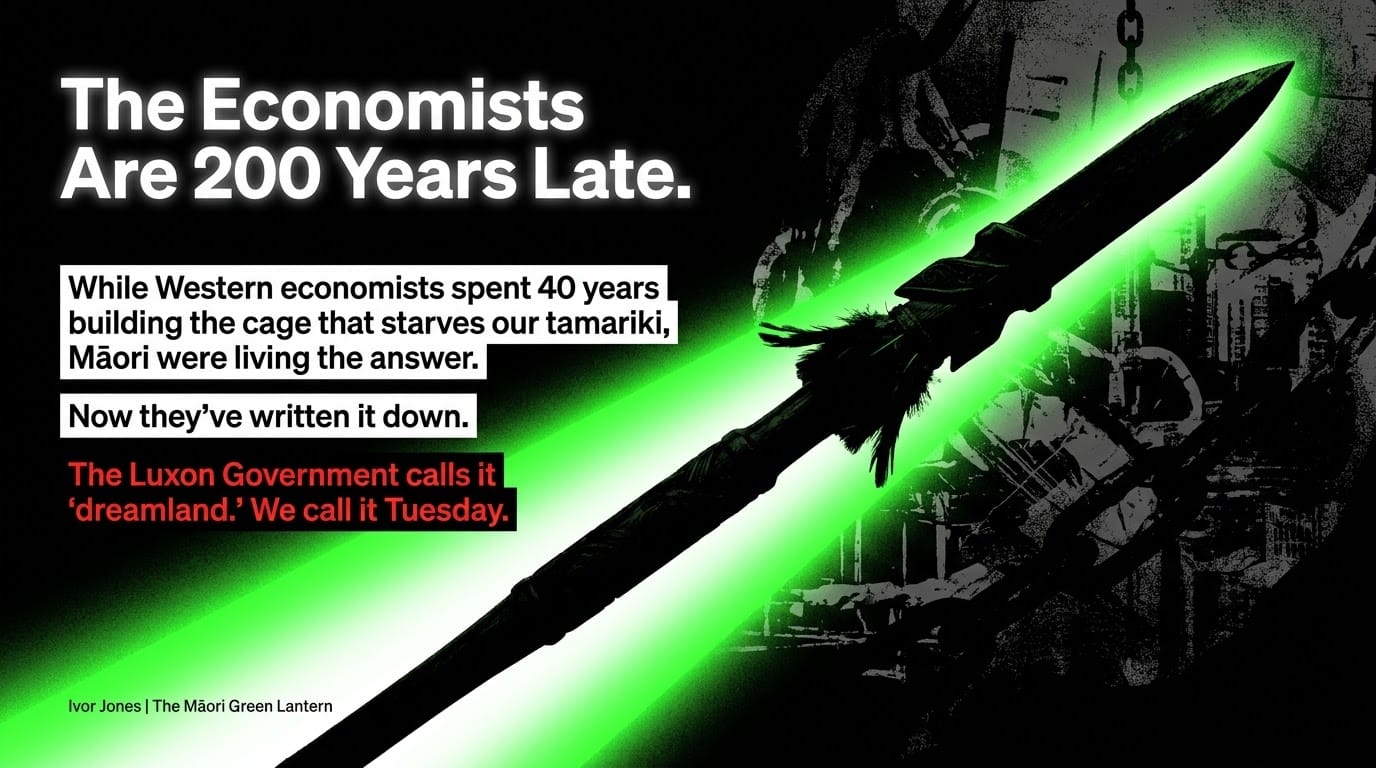
While Western economists spent 40 years building the cage that starves our tamariki, Māori were living the answer. Now they've written it down. The Luxon Government calls it "dreamland." We call it Tuesday.

Mōrena Aotearoa,
Let me tell you what happened this week.
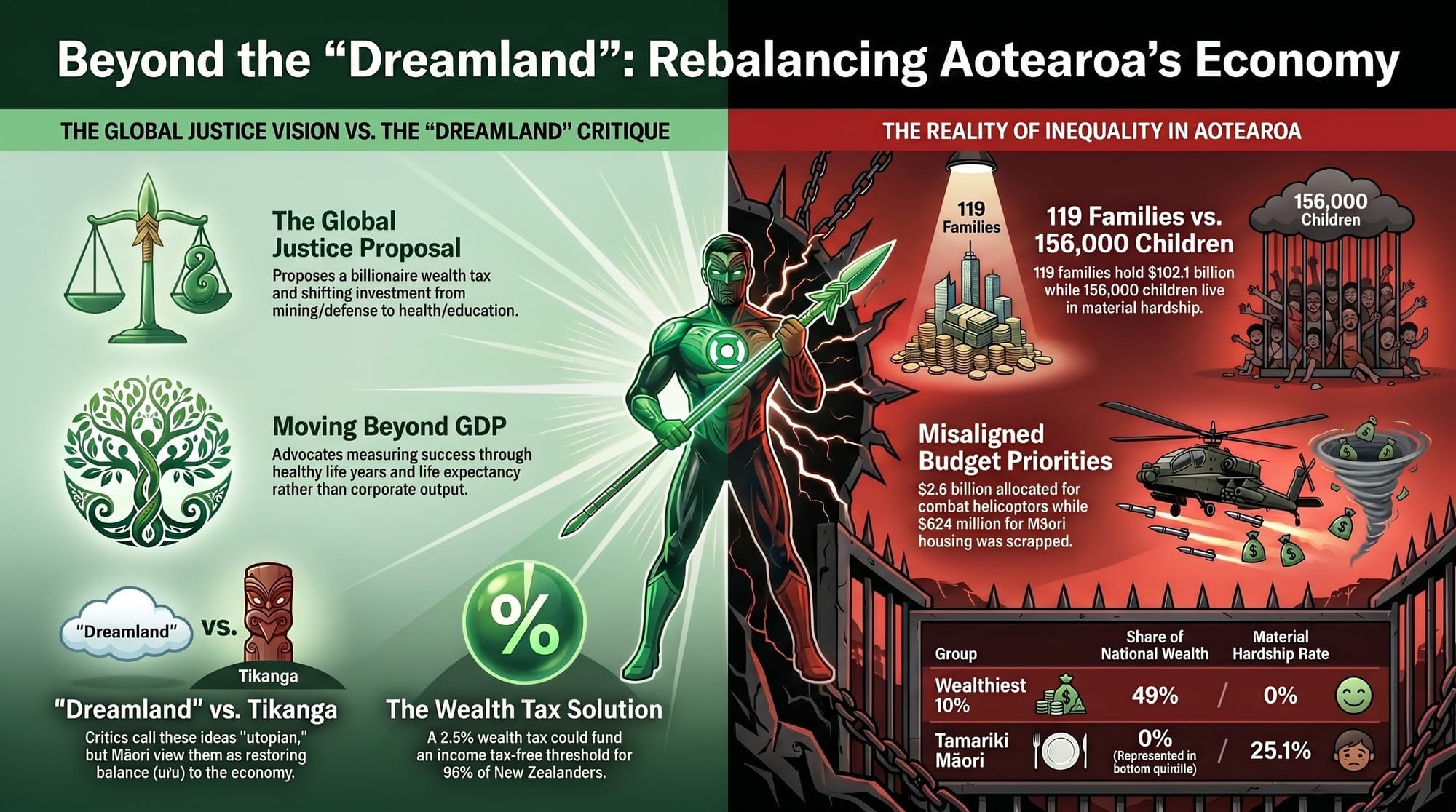
A French economist named Thomas Piketty, supported by the World Inequality Lab, published a report proposing that the world tax its billionaires, stop chasing GDP growth, shift investment from weapons and mining to education and health, measure success by healthy life years instead of corporate output, and build a Global Justice Fund to lift the world's poorest people out of poverty.World Inequality Lab — Global Justice Report: A Plan for Equality and Prosperity Within Planetary Boundaries
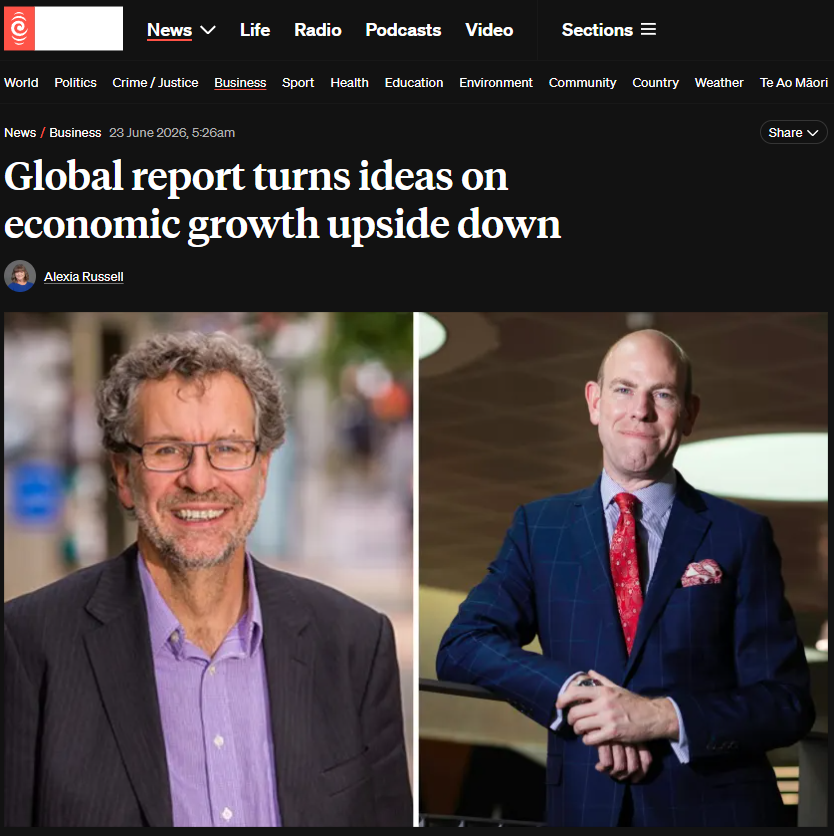
 RNZ | Te Reo Irirangi o Aotearoa
RNZ covered it on 23 June 2026 and asked two Wellington academics what they thought.
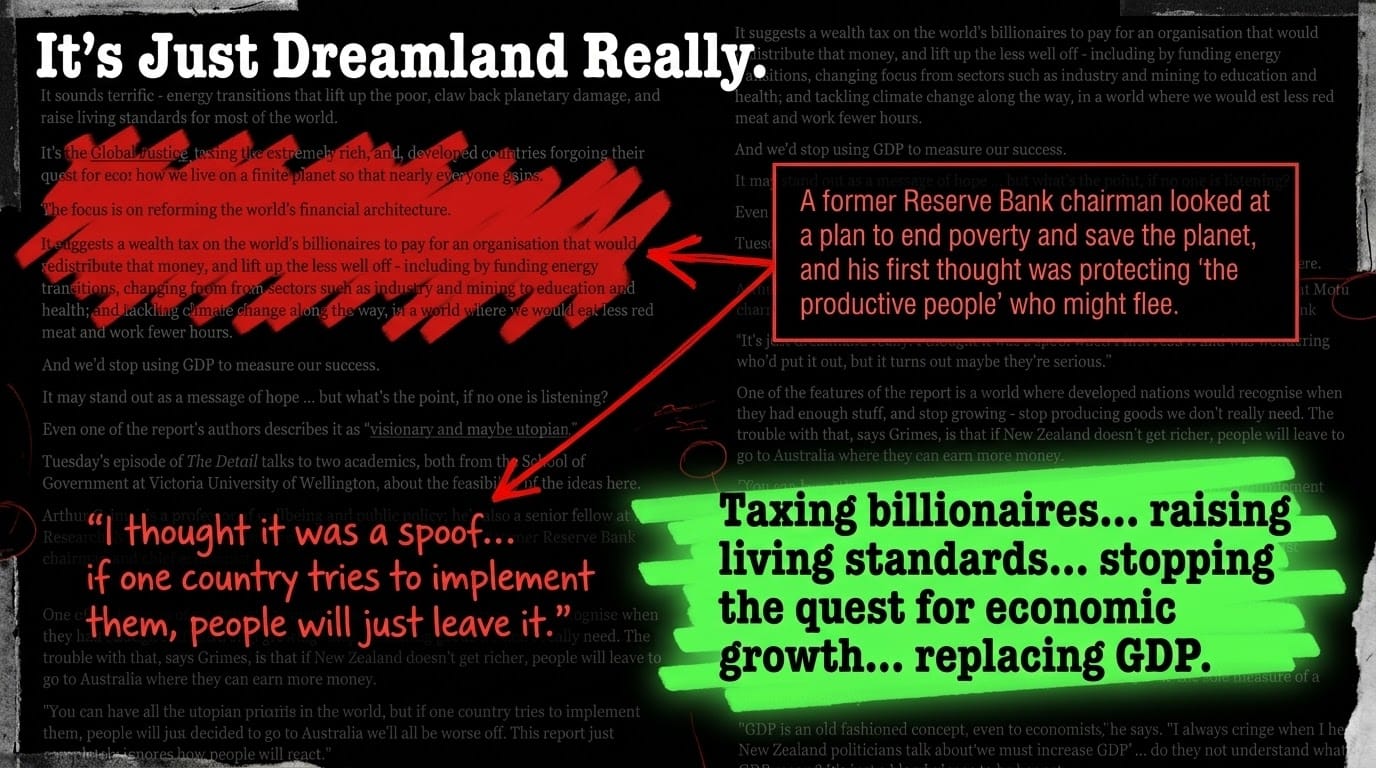
Arthur Grimes — former Reserve Bank chairman, guardian of the wealth of the people who do not need guarding — called it "dreamland." He worried that if New Zealand prioritised redistribution, "the productive people will all go to Australia."
The productive people.
Not the 1 in 4 tamariki Māori living in material poverty.Stats NZ — Child poverty statistics: Year ended June 2025
Not the 156,000 children missing meals, missing warmth, missing futures.NZCTU — Action needed now, as child poverty grows
Not the whānau sleeping in cars while the Crown spends $2.6 billion on combat helicopters.The Māori Green Lantern — The $2.6 Billion Helicopter Heist
The productive people. The ones who might leave for Australia if we asked them to pay their share.
I am Ivor Jones. I am Te Arawa, Ngāti Pikiao, Welsh whakapapa. I wield the taiaha and I trace the networks. And I am here to tell you that this report does not turn ideas on economic growth "upside down." For Māori, it simply turns Western economics right-side up — pointing at the mātauranga we have held since before 1840, the tikanga that Rogernomics spent 40 years trying to destroy, and the kaupapa that this white supremacist neoliberal government is still, right now, today, dismantling with a smile and a press release.
This essay names the crimes. Names the beneficiaries. Names the whānau being destroyed.
The taiaha is out.
🎙️ THE DEEP DIVE PODCAST
Listen to a lively conversation between two hosts unpacking and connecting the threads of this essay — from Piketty's global modelling to Rogernomics, the Wellbeing Budget, the wealth tax debate, and what tikanga economics means in practice.
I apologise in advance for the AI's very harsh pronunciation of te reo Māori — please don't shoot me! 😊 The kaupapa is in the content, not the accent.
🎬 YOUTUBE VIDEO
Like video? Here is a short video supporting the essay — visual connections, verified data, and the full kaupapa explained.
WHAT PIKETTY'S TEAM ACTUALLY FOUND — AND WHY IT TERRIFIES THE PEOPLE WHO RUN THIS COUNTRY
The Global Justice Report does not merely suggest tinkering at the margins of capitalism.World Inequality Lab — Global Justice Report.
It presents a fully modelled transition scenario — hard numbers, hard deadlines, hard choices — mapping the path from this burning, unequal world to one where:World Inequality Lab — Global Justice Report: A Plan for Equality and Prosperity Within Planetary Boundaries
- The poorest half of humanity's share of global wealth rises from 2% to 30%
- The billionaire class's share falls from 6% to 0.05%
- 90% of the world doubles its income while working roughly half the hours
- Global warming is limited to 1.8°C — versus 4.5°C on the current trajectory
- A Global Justice Fund is financed at 10.3% of world GDP annually — compared to the current 0.4% going to development aid
- Average incomes converge at €5,000 per month per capita across all nations, closing today's 16-fold gapWorld Inequality Lab — Global Justice Report: A Plan for Equality and Prosperity Within Planetary Boundaries
This requires three non-negotiable conditions: fast decarbonisation, sufficiency over excess consumption, and drastic reduction in inequality — both between countries and within them.World Inequality Lab — LinkedIn: Global Justice Report 2026
The report's own authors describe it as "visionary and maybe utopian."RNZ — Global report turns ideas on economic growth upside down
Good. Because the alternative — where we do nothing — is 4.5 degrees of warming, a planet stripped of its mauri, and our mokopuna inheriting the smoking wreckage of 200 years of Western extraction.World Inequality Lab — Global Justice Report: A Plan for Equality and Prosperity Within Planetary Boundaries
Grimes called it "dreamland" and reached for his comfort blanket: the brain drain to Australia.RNZ — Global report turns ideas on economic growth upside down
Let me translate that for you. A former Reserve Bank chairman, whose institution exists to maintain price stability — which is to say, to protect the purchasing power of people who have purchasing power — looked at a plan to save the planet and end poverty and said: but what about the people who might leave?
He did not ask about the 169,300 tamariki in material hardship.The Māori Green Lantern — Marama Davidson on Mata: They Called It Economic Lunacy. We Call It Arithmetic
He did not ask about the $102.1 billion held by 119 families.WSWS — Stark wealth inequality in New Zealand
He did not ask about the Māori unemployment rate sitting at 9.7% — still more than double the national rate, 40 years after Rogernomics was supposed to lift all boats.Infometrics — New Zealand Māori unemployment rate
His boats are fine. The canoes were already holed below the waterline.
THREE EXAMPLES FOR THE WESTERN MIND — THE CAGE, THE COST, AND THE CURE
I know some of you reading this are still reaching for your spreadsheets and your "but how would you pay for it" questions. I respect that. So let me meet you there — with three verified examples that show you the cage, quantify the cost, and name the cure. And then I will show you what all three of this do to tikanga. Because that part they never put in the spreadsheet.
Example 1: The Wealth Tax That Isn't Radical — It's Arithmetic
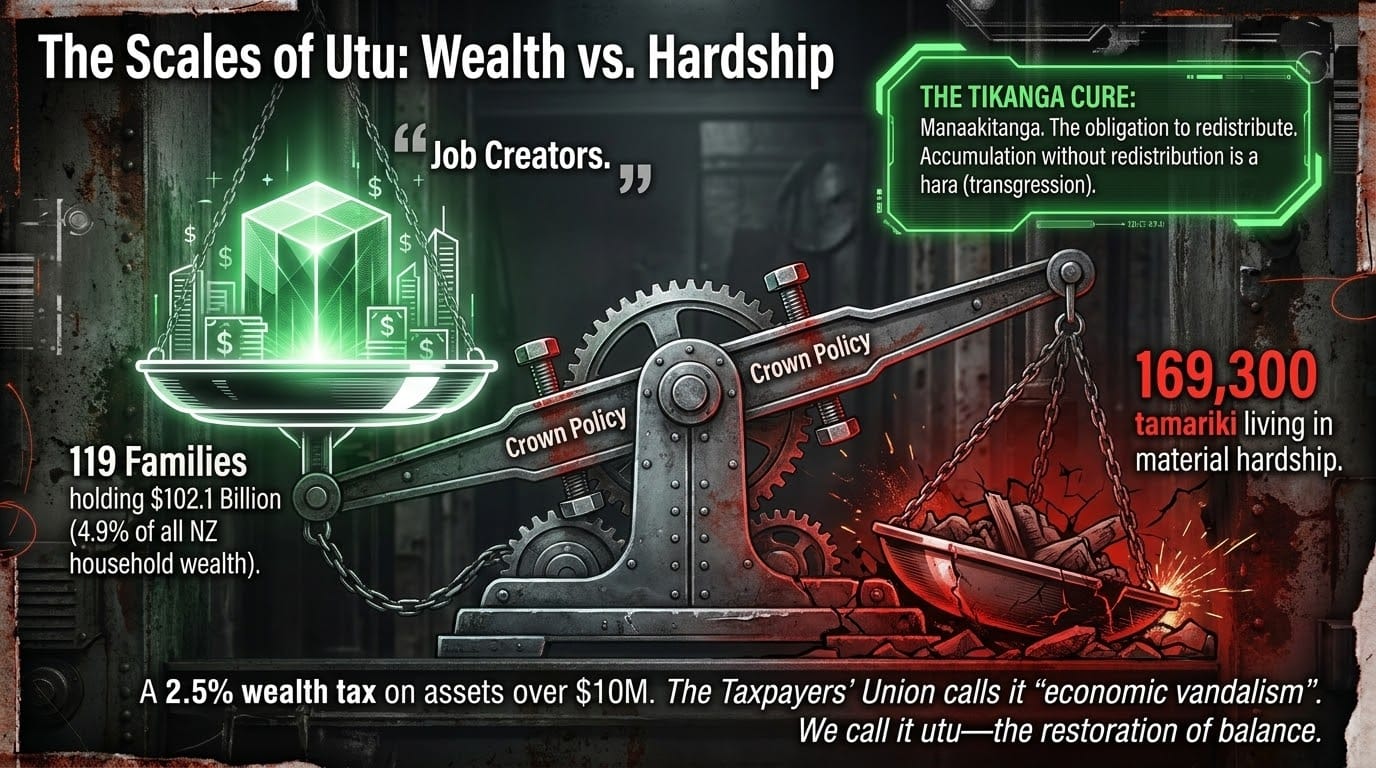
The Cage: In the year ended June 2024, the wealthiest 10% of New Zealand households held 49% of all household net worth.Stats NZ — Household net worth: wealth distribution remains unchanged One hundred and nineteen individuals and families hold a combined $102.1 billion — approximately 4.9% of all NZ household wealth.WSWS — Stark wealth inequality in New Zealand The top 1% of New Zealanders — roughly 40,000 people — control between 17% and 26% of national wealth, with a median net worth of $7.191 million each — 47.6 times the median worker.WSWS — Stark wealth inequality in New Zealand
Meanwhile, the typical household in the poorest quintile increased their net worth by $3,000 in a decade — from $8,000 to $11,000. The typical wealthiest household increased by over $1 million in the same period.Closing the Gap — Inequality Rising: the Income Equality Project
The Cost: The wealth gap between the richest and poorest fifth of NZ households increased by over $1 million in the last decade — and that gap runs on race.Closing the Gap — Inequality Rising: the Income Equality Project No Māori appear on the Rich List. Not one.The Māori Green Lantern — The Great Rebalancing: Aotearoa Has Enough for Everyone Stats NZ confirms 25.1% of tamariki Māori are in material hardship — the highest rate in a decade.Stats NZ — Child poverty statistics: Year ended June 2025
The Cure: The Green Party's 2026 Fair Tax package proposes a 2.5% annual wealth tax on net assets above $10 million, a 33% inheritance tax on inheritances over $1 million, and a $10,000 tax-free income threshold that returns money to 96% of New Zealanders.1News — Greens propose wealth and inheritance taxes to fund income tax changes Net revenue: $5.35 billion in 2027/28, rising to $5.94 billion by 2030/31.1News — Greens propose wealth and inheritance taxes to fund income tax changes Te Pāti Māori goes further — wealth taxes on assets over $2 million, GST removed from all kai, and the first $30,000 of income tax-free.Te Ao News — Te Pāti Māori tax policy: more kai on the table and less tax
The Tikanga Impact: In tikanga Māori, accumulation without redistribution violates the principle of manaakitanga — the obligation to care, to share, to ensure no one at the porch of the marae goes without. A billionaire holding $102 billion while 1 in 4 of our tamariki go hungry is not a success story. It is a hara — a transgression against the mauri of the community. When we say "tax the rich," we are not speaking the language of envy. We are speaking the language of utu — the restoration of balance when the scales have been deliberately tipped. The Taxpayers' Union called the Green wealth tax "economic vandalism which would disproportionately hit Māori assets."The Māori Green Lantern — The Green Party: The Great Rebalancing (Taxpayers' Union response) This is a lie constructed with surgical precision — weaponising Māori economic aspiration to protect billionaires who have never shared a single cent of their wealth with the Māori community whose land underpins the economy they extracted it from.
I previously exposed this exact sleight-of-hand in "Exposing Racism and Neoliberalism in New Zealand's Tax Policies" and in "THE GREAT REBALANCING: Aotearoa Has Enough for Everyone" — where I documented that the system producing 169,300 children in material hardship calls redistribution "lunacy," while the people who built that system call themselves "job creators."The Māori Green Lantern — The Great Rebalancing: Aotearoa Has Enough for EveryoneThe Māori Green Lantern — Marama Davidson on Mata: They Called It Economic Lunacy. We Call It Arithmetic
Example 2: The Defence Budget Is the Redistribution Budget — Inverted, On Purpose
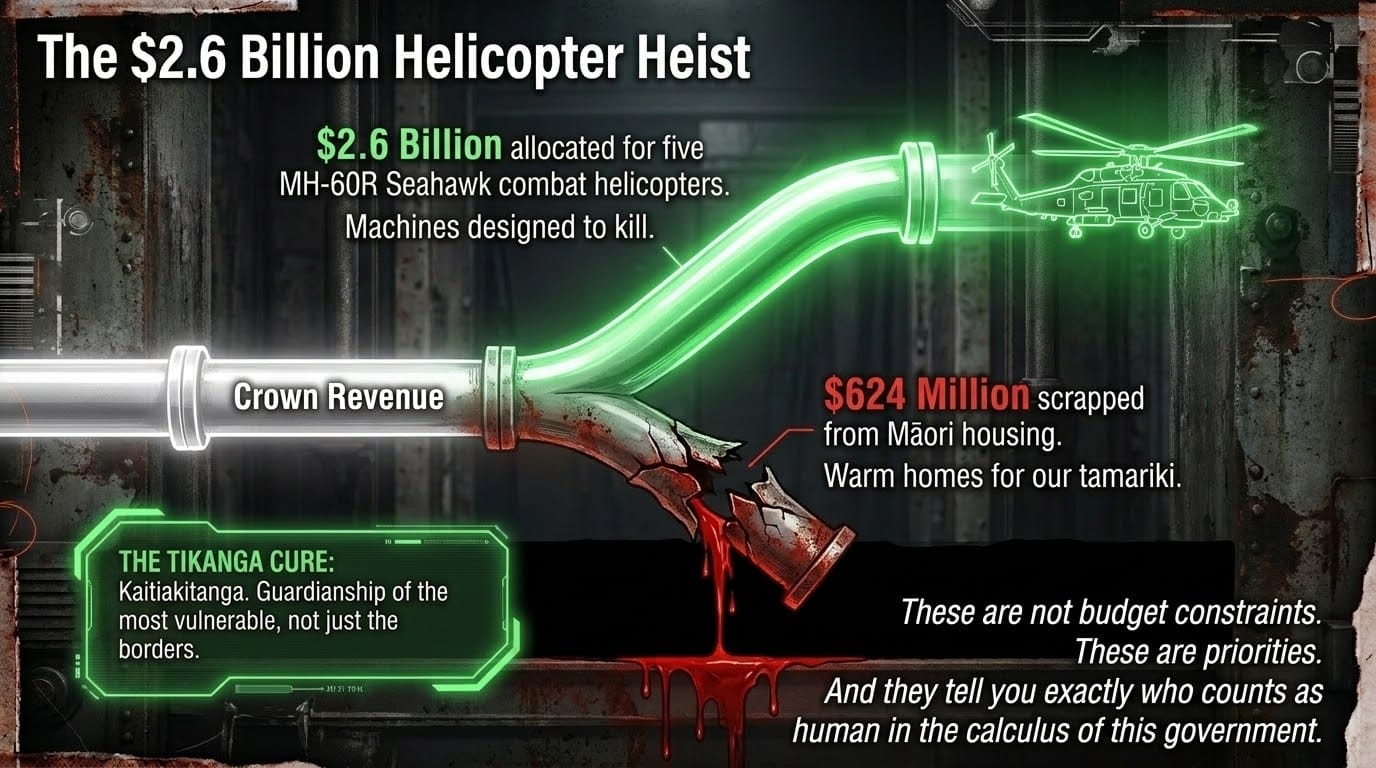
The Cage: Budget 2026 allocated $2.6 billion for five MH-60R Seahawk combat helicopters and locked in $12 billion in defence uplift over four years — targeting 2% of GDP on military spending within eight years.The Māori Green Lantern — The $2.6 Billion Helicopter Heist
In the same budget cycle, the Luxon Government:The Māori Green Lantern — The $2.6 Billion Helicopter HeistThe Māori Green Lantern — The Great Trickle-Down Deception
- Scrapped $624 million in Māori housing
- Cut Hauora Māori by a net $11.5 million
- Cut Te Puni Kōkiri by $23.6 million in Budget 2026 alone, with $73.6 million more locked in
- Eliminated over $1 billion in Māori-targeted funding across three years
- Slashed over $750 million from Māori-specific initiatives in Budget 2025 — housing, economic funds, education, trades training — gone
The Cost: The NZ Council of Trade Unions reported in February 2025: "1 in 4 tamariki Māori live in material poverty. 1 in 3 Pacific children live in material poverty."NZCTU — Action needed now, as child poverty grows CPAG confirmed that 101,600 children are now in consistent poverty in 2025 — a statistically significant increase since 2022.Child Poverty Action Group — Latest official child poverty statistics 2024/25 The Luxon Government is missing all three of its own child poverty targets — its response was to water down the targets.NZCTU — Action needed now, as child poverty grows
The Cure: The Global Justice Report proposes that nations shift investment from "sectors such as industry and mining to education and health" and fund energy transitions for the poor.RNZ — Global report turns ideas on economic growth upside down Te Pāti Māori's 2026 Budget alternative would have invested in warm and affordable housing, whānau wellbeing, and Māori-led solutions.Debbie Ngarewa-Packer — A Budget reflects choices and values The Green Party's Ending Poverty Together policy would reverse the landlord tax cuts ($2.9 billion handed back to landlords by the Luxon GovernmentThe Māori Green Lantern — Nicola's Glass Cannon) and invest in public housing.Green Party — Ending Poverty Together
The Tikanga Impact: Kaitiakitanga is the responsibility of guardianship — not just of the environment, but of the people, the tamariki, the kaumātua, the most vulnerable in the community. The Luxon Government has just told you that Seahawk helicopters matter more than Māori housing. It has told you that military hardware — machines designed to kill — are worth more than warm homes for our tamariki. This is not just a budget decision. It is a statement of who counts as human in the calculus of this government. And the answer, encoded in every line of their fiscal policy, is: not Māori. In my essay "The $2.6 Billion Helicopter Heist", I named this for what it is: the Crown's active choice to militarise while our mokopuna freeze.The Māori Green Lantern — The $2.6 Billion Helicopter Heist
Example 3: GDP Is Not Just Wrong — It Was Designed to Erase Us
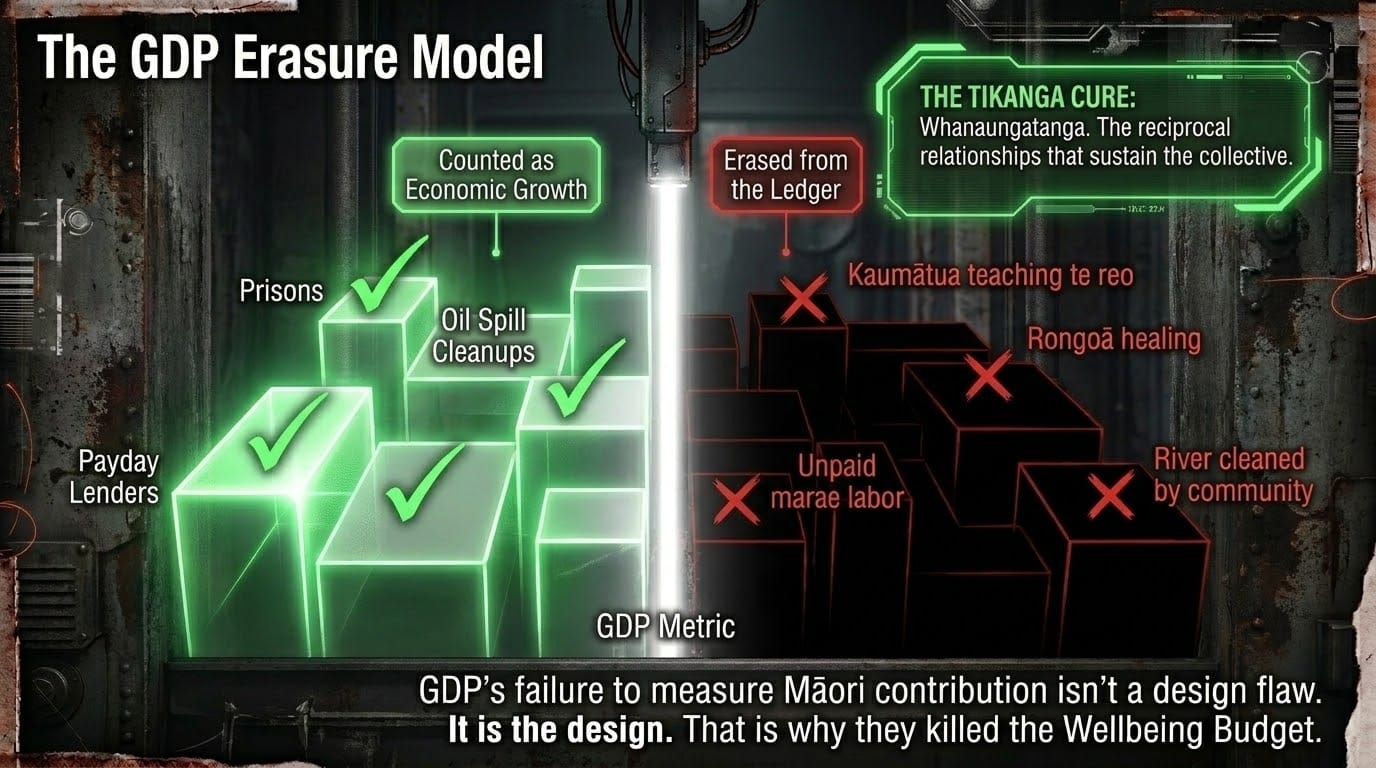
The Cage: New Zealand politicians — across all major parties — ritually invoke GDP growth as the supreme measure of national success. RNZ's own academic commentator Arthur Grimes admits: "GDP is an old fashioned concept, even to economists. I always cringe when I hear New Zealand politicians talk about 'we must increase GDP' … I don't think they've thought about it."RNZ — Global report turns ideas on economic growth upside down
He is wrong about one thing. They have thought about it. They just haven't thought about us.
The Cost: GDP counts a prison as growth. It counts a oil spill as growth (cleanup costs). It counts a payday lender as growth. It does not count a grandmother teaching te reo to her mokopuna. It does not count a kaumātua healing a whānau with rongoā. It does not count a river cleaned by community hands or a marae restored with love and labour. GDP was not built to measure Māori contribution — and its consistent failure to do so is not a design flaw. It is the design. New Zealand had a Wellbeing Budget from 2019 — a globally recognised framework that explicitly replaced GDP as the primary measure and centred Māori wellbeing.PMC — New Zealand's Wellbeing Budget Invests in Population HealthWEAll — New Zealand: Implementing the Wellbeing Budget It was grounded in He Ara Waiora — a Māori wellbeing framework — alongside the Treasury's Living Standards Framework.Wellbeing Economy Course — Wellbeing priorities for the New Zealand budget The Luxon Government dismantled it. They killed the Wellbeing Budget. Abolished Te Aka Whai Ora. And returned to the GDP-worship that produced 40 years of Māori poverty in the first place.Green Party — Green Budget delivers for Māori
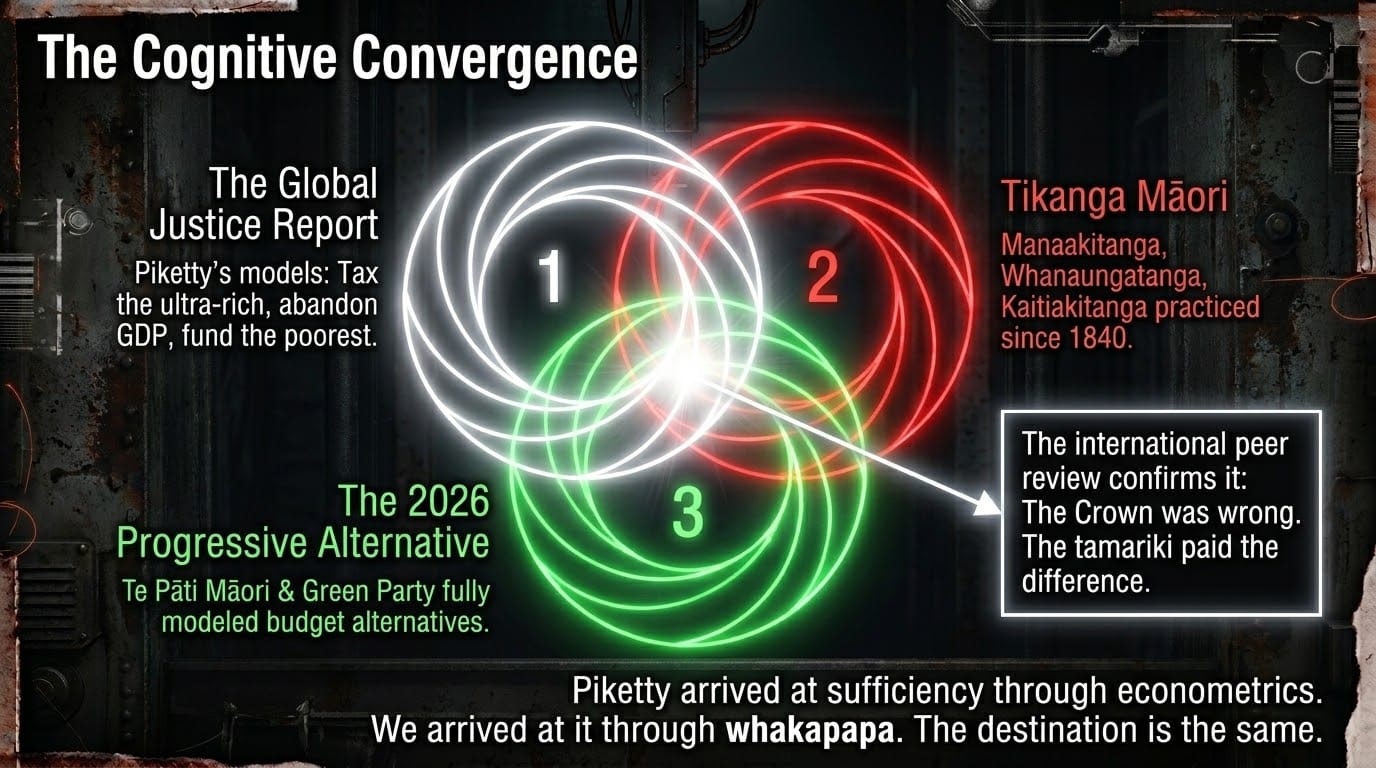
The Cure: The Global Justice Report proposes replacing GDP with measures including life expectancy, healthy life years, and family wellbeing — exactly what the Wellbeing Budget proposed, exactly what He Ara Waiora embodies.RNZ — Global report turns ideas on economic growth upside down Grimes himself confirms: "Life expectancy's a really important one, healthy life years is really important."RNZ — Global report turns ideas on economic growth upside down A 2024 academic paper in Sage Journals on "Māori economies and wellbeing economy strategies" identified a "cognitive convergence" between Māori economic kaupapa and global wellbeing economy frameworks — confirming this is not foreign theory imposed on Māori, it is mātauranga Māori finally being acknowledged by Western economists.Sage Journals — Māori economies and wellbeing economy strategies
The Tikanga Impact: Whanaungatanga — the web of reciprocal relationships that sustains the collective — cannot be measured in GDP. The marae economy, where labour is given freely, where food is shared without invoice, where healing is offered without billing, where the old teach the young without a curriculum fee — none of this appears in GDP. In fact, the Crown's austerity policies actively destroy whanaungatanga by forcing whānau into individualist survival mode — competing for scarce housing, scarce jobs, scarce healthcare — instead of being able to hold each other up. I previously connected these threads in "The Corporate Theatre of False Choice: How Luxon and Hipkins Perpetuate Neoliberal Economics" — exposing how both Labour and National maintain a false binary that keeps the permitted imagination of this country locked inside the neoliberal box.The Māori Green Lantern — The Corporate Theatre of False Choice
THE WHAKAPAPA OF THE CRISIS — 40 YEARS OF DELIBERATE INJURY
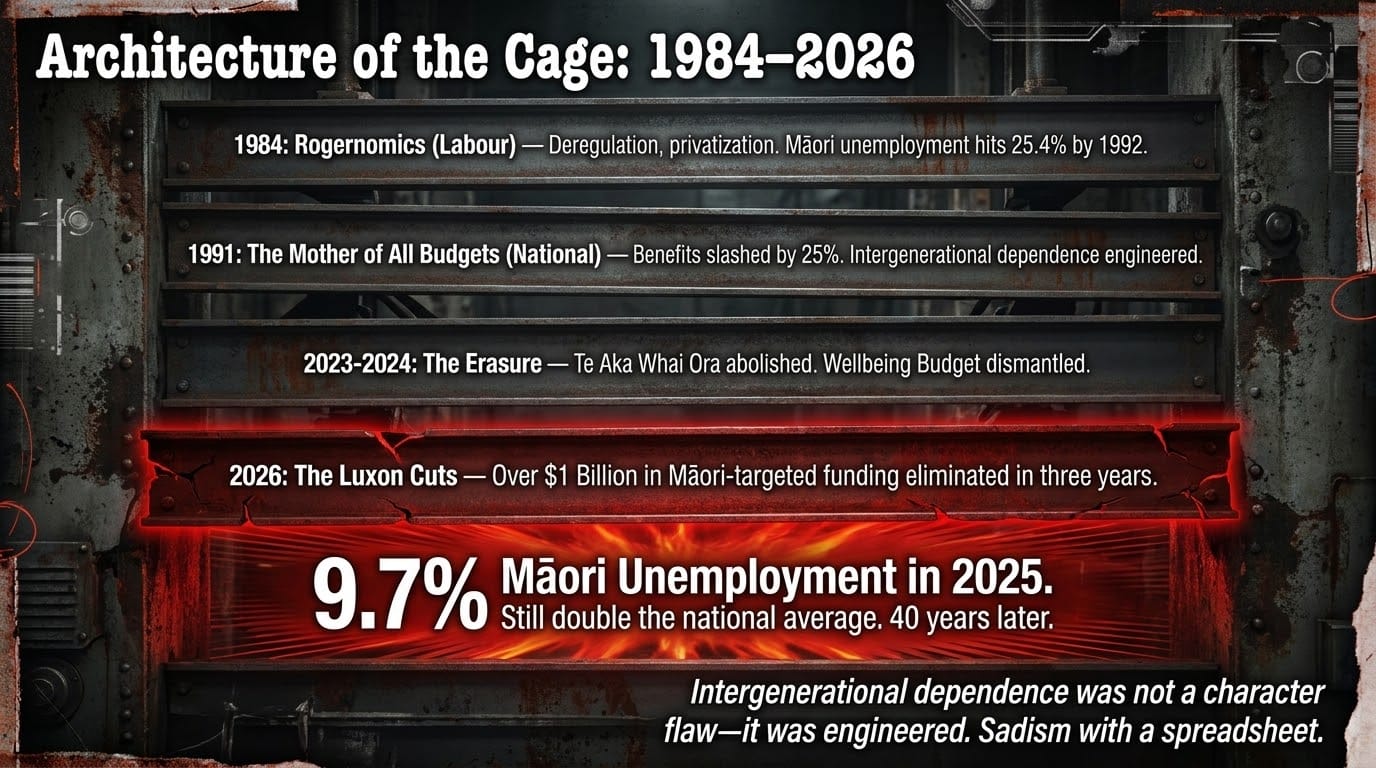
I need you to understand that none of this is accidental. The suffering has a whakapapa. It was born in July 1984 and it has never died — it has only changed suits.
Rogernomics — delivered by a Labour government, let us never forget, let us tattoo it somewhere permanent — deregulated financial markets, privatised state assets, slashed public services, removed import protections, and introduced GST: a regressive tax that takes proportionally more from the poor than from the rich.Wikipedia — RogernomicsThe Conversation — A nation reinvented: 40 years on from the Fourth Labour Government
The Māori receipt was immediate and devastating:
- Māori unemployment hit 25.4% by 1992 — when the overall rate was 10%NZ History — The 1980s overviewMSD — Social indicators: Māori unemployment rates
- Ruth Richardson followed in 1991 with the "Mother of All Budgets" — slashing benefits by up to 25%, disproportionately hitting Māori whānauThe Māori Green Lantern — Elite Plunder Masquerading as Policy
- Intergenerational dependence on welfare was not a character flaw — it was engineered by the Crown through the systematic destruction of Māori employment, Māori land, and Māori economic institutionsThe Spinoff — Forty years after Rogernomics: Imagining an economy grounded in Māori values
- In 2025, Māori unemployment stands at 9.7% — still more than double the national rate — 40 years laterInfometrics — New Zealand Māori unemployment rate
As I documented in "Knowledge Transfer as Resistance" (November 2025): Labour invented neoliberalism here in 1984. National deepened it in 1991. Neither has ever apologised. Both are still doing it.The Māori Green Lantern — Knowledge Transfer as Resistance
The Spinoff noted in August 2024, forty years after Rogernomics: "By 1992, Māori unemployment had reached 25% compared to the overall rate of 10%. Widespread job losses led many to intergenerational dependence."The Spinoff — Forty years after Rogernomics: Imagining an economy grounded in Māori values
That intergenerational dependence became the justification for every subsequent cut. You broke us with your economics, then called us broken, then cut the support as punishment for the breaking. That is not policy. That is sadism with a spreadsheet.
THE FIVE HIDDEN CONNECTIONS — WHO BUILT THE CAGE AND WHO PROFITS FROM IT
Connection 1: Labour Built the Cage It Now Pretends to Oppose
Labour did not merely fail to reverse Rogernomics. Labour invented it.The Māori Green Lantern — Knowledge Transfer as ResistanceThe Conversation — A nation reinvented: 40 years on from the Fourth Labour Government The Fourth Labour Government under David Lange and Roger Douglas delivered the most radical market liberalisation in the OECD. Māori unemployment hit 25% on their watch.NZ History — The 1980s overview They have never apologised.
In January 2025, I documented Labour's strategy in "Labour's Two-Faced Dance: Neoliberal Economics in Progressive Clothing": pivoting to National's terrain on "economy and crime" while refusing to commit to a wealth tax, CGT, or meaningful Māori economic redistribution.The Māori Green Lantern — Labour's Two-Faced Dance: Neoliberal Economics in Progressive Clothing Max Rashbrooke confirms Labour's "careful positioning on economic issues reveals a leadership more concerned with political expediency than genuine economic transformation."RNZ — Global report turns ideas on economic growth upside down
Labour is not the solution. Labour is the reason we need one.
Connection 2: The GDP Obsession Is Not Ignorance — It Is Instruction
The metrics that erase Māori contribution are the same metrics used to justify cutting Māori programmes. If Hauora Māori is cut, GDP does not register the harm. If a whānau loses their home, GDP does not register the grief. The measurement system was designed to make the costs of colonisation invisible while counting its profits. This is not oversight. This is architecture.
As I exposed in "Government Economic Spin: More Spin Than a Front-Load Washing Machine" (July 2025): neoliberal reforms created "a tremendous rise in inequality and widening gaps — not necessarily between Māori and Pākehā, but within Māori society as well."The Māori Green Lantern — Government Economic Spin: More Spin Than a Front-Load Washing Machine When this government talks about "growing the economy," they mean growing the pile held by 119 families. They do not mean growing the mauri of the whenua. They do not mean growing the life chances of tamariki in South Auckland. They mean growing the number that justifies not changing anything.
Connection 3: The Defence Budget Is the Redistribution Budget — Inverted, On Purpose
$2.6 billion for combat helicopters.The Māori Green Lantern — The $2.6 Billion Helicopter Heist $624 million Māori housing programme — scrapped.The Māori Green Lantern — The $2.6 Billion Helicopter Heist $12 billion defence uplift locked in.The Māori Green Lantern — The $2.6 Billion Helicopter Heist Te Puni Kōkiri cut by $23.6 million.The Māori Green Lantern — The $2.6 Billion Helicopter Heist These are not budget constraints. These are priorities. Priorities are values. And these values are telling you, in numbers too large to misread, whose lives matter to this government and whose do not.
I named this in "The $2.6 Billion Helicopter Heist" (June 2026): "NZ$2.6 BILLION for combat helicopters. NOTHING new for Māori housing."The Māori Green Lantern — The $2.6 Billion Helicopter Heist
Connection 4: The Taxpayers' Union Is the Billionaires' Union
When the Green Party announced its 2026 wealth tax — applying to net assets above $10 million — the Taxpayers' Union immediately declared it "economic vandalism which would disproportionately hit job creators and Māori assets."The Māori Green Lantern — The Green Party: The Great Rebalancing (Taxpayers' Union response)
This is a lie of breathtaking audacity. Stats NZ confirms no Māori appear on the Rich List.The Māori Green Lantern — The Great Rebalancing: Aotearoa Has Enough for Everyone The Green wealth tax does not touch a single Māori asset below $10 million in net worth. The Taxpayers' Union — funded by undisclosed donors with every incentive to protect the 119 families holding $102.1 billionWSWS — Stark wealth inequality in New Zealand — has weaponised Māori economic aspiration to shield billionaire tax avoidance. They are using our name. Against our tamariki. For their donors.
This is colonisation in a suit. This is 2026, and they are still using us as a human shield.
Connection 5: The Wellbeing Budget Was Real — Then Killed
New Zealand already had a domestic version of what the Global Justice Report proposes. The 2019 Wellbeing Budget — globally recognised, grounded in He Ara Waiora, centring Māori wellbeing as a primary measure of national success — was a genuine structural alternative to GDP-worship.PMC — New Zealand's Wellbeing Budget Invests in Population HealthWEAll — New Zealand: Implementing the Wellbeing BudgetWellbeing Economy Course — Wellbeing priorities for the New Zealand budget The Luxon Government dismantled it. Abolished Te Aka Whai Ora. Returned to the language of "growth."Green Party — Green Budget delivers for Māori
They are not dismissing Piketty because his plan is impractical. They are dismissing it because it is dangerous — to them. A world that measures success by the health and mana of its most vulnerable is a world where this government fails by every metric. That is why they killed the Wellbeing Budget. That is why they call the Global Justice Report "dreamland." Because in their dream, the 119 families keep the $102 billion, and our tamariki keep the hunger.
WHICH PARTIES SERVE THIS KAUPAPA — AND WHICH ONES SERVE THE CAGE
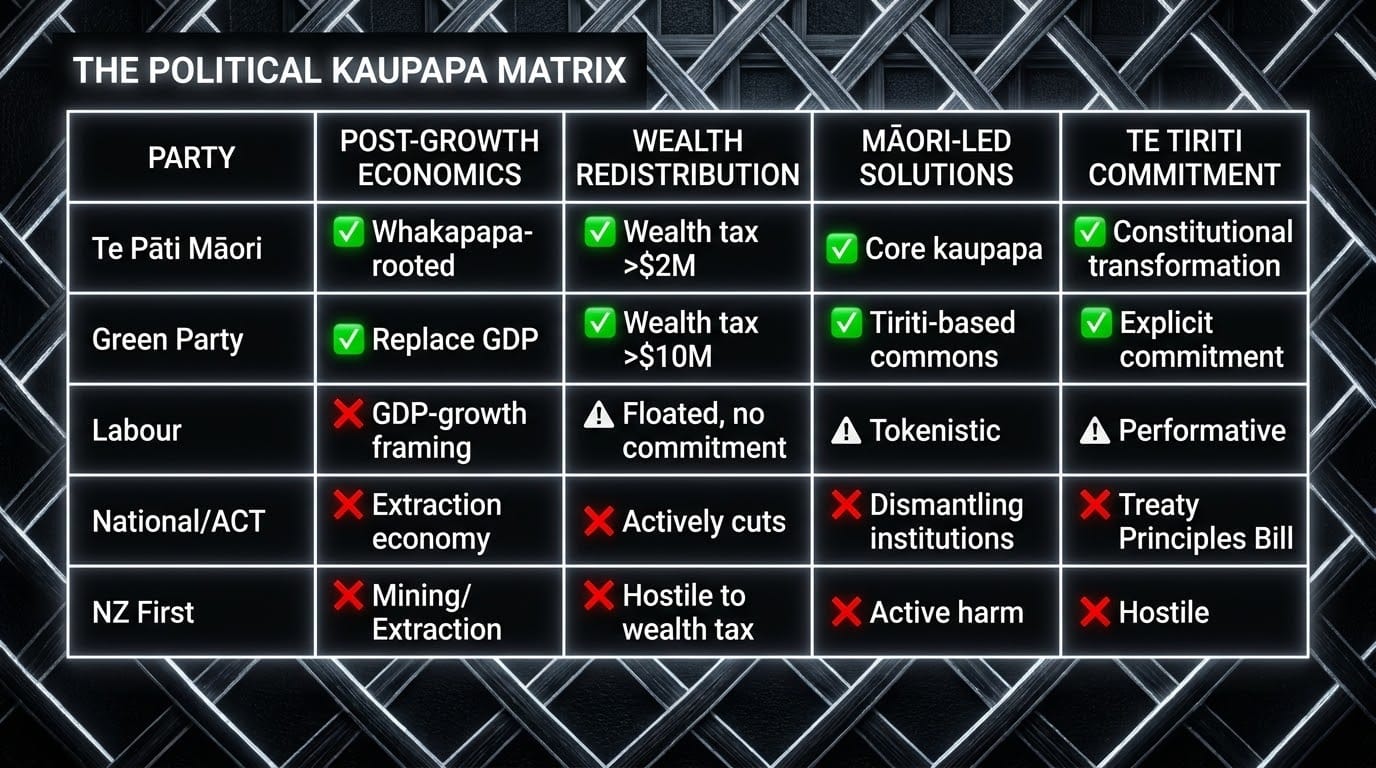
Te Pāti Māori — The Tikanga Alignment
Te Pāti Māori's policy vision: "Te Pāti Māori will look after you the way a marae looks after all people. Everyone will have a home, be cared for, protected, connected, empowered, and sovereign."Te Pāti Māori — Policy
Piketty arrived at sufficiency through econometrics. Te Pāti Māori arrived at it through whakapapa. The destination is the same. The journey confirms who has been right all along. Debbie Ngarewa-Packer confirmed in June 2026: "Our priorities would be clear: a fair tax system, warm and affordable housing, strong investment in whānau wellbeing, and Māori-led solutions."Debbie Ngarewa-Packer — A Budget reflects choices and values
The Green Party — The Structural Alignment
The Greens' 2026 Fair Tax package — announced 20 June 2026, three days before the RNZ article — proposes a complete restructuring of the tax system in the image of what the Global Justice Report demands.1News — Greens propose wealth and inheritance taxes to fund income tax changesGreen Party — A tax system for all of us (Fair Tax 2026) Their economic policy states the goal explicitly: "replace consumerism, consumption and growth with a non-polluting, regenerative economy that enables all people to thrive within nature's bounty."Green Party — Government in the Economy Policy
As I documented in "MARAMA DAVIDSON ON MATA — They Called It Economic Lunacy. We Call It Arithmetic" (21 June 2026): the system that brands this "lunacy" produced 169,300 tamariki in material hardship and a 23.9% Māori child poverty rate.The Māori Green Lantern — Marama Davidson on Mata: They Called It Economic Lunacy. We Call It Arithmetic The Global Justice Report arrives as the international peer review that confirms: the Greens and Te Pāti Māori were right. The Crown was wrong. The tamariki paid the difference.
THE COST OF THE CAGE — EVERY NUMBER IS A WHĀNAU
These are not statistics. Stop reading them as statistics. Each one is a whānau.
- 25.1% of tamariki Māori in material hardship — year ended June 2025, no statistically significant improvementStats NZ — Child poverty statistics: Year ended June 2025
- 156,000 children missing meals, warmth, and futuresNZCTU — Action needed now, as child poverty grows
- 101,600 children in consistent poverty in 2025 — statistically significant increase from 2022Child Poverty Action Group — Latest official child poverty statistics 2024/25
- $1 billion+ in Māori-targeted funding eliminated in three yearsThe Māori Green Lantern — The $2.6 Billion Helicopter Heist
- $750 million slashed from Māori housing, education, economic funds in Budget 2025 aloneThe Māori Green Lantern — The Great Trickle-Down Deception
- Māori unemployment: 9.7% — more than double the national rate — in 2025Infometrics — New Zealand Māori unemployment rate
- $102.1 billion held by 119 families — 4.9% of all NZ household wealthWSWS — Stark wealth inequality in New Zealand
- 49% of all NZ household net worth held by the wealthiest 10%Stats NZ — Household net worth: wealth distribution remains unchanged
- $1 million — the increase in wealth for a typical top-quintile household in a decade
- $3,000 — the increase in wealth for a typical bottom-quintile household in the same decadeClosing the Gap — Inequality Rising: the Income Equality Project
The cage is visible in these numbers. The bars are made of policy choices. The lock was installed in 1984. This government is not trying to open it. They are painting it gold and calling it "economic growth."
THE TAIAHA POINT — THIS IS THE ESSAY THE RNZ ARTICLE COULDN'T WRITE
The RNZ article asked whether anyone is listening.RNZ — Global report turns ideas on economic growth upside down
I am listening. I have been listening since before the economists arrived. I was listening when Rogernomics hit our whānau in 1984. I was listening when Ruth Richardson slashed our benefits in 1991. I was listening when the Wellbeing Budget was murdered in 2023. I was listening when $2.6 billion went to helicopters and $624 million was taken from Māori housing in the same breath.The Māori Green Lantern — The $2.6 Billion Helicopter Heist
The RNZ article presented the Global Justice Report as a debate between two Wellington academics — one dismissive, one mildly enthusiastic. Neither mentioned Māori. Neither mentioned Te Tiriti. Neither mentioned that the Māori economy has been operating on collective, regenerative, sufficiency-based principles since before 1840 — and that 40 years of neoliberalism was specifically designed to dismantle it.The Spinoff — Forty years after Rogernomics: Imagining an economy grounded in Māori valuesThe Conversation — A nation reinvented: 40 years on from the Fourth Labour Government
Piketty's team did not invent post-growth economics. They did not invent redistribution. They did not invent kaitiakitanga. They spent five years and the resources of a world-class research institution building the equations that confirm what our kaumātua have been saying at the porch of the marae for generations.
Welcome to our world, Professor. The door was always open.
The question is not whether this is possible. The question is whether Aotearoa has the courage to elect a government that serves whānau over billionaires, kaitiakitanga over extraction, and whanaungatanga over the myth of the deserving rich.
The Greens and Te Pāti Māori have built the architecture. The Global Justice Report has delivered the international validation. The tamariki are still waiting.
How long are we going to make them wait?
Ko te mana o te tangata, ko te mauri o te whenua — e kore e wehewehe.
The dignity of the people and the mauri of the land cannot be separated.
KOHA — BECAUSE WHĀNAU DESERVE TRUTH TELLERS THEY CAN AFFORD TO KEEP
Every koha to The Māori Green Lantern is a direct act of rangatiratanga — the right of our people to support our own accountability journalism, our own whakapapa-based analysis, our own naming of the systems that are draining the mauri from our tamariki.
This essay exists because of that support. The 169,300 tamariki in material hardship cannot wait for corporate media to care. The 119 families holding $102.1 billion will not fund the journalism that names them. The Taxpayers' Union will not stop lying just because we ask nicely. This mahi — the researching, the verifying, the weilding of the taiaha on behalf of whānau — requires resource.
If this essay has served you — if it has named something you knew but couldn't prove, if it has given you the receipts for a conversation you've been trying to have — then consider a koha to keep this voice alive.
If you are unable to koha — no worries at all. Subscribe, share with your whānau and friends, kōrero about it at the marae, the workplace, the school gate. That is koha in itself.
Four pathways exist:
💚 Koha directly: https://app.koha.kiwi/events/the-maori-green-lantern-fighting-misinformation-and-disinformation-ivor-jones
📩 Subscribe for essays direct to your inbox: https://www.themaorigreenlantern.maori.nz/#/portal/support
🏦 Direct bank transfer: HTDM | 03-1546-0415173-000
👍 Follow on Facebook: https://www.facebook.com/Themaorigreenlantern/subscribe/
Kia kaha, whānau. Stay vigilant. Stay connected. The taiaha is yours.

*Disclaimer: This essay is published for public interest journalism purposes and political commentary under qualified privilege (Lange v Atkinson