"SHE HANDED THEM THE MATCHES: Casey Costello, Philip Morris, and the Slow Burning of Māori Lives" - 8 July 2026
This white supremacist neoliberal government didn't just fail to protect your whānau from tobacco. It sold them to the corporation that profits from their addiction — and now it wants your vote for cleaning up the ash.

The Opening Reckoning
Mōrena Aotearoa,
I want you to picture something.
Picture a mountain. Ngā Puke o Te Arawa. Beautiful, alive, teeming with mauri — that life force we understand as the heartbeat of a people, the invisible thread connecting our tūpuna to our mokopuna.
Now picture someone systematically stripping its trees. Not in a storm. Not through ignorance. Deliberately. Methodically. With a corporate chainsaw in one hand and a Philip Morris cheque in the other.
That is what Casey Costello has done to the smokefree future that was almost within reach for our whānau.
She did not just fail to protect us. She dismantled the infrastructure of protection
— piece by piece, law by law, decision by suppressed decision
— and handed the timber to the corporation that has spent decades engineering addiction in Māori communities for profit.
 RNZ | Te Reo Irirangi o Aotearoa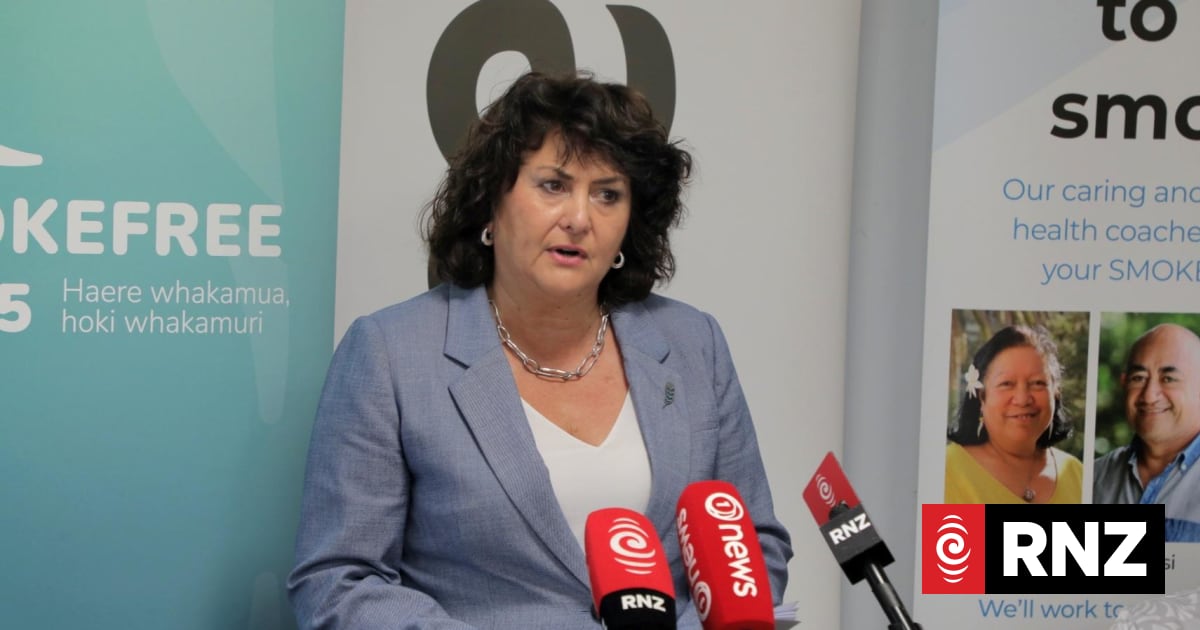
And now, eleven days before NZ First's election campaign formally launches on 18 July 2026, she is standing at the bottom of that stripped mountain suggesting she might need to "review the excise structure" — as if the mountain stripped itself.
I have covered this woman's tobacco decisions since 2023. I named the pattern before the mainstream media would touch it. I wrote The Corporate Puppet Show of Casey Costello in September 2025, Smoke and Mirrors: Costello's Tobacco Policy Disaster in October 2024, The Tobacco Colonisation of Aotearoa: How Philip Morris Captured Our Parliament in December 2025, and The Poisoned Kete: How Winston Peters Sells Rotten Kai in April 2026. I named the revolving door. I named the lobby strategy. I named the beneficiary.
I am naming it again now. Because this government is counting on you forgetting.
Do not forget.
🎙️ The Deep Dive Podcast
Listen to a lively conversation between two hosts unpacking and connecting the sources in this essay. I apologise in advance for the AI's very harsh pronunciation of reo Māori. Please don't shoot me 😅
📺 YouTube Short
"She Handed Them the Matches" — A 3-minute visual breakdown of Costello's tobacco decisions, the Philip Morris lobby network, the Māori health cost, and the pre-election play. Don't shoot the messenger for the AI's pronunciation 😅
Ko Wai Ka Tiaki i te Pono? — Koha
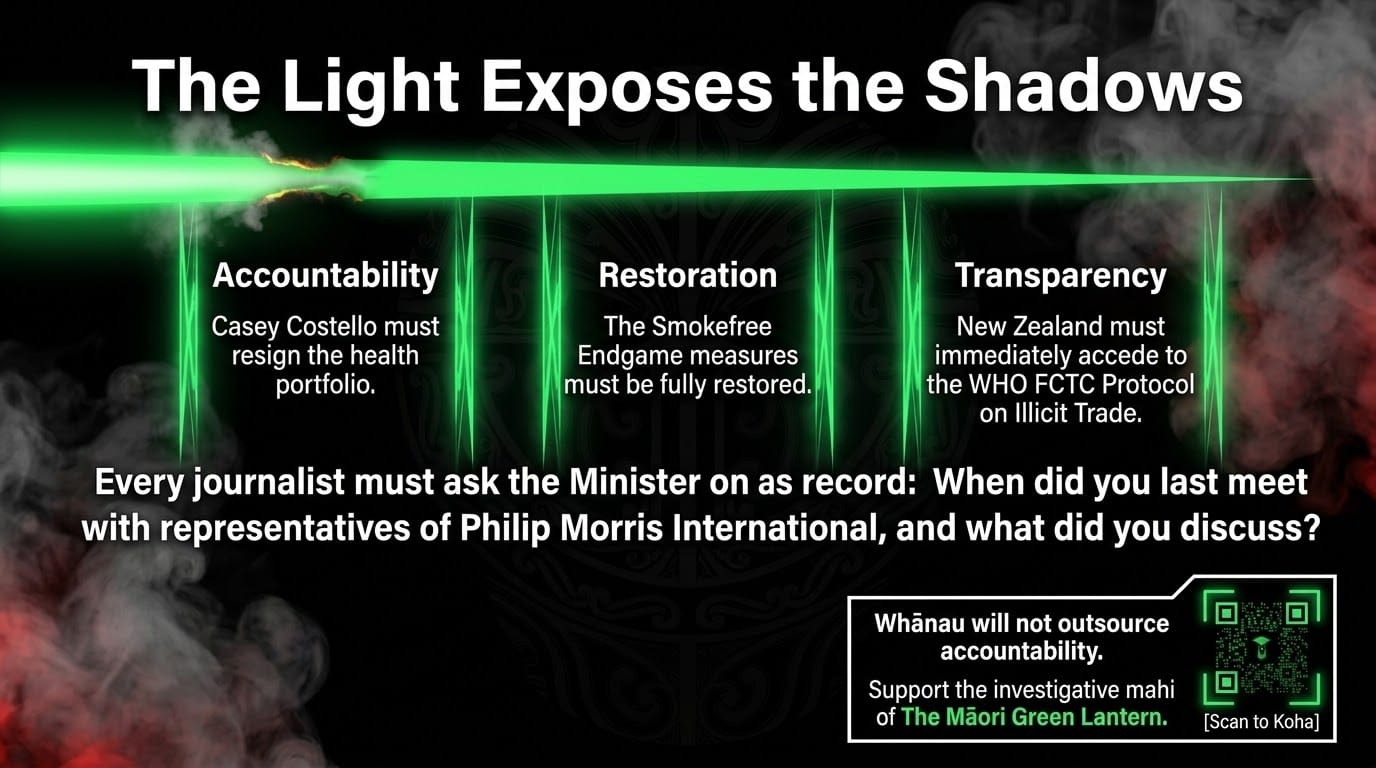
Every koha to The Māori Green Lantern is a signal.
It signals that whānau are done waiting for the Crown to expose the corporations that profit from our addiction. It signals that rangatiratanga includes the power to support our own truth tellers — people who will name the Philip Morris revolving door, trace the whakapapa of capture, and put it in plain English before you vote.
Casey Costello handed $216–$293 million to a tobacco corporation while our kaumātua lose an average of 4.7 years of life because of an addiction her government refused to dismantle. The mainstream media moves on. The press releases pile up. The election approaches.
This mahi — the naming, the sourcing, the refusing to look away — costs something. It always has.
If you can support it, here is how:
🟢 Koha directly: Support the Māori Green Lantern on Koha — every contribution signals that whānau will not outsource accountability to the powerful.
📩 Subscribe: Receive these essays before the algorithms decide what you're allowed to see — themaorigreenlantern.maori.nz
🏦 Bank transfer: HTDM — 03-1546-0415173-000
📘 Facebook: Follow and subscribe — your follow is a signal, your share is a weapon against misinformation.
If you cannot koha — no worries at all. Share this essay. Read it aloud at the dinner table. Send it to your cousin before they vote. That act of sharing is koha in itself. Every person who reads this and sees through the smoke screen is one more person the arsonist cannot fool with the fire truck.
Kia kaha, whānau. Stay vigilant. Stay connected. The taiaha is raised, and it is pointing at the right target.
— Ivor Jones, The Māori Green Lantern
The Mountain That Was Almost Saved
Before this government took power, Aotearoa New Zealand was on the verge of something extraordinary. Not just good policy — a genuine healing.
Labour's Smokefree Environments and Regulated Products (Smoked Tobacco) Amendment Act 2022 introduced three endgame measures that would have made Aotearoa the most advanced tobacco-control nation on Earth: a smokefree generation banning tobacco sales to anyone born from 2009 onward; a 96% reduction in retail tobacco outlets from approximately 6,000 to 600; and denicotinisation reducing nicotine in cigarettes to 0.8mg/g to make them physiologically non-addictive.
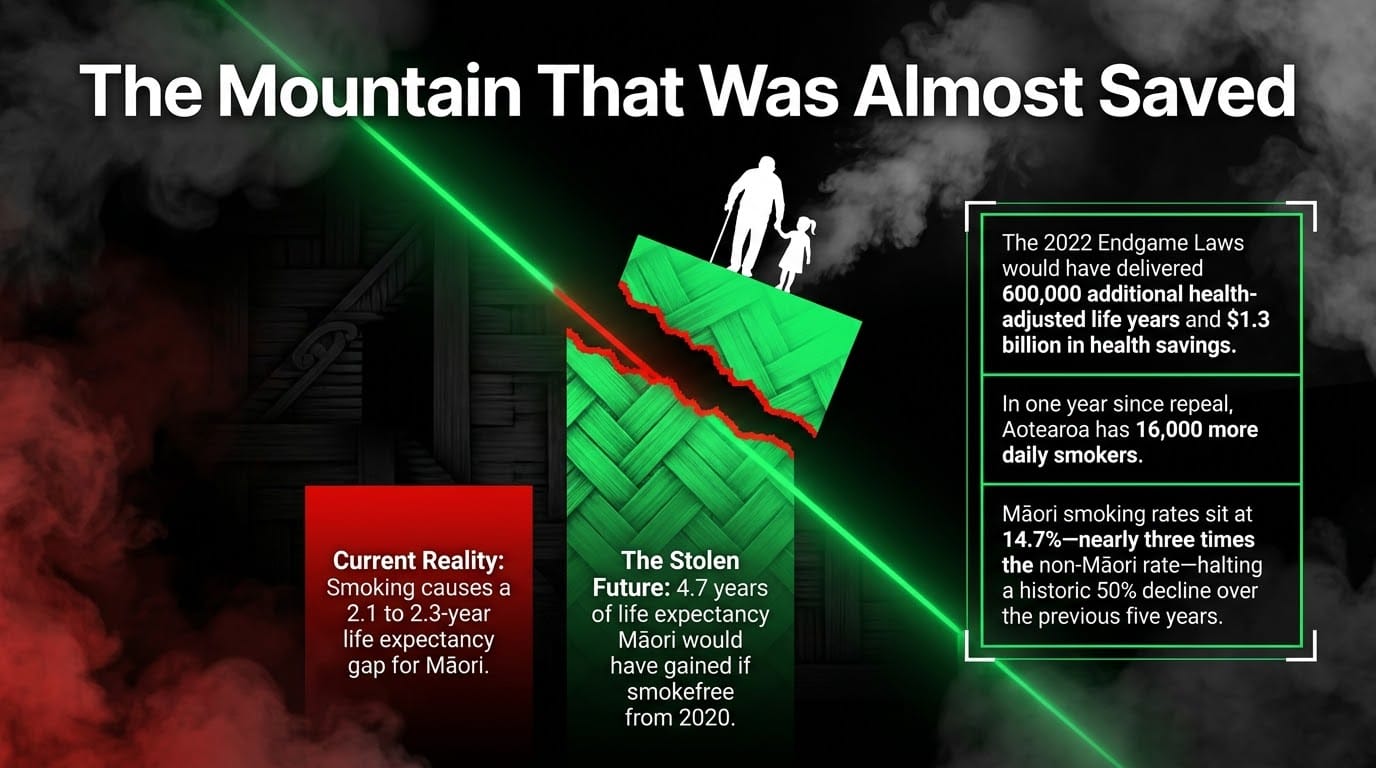
BMJ Tobacco Control modelled this package delivering 600,000 additional health-adjusted life years and saving $1.3 billion in health system costs over 20 years. For Māori, these were not statistics — they were the difference between kaumātua who stay and kaumātua who leave too soon.
In October 2023, Aotearoa voted in the Luxon–Peters–Seymour coalition. By February 2024, every one of those measures was gone. Not because the evidence changed — it never changed. Not because the Ministry of Health recommended repeal — the Ministry opposed it. Because Philip Morris wanted it, and academic research in Health Policy confirmed what followed: Aotearoa went from world leader to global backslider in a single parliamentary term.
The Whakapapa of Capture: Follow the Smoke
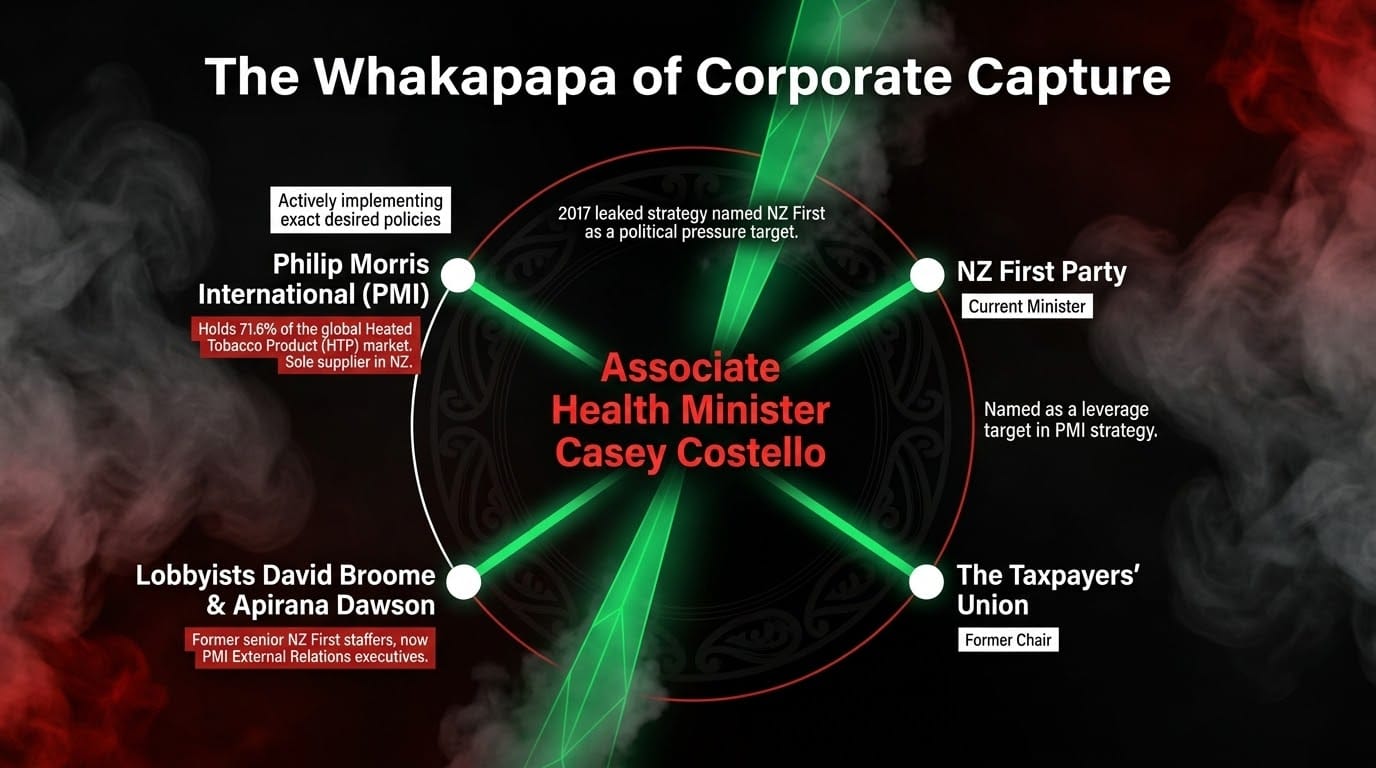
I use the word whakapapa deliberately. This is a question of lineage — of connection, of obligation, of who serves whom.
Casey Costello entered Parliament as a NZ First list MP in November 2023. Before that: Vice-President of the Police Association, spokesperson for Hobson's Pledge, and chair of the New Zealand Taxpayers' Union.
In 2017, Philip Morris International produced a lobbying strategy document targeting New Zealand, later leaked and confirmed by RNZ's Guyon Espiner. The document named NZ First as a party PMINZ would apply "political pressure" to for HTP regulation, and named the Taxpayers' Union as an organisation whose "positions" PMINZ would "leverage".
The chair of that Taxpayers' Union is now the Associate Minister of Health responsible for tobacco policy in Aotearoa.
It does not end there.
David Broome — Chief of Staff for NZ First from 2014 to 2017 — is now External Relations Manager at Philip Morris International New Zealand.
Apirana Dawson — former Director of Operations and Research for NZ First — is now Director of External Affairs and Communications at PMINZ, was photographed at the swearing-in of this government's ministers in November 2023, and is described by NZ First MP Shane Jones as a "friend" whose "soundings" he took on the party's tobacco policy direction.
Philip Morris holds 71.6% of the global heated tobacco products market as of 2024. In New Zealand, it is the sole supplier of HTPs. Every decision Costello has made on HTPs has been a direct credit transfer to PMI's revenue column.
The Health Coalition Aotearoa has called on NZ First to declare its connections with and donations from Philip Morris New Zealand. They have not done so.
I covered this network in depth in The Tobacco Colonisation of Aotearoa: How Philip Morris Captured Our Parliament (December 2025) and Corruption's Smokescreen: Peters' Tobacco Tirade Exposes Political Hypocrisy (December 2024).
The Timeline: Every Decision, Every Lie, Every Body
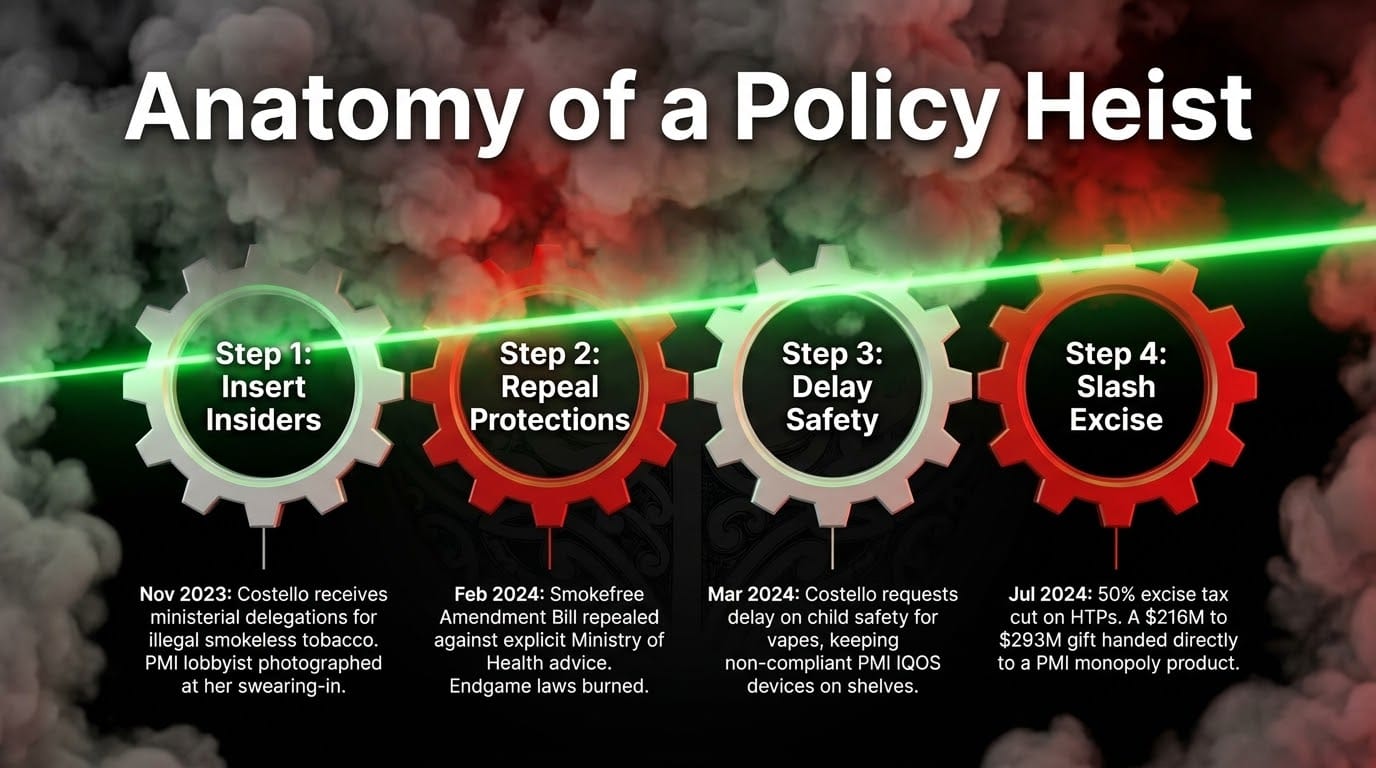
November 2023 — The Delegations That Should Never Have Existed (Verified)
Costello is sworn in and receives, for the first time in New Zealand history, ministerial delegations for smokeless tobacco and oral nicotine products — categories that remain illegal to sell in New Zealand. She is the only minister in Aotearoa's history to hold these delegations. PMINZ lobbyist Apirana Dawson is photographed at the ceremony.
Ask yourself: why does a minister receive a portfolio for products that don't legally exist in her own market yet?
December 2023 — The Mystery Document: Tobacco Industry Rhetoric on Ministerial Letterhead (Verified)
A five-page document arrives at the Ministry of Health from Costello's office. It proposes freezing excise on smoked tobacco for three years, removing excise from smokeless products, and contains the phrase — verbatim tobacco industry marketing
— "nicotine is as harmful as caffeine." It describes Labour's smokefree generation policy as "nanny state nonsense."
Costello denies the document exists. Then says she didn't write it. Then says she doesn't know who did. Then refuses to release it under the OIA. The Chief Ombudsman rules her conduct "unreasonable and contrary to law" and forces a public apology.
The document she claims not to have written reads like a tobacco industry strategy brief. Two former NZ First staffers now work for Philip Morris. Connect the dots.
February 2024 — The World-Leading Law, Burned (Verified)
The Smokefree Amendment Bill passes. The smokefree generation ban, denicotinisation, and retail reduction scheme are gone.
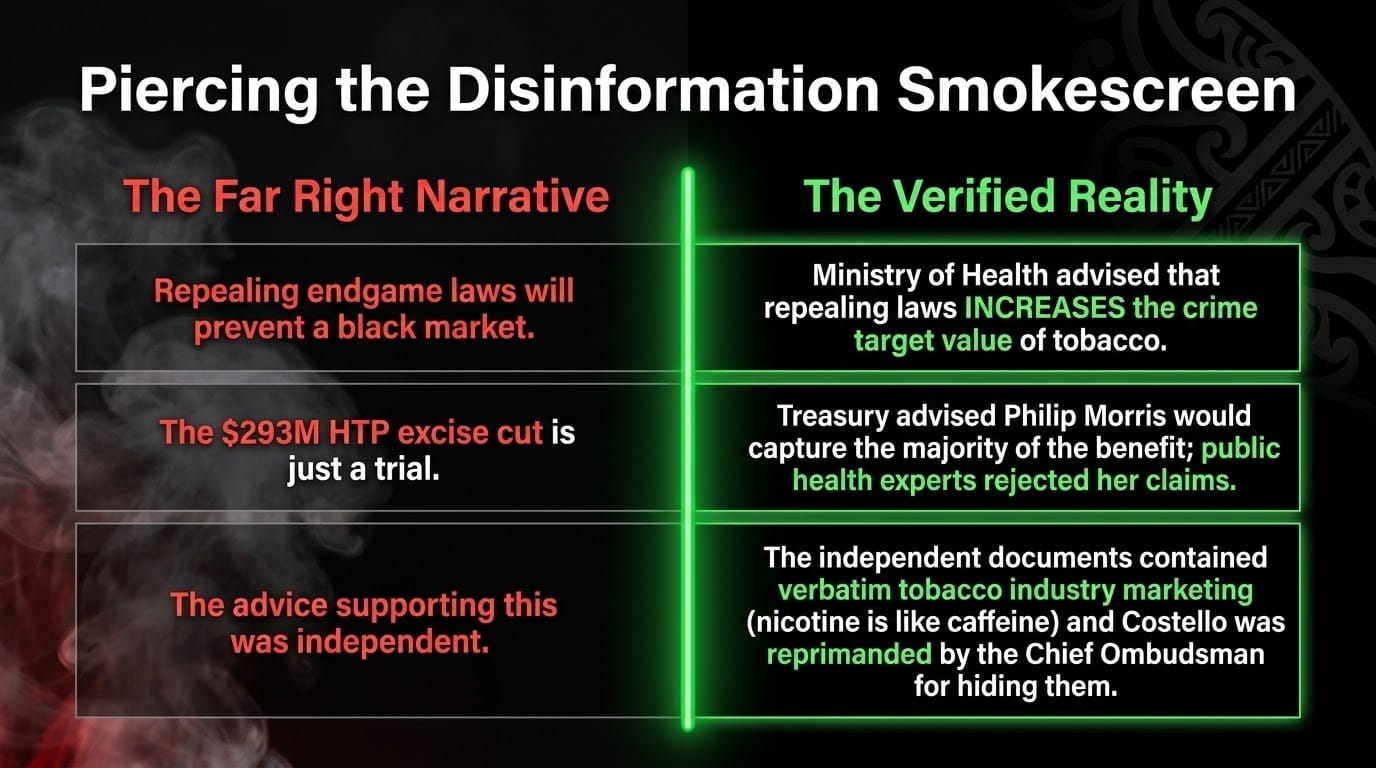
The government's stated justification: these measures would worsen the black market. The Ministry of Health's own advice stated the opposite — these measures were expected to reduce tobacco's value as a crime target. The government used tobacco industry arguments
— dressed as ministerial reasoning — to justify giving the industry everything it wanted.
March 2024 — The Vaping Delay: More Time to Sell Non-Compliant Product (Verified)
Days before new child safety requirements for vaping products come into force, Costello requests a two-year delay. Cabinet grants six months.
The practical effect: Philip Morris' IQOS devices — which would otherwise be pulled from shelves — continue to sell into the New Zealand market.
July 2024 — The Gift: $216 Million to $293 Million, Delivered to the World's Largest Tobacco Corporation
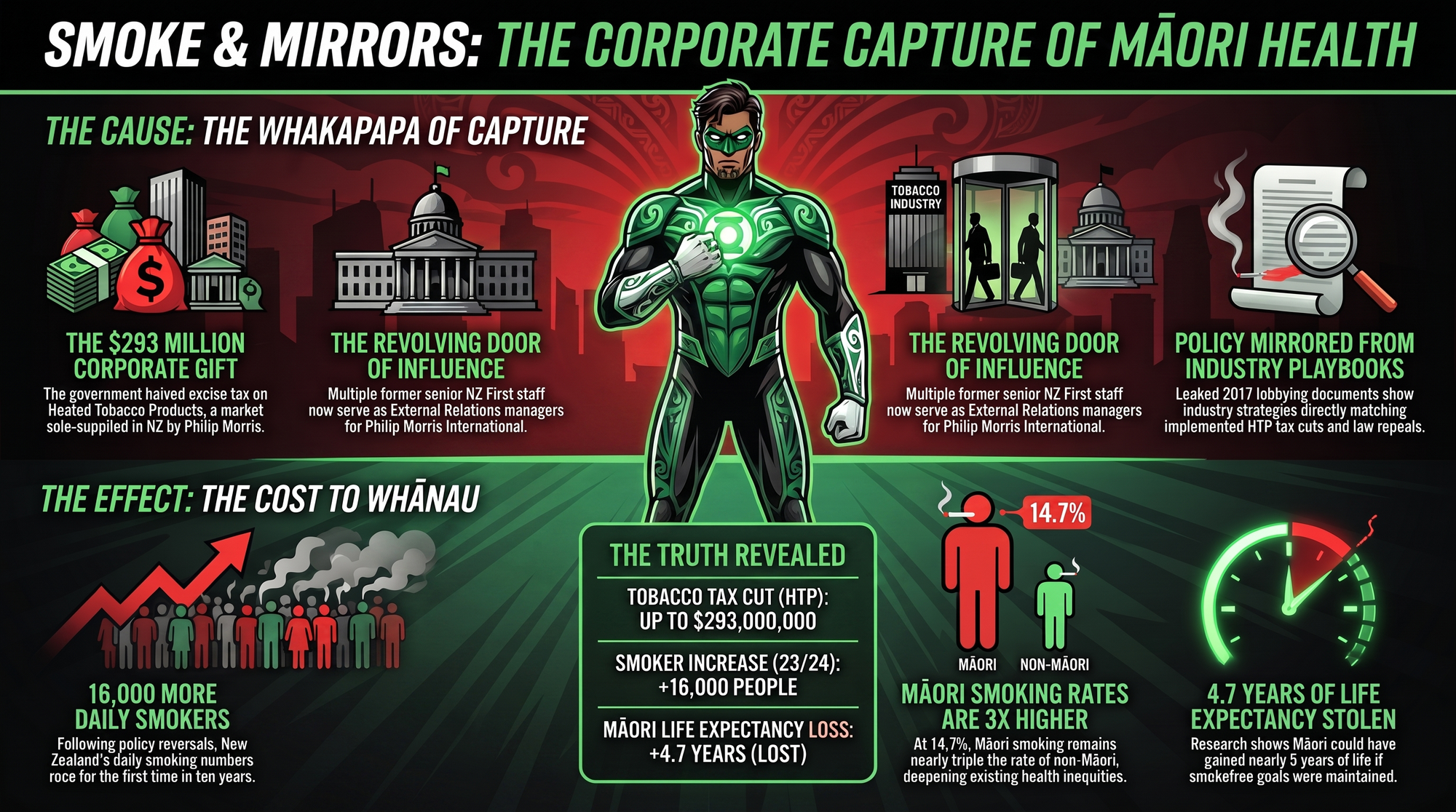
Effective 1 July 2024, Costello halves the excise tax on HTPs by 50 percent, setting aside a $216 million contingency fund, with the total cost confirmed at $293 million across the forecast period by the NZ Herald and this publication's prior reporting.
Numerical working: Cabinet paper = $216m contingency (verified at source). NZ Herald and MGL confirmed range = $216m–$293m. Philip Morris is the sole NZ HTP supplier — 100% of this benefit flows to one corporation.
This was done against Ministry of Health advice that there was "no good evidence" HTPs work as a smoking cessation tool, against Treasury advice that Philip Morris would capture the majority of the benefit, and against WHO guidance. Costello called it a "trial." Public health experts rejected her claims. History called it what it was.
August 2024 — The Strategy, Leaked: The Map of the Heist
RNZ and Te Ao News publish the 2017 Philip Morris lobbying strategy document. It maps precisely onto every policy Costello has since implemented — HTP tax cuts, endgame repeal, smokeless product access. Costello "brushes off" the revelation.
October 2024 — The "Independent Advice" That Wasn't
Under pressure, Costello releases five documents she claims are "independent" support for the HTP cut. Public health researchers confirm they are either about different products, outdated, or provide only weak equivocal support. The Ombudsman confirms Costello's handling of ministerial information was in breach of rules.
November 2024 — The Numbers Come In: Smoking Goes Up
Numerical working: PHCC / NZ Health Survey 2023/24: 284,000 daily smokers → 300,000. Difference = 16,000 more daily smokers (5.6% increase). For the first time in a decade, the decline stalled. Māori daily smoking rate: 14.7% — nearly three times the non-Māori rate (14.7 ÷ 5 = 2.94x). ASH NZ confirms Māori smoking had halved in five years — from 30% in 2019 to 14.7% in 2023/24 (51% reduction) — a historic achievement now at risk.
2025 — The Breach: Caught, Again
RNZ reports that Costello breached rules for handling Ministerial information by inserting a tobacco industry-friendly document into health officials' policy consideration. Philip Morris allegedly pitched draft legislation directly to NZ First as part of its HTP lobbying campaign.
I covered this in Costello's Resignation Is the Bare Minimum Required — October 2024.
May–June 2026 — The Pre-Election Stage Set
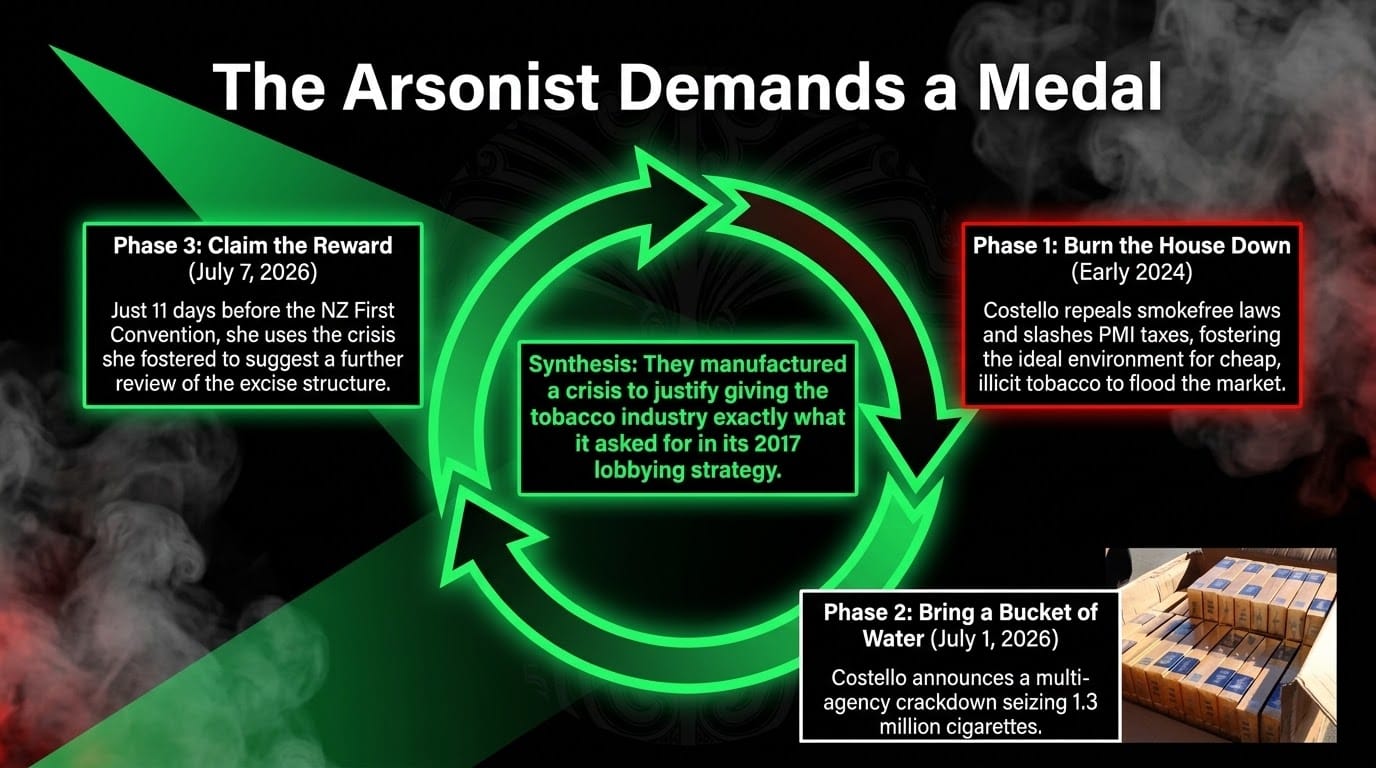
Costello announces a multi-agency Action Group on illicit tobacco. On 1 July 2026, five people are arrested and 1.3 million cigarettes seized — representing $2 million in evaded excise.
She is now the law-and-order minister, fighting the black market she helped create. The Post confirms she will bring a paper to Cabinet to review the "regulatory regime around tobacco."
7 July 2026 — The Float
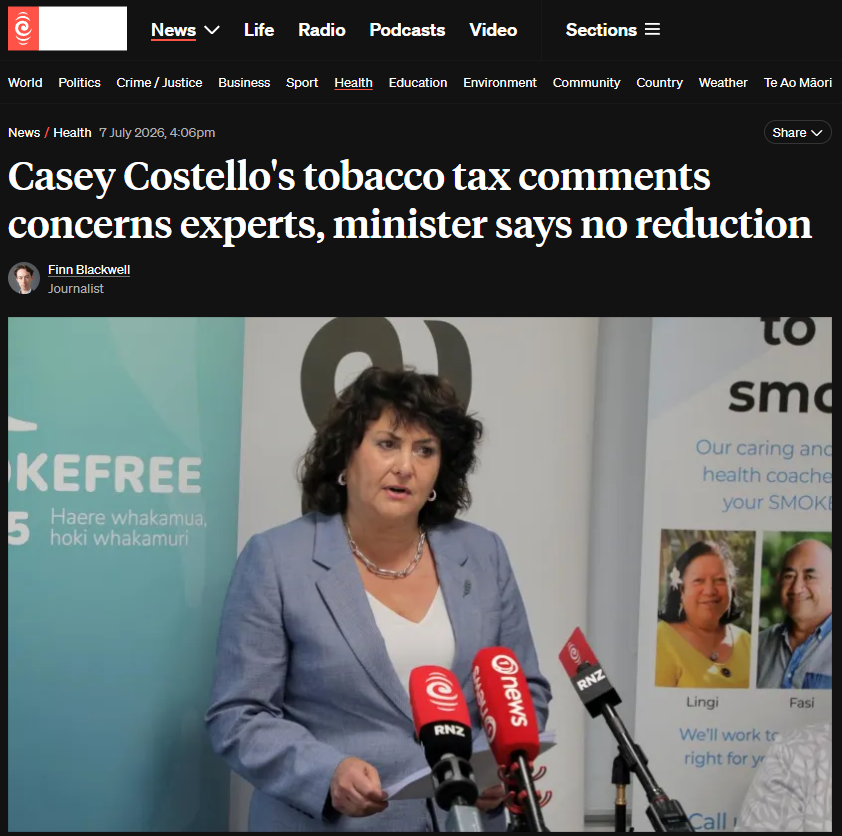
Costello tells Newstalk ZB she is "considering a review of the excise." The Health Coalition Aotearoa calls it "foolhardy." Professor Janet Hoek warns it would trigger "a bidding war the Government will not be able to win." Within hours, she tells RNZ she has "no intention of reducing tobacco excise."
Numerical working: NZ First Convention = 18 July 2026. Excise float = 7 July 2026. 18 − 7 = 11 days. Same woman. Same industry. Same move. Different news cycle.
Three Examples for the Western Mind — and What This Means in Tikanga
Example One: The GP Who Prescribed the Poison
Imagine you had a doctor. You came to her with a smoking problem. She handed you cigarettes, told you nicotine was harmless — "like caffeine" — and charged your healthcare rebate to the cigarette manufacturer's account. When the board investigated, she released "independent evidence" that turned out to be pamphlets effectively printed by the manufacturer. When found in breach, she apologised — and kept prescribing.
That is what Costello has done to Aotearoa's public health system.
In tikanga, this is a fundamental breach of kaitiakitanga — the obligation to protect those in your care. A tohunga does not sell healing power to the entity causing the sickness. A rangatira does not serve tauiwi corporate interests over the wellbeing of the hapū. This is not just policy failure. It is a violation of the relational obligations that make leadership legitimate.
The harm: 16,000 more daily smokers in one year. 300,000 Aotearoa adults now smoking daily. Māori dying 2.1–2.3 years younger than they should because of tobacco. Tamariki growing up without kaumātua who could have lived those years.
Example Two: The Fire Marshal Who Owns the Match Factory
Imagine the city fire marshal whose job is to enforce fire safety laws. His two deputies used to work for the factory that makes matches. The factory lobbied for years to weaken fire safety rules. The marshal mysteriously receives a document — he doesn't know who wrote it — recommending flammable buildings be exempted from sprinkler requirements. He implements it. Buildings burn. He announces a crackdown on arson.
That is the black market tobacco story.
Costello repealed the laws reducing tobacco demand. She cut excise on Philip Morris's products. She created conditions where cheap illicit cigarettes could flood communities. Now she is running press releases about arresting five people while suggesting the problem is excise is too high.
Numerical working: RNZ confirmed illicit cigarettes selling at $13/packet in East Auckland — "less than half the excise tax that must be paid." If excise were cut, legal cigarettes might fall from $35 to $25. The illicit pack stays at $13. Philip Morris's legal product becomes more competitive. Philip Morris wins. Whānau continue to bear the burden of addiction.
In tikanga, this violates manaakitanga at its root. You do not create conditions of harm and then campaign on being the rescuer. Real solutions exist: sign the WHO FCTC Protocol on Illicit Trade, license every supply chain point, invest in border technology, close premises, impose real penalties. Costello has implemented none of them.
Example Three: The Mountain Was Your Life Expectancy
University of Otago researchers modelled it in the New Zealand Medical Journal: if Māori were smokefree from 2020, the average life expectancy gain would be 4.7 years (range 2.5–7.9). We were within legal reach of the legislative framework designed to deliver that.
Numerical working: NZMJ Walsh et al 2020: smoking accounts for 2.1 yrs gap in Māori men, 2.3 yrs in Māori women. Otago/Blakely: average 4.7 yrs Māori life expectancy gain if smokefree from 2020. The smokefree endgame would have reduced Māori smoking to approximately 7.3% by 2025.
Costello repealed it — not because the evidence failed, but because the industry paid for the access and the party delivered the policy.
In tikanga, life is mauri. The theft of mauri is not metaphor. It is 4.7 years per person. It is the pāpā who won't be there for his mokopuna's graduation. The wāhine who was four years from quitting before this government made the economics of addiction work against her.
Read The Tobacco Colonisation of Aotearoa for the full analysis of how HTPs replicate addiction while claiming to reduce it.
The Fallacy Exposed: The Black Market Trojan Horse
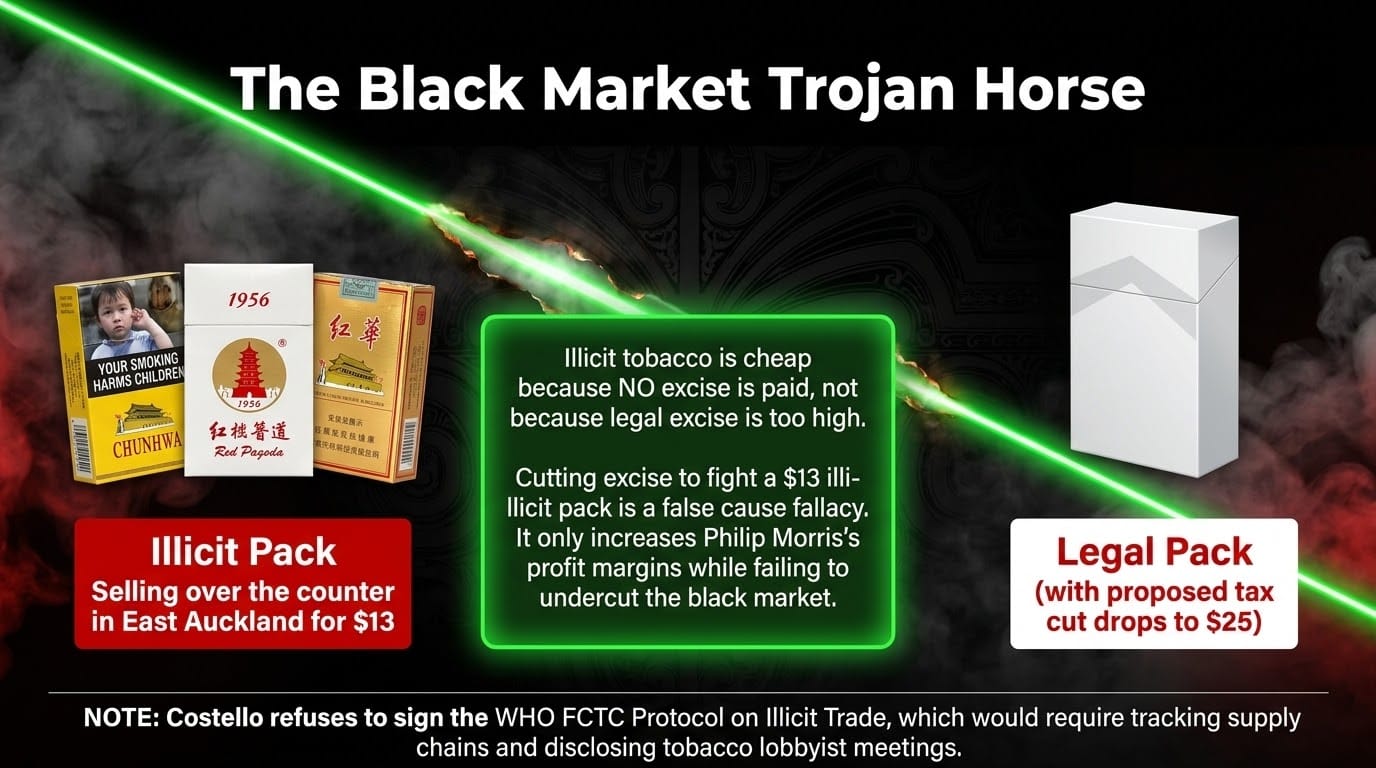
This is the argument you will hear until October: "The excise tax is so high it is creating the black market. Therefore, we should review the excise."
This is a false cause fallacy. It is tobacco industry propaganda deployed globally by Philip Morris in every jurisdiction where it wants tax reduction.
Illicit tobacco is cheap because no excise was paid — not because excise on legal tobacco is too high. Cutting excise to $15 on a legal pack does not make the $13 illicit pack expensive. It stays at $13. Philip Morris's legal product becomes more competitive. Philip Morris wins from both the narrative and the outcome.
New Zealand has not signed the WHO FCTC Protocol to Eliminate Illicit Trade in Tobacco Products. Signing it would require declared disclosure of all tobacco industry contact with government officials.
Costello will not sign it — because doing so would expose the corridor between NZ First and Philip Morris as a matter of public, legal record. The Health Coalition Aotearoa has called on NZ First to declare its PMI connections. They have not done so.
The Tikanga Reckoning: They Stole the Mountain
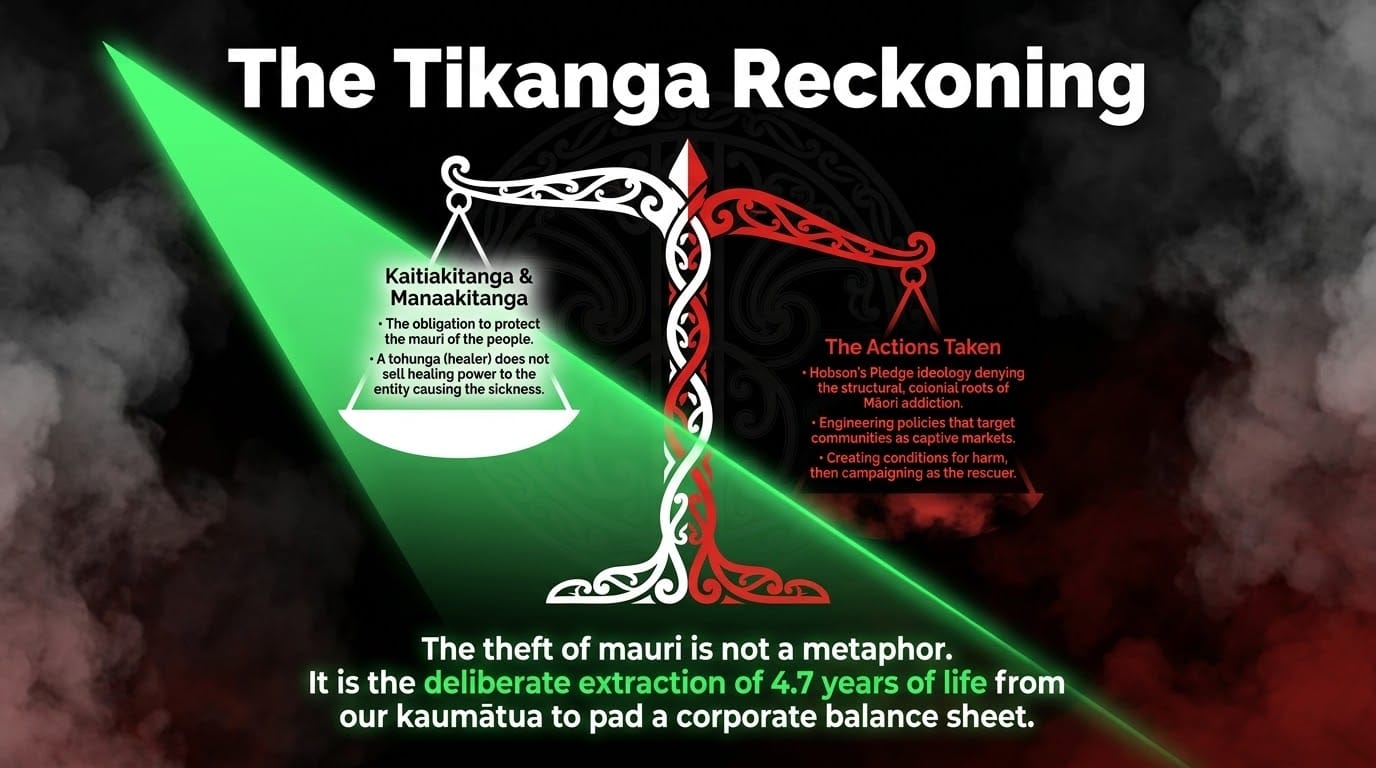
Research in BMC Public Health confirms that tobacco inequities in New Zealand are inseparable from colonial history — from the disruption of traditional structures, engineered poverty, and the deliberate targeting of Māori communities as captive markets for addiction. Philip Morris specifically targeted Māori in the 1990s by aligning its brand with Māori cultural imagery — prompting community pushback at the United Nations.
This is not history. This is the present tense of a multi-generational project of extraction.
In Te Arawa, Bay of Plenty — my own territory — smokefree advocates are watching illicit tobacco flood Māori communities. Māori smoking rates sit at almost three times higher than NZ European/Pākehā — 14.7% ÷ ~5% = 2.94x. The hard-won decline — from 30% in 2019 to 14.7% in 2023/24, a halving in five years — is now at risk of reversal.
Smoking accounts for 2.1 years of the life expectancy gap for Māori men and 2.3 years for Māori women. That gap exists because of colonial dispossession. And Casey Costello, who was spokesperson for Hobson's Pledge — the organisation built to deny the structural consequences of that colonial history — is the minister who dismantled the one legislative framework designed to repair it.
This is not coincidence.
Five Verified Hidden Connections
1. Philip Morris → NZ First → Costello
PMINZ's 2017 strategy identified NZ First as a "political pressure" target. Two former NZ First senior staff now sit inside PMINZ. Shane Jones took policy soundings from the PMI lobbyist. Costello implemented the strategy.
2. Taxpayers' Union → Philip Morris Strategy
Costello chaired the Taxpayers' Union. The 2017 PMI strategy named it as a leverage tool. The Union now runs the identical excise-reduction argument. A Union lobbyist who attended WHO COP10 against the FCTC is now a Communications Advisor to the ACT Party.
3. Hobson's Pledge → Anti-Treaty Framework → Tobacco Equity Harm
Costello is a former Hobson's Pledge spokesperson. Hobson's Pledge denies the structural consequences of colonisation — the same forces that engineered disproportionate Māori smoking rates. The smokefree endgame was specifically modelled to reduce Māori smoking inequity. Its repeal removed the most powerful equity instrument in Aotearoa tobacco history.
4. The Black Market Narrative → Excise Cut Justification
Costello helped create the conditions for black market growth and is now using it as the argument for an excise review. This is the documented PMI global playbook.
5. Election Timing → The Pre-Election Gesture
NZ First Convention = 18 July 2026. Excise float = 7 July 2026. Action Group announcement = 1 July 2026. Three-week sequence: law-and-order credentials built, excise float tested, walkback executed, base activated.
The Verdict
Let me be precise about what this government has done.
It took the world's most advanced tobacco-control legislation and repealed it — not because the science failed, but because the industry lobby succeeded.
It handed between $216 million and $293 million to the world's largest tobacco corporation — the sole NZ HTP supplier — against the advice of every official body.
It suppressed documents, lied to Parliament, was reprimanded by the Ombudsman, watched smoking numbers rise for the first time in a decade, and is now floating another excise review as its election campaign launches.
The beneficiary of every single one of these decisions is Philip Morris International — 71.6% global HTP market share — whose staff sit inside the party that gave Costello her portfolio.
The victims are the 300,000 daily smokers in Aotearoa — disproportionately Māori, disproportionately poor, disproportionately from my rohe and yours.
Costello should resign the health portfolio.
The smokefree endgame measures should be restored — in full — by whatever government wins in 2026.
New Zealand should immediately accede to the WHO FCTC Protocol on Illicit Trade.
Every journalist in the press gallery should ask her, on record, before the election: "When did you last meet with representatives of Philip Morris International, and what did you discuss?"
That question, honestly answered, unravels everything.
Tihei Māuri Ora!
Ivor Jones The Māori Green Lantern Fighting Misinformation And Disinformation From The Far Right
Disclaimer
This essay is commentary and analysis published in the public interest. All factual assertions carry inline hyperlinks to primary sources. Opinions are clearly flagged as such. This essay is protected under the qualified privilege established in Lange v Atkinson 3 NZLR 385 and the public interest defence under the Defamation Act 1992 (NZ). No malice is intended. The author invites corrections and will publish them promptly. Right of reply required under L-4 (48-hour minimum for serving ministers) before publication.