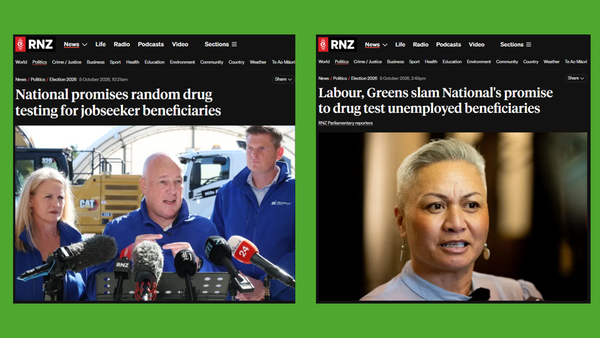
"THE POISONED KETE: HOW WINSTON PETERS SELLS ROTTEN KAI AND CALLS IT A FEAST" - 19 April 2026
He spent three years handing the duopoly a pitchfork — now he's selling you the handle and calling it revolution.

Kia ora Aotearoa, Drunken bum Koro Winnie The Poo is at it again, lieing to you to try and get your vote.
Don't let him or his crew deceive you AGAIN!
Imagine a taniwha. Not the taniwha of mātauranga Māori — the guardian, the protector, the force that demands right relationship with the land and the people.
No.
Imagine the other kind. The colonial taniwha. The one wearing a suit, holding a press release, and standing at your kitchen door with a smile that smells like old money and older lies.
That taniwha is Winston Peters.
The Deep Dive Podcast
Listen to a lively conversation between two hosts, unpacking and connecting topics in the sources of this essay.
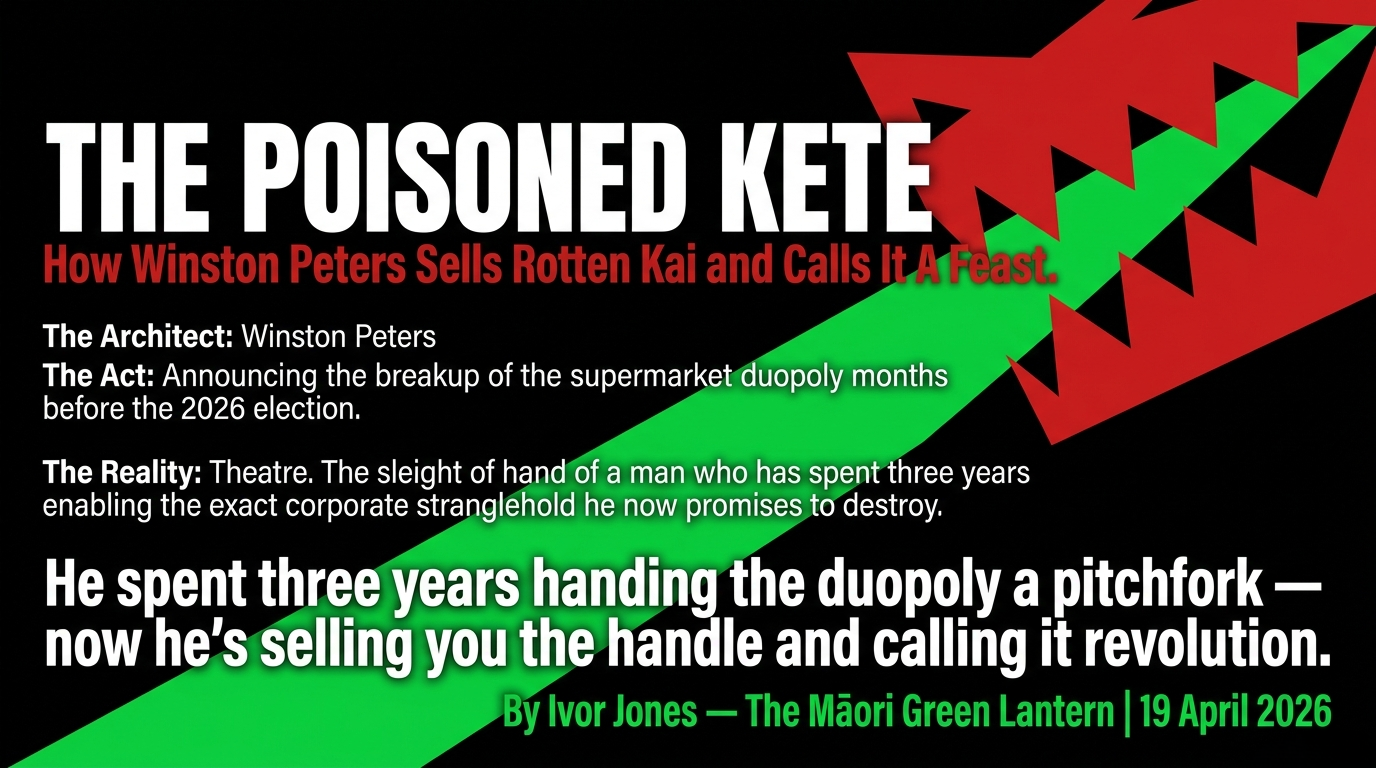
And his latest trick — announcing he will break up the supermarket duopoly just months before the 2026 election — is not policy. It is theatre. It is the sleight of hand of a man who has spent the last three years enabling the exact corporate stranglehold he now promises to destroy.
This is the arsonist handing out smoke alarms. This is the man who sold your water handing you a bucket. This is, in the fullest and most damning sense of the word, a kete of wind dressed as a kete of sustenance.
Whānau, do not eat from this kete. It is poisoned.
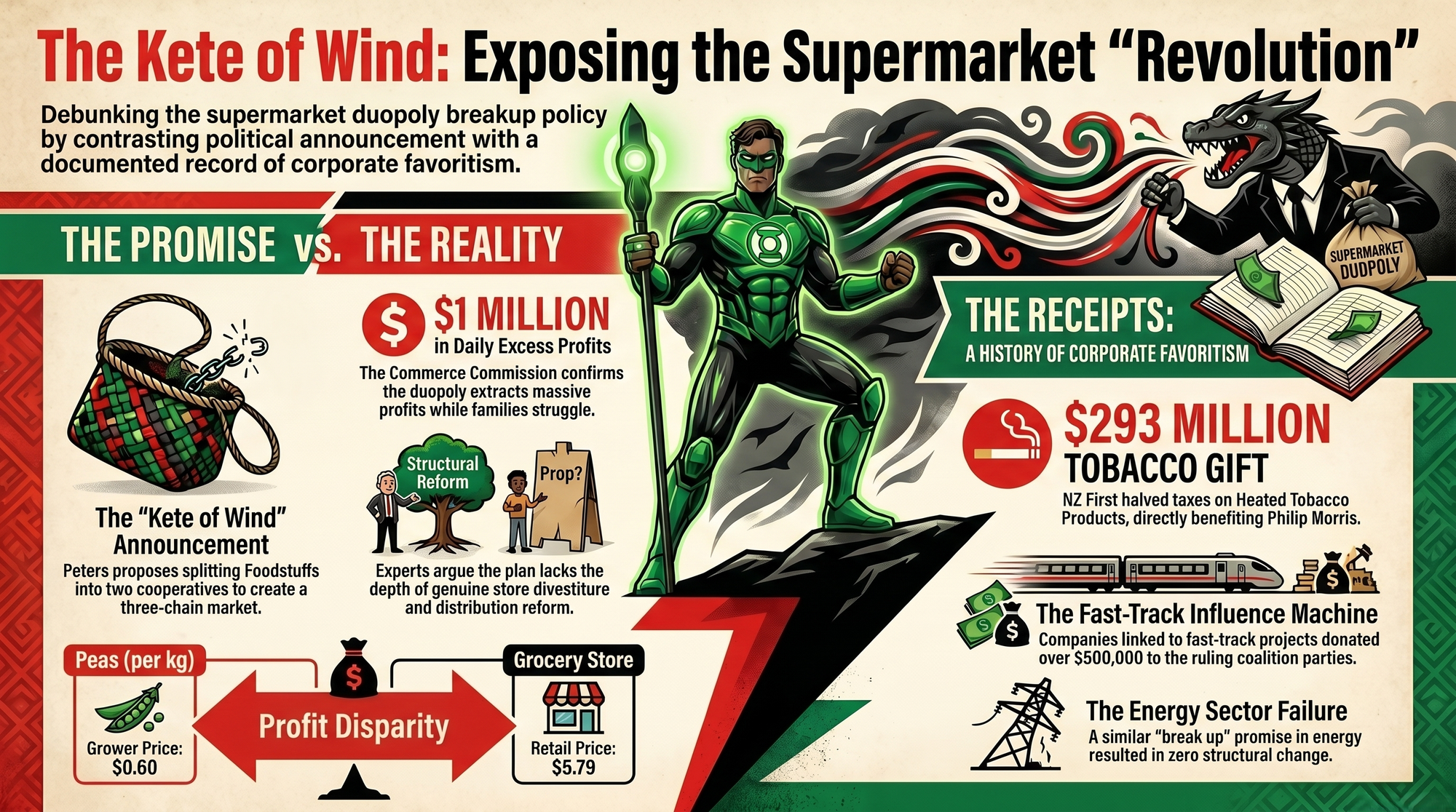
The Real Problem — And Why Peters Is the Last Person To Fix It
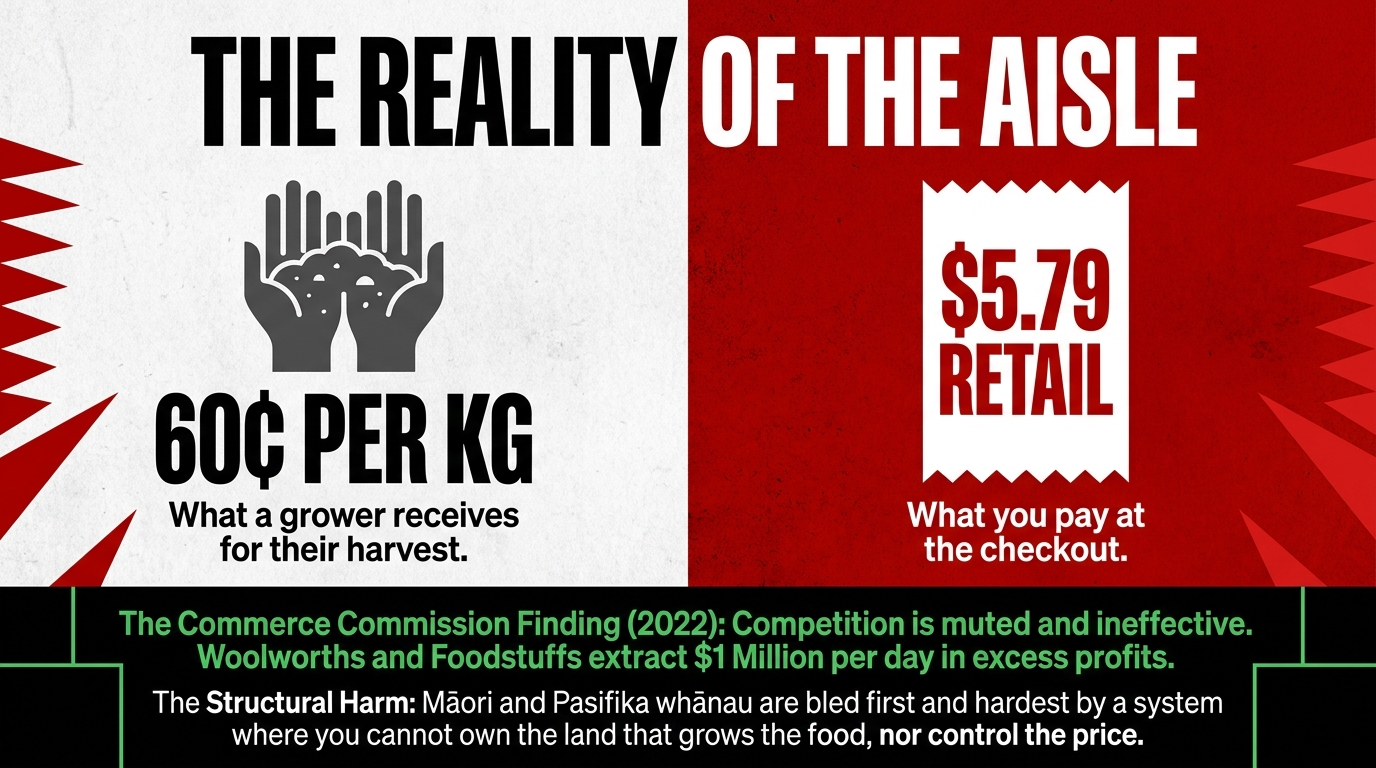
Let's begin where truth begins — with what is actually happening in your supermarket aisle.
The Commerce Commission confirmed in its 2022 final grocery market study that competition between Woolworths and Foodstuffs is "muted and ineffective," with both chains extracting approximately $1 million per day in excess profits from New Zealand families.
A grower receives 60 cents per kilogram for peas. Those same peas sit on the shelf at $5.79. The gap between those two numbers is not the market working. It is the market being owned.
This is real harm. Quantified harm. Māori and Pasifika whānau, who spend a disproportionately high share of income on food, are bled first and hardest by this system, as Consumer NZ documented in March 2024.
That is not incidental. It is structural. It is the continuation of dispossession by other means — when you cannot own the land that grows the food, you cannot control the price of the food it grows.
The problem is real. The solution requires courage, structural depth, and — crucially — clean hands. Winston Peters has none of these things.
Three Examples for the Western Mind: What This Actually Looks Like
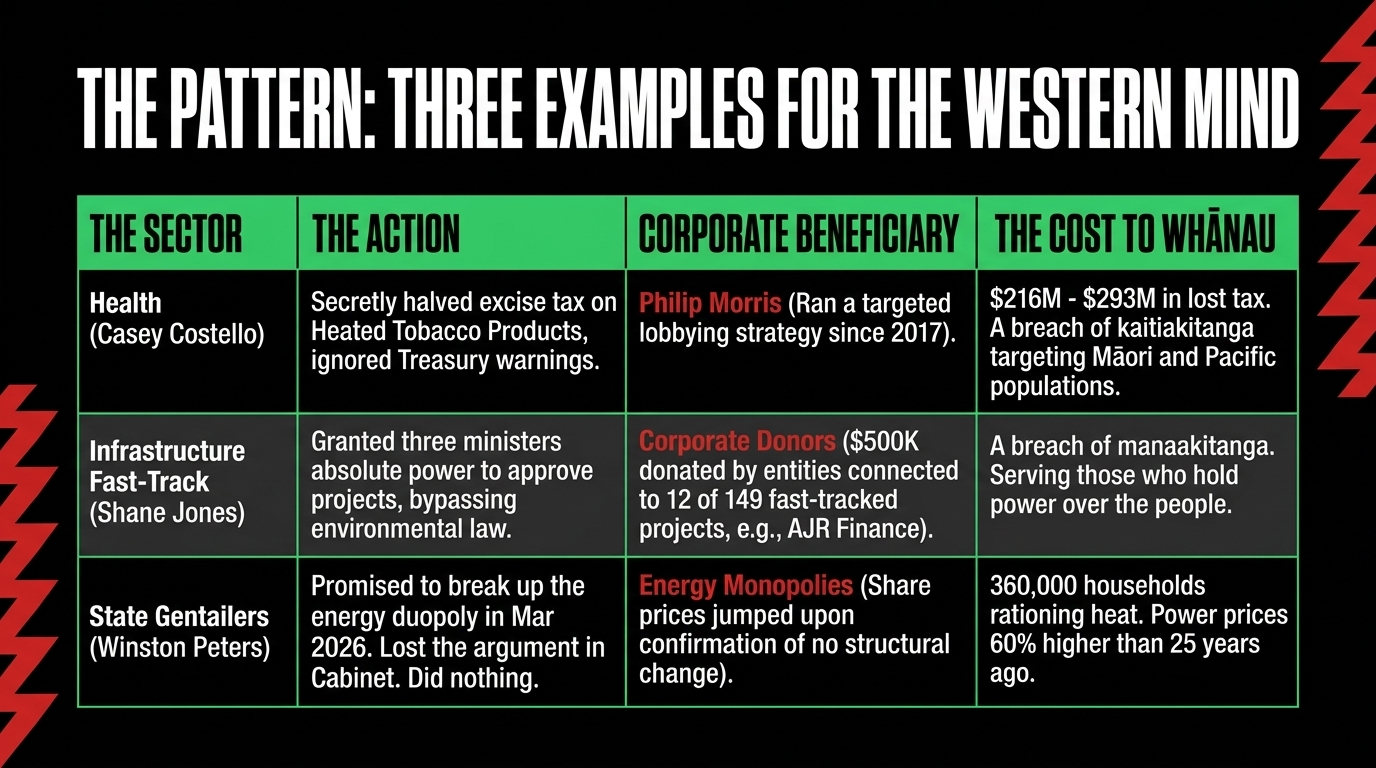
To understand how NZ First operates, you must understand the pattern. Not once. Not twice. Three times, documented, sourced, and lethal.
Example One: The Tobacco Taniwha — $293 Million for Philip Morris
In the Western mind, imagine a Health Minister who — in the middle of a public health crisis — secretly halves the tax on the most profitable product made by the world's largest tobacco corporation, ignores Treasury's own warnings that the beneficiary would be Philip Morris, suppresses the documents proving it, and then — when caught — tells Parliament she can barely remember how she got the policy advice in the first place.
That is exactly what happened.
NZ First's Casey Costello cut the excise tax on Heated Tobacco Products by 50%, at a cost estimated between $216 million and $293 million to taxpayers, as RNZ reported and the NZ Herald confirmed. Philip Morris had been running a documented lobbying strategy specifically targeting NZ First since 2017, as Te Ao News revealed in August 2024. Treasury warned that Māori and Pacific populations — who smoke at higher rates due to colonially-engineered poverty and stress — would be most harmed. Chief Ombudsman Judge Peter Boshier ruled Costello's conduct "unreasonable and contrary to law," forcing a public apology, as this archived RNZ report confirms.
In tikanga, this is a fundamental breach of kaitiakitanga — the obligation to protect those in your care. A minister who is supposed to protect public health instead handed a tobacco multinational a quarter-billion-dollar gift, then hid the receipts. The Māori Green Lantern covered this in depth in "The Corporate Puppet Show of Casey Costello" and in "Smoke and Mirrors: Costello's Tobacco Policy Disaster" and "Bringing You Death at Half the Cost".
This is who now promises to protect you from corporate greed at the checkout.
Example Two: The Fast-Track Machine — Donations for Approvals
In the Western mind, imagine an Infrastructure Minister who creates a law granting three ministers near-absolute power to approve major resource projects — bypassing public consultation and environmental law — while companies connected to those same projects quietly donate hundreds of thousands of dollars to the ruling coalition parties.
That is Shane Jones. That is NZ First's Fast-Track Approvals Act.
As the NZ Herald documented in October 2024, companies and shareholders connected to 12 of the 149 fast-track projects donated over $500,000 to National, ACT and NZ First.
One company — AJR Finance — donated $55,000 to NZ First while simultaneously being approached about fast-track project approvals, as revealed by the NZ Herald in April 2024.
The government refused to say how many conflicts of interest ministers had declared. The Auditor-General warned about the absence of statutory safeguards. The Integrity Institute confirmed that New Zealand's political donation laws are so weak that this kind of laundered influence is effectively legal and structurally embedded.
In tikanga, this violates the foundational principle of manaakitanga — you cannot serve the people while serving those who hold power over the people.
Jones was handed the Provincial Growth Fund — $3 billion — to serve Northland and regional Māori communities. He used the architecture of public investment to build a private influence machine.
The Māori Green Lantern documented this in "Corporate Greed and Environmental Betrayal: J Swap, Shane Jones, and the Fast-Track Betrayal" and "Poisoning Paradise: How Winston Peters and Shane Jones Sold Out Aotearoa".
This is who now promises to protect your pea grower from corporate exploitation.
Example Three: The Energy Gentailers — The Structural Separation Peters Already Failed to Deliver
For the most devastating example of all, look to the energy sector — because the supermarket announcement is simply the rerun of a scam Peters already ran at his State of the Nation speech in Tauranga in 2026.
As the Māori Green Lantern reported in "How Winston Peters Wraps Corporate Plunder in the Language of Liberation" in March 2026: Peters announced he would break up the energy gentailers (the state-owned power companies that function as another duopoly strangling whānau). His own minister Shane Jones lost the argument in Cabinet. Was absent from the announcement. And — critically — the gentailers' share prices jumped when the government confirmed no structural change would happen.
As that essay confirms:
"Peters didn't just fail to fix it. He governed the failure. He is the failure."
Three hundred and sixty thousand households are rationing heat right now. Power prices are 60% higher in real terms than 25 years ago. NZ First had two years to act.
They did nothing.
Now they are running the same script on supermarkets. Same promises. Same language. Same emptiness.
The Policy Is a Half-Baked Prop
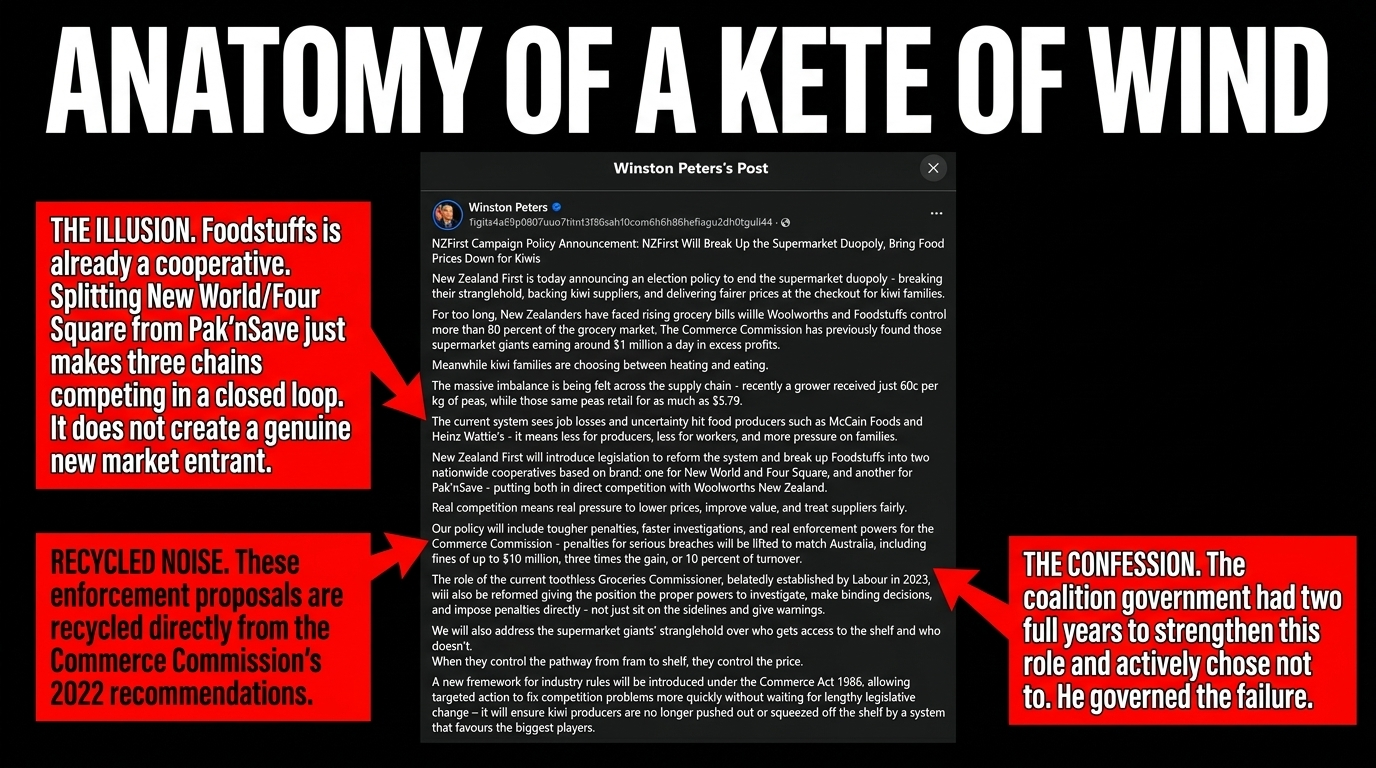
Look at what the announcement actually proposes. NZ First wants to split Foodstuffs — which is already a cooperative structure — into two separate cooperatives: one for New World and Four Square, another for Pak'nSave.
This would produce three chains competing with each other instead of two.
Experts and advocates from Monopoly Watch NZ called for the divestiture of 100 stores each and the construction of entirely new distribution centres to create genuine new market entrants — the kind of structural reform that would actually shift power.
NZ First's proposal does not approach that depth. It is a kitchen renovation announced as a demolition.
As competition lawyers confirmed to the NZ Herald in March 2025, forcing a structural de-merger through existing law is legally complex, expensive, and would take years — none of which Peters' vague announcement accounts for.
The enforcement proposals — fines up to $10 million, three times the gain, or 10% of turnover — are recycled directly from the Commerce Commission's 2022 recommendations. And the Grocery Commissioner framework they're savaging as "toothless"? The NZ First–National–ACT coalition had two full years to strengthen it and actively chose not to, as NZ First's own news archive cannot escape.
This is not reform. This is a man holding up the problem he built and calling it the solution.
The Structural Contradiction: The Kete of Wind, Exposed
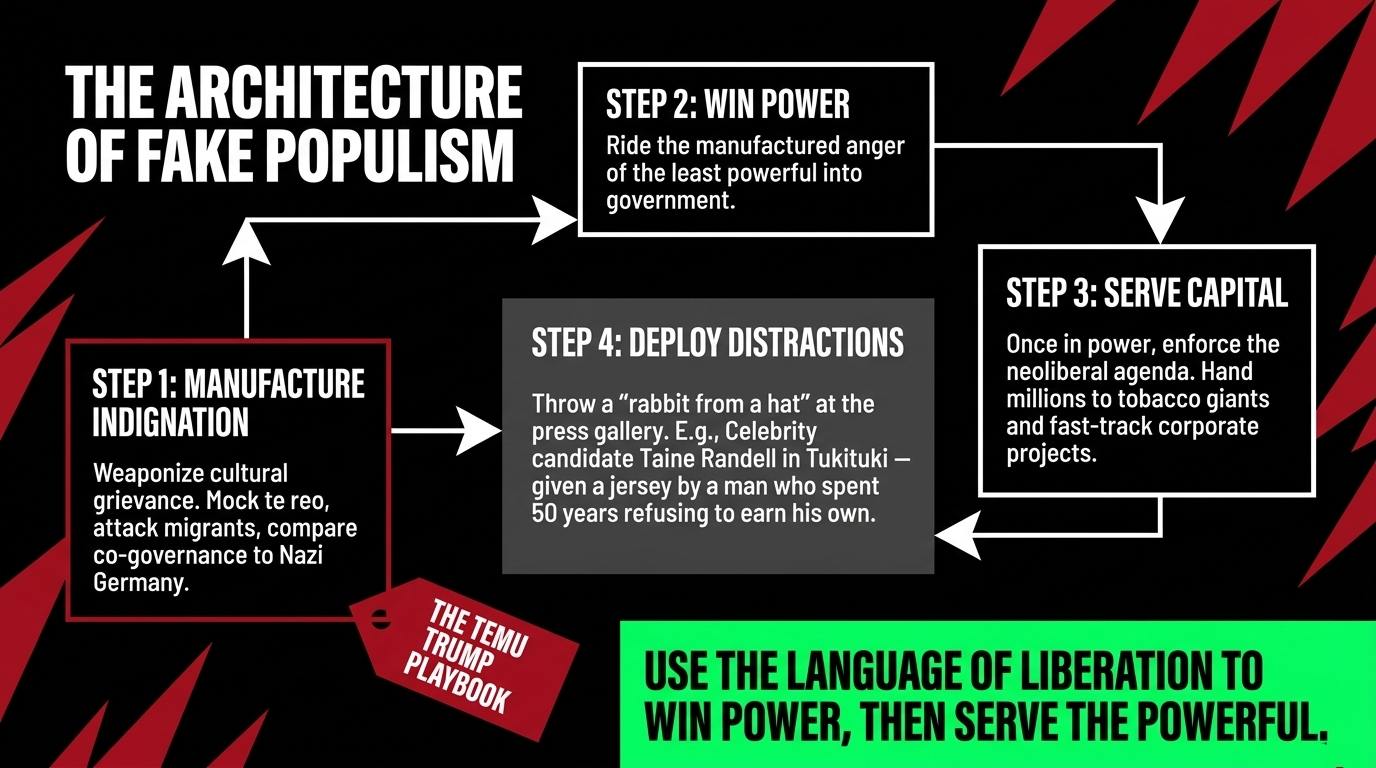
The deepest rot here is not incompetence. Incompetence can be forgiven. This is something worse.
This is a deliberate, documented, and repeated pattern: use the language of liberation to win power, then serve the powerful.
As the Māori Green Lantern documented in "Winston Peters — A Walking Contradiction, A Forked Tongue in a Taonga He Was Never Worthy to Hold" in March 2026:
Peters
"rose by attacking people who are among the least powerful: migrants, Māori, beneficiaries — while being funded by many of the wealthiest individuals and corporations in the country."
He founded NZ First in 1993 explicitly as an anti-neoliberal vehicle. In 1996 he won all five Māori electorates on the strength of that promise. Then he became Treasurer and enforced the neoliberal agenda he had condemned.
As Wikipedia's entry on Peters confirms and as the Māori Green Lantern's "Winston Peters' Hollow Lane Argument" documented in detail: he has spent four decades "denouncing the neoliberal reforms of the 1980s but doing nothing to reverse them."
He is not a populist who failed. He is a professional fake populist — a man whose entire career is built on the calculated manufacture of indignation in service of capital.
And now: "WINSTON PETERS IS A TEMU TRUMP FOR REALS" — cheaper, less effective, and still toxic. The same authoritarian cultural grievance politics. The same anti-Māori dog-whistling. The same coalition of billionaires and battlers. The same man who compared co-governance to Nazi Germany, who told Māori they are "not indigenous," who mocked te reo in Parliament, who singled out a Pacific MP for his heritage — now asking you to trust him to break corporate power at the supermarket checkout.
Taine Randell: The Distraction With Good Hair
The celebrity candidate, former All Blacks captain Taine Randell, standing for NZ First in Tukituki, is a recruitment designed entirely for the press gallery, not the policy table. As The Spinoff noted on 16 April 2026, Randell is one of several high-profile "rabbits pulled from hats" in the 2026 campaign. Labour's Chris Hipkins, with one sentence, summarised the structural reality: "He's soon going to discover there's only one captain in New Zealand First." Newswire confirmed Randell's announcement as part of Peters' pre-election star-casting exercise. In tikanga, rangatira is earned through demonstrated service to the people — through mahi, not marketing. Randell has not yet earned the right to that mantle. He has been handed a jersey by a man who has spent fifty years refusing to earn his own.
What Real Reform Would Look Like
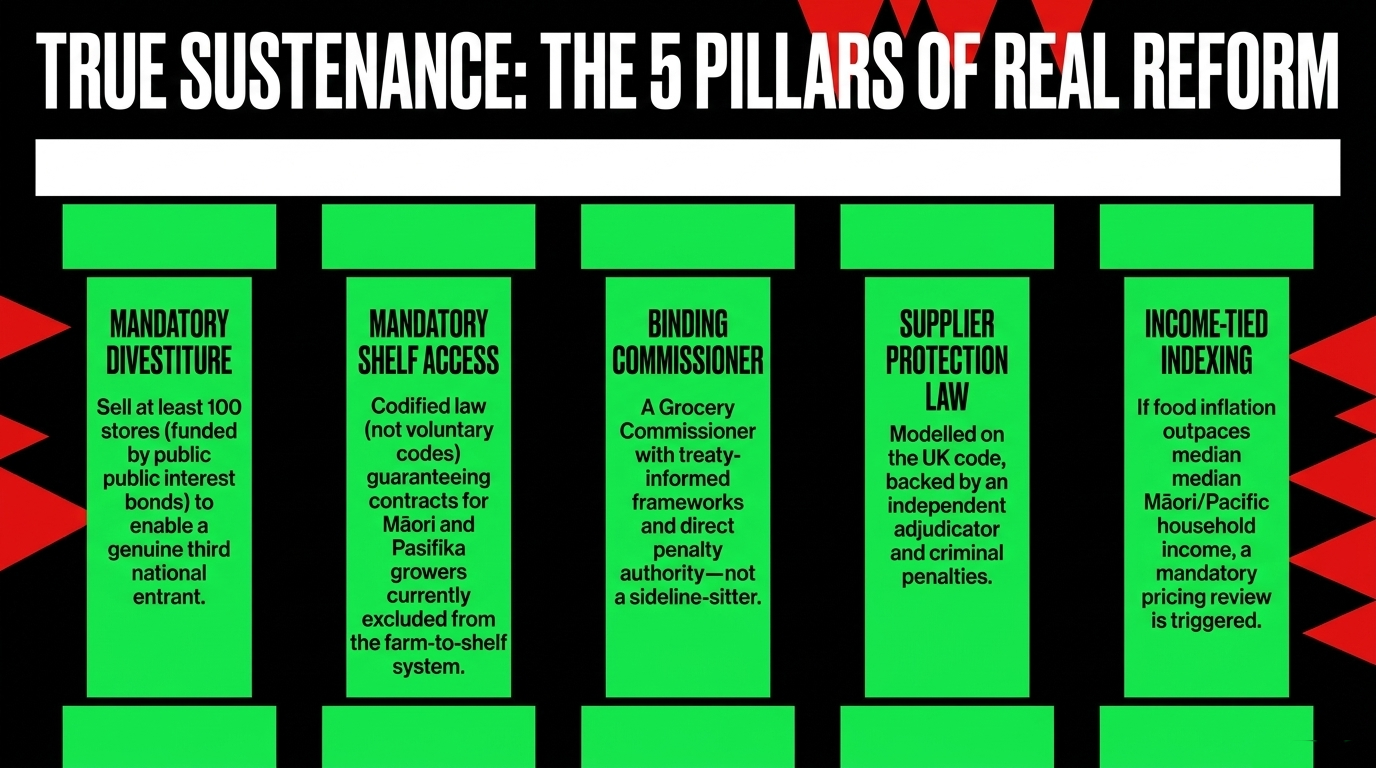
The supermarket problem demands genuine structural courage.
Real reform must include:
- Mandatory divestiture of at least 100 stores across both chains, funded by public interest bond mechanisms, to enable a genuine third national entrant into the market
- Mandatory shelf access contracts with Māori and Pasifika growers — codified in law, not voluntary industry codes — because the farm-to-shelf system currently excludes Indigenous producers at every tier
- A Grocery Commissioner with binding enforcement power, treaty-informed decision-making frameworks, and direct penalties authority — not the toothless sideline-sitter created under Labour and left deliberately crippled under this coalition
- Supplier protection legislation modelled on the UK Groceries Supply Code of Practice, with an independent adjudicator backed by criminal penalties, not civil warnings
- Food price indexing tied to median Māori and Pacific household income — if food inflation outpaces the median in those communities, mandatory pricing review is triggered automatically
None of this appears in Winston Peters' announcement.
Because this kind of reform serves whānau — and NZ First does not serve whānau.
It serves donors. It serves corporate interests. It serves the coalition that has spent three years dismantling Māori health infrastructure, gutting Māori housing programmes, threatening Waitangi Tribunal funding, silencing te reo in the public service, and — as The Arsonist's Audit documented in February 2026 — burning $55 billion in fiscal credibility while house prices surged 30% in a single year and Māori homeownership collapsed to 28%.
The Verdict of the Taiaha
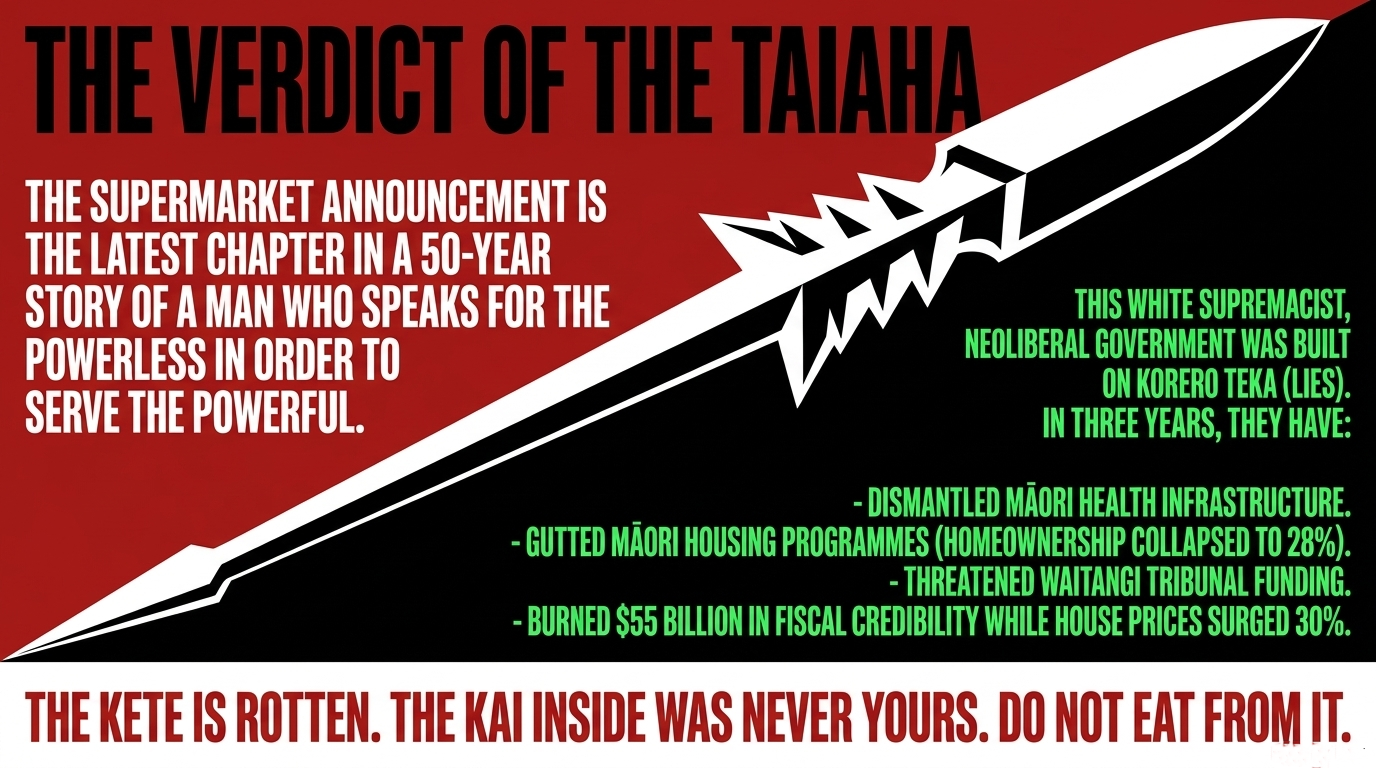
The taiaha does not perform. It does not threaten for the cameras. When it is raised, it means something — and it is raised here in full.
Winston Peters is running a supermarket breakup announcement as a campaign prop in 2026 because his own coalition government failed to act for three years, because his own minister Casey Costello handed Philip Morris a quarter-billion-dollar corporate gift and then lied about it, because his own deputy Shane Jones built a fast-track machine where corporate donations bought project approvals, and because his own NZ First Foundation was referred to the Serious Fraud Office over a secret donor fund that channelled hundreds of thousands of dollars from wealthy interests directly into political influence — as the NZ Herald's definitive investigation confirmed in October 2020.
This white supremacist, neoliberal government — Luxon, Peters, Seymour — was, as this whakapapa essay on Peters confirmed,
"never built on kaupapa. It was built on korero teka."
It was built on narratives carefully engineered to keep Māori, workers, migrants and whānau looking over their shoulders at each other while power cleared the land above them. The supermarket announcement is the latest chapter in a fifty-year story of a man who speaks for the powerless in order to serve the powerful.
The kete is rotten. The kai inside was never yours.
Do not eat from it.
Ko te Pono He Aho Matua — Truth Is the First Thread
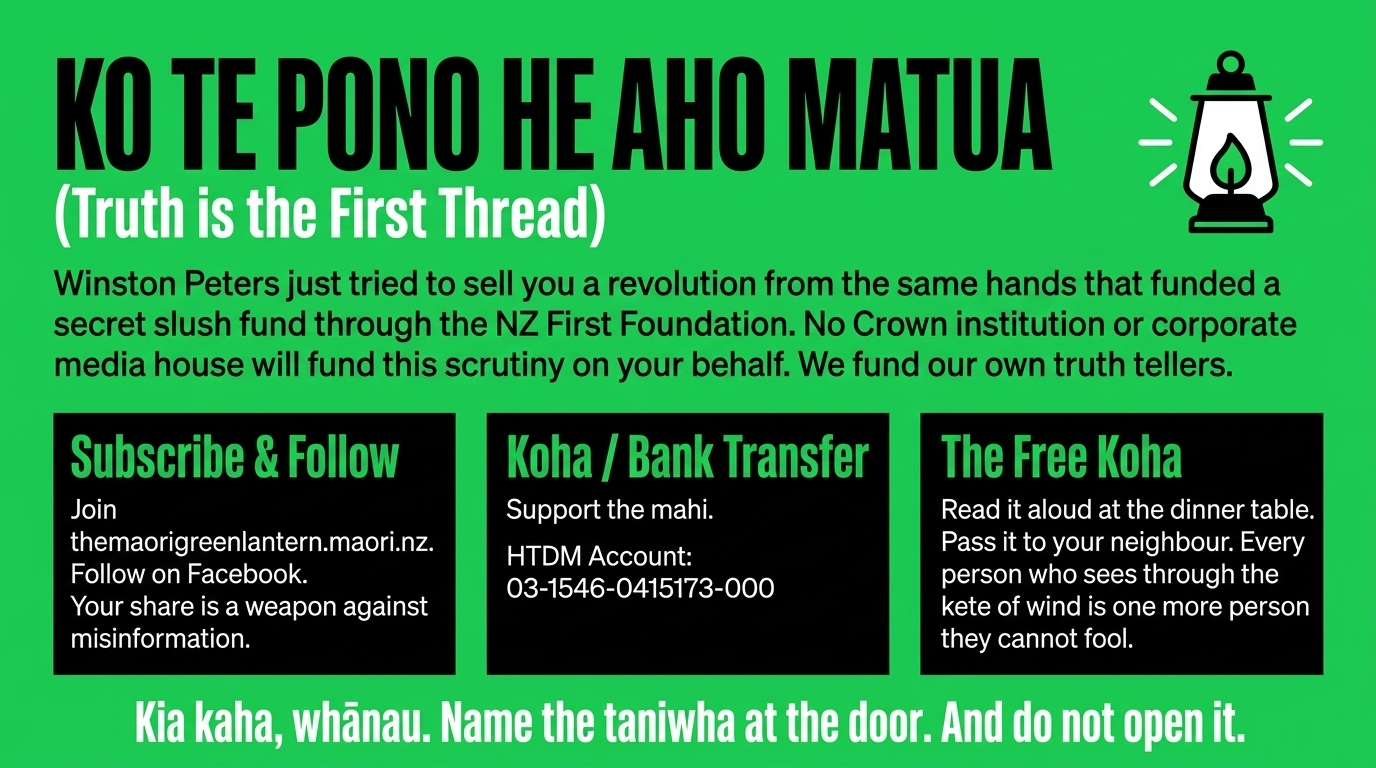
Kia ora whānau.
Winston Peters just tried to sell you a supermarket revolution from the same hands that handed Philip Morris $293 million, fast-tracked corporate donors' projects while suppressing the conflict-of-interest register, and ran a secret slush fund through the NZ First Foundation. These are not allegations. They are documented. They are sourced. They are the receipts.
If this essay helped you see through the haze — if it cut through the fog that Peters manufactures for a living — then this mahi matters. And mahi like this costs. It costs time. It costs courage. It costs the kind of relentless scrutiny that no Crown institution, no corporate media house, and no party machine will fund on your behalf.
You and I, whānau — we fund our own truth tellers. That is rangatiratanga in its most practical form.
If you are able, here is how you can support this work:
Koha directly: Support the Māori Green Lantern on Koha — every contribution, large or small, signals that whānau will not outsource accountability to the powerful.
Subscribe: Join the community at themaorigreenlantern.maori.nz and receive these essays directly — before the algorithms decide what you're allowed to see.
Bank transfer: HTDM, account 03-1546-0415173-000.
Facebook: Follow and subscribe on Facebook — your follow is a signal, and your share is a weapon against misinformation.
If you cannot koha — no worries at all. Share this essay. Read it aloud at the dinner table. Pass it to your neighbour before they vote. That act of sharing is koha in itself. Every person who reads this and sees through the kete of wind is one more person Peters cannot fool.
Kia kaha, whānau. The taniwha at the door is wearing a suit and holding a press release. Name it. Name it clearly. And do not open that door.
— Ivor Jones, The Māori Green Lantern
themaorigreenlantern.maori.nz

Research conducted 19 April 2026. Tools used: web research, URL verification, Wayback Machine, MGL essay archive. All citations tested and verified at time of publication. Unverifiable claims: none presented as fact.