"Stop Calling The Network A Coincidence And The Wreckage A Reform" - 10 October 2026
French Students Challenge Failing Schools. New Zealand Faces Public-Service Cuts. The Documented Links Run Through Think Tanks, Campaigns, And Access To Power—not A Proven Single Command Centre.

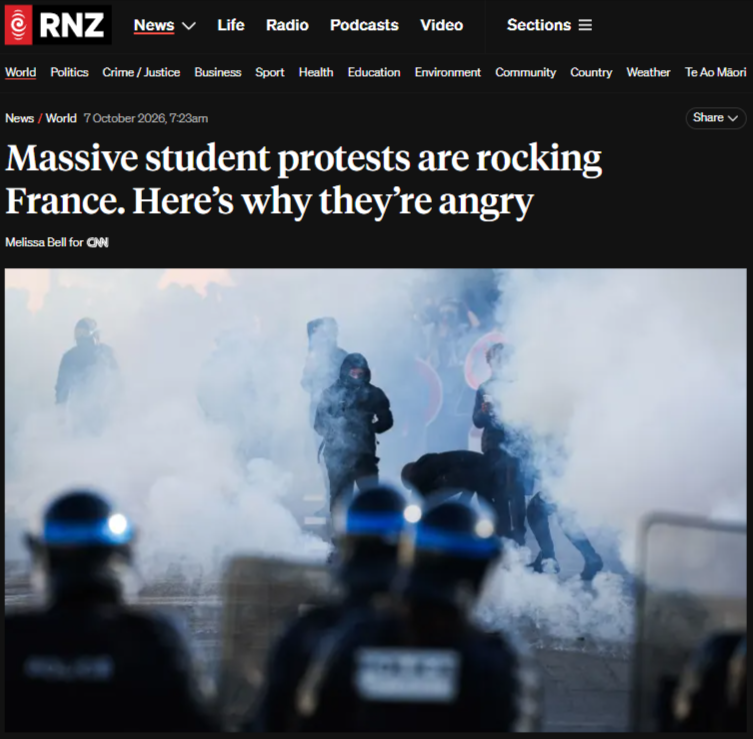
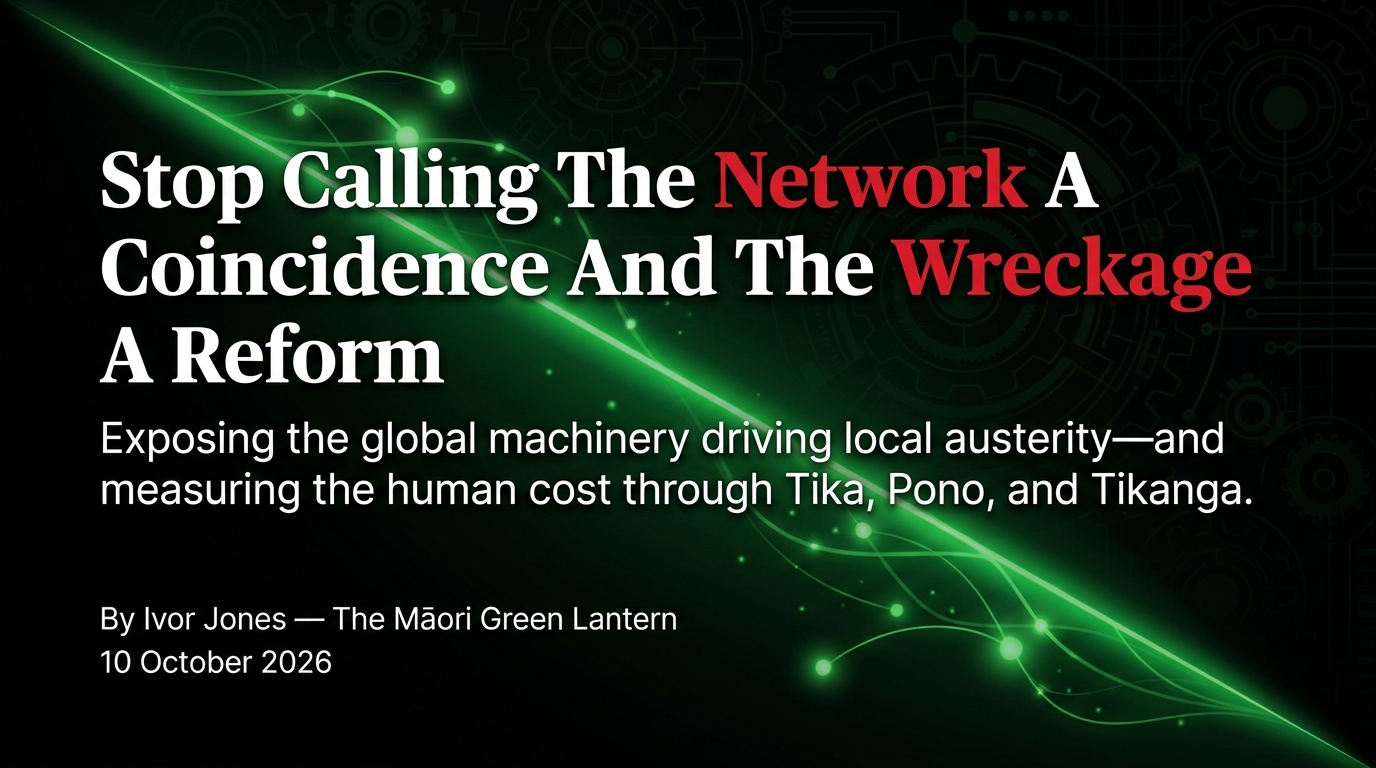
I write this as Ivor Jones, The Māori Green Lantern, and I say it plainly: I am done watching cuts dressed up as competence.
This essay covers four things, and I want you to know them before we start.
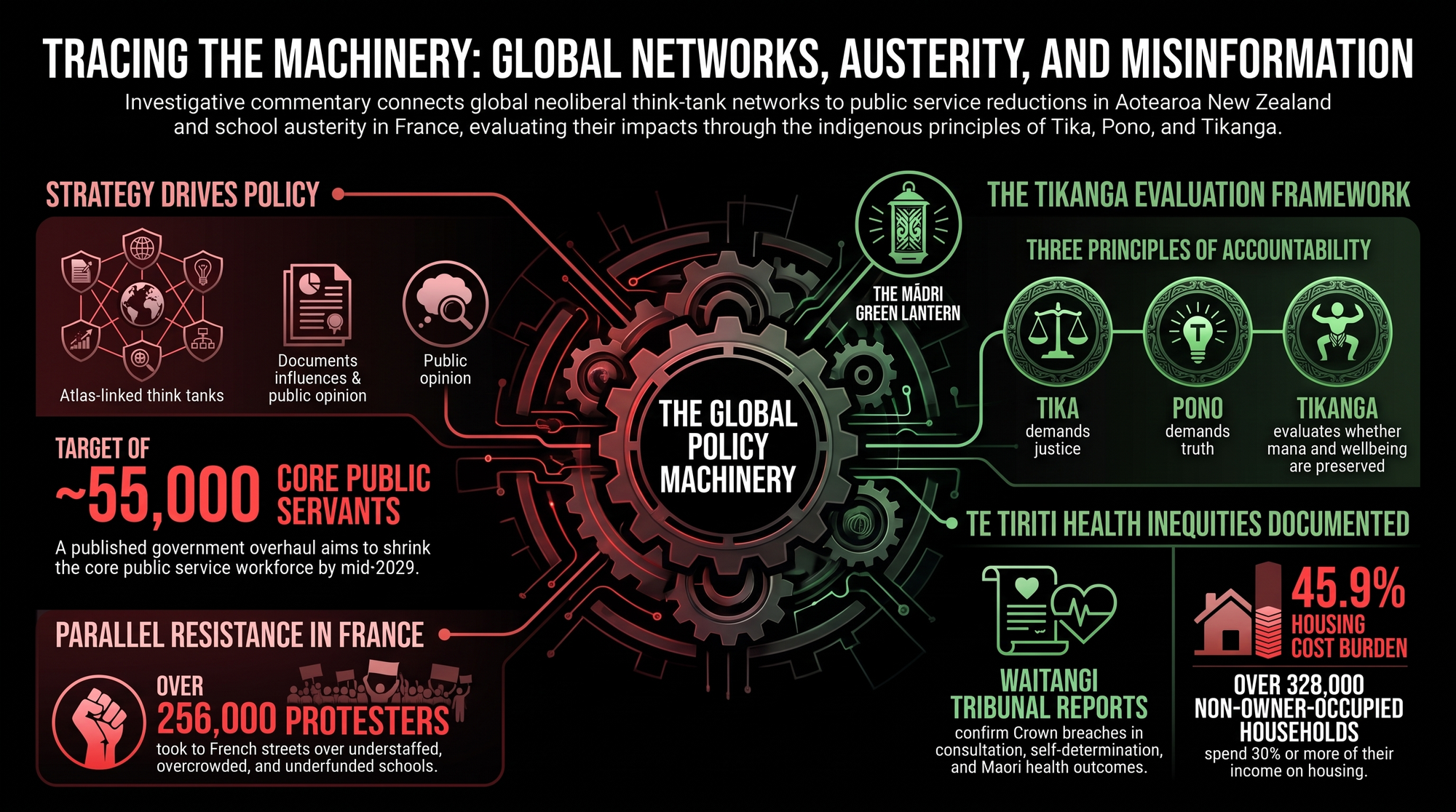
First, what France’s students are actually fighting: teacher shortages, overcrowded classrooms, decaying buildings—and a government whose substitute-teacher promises have not stopped the blockades. Second, what our own coalition is doing: a published programme to shrink the core public service, constrain its budgets, and call it progress. Third, the documented machinery connecting the two—Atlas-linked think tanks in both countries producing the ideas, running the campaigns, and walking them into the offices of ministers. Fourth, what Tika, Pono, and Tikanga demand of us in response—including peaceful, organised pressure and, this November, our votes.
 RNZ | Te Reo Irirangi o Aotearoa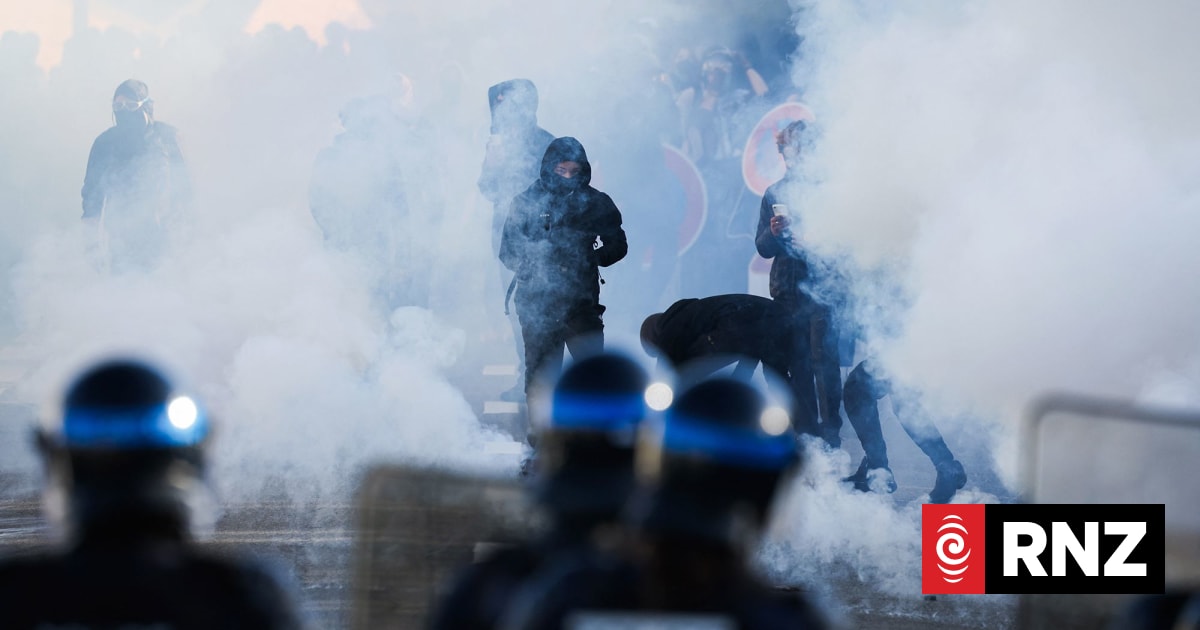
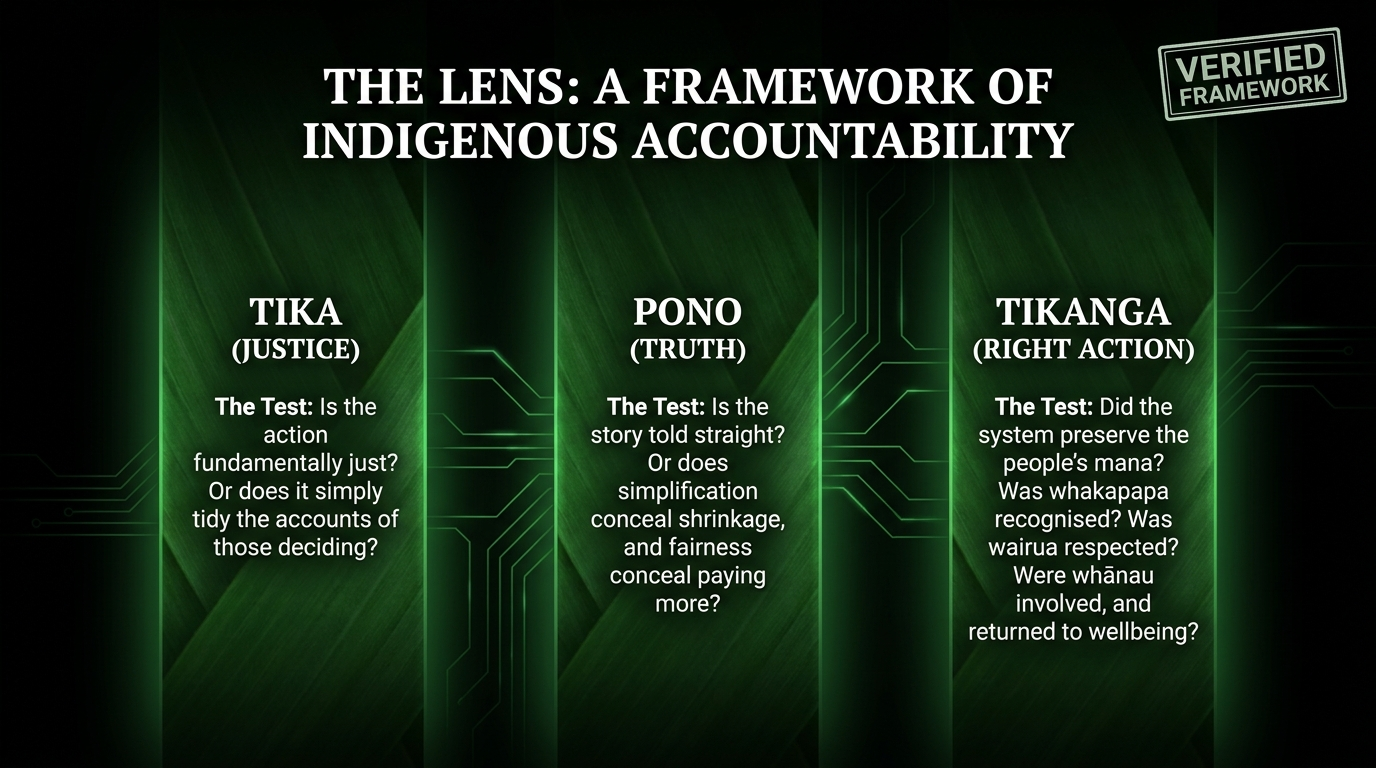
I apply this test throughout: Tika asks whether the action is just. Pono asks whether the explanation is truthful. Tikanga asks whether the system preserved people’s mana, recognised their whakapapa, respected their wairua, involved their whānau, and returned them to wellbeing. Everything below is judged against that framework—and where a claim is my judgement rather than a verified fact, I say so, because Pono does not let me blur the two.
I would love you to click into my essays because they carry information you can use in daily life—at work, at school gates, in hui, at the polls. For this kaupapa’s earlier chapter, there is an audio podcast laying out the Māori health authority argument in detail and a short video explaining it, and for long-form readers, cited full-length investigations wait on the archive.
This platform is a repository for our mokopuna. I want them to look back and say: at least we knew. At least The Māori Green Lantern, among others, was warning us.
France: Students Refuse To Be The Quiet Cost Of Austerity
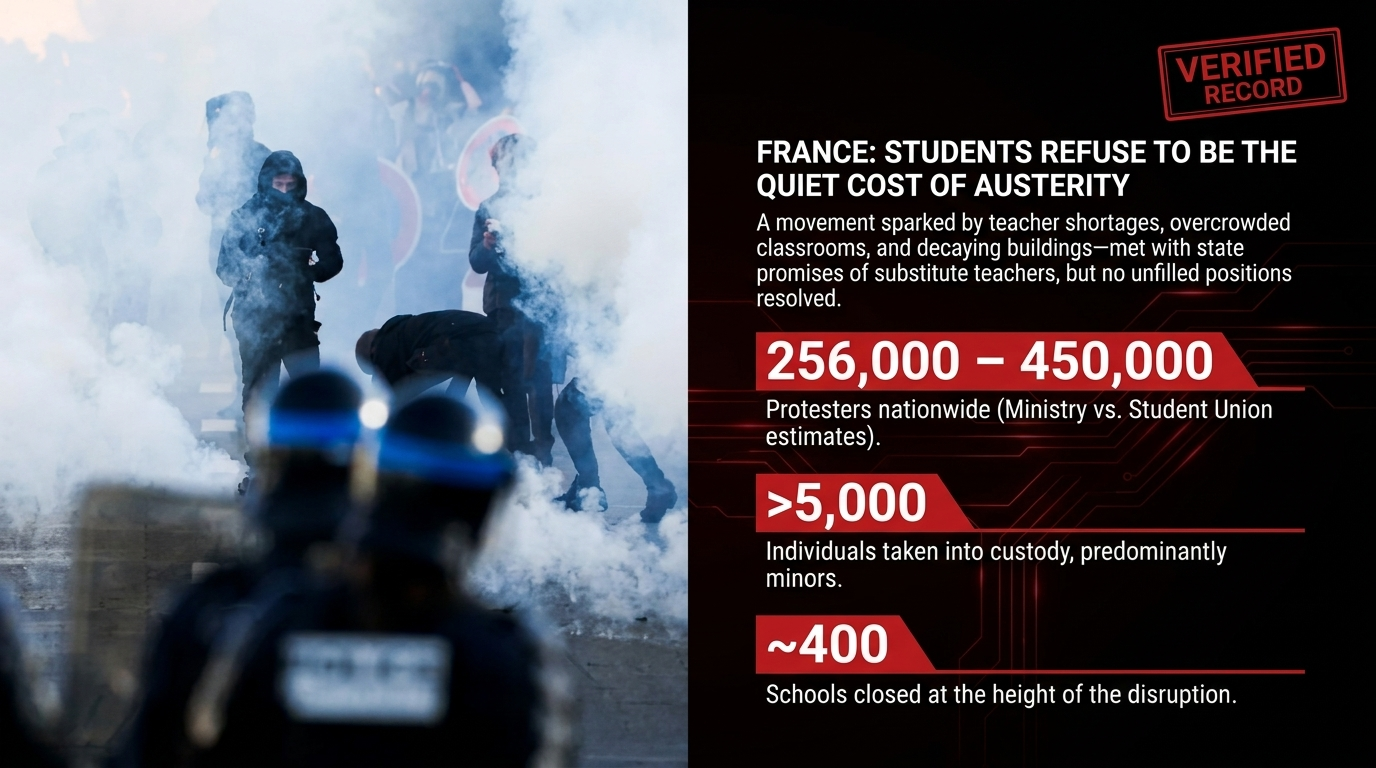
According to the CNN reporting republished by RNZ, the French movement began at a suburban school where pupils joined their teachers to protest insufficient staff and resources; when extra staff were sent, that dispute ended, but the match was lit—and the movement spread because other students recognised their own classrooms in it. RNZ’s Account Of How The Movement Spread.
The scale is not a rumour. France’s interior ministry estimated about 256,000 protesters nationwide on the biggest day of action, while a student union estimated 450,000; more than 5,000 people were taken into custody over the preceding weeks, and about 400 schools were closed at the height of the disruption. The Reported Turnout, Arrest, And Closure Figures.
Reuters reports that the major Tuesday demonstrations were mostly peaceful, with teachers and workers marching beside students—despite the violent scenes dominating some coverage. Reuters On The Predominantly Peaceful Marches.
I will be scathing about the right target, so here it is, as my stated opinion with its factual basis attached: the spectacle classes will sell you a burning bin for a month before they give you one hour on an unfilled teaching position. The bin is footage. The unfilled position is a decision. And decisions have authors.
The French Government’s answer so far—promising substitute teachers years, authorising recruitment, reviewing timetables—is verified as reported commitment, not delivered resolution. Reuters On The Government’s Offered Responses.
I reject the violence outright—it burns the very mana the movement defends. Pono cuts both ways: condemning violence must never become the anesthetic that sends the grievance back to sleep.
Aotearoa: The Shrinking Is Not An Accident, It Is A Published Programme
Now let us turn to the coalition governing us, because my patience with euphemism is gone.
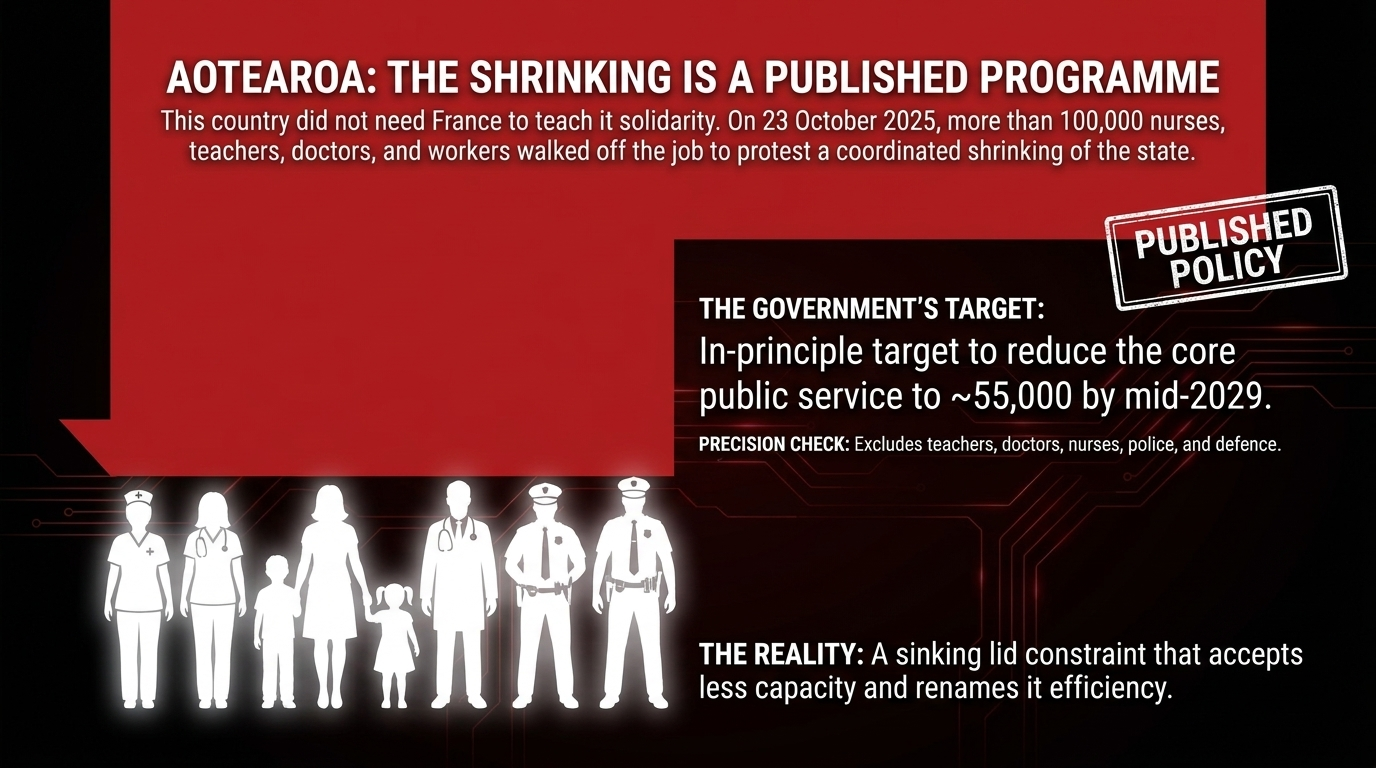
RNZ reported that more than 100,000 people—nurses, teachers, doctors, and other workers—walked off the job in the coordinated public-sector action of 23 October 2025. Confidence: verified as a reported estimate, not an independently reconciled count. RNZ’s Account Of The Nationwide Mega-Strike.
This country did not need France to teach it solidarity. It needs to stop letting solidary be divided.
The Government’s published overhaul proposes a sinking lid on agency operating budgets, mergers, greater digitisation, and an in-principle target of about 55,000 core public servants by mid-2029, with promised savings redirected to frontline priorities. Confidence: verified as published policy and rationale. The Government’s Own Overhaul Announcement.
Precision before fury, because accuracy sharpens the taiaha: that target explicitly excludes teachers, doctors, nurses, other Health New Zealand staff, police, and defence personnel. The Stated Workforce Exclusions.
My judgement, as opinion with its basis: a sinking lid is a decision to accept less capacity and rename it efficiency. A headcount target does not answer the only tikanga questions that matter. Did the service preserve mana? Did it involve whānau? Did it return anyone to wellbeing?
Or did it simply measure subtraction and call it reform?
The Network: Name The Organisations, Follow The Access
In France
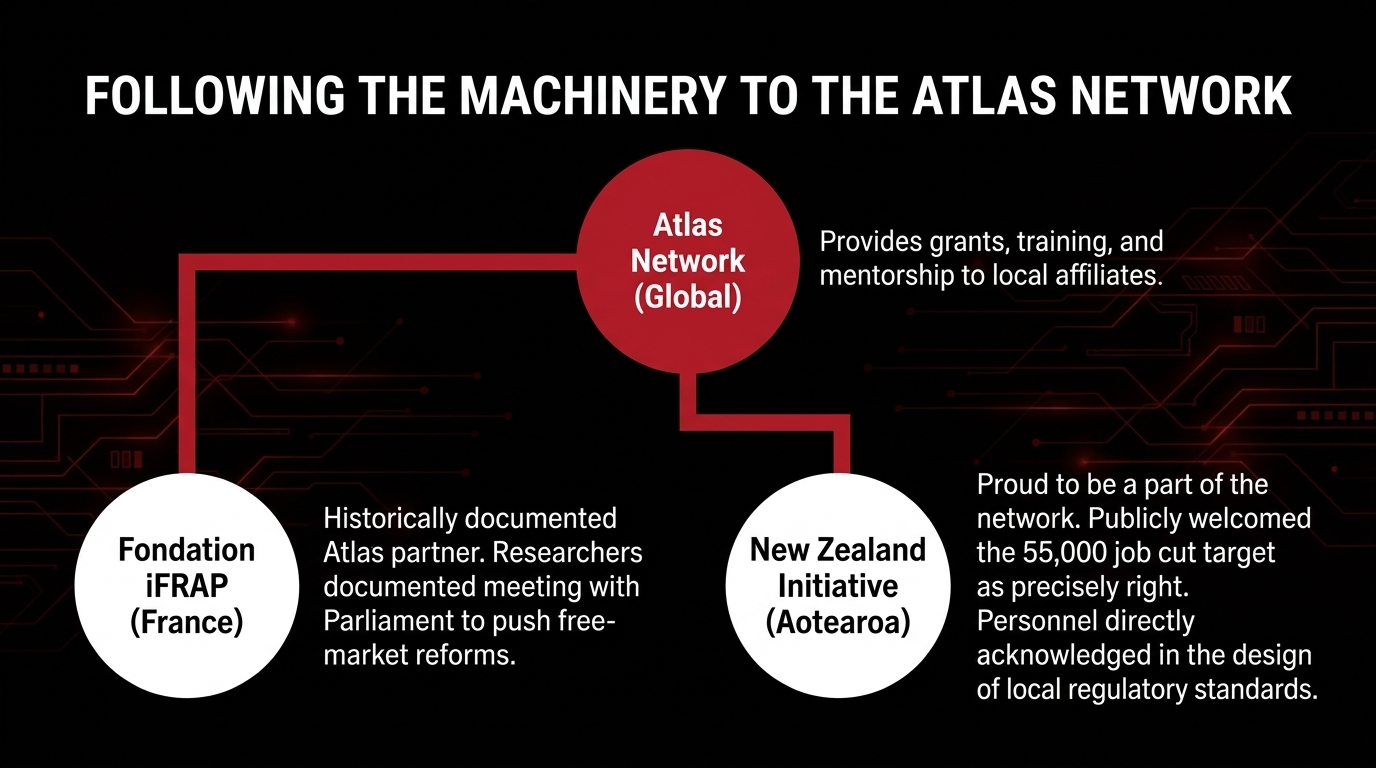
Atlas’s own published history names Fondation iFRAP, Génération Libre, and Contrepoints as French partners, and records that iFRAP researchers “regularly meet with Parliament and ministerial advisers to discuss free-market reforms.” Confidence: verified as Atlas’s historical account—not confirmation the relationship is current. Atlas’s Published Profile Of Its French Partners.
The Observatoire des multinationales reports that Christophe Kerrero, a member of iFRAP’s scientific council, also held senior roles in French education ministers’ offices—and it compares iFRAP proposals with later measures on core subjects, pupil grouping, and lycée access, while explicitly cautioning that public decisions have multiple influences. Confidence: verified as the investigation’s reporting and its own stated limit. The Investigation’s Education-Policy Connections.
And fairness hardens this taiaha, it does not blunt it: in a published right of reply, iFRAP denies a current link with Atlas; the investigators hold to their historical documentation while conceding they cannot establish the present-day partnership. Confidence: verified as the published dispute. The Right Of Reply And The Investigators’ Response.
The honest pillar therefore reads: historically documented ties, documented access routes, current affiliation disputed, direct attribution of the 2026 school-budget lines unverified.
In New Zealand
Here the record is plainer—and the responsibility heavier.
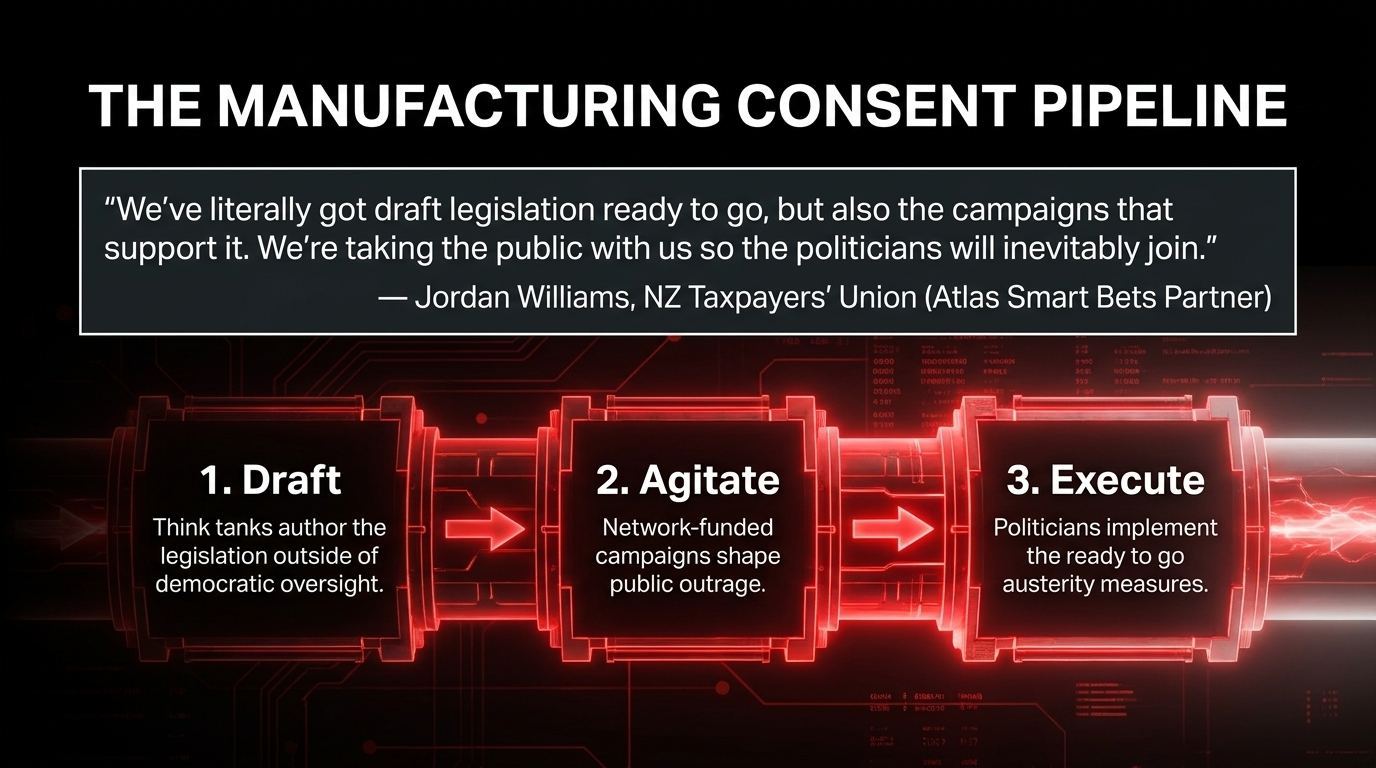
Atlas itself documents grants, training, and mentoring to the New Zealand Taxpayers’ Union through its Smart Bets programme, and quotes Jordan Williams: “We’ve literally got draft legislation ready to go, but also the campaigns that support it. We’re taking the public with us so the politicians will inevitably join.” Confidence: verified as Atlas’s own account and Williams’s own words. Atlas’s Profile Of Its Taxpayers’ Union Partnership.[atlasnetwork]
Read that sentence again. They say the quiet part loudly: prepare the legislation, build the campaign, and the politicians will follow the public they helped shape. That is not my accusation. That is their description.
The New Zealand Initiative states on its own pages that it is “proud to be a part” of Atlas’s international network—while also saying Atlas does not fund it beyond a camera provided previously. Confidence: both statements verified as the Initiative’s own; the funding claim is not independently audited. The Initiative’s Acknowledgement Of Affiliation And Funding Statement.
And when this coalition announced its public-service reductions, Initiative executive director Oliver Hartwich welcomed them—calling cuts overdue and declaring, “The substance of the announcement is precisely right.” Confidence: verified as RNZ’s report. RNZ’s Report Of Hartwich’s Endorsement.
ABC’s investigation adds the personnel thread: it reports that David Seymour’s regulatory-standards announcement acknowledged Initiative senior fellow Bryce Wilkinson’s work—a concrete chain from think tank to law—and documents Seymour’s earlier employment at an Atlas-associated Canadian think tank and his Atlas training, while retaining Atlas’s denial of any partnership or funding relationship with ACT. Confidence: all of it verified as reported. ABC’s Investigation Of The Atlas Connections And The Regulatory-Standards Chain.
So here is my voice, sharpened but honest about its limits. My judgement—political opinion grounded in that record—is that what we face is a white-supremacist, neoliberal governing project in method: not secret handshakes, but a documented apparatus that concentrates authority where wealth and ideology already sit, strips agency from those closest to harm, and then calls the subtraction natural. I name the system’s logic, not any individual’s private beliefs. No unlawful conduct is alleged anywhere in this essay. And what the evidence does not yet prove—that Atlas directed the French budget lines or authored every cut here—I leave precisely there, in the column marked unverified, because power is not beaten by borrowing its methods.
Under Pono, that restraint is strength. Under Tika, the documented record is already scandal enough.
The Damage Our Whānau Actually Carry
While think tanks talk efficiency, Stats NZ’s housing report shows the ledger in human terms: in the year ended June 2024, 45.9% of non-owner-occupied households spent at least 30% of income on housing costs; at the 2023 Census, an estimated 112,496 people were severely housing deprived; and 288,252 occupied private dwellings were recorded damp at least some of the time—three different measures, three different populations, never to be added into one number. Confidence: all verified. Stats NZ’s Housing In Aotearoa New Zealand: 2025.
Those Census findings predate this coalition’s formation, and Pono requires me to say so. The Report’s Own Dates And Definitions.
But inheritance is not absolution, and my judgement is blunt: a government that inherits fire and manages optics is still responsible for what burns on its watch.
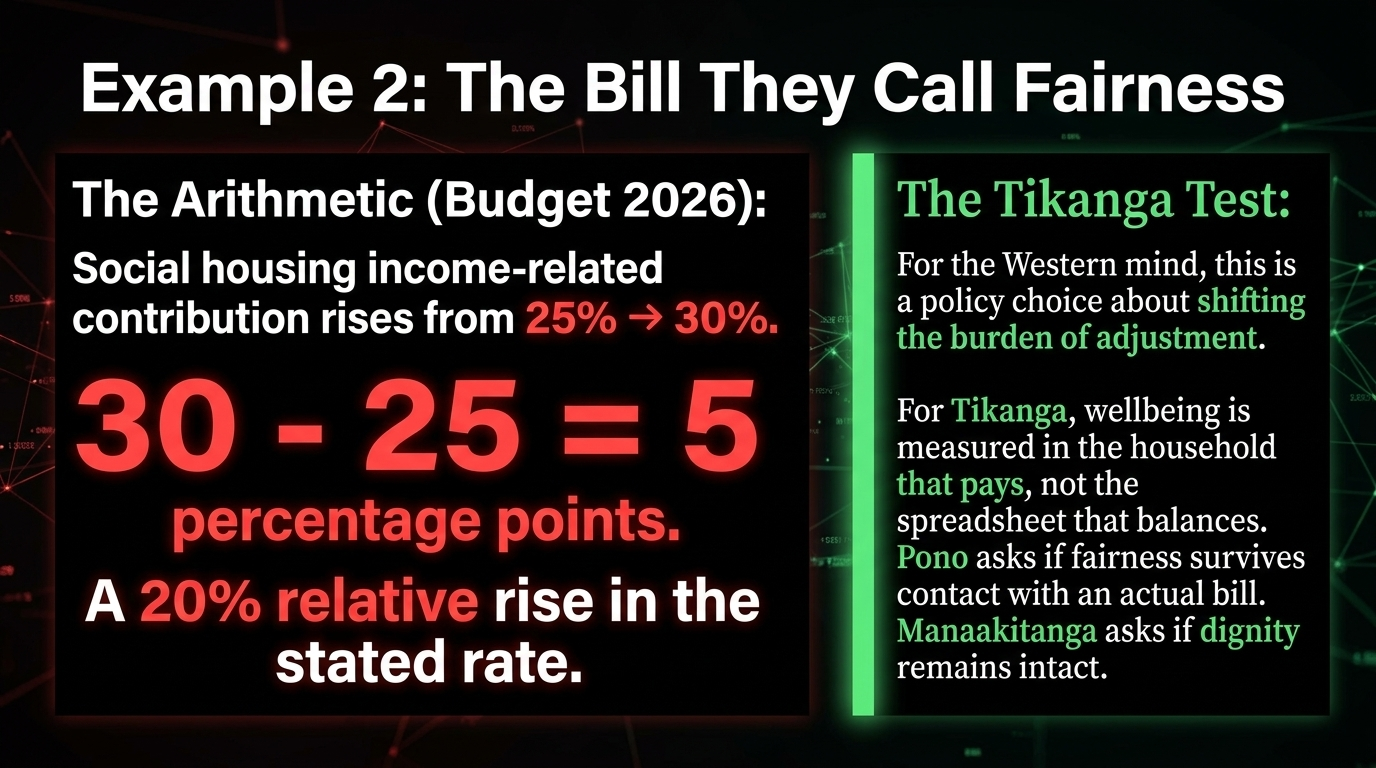
Budget 2026 raises social housing tenants’ income-related contribution from 25% to 30%—five percentage points, a 20% relative rise in the stated rate, not a proven 20% rise on every actual bill—while lifting maximum Accommodation Supplement rates and announcing more social homes through community and Māori providers. The Budget Speech; The Social Housing Announcement.
I say it as clearly as tikanga makes me: a pipeline beginning in 2028/29 is not shelter tonight. A press release is not a home. And “fairness” declared from a podium is not fairness felt in a whānau budget.
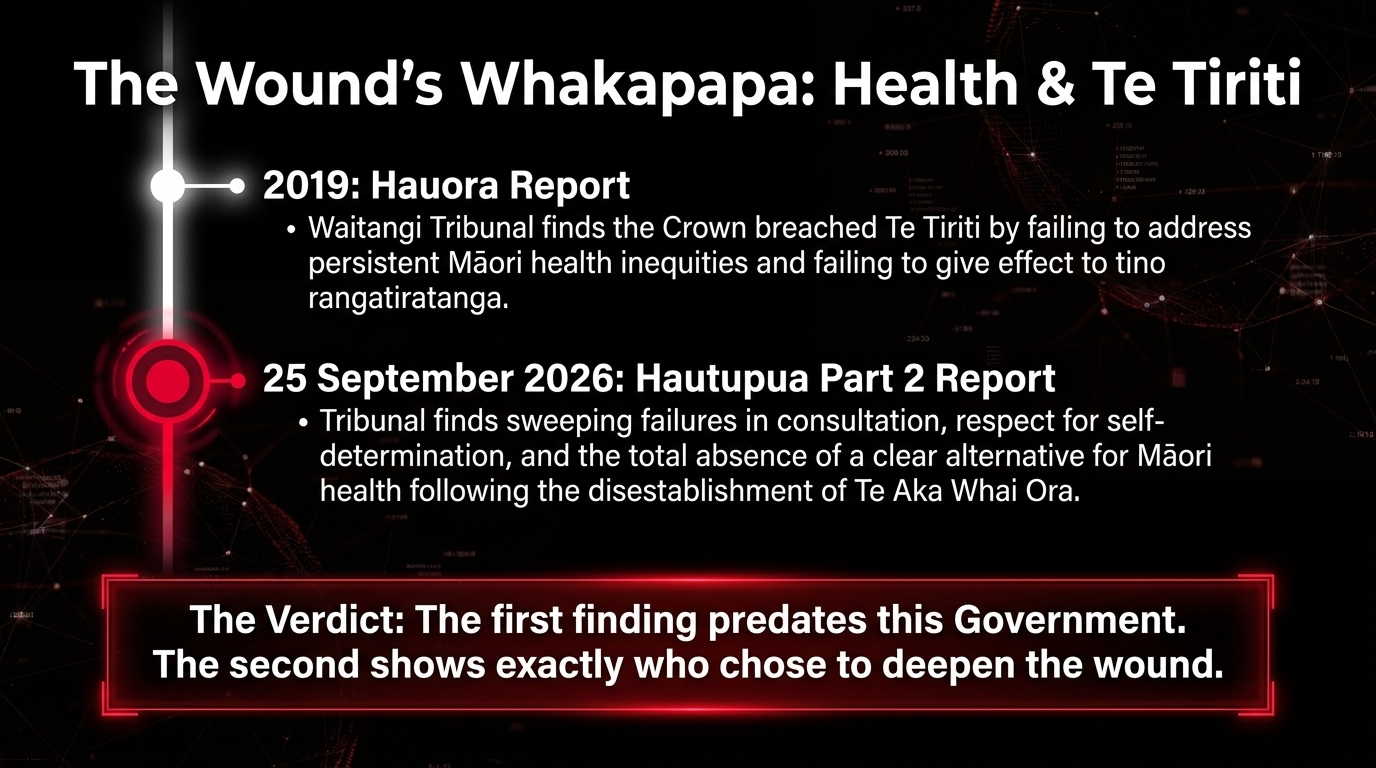
On health, the Waitangi Tribunal’s 2019 Hauora report found the Crown breached Te Tiriti by failing to address persistent Māori health inequities and failing to give effect to tino rangatiratanga—verified from the Tribunal itself. The Tribunal’s Own Hauora Account.[waitangitribunal.govt]
Its Hautupua Part 2, released 25 September 2026, found failures in consultation, information, respect for self-determination, and the absence of a clear alternative for Māori health following the disestablishment of Te Aka Whai Ora. Confidence: verified from the Tribunal’s own release. The Tribunal’s Hautupua Part 2 Release.
The first finding predates this Government; the second does not. Both matter. One shows the wound’s whakapapa. The other shows who chose to deepen it.
Three Examples For The Western Mind
For readers trained to demand the ledger before the moral: here is your ledger—with solutions, and with the tikanga dimension translated.
Example One: The House That Cannot Keep Anyone Well
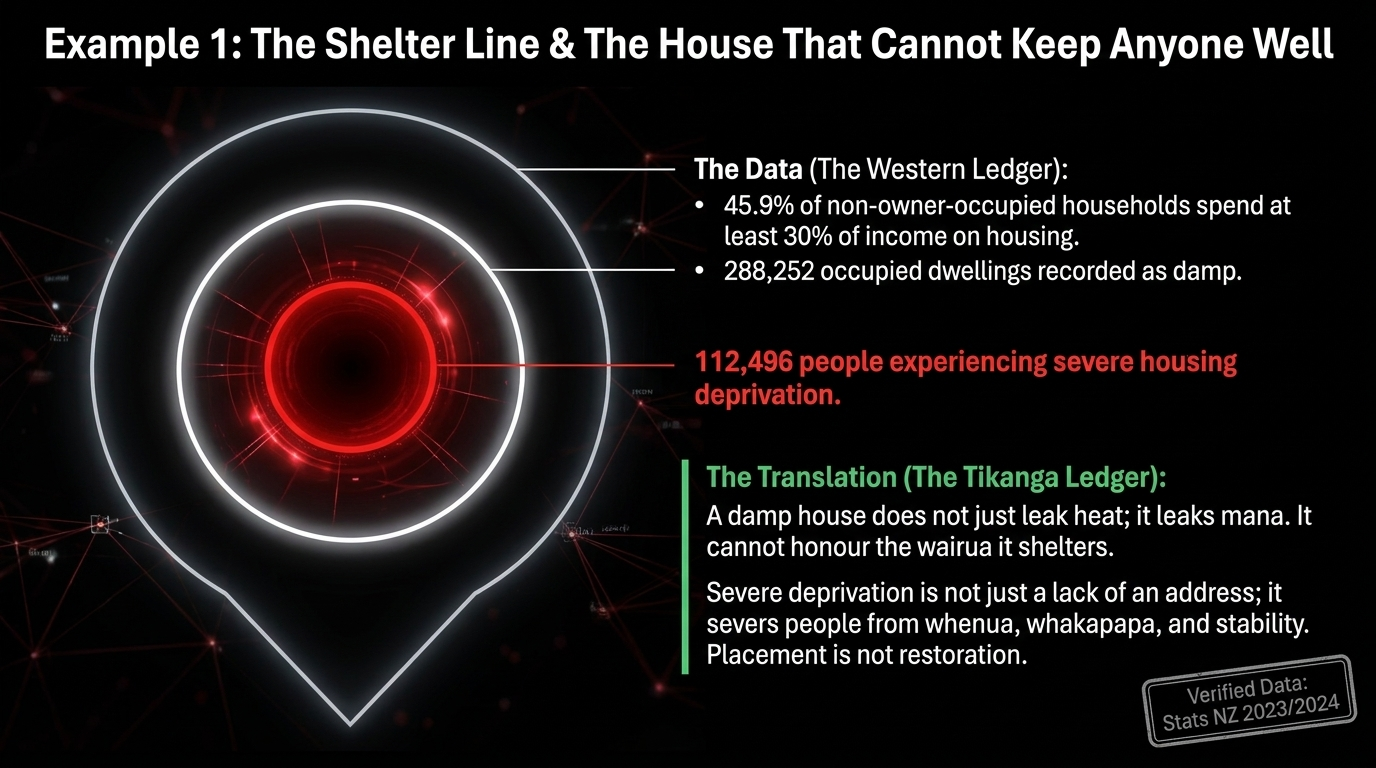
The record: 288,252 occupied private dwellings were damp at least some of the time at the 2023 Census—a count of dwellings, not illnesses, not deaths. Confidence: verified. Stats NZ’s Damp-Dwellings Count.
For the Western mind, call it a product failing its core function at national scale: nearly three hundred thousand registered units that cannot reliably perform the dryness a dwelling exists to provide.
For tikanga, a damp house does not merely leak heat; it leaks mana. A home that cannot protect the body cannot honour the wairua it shelters, cannot host whānau with pride, cannot restore anyone towards wellbeing.
My solution: enforceable healthy-homes standards with teeth, funded remediation for the worst stock, public reporting of compliance—and no normalization of damp as a Kiwi quirk.
Example Two: The Shelter Line Nobody Should Have To Stand In
The record: an estimated 112,496 people experienced severe housing deprivation at the 2023 Census—broader than rough sleeping, still vast. Confidence: verified. Stats NZ’s Severe-Deprivation Estimate.
For the Western mind: picture every person in a mid-sized New Zealand city in housing insecurity—and that figure was recorded before the 25%-to-30% contribution increase now announced for social housing tenants was layered over the landscape. The Recorded Pre-Coalition Baseline; The Announced Contribution Change.
For tikanga: severe deprivation severs people from whenua, from whānau gathering, from the stability wellbeing requires. Moving someone to a bare address without support is placement, not restoration; tikanga asks whether the whānau was involved, whether the mana survived the process.
My solution: Housing First at genuine scale, delivered with Māori providers holding real decision authority—not consultation theatre—and published delivery dates for every promised home.
Example Three: The Bill They Call Fairness
For the Western mind: this is a policy choice about who carries adjustment. The same Budget increased maximum Accommodation Supplement support for private renters—which can be genuinely good policy—while raising what social housing tenants contribute. The Full Package As Announced.
For tikanga: wellbeing is measured in the household that pays, not the spreadsheet that balances. Manaakitanga tests whether the policy leaves the person’s dignity intact; Pono tests whether “fair” survives contact with an actual bill.
My solution: publish the distributional modelling tenant-by-tenure; engage affected renters before signature; build hardship guarantees into the mechanism rather than the apology.
I have examined these dimensions before—Māori health authority in “The Crown Ripped Māori Hands From The Health System”, and the wider electoral arithmetic in “Seven Parties Walked Into The Light”.
Tikanga: The Test No Budget Line Escapes
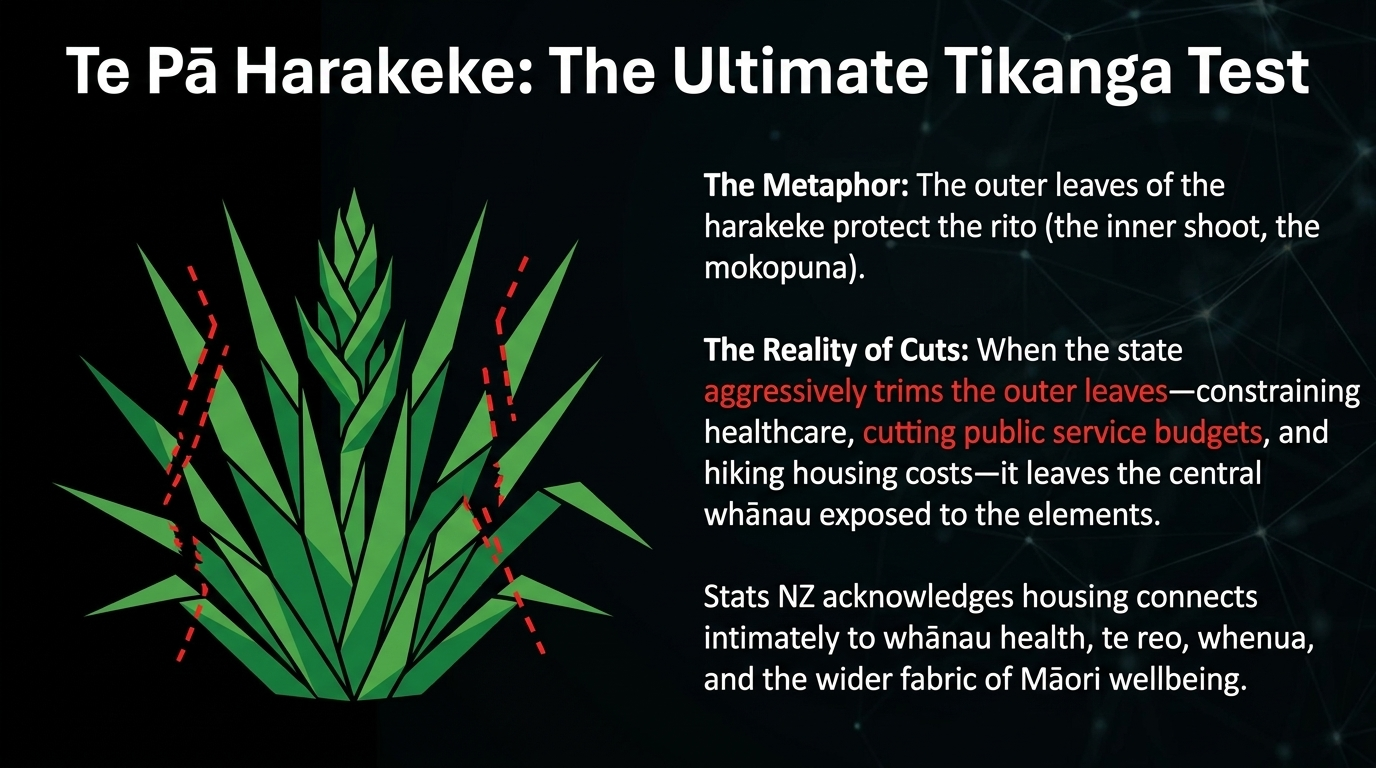
Stats NZ’s Te Pā Harakeke connects housing to whānau health, te reo, whenua, and the wider fabric of Māori wellbeing—associations, it must be said, not proof that one condition causes another. Confidence: verified. Stats NZ’s Te Pā Harakeke.
Its lesson is older than the statistics: whānau do not live one ministry at a time.
So apply the test to everything above, as I do:
- Tika: was it just, or did it simply tidy the accounts of those deciding?
- Pono: was the story told straight, or did “simplification” conceal “shrinkage,” “fairness” conceal “pay more”?
- Tikanga: was mana preserved, whakapapa recognised, wairua respected, whānau involved, wellbeing returned?
My judgement—as authorial framework, not sourced statistic—is that this austerity apparatus, whatever its flag, fails that test when it asks whānau to admire the arithmetic while absorbing the ash. Mauri is not built by subtraction audited; it is built by dignity restored.
The Deep Dive Podcast
Listen to a lively conversation between two hosts, unpacking and connecting topics in the sources of this essay. I apologise in advance for the AI's very harsh pronounciation of reo. Please dont shoot me, :).
Youtube Video
Like video? Here is a short video suppporting the essay. Again, don't shoot the messenger please because of AI's pronounciation. :)
Koha Consideration: Support The Mahi Of Tracing The Machinery

You might ask who pays The Māori Green Lantern to trace Atlas’s French ties at midnight and read Tribunal reports so you do not have to. The answer is you—not a corporate queue, not a sponsored silence. This mahi is supported through koha, and that is it. That is my declaration of how this platform operates—stated publicly, not independently audited—and the same position appears on My Koha Page.
Every koha supports the hours it takes to follow a network from Paris to Wellington, to verify what is proven and admit honestly what is not. It says rangatiratanga includes the power to support our own truth-tellers.
If you cannot koha, kāore he raru—subscribe, follow, kōrero, share with whānau. That too is koha.
Four pathways exist:
- Koha — Support The Māori Green Lantern.
- Subscribe To The Māori Green Lantern.
- Direct bank transfer: Ivor Jones, 03-1395-0099387-000—identifier reproduced from the verified Koha page.
- Support On Facebook. Destination supplied by you; could not be independently loaded in this session.
Kia kaha, whānau. Stay vigilant. Stay connected—and if you can, consider a koha so this voice continues.
Why This Coalition Must Not Return—and Why I Ask You To Vote Green
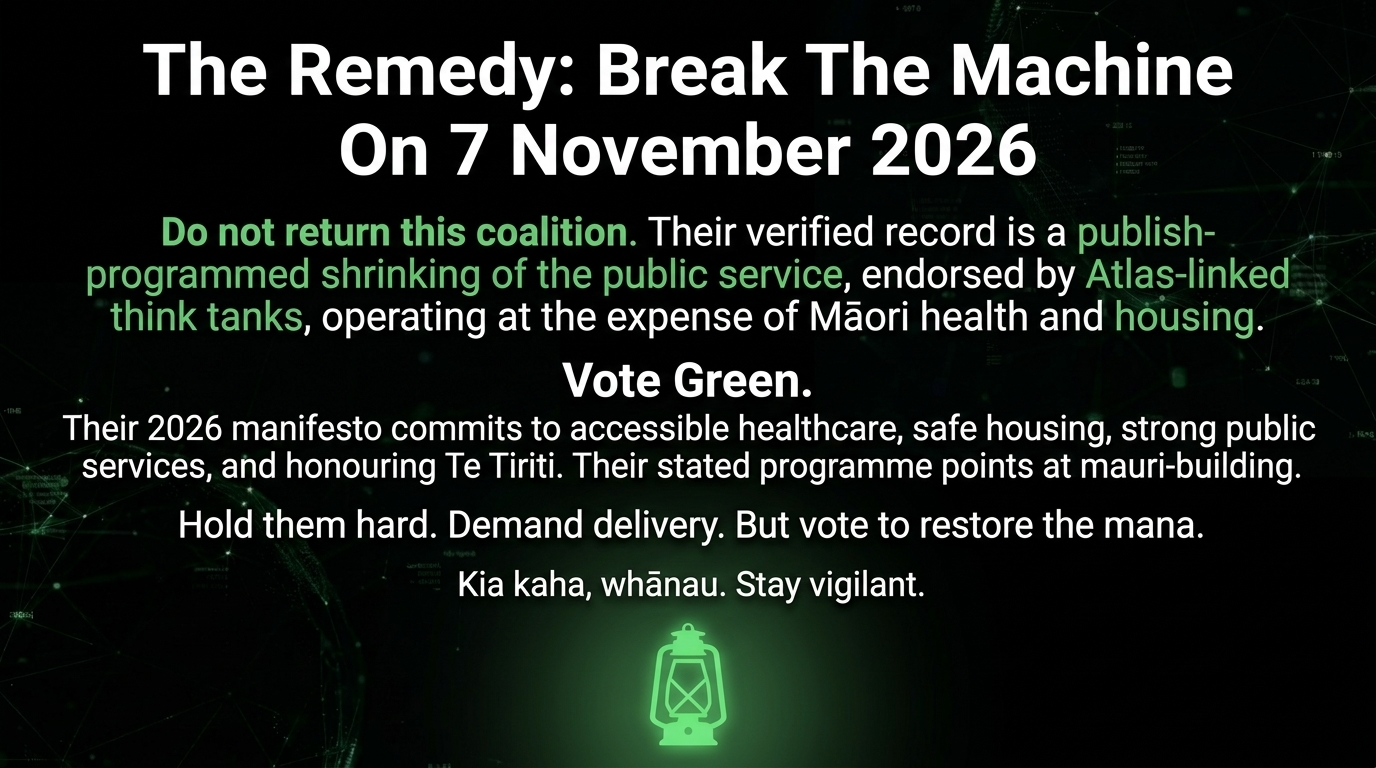
The election is Saturday 7 November 2026. Confidence: Vote NZ’s Official 2026 Election Overview.
I make this recommendation to every reader, and I will show my reasons, because an unreasoned directive insults your rangatiratanga as surely as an unaccountable minister does.
Do not return this coalition, in my judgement, because of the verified record assembled above: a publish-programmed shrinking of the core public service toward about 55,000 by mid-2029. The Overhaul Announcement.
A raised social housing contribution dressed as fairness. The Budget Speech.
A Tribunal finding, this September, of failures in consultation, information, and self-determination after Te Aka Whai Ora was dismantled. The Tribunal’s Hautupua Part 2.
And a documented cheer-squad of Atlas-linked think tanks training, mentoring, endorsing, and celebrating each stage. Atlas’s Partnership Account; The Initiative’s Affiliation; The Endorsement Of The Cuts; ABC’s Connection File.
That, in my opinion, is the method: cut the public house, thank the architect of the plans, and tell the occupants to be grateful the demolition was efficient.
Vote Green, I say—and here is my evidence-based case, not my sentimental one: the Green Party’s 2026 manifesto commits to accessible healthcare, safe and affordable housing, strong public services, employment protections, and honouring Te Tiriti. Confidence: verified as Green committee-commitments from their own document, not guarantees of delivery. The Green Party’s Own 2026 Manifesto.
Hold them exactly as hard, I beg you—read their policy, demand their delivery, prove me cheering and still checking. But a vote has direction, and this November, my direction is Green: because their stated programme points at mauri-building, and this coalition’s verified record points away from it.
Research And Publication Notes
Disclaimer: This essay is public-interest political commentary by The Māori Green Lantern. Verified facts, attributed statements, announced policies, Tribunal findings, and the author’s political judgements are distinguished throughout. The characterisations “white-supremacist logic” and “neoliberal project” are the author’s opinions of institutional method, grounded in the cited record—not allegations of criminal conduct or private racial beliefs by any individual. No unlawful conduct is alleged. No malice is held; accountability, not personhood, is the target. Material errors will be corrected transparently upon complaint.