
"Search The Poor, Dodge The Failure" - 8 October 2026
National Offers The Test, ACT Offers The Spending Cage, And Whānau Are Expected To Call The Loss Of Dignity “Responsibility”

The Machinery Behind The Smile
Kia ora Aotearoa,
I see a government offering a urine test where an employment policy should be.
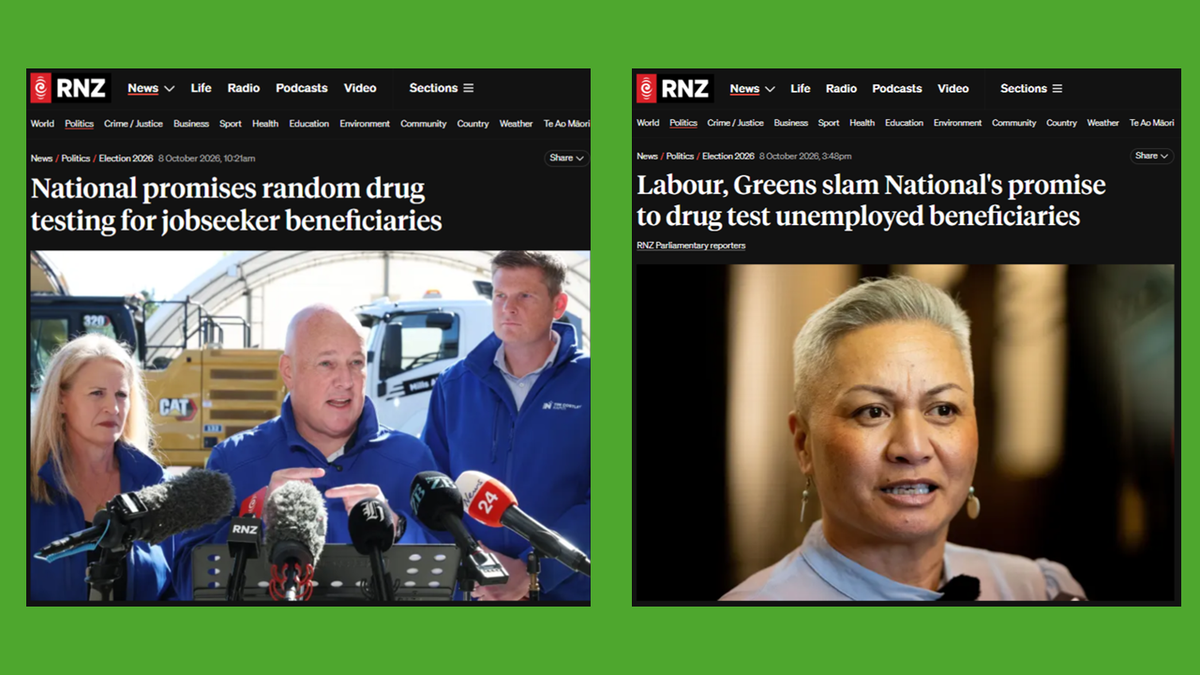
National proposes random drug testing, lower payments for long-term Jobseekers, longer non-entitlement and tighter residence requirements, alongside additional employment assistance, according to RNZ’s original report.
 RNZ | Te Reo Irirangi o Aotearoa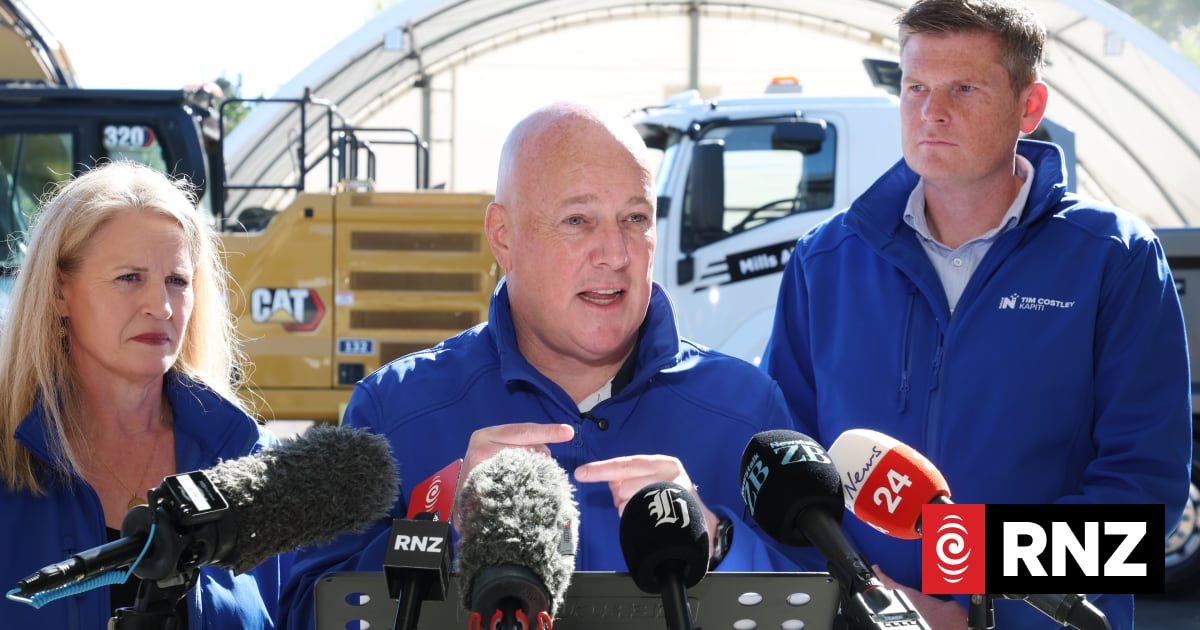
The afternoon reaction exposes the political argument behind that package: the Greens condemn it, Labour objects while accepting another welfare restriction, Winston Peters warns about freedom, and David Seymour endorses testing while advocating control over beneficiaries’ spending, according to RNZ’s follow-up.
 RNZ | Te Reo Irirangi o Aotearoa
In my opinion together, these articles show how easily a debate about employment becomes a contest over who can discipline unemployed people most aggressively.
This essay examines the proposal, the money removed from households, the workplace analogy, ACT’s rhetoric, Labour’s contradiction, Peters’ warning and the Greens’ response. I test each through Tika, Pono and Tikanga—and ask whether the system builds mauri or drains it.
I would love you to click through, read the evidence and share it. This is information for everyday kōrero: the smoko room, the kitchen table, the classroom and the whānau hui.
This repository is for our mokopuna. I want them to find a record showing that some of us challenged the language of punishment before it hardened into ordinary administration.
At least somebody was warning us.
Tika, Pono And Tikanga
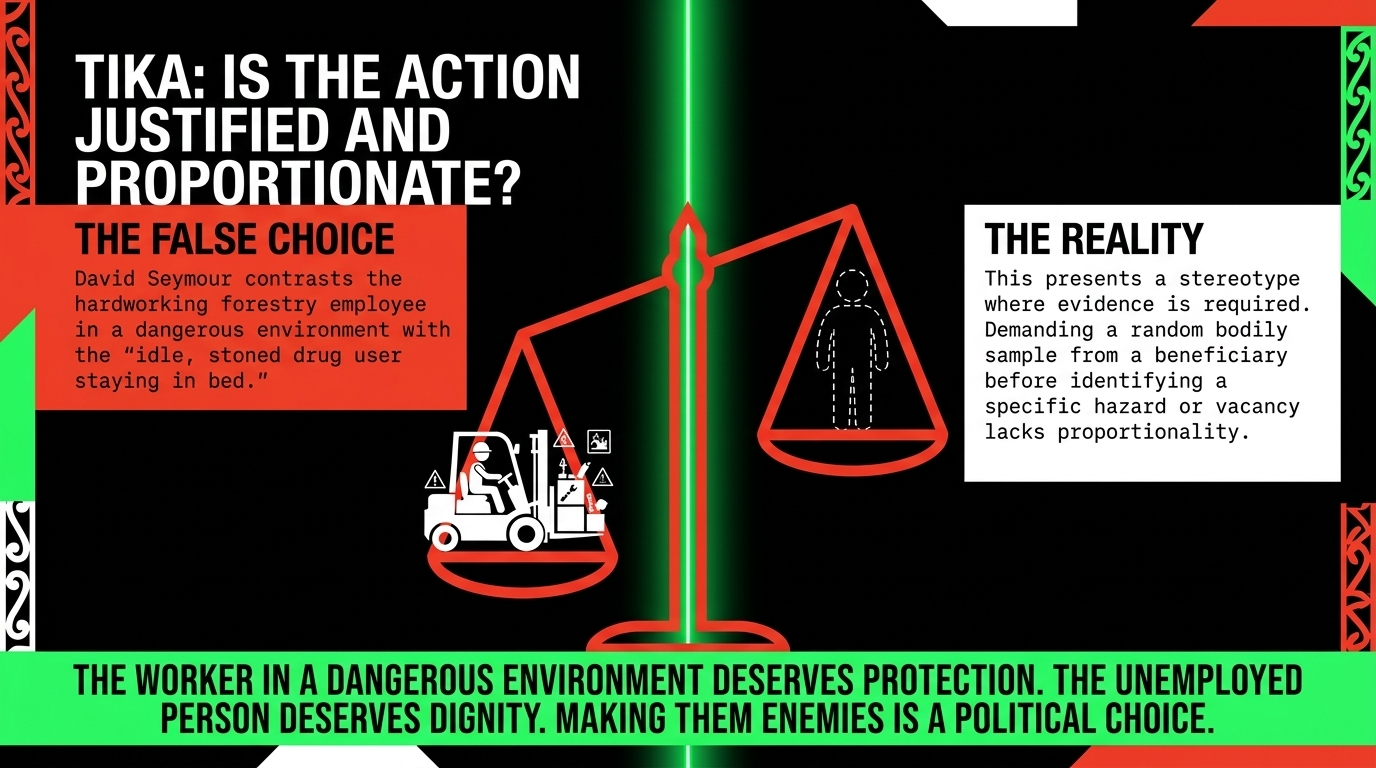
For this essay, I use Tika to ask whether the action is justified and proportionate.
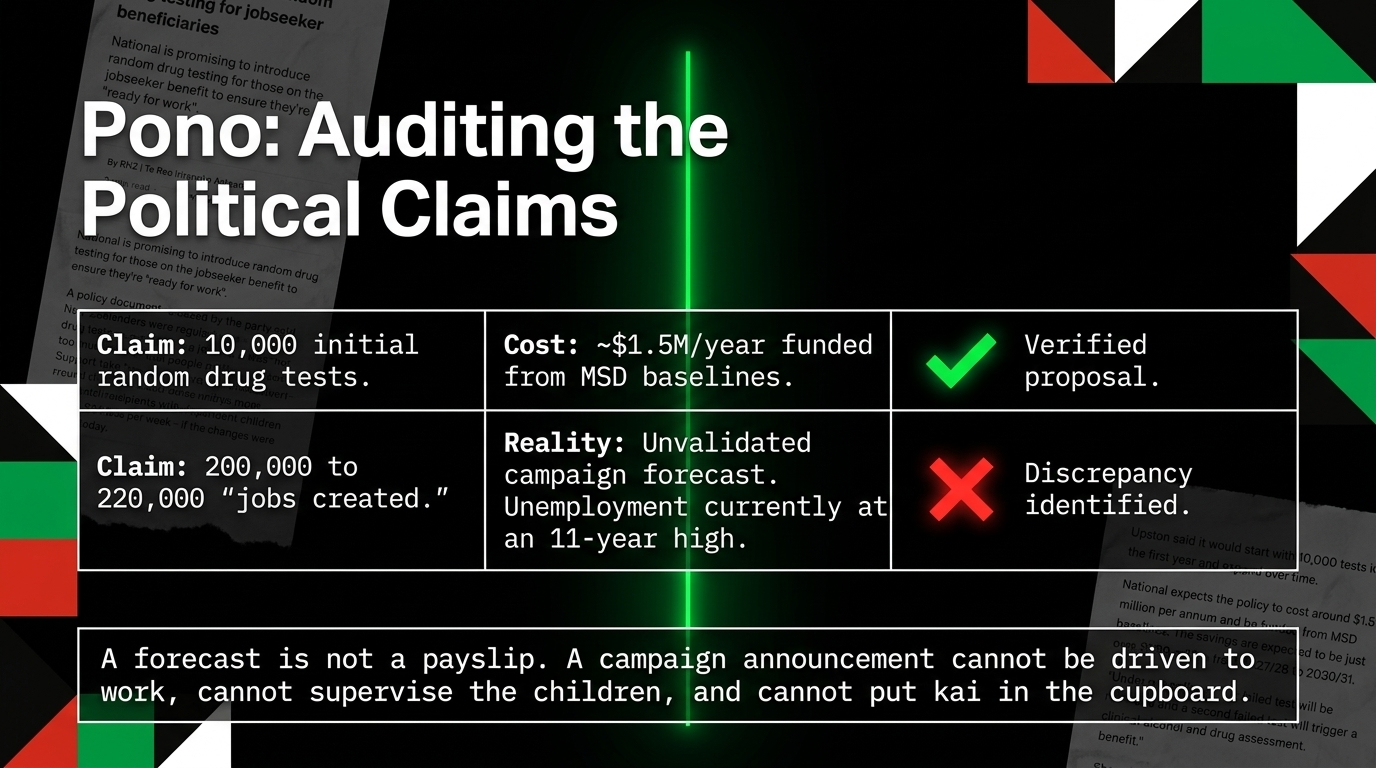
I use Pono to ask whether the explanation is honest: do the claims match the evidence, and are forecasts being sold as certainty?
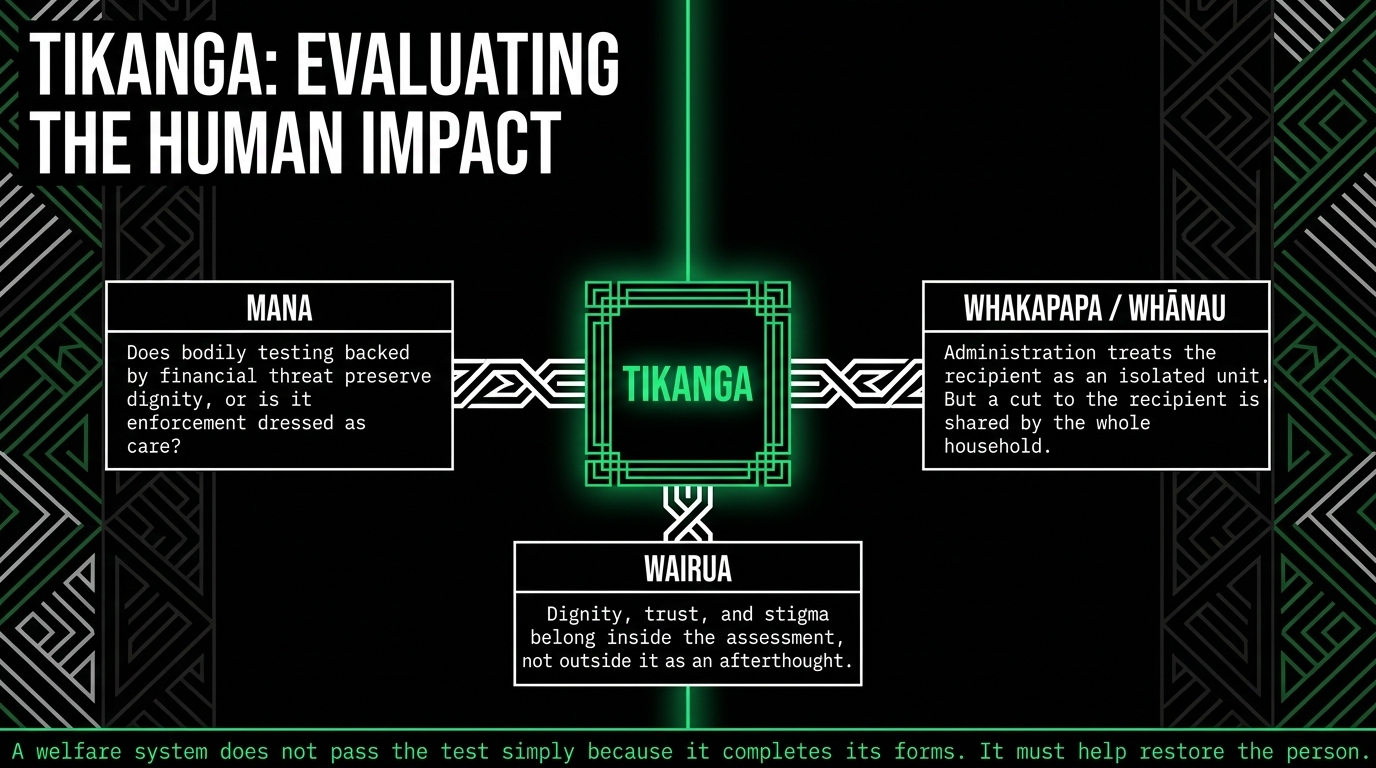
I use Tikanga to ask whether the system preserves mana, recognises whakapapa, respects wairua, involves whānau and returns people to wellbeing.
Then I ask about Mauri. What does this encounter leave alive—capability, connection and dignity, or fear, hunger and mistrust?
This is my evaluative framework, not a claim that every Māori community must express tikanga identically. I have previously applied related questions to party programmes in “Seven Parties Walked Into The Light”.
A welfare system does not pass my test simply because it completes its forms.
It must help restore the person.
What National Actually Proposes
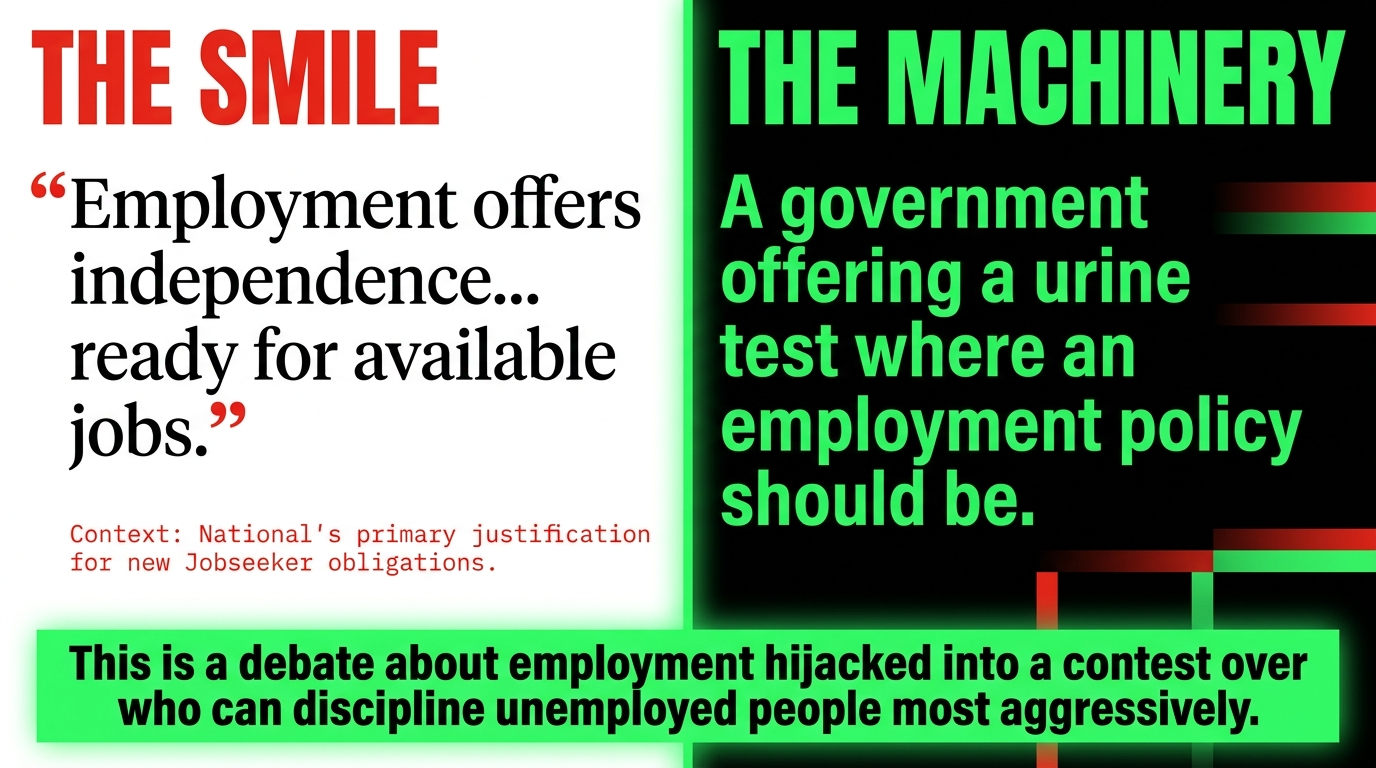
National says employment offers independence and opportunity, and that people able to work should be ready for available jobs, in its primary announcement.
I recognise that stated objective. Suitable employment can be valuable. Employment assistance is not inherently punishment.
But the mechanism matters.
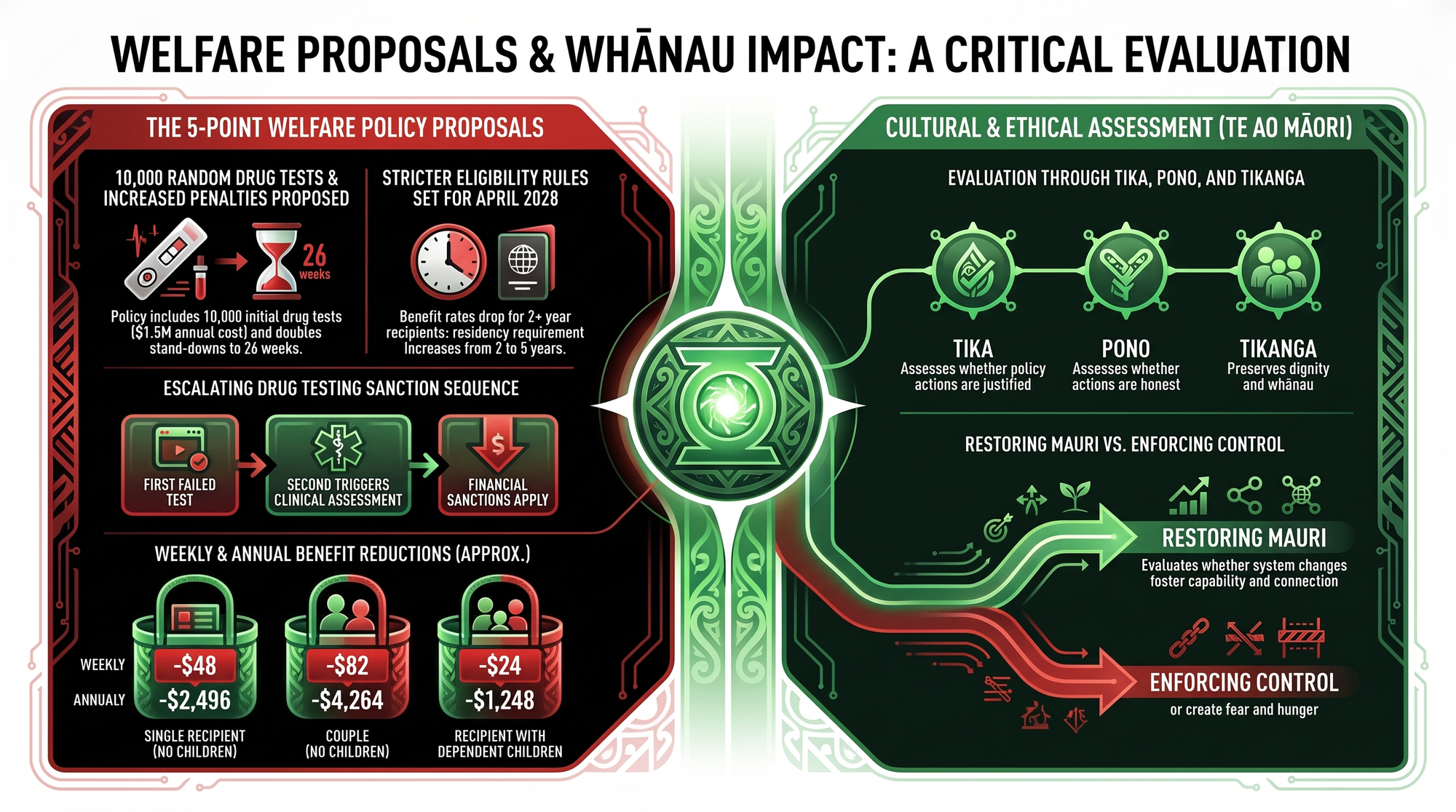
The first failed test would be recorded; a second would trigger a clinical assessment, and subsequent failure to meet obligations could lead to sanctions, according to National’s published sequence.
That distinction matters. I will not sharpen the criticism by falsely claiming an initial positive test automatically cuts the benefit.
The accurate sequence is serious enough.
In my opinion a clinical assessment may help someone if it leads to accessible, confidential treatment. Attach subsistence threats to it, however, and the relationship risks becoming enforcement dressed as care.
The Deep Dive Podcast
Listen to a lively conversation between two hosts, unpacking and connecting topics in the sources of this essay. I apologise in advance for the AI's very harsh pronounciation of reo. Please dont shoot me, :).
Youtube Video
Like video? Here is a short video suppporting the essay. Again, don't shoot the messenger please because of AI's pronounciation. :)
Koha To Keep The Receipts
Who supports the work of checking the benefit cuts, challenging the stereotypes and preserving these receipts for our mokopuna?
You do.
Every koha supports independent accountability and says rangatiratanga includes backing our own truth-tellers.
If you cannot koha, share the essay, follow the kaupapa and kōrero with whānau. That is support too.
- Koha — Support The Māori Green Lantern
- Subscribe — Receive The Essays
- Direct transfer: Ivor Jones, 03-1395-0099387-000
- Facebook — Subscribe
The Empty-Fridge Arithmetic
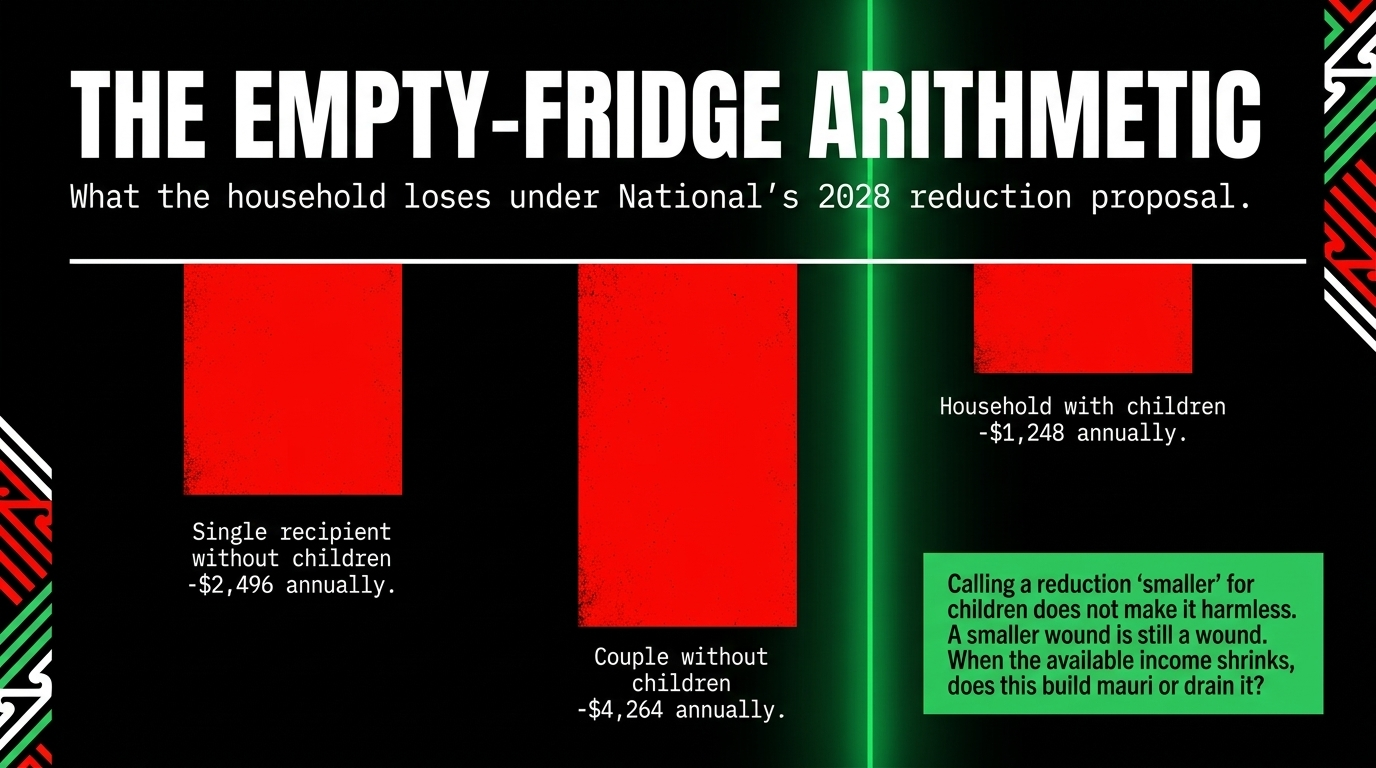
RNZ reports current-value reductions of approximately $48 weekly for a single recipient without children, nearly $82 for a couple without children and approximately $24 for a recipient with dependent children, while warning that actual reductions would use future benefit rates, in its original report.
The annual illustrations are approximately $2,496, $4,264 and $1,248 respectively, calculated by multiplying those rounded weekly examples by 52. RNZ source figures.
Those are not precise forecasts of a particular household’s 2028 loss. They demonstrate scale.
In my opinion calling the reduction smaller for households with children does not make it harmless. A smaller wound is still a wound. I do not measure the policy only by what the Crown saves. I ask what the household loses. Does it preserve mana when a person must explain another shortfall to their whānau? Does it recognise whakapapa when the administration treats the recipient as an isolated unit, while the household shares the consequences? Does it restore mauri when the available income shrinks?
National must answer those questions with more than an adjective.
Work-Ready Is Not Job-Created
National’s primary announcement forecasts 220,000 additional jobs over four years, while RNZ’s reaction report describes National referring to 200,000 jobs, leaving a discrepancy between the sources. National announcement; RNZ reaction.
Neither number, by itself, establishes that a suitable vacancy exists for the person being tested today.
A credible employment argument must consider location, qualifications, hours, disability accommodations, transport and whether an employer is actually hiring.
In my opinion a forecast is not a payslip. A campaign announcement cannot be driven to work, cannot supervise the children and cannot put kai in the cupboard.
If National wants to justify obligations through future employment, it should publish the forecast’s basis and explain how the opportunities match the people affected.
Otherwise it risks demanding readiness for work that exists chiefly inside its own campaign language.
Seymour’s False Choice
RNZ reports that David Seymour contrasted workers in dangerous forestry work with unemployed people using drugs and staying in bed, and endorsed National’s testing proposal, in its reaction article.
In my analysis, that is a false choice. It presents the hardworking employee and the idle drug user as though they exhaust the possibilities.
They do not.
The comparison does not establish how many Jobseekers use drugs, whether those people are impaired, whether substance use prevents employment or whether random testing changes the outcome.
It supplies a stereotype where evidence is required.
This is lazy political cruelty. It makes unemployed people carry the burden of an accusation that the speaker has not demonstrated about them. The worker in a dangerous environment deserves protection. The unemployed person deserves dignity. Those propositions do not contradict each other. Making them enemies is a political choice.
ACT’s Spending Cage
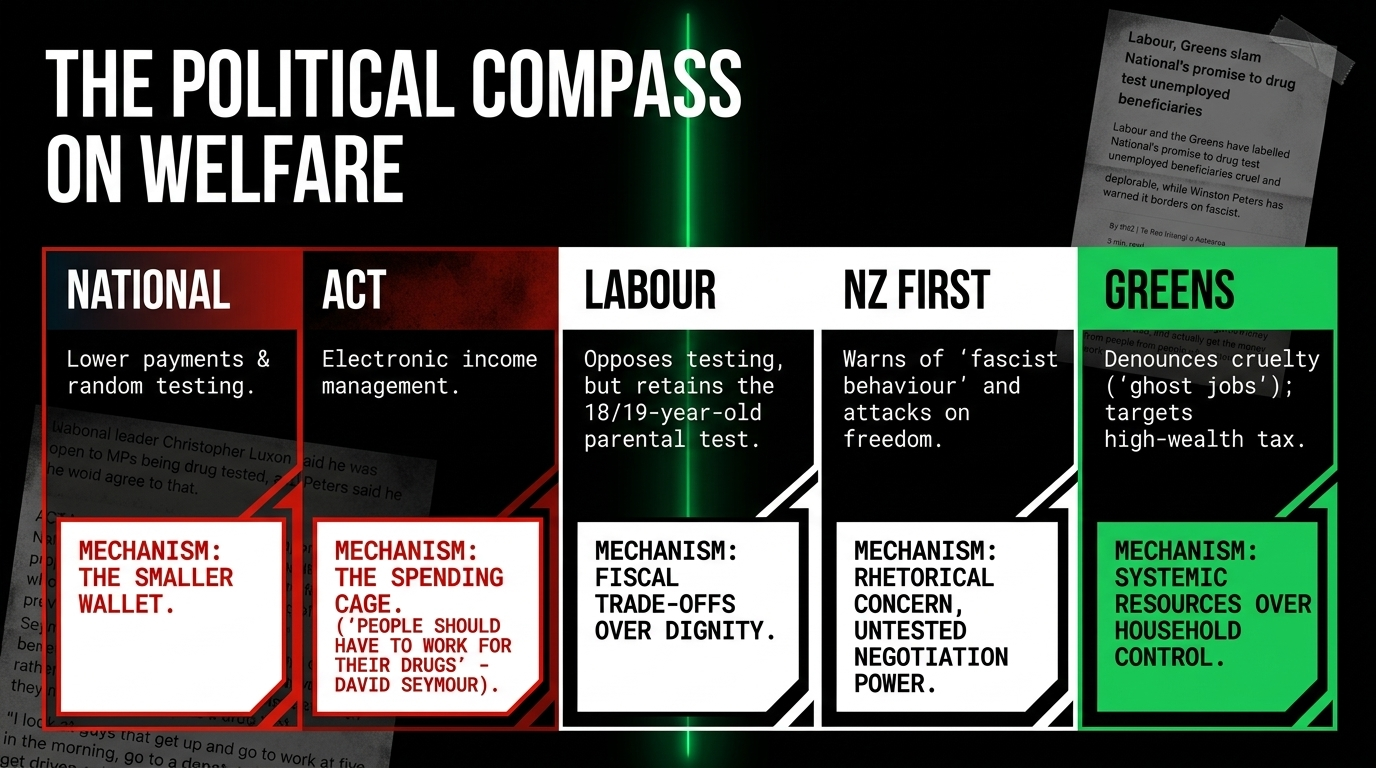
RNZ reports Seymour preferring electronic income management over National’s lower-payment proposal, with welfare money directed through a restricted payment mechanism, in the same article.
That report verifies what Seymour advocated in the interview. It does not establish every detail of ACT’s published policy.
I will not invent the missing rules.
The questions are substantial: which payments would be controlled, which shops accepted, what exceptions allowed, and what independent review available?
In my opinion controlling the purchasing mechanism is not equivalent to helping someone manage money. Assistance offers capability. Compulsion removes authority.
Nor should I pretend a restricted card necessarily reduces the nominal payment. Seymour’s reported preference was to preserve the amount while restricting its use. RNZ’s account.
That is precisely why the distinction matters. National proposes less income for some recipients. Seymour advocates more control over spending.
In my opinion the choice offered is between a smaller wallet and a wallet whose owner is no longer fully permitted to decide. Neither automatically builds mauri.
Peters’ Warning Matters
RNZ reports Winston Peters warning that the proposal could threaten freedom and move towards authoritarian conduct, while Christopher Luxon expressed openness to testing MPs, in its reaction article.
Peters’ criticism must be recorded honestly.
I cannot claim every coalition leader supports this measure when this article shows otherwise.
But a warning is not yet a legislative safeguard, a negotiated rejection or a binding commitment to prevent implementation.
My opinion: concern expressed into a microphone is the beginning of accountability, not its completion. The next question is what Peters would do with his negotiating power.
And testing MPs would not settle the underlying issue.
A shared intrusion does not prove a necessary intrusion.
The question remains whether the test has a justified purpose, a sound evidential basis and proportionate consequences.
Labour’s Contradiction
RNZ reports Kieran McAnulty rejecting National’s premise and arguing for job creation, while also reporting Labour would not campaign to reverse the coalition’s parental test affecting many people aged 18 and 19. RNZ reaction article.
McAnulty described that position as a fiscal trade-off, according to RNZ.
In my opinion Labour cannot expect full credit for opposing humiliation while accepting another restriction because reversing it is inconvenient to its budget.
The distinction between denouncing the next restriction and retaining the existing one deserves scrutiny.
If Labour believes people are genuinely seeking work, that principle should inform its own commitments—not merely its response to National.
This is not an argument that every Labour and National policy is identical.
It is an argument against mistaking opposition rhetoric for a promise of restoration.
The Greens’ Stronger Response
RNZ reports Marama Davidson condemning National’s policy as cruel and Chlöe Swarbrick challenging the usefulness of promised future jobs, in the reaction article.
In my opinion that response better identifies the question National tries to sidestep: where is the work, and how does this mechanism help someone obtain it?
The Greens also publish a tax programme directed towards high wealth and large corporations, alongside changes intended to reduce income tax for most people, in their primary tax-policy page.[waitangitribunal.govt]
Those are proposals, not guaranteed results.
Their significance here is direction: they identify resources above the household floor rather than presenting tighter control of welfare recipients as the central answer.
I favour that direction.
It still deserves scrutiny.
Examples For The Western Mind
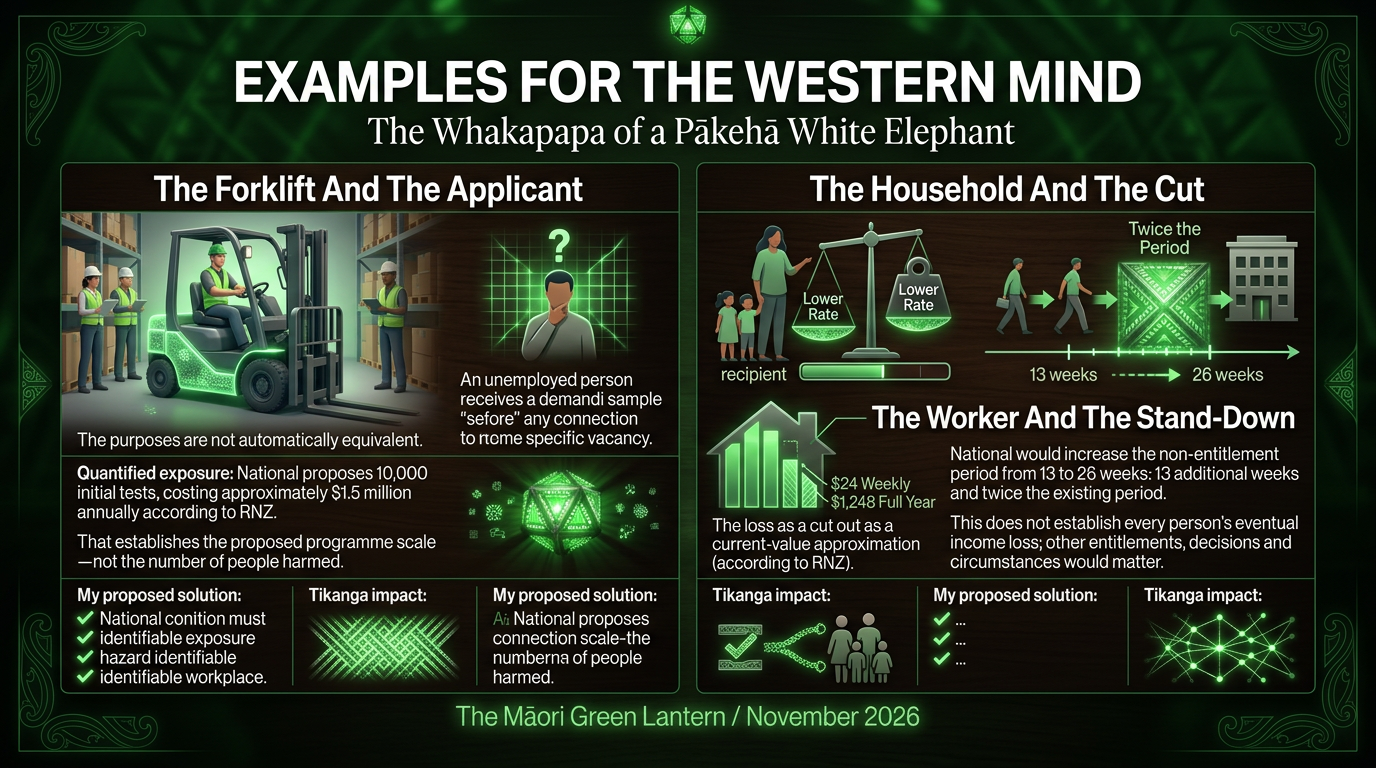
The Forklift And The Applicant
Illustration: imagine a worker driving a forklift beside colleagues. An employer’s concern is an identifiable workplace hazard. Now imagine demanding a sample from an unemployed person before any particular forklift vacancy has been identified.
The purposes are not automatically equivalent.
Quantified exposure: National proposes 10,000 initial tests, costing approximately $1.5 million annually according to RNZ.[rnz.co]
That establishes the proposed programme scale—not the number of people harmed.
My proposed solution: connect requirements to actual vacancies and demonstrable risks, protect medical information, independently confirm disputed results and guarantee review before income changes.
Tikanga impact: begin with the person’s capabilities and circumstances, not a presumption of suspicion. Preserve mana while addressing an actual problem.
The Household And The Cut
Illustration: a recipient with children remains unemployed long enough to trigger the proposed lower rate.
Using RNZ’s current-value approximation, the household would lose about $24 weekly—approximately $1,248 across a full year if the reduction continued throughout it. RNZ source.[rnz.co]
My proposed solution: protect essential income and address the employment barrier through transport, training, accessible work and practical support.
Tikanga impact: the recipient is connected to whānau. An assessment that ignores those relationships cannot adequately assess the consequences.
The Worker And The Stand-Down
Illustration: a person repeatedly leaves employment, and MSD determines the reasons do not satisfy the proposed rule.
National would increase the non-entitlement period from 13 to 26 weeks: 13 additional weeks and twice the existing period. National announcement.[ppl-ai-file-upload.s3.amazonaws]
This does not establish every person’s eventual income loss; other entitlements, decisions and circumstances would matter.
My proposed solution: investigate the breakdown, distinguish avoidable conduct from unsafe or unsuitable conditions, provide independent review and preserve a basic living floor.
Tikanga impact: restoration requires understanding the relationship that failed. A longer exclusion period does not, by itself, repair it.
The Questions Still Unanswered
National’s announcement does not specify the sampling method, substances covered, confirmation procedure, information-retention rules, treatment capacity or independent appeal design. National announcement.
That establishes an omission from this announcement—not proof that no such documents exist anywhere.
Before implementation, I would demand publication of those details, alongside the fiscal assumptions, Māori engagement, disability and child-impact assessments, and measures of sustained employment.
I would also ask what services bear the opportunity cost of paying for testing from existing MSD baselines, the funding approach reported by RNZ.[rnz.co]
My opinion: “reasonable” is not a substitute for a rulebook. “Fair” is not an impact assessment. “Work-ready” is not an employment outcome.
My Mauri Verdict
| Test | My Assessment |
|---|---|
| Tika | National has stated a purpose, but the verified announcement does not demonstrate that random testing achieves sustained employment. |
| Pono | Forecasts must remain forecasts, and the government must distinguish benefit exits from secure jobs. |
| Mana | Bodily testing backed by financial consequences demands a stronger justification than campaign analogy. |
| Whakapapa | Individual administration must recognise household relationships and personal history. |
| Wairua | Dignity, trust and stigma belong in the assessment, not outside it. |
| Whānau | The consequences must be evaluated across the household. |
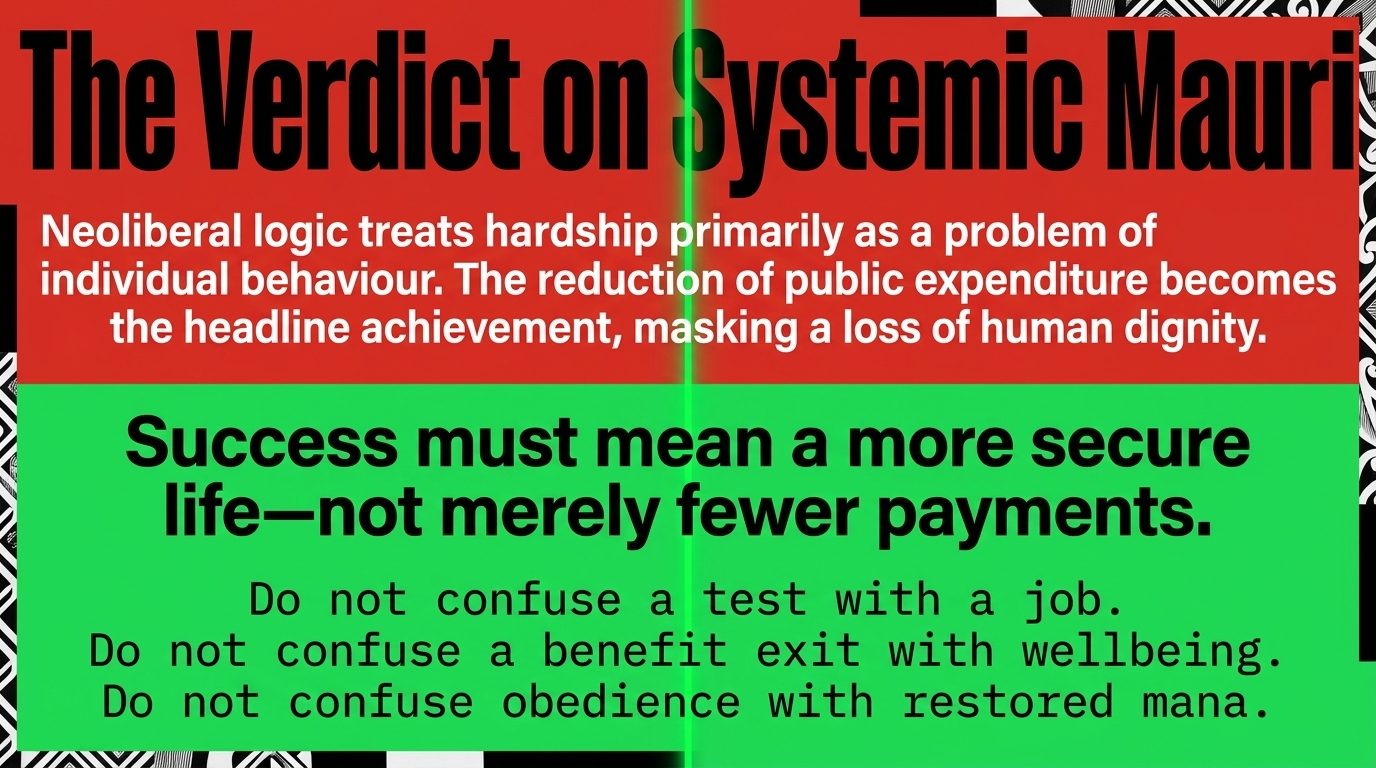
| Wellbeing | Success should mean a more secure life—not merely fewer payments. |
My opinion: neoliberal logic is visible when hardship is treated primarily as a problem of individual behaviour and the reduction of public expenditure becomes the headline achievement.
These two articles alone do not establish a sufficiently documented basis for presenting “white supremacist” as a factual description of this specific proposal. A serious argument about racialised institutional power requires evidence of unequal exposure, Crown conduct and Māori authority—not simply a harsher adjective.
Accuracy does not blunt the taiaha.
It keeps me from swinging it at something I have invented.
My Political Recommendation Is To Reject Another Term For This Coalition And Give Your Party Vote To The Greens

I base that recommendation on National’s proposed reductions and conditions, Seymour’s reported preference for stronger spending control, the Greens’ opposition to the testing proposal and their published redistributive tax direction. National announcement; RNZ reaction; Green tax policy.
That is a judgment, not a guarantee that any party will deliver everything it promises.
The Greens must face the same scrutiny.
But my standard is clear: I favour a politics that searches for resources to strengthen households over one that searches households for reasons to tighten control.
Do not confuse a test with a job.
Do not confuse a benefit exit with wellbeing.
Do not confuse obedience with restored mana.
Party Vote Green. And Keep The Receipts For Our Mokopuna.
Disclaimer
I, Ivor Jones — The Māori Green Lantern, offer this essay as public-interest political commentary on proposed welfare testing, benefit cuts and their implications for whānau. My judgments through Tika, Pono, Tikanga and mauri are opinions, not allegations of criminal conduct. Policy forecasts are not guaranteed outcomes. This is not legal advice; substantiated factual errors will be corrected promptly and transparently.


