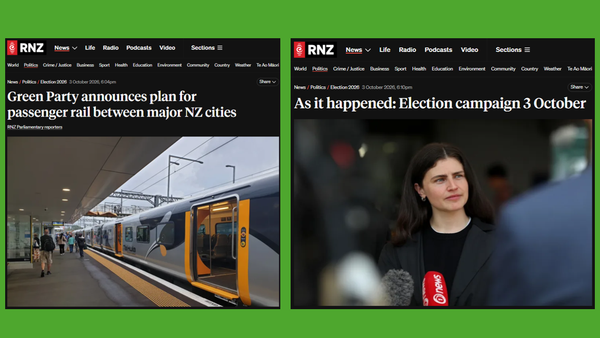
"The Same Government That Calls Rail A “White Elephant” Just Fed Private Airlines Another $5.7 Million" - 5 October 2026
They told the country passenger rail must be “viable.” Then Shane Jones opened the public wallet for private airlines whose fuel bill got too high. Same public money. Different class of recipient.


Mōrena Whānau,
 RNZ | Te Reo Irirangi o Aotearoa
On 4 October, Shane Jones announced $5.7 million in taxpayer-funded working-capital grants to private regional airlines. Not a tender for a publicly owned service. Not an investment in a national asset. Not a public buy-back of planes, routes, landing rights or maintenance capacity.
Grants — cash to help private operators manage operating costs. RNZ reported the package.
The government says fuel costs are up more than 50 percent since March. Therefore, it says, taxpayers must help the airlines keep flying.
Fine. Let us be absolutely clear: remote communities need reliable transport. People need to get to specialist care. Whānau need to get to tangihanga. Small businesses need connections. Nobody is arguing that Chatham Islands, Rakiura, Golden Bay or isolated communities should be abandoned because a Treasury spreadsheet frowns.
But then these same men turn around and sneer at rail.
When the Greens proposed overnight Auckland–Wellington rail, a Christchurch–Dunedin passenger service, and Te Huia to Tauranga, Winston Peters reached for the word “viability.” Christopher Luxon reached for “white elephant.” RNZ recorded that response.
There it is. The coalition’s transport doctrine, stripped naked:
Private airline cash-flow trouble is “temporary, targeted and proportionate.”
Public rail investment is a “white elephant.”
A motorway cost blowout is apparently just the weather.
Whānau, I want you to read this carefully, then click through to the Māori Green Lantern’s work. Not because I need another number on a dashboard. Because this is information you can use: at the polling booth, at the marae, around the table when someone repeats the line that rail is a “white elephant” and private business is simply more efficient.
This Kaupapa Is In More Than One Form
The Deep Dive Podcast
Listen to a lively conversation between two hosts, unpacking and connecting topics in the sources of this essay. I apologise in advance for the AI's very harsh pronounciation of reo. Please dont shoot me, :).
Youtube Video
Like video? Here is a short video suppporting the essay. Again, don't shoot the messenger please because of AI's pronounciation. :)
And for readers who want the full ledger, there is a 3,000-word cited essay waiting. This is a repository for our mokopuna.
One day they must be able to look back and say: at least some of us knew; at least the Māori Green Lantern was warning us. The Māori Green Lantern archivethemaorigreenlantern.maori
This article does five things
It shows what Shane Jones has actually announced: $5.7 million in grants to private regional airlines, on top of nearly $26 million in loans.
It tests the government’s reasoning against the Green Party’s passenger-rail proposal. It applies Tika, Pono and Tikanga — mana, whakapapa, wairua, whānau and wellbeing — to the policy choice.
It sets out three examples for the Western mind: the money, the public benefit and the ownership question.
And it explains why this coalition does not deserve another term in November.
The Public Wallet Has A Class System
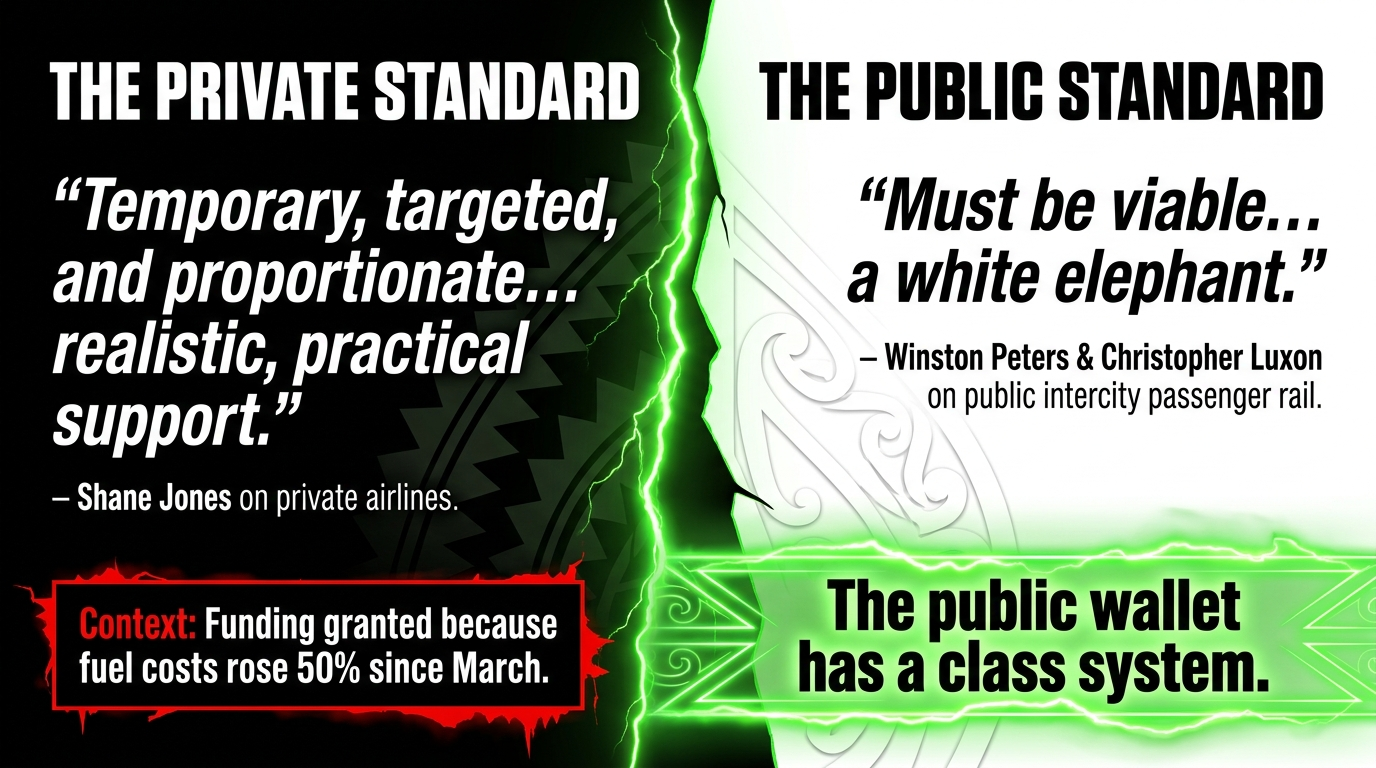
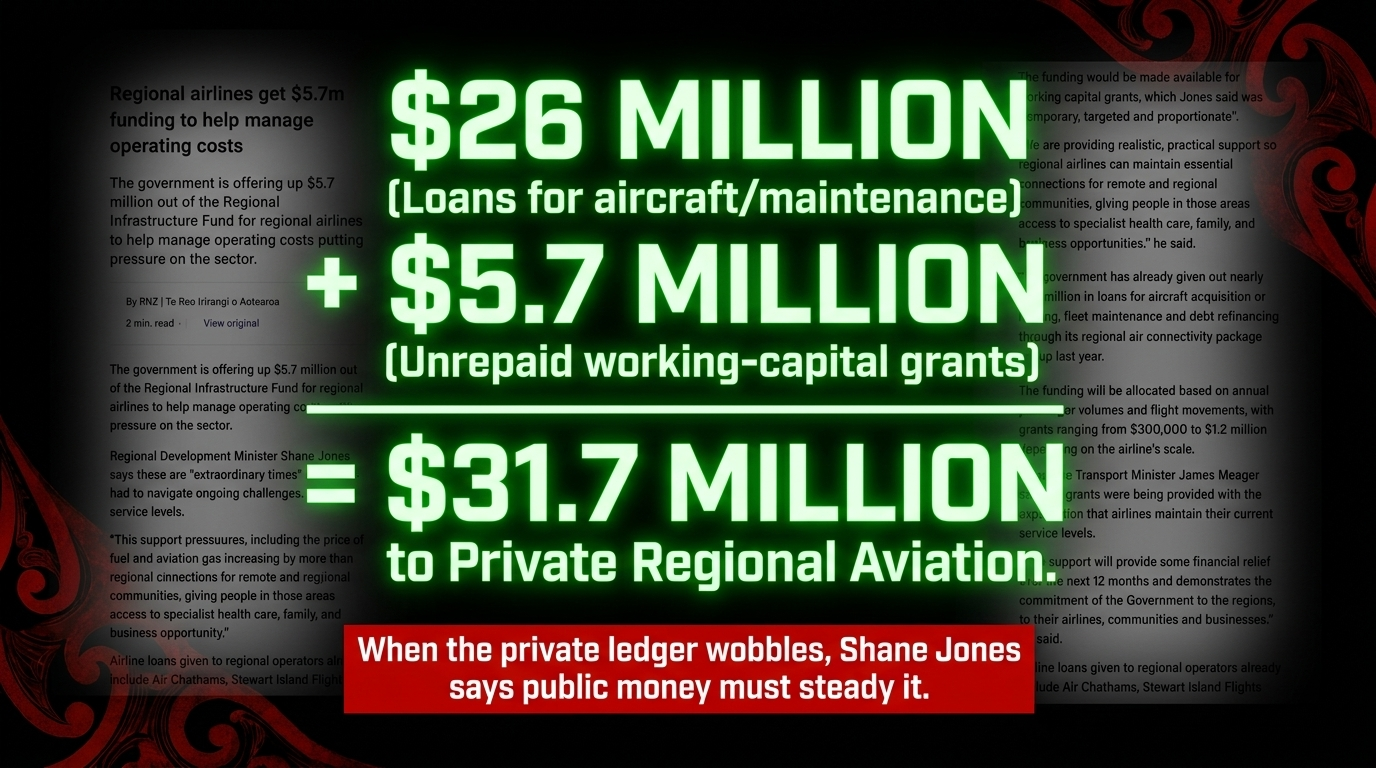
Jones’ package is not isolated assistance. The government had already handed out nearly $26 million in loans to regional airline operators for aircraft purchases or leases, fleet maintenance and debt refinancing.
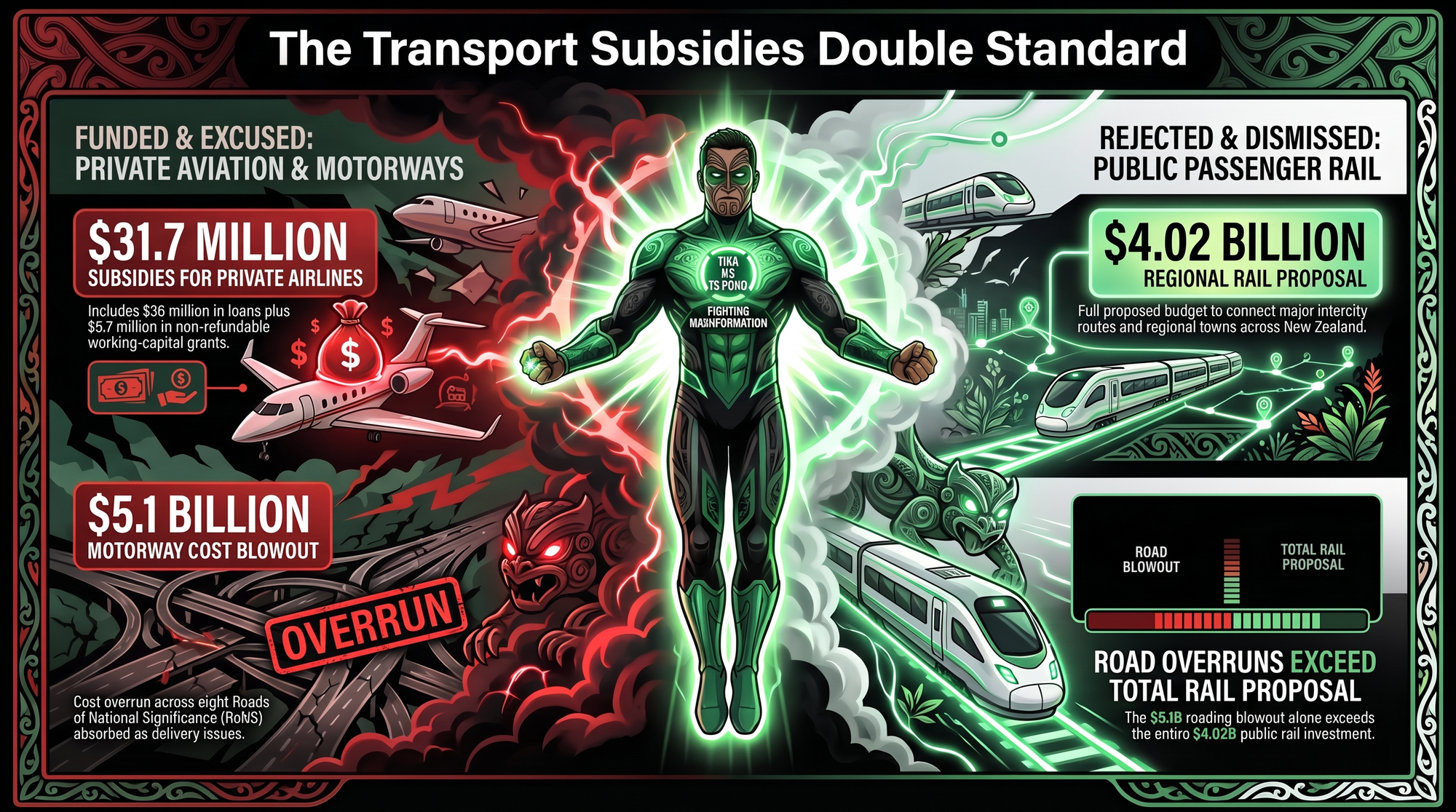
That is at least $31.7 million of identified public support flowing toward private regional aviation businesses.
Some of the loans may be repaid. The $5.7 million grants will not be. That distinction matters. But the political point stands: NZ First accepts that the market does not automatically sustain socially necessary regional transport. When the private airline’s ledger wobbles, Shane Jones says public money must steady it. The Beehive release says the package is intended to protect “vulnerable regional air services”.
That is not a scandal by itself. It is a confession.
It is an admission that transport is a public service, not merely a commercial product.
The moment Jones accepts that for an airline, the “rail must be commercially viable” argument collapses under its own weight.
The Difference Is Not Connectivity — It Is Ownership
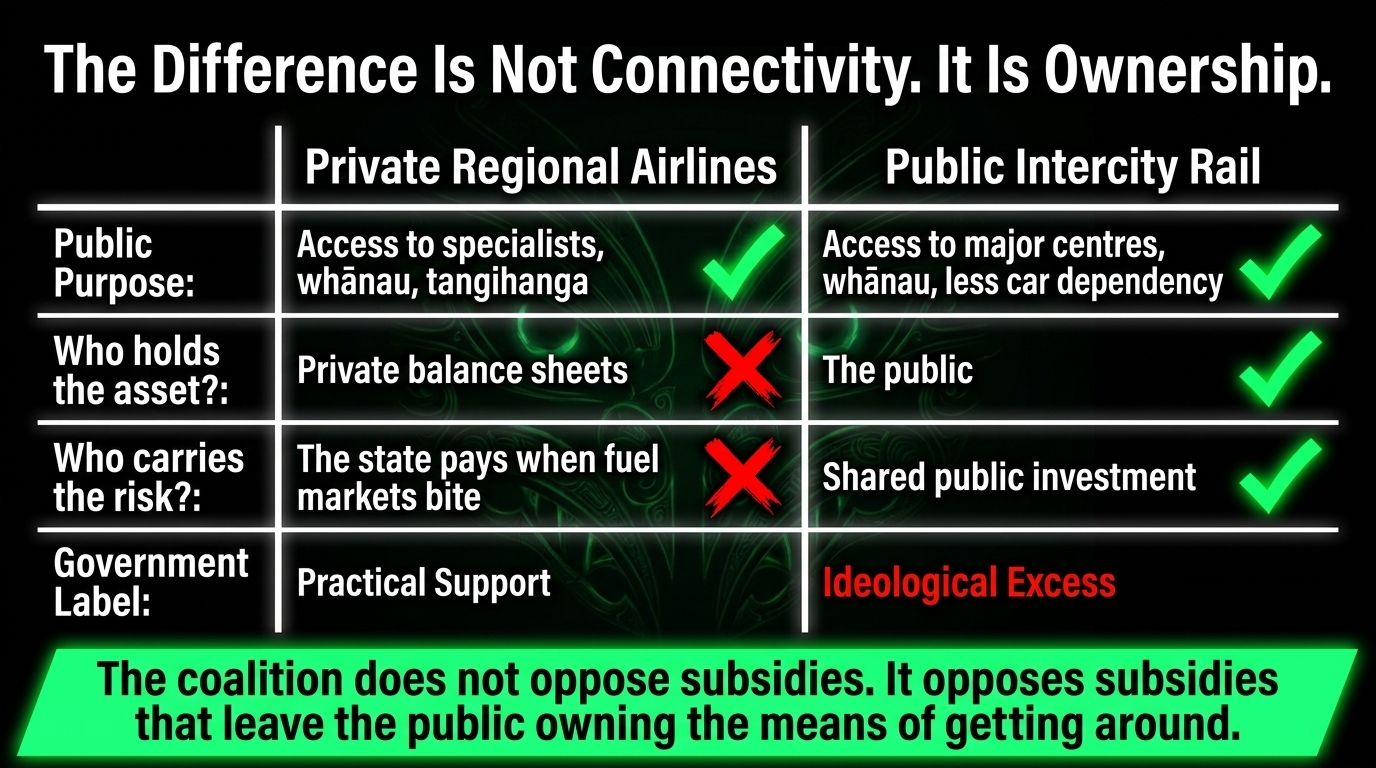
Both proposals claim the same public purpose.
Jones says airline support will preserve access to specialists, family and business opportunities. The Greens say passenger rail would give whānau cheaper, more reliable ways to reach major centres, reconnect towns, and reduce long-distance car dependency. RNZ set out the Greens’ case.
So why is one “practical” and the other a “white elephant”?
Because the airline subsidy helps preserve private businesses. The rail proposal would rebuild public capacity.
The airline owns the aircraft. The airline keeps the customer relationship. The airline holds the operational asset. The state pays the bill when the fuel market bites.
A publicly owned rail corridor is different. Every passing loop, station upgrade, sleeper carriage, signalling improvement and regional connection remains part of the country’s shared infrastructure. It is not a private balance sheet being rescued. It is a public system being rebuilt.
That is the contradiction.
The coalition does not oppose subsidies. It opposes subsidies that leave the public owning the means of getting around.
The “White Elephant” Has A Number Plate
The road machine does not have to prove itself by the same standard.
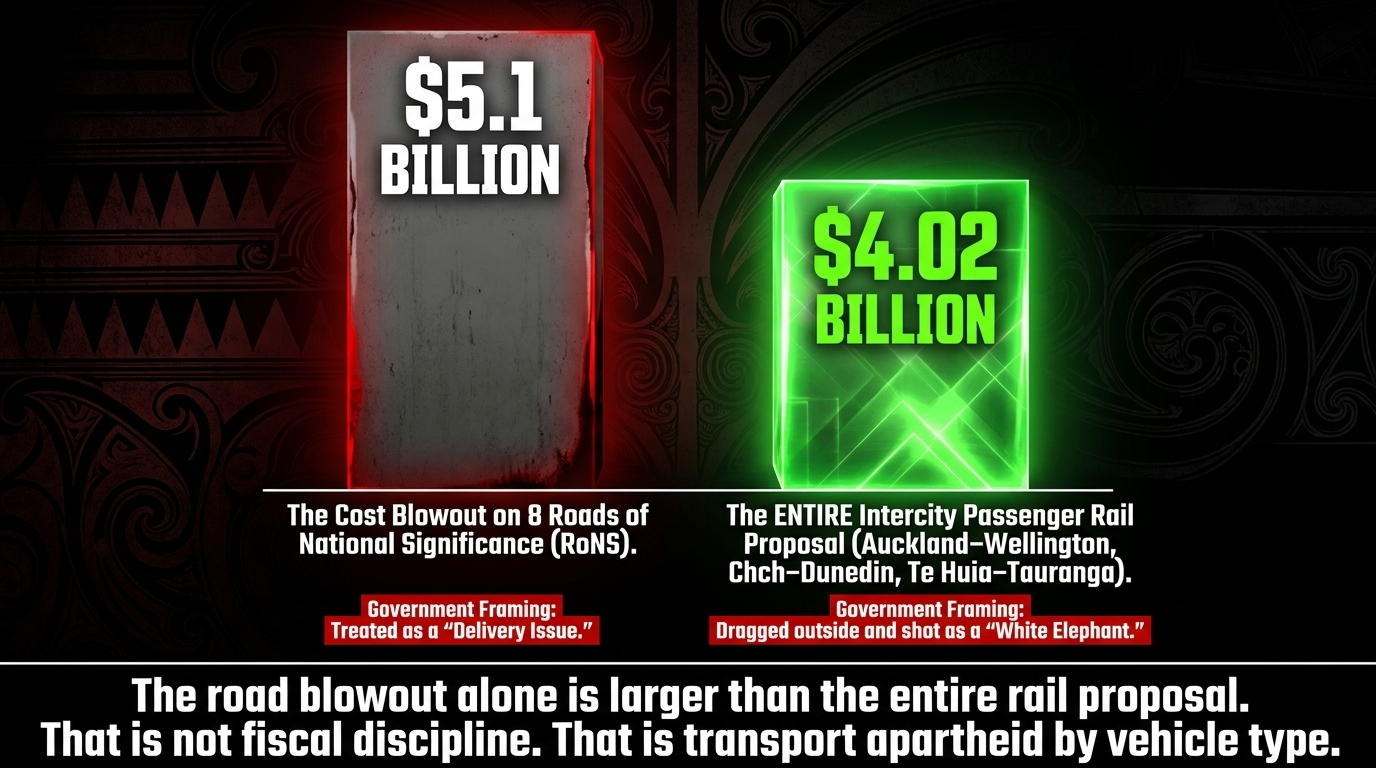
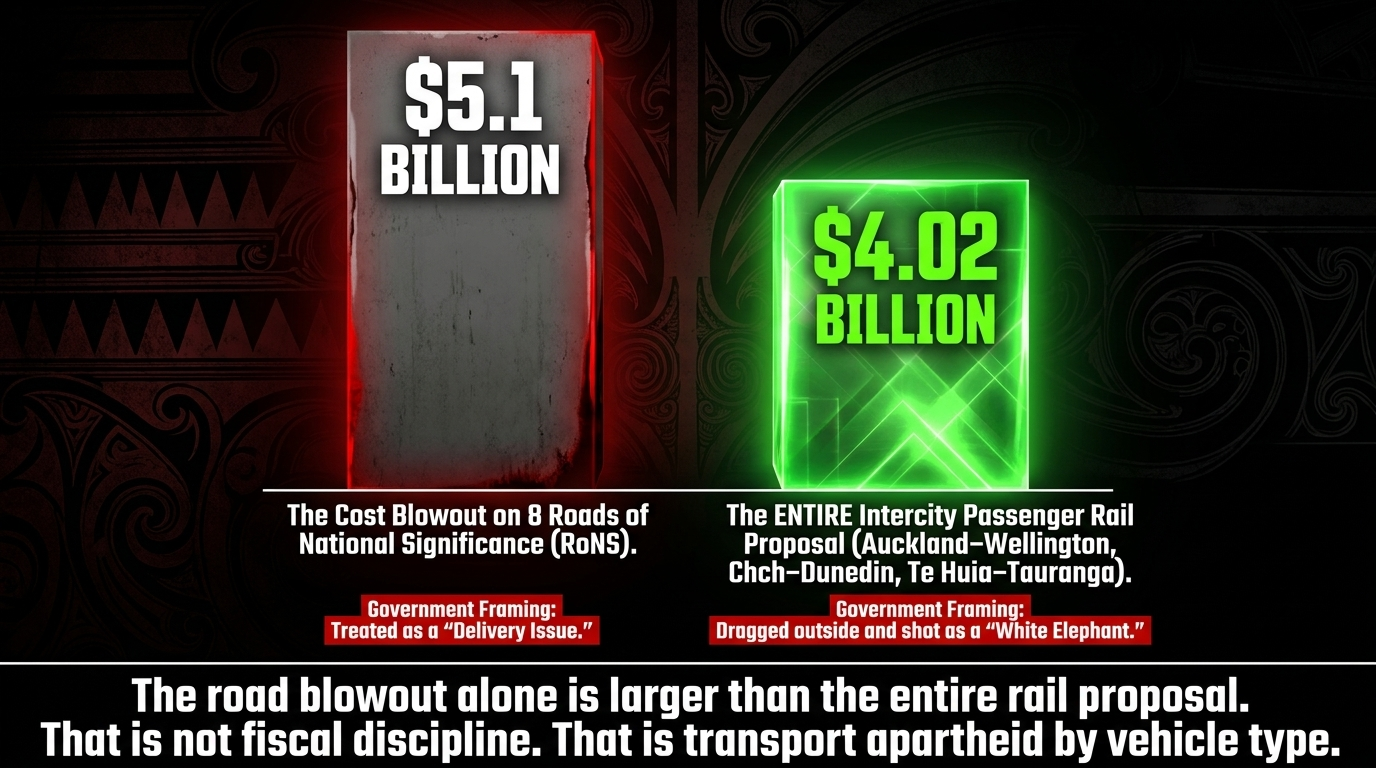
The government can tolerate a reported $5.1 billion blowout across eight Roads of National Significance. It can stretch the benefit period to 60 years, reduce discount rates, and make weak projects look just good enough on paper. Newsroom documented the cost blowout; Greater Auckland examined the changed appraisal assumptions.
But $4.02 billion for intercity passenger rail — Auckland to Wellington, Christchurch to Dunedin, Te Huia to Tauranga — suddenly needs to be dragged outside and shot behind the barn as a “white elephant.” Stuff reported the Green passenger-rail plan at $4.02 billion.
The arithmetic exposes the political choice:
The reported blowout on eight road projects alone is larger than the entire Green intercity passenger-rail proposal.
Yet the road blowout is treated as a delivery issue. Rail is treated as ideological excess.
That is not fiscal discipline. That is transport apartheid by vehicle type.
Tika, Pono And Tikanga
Tika asks what is right. It is right to ensure people in remote places can reach hospital, work, whānau and services. That is why regional aviation needs public support in some places.
But it is not right to apply that principle only where a private firm owns the planes.
Pono asks what is true. The truth is that neither regional air travel, regional passenger rail nor remote-road access survives everywhere on fare-box returns alone. All transport is subsidised. Roads are subsidised through tax, debt, rates, public land, policing, emergency care, crash costs and environmental damage. Aviation is subsidised through targeted support when private operators are under pressure. The question is never whether public money is involved. The question is who gets the benefit, who keeps the asset, and who carries the risk.
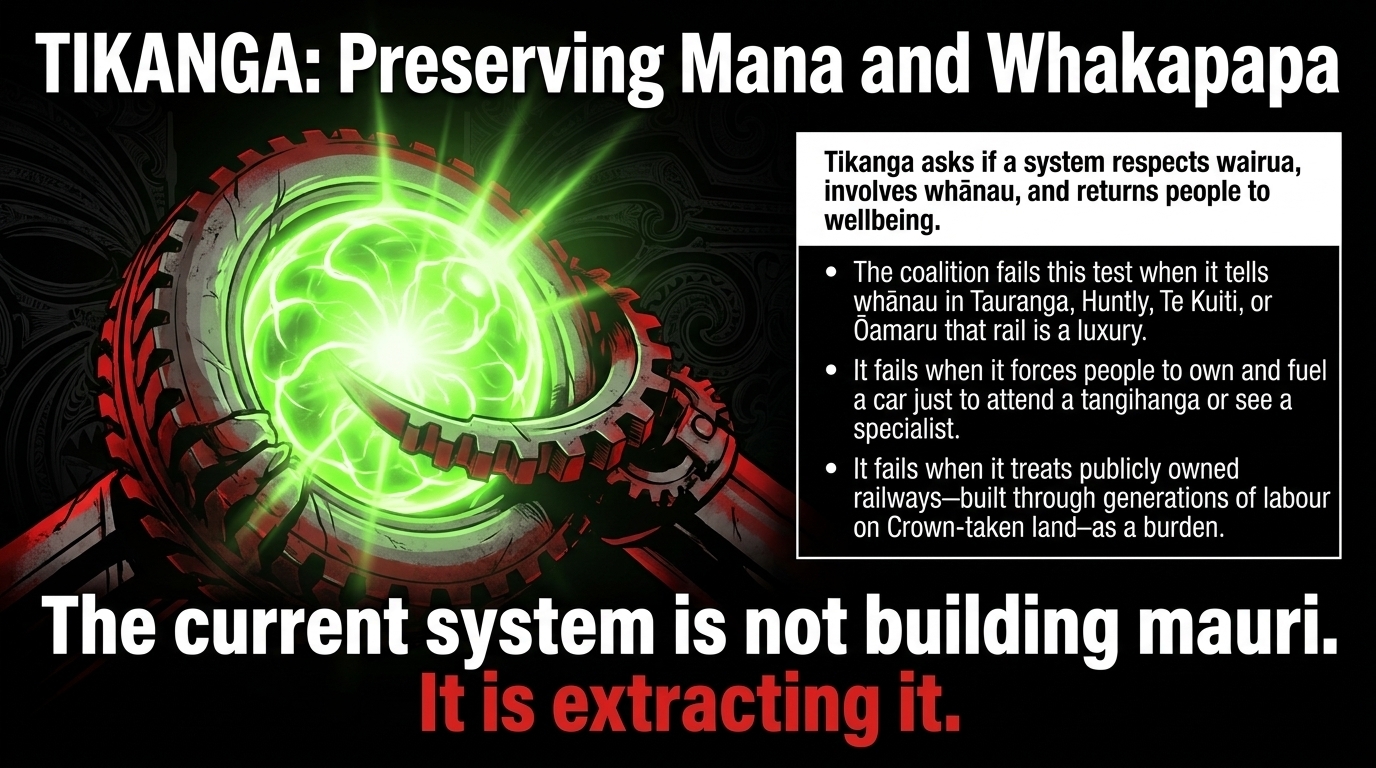
Tikanga asks whether the system preserves mana, recognises whakapapa, respects wairua, involves whānau and returns people to wellbeing.
This coalition fails that test when it tells a whānau in Tauranga, Huntly, Te Kuiti or Ōamaru that rail is a luxury, while subsidising the private carriers whose prices and timetables they cannot control.
It fails when it expects people to own and fuel a car just to see a specialist or attend a tangihanga.
It fails when it treats the publicly owned railway — built through generations of labour and through land often taken under Crown powers — as a burden, while public money flows into private operating accounts.
The system is not building mauri. It is extracting it.
Shane Jones Must Answer The Simple Question
I am not saying regional airlines should receive no support.
I am saying Shane Jones must explain why an airline facing fuel-cost pressure deserves taxpayer-funded working capital, aircraft-finance support and debt-refinancing help — while passenger rail must face a commercial purity test no motorway, private airline or fossil-fuel-dependent transport system ever faces.
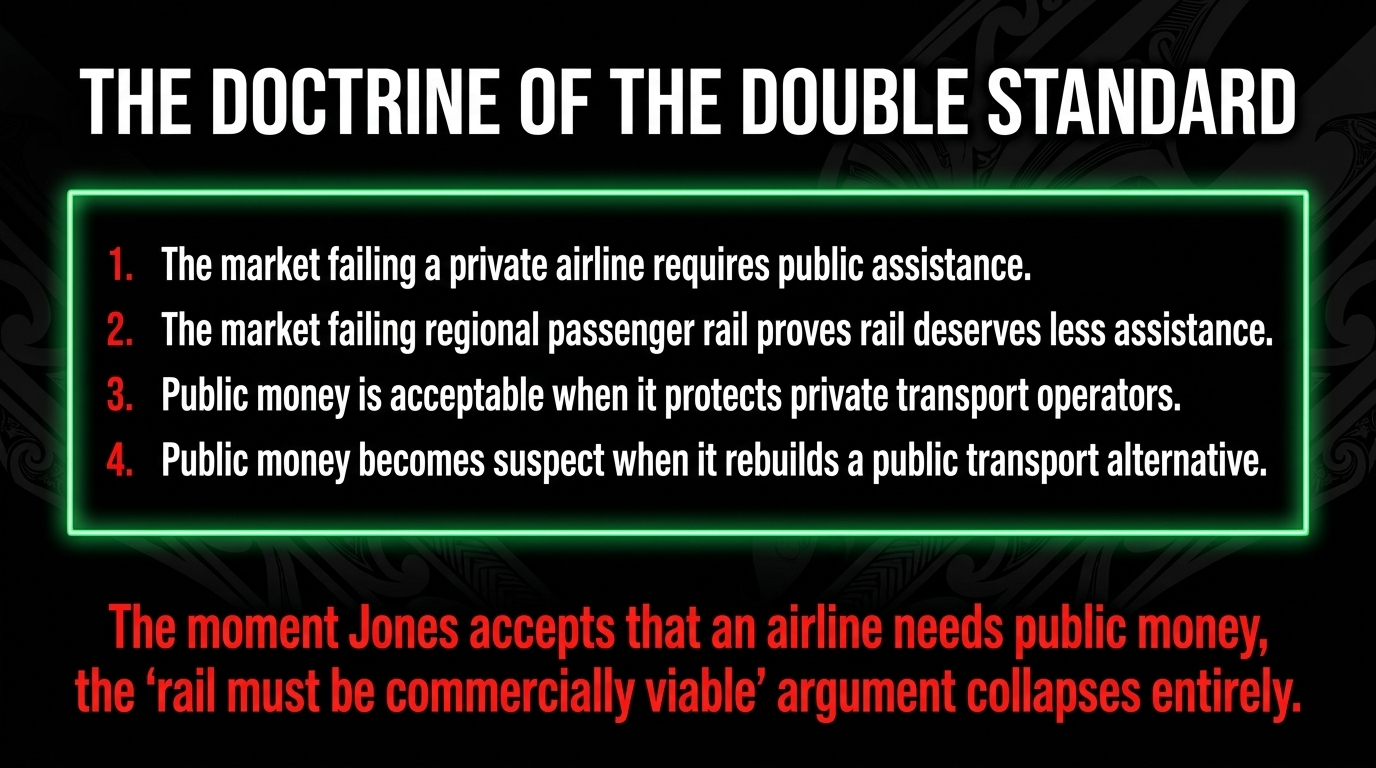
The government has already made its principle plain:
- The market failing a private airline requires public assistance.
- The market failing regional passenger rail proves rail deserves less public assistance.
- Public money is acceptable when it protects private transport operators.
- Public money becomes suspect when it rebuilds a public transport alternative.
That is not economic management. That is ideology wearing a high-vis vest.
The Choice In November
This is why this coalition should not be returned to power.
National keeps digging motorway holes while declaring rail an unaffordable dream. ACT keeps the privatisation door open. NZ First speaks of viability while its ministers spend public money to stabilise the private transport market — then demand that public rail somehow survive without the same recognition of social value.
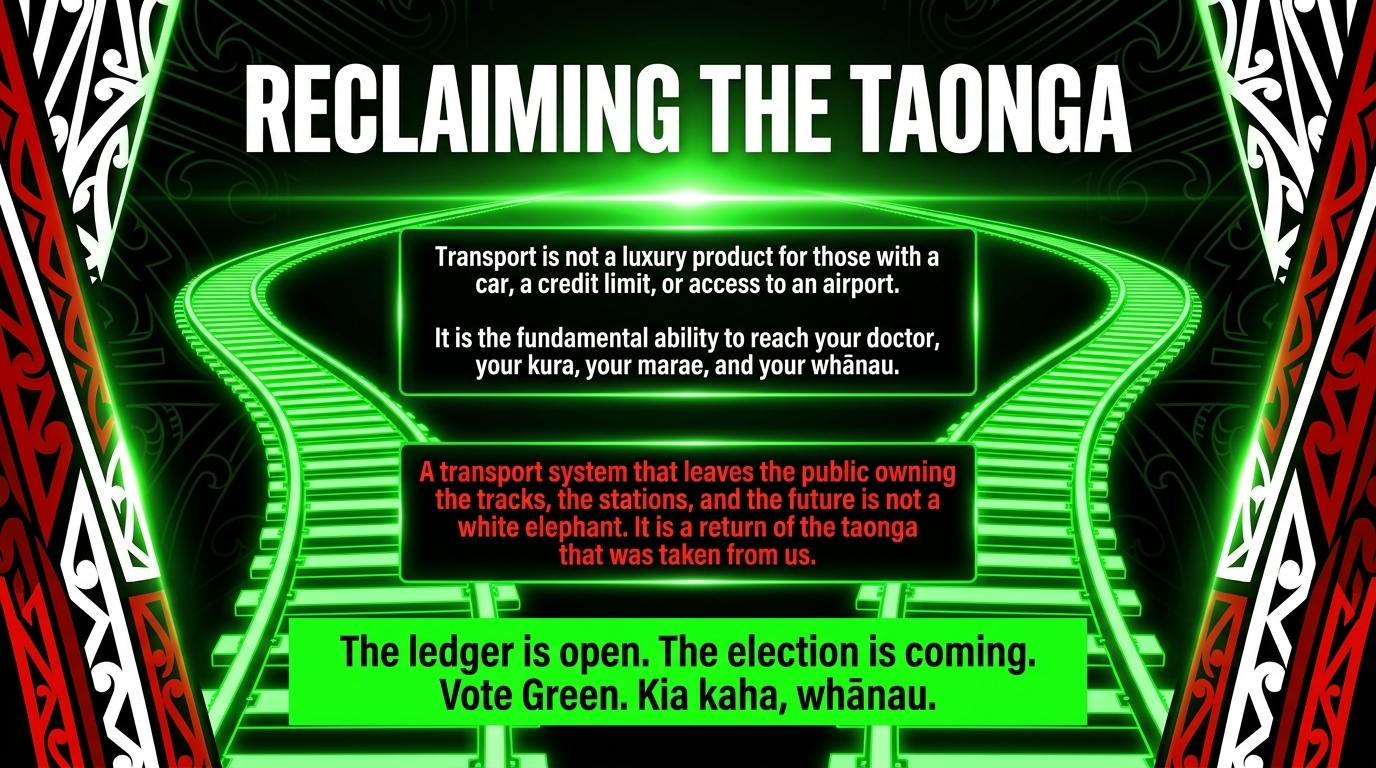
Vote Green because their rail plan begins from the correct premise: transport is not a luxury product for people with a car, a credit limit, or access to an airport. It is the ability to reach your doctor, your job, your kura, your marae and your whānau.
A transport system that leaves the public owning the tracks, the stations and the future is not a white elephant.
It is a return of the taonga that was taken from us.
Kia kaha, whānau. The ledger is open. The election is coming. The question is whether we keep paying private operators to survive — or rebuild the public systems that help all of us live.
Koha Consideration
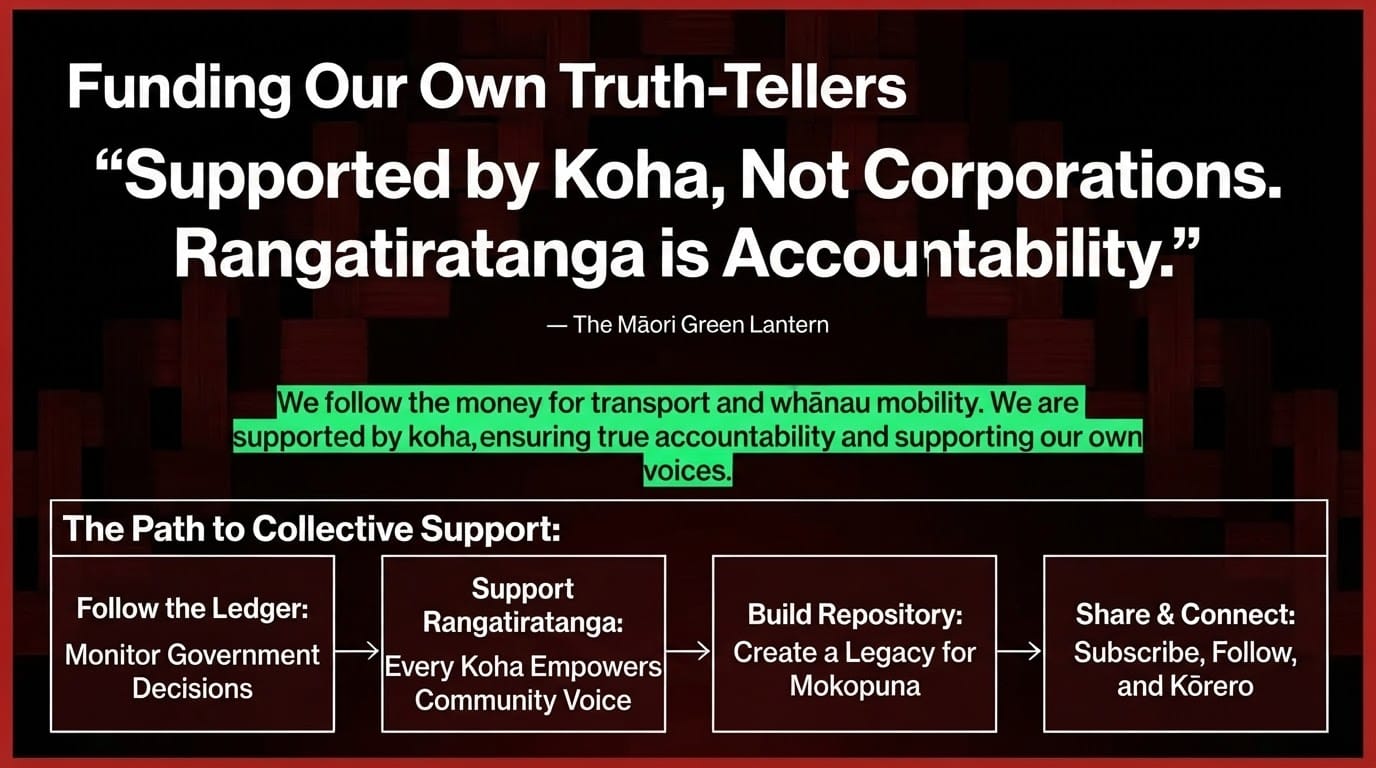
You might ask who supports the Māori Green Lantern to follow the money from a $5.7 million airline grant to the billion-dollar choices made about rail, roads and whānau mobility.
The answer is you. I am supported by koha — not corporations, lobby firms, airline owners, road builders or ministerial access. Every koha says whānau are prepared to support the accountability that Crown and corporate structures will not provide.
Rangatiratanga includes the power to support our own truth-tellers.
Kia kaha, whānau. Stay vigilant. Stay connected. If you are able, consider a koha so this voice can keep tracing the ledger and building a repository for our mokopuna.
If koha is not possible, no raruraru. Subscribe, follow, kōrero and share these essays with your whānau and friends. That is koha too.
- Support this mahi with a voluntary contribution through the Koha platform.
- Receive essays directly and support through a Māori Green Lantern subscription.
- Direct bank support: Ivor Jones, 03-1395-0099387-000.
- Follow and support on Facebook.
Public-interest statement: This is commentary on elected politicians, publicly announced expenditure, transport policy and public ownership. The analysis is in the public interest. Opinion is identified as opinion and grounded in linked material. No allegation of criminal conduct is made. A right of reply and correction process remains available.