"THE CAGE ARCHITECTS: Erica Stanford Is Building Aotearoa's ICE — And a Māori Woman Already Sits in the American Original" - 29 April 2026
"They didn't come for us in the night this time. They waited until we came home to celebrate an uncle's birthday — then they locked the door behind us."

Kia ora ano whānau,
"It invokes images of ICE and invokes images of, you know, blaming asylum seekers for the other problems in society. The government plans to be laser focused on the economy, but when they can't fix that, then it's, well, let's blame the migrants, let's blame the asylum seekers. It's the lowest form of politics that there is."
— Immigration lawyer Stewart Dalley, as reported by RNZ
WHAKATŪWHERA — THE DOOR THEY ARE BUILDING
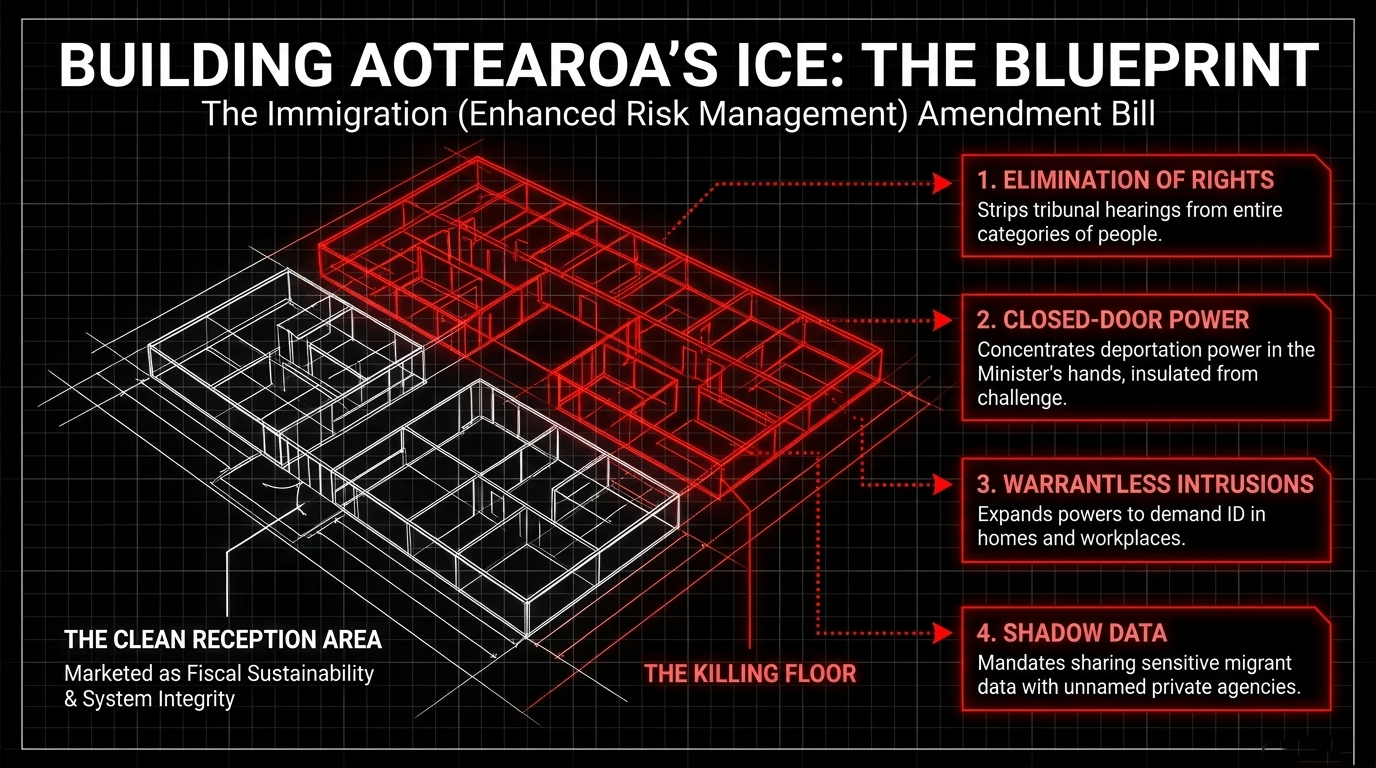
Picture a slaughterhouse.
Not the kind you can see from the road.
The kind with a clean reception area, a brochure about sustainable practices, a minister at the front desk in a blazer, smiling.
The killing floor is in the back. The blood drains quietly. The paperwork is impeccable. The Cabinet paper notes, with bureaucratic serenity, that the product will
"disproportionately affect Pacific nationals"
— and then the conveyor belt moves on.
That is the Immigration (Enhanced Risk Management) Amendment Bill, currently before Parliament with submissions closing this week.
That is the Immigration (Fiscal Sustainability and System Integrity) Amendment Act, already passed on 26 November 2025, with deportation powers coming into force on
27 May 2026
— less than four weeks away.
 Gillian Bonnett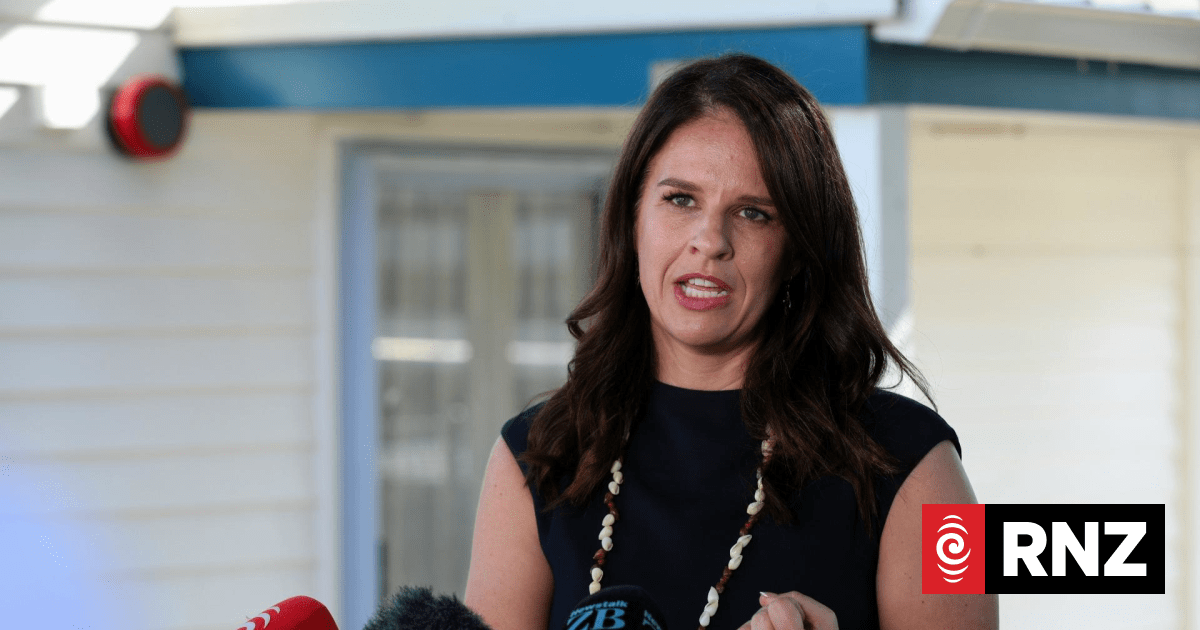
That is Erica Stanford — the minister who also dismantled Māori education, as exposed in Stanford's Colonial Classroom by the Māori Green Lantern
— now turning her expertise in colonial dismantlement to the immigration system.
The Deep Dive Podcast
Listen to a lively conversation between two hosts, unpacking and connecting topics in the sources of this essay.
And on 28 April 2026, RNZ immigration reporter Gill Bonnett published the seven words this government hoped would drown in parliamentary noise:
"Power in immigration bill 'invokes images of ICE', critics say."
Not metaphor. Not hyperbole. The architecture of American immigration terror — named, on the record, by one of New Zealand's most experienced immigration lawyers
— being built in Wellington, brick by brick, clause by clause, with a smile and a press release about fiscal sustainability.
Janatenahuowen
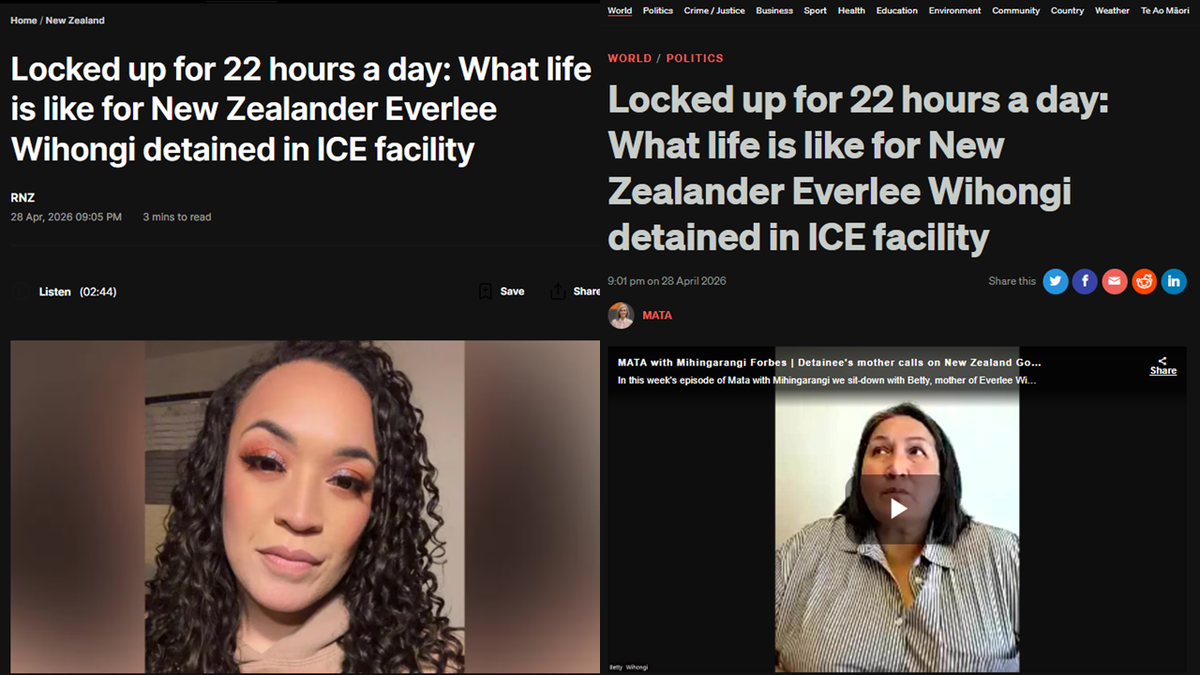
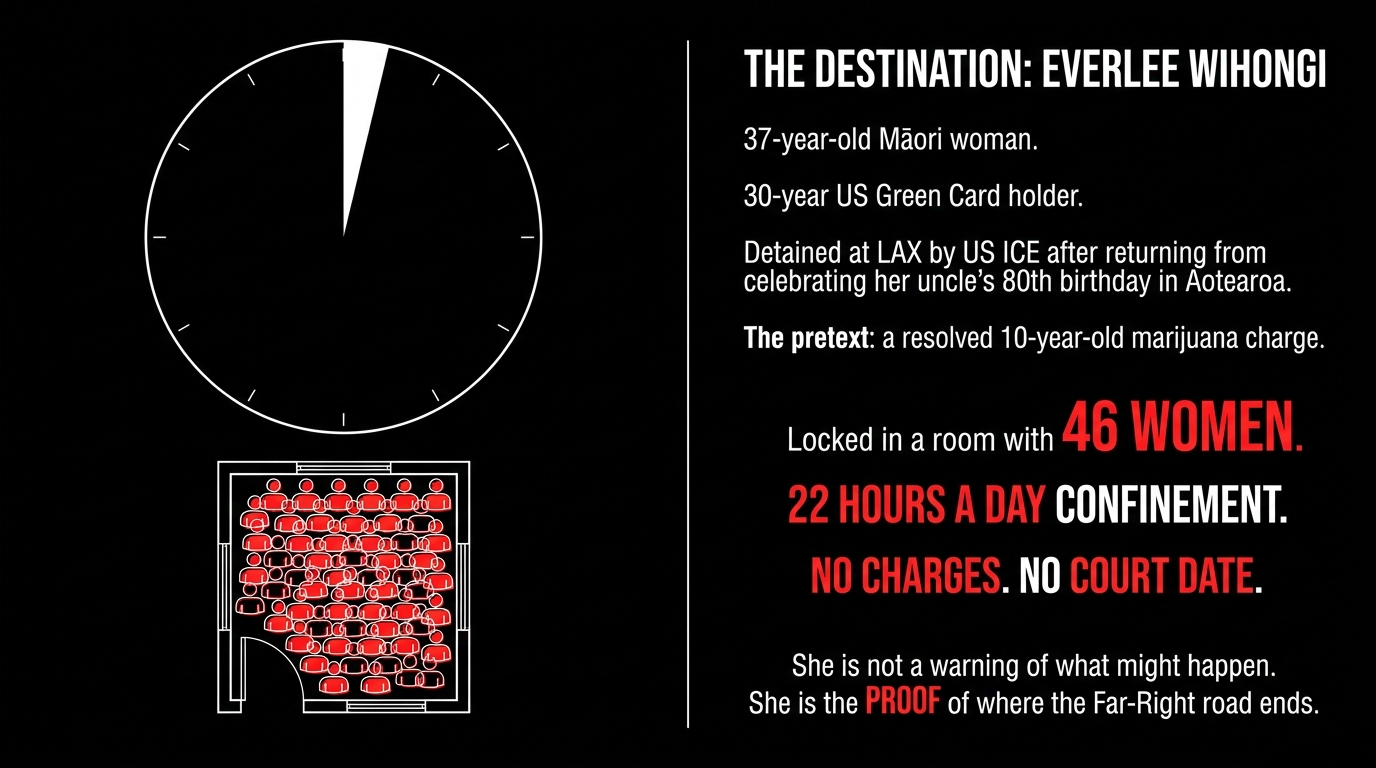
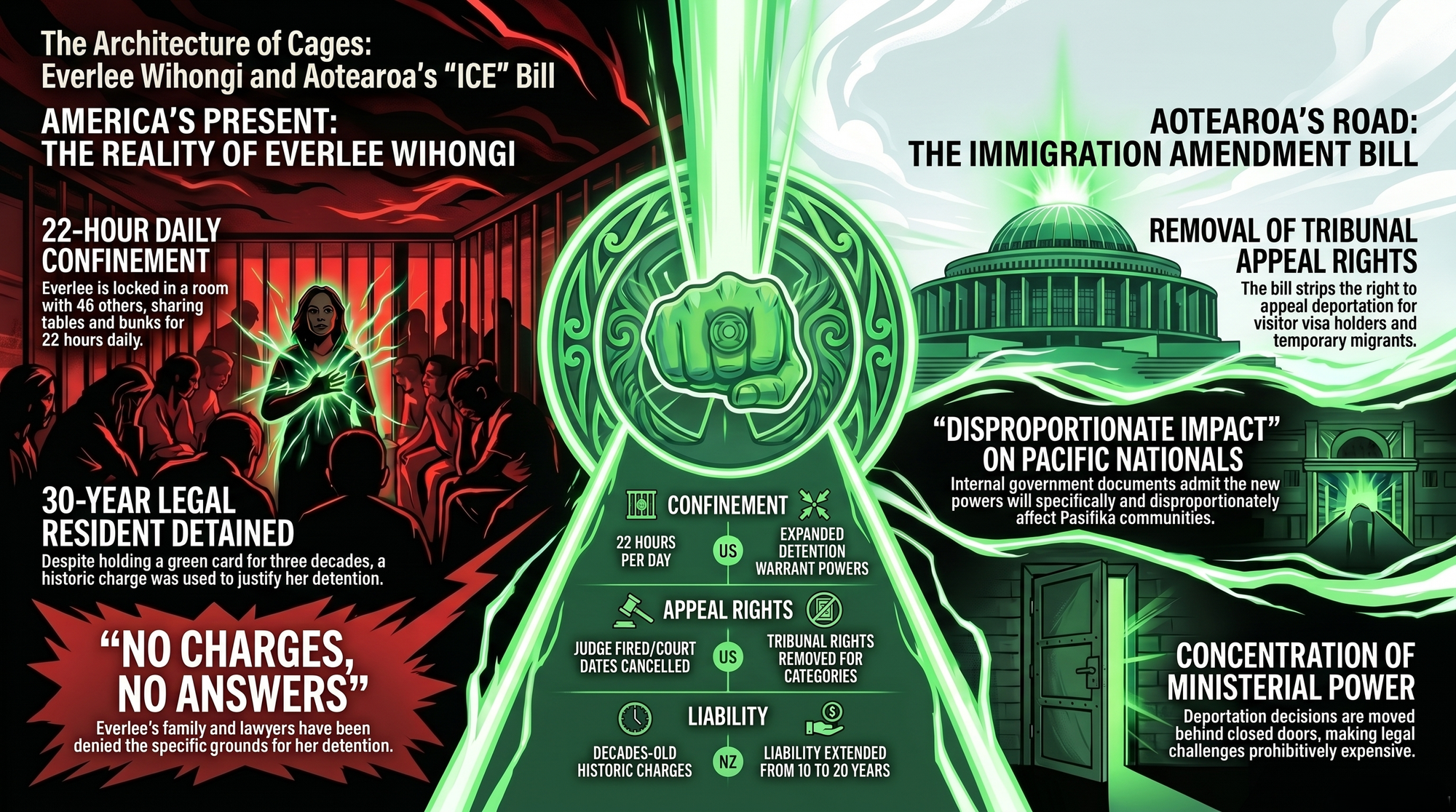
And while that article published, a 37-year-old Māori woman named Everlee Wihongi sat in the Adelanto ICE Processing Centre in California's high desert — locked up 22 hours a day, no charges, no court date, no answers
— because she went home to celebrate her uncle's 80th birthday and the machine got her on the way back, as reported by Te Ao News.
One story is the destination.
The other is the road being built right now, in our name, with our taxes, by people who call themselves our government.
TE TURE — THE BILL, STRIPPED NAKED
Let us not be polite about what this bill does.
It removes the right to a tribunal hearing for entire categories of people. It concentrates deportation decision-making in the hands of the minister — behind closed doors, insulated from challenge except through the High Court, the most expensive legal forum in the country.
It expands immigration officers' powers to demand identification in homes and workplaces without a warrant.
It allows sensitive personal immigration data to be shared with unnamed private agencies — entities the government refuses to name in the very Cabinet paper that creates the sharing obligation.
It prohibits asylum seekers who withdraw their claims from later applying for a visa.
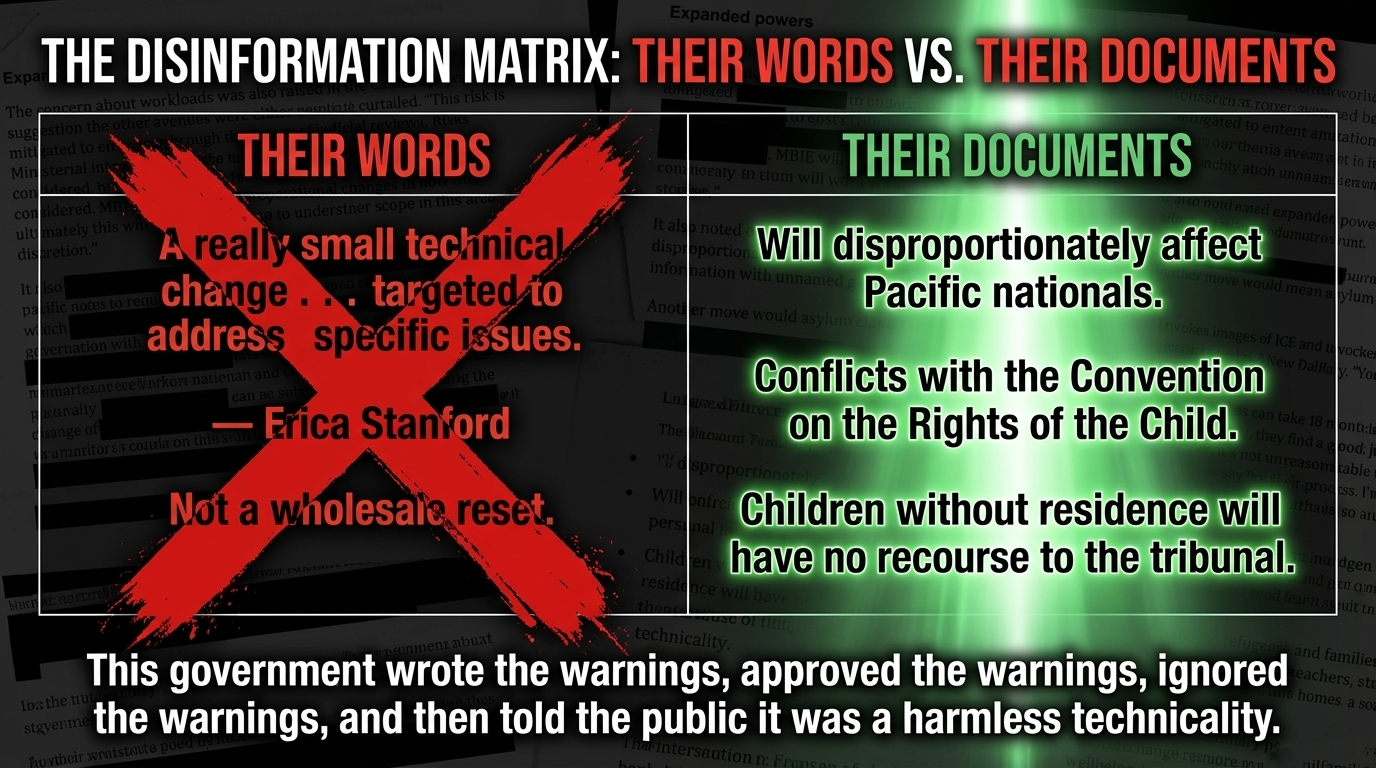
Government documents obtained and reported by RNZ show the Justice Ministry raised concerns that children without residence would have no recourse to the Immigration and Protection Tribunal, leaving them with inadequate ways of challenging deportation.
The Ministry noted a potential conflict with the Convention on the Rights of the Child. MBIE dismissed the concern by pointing to other visa avenues. That is not a safeguard. That is a suggestion to navigate a bureaucratic labyrinth without a guide, in a language that may not be yours, with a clock ticking on your family's right to stay.
The bill's destruction of tribunal rights is not abstract.
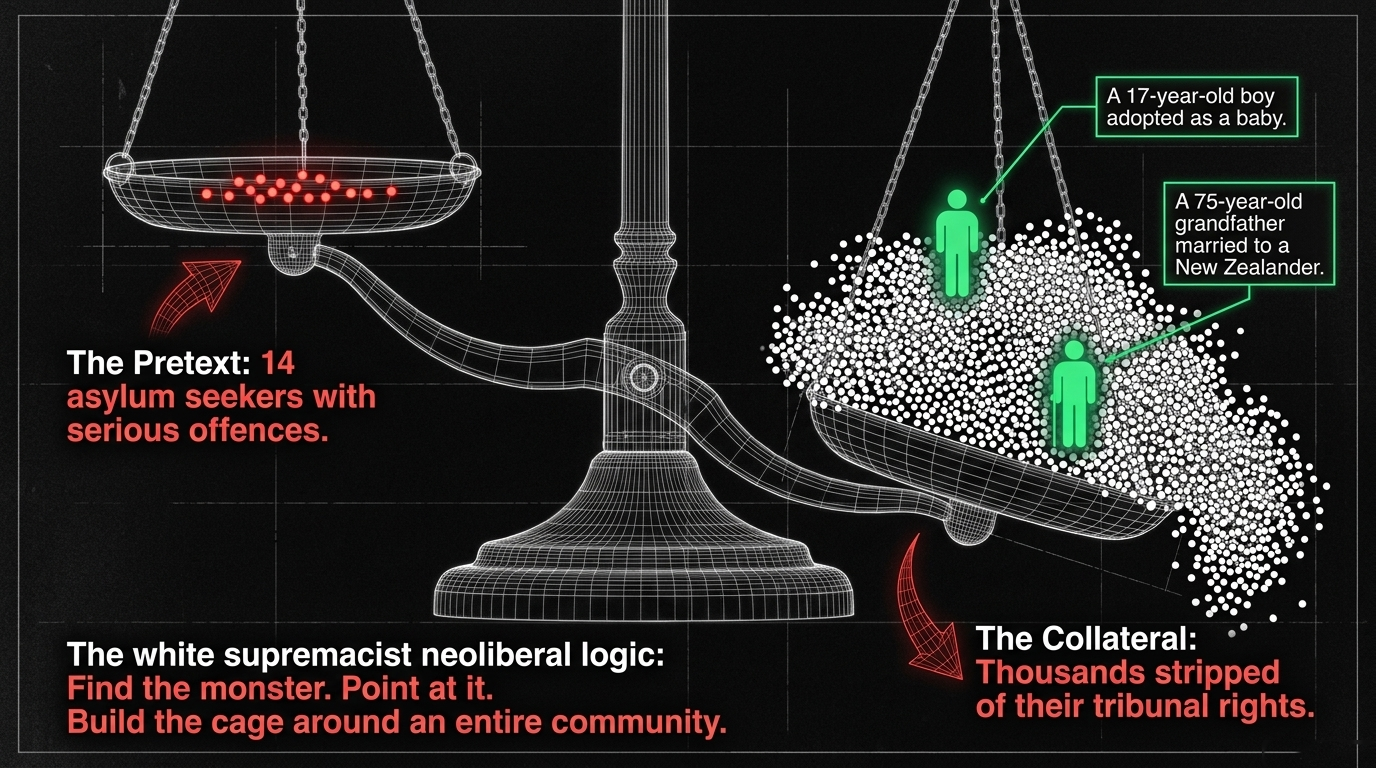
RNZ's Bonnett names who gets discarded: a 17-year-old boy adopted as a baby. A 75-year-old man married to a New Zealander.
Both had successful tribunal appeals under the current system — appeals that, under Stanford's bill, they would never have been permitted to make.
A child. A grandfather. Erased by ministerial discretion behind closed doors, with the High Court their only recourse — the court that costs tens of thousands of dollars to access, the court that is, by the Cabinet paper's own admission, a deterrent rather than a pathway. The government called that deterrent a mitigation.
Immigration lawyer Stewart Dalley — a man who has worked inside this system for years — named it with the precision it deserves:
"[The bill] says, we don't trust the Immigration and Protection Tribunal to make these decisions. I want to make the decision, but I want to make the decision behind closed doors without anybody being able to effectively challenge me."
That is not immigration policy. That is a minister building herself a court she can never lose — and making sure the people she rules against can barely afford to appeal.
TORU NGĀ TAUIRA — THREE EXAMPLES FOR THE WESTERN MIND
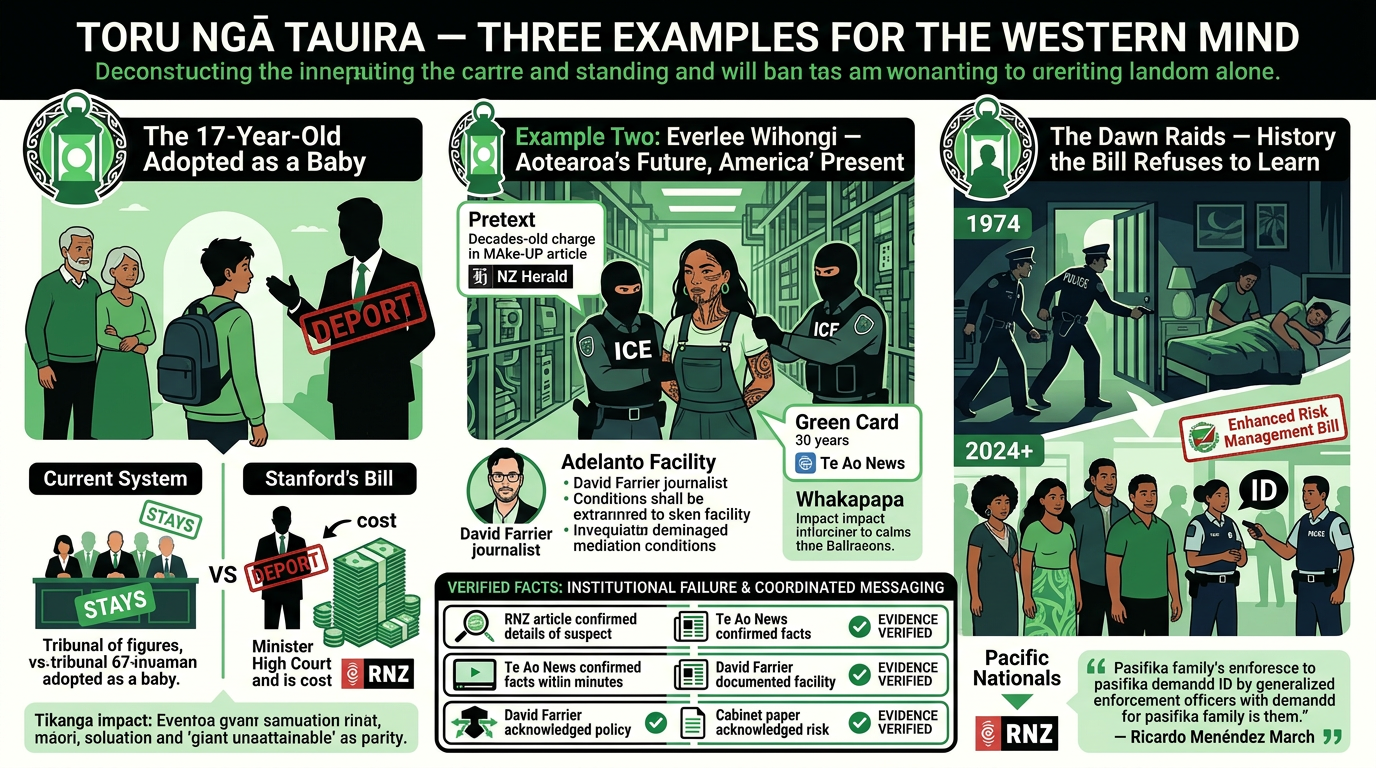
For those who have not yet felt this on their own skin, here are three concrete demonstrations of exactly what this architecture produces, what it destroys, and what tikanga demands in response.
Example One: The 17-Year-Old Adopted as a Baby
A child was adopted as a baby. He knows no other country. He speaks no other language. He has no memory of the place his birth certificate names. He is, in every meaningful human sense, from here. He made a mistake — the kind teenagers make — and faces deportation to a country that is a stranger to him.
Under the current system, his lawyer brings him before the Immigration and Protection Tribunal. The tribunal weighs his exceptional humanitarian circumstances against the public interest. The tribunal hears the truth of his life. The tribunal says: this child belongs here. He stays.
Under Stanford's bill, there is no tribunal. There is a minister, behind closed doors, with no obligation to hear his story, whose decision can only be challenged in the High Court — at a cost that will consume his whānau's savings and years of their lives. The bill's own Cabinet paper acknowledges the risk of judicial review being prohibitively costly. It describes that cost as a "mitigation" of ministerial workload.
This is what tikanga calls whakamā weaponised by the state: the deliberate construction of shame, inaccessibility, and silence as policy tools. A child with no other home, processed through a system designed to exhaust his family into giving up.
For the western mind: imagine your 17-year-old, adopted at birth from another country, facing deportation to a place he has never known. Now imagine the only court he can access costs $50,000 to enter. Stanford's bill makes that the standard. The RNZ article names this case. It is real. It has already happened once — because the tribunal worked. Under the new bill, it cannot happen again.
Example Two: Everlee Wihongi — Aotearoa's Future, America's Present
Everlee Wihongi is a welder and make-up artist who has lived legally in the United States for over 25 years, holding a valid green card for 30 of them, as confirmed by Te Ao News. She returned from her uncle's 80th birthday in Aotearoa. ICE agents seized her at LAX on 10 April 2026. They ripped papers from her hands. They refused to let her read what she was signing. They took her to Adelanto — a facility journalist David Farrier, who drove there himself, documents as having a history of documented civil rights violations — where she is locked in for 22 hours a day with 46 other women, purchasing her own hygiene products, watching the lights that never fully go dark.
The pretext: a resolved marijuana charge and a previously reported stolen green card — decades-old history, weaponised at the moment of maximum political enforcement. Her court date was cancelled when the Trump administration fired her immigration judge. Her lawyer was told to petition the court simply to obtain the grounds for her detention, as the NZ Herald reported on 19 April 2026.
Her aunt:
"We don't know why she's being held. To find out, we need to get a form that ICE won't give us."
For the western mind: this is what expanded ministerial discretion, reduced judicial oversight, and enforcement-first immigration architecture looks like when it reaches full operational capacity. A 30-year green card. Resolved charges. A birthday. A cage. That is the destination Stanford is building the road toward. The difference between Adelanto and what the Enhanced Risk Management Bill enables is not philosophical. It is a matter of degree and time.
Impact on tikanga: In te ao Māori, whakapapa — the web of relationships that defines who we are and where we belong — is not a bureaucratic category. It cannot be cancelled by a ministerial decision behind closed doors. Everlee went home for her uncle's 80th birthday because whakapapa demanded it. The state seized her for it. When a system punishes the enactment of whakapapa, it does not merely inconvenience a person. It attacks the foundation of Māori identity itself.
Example Three: The Dawn Raids — History the Bill Refuses to Learn
In 1974, the Labour government set up police taskforces that conducted dawn raids on Pacific homes across Auckland. Overstayers became scapegoats as unemployment rose. The raids were racially targeted: European overstayers — who outnumbered Pacific overstayers — were not subjected to the same enforcement. The machinery moved by race, not by law.
Fifty years later, the government's own Cabinet paper for the Enhanced Risk Management Bill acknowledges that expanded immigration officer powers to demand identification will "disproportionately affect Pacific nationals." RNZ reported this admission directly from government documents. The government published this warning — wrote it themselves — and then introduced the bill anyway.
Green Party MP Ricardo Menéndez March named it plainly when the bill passed its first reading:
"The government is taking a Trump-like approach to immigration by targeting undocumented migrants, including our Pacific communities who have already faced the intergenerational damage of the dawn raids."
For the western mind: imagine a government writes in its own internal planning document that its proposed policy will disproportionately harm a specific ethnic community. Then imagine it introduces the policy anyway. Then imagine it calls the community's concerns adequately addressed. This is not negligence. This is contempt — the same contempt that conducted the dawn raids in 1974, the same contempt the state has never fully accounted for, as RNZ's historical reporting confirms.
The Māori Green Lantern has documented this pattern of racialised state violence extensively — in The Nursery of Cages, where the assembly line from brown child to brown prisoner is traced station by station — and this bill is simply the immigration wing of the same factory.
TE REO O TE HĀPORI — THE VOICES THIS GOVERNMENT TRIED TO DROWN
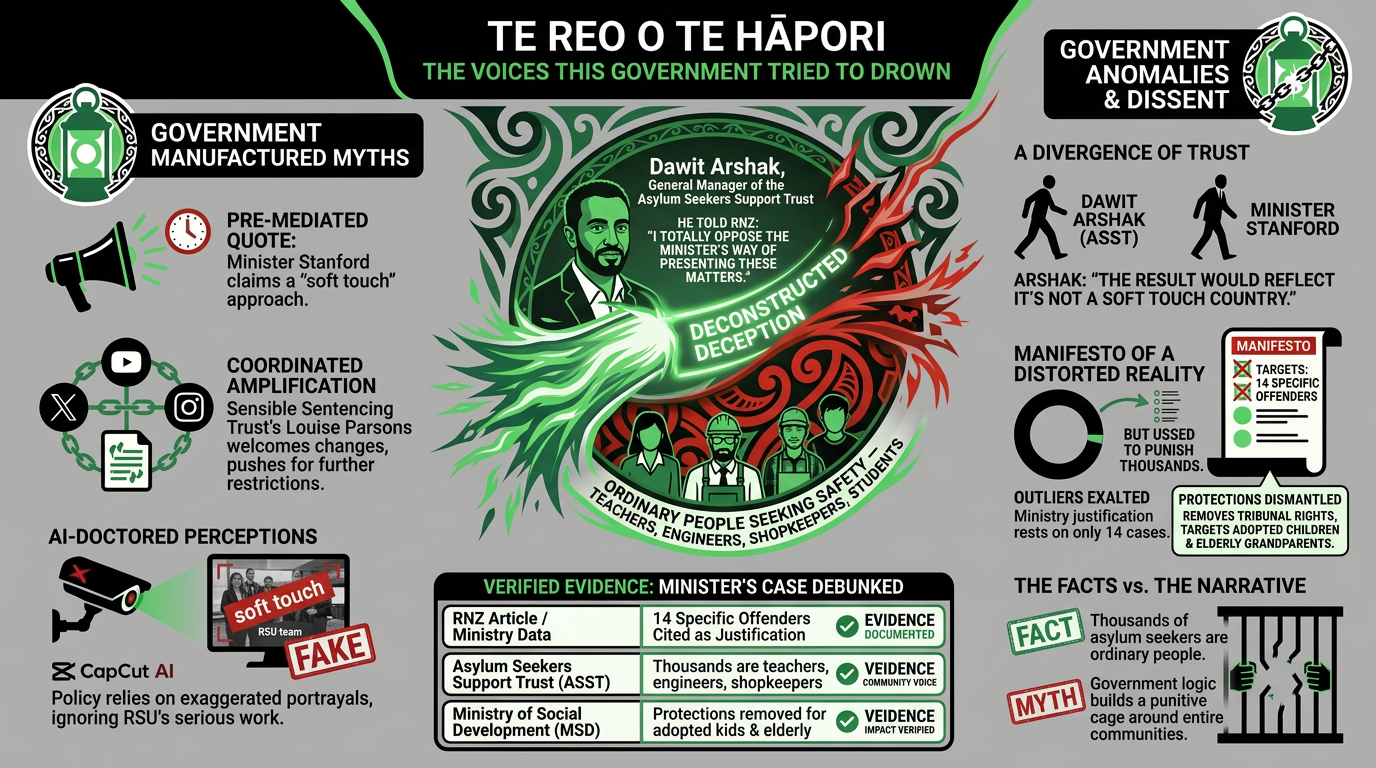
Dawit Arshak, General Manager of the Asylum Seekers Support Trust, did not mince words when confronted with Stanford's "soft touch" framing.
"I totally oppose the minister's way of presenting these matters. In the RSU, her own team are working hard and they are processing these things seriously and the result would reflect that it's not a soft touch country."
His organisation's description of who asylum seekers actually are deserves to ring from every parliamentary chamber in this country:
"Overwhelmingly the people and families seeking asylum are ordinary people like you or me — teachers, engineers, shopkeepers, students — who never imagined when they packed their bags, fled their homes and crossed a border to seek safety that their lives would unfold this way."
Stanford's justification for the entire edifice of removed rights, ministerial concentration of power, and ICE-evoking enforcement expansion rests on 14 cases — fourteen asylum seekers who committed serious offences in New Zealand. Fourteen. Against those 14, she dismantles the tribunal rights of thousands, removes protections for adopted children and elderly grandparents, expands warrantless enforcement into homes and workplaces, and shares sensitive data with unnamed private agencies. This is documented directly in the RNZ article.
This is the white supremacist neoliberal logic at full operation: use the worst possible outlier to justify dismantling protections for everyone. Find the monster. Point at it. Build the cage around an entire community.
The Sensible Sentencing Trust's Louise Parsons welcomed Stanford's changes and wanted her to go further. Her presence in this policy conversation is not coincidental. This is the same organisation that has spent decades using worst-case offenders as cover for building a punitive state that falls, always, hardest on Māori and brown bodies. Her endorsement of Stanford's bill is not a recommendation — it is a diagnosis.
TE WHAKAPAPA O TE MANA KINO — THE GENEALOGY OF THIS CRUELTY
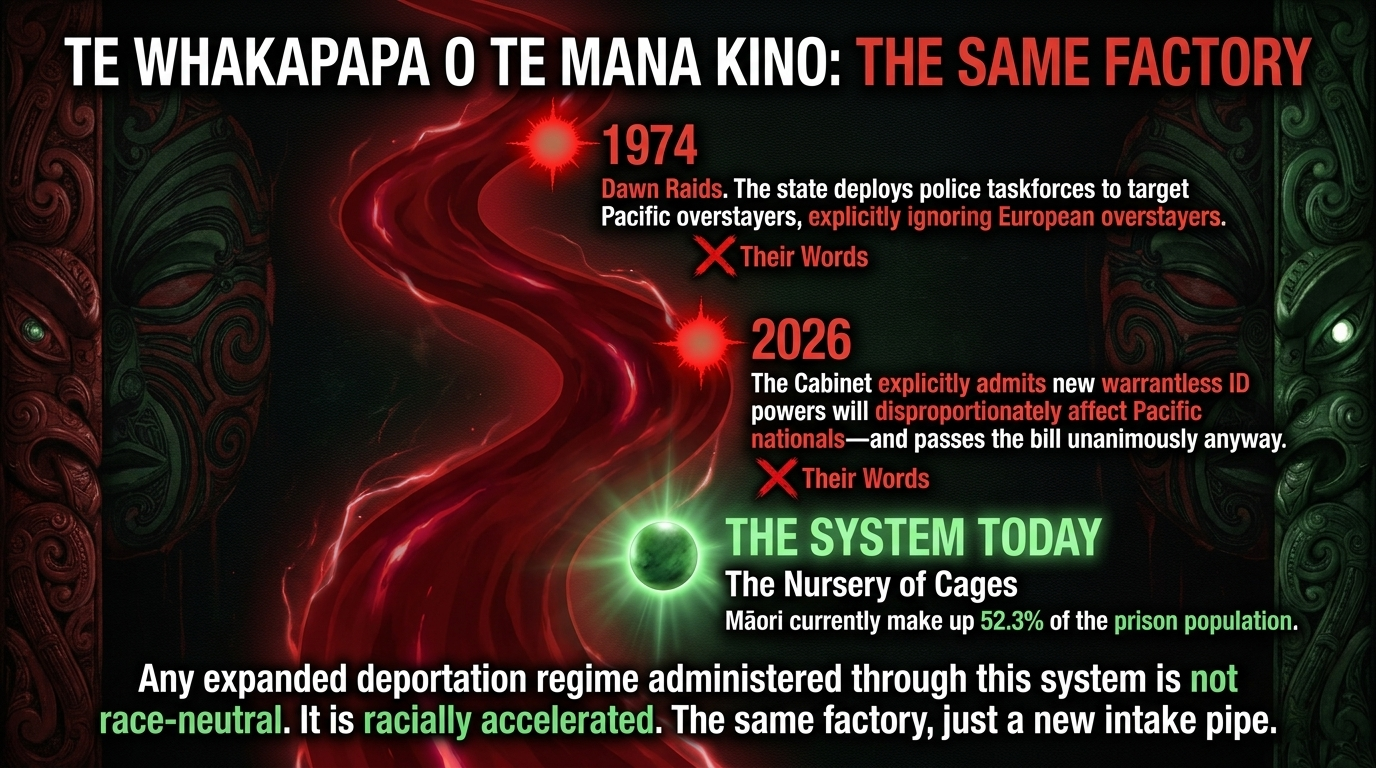
This cruelty does not begin with Erica Stanford. It has deep whakapapa in this government, and in the man who built the political permission structure for all of it.
Winston Peters — Foreign Affairs Minister, Deputy Prime Minister, and the man responsible for Everlee Wihongi's welfare — told the NZ Herald in July 2025 that "careless immigration" is "transforming cities" and described Nigel Farage's Reform Party as "compelling." Farage built his political career on the explicit claim that Britain is being destroyed by brown people arriving from elsewhere.
Peters calls that compelling. He is now the minister who must advocate for a Māori woman in a California cage. He has said nothing.
As the Māori Green Lantern documented in Winston Peters — A Walking Contradiction, A Forked Tongue in a Taonga He Was Never Worthy Of, Peters is not a man who stumbled into contradictions. He is a man who built a career on them — championing Māori rights when it earned votes, abandoning brown communities when it cost political capital.
His silence on Everlee Wihongi is not a lapse. It is decades of practice.
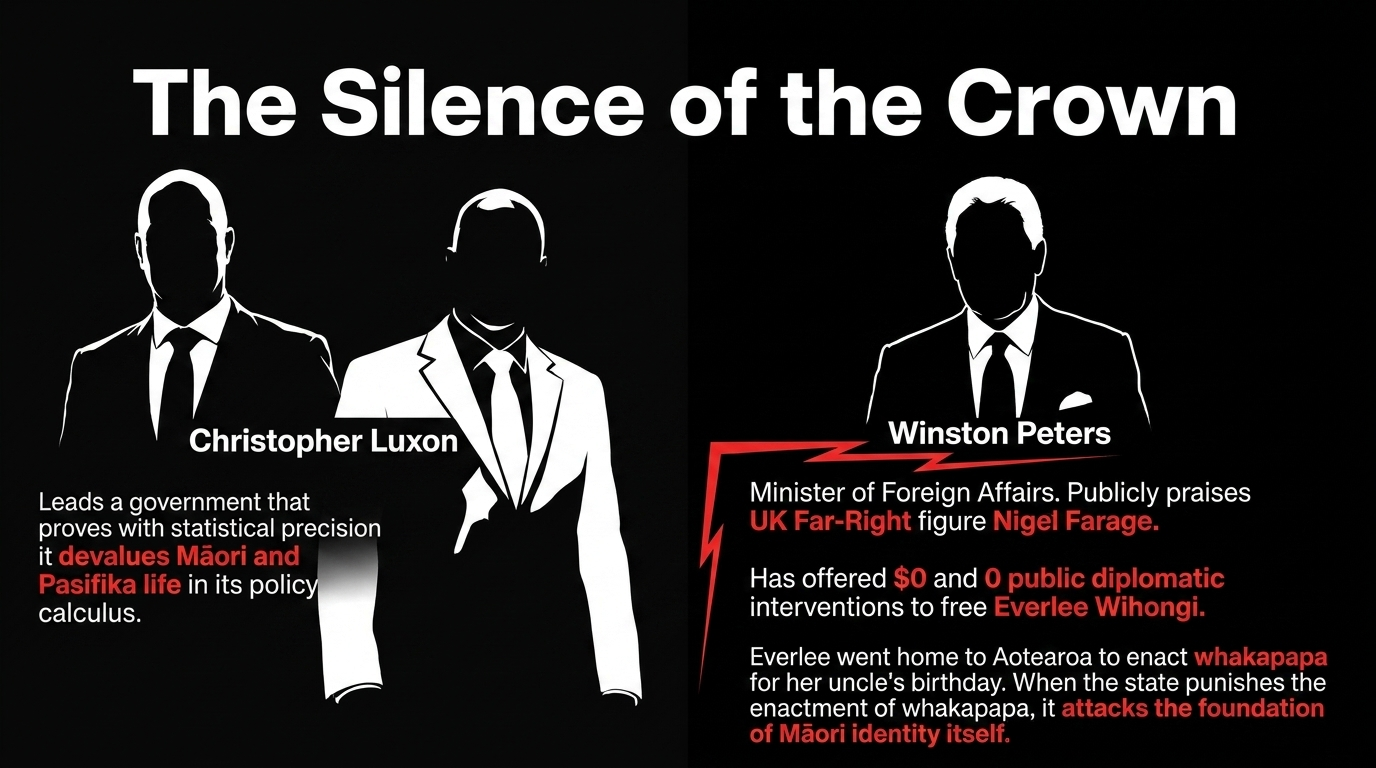
Christopher Luxon leads this government. As the Māori Green Lantern documented in The Trapdoor Prime Minister, this is a man whose government
"has spent two years proving with statistical precision that it does not consider Māori and Pasifika to be fully human in the calculus of policy."
The immigration enforcement expansion is not a departure from that record. It is its logical completion.
Te Ara records that New Zealand's immigration policy was explicitly designed to maintain a white majority population until the 1970s. The 1987 Immigration Act formally eliminated racial discrimination in law.
What Stanford's bill demonstrates — with its own Cabinet paper's racial impact admissions, its removal of tribunal rights, its concentration of ministerial power, its unnamed private agency data sharing — is that racial discrimination does not require explicit racial language.
It requires only enforcement discretion, narrowed judicial oversight, and the political will to look away from who bears the cost.
The Dawn Raids were racially targeted. The state never fully accounted for them. This history is documented by RNZ. Now the Cabinet paper writes the racial impact analysis, buries it in a footnote, and calls the bill targeted.
The cycle is not broken. It is accelerating — in high heels and a blazer, with better parliamentary drafting.
As the Māori Green Lantern exposed in The Nursery of Cages, Māori comprise 52.3% of the prison population — a system built station by station to consume brown children, process them through brutalising institutions, and stamp them with a number.
Any expanded immigration detention and deportation regime administered through this system is not race-neutral. It is racially accelerated. It is the same factory with a new intake pipe.
TE TAUNAHA A TE KĀWANATANGA — THE GOVERNMENT'S OWN CONFESSIONS
The most devastating evidence against this government is not from its critics. It is from its own documents.
The Cabinet paper, as reported by RNZ's Gill Bonnett, contains the following admissions, written by government officials, approved by ministers, and then used as the basis for proceeding with the bill:
- Expanded officer powers to demand ID will "disproportionately affect Pacific nationals"
- Sharing sensitive immigration data with unnamed government and private agencies "could undermine trust"
- Removing tribunal rights creates a risk of High Court judicial review — a risk the paper describes as "mitigated" by the cost and scope of judicial review being prohibitive
- The Justice Ministry raised concerns about conflict with the Convention on the Rights of the Child
- Children without residence would have "no recourse" to the tribunal
This government wrote these words. Approved these words. Published these words in an internal planning document. Then introduced the bill, called it targeted, called it proportionate, called it a "really small technical change", and asked you to trust them.
New Zealand Law Society formal submissions flagged expanded detention warrant powers going beyond current legal settings. The Human Rights Commission — Tika Tangata warned that the UN Committee Against Torture has explicitly recommended New Zealand avoid detaining asylum seekers in Corrections facilities, and that detention must be a last resort, individually assessed, for the shortest possible period.
The government received these submissions. The committee passed the bill unanimously. The government called the concerns addressed.
That is not democracy. That is the performance of democracy over the machinery of racial enforcement.
TE TOHU — THE NUMBERS THAT MUST BE NAMED
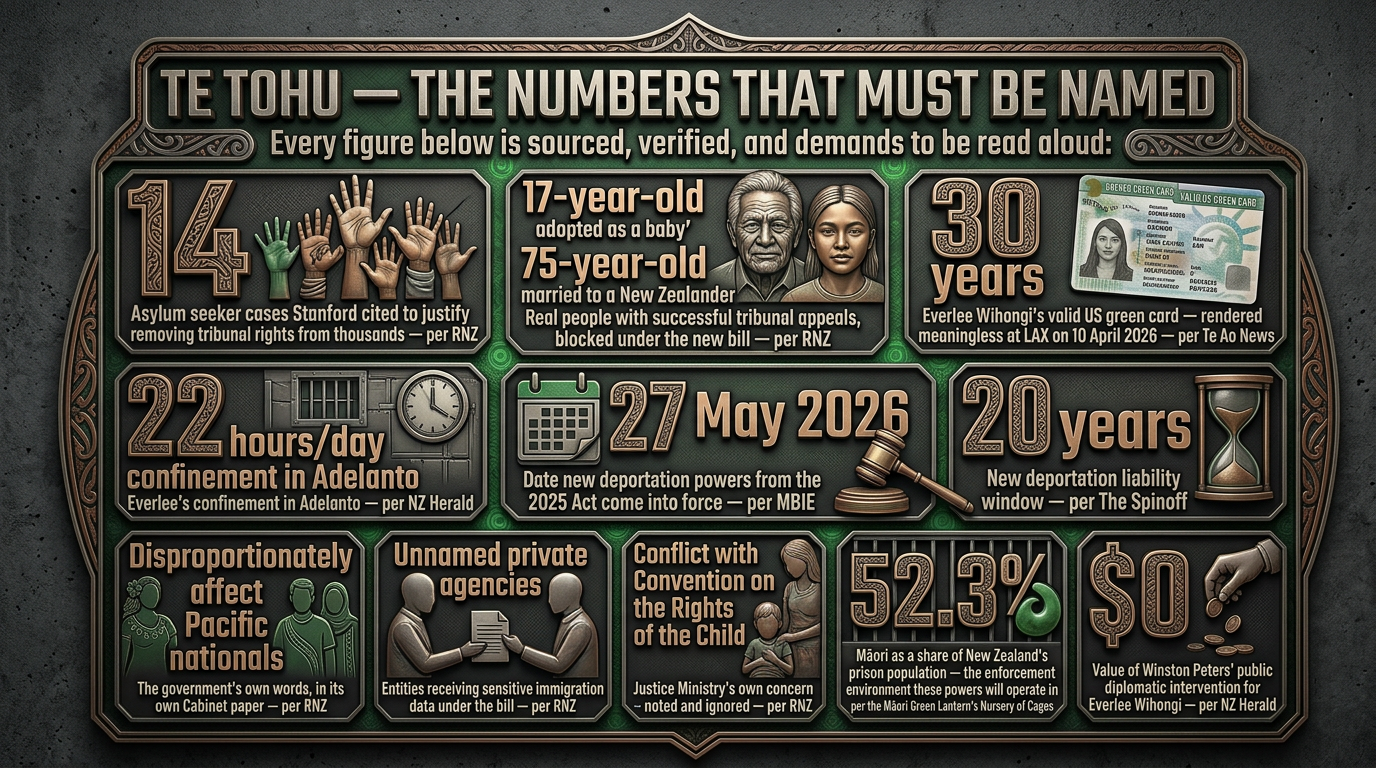
Every figure below is sourced, verified, and demands to be read aloud:
- 14: Asylum seeker cases Stanford cited to justify removing tribunal rights from thousands — per RNZ
- 17-year-old adopted as a baby / 75-year-old married to a New Zealander: Real people with successful tribunal appeals, blocked under the new bill — per RNZ
- 30 years: Everlee Wihongi's valid US green card — rendered meaningless at LAX on 10 April 2026 — per Te Ao News
- 22 hours/day: Everlee's confinement in Adelanto — per NZ Herald
- 27 May 2026: Date new deportation powers from the 2025 Act come into force — per MBIE
- 20 years: New deportation liability window — per The Spinoff
- "Disproportionately affect Pacific nationals": The government's own words, in its own Cabinet paper — per RNZ
- Unnamed private agencies: Entities receiving sensitive immigration data under the bill — per RNZ
- "Conflict with Convention on the Rights of the Child": Justice Ministry's own concern — noted and ignored — per RNZ
- 52.3%: Māori as a share of New Zealand's prison population — the enforcement environment these powers will operate in — per the Māori Green Lantern's Nursery of Cages
- $0: Value of Winston Peters' public diplomatic intervention for Everlee Wihongi — per NZ Herald
HE HAPA TIKANGA — THE FALLACIES DESTROYED
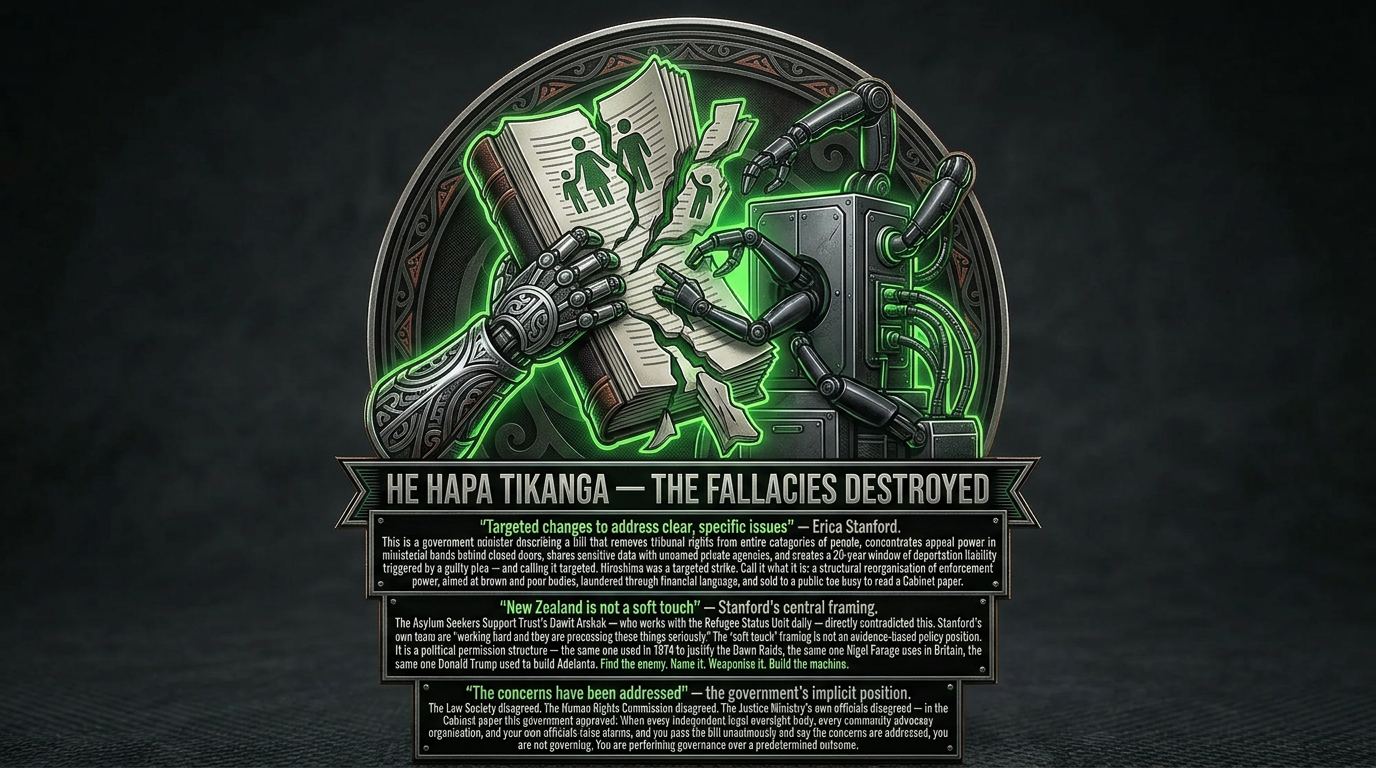
"Targeted changes to address clear, specific issues" — Erica Stanford.
This is a government minister describing a bill that removes tribunal rights from entire categories of people, concentrates appeal power in ministerial hands behind closed doors, shares sensitive data with unnamed private agencies, and creates a 20-year window of deportation liability triggered by a guilty plea — and calling it targeted. Hiroshima was a targeted strike. Call it what it is: a structural reorganisation of enforcement power, aimed at brown and poor bodies, laundered through financial language, and sold to a public too busy to read a Cabinet paper.
"New Zealand is not a soft touch" — Stanford's central framing.
The Asylum Seekers Support Trust's Dawit Arshak — who works with the Refugee Status Unit daily — directly contradicted this. Stanford's own team are "working hard and they are processing these things seriously." The "soft touch" framing is not an evidence-based policy position. It is a political permission structure — the same one used in 1974 to justify the Dawn Raids, the same one Nigel Farage uses in Britain, the same one Donald Trump used to build Adelanto. Find the enemy. Name it. Weaponise it. Build the machine.
"The concerns have been addressed" — the government's implicit position.
The Law Society disagreed. The Human Rights Commission disagreed. The Justice Ministry's own officials disagreed — in the Cabinet paper this government approved. When every independent legal oversight body, every community advocacy organisation, and your own officials raise alarms, and you pass the bill unanimously and say the concerns are addressed, you are not governing. You are performing governance over a predetermined outcome.
NGĀ HONONGA HUNA — THE HIDDEN CONNECTIONS THE RING REVEALS
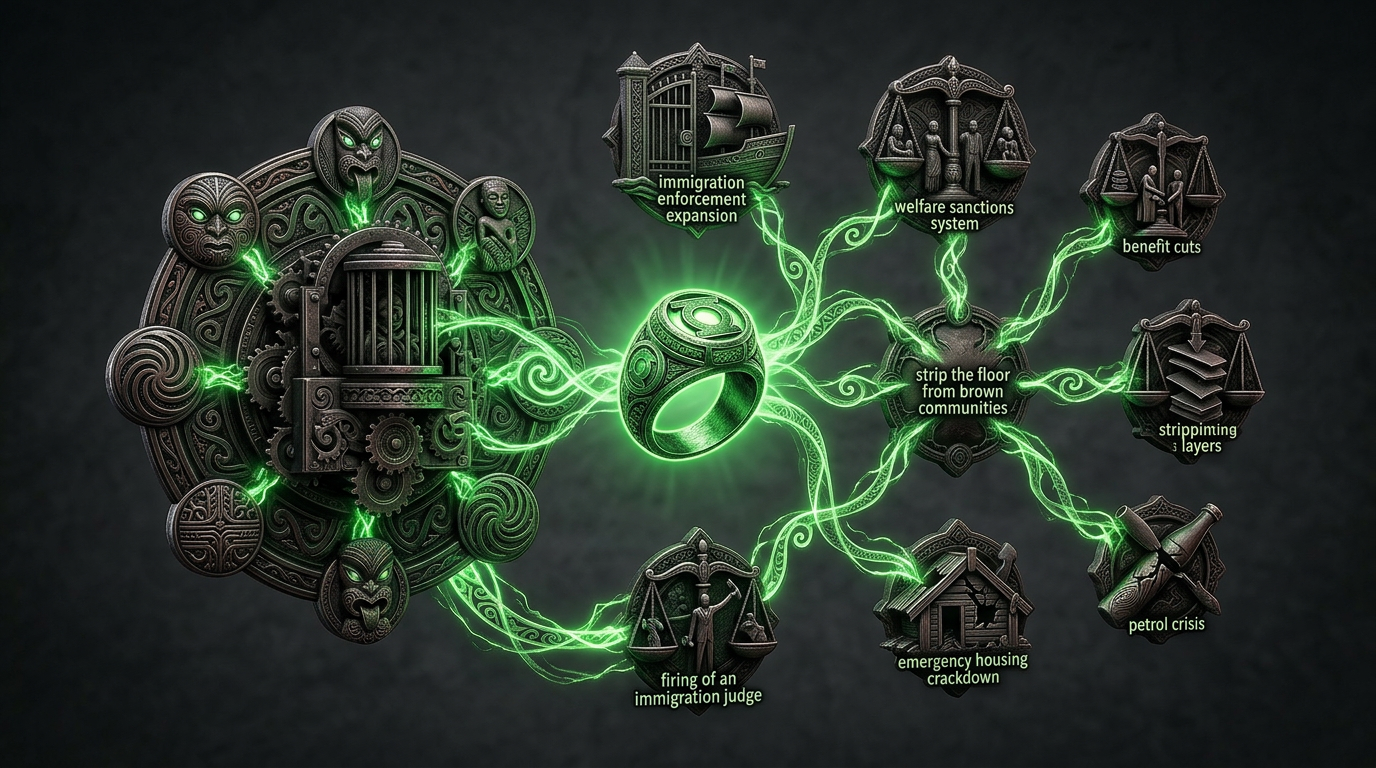
As the Māori Green Lantern documented in The Traffic Light Taiaha, this government has a consistent methodology:
"build systems that escalate punishment rather than deliver support, aim them at Māori and Pacific peoples, and then describe the resulting suffering as personal failure."
The immigration enforcement expansion is not a separate policy domain. It is the same machine, different intake pipe.
The welfare sanctions system, the benefit cuts, the emergency housing crackdown, the education dismantlement documented in Stanford's Treaty Betrayal, the petrol crisis documented in Ka Noho i Roto i te Ahi — they are all expressions of the same ideology: strip the floor from under brown communities, charge them with the fall, and call it reform.
The judicial independence connection is not incidental. In America, the Trump administration fired Everlee Wihongi's immigration judge. In Aotearoa, the Judge Ema Aitken affair demonstrated a Deputy Prime Minister willing to use the machinery of the state to pressure the judiciary when it ruled against his interests. Both governments are moving toward the same destination: an executive that removes the judges who inconvenience it, and builds enforcement systems that operate without them.
The unnamed private agencies. The Cabinet paper acknowledges that sensitive immigration data will be shared with agencies the government refuses to name. In a country where the Māori Green Lantern's Solar Theatre in a Dying Empire documented the privatisation of public infrastructure for donor benefit, this anonymity is not a drafting oversight. It is a design feature. Someone is receiving your immigration data. This government knows who it is. It has decided you do not need to.
TE ARA WHAKAMUA — WHAT MUST HAPPEN BEFORE 27 MAY 2026
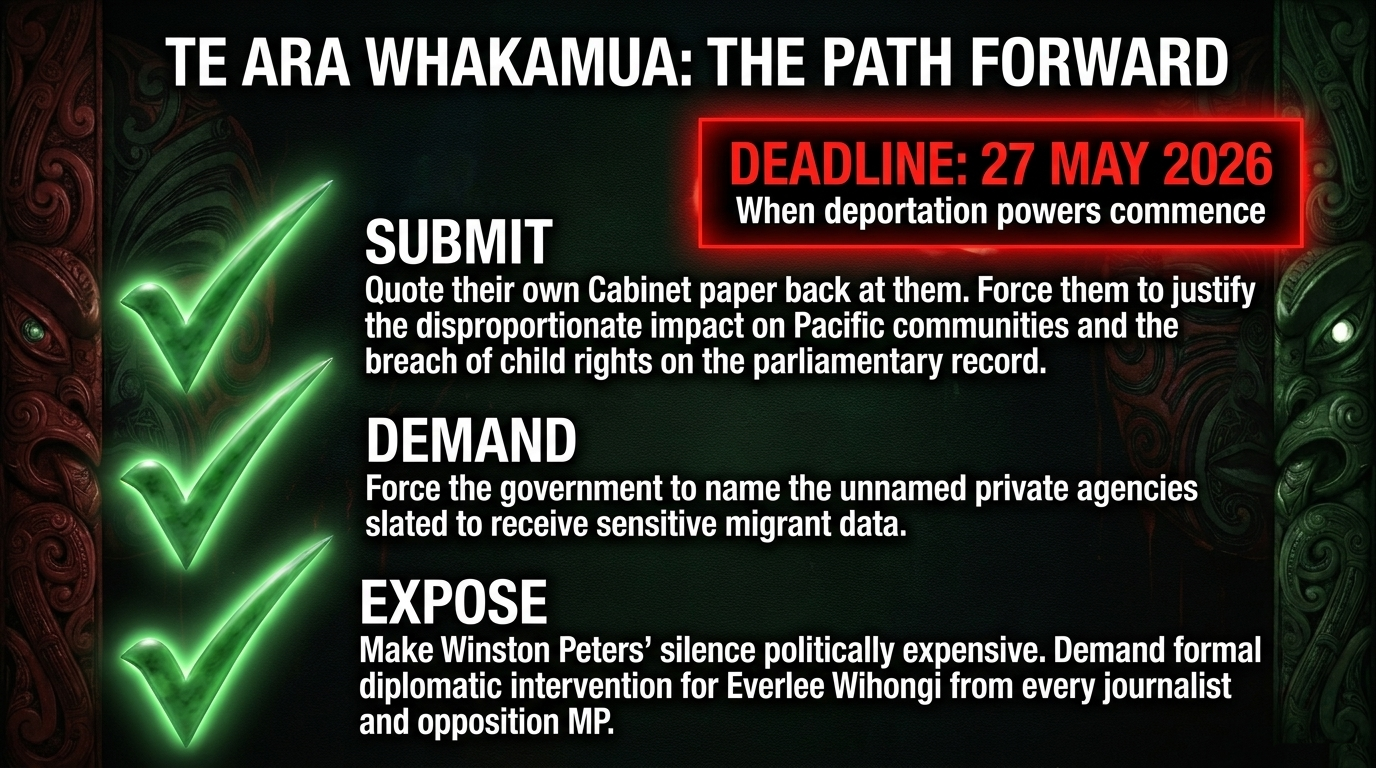
The machine is rolling. The taiaha is raised. Here is what must happen before the deportation powers of the 2025 Act come into force in less than four weeks:
Submit — today. Submissions on the Enhanced Risk Management Bill close this week. Quote the Cabinet paper back at Stanford. Every line. The 17-year-old. The 75-year-old. The "disproportionate impact" on Pacific nationals. The Convention on the Rights of the Child. The unnamed private agencies. Make them defend their own documents in their own submission process.
Name Winston Peters publicly. Betty Wihongi has asked him to intervene for her daughter, as the NZ Herald confirmed. Every journalist, every opposition MP, every community radio station must put this question to him on the record: Why have you not made a formal diplomatic demand for Everlee Wihongi's release? His silence must become politically expensive. Make it cost him something.
Demand the names. Parliament must force Stanford to identify every private agency receiving sensitive immigration data under this bill. In public. On the record. Before 27 May.
Review through te Tiriti. Māori and Pacific MPs across all parties must be asked what Treaty-based review mechanisms they will insist on before the deportation powers commence — mechanisms that would ensure the 20-year liability window is not weaponised against people who have resolved charges, rebuilt lives, and belong here.
Connect the bills. Every community organisation working on welfare sanctions, housing, education, or criminal justice must understand that the immigration enforcement expansion is not a separate domain. It is the same machine. The same communities. The same government. As documented across every Māori Green Lantern essay on this government's record — from The Nursery of Cages to The Trapdoor Prime Minister — the harms are not independent. They are coordinated.
HE KUPU WHAKAMUTUNGA — THE CLOSING WORD
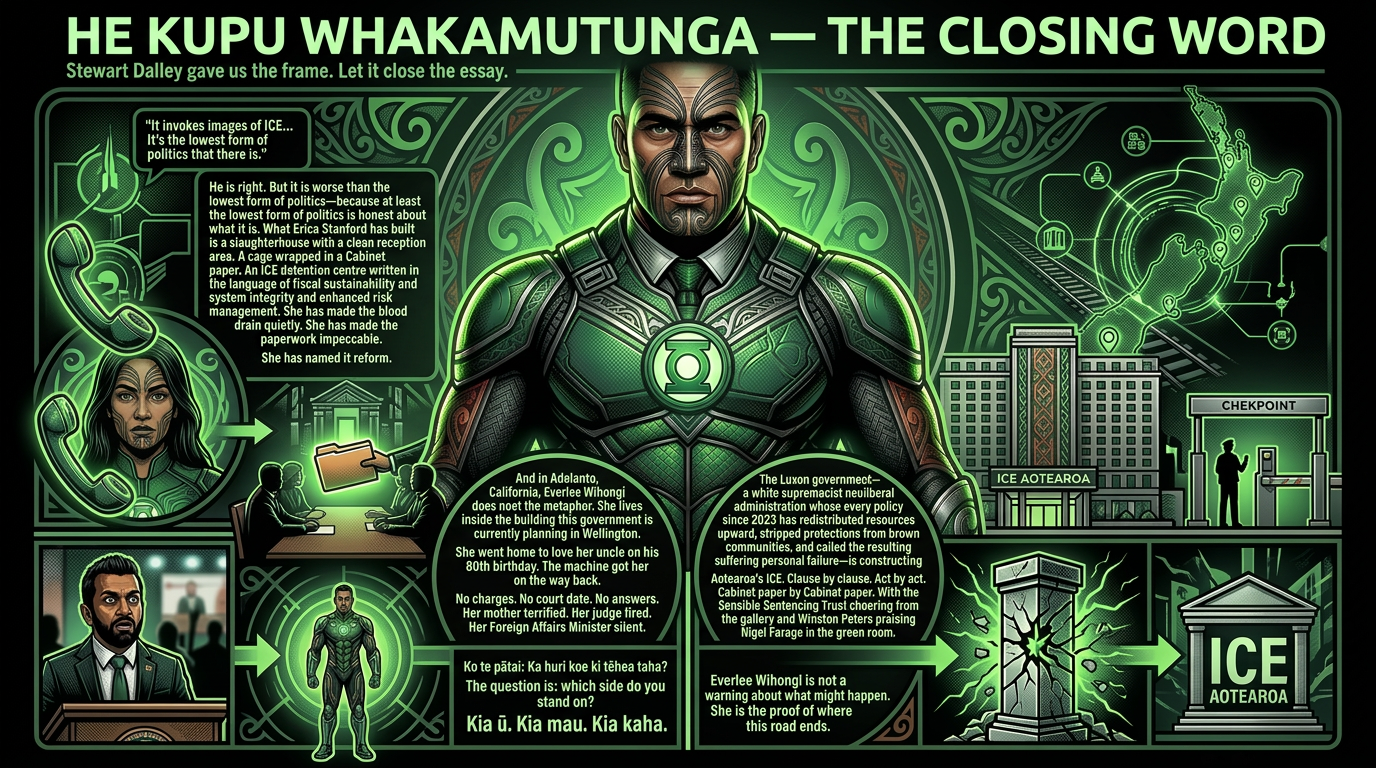
Stewart Dalley gave us the frame. Let it close the essay.
"It invokes images of ICE... It's the lowest form of politics that there is."
He is right. But it is worse than the lowest form of politics — because at least the lowest form of politics is honest about what it is. What Erica Stanford has built is a slaughterhouse with a clean reception area. A cage wrapped in a Cabinet paper. An ICE detention centre written in the language of fiscal sustainability and system integrity and enhanced risk management. She has made the blood drain quietly. She has made the paperwork impeccable. She has named it reform.
And in Adelanto, California, Everlee Wihongi does not need the metaphor. She lives inside the building this government is currently planning in Wellington. She went home to love her uncle on his 80th birthday. The machine got her on the way back. No charges. No court date. No answers. Her mother terrified. Her judge fired. Her Foreign Affairs Minister silent.
The Luxon government — a white supremacist neoliberal administration whose every policy choice since 2023 has redistributed resources upward, stripped protections from brown communities, and called the resulting suffering personal failure — is constructing Aotearoa's ICE. Clause by clause. Act by act. Cabinet paper by Cabinet paper. With the Sensible Sentencing Trust cheering from the gallery and Winston Peters praising Nigel Farage in the green room.
Everlee Wihongi is not a warning about what might happen.
She is the proof of where this road ends.
Ko te pātai: Ka huri koe ki tēhea taha?
The question is: which side do you stand on?
Kia ū. Kia mau. Kia kaha.
Ko Ivor Jones tōku ingoa. Ko te Māori Green Lantern ahau. Tēnei au e tū ana mō ngā whānau katoa.
TE KOHA — A WORD TO THOSE WHO STAND WITH US

Everlee Wihongi sits in Adelanto because a government decided her life was expendable. A 17-year-old adopted as a baby and a 75-year-old husband face deportation because Stanford decided a tribunal was inconvenient. Pacific whānau face warrantless home visits because the Cabinet paper that said they'd be disproportionately harmed was filed and forgotten.
This essay exists because whānau fund it. Not the Crown. Not the corporate press. You.
Every koha to the Māori Green Lantern is a direct signal: rangatiratanga includes the power to fund our own truth tellers.
The accountability that Stanford refuses, that Peters withholds, that Luxon papers over — this mahi provides it. Named. Sourced. Verified. Unafraid.
If you can, choose your pathway:
- Koha directly — Support the Māori Green Lantern here and fund the essay that names the cage builders
- Subscribe — receive every essay directly to your inbox at themaorigreenlantern.maori.nz
- Bank transfer — HTDM, 03-1546-0415173-000
- Facebook — follow and share at The Māori Green Lantern
If you cannot koha — no worries. Share this essay. Send it to your MP. Quote the Cabinet paper at Stanford's submission process. Tell your whānau Everlee's name. That is koha in itself.
Every share is a submission. Every voice is a taiaha. Every act of bearing witness is rangatiratanga.

Research completed 29 April 2026. Primary source: RNZ / Gill Bonnett, "Power in immigration bill 'invokes images of ICE', critics say," 28 April 2026 — full text read and verified. Named critics quoted directly: immigration lawyer Stewart Dalley; Asylum Seekers Support Trust General Manager Dawit Arshak; Sensible Sentencing Trust Louise Parsons; Green Party MP Ricardo Menéndez March. Named government sources: Erica Stanford (written statement); Cabinet paper. Supporting sources: Te Ao News, NZ Herald, Webworm/David Farrier, The Spinoff, PMN News, RNZ Dawn Raids history, Human Rights Commission, NZ Law Society, MBIE, Parliament.nz, Te Ara. Māori Green Lantern cross-references: The Nursery of Cages, The Trapdoor Prime Minister, The Traffic Light Taiaha, Winston Peters — A Walking Contradiction, Stanford's Colonial Classroom, Solar Theatre in a Dying Empire, Ka Noho i Roto i te Ahi. All URLs live at time of publication.