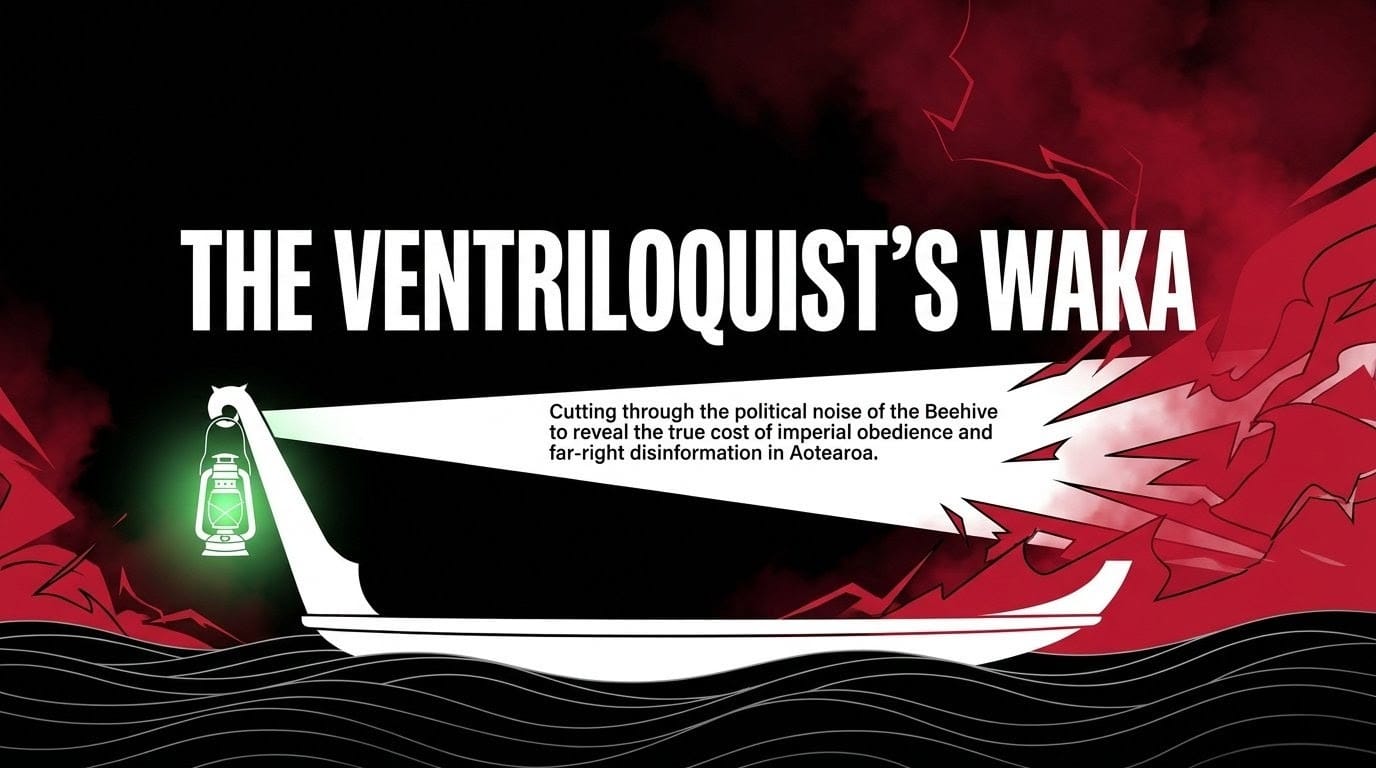
"THE VENTRILOQUIST’S WAKA" - 30 April 2026
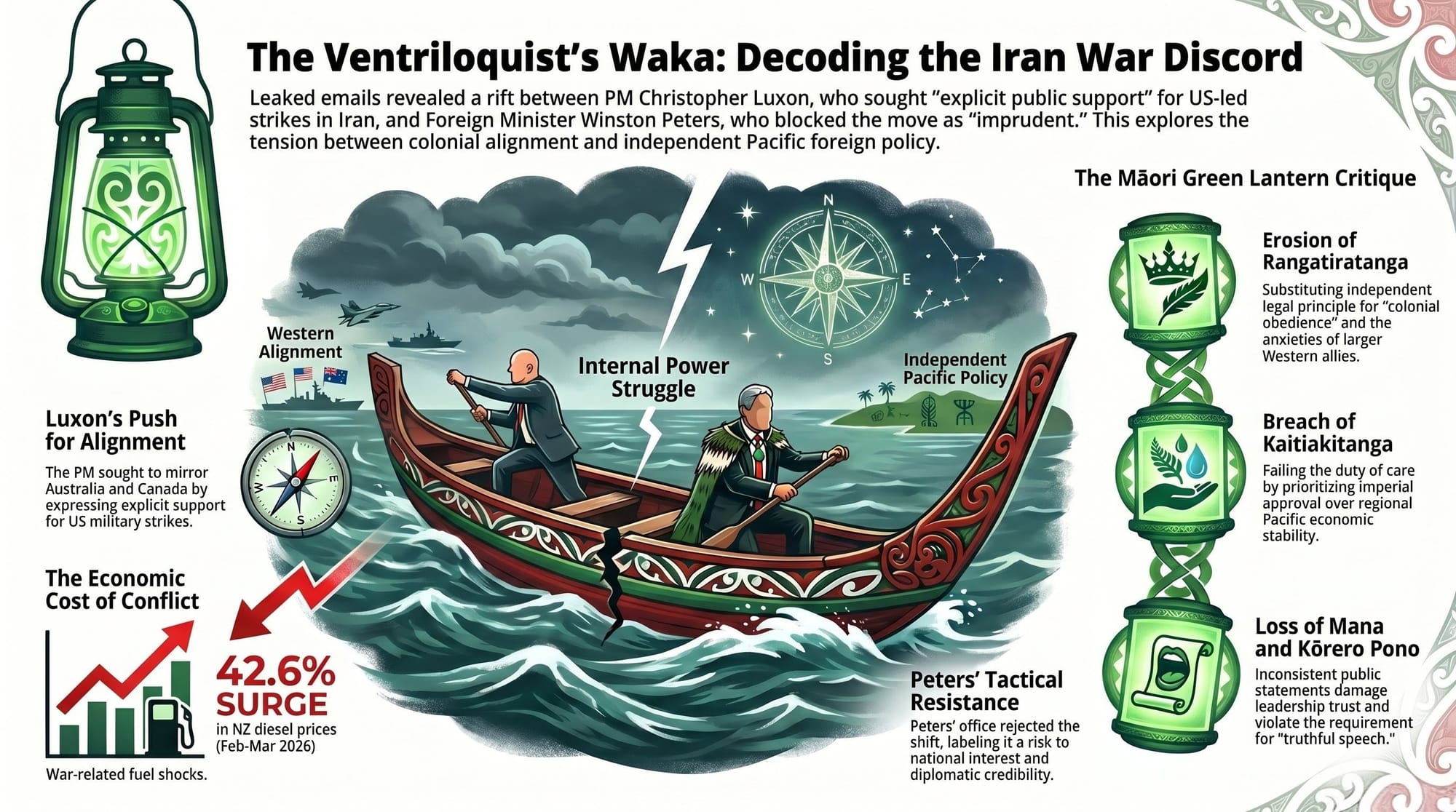
Luxon reached for the empire’s script, Peters hissed that the timing was bad, Australia and Canada sang backup for the bombers, and a nuclear-free nation was nearly dragged onto the stage like a rented prop in somebody else’s war.

Good evening Whānau,
This government truly sucks ball sacks.
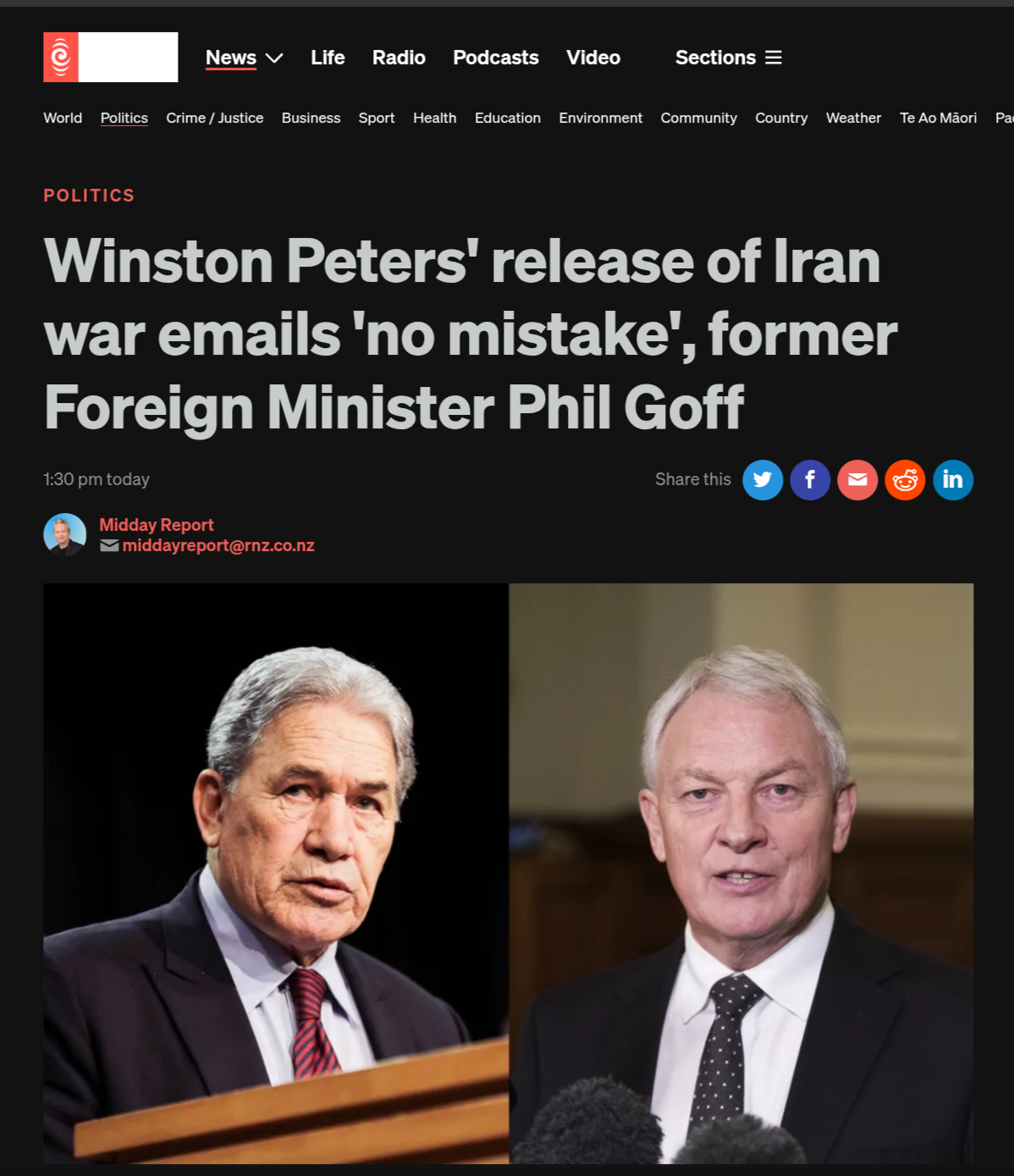
There are moments when a government’s mask slips, and there are moments when the whole papier-mache face falls into the fire.
This is one of the latter.
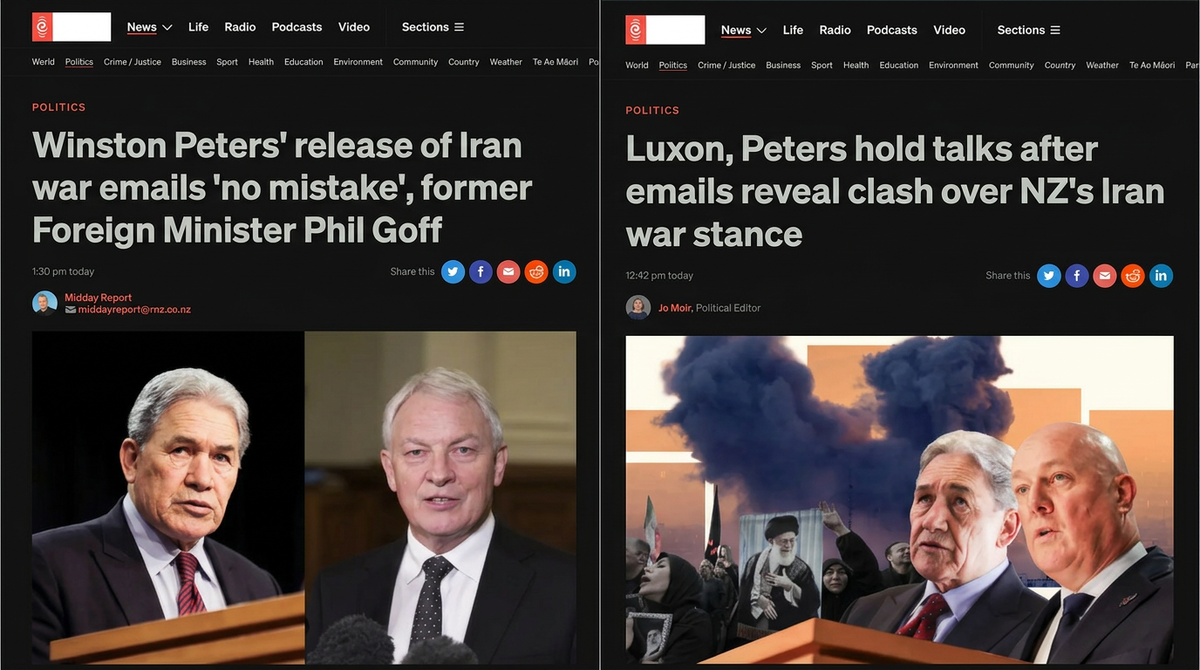
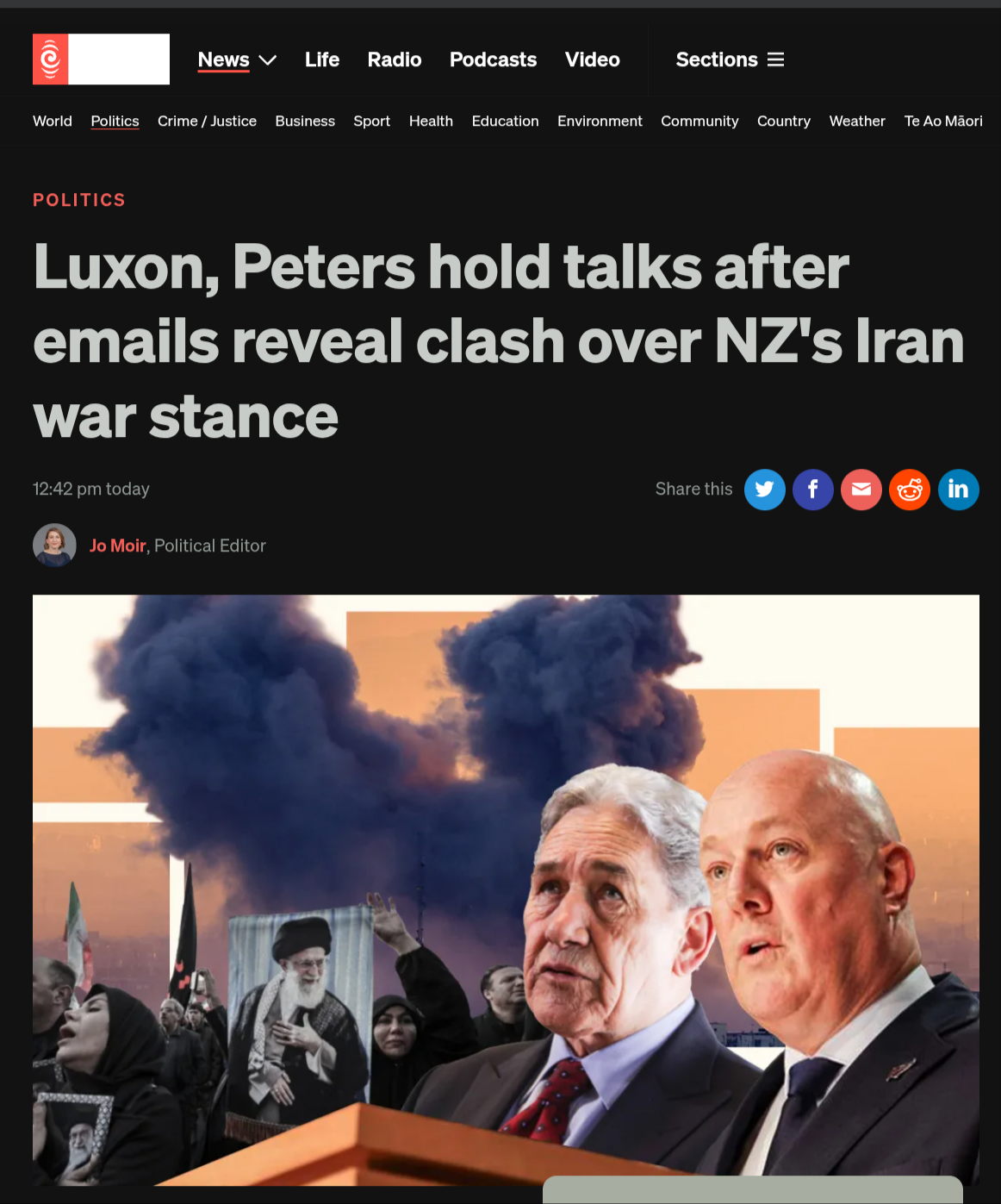
As revealed by 1News and reported in more detail by PMN, internal emails show Prime Minister Christopher Luxon wanted New Zealand to move toward “explicit public support” for the United States’ strikes on Iran, while Winston Peters’ office pushed back that such a move would be “imprudent” and a risk to New Zealand’s national interests.
That is the scandal in plain English: the Prime Minister of Aotearoa, a nuclear-free Pacific nation, wanted to edge closer to endorsing a war, and his own Foreign Minister’s office treated that as reckless.
The Deep Dive Podcast
Listen to a lively conversation between two hosts, unpacking and connecting topics in the sources of this essay.
The original joint government statement did not explicitly endorse the strikes.
As reported by 1News and PMN, Peters’ office defended the initial wording as a “careful line” that “neither condemns nor gives explicit support” to the US action.
Then, after Luxon publicly struggled to explain the government’s stance, his office moved behind the scenes to seek stronger language more closely aligned with Australia and Canada, according to the reporting by 1News.
That is not strategic clarity. That is panic in a suit. It is also the reflex of a white neoliberal government that treats alignment with powerful Western states as a substitute for moral thought.
What Peters actually argued — and why he gets no halo
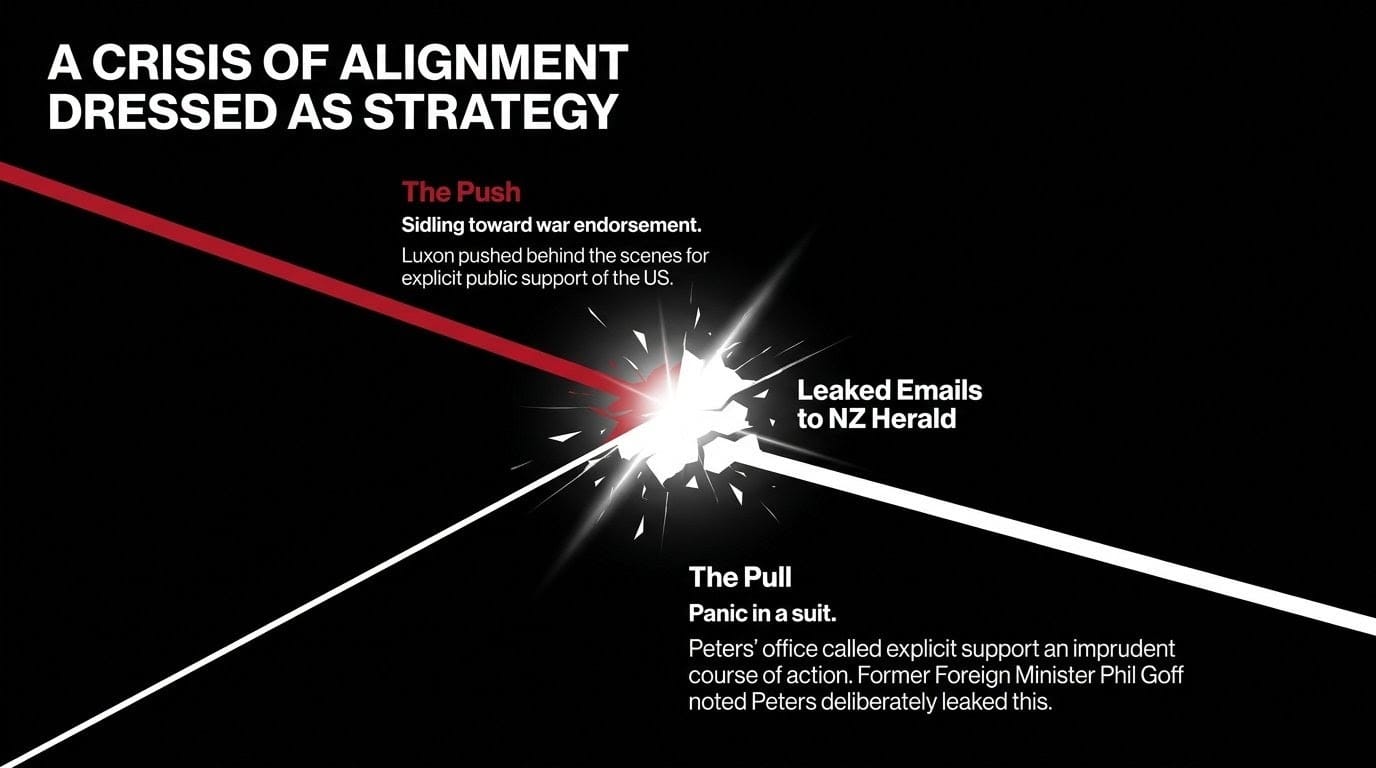
The public record does not contain a fully itemised list of the national interests Peters said were at risk. As shown in the reporting by 1News and PMN, the available email excerpts show Peters’ office saying explicit support would be “imprudent,” would risk New Zealand’s national interests, and would abandon the “careful line” already established.
Even so, the broad shape of the argument is visible.
First, New Zealand’s diplomatic credibility was at risk, because a government that changes its war posture days after issuing a carefully balanced statement looks erratic and unserious, as can be inferred from the sequence reported by 1News and PMN.
Second, Pacific economic stability was plainly in view, because Peters told US Secretary of State Marco Rubio that the Iran conflict was causing “significant economic impacts” for Pacific countries through fuel shocks and supply chain disruption, as reported by PMN.
Third, Peters was resisting a rush into automatic allied alignment, because Luxon’s office was explicitly comparing New Zealand’s position with Australia’s and Canada’s, according to 1News.
But none of this turns Winston Peters into a principled anti-imperialist.
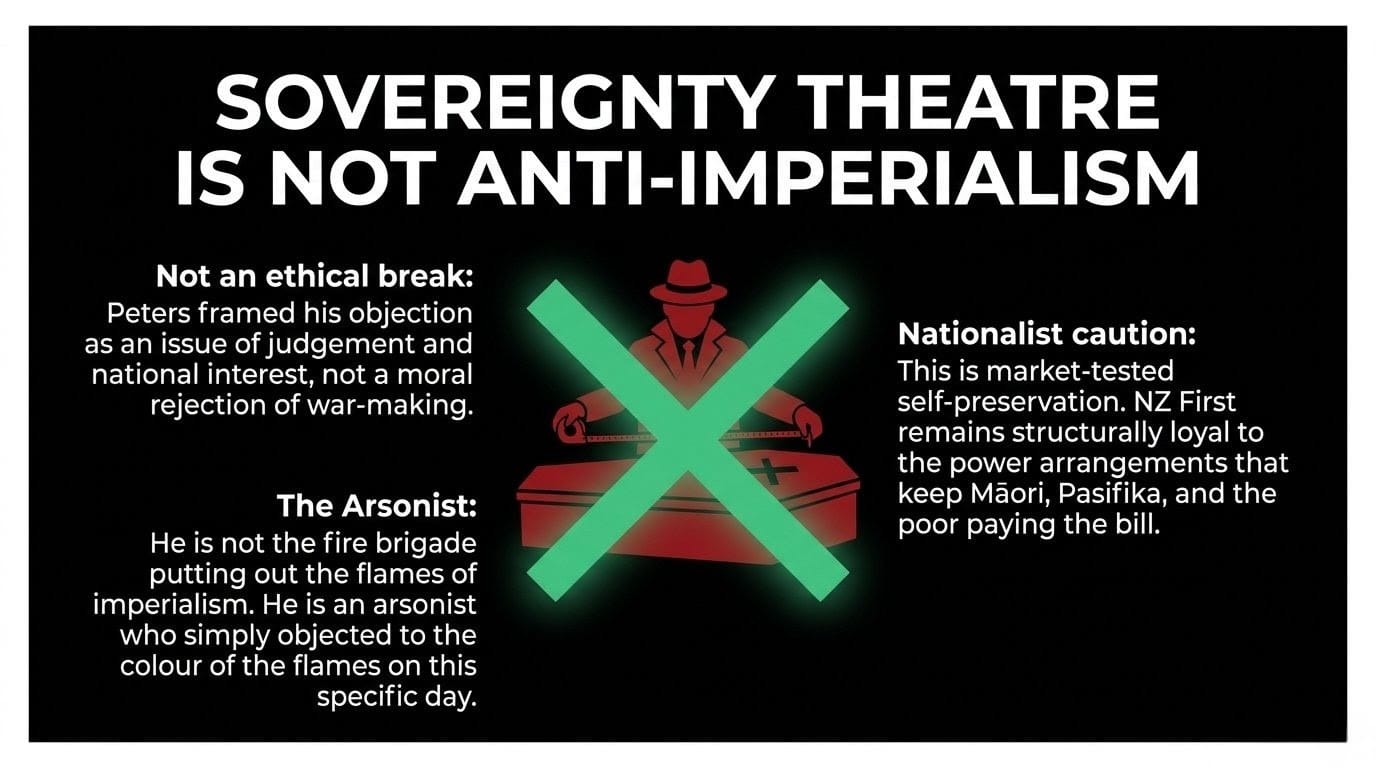
As PMN makes clear, Peters framed this as a “New Zealand first” dispute over judgement, not as a moral rejection of war-making itself.
NZ First is still a neoliberal party that wraps opportunism in patriotism, punches down when it suits, and performs sovereignty theatre while remaining structurally loyal to the same power arrangements that keep Māori, Pasifika, workers, and the poor paying the bill.
Peters did not stop this because empire is wrong. He stopped this because, on this occasion, the politics smelled bad and the cost to New Zealand’s posture was too obvious to ignore. That is not virtue. That is tactical self-preservation by an old political undertaker who knows when the corpse is starting to smell.
Australia and Canada deserve condemnation, not imitation
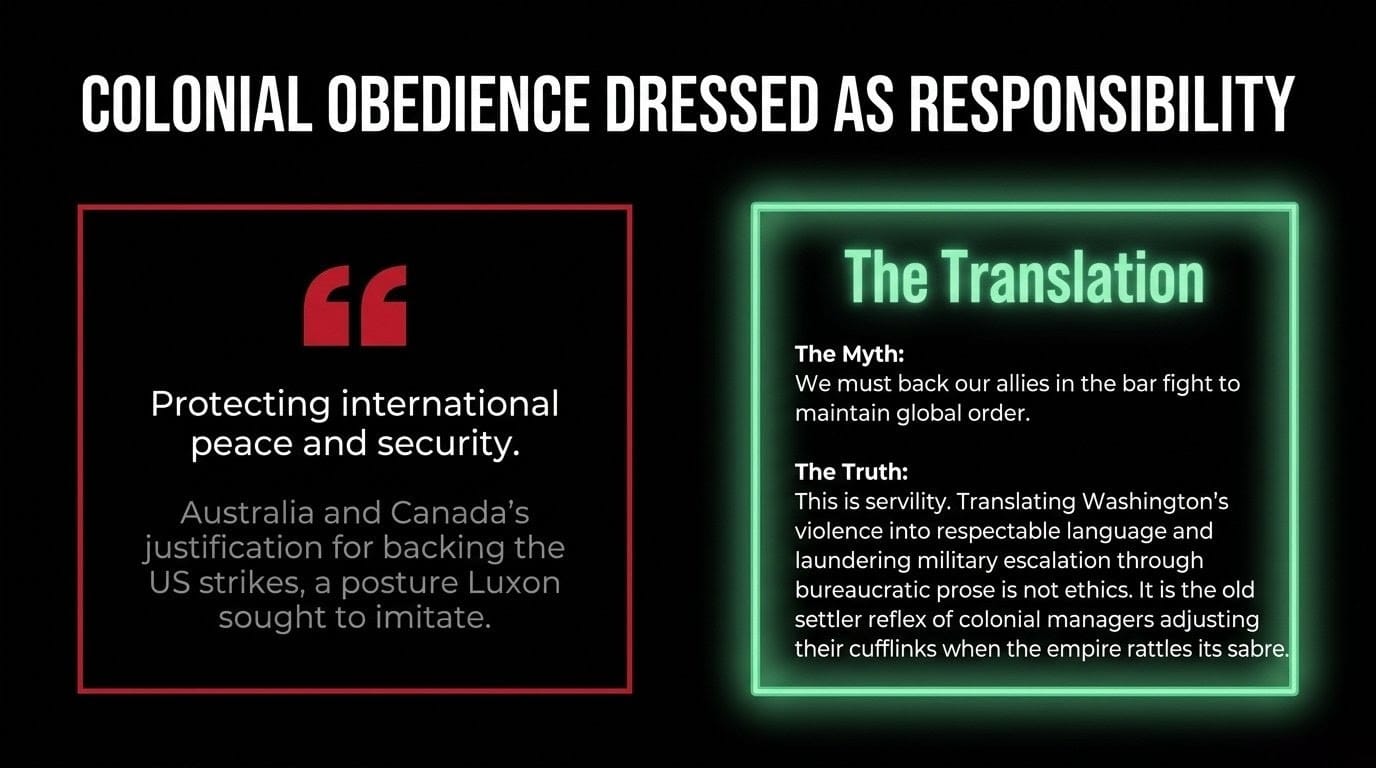
Australia and Canada did not behave like sober defenders of law. They behaved like polished colonial deputies fluffing the pillows on an imperial war bed.
Australia justified support for the strikes by saying it backed US action to prevent Iran obtaining a nuclear weapon and framed the move as protecting international peace and security, according to ABC News Australia.
Canada used the same stale script, describing Iran as a source of instability and insisting Iran must never obtain nuclear weapons, while reaffirming Israel’s right to defend itself in a statement from the Prime Minister of Canada.
That is not courage. That is colonial obedience dressed up as responsibility.
These governments translated Washington’s violence into respectable language, laundered escalation through bureaucratic prose, and pretended that repeating the strategic anxieties of larger allies was a form of ethics. It was not ethics.
It was servility.
It was the old settler reflex: when the empire rattles its sabre, the colonial managers adjust their cufflinks and call it leadership.
This matters because Luxon was trying to nudge New Zealand toward the same posture those governments had already adopted, as reported by 1News. Peters’ office treated that shift as imprudent, and on the public evidence available, they were right to do so. But the condemnation must not stop at Luxon. Australia and Canada deserve rebuke for lending political legitimacy to military escalation, and New Zealand deserves rebuke for even entertaining the idea that our role was to shuffle closer to that chorus instead of standing clearly for law, restraint, and Pacific survival.
New Zealand’s action deserves condemnation too
New Zealand did not emerge clean from this. The fact that the government’s public statement stopped short of explicit endorsement does not erase the deeper disgrace that Luxon’s office tried to move it there, as shown by 1News and PMN.
A country that still trades on its anti-nuclear history should not need an internal skirmish to prevent its Prime Minister from sidling toward explicit support for US military action. The very attempt is an indictment.
And Peters does not get to wash his hands either. He may have blocked the sharper endorsement, but by his own account in PMN, he framed the issue as one of judgement, calibration, and New Zealand-first positioning.
That is classic Peters: not an ethical break with militarism, but a market-tested brand of nationalist caution.
NZ First remains a neoliberal formation masquerading as anti-establishment rebellion, selling “sovereignty” while protecting the very hierarchies that hollow out real sovereignty for everyone else. He is not the fire brigade. He is an arsonist who objected to the colour of the flames.
The metaphor beneath the mess
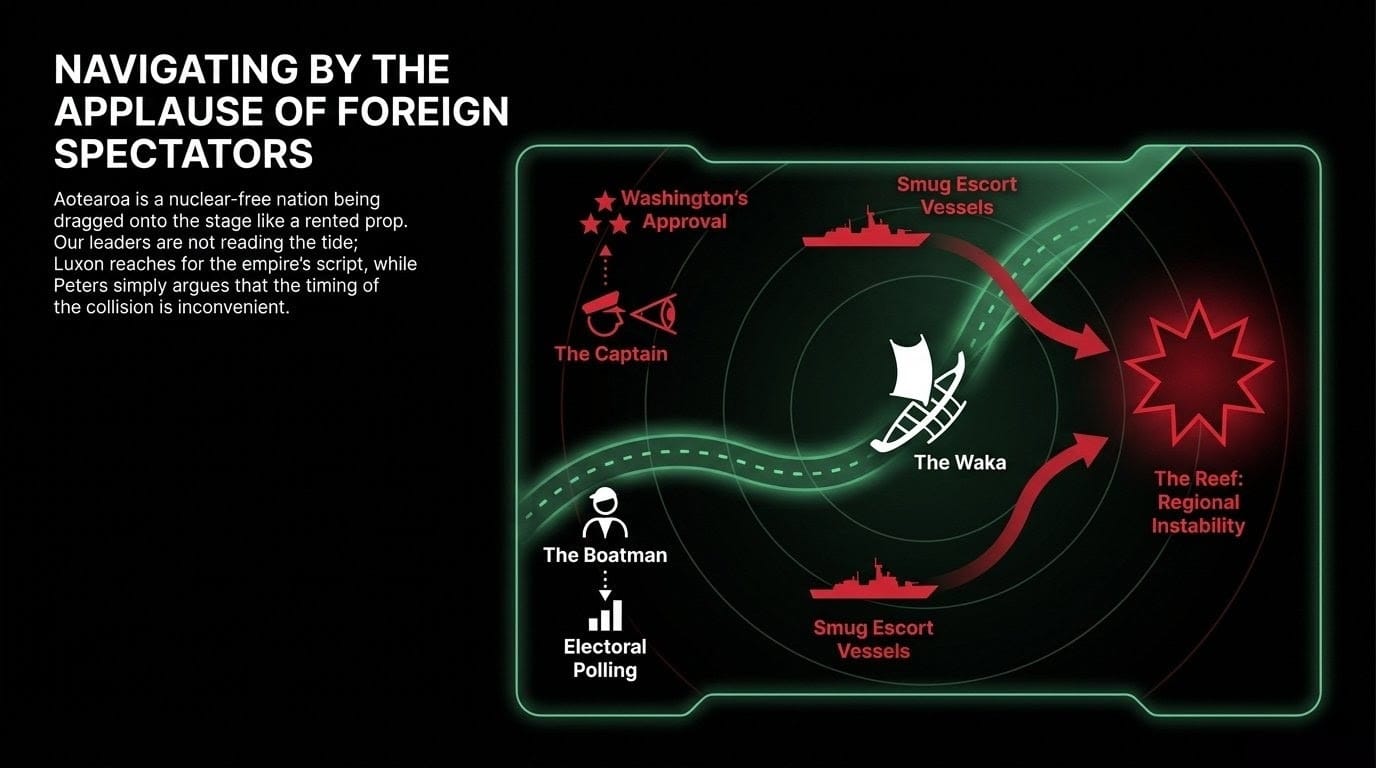
Christopher Luxon is the captain of a waka who cannot read the stars, cannot hear the tide, and mistakes the applause of foreign spectators for navigation.
Winston Peters is the old boatman standing beside him, not to save the waka from the reef, but to argue that the timing of the collision is electorally inconvenient.
Australia and Canada are the smug escort vessels on either side, waving the whole flotilla toward the rocks while insisting the crunching sound is “regional stability.”
This is what white supremacist neoliberal governance looks like when the international stage lights come on.
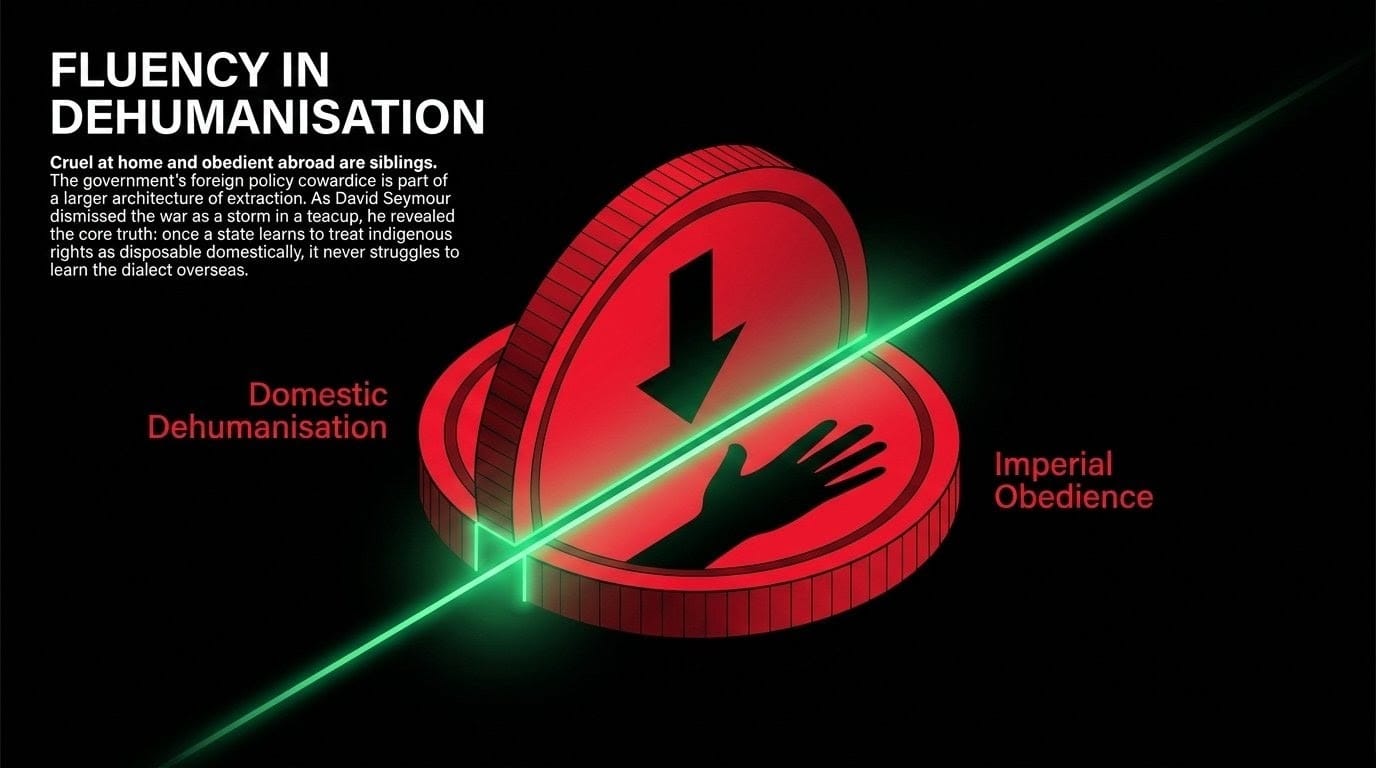
It is not merely cruel at home and obedient abroad by coincidence. The two are siblings. A government that learns to treat Māori rights, public services, and poor communities as disposable will eventually treat foreign lives, international law, and Pacific stability the same way.
Once a state becomes fluent in dehumanisation domestically, it never struggles to learn the dialect overseas.
Three examples for the Western mind
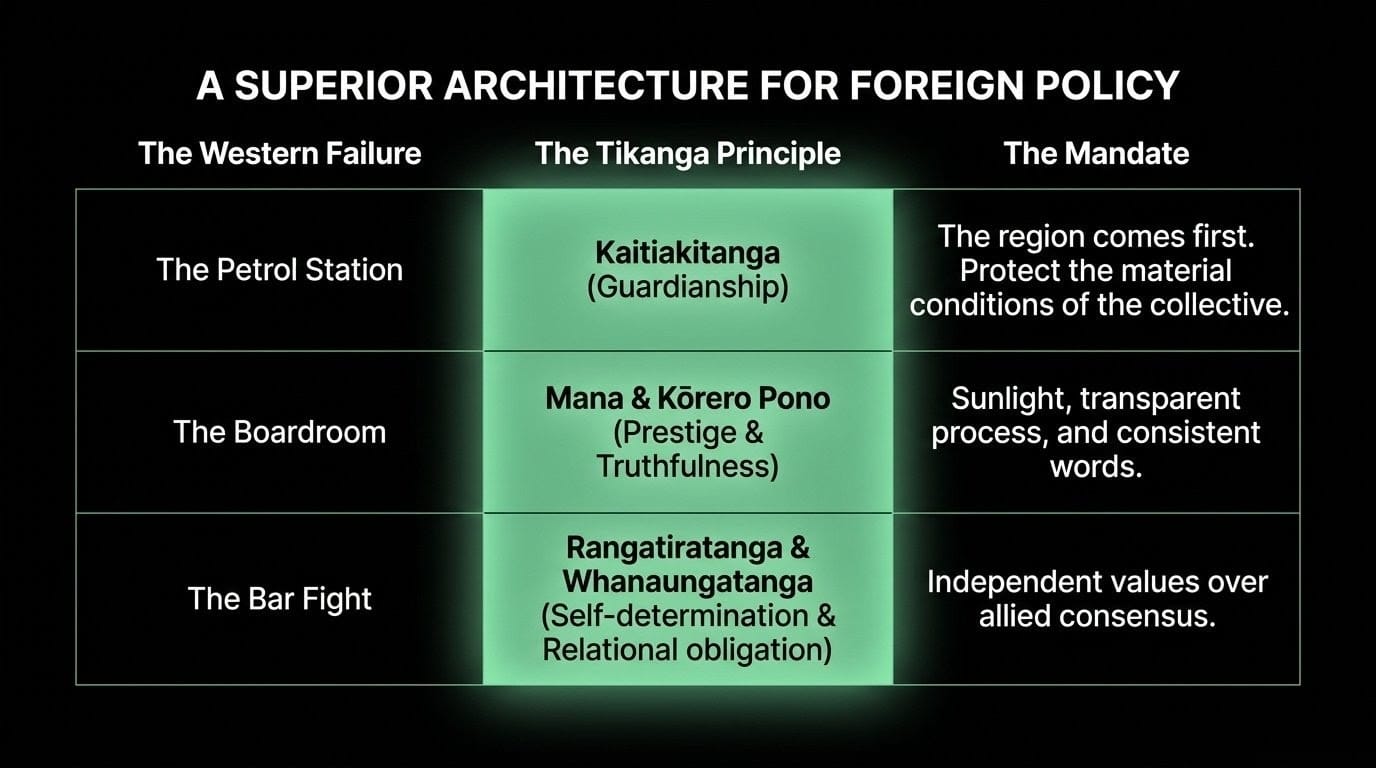
1. The petrol station example
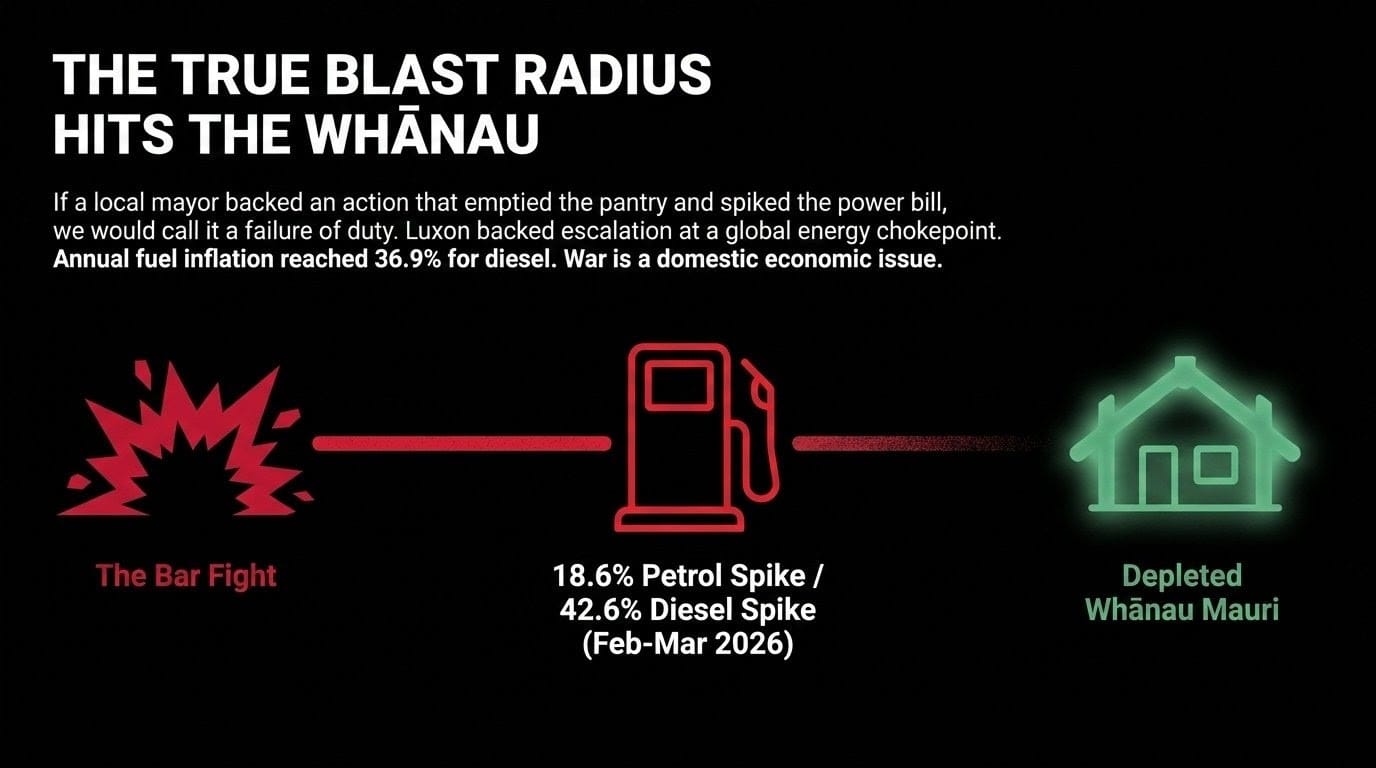
If a mayor endorsed military action overseas and that action immediately pushed up freight, fuel, and household costs in their own town, most Western readers would recognise that as self-inflicted harm.
In New Zealand, petrol prices rose 18.6% and diesel prices surged 42.6% between February and March 2026, while annual fuel inflation reached 13.9% for petrol and 36.9% for diesel, as reported by 1News.
Peters explicitly linked the Iran conflict to “significant economic impacts” on Pacific countries, including fuel and supply disruption, as reported by PMN.
In tikanga terms, that is a failure of kaitiakitanga.
For a Western mind, think of it this way: a trustee who knowingly cheers on the event that empties the pantry, raises the power bill, and makes transport dearer has violated the basic duty of care. In te ao Māori, the breach is deeper than bad management. It depletes the mauri of the collective by failing to protect the material conditions that let whānau live with dignity.
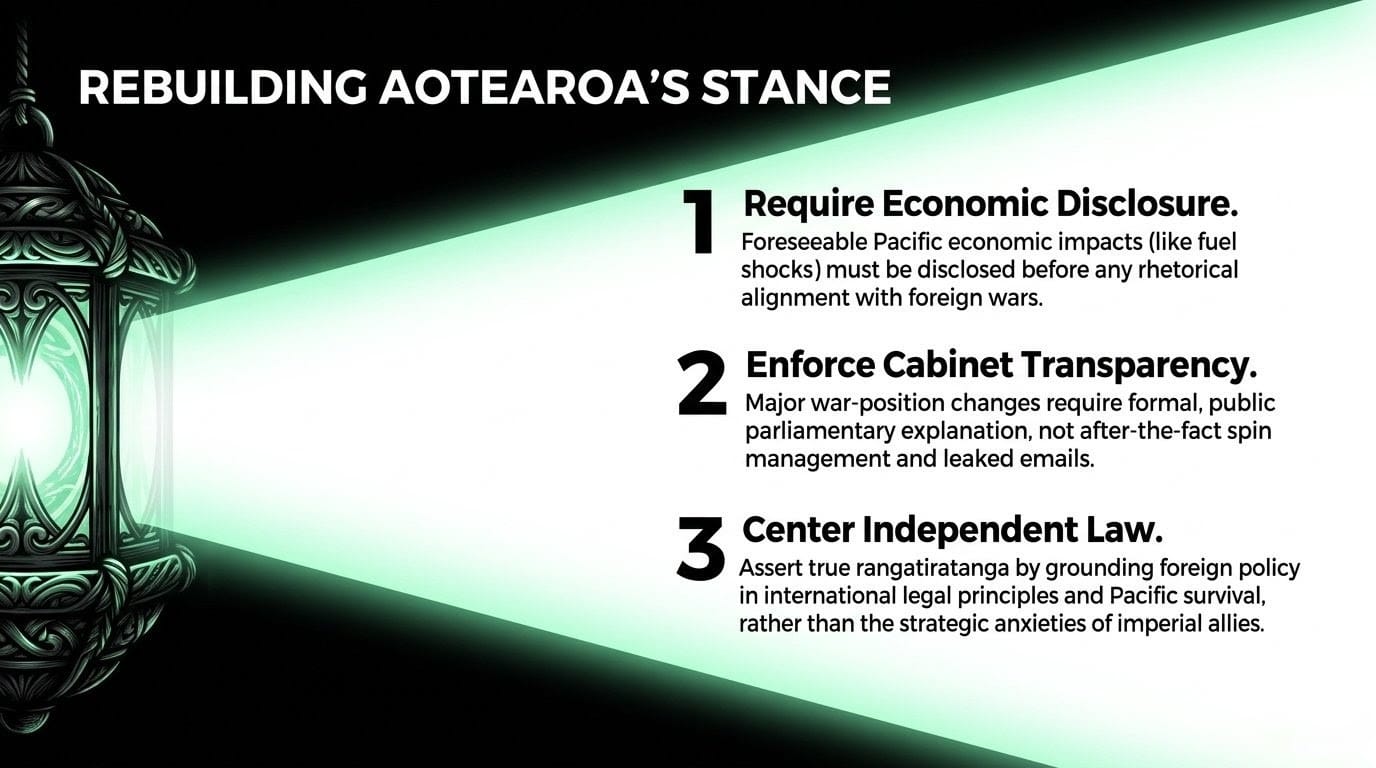
The solution is straightforward. New Zealand should adopt a public rule that any war-related foreign-policy statement must disclose foreseeable Pacific economic impacts before any rhetorical alignment occurs. If the action harms the region, the region comes first. Anything else is a government choosing the empire’s comfort over its neighbours’ survival.
2. The boardroom example
If a company issued one carefully balanced market statement and then tried to reverse into a riskier position because the CEO embarrassed himself in an interview, investors would call it instability. That is what the public sequence looks like here, based on the timeline reported by 1News.
The harm is not abstract. It damages diplomatic credibility, clouds the chain of decision-making, and tells the world that Aotearoa’s stated positions can be jerked around by political vanity.
In tikanga terms, that damages mana and violates kōrero pono.
For a Western audience, the closest translation is this: if trust is the currency of leadership, then inconsistent words are counterfeiting. A leader who treats public statements as disposable packaging is not merely clumsy. He is eating the very thing he claims to protect.
The solution is institutional discipline. Release the relevant advice, publish the full OIA material where lawful, and require major war-position changes to go through transparent Cabinet process and parliamentary explanation rather than after-the-fact spin management. Sunlight is cheaper than damage control.
3. The bar-fight example
If your friend wanted to join a bar fight started by bigger allies because “our mates are in it,” most Western readers would not call that courage. They would call it stupidity dressed as loyalty.
Australia’s and Canada’s justifications leaned on nuclear-threat rhetoric and alliance logic, as shown by ABC News Australia and the Canadian Prime Minister’s statement, and Luxon’s office was plainly measuring New Zealand’s response against those governments, according to 1News.
The scale of the stupidity is measurable.
The Strait of Hormuz accounts for about one-fifth of global oil and petroleum product consumption, making any escalation there a direct threat to energy costs and supply chains, according to the U.S. Energy Information Administration. Backing escalation around a chokepoint like that is like applauding while someone swings an axe at the mains cable and calling yourself a responsible householder.
In tikanga terms, that corrodes rangatiratanga and whanaungatanga.
For a Western mind, rangatiratanga is the sovereign capacity to make decisions from your own values, not your allies’ anxieties. Whanaungatanga is the recognition that relationships create obligations, especially to those closest to the blast radius.
The solution is to stop treating allied consensus as a substitute for judgement and to rebuild foreign policy on independent legal principle, Pacific accountability, and material protection for ordinary people.
What this says about the government
This episode does not reveal a government of principle.
It reveals a government of reflexes: neoliberal reflex, Atlantic reflex, white establishment reflex.
Luxon’s first instinct was not law, not peace, not Pacific stability, and not independent judgement. According to the reporting by 1News and PMN, his instinct was alignment.
Peters should not be romanticised for blocking that move. This is still Winston Peters, and the wider ideological machinery around him remains hostile to transformative justice and perfectly comfortable with neoliberal power so long as it can be wrapped in nationalist theatre.
The deeper anti-Māori and anti-Indigenous framing that keeps surfacing in New Zealand politics remains real, and some of it is examined sharply by E-Tangata. In this specific clash, Peters opposed a lurch toward explicit war support. In the larger picture, he and NZ First remain part of the same mauri-draining political order.
Relevant Māori Green Lantern reading
A directly verified earlier Māori Green Lantern essay that belongs beside this one is “The Pātaka Beside the Strait”. That essay argues that Peters’ sovereignty language is often a costume for a white-supremacist neoliberal project that protects oil flows, binds Aotearoa closer to American war machinery, and leaves Māori whānau squeezed between volatile fuel prices and weakened public protection.
That frame matters here, because this latest email clash does not contradict that pattern. It confirms it.
The broader Māori Green Lantern archive at themaorigreenlantern.maori.nz also situates this government’s foreign-policy cowardice inside a larger domestic architecture of cruelty, hierarchy, and extraction.
The same hand that reaches upward for imperial approval is the hand that pushes downward on Māori rights, poor communities, and public accountability.
Koha Consideration
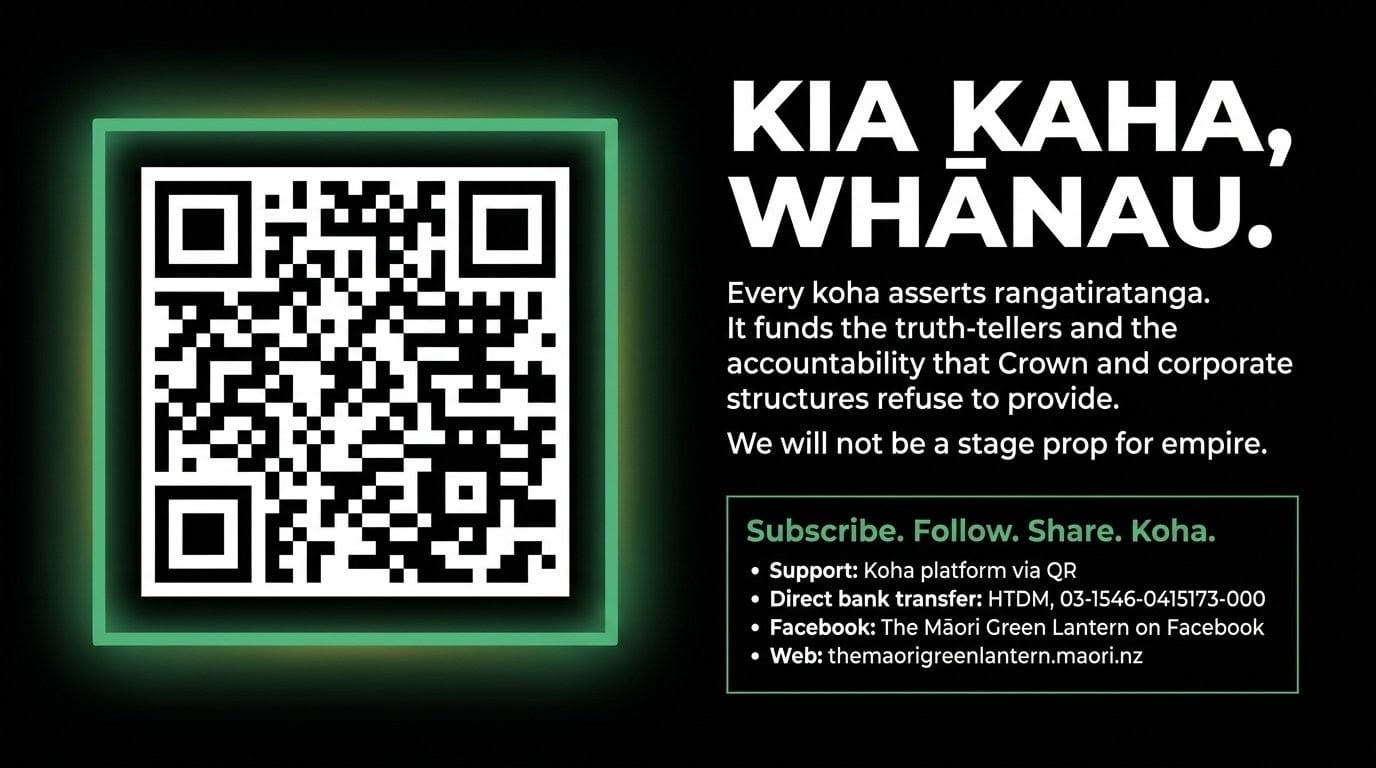
Every koha for this kaupapa says whānau are willing to fund the accountability that Crown and corporate structures refuse to provide. Every koha says rangatiratanga includes the power to back our own truth tellers when this white supremacist neoliberal government tries to turn Aotearoa into a stage prop for empire.
Kia kaha, whānau. Stay vigilant. Stay connected. If you are able, consider a koha to keep naming the ventriloquists, the arsonists, and the men who would trade Pacific survival for a nod from Washington. If koha is not possible, subscribing, following, reading, and sharing this mahi with your people is koha too.
- Koha — Support: Koha platform
- Subscribe: The Māori Green Lantern
- Direct bank transfer: HTDM, account number 03-1546-0415173-000
- Facebook: The Māori Green Lantern on Facebook
Research note: The live links used above were directly checked where possible during preparation, including 1News, PMN, ABC News Australia, the Prime Minister of Canada, E-Tangata, and The Pātaka Beside the Strait.