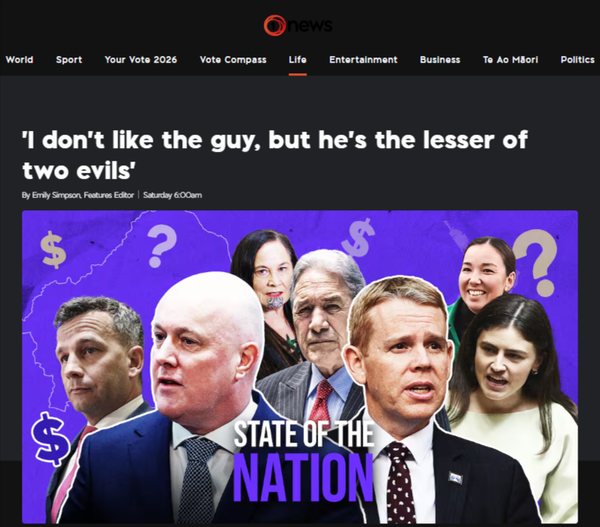
"THE PRIVATISATION PIPELINE: How the Coalition Government Is Selling Our Children's Future" - 28 April 2026

Mōrena Whānau,

The Hidden Agenda Behind "Reform"
The National-ACT-NZ First coalition government does not want to improve education in Aotearoa.
It wants to own it — or more precisely, it wants to hand it to private operators while you, the taxpayer, keep paying the bill.
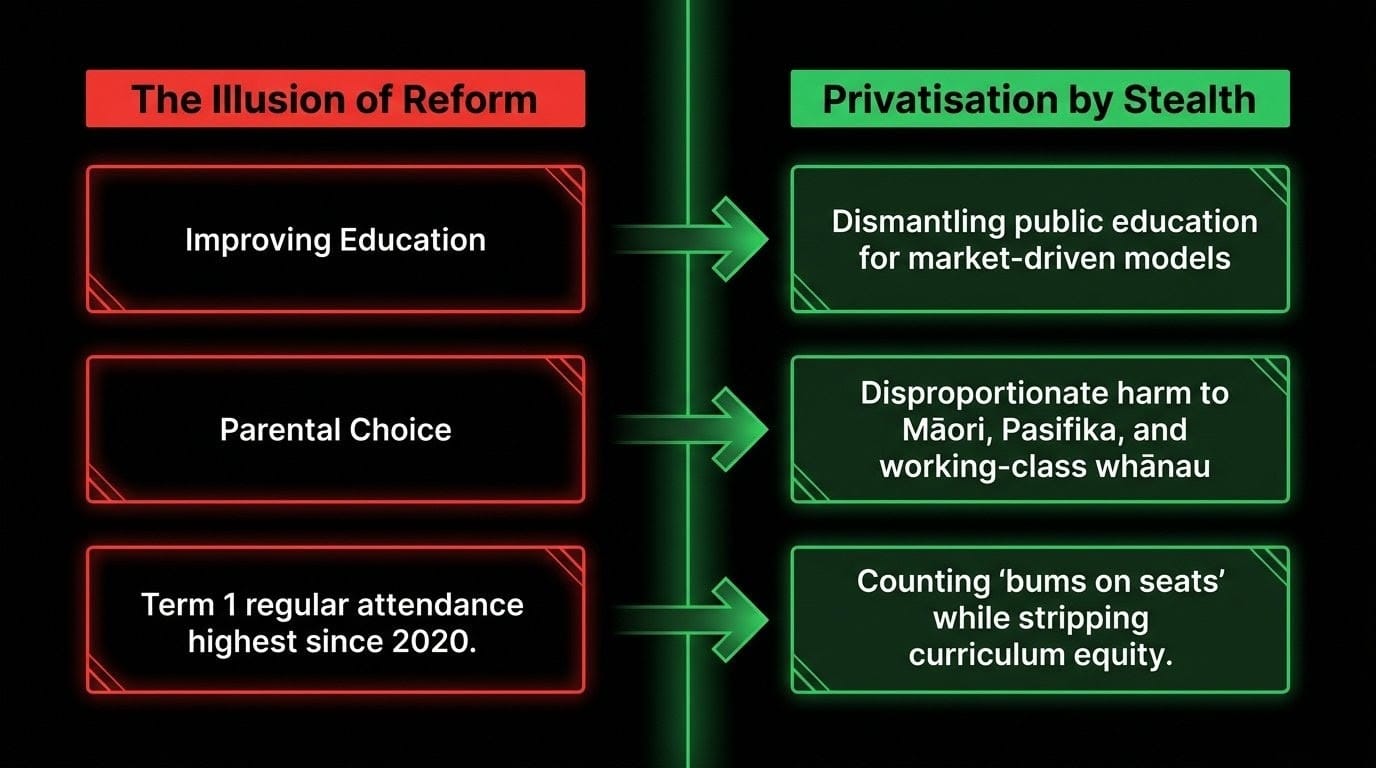
Every policy shift, every rushed curriculum change, every charter school conversion follows a single, coherent thread: the systematic dismantling of public education and its replacement with a market-driven model that will devastate Māori, Pasifika, and working-class whānau disproportionately.
This is not speculation. This is the evidence, laid bare.
The Key Players and Their Motives
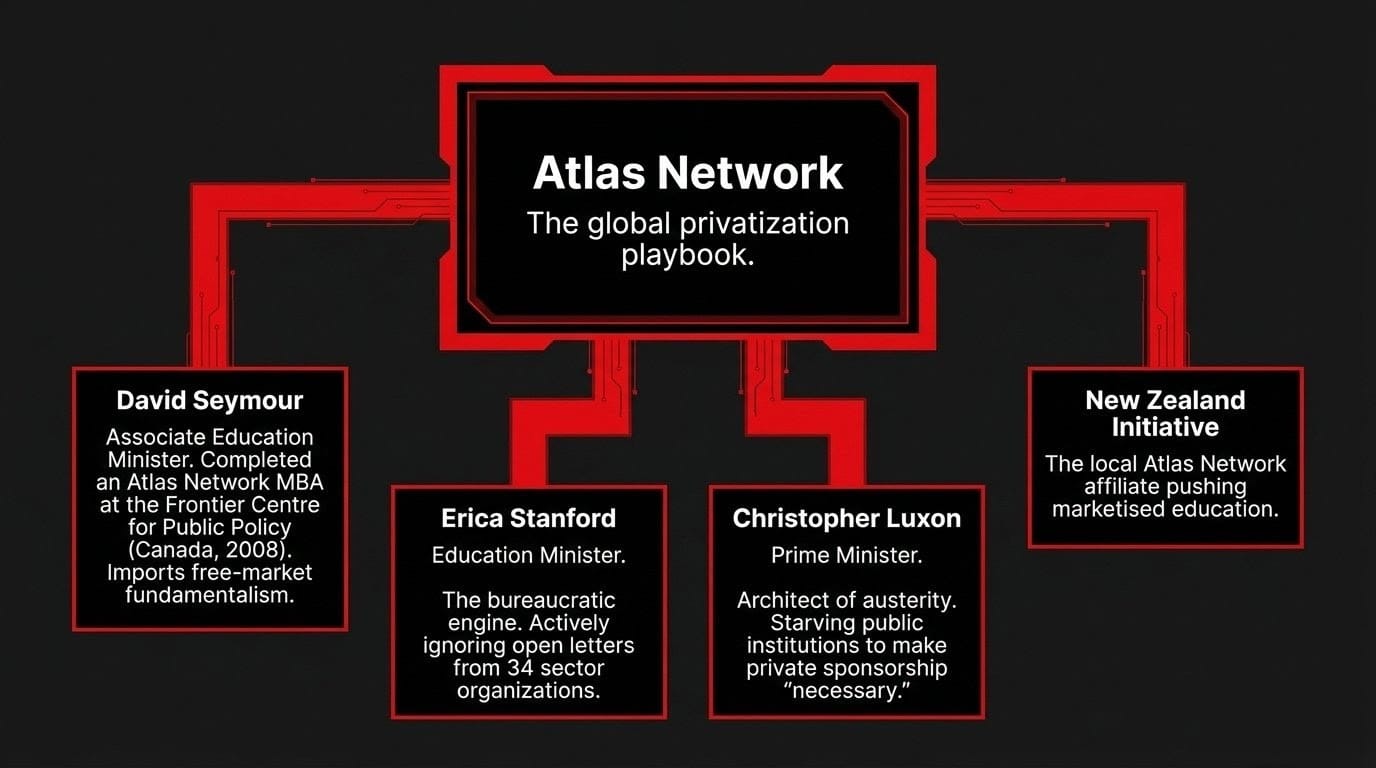
Three architects are driving this demolition. Know their names.
David Seymour — ACT leader, Associate Education Minister, and the most dangerous ideologue in the building.
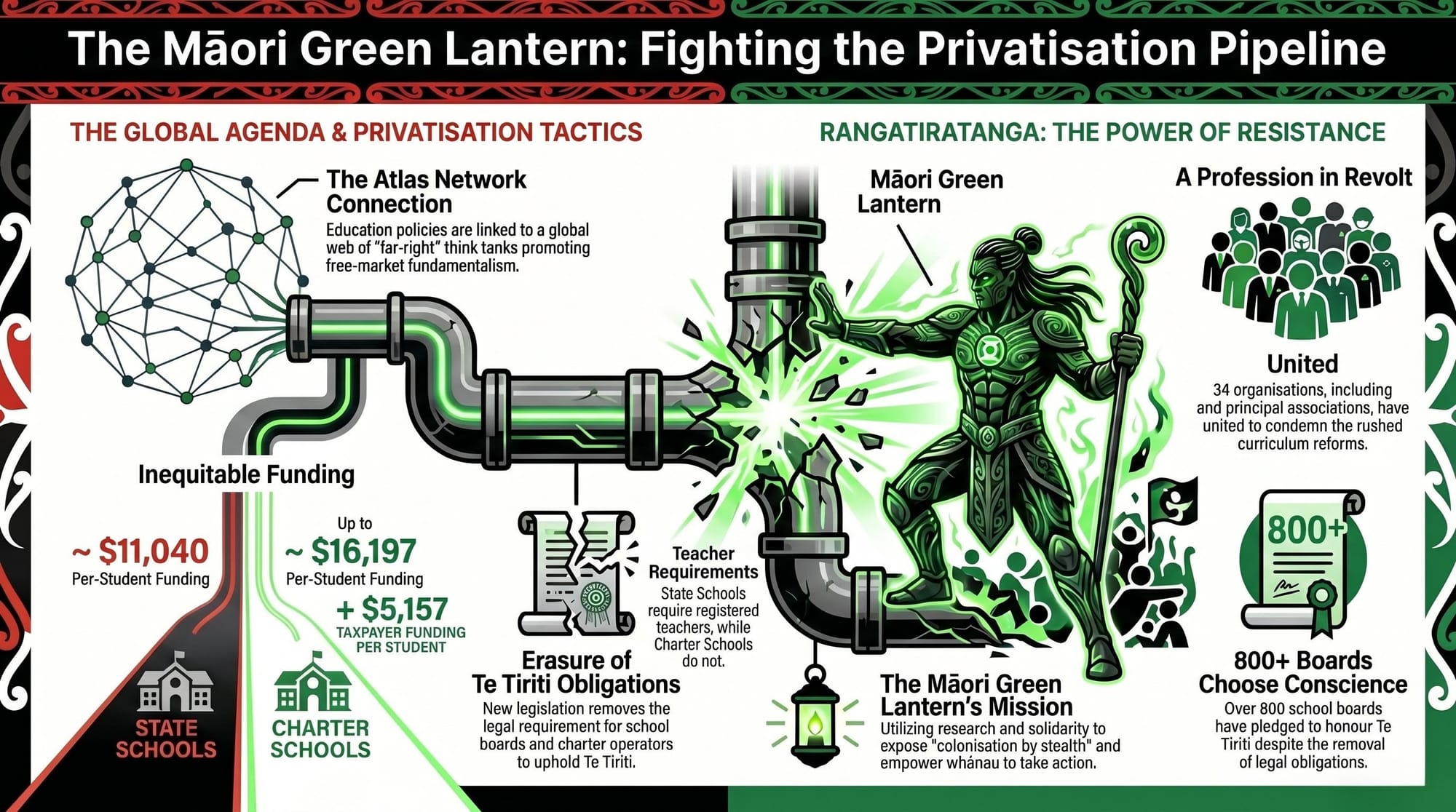
His political DNA was not formed in Aotearoa. As documented by The Māori Green Lantern, Seymour trained at the Frontier Centre for Public Policy in Canada
— an Atlas Network-linked think tank dedicated to free-market fundamentalism, Indigenous rights denial, and climate science suppression.
He completed an Atlas Network MBA for think tanks in 2008. His policies are not New Zealand originals — they are cut-and-paste imports from a global neoliberal playbook designed to privatise public services and break collective rights.
His own ACT Party website celebrates the charter school rollout as a triumph of "choice" — the same language used by every privateer since Milton Friedman. When Seymour says "not everyone wants their child's education to be an eternal marae visit," as The Spinoff reports, he is not making a joke.
He is announcing an agenda.
Erica Stanford — Education Minister and the bureaucratic engine of this wrecking operation.
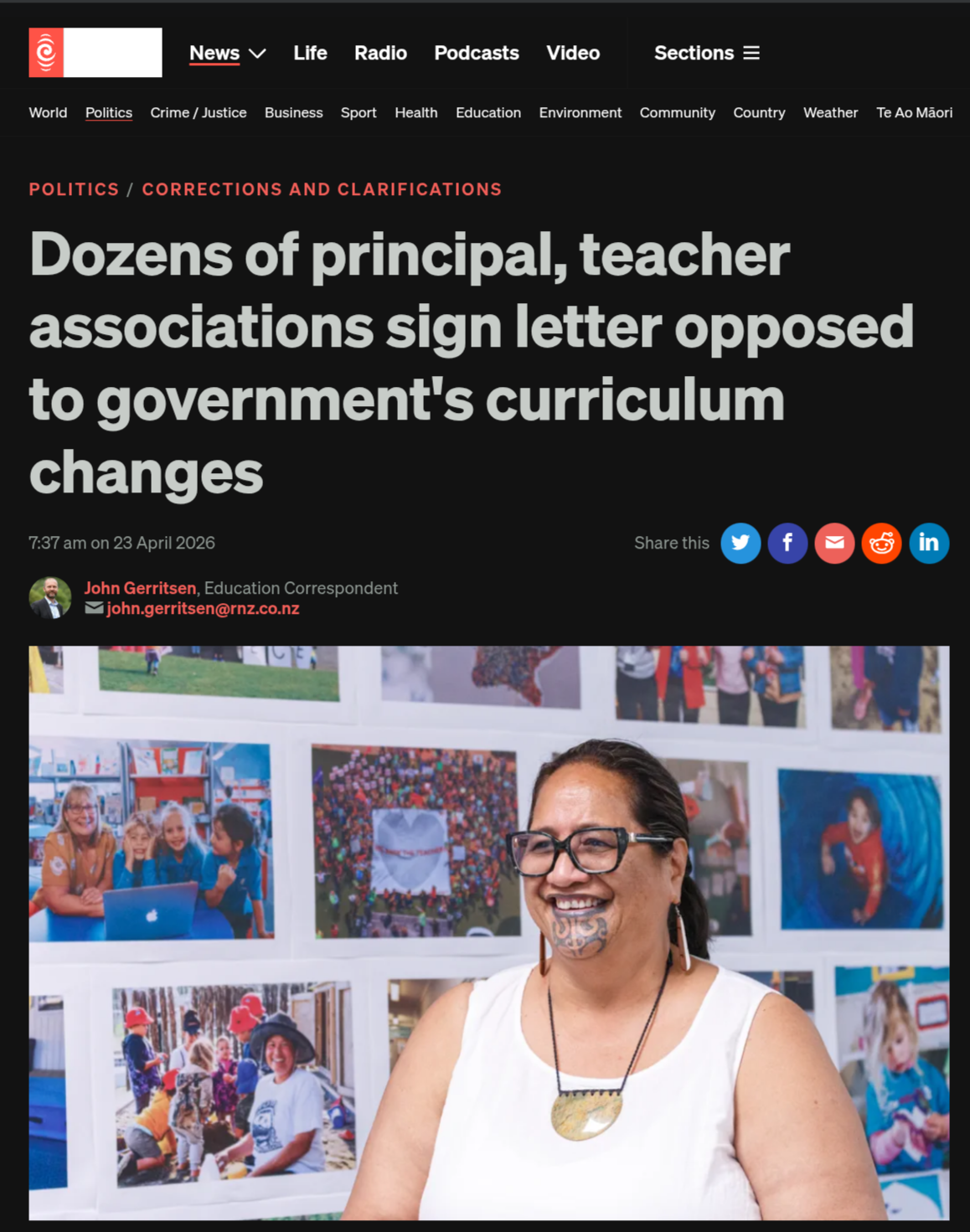
Stanford is the public face of reforms so poorly designed that, as NZEI Te Riu Roa's April 2026 joint sector statement reveals, unions, peak bodies, principal associations, teachers, and academics came together to condemn
"significant changes to the curriculum frameworks, the demotion of Te Tiriti o Waitangi and mātauranga Māori, the prescriptive nature and unmanageable size of the curricula and the number of errors throughout."
When educators across 34 organisations signed an open letter demanding a pause, as EducationHQ reports, Stanford dismissed the criticism. This is the response of a minister who has no intention of listening — because listening was never part of the plan.
The Deep Dive Podcast
Listen to a lively conversation between two hosts, unpacking and connecting topics in the sources of this essay.
Christopher Luxon — Prime Minister and National Party leader.
Luxon has floated the idea of National campaigning on asset sales at the next election. His government's tight Budget allowances deliberately starve public institutions — including schools — of the investment they need to survive without private sponsorship.
Austerity is not accidental; it is the mechanism through which privatisation becomes "necessary."
The Charter School Coup
The most brazen act of privatisation is already law.
The coalition passed the Education and Training Amendment Bill, which allows public schools to be taken over and run by private operators as charter schools while continuing to be funded by taxpayers.
It also grants the Minister of Education the power to force public schools to convert, as NZEI Te Riu Roa confirmed when Parliament passed the bill in September 2024.
This is not choice. This is compulsion dressed as reform.
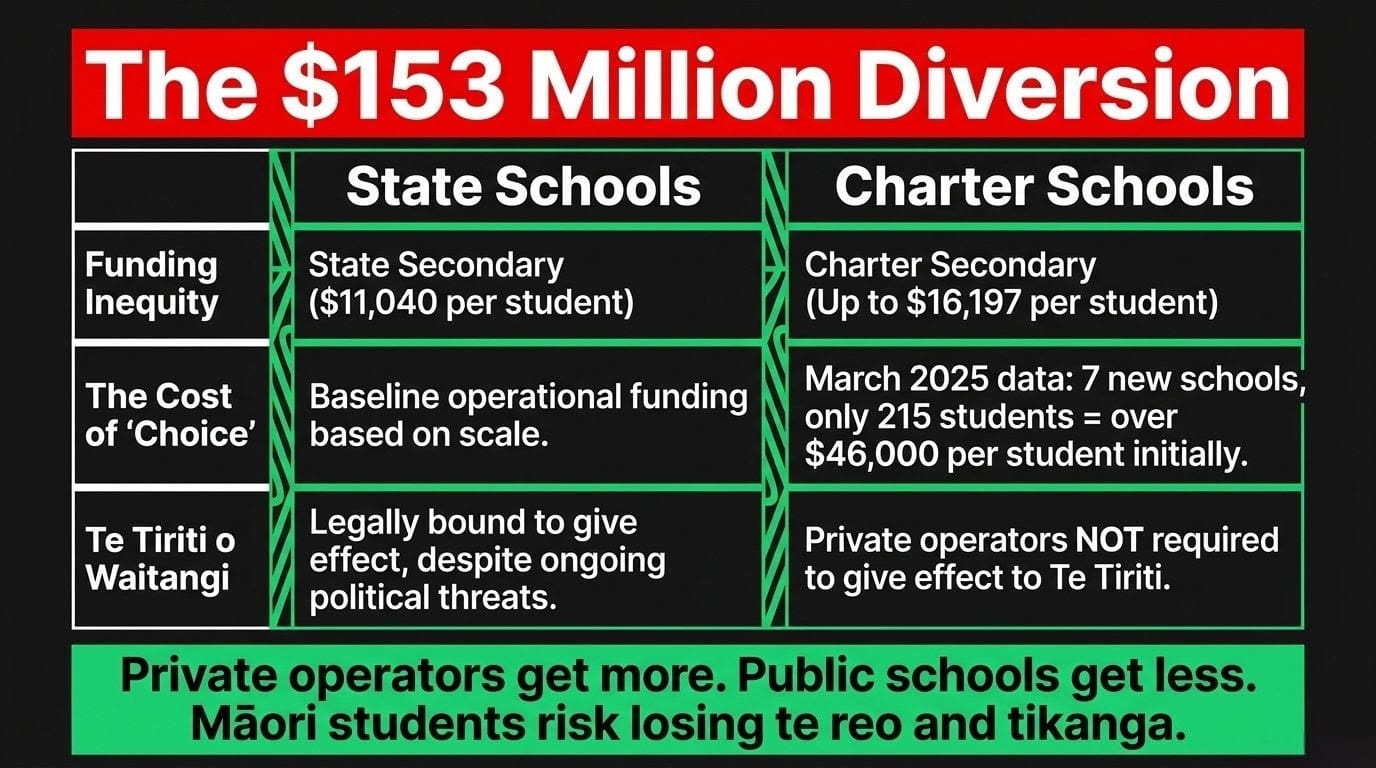
The government pledged $153 million over four years to establish up to 50 charter schools — 15 new schools and 35 state school conversions — as confirmed by 1News Budget 2024 reporting and Treasury's own charter schools expenditure report. By August 2024, NZ Herald reported that 78 groups had already applied to open new charter schools or convert existing state schools.
The financial reality, however, is damning.
Official Information Act requests, as exposed by Kiwiblog's analysis of OIA data, revealed that by March 2025 the seven operational new charter schools had just 215 students between them — at a cost of over $46,000 per student.
Seymour's claim of "overwhelming demand" was, the same analysis concludes, "porkies."
By March 2026, rolls had grown but the fundamental inequity remains: the Beehive's own charter school funding factsheet shows a small charter secondary school can receive up to $16,197 per student — while the average state secondary received $11,040.
Private operators get more. Public schools get less. The arithmetic of privatisation is this simple.
And critically, as NZEI Te Riu Roa warned at the time of the bill's passage, private operators of charter schools are not required to give effect to Te Tiriti o Waitangi.
Māori students in these schools may be stripped of access to te reo, tikanga, mātauranga Māori, and te ao Māori. This is colonisation by legislative mechanism.
The Curriculum Wrecking Ball
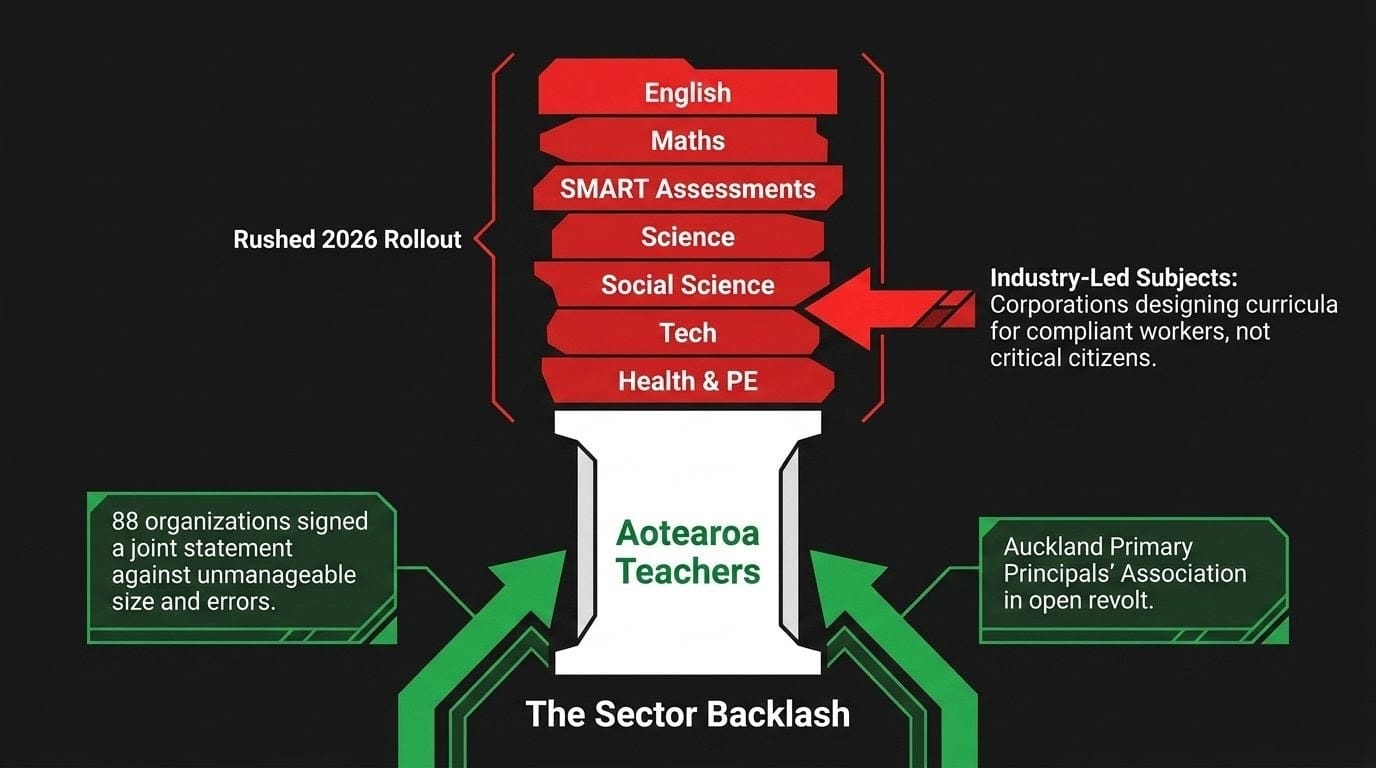
While charter school expansion grabs headlines, a quieter demolition is underway in the curriculum itself. The coalition is rushing through a complete overhaul of the national curriculum at a speed educators describe as reckless.
By April 2026, the sector backlash had reached critical mass. As Principals Today reports, opposition continues to grow with the submission deadline on the draft curriculum closing. NZEI Te Riu Roa's joint sector statement — signed by unions, peak bodies, principal associations, teachers, and academics — condemns both the content and the process: the "unmanageable size of the curricula," "errors throughout," and the systematic sidelining of mātauranga Māori.
Auckland's primary principals, through the Auckland Primary Principals' Association, have documented the precise crisis: teachers are simultaneously implementing new English and maths curricula, new assessment tools (SMART), and now being asked to absorb science, social science, technology, health and PE reforms — all in 2026. Their own newsletter records the Ministry's response to calls for a pause as essentially: keep going, we'll give you a Curriculum Day. The ODT's education outlook for 2026 confirms that "nearly every day a different regional principals' association publishes an open letter to Education Minister Erica Stanford." This is not isolated dissent. This is a profession in revolt.
The sector's outrage is backed by concrete evidence of ideological contamination. As EducationHQ documents,
NZPF president Jason Miles warned:
"Proposals as significant as the curriculum reforms floated need to be made thoughtfully, not urgently, and must involve the professionals implementing them."
They were not consulted. They are being managed.
"Industry-Led Subjects": The Market Enters the Classroom

Here is where the curriculum overhaul reveals its true architecture.
Erica Stanford introduced a lineup of "industry-led subjects" for secondary schools, framed as giving "students more choice." But as The Spinoff identified, the real concern is "the potential privatisation of the planned 'industry-led' subjects."
When corporations design the curriculum, they design it to produce compliant workers, not critical citizens.
This connects directly to the Seymour plan, covered by RNZ, to introduce a high school investment programme — financial literacy framed in the language of market participation.
Ask: who funds the curriculum? Who trains the teachers? Who owns the intellectual property? Who profits?
The Education and Training (System Reform) Amendment Bill goes further still — it transfers regulatory functions for private schools from the Ministry to ERO, and removes the requirement for community consultation on Relationships and Sex Education, replacing it with mere "notification."
As The Conversation's academic analysis concludes, the NZ government is opening "the door to private interests" through a pattern of stealth marketisation that mirrors international models — all of which ended with communities, particularly vulnerable ones, paying the price.
The Erasure of Te Tiriti
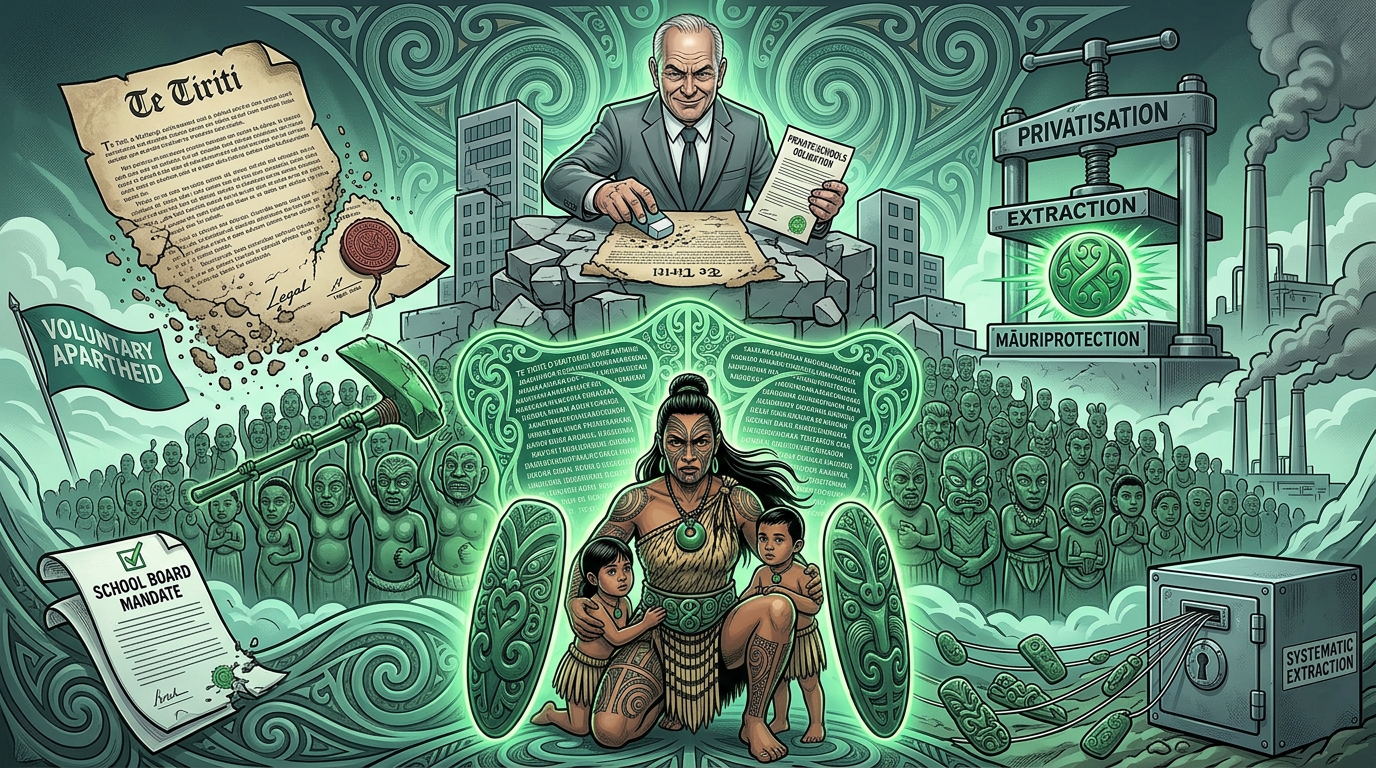
Threaded through every single one of these reforms is the deliberate erasure of Te Tiriti o Waitangi from the educational framework.
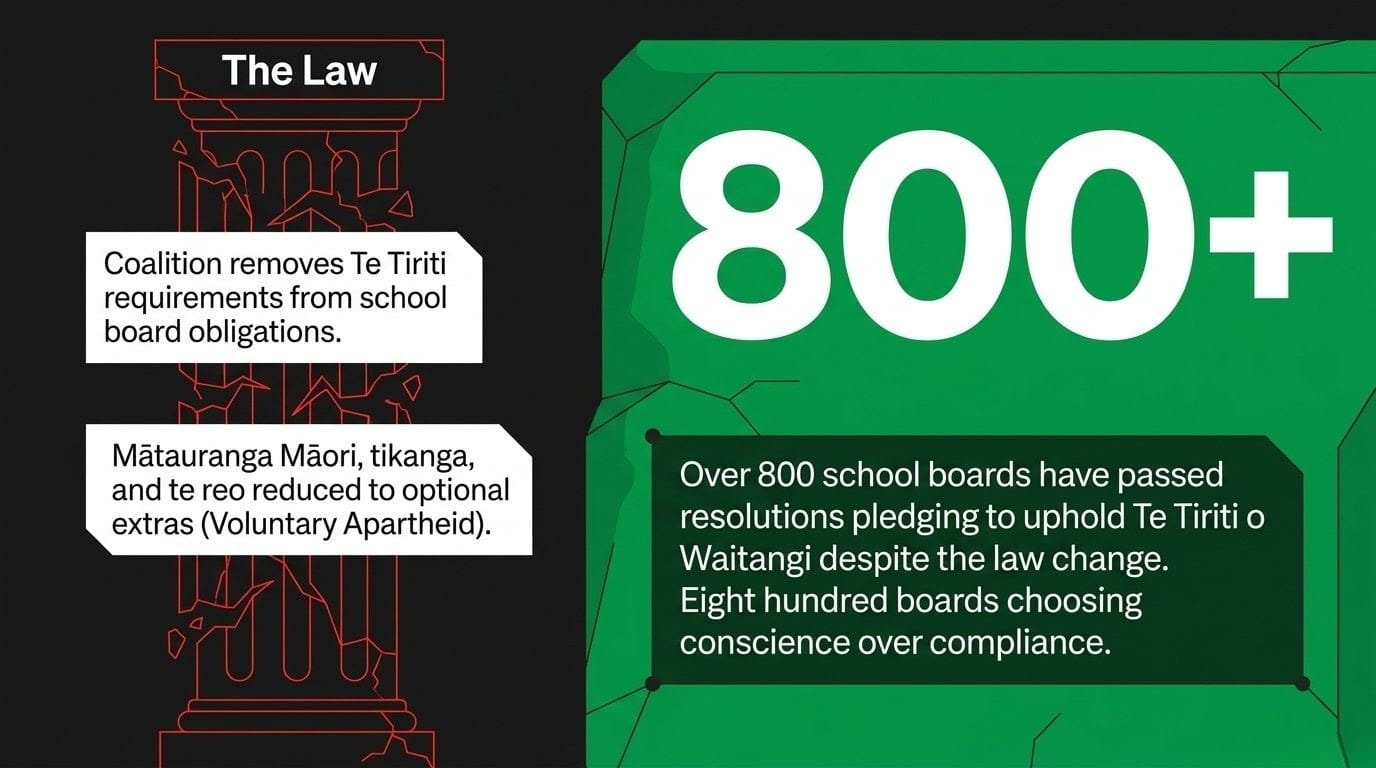
The coalition removed Te Tiriti requirements from school board obligations, with Seymour framing it as liberation — insisting boards could "teach as much tikanga and mātauranga Māori as they like," the difference being "the law won't force them to," as The Spinoff documents.
This is the language of voluntary apartheid. When legal protection is removed and replaced with "goodwill," Māori children lose.
The resistance from within the sector has been extraordinary. As ODT's reporting on the 2026 education landscape confirms, over 800 school boards have passed resolutions pledging to uphold Te Tiriti despite the law change removing the obligation. Eight hundred boards chose conscience over compliance. The government counted on the profession rolling over. It miscalculated. The NZEI Te Riu Roa joint sector statement explicitly names "the demotion of te Tiriti o Waitangi and mātauranga Māori" as a central concern — not a side note, but a headline grievance. And as the Māori Green Lantern has documented, privatisation is colonisation by another name: the systematic extraction of wealth and mana from those who need protection most.
The Attendance Illusion
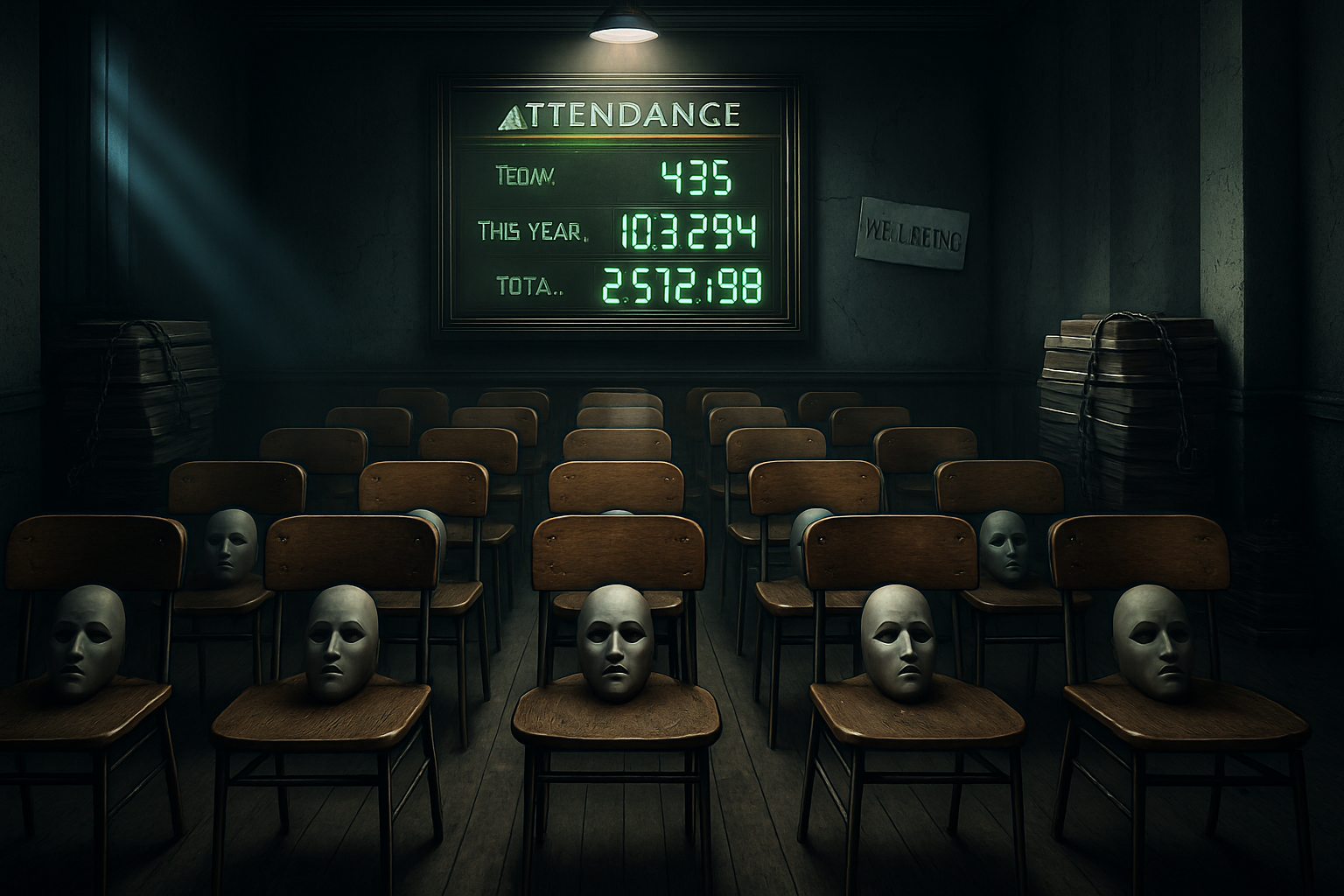
The government has pointed to data showing the highest Term 1 regular attendance since 2020 as proof their reforms are working.
Do not be deceived.
Attendance data measures bodies in seats — it does not measure learning, wellbeing, equity, or whether what children are being taught serves their futures.
A child sitting in a charter school without access to their language, culture, or a qualified registered teacher is counted as "attending."
The Beehive's own System Reform Bill removes principals' powers over justified and unjustified absences — centralising control, not improving outcomes. Counting bums on seats while stripping curriculum equity and Te Tiriti protections is not educational achievement.
It is theatre.
The Atlas Network Thread

No analysis of this agenda is complete without naming the Atlas Network — the global web of free-market think tanks that funds, trains, and coordinates the neoliberal policy agenda across dozens of countries.
As documented by The Māori Green Lantern's Atlas Network investigation, and cross-referenced with the Māori Green Lantern's Ruth Richardson analysis, Seymour's training at the Frontier Centre placed him directly inside this network. The policies flowing from ACT — charter schools, curriculum marketisation, asset sales, removal of collective rights protections — mirror Atlas Network playbooks implemented in the United States, United Kingdom, Australia, and Chile, always with the same result: public institutions hollowed out, private profits extracted, and Indigenous and working-class communities left holding the debris. The New Zealand Initiative, the local Atlas Network affiliate, continues publishing policy papers advocating for school choice and marketised education — and its fingerprints are on every major reform in this government's education agenda.
As Labour education spokesperson Jan Tinetti stated in July 2024, as documented on Labour's own website:
"The coalition Government is driving to dismantle our public school system and instead promote a privatised, competitive structure that puts profits before kids."
The evidence says she is right.
Cui Malo? Who Is Harmed?
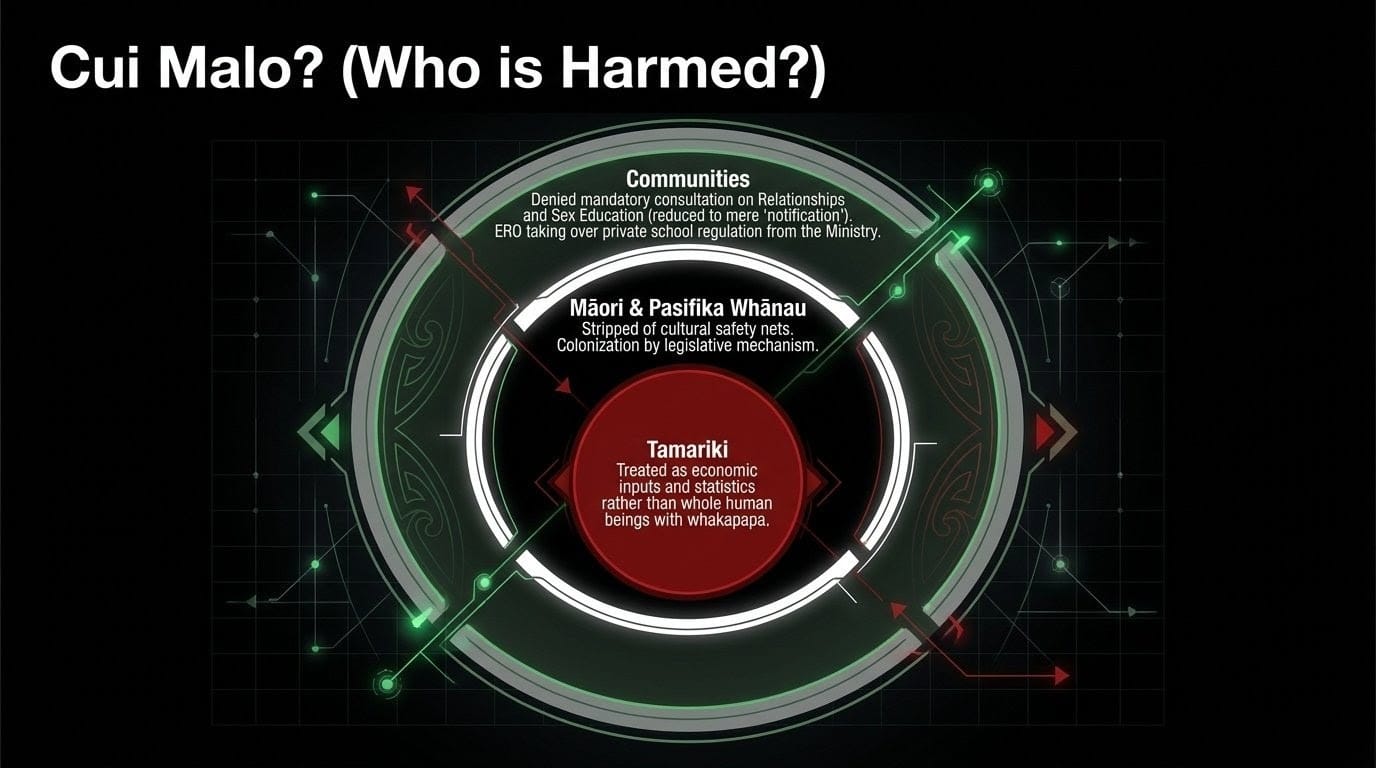
The harms are not distributed equally. They never are.
Māori and Pasifika students, already navigating a system built on colonial foundations, face the deepest cuts:
- Te Tiriti obligations removed from board duties and charter school operators, as confirmed by NZEI Te Riu Roa and The Spinoff
- Mātauranga Māori, tikanga, and te reo reduced from legal requirements to optional extras, as NZEI's joint sector statement explicitly condemns
- Charter school funding inequity — small charter secondary schools funded at up to $16,197 per student against $11,040 for state secondaries, per the Beehive's own factsheet, while the public schools serving most Māori communities are relatively starved
- Rushed curriculum changes designed without genuine sector consultation, imposed on a teaching workforce already at breaking point, as Auckland Primary Principals' Association and EducationHQ both document
- Industry-led subjects that treat our tamariki as economic inputs, not whole human beings with whakapapa and futures beyond the labour market, as The Spinoff flags
Rangatiratanga: The Path Forward
This is not a call for despair. It is a call to arms — the arms of knowledge, solidarity, and organised resistance.
The sector is already moving.
Over 800 school boards pledged to honour Te Tiriti regardless of law, as ODT documents.
Eighty-eight organisations signed a joint sector statement, as NZEI records. Principals across Auckland are pushing back through the Auckland Primary Principals' Association.
The backlash is intensifying, as Principals Today reports.
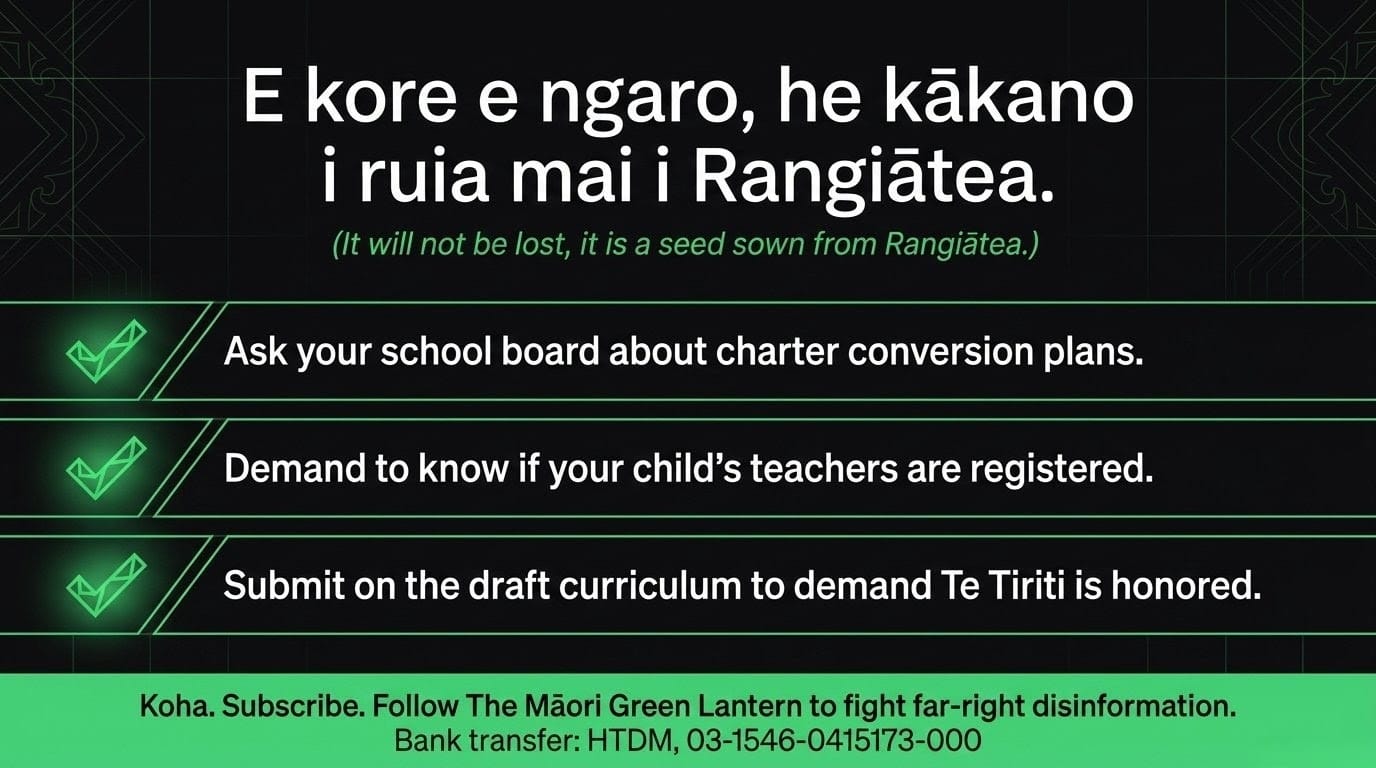
The draft curriculum consultation window is open — every submission is a taiaha blow against this agenda.
Whānau must act.
Engage with school boards. Ask who is funding the curriculum your child is being taught.
Ask whether your school has been approached about charter conversion.
Ask whether your child's teachers are registered.
Ask whether Te Tiriti is being honoured — not merely tolerated.
Name the network. Seymour. Stanford. Luxon. Atlas. Frontier Centre. New Zealand Initiative. These are not separate forces. They are one coordinated machine — and the Māori Green Lantern's ongoing investigations will continue to trace every thread.
He Kupu Whakamāhio — A Koha Consideration
This mahi — the research, the writing, the relentless tracing of networks and naming of names — is not funded by a corporation. It is not backed by a think tank. It carries no government grant, no institutional salary, no Atlas Network MBA.
It is funded by whānau, for whānau.
Every koha signals that whānau are ready to fund the accountability that Crown and corporate structures will not provide.
It signals that rangatiratanga includes the power to fund our own truth tellers.
The Māori Green Lantern exists because communities like yours chose to make it exist. When this work exposes how David Seymour's charter school agenda funnels taxpayer money to private operators while stripping Te Tiriti obligations, that exposure costs time, tools, and relentless vigilance. When this work traces the Atlas Network threads running through Aotearoa's education reforms, that tracing is only possible because people who care enough make it possible.
Kia kaha, whānau. Stay vigilant. Stay connected. And if you are able, consider a koha to ensure this voice continues.
If you are unable to koha, no worries! Subscribe or follow the Māori Green Lantern at themaorigreenlantern.maori.nz, kōrero and share with your whānau and friends — that is koha in itself.
Four Pathways to Support This Mahi
Koha — direct voluntary contribution:
Support the mahi on the Koha platform → app.koha.kiwi/events/the-maori-green-lantern-fighting-misinformation-and-disinformation-ivor-jones
Subscribe — receive essays directly:
Subscribe to the Māori Green Lantern → themaorigreenlantern.maori.nz/#/portal/support
Bank transfer — direct to the kaupapa:
Account name: HTDM
Account number: 03-1546-0415173-000
Facebook — follow, share, amplify:
Subscribe and share → facebook.com/Themaorigreenlantern/subscribe
E kore e ngaro, he kākano i ruia mai i Rangiātea.
It will not be lost, it is a seed sown from Rangiātea.
He aha te mea nui o te ao? He tangata, he tangata, he tangata.
What is the greatest thing in the world? It is people, it is people, it is people.

Research conducted 28 April 2026. Sources verified at time of publication using live URL checks. Sources include: RNZ, NZ Herald, The Spinoff, The Conversation, NZEI Te Riu Roa, EducationHQ, Beehive.govt.nz, NZPF, Auckland Primary Principals' Association, Treasury, Principals Today, ODT, 1News, Labour Party, PPTA, ACT Party, Māori Green Lantern archives. All URLs tested live.