"THE FORENSIC AUDIT OF A BURIED HIT: HOW A PRESS GALLERY FROZE, A GOVERNMENT BENEFITED, AND REACTIONARY OPERATORS MOVED TO BREAK WHAT TRUST REMAINED: THE ANI OBRIEN SAGA" - 30 April 2026
An 11-month silence. A buried breach. A press gallery too compromised to clean its own whare. A government feeding on media weakness. And a reactionary flank using the rot to attack the press while carrying anti-Māori, anti-trans, and anti-liberatory politics of its own.

Mōrena Whānau,
I have seen this pattern too many times to pretend surprise.
The minister claims to uphold standards. The broadcaster claims to be restrained by process. The press gallery claims to be the watchdog of democracy. Then a serious internal breach appears, and suddenly the watchdog goes quiet, the minister becomes a bystander, and “process” is waved around like incense to cover the smell of institutional decay.
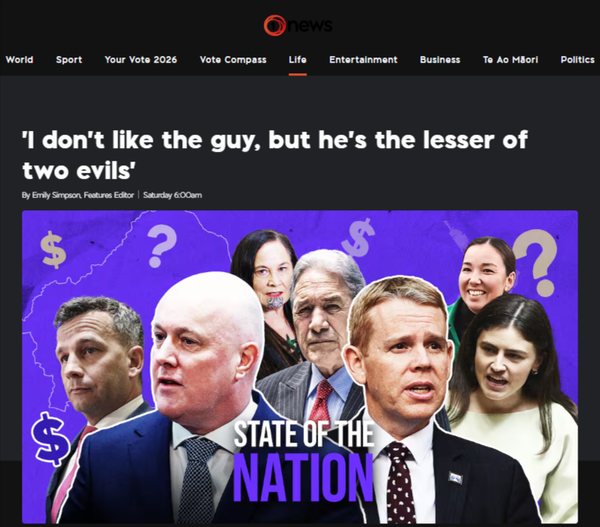
As reported by 1News, a serious alleged incident at Nicola Willis’ May 2025 pre-Budget event remained out of public view for nearly a year before surfacing through Ani O’Brien’s Substack post.
That delay matters.
The publication route matters. The silence matters. And the political uses of that silence matter even more.
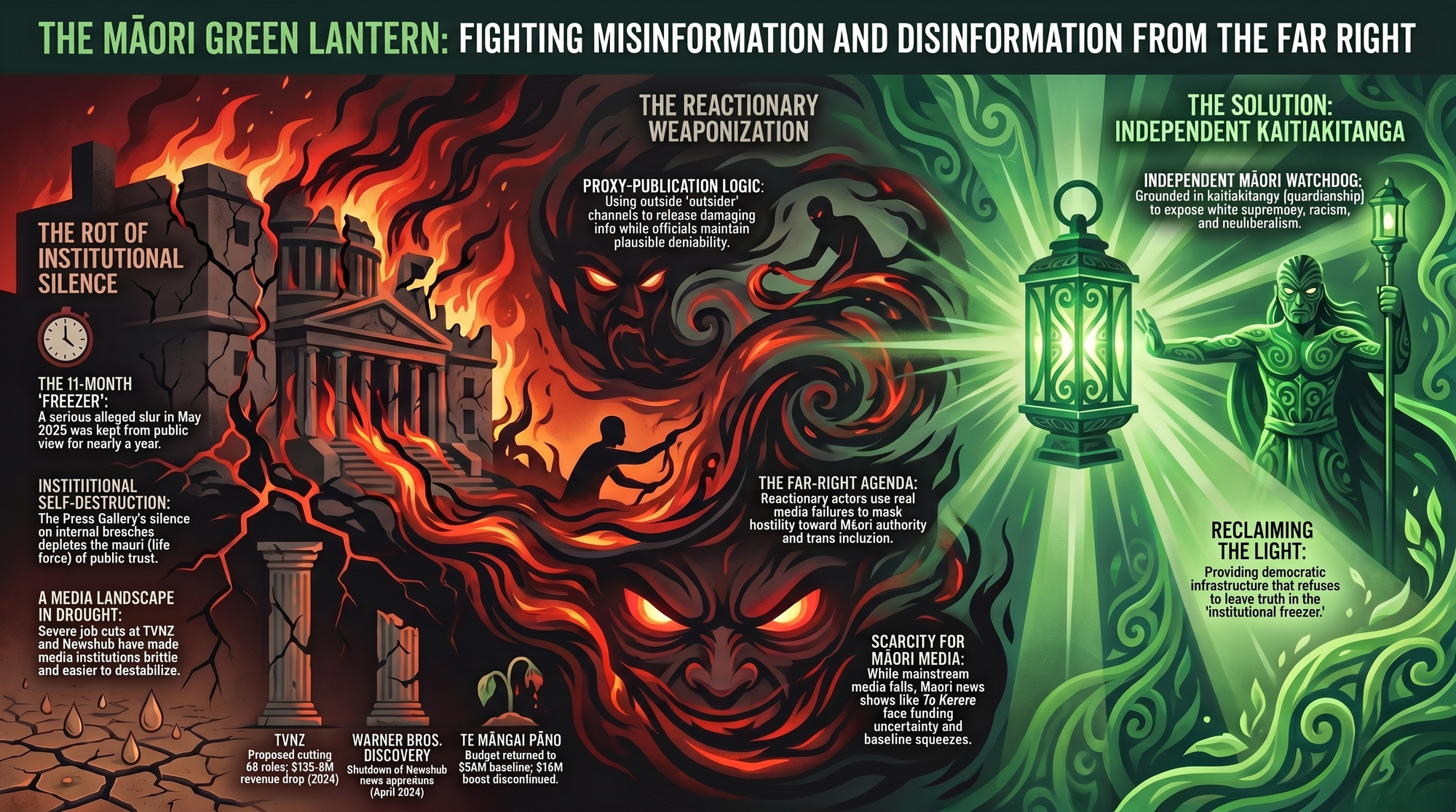
This is not only a story about one alleged slur in one room. It is a story about how elite proximity deforms public truth.
It is a story about how a press gallery can fail its own stated standards.
It is a story about how a government already presiding over a weakened media system benefits when scandal detonates inside that weakened field.
And it is a story about how reactionary political operators seize those failures and repackage them as proof that journalism itself is unworthy of trust.
The Deep Dive Podcast
Listen to a lively conversation between two hosts, unpacking and connecting topics in the sources of this essay.
I also need to be clear about who is writing this and why this platform exists.
 Ivor Jones The Māori Green Lantern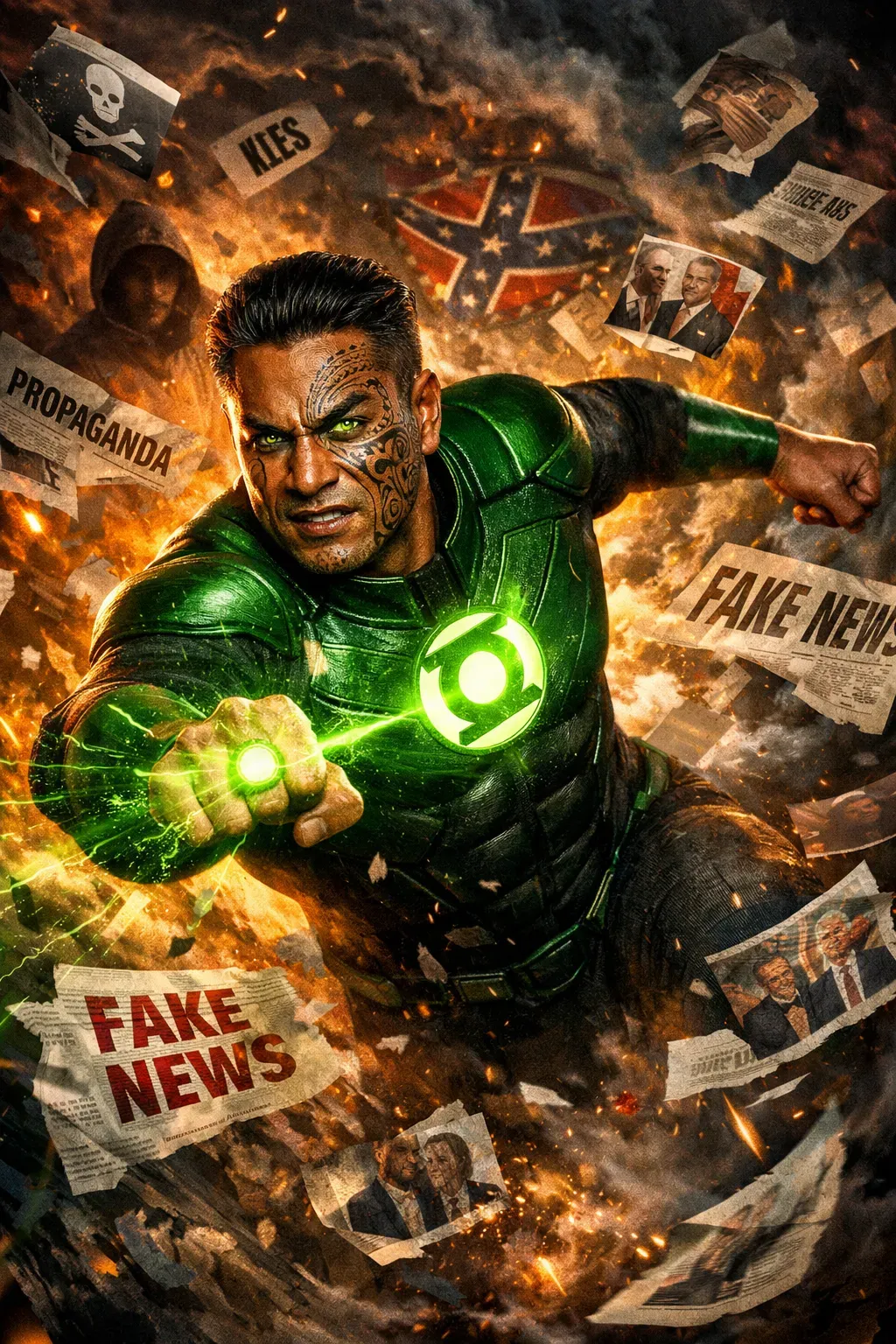
My About page on The Māori Green Lantern describes this work as an independent Māori watchdog grounded in kaitiakitanga and committed to exposing misinformation, white supremacy, racism, and neoliberalism while monitoring mainstream media and social platforms for harmful narratives.
That is not branding. That is democratic infrastructure for a country where Crown, corporate, and gallery institutions repeatedly show themselves too entangled, too cautious, or too compromised to tell the truth when that truth threatens status, access, and power.
I. The verified record
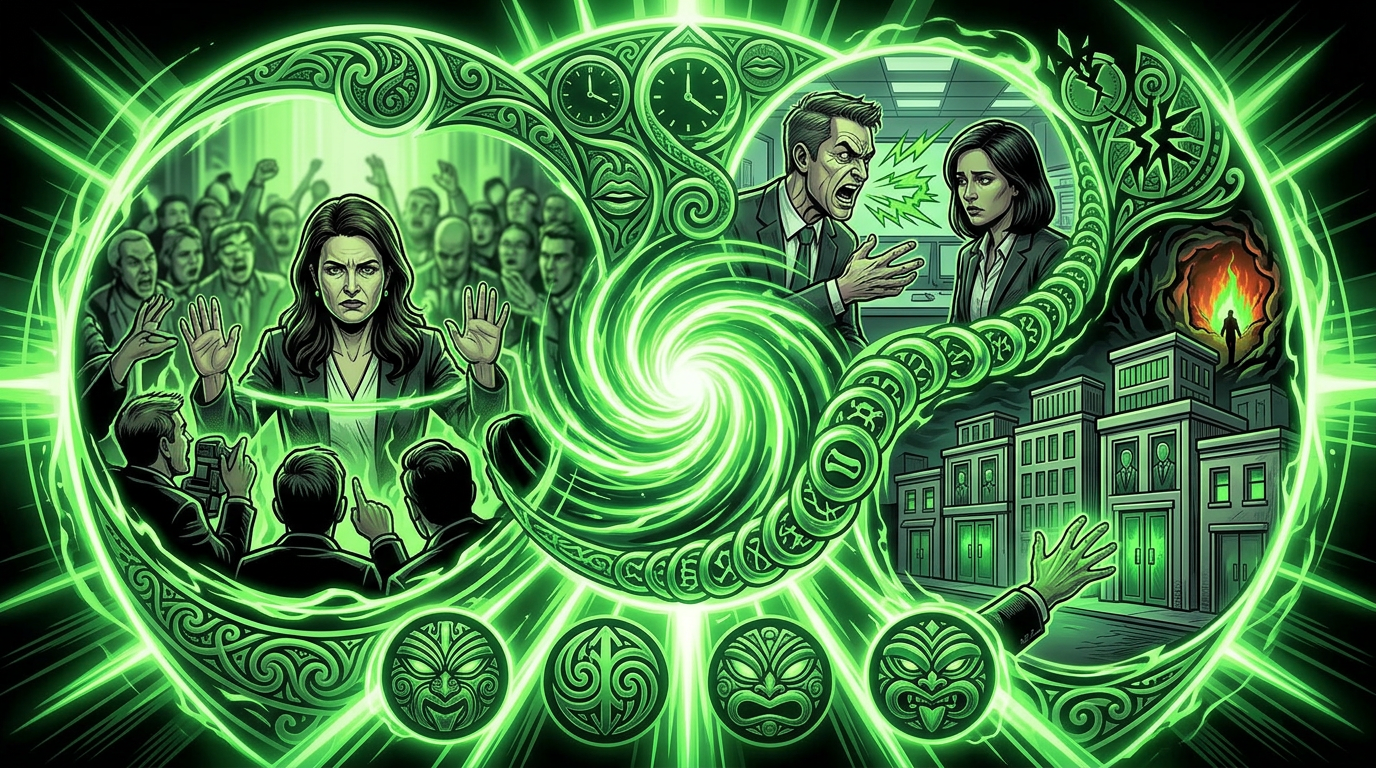
I start where every serious investigation should start: with what the public record actually verifies.
On 13 May 2025, Nicola Willis hosted a pre-Budget event in her parliamentary office for members of the press gallery, as reported by 1News and the Otago Daily Times.
Willis later said she had stepped out of the room, returned, heard “offensive language”, and immediately shut the event down, according to 1News and the Otago Daily Times.
The allegation later made public was that TVNZ political editor Maiki Sherman had used a homophobic slur toward Stuff journalist Lloyd Burr, as reported by 1News, the Otago Daily Times, and O’Brien’s Substack post.
Willis said she checked on Burr’s welfare the next day and that he did not want the matter pursued publicly, according to 1News.
TVNZ said it would not comment on employment matters, while Stuff said it stood by Burr’s account and conduct and would continue to respect his wishes not to comment further, as reported by 1News and the Otago Daily Times.
Media Minister Paul Goldsmith said the claims “should be looked at” while also saying he was not directly involved and that the matter was for TVNZ, even though he and Willis are shareholding ministers in the broadcaster, as reported by 1News.
Willis said she had not been involved in the story becoming public, according to 1News.
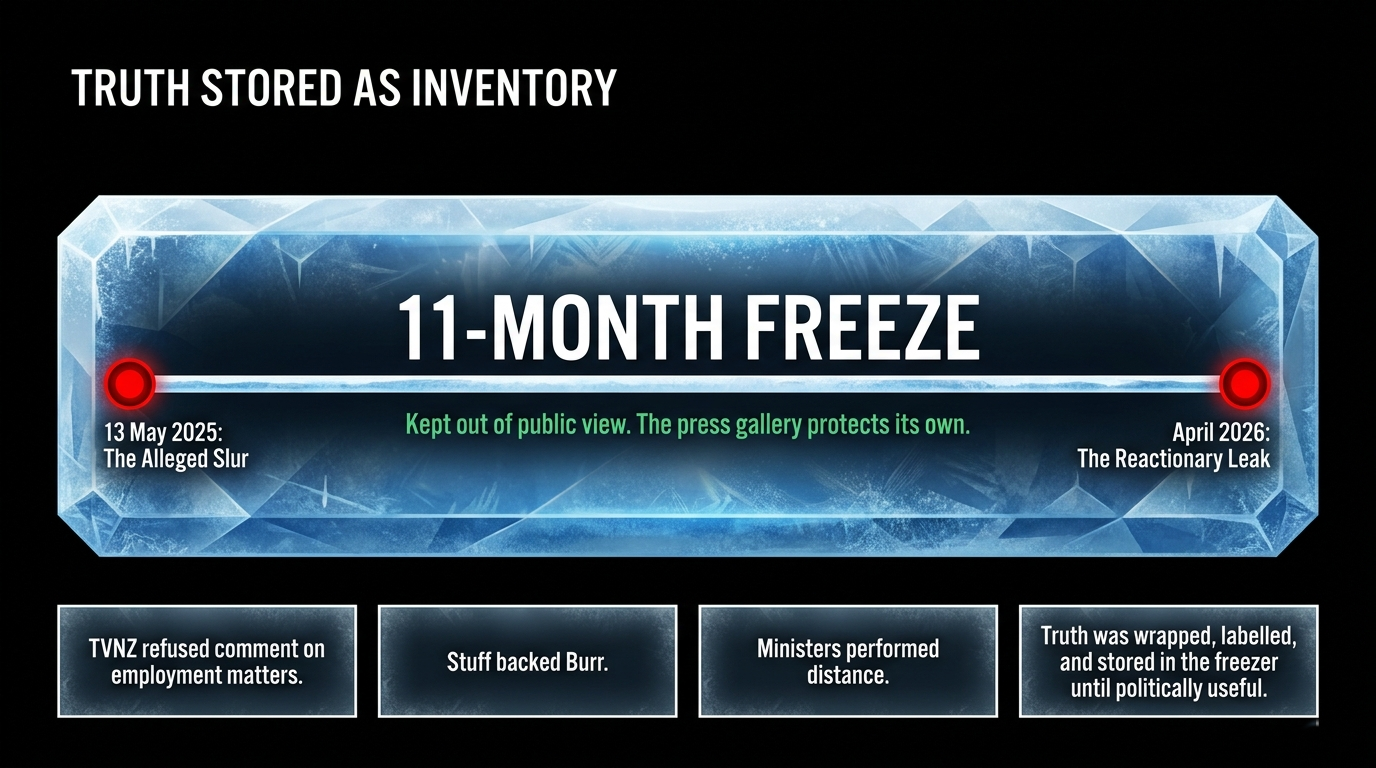
That verified record already gives me four ugly truths: a serious alleged breach, a delay of roughly eleven months, a wall of institutional silence, and eventual publication through a politically charged outside channel.
II. What remains unproven
I am not going to hand the powerful an escape route by overstating the record.
I do not have public documentary proof that Nicola Willis or her office directly gave the information to Ani O’Brien. No released message log, no public email chain, and no authenticated witness statement currently proves that direct transfer.
That matters because a strong essay is not a loud essay. A strong essay is one that keeps its footing. So I am drawing a hard line between three things.
- Verified fact: the event happened, the allegation exists, the incident stayed out of public view for months, O’Brien published it, TVNZ refused comment, Stuff backed Burr, and ministers distanced themselves, according to 1News and the Otago Daily Times.
- Strong inference: the timing, release mechanism, and political benefit resemble a proxy-publication logic familiar in New Zealand politics, as documented by Dirty Politics, Dirty Politics NZ, the NZ Herald’s reporting on Jason Ede’s resignation, and the Otago Daily Times coverage.
- Unproven allegation: that Willis personally, or through staff, directly fed the story to O’Brien.
I am not going to blur those lines just to satisfy people who think rage is a substitute for rigour. Rage without discipline is a gift to the guilty.
III. The press gallery froze
Now I come to the part the press gallery will not enjoy hearing: this story is also about them, and they have earned the scrutiny.
Duncan Garner
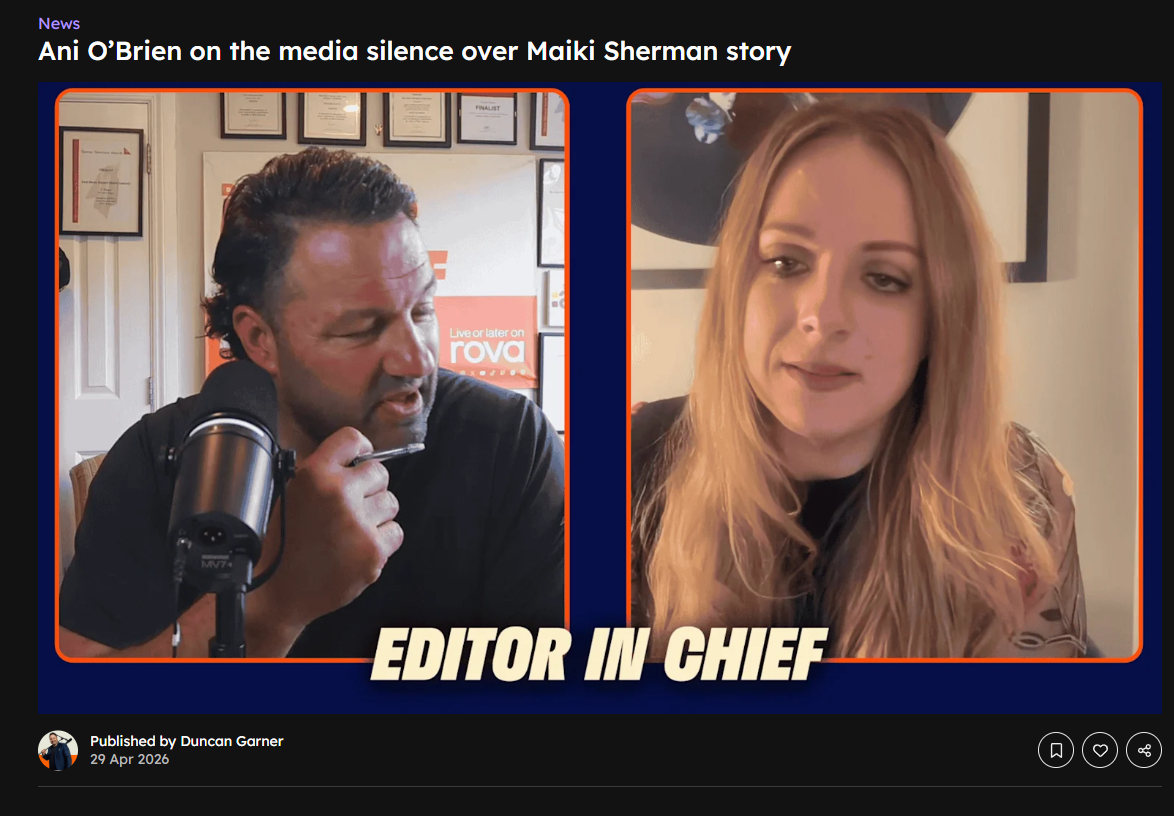
Duncan Garner’s Rova interview with Ani O’Brien makes that impossible to ignore. In that interview, O’Brien says she first received the matter as gossip, later got more detail from a second person, checked the minister’s diary, asked more questions, and concluded that
“this all kind of lines up.”
That does not amount to courtroom proof. But it does mean she presented her process as more than loose rumour. She says she tested the timeline, matched it against the ministerial calendar, and concluded there was enough factual spine to publish, according to Rova.
More damaging still is her claim that this was a press-gallery event where
“presumably every media outlet probably had one person there,”
according to Rova.
If that is even broadly correct, then the central question shifts sharply.
It is no longer “how could no one know?” It becomes “how many people knew enough, and still chose silence?”
O’Brien says the deeper story was media hypocrisy. She says the gallery is “so moralising and so ideological in how they approach everyone else” and yet allegedly chose not to report on one of their own, according to Rova.
She also says the press gallery operates “as a pack rather than having different voices and perspectives,” according to Rova.
That is a brutal assessment.
But the gallery has done itself no favours. If this matter was known internally for months, then too many journalists sat on a story they would likely have blasted across the front pages if the exact same conduct had been linked to an MP rather than to a member of their own professional class.
That is not a minor embarrassment. That is institutional self-destruction.
The press gallery’s problem is not only that it may have stayed quiet. Its problem is that every day it asks the public to trust its courage, its neutrality, and its moral seriousness.
If it then fails to report a serious alleged breach within its own ecosystem, it teaches the public a lesson more destructive than any outside critic could: that the press will preach universal standards right up until the mirror turns around.
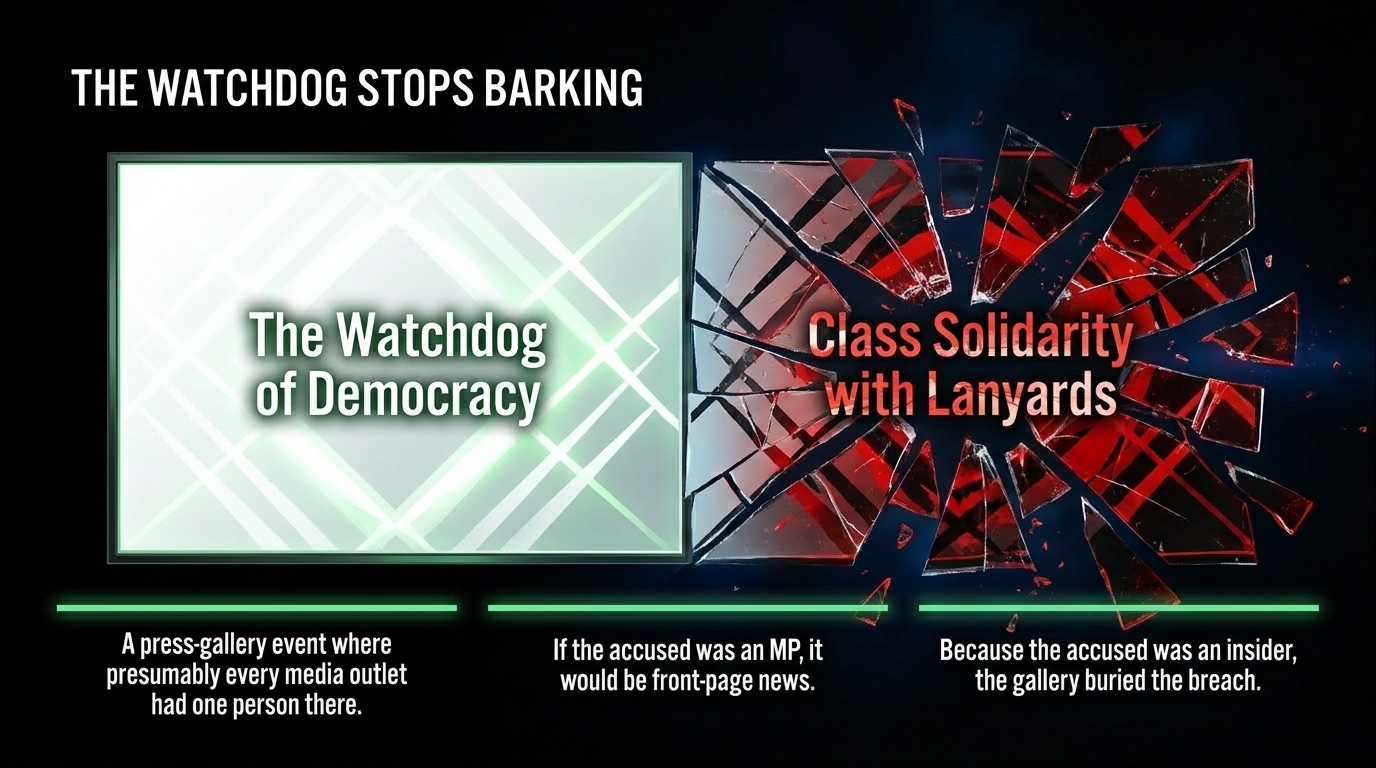
For the western mind, think of a professional disciplinary board that campaigns loudly for ethics in the sector, then buries a serious complaint when the accused is a senior insider everyone drinks with after work. That is not principled caution.
That is class solidarity with lanyards.
For tikanga, the damage is deeper. A breach inside the whare that is concealed rather than confronted does not stay neatly contained.
It depletes the mauri of the whole house.
Everyone learns the same lesson: truth is not sacred, it is inventory.
IV. This became an attack on the press
But I am not naïve enough to confuse exposure of one failure with liberation.
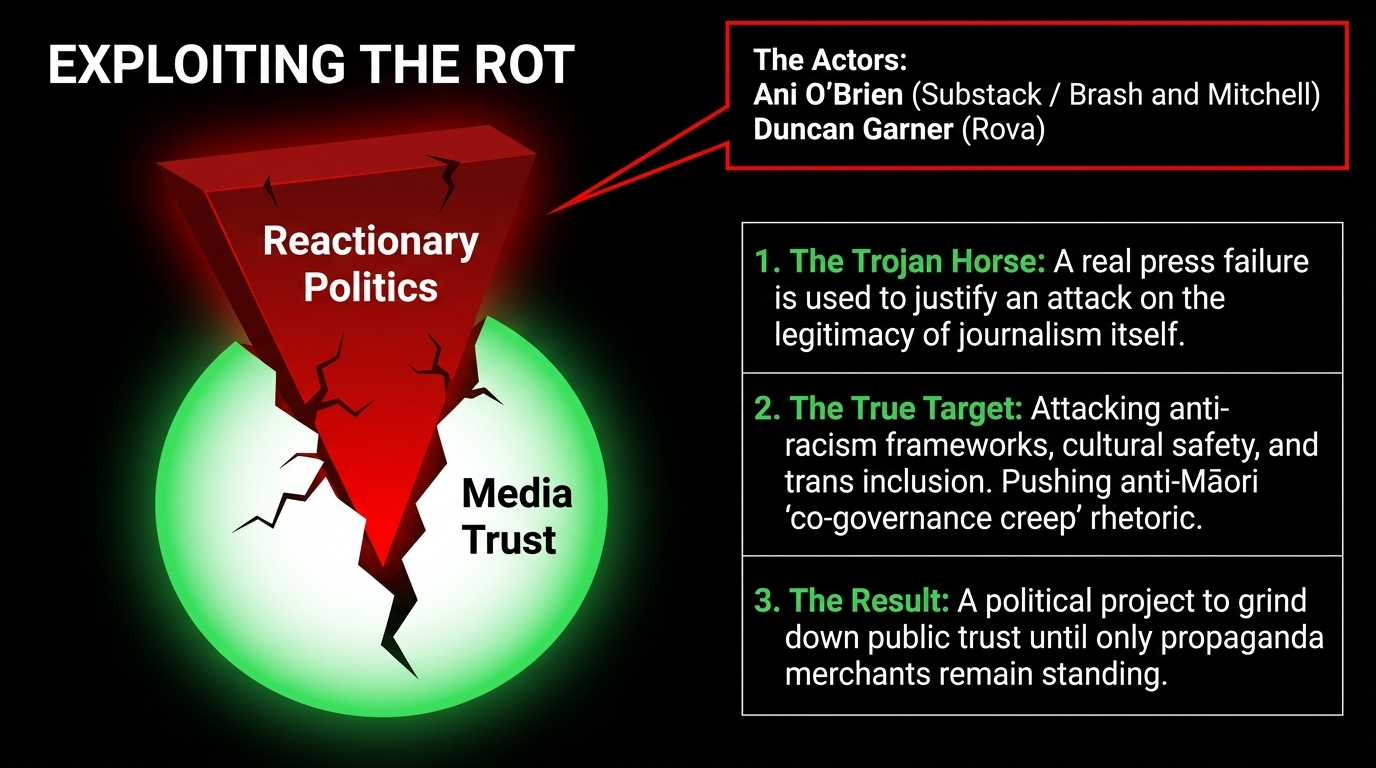
Once O’Brien published, the story did not simply remain a press-gallery reckoning. It became a broader attack on the legitimacy of the press itself. Garner’s Rova framing makes that plain. O’Brien becomes the outsider with a spine. The press gallery becomes the pampered coward class. The old media institutions become a hypocritical cartel of moralisers who protect their own and decide what the public is allowed to know, according to Rova.
That line bites because the gallery handed them the knife.
But let us be crystal clear: an attack on the press is not automatically a democratic act.
Sometimes it is. Often it is not. Sometimes it is a genuine public-interest correction. Often it is a political project to grind down public trust in journalism until only propaganda merchants remain standing.
That is why context matters.
O’Brien is not just some plucky outsider with a Substack and a lantern of truth. In her own published article at Brash and Mitchell, she attacks anti-racism and cultural safety frameworks as ideological coercion, dismisses critical race theory as an imported frame laid over Treaty issues, and explicitly positions “transphobes, racists, and bigots” as people being unfairly targeted.
Those are not innocent editorial preferences. They place her inside a reactionary political ecosystem that treats anti-racist and trans-inclusive frameworks as the threat while minimising the hierarchies those frameworks are trying to confront, as shown by her own Brash and Mitchell article.
Duncan Garner’s record matters too.
Te Ao Māori News reported that councillors shot down Garner’s claims of “co-governance creep,” rhetoric that sits squarely inside an anti-Māori backlash tradition in which Māori authority is framed as stealthy, illegitimate, or excessive.
So no, I am not going to pretend O’Brien and Garner stand outside ideology with clean hands. They do not.
They are not neutral disinfectant poured onto a corrupt press gallery wound.
They are reactionary political actors using a real press failure to drive a broader attack on the legitimacy of journalism while carrying politics steeped in hostility to Māori authority, anti-racist analysis, and trans inclusion, as shown by Rova, Brash and Mitchell, and Te Ao Māori News.
That is why they do not get hero status from me. They found a real wound. Then they used it to sell a politics that would not liberate Māori, workers, trans people, or the marginalised from media capture. It would merely swap one set of gatekeepers for another, crueler set with fewer scruples and louder slogans.
V. The government benefits from the chaos
This is where the current government must be kept under the light.
A government already presiding over a weakened media landscape does not get to pose as the neutral guardian of standards when scandal explodes inside that landscape.
In March 2024, TVNZ proposed cutting up to 68 roles, with staff describing the move as “devastating”, and 1News reported that the broadcaster’s revenue had fallen 13.5 percent to $155.9 million while it posted an operating loss for the half-year.
In April 2024, The Guardian reported that Warner Bros. Discovery shut down Newshub news operations while TVNZ also cut programmes and bulletins, describing the result as a major blow to New Zealand media.
By March 2025, the Otago Daily Times reported that TVNZ expected to save $8.9 million through 48.5 full-time jobs already cut and unfilled vacancies, while still aiming for $30 million in annualised savings by FY26.
So let me say this plainly: this scandal did not land in a healthy forest. It landed in drought.
A broadcaster already wounded by cuts is easier to isolate. Easier to destabilise. Easier to shove behind HR language and legal caution. Easier to discipline through reputation, access, and fear.
For the western mind, imagine a council that lets the reservoir run dry, then acts shocked when one spark turns a paddock fire into a township blaze. That is how media weakening works. Institutions do not have to be formally censored to be made brittle. They only need to be starved, narrowed, and left exposed.
And governments know that.
This is why the present government deserves no innocence halo.
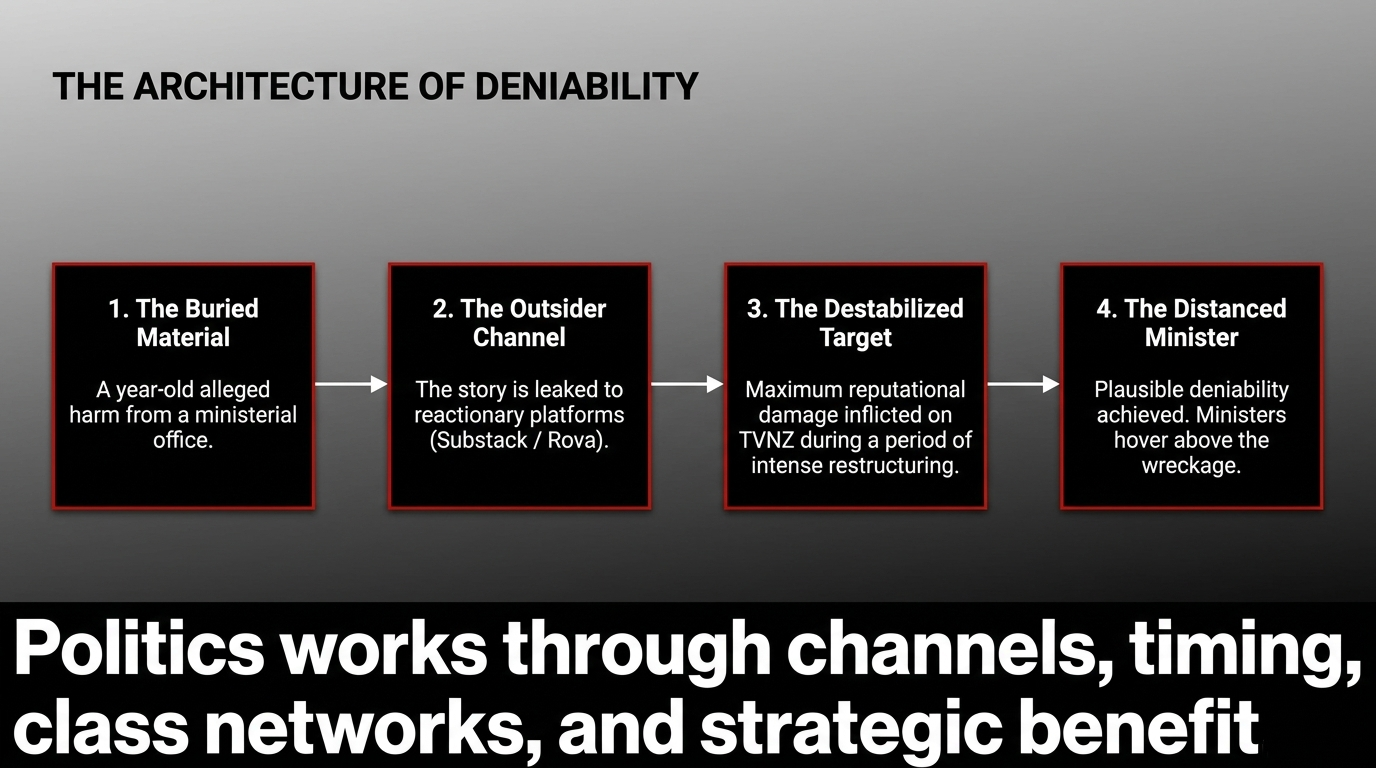
It is already presiding over a communications landscape in which public-interest journalism is weaker, local journalism is thinner, and broadcasters are retrenching under financial pressure. Then a year-old scandal erupts inside one of those weakened institutions, and ministers hover above the wreckage performing distance.
That is not proof of direct orchestration. But it is proof of political benefit. And political benefit matters.
VI. Māori media was already being squeezed
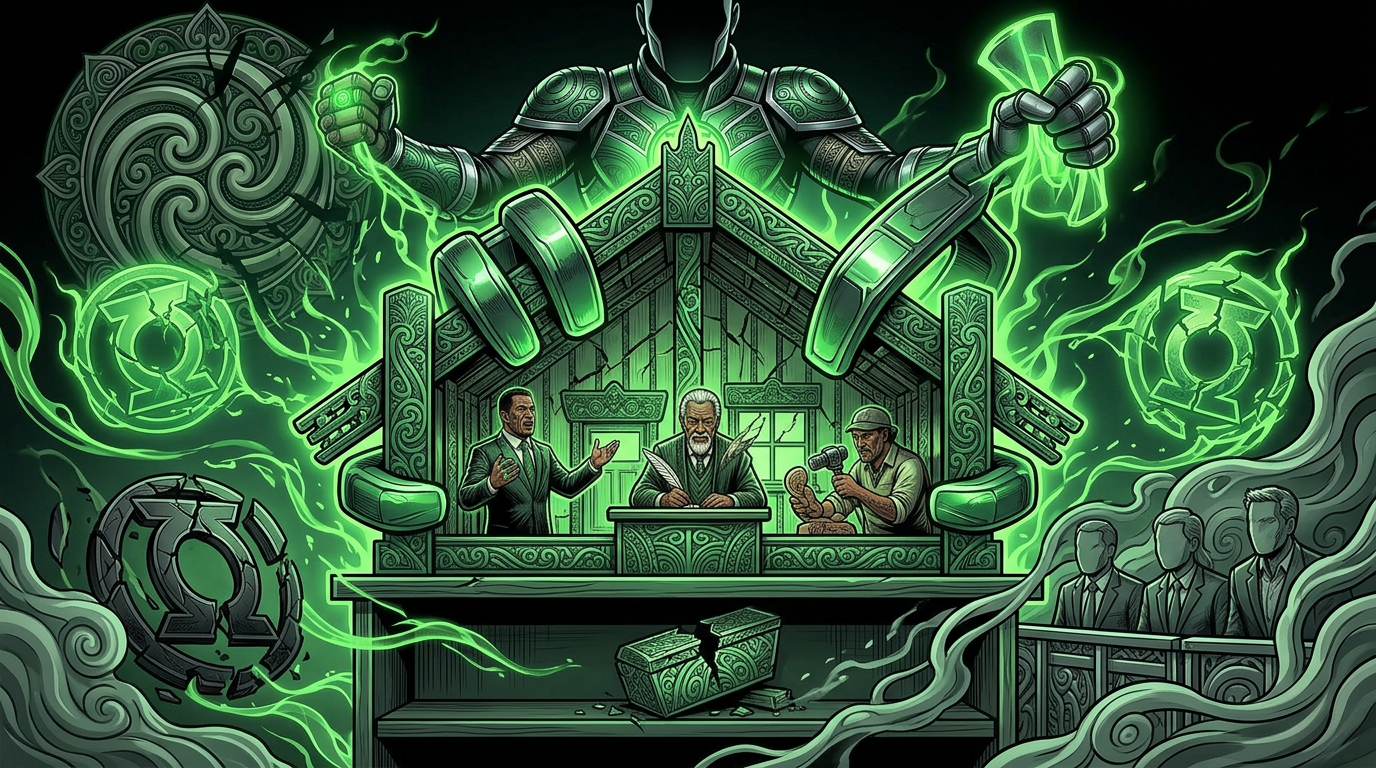
The Māori media dimension makes this worse.
In October 2025, 1News reported that Te Karere and The Hui faced an uncertain future after Te Māngai Pāho’s budget returned to a $50 million baseline when earlier annual boosts of about $16 million were not continued by the government.
That same report said Te Karere was funded by around $2.7 million from Te Māngai Pāho and $900,000 from TVNZ, while The Hui had received $1 million from Te Māngai Pāho and $788,000 from NZ On Air in the prior round, according to 1News.
Those are not sterile budget facts. They are measurements of political oxygen.
They tell us that Māori storytelling, Māori accountability, and Māori public-interest journalism are already operating under conditions of negotiated scarcity, not democratic abundance. The shelf is thinner. The pātaka is under pressure.
That matters because this affair does not sit in isolation. It sits in a communications environment where mainstream journalism is already brittle and Māori journalism is already pushed toward precarity. So when the press gallery freezes, when broadcasters retreat into legal smoke, and when reactionary commentators exploit the breach, the whole public sphere becomes easier to bend away from truth and toward power.
This is also consistent with arguments I have already traced in earlier Māori Green Lantern essays such as HE HINAKI MĀORI: THE TRAP WOVEN IN SILK FEATHERS, THE PĀTAKA IS ASH, and DRILL BABY, DRILL — INTO YOUR OWN FRAUD.
Across those essays, I have been naming the same political habit again and again: scarcity for the public, insulation for the powerful.
VII. Dirty Politics did not vanish
This is why the Dirty Politics precedent still matters.
The 2014 scandal established a recognisable method in which politically useful material moved through aligned outside figures while formal political actors preserved plausible deniability, as documented in the Dirty Politics overview, the archive at Dirty Politics NZ, the NZ Herald’s reporting on Jason Ede’s resignation, and the Otago Daily Times coverage.
I am not saying this present case has been publicly proved to involve the same direct chain. I am saying the political grammar remains familiar: a useful disclosure, an outsider channel, official distance, and concentrated damage.
This is why the naive line — “stories just happen, somebody heard something, somebody published” — is not enough. Stories do happen that way. But politics also works through channels, timing, class networks, and strategic benefit. When a year-old buried scandal suddenly surfaces through a politically useful route in a media environment already weakened and contested, the public is entitled to ask not only whether the allegations are true, but who gains from the way they arrived.
That is not conspiracy fever. It is basic democratic literacy.
VIII. Three examples for the western mind
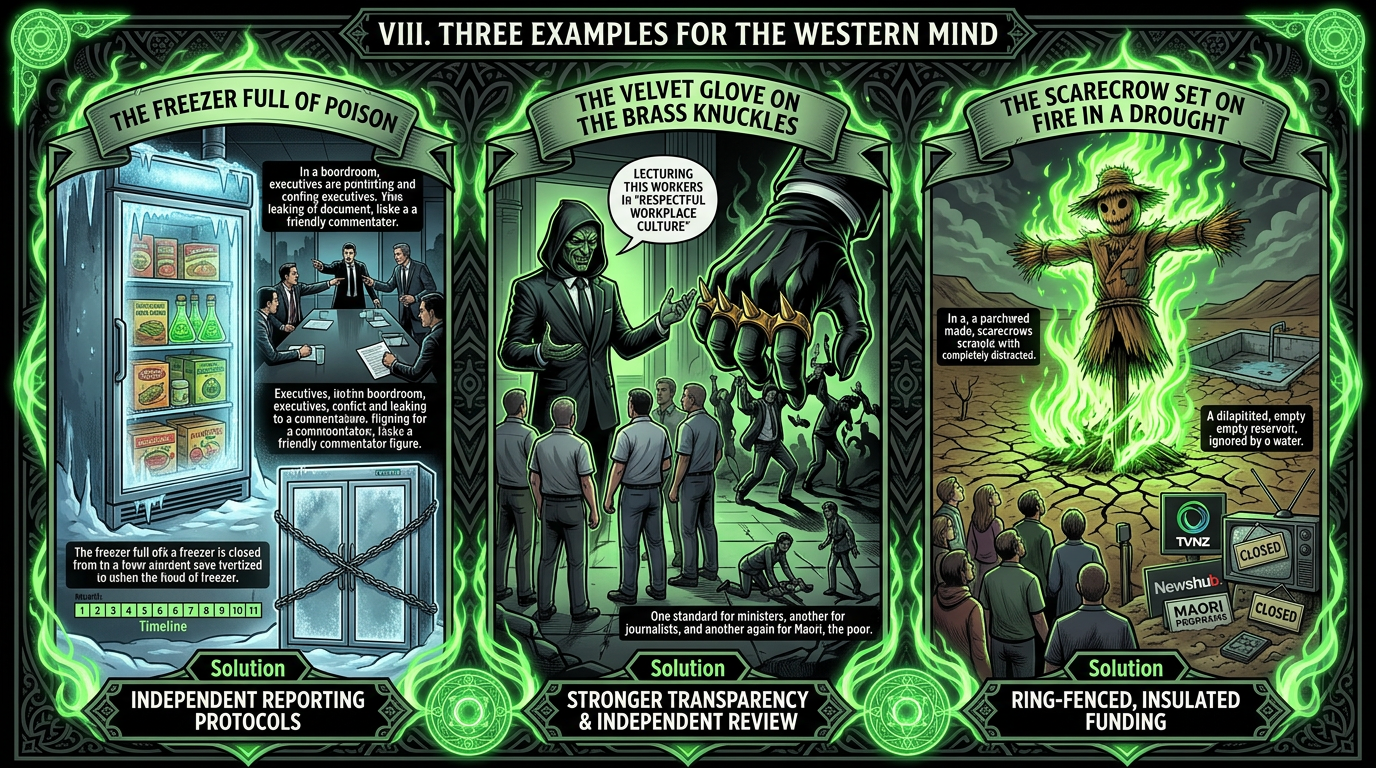
1. The freezer full of poison
Imagine a food company discovering contamination in one of its flagship products.
Instead of issuing a recall, it stores the information until a boardroom war begins. Then it leaks the contamination story through a friendly commentator and watches the rival faction collapse.
That is the closest western analogy for what this affair feels like. The original alleged harm matters. But the decision to keep it out of public view for about eleven months compounds the damage, as established by 1News, the Otago Daily Times, and O’Brien’s Substack post.
Quantified harm: roughly eleven months of foreclosed public accountability; severe delayed reputational damage to a broadcaster already under restructuring pressure; and the conversion of victim privacy into an institutional shield until it became politically usable.
Tikanga translation: tikanga says clean the wound when it happens. This system wrapped it, labelled it, and put it in the freezer.
Solution: independent reporting protocols for serious discriminatory conduct in parliamentary settings, with victim-centred protections that prevent later political weaponization.
2. The velvet glove on the brass knuckles
Imagine a CEO lecturing staff about respectful workplace culture while rewarding executives who brutalise rivals behind closed doors.
That is the western corporate analogue for selective morality.
Willis has been publicly positioned here as the shocked custodian of standards. Yet that performance sits within a broader political culture of heated confrontation and selective moral framing, reflected in the NZ Herald’s reporting on heated exchanges and Te Ao Māori News coverage of her sharp responses to critics.
Quantified harm: one standard for ministers, another for journalists, and another again for Māori, the poor, and anyone without institutional shelter. That is not mere hypocrisy. It is a hierarchy of impunity.
Tikanga translation: tikanga does not let rangatira stand outside the rules while everyone else is struck by them. The greater the power, the heavier the obligation.
Solution: stronger transparency around ministerial dealings on sensitive media matters, clearer separation between shareholding-minister roles and broadcaster discipline, and independent review mechanisms that do not rely on elite self-policing.
3. The scarecrow set on fire in a drought
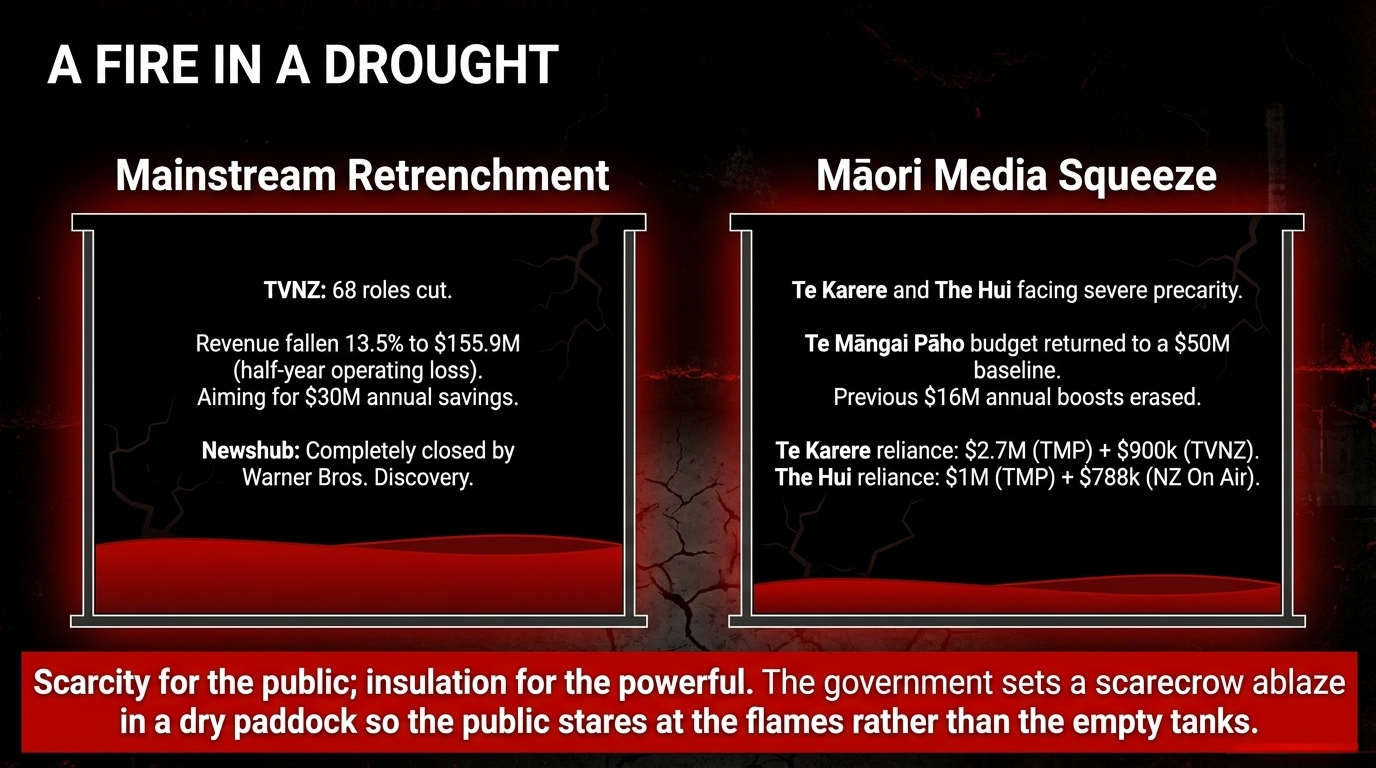
Imagine a town facing water shortages. Instead of repairing the reservoir, officials set a scarecrow ablaze in a dry paddock so the public stares at the flames rather than the empty tanks.
That is what a politically useful scandal can do in a weakened media environment.
TVNZ was already shedding roles and programmes, according to 1News and the Otago Daily Times. Newshub had already been shut down, according to The Guardian. Māori programmes later faced uncertainty under tighter funding, according to 1News.
Quantified harm: damage to a senior journalist’s standing; damage to TVNZ’s credibility; damage to public trust in the wider press system; and added pressure on a media sector already hit by major job cuts, programme losses, and shrinking Māori-public-interest capacity.
Tikanga translation: when the pā is under siege, tikanga does not tell the people to burn their own watchtower.
Solution: ring-fenced, politically insulated funding and governance protections for public-interest and Māori media, with structural separation between ministerial ownership powers and any retaliatory control over access or status.
IX. The deeper tikanga breach
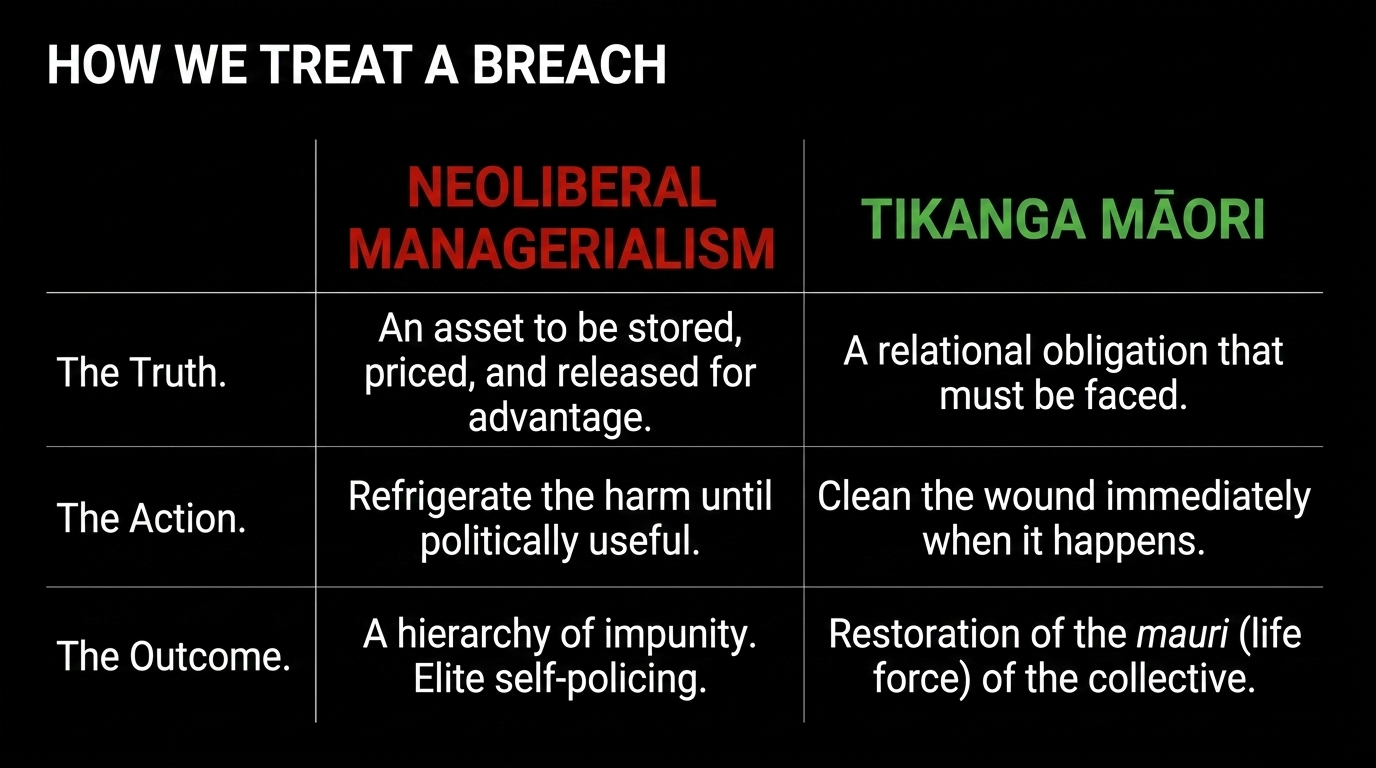
Through tikanga, the deepest breach here is not only the alleged slur. It is the conversion of harm into stored political inventory.
When harm enters the room, the task is to restore balance, protect the harmed, and repair the mauri of the collective.
What this record suggests instead is refrigeration: keep the breach out of sight, keep it sealed, then release it when it can do maximum political work, as shown by the timeline in 1News, the Otago Daily Times, and O’Brien’s Substack post.
For the western mind, that is like discovering contamination in an operating theatre and saving the disclosure for the precise moment it can destroy a rival department.
That is the difference between tikanga and neoliberal managerialism.
Neoliberal managerialism treats truth like an asset to be stored, priced, lawyered, and released when useful.
Tikanga treats truth as relational obligation. Hoarding it for advantage depletes the mauri of the whole whare.
X. Why The Māori Green Lantern is part of the answer
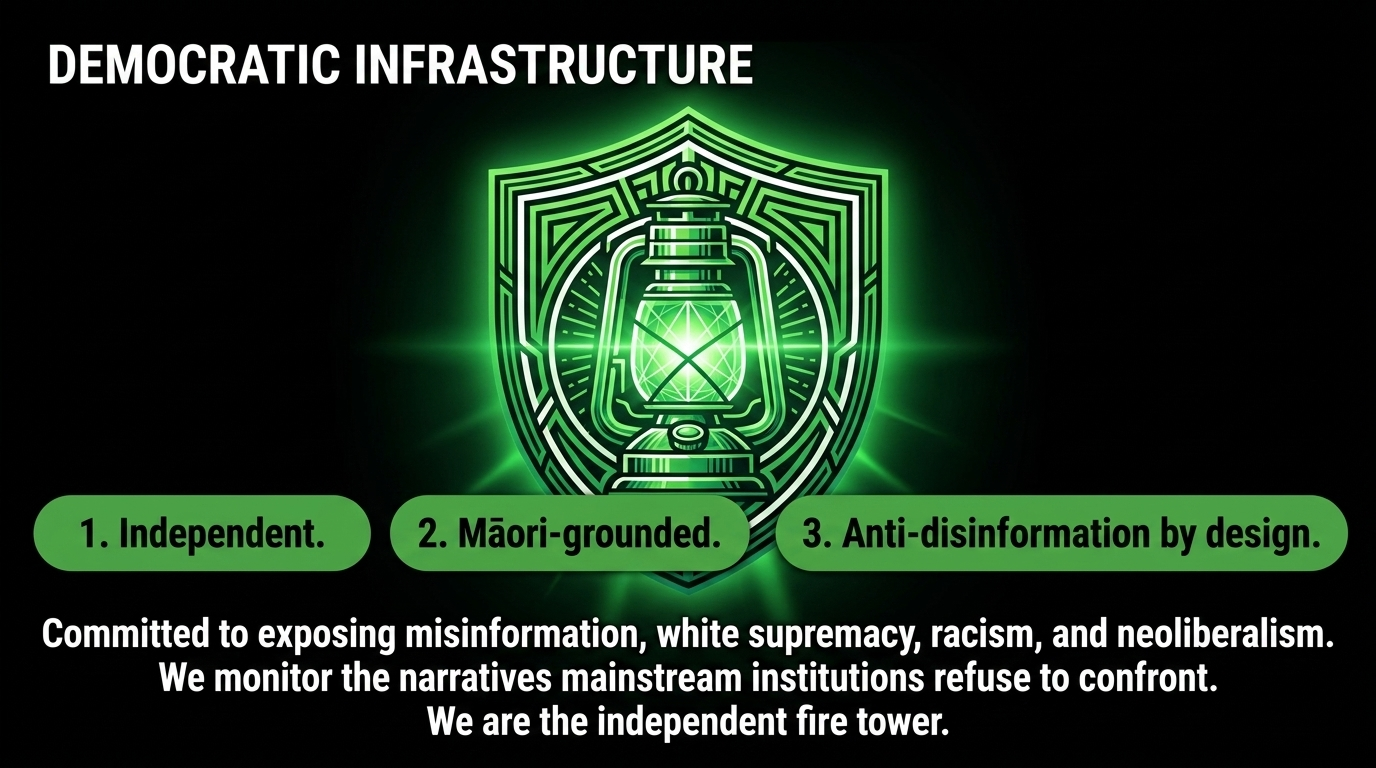
This is why The Māori Green Lantern is more than commentary.
My About page reinforces that is platform is an independent digital watchdog led by me, grounded in kaitiakitanga and committed to exposing misinformation, white supremacy, racism, and neoliberalism while analysing mainstream outlets and social media for harmful narratives.
That mission matters because the central failure in this affair is not only that a serious allegation existed. It is that mainstream institutions repeatedly showed themselves unable or unwilling to confront their own ecosystem when truth threatened access, status, ministerial relationships, or class solidarity.
I built The Māori Green Lantern to offer a different model because it is independent, Māori-grounded, anti-disinformation by design, and focused on public accountability.
For the western mind, think of it as building an independent fire tower after learning that the official alarm only sounds when the owners approve the smoke.
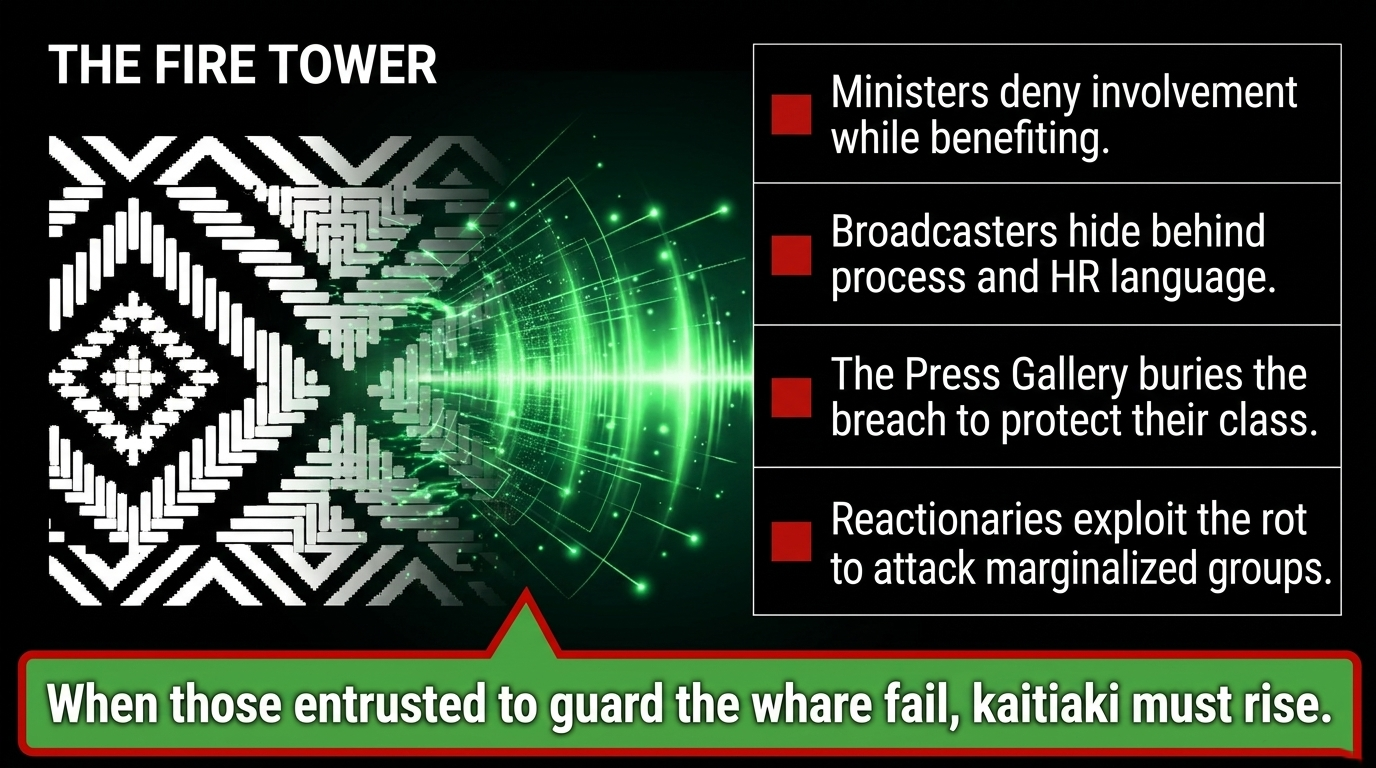
For a tikanga mind, the meaning is simpler: when those entrusted to guard the whare fail, kaitiaki must rise.
That is why support for The Māori Green Lantern is not a side note to this essay. It is part of the remedy.
If ministers can deny involvement while benefiting, if broadcasters can hide behind process, if the press gallery can bury a breach, and if reactionary operators can exploit that breach to advance anti-Māori and anti-trans politics, then independent Māori truth-telling is not optional.
It is democratic infrastructure.
XI. Keep the heat where it belongs
The press gallery deserves the shame it has earned.
TVNZ deserves hard scrutiny for hiding behind process while public trust corrodes, as shown by 1News and the Otago Daily Times.
The government deserves no trust while it presides over a weakened media ecosystem and then benefits from the chaos inside it, as shown by 1News, The Guardian, and 1News.
And O’Brien and Garner deserve no hero status for using a real press failure to drive a broader reactionary attack on journalism while carrying politics steeped in hostility to Māori authority, anti-racist analysis, and trans inclusion, as shown by Rova, Brash and Mitchell, and Te Ao Māori News.
This is not a clean morality play. It is a field of rot.
My job is not to perfume it. My job is to name it, trace it, and keep the heat where it belongs.
Koha Consideration
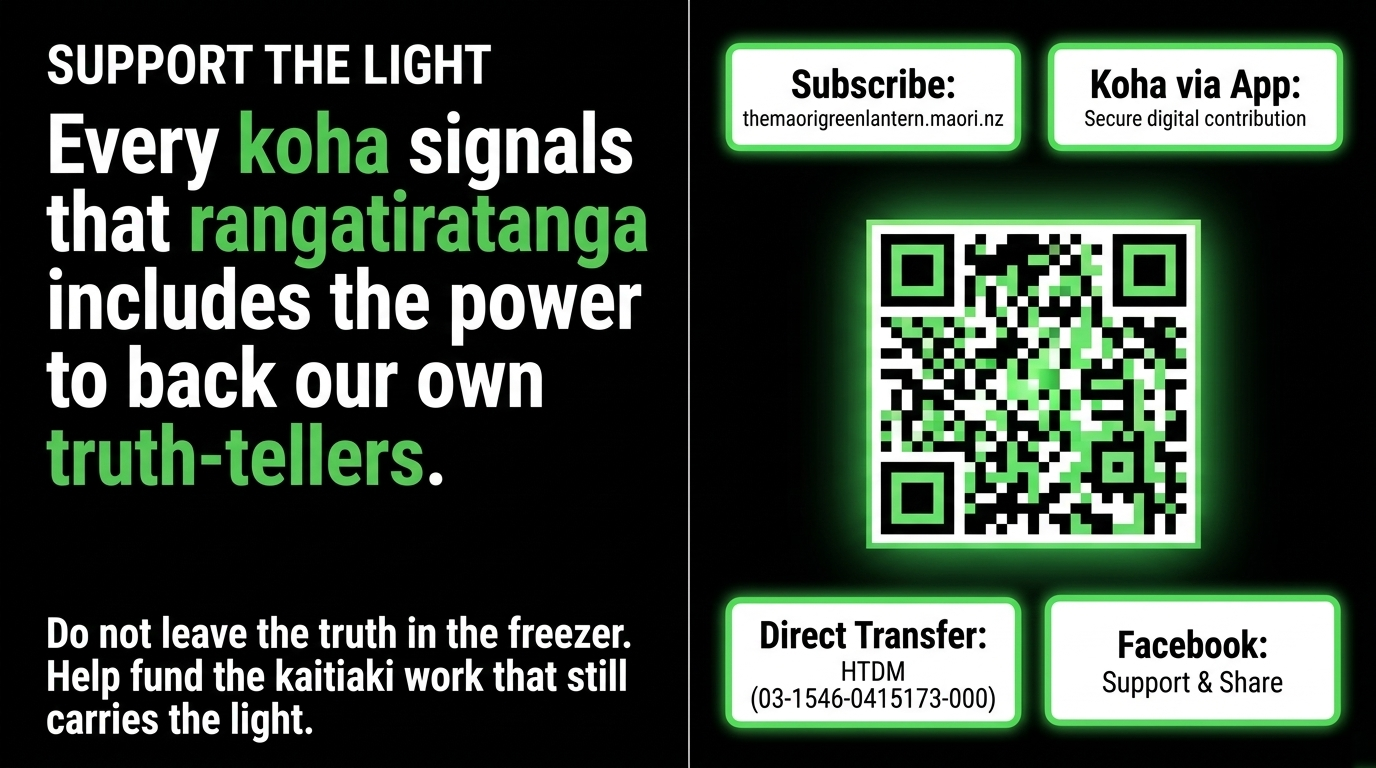
Every koha in response to this essay says something simple and dangerous: whānau are not willing to leave truth in the freezer until ministers, broadcasters, and the gallery decide it is useful.
Every koha says that when Crown and corporate structures fail to clean their own whare, you will help fund the kaitiaki work that still carries the light.
It signals that rangatiratanga includes the power to back our own truth-tellers.
Kia kaha, whānau. Stay vigilant. Stay connected. And if you are able, consider a koha to keep this light trained on the networks of silence, scarcity, and selective power.
If koha is not possible, that is all right. Subscribe or follow The Māori Green Lantern at themaorigreenlantern.maori.nz, kōrero about this piece, and share it with your whānau and friends. That is koha too.
Four pathways exist:
- Koha — Support: Koha
- Subscribe to The Māori Green Lantern: Support
- Direct bank transfer: HTDM, account number 03-1546-0415173-000
- Facebook support: Facebook Subscribe