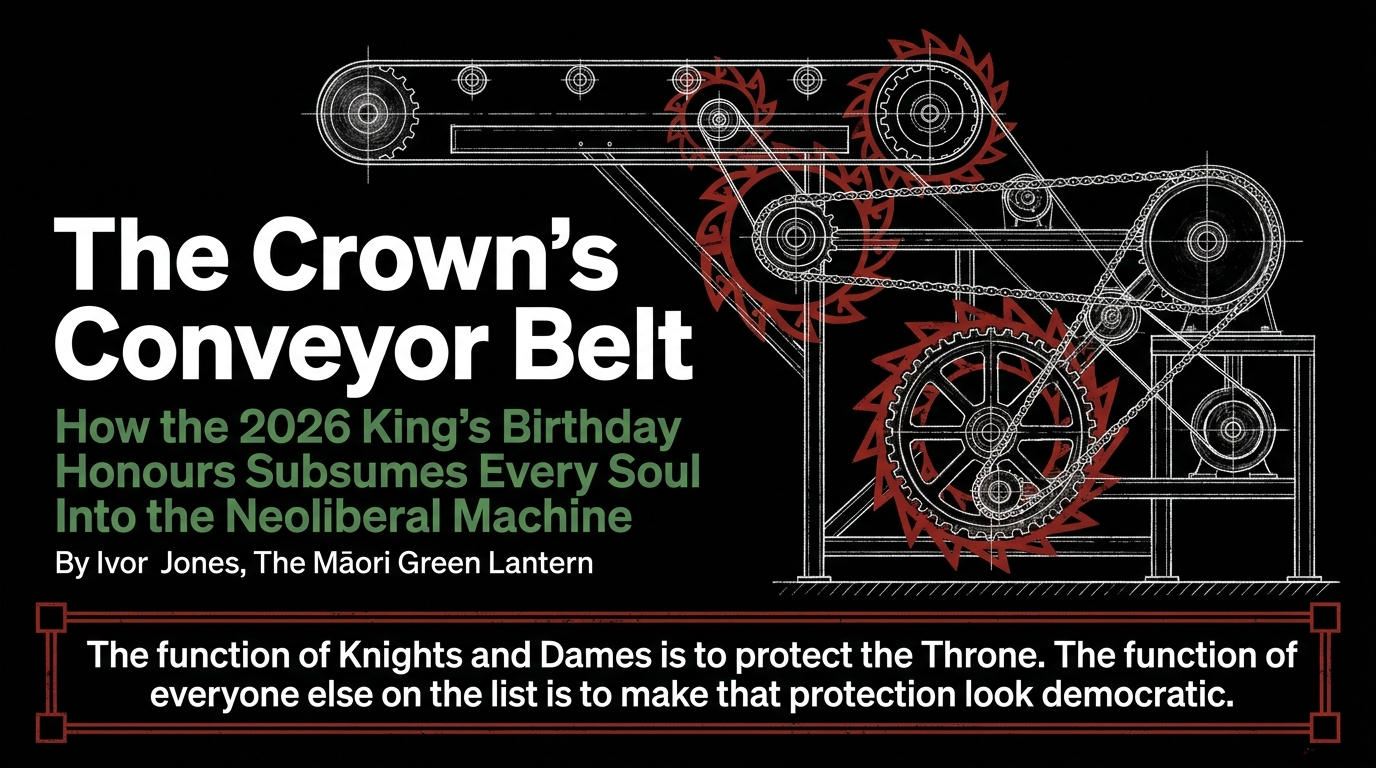
"THE CROWN'S CONVEYOR BELT: How the 2026 King's Birthday Honours Subsumes Every Soul Into the Neoliberal Machine" - 1 June 2026
The function of Knights and Dames is to protect the Throne. The function of everyone else on the list is to make that protection look democratic.
Kia ora Aotearoa,
This essay examines the 2026 King's Birthday Honours system because it directly affects Māori whānau, democratic rights, and the public accountability of those exercising Crown power under the Luxon–Seymour–Peters government. Responsible communication defence: Durie v Gardiner NZCA 278.
The Crown's Conveyour Belt
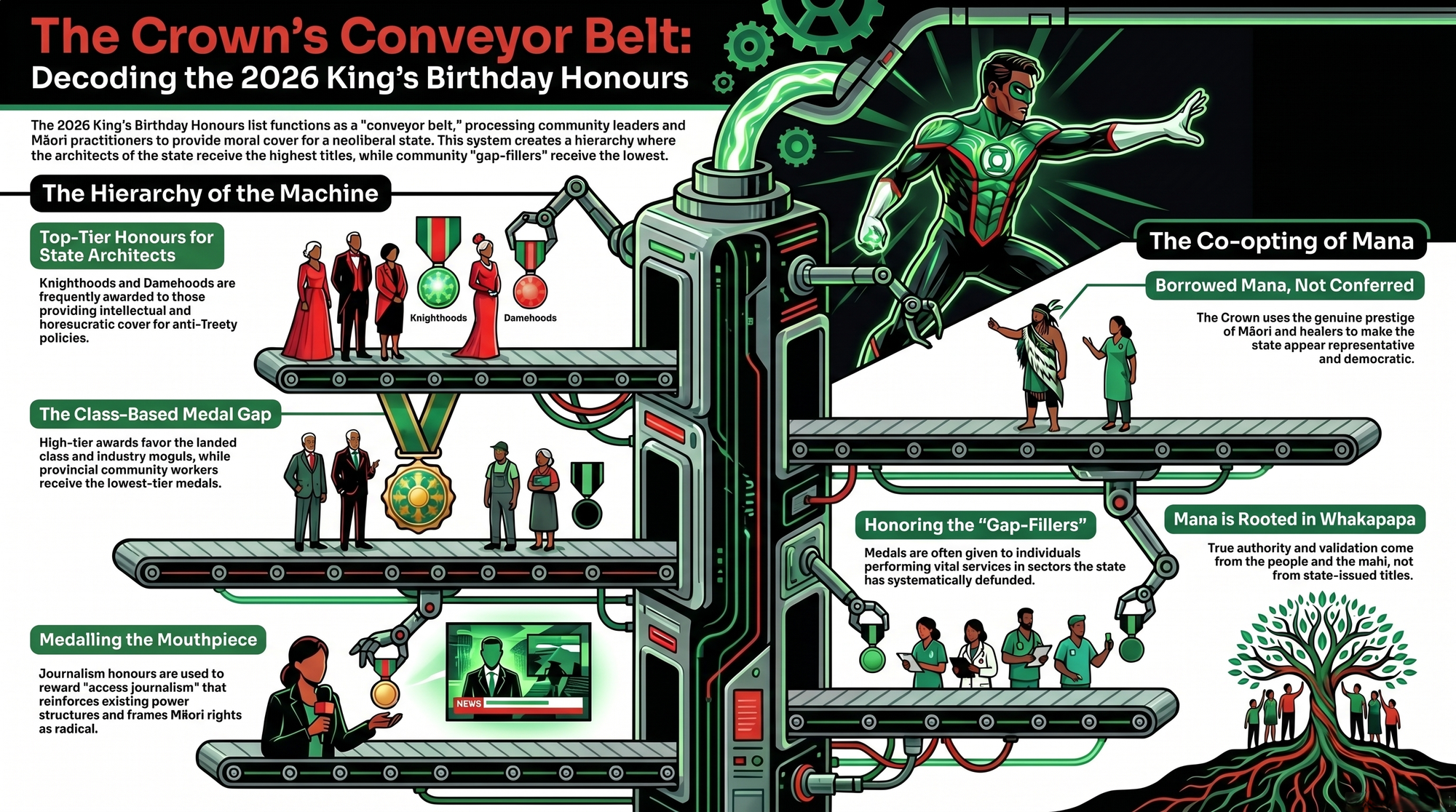
Picture a conveyor belt running through the engine room of New Zealand's neoliberal state.
At one end: a society. Communities, healers, teachers, athletes, artists, kaitiaki, kuia, tohunga, nurses, conservationists, brass band conductors, rural mental health workers. Real people doing real things.
At the other end: the Crown. Waiting with a pin.
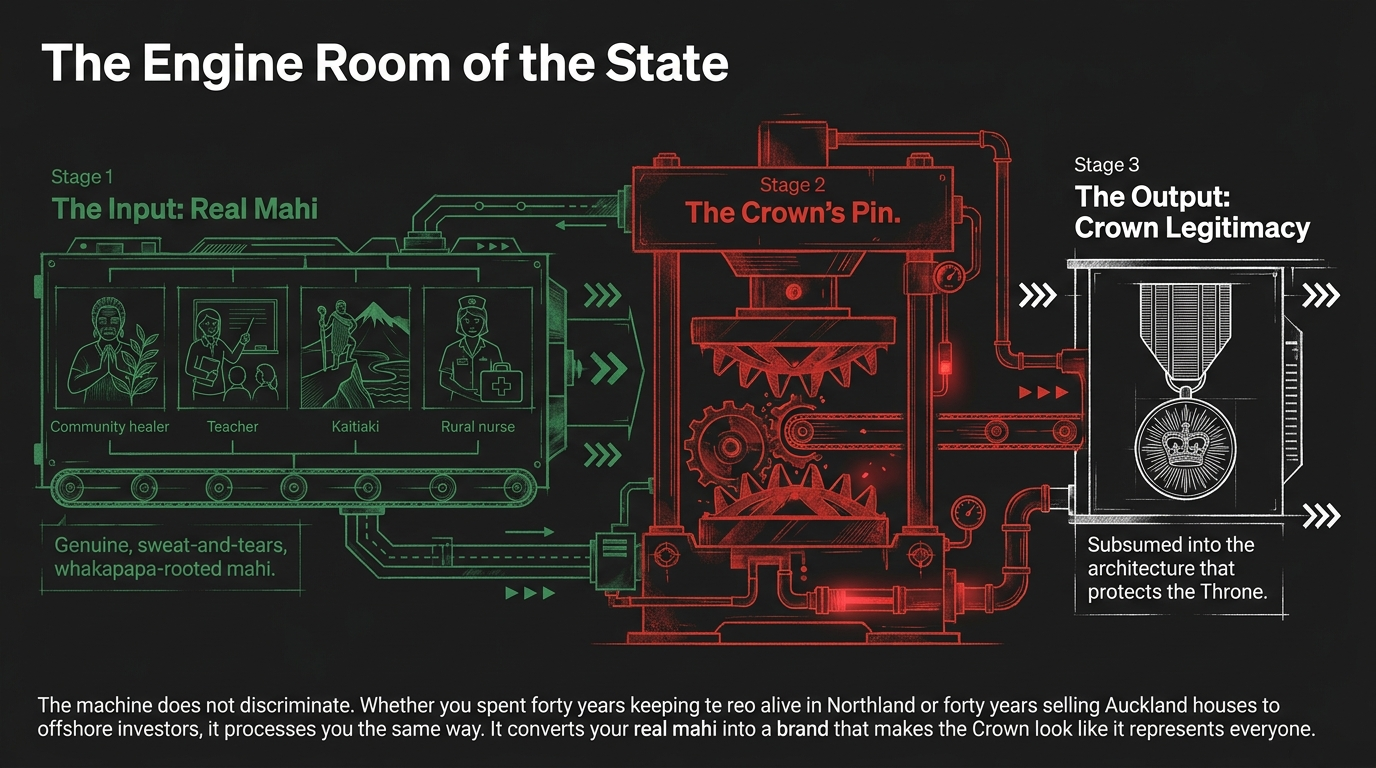
The conveyor belt doesn't discriminate. It doesn't care whether you spent forty years keeping te reo alive in Northland classrooms or forty years selling Auckland houses to offshore investors.
It processes you the same way.
It takes your mahi — your genuine, sweat-and-tears, whakapapa-rooted mahi — and it converts it into Crown legitimacy. It stamps you with a medal. It gives you a title. It makes you, in the eyes of the state and the media and the public,
a Crown person.
And in doing so, it makes the Crown look like it represents everyone.
The Deep Dive Podcast
Listen to a lively conversation between two hosts, unpacking and connecting topics in the sources of this essay. I apologise in advance for the AI's very harsh pronounciation of reo. Please dont shoot me, :).
That is the con.
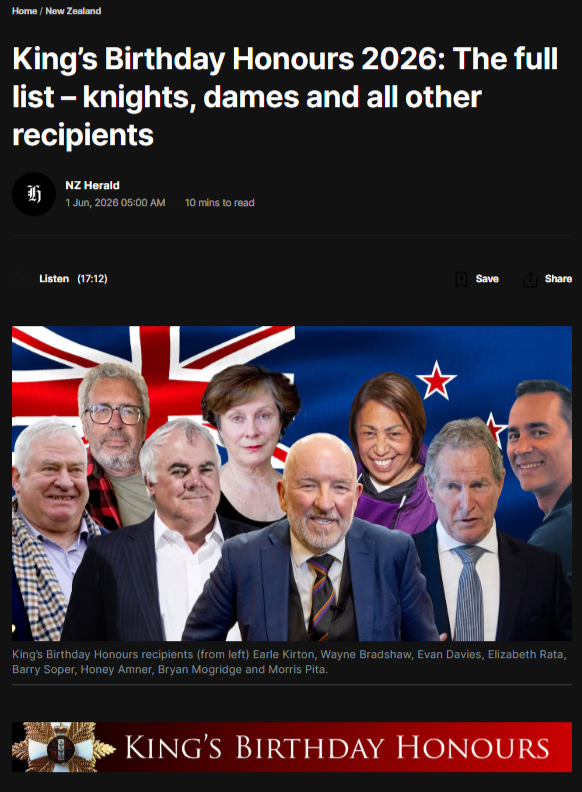
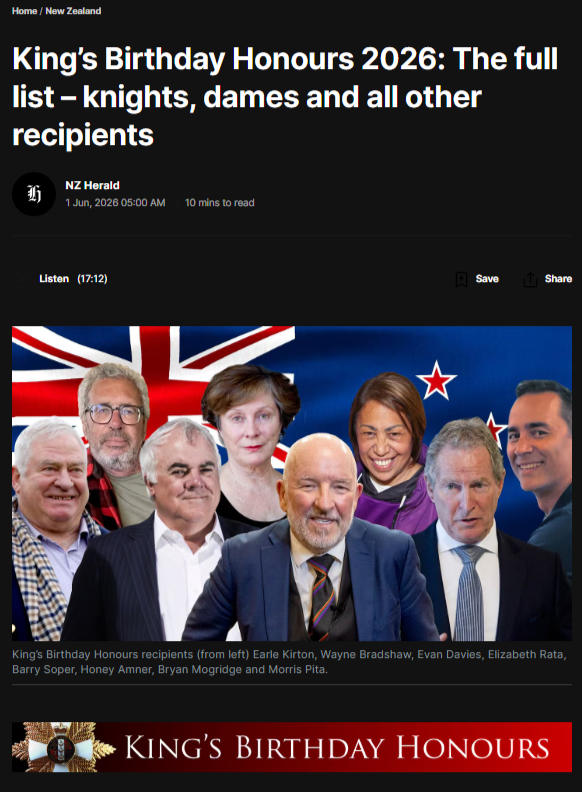
That is the 2026 King's Birthday Honours list. One hundred and sixty-plus people — from thoroughbred breeders to sexual violence prevention workers — all processed through the same machine, all now wearing the Crown's brand.
All now, whether they intended it or not, part of the architecture that protects the Throne.
This essay names every category. It names the mechanism. It names the harm. And it names — with evidence — the individuals whose incorporation into this system is most politically significant, because their Crown titles now do the most work to insulate a white supremacist neoliberal government from accountability.
PART ONE: THE ARCHITECTS — Those Who Built the Machine
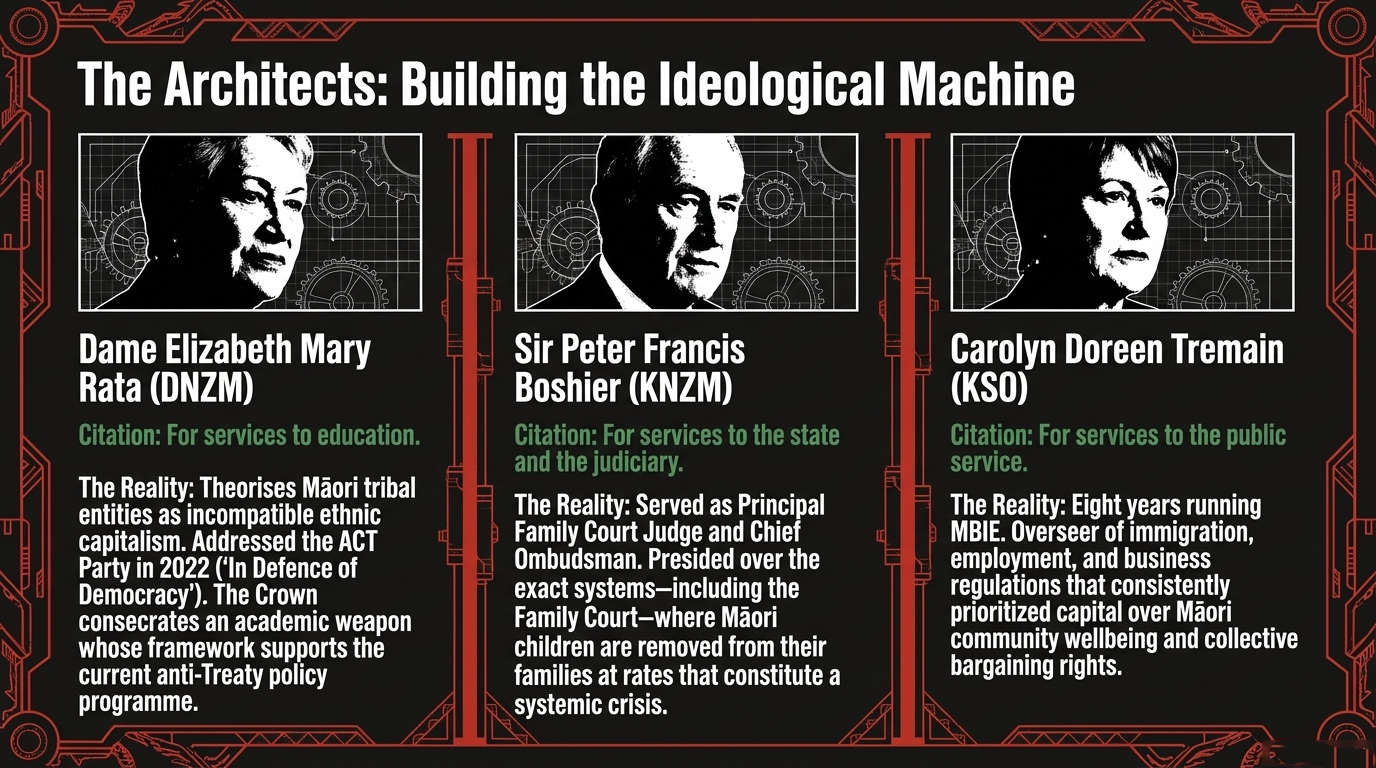
Dame Elizabeth Mary Rata (DNZM) — Auckland, "for services to education"
Let us begin here, because this is the Crown's most politically loaded choice of 2026.
Professor Elizabeth Rata is an Associate Professor of Education at the University of Auckland. She has built a substantial academic career arguing that Māori-centred education policy, Treaty co-governance frameworks, and what she calls "ethno-nationalism" represent a threat to liberal democracy. As documented in her peer-reviewed work, her 2011 paper theorises Māori tribal corporate entities as a form of ethnic capitalism incompatible with universal citizenship, as catalogued in her Google Scholar profile. Her work has been cited approvingly by ACT Party-aligned commentators and institutions seeking to dismantle Treaty-based policy architecture, as documented by the Aotearoa Liberation League.
This is not opinion. In July 2022, Professor Rata addressed the ACT Party Annual Conference — a verified, public address she published on her own website under the title "In Defence of Democracy". She spoke to the party that introduced the Treaty Principles Bill. She addressed the party whose leader David Seymour stood at Waitangi on 6 February 2026 and declared colonisation "largely advantageous for Indigenous peoples," as reported by Al Jazeera.
OIA documents and public commentary indicate officials raised concerns about Rata's team acting outside their advisory scope during curriculum reform processes — reforms that anti-Māori, libertarian ideology drove, as documented by E-Tāngata.
The Crown has awarded this woman a damehood on 2 June 2026 — while the policy programme her intellectual framework supports is in full operation. This is the Crown consecrating an academic weapon. The damehood is not a reward for education services in the abstract. It is a Crown endorsement, timed and deliberate, of a specific anti-Treaty intellectual position.
Named solely in her public capacity as a published academic and public conference speaker whose work directly shapes Treaty policy debates.
Sir Peter Francis Boshier (KNZM) — Wellington, "for services to the state and the judiciary"
Note the citation carefully: "services to the state." Not services to the people. Not services to justice. Services to the state.
Peter Boshier served as Chief Ombudsman from 2017 to 2025 and before that as Principal Family Court Judge. The Ombudsman's office is the Crown's internal complaints mechanism — the system the Crown built to give the appearance of accountability while retaining control of the outcomes. During Boshier's tenure, Māori remained catastrophically over-represented in every state system the Ombudsman nominally oversees: child protection, corrections, mental health detention.
The Family Court, where Boshier served as Principal Judge, is the arena in which Māori children are removed from their families at rates that constitute a systemic crisis. Oranga Tamariki became the subject of a Waitangi Tribunal urgency hearing in 2019 precisely because of the scale of Māori infant removal. The state is honouring its own machinery.
Carolyn Doreen Tremain (KSO) — Auckland, "for services to the public service"
Carolyn Tremain is one of the most powerful Crown bureaucrats of the neoliberal era. Her career spans Chief Executive of the Ministry of Business, Innovation and Employment for eight years, Chief Executive and Comptroller of NZ Customs Service, and Deputy Commissioner at Inland Revenue, as documented by the Leadership Development Centre. She was also a Guardian of the Aotearoa Circle — a Crown-business sustainability partnership.
MBIE is the ministry responsible for immigration policy, employment relations, and business regulation — settings that have consistently prioritised capital over Māori community wellbeing. Eight years running MBIE. A King's Service Order. "For services to the public service."
Services to which public? The public who cannot afford rent in cities MBIE's immigration settings helped price them out of? The Māori workers whose collective bargaining rights MBIE's employment framework has chronically undermined?
Sir David Charles Ellis (KNZM) — Ngaruawahia, "for services to the thoroughbred industry and philanthropy"
Ngaruawahia. The spiritual home of Waikato-Tainui. The site of Tūrangawaewae Marae, the seat of the Māori King movement. The land of the Raupatu of 1863 — 1.2 million acres confiscated from Waikato, the largest single land confiscation in New Zealand history.
The thoroughbred racing industry in the Waikato operates on that land — or land connected by the same colonial title history. The Crown knights a man from that place "for services to the thoroughbred industry." A sport of kings. The leisure infrastructure of the landowning class. The Crown does not mention the Raupatu when it pins this knighthood on. It never does.
Peter John Thompson (CNZM) — Auckland, "for services to philanthropy and rugby"
Peter Thompson is the Managing Director of Barfoot & Thompson, the dominant real estate agency in Tāmaki Makaurau. In May 2026, as reported on Barfoot & Thompson's own Facebook, Thompson reported that "Auckland's property market has surged."
It has surged for sellers and investors. For the 42% of Māori in Auckland who rent — at rents that have increased in lockstep with property values — it has been a crisis. For Māori families sleeping in cars, in garages, in overcrowded homes, it has been a catastrophe. Thompson has spoken publicly about housing affordability being his "biggest worry," as recorded by Community Housing NZ, while running an agency whose commercial model depends on prices remaining high enough to generate commission. The Crown gives him a CNZM for "philanthropy" — the part where he gave some of the commission back. The extraction is not mentioned.
PART TWO: THE GOVERNANCE CLASS — The Crown's Volunteer Administrators
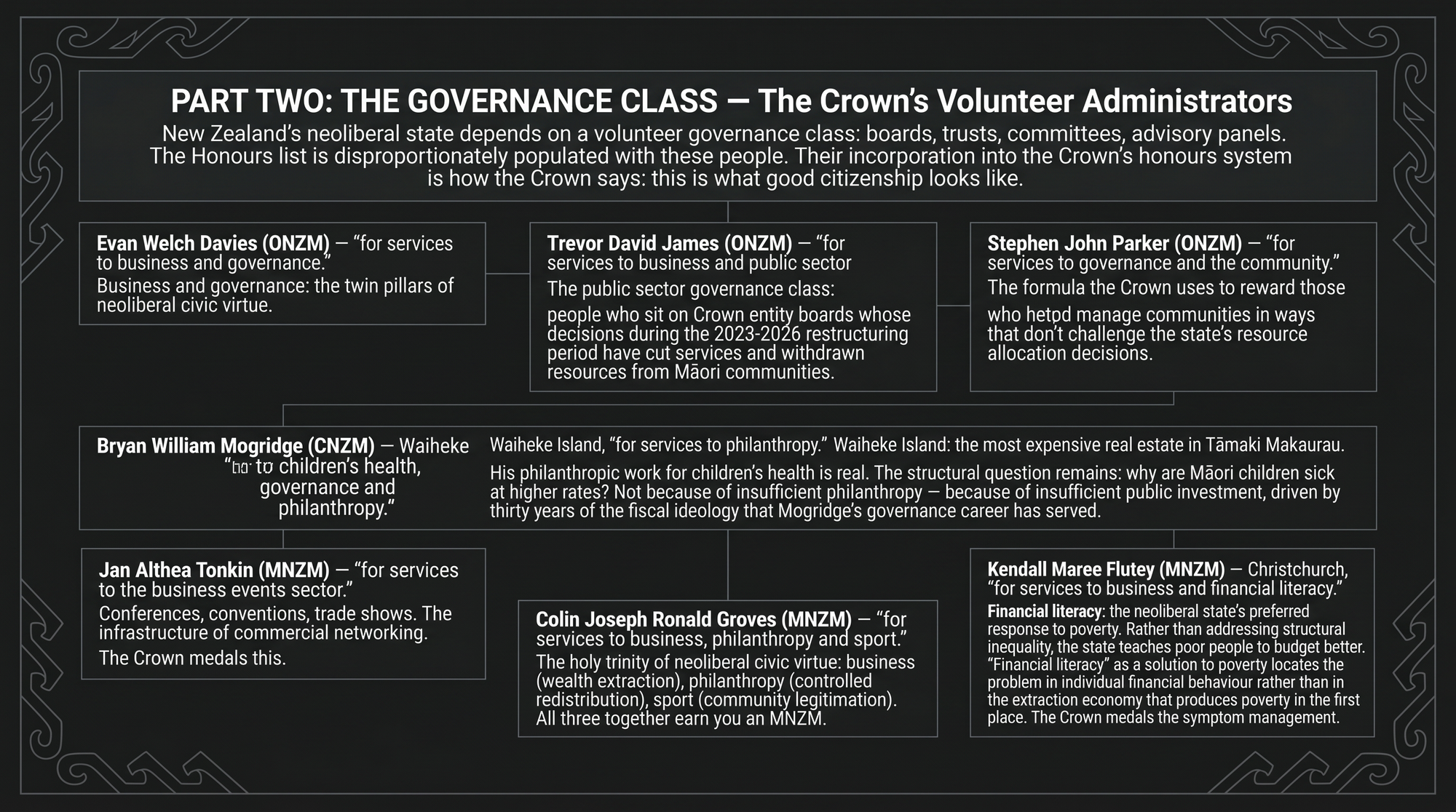
New Zealand's neoliberal state depends on a volunteer governance class: boards, trusts, committees, advisory panels. The Honours list is disproportionately populated with these people. Their incorporation into the Crown's honours system is how the Crown says: this is what good citizenship looks like.
Evan Welch Davies (ONZM) — "for services to business and governance." Business and governance: the twin pillars of neoliberal civic virtue.
Trevor David James (ONZM) — "for services to business and public sector governance." The public sector governance class: people who sit on Crown entity boards whose decisions during the 2023–2026 restructuring period have cut services and withdrawn resources from Māori communities.
Stephen John Parker (ONZM) — "for services to governance and the community." The formula the Crown uses to reward those who have helped manage communities in ways that don't challenge the state's resource allocation decisions.
Bryan William Mogridge (CNZM) — Waiheke Island, "for services to children's health, governance and philanthropy." Waiheke Island: the most expensive real estate in Tāmaki Makaurau. His philanthropic work for children's health is real. The structural question remains: why are Māori children sick at higher rates? Not because of insufficient philanthropy — because of insufficient public investment, driven by thirty years of the fiscal ideology that Mogridge's governance career has served.
Jan Althea Tonkin (MNZM) — "for services to the business events sector." Conferences, conventions, trade shows. The infrastructure of commercial networking. The Crown medals this.
Colin Joseph Ronald Groves (MNZM) — "for services to business, philanthropy and sport." The holy trinity of neoliberal civic virtue: business (wealth extraction), philanthropy (controlled redistribution), sport (community legitimation). All three together earn you an MNZM.
Kendall Maree Flutey (MNZM) — Christchurch, "for services to business and financial literacy." Financial literacy: the neoliberal state's preferred response to poverty. Rather than addressing structural inequality, the state teaches poor people to budget better. "Financial literacy" as a solution to poverty locates the problem in individual financial behaviour rather than in the extraction economy that produces poverty in the first place. The Crown medals the symptom management.
PART THREE: THE INSTITUTIONAL LEGITIMATORS
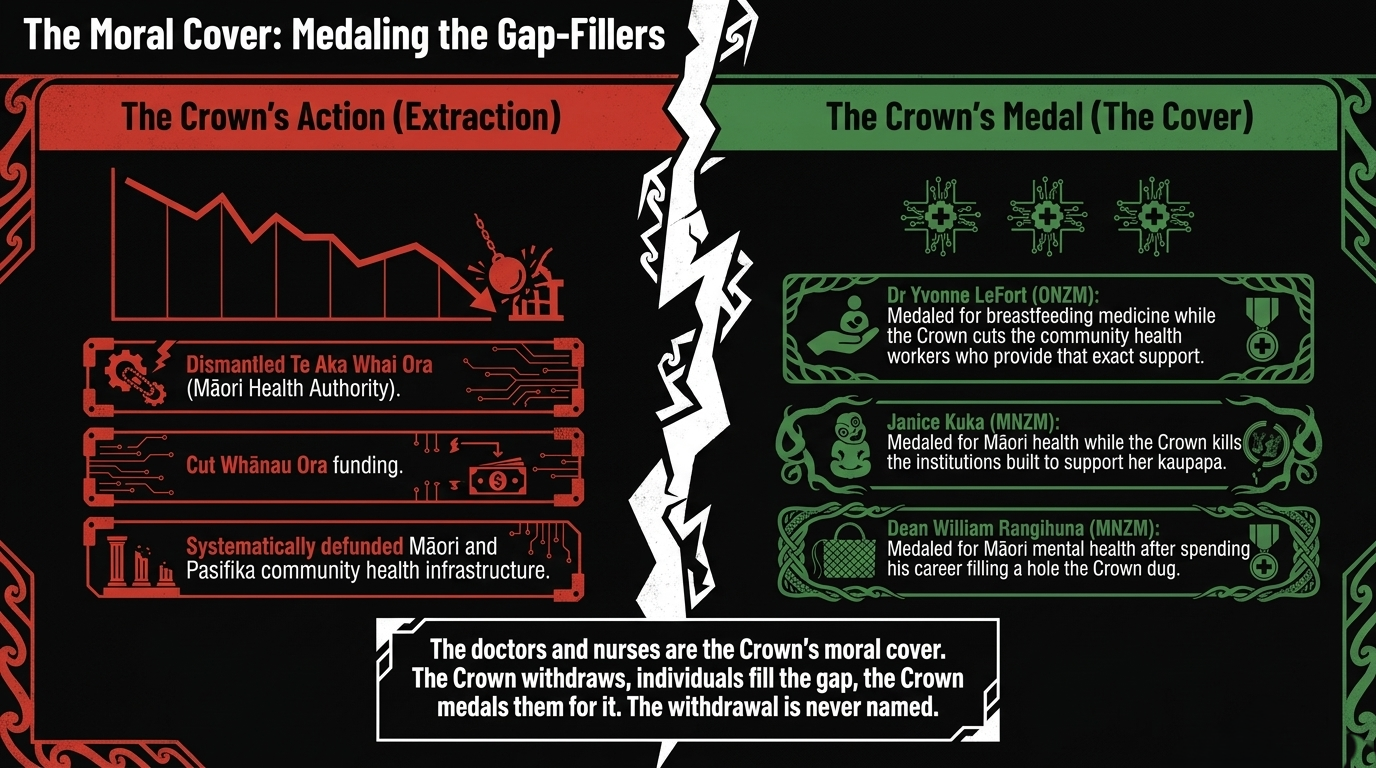
This is the largest category on the list and the most complex to analyse. Doctors, nurses, midwives, teachers, speech therapists — people doing genuinely vital work, often for Māori and Pasifika communities. Their mahi is real. Their care is real.
They are also the people the Crown needs most desperately on this list. Because if the Honours list were only knights from the racing industry and dames from the academy of anti-Treaty scholarship, the critique would be obvious to everyone. The doctors and nurses are the Crown's moral cover.
Here is what the Crown does not say when it pins a medal on a midwife from Auckland: the same government administering this Honours list has dismantled Te Aka Whai Ora, cut Māori and Pasifika health services, and withdrawn Whānau Ora funding — as documented in MGL's May 2025 analysis.
Professor Caroline Crowther (CNZM) — "for services to maternal and perinatal health." Distinguished, important work. The Crown medals her while Māori perinatal mortality rates remain significantly higher than non-Māori — a gap that Te Aka Whai Ora was specifically designed to address before this government killed it.
Margaret Ruth Davy (ONZM) — "for services to nursing and women's health." Decades of nursing service. The nursing workforce sustaining her work is understaffed, underpaid, and burning out. She gets a medal. Her colleagues get a roster.
Dr Yvonne LeFort (ONZM) — "for services to breastfeeding medicine." The Crown medals a specialist in breastfeeding support while cutting the community health workers and Whānau Ora nurses who provided that exact support to Māori and Pasifika mothers in their own homes, in their own language.
Janice Kuka (MNZM) — Tauranga, "for services to Māori health." Kuka's mahi is whakapapa-rooted and community-driven. She deserves recognition from her iwi, her hapū, her whānau. Not from the Crown that just killed the institution built to support her work. The Crown borrows her mana here. It does not confer it.
Dean William Rangihuna (MNZM) — Christchurch, "for services to Māori mental health and addiction services." Real kaupapa. Christchurch's Māori mental health sector is chronically under-resourced. Rangihuna has spent his career filling a hole the Crown dug.
Dr Te Ripowai Pauline Higgins (ONZM) — Lower Hutt, "for services to education and Māori." Distinguished. Genuine. The Crown's citation reduces decades of transformative mahi to a two-line entry alongside a man being honoured for the thoroughbred industry.
Sir James William Chapman (KNZM) — Palmerston North, "for services to literacy education." A genuine contribution to literacy pedagogy. But under this government, curriculum reforms informed by what E-Tāngata describes as "anti-Māori, libertarian ideology" have restructured what literacy education looks like for Māori children. Chapman receives a knighthood. Mātauranga Māori receives a curriculum demotion.
PART FOUR: THE MĀORI RECIPIENTS — Mana Borrowed, Not Conferred
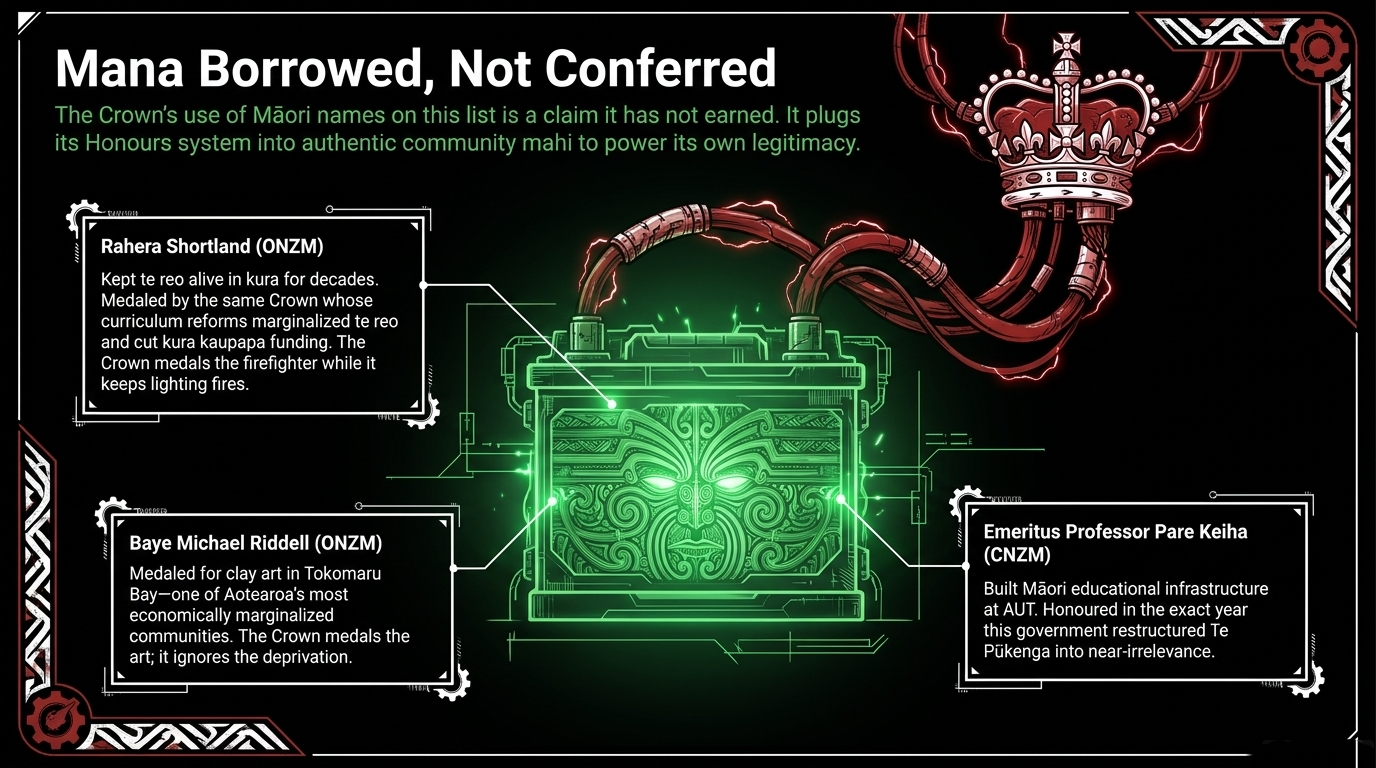
Every Māori person on this list is named with respect for their mahi. This section is not an attack on them. It is an analysis of what the Crown does with them.
Riki Henare Manuel (CNZM) — Christchurch, "for services to Māori art." Manuel's toi Māori practice is rooted in whakapapa and deserving of recognition by his people. The Crown does not know what it is honouring. It knows what the honour does for the Crown.
Emeritus Professor Pare Keiha (CNZM) — Auckland, "for services to Māori and education." Keiha spent years building Māori educational infrastructure at AUT. His CNZM arrives in the same year that Te Pūkenga — the institution serving thousands of Māori and Pasifika tertiary learners — was restructured into near-irrelevance by the same government administering this Honours list.
Dr Reuben Tuwhakahekeao Collier (CNZM) — Rotorua, "for services to Māori and education." Real mahi. The Crown's whakapapa with Rotorua includes geothermal land confiscations and the ongoing economic marginalisation of Ngāti Whakaue and related iwi. The Crown does not mention this.
Rahera Shortland (ONZM) — Kerikeri, "for services to Māori language education." Shortland has spent decades in kura and immersion settings keeping te reo alive. The Crown that awards her this honour is the same Crown whose 2023 curriculum reforms initially marginalised te reo in the national curriculum and cut kura kaupapa funding. The Crown medals the firefighter while it keeps lighting fires.
Rauru Kirikiri (ONZM) — Wellington, "for services to Māori, science and conservation." Kirikiri's work bridging mātauranga Māori and conservation science is precisely the kaupapa this government's education reforms are designed to marginalise. The Crown medals it on June 2nd and ignores it every other day.
Karleen Mae Everitt (ONZM) — Haruru, "for services to Māori and business." From Haruru, near Paihia — the site where Te Tiriti o Waitangi was signed in 1840. The Crown gives a Māori businesswoman from the treaty grounds an ONZM. The symbolism writes itself.
Baye Michael Riddell (ONZM) — Tokomaru Bay, "for services to Māori clay art." Tokomaru Bay — one of the most economically marginalised communities in Aotearoa, with unemployment and deprivation indices among the highest in the country. Riddell has built an art practice from that land. The Crown medals the art. It does not address the deprivation.
Morris Charles Pita (MNZM) — "for services to governance, business and Māori." The governance-business-Māori trifecta: exactly the citation profile the Crown prefers for Māori men in the professional class. Governance means boards. Business means commerce. "Māori" is the third item — the community credential that makes the first two acceptable.
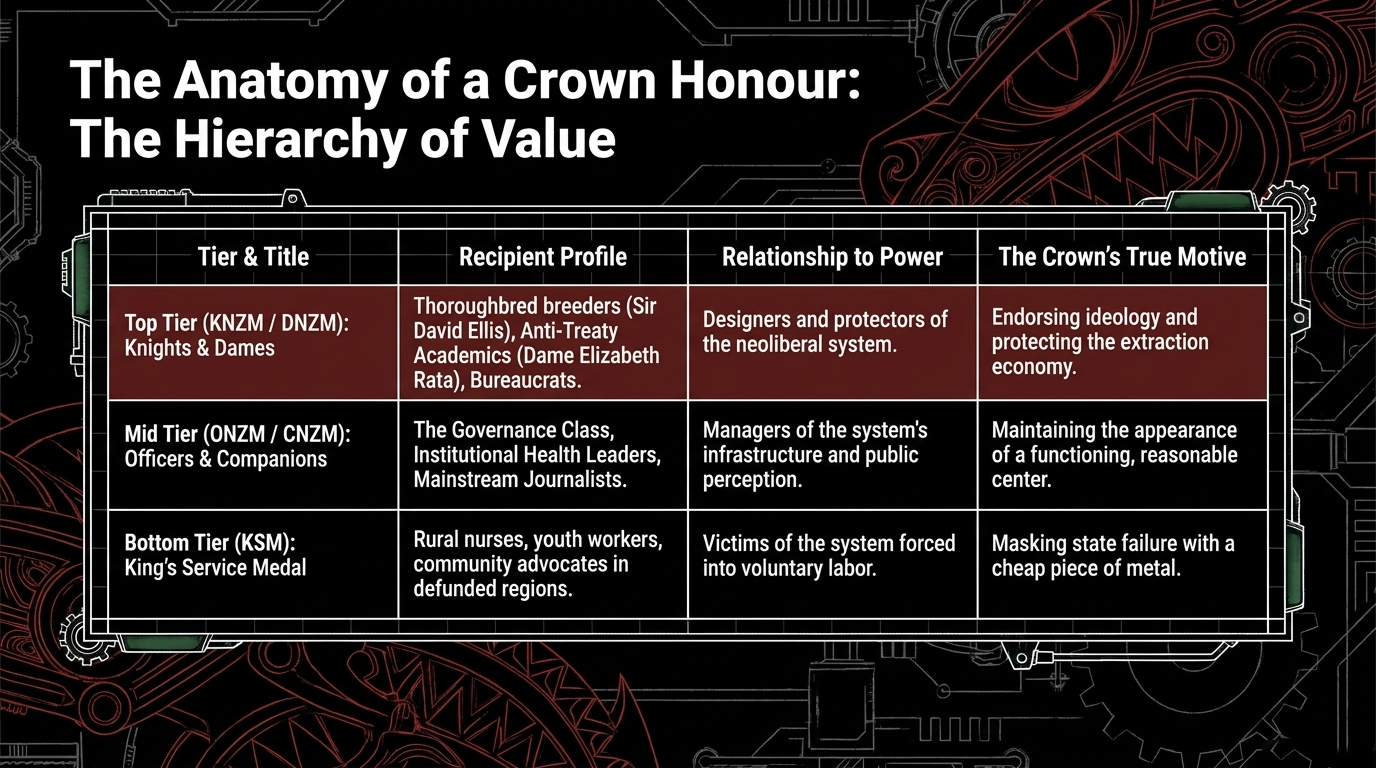
Rangi (Pania) Kahuna Houkamau-Ngaheu (KSM) — Porirua, "for services to the community." Porirua: one of the highest-deprivation urban communities in Aotearoa. Predominantly Māori and Pasifika. Community workers in Porirua operate in conditions of chronic Crown disinvestment. She receives the lowest tier of Crown recognition — a King's Service Medal — while the architects of that disinvestment receive knighthoods.
Count the tiers. Sir David Ellis: KNZM. Rangi Kahuna Houkamau-Ngaheu: KSM. The thoroughbred industry knight and the Porirua community worker. The Crown has its hierarchy. It is not subtle.
PART FIVE: THE STATE APPARATUS — Police, Defence, and the Crown's Enforcement Class
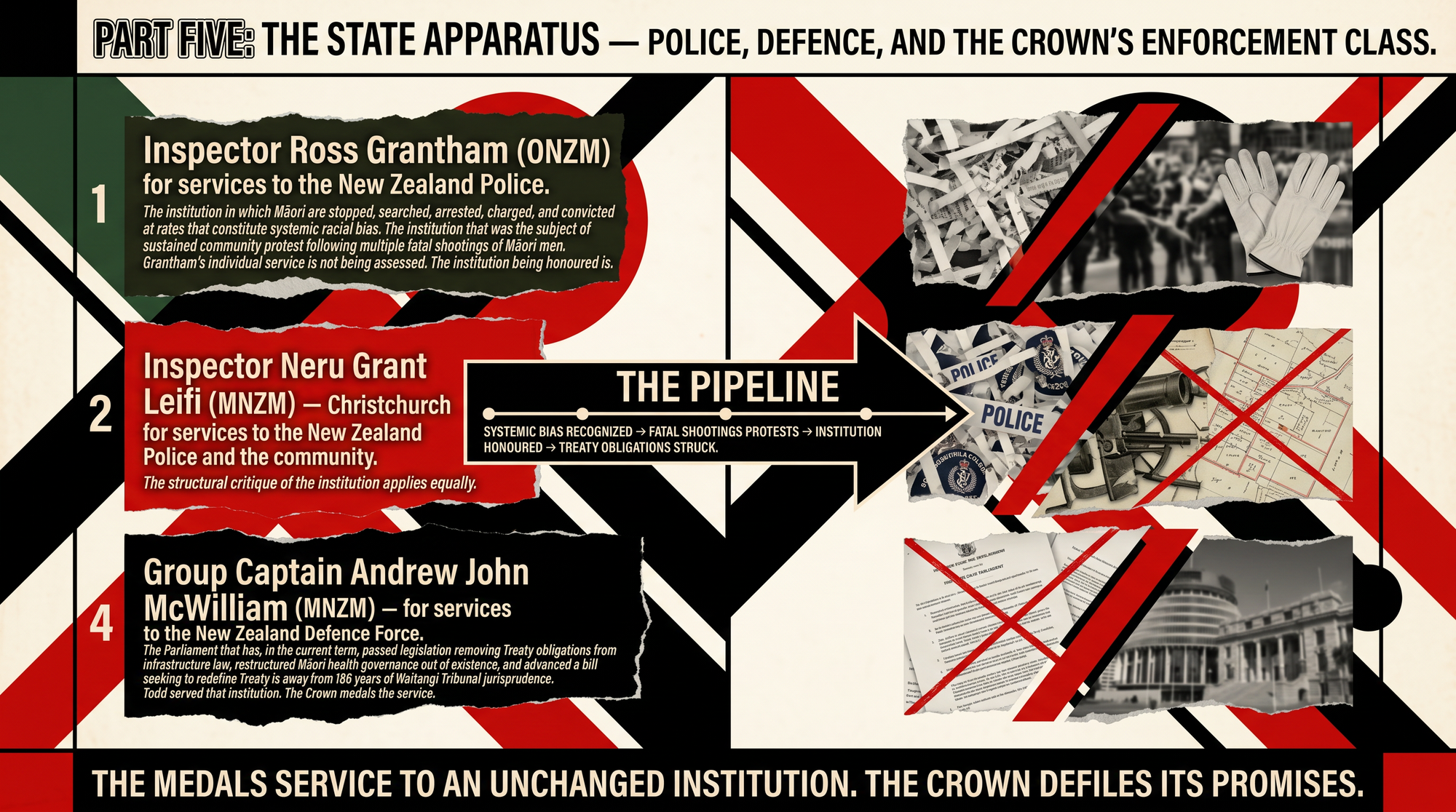
Inspector Ross Grantham (ONZM) — "for services to the New Zealand Police." The institution in which Māori are stopped, searched, arrested, charged, and convicted at rates that constitute systemic racial bias. The institution that was the subject of sustained community protest following multiple fatal shootings of Māori men. Grantham's individual service is not being assessed. The institution being honoured is.
Inspector Neru Grant Leifi (MNZM) — Christchurch, "for services to the New Zealand Police and the community." The structural critique of the institution applies equally.
Group Captain Andrew John McWilliam (MNZM) — "for services to the New Zealand Defence Force." The NZDF whose colonial predecessor served as the enforcement arm of Crown land confiscation in the nineteenth century. McWilliam's individual service is not in question. The institution's whakapapa is.
Frederick Rolland Todd (KSM) — Lower Hutt, "for services to Parliament." The Parliament that has, in the current term, passed legislation removing Treaty obligations from infrastructure law, restructured Māori health governance out of existence, and advanced a bill seeking to redefine Treaty principles away from 186 years of Waitangi Tribunal jurisprudence. Todd served that institution. The Crown medals the service.
PART SIX: THE PHILANTHROPY CLASS — Controlled Redistribution as Civic Virtue
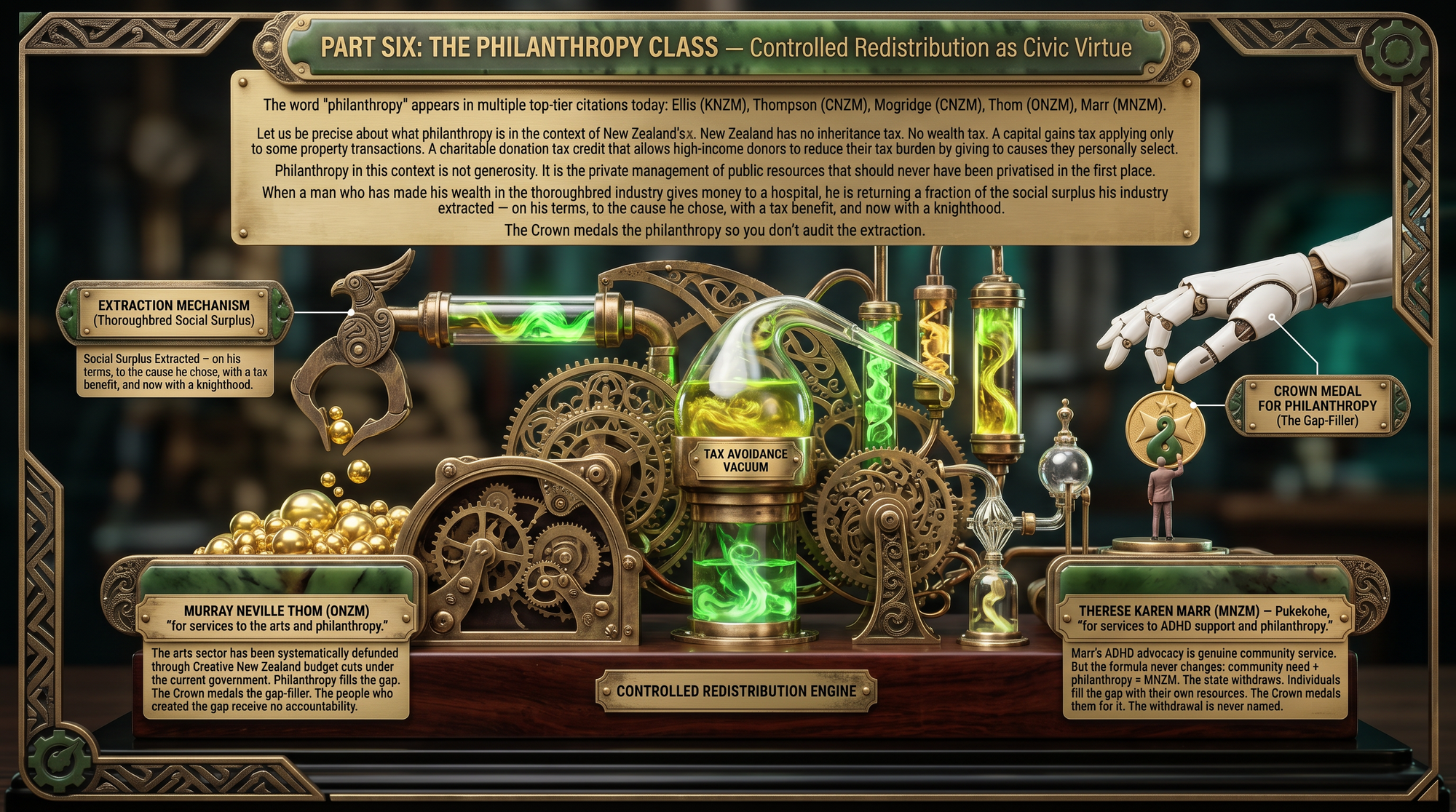
The word "philanthropy" appears in multiple top-tier citations today: Ellis (KNZM), Thompson (CNZM), Mogridge (CNZM), Thom (ONZM), Marr (MNZM). Let us be precise about what philanthropy is in the context of New Zealand's tax architecture.
New Zealand has no inheritance tax. No wealth tax. A capital gains tax applying only to some property transactions. A charitable donation tax credit that allows high-income donors to reduce their tax burden by giving to causes they personally select.
Philanthropy in this context is not generosity. It is the private management of public resources that should never have been privatised in the first place. When a man who has made his wealth in the thoroughbred industry gives money to a hospital, he is returning a fraction of the social surplus his industry extracted — on his terms, to the cause he chose, with a tax benefit, and now with a knighthood.
The Crown medals the philanthropy so you don't audit the extraction.
Murray Neville Thom (ONZM) — "for services to the arts and philanthropy." The arts sector has been systematically defunded through Creative New Zealand budget cuts under the current government. Philanthropy fills the gap. The Crown medals the gap-filler. The people who created the gap receive no accountability.
Therese Karen Marr (MNZM) — Pukekohe, "for services to ADHD support and philanthropy." Marr's ADHD advocacy is genuine community service. But the formula never changes: community need + philanthropy = MNZM. The state withdraws. Individuals fill the gap with their own resources. The Crown medals them for it. The withdrawal is never named.
PART SEVEN: THE COMMUNITY WORKERS — Doing the Crown's Abandoned Work
Joy Esther Te Wiata (MNZM) — Opua, "for services to sexual violence prevention." Sexual violence in Aotearoa affects Māori women at disproportionate rates. The Crown's response has been chronically inadequate: underfunded specialist services, long waiting lists, police systems that re-traumatise survivors. Te Wiata has spent her career in the gap. The Crown gives her an MNZM. It does not address the gap.
Russell Owen Smith (MNZM) — "for services to sexual violence prevention." Same analysis. Two people. One systemic failure. Two medals. The violence continues.
Lindsay Gordon Wright (KSM) — Gore, "for services to rural communities and mental health." Rural mental health in New Zealand is a crisis. Suicide rates in rural communities, including Māori farming communities, are among the highest in the country. Wright has served that gap in Southland for decades. He receives the lowest tier of Crown recognition. The architects of the mental health funding cuts that created his impossible workload receive Companions and Officers above him.
Noel Christopher Walker and Susan Ellen Walker (KSM) — Te Anau, "for services to Scouts and the community." Decades of volunteer service. If the state properly funded youth development, the Walkers might not have needed to volunteer for decades. The Crown does not engage with this question. It gives them a KSM and moves on.
Graeme Lawrence Kates (KSM) — Arthur's Pass, "for services to conservation and the community." A KSM — the lowest tier. The fossil fuel industry representatives on corporate governance boards get CNZMs. The conservation worker in Arthur's Pass gets the bottom of the hierarchy.
Rosalind Meronea Corban (KSM) — Tokoroa, "for services to nursing." Tokoroa: a town built on the forestry industry, now economically marginalised, with high Māori and Pasifika populations and thin health infrastructure. Corban has nursed there. The Crown gives her a KSM — while the financial architects of Tokoroa's economic decline receive higher honours.
PART EIGHT: THE EDUCATORS — Teaching in the Ruins of a Defunded System
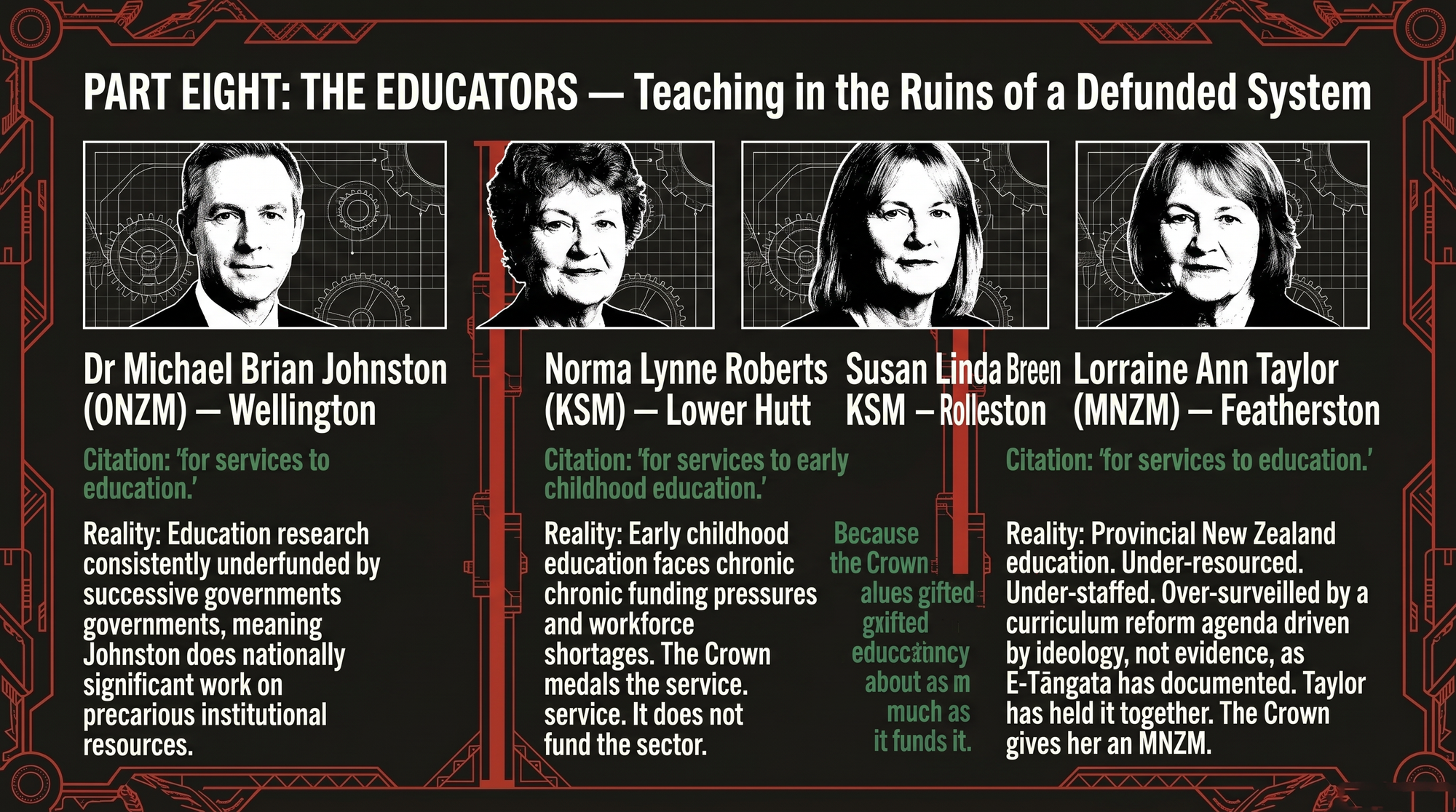
Dr Michael Brian Johnston (ONZM) — Wellington, "for services to education." Education research consistently underfunded by successive governments, meaning Johnston does nationally significant work on precarious institutional resources.
Norma Lynne Roberts (KSM) — Lower Hutt, "for services to early childhood education." Early childhood education faces chronic funding pressures and workforce shortages. The Crown medals the service. It does not fund the sector.
Susan Linda Breen (KSM) — Rolleston, "for services to gifted children education." Gifted education: one of the most under-resourced areas of the school system. A KSM at the bottom of the hierarchy. Because the Crown values gifted education advocacy about as much as it funds it.
Lorraine Ann Taylor (MNZM) — Featherston, "for services to education." Provincial New Zealand education. Under-resourced. Under-staffed. Over-surveilled by a curriculum reform agenda driven by ideology, not evidence, as E-Tāngata has documented. Taylor has held it together. The Crown gives her an MNZM.
PART NINE: THE HEALTH PROFESSIONALS — Healing in a Deliberately Broken System
Associate Professor Nicola Austin (ONZM) — Christchurch, "for services to children's health." Māori children are hospitalised for preventable conditions — rheumatic fever, respiratory disease, skin infections — at rates that reflect poverty, overcrowding, and decades of housing policy failure. Austin's clinical work is important. The conditions her patients present with are a policy choice.
Dr Lesley Ansell (MNZM) — Auckland, "for services to midwifery." The midwifery workforce is in crisis: underpaid, overworked, haemorrhaging practitioners. Ansell's decades of service have held the system together. The system that created the crisis: not mentioned.
Professor Sharon Brownie (MNZM) — Kamo, "for services to health and nursing education." Kamo, near Whangārei: a region with significant Māori health disparities. The Crown honours her at MNZM — the fourth tier — while health inequality in Northland continues to widen.
Dr Mark Robert Fraundorfer (MNZM) — Mount Maunganui, "for services to health, particularly men's health." Māori men's life expectancy is approximately 7.3 years shorter than non-Māori men. The Crown medals a men's health practitioner while dismantling the Māori Health Authority specifically designed to address that gap.
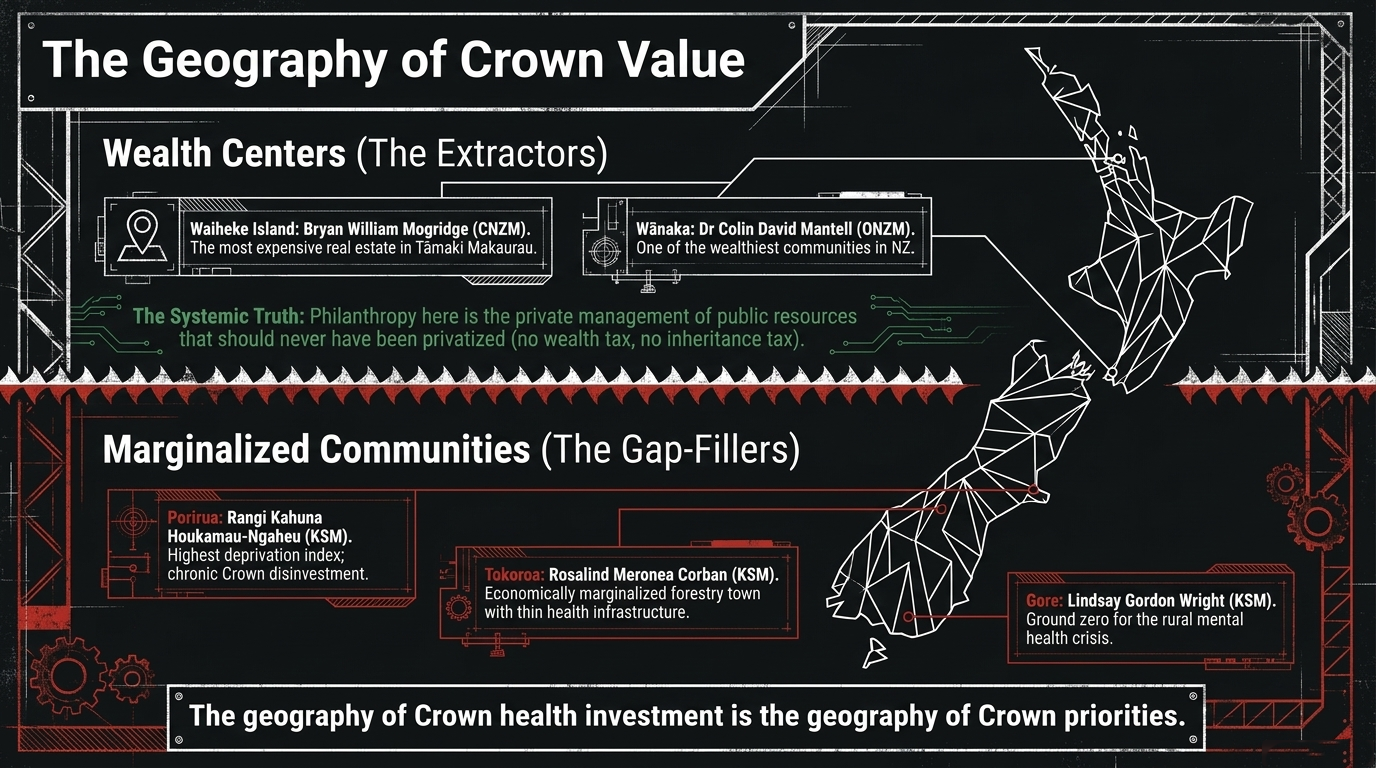
Dr Colin David Mantell (ONZM) — Wānaka, "for services to health education, obstetrics and gynaecology." Wānaka is one of the wealthiest communities in New Zealand. The health services available in Wānaka are not the health services available in Tokomaru Bay, Tokoroa, or Porirua. The geography of Crown health investment is the geography of Crown priorities.
PART TEN: THE ATHLETES AND CULTURAL FIGURES — The Crown's Warm Face
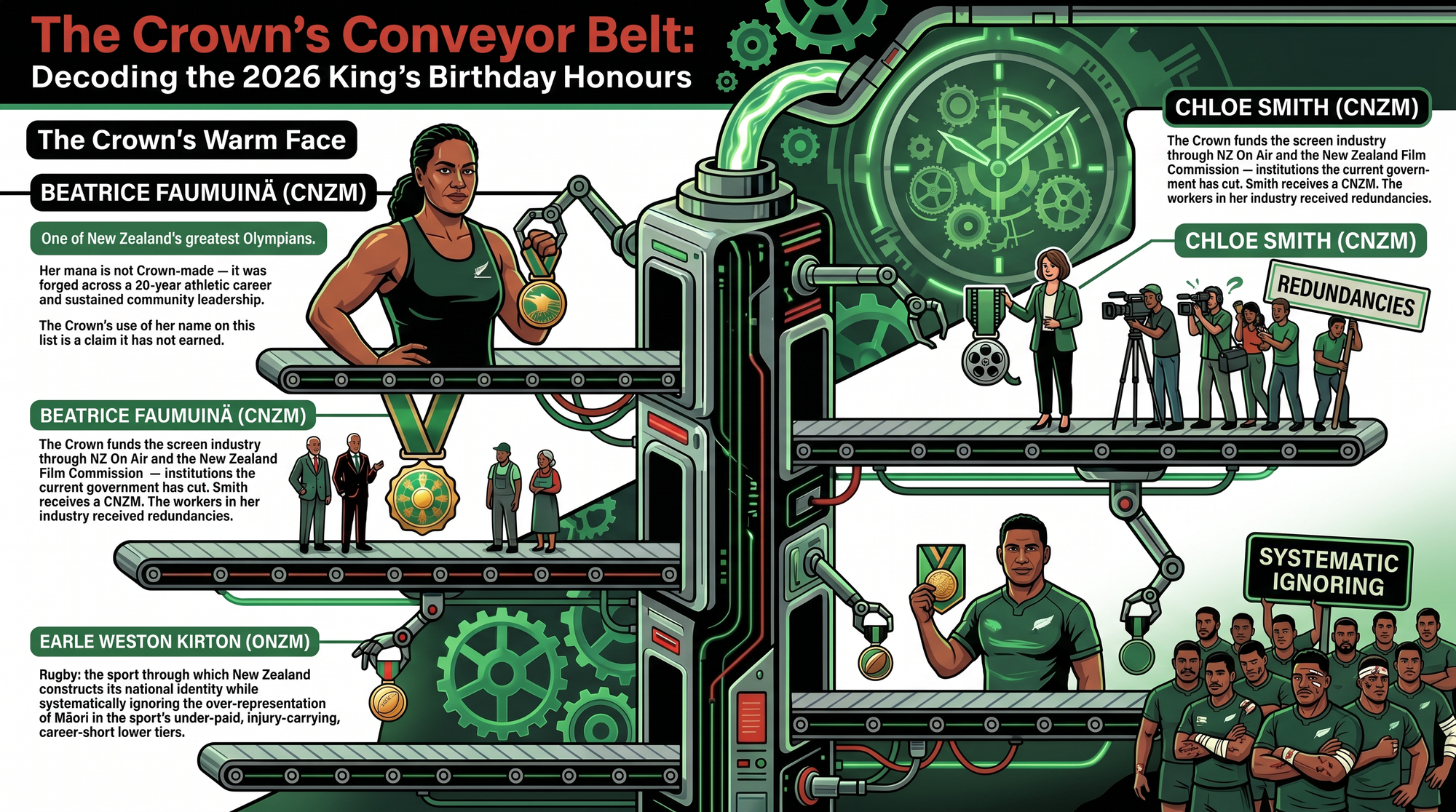
Beatrice Roini Liua Faumuinā (CNZM) — Auckland, "for services to sport and governance." One of New Zealand's greatest Olympians. Her mana is not Crown-made — it was forged across a 20-year athletic career and sustained community leadership. The Crown's use of her name on this list is a claim it has not earned.
Chloe Smith (CNZM) — Auckland, "for services to the screen industry." The Crown funds the screen industry through NZ On Air and the New Zealand Film Commission — institutions the current government has cut. Smith receives a CNZM. The workers in her industry received redundancies.
Earle Weston Kirton (ONZM) — Upper Hutt, "for services to rugby." Rugby: the sport through which New Zealand constructs its national identity while systematically ignoring the over-representation of Māori in the sport's under-paid, injury-carrying, career-short lower tiers.
PART ELEVEN: BARRY JOHN SOPER (ONZM) — The Crown Medals Its Own Mouthpiece
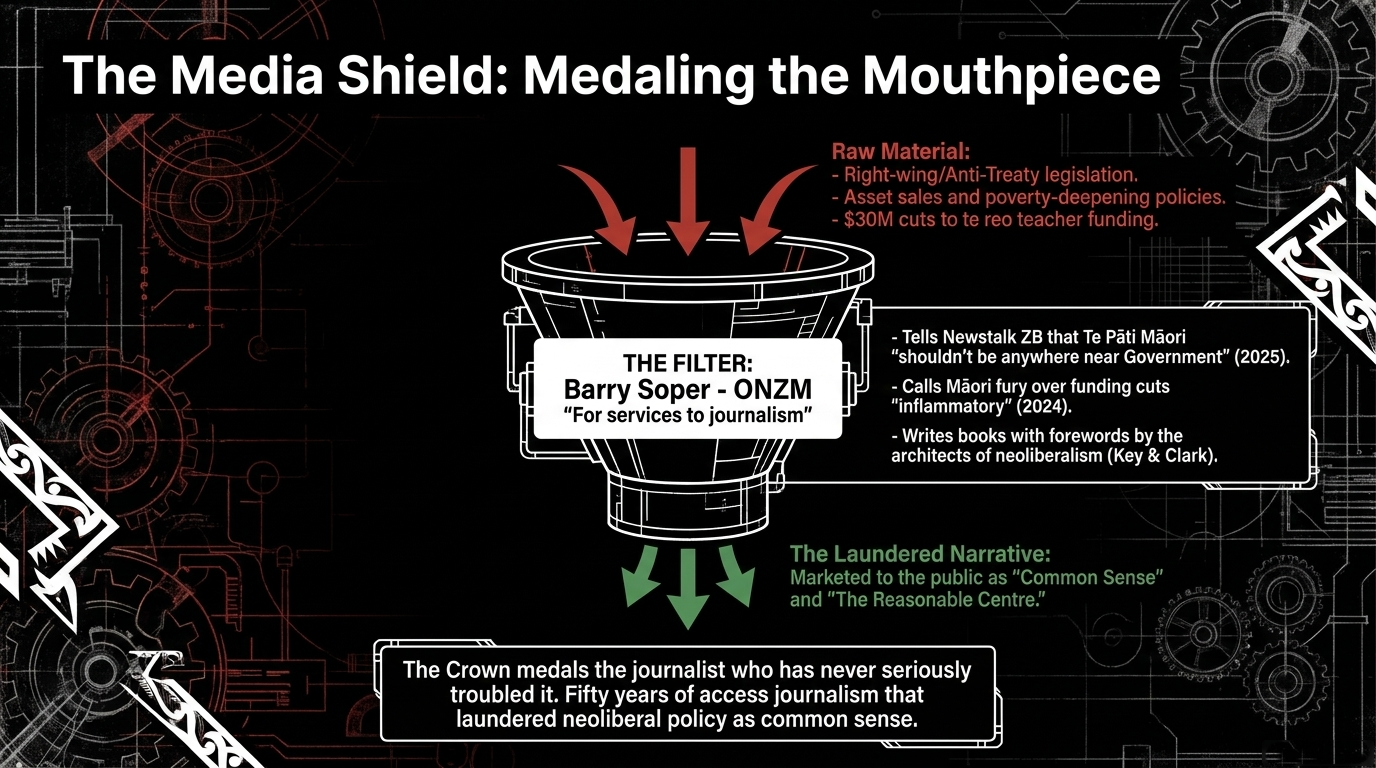
"For services to journalism." Auckland.
Let us be precise about what journalism Barry Soper has practised for fifty years — and what the Crown is therefore honouring today.
Barry Soper has been Newstalk ZB's senior political correspondent since 1980, as confirmed by his Apple Podcasts profile. He has covered twelve prime ministers. He has written a book with a foreword by John Key — the Prime Minister who led the asset-sale, housing-crisis, poverty-deepening government of 2008–2016 — and a second foreword by Helen Clark, as reviewed by The Spinoff.
As Key wrote:
"Barry knew, and still knows, where the bones are buried."
That is not a compliment to journalism. That is a description of a man trusted by power to keep its secrets.
Soper broadcasts on Newstalk ZB — the most listened-to talkback network in New Zealand, owned by NZME, the same media conglomerate that owns the NZ Herald, the Bay of Plenty Times, the Rotorua Daily Post, and Newstalk ZB. This is the media infrastructure of the New Zealand establishment. Soper is its longest-serving political voice.
The Māori Record: A Documented History of Harm
On 25 September 2024, when Te Pāti Māori responded to the government's $30 million cut to a programme funding teachers to learn te reo Māori, Soper described their statement as "inflammatory" — as confirmed by Newstalk ZB's own transcript. The Crown cuts te reo teacher funding by $30 million. Māori respond with fury. Soper calls the fury "inflammatory." Not the cuts. The fury.
On 23 October 2025, Soper told Newstalk ZB that Te Pāti Māori "shouldn't be anywhere near Government," as documented by Newstalk ZB. The only Māori political party in Parliament. The party representing 250,000 enrolled Māori voters. Should not be near Government — according to the man the Crown now honours for "services to journalism."
On 30 November 2024, when the Supreme Court ruled on Māori foreshore and seabed customary rights, Soper "unpacked the developments" on Newstalk ZB — in the context of a government pushing legislation to overturn those rights. Soper's framing, consistently, has been to present the Crown's position as the reasonable centre and Māori rights claims as the radical extreme.
The MGL Facebook archives document his reporting on the Treaty Principles Bill analysis: "By presenting these racist, revisionist views without challenge, Soper is not just reporting the news — he's actively shaping a narrative." The MGL has also documented that Soper's perspectives "often seem to align with and reinforce existing power structures," as noted in the ethnicity and waiting lists analysis.
In a separate documented episode, as recorded in MGL's legacy of access analysis, Soper was approached to stand for the Labour Party in the 1992 Wellington Central by-election. He claims to have rejected the offer. What this reveals is not his political affiliation — it reveals his proximity to power. He was embedded so deeply in the Wellington political class that political parties considered him an asset. That is not journalism. That is access management.
What "Services to Journalism" Actually Means
The Wellington press gallery model of journalism that Soper has practised and embodied for fifty years is access-dependent, relationship-managed, and structurally disinclined to challenge the people it depends on for information — as E-Tāngata has documented in its analysis of how media tools were deployed against Māori health institutions.
Soper recently appeared on The Front Page podcast to discuss covering twelve prime ministers. He blends "personal stories, policy critiques, and behind-the-scenes tales." He has outlasted them all — every prime minister from Muldoon to Luxon — while Māori communities have endured every austerity programme, every asset sale, every Treaty rollback that those prime ministers enacted. He was there. He reported it. He framed it as the reasonable centre. He never named the structural racism. He never traced the whakapapa of dispossession through the Budget cycles he covered.
Now the Crown gives him an ONZM.
Of course it does. Barry Soper spent fifty years telling power's story in power's language, broadcasting to power's audience on power's radio network, and calling it journalism.
The Crown medals the journalist who has never seriously troubled it — because the journalist who never seriously troubles the Crown is the journalist the Crown most needs.
The taiaha does not spare him.
"Services to journalism"
is a citation that names the crime: fifty years of access journalism that laundered neoliberal policy as common sense, framed Māori political assertion as "inflammatory," and told the Crown's story as if it were the nation's story.
It is not. It never was.
THE STRUCTURAL VERDICT
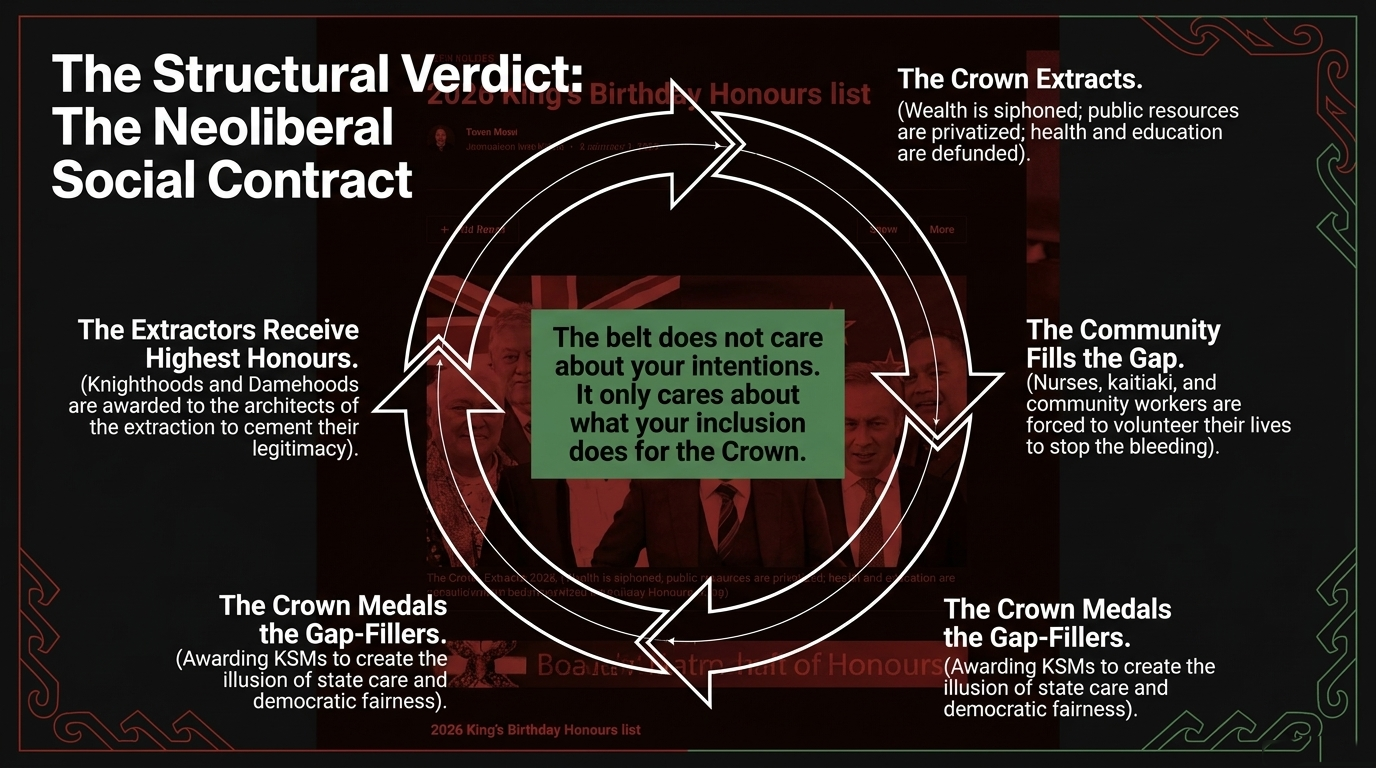
Count the categories. Count the tiers. Map the geography.
The knights and dames come from Auckland, Wellington, and the landed class. The KSMs come from Gore, Te Anau, Rolleston, Tokoroa — the provincial communities, the volunteer economy, the places where the Crown has most thoroughly withdrawn.
The top-tier honours go to those who serve the state machine, manage its governance architecture, or provide intellectual cover for its policy programme. The bottom-tier medals go to those who fill the gaps the state machine creates.
The Māori recipients are distributed through the list — a CNZM here, an ONZM there, a KSM at the bottom — in proportions that fall well short of demographic representation, clustering in community service, health, art, and education: the categories that make the list look diverse without threatening the distribution of power at the top.
The whole list, taken together, is a map of the neoliberal state's social contract: the Crown extracts, the community fills the gaps, the Crown medals the gap-fillers, and the extractors receive the highest honours of all.
Every person on this list has been processed through the conveyor belt. Some willingly, some unknowingly, some because their communities deserved to see their mahi recognised and the Crown was the only institution offering the ceremony. The belt does not care about your intentions. It only cares about what your inclusion does for the Crown.
What Rangatiratanga Looks Like
The kuia in Tokoroa who nursed for forty years and got a KSM: her mana was not made by the medal.
The toa in Tokomaru Bay making clay art in one of the country's poorest towns: his mana was not made by the ONZM.
The kaitiaki in Arthur's Pass: his service was not validated by the King's Service Medal.
Their mana was made by their people. By their whakapapa. By their mahi.
The Crown cannot confer that. It can only borrow it — for one day, for one list, for one press release — before returning to the business of extracting, dismantling, and dispossessing.
The taiaha is drawn. The evidence is the weapon. The machine is named.
Support This Mahi
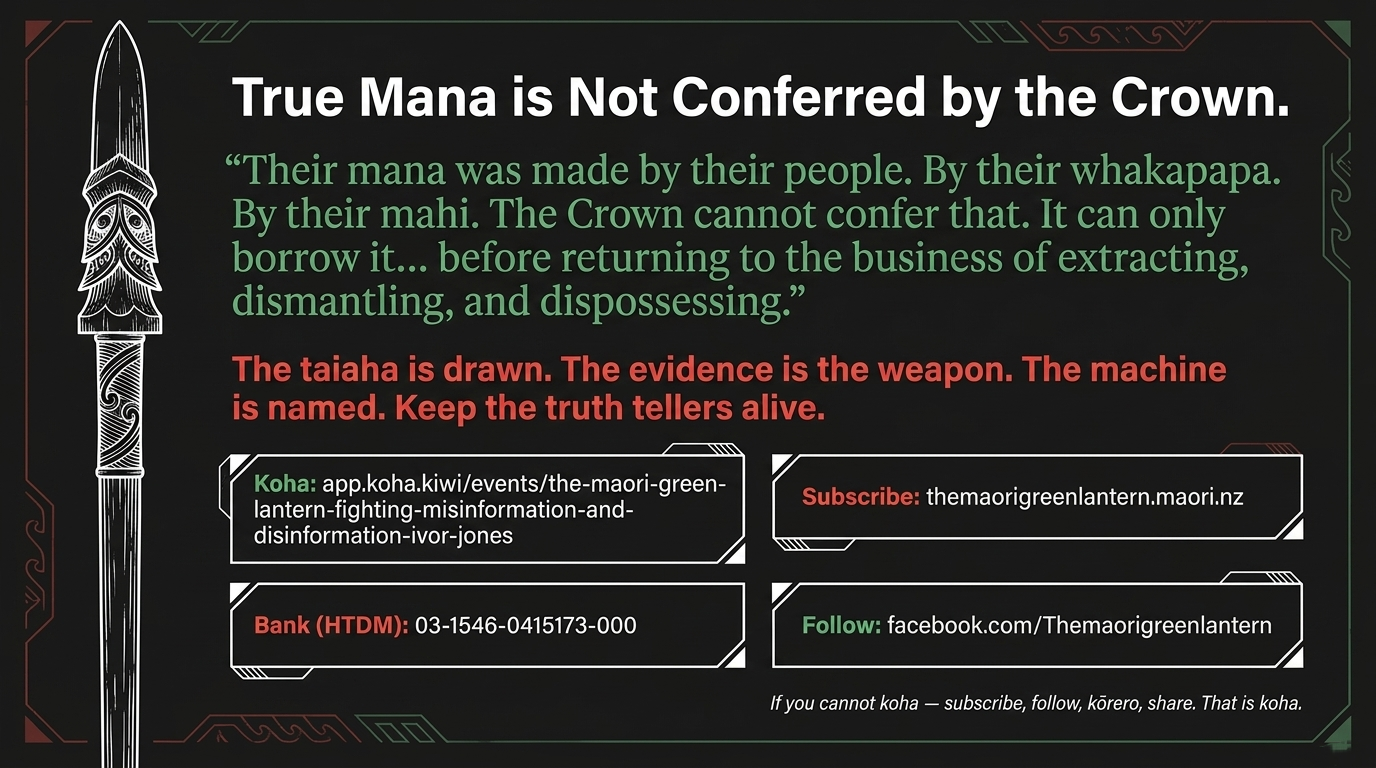
This essay was written on the morning the list dropped. Every kaupapa this Crown is honouring today took decades to build. Every kaupapa it is destroying will take decades to rebuild. Keep the truth tellers alive.
- 💛 Koha: app.koha.kiwi/events/the-maori-green-lantern-fighting-misinformation-and-disinformation-ivor-jones
- 📬 Subscribe: themaorigreenlantern.maori.nz/#/portal/support
- 🏦 Bank (HTDM): 03-1546-0415173-000
- 👍 Facebook: facebook.com/Themaorigreenlantern
If you cannot koha — subscribe, follow, kōrero, share. That is koha.
Views expressed constitute honest opinion on matters of public interest under the Defamation Act 1992 (NZ) and Durie v Gardiner NZCA 278. All named individuals are referenced solely in their public capacity — their public roles, public statements, and verifiable career histories. Errors and corrections: themaorigreenlantern.maori.nz. Qualified privilege for public officials and public figures: Lange v Atkinson 3 NZLR 385.