
"THE KING'S GUARD WITH A PARTY BADGE" - 4 June 2026
How Gerry Brownlee Turned the Speaker's Chair Into a Shield for a Thieving Minister — and What It Will Cost Every Whānau Who Dares to Be Poor

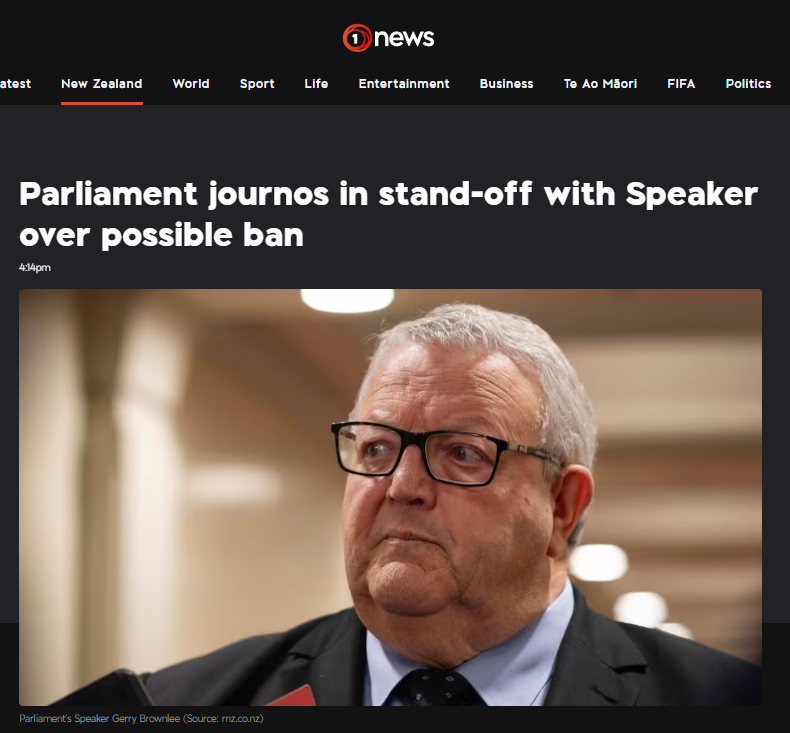
He took no complaint. He needed none. The Minister was embarrassed, the journalist was in a permitted area, and the Speaker of the House decided the truth needed to be punished. This is not democracy. This is the colonial playbook with a fresh coat of paint.
Tēnā koutou katoa.
Ko Ivor Jones tēnei — Te Māori Green Lantern, tohunga mau rākau wairua, kaitiaki of whānau Māori and of the truth. Ko Ngāti Pikiao tōku hapū, ko Te Arawa tōku iwi.
I write from Ōpōtiki, from the Eastern Bay of Plenty, and I write for the people whose names never appear in the parliamentary allowances register. I am done being polite about this.
Picture a courthouse where the judge is the defendant's best friend, belongs to the same party, gets his salary from the same coalition, and — when a journalist photographs the defendant pocketing public money — decides the journalist needs to be barred from the building.
That is not a hypothetical. That is Aotearoa New Zealand on 4 June 2026. That is what Gerry Brownlee — National Party MP, Canterbury old boy, Speaker of the 54th Parliament — is doing right now, in our Parliament, with our money, on our time.
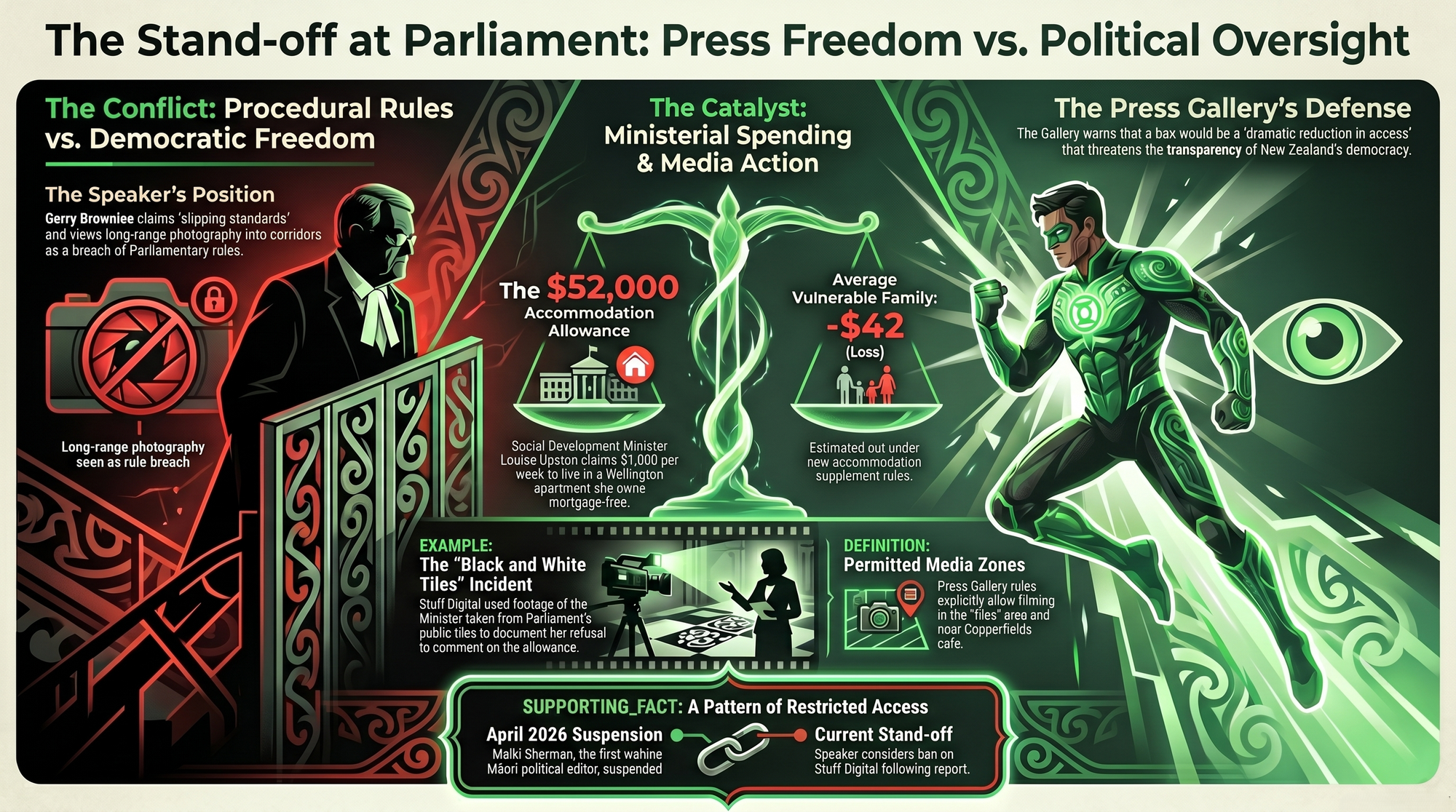
And the woman he is protecting? Louise Upston. The Minister for Social Development. The woman collecting $52,000 a year in taxpayer-funded accommodation allowances to live in a Wellington apartment she owns outright — mortgage-free — while simultaneously rewriting the rules to make it harder for your whānau to qualify for the accommodation supplement, as confirmed by 1News and The Spinoff.
She said she was "comfortable" with it.
I wonder how comfortable the whānau losing $42 a week feel.
The Deep Dive Podcast
Listen to a lively conversation between two hosts, unpacking and connecting topics in the sources of this essay. I apologise in advance for the AI's very harsh pronounciation of reo. Please dont shoot me, :).
What They Did — And Why It Matters
I have been writing about Louise Upston and her $52,000 rort since the story first broke. I named it then and I will name it again now: this is a government minister using the rules she was entrusted to administer to enrich herself while destroying the same safety net for the people she is supposed to serve. I covered this directly in my essay The Comfortable Thief — published 28 May 2026 — where I documented every number, sourced every link, and asked the question she still hasn't answered:
Would you qualify for the accommodation supplement under your own rules, Minister?
She would not answer then. She will not answer now.
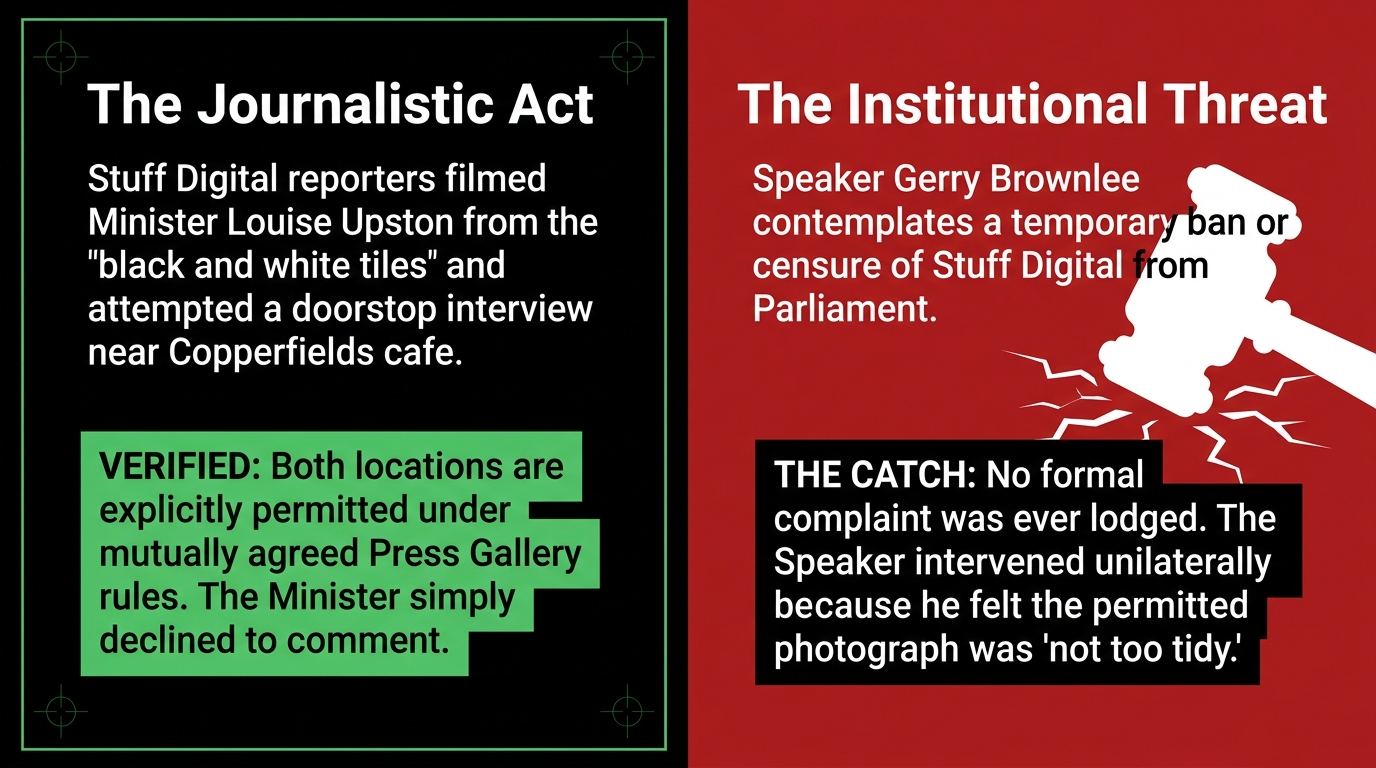
Stuff Digital asked the same question. Their journalists filmed her in areas where filming is explicitly permitted under mutually agreed Press Gallery rules, as confirmed by RNZ. They used a still screenshot from permitted footage. They attempted a doorstop interview in a permitted area. She declined to comment.
That is journalism. That is the fourth estate doing exactly what the fourth estate exists to do.
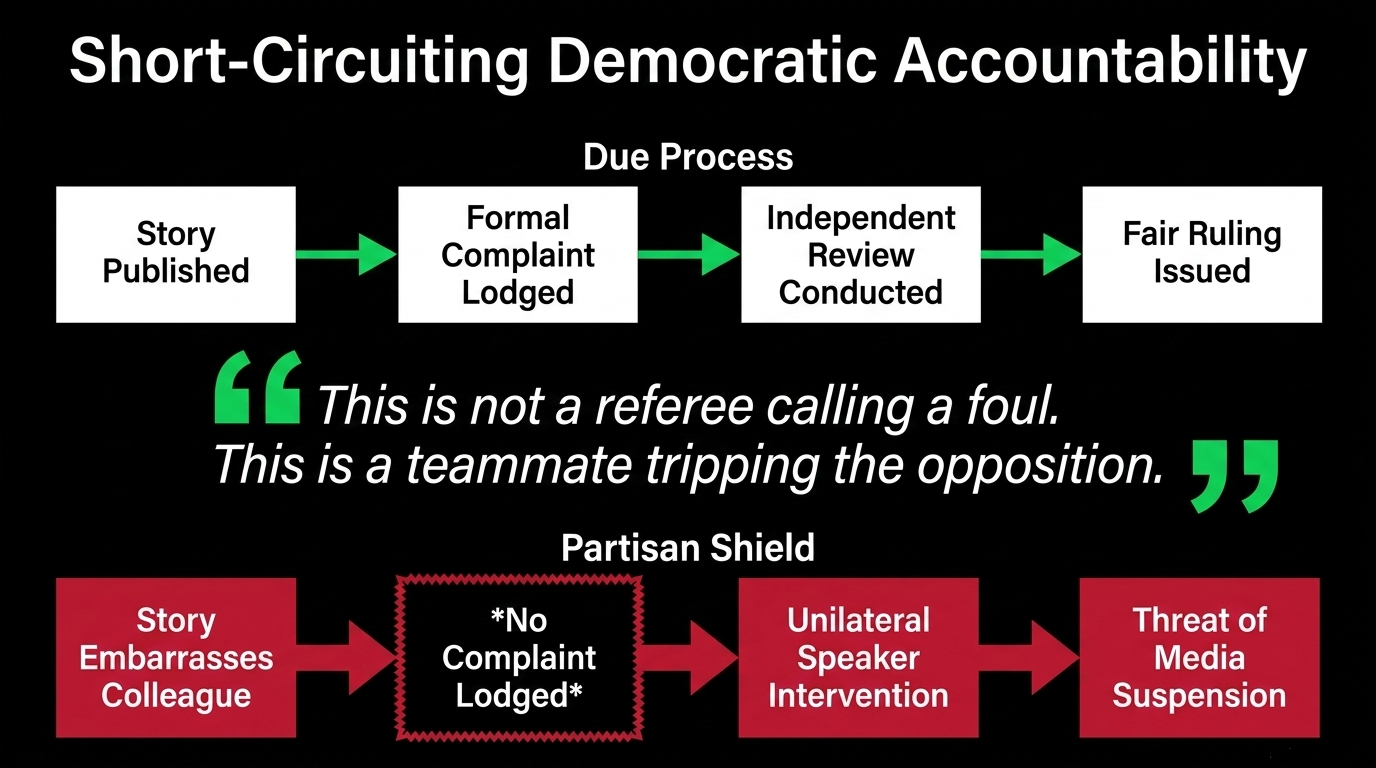
And then Gerry Brownlee — who received no formal complaint, who admits he simply "saw the photograph and thought that was not too tidy", as he told RNZ himself — decided to follow up. On his own initiative. Against an outlet that had just embarrassed his National Party Cabinet colleague. ✅ Verified.
That is not a referee calling a foul. That is a teammate tripping the opposition.
The Pattern They Hope You Won't Notice
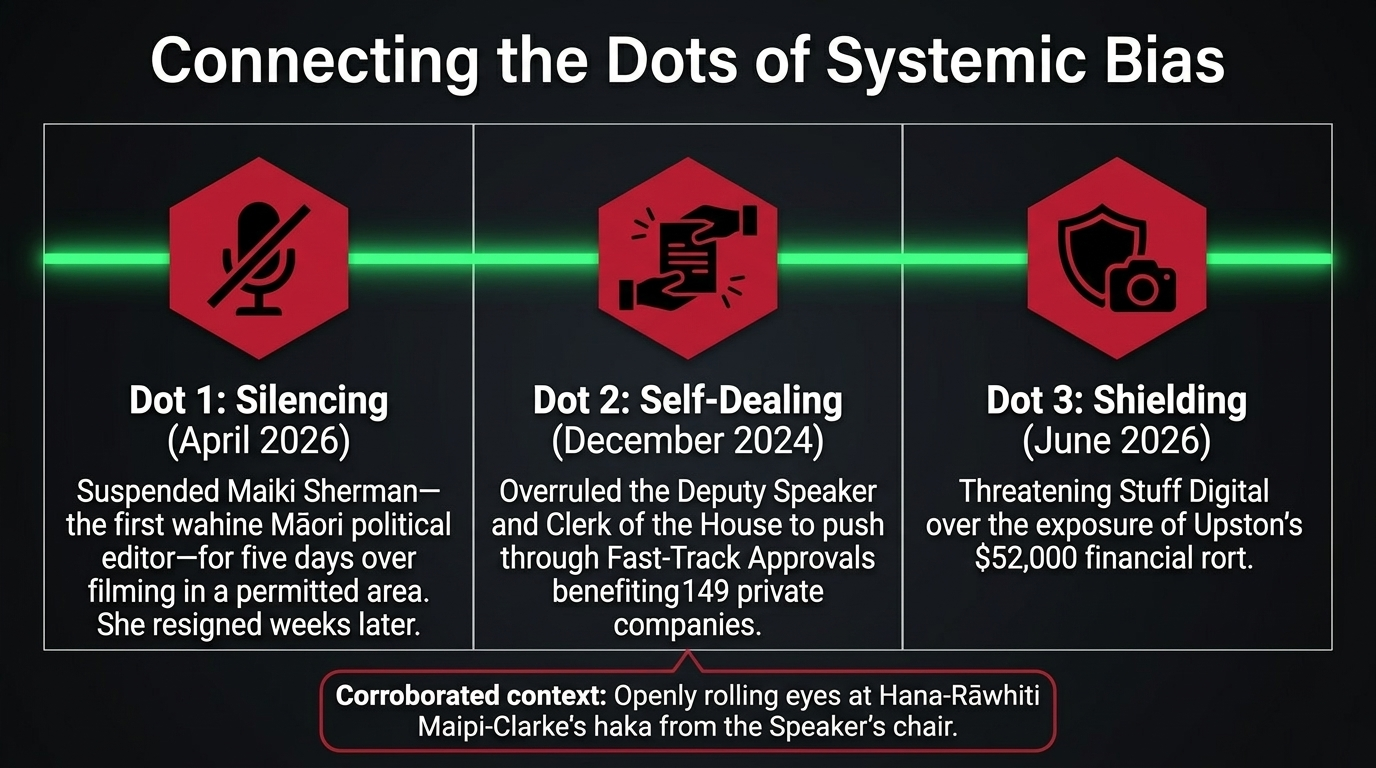
Let me be forensically clear about what Brownlee has now done in the six weeks since May 2026, because this government counts on your exhaustion. It counts on the news cycle swallowing each scandal before you can connect the dots.
Dot one: In late April 2026, Brownlee suspended Maiki Sherman — the first wahine Māori political editor in New Zealand's history — for five days, as Reuters and Scoop both confirmed. I covered the full context of what that suspension did to Māori representation in our press gallery in my essay on the MGL — the government didn't just punish a journalist, they punished a lineage. They punished every young Māori woman who looked at Maiki Sherman and saw a future in political journalism.
Dot two: In December 2024, Brownlee overruled his own Deputy Speaker and the Clerk of the House to push through a Fast-Track Approvals Bill amendment benefiting 149 private individuals and companies, as Newstalk ZB confirmed. Labour formally declared they had lost confidence in him as Speaker over that ruling.
Dot three: When Hana-Rāwhiti Maipi-Clarke performed the haka in Parliament, Brownlee rolled his eyes — on camera, in the Speaker's chair — as E-Tangata documented and named plainly:
"This is a conflict of interest."
Connect the dots. The picture is not subtle. A National Party man sits in the most powerful procedural chair in our democracy and uses it — repeatedly, patterned, predictably — to protect his coalition, punish the press, and roll his eyes at tikanga Māori.
Three Examples for the Western Mind
I know some of you reading this are not Māori. Some of you are Pākehā colleagues, progressive whānau, international readers who found this through a share. So let me make the stakes as plain as I can.
Example One: The $52,000 vs. The $42 — The Arithmetic of Contempt
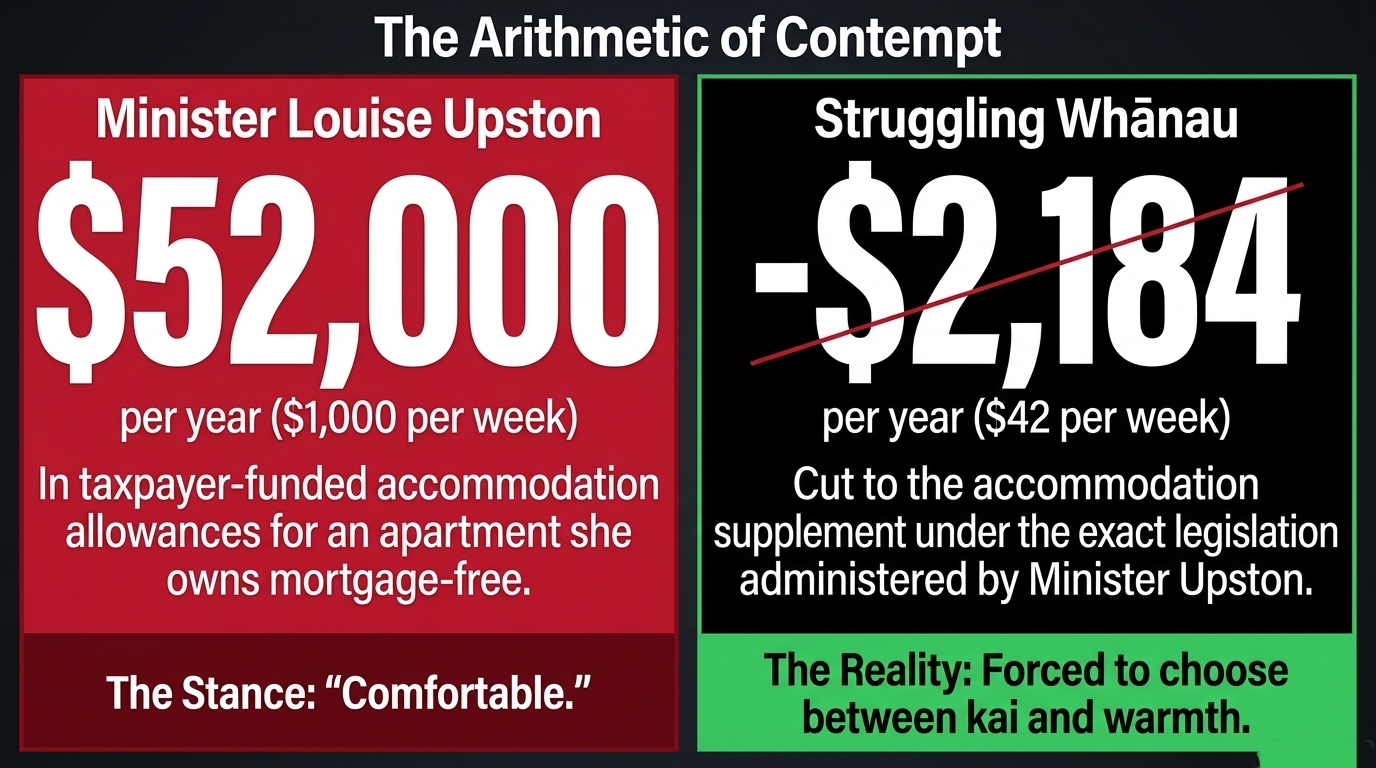
Louise Upston collects $1,000 per week in accommodation allowance from taxpayers, for an apartment she owns mortgage-free, as confirmed by 1News and the Otago Daily Times.
Under the legislation she is advancing, families with children will lose an average of $42 per week from their accommodation supplement, as The Spinoff calculates.
That is $52,000 taken from the top. $2,184 stripped from the bottom per year, per family.
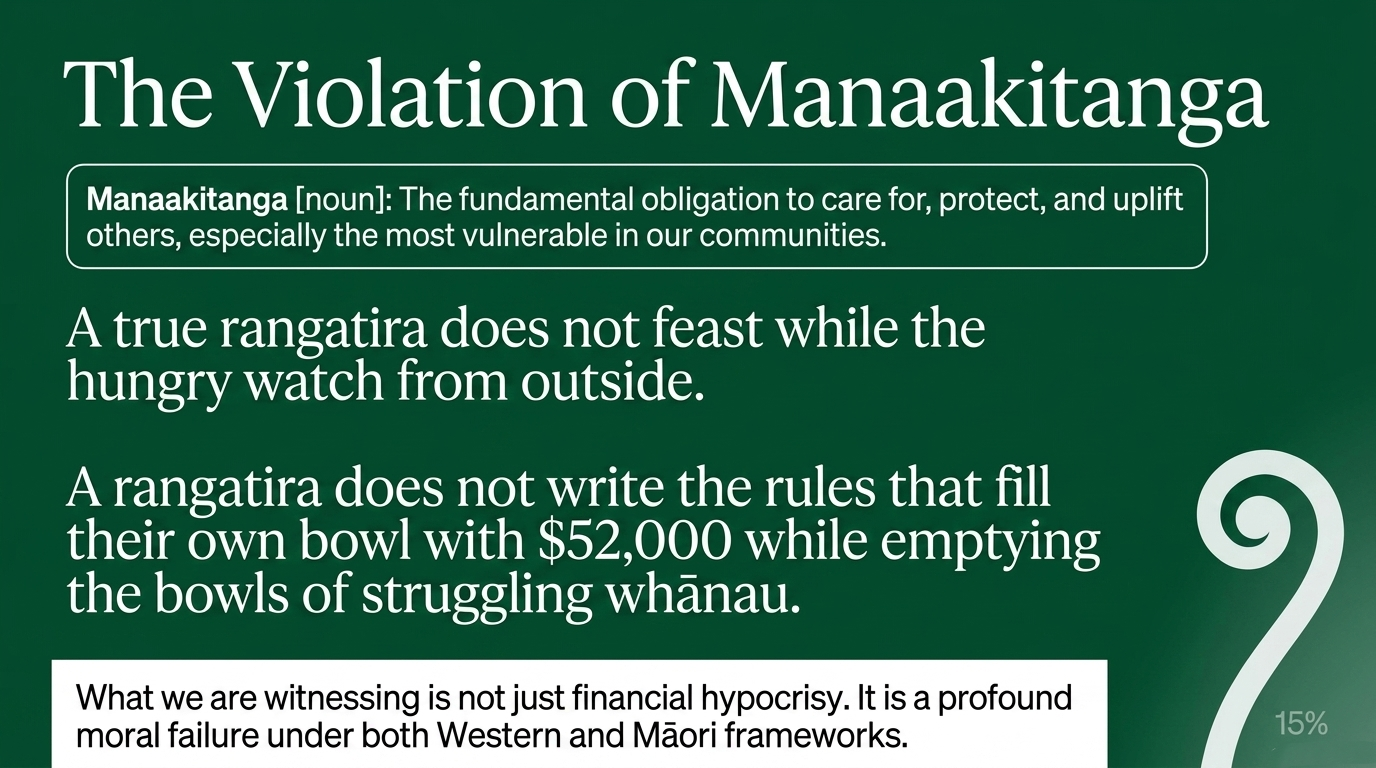
In tikanga Māori, this is a violation of manaakitanga — the obligation to care for and uplift others, especially the vulnerable. A rangatira does not feast while the hungry watch from outside. A rangatira does not write the rules that fill their own bowl while emptying everyone else's. What Upston is doing is not just financially hypocritical. It is a moral failure by any framework — Western or Māori. The Press Gallery's job was to show you that failure. Brownlee's job — as he has chosen to perform it — was to stop them.
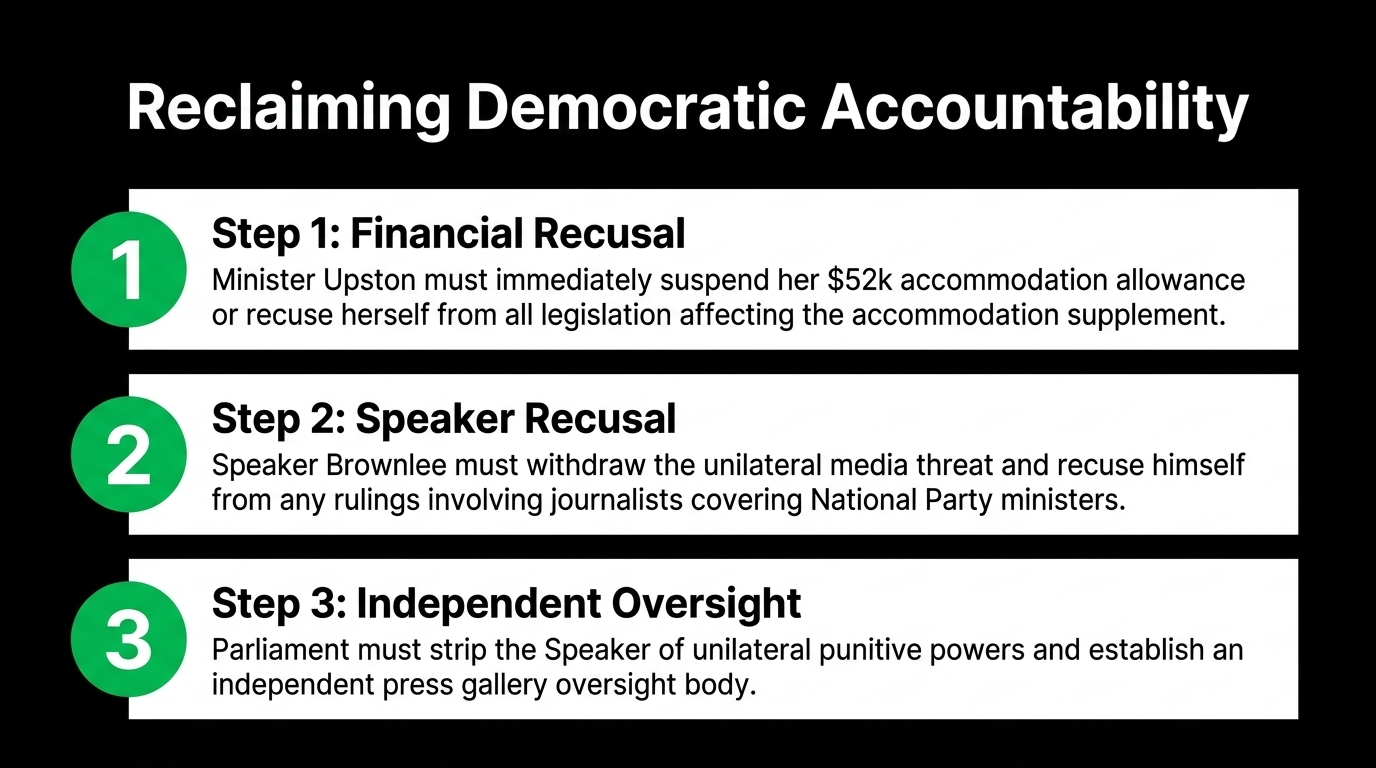
Solution: Upston should immediately suspend her accommodation allowance or recuse herself from any legislation affecting the accommodation supplement. The rules governing MP allowances need independent oversight — not self-regulation by the same parties who benefit. And the Speaker must recuse himself from any ruling involving journalists covering National Party ministers.
Example Two: The Sherman Precedent — Silencing the First Wahine Māori Political Editor
Maiki Sherman (Ngāpuhi/Whakatōhea) was the first wahine Māori political editor in the history of New Zealand broadcast journalism. Brownlee suspended her from Parliament for five days in April 2026, as Reuters confirmed. By May, she had resigned from TVNZ entirely, as I documented in my MGL essay They Built Her a Stage and Called It Progress.
For the Western mind: imagine the first Black woman to become political editor at a major US network being suspended by a Republican Speaker for filming in a permitted area, after reporting that embarrassed a Republican Cabinet minister — and then resigning within weeks. The outrage would be total. The think-pieces would be endless. Here, in Aotearoa, it was a five-day story.
In tikanga Māori, this is a direct attack on whakaaro Māori — Māori ways of knowing and communicating — in the most public arena in the country. Parliament is the house where our laws are made. When the first wahine Māori political editor is removed from that house by a Pākehā Speaker protecting Pākehā ministers, the message sent to every young Māori journalist is not subtle:
your presence here is conditional on your compliance.
As Reporters Without Borders has already documented, New Zealand's media landscape is under compounding threat. Brownlee is not the cause. But he is an accelerant.
Solution: An independent press gallery oversight body — not the Speaker, not Parliament's administrative arm — must adjudicate complaints about journalist access. The Speaker's power to suspend or censure media outlets must require formal complaint, due process, and right of reply before any action is taken.
Example Three: The Fast-Track Overrule — When the Referee Picks a Team
When Brownlee overruled the Deputy Speaker and the Clerk of the House on the Fast-Track Approvals Bill in December 2024, Labour said it was "unprecedented" and declared a formal loss of confidence in him as Speaker, as Newstalk ZB reported.
For the Western mind: the equivalent would be a Supreme Court Chief Justice, nominated by the Republican Party, issuing a casting vote on a bill that directly benefited 149 Republican donors — and then refusing to recuse. We would call it corruption. We would demand resignation.
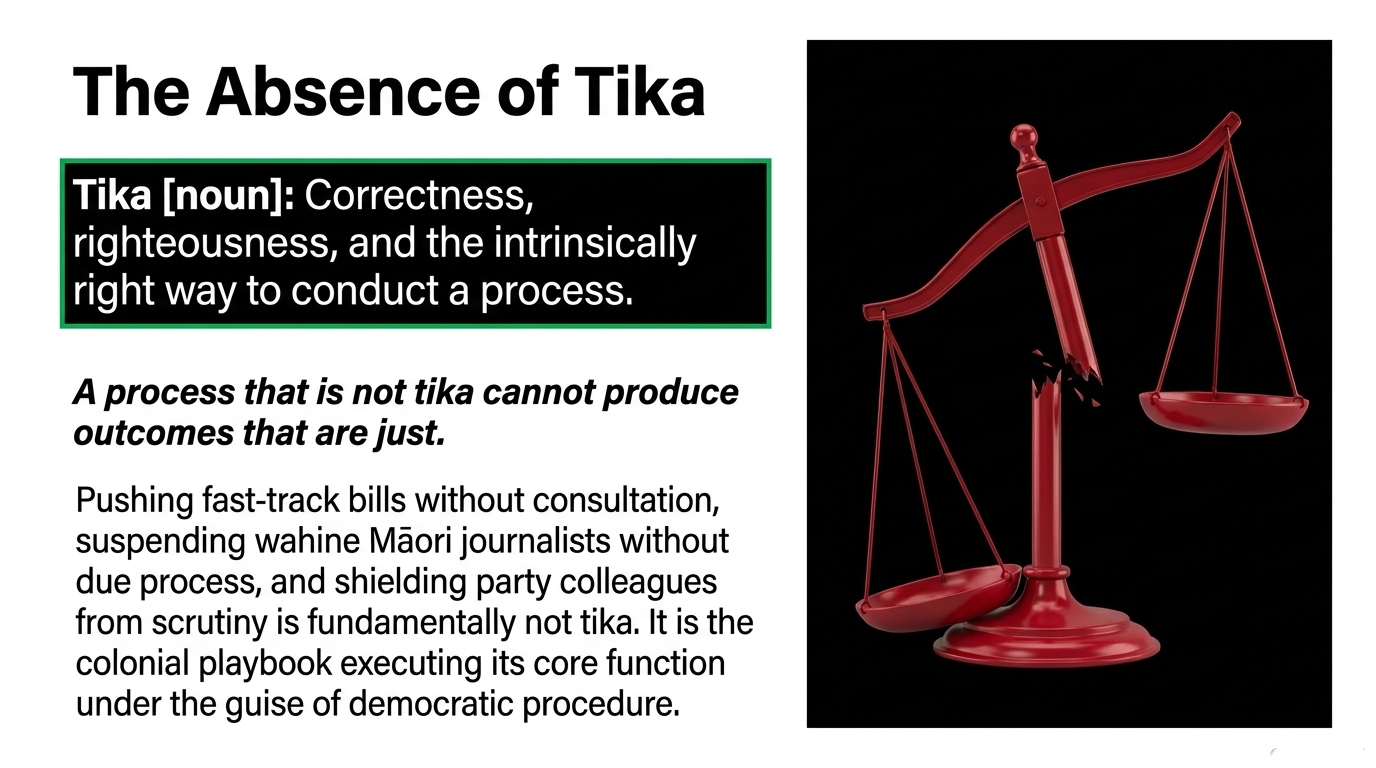
In tikanga Māori, the concept of tika — correctness, righteousness, the right way to do things — is foundational to how decisions affecting whānau and hapū should be made. A process that is not tika cannot produce outcomes that are just. Brownlee's tenure as Speaker has been consistently, documentably, and now repeatedly not tika. The harm is not abstract: those 149 private interests in the Fast-Track Bill included development projects on land adjacent to or affecting Māori land interests, without adequate consultation — the very definition of colonial process dressed in democratic clothing.
Solution: The Speaker should not be a sitting MP from the governing party. New Zealand needs a constitutional review of the Speaker's powers — specifically the unilateral powers to censure, suspend, and rule on media access without independent oversight.
The Constitutional Rot — And the Tikanga It Violates
The Speaker of the House is supposed to be te mana whakawā o te Whare — the impartial authority of the House. That role is woven through with obligations that go beyond party loyalty. In a House that is supposed to honour Te Tiriti o Waitangi, the Speaker's mana derives not from the party that appointed them but from the trust of all members — and through them, of all people.
Brownlee was elected Speaker on 5 December 2023 by a coalition government, as the Otago Daily Times confirmed. He has never demonstrated that he understands the difference between the role and the party.
The Press Gallery's formal letter to Brownlee said it plainly:
If any MP has concerns about the editorial content of a story, that should be dealt with through the usual channels for complaints, rather than by seeking to curtail our access to Parliament."
As RNZ confirmed, the Gallery warned his interpretation would amount to
"a dramatic reduction in access" and threatened media freedom.
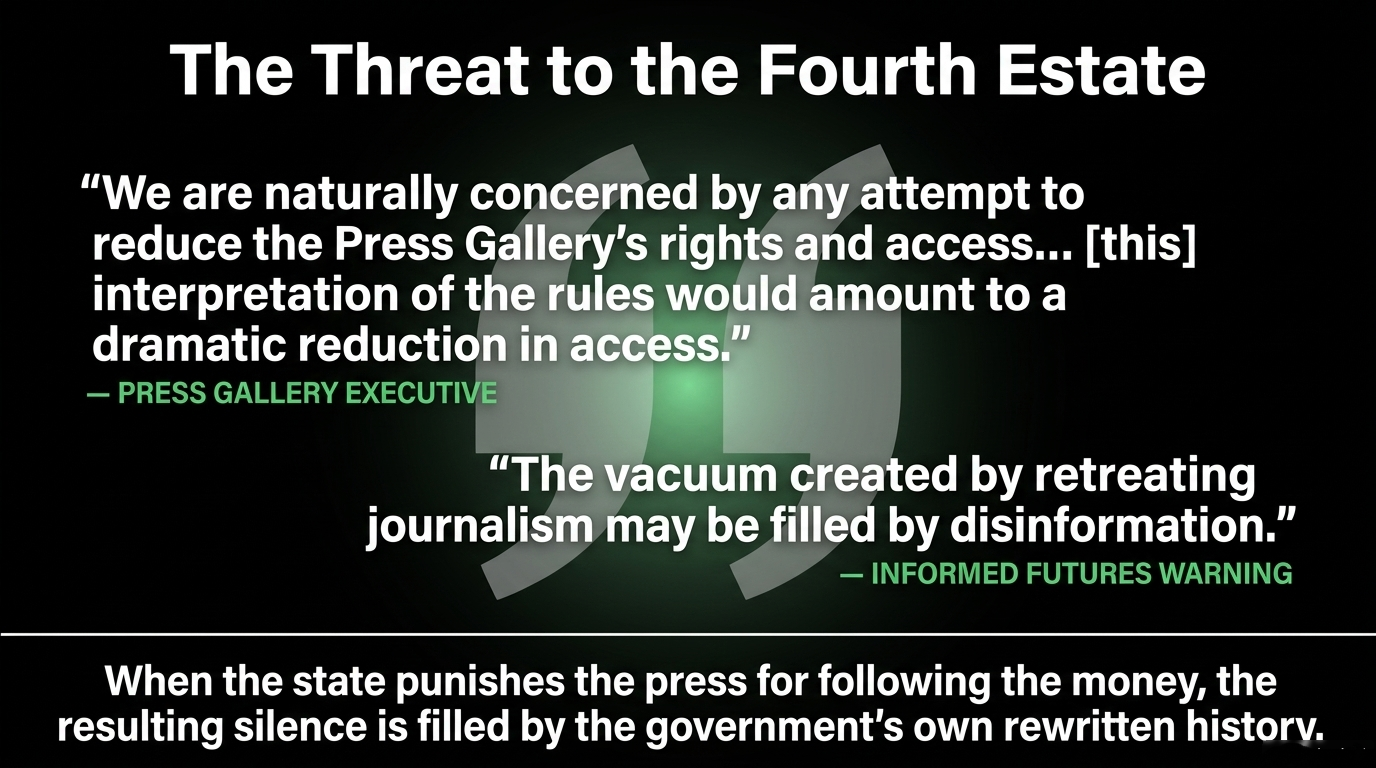
The Informed Futures report warned that
"the vacuum created by retreating journalism may be filled by disinformation."
This is not a theoretical warning. This government has already demonstrated that it fills information vacuums with its own narrative — rewriting Treaty history, as I documented in The Vote Thieves; stripping Māori health authority, as I documented in The Machine That Ate Our Children; and now silencing the journalists who follow the money.
The Double Standard That Destroys Mauri
I have written before about how the Atlas Network-linked media ecosystem in Aotearoa hunts Māori figures while shielding Pākehā property hoarders — I covered this directly in The Double Standard Laid Bare — and what is happening right now is that same double standard playing out inside our own Parliament.
Louise Upston can pocket $52,000 a year from the public purse while legislating poverty — and the Speaker protects her from the camera. A wahine Māori journalist can be suspended for filming in a permitted area. And Gerry Brownlee looks at Hana-Rāwhiti Maipi-Clarke's haka and rolls his eyes.
This is the system working as designed. White supremacy does not always arrive in a hood and a torch. Sometimes it arrives in a suit, with a gavel, in the Speaker's chair, defending the comfortable thief from the journalist who found her.
The Taiaha Speaks Plain
I, Ivor Jones — Te Māori Green Lantern — am not asking for civility here. Civility is what they demand of us when evidence is inconvenient. I am asking for truth.
The truth is this:
Gerry Brownlee is a National Party MP who has used the Speaker's powers — three times, on the documented record — to protect his coalition, silence journalists who embarrass his ministers, and roll his eyes at tikanga Māori on the floor of our Parliament. He is not a neutral arbiter. He is a partisan operator wearing constitutional robes. And the robes do not change the allegiance.
Louise Upston collects $52,000 a year from taxpayers while cutting $2,184 a year from families with children. She calls it "following the rules." So did every colonial administrator who ever signed a land deed over the heads of whānau who weren't in the room.
The Stuff Digital journalists who filmed her in a permitted area, who used a permitted screenshot, who attempted a lawful doorstop interview — they did their job. They should be protected, not punished.
And every whānau who will lose $42 a week under Upston's legislation — every kuia choosing between kai and warmth, every young Māori family one missed payment away from the car — they deserved to know. Stuff tried to tell them. Brownlee tried to stop it.
That is the story. That is the harm. That is the crime.
Brownlee should recuse himself immediately from any ruling involving Stuff Digital's access to Parliament. The Press Gallery executive's letter should be answered not with a meeting in two weeks but with an immediate withdrawal of the threatened censure or suspension. And if he will not do that of his own accord, then the question of his fitness to serve as Speaker — a question Labour has already formally raised — must be answered by the full House.
Nō reira. Tēnā koutou, tēnā koutou, tēnā koutou katoa.
Support the Mahi That Power Wants Silenced
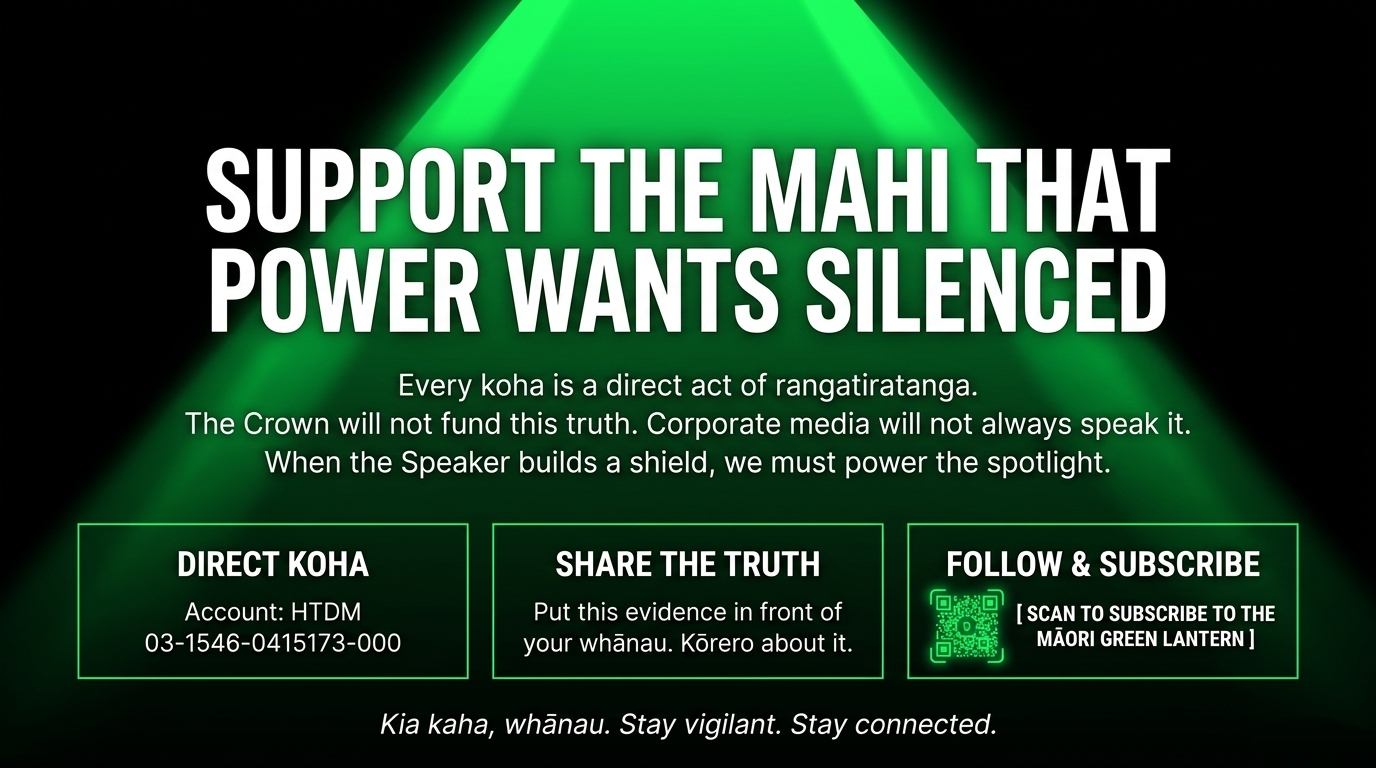
Every koha to the Māori Green Lantern is a direct act of rangatiratanga. Brownlee wants Stuff Digital gone from Parliament because they followed the $52,000. This government wants independent voices exhausted, defunded, and silenced.
Your koha says: not today.
When a Speaker uses a constitutional chair to shield a minister pocketing $52,000 a year while cutting $42 a week from your whānau — that is exactly the accountability gap this mahi was built to fill. The Crown will not fund this truth. The corporate media will not always speak it. But you can ensure it keeps being told.
If you are able, consider a koha — it directly funds the verified, sourced, scathing analysis that names names and traces the networks:
💚 Koha — Support the Māori Green Lantern
Subscribe for direct delivery — every essay, every reckoning, straight to your inbox before the algorithm buries it.
Direct bank transfer: HTDM — 03-1546-0415173-000
Follow and subscribe on Facebook
If a koha is not possible right now — no worries, e hoa. Share this essay with your whānau. Kōrero about it. Put it in front of the people who need to read it. That is koha in itself. Rangatiratanga includes the power to fund our own truth-tellers — and to be one.
Kia kaha, whānau. Stay vigilant. Stay connected.

Public interest framing: This essay concerns the conduct of a public official in their constitutional role, parliamentary expenditure of public funds, and the freedom of the press. It activates the defences under Lange v Atkinson 3 NZLR 385 and Durie v Gardiner


