"THE TANIWHA IN A SUIT: How Corporate Defendants Bribed a Government With Its Own Law — And the Prime Minister Shredded the Receipts" - 3 June 2026
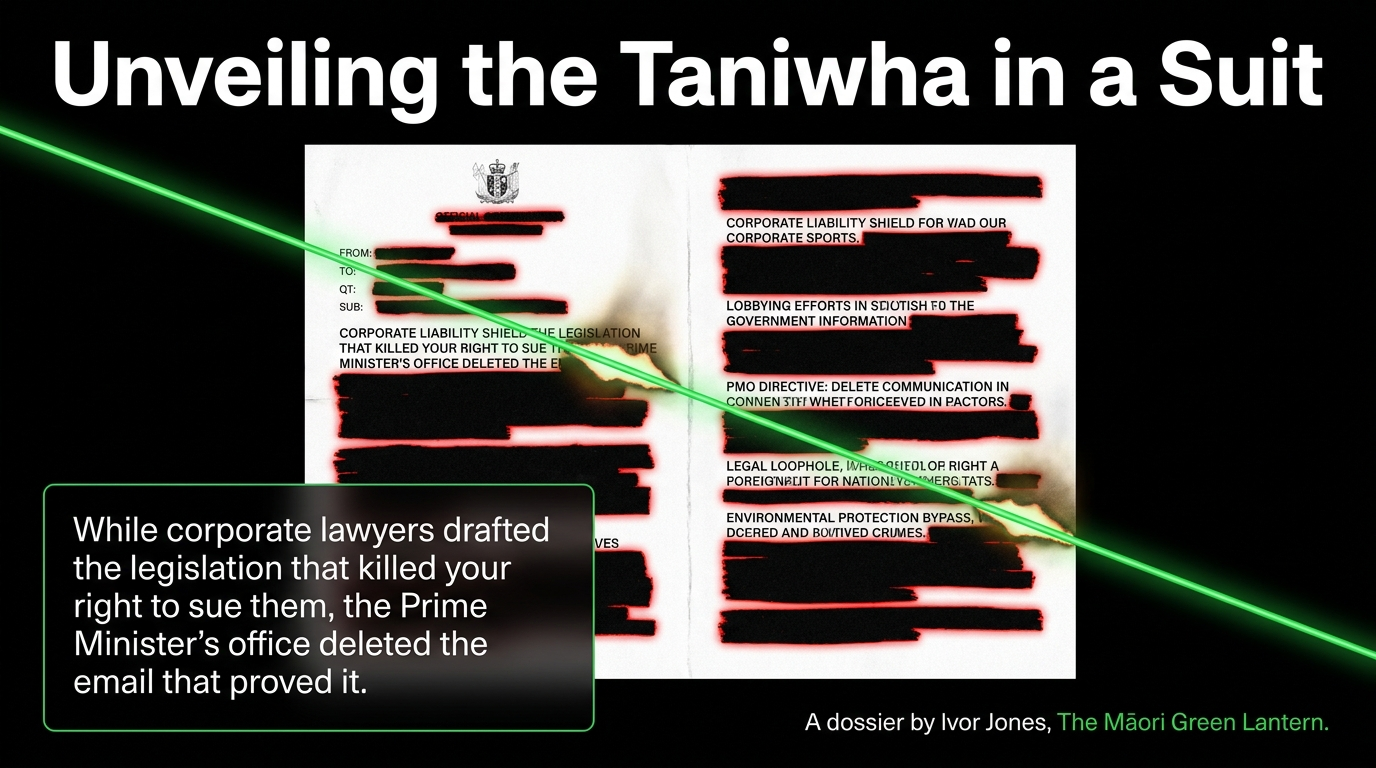
While Fonterra's lawyers drafted the legislation that killed your right to sue them, Christopher Luxon's chief policy adviser deleted the email that proved it — and called the cover-up a "teachable moment."

Tēnā koutou katoa,
This essay examines the secret corporate lobbying campaign by Fonterra and Z Energy to amend New Zealand's climate change law
— a campaign that directly protected their interests in active litigation
— and the role of Prime Minister Christopher Luxon's office in concealing that campaign from the public and the courts.
This examination is made in the public interest because it directly affects the democratic rights of all New Zealanders, the constitutional integrity of the judiciary, and the Treaty rights of Māori whānau whose kaitiakitanga was legally recognised — and then legislatively assassinated.
THE TANIWHA THAT CAN NOT BE CAUGHT
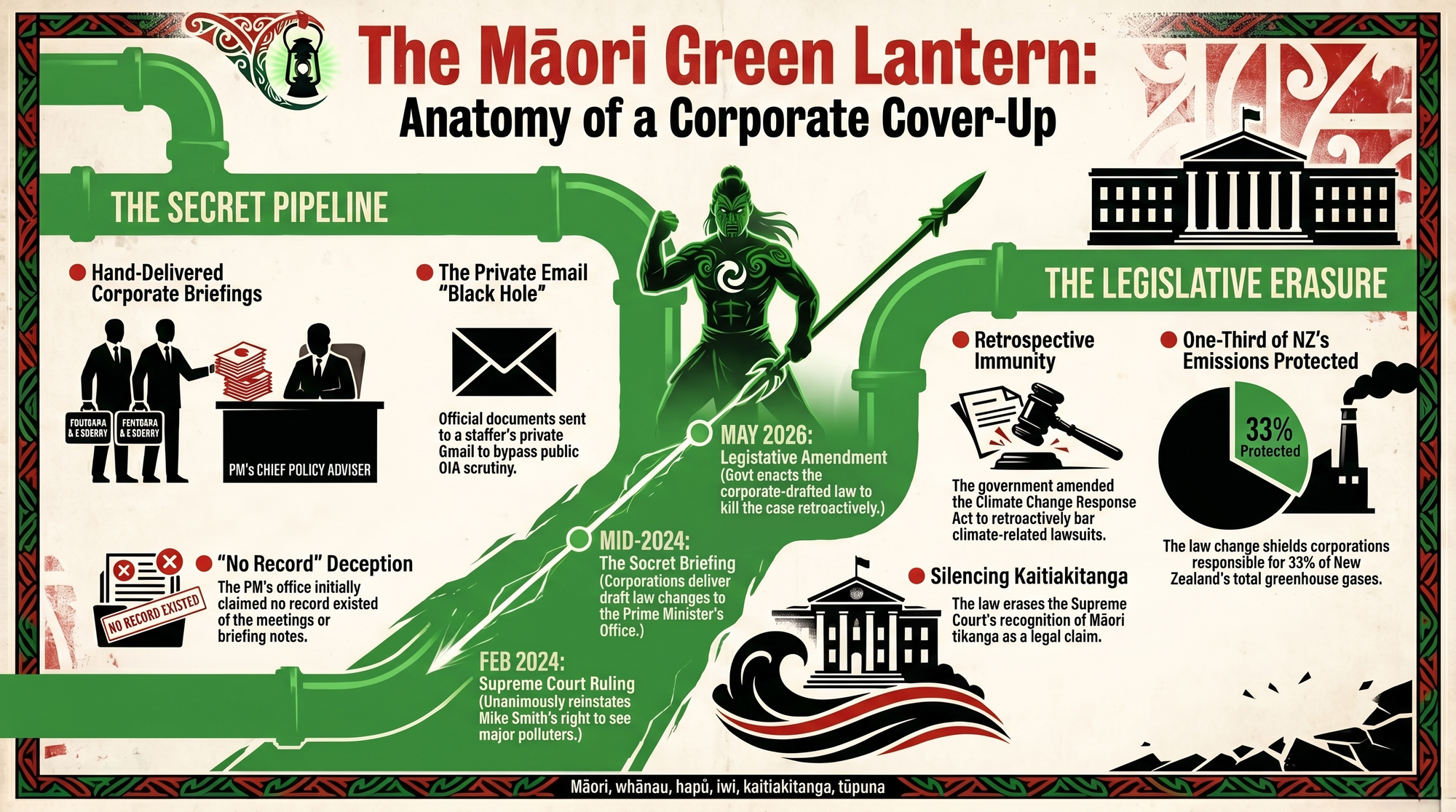
There is a taniwha that cannot be caught in a net.
So it swims upstream into Parliament. Sits at the desk of the Prime Minister's chief policy adviser. Pours itself a coffee. And drafts its own immunity into law.
Then — when the courts come looking for the proof — it deletes the email. Shreds the paper. Tells the judge there is no record. Calls a press conference. Says the quiet part out loud:
"It's a good teachable moment."
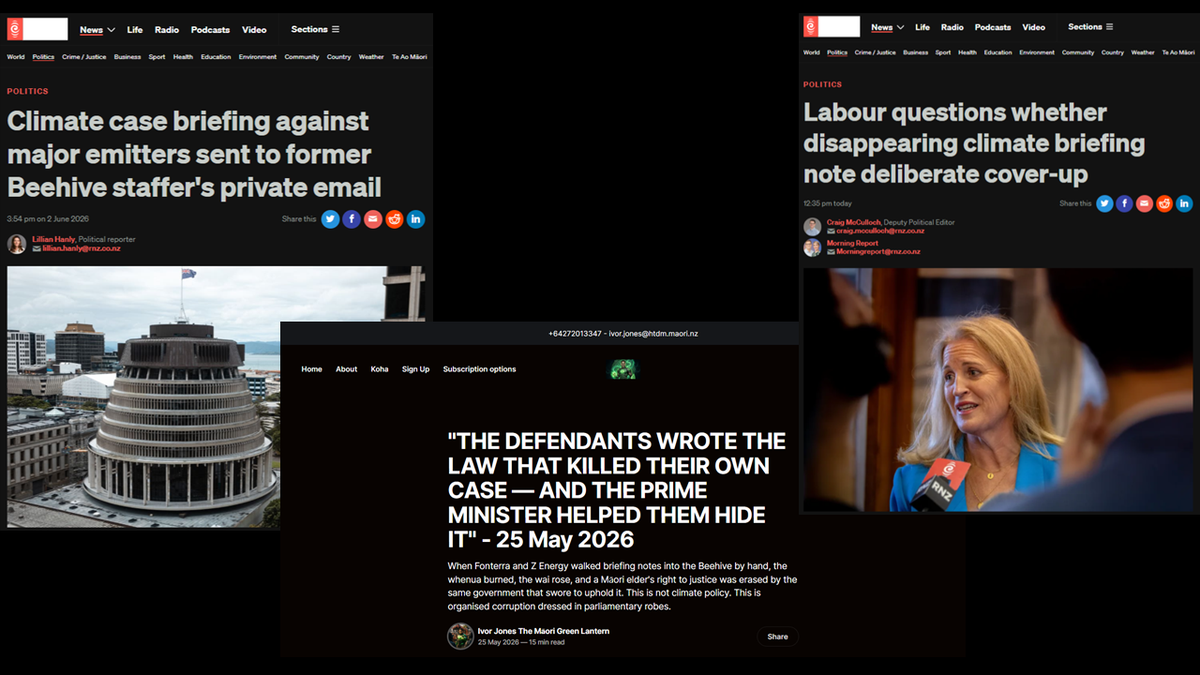
 Lillian Hanly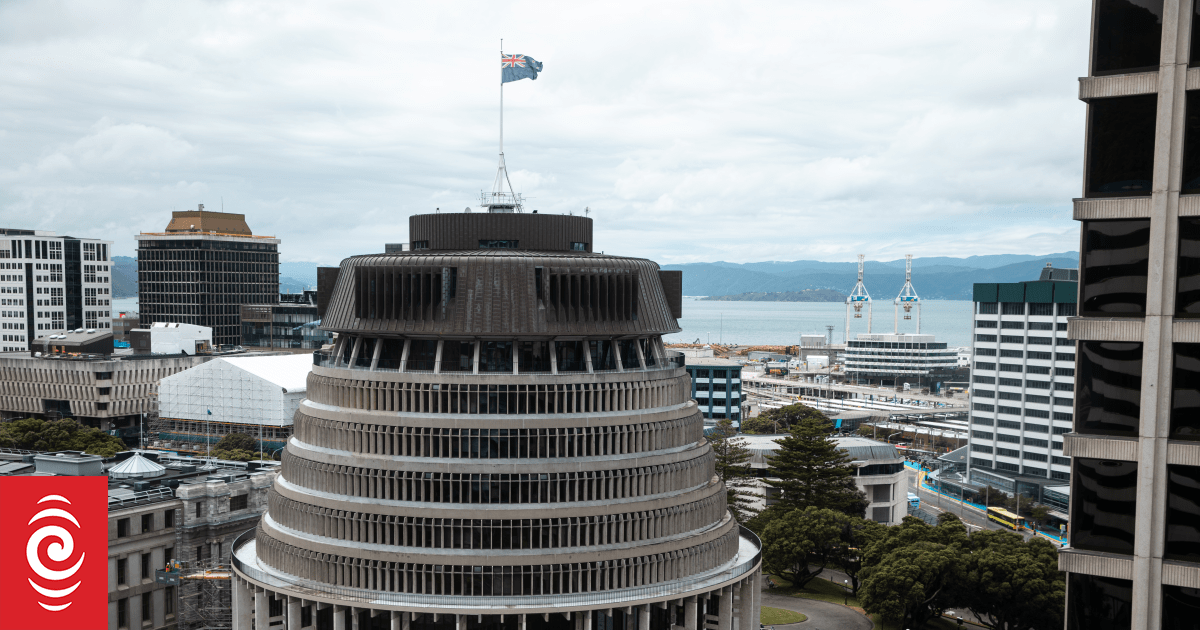
That taniwha's name is Fonterra. That taniwha's name is Z Energy. And the man who held the door open for them — who sat in the Prime Minister's innermost circle, who received the briefing note designed to extinguish New Zealand's most significant climate case in history, who used his personal Gmail account to receive corporate lobbying documents in a live Supreme Court case, and who left the Beehive without explanation in October 2025
— is Matt Burgess, former senior economist at the New Zealand Initiative, former chief policy adviser to Christopher Luxon.
 Craig Mcculloch, Morningreport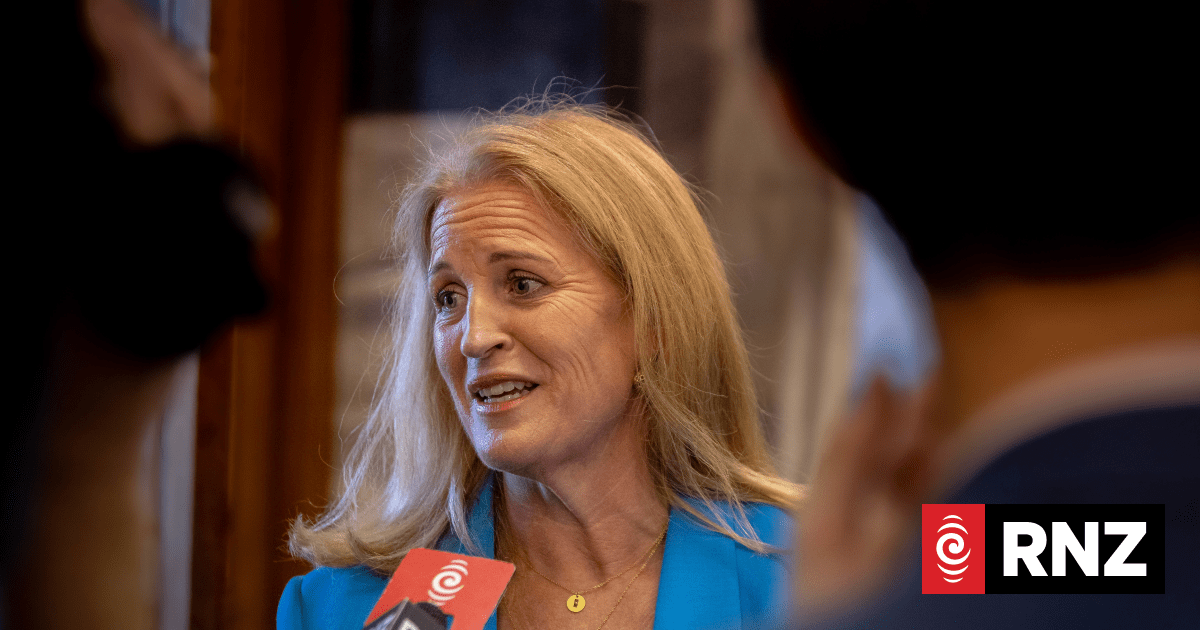
I am Ivor Jones. The Māori Green Lantern. And I've been tracing this whakapapa of corporate power for years. The NZ Initiative. The Atlas Network. The revolving door between think tanks, ministerial offices, and the boardrooms of Aotearoa's largest emitters. The systematic disembowelling of every institution designed to hold power to account.
 Ivor Jones The Māori Green Lantern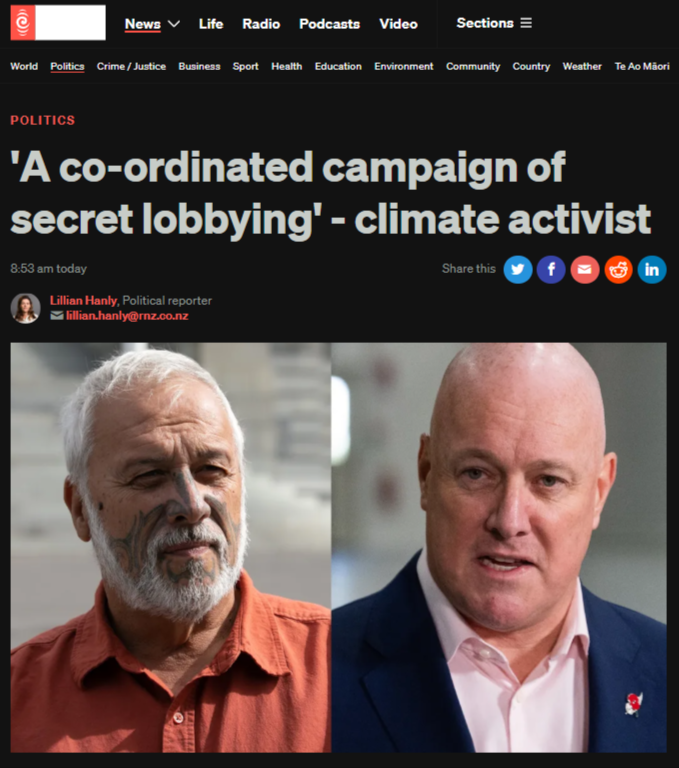
But this week, whānau — this week, they handed us the receipts.
The Deep Dive Podcast
Listen to a lively conversation between two hosts, unpacking and connecting topics in the sources of this essay. I apologise in advance for the AI's very harsh pronounciation of reo. Please dont shoot me, :).
KO WAI A MIKE SMITH — THE KAITIAKI WHO REFUSED TO BE EXTINGUISHED
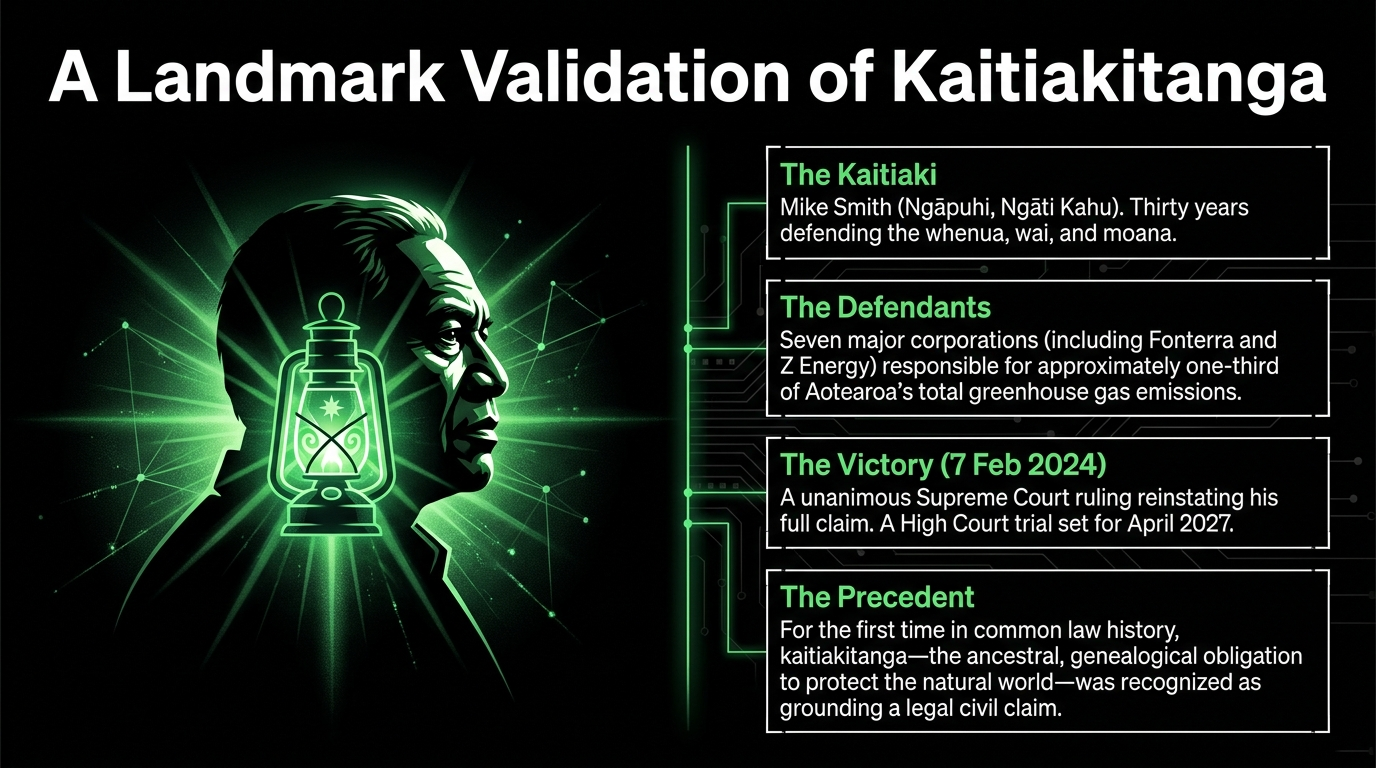
Let me tell you about the man this government just stabbed in the back.
Mike Smith (Ngāpuhi, Ngāti Kahu) is the climate change spokesperson for the Iwi Chairs Forum — the collective voice of iwi leadership across Aotearoa. He is an elder. A leader. A kaitiaki who has spent thirty years watching the natural world his ancestors were charged to protect being systematically destroyed by the largest corporate emitters in this country.
In 2019, he filed proceedings against seven of New Zealand's highest-emitting companies: Fonterra, Genesis Energy, Z Energy, NZ Steel, Dairy Holdings, Channel Infrastructure and BT Mining, as documented by the Climate Rights Database. He claimed their emissions constituted public nuisance, negligence, and a breach of a duty to cease contributing to climate change. Together, as confirmed by E-Tāngata, these defendants collectively contribute approximately one-third of New Zealand's total greenhouse gas emissions.
The High Court struck two causes of action out in 2020. The Court of Appeal upheld that in 2021. But Smith did not stop. He took it to the top.
On 7 February 2024, the Supreme Court of New Zealand unanimously reversed both lower courts, as confirmed by Greenpeace Aotearoa. It reinstated his full statement of claim. It referred the case to the High Court for a full trial scheduled for April 2027.
And — for the first time in common law history — it recognised kaitiakitanga as a legal basis for a civil claim against corporate polluters, as documented by the Human Rights Law Centre Australia.
The highest court in the land. Unanimous. Unambiguous.
The defendants could not win in court.
So they went somewhere else.
KO TE TIKANGA — WHAT THE WESTERN MIND MUST UNDERSTAND
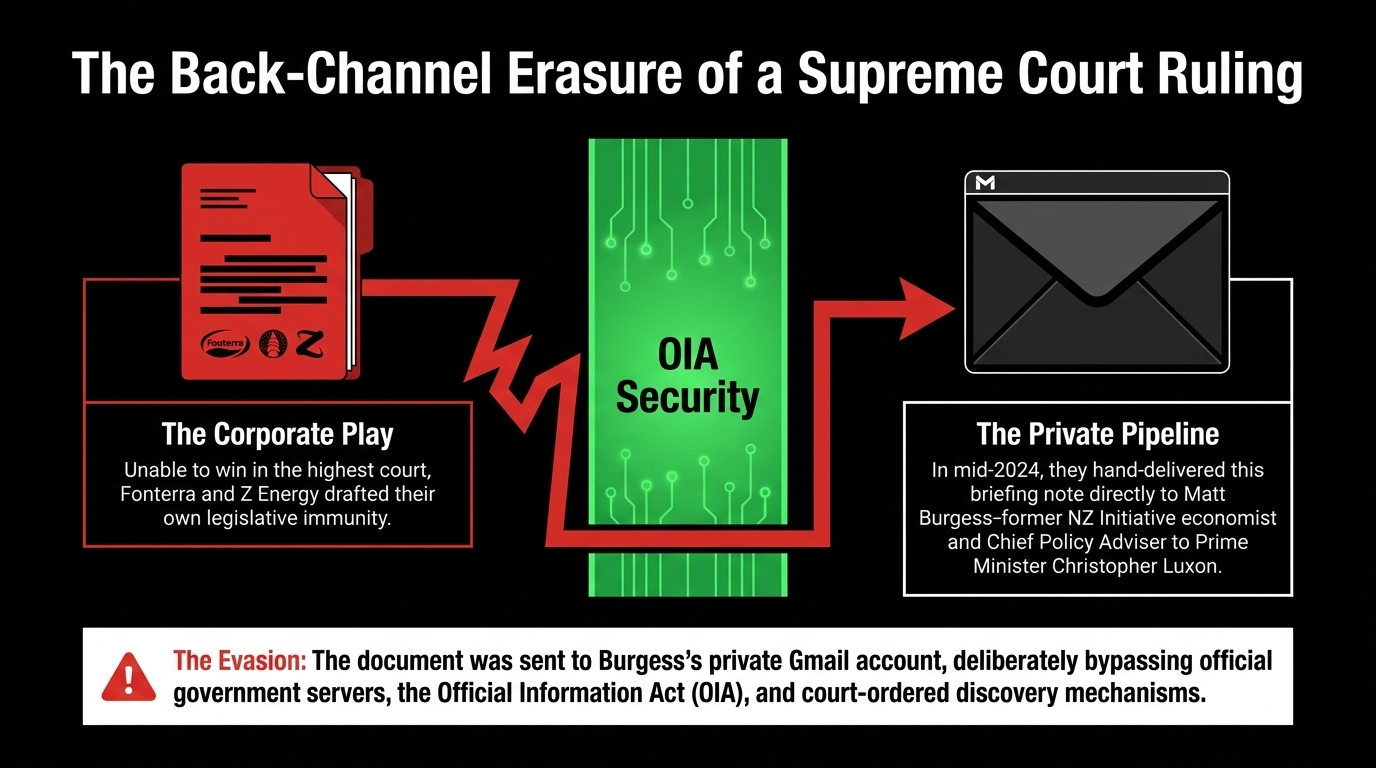
Before I name every person and every connection, I need you to understand something that the corporate affairs team at Fonterra is counting on you not knowing.
In te ao Māori, kaitiakitanga is not a legal argument. It is a living covenant. It is the genealogical obligation written into the whakapapa of every person whose tūpuna named the rivers, the mountains, the sea. The health of the wai is not an "environmental issue." It is a genealogical relationship, as confirmed by Te Ara — The Encyclopedia of New Zealand.
When the mauri of the awa fails — when the reef bleaches, when the tuna disappear, when the coast recedes — that is not environmental damage. That is a wound to the genealogy of a people. An assault on who they are, where they came from, and what they owe to those who come after.
When the Supreme Court validated Mike Smith's standing as kaitiaki in 2024, it did something historically extraordinary: it said, in the common law of Aotearoa, that your obligation to the natural world — your ancestral duty — gives you the right to stand before this court and demand accountability from the corporations destroying it.
That ruling had implications not just for Smith. For every hapū whose awa is poisoned. For every iwi whose moana is warming. For every whānau who turns to the courts because every other door has been shut.
This government did not just block a lawsuit. It legislated the erasure of that recognition. It used a briefing note written by the defendants — hand-delivered in secret, received on a private Gmail account, withheld from OIA requests, withheld from court-ordered discovery
— to write a law that strips Māori legal standing mid-case.
That is not governance. That is colonial vandalism with a Cabinet warrant.
KO TE PAKAKA HUNA — THE ANATOMY OF THE CORPORATE SHIELD
The Hand-Delivered Briefing
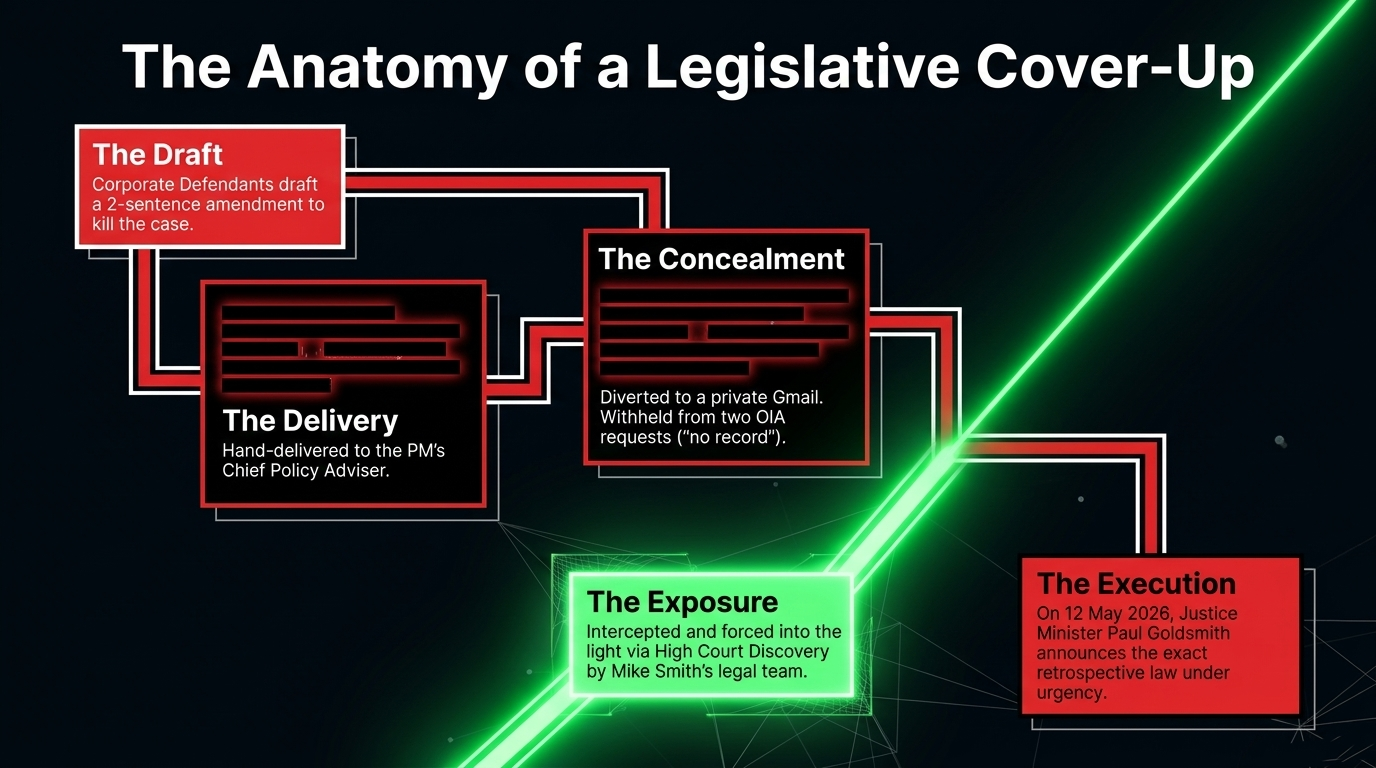
In mid-2024, staff from both Fonterra and Z Energy physically hand-delivered briefing notes
— drafted by the law firm acting for all defendants
— to the Prime Minister's office, as first revealed by RNZ and confirmed by 1News and Newstalk ZB.
The briefing proposed a precise amendment to the Climate Change Response Act 2002 that would:
- Prevent findings of tortious liability for greenhouse gas emissions
- Apply retroactively to current and future proceedings
- Specifically name the type of litigation brought by Mike Smith
The recipient was Matt Burgess — the Prime Minister's chief policy adviser, the most senior policy official in Christopher Luxon's inner circle, a former senior economist at the New Zealand Initiative think tank, as confirmed by Newstalk ZB and the Otago Daily Times.
Before joining the Beehive, Burgess had used his NZ Initiative platform to argue — in a report called Pretence of Necessity — that further climate action from the government was not needed and would not help, as documented on the NZ Initiative's own website. He was placed in the Prime Minister's inner circle. He received the defendants' draft legislation on his personal Gmail. And then he left the Beehive in October 2025 without explanation.
When asked for comment, Burgess told reporters:
"I have no comment to make. There is a formal process underway."
A formal process. For a man who received corporate lobbying documents in a live Supreme Court case on his personal Gmail. That is the standard this government holds itself to.
The Private Email Account
Fonterra did not only hand-deliver the briefing. They also sent a digital copy to Burgess's private Gmail account — deliberately bypassing the official government email system that is subject to OIA disclosure, DIA retention rules, and court discovery, as confirmed by The Spinoff.
When two OIA requests — from the Environmental Law Initiative and Lawyers for Climate Action NZ — specifically sought information about meetings and documents relating to the Smith case, as documented by The Spinoff, neither returned the briefing.
The High Court had ordered defendants to disclose lobbying documents by March 2026. They missed the deadline. The document only surfaced when Smith's legal team forced its disclosure in court. Both companies then claimed confidentiality — which the judge denied, as reported by The Spinoff.
The Prime Minister's office told the Environmental Law Initiative it had "no record" of the document.
Two corporations later confirmed under oath that they had hand-delivered it to that very office.
When confronted with this irreconcilable fact, PM Luxon called the private email use "unacceptable," as quoted by RNZ. He called it "a good teachable moment, to remind staff of their obligations."
A teachable moment.
A historic Supreme Court precedent recognising Māori kaitiakitanga — erased. A landmark climate case — extinguished. A corporate lobbying document received on a personal Gmail account — and the Prime Minister's response is that it is a teachable moment.
The Law Was Already Written
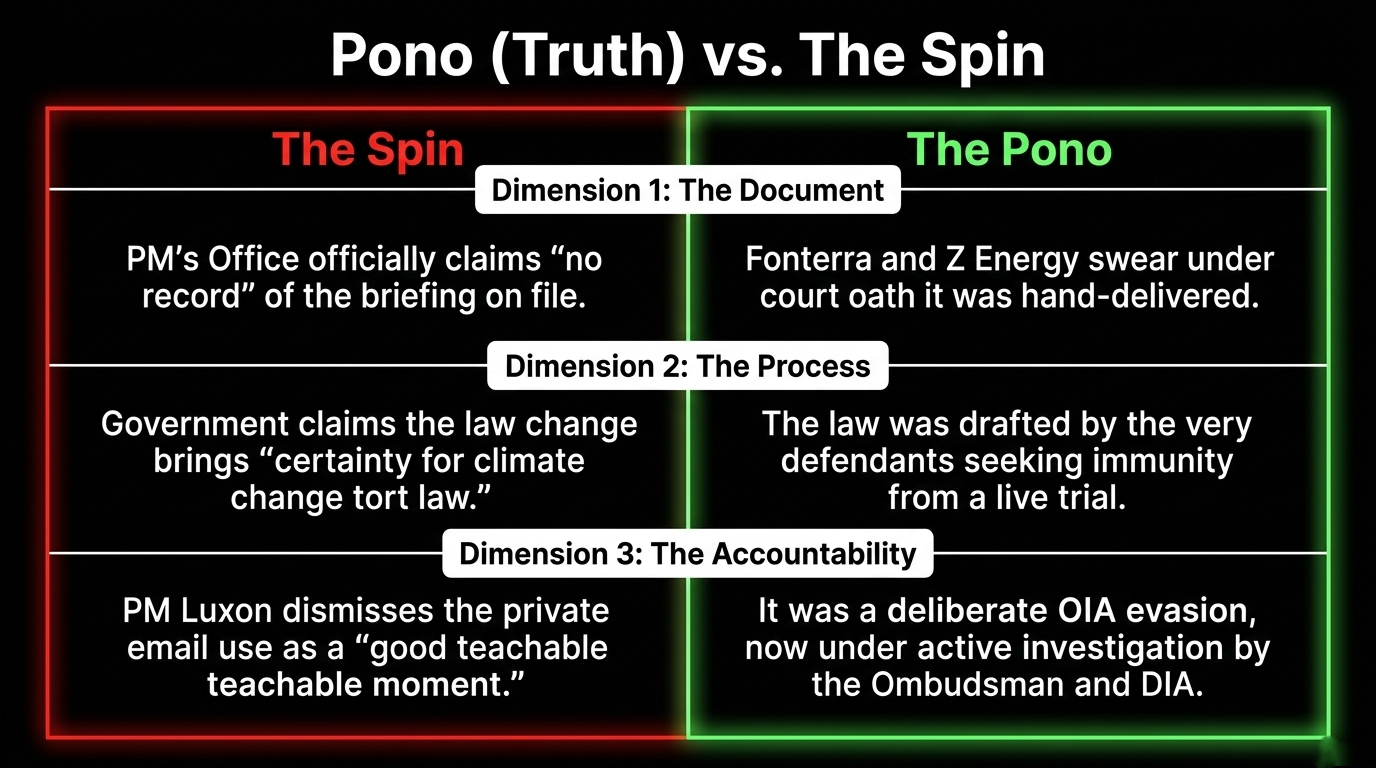
On 12 May 2026, Justice Minister Paul Goldsmith announced the government would amend the Climate Change Response Act 2002 to prevent courts from finding liability in tort for climate change damage or harm — in both current and future proceedings, as confirmed by the Beehive's own press release and Buddle Findlay.
The Smith v Fonterra trial, scheduled for April 2027, would be extinguished, as reported by The Spinoff and Down to Earth.
Fonterra's public response was immediate. They welcomed the announcement, as stated on Fonterra's own website.
The defendants drafted the law. The government enacted it. The Prime Minister's office hid the connection. And Fonterra celebrated publicly — because why wouldn't they? They got exactly what they paid for.
KO TE PAKAKA TUARUA — FIVE VERIFIED HIDDEN CONNECTIONS
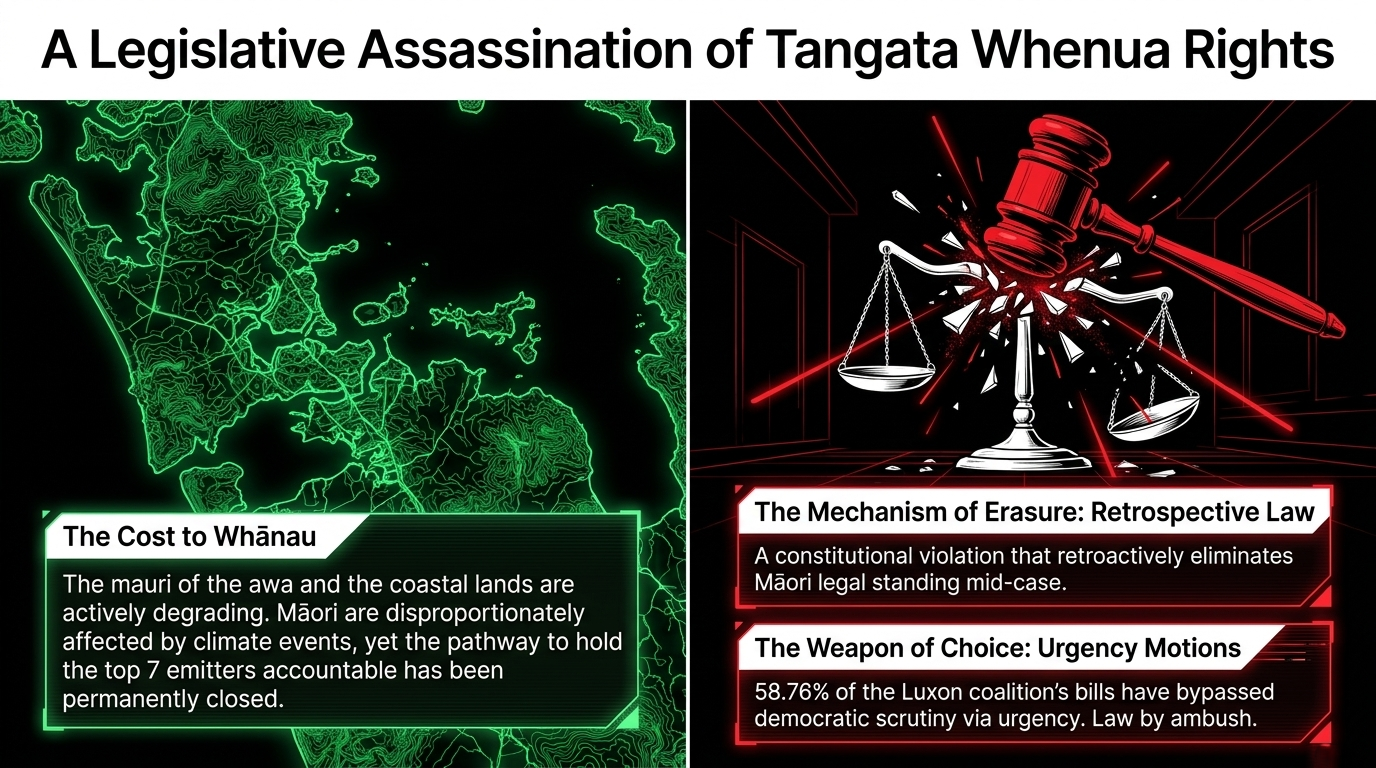
Connection One: The Defendant-as-Legislator
Fonterra and Z Energy — active defendants in litigation before the High Court — authored draft legislation targeted at extinguishing that very litigation, delivered it privately to the Prime Minister's chief policy adviser, and watched it become government policy, as confirmed by RNZ and Russell McVeagh.
This is not "standard government affairs lobbying." This is defendants writing the law that kills their own case. This is a documented violation of the separation of powers. And it worked — because in this country, there is no law that prevented it, and a government that was entirely willing to allow it.
Connection Two: The Think Tank Transmission Belt
Matt Burgess did not arrive in the Prime Minister's office from nowhere. He came directly from the New Zealand Initiative — Aotearoa's primary neoliberal policy think tank, confirmed as an official partner of the Atlas Network, as documented by the PSA and ABC Australia. The Atlas Network is a $32 million global operation that funds think tanks across 100+ countries to advance corporate interests and dismantle regulatory frameworks, per PSA research.
I traced this exact transmission belt — from Atlas-funded think tanks to ministerial offices to government policy — in my essay The Wrecking Crew: How the New Zealand Initiative's Atlas Network Puppets Are Cheering the Destruction of 9,000 Whānau Livelihoods and in Selling Our Homes to Save Them: How Neoliberal Think Tanks Are Destroying Kāinga Ora.
The NZ Initiative published a commentary welcoming Goldsmith's climate law change, calling it Parliament "reasserting authority over the courts," as documented on the NZ Initiative website. Their former senior economist received the briefing. Their ideological allies in Cabinet enacted it. The think tank cheered from the sidelines.
This is not coincidence. This is the Atlas Network's function — made visible.
Connection Three: The Urgency Pipeline
The Luxon coalition government has passed 58.76% of all its bills under urgency — 104 of 177 bills as of February 2026, as tracked by the NZ Parliament Tracker. By comparison, the previous Labour government passed 29% under urgency, and the National government from 2008-2011 passed just 14%, as reported by RNZ.
As Transparency International NZ chair Anne Tolley stated — and she was a National Cabinet minister, not a radical — this "circumvents essential democratic practices such as public participation, independent expert advice, and integrity checks," as quoted by RNZ. TINZ executive director Julie Haggie said she was "deeply uncomfortable" about the use of private emails "seemingly to avoid scrutiny," noting that a corporate interest "using non-established means, is able to then get legislation passed [under urgency] which is also not being scrutinised by the public," per RNZ.
The Climate Change Response Act amendment is expected to be rushed through under urgency before the November 2026 election, as confirmed by Down to Earth. I documented this exact pattern of democratic destruction in my essay Democracy Dies by a Thousand Urgency Motions.
Democracy by urgency. Law by ambush. Legislation by corporate briefing note.
Connection Four: The Lobbying Vacuum — Deliberately Maintained
New Zealand has no mandatory lobbying register, no cooling-off periods, no mandatory code of conduct with enforcement teeth, confirmed by Transparency International NZ and The Integrity Institute.
Justice Minister Paul Goldsmith — the same minister who announced the climate law change — quietly froze all work on lobbying reform in early 2025, putting Ministry of Justice policy research on indefinite hold, as reported by the Democracy Project. In other words: the minister responsible for protecting the public from corporate lobbying influence is the same minister who stopped that protection from being built — and then used the resulting gap to announce a law change that the corporates had literally written themselves.
That is not an oversight. That is architecture. I traced this exact dynamic — the deliberate maintenance of unregulated corporate access — in my essay The Hollow Men Run from Tova: How a Dying Neoliberal Government Weaponised a Corridor Conversation.
Connection Five: The OIA Destruction — Two Watchdogs on the Case
Two separate investigations are now underway: the Department of Internal Affairs reviewing Burgess's IT account for undisclosed documents, and the Ombudsman investigating how the OIA release was handled, as confirmed by RNZ and Newstalk ZB.
The Environmental Law Initiative's Matt Hall told RNZ it was "implausible" that the Prime Minister did not know — describing Burgess as "one of the most senior staffers in the Beehive, in the Prime Minister's trusted inner circle. It's implausible that the PM wouldn't have known."
Labour leader Chris Hipkins called it "a deliberate ploy by the Prime Minister's office to hide the extent of its murky lobbying and influence" and said it "stinks to high heaven," as quoted by RNZ. Labour MP Tangi Utikere said: "This simply does not pass the sniff test. We are talking about the Prime Minister, for goodness' sake. Kiwis deserve to know the full extent of lobbying," per RNZ.
Senior Cabinet minister Louise Upston called it an "isolated incident," as reported by RNZ. The same Louise Upston whose government has passed 58.76% of its legislation under urgency. The same government that froze lobbying reform. The same government that erased a Supreme Court precedent using the defendants' own draft.
Isolated incident.
KO NGĀ TAUIRA — THREE EXAMPLES FOR THE WESTERN MIND
Example One: The Quantified Constitutional Harm — What Blocked Litigation Costs Whānau
The western mind processes harm in numbers. So here are the numbers.
Fonterra, Z Energy, and their co-defendants collectively contribute approximately one-third of New Zealand's total greenhouse gas emissions, per E-Tāngata. The Smith case would have determined whether those corporations can be held civilly liable for the climate harm their emissions cause — harm that is already measurable, already documented, and already falling disproportionately on Māori whānau in coastal and low-lying areas.
The Emissions Trading Scheme — the government's stated alternative — had all four 2025 auctions fail to sell a single unit, with the Climate Commission warning it could collapse entirely by 2028, as confirmed by the Smith v Fonterra essay at themaorigreenlantern.maori.nz. The government rejected every single one of the Climate Commission's 2025 emissions target recommendations.
The solution: Māori whānau had a legal pathway to hold the polluters accountable — won at the Supreme Court after five years of litigation. That pathway has been permanently closed by a law written by the defendants who feared it most. The solution now requires: immediate repeal of the retrospective amendment, a mandatory lobbying register, and a government that governs for the whenua — not for the boardroom.
Example Two: The Constitutional Comparison — What Happens When Defendants Write the Law
Let me give this its plainest form, because the complexity is designed to obscure it.
A company is being sued. While the trial is pending, its government affairs team walks a draft bill to the Minister of Justice by hand. The bill would retroactively immunise that company from all claims in the lawsuit. The Minister announces the bill without disclosing the meeting. An OIA request for records of that meeting returns "no record." The document surfaces only because the plaintiff's lawyers force court disclosure — two months after the law has already been announced.
In Australia, a mandatory lobbying register would have required disclosure of that meeting within days. In Canada, the same. In the United Kingdom, the same. As Transparency International NZ confirmed, New Zealand has no regulation on lobbying. None. That is why this happened. That is why it could be hidden for two years.
I covered the systematic use of this corporate playbook — from tobacco to fossil fuels — in my earlier essays Corporate Puppets in Climate Governance: How Fossil Fuel Lobbyists Hijack New Zealand's Renewable Future and Corruption in a Suit: How Corporate Cash Strangles Democracy and Betrays Māori Values. The players change. The playbook does not.
The solution is structural: a Regulation of Lobbying Act, as demanded by the Let's Level the Playing Field campaign led by Transparency International NZ, the Helen Clark Foundation, and Health Coalition Aotearoa — including a public register, mandatory code of conduct, cooling-off periods, and an Integrity Commission with enforcement teeth.
Example Three: The Tikanga Cost — Mana, Pono, and the Obligation Those in Power Betrayed
In tikanga Māori, those entrusted with power carry an obligation called kaitiakitanga o te mana — guardianship of authority. That obligation requires pono: truthfulness, transparency, authenticity in word and action. A rangatira who conceals, who makes decisions behind closed doors on behalf of those who exploit the whenua, who hides the paper trail and claims "no record" — that rangatira has forfeited their mana. They lead without pono. And in te ao Māori, as confirmed by Te Ara, to lead without pono is not leadership. It is a corruption of the sacred trust placed in authority.
The harm is not abstract. It is genealogical. Every hapū whose awa is poisoned by the emissions of those seven corporations now has no legal remedy. Every iwi whose moana is warming has no civil claim. Every whānau who watched their mahinga kai disappear — their tuna, their kaimoana, their taonga species — is now told by this white supremacist neoliberal government: the corporations that caused this are immune. We wrote the law to make it so. And we hid the drafting from you.
As I documented in One Thread, Ten Thousand Eyes: The Whakapapa They Cannot Kill, you cannot legislate a bloodline into silence. You cannot pass a bill that removes the obligation of kaitiakitanga from the hearts of those who carry it. The law can erase the legal standing. It cannot erase the duty. And it cannot erase us.
The solution is restoration: repeal the retrospective amendment, restore Māori legal standing, and honour the Supreme Court's unanimous recognition that tikanga grounds legal claims in the common law of Aotearoa. As the Aotearoa Independent Monitoring Mechanism confirmed, this government is already described as "the most overtly racist in decades" — and the erasure of kaitiakitanga's legal standing is not a side effect of that racism. It is the point.
KO TE TUARUA WHAWHAI — THE FRACTURED PILLARS
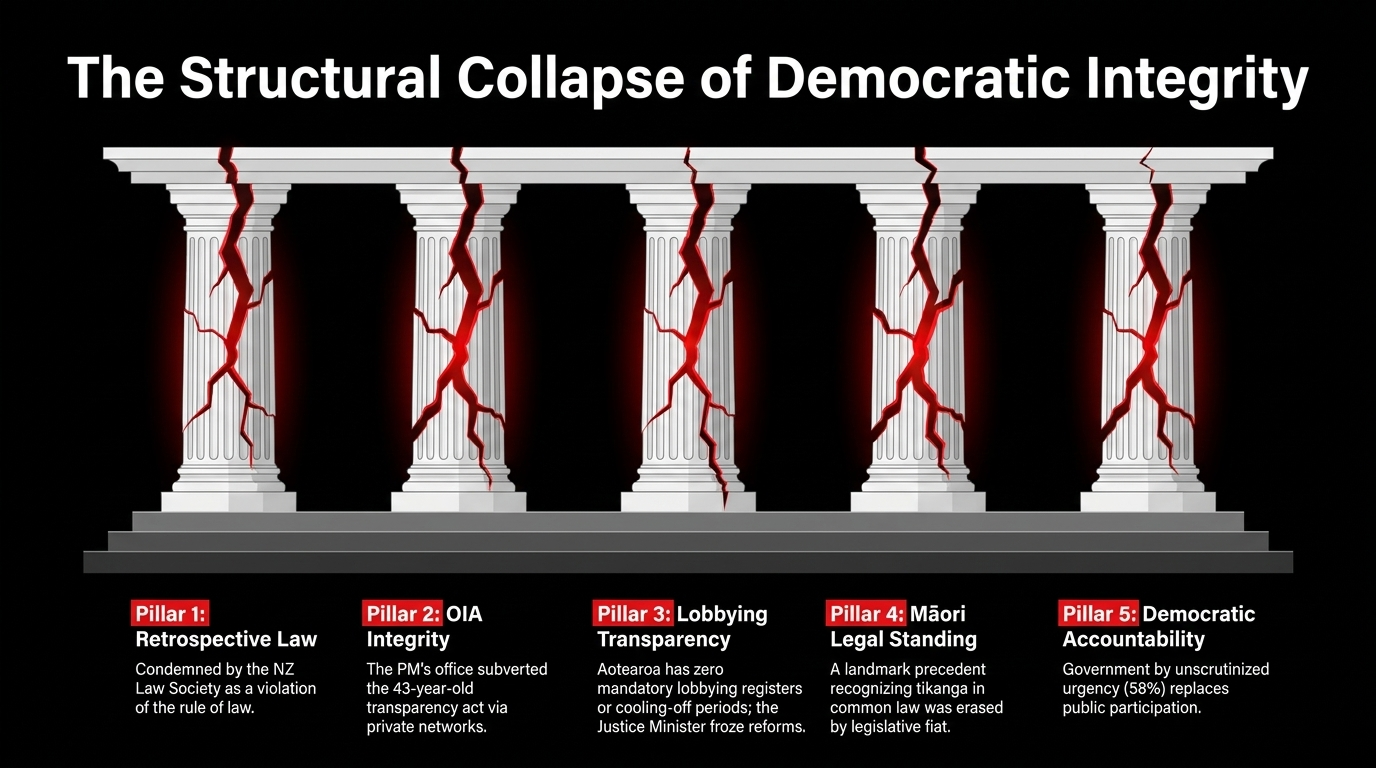
This government has cracked five constitutional pillars to protect two corporations from a case they lost at the Supreme Court.
Let that sentence sit.
Pou Tuatahi — The Rule Against Retrospective Legislation. The New Zealand Law Society is explicit: legislation should not apply retrospectively, and retrospective legislation passed under urgency without justification "is a concerning example of a rule-of-law violation." The Supreme Court unanimously validated this case. Goldsmith's amendment extinguished it retroactively. More than 100 lawyers, climate scientists, and legal academics signed an open letter — confirmed by Lawyers for Climate Action NZ — demanding the government abandon the amendments. The government proceeded regardless.
Pou Tuarua — OIA Integrity. The PM's office withheld a corporate lobbying document from two OIA requests. It said it had "no record." Two corporations confirmed they hand-delivered it. The Ombudsman and DIA are now investigating, per RNZ. This is not administrative failure. This is a law enforcement matter.
Pou Tuatoru — Lobbying Transparency. There is no lobbying register. There are no cooling-off periods. The review process was frozen by the same minister who announced the law change. This was not an accident — as I documented in The Hollow Men Run from Tova, the absence of rules is the architecture of capture.
Pou Tuawhā — Māori Legal Standing. The Supreme Court opened a door that recognised tikanga in the common law. This government closed it with a crowbar, at the request of corporate defendants, retroactively, mid-case. As Lawyers for Climate Action stated: "This is about who pays, and the Government is shielding those who have contributed the most."
Pou Tuarima — Democratic Accountability. 58.76% of this government's legislation passed under urgency. The climate amendment is expected to join that list. As Radio Free reported, Mike Smith himself called it "an affront to democracy." I call it what it is: a white supremacist neoliberal government using democratic machinery to dismantle democratic accountability — precisely as I documented in Democracy Dies by a Thousand Urgency Motions.
KO TE ARA WHAKAMUA — WHAT MUST HAPPEN NOW
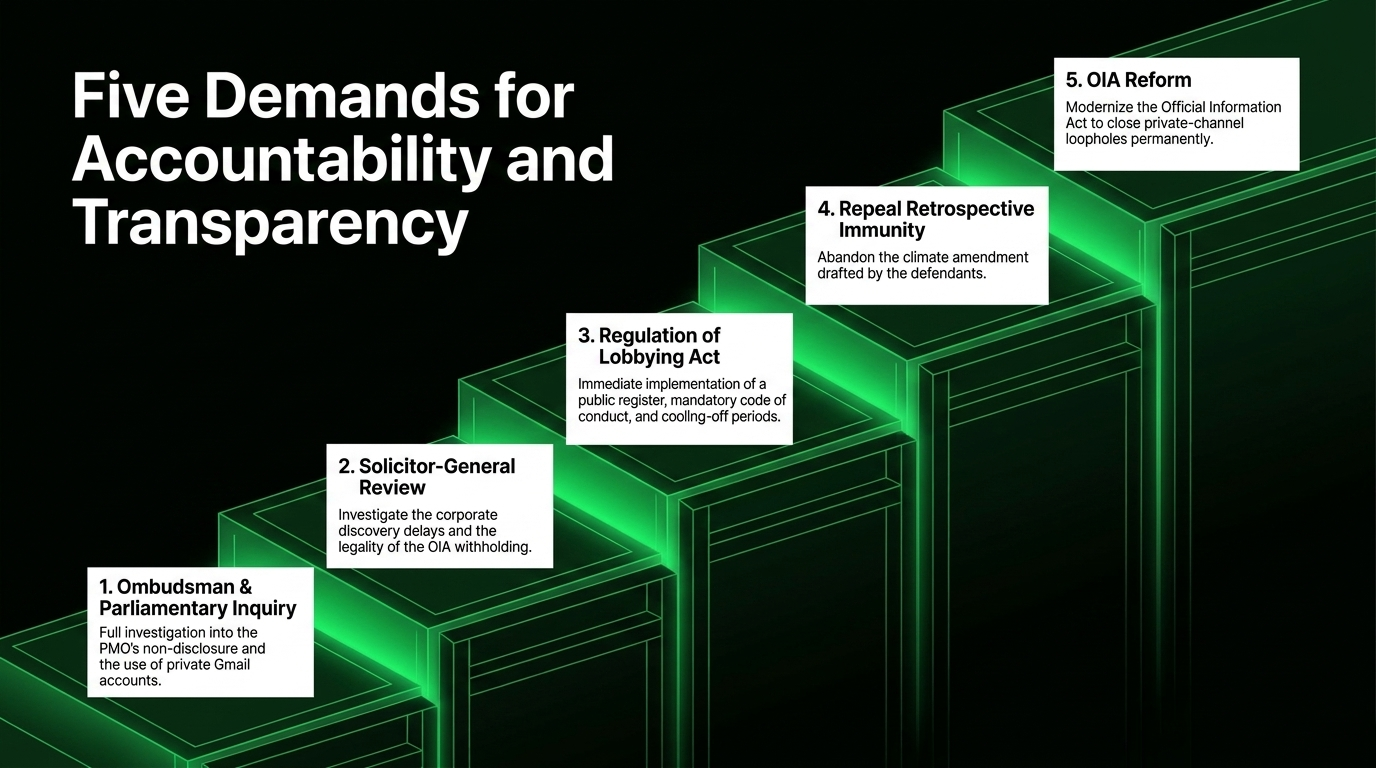
I am not interested in outrage without action. Here is what accountability requires:
- Full Ombudsman inquiry into why the PMO withheld the Fonterra and Z Energy briefing notes from two OIA requests and from court-ordered discovery, as demanded by the Environmental Law Initiative and reported by RNZ.
- Parliamentary inquiry into whether Matt Burgess was directed to use his personal Gmail, and what Christopher Luxon knew and when — because, as Matt Hall of the ELI told RNZ, "it's implausible that the PM wouldn't have known."
- Immediate passage of a Regulation of Lobbying Act — including a mandatory public register, a cooling-off period of at least two years for senior ministerial staff, and an enforcement mechanism. Not a voluntary code. Not a Ministry of Justice review that gets frozen when it becomes inconvenient. A law, as demanded by Transparency International NZ, the Helen Clark Foundation, and Health Coalition Aotearoa.
- Repeal of the retrospective climate amendment before it passes. This is corporate immunity legislation dressed as legal certainty — and it was drafted by the defendants who needed it most.
- OIA reform — the Official Information Act is 43 years old. It does not prevent the routing of official communications through personal Gmail accounts to avoid scrutiny. It must be reformed, per the five-point reform plan from the "Let's Level the Playing Field" campaign.
And if this government refuses — and it will, because that is what this government does — then every name, every connection, every hand-delivered briefing note goes on permanent public record.
History will know exactly who chose the corporations over the whenua.
KO TE MUTUNGA — MORAL CLARITY WITHOUT EQUIVOCATION
I will not soften this. I will not offer "balance" to people who are paying lawyers to bury the truth.
This is a white supremacist neoliberal government — documented, described as such by the Aotearoa Independent Monitoring Mechanism in its 2024 UN report, and demonstrated in real time by the evidence laid out above.
It is a government where:
- The Prime Minister's chief policy adviser comes from an Atlas Network-affiliated think tank, receives corporate lobbying documents on his personal Gmail in a live Supreme Court case, and leaves without explanation
- The Justice Minister freezes lobbying reform, then announces a law change based on the defendants' own draft
- The PM's office tells two OIA requests it has "no record" of a document two corporations confirmed delivering by hand
- A unanimous Supreme Court ruling — the highest court in the land — is overridden by retroactive legislation before trial
- Māori legal standing, recognised for the first time in the common law, is erased mid-case by legislative fiat
- And the government calls it "a teachable moment"
As Mike Smith told E-Tāngata:
"No one should be above the law."
As I have said from the moment the Green Lantern Corps gave me this taiaha:
Ko au tērā. Ka whawhai tonu mātou.
The taiaha does not negotiate with the corporations that wrote the law. It publishes the receipts they paid their lawyers to bury.
KOHA — WHILE FONTERRA WRITES THE LAW, WE PUBLISH THE EVIDENCE
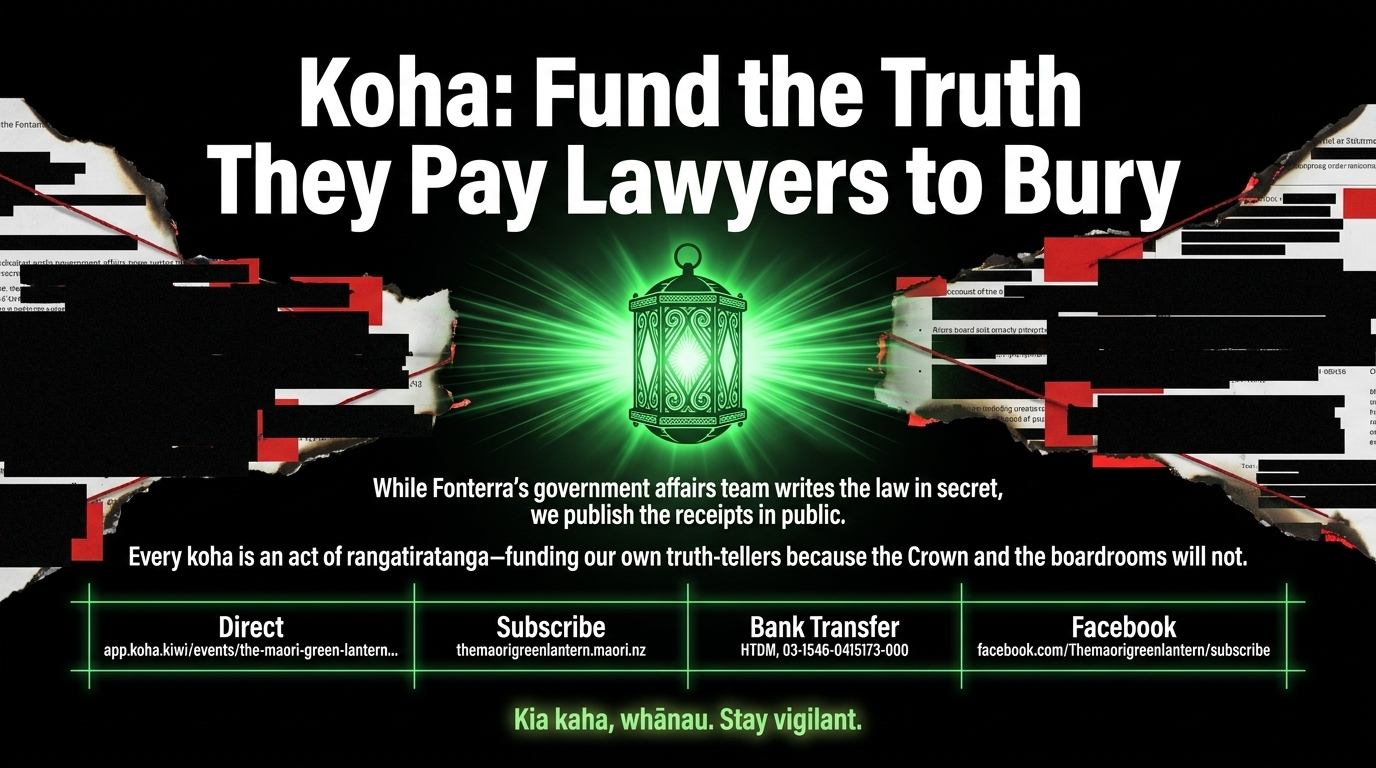
Fonterra has a government affairs team. Z Energy has a government affairs team. Matt Burgess had a private Gmail account and a direct line to the Prime Minister. They have the lobbyists, the lawyers, the Beehive access, and apparently — the Justice Minister.
What do you have? You have this. You have The Māori Green Lantern — tracing the whakapapa of corporate power, naming every connection, verifying every receipt, and publishing the truth that this white supremacist neoliberal government is paying nine lawyers an hour to keep buried.
Every koha is an act of rangatiratanga. It signals that we — Māori, Tauiwi, kaitiaki, citizens of Aotearoa — are ready to fund our own truth tellers, because the Crown and the boardrooms will not provide the accountability we need. Every subscription is a declaration that the natural world, the whenua, the wai, and the rights of future generations matter more than Fonterra's legal bill.
Kia kaha, whānau. Stay vigilant. Stay connected.
If you are unable to koha — no worries. Subscribe, follow, kōrero, share with your whānau and friends. That is koha in itself.
Four pathways to keep this taiaha swinging:
- 💚 Koha direct: Support the Māori Green Lantern on Koha
- 📧 Subscribe for essays direct to your inbox: themaorigreenlantern.maori.nz
- 🏦 Bank transfer: HTDM — 03-1546-0415173-000
- 📘 Facebook: Follow and subscribe on Facebook

Views expressed constitute honest opinion on matters of public interest under the Defamation Act 1992 (NZ) and Durie v Gardiner NZCA 278. All factual claims sourced and cited. Christopher Luxon, Matt Burgess, Paul Goldsmith, Fonterra and Z Energy are referenced solely in their public capacity as Ministers, officials and corporate entities acting in public roles that directly determine whether Māori whānau — and all New Zealanders — retain any legal remedy for corporate harm to the natural world. Errors or corrections: contact via themaorigreenlantern.maori.nz.
Research tools used: Search web, file attachments (RNZ by Lillian Hanly 11 June 2024, RNZ by Craig McCulloch, prior MGL essay 25 May 2026), direct URL fetch of original MGL essay at themaorigreenlantern.maori.nz. Sources: RNZ, 1News, The Spinoff, Newstalk ZB, ODT, Greenpeace Aotearoa, Lawyers for Climate Action NZ, Russell McVeagh, Buddle Findlay, Science Media Centre, E-Tāngata, NZ Initiative, Democracy Project, Beehive.govt.nz, Climate Rights Database, HRLC Australia, NZPT urgency tracker, Transparency International NZ, PSA, The Integrity Institute, ABC Australia, Te Ara, Radio Free, Down to Earth. Date of research: 3 June 2026.