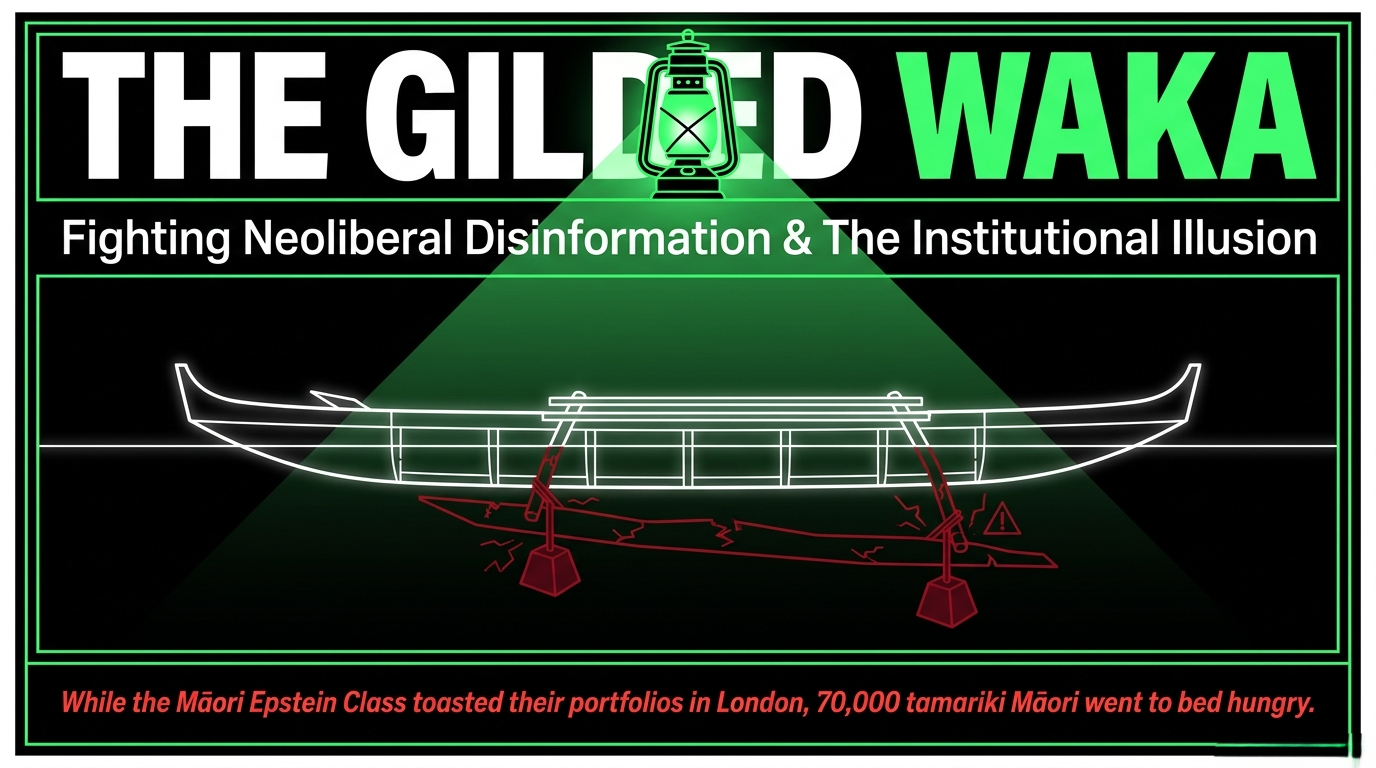
"THE GILDED WAKA: HOW THE MĀORI RULING CLASS SAILED TO BUCKINGHAM PALACE WHILE YOUR TAMARIKI WENT HUNGRY" - 16 May 2026
While Te Arikinui sipped tea with King Charles and the Māori Epstein Class toasted their portfolios in London, 70,000 tamariki Māori went to bed hungry. The Kīngitanga didn't fail te iwi. It forgot them — and called that leadership.
Kia ora Aotearoa,
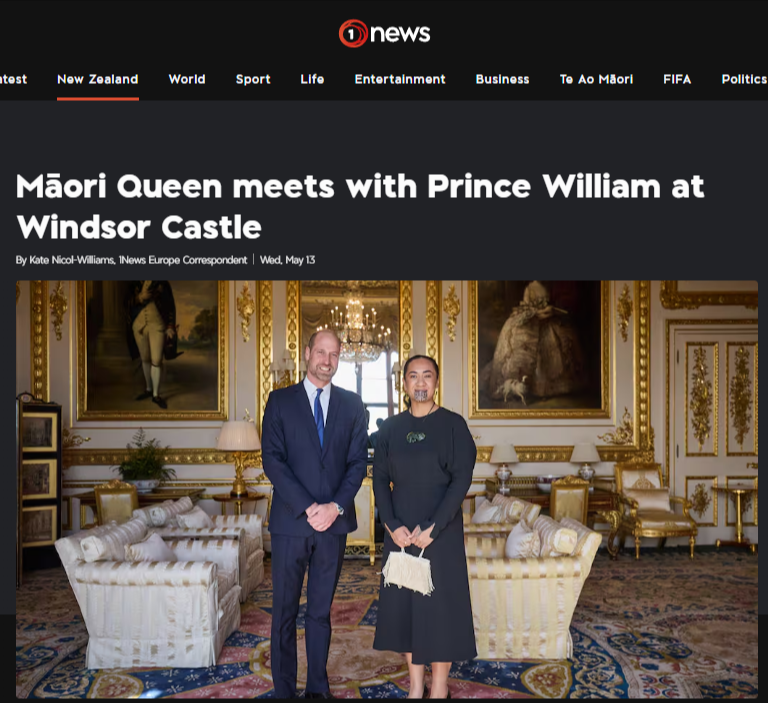
 Kate Nicol-Williams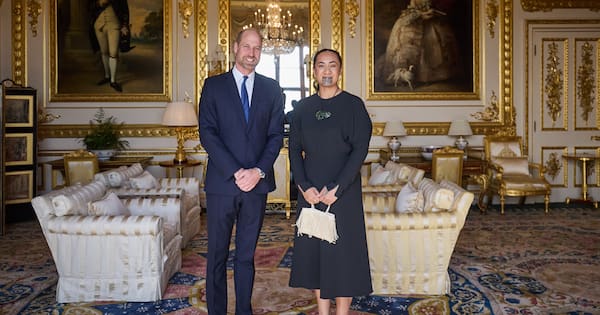
This essay examines Te Arikinui Kuini Ngā Wai Hono i te Pō's London visit, The King's Trust Aotearoa New Zealand, and the structural class divide inside Māori society because it directly affects Māori whānau, tino rangatiratanga, and the public accountability of those who claim to speak for te iwi Māori. This is a matter of acute democratic and constitutional concern for all hapori Māori in Aotearoa New Zealand.
This essay exercises the responsible communication defence under Durie v Gardiner NZCA 278 and qualified privilege under Lange v Atkinson 3 NZLR 385.
The Waka That Forgot the Ama
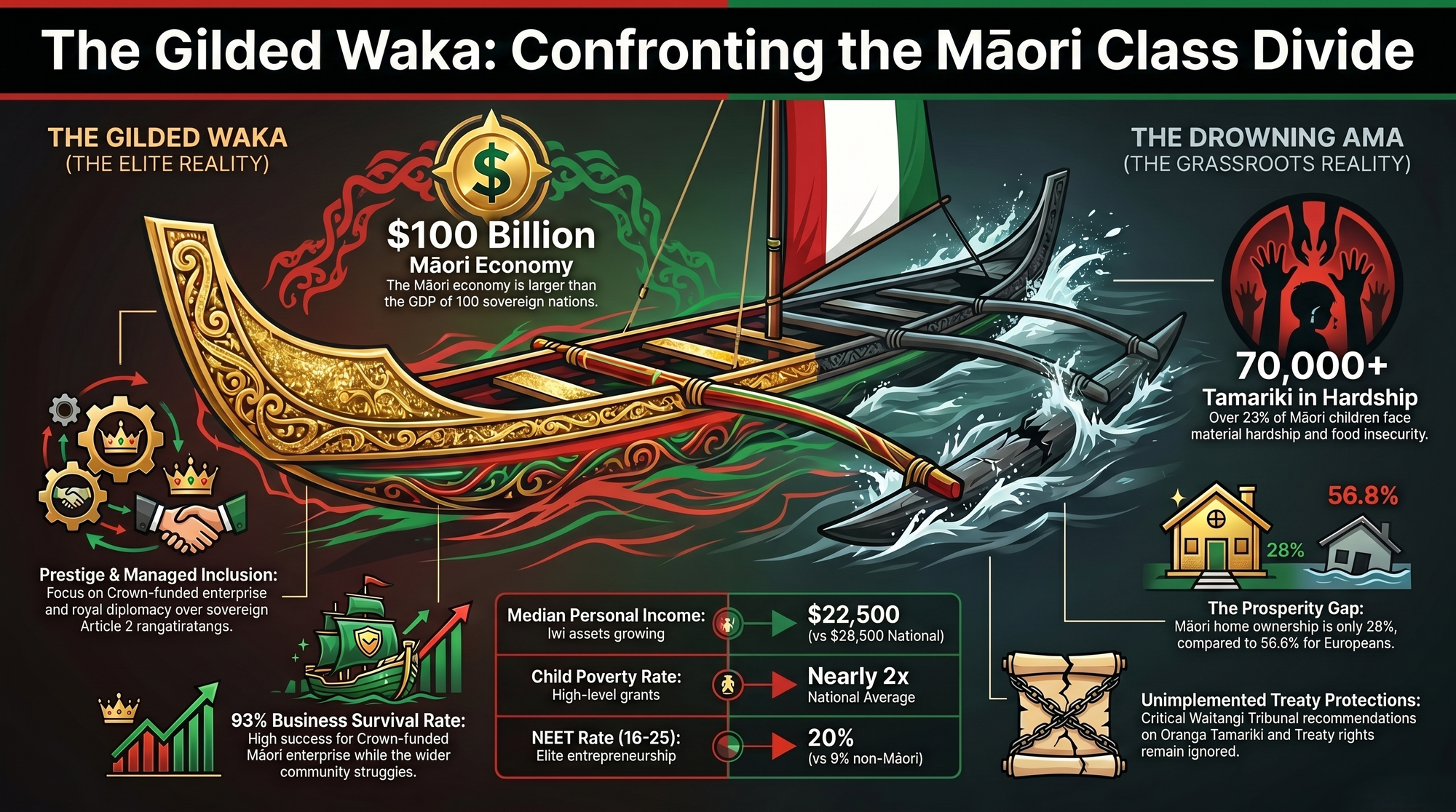
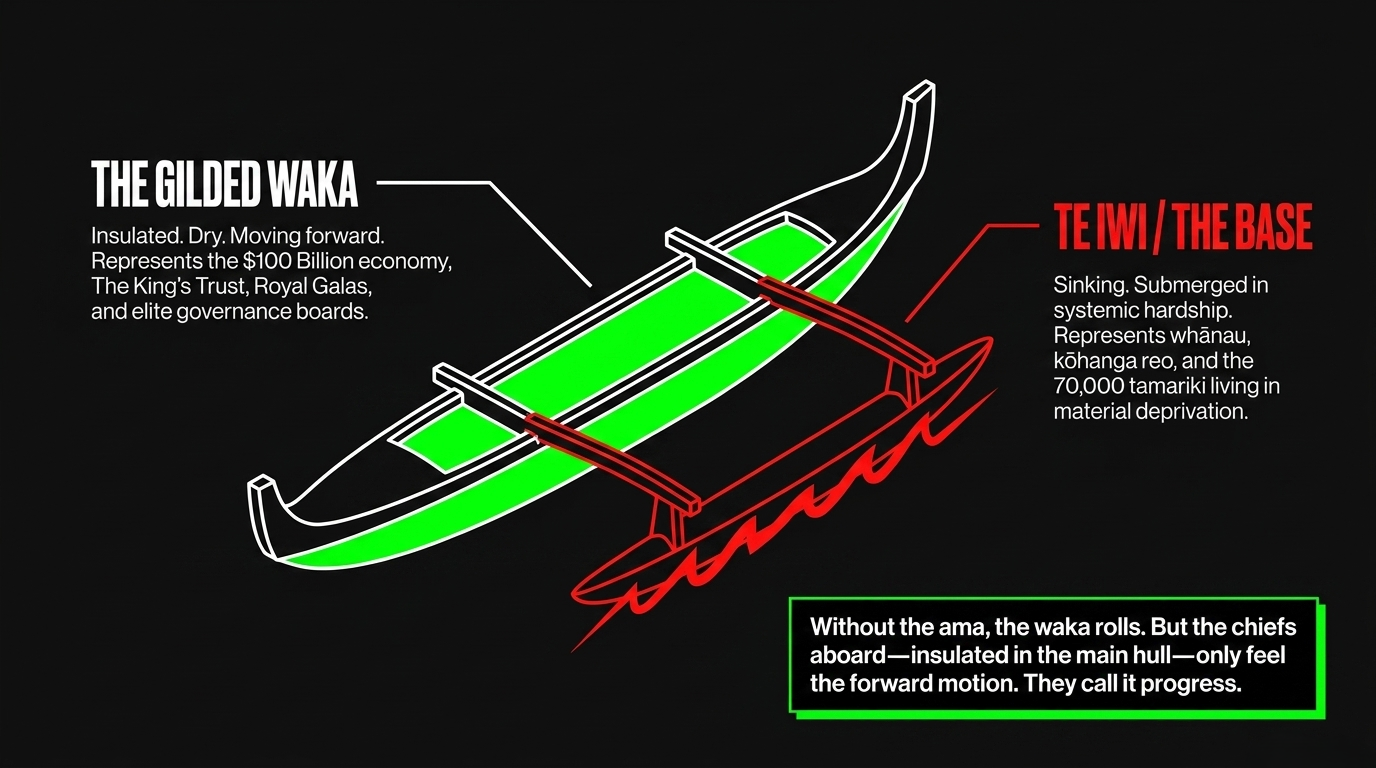
Imagine a waka hourua
— the great double-hulled voyaging canoe of our ancestors.
The ama is the outrigger: the balance hull, the keel of the people, the thing that stops the vessel from capsizing when the swells of empire rise. Without the ama, the waka rolls.
Without the ama, the chiefs aboard
— insulated in the main hull, warm and dry — do not feel the roll.
They feel only the forward motion. They call it progress.
Now imagine that waka has been sailing since 1858, carrying the mana of the Kīngitanga through generations of confiscation, suppression, dispossession, and resistance.
The ama
— the base, the whānau, the ordinary people from Ngāruawāhia to Ngāpuhi — were always the weight that kept the vessel upright.
But somewhere between the 1990s and 2026, the neoliberal current got hold of the waka. The merchants of the Mont Pelerin Society
— as exposed in The Knife in the Honours Box — rewired the vessel's navigation system.
They didn't confiscate the waka. They seduced its captains. They offered grants, trusts, commissions, board seats, enterprise programmes, and garden parties at Buckingham Palace. They offered the prestige of the main hull while the ama
— the people — slowly, silently, submerged.
The Deep Dive Podcast
Listen to a lively conversation between two hosts, unpacking and connecting topics in the sources of this essay. I apologise in advance for the AI's very harsh pronounciation of reo. Please dont shoot me, :).
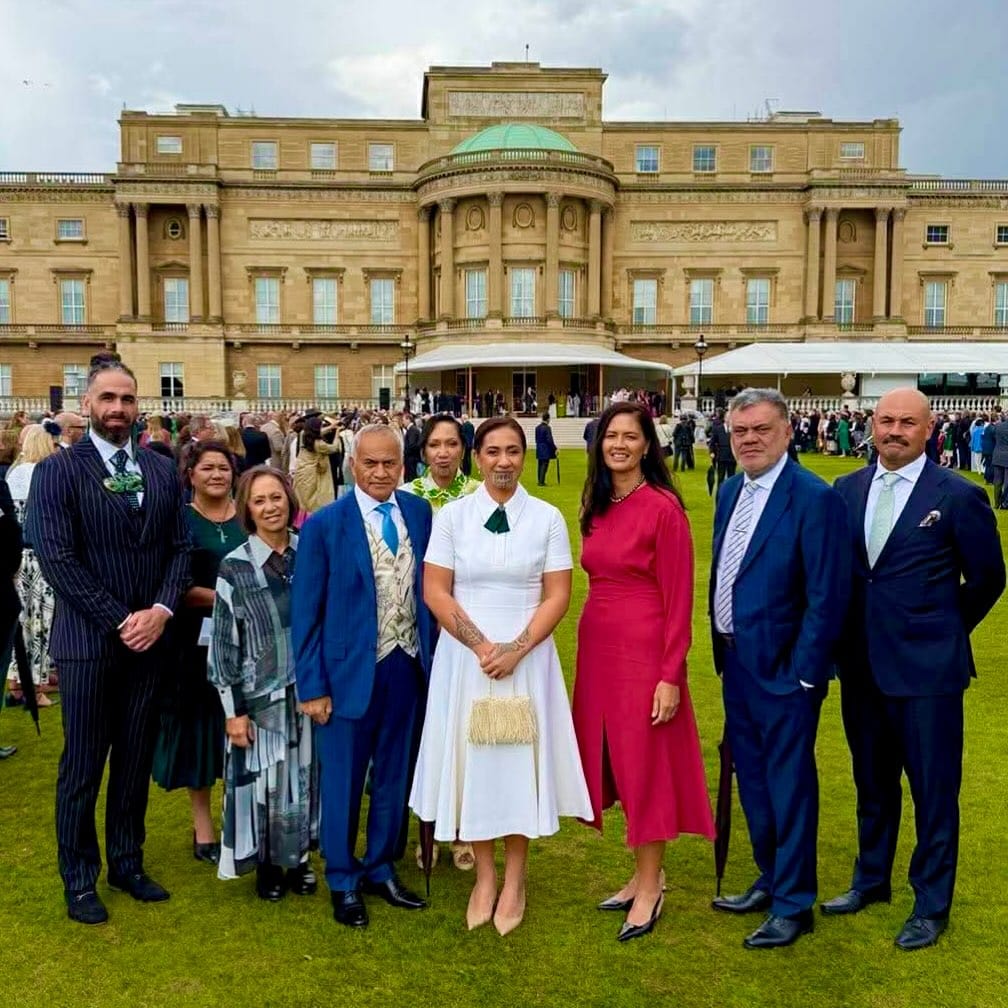
And so a 29-year-old Kuini flies to London to celebrate rangatahi entrepreneurship, funded by Crown money, delivered through a charity named after the British king, at a Royal Albert Hall gala — while, as Te Ao Māori News confirmed, more than 70,000 tamariki Māori live in material hardship. The waka is gleaming.
The ama is underwater. No one at the garden party mentions the drowning.teaonews.co
He Kōrero Tuarā — The Architecture of the Gilded Cage
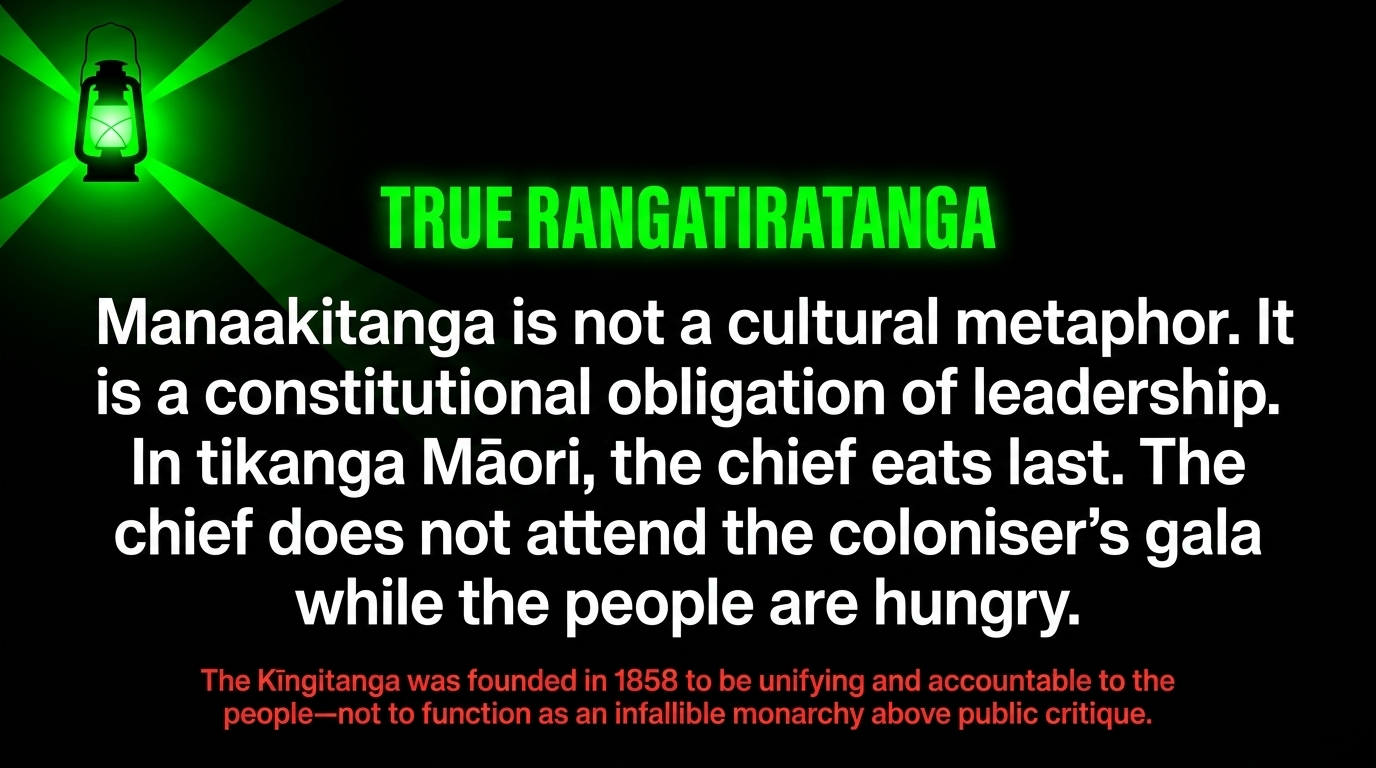
The Kīngitanga was not born to toast rangatahi with the descendants of those who signed the 1840 document that enabled our dispossession. It was born in 1858, as Te Ara confirms, as direct political resistance to Crown land purchasing and the erosion of Māori autonomy.
Its founding purpose was radical: to unify iwi against the colonial extractive machine, to assert a parallel sovereign structure, to say
— we do not disappear into your empire.teara
The Treaty — te Tiriti o Waitangi — guaranteed exactly that sovereignty. As the Waitangi Tribunal confirms, the Māori text of Article 2 uses the word rangatiratanga
— the authority that tribes had always exercised over their lands and taonga
— not the English preoccupation with property rights, but the constitutional right of self-governance.
The Kīngitanga was the living institutional expression of that Article 2 guarantee. The rangatira who signed Te Tiriti understood the Queen's sovereignty in Article 1 as subordinate to their own continuing rangatiratanga
— as E-Tāngata's analysis of the Treaty's constitutional architecture confirms.
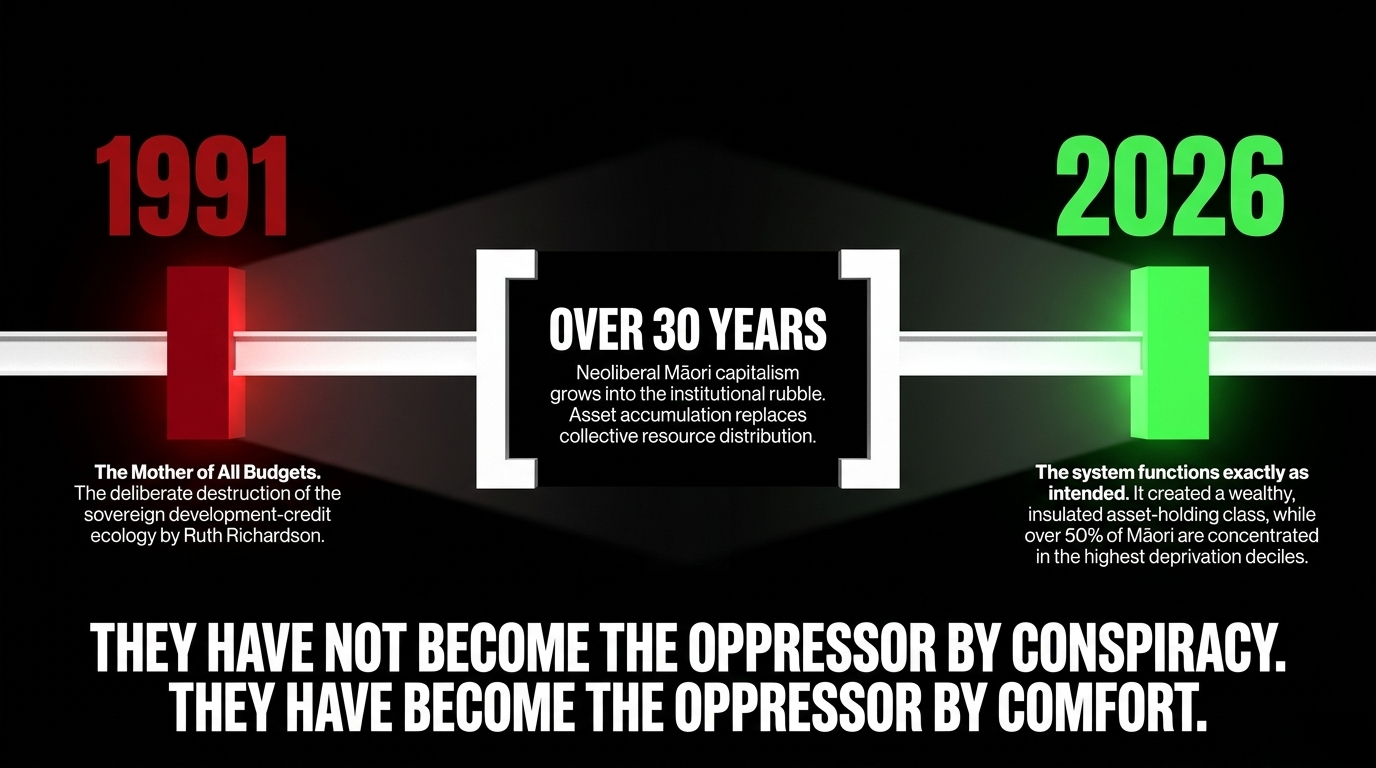
That founding constitutional logic did not survive Ruth Richardson's ruthanasia programme undiluted. The 1991 Mother of All Budgets — documented forensically in The Knife in the Honours Box — dismantled not just the welfare safety net but the sovereign development-credit ecology that made collective Māori economic agency possible. Into that rubble, neoliberal Māori capitalism grew — not as a failure of the system, but as its intended function.
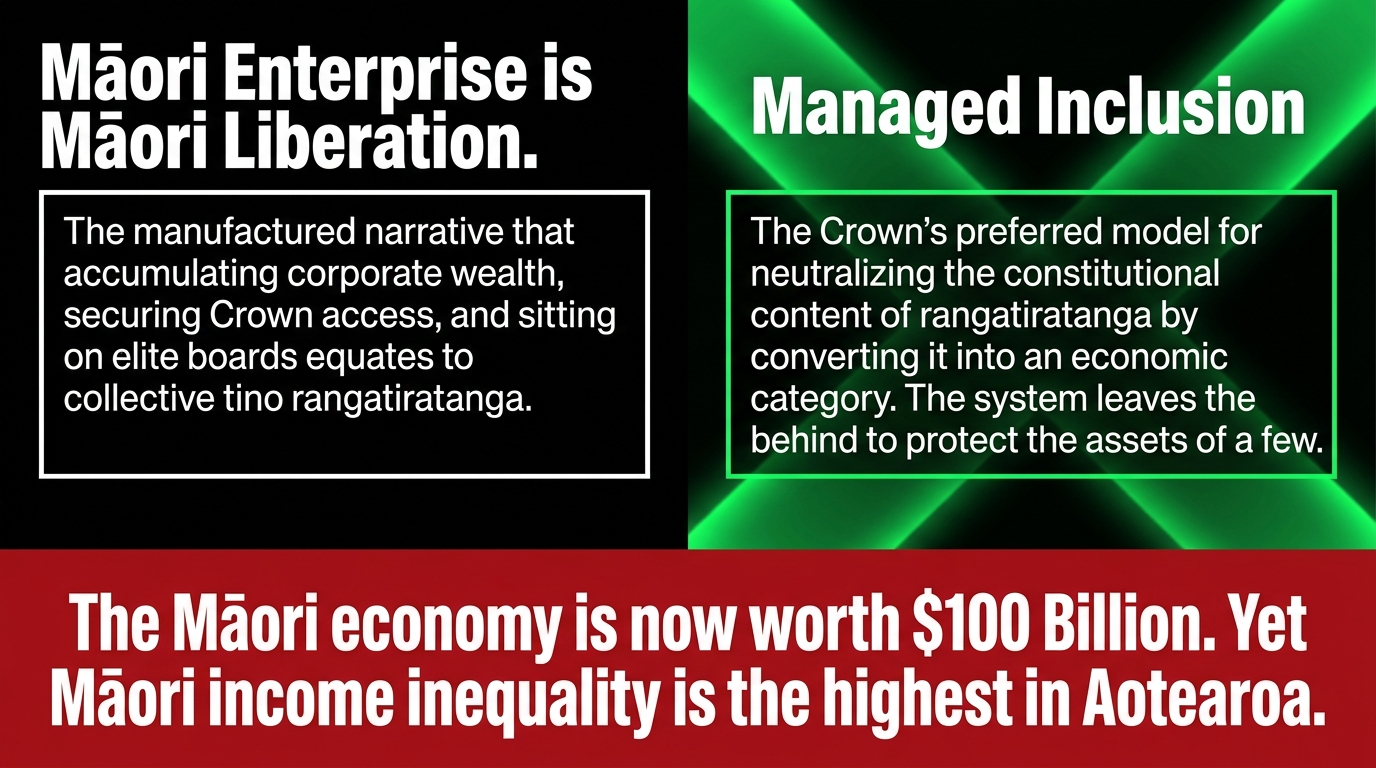
As E-Tāngata's March 2026 analysis confirmed, the Māori economy is now estimated at over $100 billion — and yet, as Waatea News documented, income inequality is greater among Māori than in any other ethnic group in Aotearoa. The Māori economy does not belong to Māori. It belongs to those Māori who own it.
The Māori Epstein class. Insulated. Connected. Celebrated. Remote.
Hardening the Case: The Treaty Trap Inside the Gilded Waka
Here is where the Māori Epstein class will push back hardest — so let us pre-empt every argument and dismantle it with Treaty law, not rhetoric.
Counterargument 1: "We are exercising rangatiratanga by building Māori enterprise."
No. You are exercising managed inclusion — the Crown's preferred model for neutralising the constitutional content of rangatiratanga by converting it into an economic category. As E-Tāngata's forensic analysis of resourcing rangatiratanga confirms, Treaty settlements and government grants are both rooted in the government's assumption of singular Crown sovereignty — the fiction that the Crown alone decides who gets resources, for what, and on what terms. True rangatiratanga — as guaranteed in the Māori text of Article 2 — means hapū govern their own development, fund their own institutions, set their own terms. It does not mean the British king's charity, funded by the Ministry of Youth Development, delivers your rangatahi's entrepreneurship programme and your Kuini attends the gala at his palace.e-tangata
The Waitangi Tribunal itself confirmed this architecture in 2024 — finding the Treaty Principles Bill breached the Article 2 guarantee of rangatiratanga because it would "reduce the constitutional status of the Treaty, remove its effect in law, limit Māori rights and Crown obligations," as confirmed in the Tribunal's Treaty Principles Bill report. The same logic applies here: when Māori institutions embed themselves in Crown-funded, British-branded infrastructure, they are not exercising the Article 2 guarantee. They are accepting its diminishment in exchange for access.waitangitribunal.govt
Counterargument 2: "These rangatahi would have nothing without The King's Trust."
This argument is the most seductive — and the most structurally dishonest. It presupposes that the only alternative to Crown-funded, British-branded enterprise support is nothing. That presupposition is the exact logic of colonisation: that Māori people cannot resource their own institutions without the Crown's permission and the coloniser's infrastructure. As E-Tāngata's analysis documents, the Crown's assumption of singular sovereignty has systematically deprived Māori of the ability to levy taxes, raise territorial revenues, or operate sovereign development finance — the very mechanisms every other nation uses to fund its own institutions. The rangatahi's excellence is not in question. What is in question is who controls the frame — and the answer, in 2026, is still the British Crown.e-tangata
Counterargument 3: "Te Arikinui is building relationships. Diplomacy is rangatiratanga."
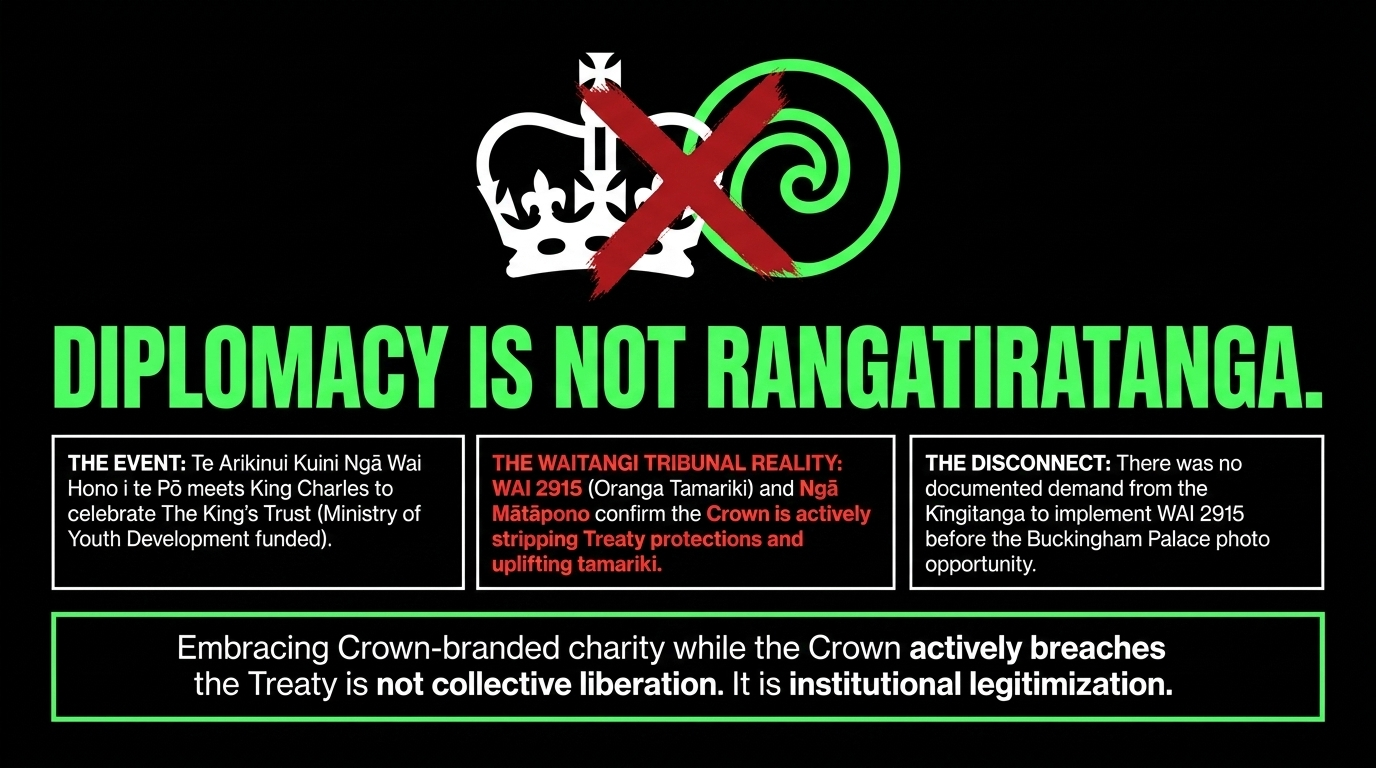
Let us grant this in full for the purpose of argument. If diplomatic engagement with the British royal family is an exercise of rangatiratanga, it must be measured against the Treaty obligation of active protection — the Crown's duty, confirmed in more than a dozen Waitangi Tribunal reports, to actively protect Māori rights and interests, not merely abstain from harm. The Ngā Mātāpono report released October 2025 found that Crown actions reducing Treaty protections breach the duty of active protection and create "discriminatory outcomes" that are "highly prejudicial to Māori". This is the same Crown that invited Te Arikinui to its palace. The same Crown that, as The Knife in the Honours Box documents, gave Ruth Richardson a medal for destroying the material conditions of Māori whānau. Diplomatic rangatiratanga with the author of your people's poverty is not liberation strategy. It is legitimisation of the system that created the poverty.waitangitribunal.govt
Counterargument 4: "You are attacking Māori leaders instead of attacking the Crown."
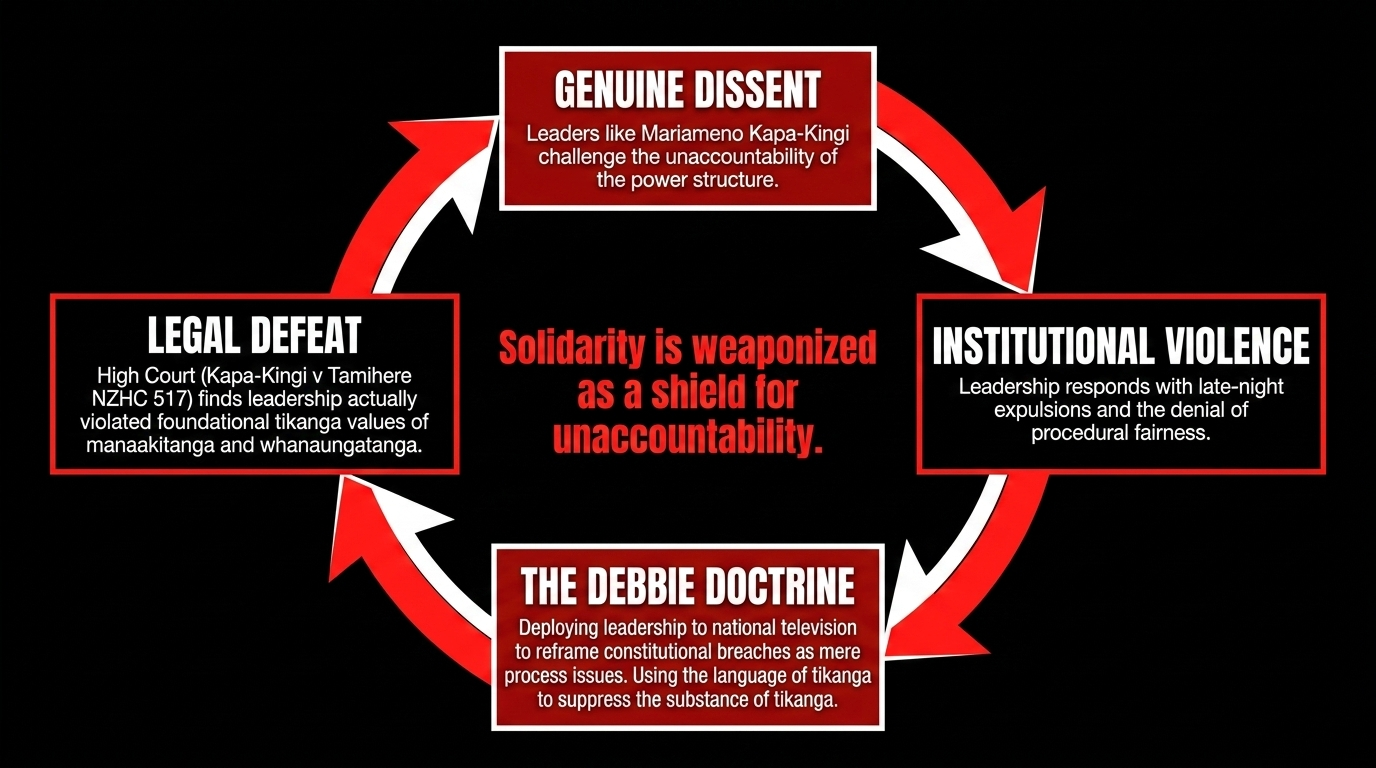
This is the oldest deflection in the playbook — and the most dangerous, because it uses solidarity as a shield for unaccountability. When Mariameno Kapa-Kingi challenged the leadership of Te Pāti Māori, she was told the same thing — and the High Court, in Kapa-Kingi v Tamihere NZHC 517, found that the leadership had violated tikanga values — manaakitanga, whanaungatanga, and rangatiratanga — the very values that solidarity-deflection claims to protect. As The Silencing Season documents, the silencing of internal dissent is not an act of protection — it is an act of institutional self-preservation by a class that has confused its own power with the people's wellbeing. To critique Māori institutions is not to attack Māori. It is the deepest form of aroha for te iwi — the refusal to let power hide behind culture.
Counterargument 5: "The Kīngitanga is sovereign and cannot be subjected to external critique."
This is the monarchy argument — and it defeats itself the moment it is spoken aloud. The Kīngitanga was not founded to be above critique. It was founded to be accountable to the people who chose it. As Te Ara's whakapapa of the Kīngitanga confirms, the founding rangatira chose a unifying figure — not an infallible one. The mechanism was consent, not divine right. When hierarchy exempts itself from accountability by invoking sovereignty, it has ceased to be the Kīngitanga's founding vision. It has become the Crown's architecture — in Māori clothing.teara
Ngā Whakakitenga — Five Hidden Treaty Connections
Connection 1: He Kākano is Crown Sovereignty in Charitable Form
The Beehive confirms He Kākano is funded through the Ministry of Youth Development. The King's Trust NZ confirms its $1.33 million in grants to 126 young entrepreneurs. The funding gate is the Crown. The branding is the British king. The delivery vehicle is a private charity without confirmed hapū governance.
In Treaty terms — as E-Tāngata's rangatiratanga analysis confirms — this is the precise architecture of Crown singular sovereignty: Māori aspirations resourced on Crown terms, through Crown-approved channels, branded with Crown prestige.
The Article 2 guarantee of rangatiratanga does not mean "we will fund your development if you name the programme after our king." It means you govern your own development. Full stop.
Connection 2: The WAI 2915 Indictment — Oranga Tamariki and the Tamariki Left Behind
While Te Arikinui was at Windsor Castle, the WAI 2915 Oranga Tamariki findings — confirmed by the Waitangi Tribunal and documented at Te Mata Law's summary — remain unimplemented. The Tribunal found that the disproportionate removal of tamariki Māori into state care is a direct consequence of the Crown's intrusion into the rangatiratanga of Māori over their kāinga. The Tribunal recommended an independent Māori Transition Authority. The Crown has not implemented it. The same Crown hosted the garden party. The same Kīngitanga attended. No documented public demand from the Kīngitanga that the WAI 2915 recommendations be implemented before the photo opportunity at Buckingham Palace.
Tikanga demands: the chief protects the tamariki. The tamariki were not protected.
Connection 3: The Wrecking Ball and the Crown's Complicity
As The Wrecking Ball and the Warrior documents, John Tamihere's Waipareira Trust holds net assets approaching $104 million. His Whānau Ora Commissioning Agency received $182 million in a single Budget allocation. The Department of Internal Affairs is investigating the charity's political donations.
This is the institutional architecture of Māori Epstein-class power: assets accumulated through Crown contracts, deployed to fund political influence, protected by solidarity deflection.
As The Silencing Season confirms, when that power is challenged internally — as Mariameno Kapa-Kingi challenged it — the institution responds not with tikanga but with legal process and organisational violence.
In Treaty terms, this is the exact inversion of Article 2: rangatiratanga weaponised by the powerful against the very people it was supposed to protect.
Connection 4: The Treaty Clause Review — Dismantling Protections While the Class Dines in London
The Ngā Mātāpono Waitangi Tribunal report, October 2025 found the Crown's Treaty Clause Review — in progress as Te Arikinui traveled to London — would breach the Treaty principles of partnership, active protection, equity, and the Article 2 guarantee of rangatiratanga. The review, if implemented, would reduce or remove legal protections for Māori Treaty rights across key statutes.
The Tribunal found the Crown was aware the review would cause "discriminatory outcomes" for Māori — and proceeded anyway.
Where is the Kīngitanga's public response to this Treaty breach? Where is the documented pressure applied in London?
Where is the garden party condition: no photo opportunity until you implement the Ngā Mātāpono recommendations? The silence is not diplomatic. The silence is the Epstein class protecting its access.waitangitribunal.govt
Connection 5: The Ruthanasia Inheritance — The Trap Was Built For Exactly This
The Knife in the Honours Box documents how Ruth Richardson's 1991 Mother of All Budgets destroyed not just welfare but the sovereign development-credit architecture — the Development Finance Corporation, the state mortgage channels, the sectoral credit programmes — that had made collective community economic agency possible.
What grew in the vacuum was Māori capitalism: a class of asset holders whose accumulation replicates the structural logic of the system they nominally resist.
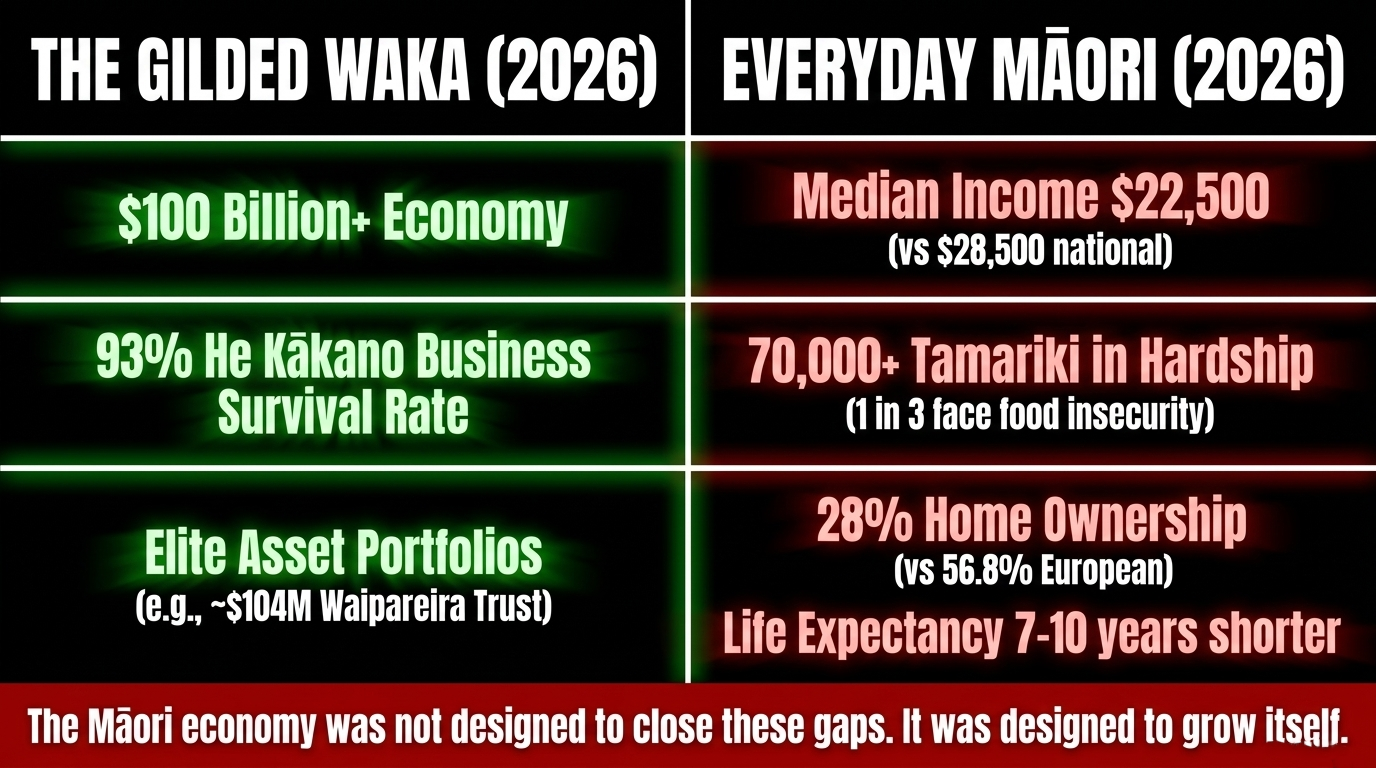
As Waatea News confirmed, Māori home ownership sits at 28% against 56.8% for Europeans, median Māori personal income is $22,500 against $28,500 nationally, and over 50% of Māori live in the highest deprivation deciles.
The Māori economy is $100 billion — and it has not closed a single one of those gaps in thirty years. Not one. Because the Māori economy was not designed to close them. It was designed to grow itself — exactly as every neoliberal economy is designed to do.waateanews
He Tauira — Three Examples for the Western Mind
Example 1: The 70,000 Left Behind — The Tino Cost of the Gala
While Town & Country Magazine photographed Te Arikinui's London visit in aristocratic soft focus, the Salvation Army's State of the Nation 2026 confirmed 70,000+ tamariki Māori in material hardship, one-third facing food insecurity, and violence against children at its highest in a decade. As Waatea News documented, Māori adults face unemployment 2–3 times higher than non-Māori, 20% of rangatahi Māori aged 16–25 are NEET, and life expectancy is 7–10 years shorter for Māori.
The tikanga impact in plain English: Manaakitanga — the duty of the powerful to uplift those in their care — is not a cultural metaphor. It is a constitutional obligation of leadership.
In tikanga Māori, the chief eats last. The chief does not attend the coloniser's gala while the people are hungry unless the chief is returning with something the people need.
There is no documented public commitment from the Kīngitanga to leverage the London visit for Treaty implementation, WAI 2915 enforcement, or material resource transfer to the 70,000 tamariki in hardship.
The ama is underwater. The chief is at the gala. That is not rangatiratanga. That is management of optics.
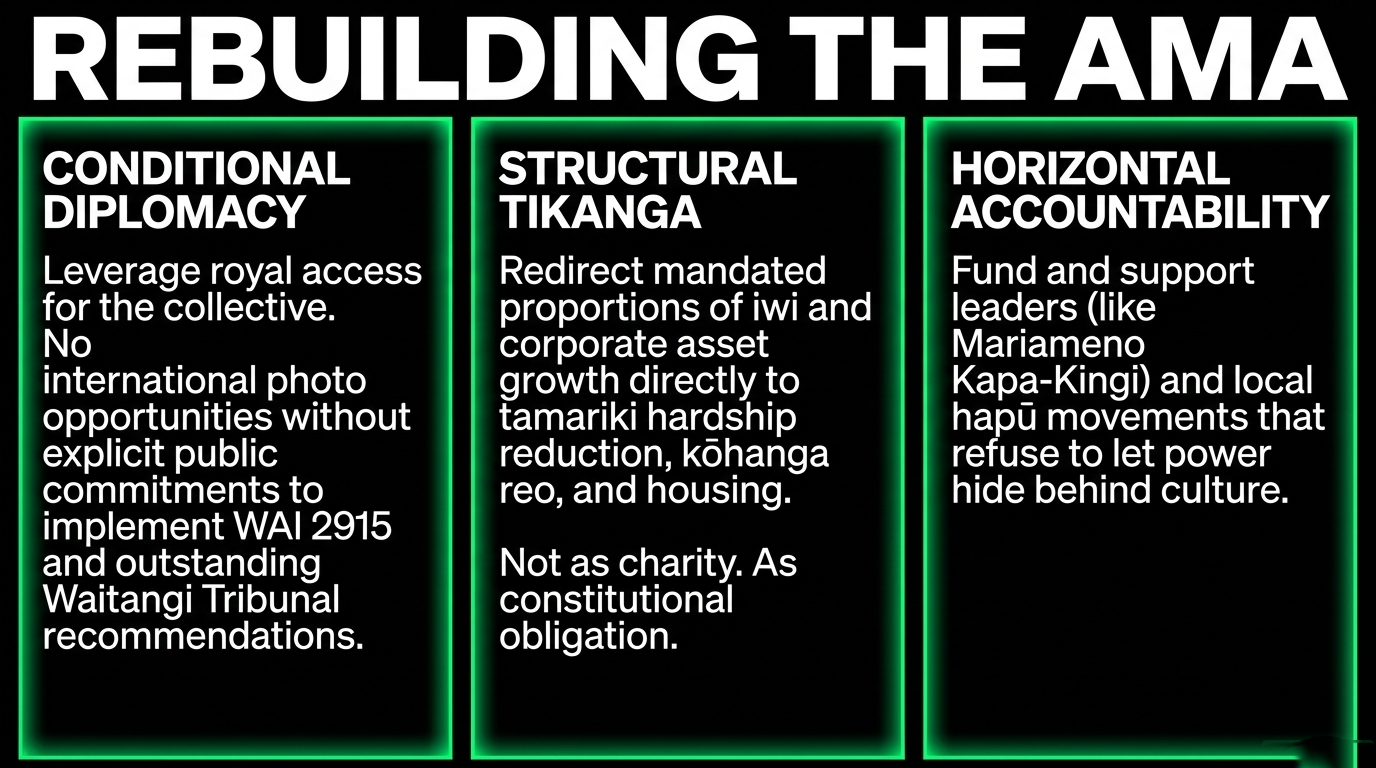
The solution: The Kīngitanga must formally and publicly condition international prestige visits on Crown commitments to implement outstanding Waitangi Tribunal recommendations — beginning with WAI 2915.
Te Arikinui's access to King Charles is a diplomatic asset that belongs to te iwi, not to the institution. Use it as such, or the gap between the gilded waka and the drowning ama will widen until no amount of cultural branding can close it.
Example 2: The $100 Billion Economy That Doesn't Feed Its Children
The Māori economy exceeds $100 billion, as E-Tāngata confirmed in March 2026.
For context: that is larger than the GDP of more than 100 sovereign nations.
The He Kākano programme has demonstrated a 93% business survival rate against a 37% national average, as confirmed by The King's Trust NZ. And yet, as the Child Poverty Action Group confirms, Māori children experience child poverty at nearly double the rate of the general population.kingstrust.org+2
The tikanga impact in plain English: In tikanga Māori, resources are held in trust for the collective — for the mokopuna, for the future, for the most vulnerable.
An economy that grows its asset base while its children go hungry is not exercising kaitiakitanga. It is exercising shareholder capitalism in Māori costume. The distinction matters. Kaitiakitanga means the wellbeing of the most vulnerable is the measure of the wealth-holder's legitimacy — not the size of the asset base.
The solution: As The Wrecking Ball and the Warrior and Mariameno Kapa-Kingi's new political project both demonstrate, the alternative exists: hapū-governed, tribally accountable enterprise structures that direct a mandated proportion of iwi and Māori corporate asset growth to tamariki hardship reduction, kōhanga reo funding, and rangatahi housing. Not as charity. As tikanga. As constitutional obligation.
Example 3: The Silencing Architecture — How the Epstein Class Suppresses Its Own Dissenters
As The Silencing Season documented, Mariameno Kapa-Kingi was expelled from Te Pāti Māori through a process Justice Radich found, in Kapa-Kingi v Tamihere NZHC 517, denied her procedural fairness and breached the tikanga values embedded in the party's own constitution
— including manaakitanga, whanaungatanga, and rangatiratanga.
The same Debbie Ngarewa-Packer who went on national television to call it "process issues" and invoke institutional longevity as a virtue is the co-leader of a party whose leadership the High Court found had violated its own tikanga obligations.
This is the Debbie Doctrine: use the language of tikanga to suppress the substance of tikanga. It is the identical move made by every Māori Epstein-class institution — use te reo, use the moko, use the Māori Queen at Buckingham Palace as cultural legitimacy, while the structural conditions that tikanga was designed to resist remain architecturally intact.
The tikanga impact in plain English: Kōrero — the right to speak and be heard — is foundational to collective Māori decision-making. Consensus is not silence.
It is not the 10pm email expelling the dissenting voice and then deploying the co-leader to manage the television narrative. The Kīngitanga was born from many voices choosing one leader.
When that leader's institution begins to function like the Crown — suppressing dissent, protecting hierarchy, managing public narrative — the founding mauri is gone.
The institution has become what it was built to resist.
The solution: Mariameno Kapa-Kingi is the answer — not because she is perfect, but because she represents the principle that tikanga accountability must be structurally enforceable, not just rhetorically invoked.
Support her new political project. Fund horizontally accountable hapū governance. Remove the architecture that allows any single figure — Kuini, party president, or trust CEO — to concentrate power without structural accountability.
Ngā Hua — The Scorecard of the Gilded Waka
| Indicator | Gilded Waka (2026) | Everyday Māori (2026) | Source |
|---|---|---|---|
| Māori economy size | $100 billion+ | — | E-Tāngata Mar 2026 e-tangata |
| Tamariki Māori in material hardship | — | 70,000+ / 23.9% | Te Ao News Feb 2026 teaonews.co |
| Māori child poverty rate | — | Nearly 2× national average | CPAG Feb 2025 cpag.org |
| Māori home ownership | Iwi assets growing | 28% (vs 56.8% European) | Waatea News Jun 2025 waateanews |
| Māori median income | — | $22,500 (vs $28,500 national) | Waatea News Jun 2025 waateanews |
| Tamariki Māori food insecurity | — | 1 in 3 | Te Ao News Feb 2026 teaonews.co |
| Māori NEET rate (16–25) | — | 20% (vs 9% non-Māori) | Waatea News Jun 2025 waateanews |
| Māori life expectancy gap | — | 7–10 years shorter | Waatea News Jun 2025 waateanews |
| He Kākano business survival | 93% (Crown-funded) | 37% (national average) | King's Trust NZ kingstrust.org |
| Waipareira Trust assets (Tamihere) | ~$104 million | — | The Wrecking Ball MGL |
| Waitangi Tribunal Treaty breaches 2023–26 | Crown unimplemented | Māori prejudiced | Ngā Mātāpono Oct 2025 waitangitribunal.govt |
| WAI 2915 recommendations | Unimplemented | Tamariki still uplifted | Te Mata Law tematalaw |
He Aha Te Tikanga? — The Moral Verdict
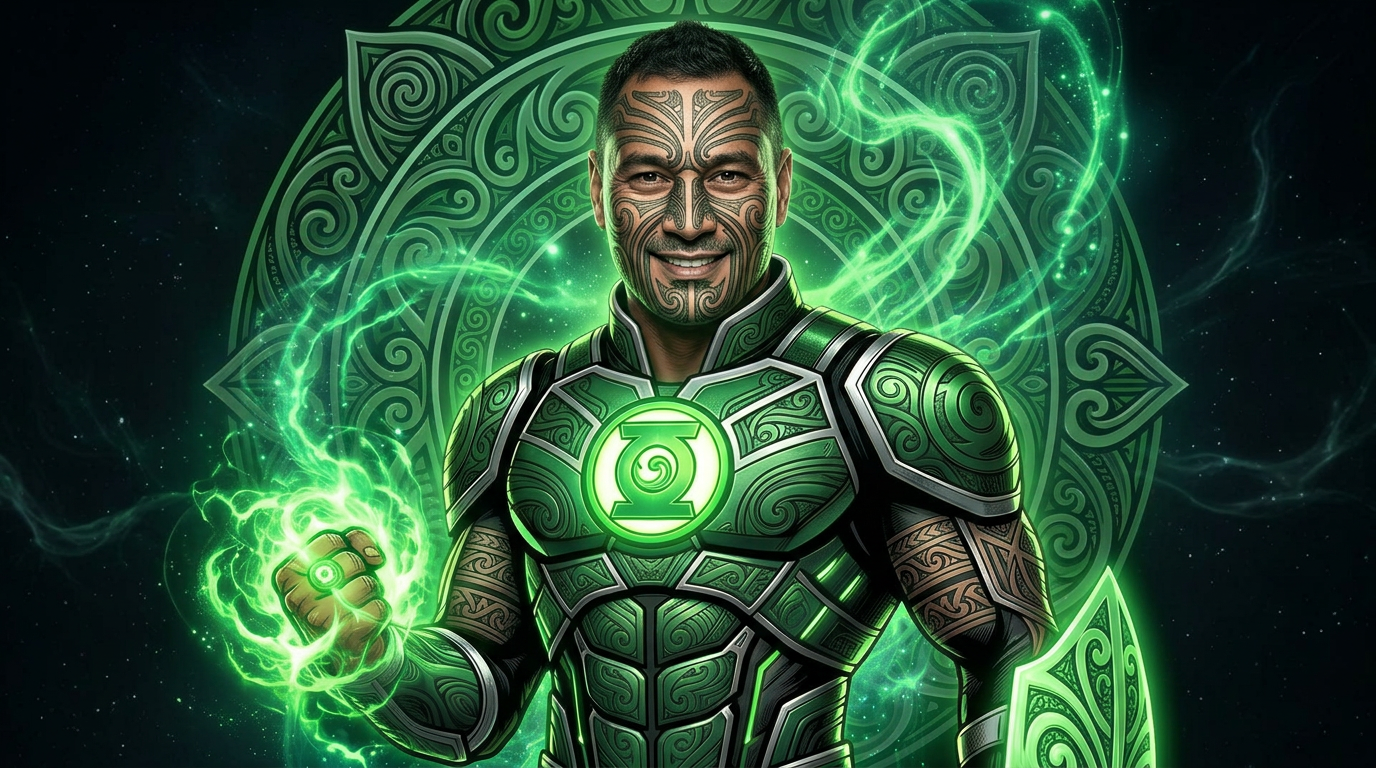
Ko Ivor Jones tēnei. Ko Te Māori Green Lantern. Let me be plain.
Te Arikinui Kuini Ngā Wai Hono i te Pō is 29 years old. She did not design this system. She inherited it. She is navigating it with the tools and the institutional architecture she was handed, within a geopolitical context not of her making. Her personal courage, her youth, her willingness to carry the weight of eight generations of Kīngitanga
— none of that is in question. Her individual mana is not on trial.
The institution is on trial. The class is on trial. The architecture is on trial.
The Kīngitanga, as it currently operates, is a neoliberal Māori institution: a hierarchy that speaks the language of collective sovereignty while functioning as a prestige access mechanism for those who can afford to fly to London and attend galas.
The Waitangi Tribunal guaranteed rangatiratanga over lands and taonga to rangatira and hapū in 1840. The WAI 2915 findings confirmed that failure to honour that guarantee is a direct cause of the disproportionate removal of tamariki Māori into state care.
The Ngā Mātāpono report confirmed the Crown is actively reducing Treaty protections right now, while Aotearoa's cameras were on Buckingham Palace.
And the Treaty Principles Bill findings confirmed the Crown is engaged in an "alarming pattern" of using parliamentary sovereignty against Māori instead of meeting Treaty obligations.
This is the context of the garden party. This is what was not said in the speeches at the Royal Albert Hall. This is the waka that forgot the ama.
They have not become the oppressor by conspiracy. They have become the oppressor by comfort. By access. By the slow, warm, seductive process of being given a seat at the table of empire and forgetting
— or choosing to forget — that the table was built on the bones of their people.
The taiaha is not at Buckingham Palace. It is in every whānau in Ngāruawāhia, Murupara, Flaxmere, and Wairoa. In every kōhanga reo holding te reo alive on zero Crown funding. In every Mariameno Kapa-Kingi who takes an unlawful expulsion to the High Court and wins. In every kuia who reads these words while paying $10 for butter. In every rangatahi who was told the Māori economy is booming while she cannot pay rent.
Ko tēnā te tino rangatiratanga. Ko tēnā te ārahitanga.
The ama does not need the waka to notice it is drowning. The ama needs to build its own vessel.
He Tono Koha — Ko Wai Ka Tūtaki i Ngā Utu?
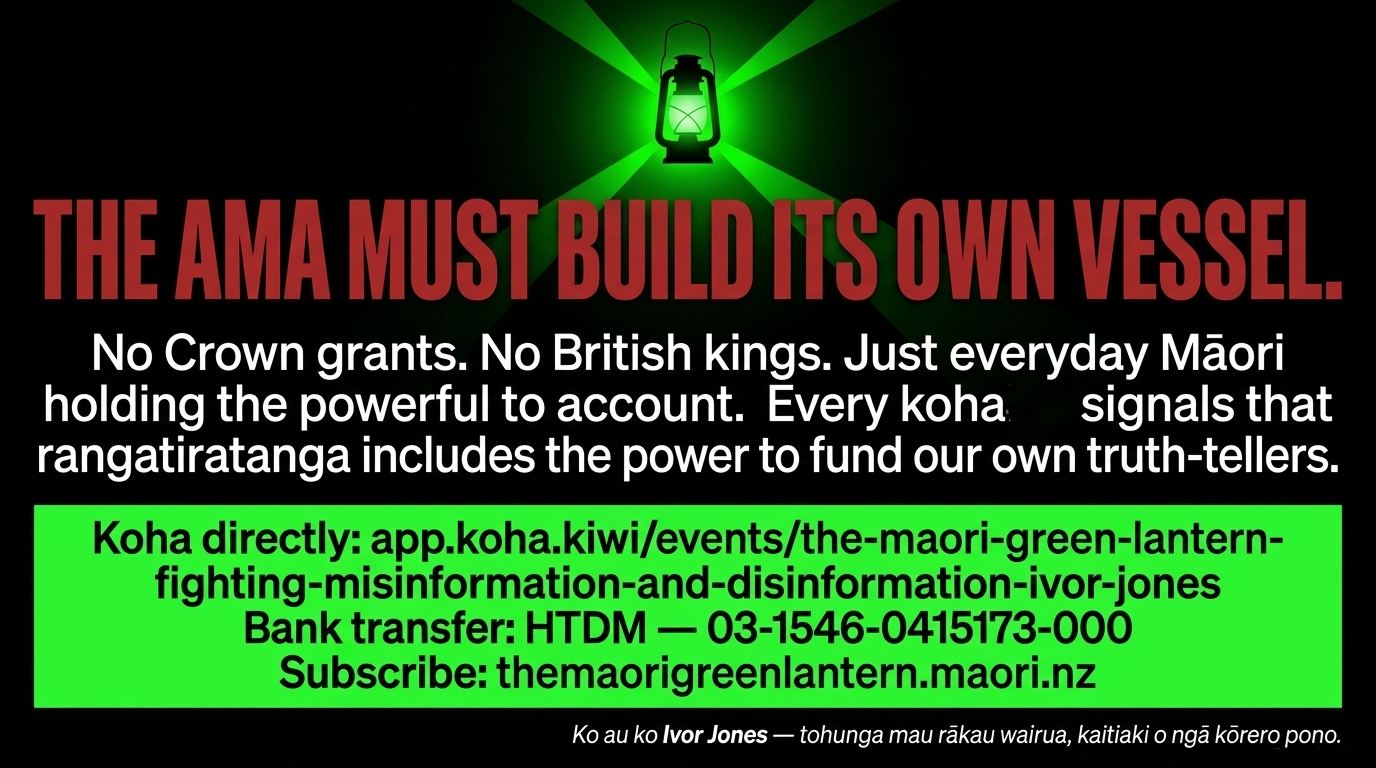
This essay traced the whakapapa of the Māori Epstein class from Buckingham Palace to the 70,000 tamariki in material hardship. It named the Treaty provisions that were supposed to prevent this. It showed the Waitangi Tribunal findings that have confirmed the breach
— and the silence of those with the most prestige access and the least political cost to speak.
No iwi board funded this essay. No Crown grant delivered it. No British king gave it a name. It exists because whānau koha keeps it alive.
Every koha to this mahi signals that rangatiratanga includes the power to fund our own truth tellers
— the ones who do not need a garden party invite, who do not need the coloniser's prestige, who need only the evidence and the will to name what the gilded waka will not name for itself.
If you cannot koha right now
— no worries, whānau.
Subscribe, follow, kōrero, share. Pass this to the kuia paying $10 for butter. Pass it to the rangatahi who was told the Māori economy is booming while she cannot pay rent. That sharing is koha in itself.
Ngā ara tautoko — four pathways:
🌿 Koha directly: app.koha.kiwi/events/the-maori-green-lantern-fighting-misinformation-and-disinformation-ivor-jones
📩 Subscribe to essays: themaorigreenlantern.maori.nz/#/portal/support
🏦 Bank transfer: HTDM — 03-1546-0415173-000
📘 Facebook: facebook.com/Themaorigreenlantern/subscribe
Ko au ko Ivor Jones — tohunga mau rākau wairua, kaitiaki o ngā kōrero pono. Nō Rotorua ahau. Nō Te Arawa.
Views expressed constitute honest opinion on matters of public interest under the Defamation Act 1992 (NZ) and Durie v Gardiner NZCA 278. All factual claims sourced and cited. Te Arikinui Kuini Ngā Wai Hono i te Pō, John Tamihere, Debbie Ngarewa-Packer, Rahui Papa, and all named individuals are referenced solely in their public capacity. Right of reply offered under qualified privilege (Lange v Atkinson 3 NZLR 385). Corrections: contact via themaorigreenlantern.maori.nz. Research tools: search_web, fetch_url. All URLs verified live 16 May 2026 NZST.