"The Knife in the Honours Box: How Ruth Richardson Bled Aotearoa Dry — and the Crown Gave Her a Medal for It" - 16 May 2026
The architect of manufactured poverty just received the Companion of the New Zealand Order of Merit. Tadhg Stopford drew the constitutional map. Now we name the bodies — and the mechanism.

Mōrena Aotearoa,
Thank you for coming here and examining Ruth Richardson's ruthanasia programme and its direct, measurable harm to Māori whānau because it directly affects democratic accountability, Treaty obligations, and the intergenerational poverty deliberately inflicted on tangata whenua by public officials acting in their public capacity.
The Surgeon Who Poisoned the Well
Imagine a surgeon who, in the name of fiscal hygiene, walks into a hospital in 1991, severs the blood supply to the wards where the poor and Māori sleep, stitches the wound with Treasury letterhead, and hands the scalpel to the banks.
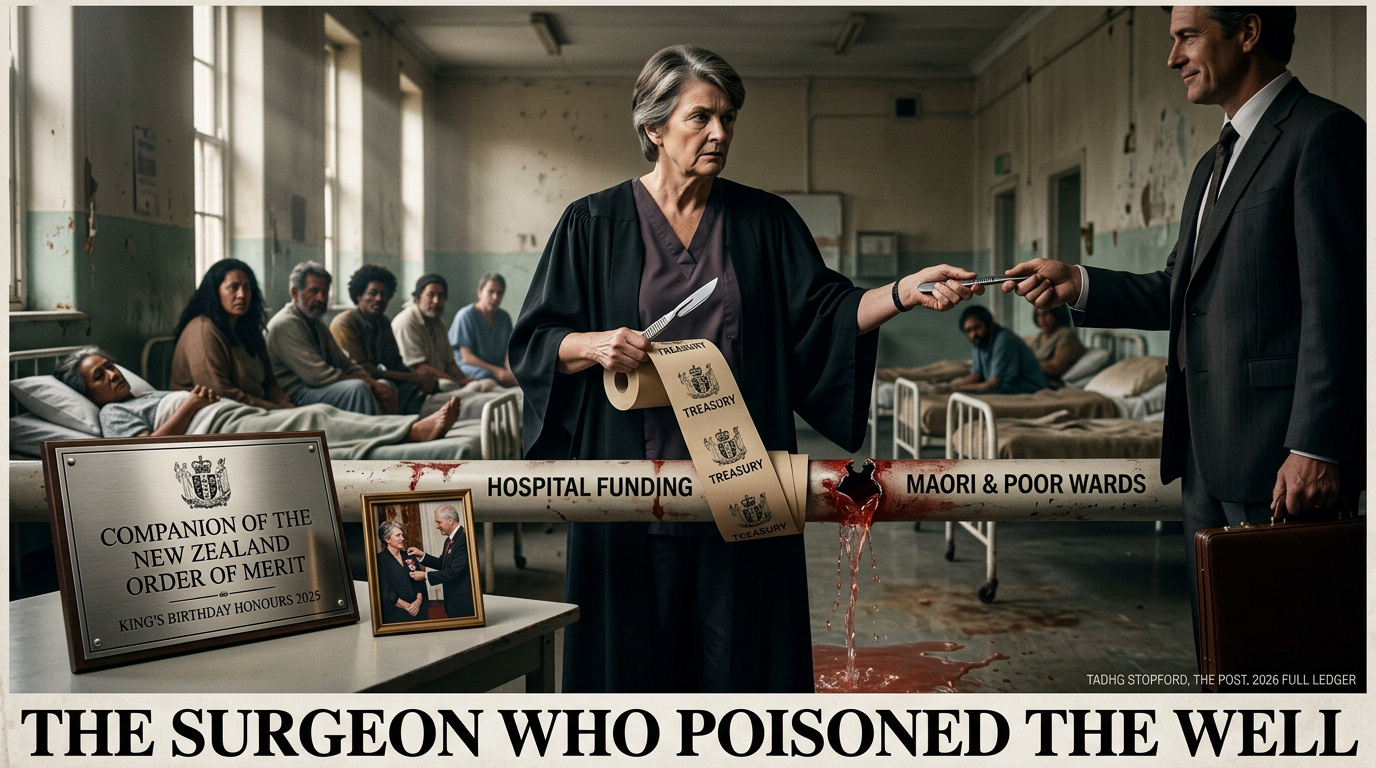
Thirty-five years later, the patients are still bleeding on the floor — and the Crown puts a medal around the surgeon's neck and calls it an honour.
That is not metaphor. That is Ruth Richardson receiving the Companion of the New Zealand Order of Merit in the King's Birthday Honours 2025, honoured, in the Crown's own words,
"for services as a Member of Parliament and to governance."
As Global Women confirmed, Richardson is currently Chair of Syft Technologies, New Zealand Merino Company, and the Kula Fund, and sits on the board of Bank of China Ltd
— the same private-sector class that has gorged on the structural trap she built.
The Deep Dive Podcast
Listen to a lively conversation between two hosts, unpacking and connecting topics in the sources of this essay. I apologise in advance for the AI's very harsh pronounciation of reo. Please dont shoot me, :).
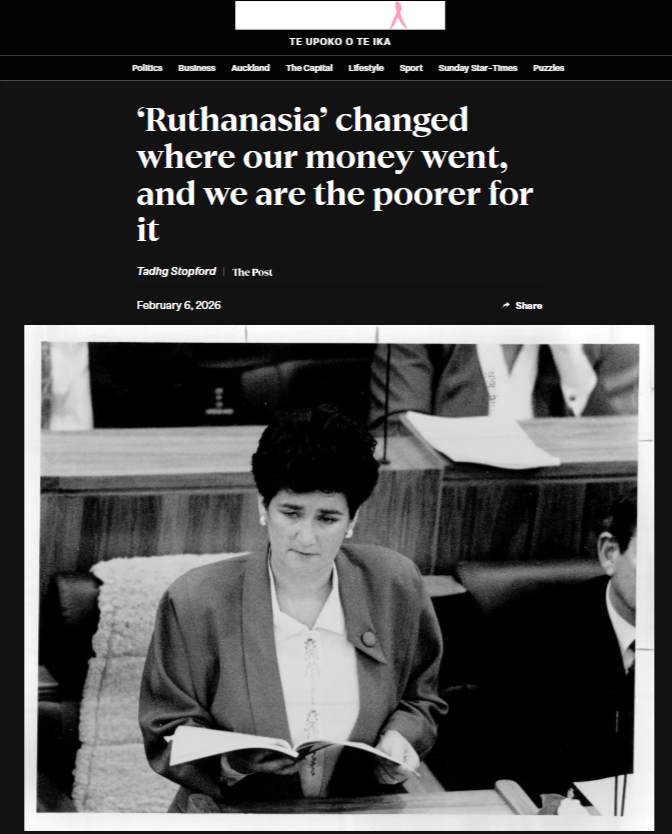
Historian, high school teacher, and small business owner Tadhg Stopford cracked this open in The Post, arguing that ruthanasia changed where our money went
— and we are poorer for it.
His March 2026 Full Ledger goes further still, documenting with constitutional precision exactly how the trap was engineered, who benefits, and what must be done to dismantle it.
The Māori Green Lantern is here to finish the sentence both began: we are poorer because that was the design.
He Kōrero Tuarā — The Constitutional Crime Scene
Ruth Richardson was no rogue actor. She was the militant delivery wing of an ideological project seeded into the NZ Treasury since the mid-1980s by Mont Pelerin Society-aligned economists and, later, Atlas Network-funded think-tanks. When Jim Bolger's National government took power in October 1990, Richardson was unleashed.
She openly named her 1991 Budget the
"Mother of All Budgets" — and meant it as a boast.
As Stopford's Full Ledger documents, the reforms were so extreme that Prime Minister Jim Bolger
"had to be almost coerced into many of the reforms by his finance minister and Treasury, and he called them a failure before his death."
Self-styled entrepreneurs of the right wing, Stopford notes, now openly acknowledge these were
"deliberate constitutional law amendments that changed our economic architecture — to protect it from democracy."
This is not analysis. This is confession.
As Wikipedia's documented account of the Mother of All Budgets records, the 1991 Budget cut unemployment benefits, abolished the universal family benefit, introduced user-pays into hospitals and schools, and corporatised state housing
— simultaneously removing every floor Māori families stood on.
Te Hao Rangahau, the MSD's own research chronology, documents the cascade: welfare restructuring, state asset sales, and health reforms that disproportionately dismantled the institutions Māori communities relied upon most.
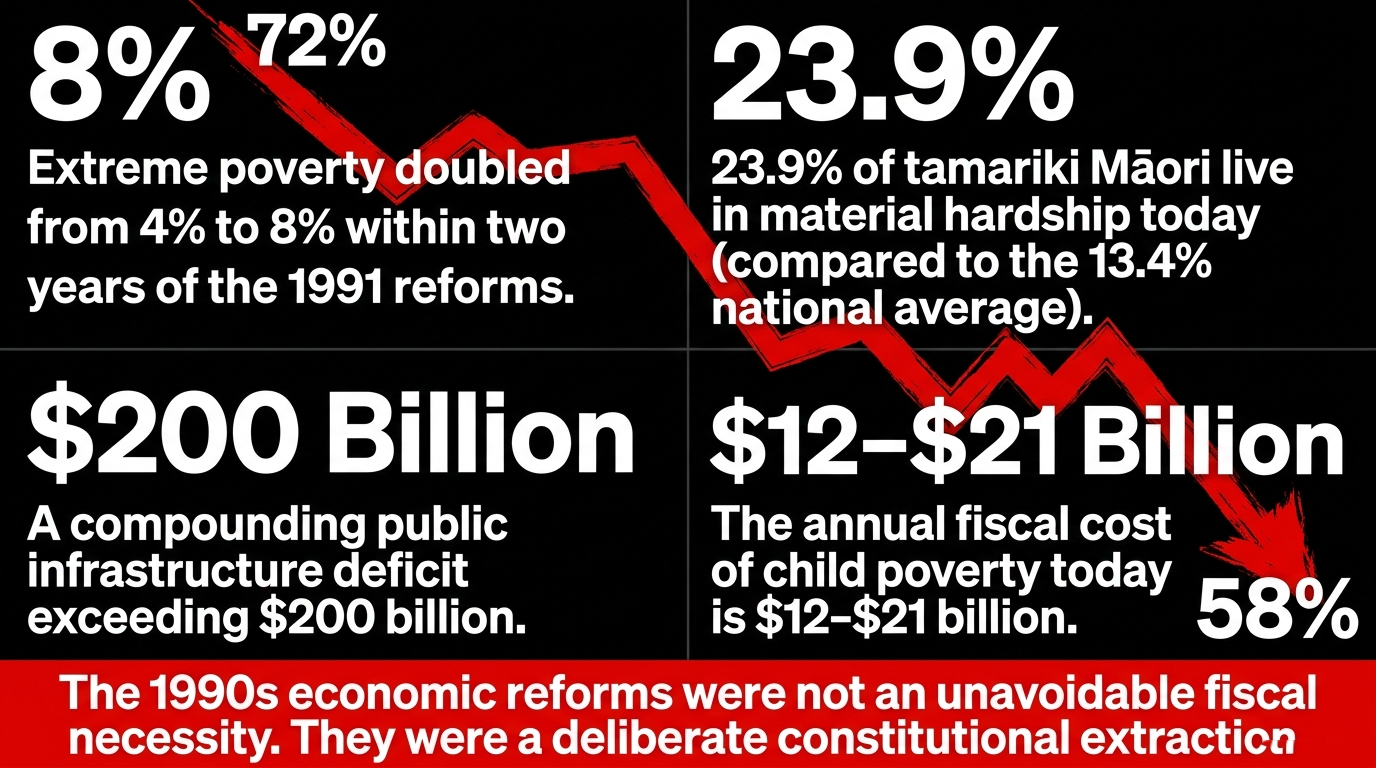
The income of welfare-reliant households collapsed from 72% of average national income to just 58% within three years, as E-Tāngata's analysis of poverty patterns and politics documents.
He Tātari Mātauranga — Deconstructing the Three Myths
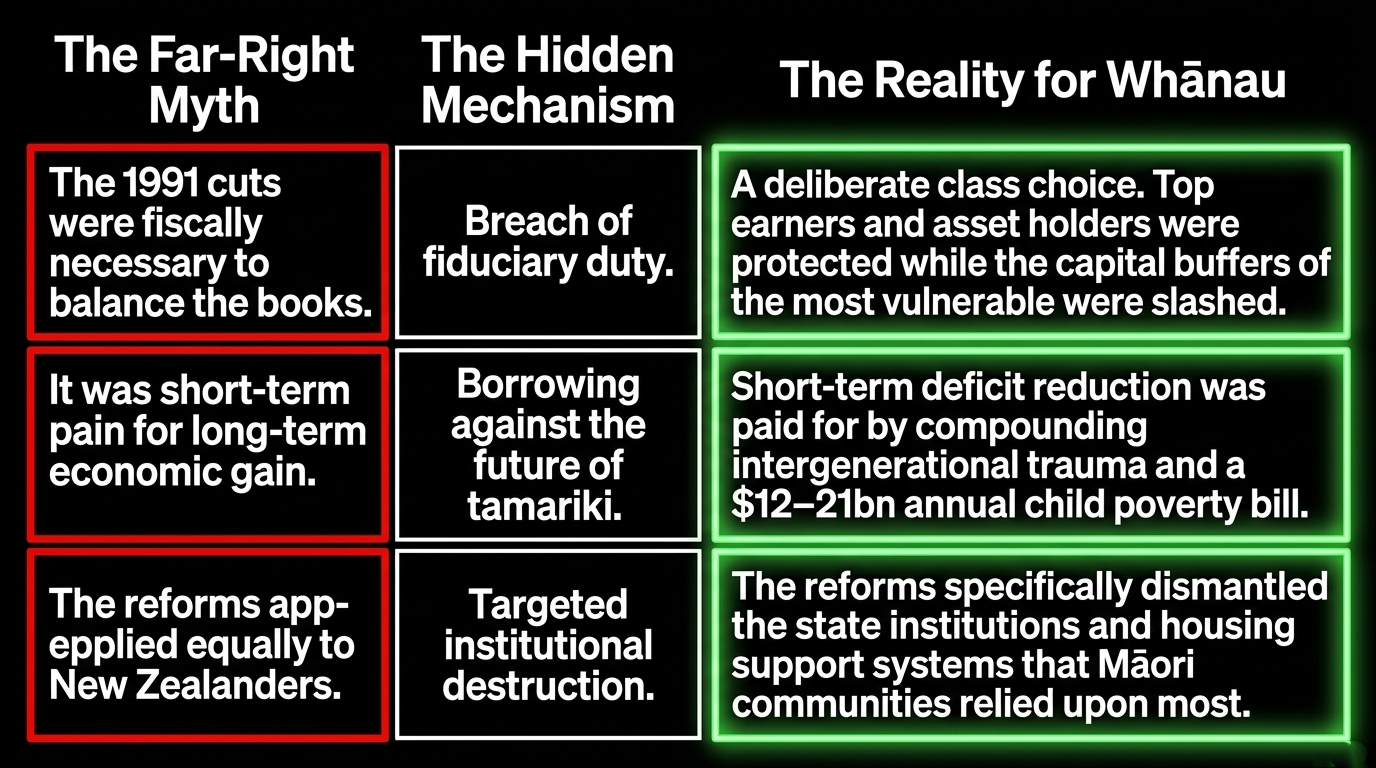
Myth 1: "It was fiscally necessary."
The deficit could have been addressed through progressive income taxation on top earners, a capital gains tax, or a wealth levy
— none of which were seriously considered.
Instead, as Max Rashbrooke documented in The Spinoff, Richardson cut the benefits of some of the poorest and most vulnerable New Zealanders by up to one-quarter. That is not necessity. That is a class choice disguised as economics.
Stopford's Full Ledger confirms the legal dimension: the reforms appear to breach the duty of care, fiduciary duty, and the ancient obligation to use "honest weights and measures" in public governance — three duties the Crown owed every citizen it instead chose to sacrifice.
Myth 2: "The long-term benefits justified the pain."
The annual fiscal cost of child poverty in Aotearoa is now estimated at between $12 billion and $21 billion per year, as Rashbrooke documents citing Treasury's own modelling. Whatever short-term deficit reduction was achieved in 1991 has been repaid many times over in health costs, criminal justice costs, lost productivity, and intergenerational trauma. The Crown borrowed against the futures of tamariki to balance a ledger.
Worse: it then spent thirty years pretending the ledger was balanced.
Myth 3: "It applied equally to all New Zealanders."
Stopford's Full Ledger documents that the reforms produced
"broad and measurable underinvestment in essentials and productive industries, economic inequality, increased poverty, strategic fragility, political immaturity, de-industrialisation, an annual haemorrhaging of our wealth overseas that equals 20% of our total exports, and a cost of living that consumes four-fifths of most people's income."
The Office of the Auditor-General's 2025 child poverty report confirms Māori children experience material hardship at 23.9%
— nearly double the national average of 13.4%. Pasifika children sit at 28.7%.
These are not residual statistics. They are the compounded interest of a deliberately unequal policy.
Ngā Whakakitenga — Six Verified Revelations
1. The Poverty Was Immediate, Measurable, and Deliberate
Extreme poverty doubled from 4% to 8% within two years of the 1991 Budget, as Max Rashbrooke documents in The Spinoff.
The instruments were specific: unemployment benefit slashed, sickness benefit cut, family benefit abolished, market rents introduced to state housing.
Each cut was targeted. Each cut landed hardest on households with no capital buffer
— which, after decades of land confiscation, disproportionately meant Māori whānau.
2. Tamariki Māori Still Carry the Wound — in 2026
As of the latest official statistics, 23.9% of tamariki Māori live in material hardship, against a national average of 13.4%. The Child Poverty Action Group's 2024/25 statistics confirm these rates remain structurally entrenched. As Teao News reported in February 2026, an additional 4,400 tamariki Māori fell into poverty since 2019. The direct lineage from Richardson's 1991 demolition to today's statistics is not speculative — it is compound interest on a designed wound.
As E-Tāngata's analysis of the Crown versus Māori children makes clear, this pattern
— remove institutional protection, blame the community — continues under the Luxon government today.
3. The Treasury Trap Is a Constitutional Misalignment — Not a Policy Mistake
This is the revelation at the heart of Stopford's Full Ledger.
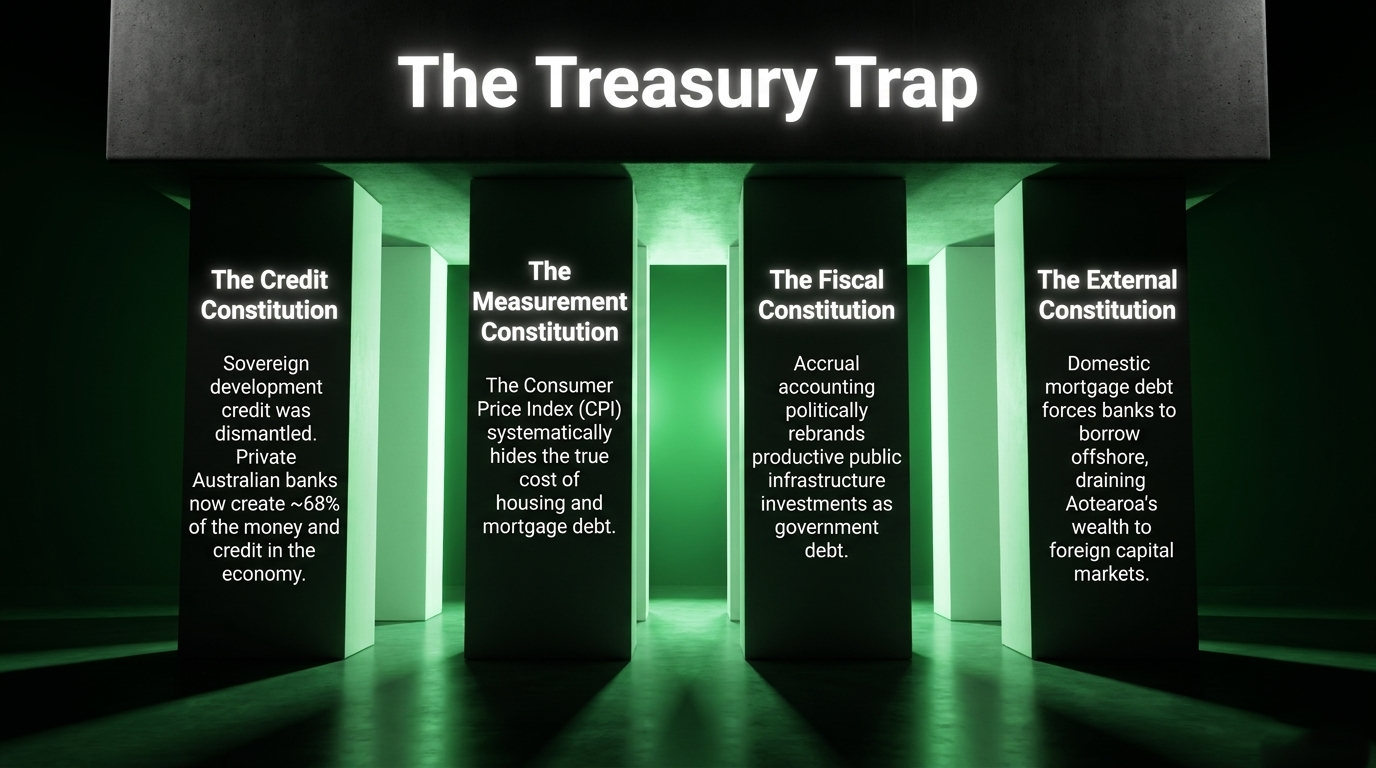
The Treasury Trap is not poor economic management. It is a structural constitutional misalignment deliberately engineered through four interlocking mechanisms:
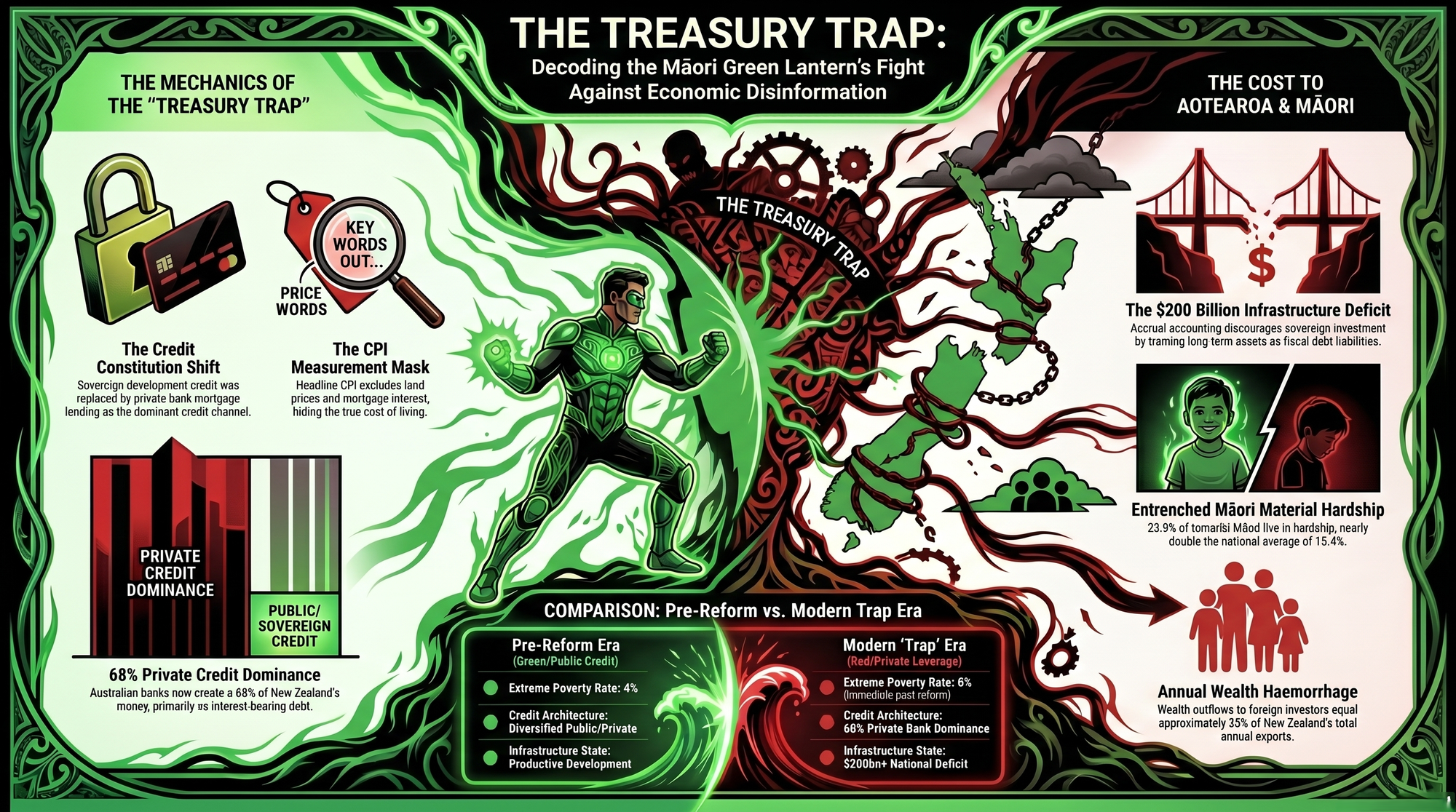
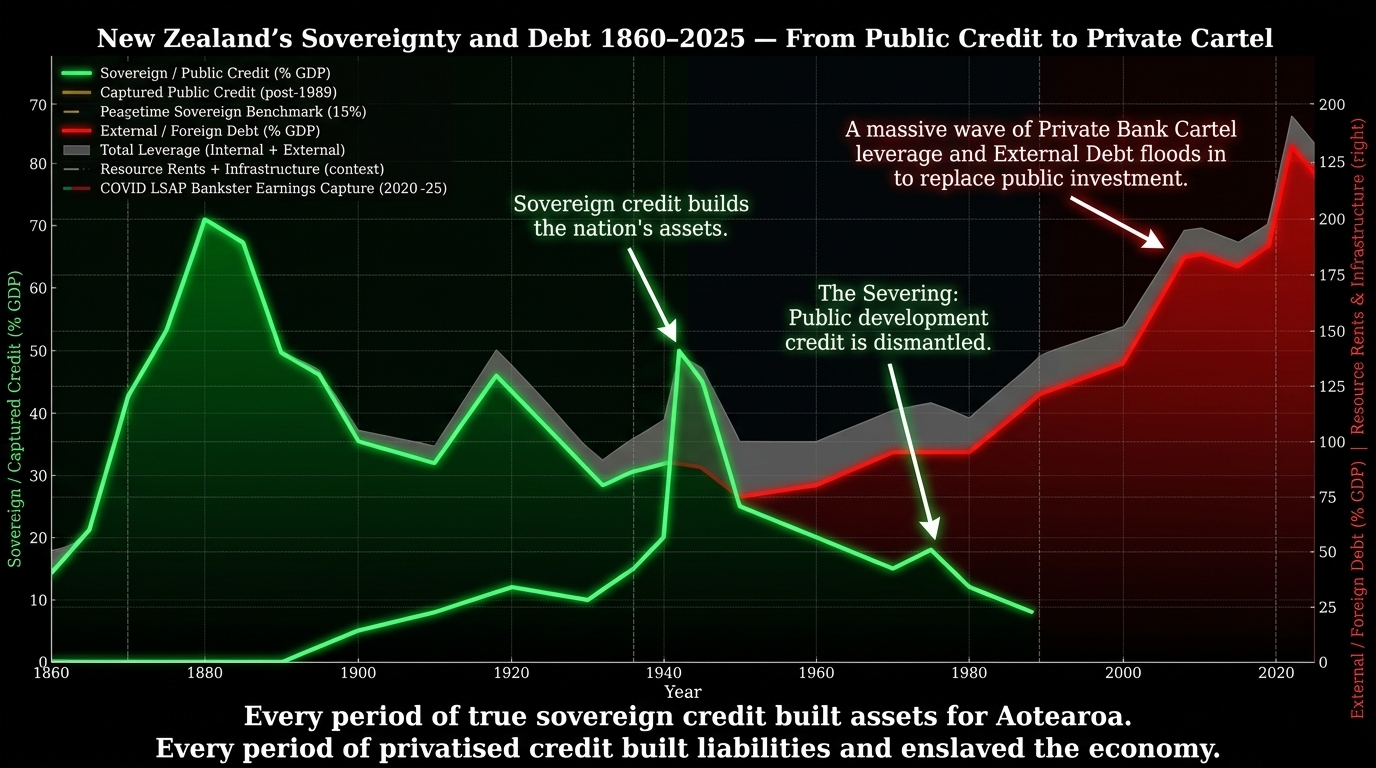
The Credit Constitution: Before the reforms, New Zealand possessed a sovereign development-credit ecology
— State Advances lending systems, Housing Corporation mortgage programmes, the Development Finance Corporation, and sectoral credit programmes.
These institutions financed housing construction, infrastructure, agricultural expansion, and industrial investment. Richardson's era liquidated them.
As the Full Ledger documents,
"the Development Finance Corporation was liquidated, state mortgage lending channels removed, and government-directed credit programmes declined sharply. The sovereign development-credit ecology ceased to function."
Australian banks now create approximately 68% of the money and credit in the NZ economy
— and approximately 70% of that becomes interest-bearing debt for ever-more-expensive houses, not factories, not infrastructure, not farms.
The Measurement Constitution: The Consumer Price Index
— the inflation tool Treasury and the Reserve Bank use to set monetary policy — was designed in a different era.
It excludes land prices, house purchase prices, mortgage principal repayments, and mortgage interest payments. When cheap imported manufactured goods push CPI down, rising domestic housing costs, insurance, utilities, and debt-service pressure are masked.
As the Full Ledger states:
"the measurement regime can register stability while the underlying economic structure becomes more leveraged, more property-dominated, and more burdensome for households."
The Reserve Bank's OCR tool targets a number that doesn't measure the dominant cost pressure destroying whānau. This is not accident. This is architecture.
The Fiscal Accounting Constitution: Under the Public Finance Act 1989, New Zealand adopted accrual accounting. Public capital investment now appears on the Crown balance sheet as both an asset and a liability
— but political discourse and fiscal frameworks focus almost exclusively on the liability side.
The result, as the Full Ledger documents, is that
"long-lived public investments that create productive national assets are frequently interpreted primarily as increases in government debt."
The state has talked itself out of building anything. Every road, hospital, or school the Crown needs becomes a "debt problem" rather than a capital asset. Meanwhile, $200 billion in infrastructure deficit accumulates.
The External Liabilities Constitution: When mortgage-dominant bank lending expands beyond domestic savings
— which it must, because that is the system's incentive structure
— banks fund themselves through offshore wholesale borrowing.
External liabilities accumulate.
New Zealand therefore records a persistent net primary income deficit: interest payments, dividends, and profit repatriation flowing to foreign investors.
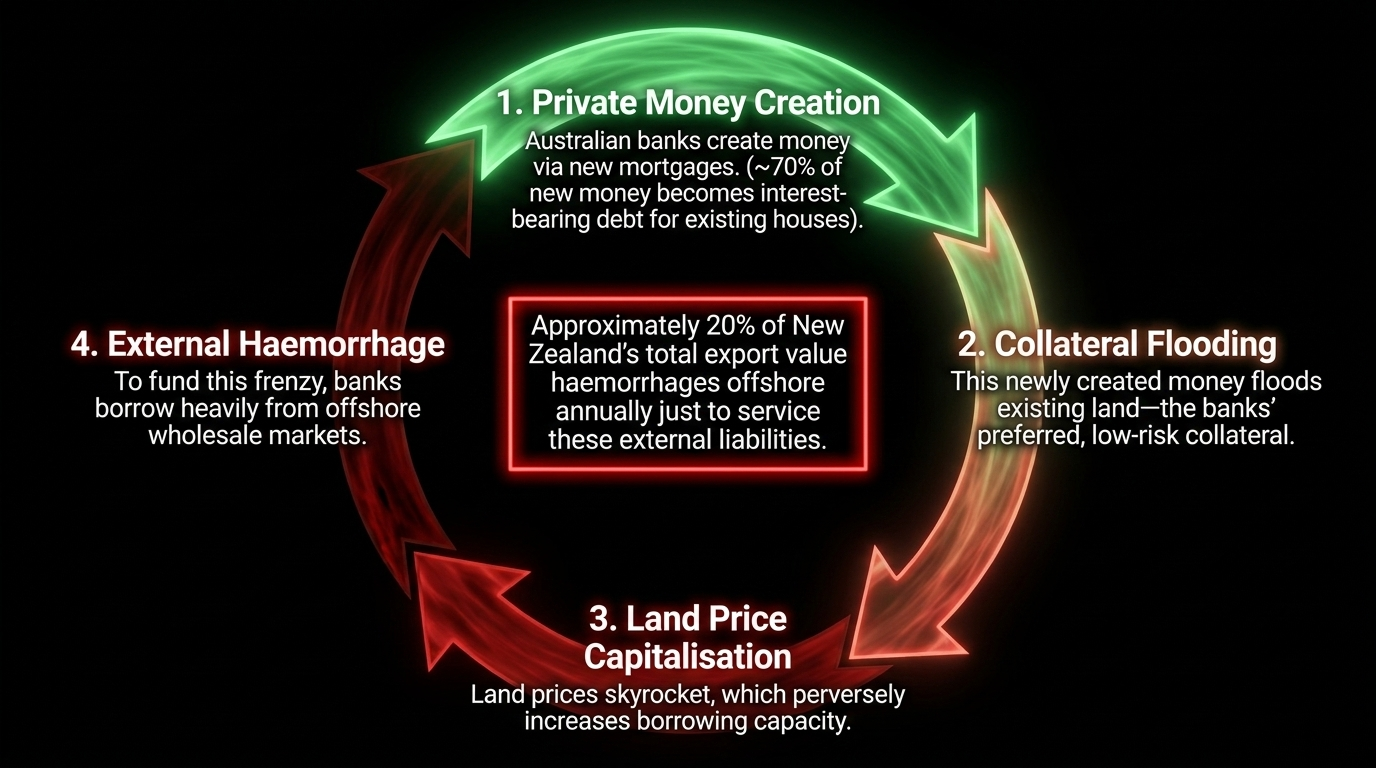
As the Full Ledger notes, this haemorrhage equals approximately 20% of New Zealand's total exports leaving the country annually before a dollar reaches a school or a hospital.
4. The CPI Masking Mechanism — How You Were Lied to About Inflation
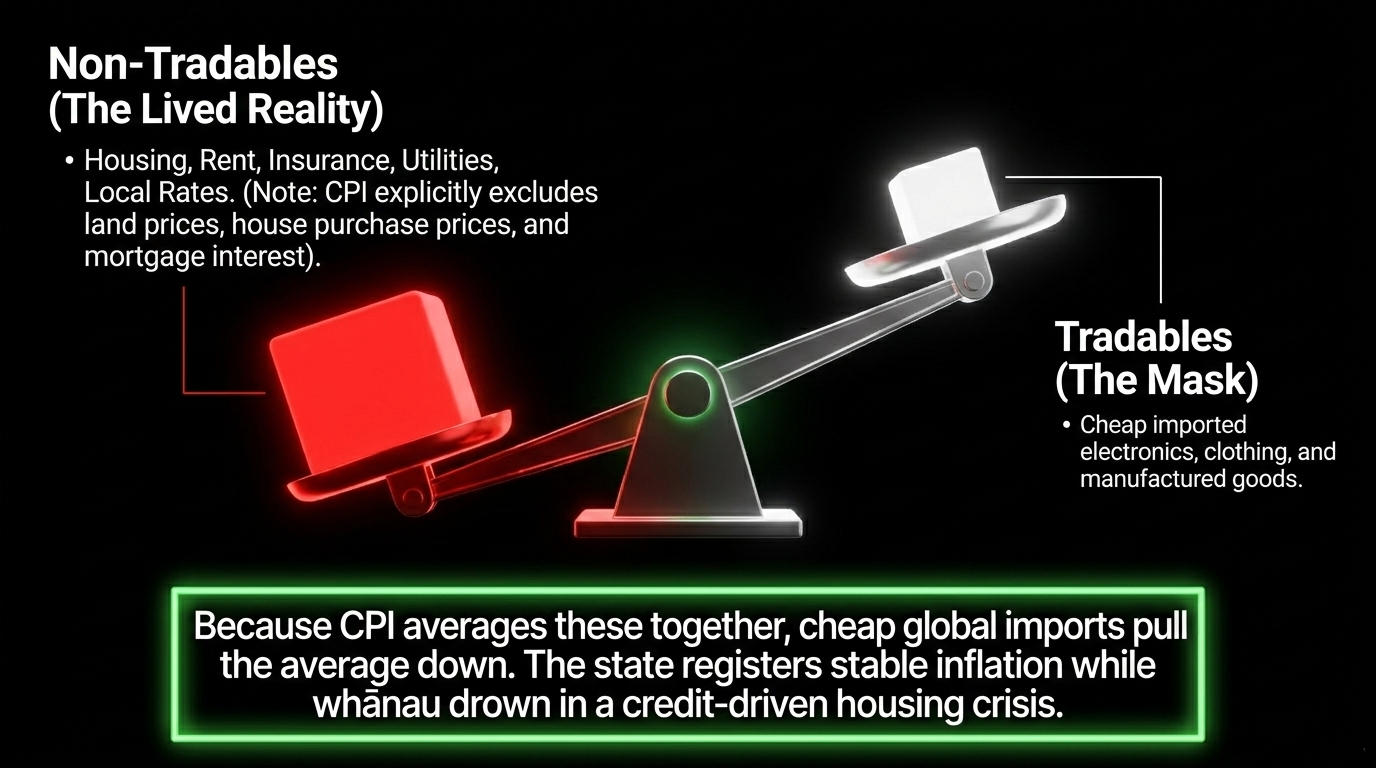
This revelation deserves its own section because it explains how the system survived for thirty-five years without democratic correction.
The Full Ledger identifies a structural deception embedded in the measurement architecture:
"Because CPI averages tradable and non-tradable goods, falling prices for imported goods can offset rising domestic costs. Consequently CPI may remain stable even while housing prices rise, insurance costs increase, utilities become more expensive, mortgage debt expands, and household financial pressure rises."
In plain English: cheap electronics, cheap clothing, cheap manufactured imports pushed CPI down
— while the essential costs of being alive in Aotearoa (rent, rates, insurance, power, food, debt service) climbed relentlessly.
The Reserve Bank looked at CPI, said inflation was under control, and kept the settings that fed the property boom. The trap was self-reinforcing, self-concealing, and structurally immune to the policy tools available to correct it. Whānau experienced the real cost of living. The measurement system told the government everything was fine.
5. The Honours System Exposes the Colonial Hierarchy
In June 2025, as confirmed by the official King's Birthday Honours List 2025 at DPMC, Richardson received the Companion of the New Zealand Order of Merit. The same honours system that has never adequately recognised the architects of Māori economic sovereignty
— Tā Āpirana Ngata, Dame Whina Cooper, the kuia and kaumātua who kept te reo alive through suppression
— draped a medal on the woman who doubled overnight poverty.
As The Spinoff put it plainly: Richardson is
"quite disconnected from the realities of that harm."
The Crown honoured its own weapon.
6. The Legal Dimension — Three Constitutional Duties Breached
Stopford's Full Ledger introduces a legal framework that the mainstream media has not yet absorbed.
When governments exercise sovereign economic powers
— over currency, banking regulation, fiscal policy, and national accounting
— they owe three non-negotiable constitutional duties:
- Fiduciary Duty: Public authorities must exercise economic powers in the long-term interest of the nation, including stewardship of national economic stability, prosperity, and development capacity.
- Duty of Care: Economic institutions must be designed with reasonable competence and awareness of foreseeable systemic consequences. Institutional negligence in economic design can produce structural instability.
- Honest Weights and Measures: Governance requires accurate measurement of the phenomena being regulated. If measurement systems misrepresent economic reality, policy becomes structurally distorted.
The Full Ledger's assessment: ruthanasia and the resulting institutional architecture
"seem to breach the duty of care, fiduciary duty, and the duty to use honest weights and measures — to name only three."
This is not a political opinion. It is a constitutional analysis. The legal consequences of that analysis have not been tested
— yet.
Ngā Hua — Quantified Harm to Whānau
| Indicator | Before Ruthanasia (1990) | After Ruthanasia | 2026 Status |
|---|---|---|---|
| Extreme poverty rate | 4% | 8% (1992) | Stalled The Spinoff |
| Welfare household income (% of avg) | 72% | 58% (1993) | No restoration E-Tāngata |
| Tamariki Māori material hardship | — | Doubled | 23.9% OAG 2025 |
| Pasifika tamariki material hardship | — | — | 28.7% OAG 2025 |
| Annual cost of child poverty | — | — | $12–21bn/yr The Spinoff |
| Net Crown debt | — | — | $184.6bn / 43.2% GDP Treasury 2025 |
| Infrastructure deficit | — | — | $200bn+ [Stopford Full Ledger 2026] |
| Wealth haemorrhage offshore | — | — | ~20% of total exports annually [Stopford Full Ledger 2026] |
| Sovereign development credit share | Diversified public/private | Dismantled | Australian banks: ~68% of credit creation [Stopford Full Ledger 2026] |
He Aha Te Tikanga? — Implications for Rangatiratanga
The Treasury Trap is a te Tiriti violation. Article 2 of te Tiriti guarantees tino rangatiratanga
— full authority over taonga.
Taonga is not only land and language. It is the institutional capacity of a people to direct their own economic futures.
When Richardson dismantled public development credit and welfare simultaneously, she stripped Māori communities of both economic agency and safety net in a single parliamentary term.
As the Full Ledger documents, the state
"possesses formal authority over currency, banking regulation, fiscal policy, and national accounting frameworks, yet the practical direction of credit creation and capital formation shifts toward private balance-sheet incentives."
Formal authority without actual power is a colonial shell. That shell is called the New Zealand government.
The Full Ledger identifies the solution as clearly as it identifies the crime.
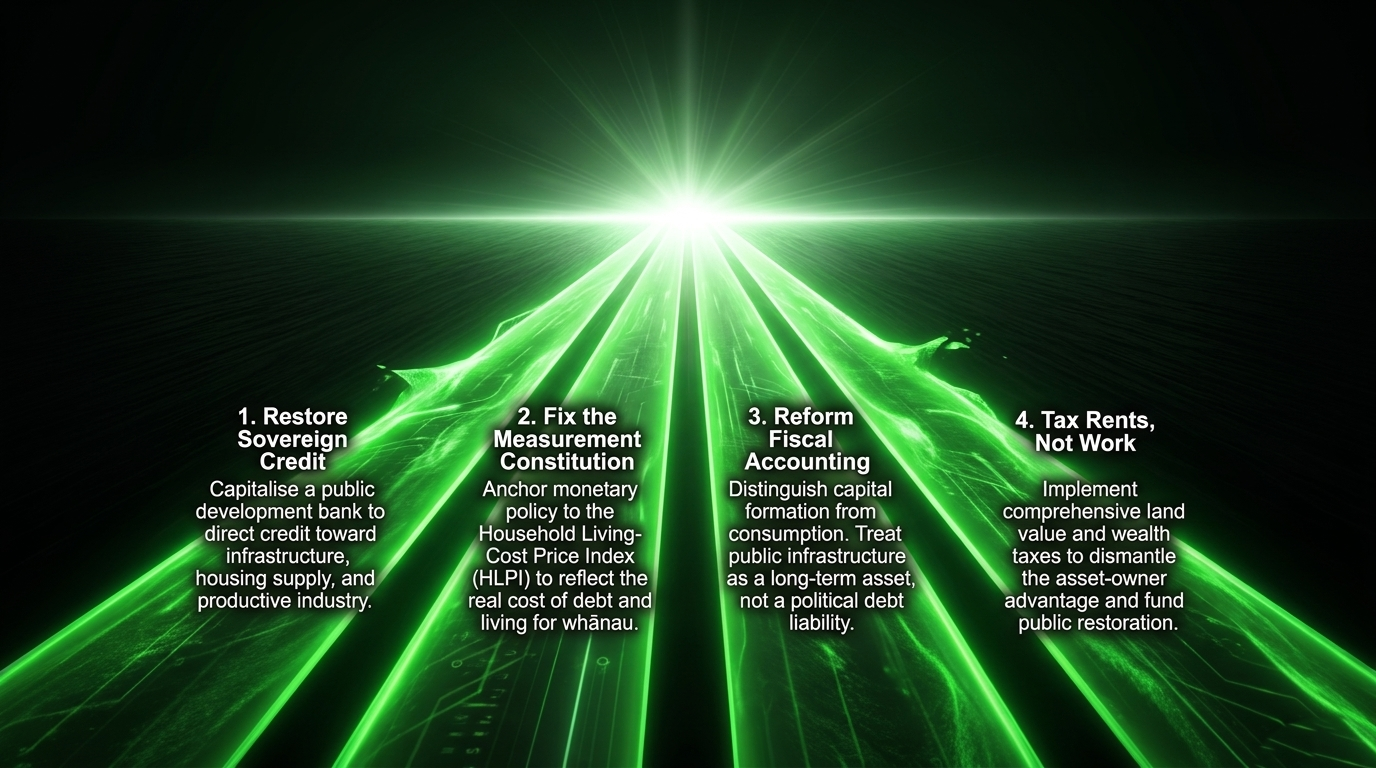
It requires rebuilding all four constitutional layers:
- Restore sovereign development credit — a public development bank, capitalised and mandated to direct credit toward infrastructure, housing supply, and productive industry that the private mortgage machine ignores.
- Fix the measurement constitution — replace CPI as the sole inflation anchor with a framework that includes housing-credit dynamics, Household Living Cost Indexes (HLPIs), and essential domestic cost pressures actually experienced by whānau.
- Reform fiscal accounting — distinguish between capital formation and consumption spending so that a new hospital appears on the Crown balance sheet as an asset, not a debt, ending the political cowardice that produced a $200 billion infrastructure deficit.
- Tax the rents, not the work — a comprehensive land value tax and wealth tax on the asset owners who have benefitted from thirty-five years of the Treasury Trap, to fund the restoration of public institutions.
As Stopford argues in his Substack archive, every period of genuine sovereign credit in New Zealand's history built assets; every period of captured or privatised credit built liabilities. Public credit built the nation. Private credit is enslaving it.
Whakakapi — Moral Clarity
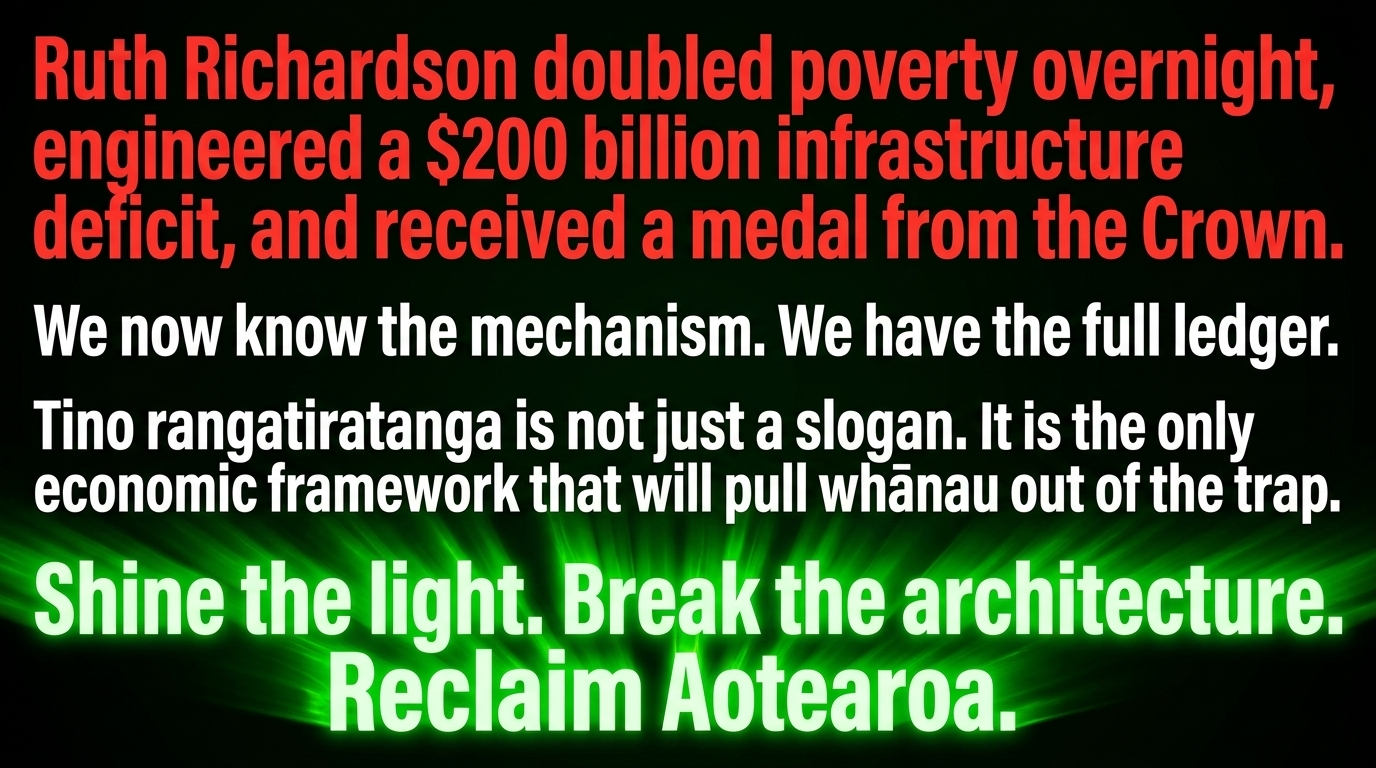
Ruth Richardson built a machine that doubled poverty overnight, hospitalised tamariki, destroyed Māori economic foundations, handed Aotearoa's money supply to offshore banks, engineered a $200 billion infrastructure deficit, and concealed the entire mechanism behind a measurement system that told the government everything was fine.
The Jackalman Blog summarised the public reaction plainly: she got a damehood for wrecking New Zealand. The Crown gave her a medal. The Māori Green Lantern names it for what it is: the colonial state honouring the colonial project.
Jim Bolger
— the Prime Minister who oversaw it
— called it a failure before he died.
The people who designed it call it a constitutional innovation. Thirty-five years later, 23.9% of tamariki Māori go hungry in a country that can feed the world. That is not policy failure.
That is policy success — for those it was designed to serve.
Tadhg Stopford drew the constitutional map. The Māori Green Lantern is here to walk every whānau through it until the wall comes down.
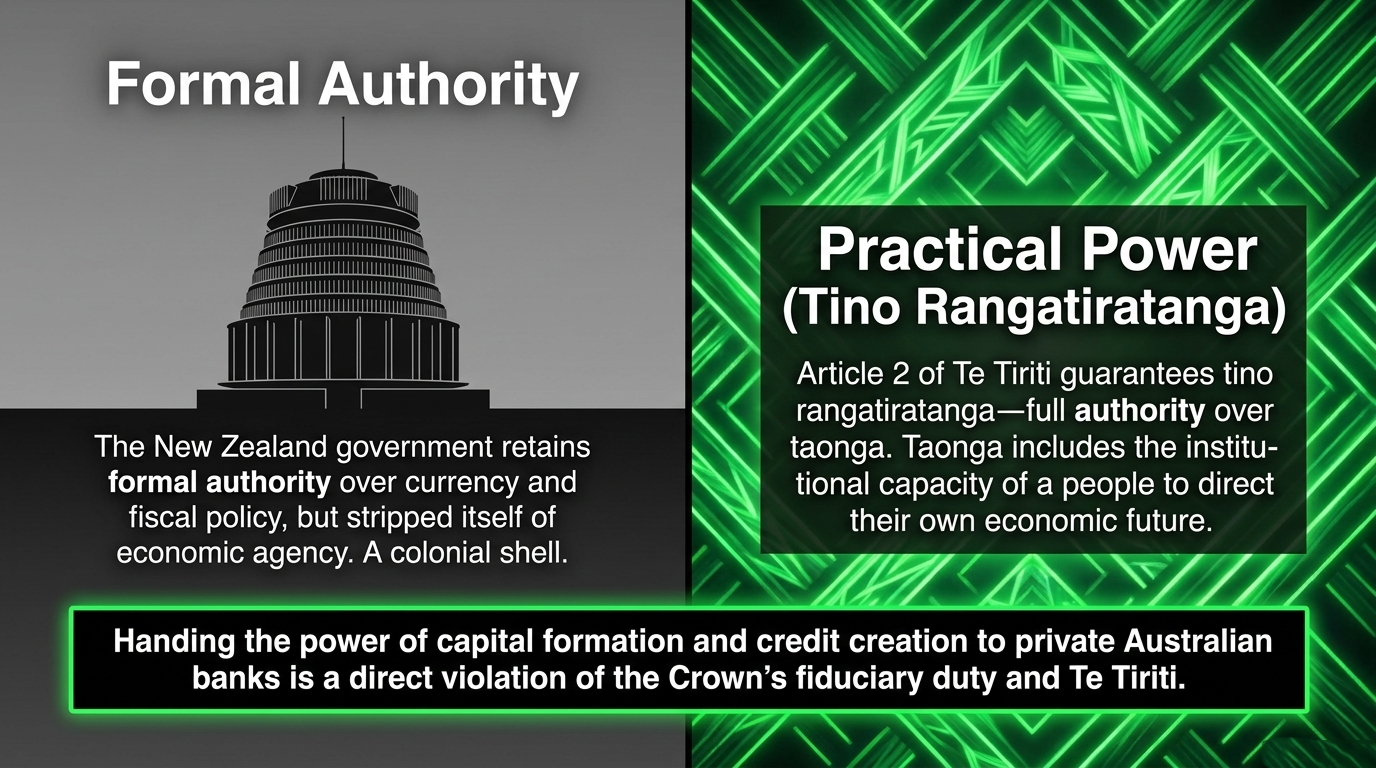
Tino rangatiratanga is not a slogan. It is the only economic framework that will pull whānau out of the trap Richardson built. Name the architect. Name the network. Name the harm. Do not stop naming until it is remedied.
He Tono Koha — A Personal Call to Action
This essay took me deep into the 1991 Mother of All Budgets, through the constitutional machinery that dismantled Aotearoa's sovereign credit institutions, and into the $200 billion infrastructure deficit those decisions left behind. I named the harm being done to tamariki Māori — 23.9% still in material hardship in 2026. I named the architect. I named the network. I named the legal breaches.
That work is not free. Here is what it took — and here is why your response matters.
Ruth Richardson's ruthanasia programme stripped whānau of welfare, of development credit, of institutional protection — and then handed our money supply to Australian banks. To prove that, I traced the mechanism through constitutional law, Treasury documents, RBNZ data, child poverty statistics, and Tadhg Stopford's Full Ledger (March 2026).
That is what I do. Forensic political analysis. Whakapapa of power. Named, sourced, and delivered free to every whānau that needs it.
No subscription wall. No shareholder suppressing my conclusion. No advertiser whose bank profits from the system I am exposing.
I am one person. I do this on koha.
He Aha Te Koha? — What Koha Means to Me
Koha is not a transaction. I am not selling you content. Koha is a tikanga-grounded act of reciprocity
— manaakitanga, whanaungatanga, and rangatiratanga expressed through contribution, as stated on my koha page.
As I say on that koha page,
“Koha reflects tikanga: manaakitanga, whanaungatanga, rangatiratanga. Your koha directly funds research, international networks, and the Green Lantern Corps multiplying this framework across Indigenous media.”
When you contribute, you are not paying for something you already read. You are investing in the next whānau who reads this essay and finally has words for something they have felt in their bones since 1991.
He Kōrero Tika — What I Do With Your Koha
I have published over 1000 essays, built a readership with a 41% open rate (industry standard 22%), and sustained this kaupapa without corporate funding.
Every dollar of koha goes directly to:
- Research time — reading Treasury documents, Waitangi Tribunal reports, RBNZ data, and Full Ledgers so you do not have to.
- Verification — checking every URL, every claim, every name before I publish.
- The Green Lantern Corps — extending this analytical framework across Māori and Indigenous media.
- Keeping it free — so that a beneficiary whānau in Flaxmere and a lawyer in Tāmaki Makaurau read the same essay with the same access.
My current koha target is $20,000, with $6440 raised at the live page capture.
Give what you can, when you can. Nothing is too small. Nothing is obligatory.
Ngā Ara Tautoko — How You Can Support Me
I know not everyone can koha with money right now. That is okay. Here are four ways to support, and all of them matter:
- Koha directly via Koha.kiwi or bank transfer to HTDM 03-1546-0415173-000 as listed on my About page
- Subscribe free at themaorigreenlantern.maori.nz
- Follow and share via Facebook
- Kōrero about the essay at your kai table, in your rōpū, in your classroom, in your union, in your marae.
If you cannot koha — subscribe, follow, kōrero, share. That is koha.
Every koha funds rangatiratanga's own truth-tellers. Every share puts evidence into the hands of whānau the state would rather keep uninformed. Every kōrero is a taiaha passed on.
Ko au ko Ivor Jones — Te Māori Green Lantern.
www.themaorigreenlantern.maori.nz
*Views expressed constitute honest opinion on matters of public interest under the Defamation Act 1992 (NZ) and Durie v Gardiner