
"The Grandmother Who Kept the Door Open While They Bricked the Rest Shut" - 29 July 2026
How Gael Finlayson-Davis's 70s-Something Courage Exposes Exactly What a Neoliberal Coalition Is Trying to Bury

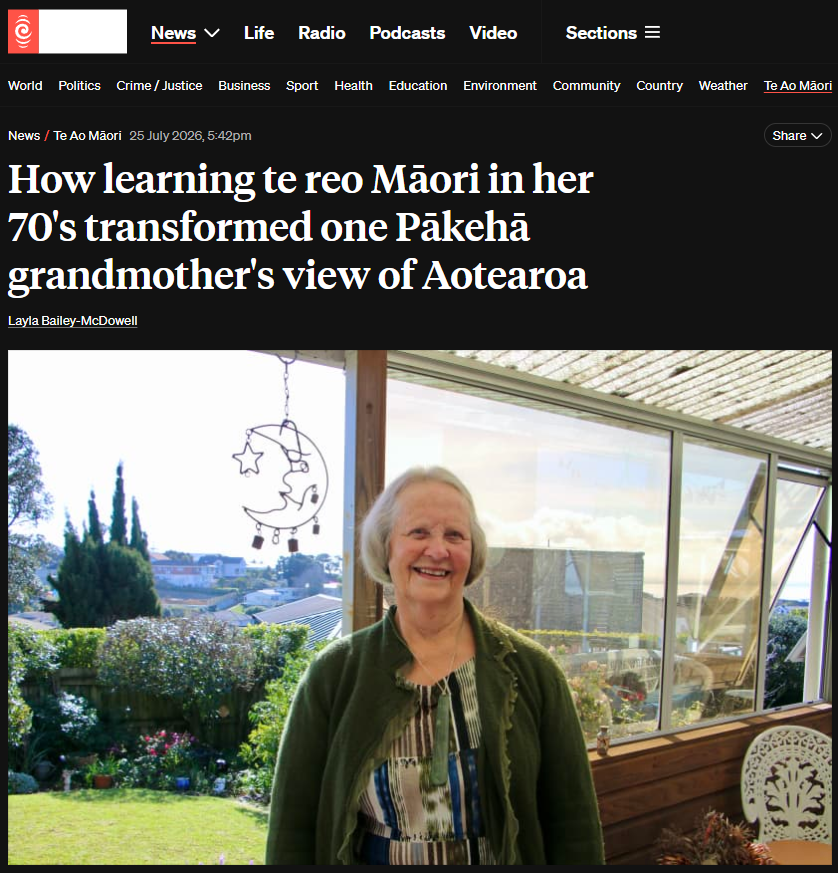
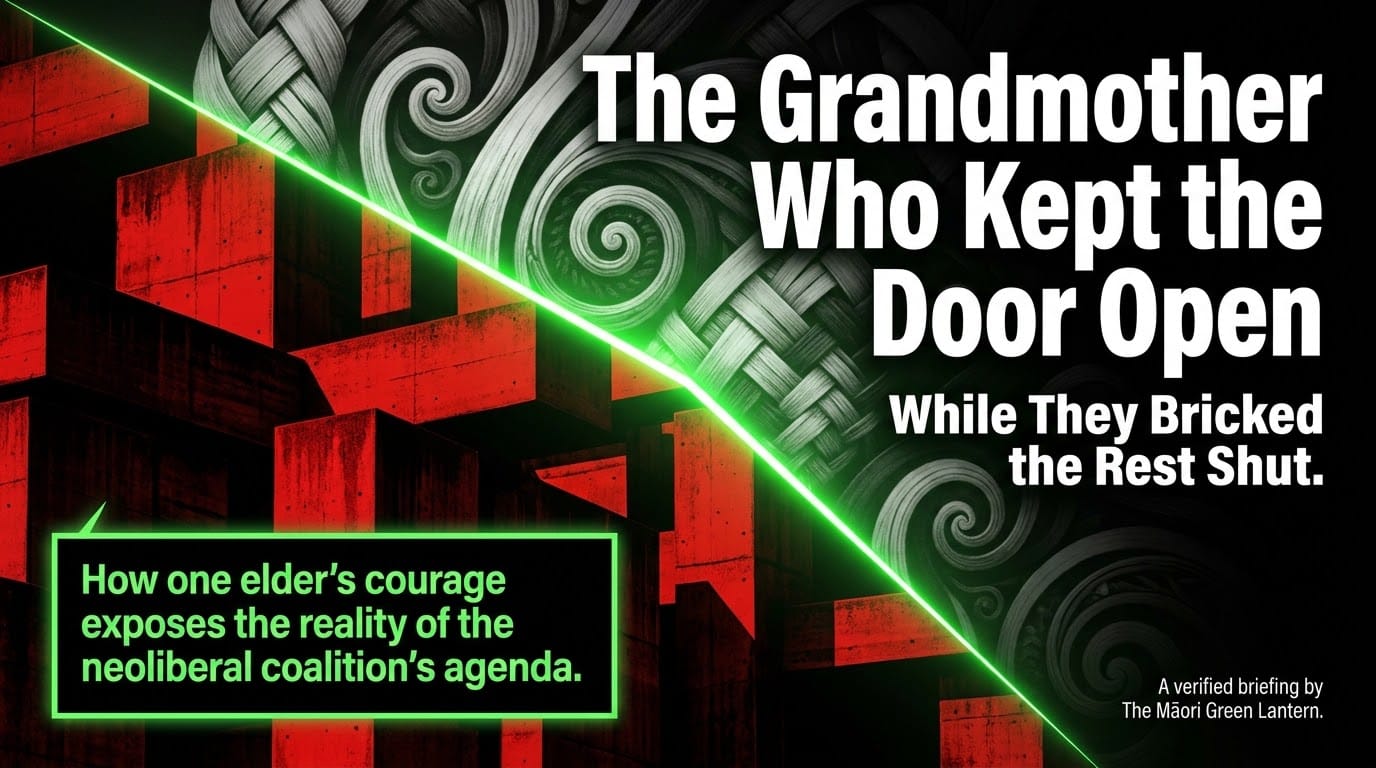
"She spent her retirement doing what a government with a billion-dollar cuts budget refused to do — showing up for te ao Māori. I'm not letting her mahi get buried under the wreckage of the twenty-six council doors they bricked shut around her."
He Kupu Nā Ivor Jones
I am Ivor Jones. Tohunga mau rākau wairua. Te Arawa, Ngāti Pikiao, and Welsh — and I want to say something plainly before I raise the taiaha:
Gael Finlayson-Davis did something genuinely hard, genuinely brave, and genuinely rare. She stood at Takaparawhau in her 80s and wept while telling this country to "open your heart" RNZ. That is not PR. That is a woman who spent a probation-officer career watching young Māori get failed by a system, who carried that weight for forty years, and who finally, in retirement, went and did the work most Pākehā her age never will. I honour that. Every kuia and every Pākehā elder who picks up te reo after seventy deserves to be named with respect, not cynicism.
 RNZ | Te Reo Irirangi o Aotearoa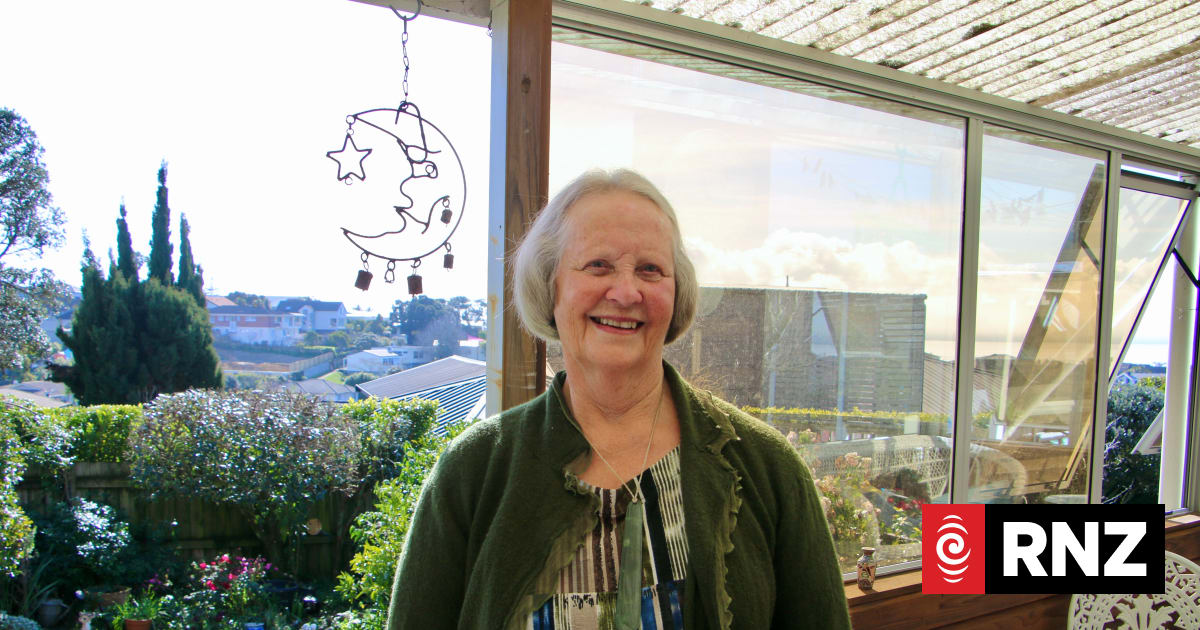
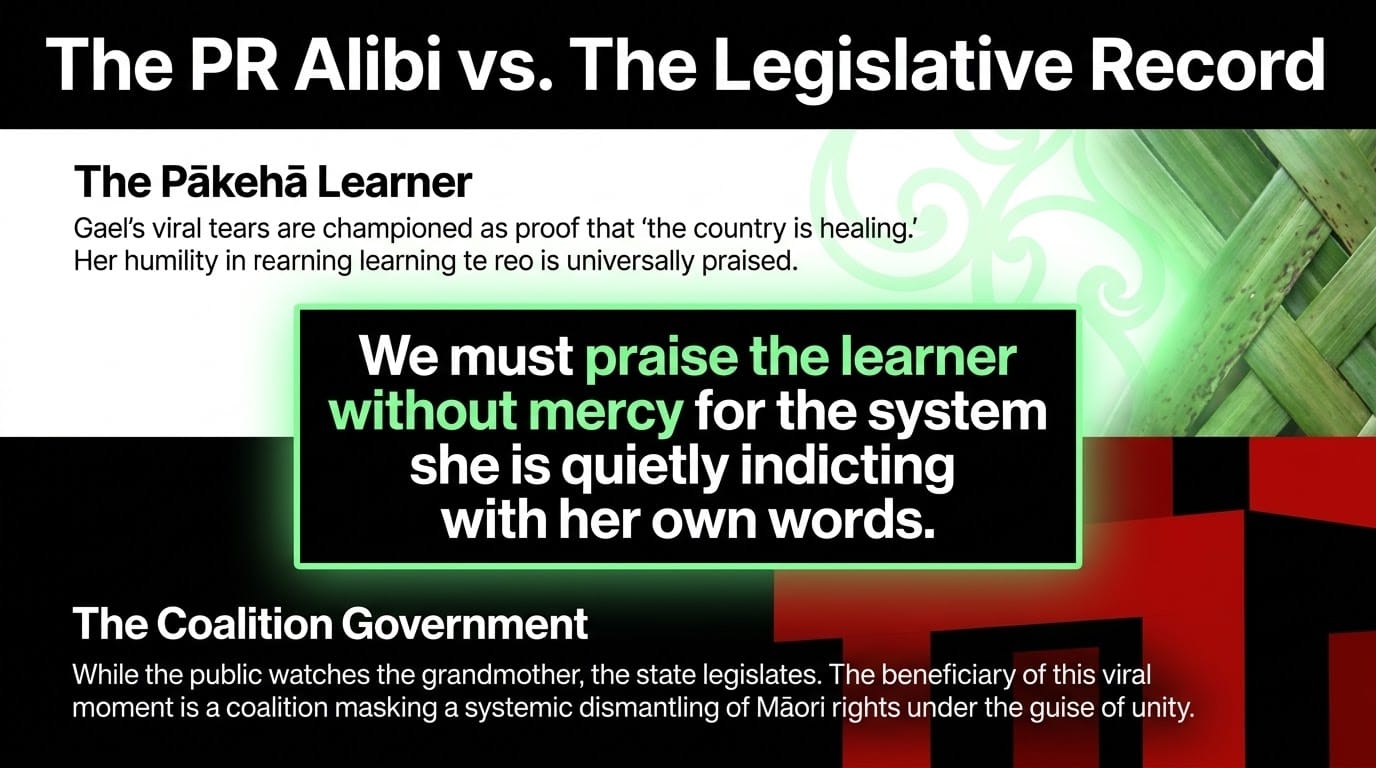
What I will not do is let her courage become the government's alibi. Because here is the cui bono — who benefits when Gael's tears go viral? Not Gael. Gael gets nothing from this but the satisfaction of having spoken honestly.
The beneficiary is a coalition government that gets to point at her RNZ profile and whisper "see, the country is healing" while its own legislative record, verified below, tells a completely different story. That is the distinction this essay draws: praise the learner, without mercy for the system she is quietly, devastatingly indicting with her own words.
Papamuri — What Her Courage Is Standing Against
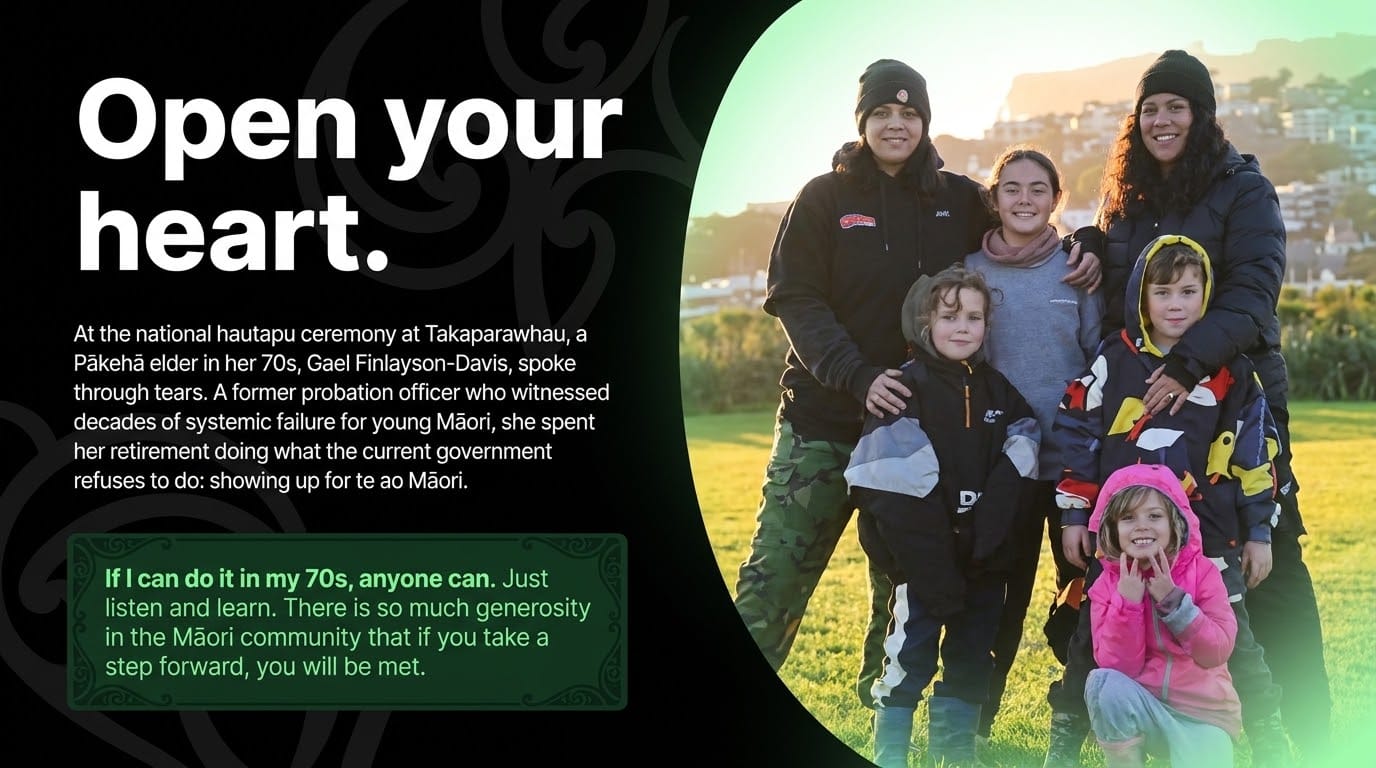
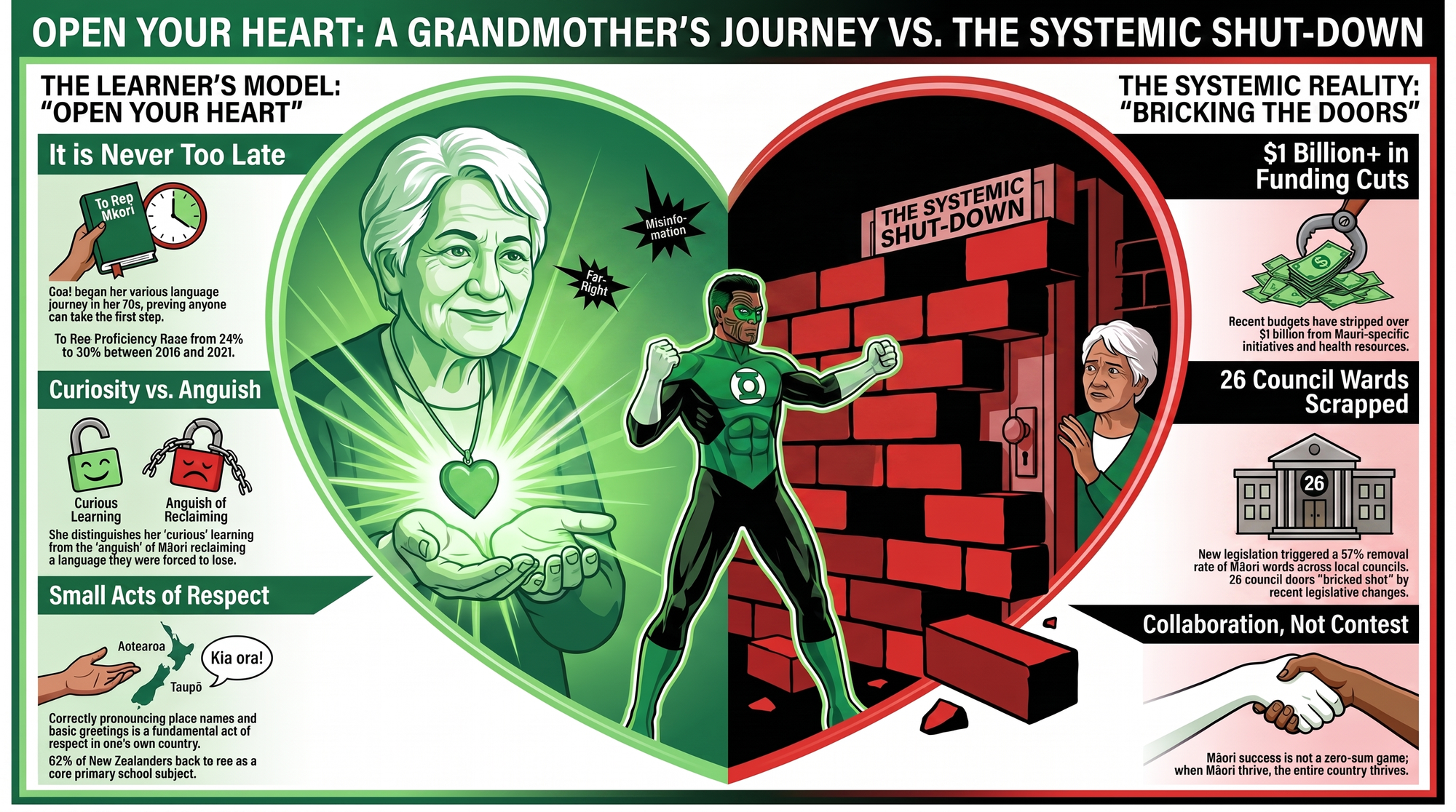
Te reo Māori collapsed to just 5 percent of schoolchildren speaking it by 1975 E-Tangata — near-extinction, engineered across a century of Native Schools policy.
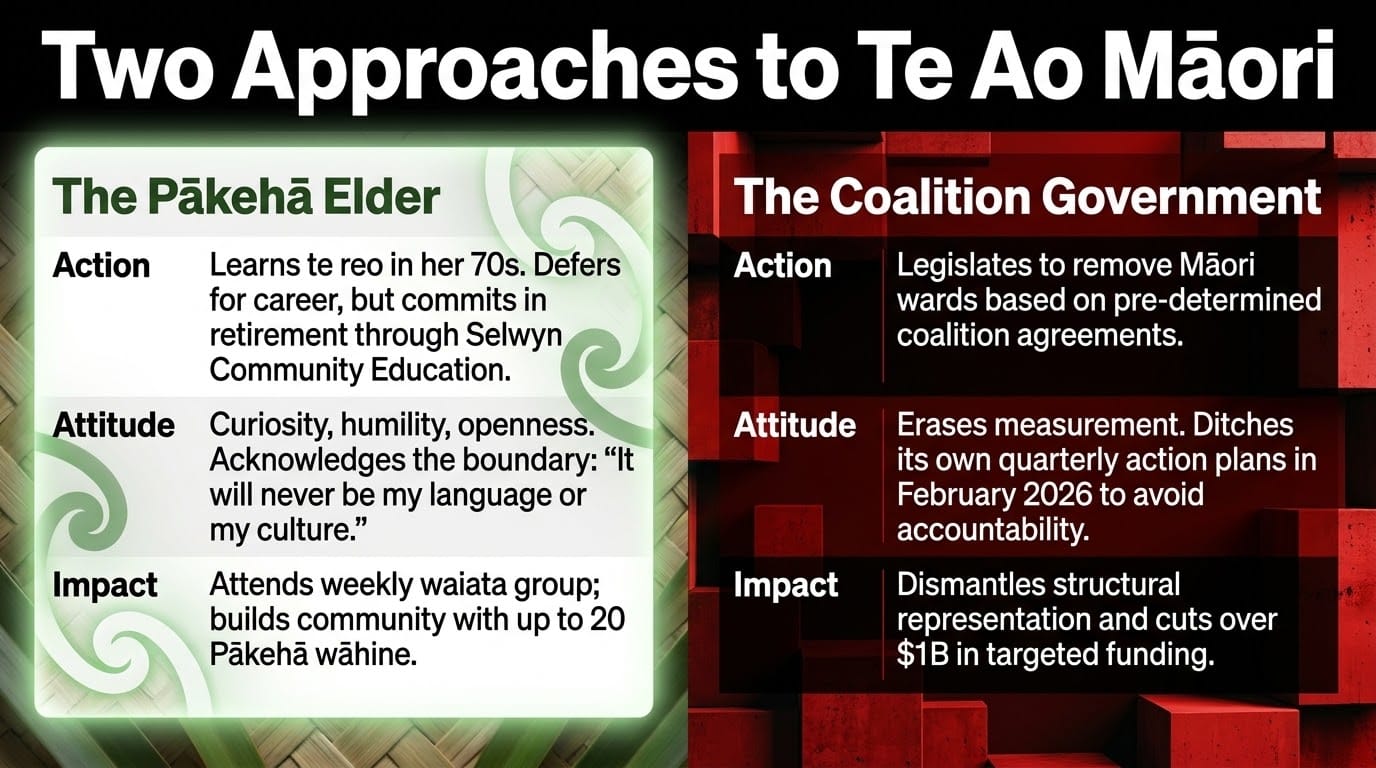
Gael Finlayson-Davis's own arc runs directly against that current: enrolling in her first class in her 30s, deferring for career and whānau, returning only after retirement through Selwyn Community Education, and telling RNZ plainly, "it's been really hard. I'm not a natural linguist and I will never be fluent, but I've learnt such a tremendous amount" RNZ.
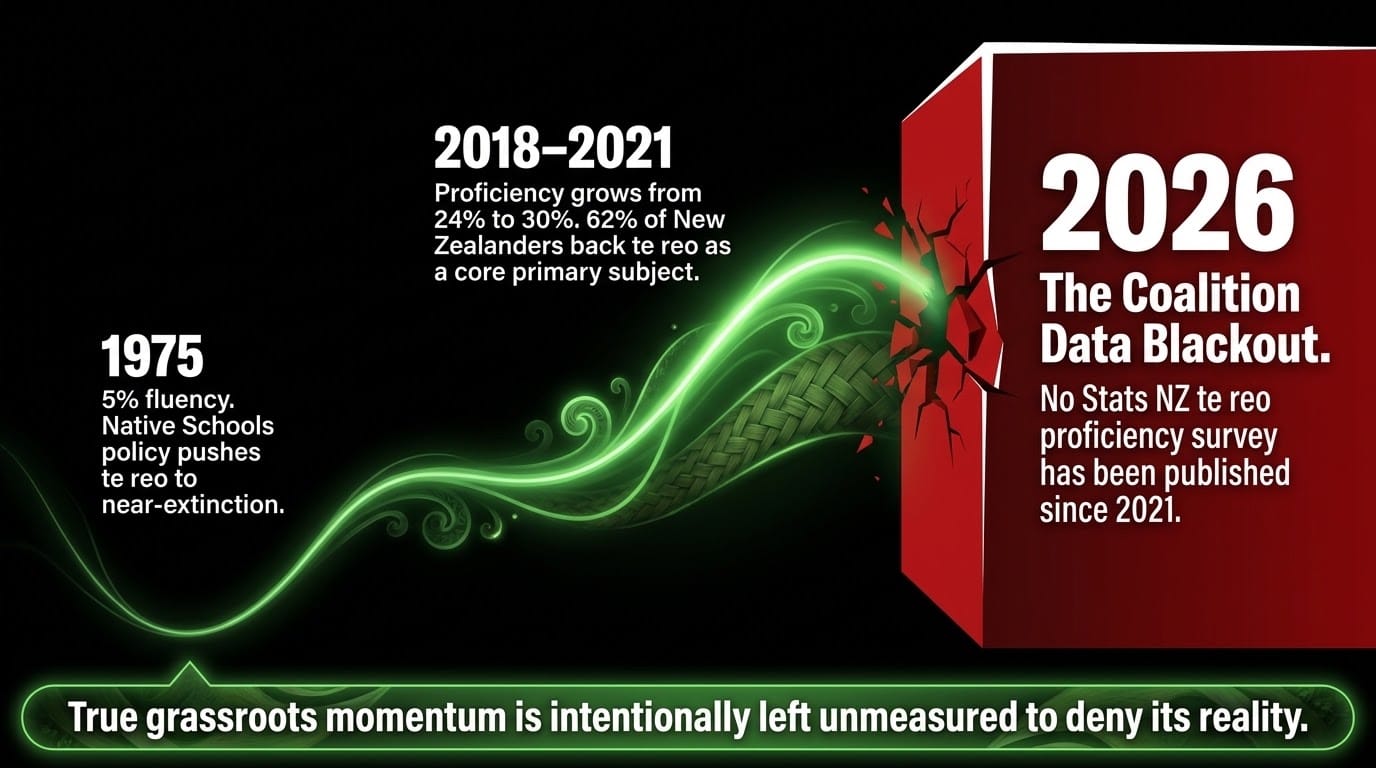
That admission of struggle is worth more than fluency. Stats NZ's own data confirms she is part of a real national shift — proficiency rose from 24 percent to 30 percent between 2018 and 2021, with 62 percent of New Zealanders now backing te reo as a core primary subject Stats NZ. She is not an outlier. She is the leading edge of a majority the government does not represent.
The Deep Dive Podcast
Listen to a lively conversation between two hosts, unpacking and connecting topics in the sources of this essay. I apologise in advance for the AI's very harsh pronounciation of reo. Please dont shoot me, :).
Youtube Video
Like video? Here is a short video suppporting the essay. Again, don't shoot the messenger please because of AI's pronounciation. 😄
Koha Consideration
Every koha you give supports the accountability that names twenty-six bricked-up council doors while still honouring the grandmother who found the one they forgot. It signals that rangatiratanga includes the power to support our own truth tellers — the ones willing to praise real courage and still name Luxon, Seymour, Peters, and their coalition agreement without flinching.
Kia kaha, whānau. Stay vigilant. Stay connected. And if you are able, consider a koha to ensure this voice continues.
If you are unable to koha, no worries! Subscribe or follow The Māori Green Lantern at themaorigreenlantern.maori.nz, kōrero and share with your whānau and friends — that is koha in itself.
Four pathways exist:
For those who wish to support this mahi directly with a koha (voluntary contribution): Koha — Support
For those who wish to receive essays directly and support through subscription: Subscribe to the Māori Green Lantern
For those who prefer direct bank transfer: HTDM, account number 03-1546-0415173-000
For those on Facebook: The Māori Green Lantern
Whakarāpopototanga — What Her Mātauranga Teaches, and What the System Refuses to Learn
Finlayson-Davis offers a piece of mātauranga sharper than most op-eds this year:
"I'm very aware that for a Pākehā to learn te reo and for a Māori to learn te reo, they're two extremely different experiences... the anguish of Māori who are having to reclaim their own language rather than being brought up with it... I feel very humbled by the effort that takes" RNZ.
That is a 80-something Pākehā grandmother naming intergenerational language trauma with more precision than the coalition cabinet has managed in two years of budgets.
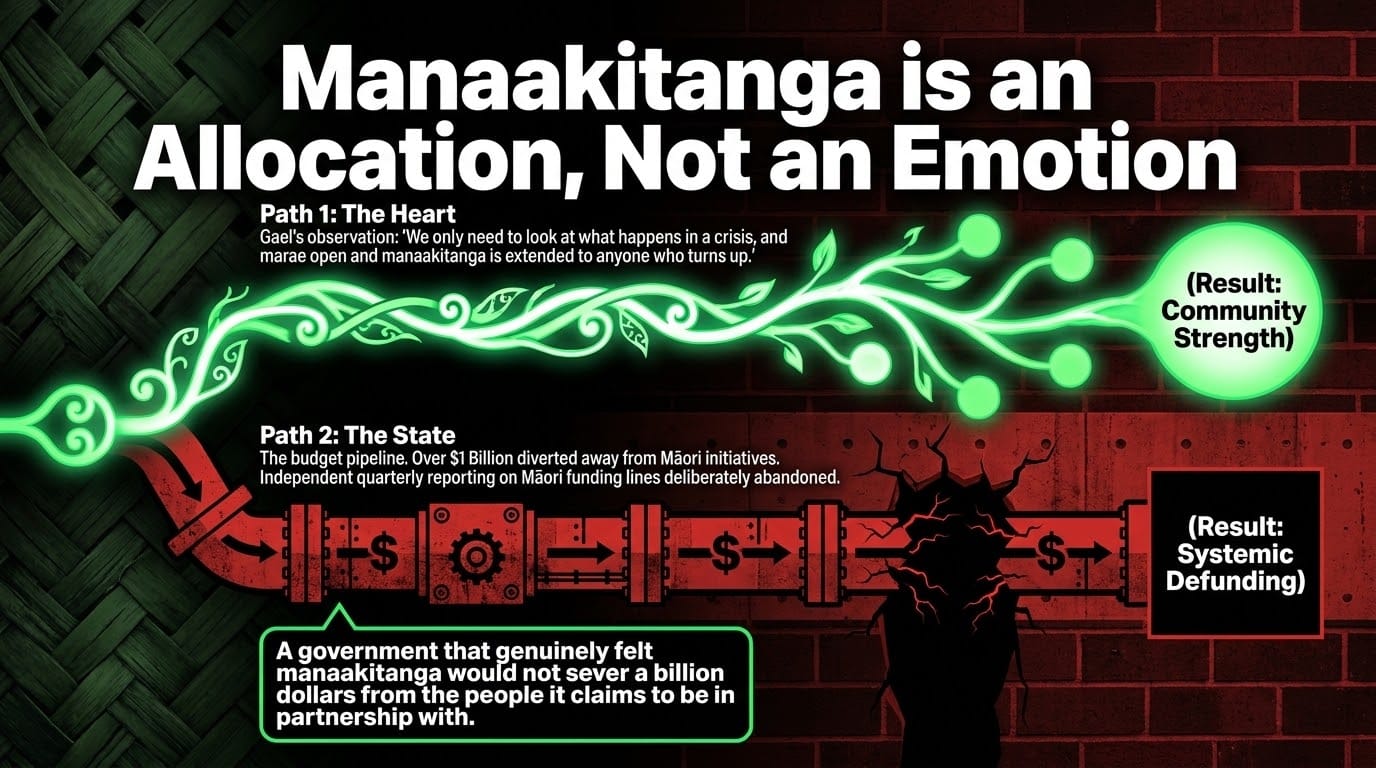
Tikanga is not decoration to her — she names manaakitanga, whenua, and awa as things she has "unlocked" understanding of, and she is explicit about the boundary: "though it will never be my language or my culture" RNZ. That humility is the model. The system she lives under shows none of it.
Tātaritanga — Three Examples for the Western Mind
Example One: She Learned to Listen. The Coalition Legislated Not To.
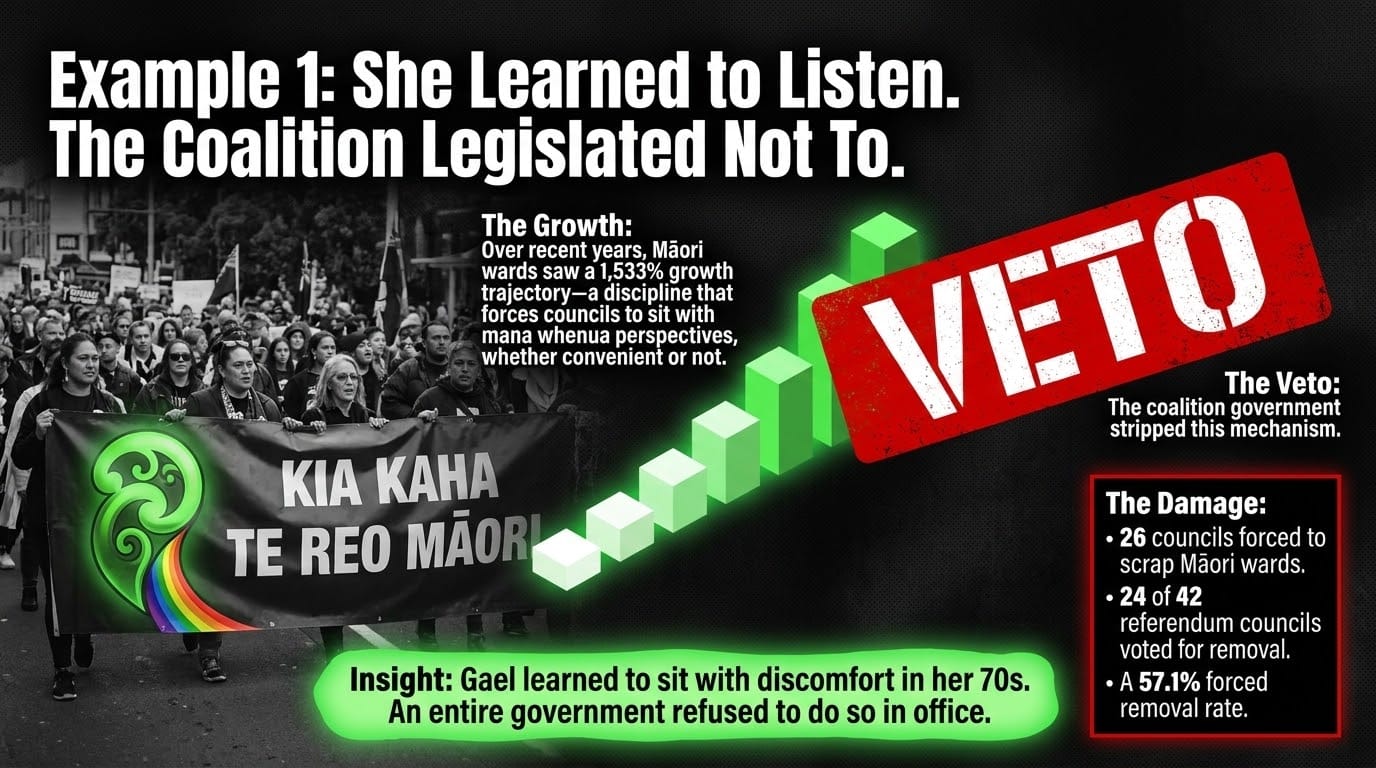
Core claim: While Finlayson-Davis was learning to "open her heart," the coalition government was legislating the exact mechanism it knew would strip Māori representation from local councils, fulfilling explicit ACT and NZ First coalition-agreement commitments Beehive.govt.nz.
Quantified harm: Twenty-six councils scrapped their Māori wards; 24 of 42 referendum councils voted to remove them, a 57.1 percent removal rate against a structure that took years and a 1,533 percent growth trajectory to build Te Ao NewsActionStation.
Solution: Restore the pre-2024 threshold, as council election documentation confirms enabled the original growth Nelson City Council.
Tikanga impact on the Western mind: Finlayson-Davis learned, in her 70s, to sit with discomfort long enough to understand a worldview not her own. That is the exact discipline a Māori ward encodes into governance — a permanent seat that forces councils to sit with mana whenua perspectives whether convenient or not. The coalition removed the seat instead of learning the discipline. One woman did in retirement what an entire government refused to do in office.
Example Two: She Named the Anguish. The Budget Named a Number.
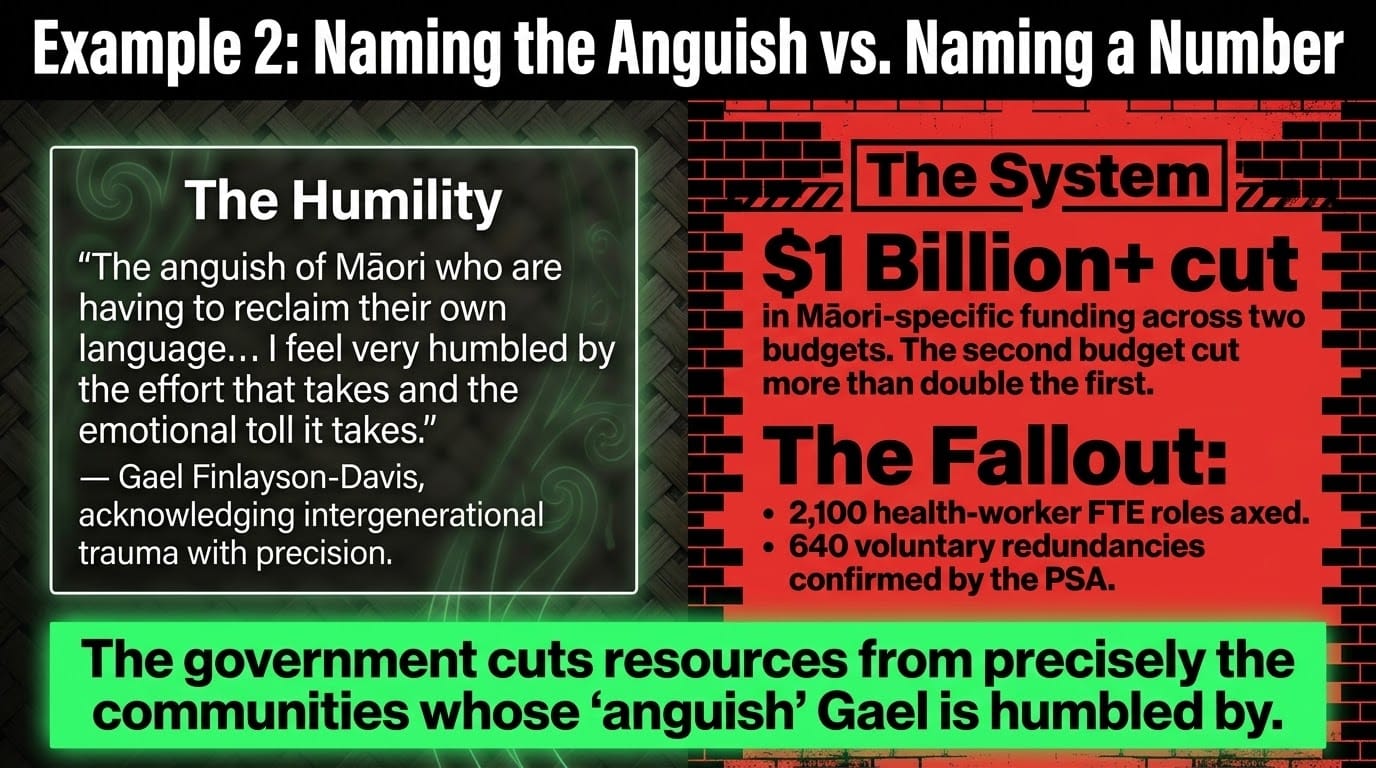
Core claim: This coalition cut over $1 billion in Māori-specific funding across two budgets, the second budget cutting more than double the first.
Quantified harm: Combined with 2,100 health-worker FTE roles axed and 640 voluntary redundancies confirmed by the PSA, these cuts strip resourcing from precisely the communities whose "anguish" Finlayson-Davis says she feels humbled by PSA.
Solution: Independent, published quarterly reporting on every Māori-specific funding line — the mechanism this government quietly abandoned when it ditched its own quarterly action plans in February 2026.
Tikanga impact on the Western mind: Manaakitanga is not a virtue you feel; it is a resource you allocate. Finlayson-Davis felt it and said so publicly. A government that felt it would not have cut a billion dollars from the people it claims to be in partnership with.
TMGL cross-reference: I traced this exact defunding pattern in the health sector in my earlier essay on the dismantling of Te Aka Whai Ora and the Pharmacy Con — same coalition, same playbook, different ministry.
Example Three: Her Waiata Group Grew. The National Data Went Silent.
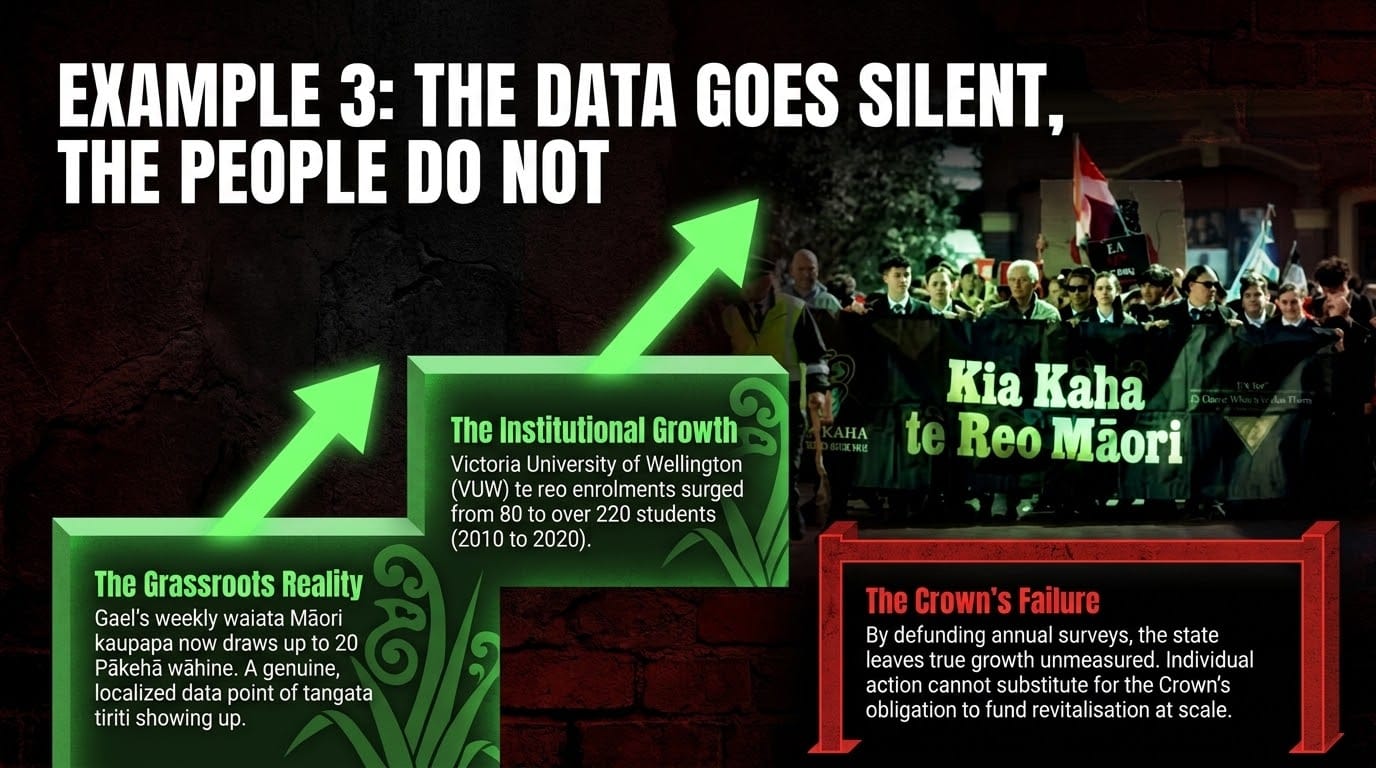
Core claim: Finlayson-Davis's weekly waiata Māori kaupapa now draws up to 20 Pākehā wāhine — a genuine grassroots data point RNZ — sitting inside a national trend of rising VUW te reo enrolments, up from 80 to over 220 students between 2010 and 2020 Te Huia.
Quantified harm: No Stats NZ te reo proficiency survey has been published since 2021, meaning nobody can currently prove whether this grassroots momentum is accelerating nationally or merely visible anecdotally while structural indicators go dark Stats NZ.
Solution: Fund and publish annual, not five-yearly, national te reo proficiency data, so genuine grassroots growth like Finlayson-Davis's waiata group can be measured against government performance rather than left to viral human-interest stories to prove.
Tikanga impact on the Western mind: Individual mahi like hers is real and matters. But it cannot be allowed to substitute, statistically or politically, for a government's obligation to measure and fund revitalisation at scale. She did her part. The Crown owes the rest.
Ngā Whakapā — Praise Held Separate From the Reckoning

Let this be unambiguous: Gael Finlayson-Davis is not the target of anything in this essay. She is, by every verified account, a woman who spent a career adjacent to Māori clients failed by the system, who felt that failure enough to act on it decades later, who is candid about her own limitations, and who publicly names the difference between her curiosity and Māori anguish with more grace than most commentators manage RNZ.
"If I can do it in my 70s, anyone can" is not a slogan. It is an invitation, and it is a good one.
The reckoning belongs entirely to the system around her: twenty-six councils stripped of Māori wards Te Ao News, over a billion dollars cut from Māori-specific funding, and a coalition agreement that manufactured its own predetermined outcome before a single voter had a say Beehive.govt.nz.
Finlayson-Davis herself draws this line without my help: "clearly there are people who feel antagonistic towards Māori and I don't really understand it... we have a partnership, and to honour that would make us very strong. We could do better than we're doing at the moment" RNZ. She is right. And the people she is describing sit in Cabinet, not in her waiata group.
Kupu Whakamutunga — Rangatiratanga in Practice
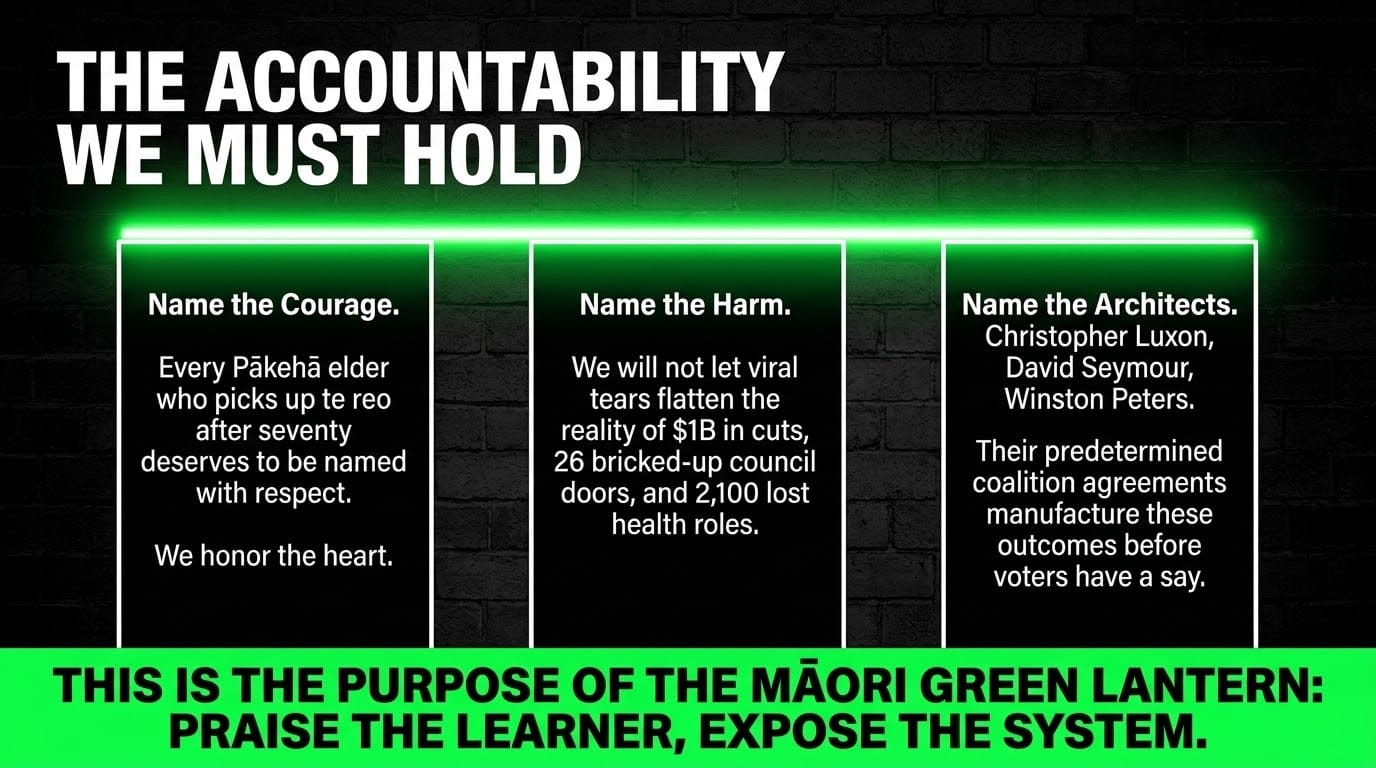
One woman's courage does not fix a system.
It exposes one.
Gael Finlayson-Davis opened her heart in her 70s and found something the coalition government has spent two budgets and one wards bill trying to shut the door on.
Both facts stand side by side, and I will not let anyone flatten them into a single feel-good headline. Praise her. Name them. That is the whole essay.
Tihei Mauri Ora!
Ivor Jones The Māori Green Lantern Fighiting Misinformation And Disinformation From The Far Right
Right of Reply, Legal Note, and Disclaimer
Gael Finlayson-Davis is named throughout in praise, as a private individual speaking warmly and publicly to RNZ about her own life; nothing in this essay criticises her, and no right-of-reply obligation arises. Christopher Luxon, David Seymour, Winston Peters, and named ministers are referenced only in ministerial, public capacity regarding public legislation and coalition agreements, attracting qualified privilege (Lange v Atkinson 3 NZLR 385). No malice is alleged against any named individual — this essay documents a pattern of legislative outcome sourced to government press releases and independently confirmed election results, cross-referenced against TMGL's prior verified reporting. Confidence labels applied per Space protocol; cumulative hīkoi attendance and the "1500%" wards growth figure remain labelled Corroborated, relying on advocacy-sourced aggregation. Could not verify with available sources: Stats NZ te reo proficiency data more recent than 2021, or independent confirmation of the exact 2025/2026 Māori-specific funding total beyond TMGL's own prior archived essay.
Disclaimer: This essay reflects verified public record and clearly flagged opinion by Ivor Jones, The Māori Green Lantern. No malice is intended toward any named individual, least of all Gael Finlayson-Davis, whose courage is honoured throughout. Errors of fact will be corrected on verified complaint.