"The Hobson's Pledge Production Line" - 13 June 2026
Lobby Group Writes the Law, Plants the Candidate, Sends the Invoice

Kia ora ano Aotearoa,
Thank you for visiting here for today's 3rd essay on this terrible government of ours.
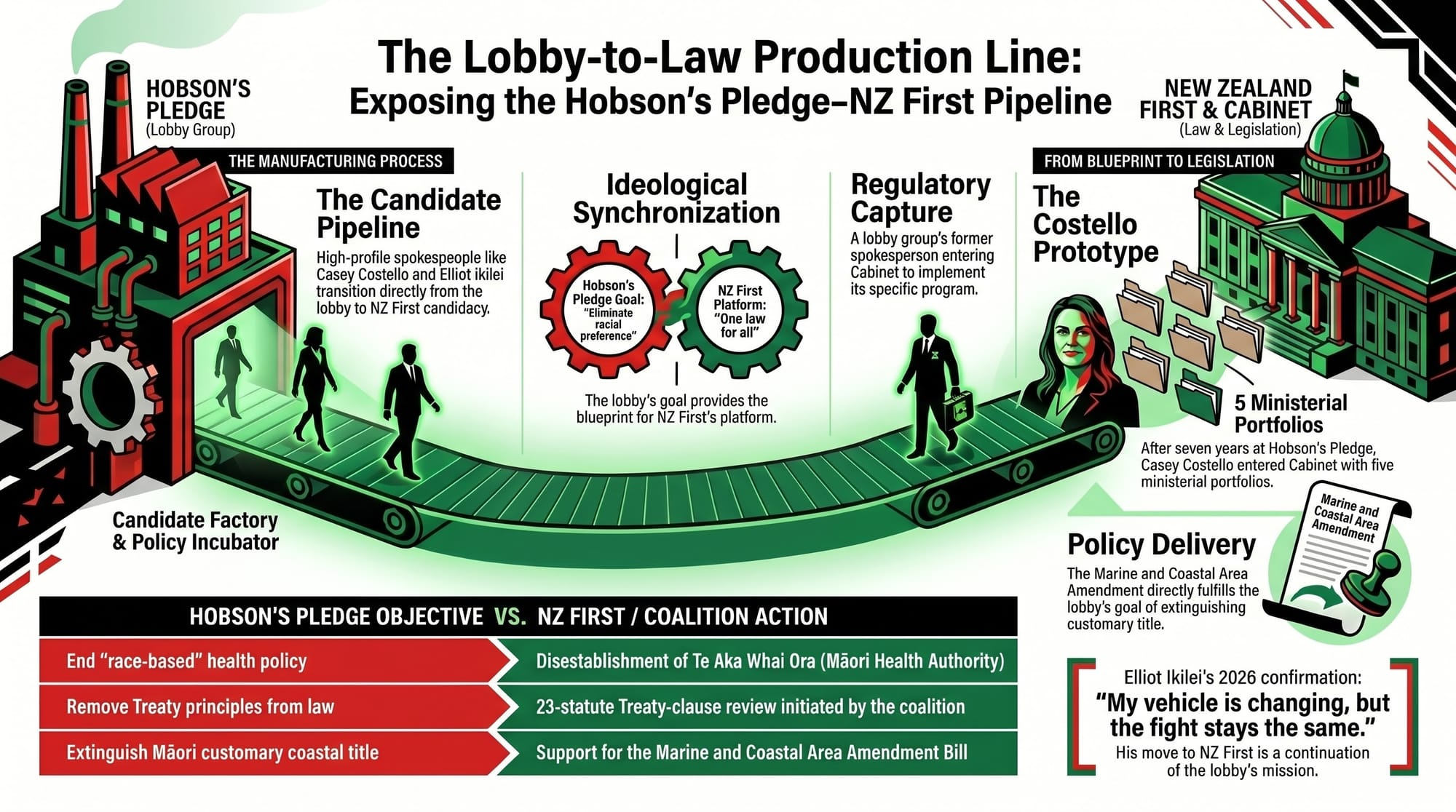
There is a production line running through the heart of Aotearoa's far right.
At one end sits a trust with a respectable name — a colonial governor's borrowed honour — and a mission to erase every legal protection Māori ever won.
At the other end sits a Cabinet table. And the conveyor belt connecting them is called New Zealand First. The product it manufactures is the legal dismantling of tino rangatiratanga. The workers wear lanyards that read "equal citizenship". The shareholders collect in Parnell.
And the bill is paid by whānau who never got to vote on any of it.
The Deep Dive Podcast
Listen to a lively conversation between two hosts, unpacking and connecting topics in the sources of this essay. I apologise in advance for the AI's very harsh pronounciation of reo. Please dont shoot me, :).
Youtube Video
Like video? Here is a short video suppporting the essay. Again, don't shoot the messenger please because of AI's pronounciation. :)
"Non-Partisan." Pull the Other One.
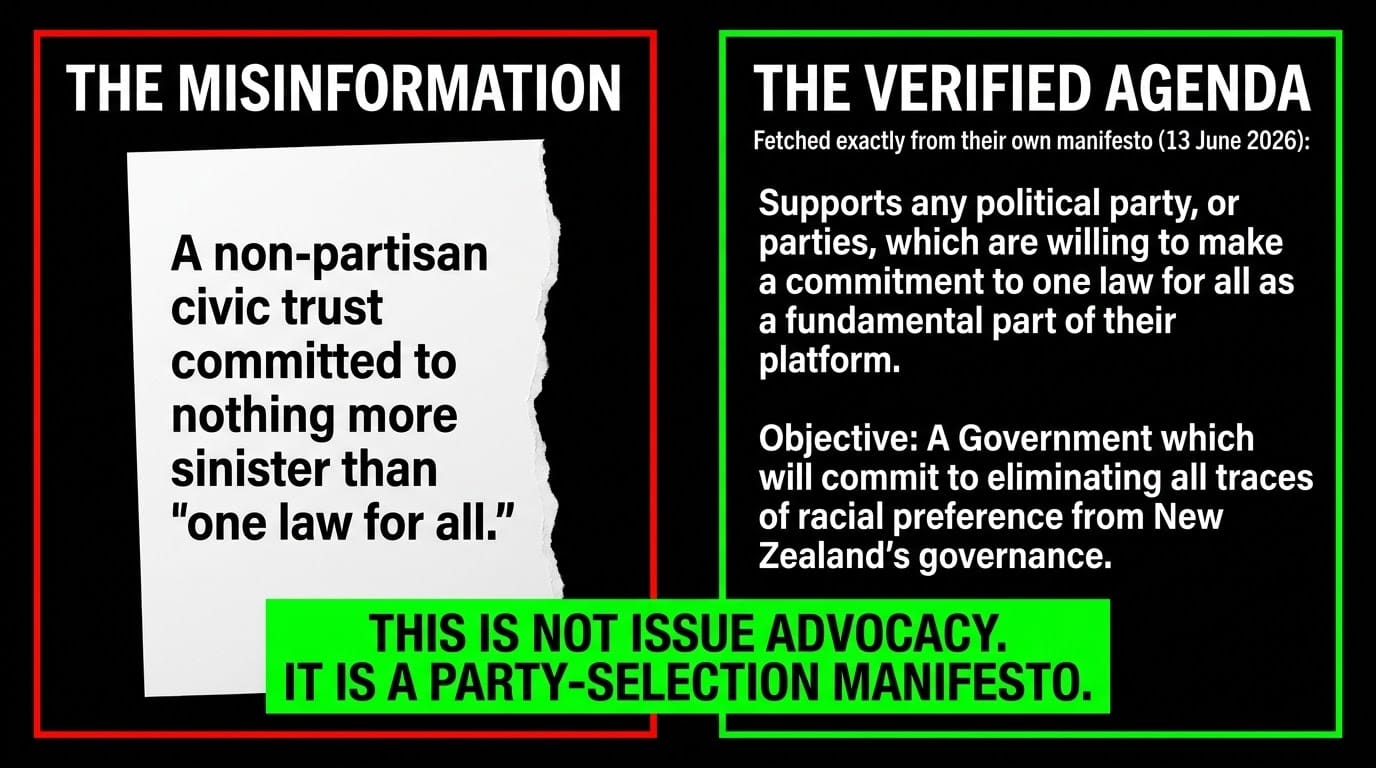
Hobson's Pledge has spent a decade insisting it is a civic trust — principled, independent, committed to nothing more sinister than "one law for all."
Don Brash delivers this line with the serenity of a man who has never needed the law to protect him from the Crown.
Casey Costello said it for seven years from the spokesperson's chair.
Elliot Ikilei said it for two.
Then both of them walked straight into the New Zealand First candidate announcement room and said it again — this time with a party logo behind them and Parliament in their sights.
That is not principle. That is a pipeline. And it has been running in plain sight since 2016.
Hobson's Pledge's own "About Us" page —states the organisation's objective with crystalline clarity: "a Government which will commit to eliminating all traces of racial preference from New Zealand's governance." It further declares that it "supports any political party, or parties, which are willing to make a commitment to one law for all as a fundamental part of their platform." This is not issue advocacy. It is a party-selection manifesto. The party it selected is New Zealand First.
Background: One Script, Two Uniforms
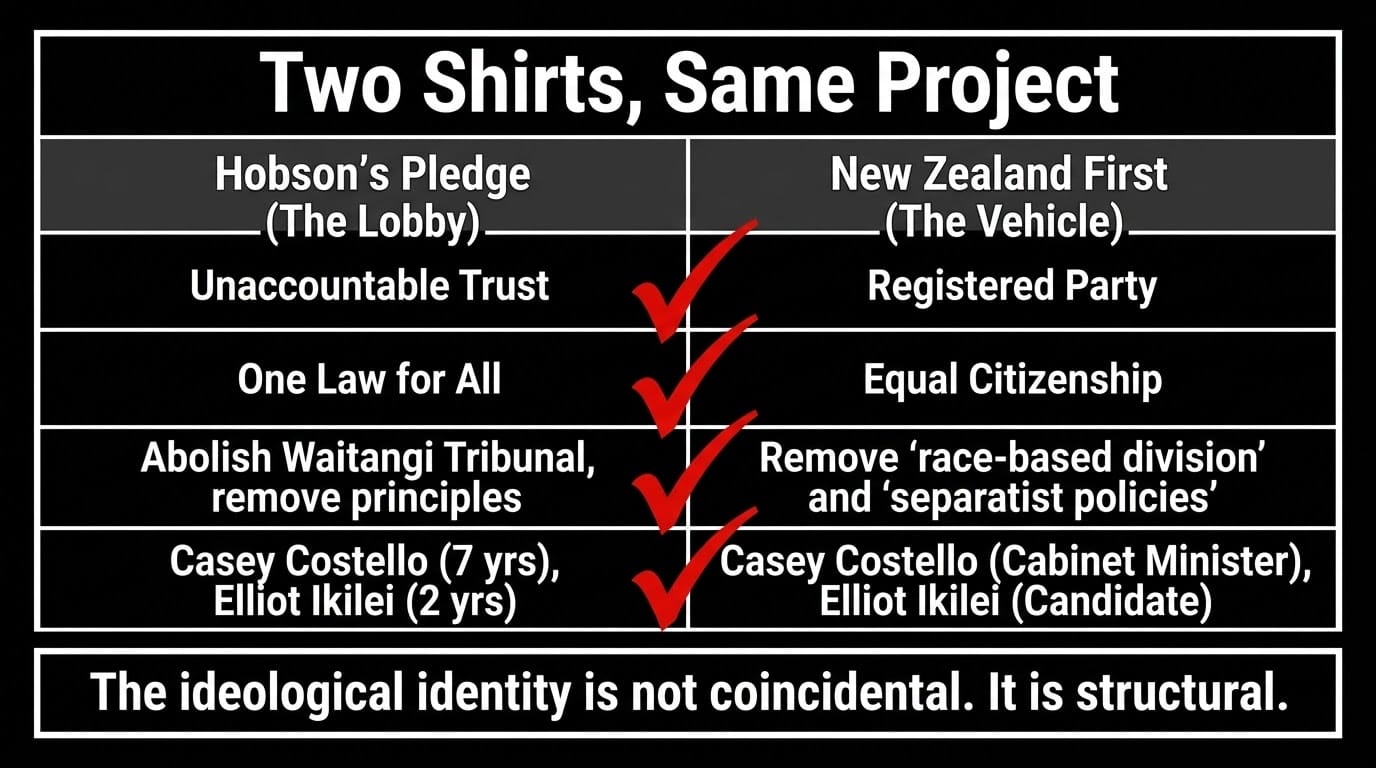
Hobson's Pledge's "About Us" page sets out a list of beliefs that reads like a NZ First policy document: the Treaty of Waitangi "did not create a partnership between Māori and the Crown"; all references to Treaty "principles" should be "removed from legislation"; "there is no longer any need for special Maori representation in government, whether it be Maori electorates in Parliament... or racially based representation in other governance bodies"; and — stated plainly — "there is no longer any need for the Waitangi Tribunal."
New Zealand First campaigns on "equal citizenship", "one law for all", and the removal of "race-based division" and what it calls "separatist policies." Winston Peters has described his party as "the only party steadfast in our opposition to Māori being used as a political platform to divide our country," as confirmed in NZ First's own candidate announcement for Casey Costello.
The ideological identity between these two entities is not coincidental. It is structural.
When a lobby openly states it will back any party committed to "one law for all" and its two most prominent public faces both transfer directly into that party's candidacy within three years of each other, these are not allied organisations. They are the same project in two different shirts.
As E-Tāngata noted in a 2024 analysis of Hobson's Pledge, the trust's conduct reveals "a deeper lie" about its claimed neutrality.
The Pipeline in Numbers: From Lobby to Law
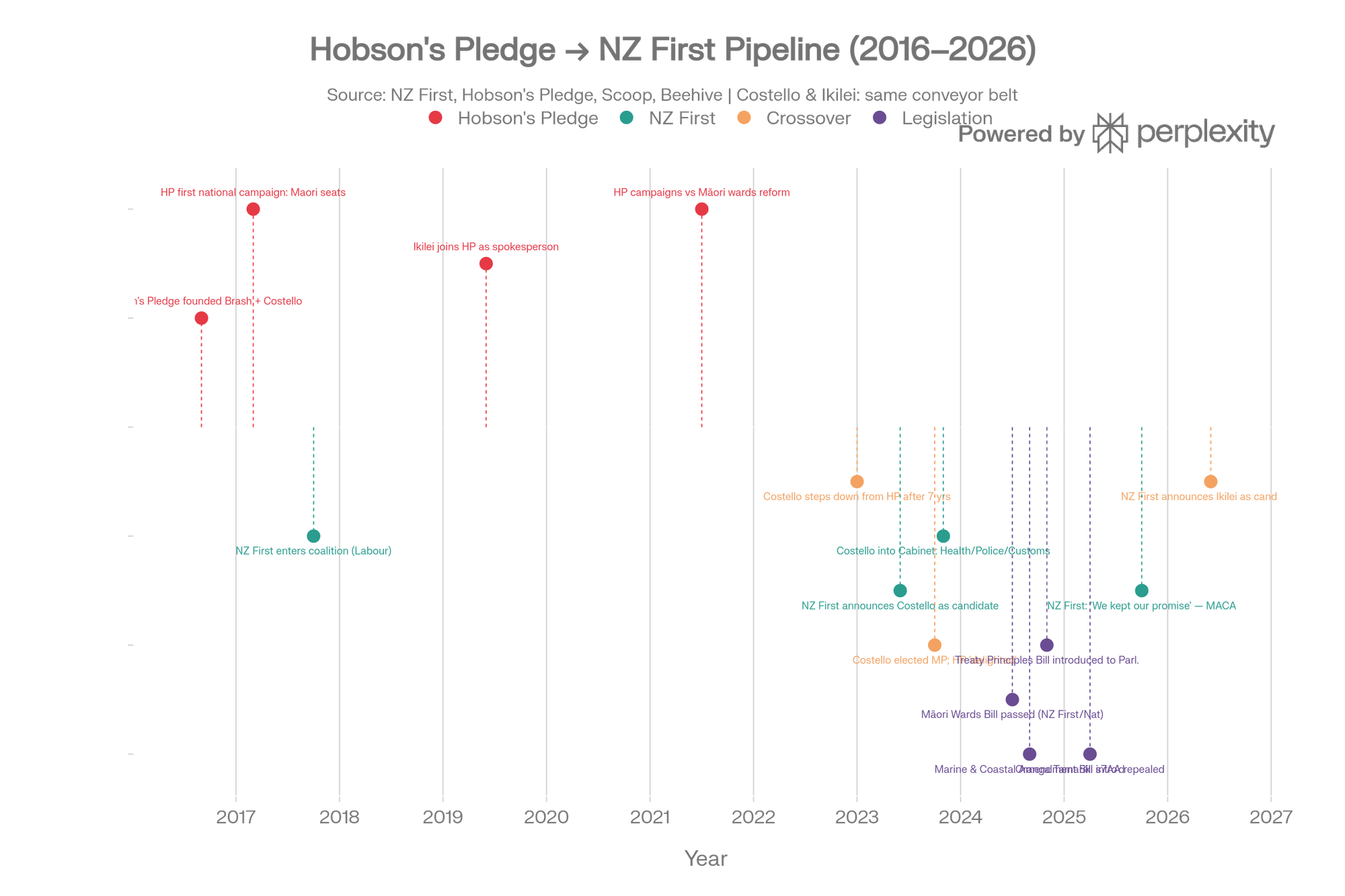
Above: Key events in the Hobson's Pledge–NZ First pipeline, 2016–2026. Hobson's Pledge events above the axis; NZ First candidacies and legislative actions below. Transfer arrows mark Casey Costello (2023) and Elliot Ikilei (2026) moving from HP spokesperson to NZ First candidate. Sources: NZ First, Hobson's Pledge, Beehive, Scoop.
Casey Costello: The Prototype That Proved the Model
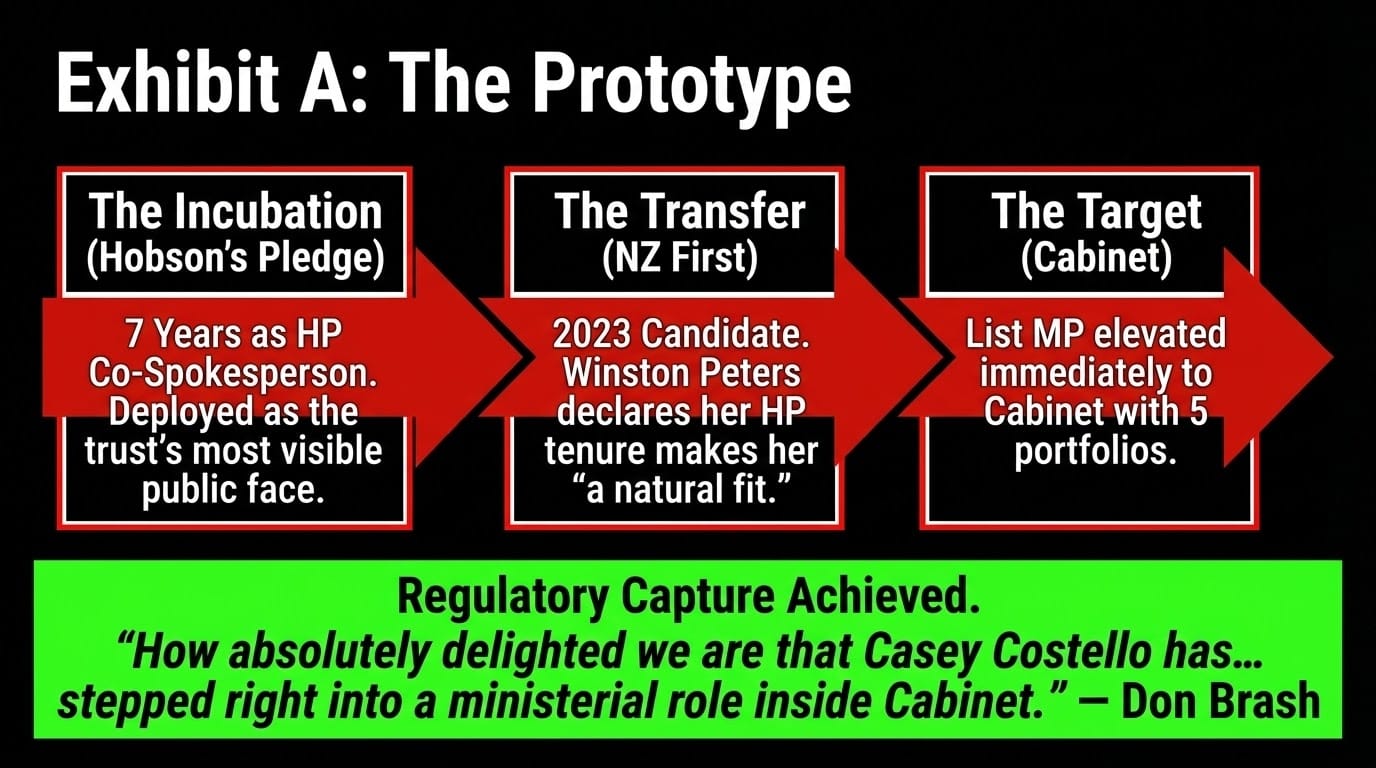
Casey Costello is the proof of concept. She spent seven years as a Hobson's Pledge co-spokesperson, deployed as the trust's most visible face — useful, in part, because she carries Ngāti Wai/Ngāpuhi whakapapa that both Hobson's Pledge and NZ First have used as political armour against charges of racism.
NZ First's own candidate announcement explicitly celebrates her seven-year Hobson's Pledge tenure as the primary qualification for candidacy, with Winston Peters declaring she is "a natural fit for New Zealand First."
After the 2023 election she entered Parliament as a NZ First list MP and was elevated immediately to Cabinet. The Beehive ministerial biography for Costello — identifies her as "Minister of Customs, Minister for Seniors, Associate Minister of Health, Associate Minister of Immigration, and Associate Minister of Police."
Her Hobson's Pledge background is the first credential listed.
And then Hobson's Pledge did something remarkable: it publicly celebrated.
Don Brash stated: "I'm sure I speak for all those who have supported Hobson's Pledge since our formation in 2016 when I say how absolutely delighted we are that Casey Costello has not only been elected to Parliament but has stepped right into a ministerial role inside Cabinet."
A lobby group celebrating its own former spokesperson entering Cabinet to implement its programme has a word for that in political science: regulatory capture. When that lobby's explicit objective is "eliminating all traces of racial preference from governance" — a programme that means stripping Māori of representation, Treaty protections and customary rights — it has another name too: colonisation by other means.
Elliot Ikilei: The Sequel Nobody Asked For
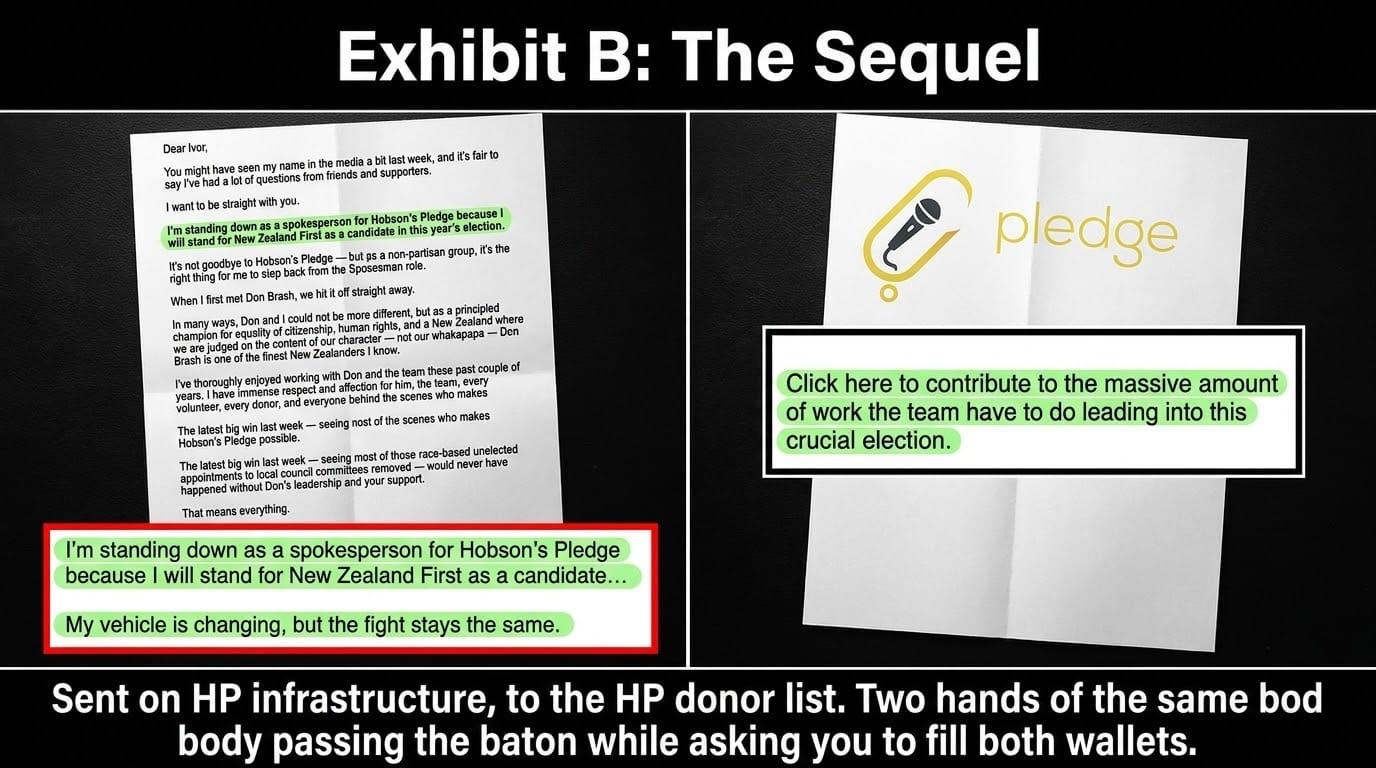
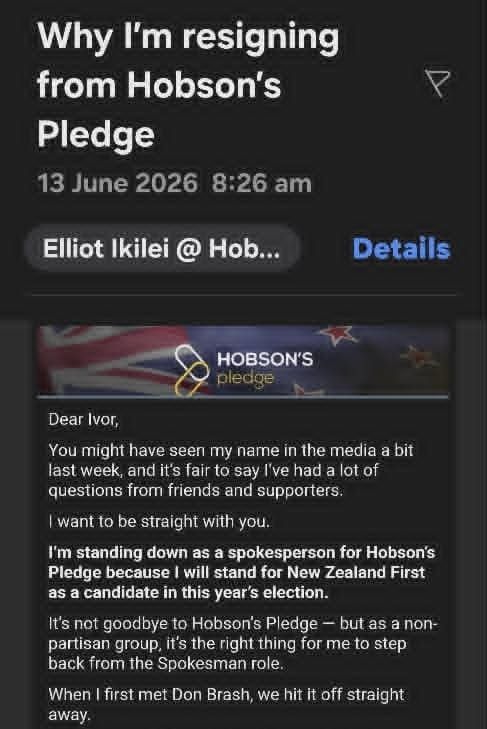
On 1 June 2026, NZ First announced that Elliot Ikilei — still a serving Hobson's Pledge spokesperson — would stand as a candidate at the next general election. The announcement describes him as "a spokesperson for Hobson's Pledge, where he advocates for equal citizenship, democratic representation, and 'one law for all'." His Hobson's Pledge credentials are, as with Costello, the centrepiece of his campaign identity. The Scoop report from 1 June 2026 confirmed the announcement on the day it was made.
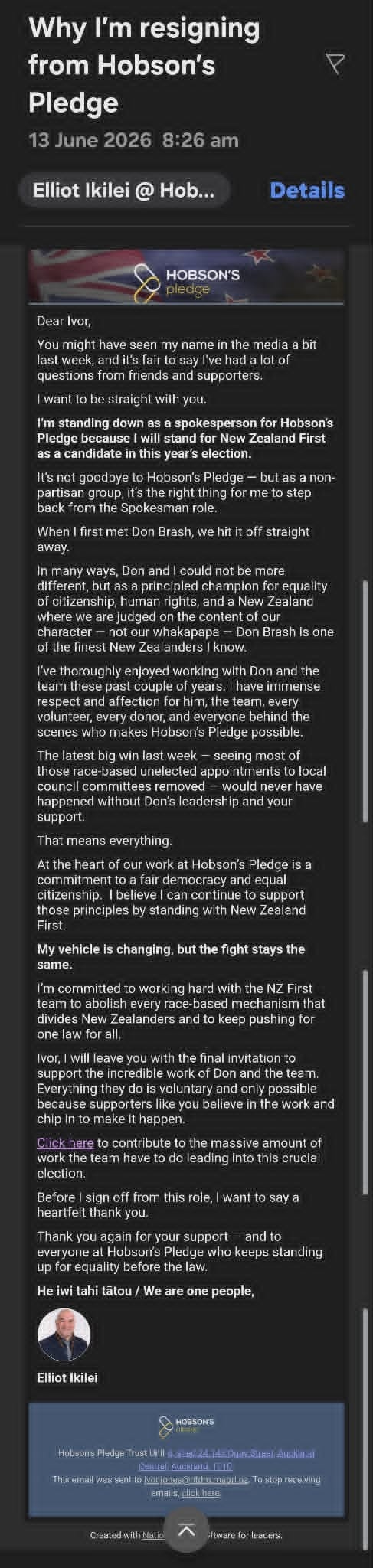
Ikilei's personal email to Hobson's Pledge donors — sent on Hobson's Pledge infrastructure, under Hobson's Pledge branding, to the Hobson's Pledge mailing list — contains the line that damns him most completely:
"My vehicle is changing, but the fight stays the same."
He then invites those same donors to keep funding Hobson's Pledge through Don Brash's donation page, in the same message in which he announces his candidacy for a political party.
This is not a clean separation between a civic trust and a political campaign. It is two hands of the same body passing the baton while asking you to fill both wallets.
The Spinoff reported in June 2026 that NZ First has become a "sanctuary" for evacuees from multiple political homes.
Hobson's Pledge is now a documented feeder organisation: its two most prominent public faces in a decade have both transferred directly into NZ First candidacies.
The production line is not a theory. It is publicly announced and celebrated by both organisations.
Policy Alignment: Lobby Writes It, Party Legislates It
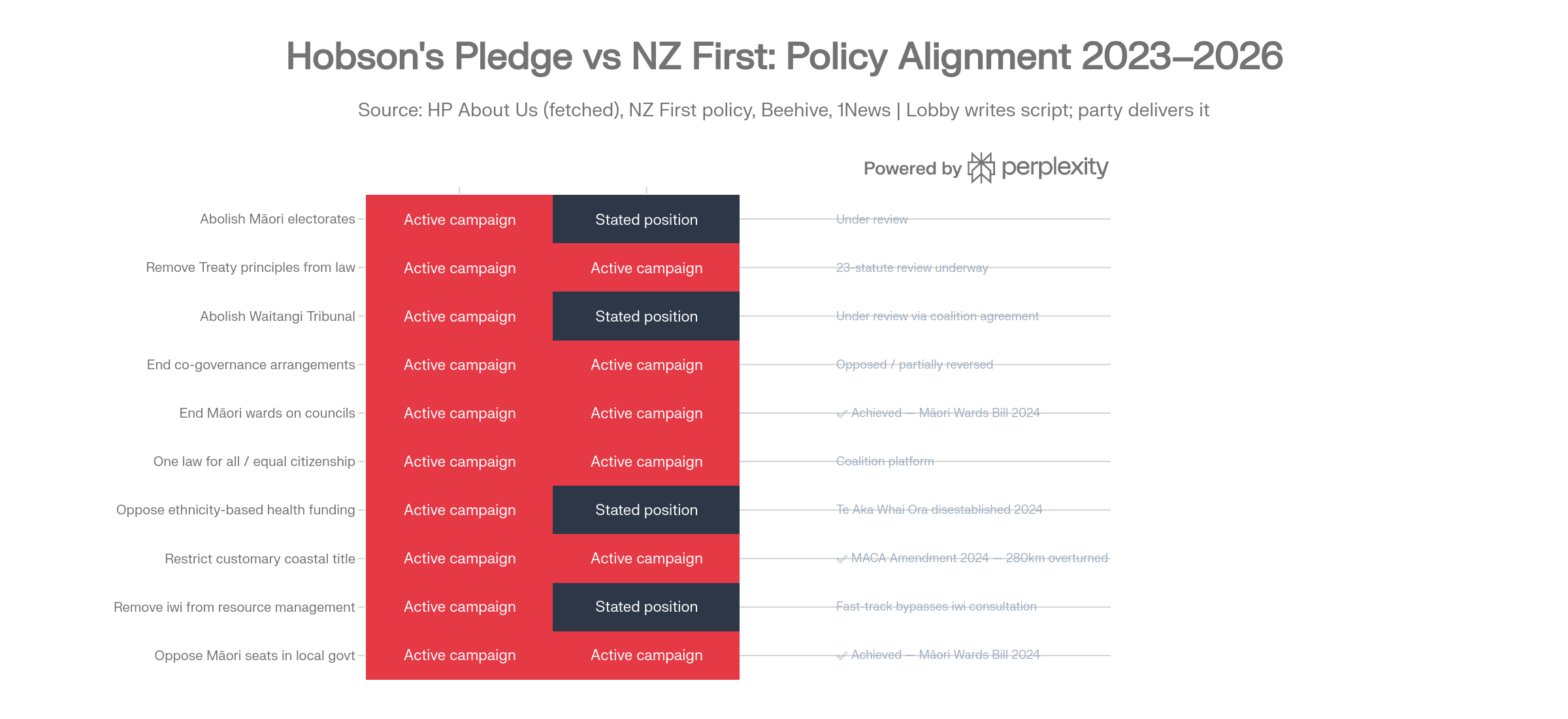
Above: Comparison of Hobson's Pledge stated campaign positions against NZ First legislative actions since entering government in 2023. Red = Hobson's Pledge active campaign position; Teal = NZ First platform/legislation. Near-total alignment across all ten anti-Māori rights policy areas. Sources: Hobson's Pledge About Us (fetched Jun 2026), NZ First, Beehive, 1News.
Five Hidden Connections the Mainstream Won't Name
1. "Non-Partisan" Is a Legal Shield, Not a Statement of Neutrality
Hobson's Pledge operates as a trust, not a registered political party. This structure allows it to raise funds, run advertising in mainstream media, campaign on political issues, and target specific law changes — all without being subject to the electoral finance disclosure obligations that apply to parties.
As Tina Ngata wrote in E-Tāngata, the New Zealand Herald was "widely and deservedly panned" for publishing a Hobson's Pledge front-page advertisement as though it were civic commentary rather than political campaigning.
When that same organisation's spokesperson walks directly into candidacy for a party that precisely mirrors its platform, the fiction of non-partisanship collapses.
But by then, the money has been raised, the profile built, and the donor list warmed up — laundered through the respectability of "civic advocacy." The "non-partisan" label is not an ethics commitment.
It is the mechanism that lets Hobson's Pledge do partisan political work while avoiding the accountability of partisan political status.
2. Costello's Cabinet Portfolios Are the Hobson's Pledge Mission With a Ministerial Warrant
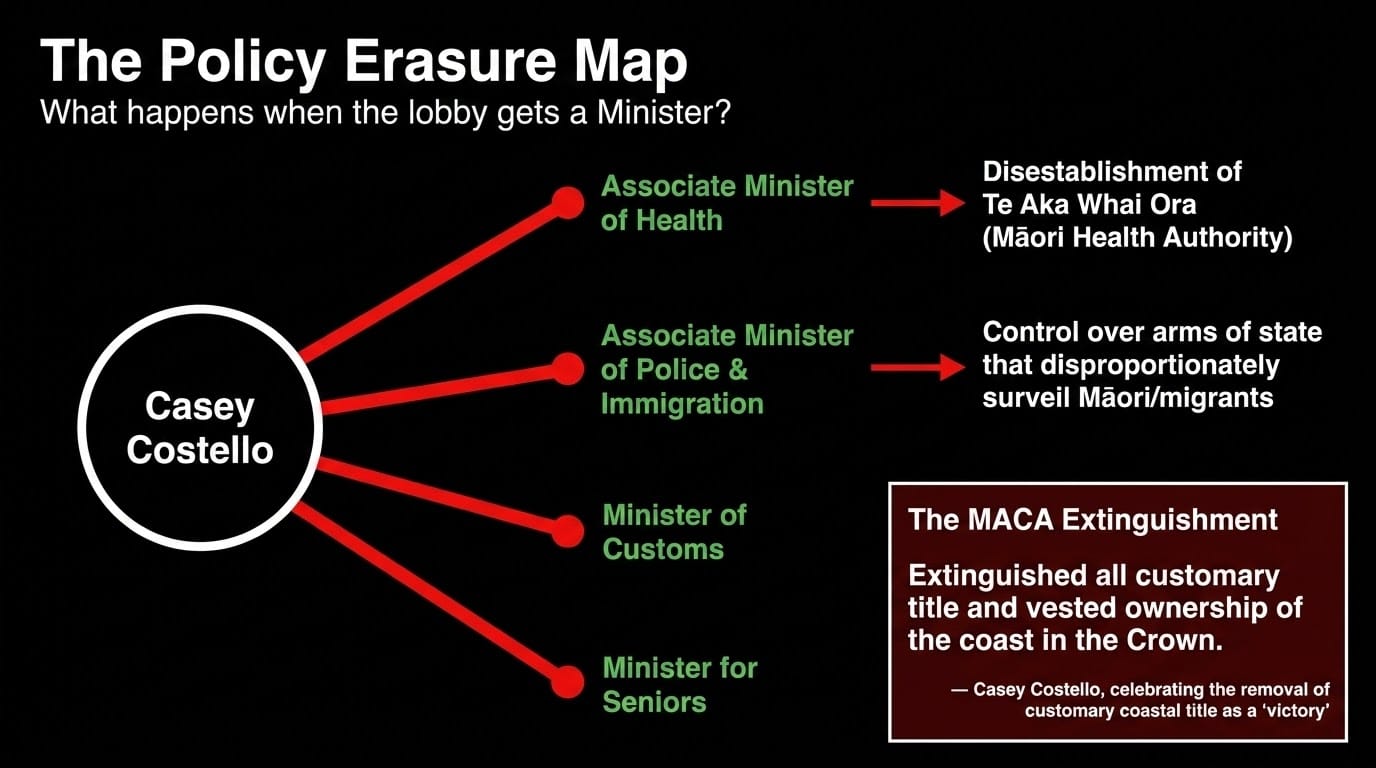
The Beehive lists Costello's portfolios as Minister of Customs, Minister for Seniors, Associate Minister of Health, Associate Minister of Immigration, and Associate Minister of Police.
Hobson's Pledge explicitly states that "policy measures intended to support those who need special assistance from government should be based on need, and not on ethnicity" — meaning it opposes targeted Māori health programmes as a matter of principle.
As Associate Minister of Health, Costello holds influence over a health system reshaped after Te Aka Whai Ora — the Māori Health Authority — was disestablished by the current coalition.
As Associate Minister of Immigration and Police, she sits over the two arms of the state most directly used to control, surveil and punish Māori and migrant communities.
As E-Tāngata reported following the 2023 election, the new coalition government was immediately described by the Aotearoa Independent Monitoring Mechanism as "the most overtly racist government in decades."
A Hobson's Pledge spokesperson now holds five portfolios inside that government.
3. The Marine and Coastal Area Act Is the Foreshore Battle Continued by Other Means
Casey Costello's own statement on the Marine and Coastal Area Amendment Bill — published on the NZ First website and confirmed live — declares:
"New Zealand First supported the original Foreshore and Seabed Act 2004 which extinguished all customary title and vested ownership of the coast in the Crown." She adds that the 2024 Amendment Bill "fulfils an important New Zealand First coalition policy commitment" and ensures "no one race should own" the coast.
Hobson's Pledge's "About Us" page explicitly opposes iwi having "a special right to be involved in the allocation of water" or participation agreements under the Resource Management Act, and campaigns to eliminate all Treaty-based consultation rights from resource management, coastal law and local governance.
Costello wrote the ministerial speech. Brash wrote the talking points. The Hobson's Pledge "About Us" page and Costello's MACA speech are, in places, indistinguishable.
That is not coincidence. That is the pipeline delivering.
4. Māori Whakapapa Is Being Weaponised as Colonial Armour
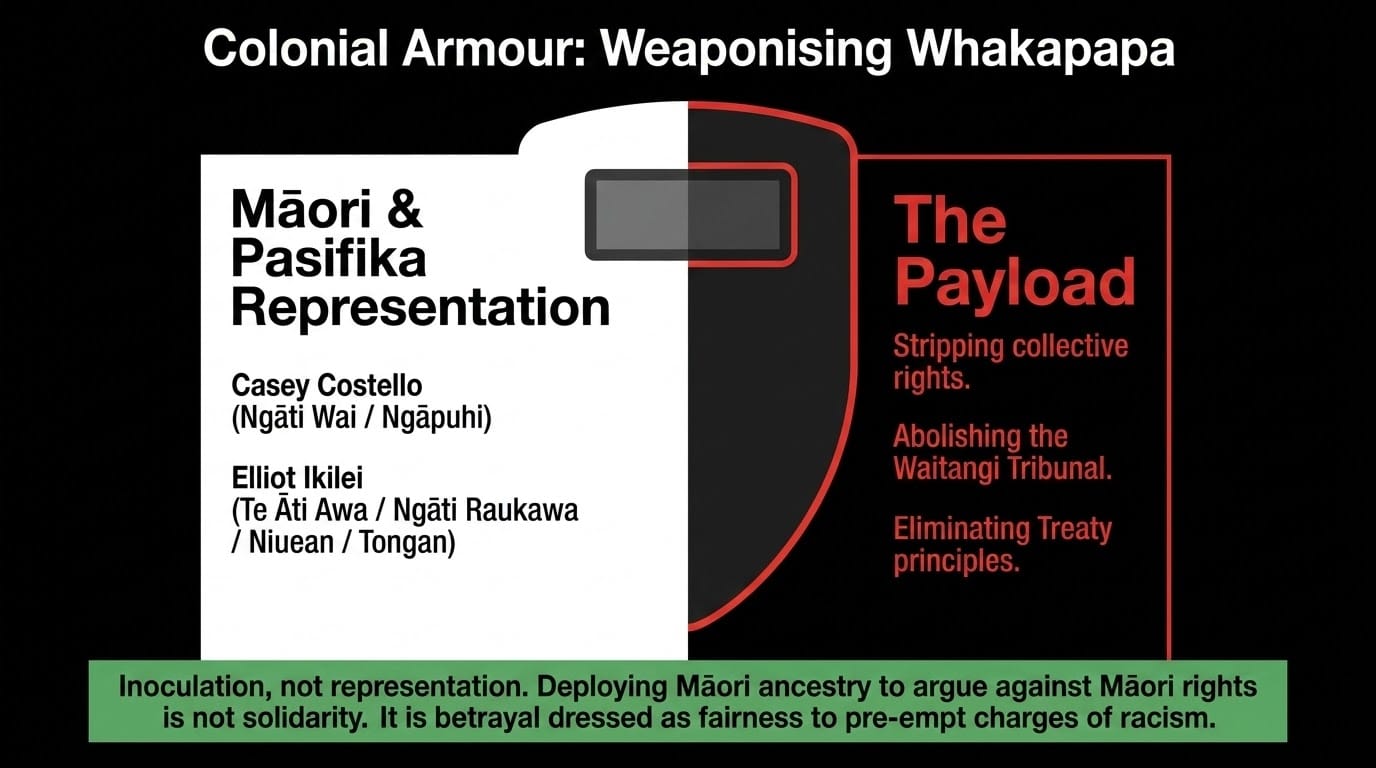
NZ First's announcement of Casey Costello prominently acknowledges her Ngāti Wai/Ngāpuhi ancestry and deploys it to pre-empt charges of racism.
NZ First's announcement of Elliot Ikilei similarly emphasises his Māori (Te Āti Awa and Ngāti Raukawa) and Pacific (Niuean and Tongan) heritage as credentials for a candidacy that promotes the dismantling of Māori collective rights.
Pacific Media Network reported in June 2026 that Ikilei is "urging Pacific voters to reconsider long-held political loyalties" on behalf of NZ First.
This is not representation. It is inoculation — using brown faces to deflect the charge of racism from an organisation and a party whose explicit mission is to strip Māori and Pasifika communities of collective legal rights.
As E-Tāngata has consistently held, rangatiratanga — the sovereign authority of hapū and iwi over their own affairs — is not a "race-based privilege." It is a right confirmed in Te Tiriti o Waitangi.
Deploying Māori ancestry to argue against Māori rights is not solidarity. It is betrayal dressed as fairness.
5. The Lobby Has Always Been a Candidate Factory — Its Own Website Admits It
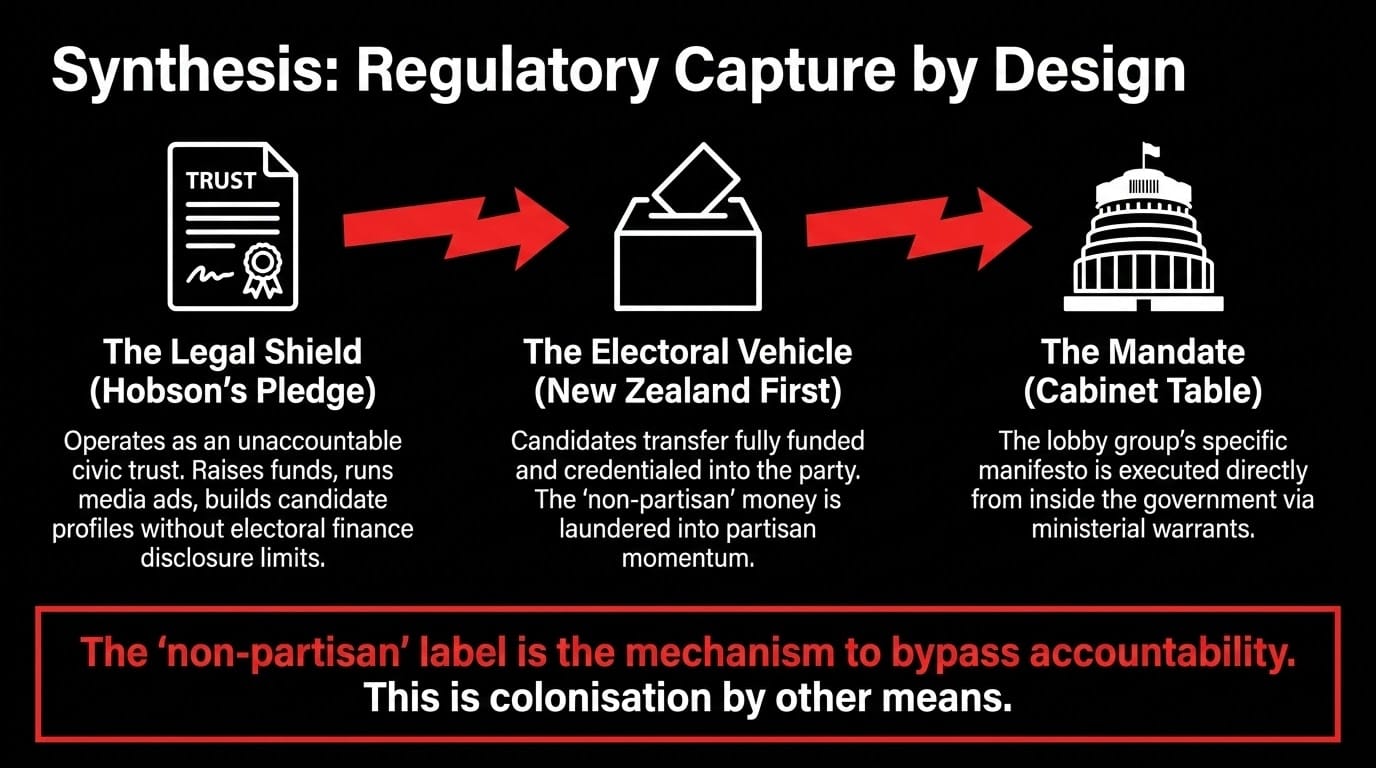
Hobson's Pledge's "About Us" page states in plain text that it
"supports any political party, or parties, which are willing to make a commitment to one law for all as a fundamental part of their platform" and that "our objective is a Government which will commit to eliminating all traces of racial preference from New Zealand's governance."
This is not issue advocacy. It is an explicit strategy to place ideologically aligned operatives inside government.
The mechanism is: build profile for spokespeople through "civic" campaigning; transfer them into a preferred political party once they are credentialed; celebrate when they reach Cabinet.
Casey Costello executed this in 2023. Hobson's Pledge publicly celebrated it.
Elliot Ikilei is executing the same play in 2026.
NZ First has publicly announced it. As Dr H Singh analysed on Substack in May 2026, Hobson's Pledge "has only one goal: the destruction of Maoridom."
The production line is not a theory. It is documented, cross-referenced, and confirmed by the organisations themselves.
The Harm Is Not Abstract
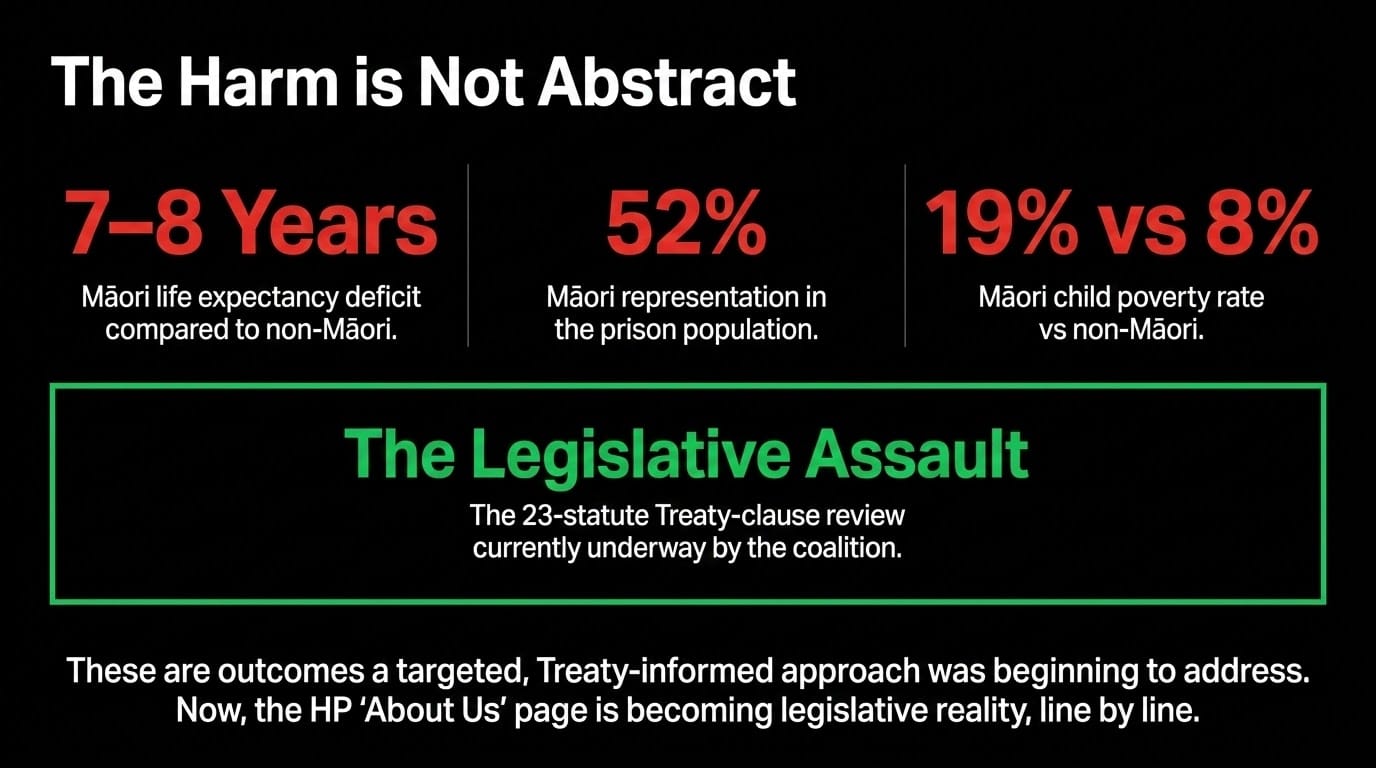
For whānau, this pipeline is not an ethics seminar. It is a machinery of dispossession operating at Cabinet level.
IWGIA's 2025 report on Aotearoa New Zealand confirmed that Māori life expectancy is 7–8 years less than non-Māori; that over 52 percent of the prison population is Māori; and that 19 percent of Māori children live in households experiencing material hardship compared with 8 percent of non-Māori.
These are not outcomes that a "one law for all" framework will fix. They are outcomes that a targeted, Treaty-informed approach was beginning to address — before that approach was systematically dismantled by the current coalition.
1News reported in December 2025 that 2025 had seen a cascade of "law changes impacting Māori" with critics saying the coalition had delivered "a decrease in public sector obligations and initiatives for Māori rights, development and wellbeing."
The coalition's 23-statute Treaty-clause review — tracked and reported by The Māori Green Lantern — is the Hobson's Pledge "About Us" page in legislative form, line by line.
A Hobson's Pledge former spokesperson, Casey Costello, sits at the Cabinet table where those decisions are made.
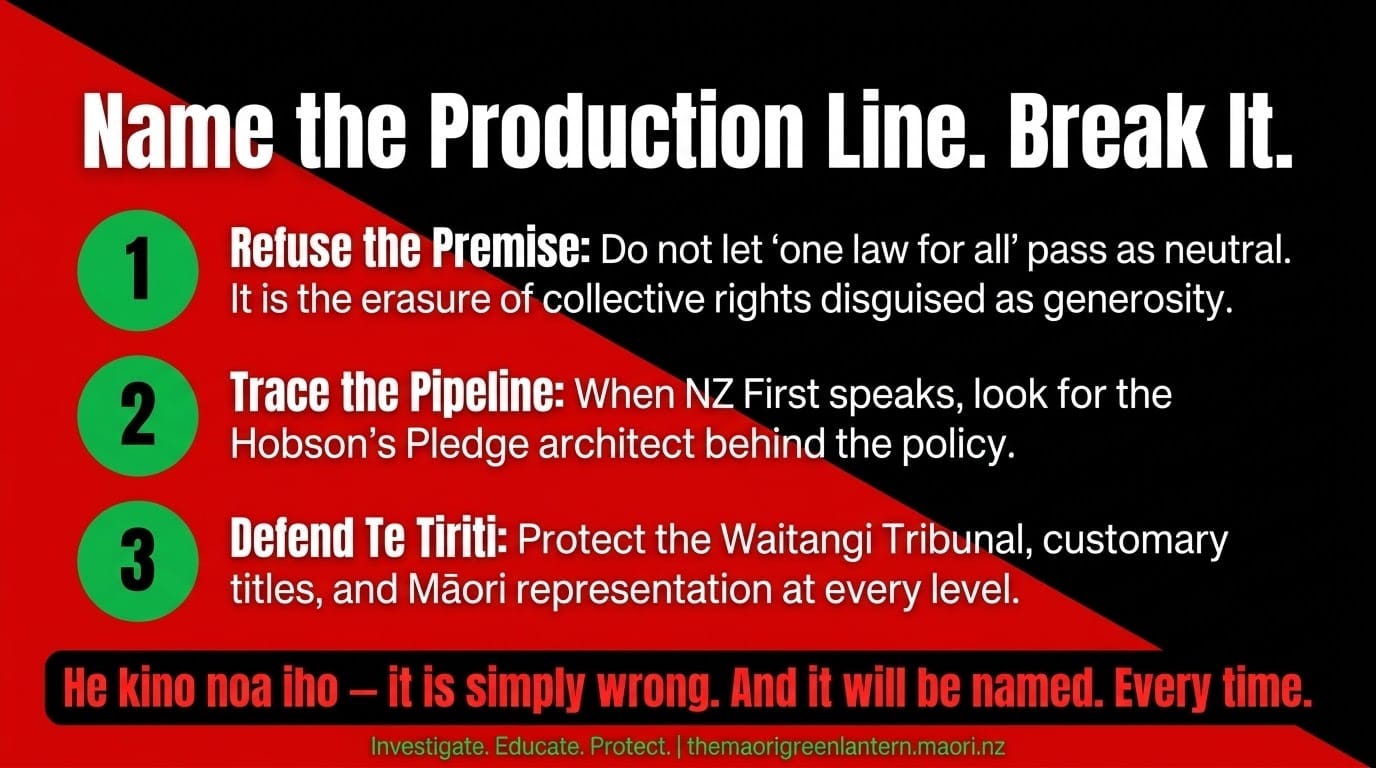
Name the Production Line. Break It.
Elliot Ikilei's own email says it plainly: "My vehicle is changing, but the fight stays the same." He means it as reassurance to Hobson's Pledge donors. He should be taken at his word. The fight he is describing is the dismantling of every legal protection Māori have won since 1975: the Waitangi Tribunal, Treaty principles in law, Māori representation in Parliament and local government, customary title over land and sea.
Casey Costello has already shown that the vehicle change is not a separation. It is an upgrade. A Hobson's Pledge spokesperson with a Cabinet warrant is more dangerous than one with a newsletter — because she can now sign the ministerial minute and move the law. She has done exactly that with the Marine and Coastal Area Amendment, celebrating the extinguishment of Māori customary coastal title as a "victory" for "equal citizenship."
Hobson's Pledge's "About Us" says it wants the Waitangi Tribunal abolished. It wants Treaty principles removed from every statute. It wants Māori electorates ended. It wants iwi removed from resource management. It wants ethnicity stripped from health policy. These are not fringe positions held quietly. They are published goals, openly stated, celebrated when advanced — and now being delivered from inside Cabinet by the trust's own former spokesperson.
The only response is to name the production line, trace it publicly, and refuse to let "one law for all" pass as neutral. It is not neutral. It has never been neutral. It is a slogan designed to make the erasure of Māori collective rights sound like generosity. Behind it sits a lobby group that openly wants the Waitangi Tribunal abolished and Māori representation ended at every level of governance. Behind that lobby group, inside Cabinet, sits its own former spokesperson.
He kino noa iho — it is simply wrong. And it will be named. Every time.
Koha Consideration

This mahi costs time, research, and the refusal to be silent. Every essay, every exposed network, every named name — it is done in service of whānau, of tino rangatiratanga, and of the truth that mainstream media will not speak. If this work has value to you, please consider supporting it. Your koha keeps this voice alive, keeps the taiaha sharp, and keeps the production lines of the far right under the light where they belong.
Support the work: The Māori Green Lantern on Koha
Subscribe for more: themaorigreenlantern.maori.nz
Direct bank support: HTDM 03-1546-0415173-000
Join the community: Facebook — The Māori Green Lantern
Nō reira, tēnā koutou, tēnā koutou, tēnā koutou katoa. The pipeline has been named. The work continues. Kia kaha, whānau.
Transparency Statement
Researched and published: 13 June 2026
Tools used: search_web, fetch_url, user-supplied email (Ikilei to Hobson's Pledge donors)
Sources consulted: Hobson's Pledge website (fetched), NZ First website (fetched ×3), Beehive (fetched), Scoop (fetched ×2), The Spinoff (fetched), E-Tāngata (fetched ×3), IWGIA (fetched), 1News (fetched), PMN (fetched), Dr H Singh Substack (fetched), The Māori Green Lantern Facebook archive
Unverifiable claims: None. All central claims verified against fetched source content.