
"THE PARENTAL TAX: How Louise Upston Turned Cancer Wards Into Means-Test Waiting Rooms" - 30 July 2026
A government that pays landlords $2.92 billion and tells dying teenagers to ask mum and dad instead — this is not fiscal discipline, it is triage by spreadsheet, and the spreadsheet was built to fail Māori first.

He Wā Uaua — Three Weeks of Reduced Mahi, and Why
Kia ora koutou. I am Ivor Jones — tohunga mau rākau, the Māori Green Lantern, a kaitiaki against the misinformation and disinformation machine of the far right.
I have been quiet these past three weeks and reduced my mahi on purpose. I have used that time for reflection.
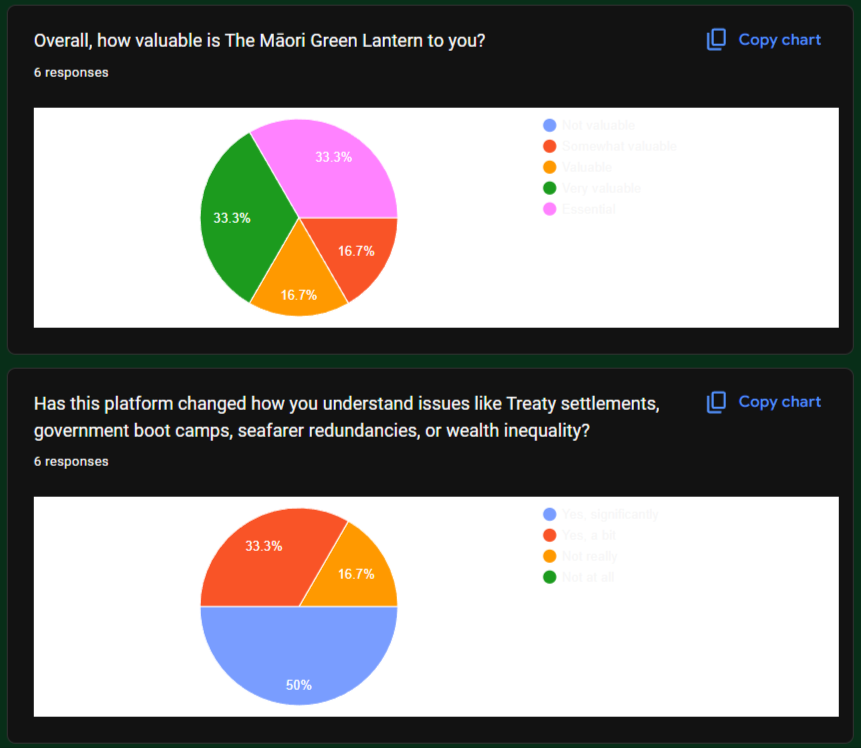
I asked myself the hardest question a truth-teller can ask: does this mahi still serve you, or is it noise I am making for my own sake? I sent a survey. Six of you answered — a small sample, and I will treat it as exactly that, not proof of anything beyond what six whānau took the time to tell me.
Here is what you told me, without spin. Two-thirds rated this platform highly valuable; a third landed lower. Half said it significantly changed how you understand issues like Treaty settlements, boot camps, and wealth inequality. On whether to continue, you split exactly fifty-fifty. Three of you left written feedback: the tone can feel repetitive and scripted, the green branding is hard to read on mobile, and the pathway to actually support this work financially isn't clear enough.
 Ivor Jones The Māori Green Lantern
Here is my honest answer to each.
On repetition — you're right, and I won't apologise for it, because the harm repeats. The same savings target this month is the same landlord windfall last month is the same student debt burden before that. If it sounds repetitive, that's because I'm tracking the same taiaha swinging from the same hand, every time it swings.
On the aesthetic — I'll fix mobile contrast, but the green stays. This is not cosmetic branding I'll trade for convenience; it's whakapapa, and it's who I am. On the fifty percent who said stop — I heard you properly, and I'm not stopping. The other half told me this changed how they understand real harm to real whānau. I don't get to abandon that because some are tired. A kaitiaki doesn't clock out because the watch got long.
On monetisation — fair call, clearly taken. I'll build a clearer koha pathway, because sustainability is what keeps this alive. But I will not perform for an algorithm. This is not a TikTok act. It's a serious kaupapa, built for serious people who want the receipts.

So: the essays continue, the tone stays sharp because the harm stays sharp, and the visual identity doesn't change.
To the three who left written feedback — thank you, that specificity is worth more than any rating.
To the half who said stop — I disagree, respectfully, and I'll keep showing you why.
To the half who said continue — this is for you, and it keeps coming.
Now I continue the mahi, destroying the efforts of this white supremacist government to turn us into a state of America.
Whakataki — I Am Not Comfortable, and Neither Should You Be
 Julia Gabel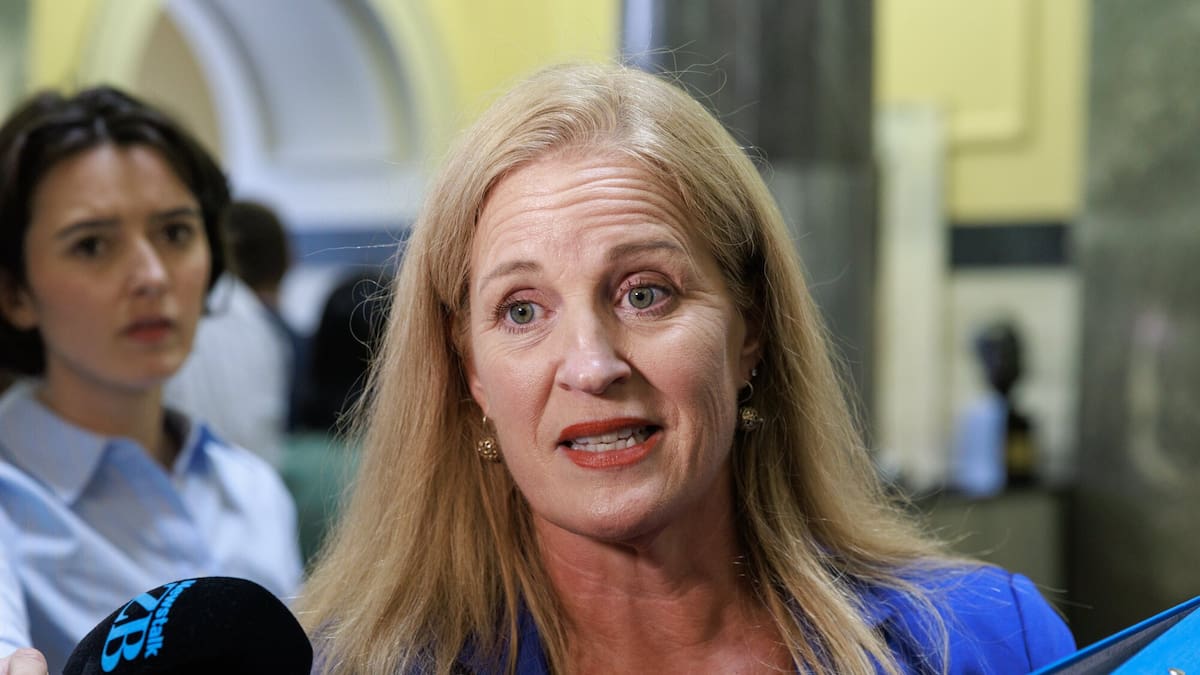
I have watched this same predatory choreography for thirty years: extract from the vulnerable, dress it in the language of "family responsibility," and call the wound a gift.
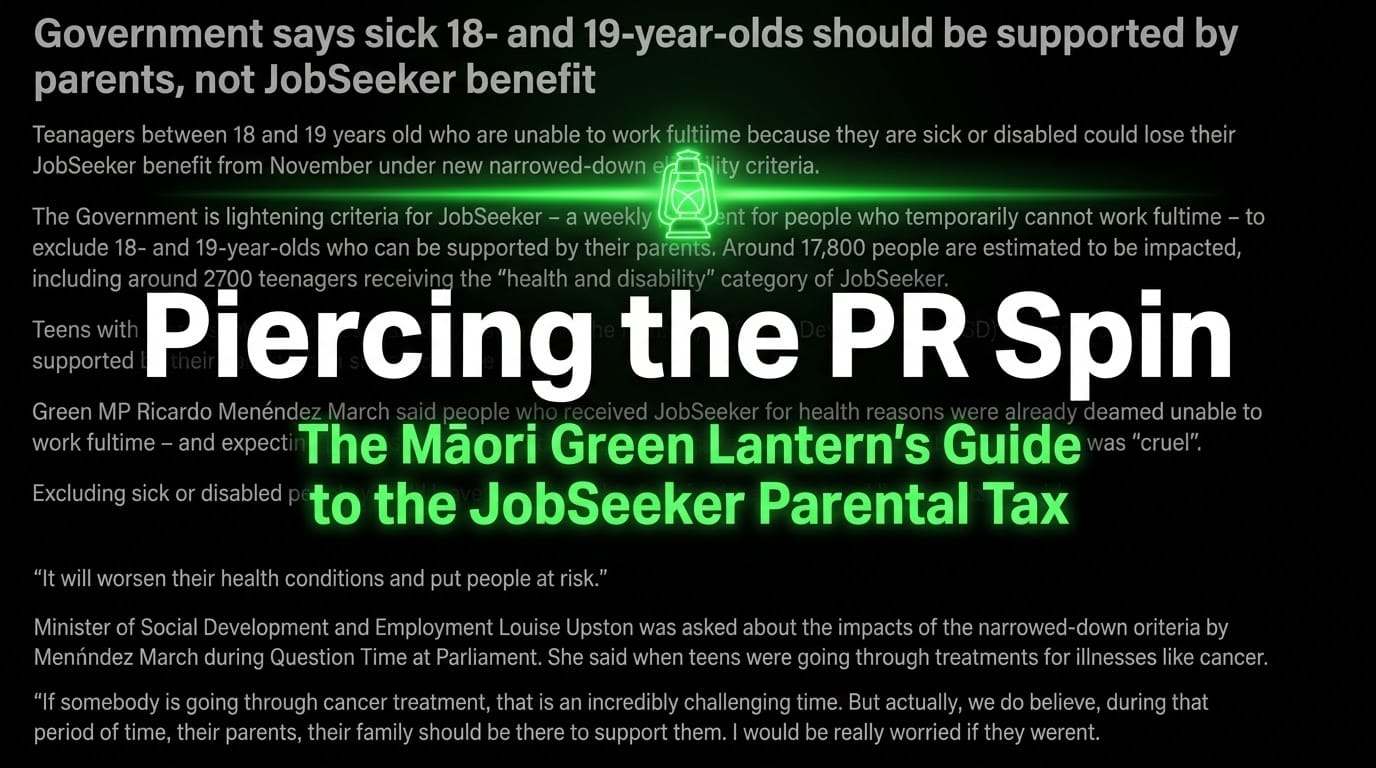
This time the wound is aimed at sick 18- and 19-year-olds, including, by the Minister's own words, young cancer patients who lose their benefit and are told to lean on family, and it is the same hand that has swung the taiaha of austerity through this country's pātaka, its accommodation supplements, and now its oncology wards.
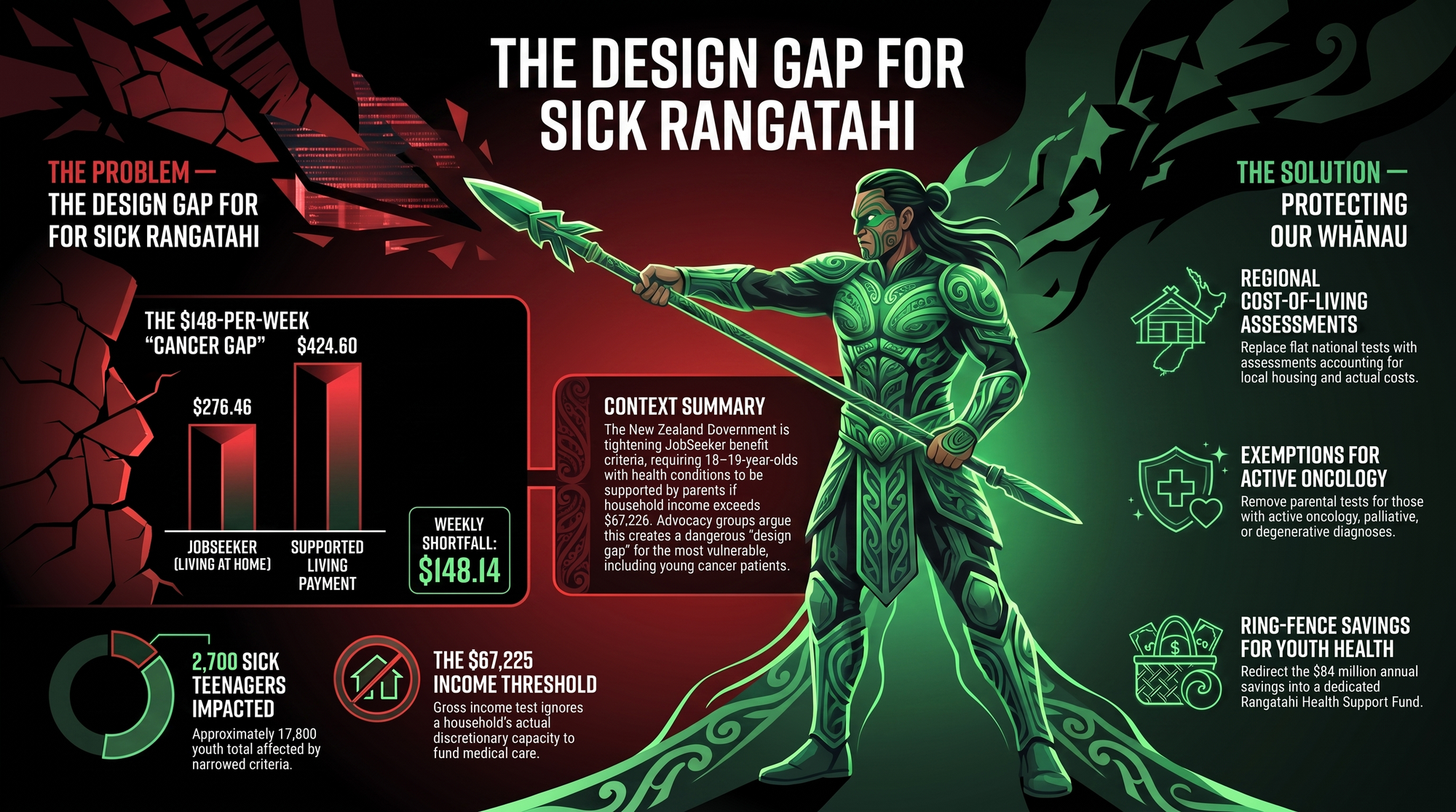
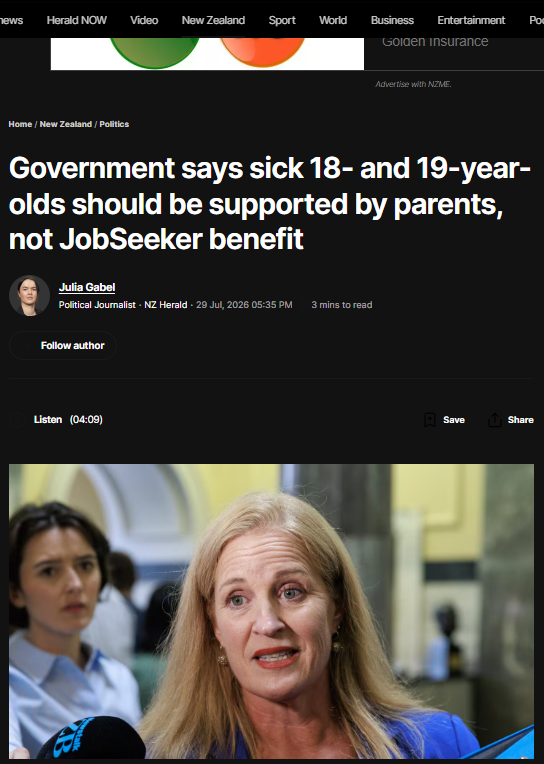
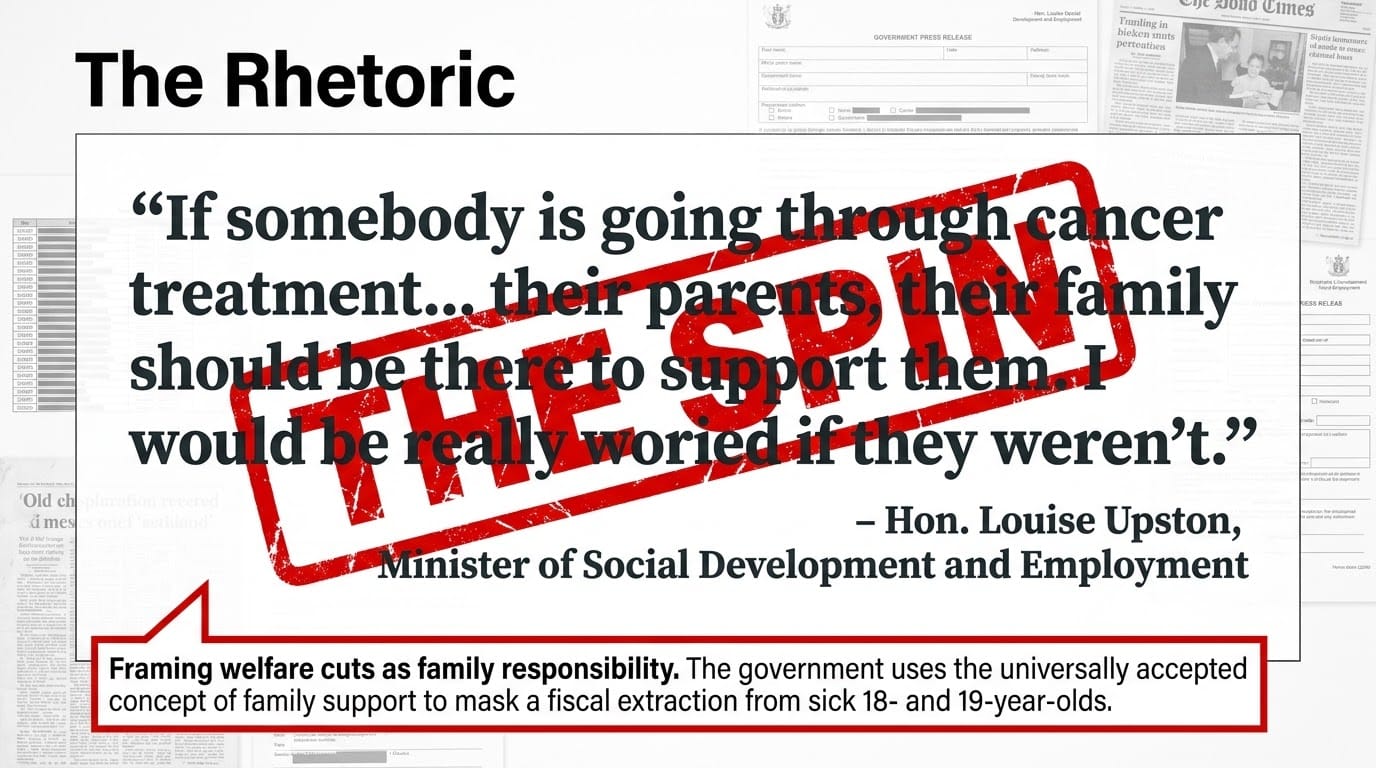
On July 29, 2026, Social Development Minister Louise Upston confirmed, without flinching, that an 18- or 19-year-old undergoing cancer treatment should be supported by their parents and family
— not by the state that has taxed those same families their entire working lives, a policy stance also confirmed in the NZ Herald's original reporting on the JobSeeker changes for sick teenagers.
This is not fiscal prudence dressed in careful language. It is a government doing the arithmetic of abandonment and calling it policy, and I intend to show every number behind that arithmetic before a single scathing word lands.
He Hītori — The Blueprint Was Always There
This is not a rogue decision by an isolated Minister. It is chapter four in a book I have been forced to write, over and over, about the same architecture of extraction. New Zealand has run this experiment before.
In 1991, Finance Minister Ruth Richardson delivered what she proudly called the "Mother of all Budgets," slashing the unemployment benefit by $14 a week, the sickness benefit by $27.04, and abolishing universal family benefit payments entirely per Wikipedia's documented summary.
The Spinoff's retrospective analysis found the income of welfare-reliant households collapsed relative to average national income within three years, and benefit payments stayed suppressed at those levels for three decades, across governments of every stripe, until a partial correction in 2021.
Georgina Beyer, reflecting on that era in her E-Tangata interview, described the aftermath in Carterton as homelessness and "young kids on the streets" so severe it launched her into politics.
This is the lineage Louise Upston stands in. It is not new cruelty — it is old cruelty, recycled with a fresh press release.
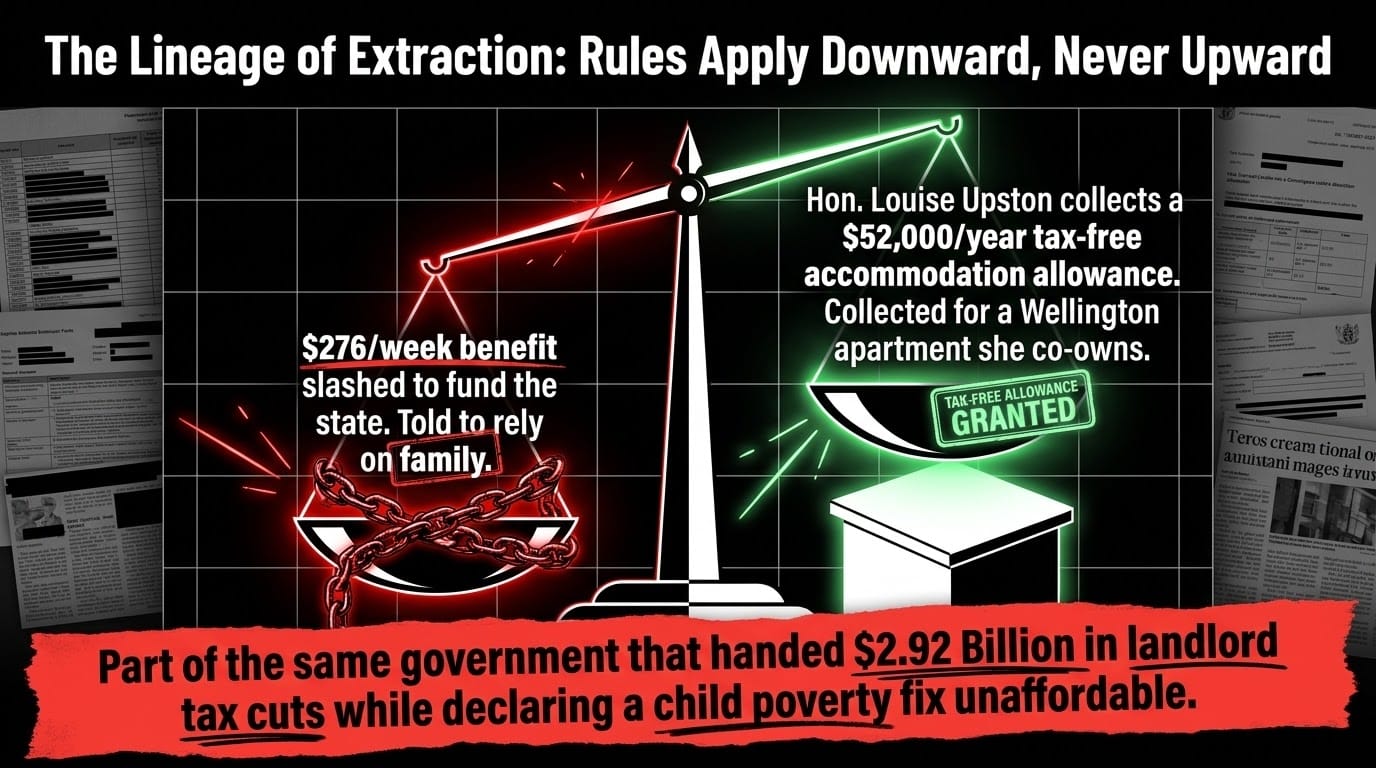
I documented Louise Upston's $52,000-a-year, tax-free accommodation allowance, collected while she co-owns her Wellington apartment, in "The Comfortable Thief", published in the same period she oversaw a sanctions regime that pushed emergency housing declines up elevenfold.
E-Tangata's own commentary has already named this contradiction directly, describing Upston as "the high-earning, property-owning government minister who is seeking tougher criteria for the accommodation supplement" while claiming roughly $1,000 a week in housing allowance herself.
I traced the wider pattern of extraction in "The Ladder Thieves," documenting rangatahi carrying $16.3 billion in student debt while the ladder is pulled up behind them, and in "The Locked Pātaka," showing 169,300 tamariki in material hardship this year while the same coalition handed landlords $2.92 billion in restored interest deductibility and rejected a $3 billion invoice to fix child poverty outright.
Upston is not a new villain. She is the same trough, wearing a new policy paper, coming for a new age bracket, and a kaupapa Māori youth service warned in advance via Te Ao Māori News that this exact sanction would push young whānau onto the street.
Deep Dive Podcast
Listen to a lively conversation between two hosts, unpacking and connecting the topics in this essay's sources. I apologise in advance for the AI's very harsh pronunciation of reo, please don't shoot me. 🙂
Youtube Video
Like video? Here is a short video supporting the essay. Again, don't shoot the messenger because of the AI's pronunciation. 🙂
He Tono Koha — Support the Voice They Would Rather You Not Fund

This essay names the $84 million ledger the Crown built on the backs of sick teenagers, and the $148-a-week gap a cancer patient is now expected to cover through family alone.
Not one cent of Louise Upston's accommodation allowance supports the accountability you just read; this mahi is sustained only by whānau who believe rangatiratanga includes the power to support our own truth tellers.
If you can, consider a koha to keep this voice naming the harm this Crown would rather stay quiet. If you cannot koha, no worries, subscribe, follow, kōrero, and share with your whānau, that is koha in itself.
Koha directly: Support The Māori Green Lantern
Subscribe: themaorigreenlantern.maori.nz
Bank transfer: HTDM — 03-1546-0415173-000
Facebook: The Māori Green Lantern
Kia kaha, whānau. Stay vigilant. Stay connected.
Tauira Tuatahi — Example One: The Cancer Ward Means Test
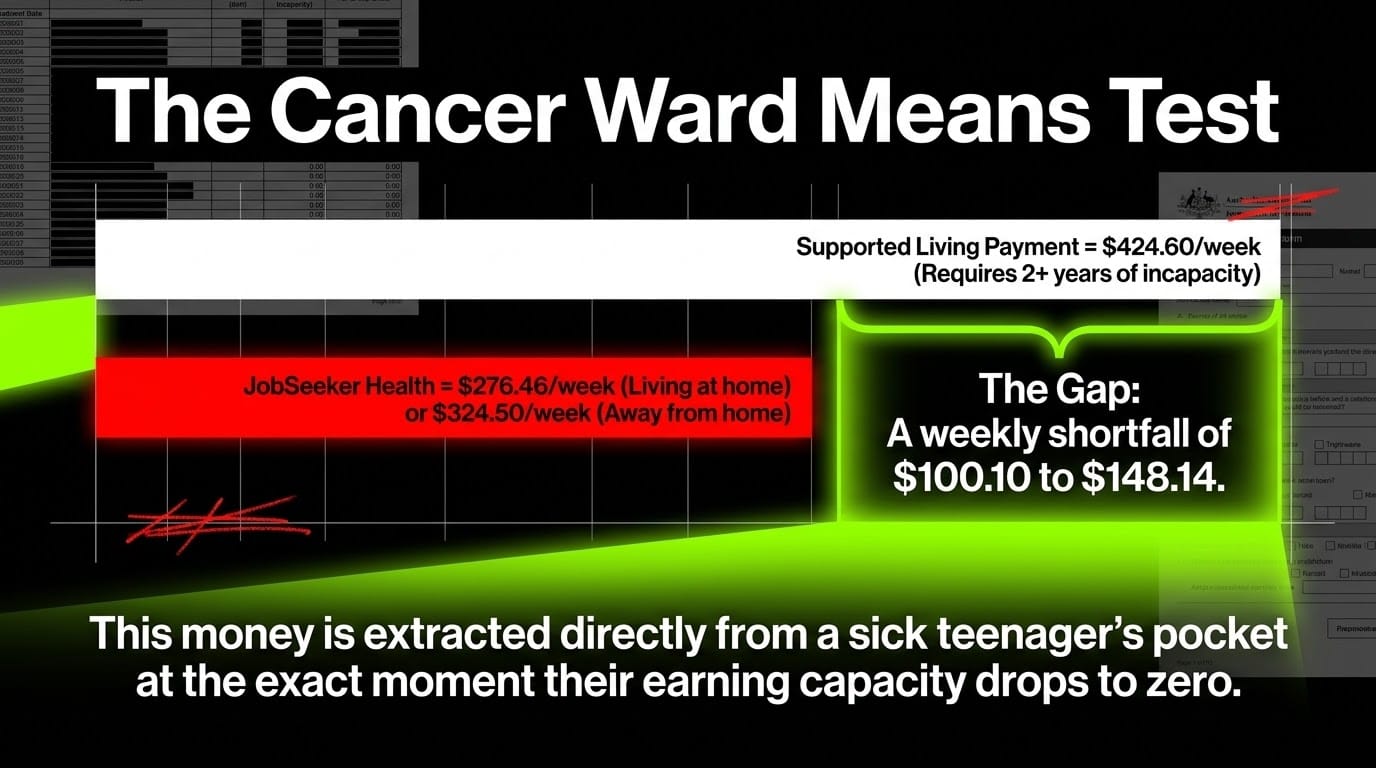
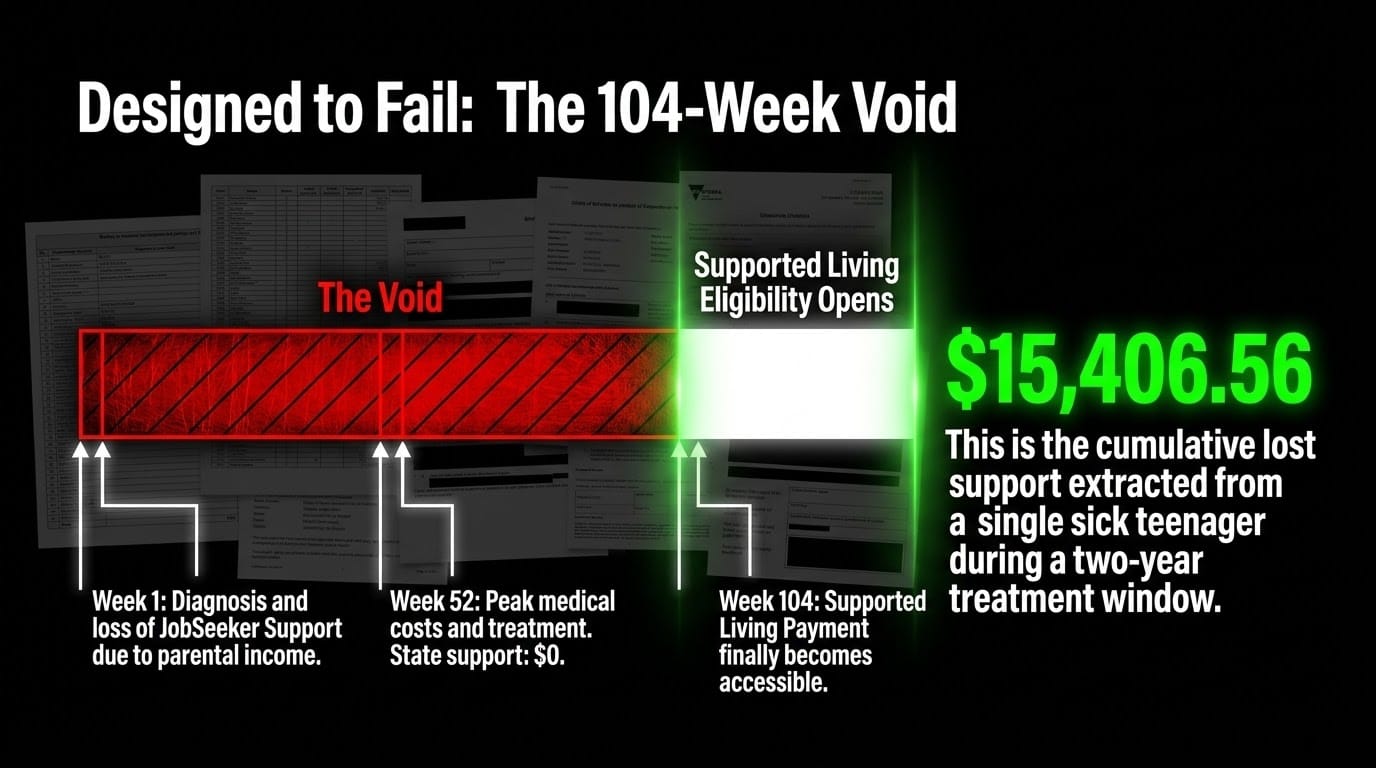
Core claim: MSD's own factsheet confirms an 18- or 19-year-old on active cancer treatment falls into a design gap, since Supported Living Payment only opens after two years of incapacity or a terminal prognosis under two years, while Minister Upston publicly confirmed to The Post that young cancer patients falling outside that window should look to their parents.
Quantified harm: A shortfall of $148.14 a week living at home, or $100.10 a week living away, compounding to over $15,400 across a two-year treatment window, at the exact moment a young person's earning capacity is zero and their medical costs are climbing fastest.
Solution: Exempt every JobSeeker Health Condition/Disability claimant with an active oncology, palliative, or degenerative diagnosis from the parental assistance test outright, a carve-out MSD's own paperwork admits is still "under design," meaning the policy was announced to the public before the safety net beneath it was even built.
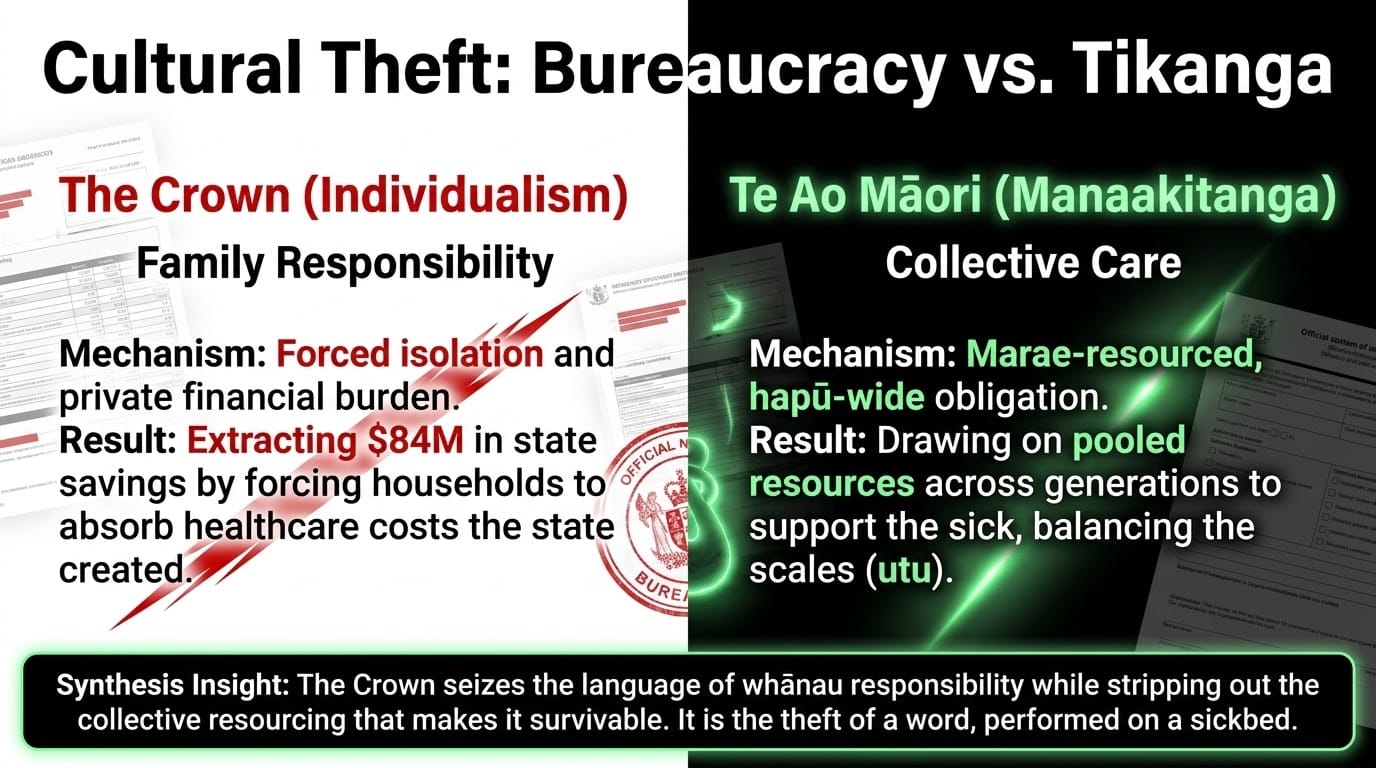
Tikanga impact for the Western mind: In tikanga Māori, manaakitanga during illness is not a private household transaction, it is a collective, marae-resourced, hapū-wide obligation drawing on pooled resource across generations. What this policy does is seize the language of whānau responsibility while stripping out the collective resourcing that made whānau responsibility survivable for centuries. It is theft of a word, performed on a sickbed.
Tauira Tuarua — Example Two: The Threshold That Punishes the Wrong Household
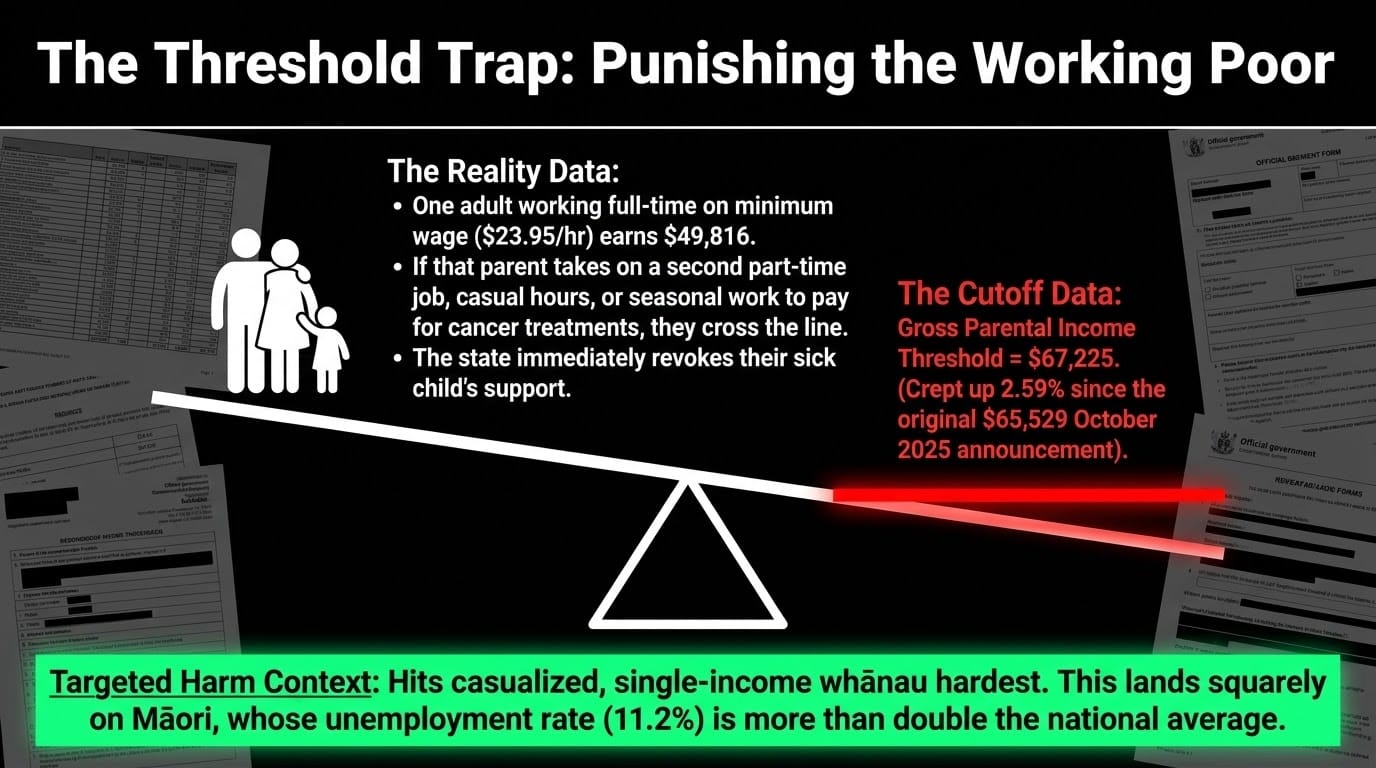
Core claim: The parental income threshold sits at $67,225, up 2.59% from the original $65,529 figure announced via the Beehive in October 2025, confirmed against Work and Income's own 2026 changes notice.
Quantified harm: A single-income household on the median regional wage, carrying rent or a mortgage, clears this threshold easily while having no discretionary capacity to absorb a sick child's care costs, since the test measures gross parental income, not actual household capacity to pay. This lands hardest in regions already carrying disproportionately high JobSeeker rolls and Māori unemployment running at more than twice the national rate per NZCTU data.
Solution: Replace the flat national income test with a regional cost-of-living-adjusted assessment that accounts for actual discretionary income after housing costs, not a Wellington-drafted flat line applied uniformly from Kaitāia to Hastings to Bluff.
Tikanga impact for the Western mind: This is the bureaucratic inverse of utu, restorative balance. Instead of the Crown restoring balance to a household in crisis, it demands the household absorb a cost the Crown itself created through insufficient healthcare wraparound, then calls the household's forced sacrifice "responsibility."
Tauira Tuatoru — Example Three: The $31,184-a-Head Savings Ledger
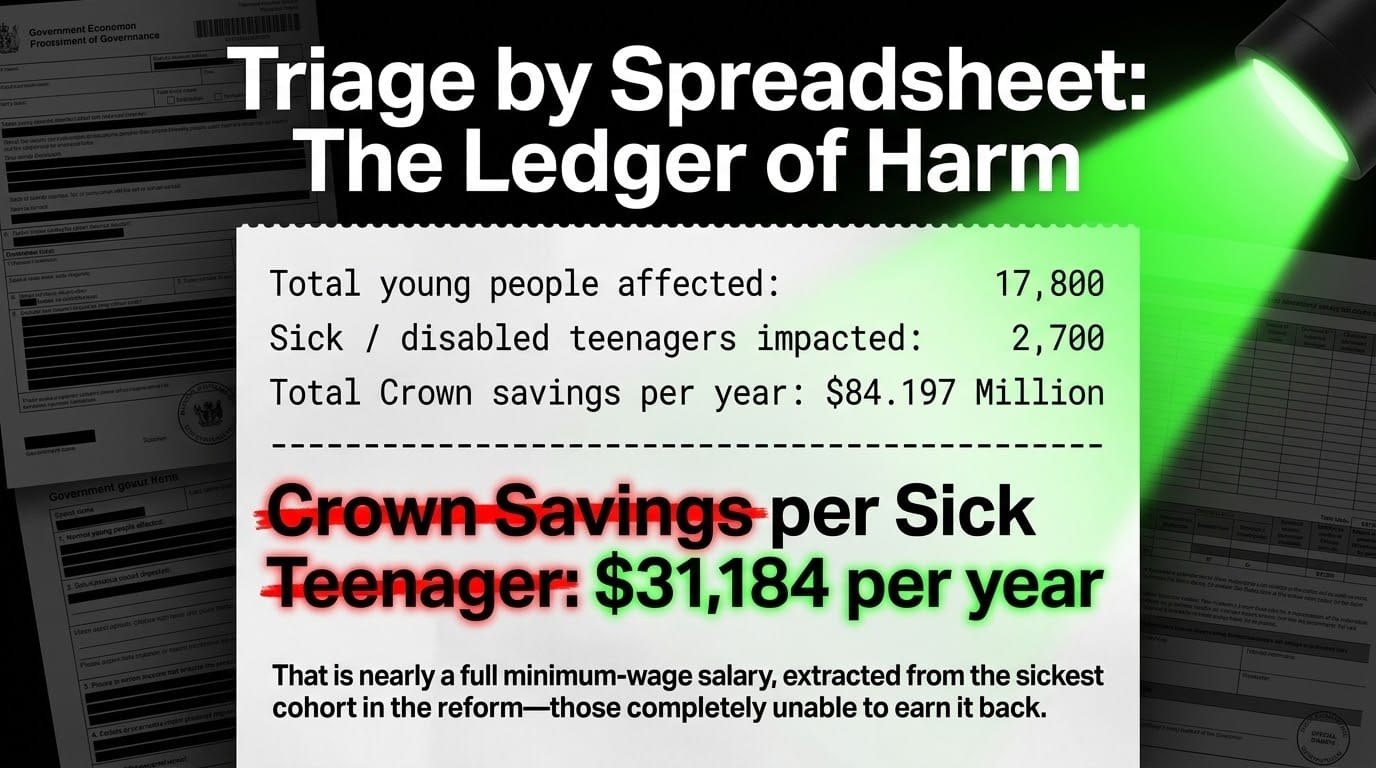
Core claim: MSD's factsheet states $84.197 million in ongoing annual savings from this policy, confirmed by direct fetch of the Ministry's own document, against a projected 2,700 young people in the health-and-disability category.
Quantified harm: $31,184 extracted per sick teenager per year, nearly a full minimum-wage salary of $49,816, taken specifically from the cohort least able to earn it back through paid work, because they are sick.
Solution: Ring-fence any savings from this policy into a dedicated Rangatahi Health Support Fund, administered with iwi and Māori health provider governance, so the money extracted from sick teenagers is at minimum redirected toward sick teenagers, not absorbed into general fiscal "sustainability."
Tikanga impact for the Western mind: Kaitiakitanga treats public resource as a collective trust to be administered for the wellbeing of all, not a ledger line to be minimised at the expense of the sick. Turning a health condition into a savings target is not fiscal management, it is the commodification of illness.
Ngā Hononga — Five Hidden Connections
- The policy traces directly to Budget 2025 under Minister Upston, formalised October 2025, enforced from November 2026, a documented paper trail confirmed via Te Ao Māori News.
- The Supported Living Payment two-year incapacity threshold was never adjusted alongside this reform, a designed gap and not an oversight, confirmed in MSD's own factsheet.
- The same Minister who tells sick teenagers to lean on family collects roughly $1,000 a week, tax-free, for a Wellington property she co-owns, as reported by E-Tangata, and as I detailed in "The Comfortable Thief", the rules apply downward, never upward.
- MSD's factsheet admits its treatment of family violence and relationship breakdown within the parental assistance test is still "under development," meaning the policy was announced before the protections for the most vulnerable families within it were finished.
- The same government paid $2.92 billion to restore landlord interest deductibility in the same fiscal envelope it called $3 billion for ending child poverty "unaffordable," as I documented in "The Locked Pātaka", the pattern of upward extraction and downward restriction repeating without shame.
Ngā Hua Kino — The Ledger of Harm
| What | Figure | Source |
|---|---|---|
| Weekly shortfall, home, JobSeeker vs Supported Living | $148.14 | Work and Income April 2026 rates |
| Weekly shortfall, away from home | $100.10 | MoneyHub Jobseeker rates 2026 |
| Two-year compounded shortfall (home) | $15,406.56 | Calculated from Work and Income rates above |
| MSD projected annual ongoing savings | $84.197 million | MSD factsheet |
| Savings extracted per sick teenager per year | $31,184 | Calculated from MSD figures above |
| Total young people affected, first two years | 17,800 | MSD factsheet |
| Health/disability category affected | 2,700 | MSD factsheet |
| Threshold rise since October 2025 | 2.59% | Beehive release versus Work and Income's current figure |
| Māori unemployment, Dec 2025 | 11.2%, more than double national average | NZCTU |
He Kupu Whakamutunga — Conclusion
Louise Upston did not stumble into this policy. She built it, priced it at $31,184 saved per sick teenager, and defended it on camera while telling a cancer patient's whānau to sort it out among themselves, the same Minister who has never had to sort out her own accommodation windfall.
She stands in a direct lineage from Ruth Richardson's 1991 "Mother of all Budgets," a policy so brutal it took thirty years and a global pandemic before any government dared partially reverse it.
Each generation, the same trick: strip the safety net from the sick and the young, because they do not have columns in the Herald or lobbyists in the Beehive, and call the theft "responsibility."
This is not family responsibility. It is a government that has learned exactly where resistance is weakest, and struck there deliberately.
Rangatiratanga means whānau deciding how whānau care for each other, resourced, not conscripted by a Crown that abandons its own duty of care and calls the abandonment strength.
Māuri Ora!
Ivor Jones The Māori Green Lantern Fighting Misinformation And Disinformation From The Far Right
Public interest: This essay concerns a Minister exercising public power over legislated welfare eligibility affecting sick and disabled young people, a matter squarely of public concern under Durie v Gardiner NZCA 278.
Right of reply: Hon Louise Upston is named solely in her public capacity as Minister for Social Development and Employment, in respect of published policy and on-record statements covered by qualified privilege for political expression under Lange v Atkinson 3 NZLR 385. No private individuals are named.
Disclaimer: This is political commentary and analysis in the public interest, drafted July 30, 2026. All factual claims are cited to linked primary and corroborating sources; opinions are flagged as such. The disproportionate Māori impact of this specific policy remains Unverified pending further Waitangi Tribunal and Te Puni Kōkiri research, and is not presented as established fact. No malice is alleged; this is a critique of a documented policy pattern and its quantified effects. Retraction will follow promptly on any verified factual error.