"THE WAKA THIEVES: HOW SIMEON BROWN AND NICOLA WILLIS ARE SELLING YOUR BANK TO THE SAME MARKET THAT HAS ALWAYS OWNED YOU" - 13 May 2026
They promised no asset sales. They lied. And now they want to hand the people's bank to the investors who already own everything else — while Māori whānau pay the price in silence.

Kia ora Aotearoa,
This essay examines the Luxon Government's push to partially privatise Kiwibank because it directly threatens Māori economic sovereignty, Treaty obligations under the State-Owned Enterprises Act 1986, and the financial wellbeing of all tangata whenua and working New Zealanders. This essay invokes the responsible communication defence under Durie v Gardiner NZCA 278.
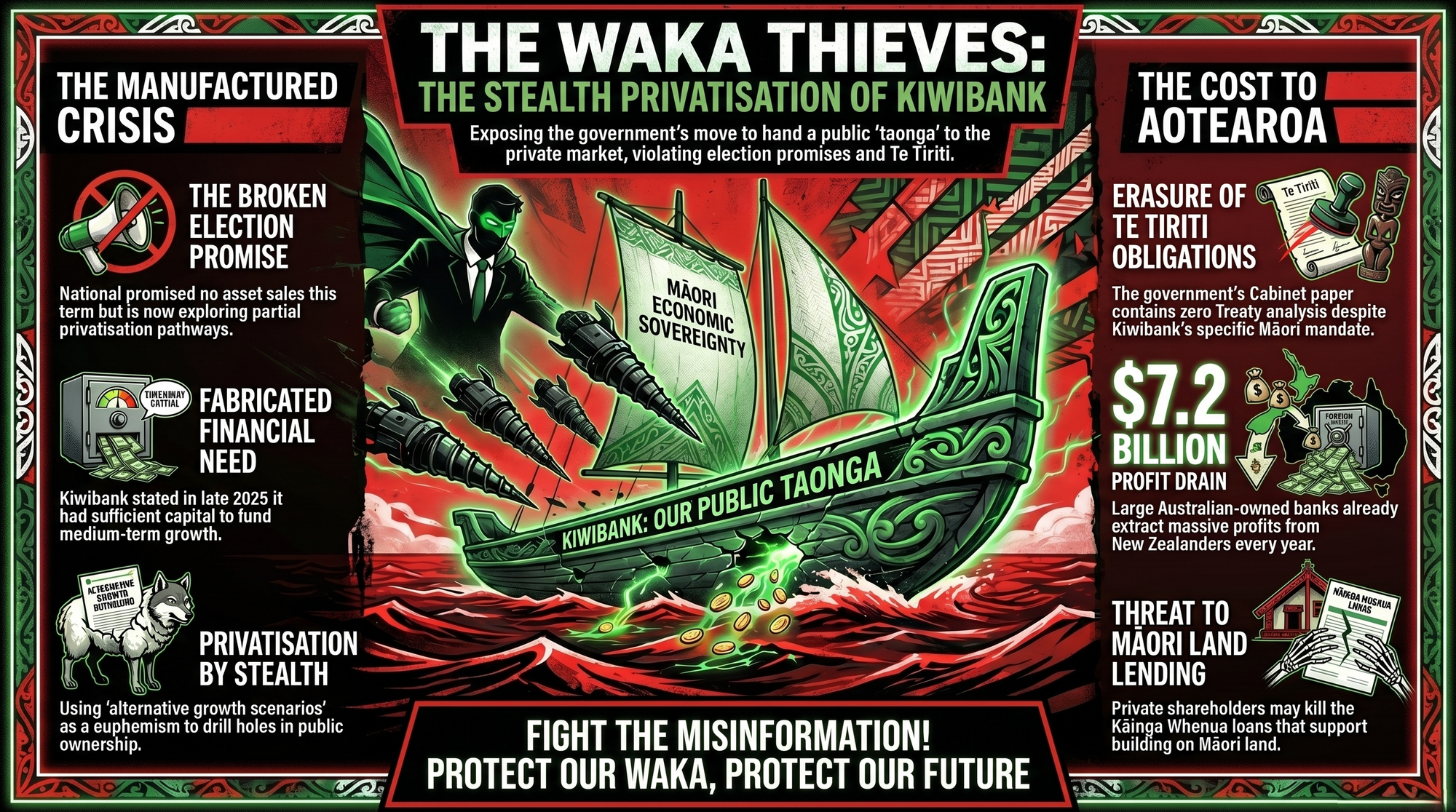
The Burning Waka
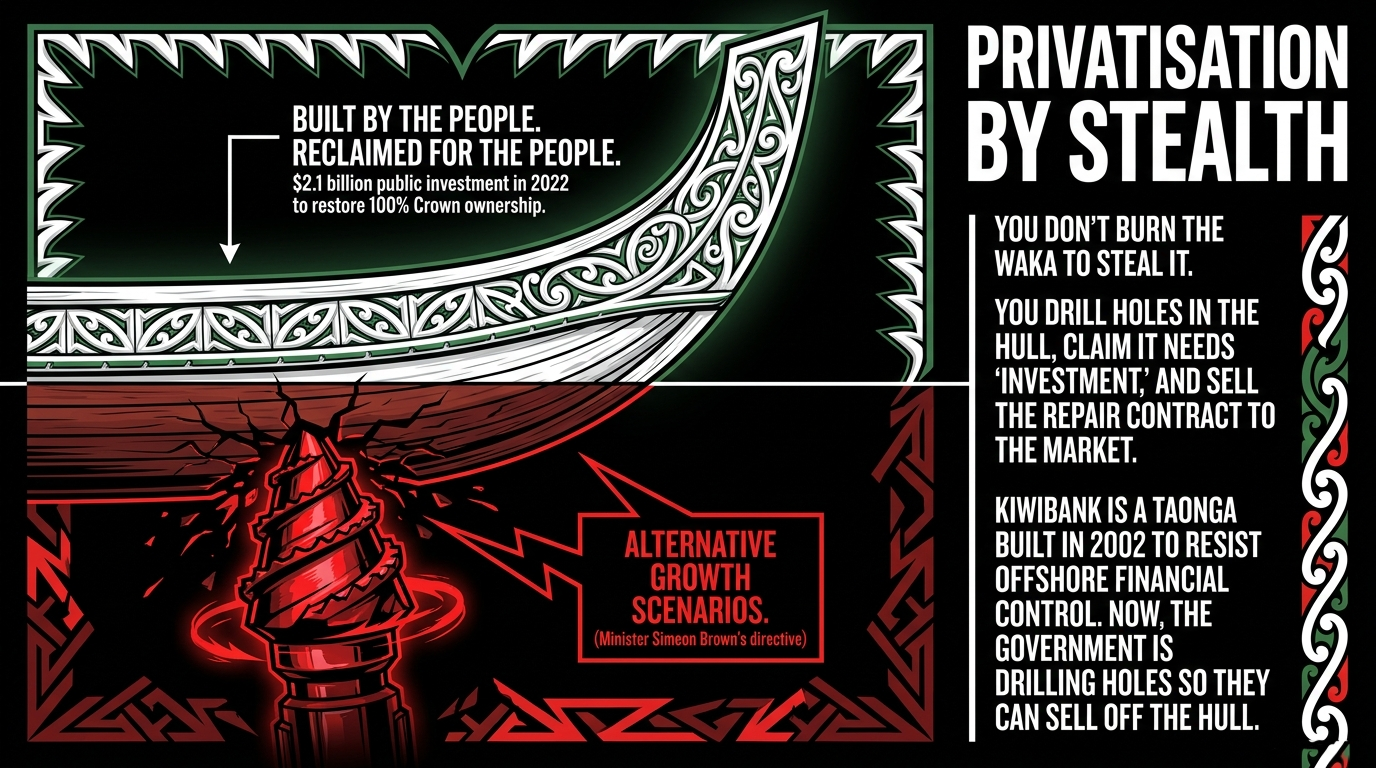
Picture your tūpuna felling the tōtara. Hear the karakia. Watch the tohunga whakairo carve the tauihu — not for beauty alone, but as declaration:
"this vessel belongs to the people".
It took generations to build. It took $2.1 billion of your tax money to reclaim it from those who had already sold pieces away. It is your waka. It is Kiwibank.
 Corin Dann
Now picture Simeon Brown — Minister of Privatisation by Stealth, architect of pharmacy sell-offs, saboteur of public health — standing at the stern with a pen in his hand and a letter of intent. Not a patu. Not a taiaha. A letter of intent.
Because in the neoliberal playbook, you don't burn the waka. You just quietly drill holes in the hull, tell the people the waka "needs investment," and sell the repair contract to the market.
By the time whānau notice the water rising, the hull belongs to someone else.
The Deep Dive Podcast
Listen to a lively conversation between two hosts, unpacking and connecting topics in the sources of this essay. I apologise in advance for the AI's very harsh pronounciation of reo. Please dont shoot me, :).
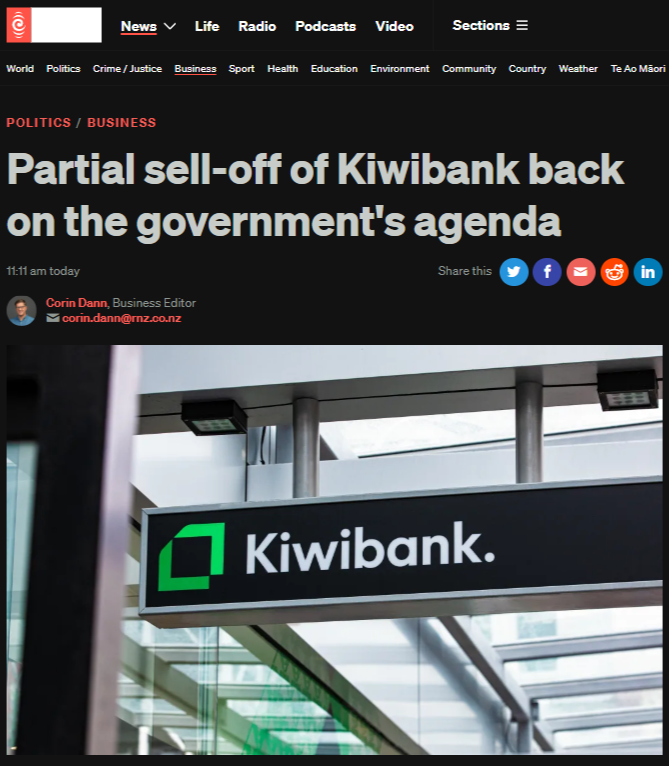
That is what is happening today, 13 May 2026, as revealed by RNZ.
Brown has issued a letter of intent to Kiwi Group Capital instructing it to explore "alternative growth scenarios" — including partial privatisation. His Finance Minister Nicola Willis has co-signed a Cabinet paper declaring the Crown
"is not in a position"
to fund Kiwibank's growth.
The waka is being drilled. And they are smiling while they do it.
Background: A Bank Built in Resistance
Kiwibank was born as an act of defiance.
Jim Anderton built it in 2002 precisely because New Zealand had already watched its banking sector get devoured — the BNZ sold to National Australia Bank, PostBank gone, the country's financial sovereignty offshore by the time the rogernomics experiment had finished with us, as documented by Te Ara.
Kiwibank was the people's answer.
As analysed previously by The Māori Green Lantern in Privatisation of Kiwibank: A Disservice to New Zealanders, this bank was the very counter-institution that Aotearoa needed — and now, two decades later, the same class of people who benefited from the original sell-offs want another turn.
By 2016, New Zealand Post had already carved off 25% to the NZ Superannuation Fund and 22% to ACC — the creeping privatisation playbook in practice, as charted by Wikipedia's Kiwibank history. In 2022, the Labour Government spent $2.1 billion restoring 100% Crown ownership, as confirmed by the Beehive. That act of reclamation — hard-won, publicly funded — now sits on Simeon Brown's desk being systematically dismantled.
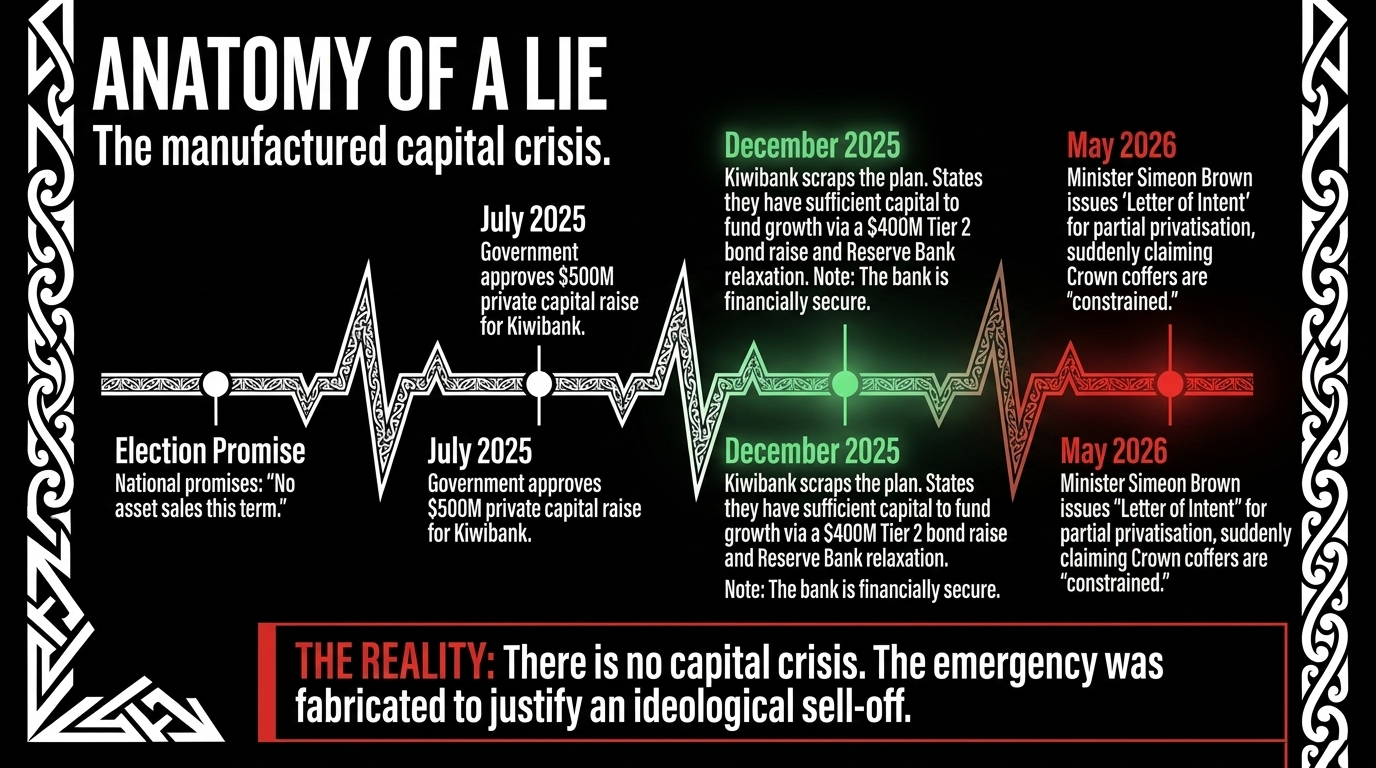
The Commerce Commission's 2024 banking study, covered by Newstalk ZB, looked at the cartel of Australian-owned banks extracting record profits and said the obvious: capitalise Kiwibank, let it disrupt the oligopoly. The Government nodded. Then it scrapped the $500 million capital raise in December 2025, as confirmed by Interest.co.nz. Then it re-activated the privatisation option today. This is not policy incoherence. This is a plan unfolding exactly as intended.
The Hidden Connections — Five Verified Revelations
Revelation 1: The Lie That Built the Government
National promised no asset sales this term. It is not a rumour. It is not a mischaracterisation. It is documented policy that won them votes. Today's Cabinet paper, cited by RNZ, explicitly signals partial privatisation as the structural pathway forward. Willis confirmed to media in July 2025 that "a future government may consider a public listing" — a public listing that requires the exact structural groundwork Brown is laying right now. The promise was never meant to be kept. It was a campaign prop. It was always going to end here.
Revelation 2: The $500 Million Shell Game
In July 2025, the Government approved Kiwibank raising $500 million from private institutional investors — KiwiSaver funds and investment houses — as confirmed by Reuters and Kiwibank's own media release. By December 2025, Kiwibank scrapped the plan entirely, saying Reserve Bank capital relaxation and a $400 million Tier 2 bond raise meant it could fund its own growth, per Interest.co.nz. There was no capital crisis. Kiwibank was fine. Today, Brown has re-activated the question not because the bank needs saving — but because the ideology demands the market be given a seat. This is manufactured necessity. This is a fabricated emergency dressed in a business case.
Revelation 3: $7.2 Billion — The Robbery in Plain Sight
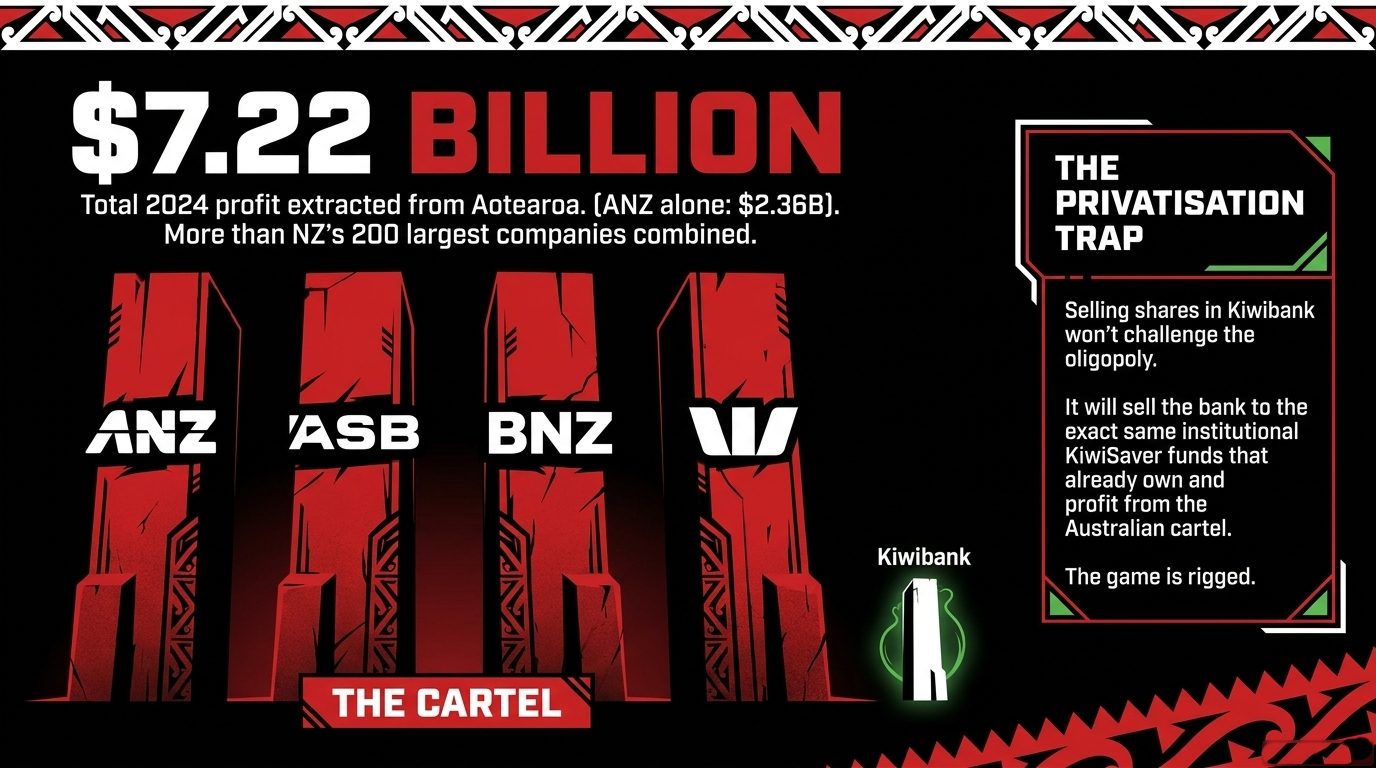
In 2024, New Zealand's banking sector posted record profits of $7.22 billion, as reported by NZ Herald/KPMG and ODT. ANZ NZ alone posted a cash NPAT of $2.369 billion for the year to September 2025, up 4%, per ANZ's own results. The four Australian-owned banks now make more profit than the rest of New Zealand's 200 largest companies combined, as reported by Newswire. That money leaves Aotearoa. It has always left. The Commerce Commission saw this cartel, named it, and recommended Kiwibank be the weapon against it. This Government's response — as previously exposed by The Māori Green Lantern in ComCom Report: Willis's 'Action' on Banking Sector Reforms — A Sham of Epic Proportions — has been to perform concern while engineering the exact conditions that protect the cartel.
Revelation 4: The Treaty Is Nowhere in This Cabinet Paper
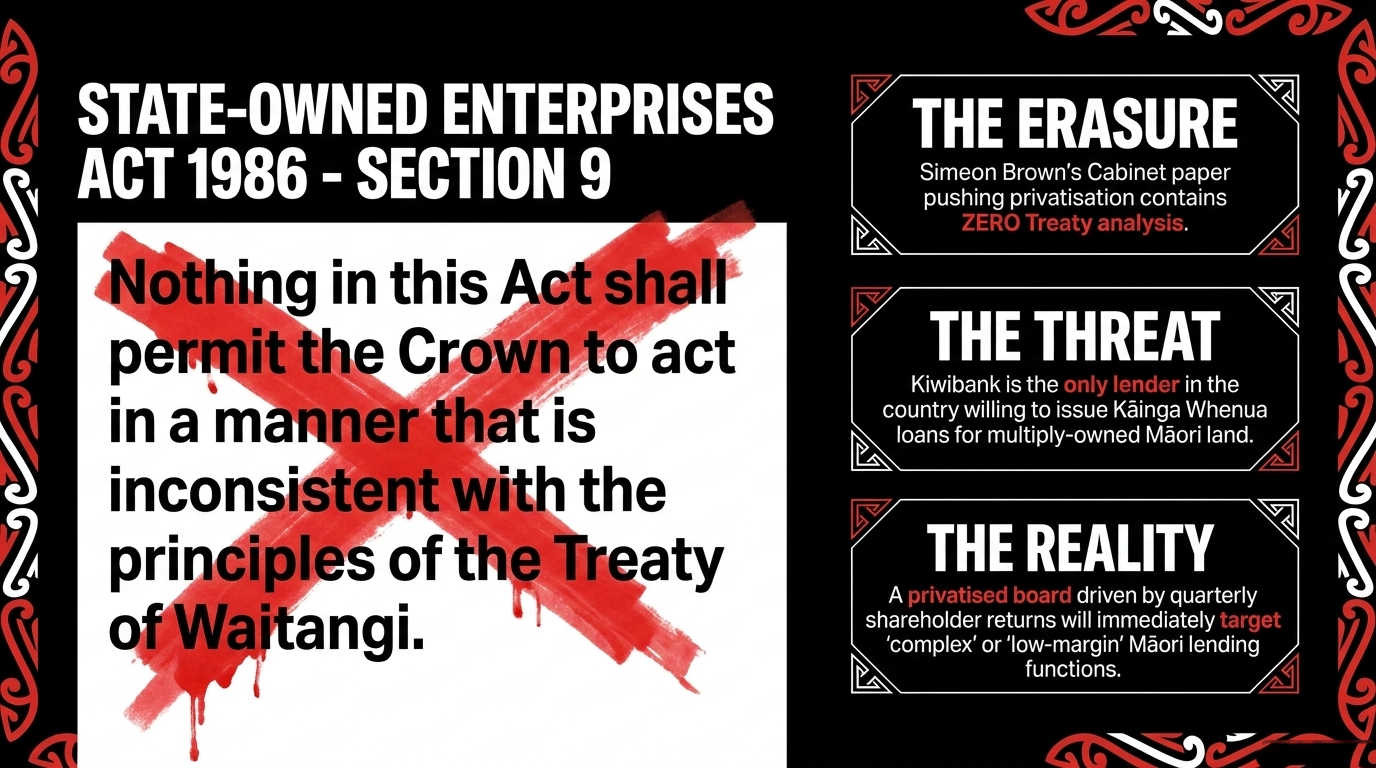
Section 9 of the State-Owned Enterprises Act 1986 is unambiguous: "Nothing in this Act shall permit the Crown to act in a manner that is inconsistent with the principles of the Treaty of Waitangi," as confirmed by Te Ara. The Court of Appeal confirmed in 1987 that Crown asset transfers require Treaty consistency assessment. Kiwibank provides the Kāinga Whenua home loan — the only lender in the country willing to lend on multiply-owned Māori land, documented by the Beehive. It has an active Māori Advisory function and disrupts banking rules specifically to support the Māori economy, per Kiwibank's own release. Brown's letter of intent — and the accompanying Cabinet paper — contains zero Treaty analysis. Zero. This Government is already conducting a review of Treaty clauses across 28 pieces of legislation, as exposed previously by The Māori Green Lantern in The under-the-radar Treaty clause review that could have far-reaching consequences. Stripping Treaty obligations from SOE legislation while simultaneously engineering privatisation is not a coincidence. It is a programme.
Revelation 5: Simeon Brown — The Crown's Most Dangerous Bureaucrat
Brown is not a blundering minister. He is a methodical one. This is the same minister who engineered the expansion of pharmacist prescribing as covert health privatisation — documented by The Māori Green Lantern as The Pharmacy Con: Simeon Brown's Privatisation by Stealth. He is the same minister whose health system failures were dissected in How Simeon Brown's Corpse of a Health System Left a Hantavirus Victim to Die. He reappointed David McLean as Chair of Kiwi Group Capital in November 2025, per DevDiscourse, ensuring governance is market-aligned before the structural work begins. Brown does not govern public institutions. He prepares them for sale.
Three Examples for the Western Mind
Example 1: Telecom — The Blueprint for What Happens Next
The claim: Partial privatisation of strategic public assets in New Zealand history has always ended in public harm, private extraction, and eventual Crown bailout.
The evidence: Telecom NZ was privatised in 1990, sold to Ameritech and Bell Atlantic for $4.25 billion. Its new owners extracted maximum short-term profit, chronically underinvested in the network, and left New Zealand with some of the worst broadband infrastructure in the developed world for two decades. By 2006, the government was forced to structurally separate Telecom — effectively a regulatory bailout — because the private market had failed the public interest, as documented in the NZ Herald's privatisation history. Air New Zealand was sold for $660 million in 1989 and the Crown had to inject $885 million in 2002 to prevent receivership, per the same source. The BNZ was sold to National Australia Bank for a fraction of its value after the Crown bailed out the private shareholders who had run it into trouble. The pattern is identical every time. Sell the asset. Extract the value. Socialise the losses. If Kiwibank is partially privatised and the private shareholders demand returns that conflict with the bank's public-interest function — Kāinga Whenua loans, Māori business lending, low-fee banking for low-income New Zealanders — those functions will be the first casualties.
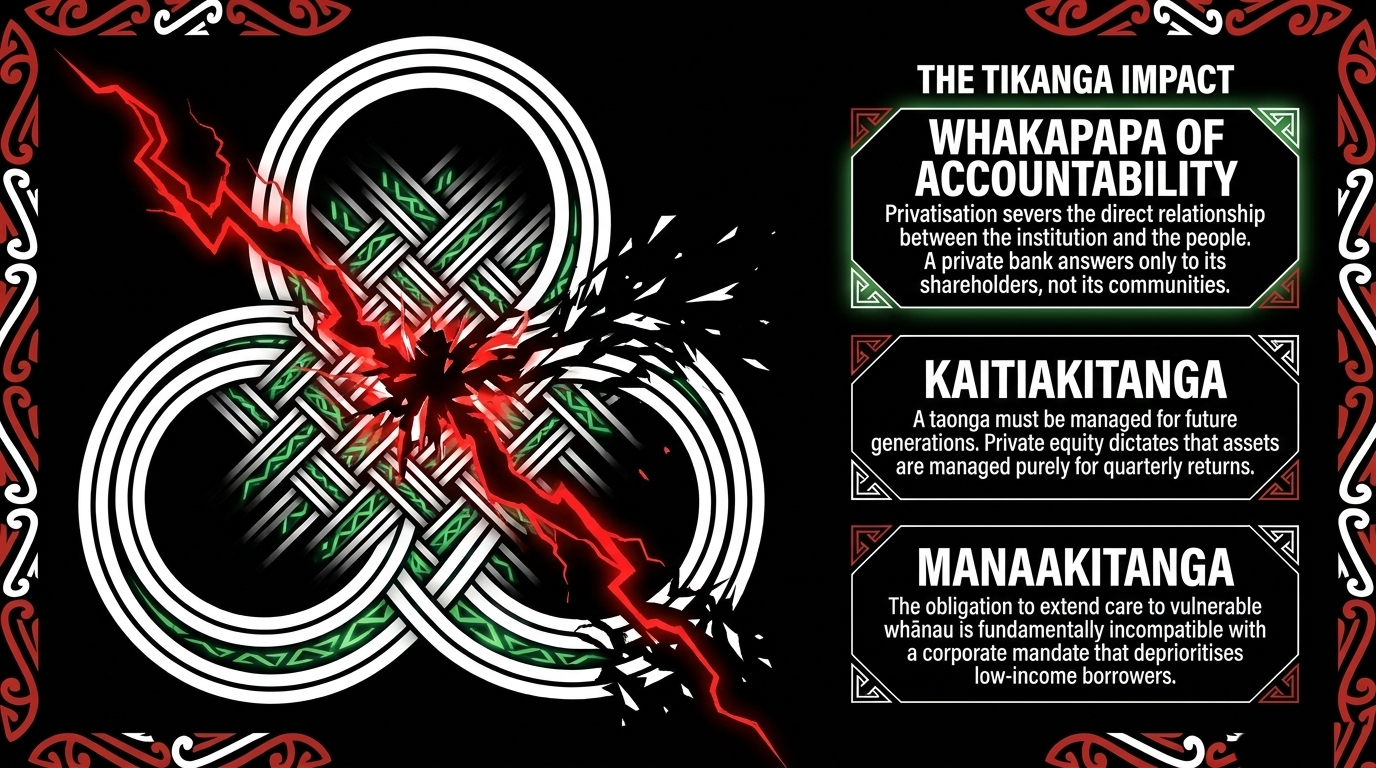
The tikanga impact: In tikanga Māori, a taonga held in trust for the people cannot be transferred to another party without the consent of those it serves. Kiwibank's function as a Kāinga Whenua lender makes it a taonga of the first order. Privatisation breaks the whakapapa of accountability — the chain of relationship between the institution and the people it exists to serve. Once that chain is broken, the institution no longer knows its obligations. It only knows its shareholders.
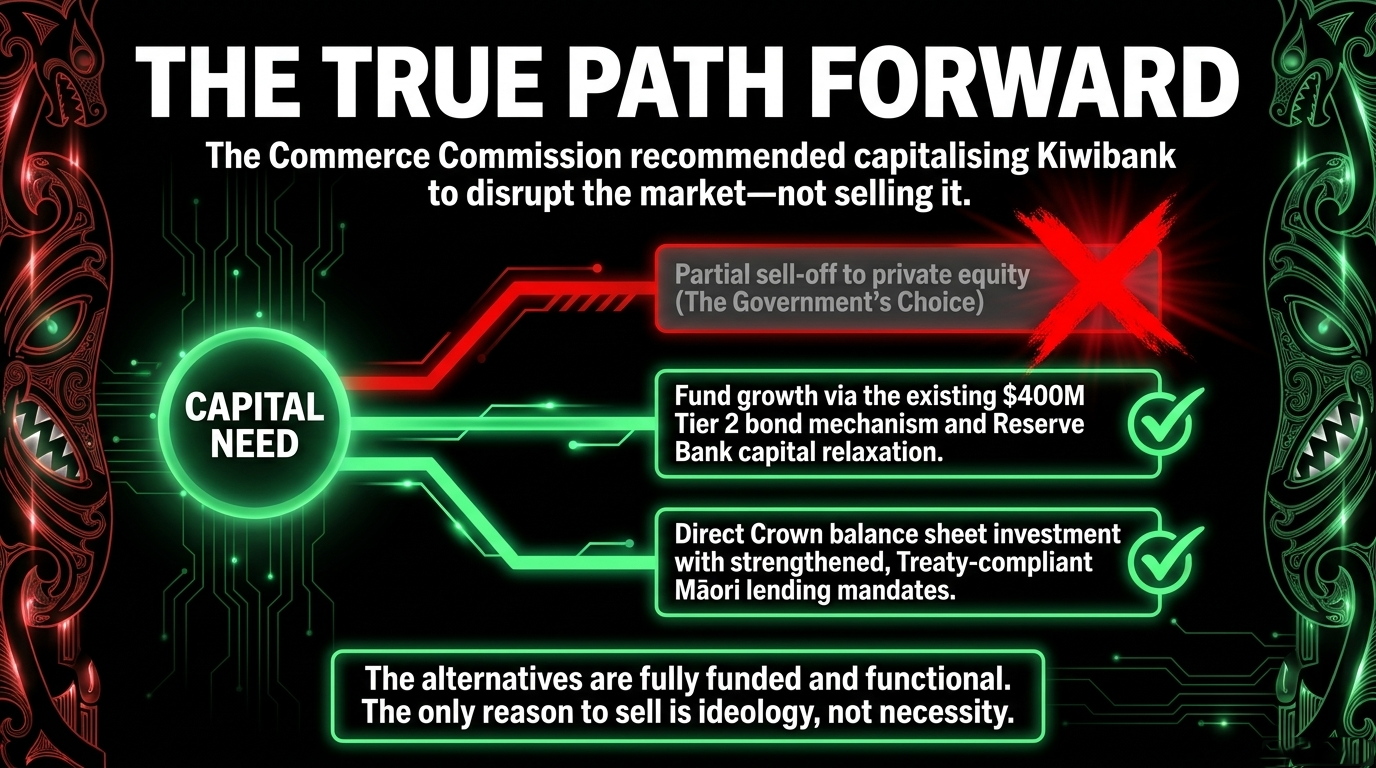
The solution: The Crown already has the answer. Maintain 100% ownership. Fund Kiwibank's growth through the $400 million Tier 2 bond mechanism that already works. Direct Reserve Bank capital setting relaxations — already in effect — to support Kiwibank expansion. No privatisation required. Kiwibank said so in December 2025. The only reason this option is not being chosen is ideology.
Example 2: The Australian Banking Cartel — Why the "Competition" Argument Is a Fraud
The claim: Partially privatising Kiwibank does not create competition with the Australian banks. It hands the solution to the same investor class that profits from the oligopoly.
The evidence: New Zealand's four Australian-owned banks — ANZ, ASB, BNZ, Westpac — extracted $7.22 billion in profit from New Zealanders in 2024, as confirmed by KPMG via NZ Herald. ANZ NZ alone made $2.369 billion profit in the year to September 2025, per ANZ's results. These profits are not reinvested in Aotearoa. They are dividend-flowed offshore. Now: the institutional investors most likely to buy a partial stake in Kiwibank are KiwiSaver fund managers — the same managers who hold shares in ANZ, ASB, BNZ and Westpac. As analysed by The Conversation, partial privatisation via private equity risks creating a "façade of New Zealand ownership while primarily benefiting the foreign entity" through leveraged buyout structures — the same playbook used when Fisher Funds was acquired by overseas private equity in 2022. The market being offered Kiwibank is the market that already owns the banks Kiwibank is supposed to challenge.
The tikanga impact: Kaitiakitanga — the principle of guardianship — requires that taonga be managed in the interests of future generations, not present shareholders. A bank under private investment pressure makes decisions on the basis of quarterly returns, not generational wellbeing. The concept of manaakitanga — extending care and hospitality, particularly to those in need — is directly incompatible with a shareholder return mandate that deprioritises low-income or high-risk borrowers, including many Māori whānau. When you privatise the bank, you privatise the obligation to care.
The solution: Implement the Commerce Commission's actual recommendation — inject capital directly into Kiwibank through the Crown balance sheet, using debt instruments rather than equity dilution. The Crown's borrowing cost is lower than any private equity return expectation. Strengthen Kiwibank's Māori lending division with a dedicated Treaty-compliant lending mandate. Make Kiwibank the structural competitor the market cannot buy.
Example 3: The 1980s Playbook, Rerun in 2026
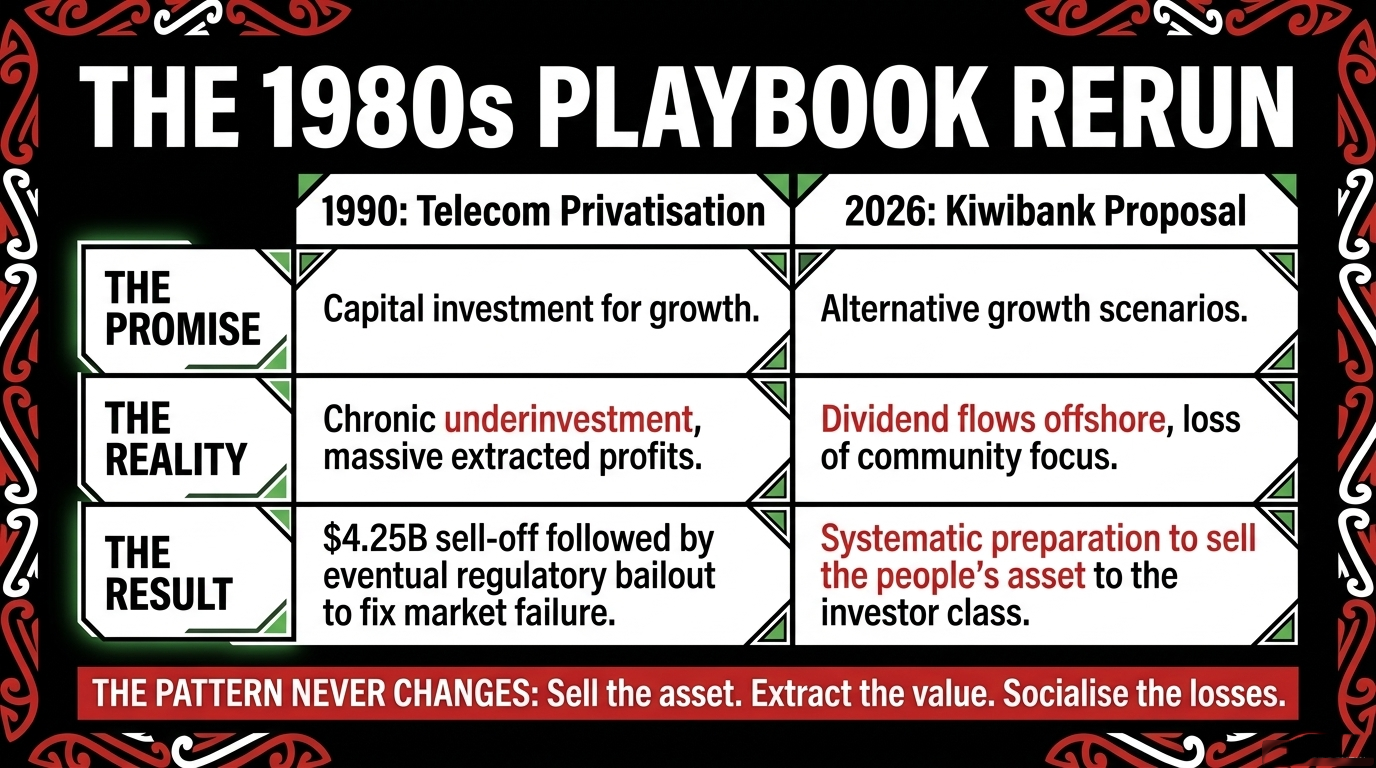
The claim: This government is executing — point for point — the same privatisation programme that devastated Māori and working-class New Zealanders in the 1980s and 1990s, as documented by AUT's academic analysis of the NZ privatisation experiment.
The evidence: Between 1987 and 1999, New Zealand sold $19.1 billion of public assets. The AUT study confirms that privatised firms returned 12.71% to early investors — profits extracted from public infrastructure that the whole country had built. The losers were the people who no longer owned those assets. The winners were the investment class. The SOE Act 1986 was supposed to protect Māori from this — Section 9 required Treaty consistency in all asset transfers, as documented by Te Ara. It was routinely ignored. Today, the same government engineering the Kiwibank partial privatisation is also conducting a review of Treaty clauses across 28 pieces of legislation, as exposed in the MGL's Treaty clause review analysis. The protections are being gutted in parallel with the asset being prepared for sale. This is not coincidence. This is coordination.
The tikanga impact: In tikanga, you cannot separate the land — or the institution — from the people who hold mana whenua, mana tangata over it. The privatisation experiments of the 1980s erased Māori from the room entirely. The same erasure is happening now: a Cabinet paper about a bank with a specific Māori lending function, a specific Treaty obligation in its enabling legislation, and a specific role in the Māori economy — and not a single mention of Te Tiriti. That is the continuation of colonial governance. It was wrong in 1987. It is wrong in 2026.
The solution: Require a full Waitangi Tribunal hearing on the proposed privatisation before any capital structure change proceeds. Mandate a Treaty impact assessment as a condition of any structural change to Kiwibank. Establish a Māori advisory taumata with binding governance authority over Kiwibank's community lending function, regardless of any future ownership structure. Do not proceed without the people.
The Moral Verdict
This white supremacist neoliberal government
— and the evidence demands that naming —
has broken its election promise, ignored Treaty obligations, manufactured a capital crisis that does not exist, and is engineering the partial transfer of a people's institution to the investor class that already profits from the oligopoly it was designed to disrupt.
As previously exposed by The Māori Green Lantern in Unmasking the Neoliberal Puppet Show: How the Luxon Government's Economic Terrorism is Dismantling Aotearoa, the coalition's economic philosophy rests on three pillars of destruction: privatisation of public assets, rollback of environmental protections, and the systematic stripping of indigenous rights.
Kiwibank is simply the next asset on the block.
Simeon Brown does not serve the public. He serves the market. Nicola Willis does not serve the people. She serves the portfolio. And the Cabinet paper they co-signed today is not a growth strategy. It is a heist document.
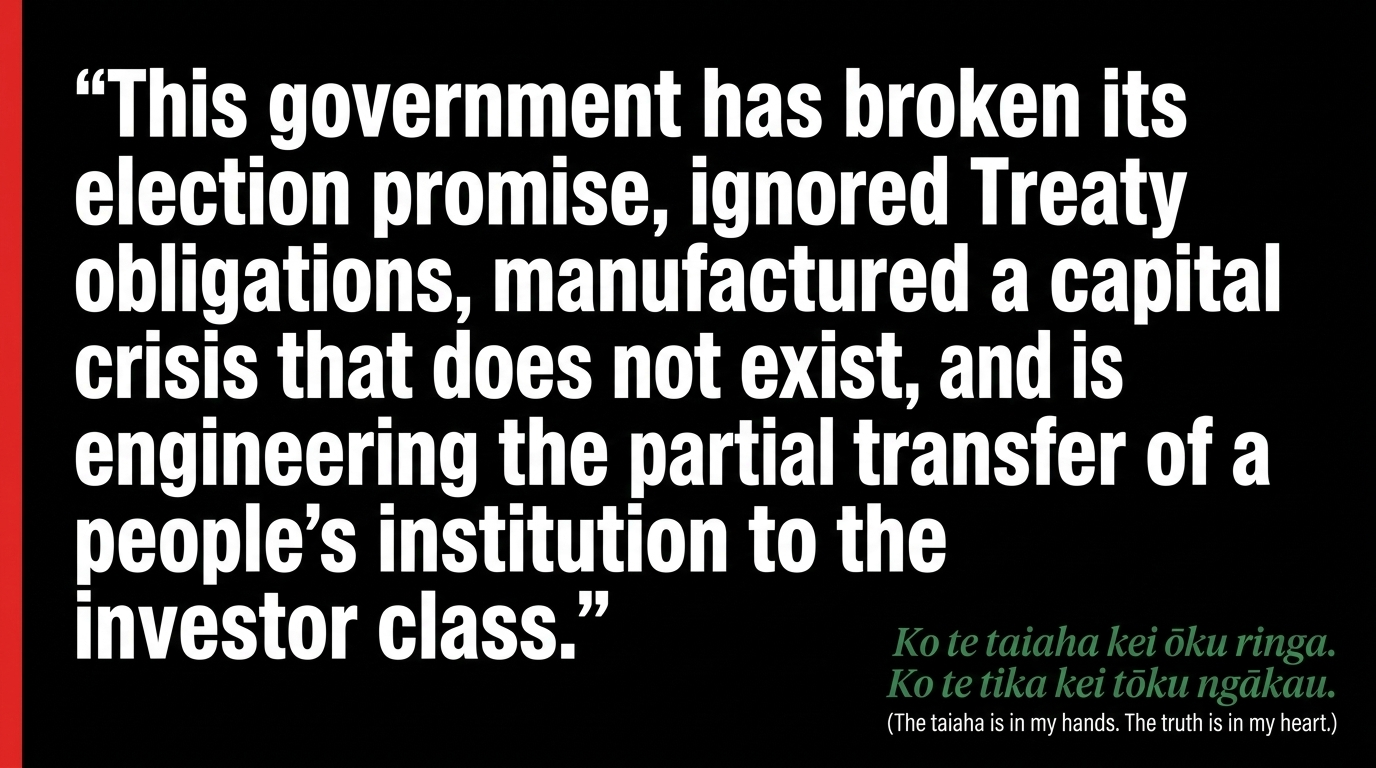
Ko te taiaha kei ōku ringa. Ko te tika kei tōku ngākau.
Koha — Fund the Truth They Don't Want Told
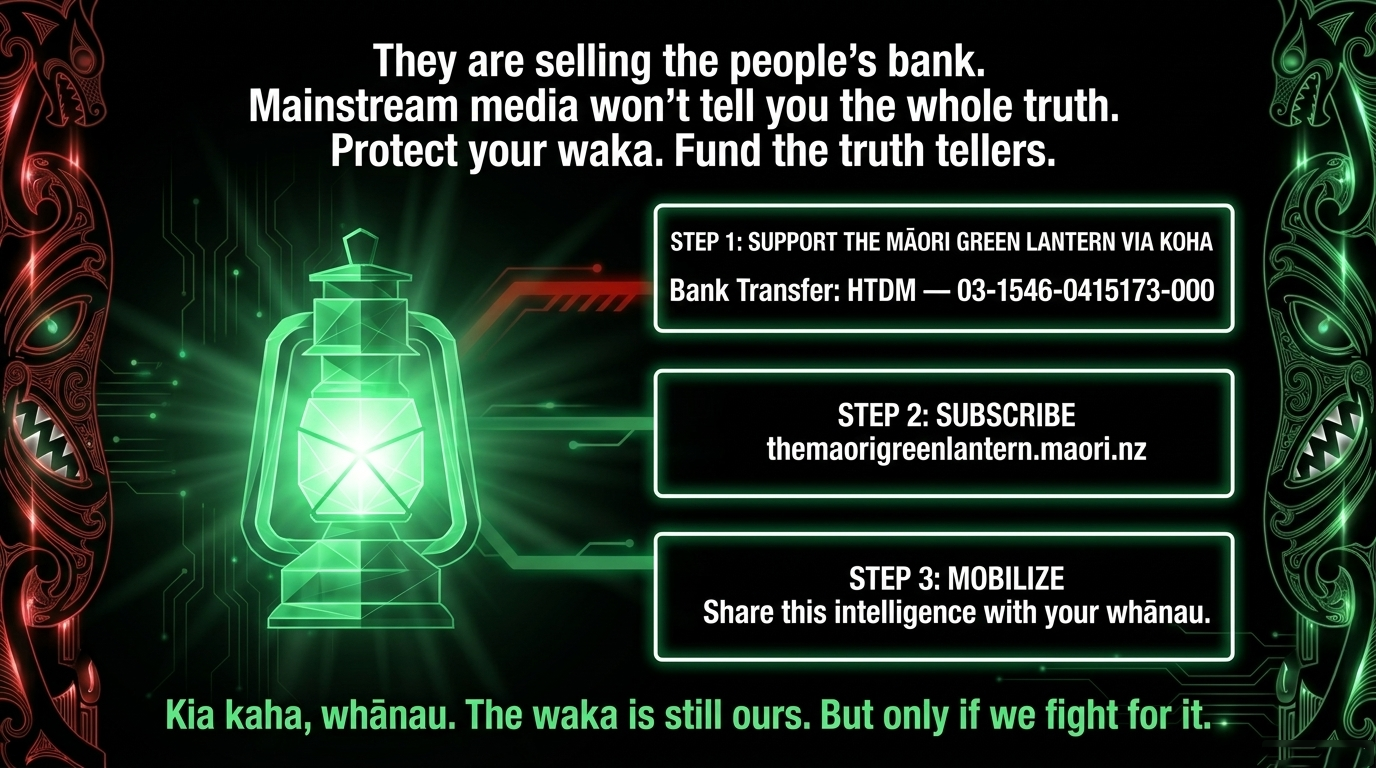
They are selling the people's bank. Who is going to tell the people?
Not the mainstream media that prints the press release. Not the government that issued it. The Māori Green Lantern has been tracking this privatisation play since 2024 — through the shell game, through the broken promises, through the Treaty erasure — because whānau deserve to know the truth before the hull is sold, not after.
Every koha signals that rangatiratanga includes the right to fund our own truth tellers. Every dollar keeps this taiaha raised. Every subscription means one more whānau gets this analysis before the decision is made, not after.
If you can koha — do it now, while there is still time to matter:
- Koha direct: Support The Māori Green Lantern on Koha
- Subscribe for essays: themaorigreenlantern.maori.nz
- Bank transfer: HTDM — 03-1546-0415173-000
- Facebook: Follow and subscribe
If you cannot koha — no worries. Subscribe. Follow. Share this with your whānau and friends. Tell someone who needs to know. That is koha in itself. That is kaitiakitanga in practice.
Kia kaha, whānau. The waka is still ours. But only if we fight for it.
Views expressed constitute honest opinion on matters of public interest under the Defamation Act 1992 (NZ) and Durie v Gardiner NZCA 278. All factual claims are sourced and cited. Named individuals are referenced solely in their public capacity as Ministers of the Crown. Corrections and correspondence: themaorigreenlantern.maori.nz.