
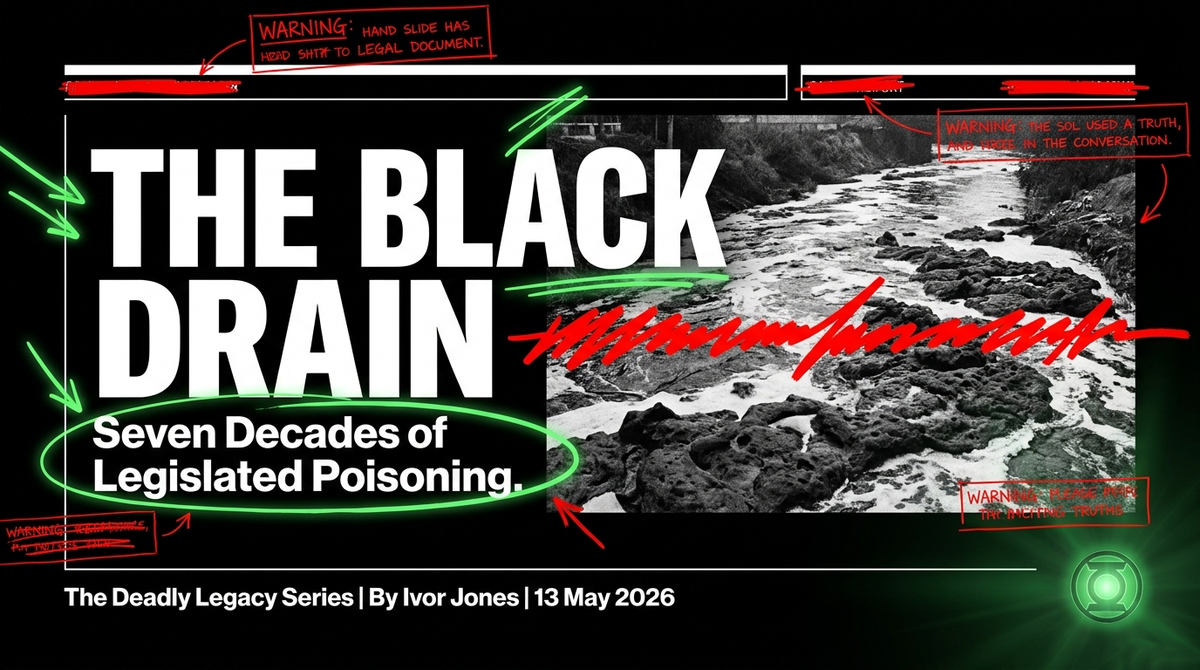
"THE BLACK DRAIN: How the Crown Sold a River to a Corporation, Watched It Die, and Is Now Selling the Undertakers" - 13 May 2026
When a government writes a company permission to kill a river — replaces that permission with a living law it keeps weakening — and then bans the courts from making corporations pay for the damage — that is not negligence. That is a system. And it is working exactly as designed.

Kia ora Aotearoa,
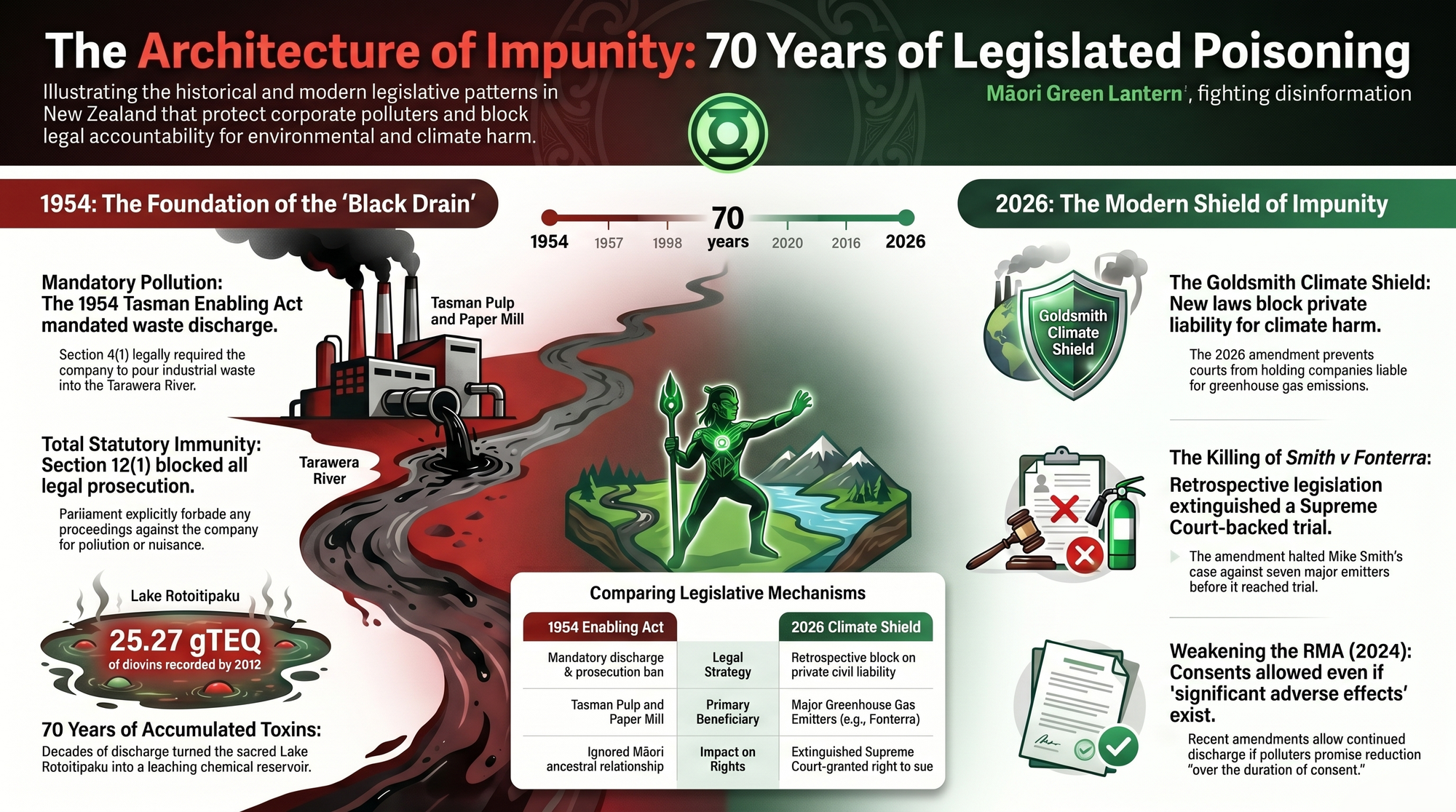
This essay examines the corporate poisoning of the Tarawera River by Tasman Pulp and Paper, the Crown consent architecture that made it legal, the Resource Management Act provision that replaced it, the 2024 weakening of that provision under the Luxon government, and Paul Goldsmith's 13 May 2026 announcement that the Crown will amend the Climate Change Response Act to block courts from holding companies liable for climate-related harm — because all of this directly affects Māori whānau, downstream communities, and the democratic right of every New Zealander to hold corporations accountable for environmental crimes. This essay is published in the public interest under the Defamation Act 1992 (NZ) and Durie v Gardiner NZCA 278.
Essay Two of The Deadly Legacy Series | By Ivor Jones, Te Māori Green Lantern | 13 May 2026
Three Laws. One Logic. Seventy Years of Poison.
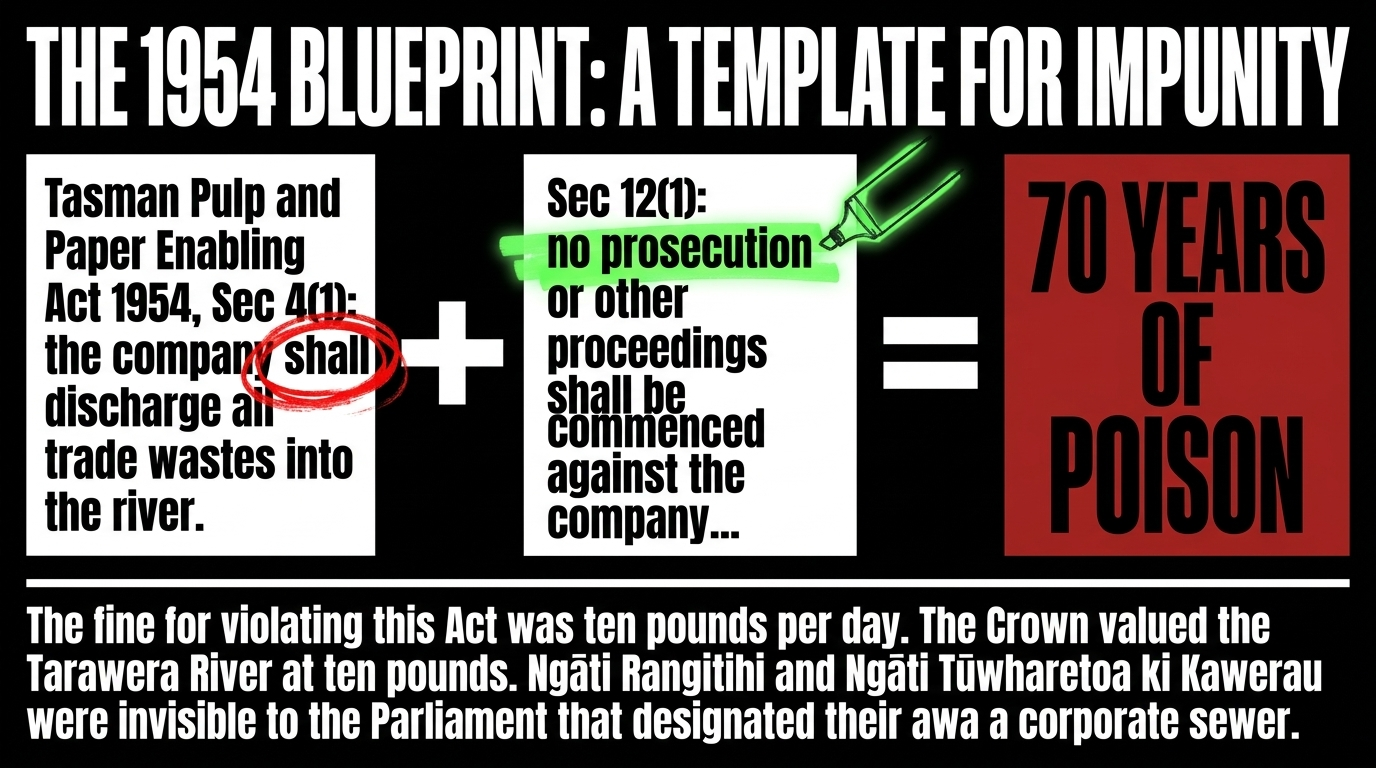
In 1954, Parliament passed a law that said a corporation shall discharge its industrial waste into a river. Section 12 said no one could prosecute them for it.
In 2010, the Resource Management Act — which replaced the 1954 Act — gave the same mill a fresh 25-year discharge consent under
"exceptional circumstances."
In 2024, the Luxon government amended the RMA to make it easier to grant discharge consents where significant adverse effects on aquatic life already exist.
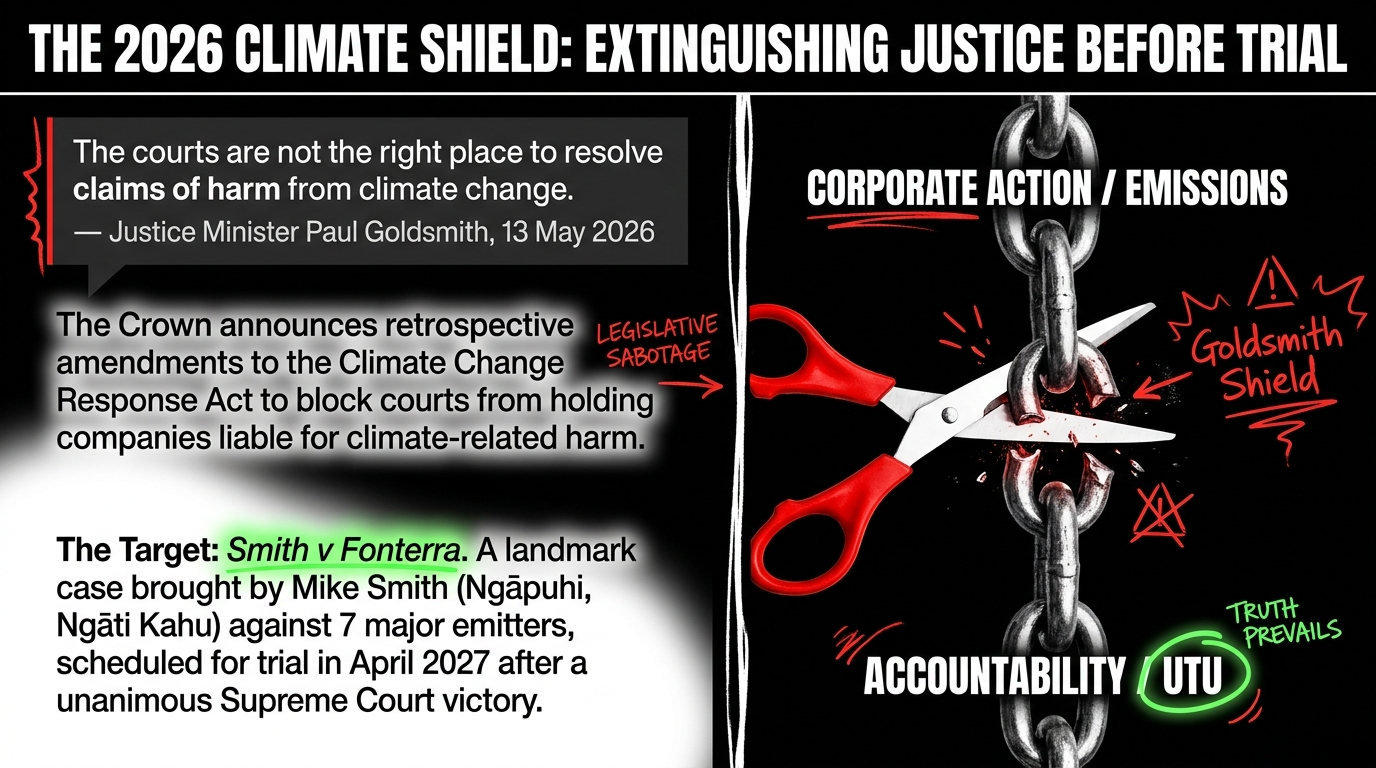
On 12 May 2026, Justice Minister Paul Goldsmith announced that the Crown will amend the Climate Change Response Act 2002 to prevent courts from holding companies liable in private cases for climate-related harm. The amendment applies retrospectively — killing a High Court trial scheduled for April 2027. That trial is Smith v Fonterra — brought by Mike Smith (Ngāpuhi, Ngāti Kahu), climate change spokesperson for the Iwi Chairs' Forum, alleging that seven of New Zealand's biggest emitters had harmed his land, interests, and cultural rights as kaitiaki.
As the ODT confirmed on 11 May 2026, Smith himself said the move was unprecedented, while Greenpeace called it a
"shocking abuse of power."
The Deep Dive Podcast
Listen to a lively conversation between two hosts, unpacking and connecting topics in the sources of this essay. I apologise in advance for the AI's very harsh pronounciation of reo. Please dont shoot me, :).
Three laws. Seventy years apart. One logic: when corporate pollution creates liability, change the law to remove it. The Tarawera River is not the past. It is the template.
The River That Made Him — And the One They Destroyed

Gordon Jackman learned to swim in the Hangaroa River as a boy. It was clean, cold, and alive. That river gave him a physical standard for what water is supposed to be — a standard the world around him would spend the next forty years failing to meet.
When Gordon stood at the Tarawera River in 1980–81 and looked down, he understood immediately.

The water was black. Not metaphorically. Not "a little discoloured." Black.
The community had already named it the Black Drain. In that moment of witnessing, something in Gordon Jackman shifted from observer to fighter — because in tikanga terms, a witness who stays silent becomes complicit, while a witness who speaks becomes part of the healing.
He chose to speak. For forty-five years, he has not stopped. And what Paul Goldsmith announced on 13 May 2026 is the most powerful argument yet for why Gordon Jackman was right about everything
— and why the fight he started at the Tarawera in 1981 is not over.
It has reached its logical endpoint: a government that does not just licence the poisoning, but bans the courts from adjudicating it.
The 1954 Law That Made Poisoning Mandatory
The Tarawera River did not become the Black Drain by accident or ignorance. It became the Black Drain because Parliament passed a law to make it mandatory.
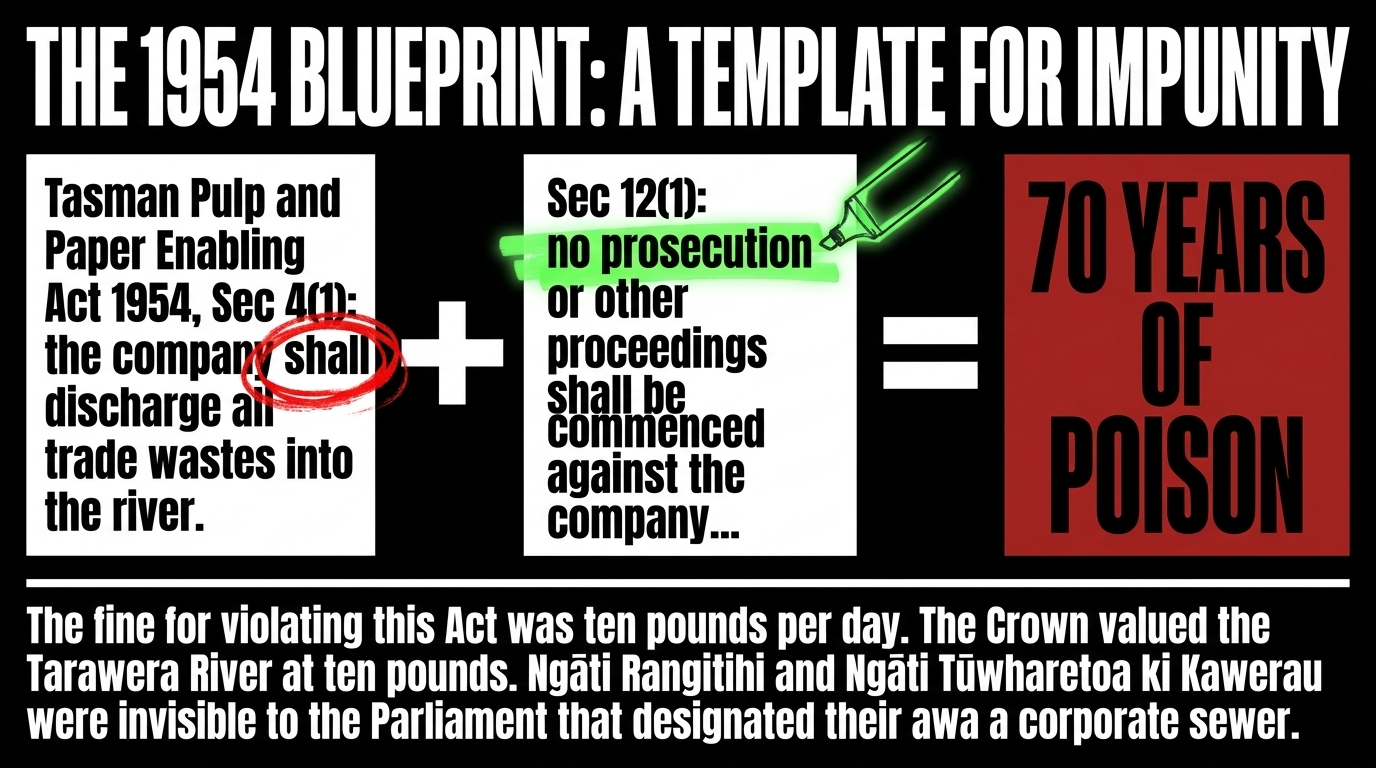
Section 4(1) of the Tasman Pulp and Paper Enabling Act 1954 reads, in full:
"Subject to the provisions of this Act, the company shall discharge all trade wastes into the river."
Not "may." Not "is permitted to." Shall.
The Parliament of New Zealand made it a legal obligation for Tasman Pulp and Paper to pour its industrial waste into the Tarawera River.
And Section 12(1) — the clause that makes the rest possible — in the same Act:
"Notwithstanding the provisions of any Act, no prosecution or other proceedings shall be commenced against the company under any Act, other than this Act, relating to nuisance or the pollution of waters in respect of the discharge by the company of trade wastes in accordance with this Act."
Parliament wrote corporate immunity directly into the statute. The fine for violating conditions under this Act? A maximum of one hundred pounds, with ten pounds per day for continuing offences. The Crown valued the Tarawera River at ten pounds per day. The communities downstream — Ngāti Rangitihi, Ngāti Tūwharetoa ki Kawerau — were not consulted. They were not mentioned. Their ancestral relationship with the river was invisible to the Parliament that designated it a corporate sewer.
The 1954 Act Was Repealed — But Its Logic Survived in Section 107
The 1954 Act was eventually repealed. But it was not remediated. The Resource Management Act 1991 replaced it — and Section 107 of the RMA stepped directly into the same structural role.
The Parliamentary Commissioner for the Environment confirmed this in her 2012 submission:
"This Bill has its origin in concern about the pulp and paper mill on the Tarawera River in the Bay of Plenty. In 1954, an Act of Parliament was written with the explicit purpose of enabling this mill to discharge its waste into the river. Such legislation would be unthinkable today."
And the Environment Court confirmed in Marr v Bay of Plenty Regional Council NZEnvC 347 that
"Section 107 was specifically enacted as it was with the Tasman Mill and the pulp and paper industry in mind."
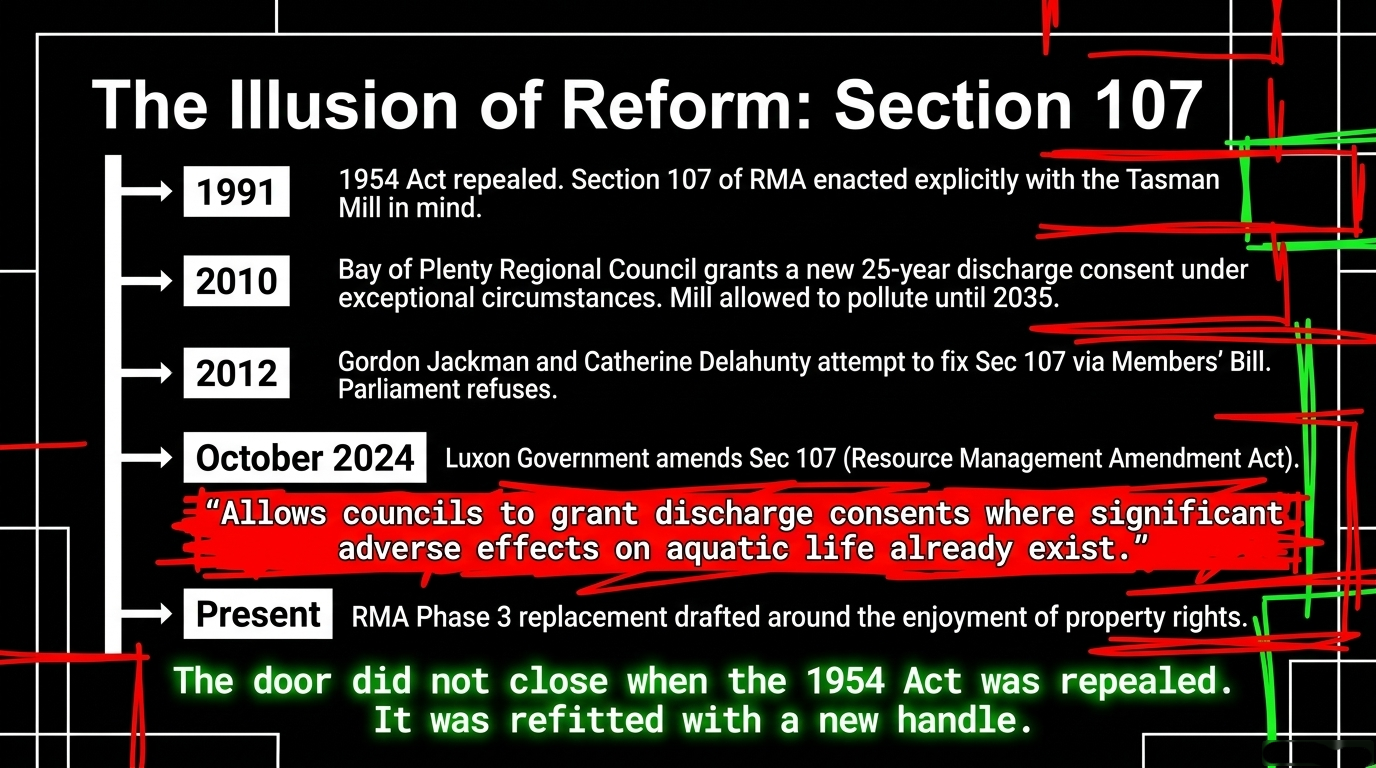
The door did not close when the 1954 Act was repealed. It was refitted with a new handle.
In 2010, under Section 107's "exceptional circumstances" provision, the Bay of Plenty Regional Council granted the mill a new consent to continue discharging waste into the Tarawera — for 25 years, until 2035, with conditions more lenient than the regional plan required.
The exceptional circumstance was that the mill had been discharging for fifty-six years already.
The Science the Crown's Own Experts Recorded
The Crown's own commissioned inventories tell this story in numbers. The New Zealand Inventory of Dioxin Emissions to Air, Land and Water, and Reservoir Sources 2011, prepared for the Ministry for the Environment under New Zealand's Stockholm Convention obligations, explicitly identifies pulp and paper waste disposal sites as significant known dioxin reservoir sources in New Zealand.
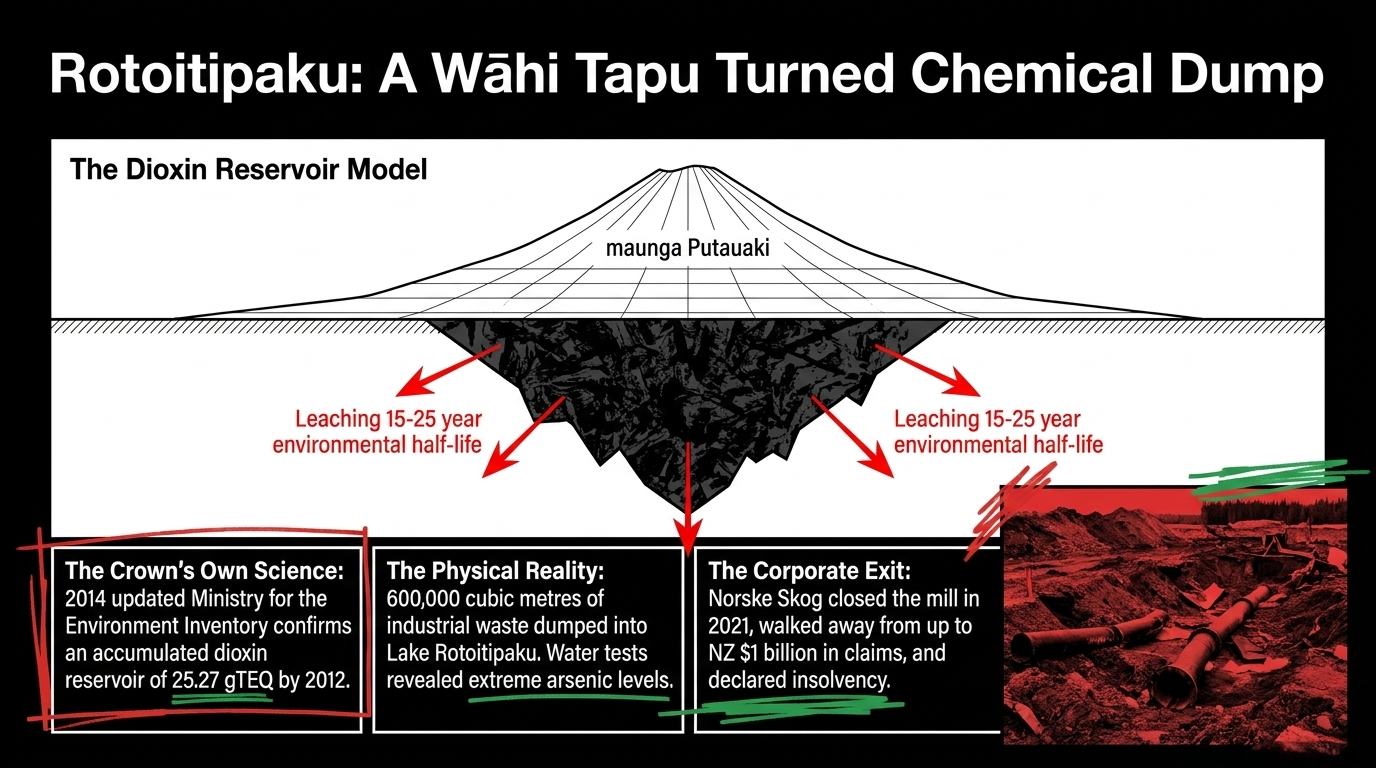
The 2014 update of that inventory confirms the accumulated dioxin reservoir at the Kawerau mill's waste disposal sites reached 24.8 gTEQ by 2008, growing to 25.27 gTEQ by 2012. This is Crown data. Crown scientists. Crown-commissioned reports. The science was never in dispute. The accountability was.
The 2011 Inventory states that dioxins are "extremely toxic to humans and can be found throughout the world in air, soil, sediment and water. They break down very slowly in the environment, and can accumulate in the fatty tissues of birds, fish, marine mammals, domestic animals, and in people." The half-life of dioxins in the environment is 15 to 25 years. The half-life in humans is 8 to 10 years. The dioxins deposited into Rotoitipaku from the 1950s onward are still there. Still active. Still leaching. The 2011 Inventory also flags that reservoir sources pose "an ongoing risk to the environment and to human health, although the potential exposure pathways and the resulting environmental significance are often difficult to characterise and are poorly understood." This is not a science failure. It is Crown policy.
Rotoitipaku: The Sacred Lake They Turned Into a Dump
Lake Rotoitipaku is a taonga of Ngāti Tūwharetoa ki Kawerau — a burial ground, a sacred site, a place where the community fished for eels and gathered in the hot springs. In the 1950s, enabled by the same Crown legislative architecture that produced the Enabling Act, it was converted into an industrial dump.
As documented by Corpwatch, over 600,000 cubic metres of industrial waste — dioxins, polychlorinated biphenyls, arsenic, sodium dichromate and zinc hydrosulphite — were deposited into this lake over the mill's operational life. Water testing revealed levels of arsenic and other toxics well above maximum concentration limits for drinking water. The Crown's own 2014 dioxin inventory confirms the accumulated dioxin reservoir reached 25.27 gTEQ by 2012.
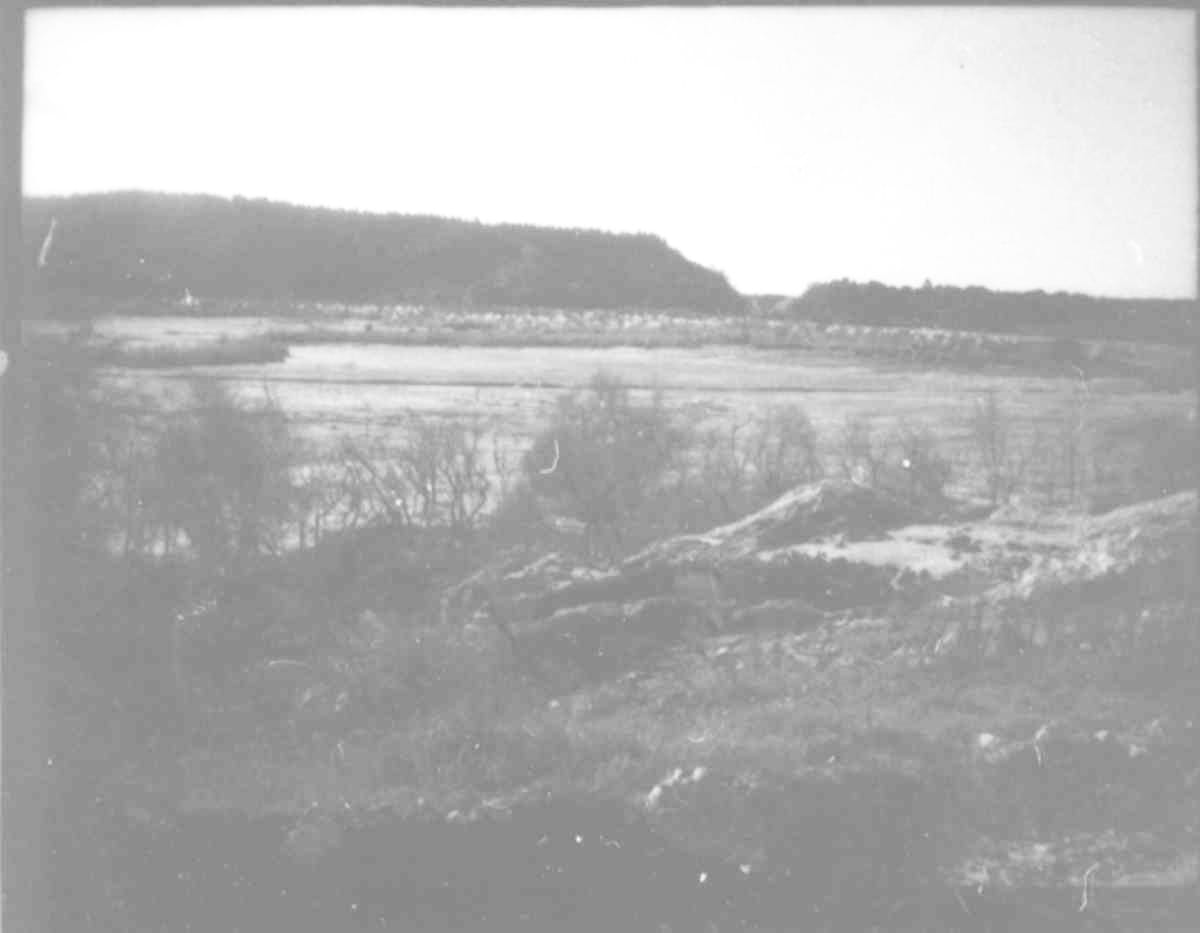
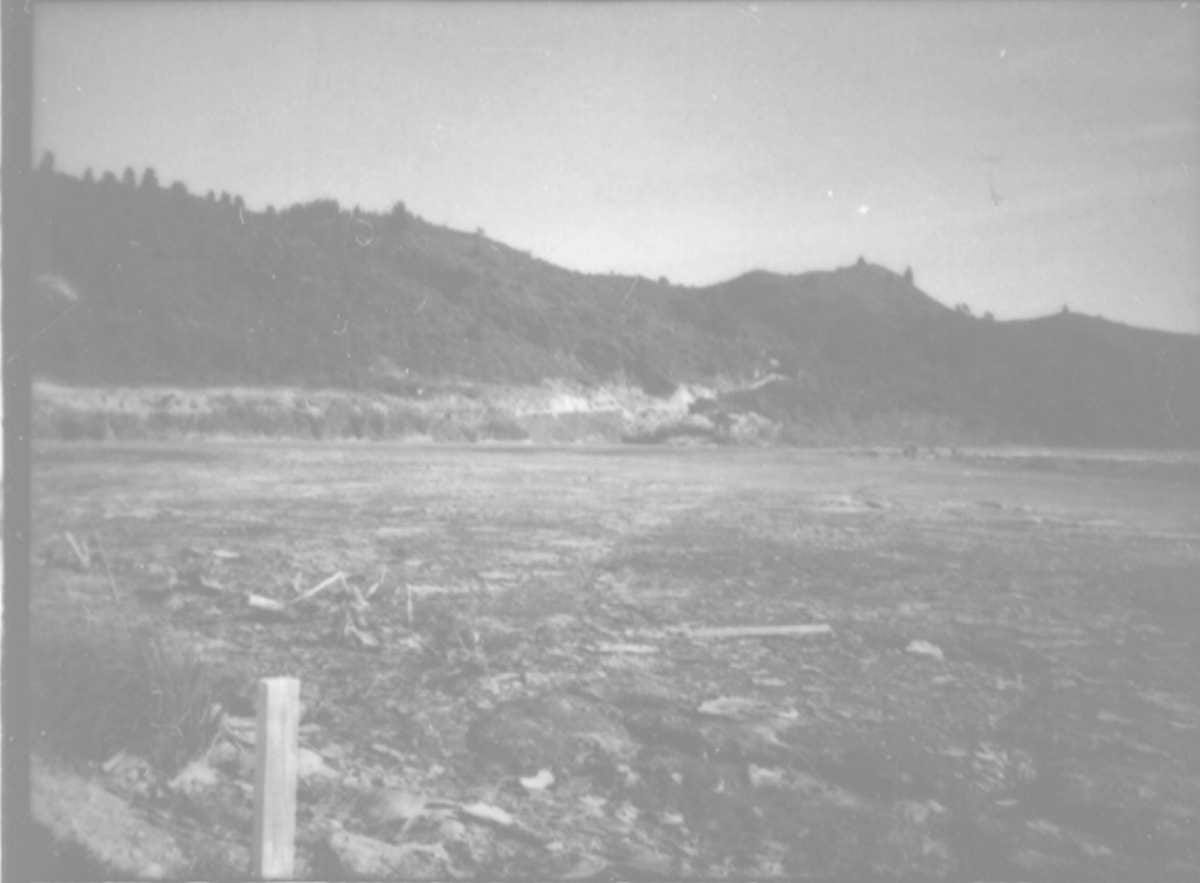
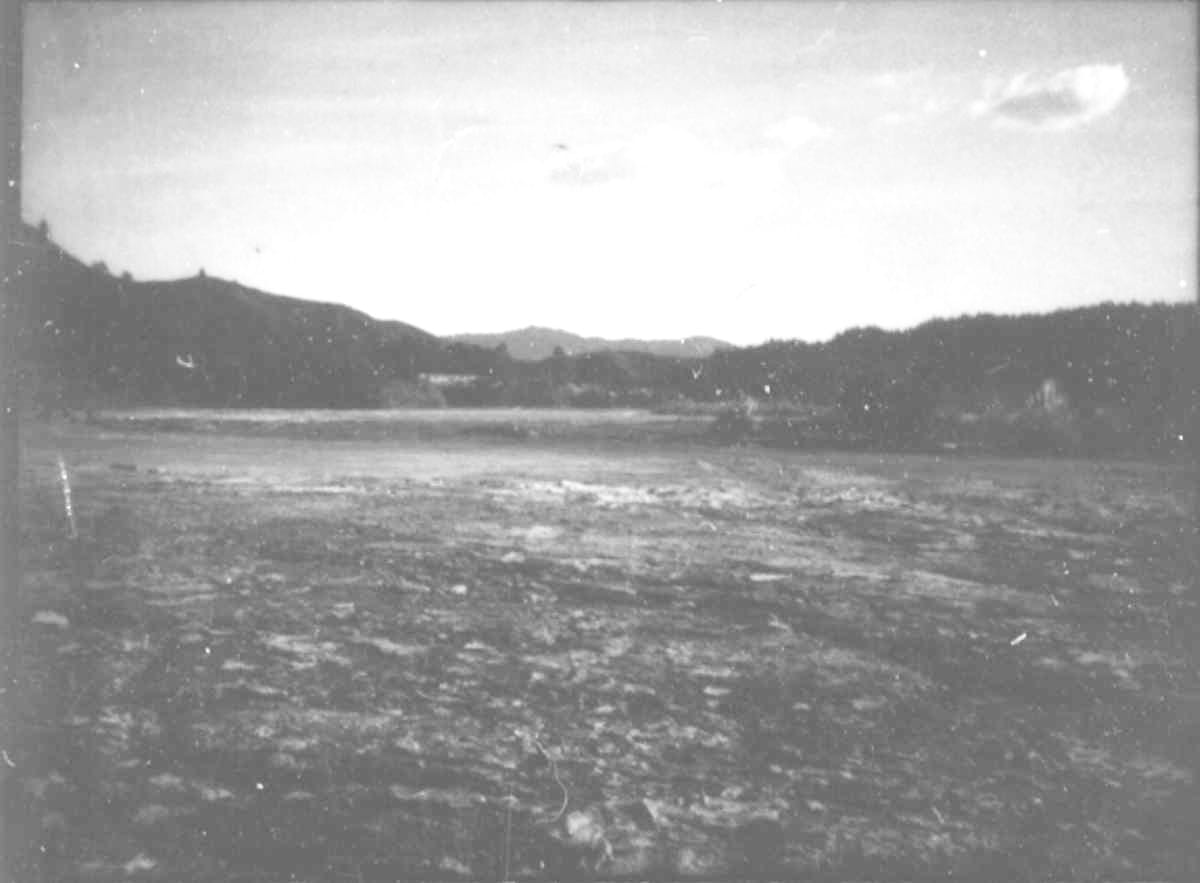
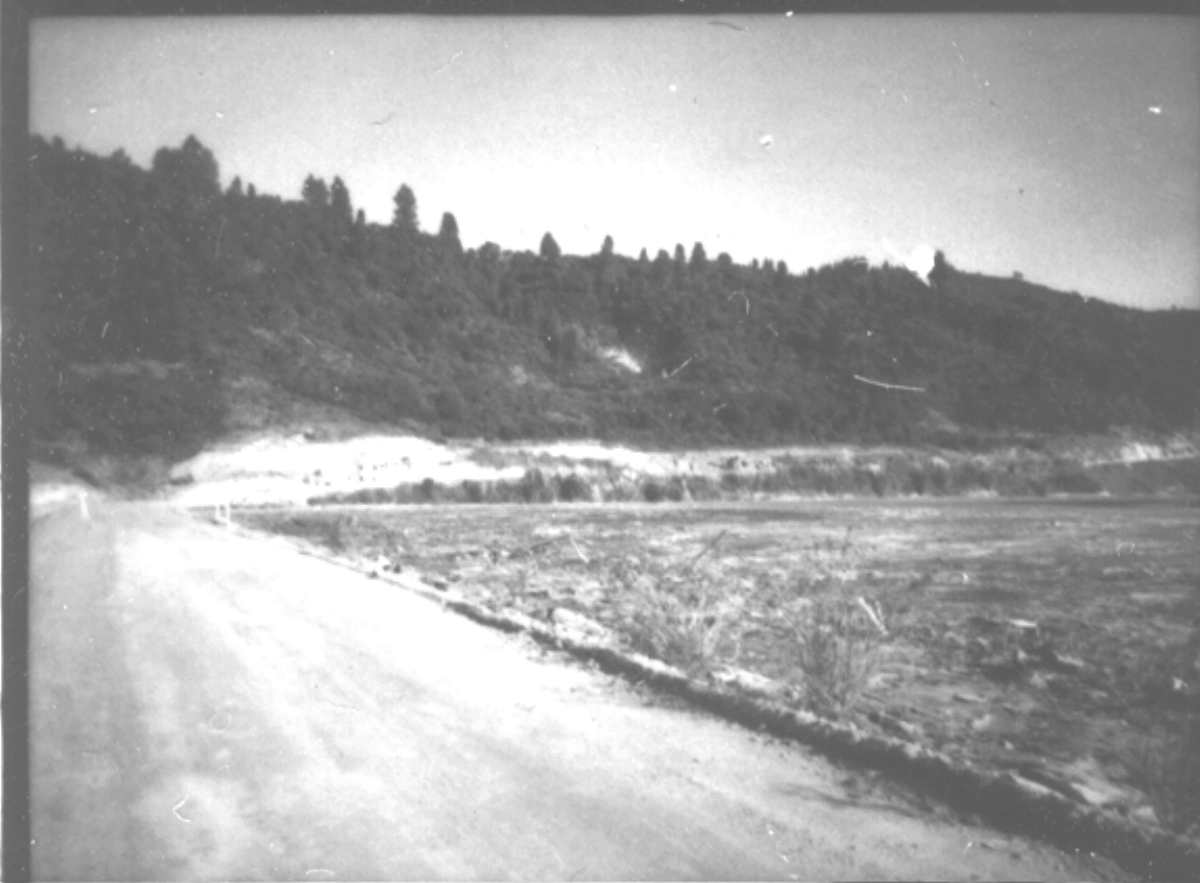
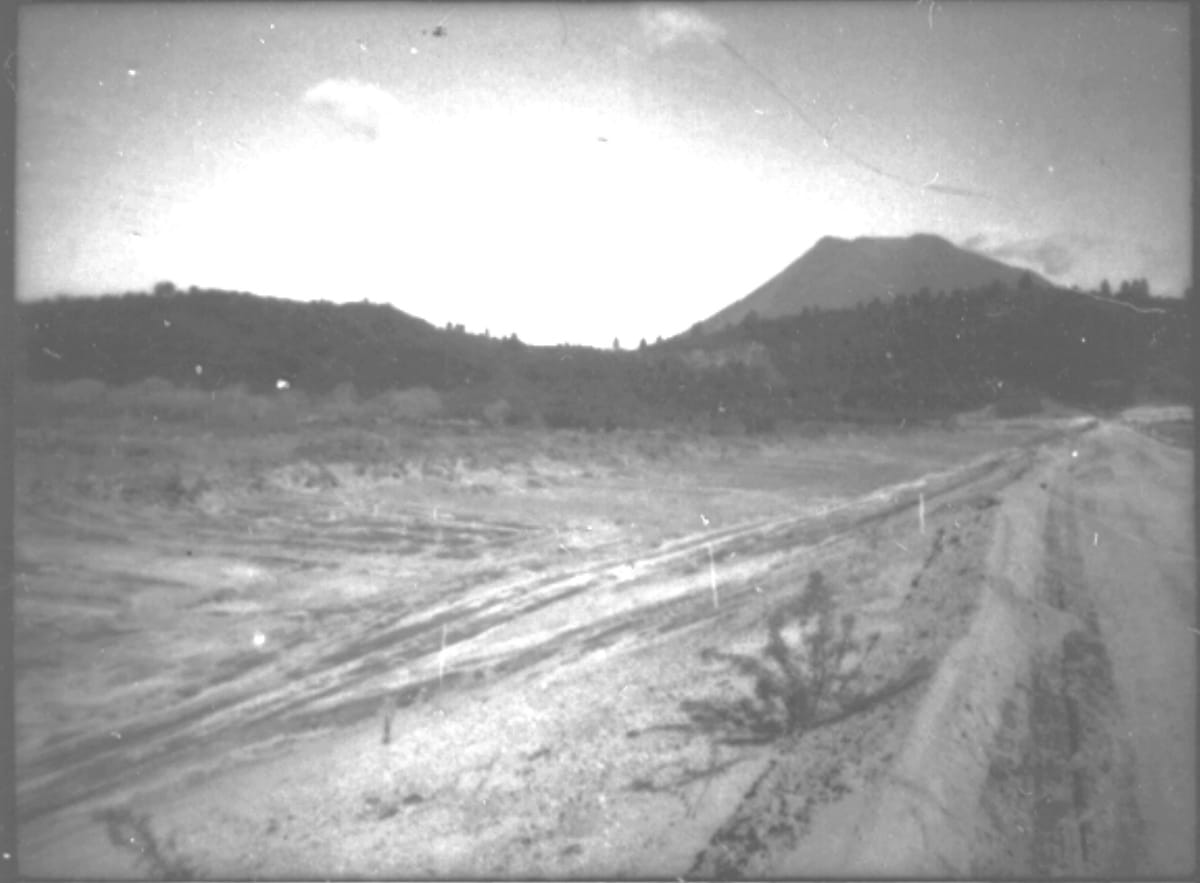
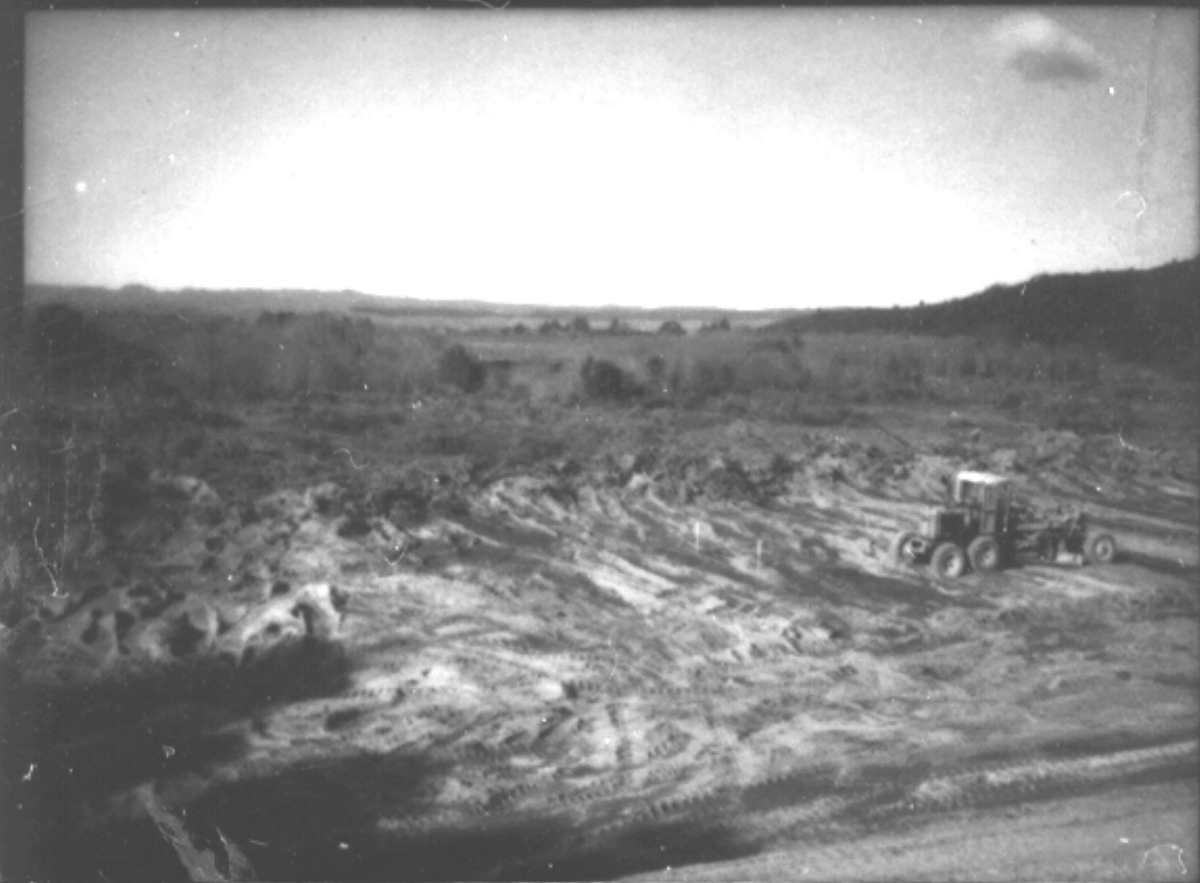
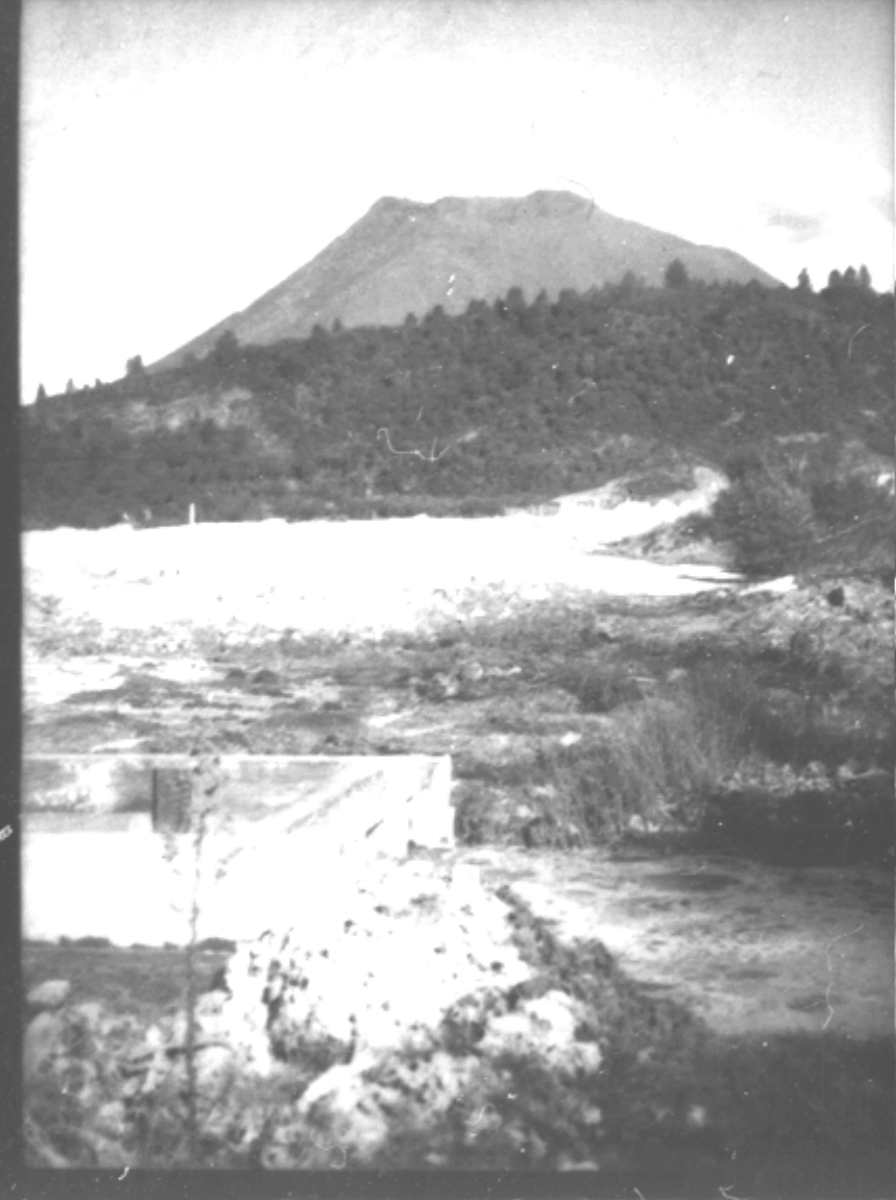
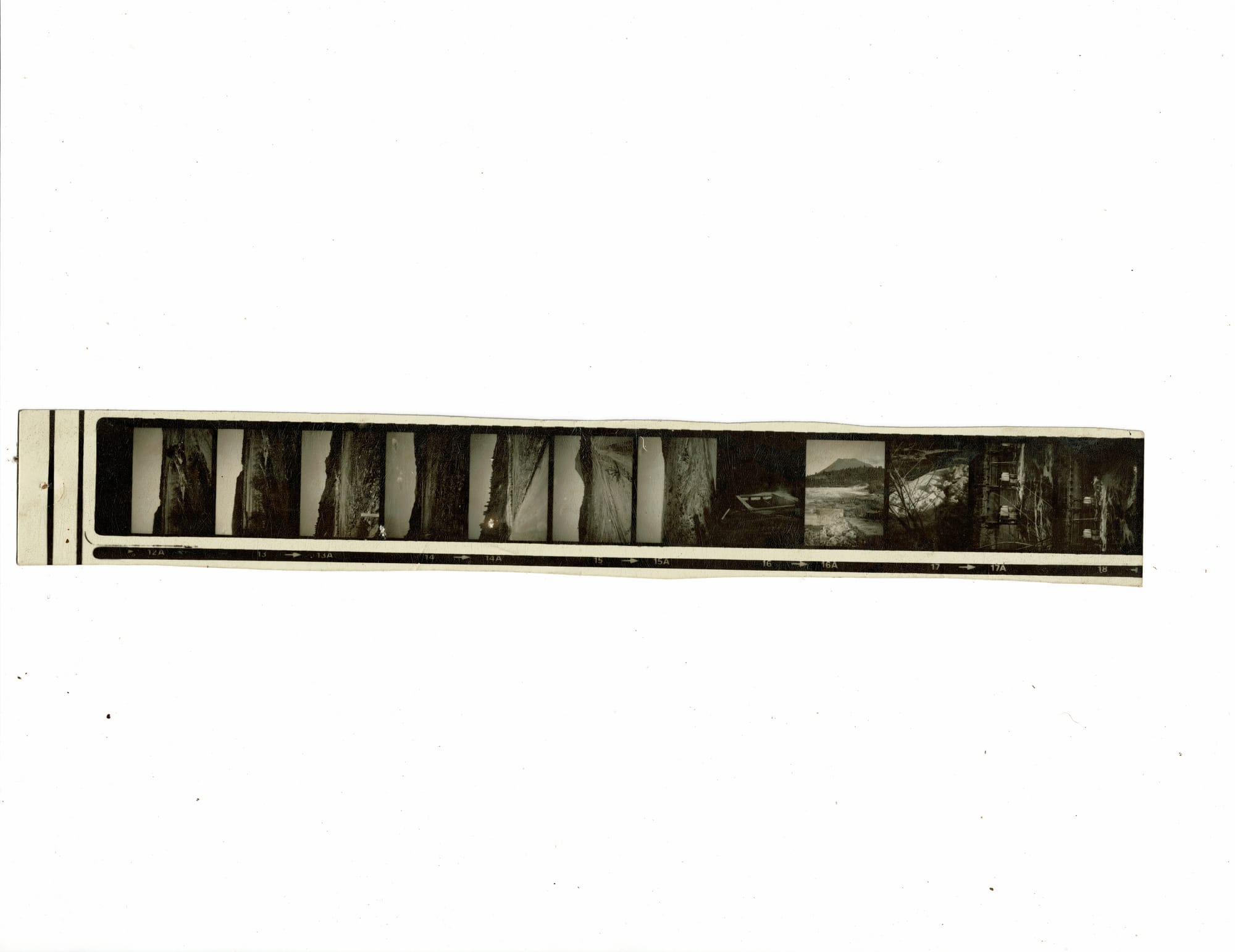
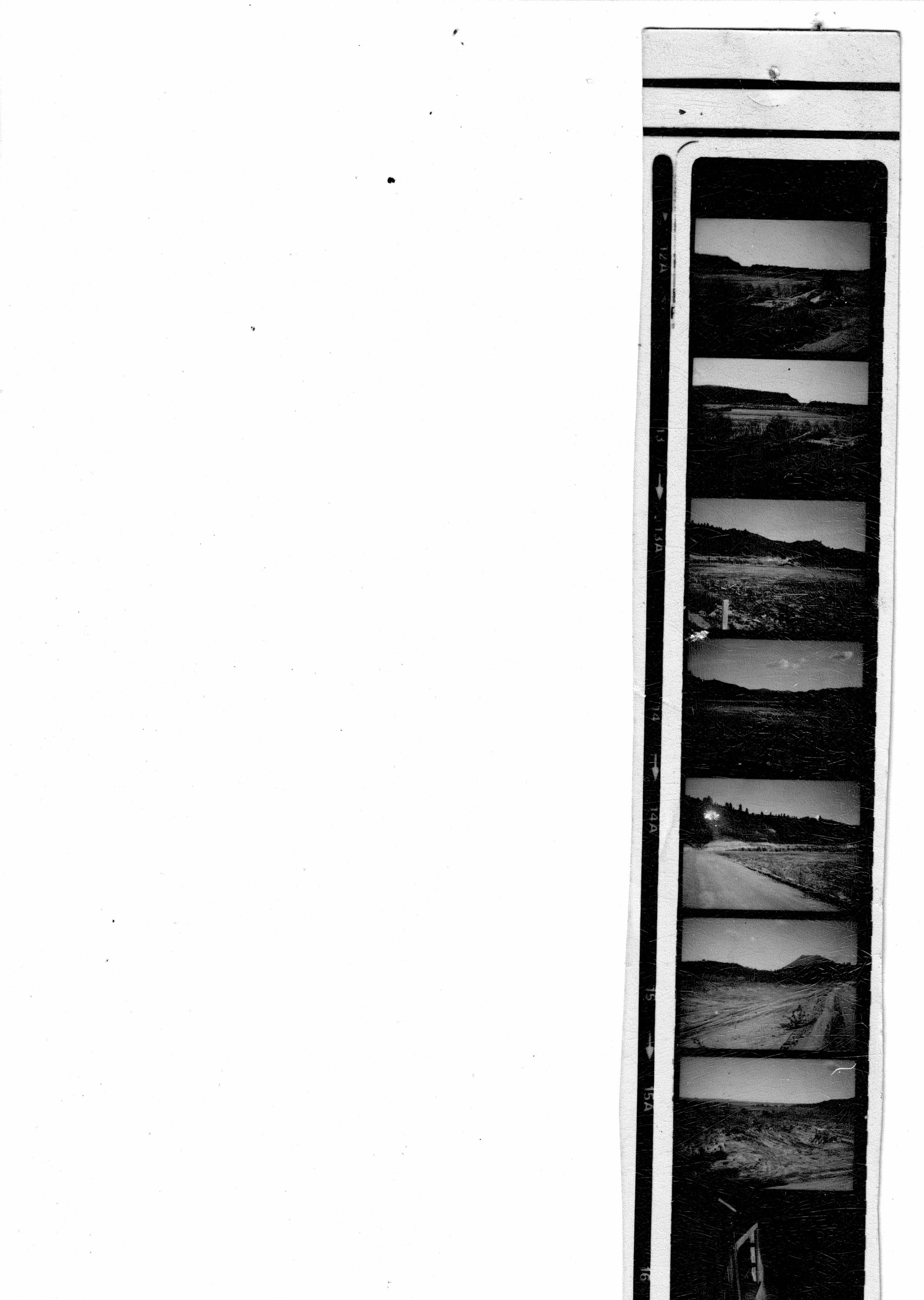
Gordon Jackman photographed Rotoitipaku himself. The images attached to this essay are his. Look at them carefully. The black water churning through the discharge pipes. The white industrial foam spread across what was once a living lake surface. The bulldozed bare earth stripped of all vegetation. The conical shape of Putauaki — Ngāti Awa's sacred maunga — standing in the background of frame after frame, a witness to what was done to the water at its feet.
Norske Skog, the Norwegian company that acquired the mill, closed it in 2021 and entered liquidation when, as the NZ Herald reported, legal claims reached up to NZ $1 billion and
"the director concluded that the company is no longer solvent."
As Tipene Marr of Ngāti Rangitihi told the NZ Herald in 2021:
"The whole Tasman site is totally contaminated. It's been running for 66 years, polluting our river and polluting our people."
Norske Skog's official response, as recorded by Corpwatch: the environmental issues were
"being managed in accordance with existing licence conditions."
Written under Section 107. Enacted for the Tasman Mill. Now being weakened further.
The Campaign — Greenpeace, Millwatch, Iwi, and the Day They Shut the Mill
Gordon Jackman joined Greenpeace as its Green Forestry Campaigner and built one of the most consequential environmental campaigns in New Zealand's industrial history. Working with unions, with community organisations like Millwatch, with iwi including Ngāti Rangitihi, and with Māori leaders Jack and Isabel Fox, he made the Tarawera's poisoning politically impossible to defend.
As confirmed by Greenpeace Aotearoa, Greenpeace joined with iwi and local communities to protest the chlorine-based pollution Tasman was dumping into the Tarawera. The crew of the Greenpeace flagship physically blocked and locked the mill's pollution discharge pipes.
On 11 November 1991 — Armistice Day — the campaign succeeded in shutting the Tasman mill down. The victory forced a shift from elemental chlorine to chlorine dioxide bleaching — reducing but not eliminating the dioxin component. The company continued to dump tonnes of toxic organochlorines every day. The chemistry changed. The crime continued.
Gordon told me in our May 2026 meeting that at Greenpeace's peak, people contacted it as if it were a government agency. The Crown was genuinely afraid of it. But partial victories secured through advocacy are always reversible when the political cycle turns.
The only durable protection is law. Not guidelines. Not consent processes. Law.
Gordon Jackman understood that from 1993, when he told New Scientist that
"guidelines are a meaningless waste of time unless there is some statutory basis to enforce them."
Thirty-three years later, the statutory basis is being removed — and the courts that might have enforced it are being sealed by Paul Goldsmith.
The 2012 Members' Bill: Gordon's Attempt to Fix Section 107
In 2012, Gordon Jackman and Green MP Catherine Delahunty tried to repair the Section 107 damage through Parliament.
The Resource Management (Restricted Duration of Certain Discharge and Coastal Permits) Amendment Bill proposed a simple, targeted fix: reduce the maximum term of "exceptional circumstances" discharge consents from 35 years to 5 years.
The Parliamentary Commissioner for the Environment Dr Jan Wright submitted in support:
"In 2010, the pulp and paper mill was granted a consent to continue to discharge waste into the river under exceptional circumstances for 25 years. The conditions in this consent are actually more lenient than the requirements in the council's plan but override them. It would be a mistake to judge the merit of this Bill solely on the history of this particular case. However, it is extraordinary that the company has been given the right to discharge this waste at virtually the same level right through until 2035."
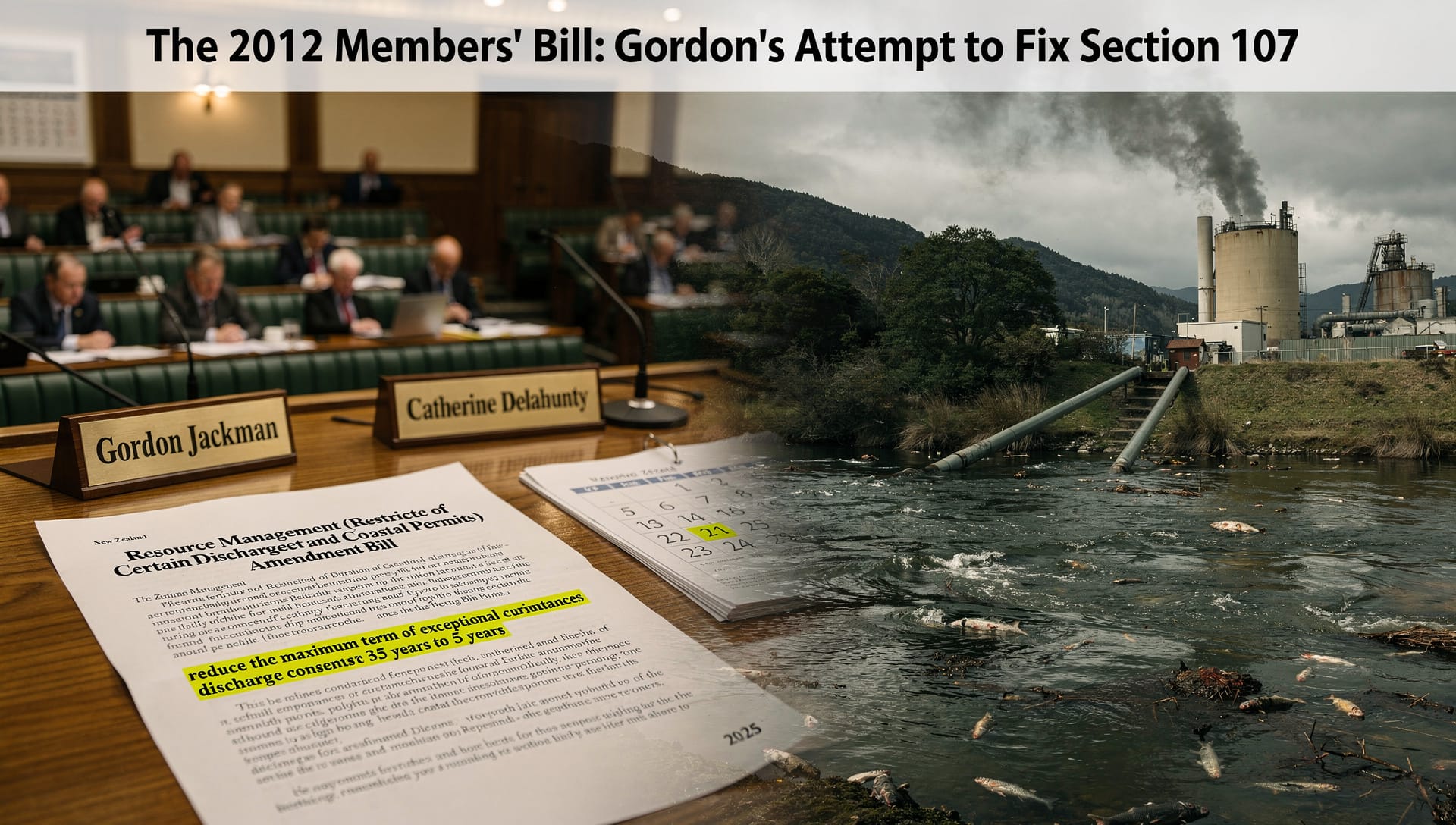
The Bill was defeated. The 35-year window remained. The mill's consent to continue poisoning the Tarawera until 2035 remained in force. And in 2024, the Luxon government moved not toward fixing Section 107, but toward weakening it further.
The Luxon Government: Weakening the Last Protection Standing
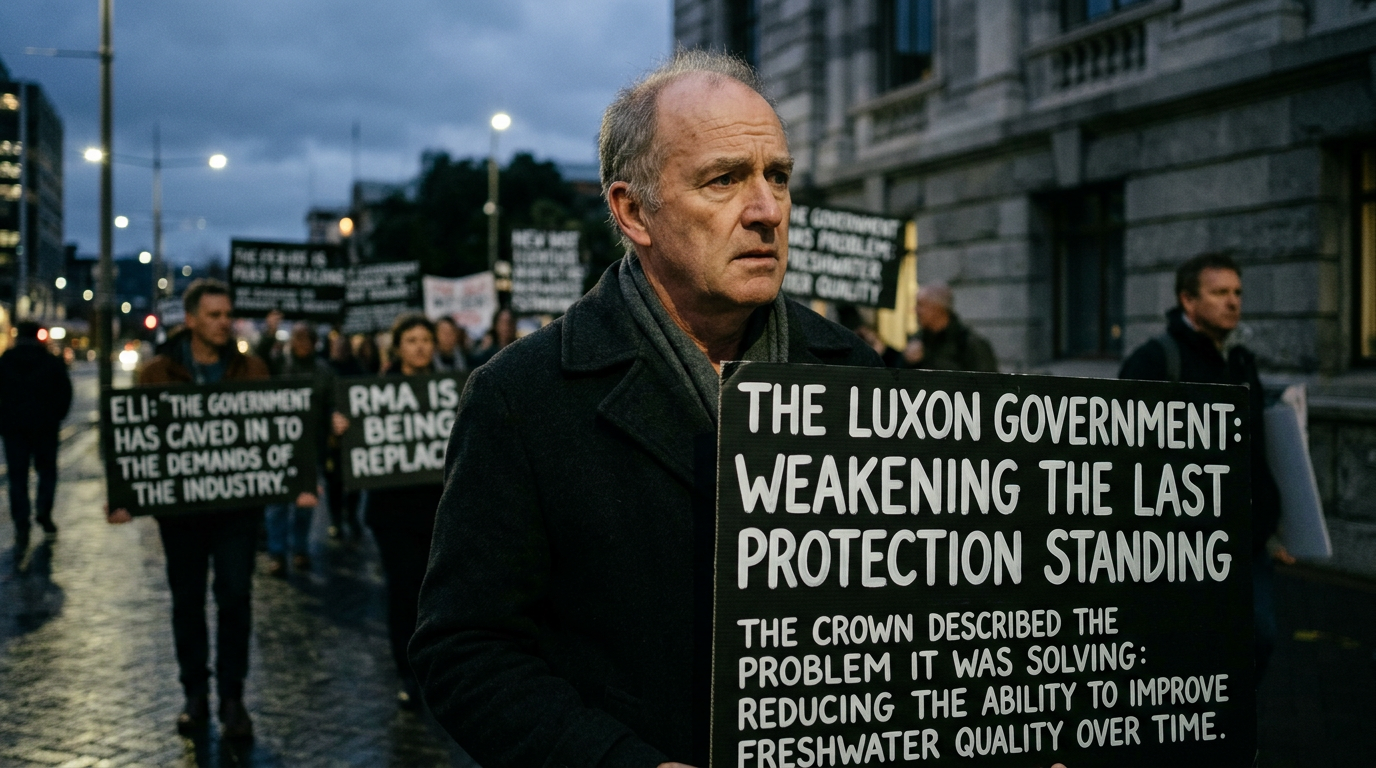
In 2024, courts finally began enforcing Section 107 as written. As confirmed by the Environmental Law Initiative, ELI's successful High Court challenge in Environmental Law Initiative v Canterbury Regional Council overturned Environment Canterbury's decision to grant a discharge consent to Ashburton Lyndhurst Irrigation Ltd — finding that councils must be satisfied significant adverse effects on aquatic life will not occur at the time discharge is consented, not merely over the life of the consent.
Poisoning first and asking for consent later was no longer viable.
The Luxon government's response was immediate. As Agriculture Minister Todd McClay announced on the Beehive on 8 August 2024:
"Cabinet this week agreed to make time critical amendments to section 107 of the RMA so that councils and consent applicants have legal clarity, and the certainty they need to plan ahead."
The stated rationale: court decisions could result in
"more discharges needing consents, more consent applications being declined, and consent conditions becoming more restrictive, reducing the ability to improve freshwater quality over time."
Reducing the ability to improve freshwater quality over time. That is how the Crown described the problem it was solving.
The Resource Management (Freshwater and Other Matters) Amendment Act 2024, enacted 25 October 2024, amended Section 107 to now allow councils to grant discharge consents where the discharge may give rise to significant adverse effects on aquatic life — provided significant adverse effects already exist and the consent conditions will
"contribute to a reduction of effects over the duration of the consent."
As the Environmental Law Initiative stated directly:
"the Government has caved in to the demands of the industry." The anti-democratic process meant no opportunity for ELI, or any member of the public, to have their say on changes that "cut to the heart of Aotearoa's freshwater protections."
The RMA is now being replaced entirely. Gordon Jackman's warning, given in his 12 May 2026 feedback on this essay, is exact:
"I bet it will still be in whatever replacement this Govt brings in."
The Goldsmith Climate Shield: Section 12 Reborn, 2026 Edition
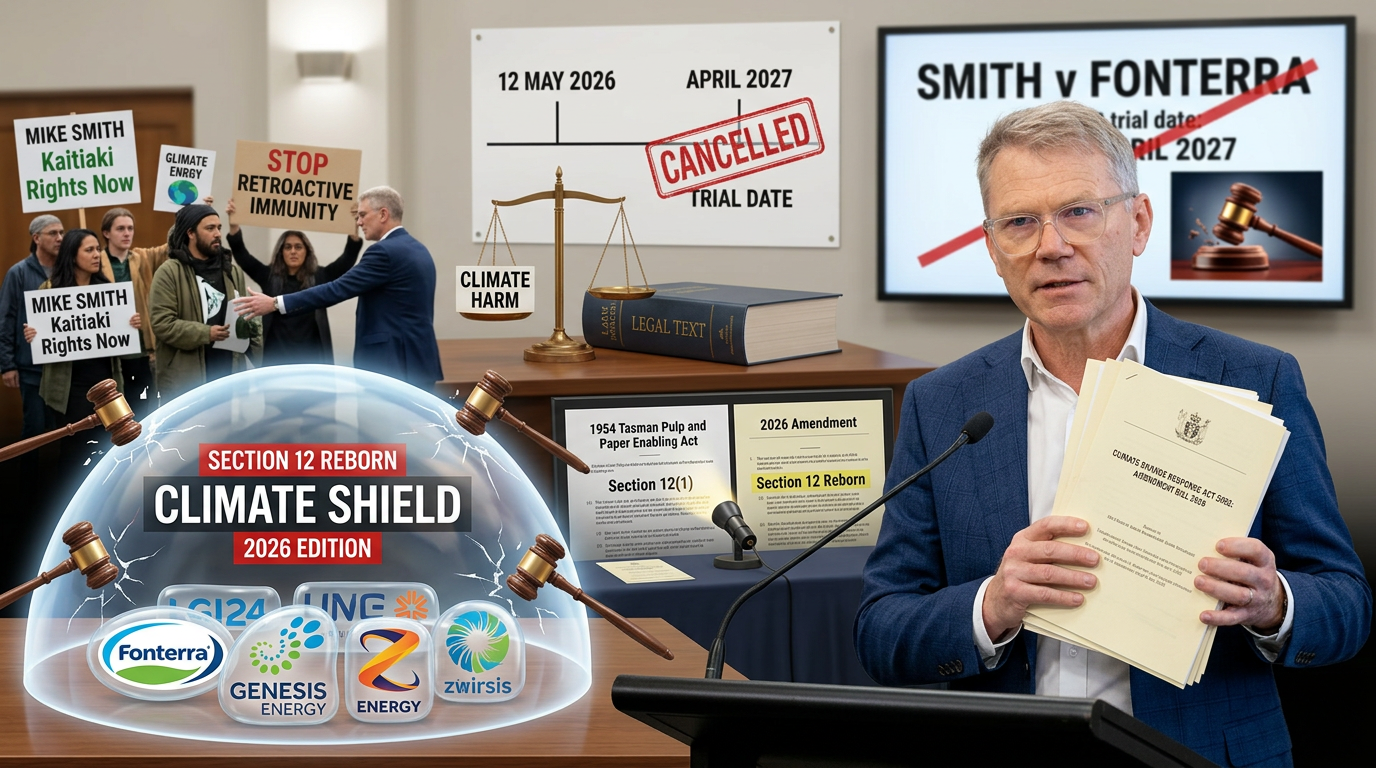
Then came 12 May 2026.
Justice Minister Paul Goldsmith announced that the Crown will amend the Climate Change Response Act 2002 to prevent courts from holding companies liable in private cases for climate-related harm caused by greenhouse gas emissions. The amendment will apply retrospectively — killing a High Court trial scheduled for April 2027.
As Buddle Findlay confirmed in their legal analysis:
"The changes could mean that individuals and entities are now effectively barred from seeking compensation from companies for climate change-related harm."
That trial is Smith v Fonterra. Brought by Mike Smith — Ngāpuhi, Ngāti Kahu, climate change spokesperson for the Iwi Chairs' Forum — alleging that seven of New Zealand's biggest emitters, including Fonterra, Genesis Energy, and Z Energy, had caused harm to his land, his cultural rights, and his standing as kaitiaki.
As confirmed by RNZ via the Wayback Machine, Smith
"says the group including Fonterra, Z Energy and Genesis Energy (which together make around a third of New Zealand's emissions) have a legal duty to him and others in communities who are being damaged by planet-heating gases."
In February 2024, the New Zealand Supreme Court unanimously ruled that Smith had the right to sue — reinstating his statement of claim and sending the case to the High Court for a full hearing.
The Supreme Court decision NZSC 5 held that determining whether the emitters' actions constituted a
"substantial and unreasonable interference"
with public rights was a fact inquiry requiring full trial.
As the Resource Management Law Association confirmed:
"The refusal to strike out the claim is not an assessment that it is bound to succeed at trial, but rather a finding that it cannot be said at this preliminary stage that it is 'bound to fail'."
A trial date was set: April 2027. Seven years of litigation. A unanimous Supreme Court. A trial date. Extinguished by ministerial announcement before a single day of evidence was heard.
Goldsmith said:
"The courts are not the right place to resolve claims of harm from climate change."
Read that sentence. Then read Section 12(1) of the Tasman Pulp and Paper Enabling Act 1954:
"Notwithstanding the provisions of any Act, no prosecution or other proceedings shall be commenced against the company..."
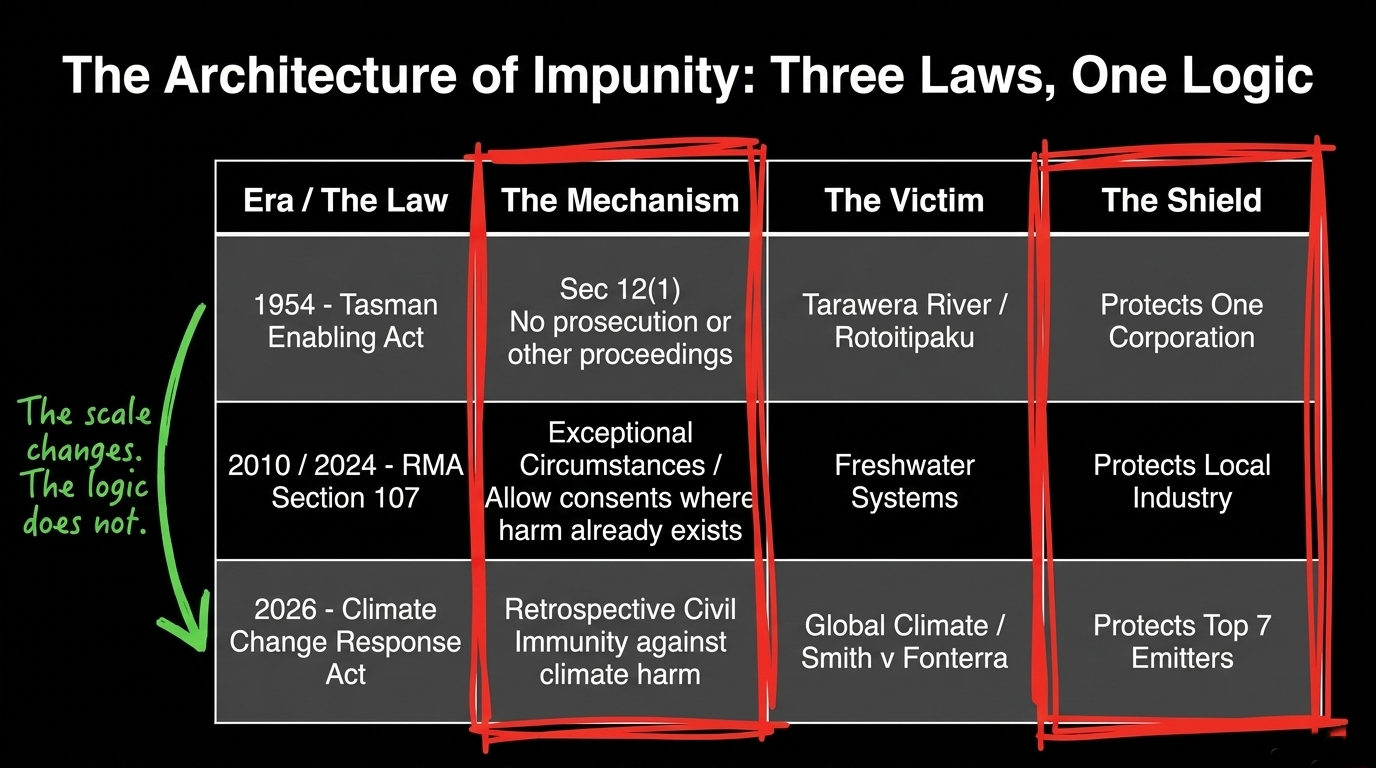
The language is different. The logic is identical. In 1954, Parliament used legislation to make a specific corporation immune from prosecution for a specific pollution harm. In 2026, Paul Goldsmith is using legislation to make an entire class of corporations immune from private liability for an entire category of environmental harm. The scale has changed. The purpose has not changed by a single word.
Five Hidden Connections: The Architecture of Impunity
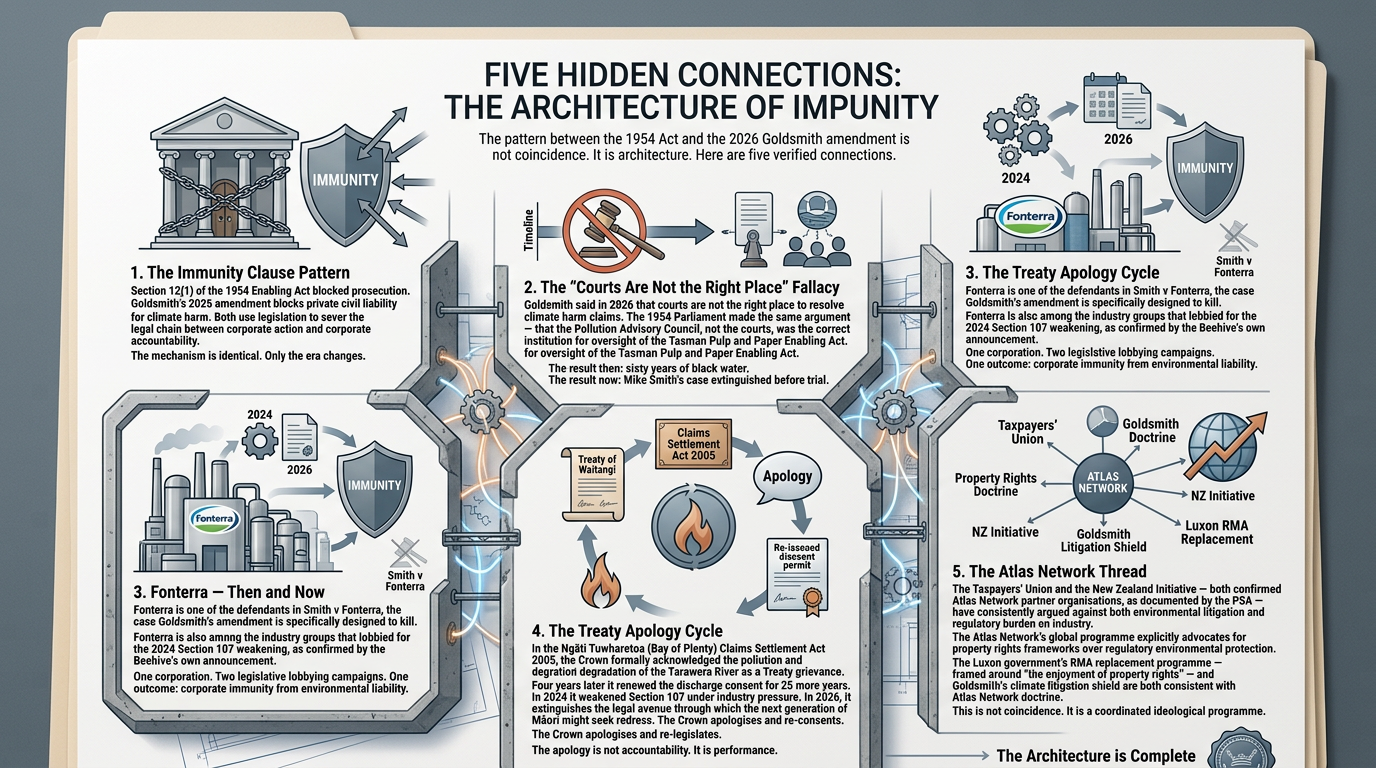
The pattern between the 1954 Act and the 2026 Goldsmith amendment is not coincidence. It is architecture. Here are five verified connections.
1. The Immunity Clause Pattern. Section 12(1) of the 1954 Enabling Act blocked prosecution. Goldsmith's 2026 amendment blocks private civil liability for climate harm. Both use legislation to sever the legal chain between corporate action and corporate accountability. The mechanism is identical. Only the era changes.
2. The "Courts Are Not the Right Place" Fallacy. Goldsmith said in 2026 that courts are not the right place to resolve climate harm claims. The 1954 Parliament made the same argument — that the Pollution Advisory Council, not the courts, was the correct institution for oversight of the Tasman Pulp and Paper Enabling Act. The result then: sixty years of black water. The result now: Mike Smith's case extinguished before trial.
3. Fonterra — Then and Now. Fonterra is one of the defendants in Smith v Fonterra, the case Goldsmith's amendment is specifically designed to kill. Fonterra is also among the industry groups that lobbied for the 2024 Section 107 weakening, as confirmed by the Beehive's own announcement. One corporation. Two legislative lobbying campaigns. One outcome: corporate immunity from environmental liability.
4. The Treaty Apology Cycle. In the Ngāti Tuwharetoa (Bay of Plenty) Claims Settlement Act 2005, the Crown formally acknowledged the pollution and degradation of the Tarawera River as a Treaty grievance. Four years later it renewed the discharge consent for 25 more years. In 2024 it weakened Section 107 under industry pressure. In 2026, it extinguishes the legal avenue through which the next generation of Māori might seek redress. The Crown apologises and re-consents. The Crown apologises and re-legislates. The apology is not accountability. It is performance.
5. The Atlas Network Thread. The Taxpayers' Union and the New Zealand Initiative — both confirmed Atlas Network partner organisations, as documented by the PSA — have consistently argued against both environmental litigation and regulatory burden on industry. The Atlas Network's global programme explicitly advocates for property rights frameworks over regulatory environmental protection. The Luxon government's RMA replacement programme — framed around "the enjoyment of property rights" — and Goldsmith's climate litigation shield are both consistent with Atlas Network doctrine. This is not coincidence. It is a coordinated ideological programme.
Three Examples for the Western Mind
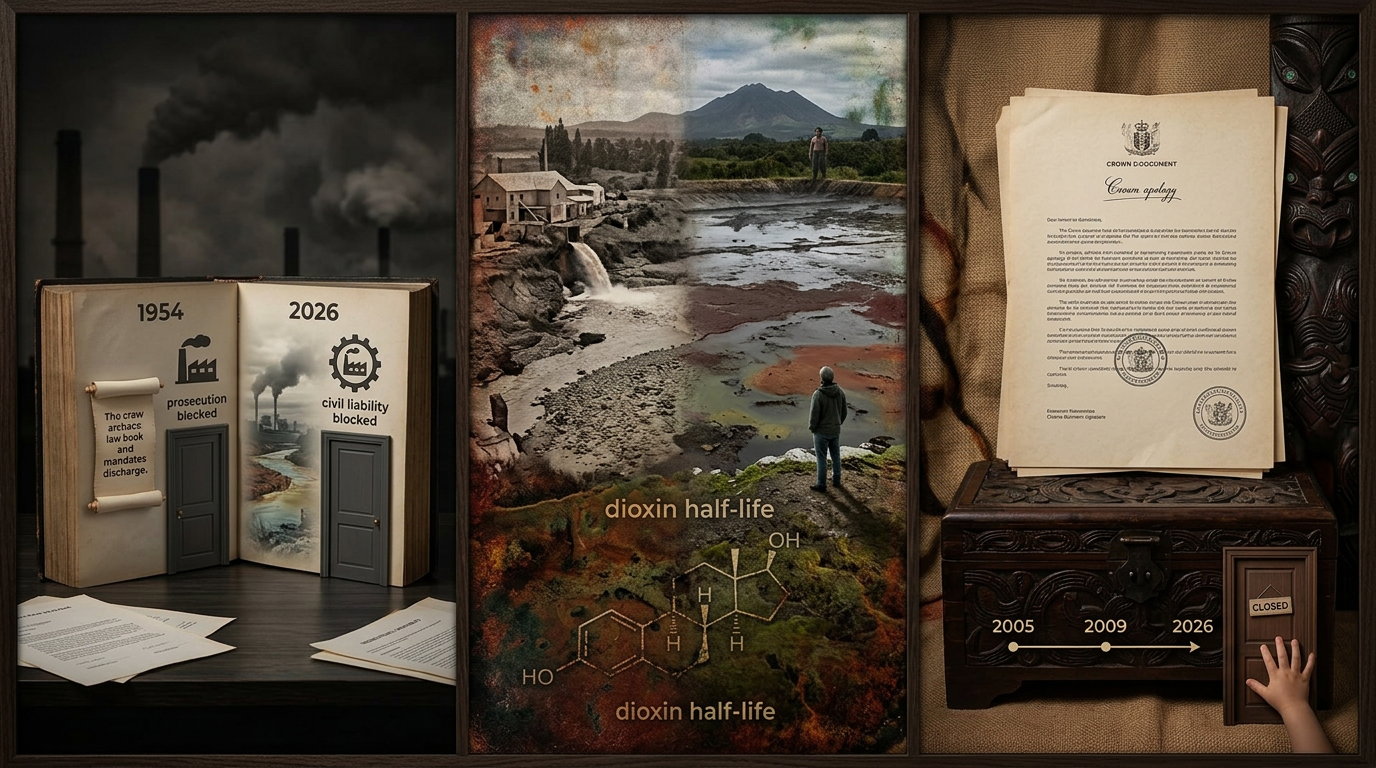
Example 1: "Shall Discharge" — Then "Cannot Sue" — Same Crime, New Dress
The demonstration: In 1954, Section 4(1) made discharge mandatory. Section 12(1) blocked prosecution. In 2026, Goldsmith's amendment blocks civil liability for climate harm. Both use legislation to achieve corporate immunity from accountability for environmental destruction. The 1954 Act protected one company. The 2026 amendment protects an entire industry sector. The scope has expanded. The logic has not changed by a single word.
The quantified harm: At peak operation, the Tasman mill discharged over 160 million litres of industrial waste per day into the Tarawera. By 1997, Te Ara confirmed aquatic life on the riverbed was completely obliterated. The Crown's own scientists confirmed 25.27 gTEQ of accumulated dioxins at the mill's waste disposal sites by 2012. Norske Skog walked away from NZ $1 billion in claims. The defendants in Smith v Fonterra collectively make around a third of New Zealand's emissions. Goldsmith's amendment extinguishes Mike Smith's legal avenue before a court has heard a single day of evidence.
The tikanga impact, explained for the western mind: In te ao Māori, the right to seek utu — to restore balance, mana, and dignity after harm — is not a courtesy of the Crown. It is a birthright. Every law that removes a Māori person's ability to seek redress for harm to their whenua, their wai, their whakapapa, is a law that reasserts Crown supremacy over tikanga. Gordon Jackman tried to seek remedy through the consent process. Through Parliament. Through public advocacy. Through Greenpeace. The courts were the last institution standing. Paul Goldsmith is closing that door.
The solution: No legislation that restricts private civil liability for environmental harm should be enacted without a full Treaty impact assessment, binding iwi consultation, and an explicit determination that it does not remove existing rights recognised under the Treaty of Waitangi. Smith v Fonterra must be allowed to proceed to trial. Corporate climate liability is not a threat to business confidence. It is a precondition for justice.
Example 2: Rotoitipaku — What Immunity Looks Like After 70 Years
The demonstration: Rotoitipaku received 600,000 cubic metres of industrial waste — dioxins, PCBs, arsenic — over the operational life of the Tasman mill. The Crown's own scientists confirmed the dioxin reservoir. Norske Skog faced NZ $1 billion in claims and concluded it was insolvent. The corporate immunity structure of the 1954 Act allowed the harm to compound for seventy years before any meaningful accountability was attempted. Goldsmith's 2026 amendment is Rotoitipaku at national scale: poison the future, legislate away the liability, walk away solvent.
The quantified harm: A dioxin half-life of 15–25 years in the environment means the material deposited in the 1950s is still biologically active in 2026. The communities of Ngāti Tūwharetoa ki Kawerau have been living alongside a leaching chemical reservoir for seven decades. No full health impact study has been completed. No remediation timeline has been set. No funding has been committed. The 2005 Crown apology came without a remediation plan. The 2009 discharge consent renewal came without one. Gordon Jackman's photographs show what seventy years of corporate immunity produces: a wāhi tapu turned into a waste pond, Putauaki watching from the background.
The tikanga impact: A wāhi tapu is a living repository of whakapapa — the genealogical record of who a people are, where they come from, and what they owe to each other and to the world. To convert a wāhi tapu into a chemical dump is not environmental damage. It is an assault on identity, on memory, on the capacity of a people to locate themselves in time. Goldsmith's amendment tells Mike Smith that he cannot use a New Zealand court to seek remedy for that same kind of assault — if the perpetrator is a sufficiently large emitter.
The solution: Mandatory remediation of Rotoitipaku under Ngāti Tūwharetoa ki Kawerau governance, fully funded, on a timeline set by the iwi. Corporate successor liability legislation making remediation obligations non-extinguishable through insolvency, restructuring, or asset sale. Personal criminal accountability for directors who knowingly directed environmental harm under consents they knew were inadequate.
Example 3: The Treaty Apology That Changed Nothing — Three Times Running
The demonstration: In 2005, the Crown formally acknowledged in the Ngāti Tuwharetoa (Bay of Plenty) Claims Settlement Act that the pollution of the Tarawera River was a Treaty grievance. Four years later it renewed the discharge consent for 25 more years. In 2024, the government weakened Section 107 in response to industry lobbying. In 2026, it moved to legislate away the right of a Māori kaitiaki to have his climate harm case heard in court. The Crown apologises and re-consents. The Crown apologises and re-legislates. The apology is not a step toward accountability. It is the Crown performing reconciliation while extending the injury with the other hand.
The quantified harm: As Buddle Findlay confirmed on 12 May 2026: Goldsmith's amendment means individuals and entities are
"now effectively barred from seeking compensation from companies for climate change-related harm."
One activist. Seven years of litigation. A unanimous Supreme Court ruling that his case had merit and deserved full trial. A trial date. All of it extinguished by ministerial announcement before a single day of evidence.
The tikanga impact: In tikanga terms, an apology without utu — without action that restores balance — is not an apology. It is performance. The Crown showing its face at the marae while its lawyers are at Parliament drafting the next immunity clause. Three times, in three different forms of law, the same cycle has run: Crown acknowledges harm, Crown re-consents or re-legislates the same harm. Ngāti Rangitihi have been waiting for utu since 1954. Mike Smith has been waiting for a trial date since 2017. The 2026 amendment tells them both: the courts are not for you.
The solution: Any formal Crown acknowledgement of environmental or Treaty harm must be legally paired with a binding remediation plan, an independent monitoring body under iwi co-governance, and a guarantee that no new legislation will remove existing legal avenues for remedy. Apology and amnesty cannot coexist.
The Luxon Government: The Full Architecture
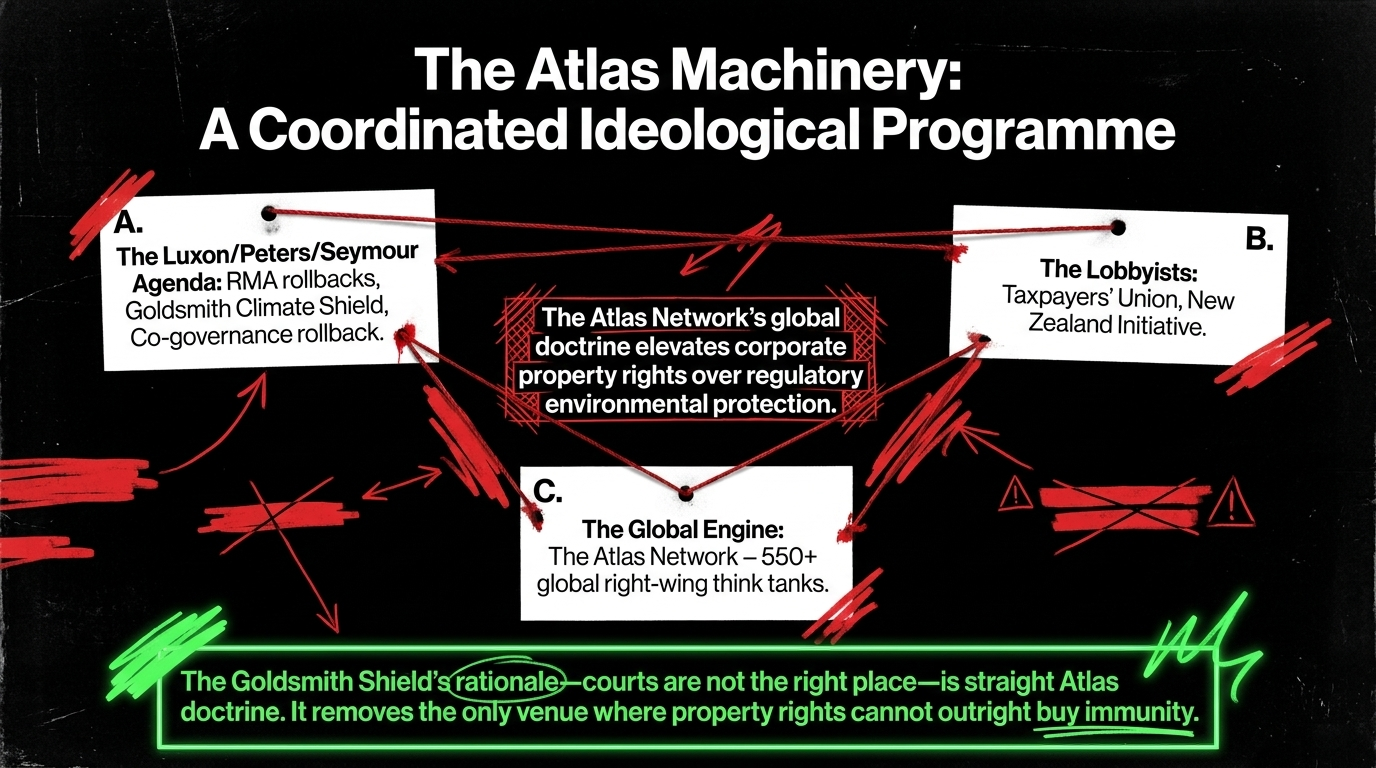
The Luxon-Peters-Seymour administration is not a new phenomenon. It is the latest and most brazen iteration of the same Crown logic that passed the Enabling Act in 1954 — the logic that says corporate productivity is more important than Māori water, that industry self-management is sufficient, that iwi without governance power have no standing to object, and that courts are not the right institution when a corporation's liability is large enough.
The specific mechanisms this government has now deployed against environmental accountability:
- Section 107 of the RMA weakened (October 2024) — amended via the Resource Management (Freshwater and Other Matters) Amendment Act 2024 to allow discharge consents even where significant adverse effects on aquatic life already exist, provided polluters promise to reduce effects over time. The Environmental Law Initiative confirmed the government "caved in to the demands of the industry" through an anti-democratic process with no public submissions permitted.
- RMA Phase 3 replacement — the entire Resource Management Act is being replaced with legislation framed around "the enjoyment of property rights." Section 107's successor is unwritten. Gordon Jackman is right: the same logic will be built in unless Parliament is made to explicitly exclude it.
- Goldsmith climate litigation shield (May 2026) — amends the Climate Change Response Act 2002 to block private civil liability for climate-related harm. Applies retrospectively to kill Smith v Fonterra. Announced 13 May 2026. Confirmed by Buddle Findlay. Characterised by Greenpeace as a "shocking abuse of power".
- Māori ward abolition and co-governance rollback — removing the governance mechanisms that give communities like Ngāti Rangitihi institutional standing to contest discharge consents affecting their awa.
- Regional council restructuring — reducing the environmental enforcement capacity of the bodies responsible for monitoring industrial discharge consents.
The ideological engine behind this project is the Atlas Network — a global web of over 550 right-wing think tanks in more than 100 countries — with two confirmed New Zealand partner organisations: the Taxpayers' Union and the New Zealand Initiative. The Atlas Network's global programme explicitly advocates for property rights frameworks over regulatory environmental protection. The Luxon government's legislative programme is consistent with Atlas Network doctrine in every detail.
What the Law Must Now Say
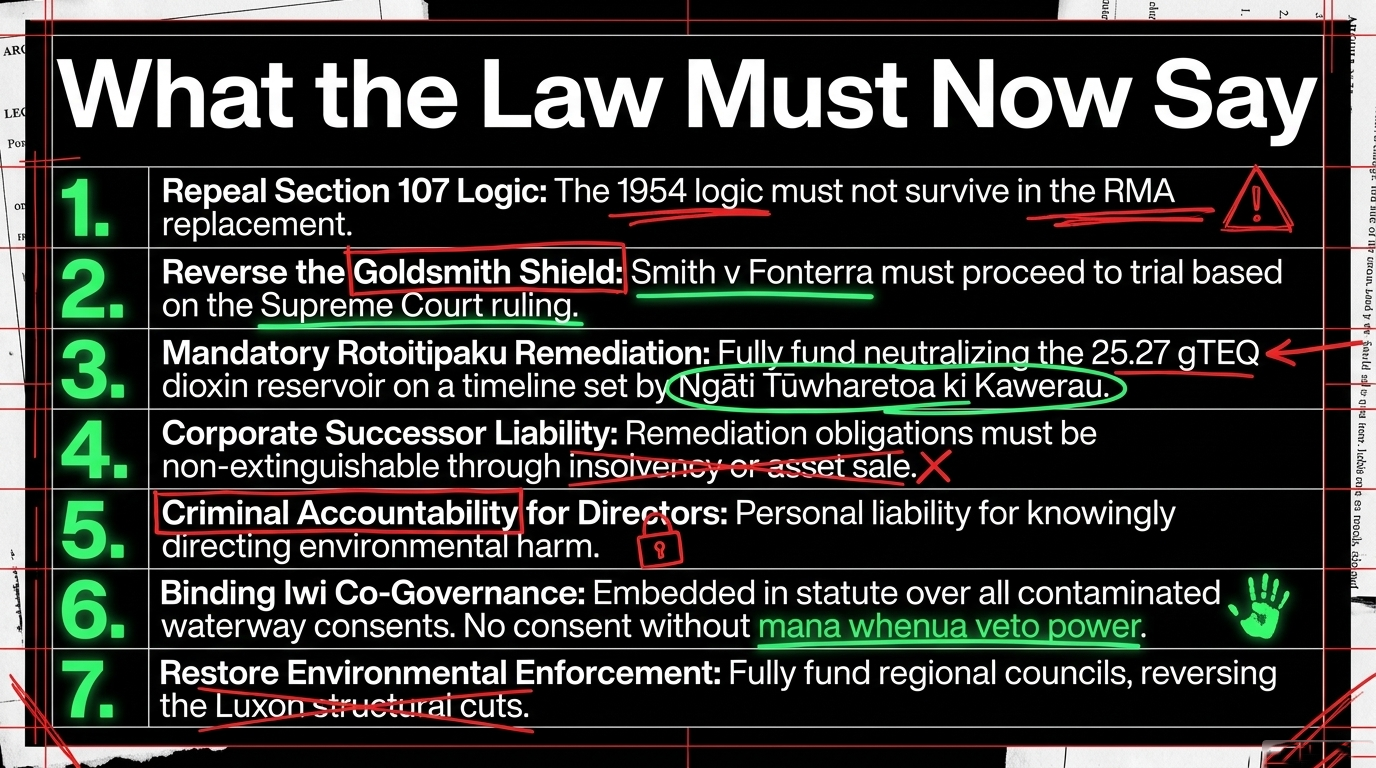
1. Repeal Section 107's logic from the RMA replacement entirely. The Tasman Pulp and Paper Enabling Act 1954 was repealed — but its logic survived inside the RMA in Section 107, confirmed by the Environment Court to have been written "with the Tasman Mill and the pulp and paper industry in mind." In 2012, Gordon Jackman and Catherine Delahunty tried to fix it. Parliament refused. In 2024, the Luxon government weakened it further. It must not survive in any form in the replacement legislation.
2. Reverse the Goldsmith climate litigation shield immediately. The amendment to the Climate Change Response Act 2002 announced by Paul Goldsmith is Section 12(1) of the 1954 Act, updated for 2026. It uses legislation to remove corporate liability for documented environmental harm. It is retrospective. It targets a case brought by a Māori activist whose land and cultural rights are at stake. It must be reversed. Smith v Fonterra must proceed to trial on the basis of the unanimous Supreme Court ruling.
3. Mandatory Rotoitipaku remediation. Fully fund and complete the remediation of Rotoitipaku under Ngāti Tūwharetoa ki Kawerau governance, on a timeline set by the iwi. The dioxin reservoir of 25.27 gTEQ confirmed by the Crown's own scientists must be neutralised.
4. Corporate successor liability. Any company acquiring assets from a polluting predecessor acquires the full remediation obligation — non-extinguishable through restructuring, insolvency, or asset sale.
5. Criminal accountability for directors. Those who knowingly directed industrial discharge into New Zealand waterways under consents they knew were environmentally inadequate must face personal criminal liability.
6. Binding iwi co-governance over all contaminated waterway consents. Not consultation. Binding co-governance embedded in statute — the right to participate in and veto consent renewals affecting the mauri of their wai and whenua.
7. Restore and fully fund regional council environmental enforcement. Reverse the Luxon government's restructuring before the next generation of discharge consents is issued.
The Verdict
The Tarawera River has a second name. The community gave it that name because the first name — the ancestral name, the whakapapa name — had been made unrecognisable by decades of Crown-mandated industrial discharge.
The 1954 Act is read. Section 4(1) says shall. Section 12(1) says no prosecution. Section 14(2) sets the fine at one hundred pounds. That Act was repealed. Its replacement — Section 107 of the RMA — carried the same mandate with new language, confirmed by the Environment Court to have been written for the Tasman Mill. Gordon Jackman and Catherine Delahunty tried to fix it in 2012. Parliament refused. The Luxon government weakened it in 2024. The legislation that will replace the RMA entirely has not yet been written.
And on 13 May 2026, Paul Goldsmith announced a climate litigation shield that is Section 12(1) reborn — corporate immunity from environmental harm, legislated by a friendly government, justified by business confidence, delivered retrospectively to kill a case that the Supreme Court of New Zealand unanimously ruled deserved a full hearing. As the ODT confirmed, Mike Smith called it unprecedented. As Greenpeace confirmed, it was a shocking abuse of power.
One logic. Seventy years. Compounding.
Gordon Jackman was right in 1981. He was right in 1991. He was right in 1993. He was right in 2012. He is right now. And Paul Goldsmith's announcement on 13 May 2026 is the most powerful possible proof that Gordon Jackman's forty-five years of fighting were not only justified — they were insufficient, because the system he was fighting has just revealed its full architecture.
The Black Drain is still flowing. The reservoir is still leaching. Section 107 is being weakened. The RMA is being replaced. The courts are being sealed. Ka whawhai tonu. This essay series is not done.
Read the Full Series
The Man With the Brown Paper Bag — Essay One of The Deadly Legacy Series
When the Whenua Bleeds — 36+ PCP dump sites, marae land poisoned, community water supplies contaminated
Dying on the Books — How ACC's evidentiary architecture was designed to outlast the claimants
The Watchdog They Shot — How Paul Goldsmith handed Sean Plunket a licence to hate while Māori radio news went silent
Koha — Fund the Truth the Drain Couldn't Wash Away
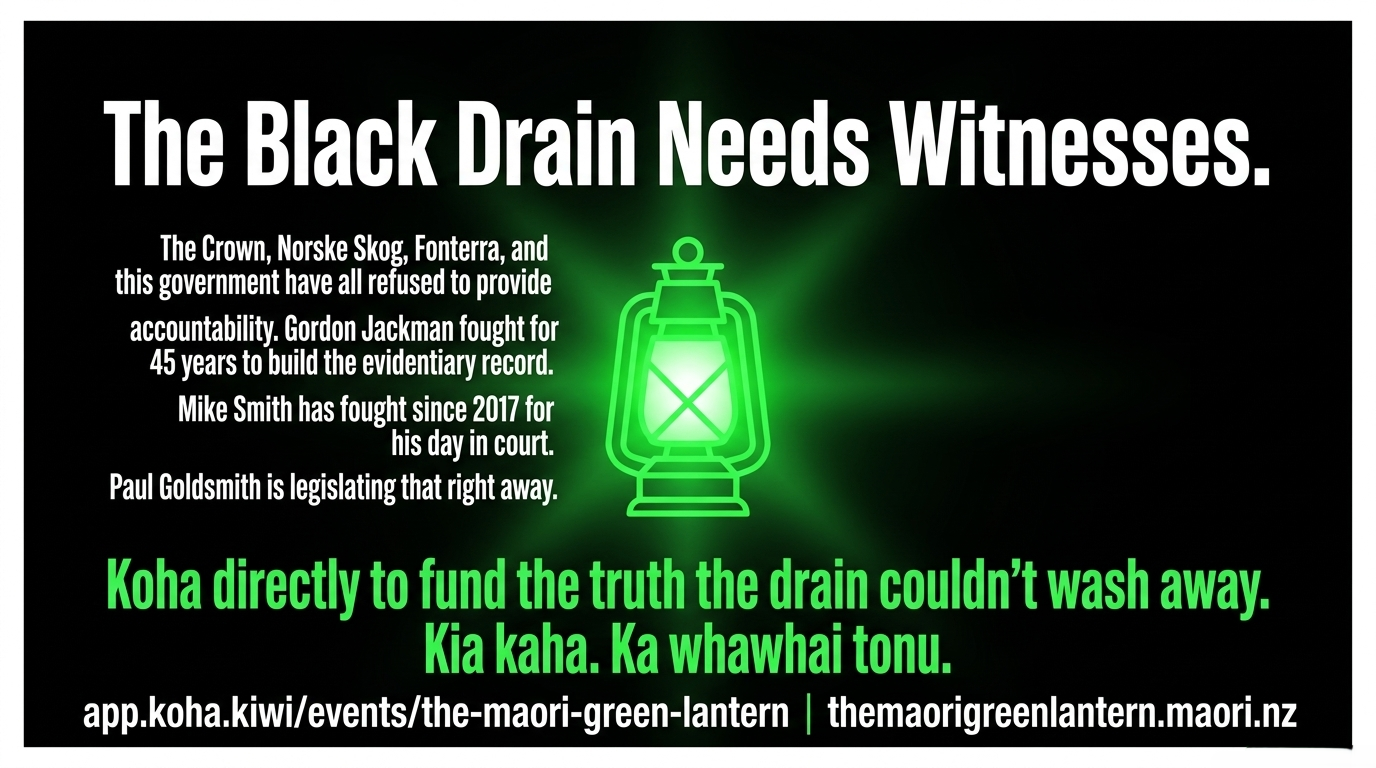
The Black Drain took seventy years to name in a liquidation claim. It took Gordon Jackman forty-five years of fighting to build the evidentiary record that made that naming possible. The whānau downstream of Rotoitipaku are still waiting for remediation promised in a formal Crown apology signed four years before the next consent was issued. Mike Smith has been fighting for the right to have his day in court since 2017 — and Paul Goldsmith is legislating that right away before the first witness is called.
Every koha to The Māori Green Lantern funds the accountability the Crown, Tasman Pulp and Paper, Norske Skog, Fonterra, and this government have all refused to provide. If you cannot koha — subscribe, follow, kōrero with your whānau, share this essay. That is koha. The Black Drain needs witnesses, not just readers. And the witnesses must be loud.
Kia kaha. Ka whawhai tonu. 💚
Koha directly: app.koha.kiwi/events/the-maori-green-lantern
Subscribe: themaorigreenlantern.maori.nz/#/portal/support
Direct bank transfer: HTDM, 03-1546-0415173-000
Facebook community: facebook.com/Themaorigreenlantern/subscribe

This is Essay Two of five in The Deadly Legacy Series. Read the full series at themaorigreenlantern.maori.nz. If you learn best through audio, The Deep Dive Podcast is on every essay page — two hosts unpacking every source, every hidden connection, every lie.
Views expressed constitute honest opinion on matters of public interest under the Defamation Act 1992 (NZ) and Durie v Gardiner NZCA 278. All factual claims sourced and cited. Named individuals referenced solely in their public capacity. Corrections: ivor.jones@htdm.maori.nz